


Spotted Towhee
Pipilo maculatus
By the Birdfact teamChecked by Nathan Cope
On this page13 sections
How to recognise it
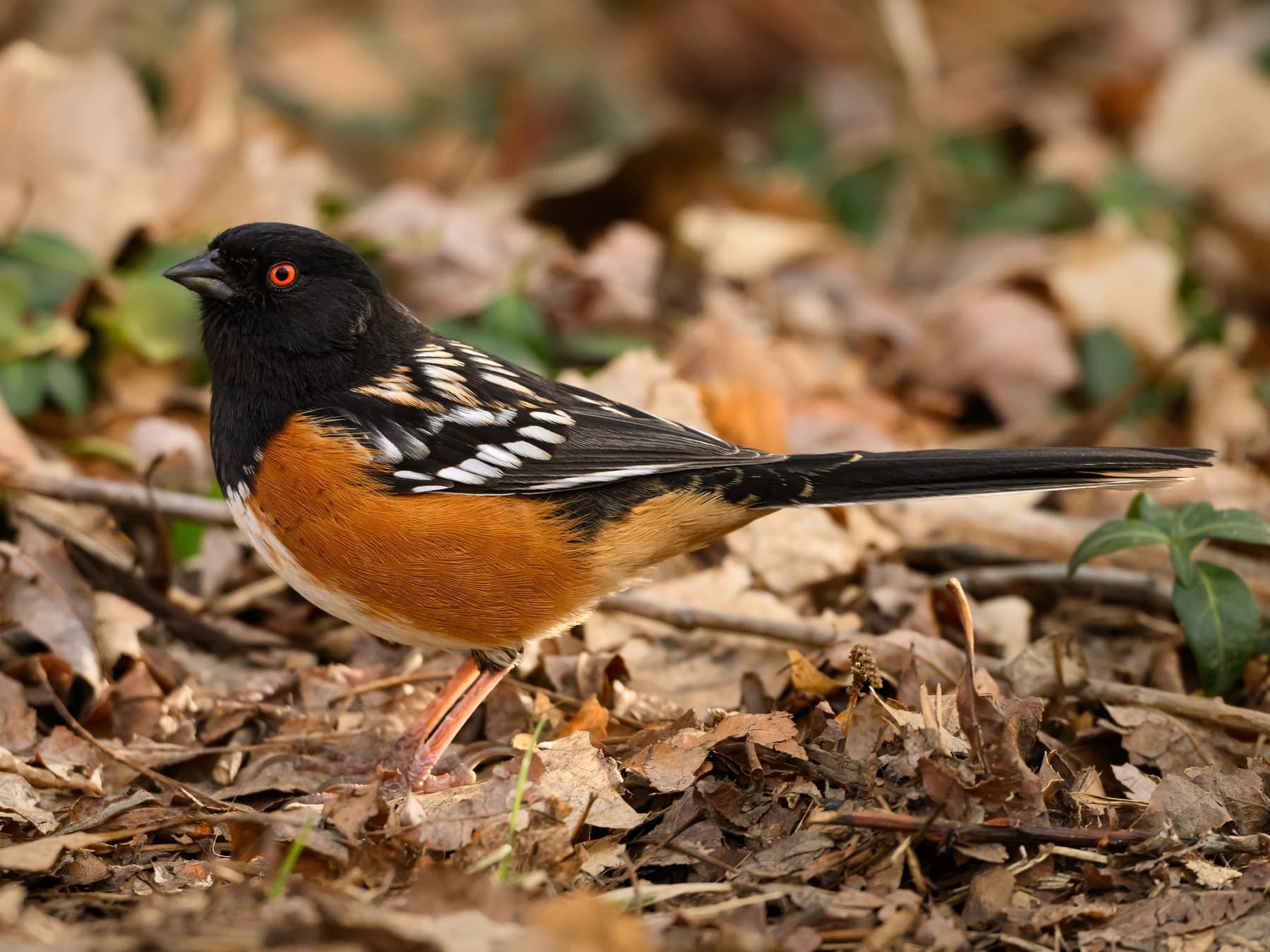
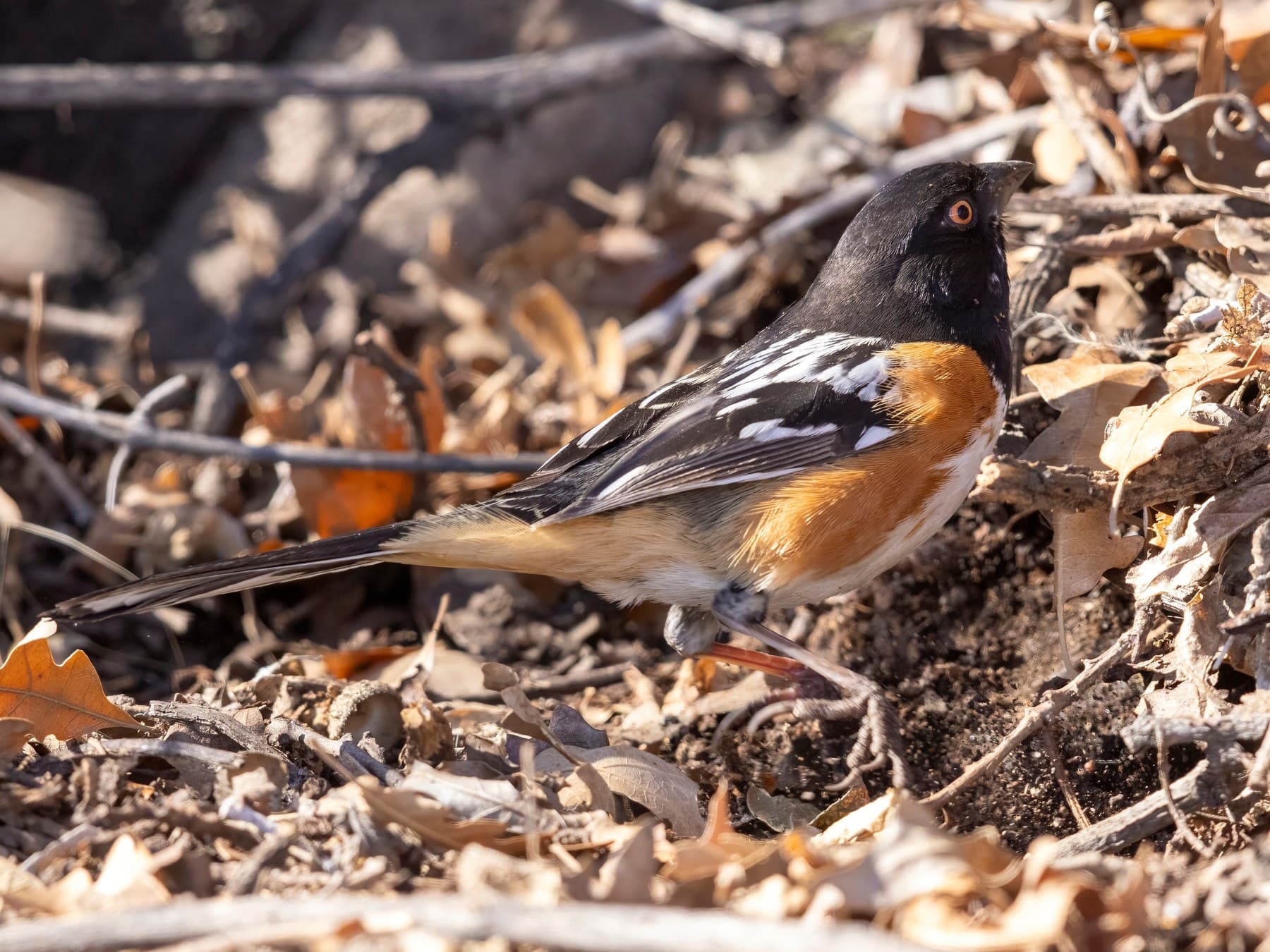
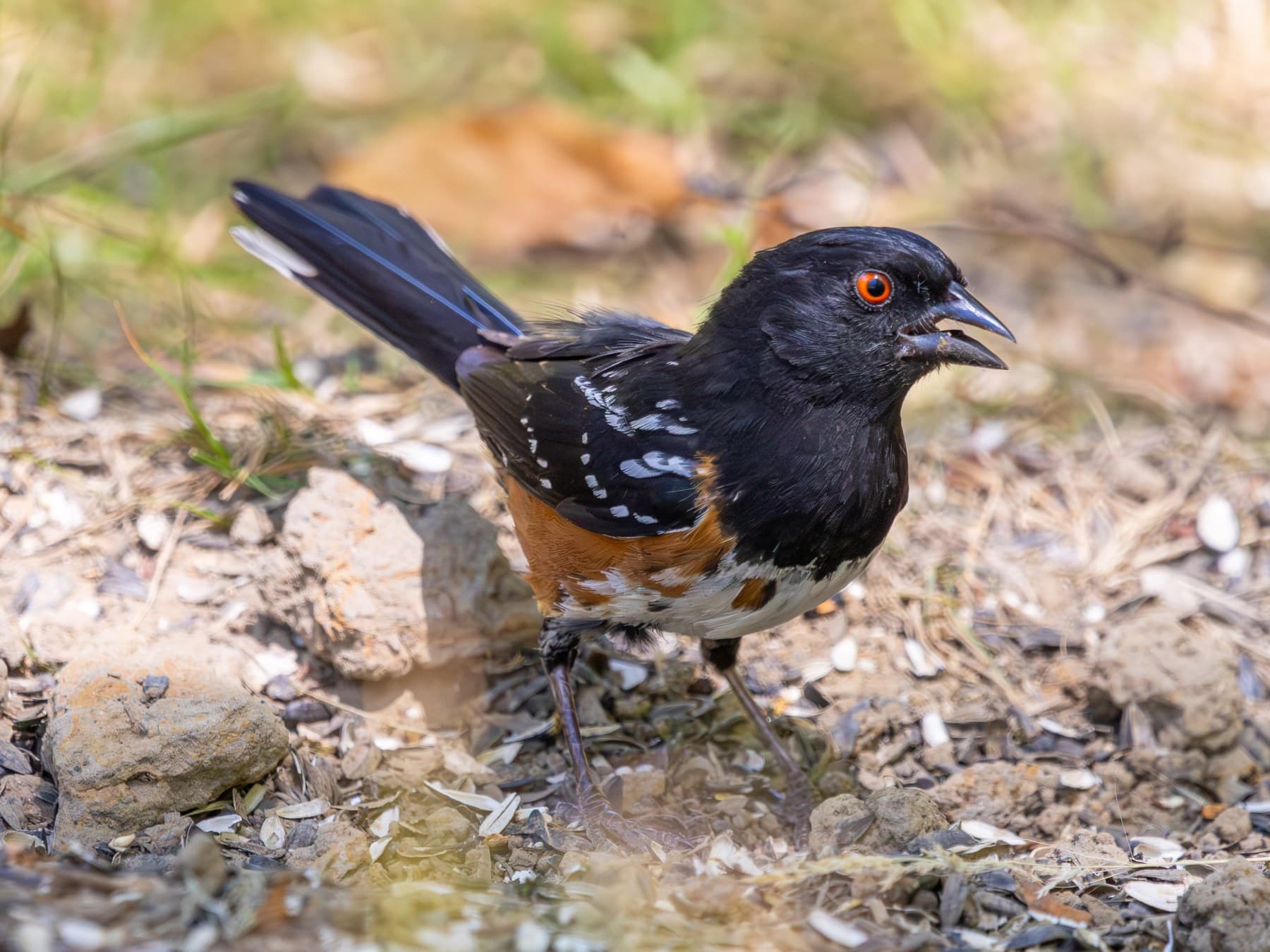
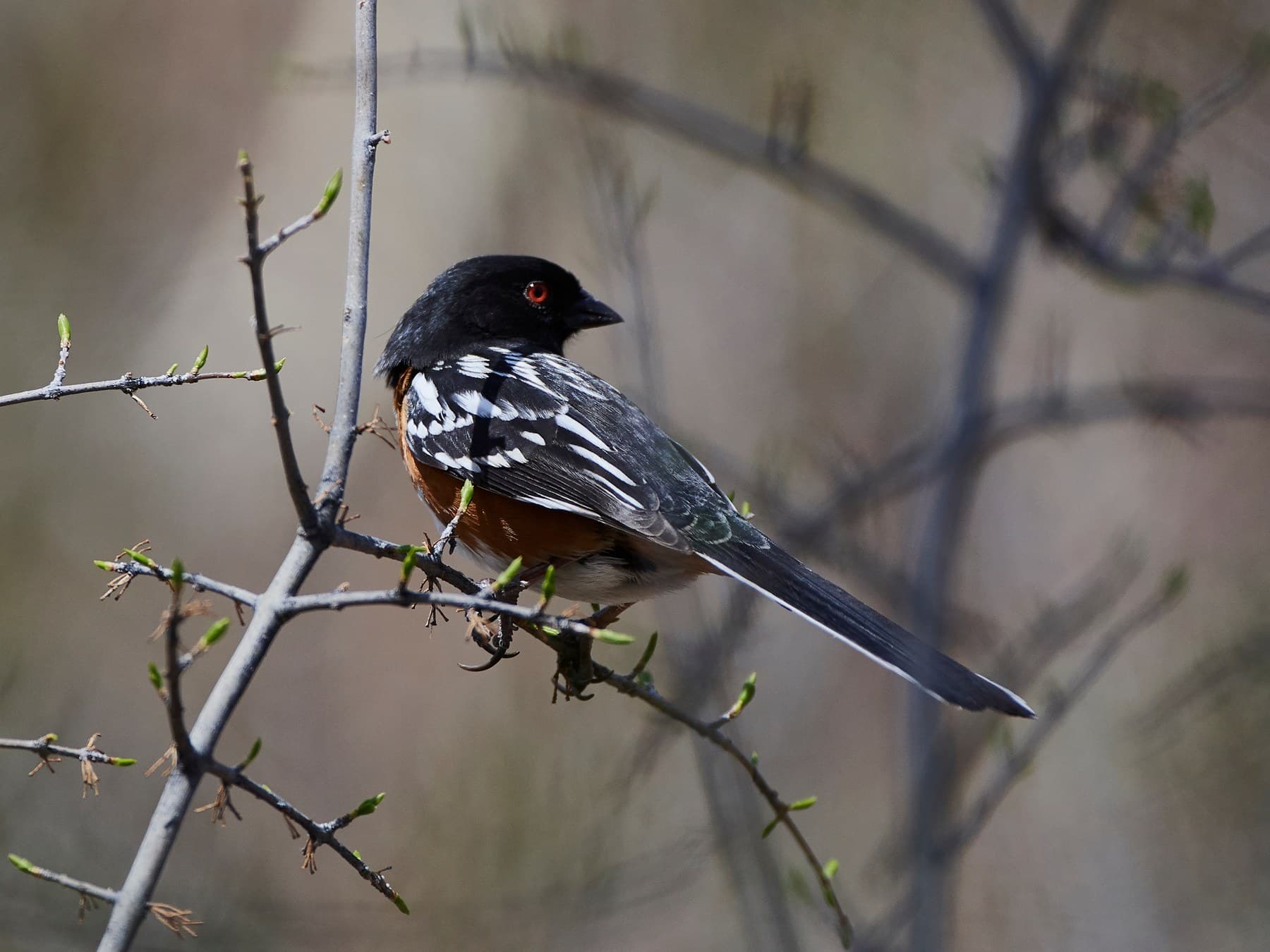
A male Spotted Towhee is a big, long-tailed sparrow in three colors: a black hood and back, rufous sides, and a white belly. His black back and wings carry rows of white spots and streaks, two of which line up as wing bars. The eye is red, the bill black and cone-shaped, and the long, rounded tail has white corners that flash when he flies.1, 2
Most of the time you will see one low down: hopping on the ground under shrubs, or kicking up dry leaves, which it does so noisily that you often hear it before you see it.3
Size and shape
Spotted Towhees are 6.7 to 8.3 inches (17-21 cm) long, with a wingspan of about 11 inches (28 cm), and weigh 1.2 to 1.7 ounces (33-49 g). That makes them a big sparrow: larger and about double the weight of a Song Sparrow, but well short of an American Robin. The shape is chunky, with a short neck, a thick, pointed bill and a long tail.2
In one study, males were heaviest in winter, at about 1.6 ounces (45 g), and lightest in June, at about 1.3 ounces (38 g).1
Males, females and young
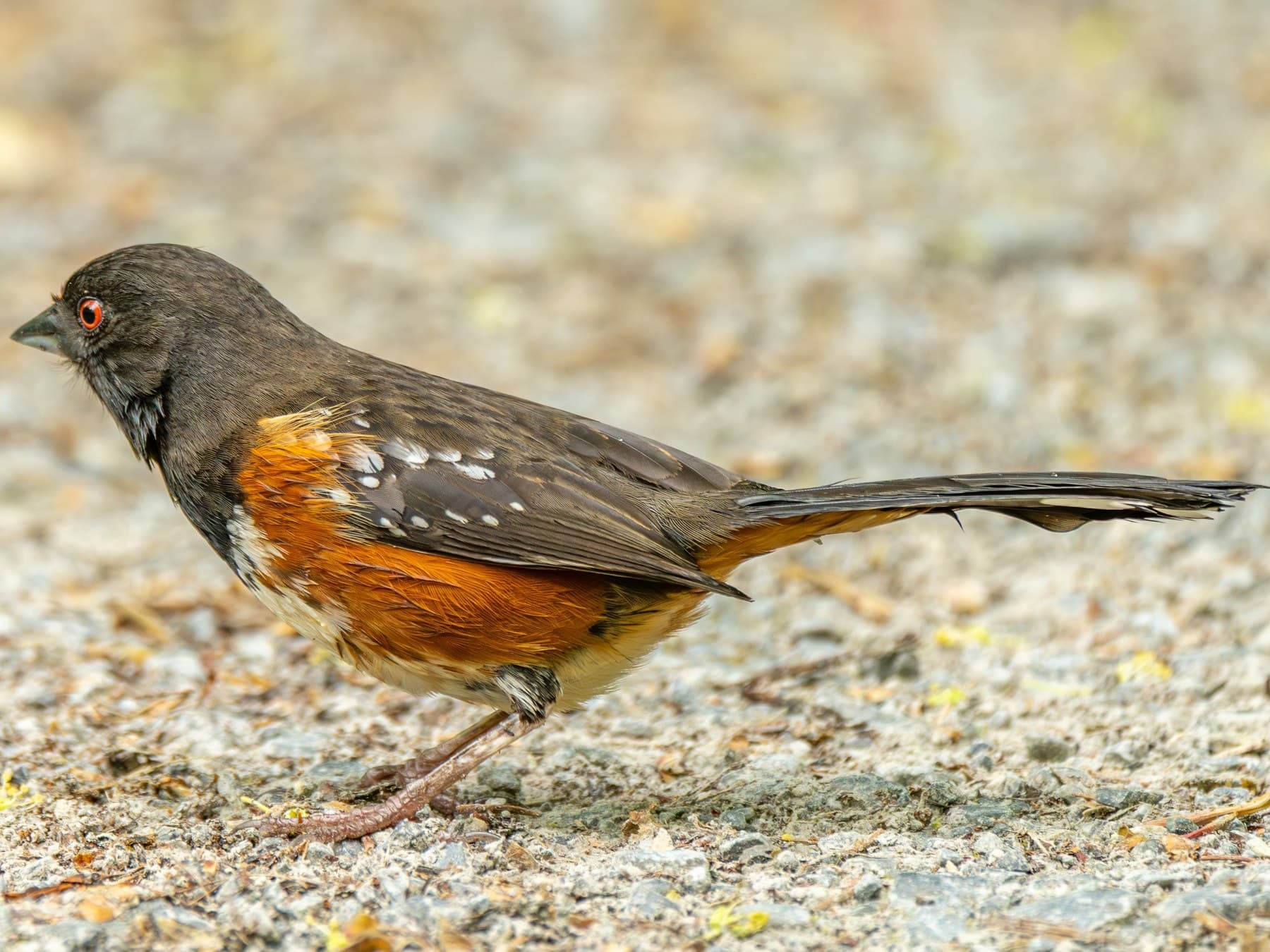
The female has the same pattern as the male, but where he is black she is grayish brown to olive-brown, with the same white spots, rufous sides and red eye. How different the sexes look depends on where you are: the contrast is strongest on the northern Great Plains, and weakest in coastal California, where females are dark and only a little paler than males.
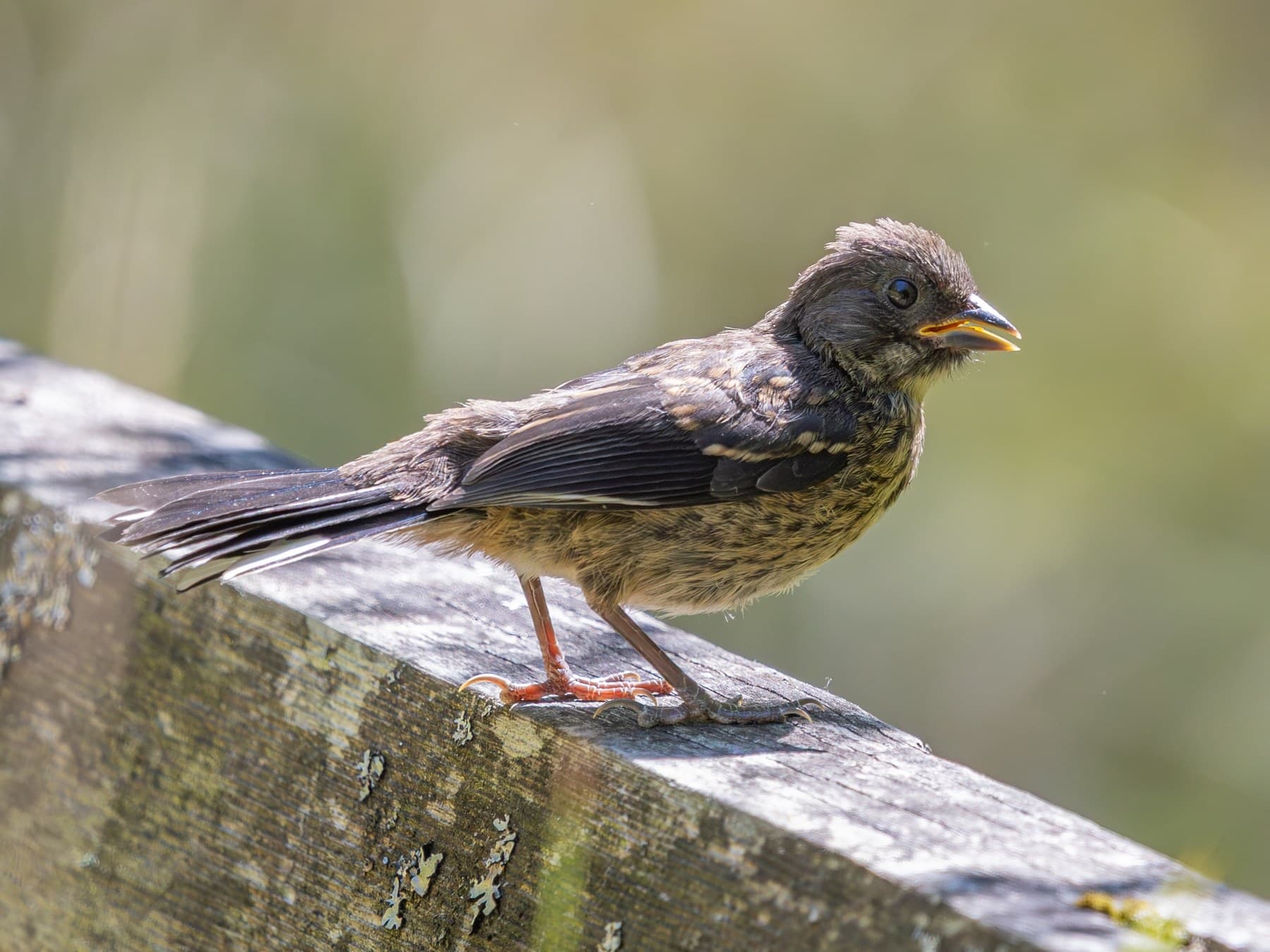
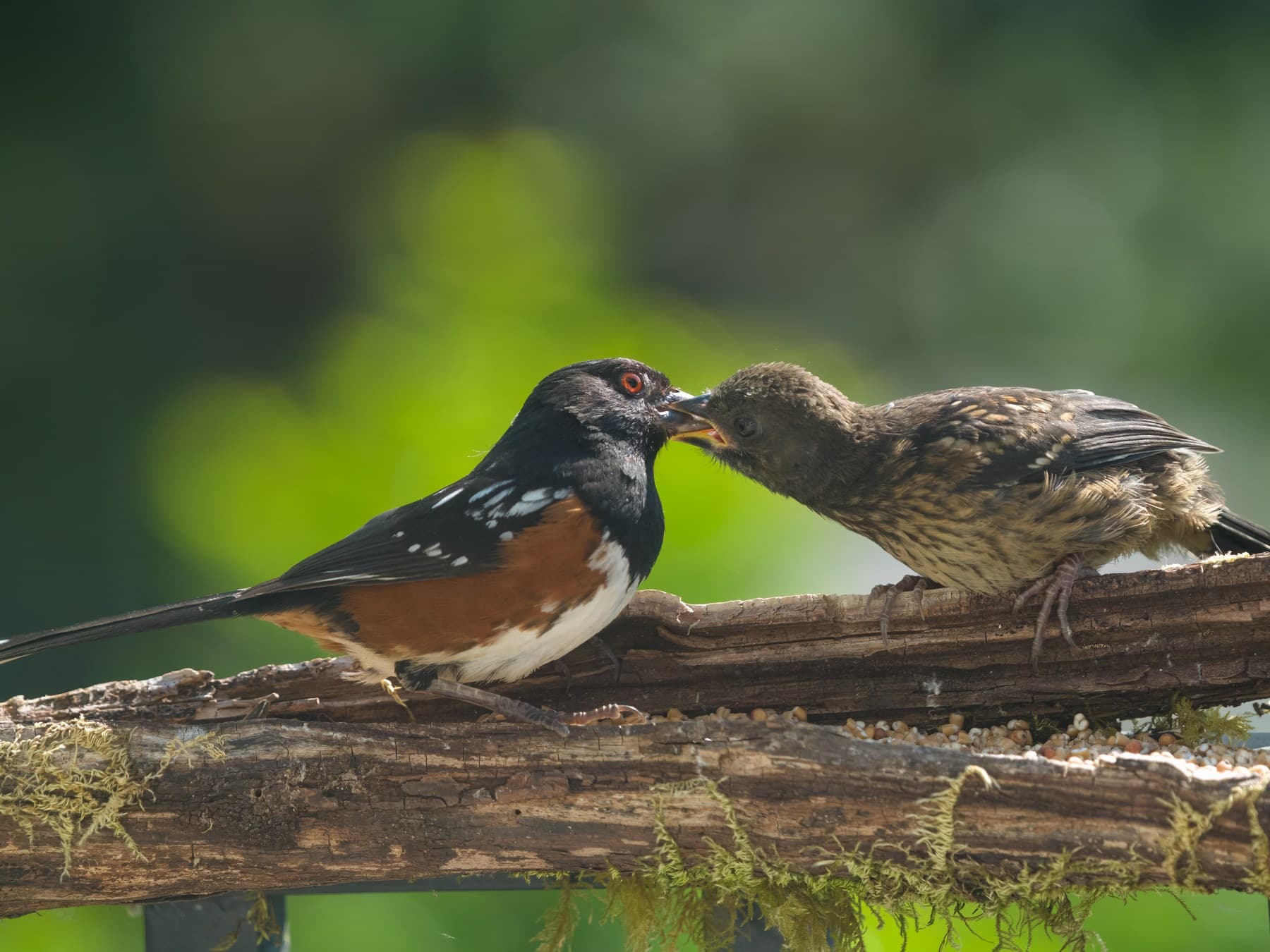
Juveniles are a different-looking bird for their first few weeks out of the nest: brown above and buff below, heavily streaked on the back and breast, with buffy-white spots on the wing coverts. A young towhee's long tail, its outer feathers tipped white, sets it apart from streaky sparrows.1 Young birds have brown eyes through their first fall and winter, and most have the red adult eye by the end of their first May.4
How spotted a towhee is depends on where it lives. Birds of the northern Great Plains are the boldest, and those of the coastal Pacific Northwest the darkest, with the least white. The white spot on the outer tail feather averages about 1.25 inches (32 mm) long on Great Plains males and about 0.8 inch (21 mm) on Pacific Northwest males. There are 21 subspecies from British Columbia to Guatemala.1
Identification: similar birds
Eastern Towhee. The closest lookalike, and until 1995 the same species: together they were the Rufous-sided Towhee.5 They meet along river valleys on the Great Plains, from Manitoba to Nebraska and northwest Kansas, and sometimes interbreed there,6 though pure birds of both kinds are common in the zone.5 An Eastern Towhee has the same black or brown hood, rufous sides and white belly, but no white spots on the back or wing coverts, only a small white mark on the closed wing. The spots separate the two at every age once the bird has left the nest.
Dark-eyed Junco. Much smaller, with a pale pink bill and white outer tail feathers. An Oregon male has a black hood and rusty sides like a towhee, but a plain brown back with no white spots.
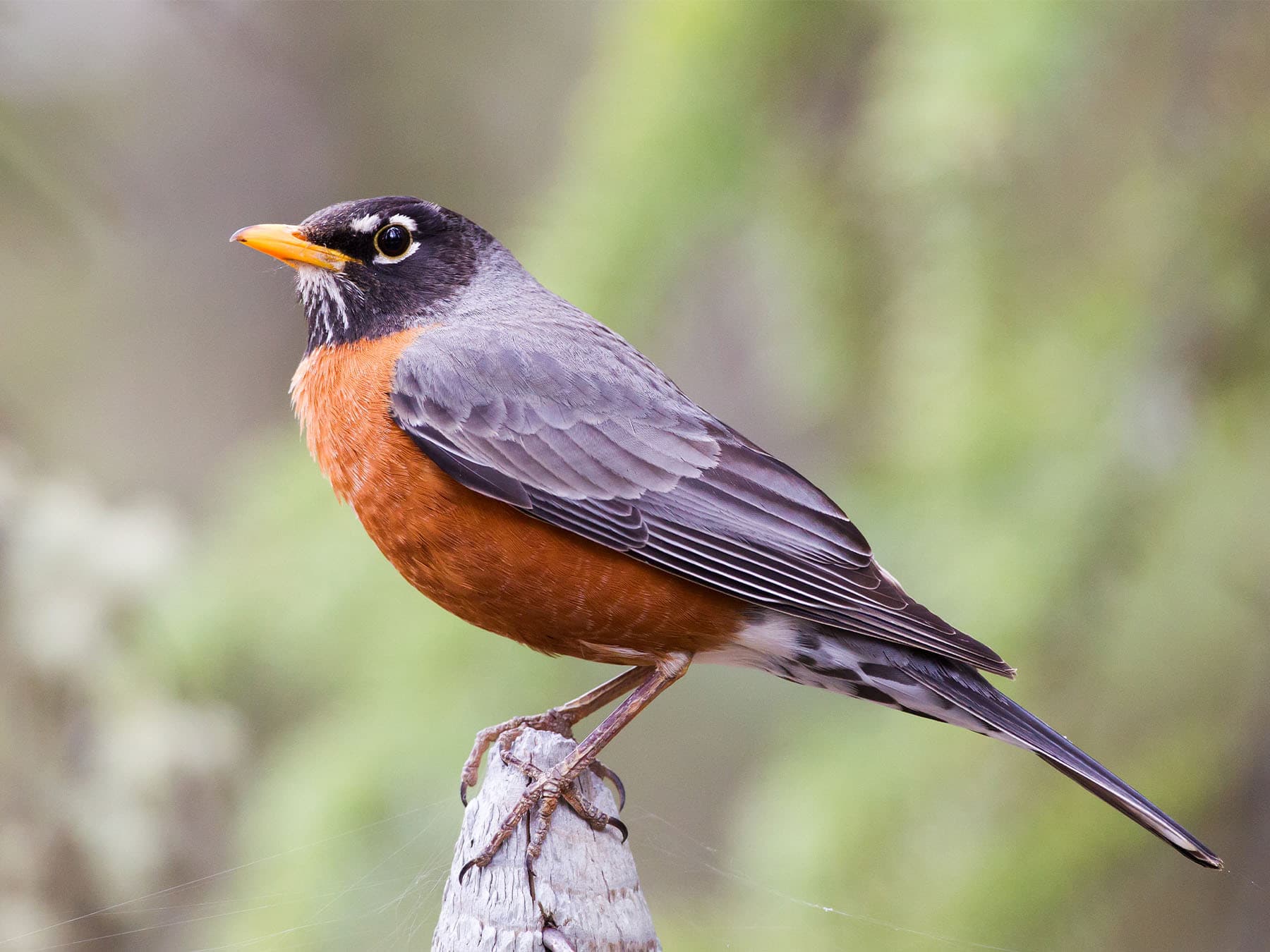
American Robin. Bigger, with a gray back, a red-orange breast right across the front and a yellow bill. A towhee's rufous is only on its sides, with a white belly between.
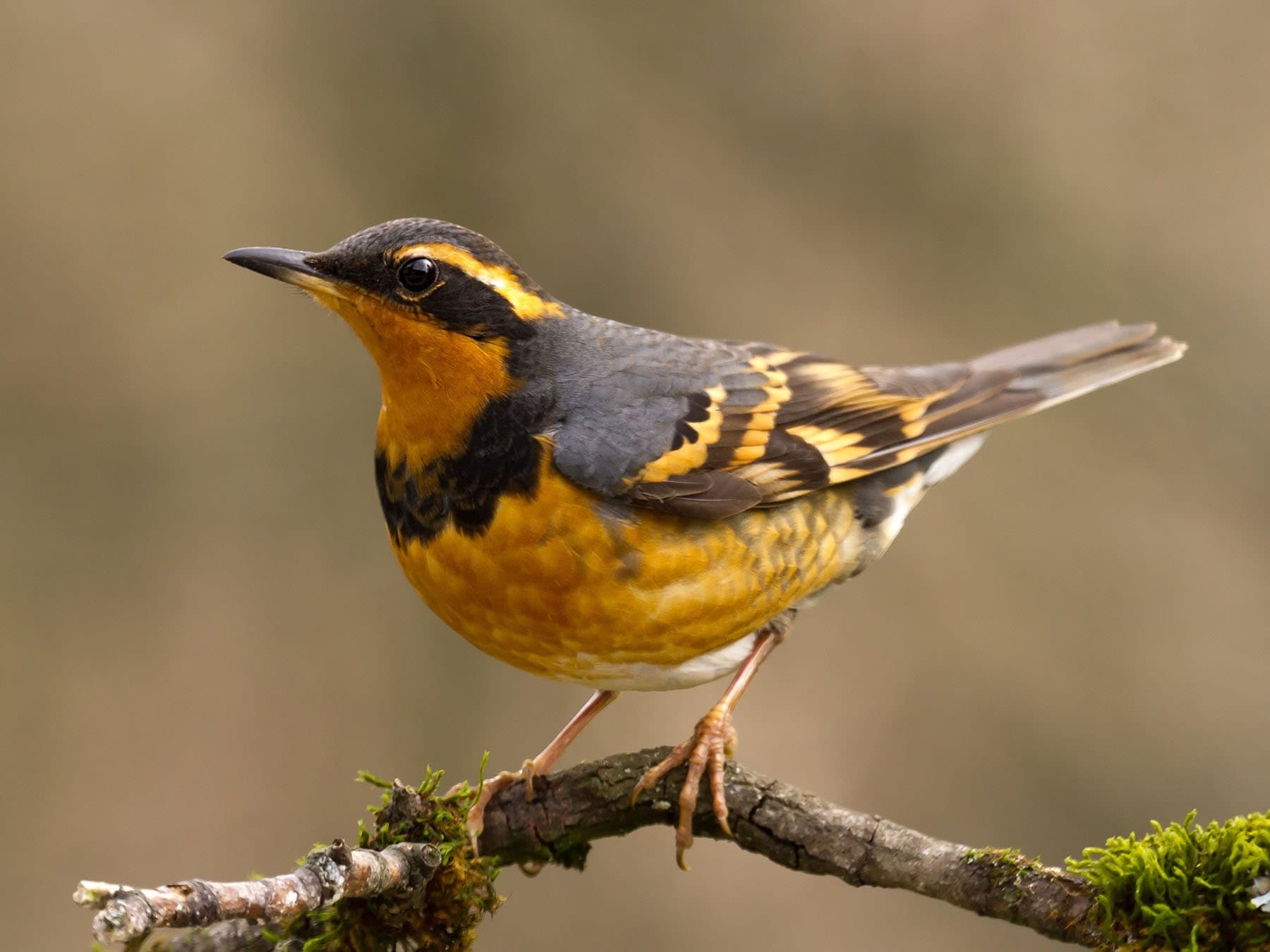
Varied Thrush. A male has a blue-gray back, an orange eyebrow, throat and wing bars, and a black band across orange underparts. A towhee has a dark throat, white spots and a white belly.
Black-headed Grosbeak. A male has a black head, but a cinnamon breast and collar, a huge two-toned bill and big white wing patches, and it feeds mostly up in trees.
Not sure it’s a Spotted Towhee? Check your photo: Birdfact names the bird and shows the look-alike side by side.
Its size
Adults- Length
- 17–21 cm
- Wingspan
- 28 cm
- Weight
- 33–49 g
Its song and calls
The song is short and buzzy: often a few quick introductory notes, then a trill. It changes across the range. Birds of the Pacific coast usually sing the trill alone, while birds of the mountains and plains, from Canada to Mexico, put the notes in front.7 Each song lasts about a second or less (0.83 s on average in Oregon), and a singing male repeats it about every 6 seconds.8, 9
Each male has a small set of songs, mostly differing in the trill, from slow to fast and buzzy.1 In Oregon, neighbors share many songs and the songs change over short distances, like dialects.8
The call to listen for is a whining, cat-like mew, nasal and slurred, given by both sexes when scolding or alarmed and sometimes by birds feeding calmly. Towhees also give a soft, high lisp between mates and a sharp chip, once reported in alarm.1 Compared with the Eastern Towhee's, its songs and calls are more variable and harsher.3
Song season
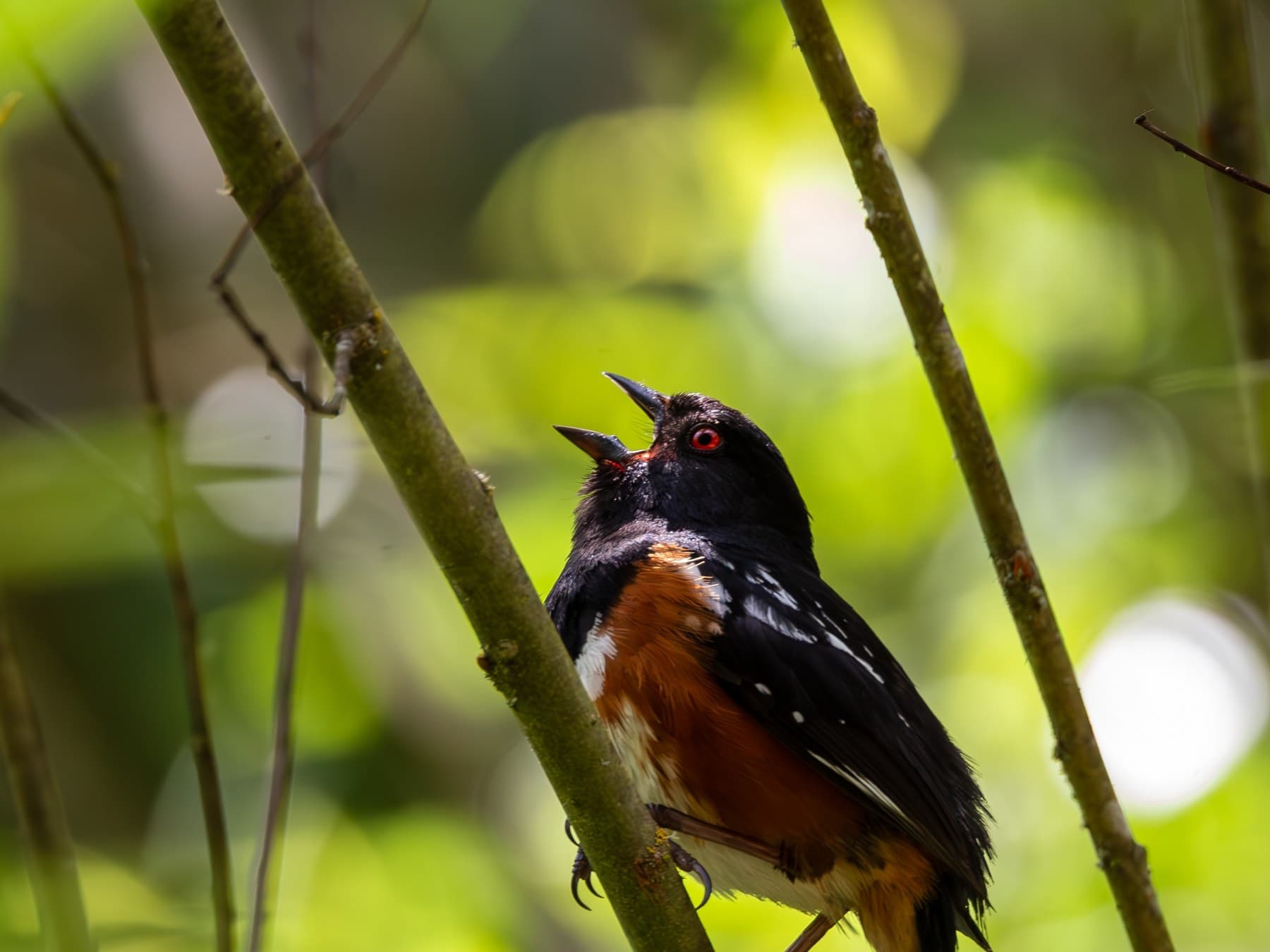
In one coastal California population, males started singing between mid-January and mid-February, depending on the year, and stopped in early August, as they molted and came out of breeding condition. Singing is strongest in the early morning, starting up to 25 minutes before dawn light from mid-April to June, and the species is not known to sing at night. Males sing from the tops of shrubs or trees, up to 50 feet (15 m) up, and sometimes from the ground.
A male without a mate sings for long stretches: in an 8-hour watch one sang 84.3% of the time, 3,390 songs. After pairing, singing drops sharply: one male went from 91% of a two-hour morning watch to 11% a few days after a female arrived.9
- Song0:00 / 0:07
Recorded in Colorado, United States · May 2022
- Song (trill only)0:00 / 0:19
Recorded in Ed R, United States · July 2023
- Mew calls0:00 / 0:13
Recorded in Washington, United States · March 2026
Heard one and not sure? Let the bird song identifier listen.
When and where to see it
Spotted Towhees breed from southern British Columbia, Alberta and Saskatchewan south through the western US to the mountains of Mexico and southwest Guatemala, east to the western Dakotas, western Nebraska (locally), northwestern Kansas and Oklahoma.
Look for dense, low, broadleaf shrubs with deep leaf litter underneath: chaparral, scrub oak, manzanita, pinyon-juniper, streamside thickets, forest edges, overgrown fields and shrubby yards. In the interior they live at middle elevations, above desert and below the high conifer forest; in Idaho mostly between 2,500 and 6,000 feet (760-1,830 m). After logging or fire, the regrowing shrubs attract towhees for a while.
They are most abundant locally in west-central Arizona, central New Mexico and coastal southern California, and high numbers are most continuous on the Pacific side, from southern California up to British Columbia; interior populations are patchier.1
Spotting tips
Walk slowly along brushy edges and listen: the mew call, the buzzy song or the sound of a bird kicking through dry leaves will usually give one away. In spring, males climb to the top of a shrub to sing, which is the best chance of a clear view.2
Migration and winter range
Some towhees migrate and some do not. Most Pacific coast and Mexican birds stay all year. Birds of the northern Rockies and Great Plains migrate wholly or partly, and mountain birds leave high slopes in winter, often for nearby valleys. In winter the species spreads east onto the southern Great Plains, to eastern Kansas, Oklahoma, central Texas and western Missouri, and south into northern Mexico.1
Spring migration across the northern interior peaks from the last week of April to mid-May. Northern birds leave mostly in September, and arrive in Oklahoma, Texas and Arizona from mid to late September. Great Plains birds head south and southeast to New Mexico, Texas and northeast Mexico.
Strays reach the East, from Quebec to Florida, mostly in winter.
What it eats
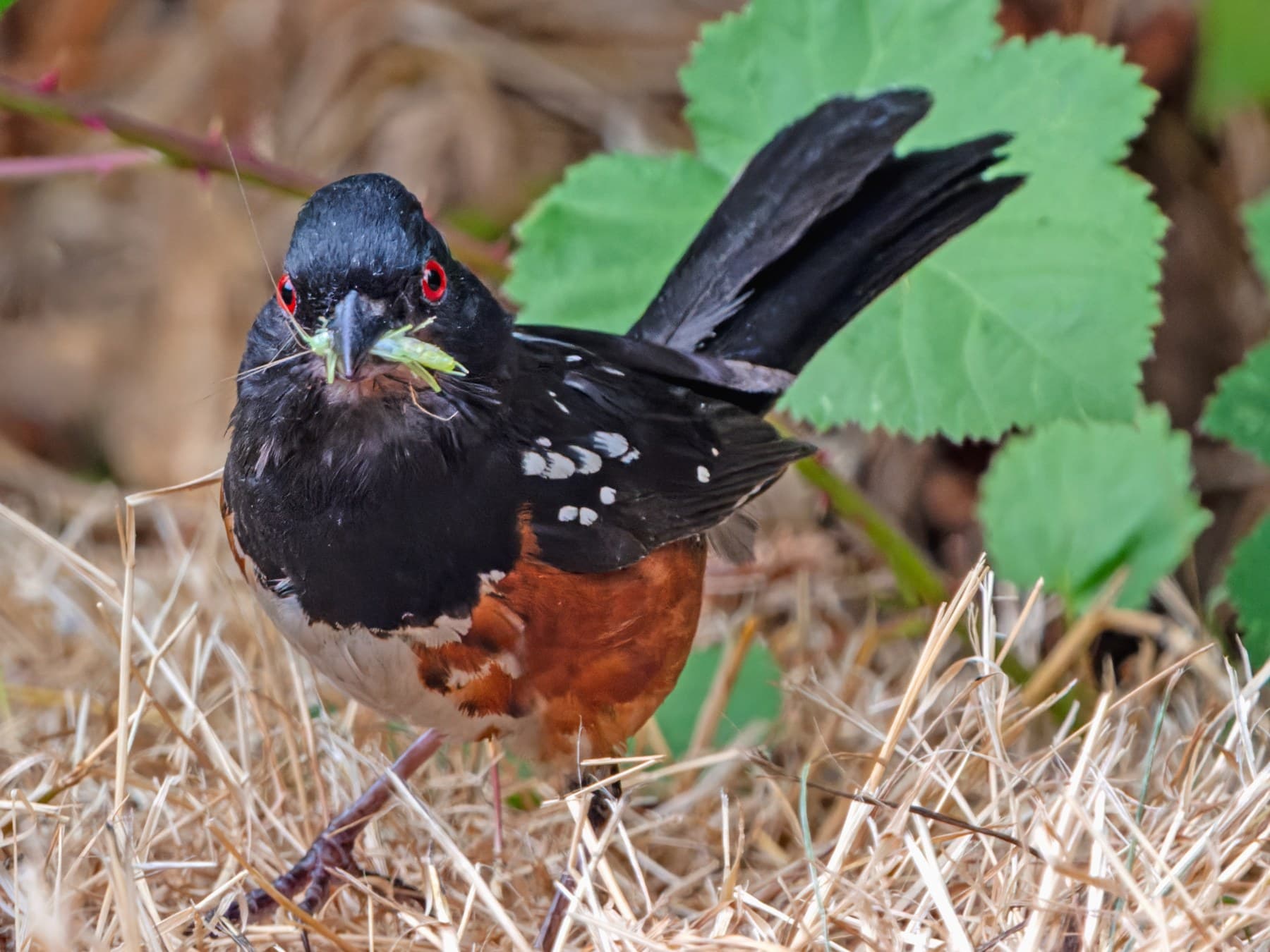
In the breeding season their commonest food is insects and other small animals from the leaf litter: beetles, crickets and grasshoppers, caterpillars and moths, bugs, ants, spiders, millipedes and sowbugs. In fall and winter they switch to seeds, acorns and berries.1
In a 1910 study of 139 California stomachs, taken in every month, plants made up 76% of the year's food and animals 24%.10 A later national summary found roughly half animal food in spring and over 90% plant food in fall and winter.11
Berries and fruit include blackberries, raspberries, elderberries, coffeeberries, toyon, manzanita, poison oak and hackberries.1 They eat acorns too, mostly ones already opened by chipmunks or scrub-jays.12
How it finds food: the double-scratch
The towhee's signature move is the double-scratch: a quick hop forward, then a backward hop that rakes the leaf litter with both feet at once and uncovers whatever is underneath.13 Repeated scratching leaves an oval pit in the litter about 11 to 22 square inches (70-145 square cm).12
It finds most of its food on the ground beneath shrubs and seldom in the open; in spring it also climbs into shrubs and trees for insects and fruit. One bird with an injured, useless foot still hopped and scratched on one leg.1
Feeders and yards
Spotted Towhees come into yards with brushy borders and take seed from the ground or a low platform near cover: sunflower seed, millet, cracked corn and peanut pieces.14 Scatter seed on the ground close to shrubs, where towhees prefer to feed, rather than filling a hanging feeder; a yard with dense shrubs and leaf litter beneath them is the kind of cover they live in.
Yards can be risky for young towhees, though. In a Portland park study, 16 of 52 radio-tagged fledglings died within 27 days, 11 of them to cats and screech-owls; where yards have many cats, few young towhees may survive.15
Nesting and breeding
The nest is usually on the ground, sunk into the leaf litter at the base of a shrub, grass clump or log, or low in a shrub, at the edge of a thicket rather than deep inside it. Over 90% of nests were on the ground in two small California studies (25 and 11 nests), and 69% of 344 in Oregon; the rest were low in shrubs or ferns, about 2 to 12 feet (0.6-3.6 m) up, the highest 16 feet (5 m).1, 16, 17
The female builds it in two days or more: an outer frame of dead leaves, bark strips, stems and coarse grass around a cup of fine grass, rootlets, pine needles and sometimes hair. The cup is about 3 inches (8 cm) across inside and 1.5 to 2.5 inches (4-6 cm) deep.16, 18
First eggs are laid from mid to late April on the Pacific coast (as early as March in San Diego County) and from early to mid May in the interior, and young can still be leaving nests in early August.
Pairs are socially monogamous and stay together for second broods, and half the Oregon females that could pair with the same male the next year did.1 Not every chick is the male partner's, though: DNA tests in Portland, Oregon, found chicks fathered by another male in 44% of 228 broods, 26% of 575 young.19
Eggs and incubation
A clutch is 3 to 5 eggs, sometimes 2 or 6; the average was 3.4 to 3.6 in California and Oregon. The eggs are white, cream, greenish or pinkish, finely speckled with reddish brown, purple and gray, most of it at the wide end.1
The female alone incubates, for 12 to 14 days, sitting about 80% of the time at four California nests, in spells of about 40 minutes.18 Pairs raise one to three broods a season; in an Oregon study of 106 females, 34% raised two broods and 7% three.1
Young and fledglings
Both parents feed the young. At two California nests the male brought much of the food while the female brooded,18 but in Oregon females made more trips (about 5 an hour against nearly 4).20 The young leave at 9 to 11 days old, before they can fly, and are fed for about another month.16
Fledglings keep to dense thickets near the ground; one was seen making short flights six days after leaving the nest.
Nest predators and cowbirds
Most nest losses are to predators. Nest success in Oregon was estimated at 41% (329 nests),21 and in California's Sacramento Valley predators caused 85% of the failures among 265 nests, 59% of which failed.17 Nest predators include scrub-jays, king snakes and racers, raccoons, rats and Red-shouldered Hawks, and probably ground squirrels.
Brown-headed Cowbirds lay in towhee nests: 38% of 265 nests in the Sacramento Valley, though only 16 failed because of it, and none of 329 in Oregon.1, 17 Parents scold and mob predators, and one male rushed a king snake with wings spread and tail fanned for 8 minutes until it left.18
Behaviour
Towhees hop rather than walk, on the ground and through branches. They usually make short, slow flights from one patch of cover to the next, and a disturbed bird may flutter along with its body bobbing and its tail opening and closing. An alarmed bird flicks its wings and flashes the white tail corners.1
In California, where towhees stay all year, males defend territories by singing and chasing other males from about February to July; in winter they are quiet and tolerant.12 Early-spring fights can be fierce, with males grappling face to face in the air.16 In tense encounters a male may pick up a dead leaf, twig or strip of bark and carry it about, which seems to be a sign of submission.2
Outside the breeding season they are not very sociable, but often feed near sparrows, juncos and California Towhees. They bathe in standing water and have been seen bathing in wet foliage.1
Lifespan and predators
The oldest Spotted Towhee on the US Bird Banding Laboratory's list was at least 11 years old: a male banded in California in 2001, when he was at least two, and caught and released there in 2010.22
Most live far shorter lives. About 55% of adults survive each year in central California, and birds that survived their first year there lived about two years on average.23 Adults are taken by Cooper's and Sharp-shinned Hawks; in one study of their diets, towhees made up about 4% of Sharp-shinned Hawk prey and 6% of Cooper's Hawk prey.24
Conservation
The Spotted Towhee is listed as Least Concern on the IUCN Red List.25 Partners in Flight estimates about 40 million birds, 35 million of them in the US and Canada, and rates it of low concern (9 out of 20).26
Numbers have been stable since 1966: the North American Breeding Bird Survey trend is +0.06% a year, not significantly different from zero. Among states and provinces, only Oregon shows a clear long-term decline (about 1% a year), and Nevada a clear rise.27
Dense development removes the shrubs it needs and raises cat predation on ground nests and fledglings, and heavy cattle grazing along streams can harm local birds. Island forms are vulnerable: the Guadalupe Island population off Baja California died out by about 1900 after goats destroyed the shrubs, and the San Clemente Island birds were probably lost the same way.1
Similar birds
Often mistaken for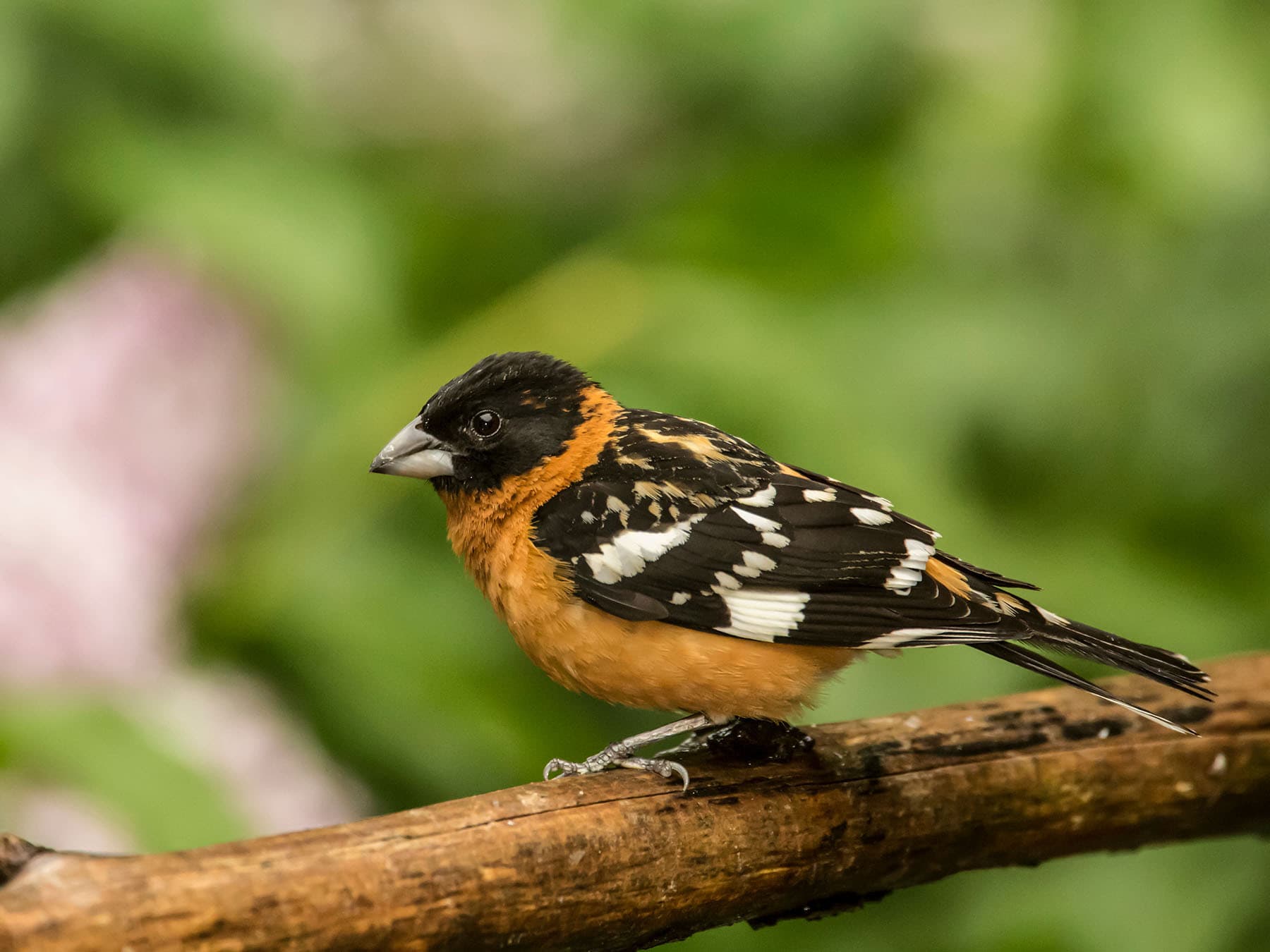

Quick facts
- Length
- 17–21 cm
- Wingspan
- 28 cm
- Weight
- 33–49 g
- Lifespan
- oldest recorded at least 11 years
- Family
- New World Sparrows
- Migration
- Partial migrant
- Global status (IUCN)
- Least Concern
- World population
- About 40 million (Partners in Flight, 2023)
- Population trend
- Common, widespread and stable
- Scientific name
- Pipilo maculatus
Questions
3Are Spotted Towhees sparrows?
Yes. Towhees are big members of the New World sparrow family, Passerellidae, and the Spotted Towhee's closest relative is the Eastern Towhee. See how to identify one.
Is the Spotted Towhee the same as the Rufous-sided Towhee?
It used to be. Until 1995 the Spotted and Eastern Towhees were treated as one species, the Rufous-sided Towhee. See similar birds.
Are Spotted Towhees rare?
No. They are common across the West, with about 40 million birds in all, though they keep out of sight in thick cover. In the East they are rare strays. See where and when.
Sources
36- 1Bartos Smith, S. and Greenlaw, J. S. (2026). Spotted Towhee (Pipilo maculatus), version 1.1. Birds of the World (P. G. Rodewald, editor). Cornell Lab of Ornithology. doi:10.2173/bow.spotow.01.1 (opens in a new tab)
- 2Cornell Lab of Ornithology. Spotted Towhee. All About Birds. Accessed 3 November 2026. Source (opens in a new tab)
- 3National Audubon Society. Spotted Towhee. Guide to North American Birds. Accessed 3 November 2026. Source (opens in a new tab)
- 4Davis, J. (1957). Determination of age in the Spotted Towhee. Condor 59: 195-202. doi:10.2307/1364724 (opens in a new tab)
- 5American Ornithologists' Union (1995). Fortieth supplement to the American Ornithologists' Union Check-list of North American Birds. Auk 112: 819-830. Accessed 3 November 2026.
- 6Sibley, C. G. and West, D. A. (1959). Hybridization in the Rufous-sided Towhees of the Great Plains. Auk 76: 326-338. doi:10.2307/4081810 (opens in a new tab)
- 7Borror, D. J. (1975). Songs of the Rufous-sided Towhee. Condor 77: 183-195. Accessed 3 November 2026.
- 8Kroodsma, D. E. (1971). Song variations and singing behavior in the Rufous-sided Towhee, Pipilo erythrophthalmus oregonus. Condor 73: 303-308. doi:10.2307/1365756 (opens in a new tab)
- 9Davis, J. (1958). Singing behavior and the gonad cycle of the Rufous-sided Towhee. Condor 60: 308-336. doi:10.2307/1365157 (opens in a new tab)
- 10Beal, F. E. L. (1910). Birds of California in relation to the fruit industry, part 2. U.S. Department of Agriculture, Biological Survey Bulletin 34. Accessed 3 November 2026.
- 11Martin, A. C., Zim, H. S. and Nelson, A. L. (1951). American Wildlife and Plants: A Guide to Wildlife Food Habits. Dover Publications, New York. Accessed 3 November 2026.
- 12Davis, J. (1957). Comparative foraging behavior of the Spotted and Brown towhees. Auk 74: 129-166. doi:10.2307/4081708 (opens in a new tab)
- 13Greenlaw, J. S. (1977). Taxonomic distribution, origin, and evolution of bilateral scratching in ground-feeding birds. Condor 79: 426-439. doi:10.2307/1367722 (opens in a new tab)
- 14Project FeederWatch. Common Feeder Birds: Spotted Towhee. Cornell Lab of Ornithology and Birds Canada. Accessed 3 November 2026. Source (opens in a new tab)
- 15Shipley, A. A., Murphy, M. T. and Elzinga, A. H. (2013). Residential edges as ecological traps: postfledging survival of a ground-nesting passerine in a forested urban park. Auk 130: 501-511. doi:10.1525/auk.2013.12139 (opens in a new tab)
- 16Baumann, S. A. (1959). The breeding cycle of the Rufous-sided Towhee, Pipilo erythrophthalmus (Linnaeus), in central California. Wasmann Journal of Biology 17: 161-220. Accessed 3 November 2026.
- 17Small, S. L. (2005). Mortality factors and predators of Spotted Towhee nests in the Sacramento Valley, California. Journal of Field Ornithology 76: 252-258. doi:10.1648/0273-8570-76.3.252 (opens in a new tab)
- 18Davis, J. (1960). Nesting behavior of the Rufous-sided Towhee in coastal California. Condor 62: 434-456. doi:10.2307/1365591 (opens in a new tab)
- 19Bartos Smith, S. (2008). The reproductive and conservation biology of the Spotted Towhee in urban forest fragments. PhD dissertation, Portland State University. Accessed 3 November 2026.
- 20McKay, J. E., Murphy, M. T., Smith, S. B. and Richardson, J. K. (2009). Fecal-sac ingestion by Spotted Towhees. Condor 111: 503-510. doi:10.1525/cond.2009.080065 (opens in a new tab)
- 21Bartos Smith, S., McKay, J. E., Richardson, J. K. and Murphy, M. T. (2012). Edges, trails, and reproductive performance of Spotted Towhees in urban greenspaces. Urban Bird Ecology and Conservation (Lepczyk and Warren, editors), University of California Press. Accessed 3 November 2026.
- 22USGS Bird Banding Laboratory. Longevity records of North American birds. USGS Eastern Ecological Science Center, Bird Banding Laboratory. Accessed 3 November 2026. Source (opens in a new tab)
- 23Linsdale, J. M. (1949). Survival in birds banded at the Hastings Reservation. Condor 51: 88-96. doi:10.2307/1365077 (opens in a new tab)
- 24Storer, R. W. (1966). Sexual dimorphism and food habits in three North American accipiters. Auk 83: 423-436. doi:10.2307/4083053 (opens in a new tab)
- 25BirdLife International (2021). Spotted Towhee Pipilo maculatus: species factsheet. BirdLife DataZone (IUCN Red List assessment 2021). Accessed 3 November 2026. Source (opens in a new tab)
- 26Partners in Flight (2023). Avian Conservation Assessment Database and Population Estimates Database. Bird Conservancy of the Rockies. Accessed 3 November 2026. Source (opens in a new tab)
- 27Hostetler, J. A. et al. (2026). The North American Breeding Bird Survey, Analysis Results 1966-2025. U.S. Geological Survey data release. doi:10.5066/P1OSNSFC (opens in a new tab)
- 28Cornell Lab of Ornithology. Eastern Towhee. All About Birds. Accessed 3 November 2026. Source (opens in a new tab)
- 29Cornell Lab of Ornithology. Dark-eyed Junco. All About Birds. Accessed 3 November 2026. Source (opens in a new tab)
- 30Cornell Lab of Ornithology. American Robin. All About Birds. Accessed 3 November 2026. Source (opens in a new tab)
- 31Cornell Lab of Ornithology. Varied Thrush. All About Birds. Accessed 3 November 2026. Source (opens in a new tab)
- 32Cornell Lab of Ornithology. Black-headed Grosbeak. All About Birds. Accessed 3 November 2026. Source (opens in a new tab)
- 33DaCosta, J. M., Spellman, G. M., Escalante, P. and Klicka, J. (2009). A molecular systematic revision of two historically problematic songbird clades: Aimophila and Pipilo. Journal of Avian Biology 40: 206-216. doi:10.1111/j.1600-048X.2009.04514.x (opens in a new tab)
- 34Roberts, J. B. (1969). Vocalizations of the Rufous-sided Towhee, Pipilo erythrophthalmus oregonus. Condor 71: 257-266. doi:10.2307/1366302 (opens in a new tab)
- 35Gardali, T. and Nur, N. (2006). Site-specific survival of Black-headed Grosbeaks and Spotted Towhees at four sites within the Sacramento Valley, California. Wilson Journal of Ornithology 118: 178-186. doi:10.1676/05-037.1 (opens in a new tab)
- 36AviList Core Team (2025). AviList: The Global Avian Checklist, v2025b. doi:10.2173/avilist.v2025b (opens in a new tab)

Checked by
Nathan Cope, founder and editor
Nathan founded Birdfact and leads its writers and contributors in the UK, the US and Canada. He has watched and studied birds for more than ten years, and checks every article and species guide before it’s published.