


Black-headed Grosbeak
Pheucticus melanocephalus
By the Birdfact teamChecked by Nathan Cope
On this page14 sections
How to recognise it
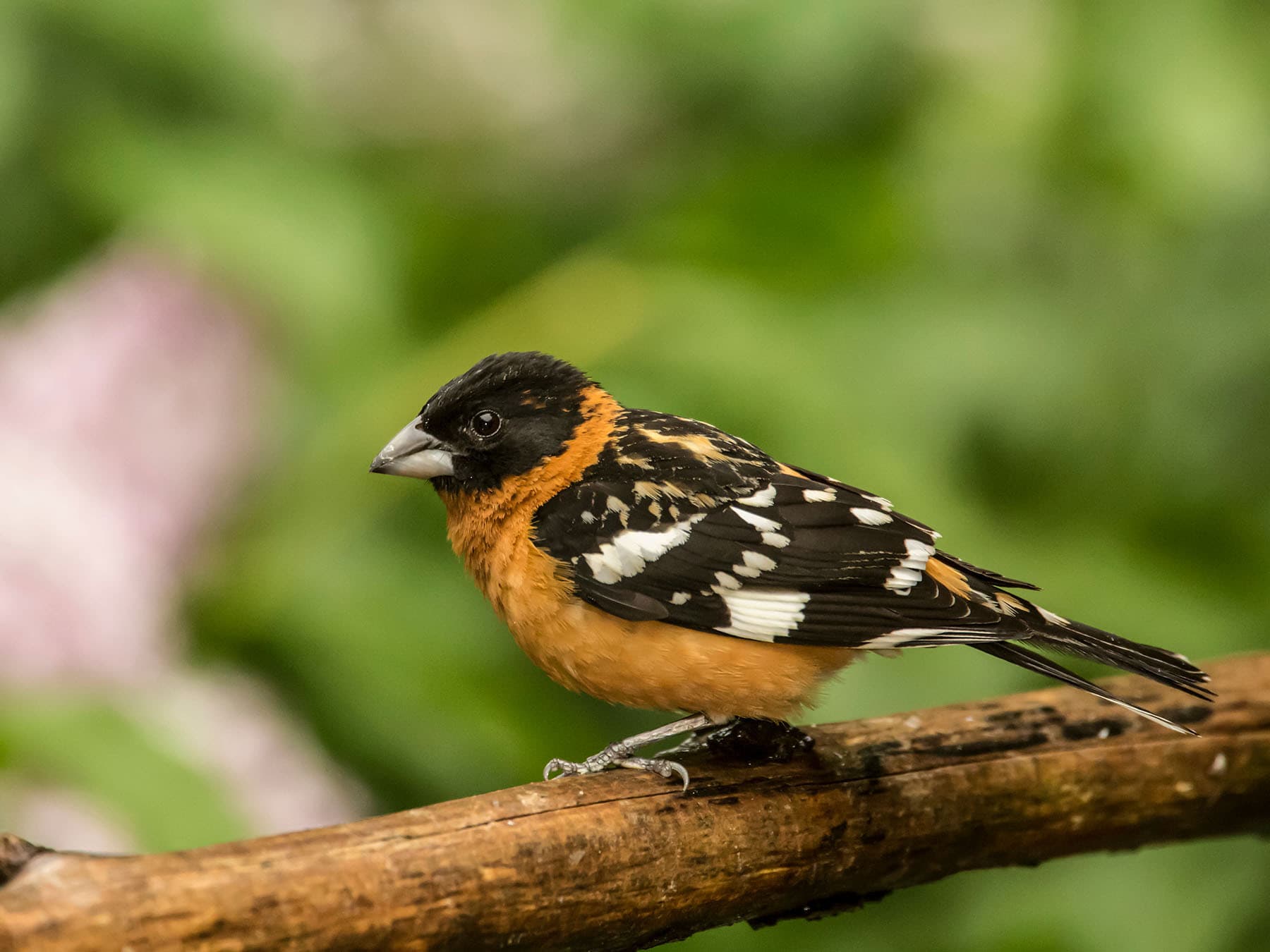
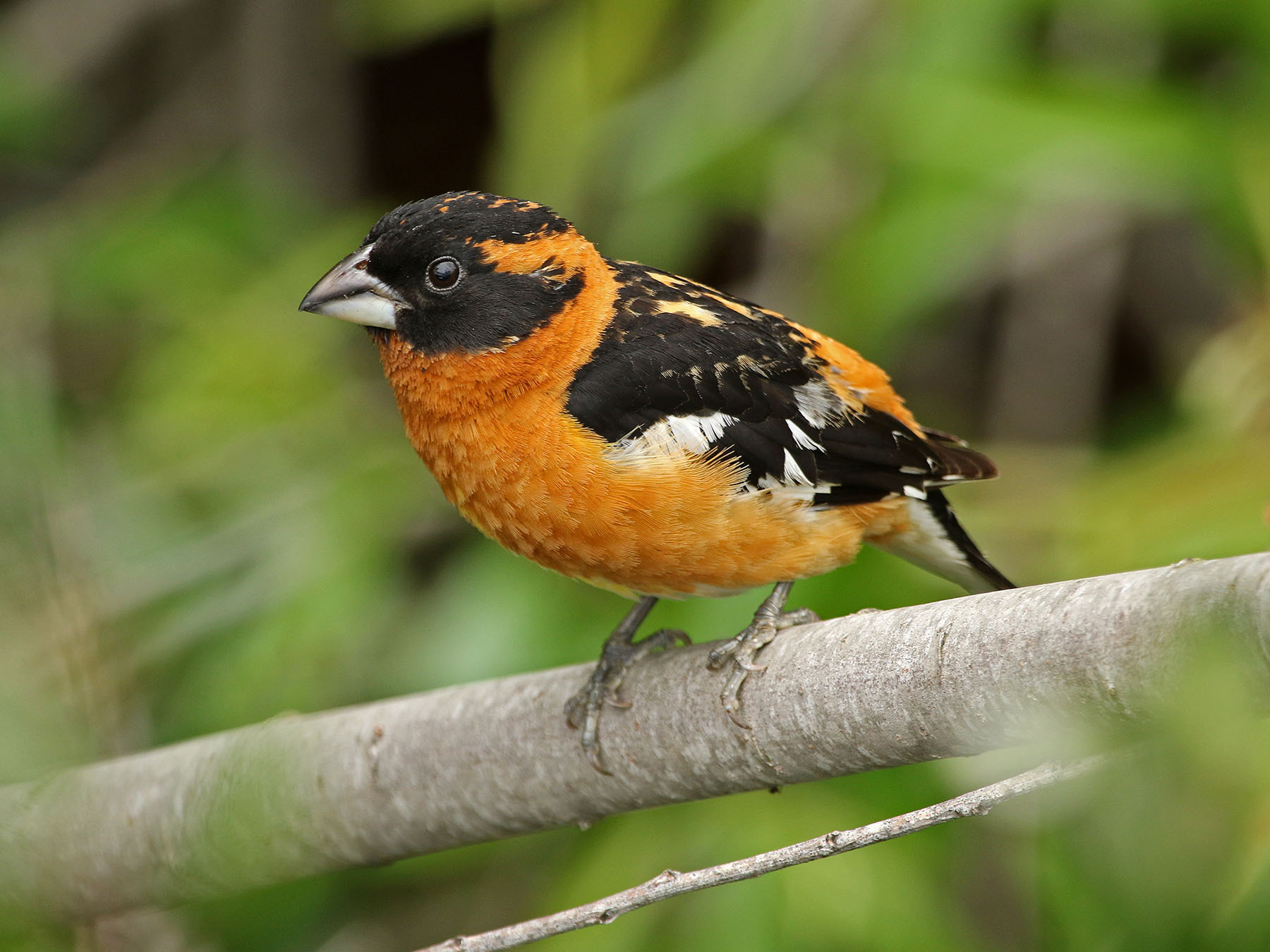
An adult male Black-headed Grosbeak is easy to name once you see him: a black head, a cinnamon-orange breast and collar, and black wings and tail with bold white spots. The middle of his belly is lemon yellow, and in flight he flashes yellow under the wings and a big white patch on each wing.1, 2
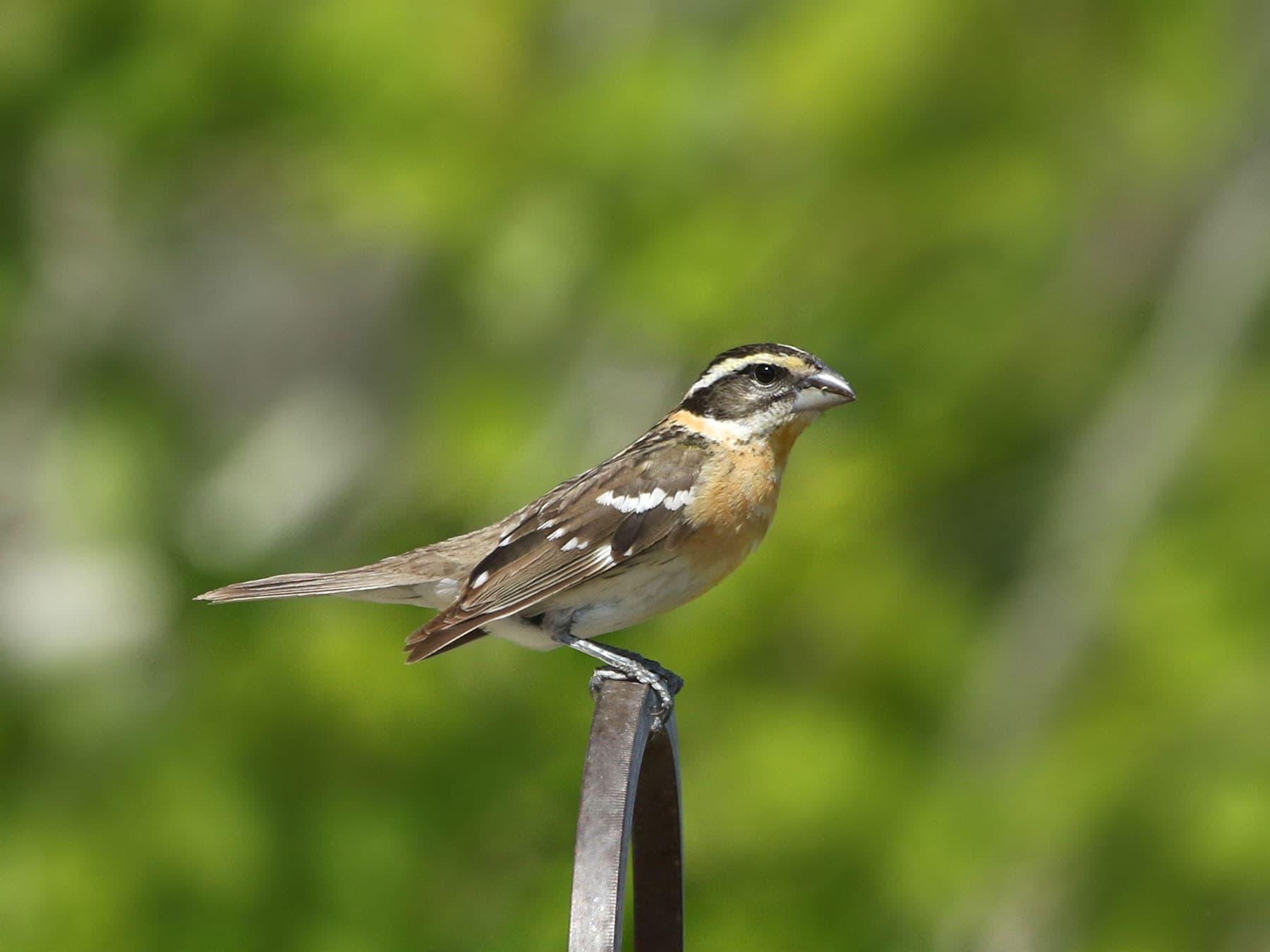
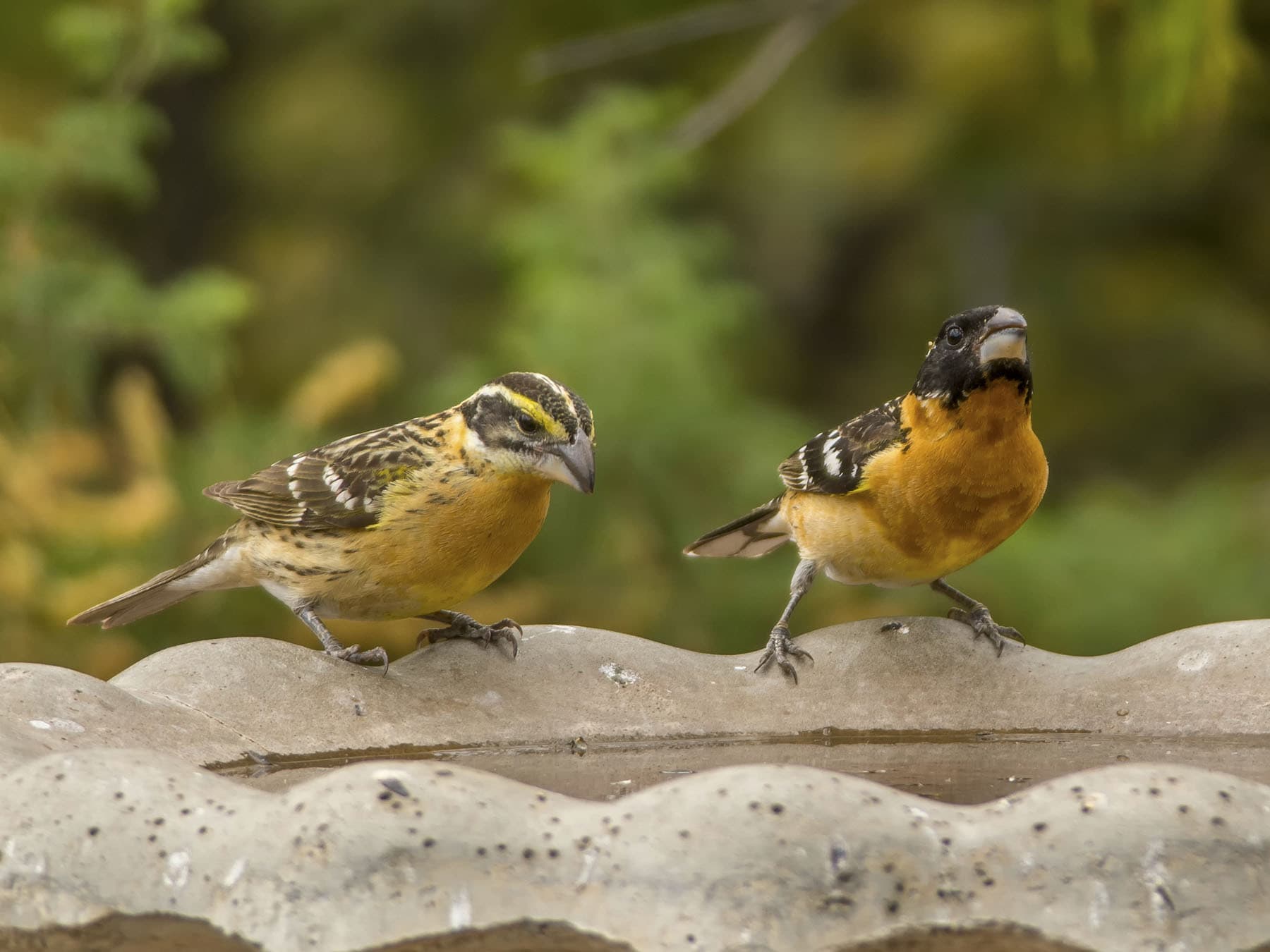
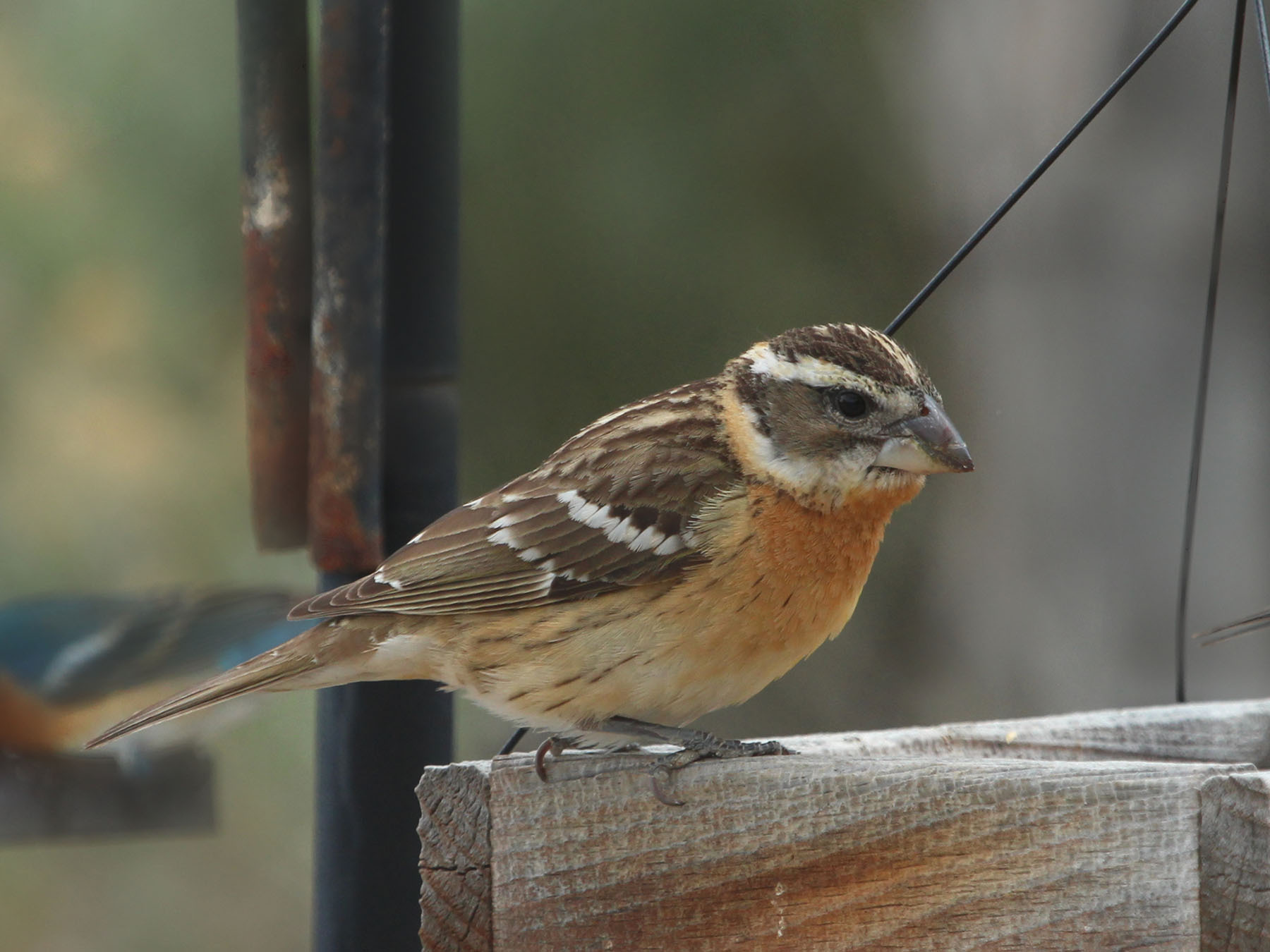
The female is brown and buff. Her head is strongly striped, with a pale stripe over the crown and another over each eye, and her underparts are warm buff to cinnamon, streaked on the sides but with few or no streaks across the middle of the breast. Both sexes have a huge, cone-shaped bill that is dark on top and pale bluish-white or cream below.
Size and shape
Black-headed Grosbeaks are 7.1 to 7.5 inches (18-19 cm) long, with a wingspan of 11.8 to 12.6 inches (30-32 cm), and weigh 35 to 50 g (about 1.2-1.8 ounces).1, 2, 3 That is about robin-sized, though the shape is different: bulkier than a House Finch, slimmer and more compact than an American Robin, with a big head on a short neck, a short tail and a very large bill.
Females can be the heavier sex: in a New Mexico study, females averaged about 48 g against 46 g for adult males, though the males had longer wings and tails.4
Males, females and young
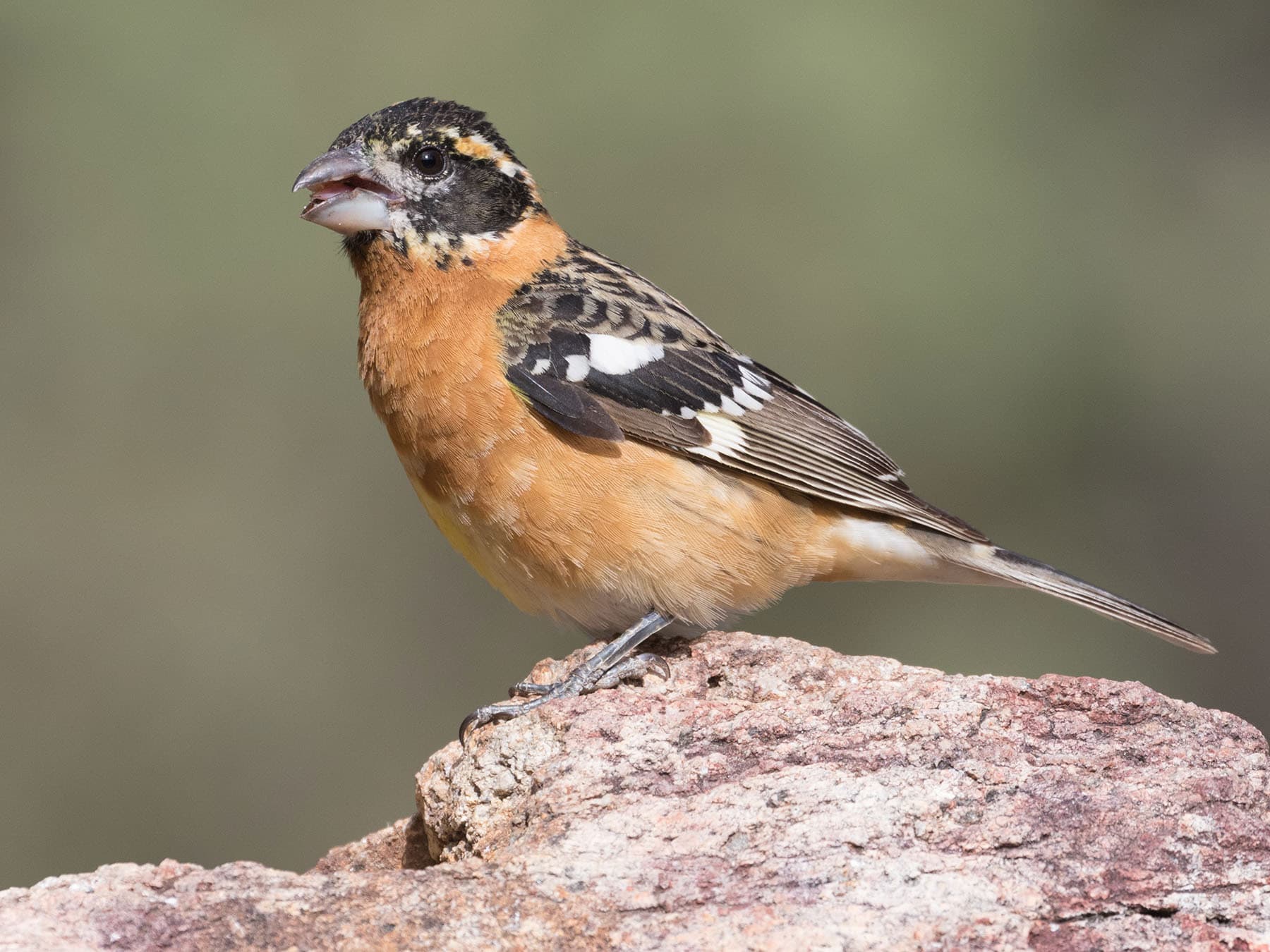
A male does not get his full adult colors until he is about two years old. First-year males vary enormously, from birds that look like a female with a few black feathers on the face to birds that look almost adult.4 The giveaway is the wing: a first-year male keeps brown primaries and primary coverts, with much less white at the base of the primaries than an adult male.1
Only the yearlings that look most like adults hold territories and try to breed.4 The drab ones seem to gain something too: in an experiment with mounted birds, older males were least aggressive toward a yearling that looked like a female.5
Juveniles, seen from June to August, look like females: a dark brown head with wide buff stripes, and buff underparts lightly streaked on the upper breast and flanks. Young males are often brighter than young females. After the late-summer molt, an adult male's black feathers have brown tips, so in fall and early winter he looks browner, though his wings and tail stay black; the tips wear away by spring.1
Identification: similar birds
Rose-breasted Grosbeak. The male is black and white with a rose-red chevron on his breast, so males are easy. Females and young are the challenge. A female Rose-breasted is paler below and streaked right across the breast, with a paler, pinker bill; a female Black-headed is warmer buff, with few streaks across the middle of the breast and a darker upper bill. Beware worn summer Black-headed females, which can fade whitish below. In females the wing linings settle it, if you can see them: lemon yellow in the Black-headed, more saffron in the Rose-breasted. A young male Rose-breasted flashes pinkish-red under the wings and may already show some red on the breast.1 The two meet along rivers on the Great Plains, where they sometimes hybridize, but DNA studies show a stable hybrid zone between two distinct species.6
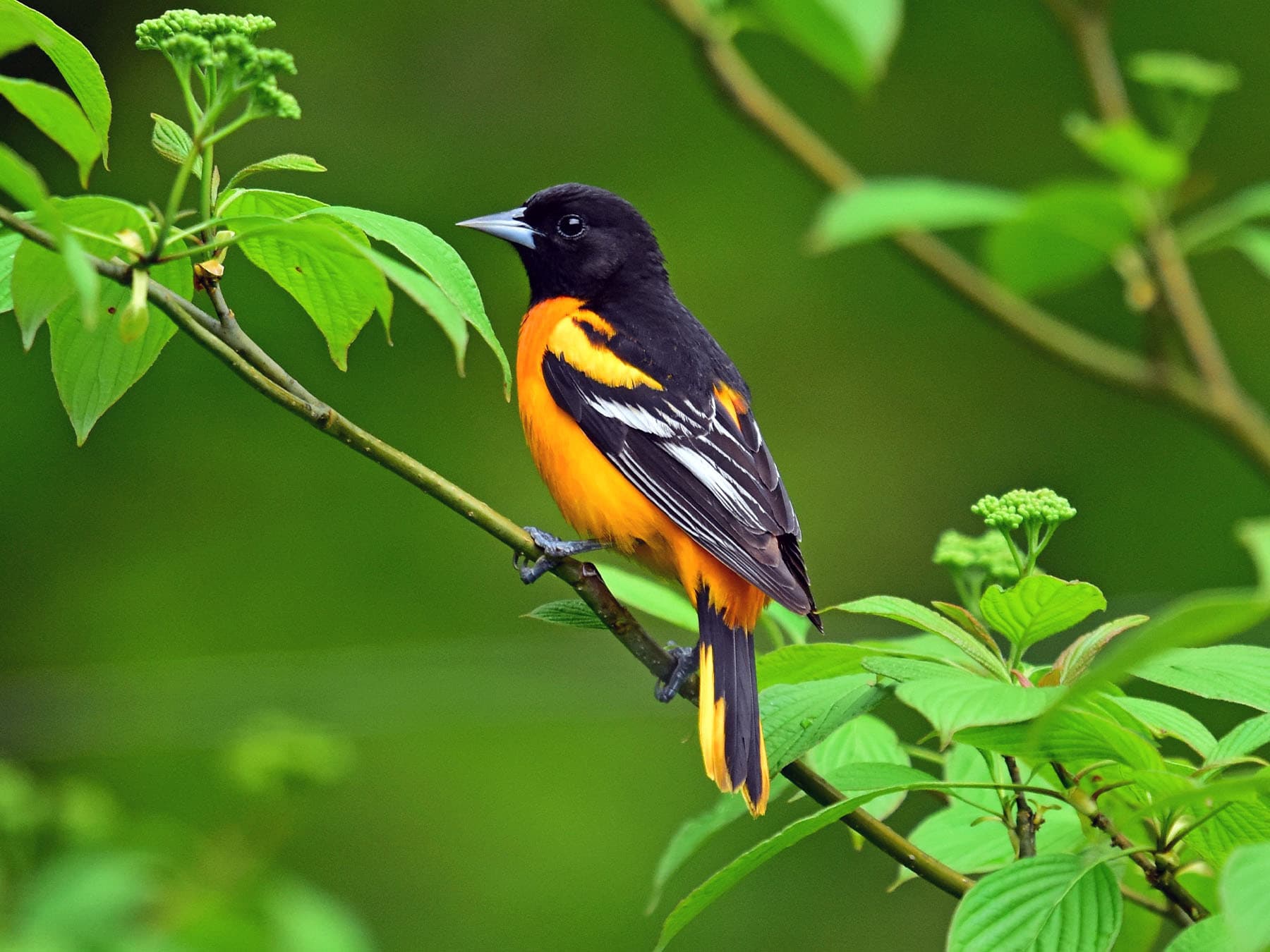
Baltimore Oriole. A male oriole is also black-headed and orange, but slimmer, with a long, pointed bill and a single white wing bar.7 A grosbeak's bill is thick and cone-shaped.
Bullock's Oriole. A male Bullock's has an orange face with a black line through the eye and a black throat, not a black head, a large white wing patch and the same slim, pointed bill.
Spotted Towhee. A male towhee has a black hood and throat, rufous sides, a white belly and a long tail, and it scratches on the ground under shrubs.8 A male grosbeak is cinnamon from throat to breast.
American Robin. The confusion here is the song, not the look. A robin is larger, with a gray back, a brick-red breast, white arcs around the eye and a streaked white chin.
Not sure it’s a Black-headed Grosbeak? Check your photo: Birdfact names the bird and shows the look-alike side by side.
Its size
Adults- Length
- 18–19 cm
- Wingspan
- 30–32 cm
- Weight
- 35–50 g
Its song and calls
The song is a long, rich warble of rising and falling whistled phrases, like an American Robin's but sweeter, smoother and faster.2, 3 Each note lasts about a sixth of a second, with pauses of a similar length between them, mostly between 1.5 and 4 kHz.1
Females sing too, usually a simpler version of the male's song, and now and then a female sings a full male song.9, 10 Males often sing while sitting on the eggs,11 and females sometimes sing from the nest too.9
The call is a sharp, squeaky chip, often written spik or chink, very like a Rose-breasted Grosbeak's but slightly less sharp. Birds give a short wheet as they take off, and the sitting bird gives it as it leaves the nest at a changeover. Fledglings keep in touch with their parents with a whistled phee-oo, and in midsummer their whining begging is a common sound in western oak woods.1, 3
Young birds deafened in an experiment could not develop normal song, though some notes came out normal: the song is partly inborn and partly depends on hearing.12 In a study of 22 males, each used 14 to 37 different syllables, about 70% of them his alone, and neighbors shared many more of them than males from another population only 4.4 km (under 3 miles) away.1
Song season
Males sing from the day they arrive in spring, mostly from exposed perches 7 to 33 feet (2-10 m) up.1 Song peaks until the female finishes laying, drops while the pair sit on the eggs, rises again when the young leave the nest and stops once they are independent.13, 11, 5 Early in the season males sing hardest in the first three or four hours after dawn, with a smaller peak in the evening.1
- Song0:00 / 0:05
Recorded in California, United States · June 2022
- Calls0:00 / 0:06
Recorded in California, United States · May 2024
Heard one and not sure? Let the bird song identifier listen.
When and where to see it
Black-headed Grosbeaks breed across western North America, from southern British Columbia, southern Alberta and southwest Saskatchewan south to Guerrero and Oaxaca in Mexico, and east to the central Great Plains.1 Nesting has also been documented in southern Alaska, first reported in 2021.14
Look in mixed woods with big trees and a rich understory, often near water: streamside cottonwoods and willows, oak woods, pine-oak, aspen, pinyon-juniper, canyons, orchards, gardens and suburbs. They avoid open desert away from streams, grassland, dry chaparral and unbroken conifer forest, though they use the edges and clearings.1, 2 They are common in summer across much of the West, and Breeding Bird Survey counts are highest in the Sierra Nevada and the Pacific Northwest.15
Spotting tips
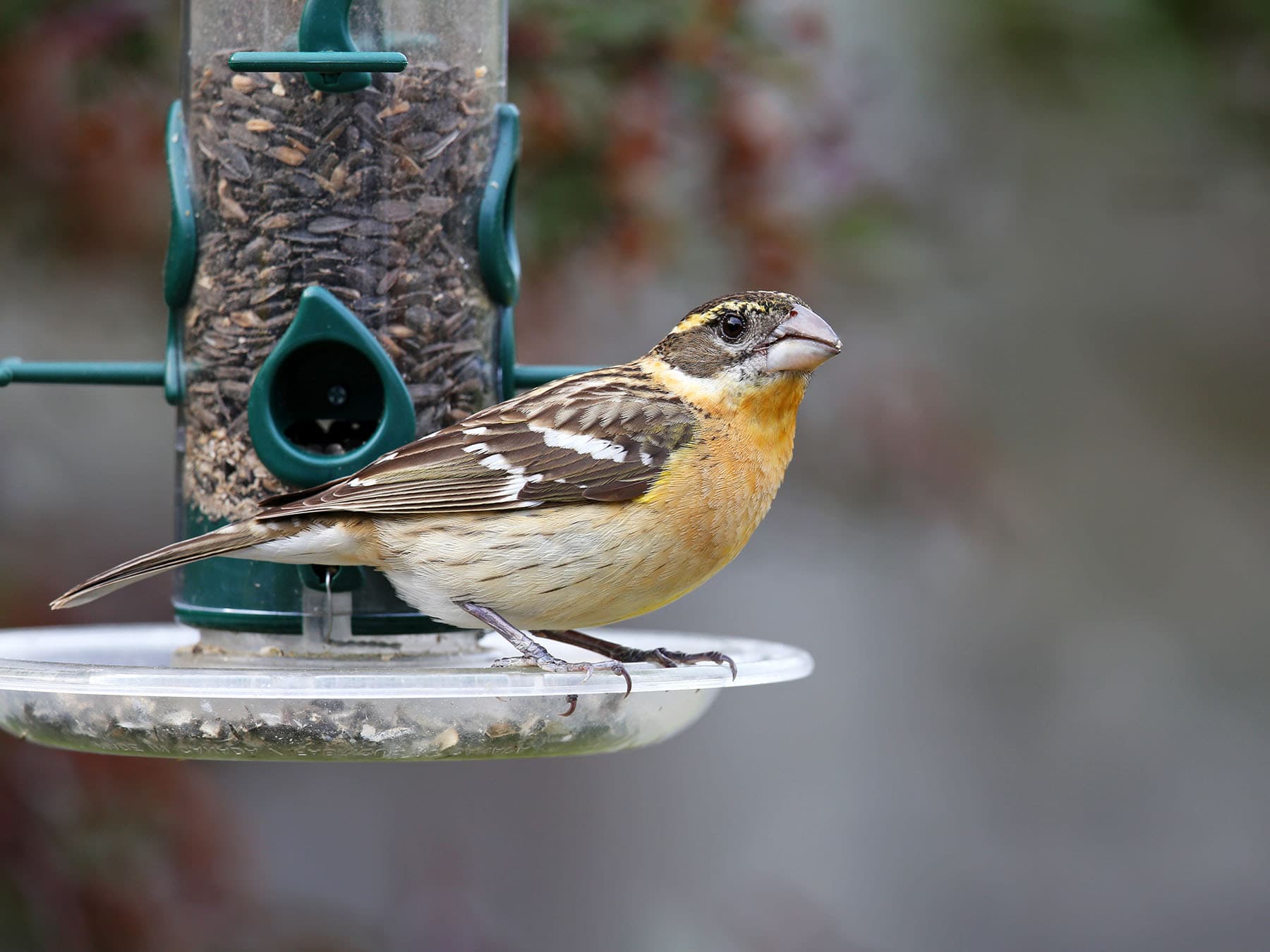
In yards, a sunflower seed feeder is often the easiest place to see one, from spring to late summer. Away from feeders, listen for the robin-like song high in the trees, or the squeaky chip of a bird feeding out of sight in thick leaves, then look for the big two-toned bill.
Migration and winter range
Northern birds are long-distance migrants. They go overland, west of the Gulf of Mexico, never across it, and winter in Mexico, mostly on the Pacific slope from southern Sonora to Michoacan, in the interior and in southern Baja California. A few winter in the southern United States. Birds in central and southern Mexico apparently stay all year.1
Early spring dates in regional bird books run from late March in San Diego and Nuevo Leon to late April in South Dakota and early May in Wyoming and British Columbia's Okanagan Valley.1 Adult males arrive first; females follow 5 to 7 days later, and yearling males about two weeks after the first adults.13, 5 In coastal California, adult males leave first, in late July or early August, and females and young follow, usually by mid-August.13 Juveniles have also been seen to linger on the breeding grounds several weeks after the last adults.1
Many make a stop on the way south to molt. After nesting, many adults and young from the north fly to the monsoon region of northwest Mexico and Arizona, molt there from late July to September, then continue to their wintering grounds; it is not known whether all northern birds do this. A yearling male fitted with a GPS tag in Yosemite spent August to October in Sonora, about 800 miles (1,300 km) south, then moved another 800 miles (1,300 km) to Michoacan for the winter.16 Strays turn up rarely in eastern North America, mostly in late fall and winter, as far as Newfoundland.1, 3
What it eats
In the breeding season roughly three-fifths to two-thirds of their food is animal (57% and 66% in two early stomach studies), mostly beetles and other insects, plus spiders and snails; the rest is seeds and fruit.17, 18 In the second of these, a 1908 study of 226 stomachs from across the western US, beetles made up 28.7% of the food, other invertebrates 37%, cultivated fruit 11.9% and weed seeds 9.3%.18
That big bill handles hard-shelled insects and large seeds. Fruit includes elderberries, serviceberries, poison oak berries, mulberries, cherries, figs, plums and blackberries. Nestlings are fed almost only insects at first, especially caterpillars; older nestlings get more beetles and some fruit.1
They glean insects from leaves high in the trees and in the understory, and also feed on the ground. In a Sierra Nevada forest they foraged most often 80 to 100 feet (25-30 m) up, and 70% of their attacks were gleans, mostly from leaves.19
Eating monarch butterflies
At the monarchs' winter roosts in the mountains of central Mexico, Black-headed Grosbeaks eat large numbers of the butterflies, which are poisonous to most birds. A grosbeak never eats the wings, lets go of about 70% of the monarchs it catches, and their poison does not make it vomit.20 It feeds on them in roughly eight-day cycles, which may give it time to recover from the toxins.21
Feeders and yards
Nesting and breeding
The nest is built well out from the trunk of a small deciduous tree or shrub, often by a stream, usually 7 to 13 feet (2-4 m) up and anywhere from about 3 to 26 feet (1-8 m). Oaks, cottonwoods, maples, willows, Russian olive, alders, water birch, pinyon pine and juniper are all used.1, 13, 22
The female builds it in 3 to 4 days, gathering most of the material within about 200 feet (60 m). It is a bulky, loose open cup of pine needles, rootlets, stems and twigs, with a finer lining that can include hair. Twenty-five nests measured in northern California averaged about 5.5 inches (14 cm) across, with a cup about 3 inches (8 cm) wide and 1.6 inches (4 cm) deep.13 Some nests are so thin the eggs show through, and in Colorado some have purple lupine flowers worked into the outside.22
Eggs and incubation
Most eggs are laid between late April and late June, a few in July; in museum egg sets, mostly from California, the average clutch was complete by about May 23. There are 2 to 5 eggs, usually 3 (3.4 on average), pale blue or greenish blue spotted with brown, mostly at the broad end, and about 1 by 0.7 inches (2.5 by 1.8 cm).1
Incubation takes 12 to 14 days, and the sitting is shared. Both parents sit on the eggs and split the day about equally, the males covering 40% to 50% of daytime sitting in studies in California, Utah and New Mexico. Only the female sits at night, and only she has a full brood patch, so the male may be guarding the eggs more than warming them.13, 11, 23
Young and fledglings
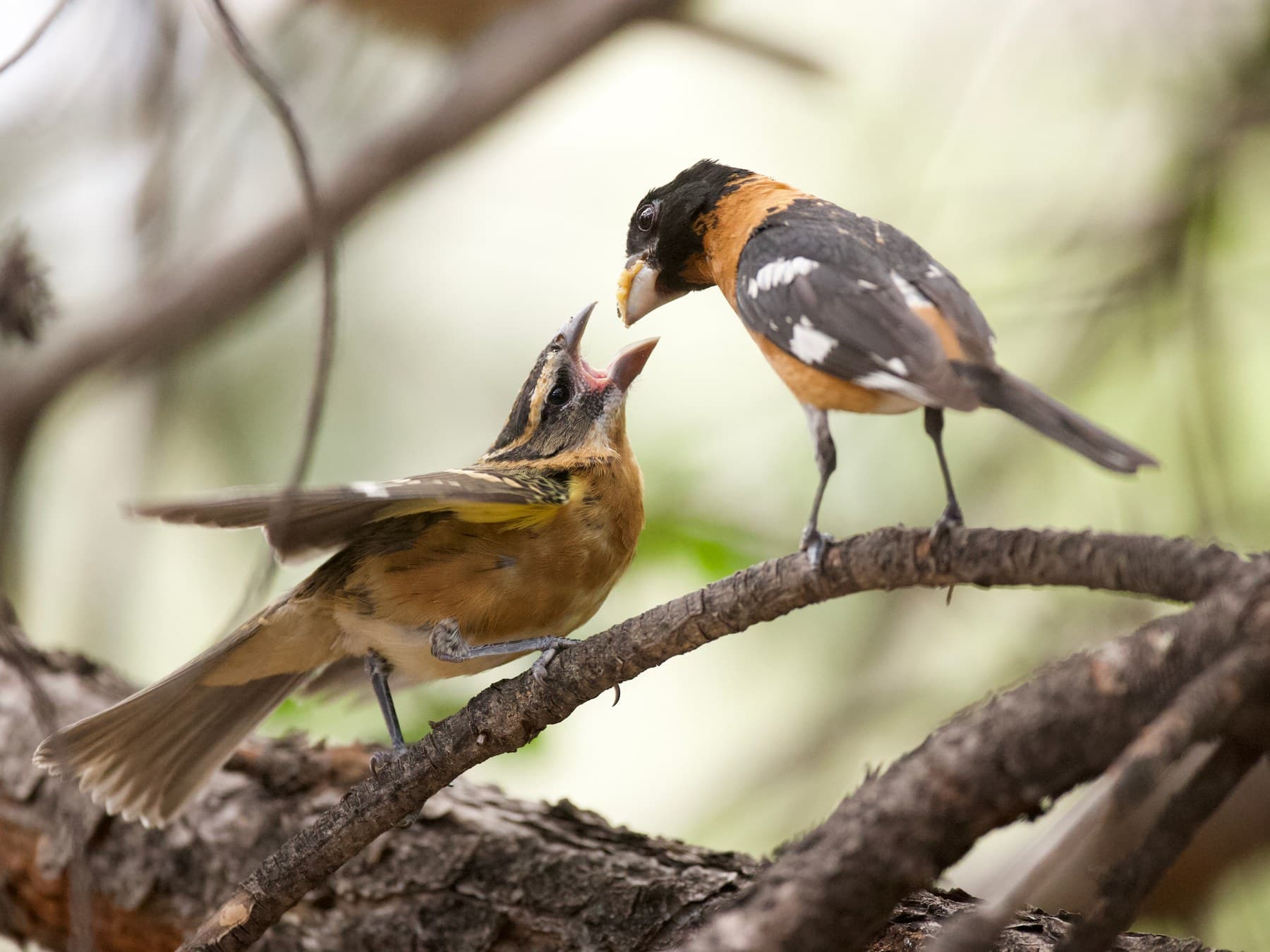
The young leave the nest at 10 to 14 days old (11.5 on average in a Utah study11), about two weeks before they can fly. They hide quietly in thick cover near the nest while both parents feed them; once flying, they follow the parents, begging. Males leave earlier, so late in summer only females are seen feeding young.1
Pairs raise one brood a year in the US and Canada (it is not known farther south). In northern California and New Mexico, a pair that lost its nest before about the second week of June nested again. Most females breed at one year old, but most males wait until they are about two.1, 4, 13
Nest predators and cowbirds
Steller's Jays and Woodhouse's Scrub-Jays were the main nest predators in a New Mexico mountain study, where nearly all nest losses were to predators.23 In southwest Colorado, 66% of 56 nests succeeded, among the most successful songbirds there.22 Both parents defend the nest, especially once there are chicks, chirping and fluttering near an intruder, and they will sometimes attack small predators such as scrub-jays with their bills.1
Brown-headed Cowbirds lay in grosbeak nests only rarely in most places: none of 56 nests in Colorado and 2 of 77 in California held cowbird eggs, though one British Columbia valley study found 35% of 20 nests hit.1
Behaviour
Males are fiercely territorial when they arrive, trading songs, chasing each other and sometimes grappling in the air. Females defend the nesting area too; in one case a female died of wounds after a fight with another.1
In courtship the male flies up from a perch singing, wings and tail spread to show off the black-and-white pattern, rises a few meters and glides back, usually to the same perch; each flight lasts 8 to 10 seconds. Pairs are socially monogamous, and the bond seems to last one season: in a New Mexico study only one of three returning females paired with the same male.1 From nest building to the last egg, the male follows the female closely.
Grosbeaks ignore small birds such as Bushtits and warblers near the nest, and one pair even let a House Wren help feed their young. They hop, on the ground and in branches, and fly with fast wingbeats in a slightly undulating line; in New Mexico they were seen bathing in streams often in summer, probably daily. In fall and winter they are less aggressive and may travel in loose flocks.
Lifespan and predators
The oldest Black-headed Grosbeak on the US Bird Banding Laboratory's list was at least 11 years 11 months old: a male banded in Montana in 1994, already at least a year old, and caught and released there in 2005.24 In a New Mexico study, at least 77% of adult males survived each winter, judging by the territories they reoccupied.23
Conservation
The Black-headed Grosbeak is listed as Least Concern on the IUCN Red List. Partners in Flight estimates about 15 million birds and gives it a Continental Concern Score of 9 out of 20, low concern (2023).25
The North American Breeding Bird Survey shows numbers stable to slightly rising since 1966 (+0.38% a year, not statistically significant). From 1966 to 2025 they rose in Washington (+2.7% a year), Montana, Utah, Colorado and Canada (+1.9%), and fell in California (-0.4%) and New Mexico (-1.2%).15
Much habitat has been lost to building, and heavy grazing can make sites poorer, but irrigation, orchards and garden planting have added habitat too.1
Similar birds
Often mistaken for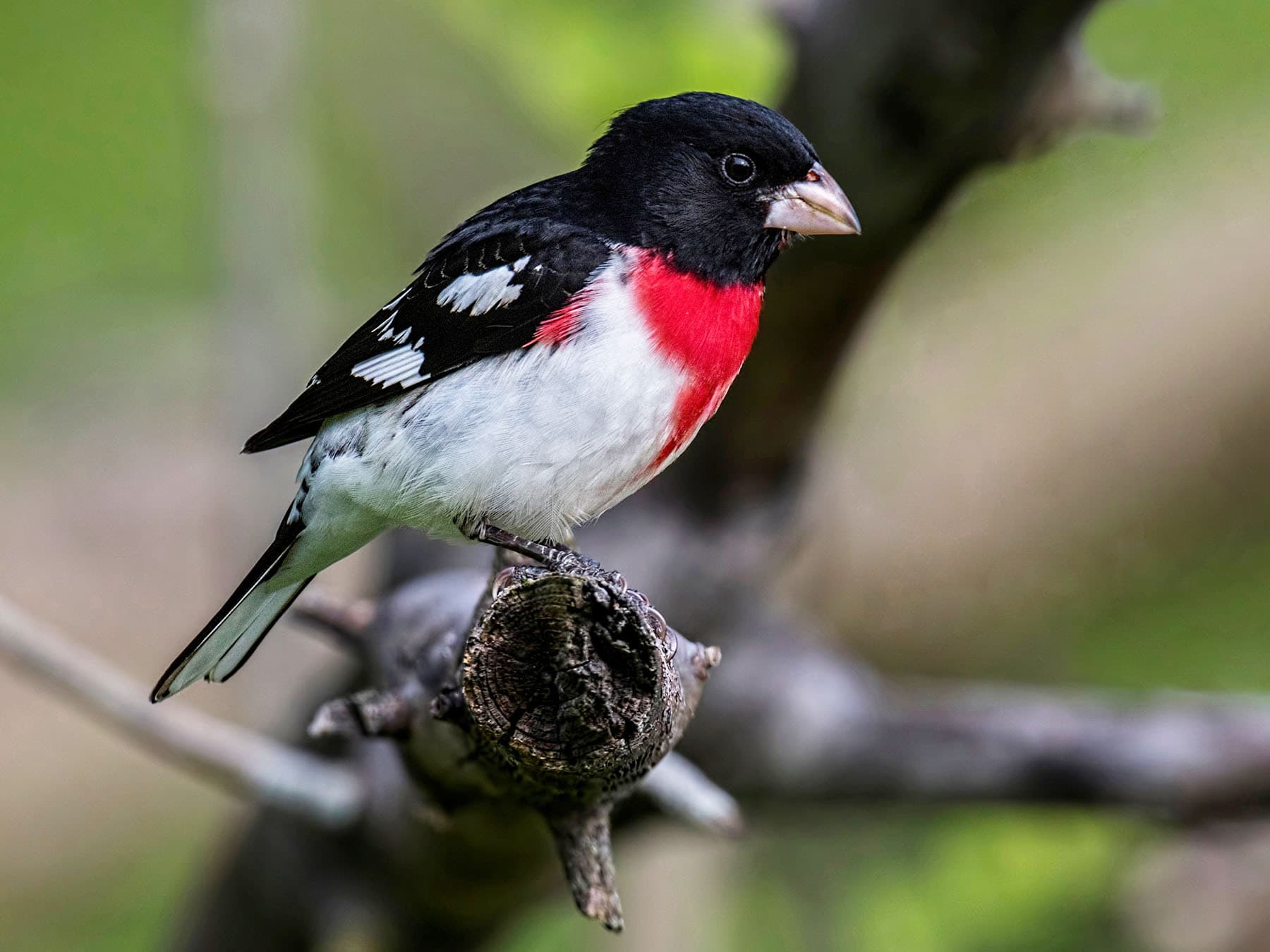
More photos
3 photos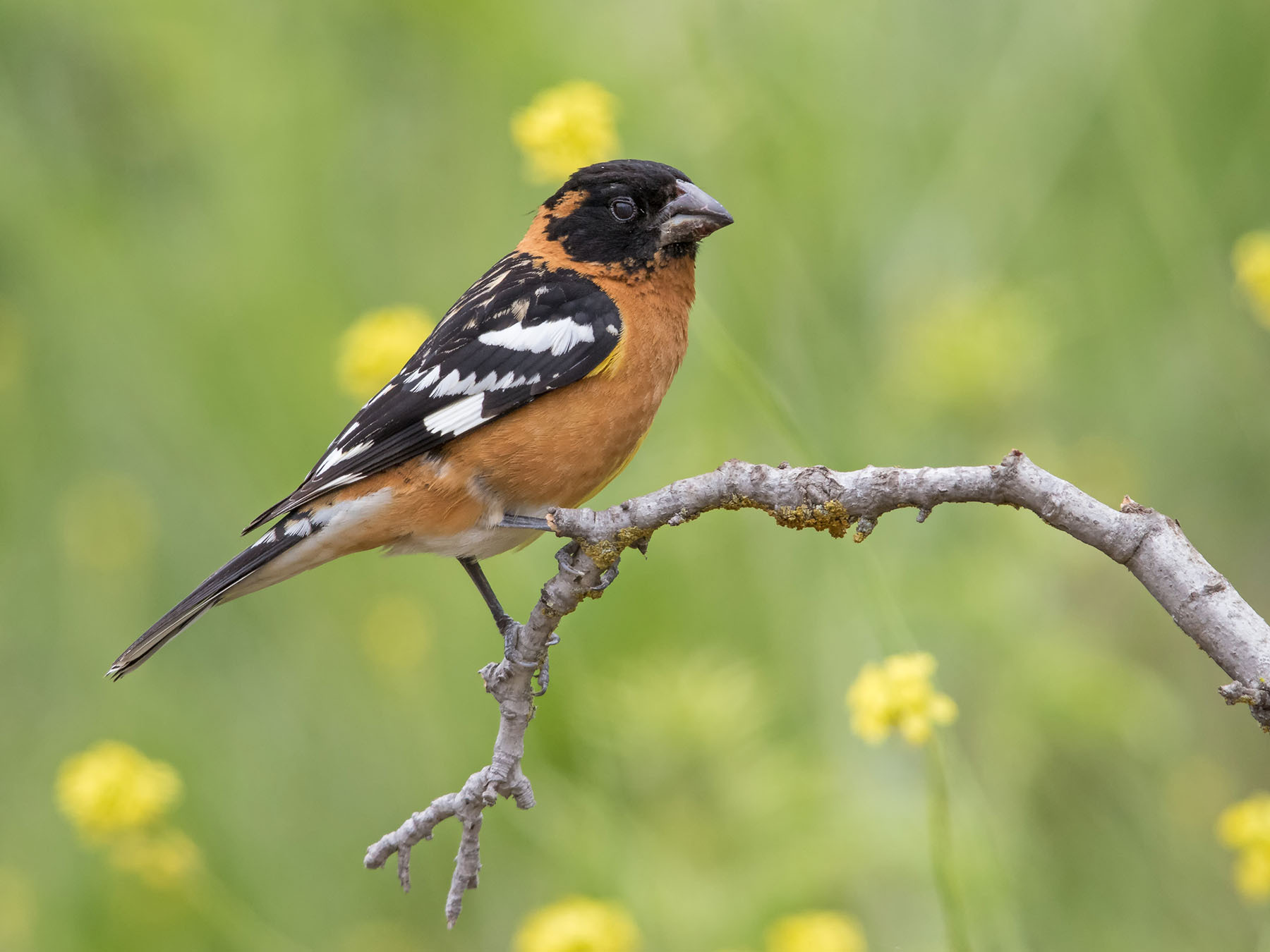
Quick facts
- Length
- 18–19 cm
- Wingspan
- 30–32 cm
- Weight
- 35–50 g
- Lifespan
- oldest recorded at least 11 years 11 months
- Family
- Cardinals & Grosbeaks
- Migration
- Long-distance Migrant
- Global status (IUCN)
- Least Concern
- World population
- About 15 million (Partners in Flight, 2023)
- Population trend
- Common and stable overall, rising in the north, falling in California
- Scientific name
- Pheucticus melanocephalus
Questions
2Are Black-headed Grosbeaks finches?
No. Despite the big, finch-like bill, they belong to the cardinal family, Cardinalidae, with the Northern Cardinal and the Rose-breasted Grosbeak; DNA studies moved them there from the finches. See how to identify one.
Are Black-headed Grosbeaks rare?
Not in the West in summer: they are common across much of their range, with about 15 million birds in all. In the East they are rare strays. See where and when.
Sources
34- 1Hill, G. E. (2022). Black-headed Grosbeak (Pheucticus melanocephalus), version 2.0. Birds of the World (S. M. Billerman and B. K. Keeney, editors). Cornell Lab of Ornithology. doi:10.2173/bow.bkhgro.02 (opens in a new tab)
- 2Cornell Lab of Ornithology. Black-headed Grosbeak. All About Birds. Accessed 3 November 2026. Source (opens in a new tab)
- 3National Audubon Society. Black-headed Grosbeak. Guide to North American Birds. Accessed 3 November 2026. Source (opens in a new tab)
- 4Hill, G. E. (1988). The function of delayed plumage maturation in male Black-headed Grosbeaks. Auk 105: 1-10. doi:10.1093/auk/105.1.1 (opens in a new tab)
- 5Hill, G. E. (1989). Late spring arrival and dull nuptial plumage: aggression avoidance by yearling males?. Animal Behaviour 37: 665-673. doi:10.1016/0003-3472(89)90045-6 (opens in a new tab)
- 6Mettler, R. D. and Spellman, G. M. (2009). A hybrid zone revisited: molecular and morphological analysis of the maintenance, movement, and evolution of a Great Plains avian (Cardinalidae: Pheucticus) hybrid zone. Molecular Ecology 18: 3256-3267. doi:10.1111/j.1365-294X.2009.04217.x (opens in a new tab)
- 7Cornell Lab of Ornithology. Baltimore Oriole. All About Birds. Accessed 3 November 2026. Source (opens in a new tab)
- 8Cornell Lab of Ornithology. Spotted Towhee. All About Birds. Accessed 3 November 2026. Source (opens in a new tab)
- 9Ritchison, G. (1983). The function of singing in female Black-headed Grosbeaks (Pheucticus melanocephalus): family-group maintenance. Auk 100: 105-116. doi:10.1093/auk/100.1.105 (opens in a new tab)
- 10Ritchison, G. (1983). Possible deceptive use of song by female Black-headed Grosbeaks. Condor 85: 250-251. doi:10.2307/1367264 (opens in a new tab)
- 11Ritchison, G. (1983). Breeding biology of the Black-headed Grosbeak in northern Utah. Western Birds 14: 159-167. Accessed 3 November 2026.
- 12Konishi, M. (1965). Effects of deafening on song development in American Robins and Black-headed Grosbeaks. Zeitschrift fur Tierpsychologie 22: 584-599. Accessed 3 November 2026.
- 13Weston, H. G., Jr. (1947). Breeding behavior of the Black-headed Grosbeak. Condor 49: 54-73. doi:10.2307/1364119 (opens in a new tab)
- 14Pohlen, Z. M., Gesmundo, C. F. and Hajdukovich, N. R. (2021). First documented breeding of the Black-headed Grosbeak in Alaska. Western Birds 52: 351-354. doi:10.21199/WB52.4.8 (opens in a new tab)
- 15Hostetler, J. A. et al. (2026). The North American Breeding Bird Survey, Analysis Results 1966-2025. U.S. Geological Survey data release. doi:10.5066/P1OSNSFC (opens in a new tab)
- 16Siegel, R. B. et al. (2016). GPS-tracking reveals non-breeding locations and apparent molt migration of a Black-headed Grosbeak. Journal of Field Ornithology 87: 196-203. doi:10.1111/jofo.12149 (opens in a new tab)
- 17Beal, F. E. L. (1910). Birds of California in relation to the fruit industry, part 2. U.S. Department of Agriculture, Biological Survey Bulletin 34. Accessed 3 November 2026.
- 18McAtee, W. L. (1908). Food habits of the grosbeaks. U.S. Department of Agriculture, Biological Survey Bulletin 32. Accessed 3 November 2026.
- 19Airola, D. A. and Barrett, R. H. (1985). Foraging and habitat relationships of insect-gleaning birds in a Sierra Nevada mixed-conifer forest. Condor 87: 205-216. doi:10.2307/1366884 (opens in a new tab)
- 20Fink, L. S. and Brower, L. P. (1981). Birds can overcome the cardenolide defence of monarch butterflies in Mexico. Nature 291: 67-70. doi:10.1038/291067a0 (opens in a new tab)
- 21Brower, L. P. and Calvert, W. H. (1985). Foraging dynamics of bird predators on overwintering monarch butterflies in Mexico. Evolution 39: 852-868. doi:10.2307/2408685 (opens in a new tab)
- 22Ortega, C. P. and Ortega, J. C. (2003). Comparison of Black-headed Grosbeaks nesting in riparian and Gambel oak pastures in southwestern Colorado. Southwestern Naturalist 48: 383-388. doi:10.1894/0038-4909(2003)048<0383:COBGNI>2.0.CO;2 (opens in a new tab)
- 23Hill, G. E. (1988). Age, plumage brightness, territory quality, and reproductive success in the Black-headed Grosbeak. Condor 90: 379-388. doi:10.2307/1368566 (opens in a new tab)
- 24USGS Bird Banding Laboratory. Longevity records of North American birds. USGS Eastern Ecological Science Center, Bird Banding Laboratory. Accessed 3 November 2026. Source (opens in a new tab)
- 25Partners in Flight (2023). Avian Conservation Assessment Database and Population Estimates Database. Bird Conservancy of the Rockies. Accessed 3 November 2026. Source (opens in a new tab)
- 26Cornell Lab of Ornithology. Rose-breasted Grosbeak. All About Birds. Accessed 3 November 2026. Source (opens in a new tab)
- 27National Audubon Society. Rose-breasted Grosbeak. Guide to North American Birds. Accessed 3 November 2026. Source (opens in a new tab)
- 28National Audubon Society. Baltimore Oriole. Guide to North American Birds. Accessed 3 November 2026. Source (opens in a new tab)
- 29Cornell Lab of Ornithology. Bullock's Oriole. All About Birds. Accessed 3 November 2026. Source (opens in a new tab)
- 30National Audubon Society. Bullock's Oriole. Guide to North American Birds. Accessed 3 November 2026. Source (opens in a new tab)
- 31National Audubon Society. Spotted Towhee. Guide to North American Birds. Accessed 3 November 2026. Source (opens in a new tab)
- 32National Audubon Society. American Robin. Guide to North American Birds. Accessed 3 November 2026. Source (opens in a new tab)
- 33Anderson, B. W. and Daugherty, R. J. (1974). Characteristics and reproductive biology of grosbeaks (Pheucticus) in the hybrid zone in South Dakota. Wilson Bulletin 86: 1-11. Accessed 3 November 2026.
- 34AviList Core Team (2025). AviList: The Global Avian Checklist, v2025. data/reference/avilist.csv. Accessed 3 November 2026. Source (opens in a new tab)

Checked by
Nathan Cope, founder and editor
Nathan founded Birdfact and leads its writers and contributors in the UK, the US and Canada. He has watched and studied birds for more than ten years, and checks every article and species guide before it’s published.