Species Profile
Varied Thrush
Ixoreus naevius
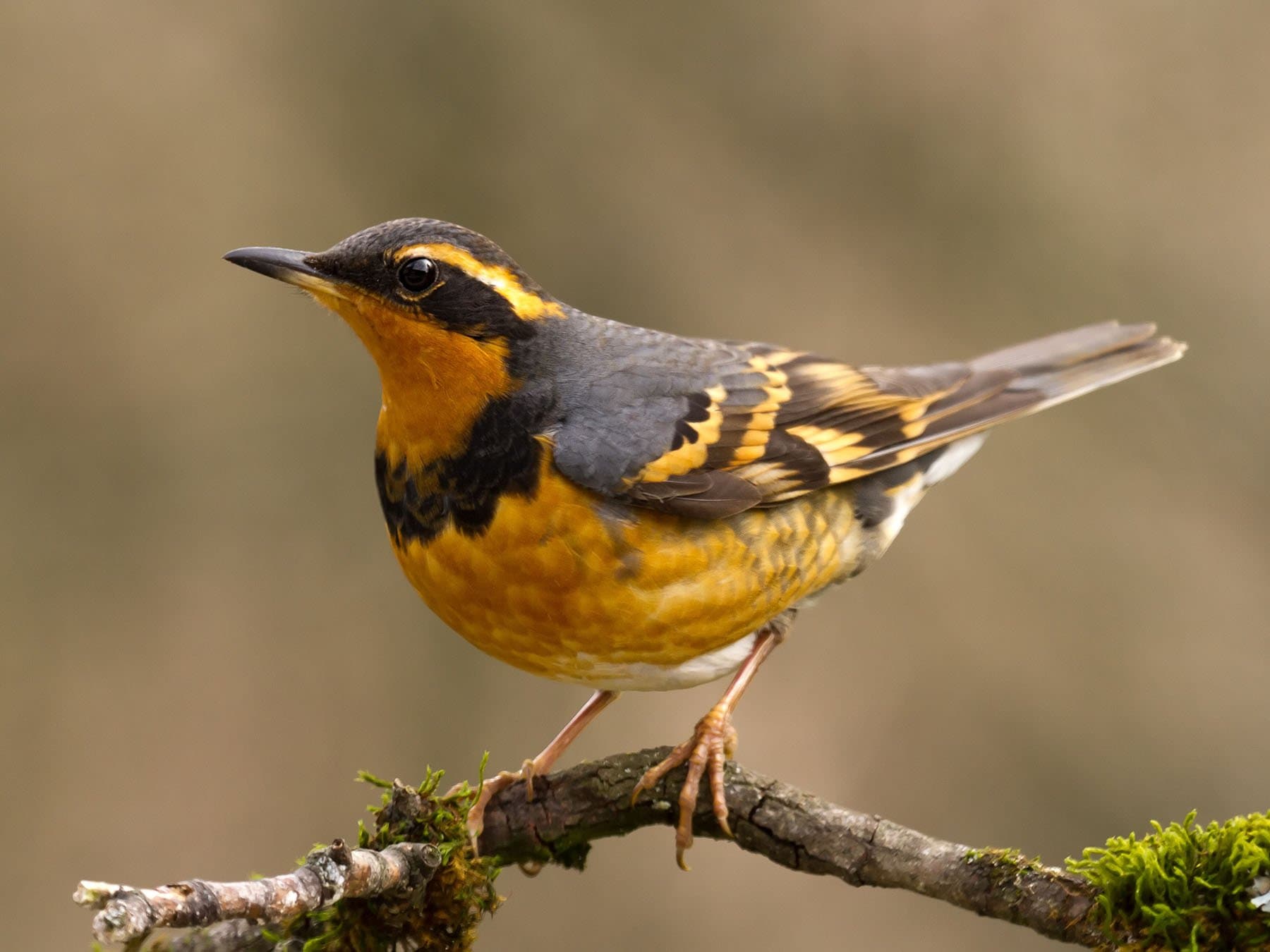
Varied Thrush perched on a mossy branch, showing its distinctive black head, orange breast, and gray back with patterned wings.
Quick Facts
Conservation
LCLeast ConcernLifespan
3–5 years
Length
20–26 cm
Weight
65–100 g
Wingspan
34–42 cm
Migration
Partial migrant
Slate-blue above and burnt-orange below, with a bold black breast band cutting across the chest like a painted stripe, the Varied Thrush is one of the most strikingly patterned birds in North America. Its song — a single, haunting, flute-like note held for two seconds, then silence, then another note at a different pitch — drifts through the dark Pacific rainforest like something heard in a dream.
Think you've spotted a Varied Thrush?
Upload a photo and we'll confirm it instantly
Confirm with a PhotoAppearance
The male Varied Thrush is one of the most boldly patterned thrushes in the world. The upperparts — back, rump, tail, crown, and nape — are a rich slate blue-grey. The face, supercilium (eyebrow stripe), throat, breast, belly, and flanks are a warm burnt-orange. A broad black breast band crosses the chest like a painted necklace, and a thick black eye stripe runs from the bill through the eye.
The wings are slate-grey with two vivid orange wing bars; the primary feathers are slate-grey dappled with orange, and the secondaries are slate-grey tipped with orange. The bill is mostly black with a tan base to the lower mandible. The legs and feet are tawny to dark brown.
Females share the same bold patterning but are noticeably duller throughout. The slate-grey of the male is replaced by brownish-olive on the upperparts, the orange tones are paler and less saturated, and the breast band is grey rather than black — faint or nearly absent in some individuals. Juvenile birds are generally brown with a whitish belly; they initially show two orange stripes on the covert feathers, and the breast band is incomplete, frequently showing orange and dusky speckles.
The species is similar in size and shape to the American Robin, though slightly slighter in build, measuring 20–26 cm in length and weighing 65–100 g. Four subspecies are recognised, distinguished primarily by differences in female plumage. I. n. naevius females are a deeper brown with shorter, more rounded wings; I. n. meruloides females are greyer and paler; I. n. carlottae females are reddish dorsally; and I. n. godfreii females are darker than meruloides, more reddish in fresh plumage, and paler on the back and rump than naevius.
There is an extremely rare colour variant in which all the orange plumage is replaced by white — a leucistic or albinistic condition. Only five such individuals have been recorded since 1921, including the first British record in 1982 (see the Colour Variants section below).
Identification & Characteristics
Male Colors
- Primary
- Blue-grey
- Secondary
- Orange
- Beak
- Black
- Legs
- Dark Brown
Female Colors
- Primary
- Olive-brown
- Secondary
- Pale Orange
- Beak
- Black
- Legs
- Dark Brown
Male Markings
Bold black breast band; orange supercilium and wing bars; slate blue-grey upperparts; burnt-orange underparts
Tail: Slate-grey, medium length, slightly rounded
Female Markings
Brownish-olive upperparts; pale orange supercilium and wing bars; faint grey breast band
Tail: Brownish-grey, medium length, slightly rounded
Attributes
Understanding Attributes
Rated 0–100 based on research and observation. A score of 50 is average across all bird species. These attributes are relative and don't necessarily indicate superiority.
Habitat & Distribution
The Varied Thrush is endemic to western North America and is strongly associated with dark, wet, mature and old-growth coniferous forests. During the breeding season it favours dense, moist forest with a shaded understory, and research suggests it rarely uses forest patches smaller than approximately 40 acres — a threshold that makes it a useful indicator species for forest fragmentation.
Specific habitat preferences vary by region. In California, the species favours coastal redwood, Sitka spruce, and red alder forests. In Oregon and Washington, it uses wet coastal forests of Sitka spruce, western hemlock, and western red cedar, as well as wet montane forests with Douglas-fir; in northwestern Montana, forests of western larch and Douglas-fir. In coastal British Columbia, Douglas-fir, western hemlock, western red cedar, and Sitka spruce are the key trees; in interior British Columbia and Alaska, montane coniferous, taiga, and wet coastal forests dominate. Approximately 35% of the global population breeds in the boreal forest.
The breeding range extends from northern California north through Oregon, Washington, and British Columbia to Alaska and the Yukon Territory, and east into Idaho, western Montana, and Alberta. Four subspecies occupy distinct parts of this range. I. n. naevius breeds along the coast from southeast Alaska to northern California; I. n. meruloides through interior Alaska and British Columbia into the northern Rockies; I. n. carlottae is restricted to Haida Gwaii (Queen Charlotte Islands); and I. n. godfreii breeds in southern interior British Columbia, eastern Washington, and western Montana.
In winter, the core range contracts to the Pacific Coast from southern British Columbia to California, including the Central Valley. In the US, birders in California, Oregon, and Washington have the best chance of encountering wintering birds, including at garden feeders. In Canada, wintering birds are most reliably found in coastal British Columbia. However, the species is well known for irruptive eastward wandering — individual birds have turned up in every US state and every Canadian province except Newfoundland. In the UK, there are two accepted records (see the Colour Variants and Did You Know sections).
In milder coastal areas, the Varied Thrush is an altitudinal migrant rather than a true long-distance migrant, simply descending to lower elevations in winter. Northern populations from Alaska and the Yukon undertake genuine southward migrations each autumn.
Where to See This Bird
Explore regional guides for locations where this bird has been recorded.
Diet
The Varied Thrush is omnivorous with a strongly seasonal diet. During the breeding season, ground-dwelling arthropods form the bulk of the food: beetles, ants, caterpillars, crickets, millipedes, sowbugs, snails, earthworms, and spiders. In autumn and winter, the diet shifts heavily to fruits, berries, seeds, and acorns — a switch that mirrors the seasonal availability of invertebrates in cold, wet Pacific forests.
Fruits consumed include snowberry, apple, honeysuckle, madrone, mistletoe, manzanita, toyon, ash, salal, cascara, dogwood, blueberry, huckleberry, salmonberry, thimbleberry, and crabapple. Research by Wells et al. (1996) linked population cycling in the Varied Thrush to the fruiting cycle of oak trees, suggesting that acorn availability is a key driver of winter abundance and irruptive eastward movements.
Foraging takes place primarily on the ground. The bird uses a characteristic technique: seizing dead leaves in the bill and hopping backward to clear a patch of ground, then searching the exposed soil for prey. This leaf-tossing method is shared with other thrushes but is particularly well developed in this species. Varied Thrushes also glean fruit directly from trees and shrubs, and in winter will visit ground-level bird feeders for seed mixes and suet.
Behaviour
Varied Thrushes are largely solitary birds, spending most of their time foraging quietly on the forest floor. In winter, loose flocks of up to 20 individuals may gather around productive food sources, but even then the birds tend to keep their distance from one another. Males are territorial during the breeding season, defending their patch through song and a series of escalating threat displays.
When a rival approaches, a displaying male first cocks and turns his tail toward the intruder, then lowers his wings. If the rival holds his ground, the displaying bird faces off directly — lowering his head, raising and fanning his tail, and spreading his wings wide. If that fails to deter the intruder, the confrontation can escalate to bill-locking, pecking, and diving swoops through dense vegetation. These displays are rarely prolonged; most rivals retreat before physical contact.
At winter bird feeders, Varied Thrushes establish a clear dominance hierarchy. Males typically dominate sparrows, blackbirds, cowbirds, towhees, and juncos, but generally defer to California Quail, Northern Flickers, Western Scrub-Jays, and American Robins. Ground-level feeding stations are preferred over hanging feeders, consistent with the species' natural ground-foraging habits. Outside the breeding season, birds become somewhat bolder, venturing into gardens, parks, and open lawns in search of fruit.
The species is strongly associated with dense, shaded forest and tends to be secretive and difficult to observe despite its striking plumage. It is far more often heard than seen — the haunting song drifting through the canopy long before the bird itself comes into view.
Calls & Sounds
The Varied Thrush's song is unlike that of any other North American thrush. The male delivers a single whistled, flutelike tone — sometimes slightly burry or buzzy — held on one pitch for approximately two seconds. Then silence. Then another note at a completely different pitch. This slow, isolated pattern repeats indefinitely, each note seeming to grow out of the quiet, swell to full volume, and then fade away. The dominant frequency ranges from approximately 2,500 to 5,850 Hz.
What makes the song genuinely unusual is its polyphonous quality. Like all oscine songbirds, the Varied Thrush has a two-chambered syrinx and can produce sounds independently and simultaneously from each half. The result is a chord-like effect — some observers describe hearing two or three notes sounded at once, producing a resonant, almost dissonant quality that seems to fill the forest. Ornithologist Louis Agassiz Fuertes described it as "perfectly the voice of the cool, dark peaceful solitude which the bird chooses for its home" — a quote that has been repeated by birders for over a century, and which remains the most accurate description ever written of it.
Males sing primarily from the tops of live conifers, most actively in the morning and evening and after rain. Song serves a territorial function during the breeding season, but males may also sing sporadically during winter. The call is a low, soft "took" — easy to miss and quite different from the penetrating song.
Only males sing. Females are largely silent except for soft contact calls. The song is often the only indication that a Varied Thrush is present, as the bird tends to remain concealed in dense forest canopy while singing. Learning the song is essential for finding this species in its breeding habitat.
Flight
In flight, the Varied Thrush shows a distinctive silhouette: broad, rounded wings, a fairly short tail, and a compact, robust body. The wing pattern is visible even at a distance — the two orange wing bars flash against the slate-grey upperwing, and the orange dappling on the primaries creates a warm wash across the wingtip. From below, the orange underparts contrast sharply with the darker underwing coverts.
The flight style is direct and purposeful, similar to that of the American Robin — a series of rapid wingbeats interspersed with brief glides, producing a slightly undulating trajectory over longer distances. When moving between foraging patches on the forest floor, the bird makes short, low flights through the understory, weaving between trunks and branches with ease. It does not perform the extended aerial manoeuvres of more aerial thrushes.
During migration, Varied Thrushes travel at night, as is typical for most North American thrushes. Coastal populations moving altitudinally may make short, low-level movements between forest patches, while northern populations undertaking longer southward migrations travel more substantial distances. The species' irruptive eastward wandering has taken individual birds across the entire North American continent and, on two occasions, across the Atlantic to Britain. This suggests a capacity for sustained long-distance flight that is not reflected in its typical short-range foraging behaviour. Wingspan measures 34–42 cm.
Nesting & Breeding
Males arrive on the breeding grounds before females and immediately begin establishing territories through song, singing most persistently at dawn, dusk, and after rain. The breeding habitat is dense, mature coniferous forest — the darker and wetter the better. Pairs are thought to be monogamous, though the duration of pair bonds between seasons is not well documented.
The female builds the nest alone, typically placing it around 1.5–4.5 m (5–15 ft) off the ground close to the trunk of a small conifer in the forest understory. Occasionally nests are placed much higher, and in the far north, nests may be very low in deciduous thickets or even on the ground. Females sometimes build directly on top of a previous nest, and old nests nearby appear to be a cue for site selection.
The nest itself is a bulky open cup constructed in three distinct layers. The outer layer is coarse fir, hemlock, spruce, or alder twigs. The middle layer is a dense matrix of rotten wood, moss, mud, or decomposing grass that hardens into a firm cup approximately 10 cm across and 5 cm deep. The inner lining is soft grasses, dead leaves, and fine moss, with pieces of green moss draped decoratively over the rim and outside of the cup.
Clutch size is 1–6 eggs, typically 3–4 along the coast and averaging 4 in interior populations. Eggs are pale sky blue, sometimes with sparse dark brown speckles, measuring approximately 2.8–3.5 cm long and 1.9–2.3 cm wide. Incubation is by the female alone and lasts approximately 12–14 days. Chicks hatch with eyes closed and bodies mostly bare, with sparse patches of grey down. Both parents feed the nestlings, which fledge after 13–15 days. Up to two broods may be raised per year when conditions allow.
Lifespan
The typical lifespan of a Varied Thrush in the wild is 3–5 years, with a maximum recorded longevity of 5.6 years. The oldest documented individual was a male banded in California in 1978 and recaptured at the same location in 1982 — at least 4 years and 9 months old at the time of recapture.
Adult apparent survival rates are strikingly low for a passerine of this size, estimated at around 0.43 (43% annual survival) from MAPS banding data collected between 1992 and 2006. This means that, on average, fewer than half of adult Varied Thrushes survive from one year to the next — a figure more typical of smaller, shorter-lived songbirds. The likely explanation is the species' irruptive and unpredictable winter movements: birds that wander far from their normal range in search of food face unfamiliar conditions, novel predators, and increased exposure to hazards such as window strikes and vehicle collisions.
For comparison, the closely related American Robin has a considerably longer maximum recorded longevity of around 13–14 years, though typical wild lifespans are also short. The Common Blackbird (Turdus merula), another Turdidae family member, has a maximum recorded longevity of over 21 years, though most wild individuals live only 2–3 years.
The Varied Thrush's low survival rate, combined with a clutch size of 3–4 eggs and up to two broods per year, suggests that productivity must be relatively high in good years to maintain population levels. The documented long-term decline of around 32% since 1966 therefore represents a genuine and concerning imbalance between productivity and survival.
Conservation
The Varied Thrush is listed as Least Concern on the IUCN Red List (2016), with a global population estimated at approximately 35 million mature individuals by Partners in Flight (2020). However, the population trend is clearly downward. The North American Breeding Bird Survey recorded a cumulative decline of approximately 32% between 1966 and 2019 — roughly 0.7% per year. Some analyses cite steeper declines of around 2.5% per year, amounting to a 73% cumulative loss between 1966 and 2015.
The species is included on the Partners in Flight list of Common Birds in Steep Decline, with a Continental Concern Score of 12 out of 20.
The primary threat is the loss and fragmentation of mature and old-growth coniferous forest. Approximately 72% of original old-growth conifer forests in the Pacific Northwest have been lost since European settlement. The Varied Thrush's requirement for forest patches of at least 40 acres means that fragmented second-growth landscapes offer little suitable habitat. Logging remains the most direct driver of decline.
Climate change poses a significant long-term threat. Audubon Society climate models project that a 3°C temperature increase would eliminate 68% of the species' current habitat, shifting the range northward and compressing it considerably — placing it among the most climate-vulnerable forest birds in Audubon's analysis.
Additional mortality causes include window strikes, predation by domestic and feral cats, and vehicle collisions — hazards shared with most forest birds that venture into human-modified landscapes in winter. On a more positive note, the species may benefit indirectly from habitat reserves established to protect the Northern Spotted Owl, which occupies the same old-growth forest ecosystem. Population density shows regular 2-year cycles of abundance and decline linked to food availability, particularly oak mast production.
Population
Estimated: Approximately 35 million mature individuals
Trend: Decreasing
Decreasing. The North American Breeding Bird Survey recorded a cumulative decline of approximately 32% between 1966 and 2019 (around 0.7% per year). Some analyses cite steeper declines of 2.5% per year, amounting to a 73% cumulative loss from 1966–2015. The species is included on the Partners in Flight list of Common Birds in Steep Decline (Continental Concern Score: 12/20).
Elevation
Sea level to subalpine zones; altitudinal migrant in coastal areas, descending to lower elevations in winter
Additional Details
- Predators:
- Primary predators include domestic and feral cats (a significant cause of mortality at winter feeders and in gardens), raptors such as Cooper's Hawk and Sharp-shinned Hawk, and corvids that may predate eggs and nestlings. Window strikes and vehicle collisions are additional significant mortality causes, particularly for birds wintering in human-modified landscapes.
Colour Variants
The Varied Thrush has one of the rarest colour variants documented in any North American passerine. In a small number of individuals, all the orange plumage is replaced by white — a condition resulting from leucism or albinism affecting the pigmentation of the orange feathers while leaving the dark slate-grey and black areas largely intact. Only five such white-orange individuals have been recorded since 1921, making this one of the least frequently documented colour variants in the entire family Turdidae.
The most famous of these white-orange birds was the first British record of the species: a leucistic individual found at Nanquidno, St Just, Cornwall, from 14 to 23 November 1982. The bird's extraordinary appearance — a thrush with white where orange should be, turning up on the far tip of southwest England — prompted considerable discussion among British ornithologists. Some speculated that the same genetic mutation responsible for the colour abnormality might also impair the bird's navigational abilities. This could potentially explain how it came to be on the wrong side of the Atlantic, though the hypothesis remains unproven.
Normal-plumaged Varied Thrushes are themselves occasionally subject to partial leucism, producing birds with white patches in the wing or tail. These are more frequently reported than the full white-orange variant but are still uncommon. The species' striking normal plumage — with its precise geometric pattern of slate, orange, and black — makes any deviation from the standard pattern immediately obvious, which may partly explain why colour variants in this species attract such disproportionate attention.
Taxonomy And Naming
The Varied Thrush occupies a unique position in the family Turdidae as the sole member of the monotypic genus Ixoreus. The genus name was assigned by the French-American ornithologist Charles Lucien Bonaparte in 1854. Ixoreus derives from the Ancient Greek ixos, meaning mistletoe — a reference that arose from a taxonomic error. Bonaparte believed the Varied Thrush was related to mockingbirds because the naturalist William Swainson had illustrated both on the same plate of his book, leading Bonaparte to group them together. The mistake was eventually corrected, but the genus name — with its mistletoe etymology — was retained.
The species epithet naevius is Latin for "spotted" or "marked with spots", a reference to the bird's patterned plumage. The species was first formally described by Johann Friedrich Gmelin in 1789. Common regional names have included Canadian Thrush, Oregon Thrush, and Mountain Thrush — all reflecting the bird's geographic associations in different parts of its range.
Four subspecies are currently recognised. I. n. naevius (Gmelin, 1789) breeds along the coast from southeast Alaska to northern California. I. n. meruloides (Swainson, 1832) occupies interior Alaska and British Columbia south through the northern Rockies. I. n. carlottae (Brooks, 1929) is endemic to Haida Gwaii (Queen Charlotte Islands) in British Columbia. I. n. godfreii (Phillips, 1991) breeds in southern interior British Columbia, eastern Washington, and western Montana. The subspecies are distinguished primarily by differences in female plumage — male plumage is relatively consistent across the range.
Attracting To Garden
In the Pacific Northwest, Varied Thrushes are occasional but welcome winter visitors to gardens, particularly during cold snaps or in years when natural food supplies are poor. They are most likely to appear between October and March, and their presence at a feeder is often announced by the sight of a boldly patterned bird standing motionless on the lawn before moving to the feeding area.
Ground-level feeding is essential — Varied Thrushes rarely use hanging feeders and are most comfortable foraging on a flat surface or low platform. Seed mixes containing millet and sunflower seeds are taken readily, as is suet placed on or near the ground. Fruit is particularly attractive: halved apples, raisins soaked in water, and berries placed on a ground tray will draw birds in. Planting berry-bearing shrubs such as snowberry, salal, manzanita, toyon, or native dogwood provides a natural food source that may encourage regular visits.
Varied Thrushes are shy birds and may take several days to become comfortable at a new feeding station. Minimising disturbance near the feeding area — keeping cats indoors and avoiding sudden movements near windows — significantly improves the chances of a bird settling in. Window strikes are a real hazard: applying window decals or external screens to large glass panes near feeders is strongly recommended, as collisions are one of the documented causes of mortality for this species.
In eastern North America, Varied Thrushes appear as rare winter wanderers, most often during irruption years when western food supplies fail. Birders who find one at their feeder should report the sighting to eBird — these records contribute to understanding the species' irruptive movements and long-term population trends.
Birdwatching Tips
In the US and Canada, the Varied Thrush is most reliably found in the Pacific Northwest. Coastal Oregon, Washington, and British Columbia offer the best year-round opportunities, with wintering birds present from October through March. Dense, wet coniferous forest is the key habitat — look for birds foraging quietly on the ground among leaf litter, particularly along shaded forest trails and in ravines. After rain, males often sing from the tops of tall conifers, and the haunting, single-note song is usually the first indication of the bird's presence.
In California, wintering birds are widespread in coastal forests and can turn up in gardens and parks with fruiting trees. The Central Valley also receives wintering birds in good years. At garden feeders, Varied Thrushes prefer ground-level feeding stations stocked with seed mixes or suet; they are shy and may take several days to become comfortable at a new feeder.
The most common confusion species is the American Robin, which shares the orange underparts. The Varied Thrush is distinguished by the bold black breast band, the orange supercilium and wing bars, and the slate-blue (not brown) upperparts. Females can be trickier — look for the brownish-olive back, the pale orange supercilium, and the faint grey breast band.
In winter irruption years, individual birds appear across eastern North America — anywhere from New England to Florida and the Great Plains. These wanderers are typically found at garden feeders or in parks with berry-bearing shrubs. In the UK, both accepted records came in autumn (October–November), and any thrush-like bird with orange underparts and a breast band seen in Britain should be carefully examined and reported to the British Birds Rarities Committee.
The best time to hear the song is early morning or late evening during the breeding season (April–July), and particularly after rainfall. The song's slow, isolated, single-note structure is unlike any other North American thrush and is essentially unmistakable once learned.
Did You Know?
- The Varied Thrush is the sole member of the monotypic genus Ixoreus — a name derived from the Ancient Greek ixos (mistletoe), assigned by Charles Lucien Bonaparte in 1854 after he mistakenly believed the thrush was related to mockingbirds. The full story of this taxonomic error is told in the Taxonomy and Naming section.
- Adult apparent survival rates in the Varied Thrush are strikingly low for a bird of its size — around 0.43 annually, according to MAPS banding data collected between 1992 and 2006. This means fewer than half of adult birds survive from one year to the next, a figure more typical of much smaller songbirds.
- The species has reached Britain only twice: at Nanquidno, Cornwall (14–23 November 1982, a leucistic individual with white replacing all orange plumage) and at Papa Westray, Orkney (27 October – 1 November 2021). Both records were accepted by the British Birds Rarities Committee.
- Audubon Society climate models project that a 3°C temperature increase would eliminate 68% of the Varied Thrush's current habitat — one of the steepest projected losses of any forest bird in their analysis. The range is expected to shift northward and compress considerably.
Records & Accolades
Most Haunting Song
Single-note polyphonic song
The Varied Thrush produces a genuinely polyphonous song — a single held note with a chord-like quality created by voicing sounds simultaneously from each half of its two-chambered syrinx. Ornithologist Louis Agassiz Fuertes called it 'perfectly the voice of the cool, dark peaceful solitude which the bird chooses for its home.'
Rarest Transatlantic Vagrant
2 accepted UK records
The Varied Thrush has reached Britain only twice in recorded history — in 1982 (Cornwall) and 2021 (Orkney) — making it one of the rarest transatlantic vagrants ever to reach the UK. The 1982 bird was also a leucistic individual, replacing all orange plumage with white.
Old-Growth Sentinel
Minimum 40-acre forest patch required
The Varied Thrush rarely uses forest patches smaller than approximately 40 acres, making it one of the most sensitive indicators of old-growth forest fragmentation in the Pacific Northwest. Around 72% of original old-growth conifer forest in the region has been lost since European settlement.
Community Photos
Be the first to share a photo of the Varied Thrush
Upload a PhotoIdentify Any Bird Instantly
- Upload a photo from your phone or camera
- Get an instant AI identification
- Ask follow-up questions about the bird
Monthly Birds in Your Area
- Personalised for your location
- Seasonal tips and garden advice
- Updated every month with new species