


Curve-billed Thrasher
Toxostoma curvirostre
By the Birdfact teamChecked by Nathan Cope
On this page13 sections
How to recognise it
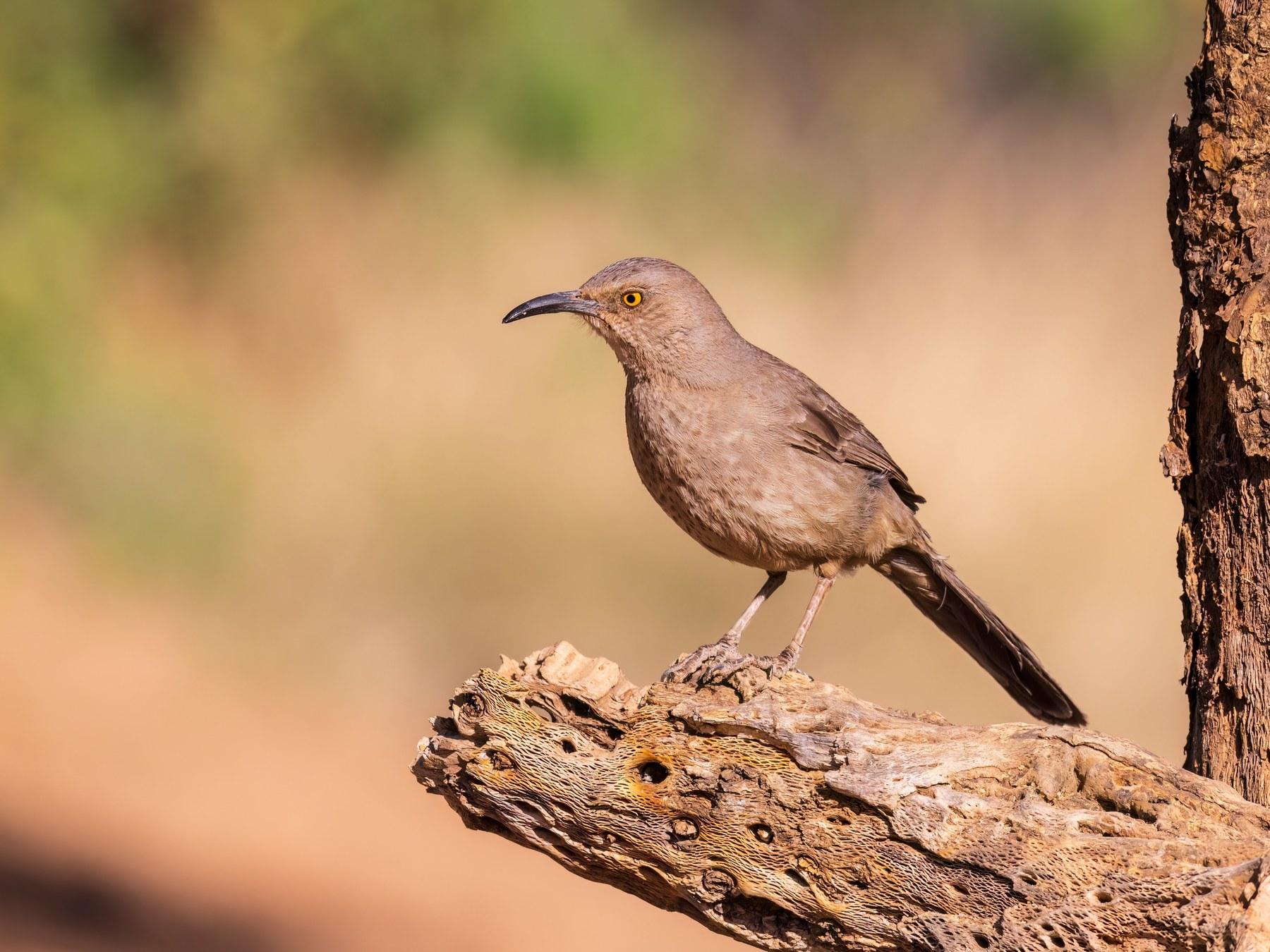
Size it up against an American Robin: about the same size, but slimmer and longer-tailed, and plain gray-brown. Then look for the long, dark, down-curved bill and the bright orange to yellow eye. It spends much of its day on the ground under cactus and thorny shrubs, digging for insects, and its loud, whistled "whit-wheet" often gives it away before you see it.
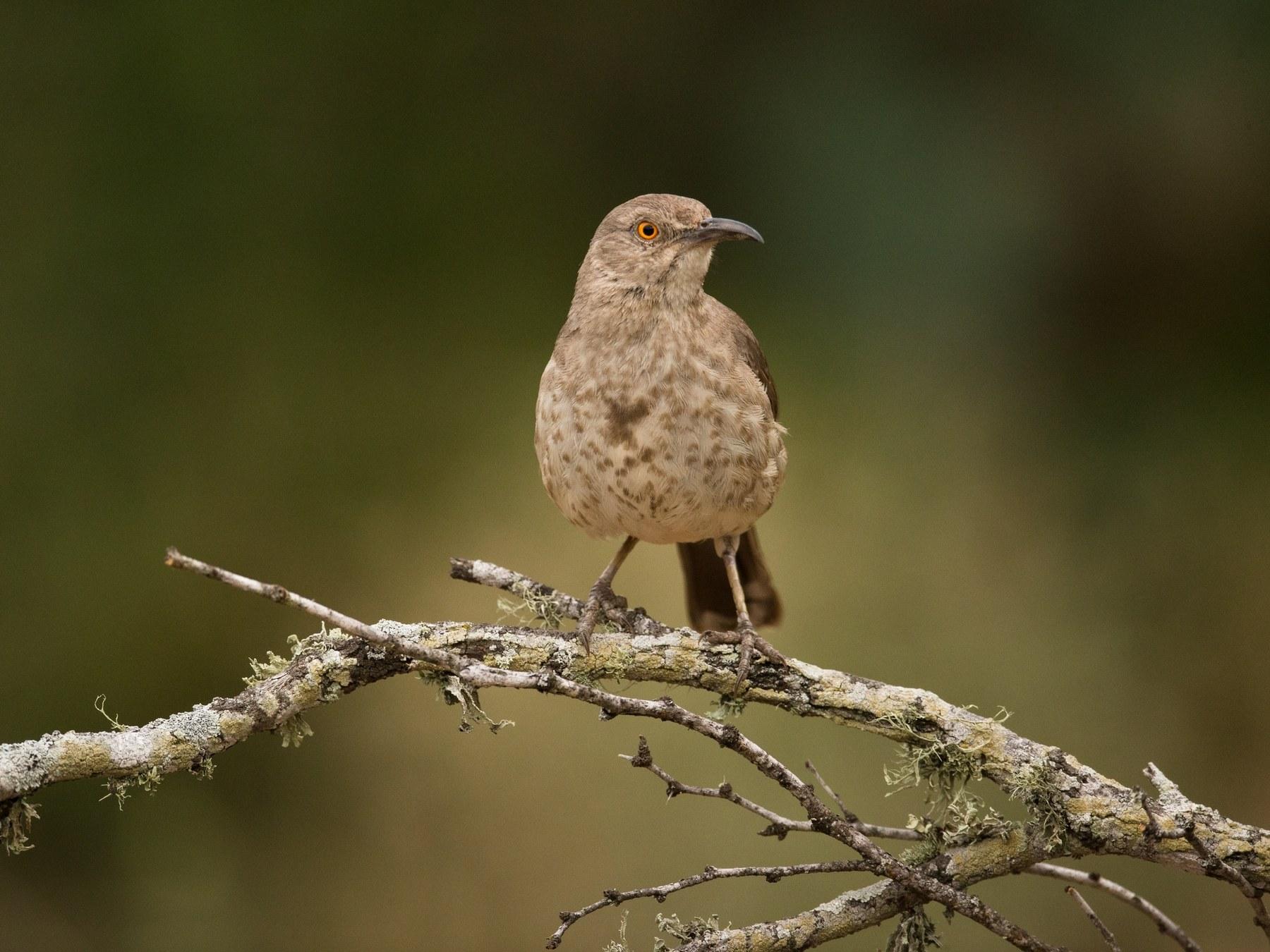
Up close, the upperparts are fairly plain gray-brown. The throat is white or buffy with a faint dark whisker, and the pale breast carries roundish gray-brown spots. There is a cinnamon-buff to rusty wash under the tail, and the long, dark tail has pale corners. The legs are thick and dark brown, as befits a bird that feeds on the ground. The bill is dull black or dark brown, though the base of the lower mandible can be paler.
Two groups look noticeably different. Eastern birds, in Texas, New Mexico, southeast Arizona and on the Mexican plateau, have a paler breast with bolder, darker spots, two thin whitish wing bars and broad white tail corners; adult eyes are orange. Western birds of the Sonoran Desert in Arizona and Sonora have a grayer breast with faint spots, dull or no wing bars, only small pale tail corners and a more yellow eye.
Plumage fades through spring and summer. In western birds the breast spots can wear away almost completely by June, so a plain-breasted thrasher in summer can still be this species.1
Size and weight
It is 10.6–11.0 in (27–28 cm) long, with a wingspan of 13.4–13.6 in (34–34.5 cm), and weighs 2.1–3.3 oz (60.8–93.6 g).2 That makes it bigger than a Bendire's Thrasher, its closest lookalike.
Breeding-season weights come from two samples. In a Tucson banding sample of western birds, 70 males averaged about 2.9 oz (80.9 g) and 38 females about 2.7 oz (75.8 g), while 31 south Texas birds of the eastern group averaged about 3.0 oz (85.2 g).1 Males also have slightly longer bills, wings and tails, but the sexes look alike.
Male, female and young birds
Males and females look alike in every plumage. There is no separate breeding plumage: adults molt all their feathers once a year after nesting, in July and August in eastern birds and from July into early October in Tucson birds.
Juveniles are browner above with a rufous tinge to the rump, and their breast marks are smaller and browner: often streaky or triangular in eastern birds, only vaguely spotted in western ones. The bill is shorter and straighter, and the eye is duller, taking about three months after fledging to reach the adult color in western birds. Some young western birds cannot be told from young Bendire's Thrashers by plumage at all.
Identification: similar birds
In Arizona, western New Mexico and northern Sonora, the bird to rule out is Bendire's Thrasher. Bendire's is smaller, with a shorter, straighter bill, usually pale at the base of the lower mandible, whose lower edge is rounded. An adult Curve-billed Thrasher's bill is longer and more curved, usually all dark, and its lower edge angles sharply. In fresh plumage, Bendire's shows fine pointed spots on the upper breast. Eye color overlaps between the two and does not help.
Young birds are the hardest. A young Curve-billed can have a bill as short and straight as a Bendire's, and a yellow gape that looks like a pale bill base, and young of either species may show fine pointed breast spots. Listen as well as look: the whistled "whit-wheet" sets the Curve-billed apart from the other thrashers that share its range.
A Crissal Thrasher has plain, unspotted underparts, a dark rusty patch under the tail, a black whisker stripe and a longer, more strongly curved bill. A LeConte's Thrasher is paler than western Curve-billed birds on the head, back, tail and breast. In south Texas, the Long-billed Thrasher is more rufous, with darker spots on a whiter breast and bolder wing bars, while the Curve-billed is paler, grayer, heavier and shorter-tailed. A Brown Thrasher, a winter visitor to south Texas, is rufous-brown above with bolder streaks below and a shorter, less curved bill with a pale base.
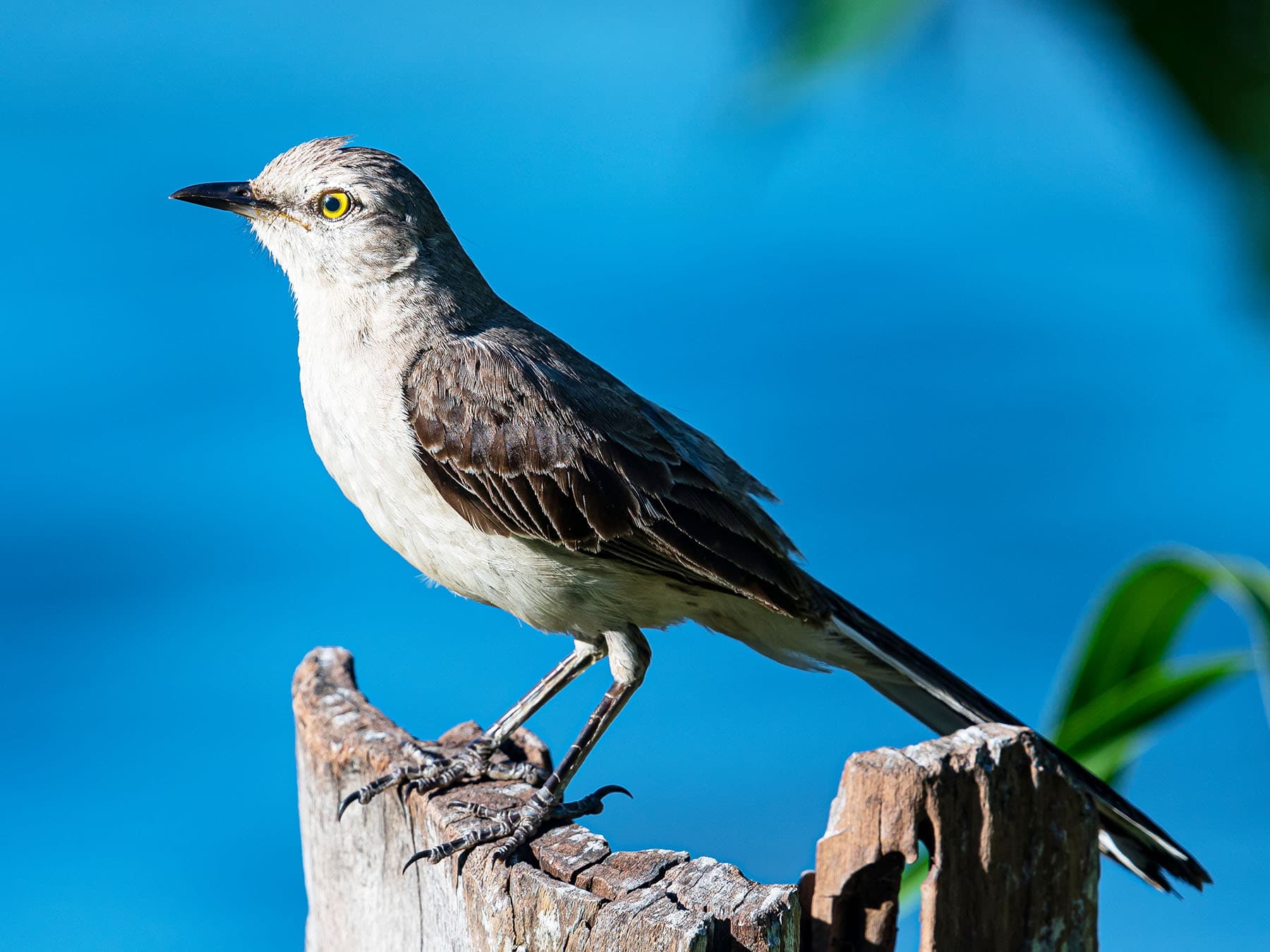
A Northern Mockingbird has a similar long-tailed shape but a slighter build and a different bill. Mockingbirds sometimes copy the thrasher's whistle, so the call alone is not proof.
Not sure it’s a Curve-billed Thrasher? Check your photo: Birdfact names the bird and shows the look-alike side by side.
Its size
Adults- Length
- 27–28 cm
- Wingspan
- 34–34.5 cm
- Weight
- 60.8–93.6 g
Its song and calls
The sound to learn is the call: a loud, sharp, high whistle, usually of two notes, "whit-wheet", and sometimes of three or up to five. Both sexes give it all year, to hold their territory, to keep in touch with a mate or young and in alarm, and they give it softly at the nest. It is often the first desert bird call that visiting birders learn.2
Other calls include a scolding, wren-like "chrrr", lower in the female, a "chirp" the female gives while feeding small young, a throaty, wooden "kuk" given at snakes, and the begging "chack" of fledglings.
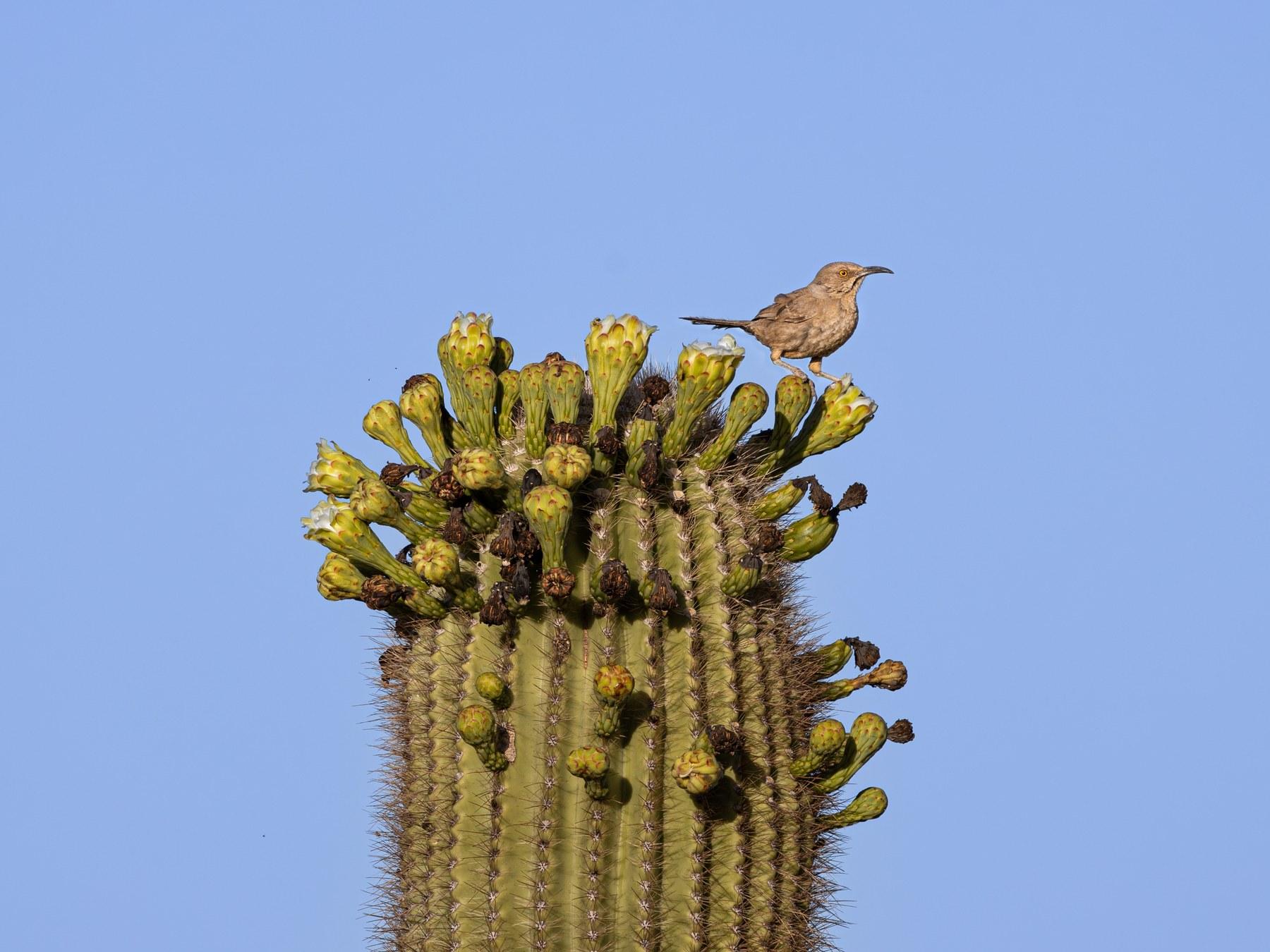
The song is a long warble broken by pauses, sometimes with call notes worked in. No female song has been reported. Songs usually last under a minute, but in a study of one pair a song ran for up to 14 minutes.1 Western birds start singing in December and sing from mid-January into March, and at intervals as late as mid-July; in Texas, song runs mainly from March into July. Males sing at dawn, at dusk and through the day from the top of a mesquite, a shrub, a tall cactus or a post, at regular spots around the territory.
Eastern birds in Texas sometimes work imitations of other species, such as Scissor-tailed Flycatcher and Northern Cardinal, into the song, and they rarely sing at night. The main handbook account, written in 1996, had no report of mimicry from Arizona.1 A 2010 note then reported the first mimicry in the western subspecies, a bird near Tucson countersinging with a migrating Black-headed Grosbeak, and documented night singing there for the first time, by at least three birds.3
- Whit-wheet call0:00 / 0:04
Recorded in Cochise County, United States · November 2024
- Call series0:00 / 0:30
Recorded in Tucson, United States · August 2025
Heard one and not sure? Let the bird song identifier listen.
When and where to see it
The Curve-billed Thrasher lives all year in the arid Southwest of the United States, in Arizona, New Mexico and Texas, with smaller numbers in southeast Colorado, southwest Kansas and the Oklahoma panhandle. Its range continues south through northern and central Mexico to Puebla and Oaxaca.
In the US, western birds breed across southern and central Arizona below about 4,600 ft (1,400 m) wherever cholla cactus grows, east of the lower Colorado River. Eastern birds breed in southeast Arizona, most of New Mexico, west and south Texas, southeast Colorado, where they are uncommon and local, four counties of southwest Kansas, and parts of the Oklahoma panhandle and the southwest of that state. Eastern birds range up to about 9,800 ft (3,000 m).
Look for it in open desert scrub and thornscrub with cholla, prickly pear, yucca and mesquite. In Arizona that means creosote-bush flats, saguaro and palo verde desert, grassland with cholla, and towns; in Texas, open brushland; on the plains of Colorado, grassland with cholla. In south Texas it uses more open ground than the Brown or Long-billed Thrasher. It also lives in towns and suburbs, as long as some native plants, especially cholla, remain.
Cholla matters most of all. In the Arizona Breeding Bird Atlas, 90% of 87 nests were in six species of cholla, and the birds avoided sparse Sonoran Desert without it.4
Range and movements
It does not migrate. In Arizona all 115 banding recoveries came from the same or the next 10-minute banding block, with no sign of migration.1 Some northern eastern birds were once described as partly migratory, but the 1996 account says that may be premature, given reports of birds staying all year in Colorado and the Oklahoma panhandle.
Young birds seem to leave home soon after they become independent. Of 345 juveniles banded at Tucson, 71% were never caught again and only 7% were caught at the same site more than a year later, which suggests fairly quick dispersal along with heavy losses.1
Strays beyond the range are rare and turn up mostly in fall and winter. The 1996 account lists it as a casual visitor to California's Colorado River and Imperial valleys, Nevada and southwest Utah, and as accidental as far away as Minnesota, Wisconsin, New Hampshire and Manitoba. It apparently spread into Colorado after 1951.
Tips for seeing it
What it eats
It eats mainly insects and other small animals: beetles, ants, termites, grasshoppers, caterpillars, spiders, snails, sowbugs and other crustaceans. Berries, cactus fruit and seeds make up the rest of its food.
It feeds on the ground, flicking litter aside with its bill rather than scratching with its feet, and tossing away bigger items such as fallen cholla joints. It digs holes up to about 2 in (5 cm) deep. In hard or sandy soil it braces its tail on the ground and hammers down with its bill.
Two stomach studies show how the menu varies. In south Texas in March, beetles made up 45.5% of the items, crustaceans 19.8%, snails 16.6% and spiders 12.4%. In Arizona from February to June, ants and their relatives made up 37.0%, termites 25.9% and beetles 18.3%. Grasshoppers and crickets made up 60.4% of 433 items brought to nestlings in south Texas.1
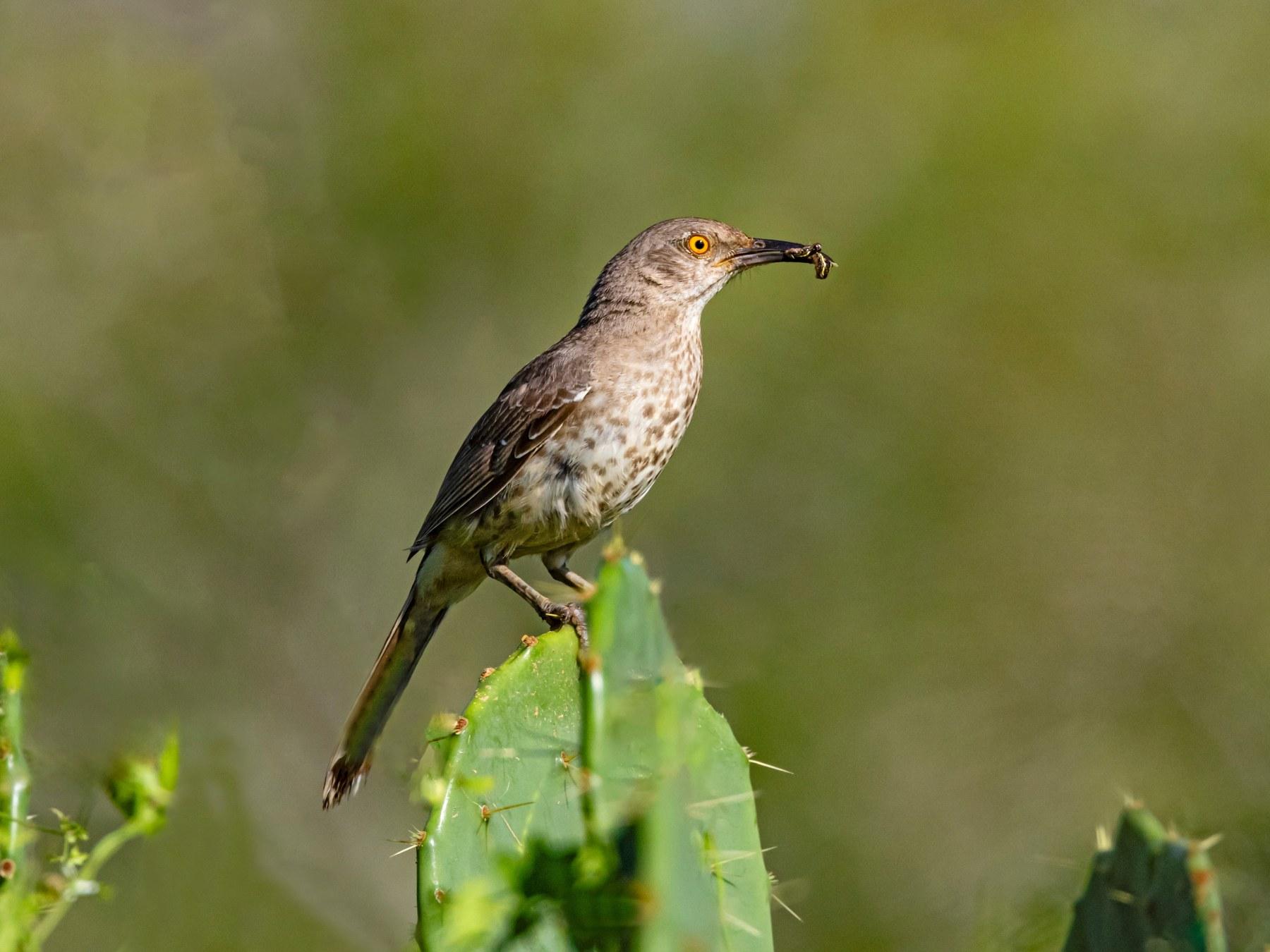
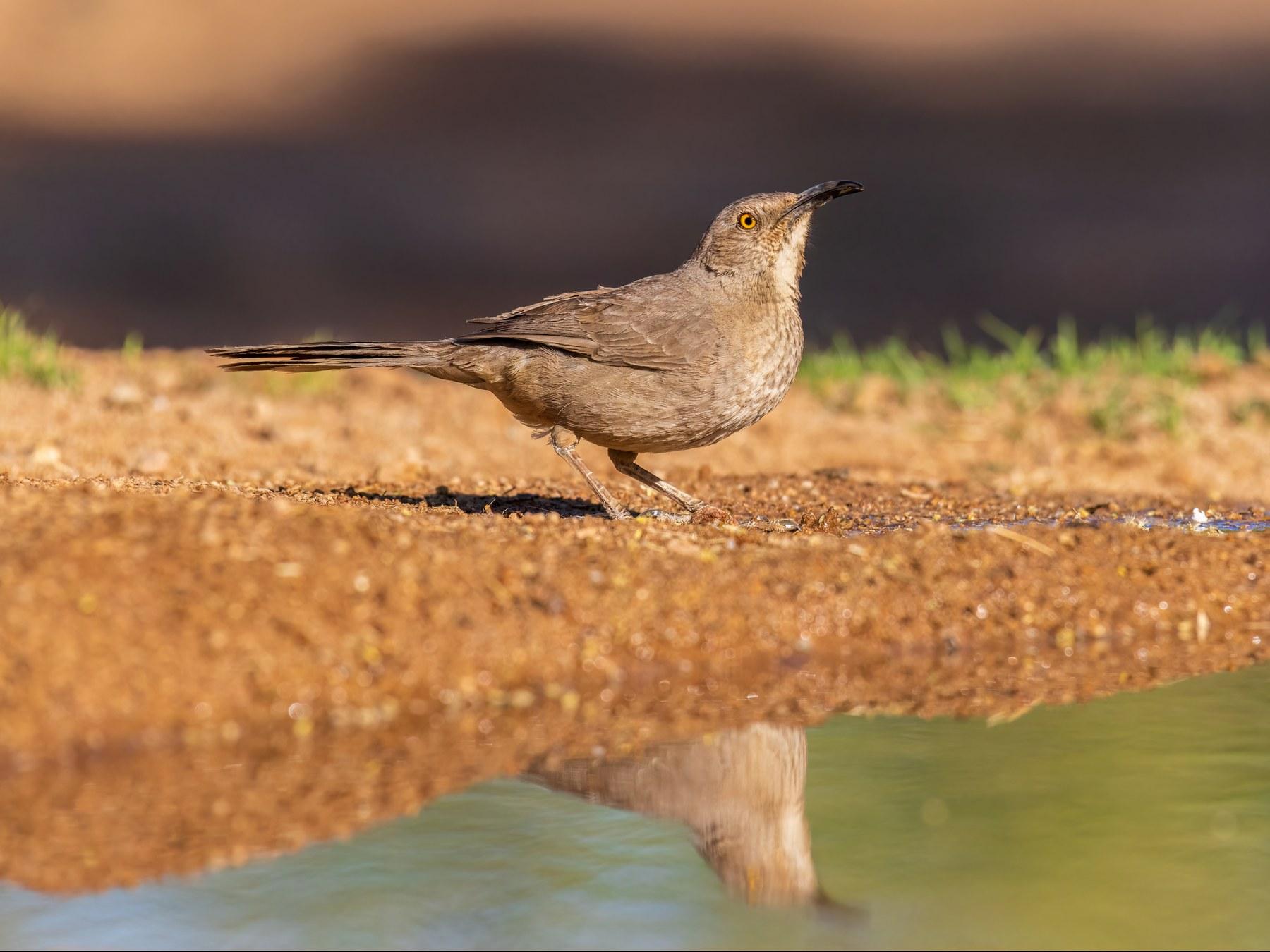
Fruit is also a source of water. In May and June, the hottest and driest months, cactus fruit provides both water and nourishment, and in Arizona in June and July adults switch from insects early in the morning to moist saguaro fruit.1 It also eats saguaro and other cactus seeds and hackberry seeds, and it drinks at dripping taps, water holes and other reliable water.
Feeding in your garden
Within its range it often visits yards where seeds, berries, insects and water are put out, especially on platform feeders or on the ground, and it can sometimes boss smaller birds at feeding stations.2 A large yard with native plants may even hold a nesting pair.
In a study of 20 Phoenix yards offered millet on trays, it turned up in 15, more than any of the 14 species that visited, and it ate seed faster than the other three commonest visitors.5
Nesting and breeding
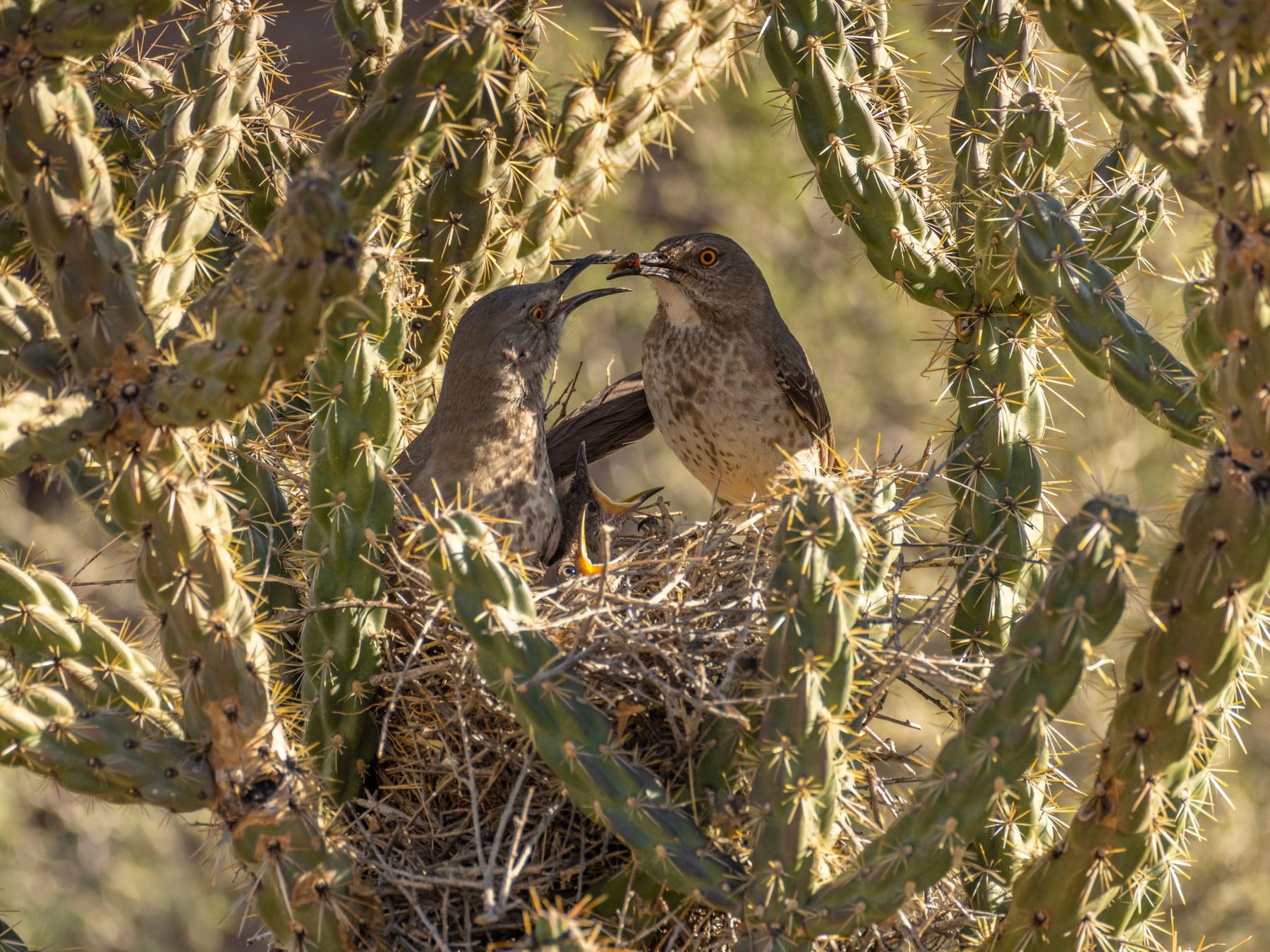
Most nests are in cholla cactus where it grows, often jumping cholla in Arizona. Elsewhere it nests in yucca, prickly pear, mesquite, thorny shrubs, small trees or mistletoe, and a few nests have been found in holes in saguaros or sycamores.
The nest is a bulky, open cup of thorny twigs, lined with fine grass, rootlets, hair or feathers. Both sexes build it, gathering twigs from the ground or breaking them off branches, and snapping off cactus spines that get in the way with a twist of the head. A pair sometimes builds several nests. Flowers or greens are often placed in the nest 1–3 days before the first egg is laid.1 Arizona nests are usually 3–5 ft (1–1.5 m) up, while 76 south Texas nests averaged about 5.8 ft (1.8 m).1
Nesting in cavities or man-made structures has rarely been reported. At Lubbock, Texas, one pair nested in an American Kestrel nest box from 2021 to 2025, and two more boxes were used in 2025, which the author believes is the first documented successful use of nest boxes by the species.6
Eggs and young
In Arizona, nesting starts in February, once as early as about 26 January in a mild winter. It peaks from March to May and drops sharply in June, with eggs as late as 30 July. Timing seems to follow winter rain: after a dry winter at Organ Pipe, nests were not found until May. In Texas, active nests peak in May, with some into August.1
The eggs are pale blue-green, densely dotted with reddish brown, and about 1.1 by 0.8 in (28–29 by 20 mm). Clutches are larger in the east: south Texas nests averaged 3.8 eggs (3–5, 67 nests) and northeastern Mexican nests mostly held 4, while southeast Arizona studies averaged 2.5–3.2.1 In one wet year near Tucson, 1979, 38 clutches averaged 2.53 eggs.4
Both parents incubate by day, the female more than the male in south Texas, and the female sits at night. Incubation lasts about 14 days in south Texas (12–15 days). The chicks hatch nearly naked with sparse gray down and open their eyes at 4–5 days. Only the female broods them, and both parents feed them, the female making most of the trips.
The young leave the nest at about 14 days in south Texas (11–16) and at 14–18 days in Arizona, on foot, hopping through the cholla with their tails less than half grown. They fly weakly at 18 days and well by about 24, and they are independent at about 40 days. South Texas pairs usually lay two clutches a season, or three if the first two fail, and Arizona pairs in saguaro and palo verde desert averaged 2.2 clutches, up to 4.1
Success varies with the year and the place. In south Texas in 1977–78, 138 of 194 eggs hatched and 85 young fledged.1 In the wet 1979 season near Tucson, 36 of 38 nests hatched at least one egg and 80% of 96 eggs produced fledglings, far above earlier Arizona studies.4 When food runs short in Arizona, the older, larger chicks are fed first and the youngest may starve. Cowbirds rarely use its nests: only 2 of about 1,000 nest records held cowbird eggs.1
Behaviour
It walks quickly while foraging and runs or hops in a jerky way. Its flight is quick and jerky, usually low from bush to bush, often with the spread tail dipping, and it sometimes climbs trees.
Pairs hold the same territory all year and are probably mated for life, staying together as long as both survive. In south Texas, 8 of 9 pairs nested on the same territory the next year, and in Arizona, when breeding birds were removed, they were quickly replaced. Territories were about 5 acres (2 ha) in south Texas and 6–11 acres (2.5–4.5 ha) in Arizona saguaro and palo verde desert in a wet enough year. Territorial chases can last up to 15 minutes, and fights can rise 6 ft (1.8 m) into the air.1
City birds can be more territorial. In a Phoenix study that staged territorial intrusions, city thrashers responded more strongly than desert birds, and more so where desert-type plants made up much of the vegetation.7
In Arizona it shares the desert with the Cactus Wren, often nesting in a nearby cholla, on average 115–174 ft (35–53 m) away and once just 6 in (15 cm). Neither attacks the other's breeding nest, but thrashers pull apart wren roosting nests and old nests in their territories and push wrens off food on the ground.1
In Arizona it roosts in cholla, usually on a level branch near the trunk, and in winter it often builds a stick platform to roost on. It sleeps with its bill turned over its back.
In Arizona, its stress-hormone response to capture was damped in the hottest summer months, as in Cactus Wrens and Black-throated Sparrows, and the authors suggest this may let breeding continue in severe heat.8
Lifespan and predators
The oldest known wild Curve-billed Thrasher lived for at least 10 years 9 months. It was banded in Arizona on 3 February 1936, when already past its hatching year, and found dead in Arizona on 30 March 1946; it is the only longevity record the US Bird Banding Laboratory holds for the species.9 No source we read gives a typical lifespan. In south Texas, 17 of 18 marked adults lived to the next breeding season, and in one Arizona study banded breeding birds survived at about 79% a year.1
Nest predators in Arizona include gopher snakes, common kingsnakes, desert spiny lizards, Greater Roadrunners and ground squirrels, and snakes were the main predators of eggs and young in south Texas. A Harris's Hawk took a fledgling in south Texas, and adults have driven a roadrunner away from the nest. In a 1941 study of their development, thrashers older than about 24 days faced a snake from about 1.6 ft (0.5 m) away with their wings spread flat, giving a wooden "kuk".1
Weather takes a toll too. A cold 1.6 in (41 mm) March rain in Arizona in 1968 killed all seven nestlings aged 3–6 days at the nests studied, while Cactus Wren chicks in covered nests survived.1
Conservation
The Curve-billed Thrasher is rated Least Concern on the IUCN Red List.10 Partners in Flight estimates about 3.1 million breeding-age birds, as of around 2010, about 1 million of them in the US; the rest live in Mexico.11
In the US, the North American Breeding Bird Survey shows a long-term decline of 1.20% a year from 1967 to 2025 on 245 routes, a statistically clear fall. The survey's index roughly halved over that time, from 3.00 birds per route to 1.49.12 Over the last ten years, 2015 to 2025, the estimate is a fall of 1.86% a year, but it is too uncertain to call. Most of the decline is in Texas, at 2.07% a year, while Arizona, New Mexico and Oklahoma show no clear change and Colorado has increased by 3.38% a year.12 The survey covers only the US share of the population, and we found no measured trend for the birds in Mexico.
Conservation pressures
The main handbook account, written in 1996, says much south Texas brushland has been lost and, citing a 1973 study, that rapid habitat loss around Phoenix and Tucson was seriously affecting numbers. It adds that conversion of land to buffel grass in Sonora has affected millions of hectares.1 Long-term declines may be due to habitat loss to development and farming in south Texas and Arizona.2
The bird has its strengths too. The same 1996 account says it appears to have been the least affected by people of the southwestern thrashers.1 Partners in Flight's Mexican committee calls it very flexible and tolerant of disturbance, while noting that it is used in the cage-bird trade in Mexico.11
Legal status
In the United States it is on the federal list of birds protected under the Migratory Bird Treaty Act.13 Under the federal regulations, no one may take, possess, sell, transport or otherwise deal in such a bird, its parts, nests or eggs except as a permit or regulation allows.14 It is not listed under the Endangered Species Act.15
In Mexico it is not on the 2010 national list of species at risk, NOM-059-SEMARNAT-2010; we did not read later changes to the list.16 In Canada, where it has turned up only as an accidental visitor, the thrashers are among the families in the Migratory Birds Convention Act's schedule.17
Names and relatives
The name is something of a misfit. Several other thrashers, including LeConte's, Crissal and California, have more strongly curved bills, but they were not yet known when Swainson described this one in 1827 from a specimen from the Mexican plateau. Its scientific name, Toxostoma curvirostre, joins Greek words for a bow and a mouth, for the arched bill, with Latin for "curved-billed". In Spanish it is the cuitlacoche piquicurvo.
Seven subspecies are recognized, in two groups. The western palmeri group runs from Arizona south through Sonora and Sinaloa to Jalisco, including birds on Tiburón and San Esteban islands, and the eastern curvirostre group from southeast Colorado and southwest Kansas through New Mexico and Texas to central Mexico. The 1996 account says the two may be separate species. Mitochondrial DNA from 66 birds sorted them into these two groups plus a third, southern group in Puebla and Oaxaca.18 A study of 821 male museum skins found the eastern and western groups divided by the Sierra Madre Occidental.19 A later DNA study says the three groups amount to two species or three, according to which species concept is applied, and no checklist we read splits it.20
Its lookalike is not its closest relative. A genus-wide genetic study placed Bendire's Thrasher nearest the Gray Thrasher, only 1.6% apart in mitochondrial DNA.21
Similar birds
Often mistaken for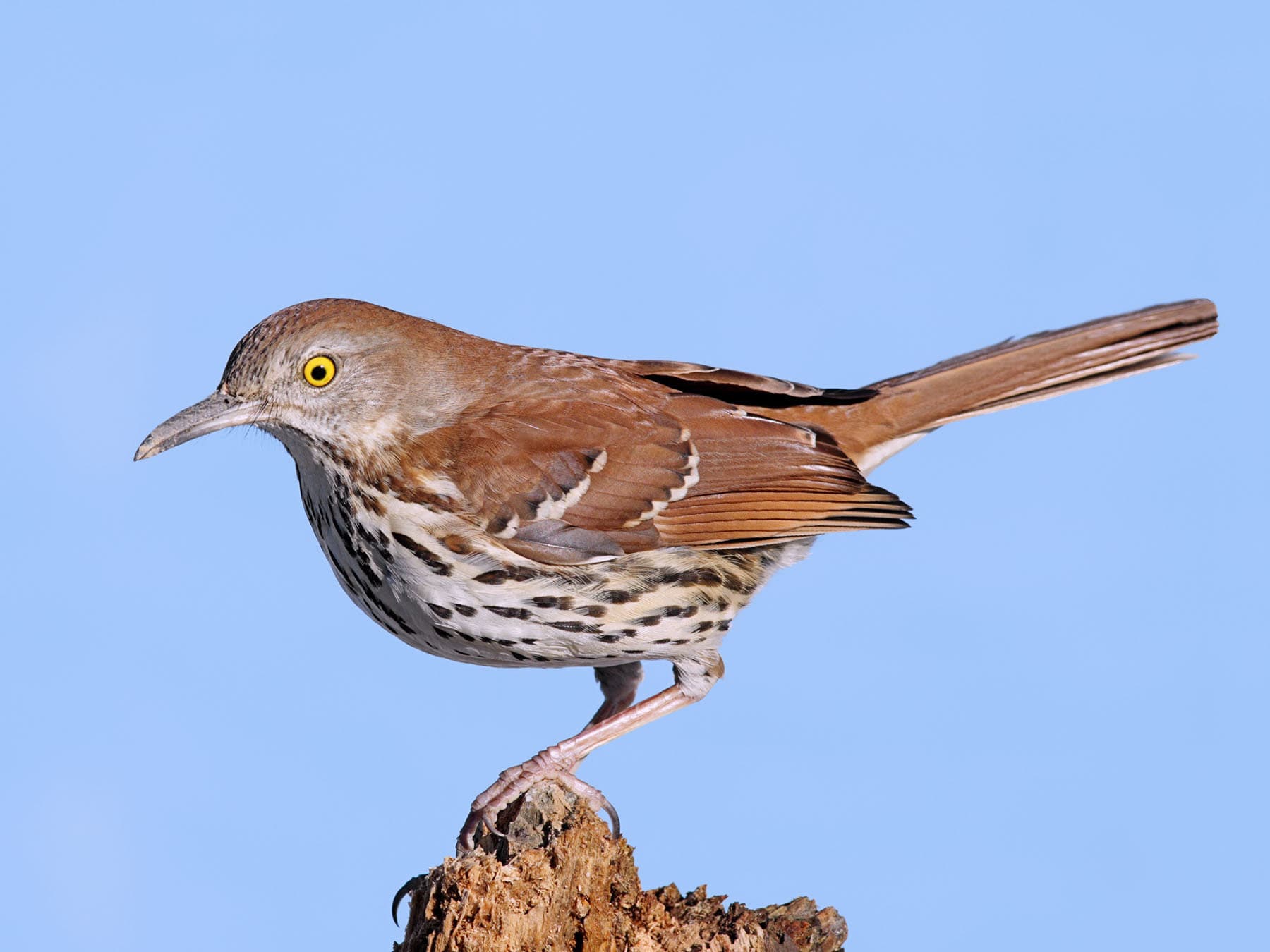
Quick facts
- Length
- 27–28 cm
- Wingspan
- 34–34.5 cm
- Weight
- 60.8–93.6 g
- Lifespan
- oldest recorded 10 years 9 months
- Family
- Mockingbirds & Thrashers
- Migration
- Resident
- Global status (IUCN)
- Least Concern
- World population
- About 3.1 million (Partners in Flight, around 2010)
- Population trend
- A long-term decline in the US Breeding Bird Survey since 1967, about half the 1967 level by 2025 and driven mostly by Texas; the last ten years' estimate is too uncertain to call, Arizona shows no clear trend and Colorado has increased; most of the population lives in Mexico, which the survey does not cover
- Scientific name
- Toxostoma curvirostre
Sources
31- 1Tweit, R. C. (2020). Curve-billed Thrasher (Toxostoma curvirostre), version 1.0. Birds of the World (A. F. Poole and F. B. Gill, editors). Cornell Lab of Ornithology. doi:10.2173/bow.cubthr.01 (opens in a new tab)
- 2Cornell Lab of Ornithology. Curve-billed Thrasher: Overview, Identification and Life History. All About Birds. Accessed 21 November 2026. Source (opens in a new tab)
- 3Johnson, R. R. and Haight, L. T. (2010). Occasional Mimicry and Night-time Singing by the Western Curve-billed Thrasher (Toxostoma curvirostre palmeri). The Wilson Journal of Ornithology 122(3): 625-626. doi:10.1676/10-022.1 (opens in a new tab)
- 4Littlefield, C. D. (2009). Curve-billed Thrasher Reproductive Success after a Wet Winter in the Sonoran Desert of Arizona. Western Birds 40(3): 234-236. doi:10.21199/wb40.3.6 (opens in a new tab)
- 5Lerman, S. B., Warren, P. S., Gan, H. and Shochat, E. (2012). Linking foraging decisions to residential yard bird composition. PLoS ONE 7(8): e43497. doi:10.1371/journal.pone.0043497 (opens in a new tab)
- 6Boal, C. W. (2026). Successful nesting by Curve-billed Thrashers (Toxostoma curvirostre) using American Kestrel (Falco sparverius) nest boxes. The Wilson Journal of Ornithology: 1-5. doi:10.1080/15594491.2026.2719979 (opens in a new tab)
- 7Fokidis, H. B., Orchinik, M. and Deviche, P. (2011). Context-specific territorial behavior in urban birds: No evidence for involvement of testosterone or corticosterone. Hormones and Behavior 59(1): 133-143. doi:10.1016/j.yhbeh.2010.11.002 (opens in a new tab)
- 8Wingfield, J. C., Vleck, C. M. and Moore, M. C. (1992). Seasonal changes of the adrenocortical response to stress in birds of the Sonoran Desert. Journal of Experimental Zoology 264(4): 419-428. doi:10.1002/jez.1402640407 (opens in a new tab)
- 9USGS Bird Banding Laboratory (2025). Longevity Records of North American Birds, version 2025.1 (AOU 7070). U.S. Geological Survey. Accessed 21 November 2026. Source (opens in a new tab)
- 10BirdLife International (2018). Toxostoma curvirostre. The IUCN Red List of Threatened Species 2018 (via GBIF's copy of the IUCN checklist). IUCN Red List / GBIF. doi:10.2305/IUCN.UK.2018-2.RLTS.T22711115A132093983.en (opens in a new tab)
- 11Partners in Flight (2024). Avian Conservation Assessment Database, Global (version 2024.05.23). Partners in Flight. Accessed 21 November 2026. Source (opens in a new tab)
- 12Hostetler, J. A. et al. (2026). The North American Breeding Bird Survey, Analysis Results 1966 - 2025. U.S. Geological Survey. doi:10.5066/P1OSNSFC (opens in a new tab)
- 13U.S. Fish and Wildlife Service (2026). 50 CFR 10.13 List of Migratory Birds (eCFR, issue of 2026-11-17). Electronic Code of Federal Regulations. Accessed 21 November 2026. Source (opens in a new tab)
- 14U.S. Fish and Wildlife Service (2026). 50 CFR 21.10 (eCFR, issue of 2026-11-17). Electronic Code of Federal Regulations. Accessed 21 November 2026. Source (opens in a new tab)
- 15U.S. Fish and Wildlife Service (2026). 50 CFR 17.11 Endangered and threatened wildlife (eCFR, issue of 2026-11-17). Electronic Code of Federal Regulations. Accessed 21 November 2026. Source (opens in a new tab)
- 16SEMARNAT (2010). NOM-059-SEMARNAT-2010 (DOF 30/12/2010). Diario Oficial de la Federación. Accessed 21 November 2026.
- 17Government of Canada (1994). Migratory Birds Convention Act, 1994 (S.C. 1994, c. 22), Schedule. Justice Laws Website. Accessed 21 November 2026. Source (opens in a new tab)
- 18Zink, R. M. and Blackwell-Rago, R. C. (2000). Species Limits and Recent Population History in the Curve-Billed Thrasher. The Condor 102(4): 881-886. doi:10.1093/condor/102.4.881 (opens in a new tab)
- 19Rojas-Soto, O. R. (2003). Geographic variation of the Curve-billed Thrasher (Toxostoma curvirostre) complex. The Auk 120(2): 311. doi:10.1642/0004-8038(2003)120[0311:gvotct]2.0.co;2 (opens in a new tab)
- 20Rojas-Soto, O. R., Espinosa de los Monteros, A. and Zink, R. M. (2007). Phylogeography and Patterns of Differentiation in the Curve-Billed Thrasher. The Condor 109(2): 456-463. doi:10.1093/condor/109.2.456 (opens in a new tab)
- 21Zink, R. M., Dittmann, D. L., Klicka, J. and Blackwell-Rago, R. C. (1999). Evolutionary Patterns of Morphometrics, Allozymes, and Mitochondrial DNA in Thrashers (Genus Toxostoma). The Auk 116(4): 1021-1038. doi:10.2307/4089682 (opens in a new tab)
- 22England, A. S. and Laudenslayer, W. F., Jr. (2020). Bendire's Thrasher (Toxostoma bendirei), version 1.0: Identification. Birds of the World. Cornell Lab of Ornithology. doi:10.2173/bow.benthr.01 (opens in a new tab)
- 23Cody, M. L. (2020). Crissal Thrasher (Toxostoma crissale), version 1.0: Identification. Birds of the World. Cornell Lab of Ornithology. doi:10.2173/bow.crithr.01 (opens in a new tab)
- 24Tweit, R. C. (2020). Long-billed Thrasher (Toxostoma longirostre), version 1.0: Identification. Birds of the World. Cornell Lab of Ornithology. doi:10.2173/bow.lobthr.01 (opens in a new tab)
- 25National Audubon Society and Kaufman, K.. Curve-billed Thrasher. Audubon Guide to North American Birds. Accessed 21 November 2026. Source (opens in a new tab)
- 26National Park Service. Birds. Saguaro National Park. Accessed 21 November 2026. Source (opens in a new tab)
- 27National Park Service. Birds. Organ Pipe Cactus National Monument. Accessed 21 November 2026. Source (opens in a new tab)
- 28Fischer, D. H. (1980). Breeding Biology of Curve-Billed Thrashers and Long-Billed Thrashers in Southern Texas. The Condor 82(4): 392. doi:10.2307/1367560 (opens in a new tab)
- 29Novy, S. A. and Sizer, C. E. (2024). Curve-billed Thrasher (Toxostoma curvirostre) entanglement and mediated dispersal of Teddy Bear Cholla (Cylindropuntia bigelovii). The Southwestern Naturalist 69(1). doi:10.1894/0038-4909-69.1.5 (opens in a new tab)
- 30AviList Core Team (2025). AviList: The Global Avian Checklist, v2025b. AviList. doi:10.2173/avilist.v2025b (opens in a new tab)
- 31Jobling, J. A.. The Key to Scientific Names: Toxostoma; curvirostra / curvirostre / curvirostris. Birds of the World. Accessed 21 November 2026. Source (opens in a new tab)

Checked by
Nathan Cope, founder and editor
Nathan founded Birdfact and leads its writers and contributors in the UK, the US and Canada. He has watched and studied birds for more than ten years, and checks every article and species guide before it’s published.