
Blue Grosbeak
Passerina caerulea
By the Birdfact teamChecked by Nathan Cope
On this page14 sections
How to recognise it
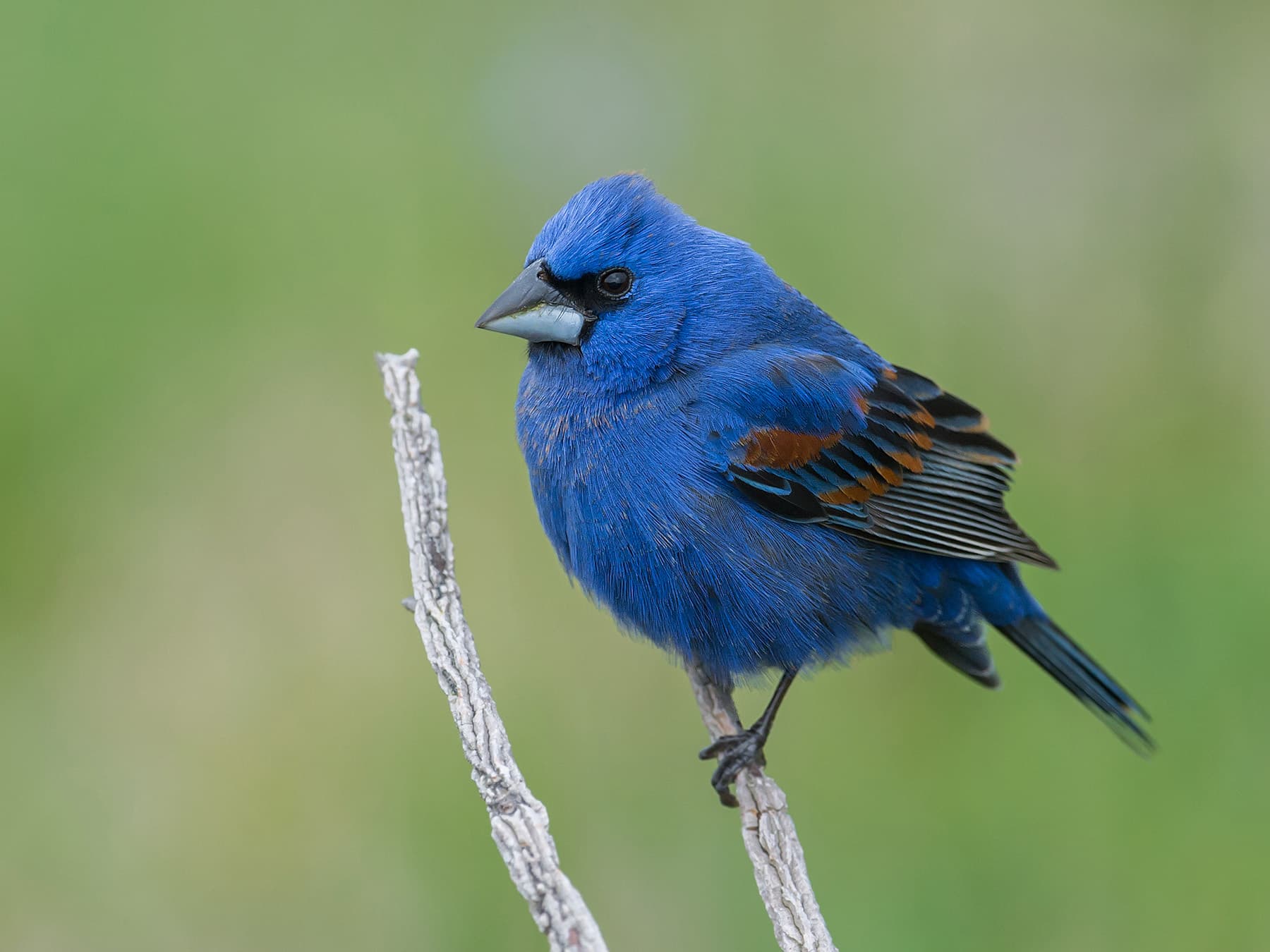
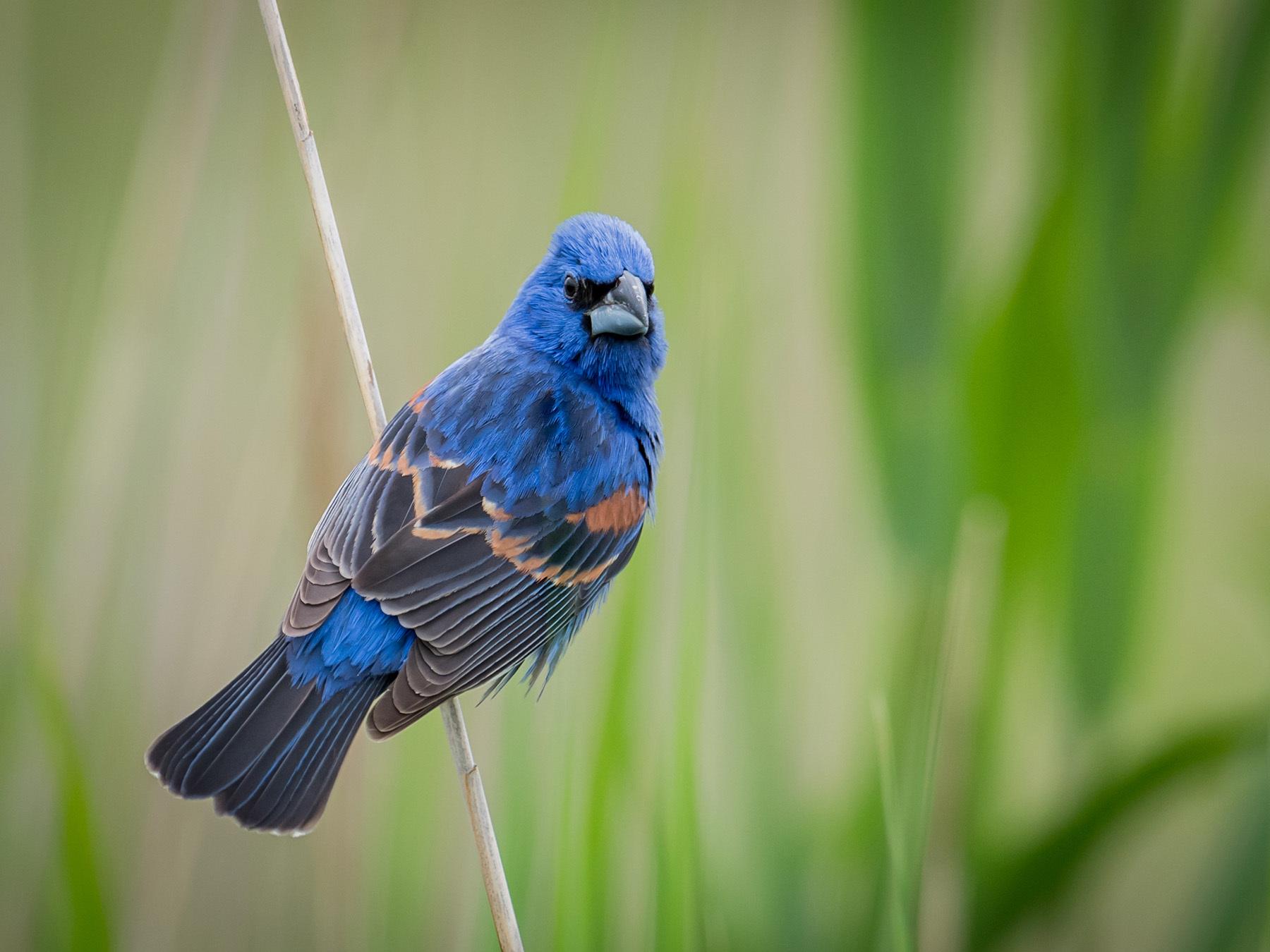
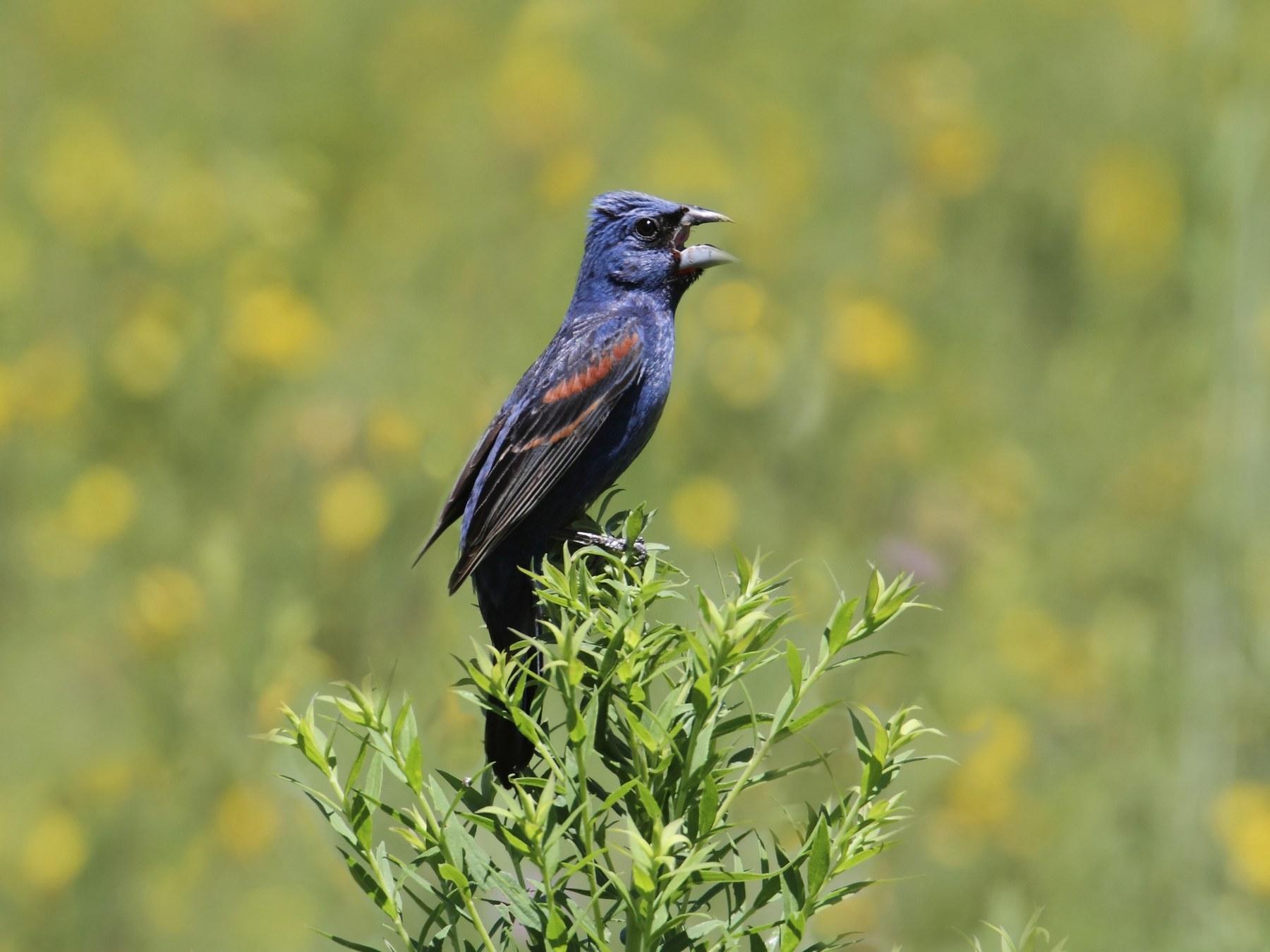
The breeding male is deep blue all over, more purplish in the East, with two chestnut wing bars on blackish wings. A small black mask runs from in front of the eye down to the chin, and the very heavy, conical bill is black above and silver below. In poor light he can look almost black.
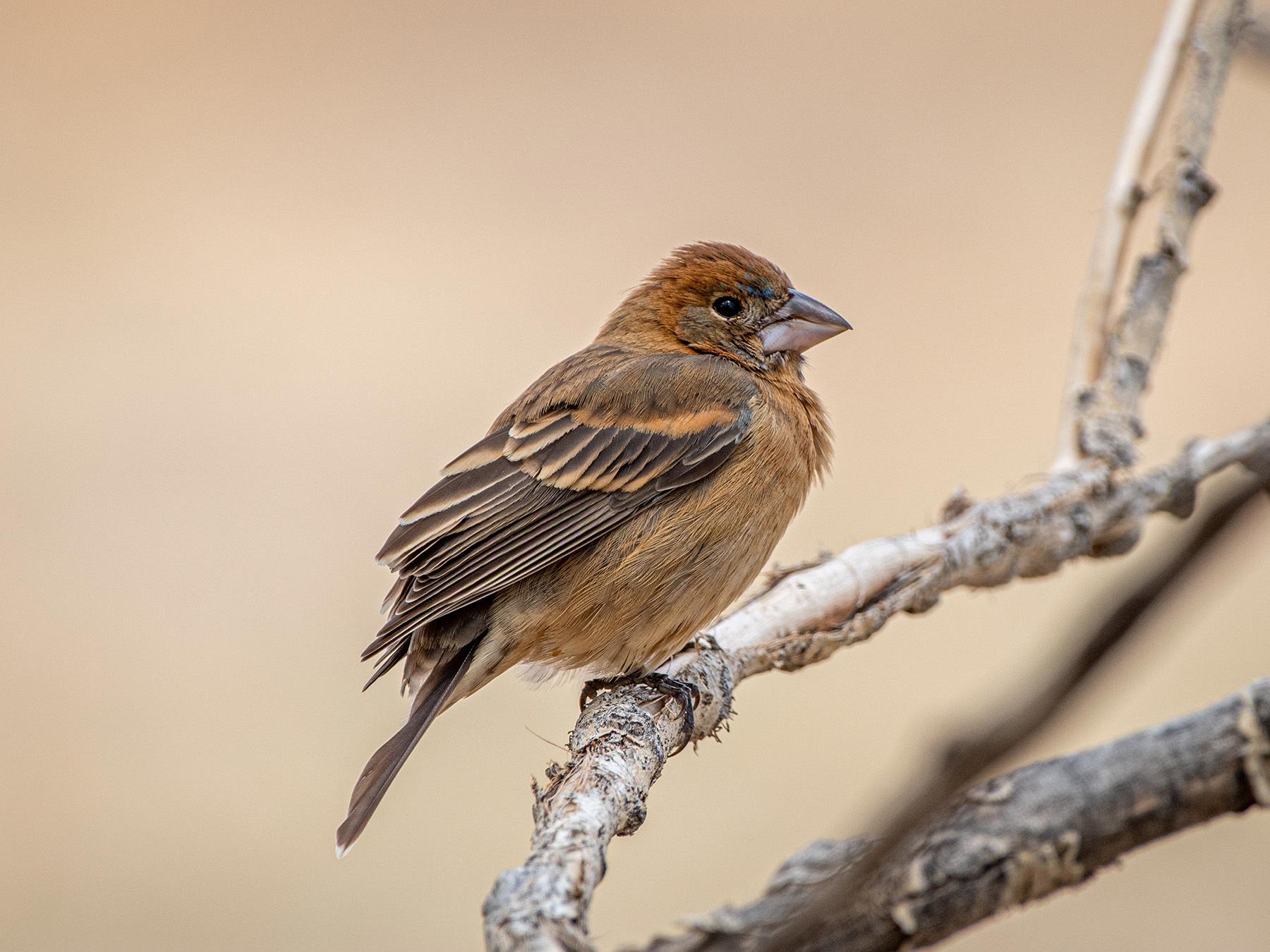
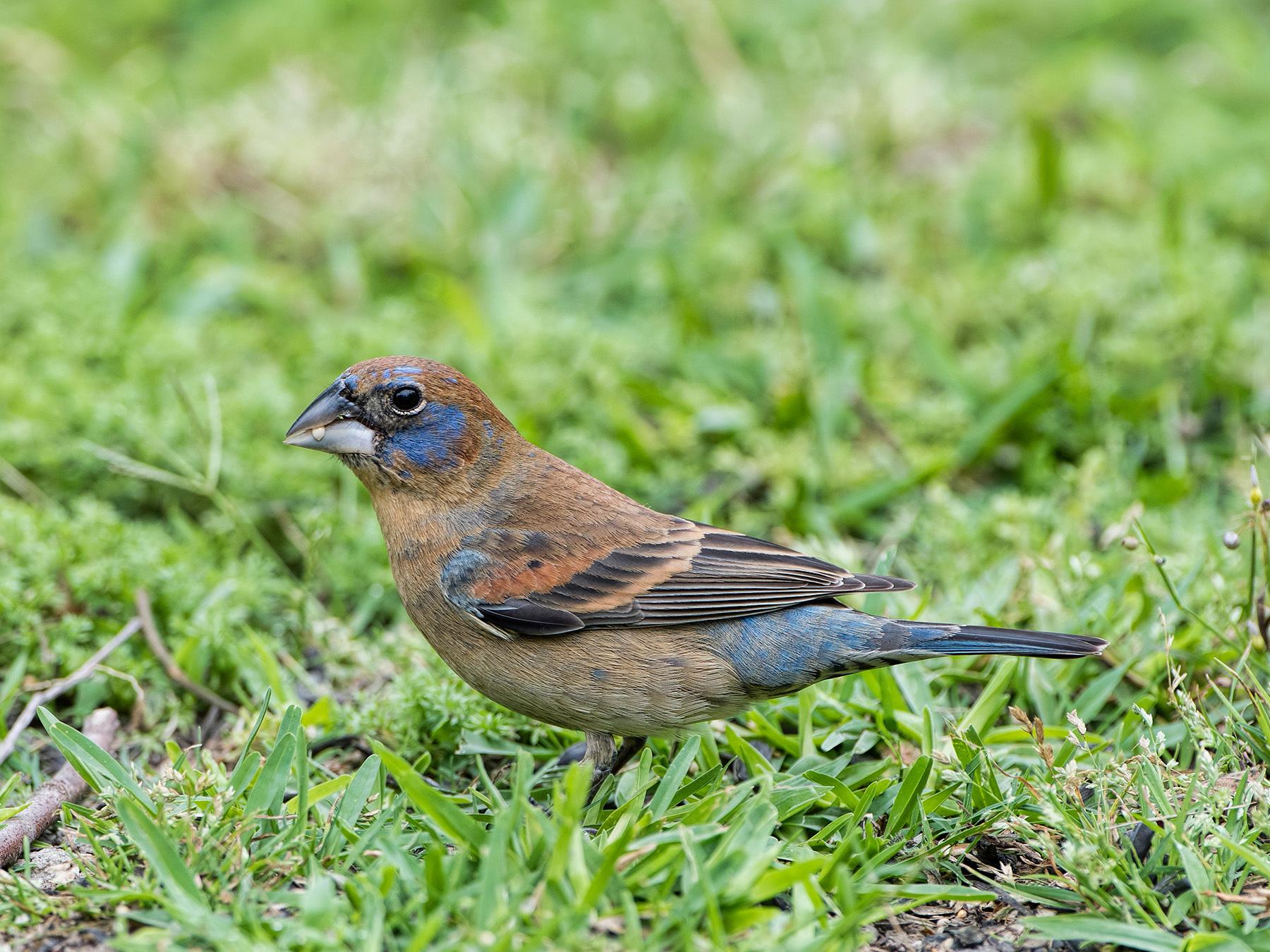
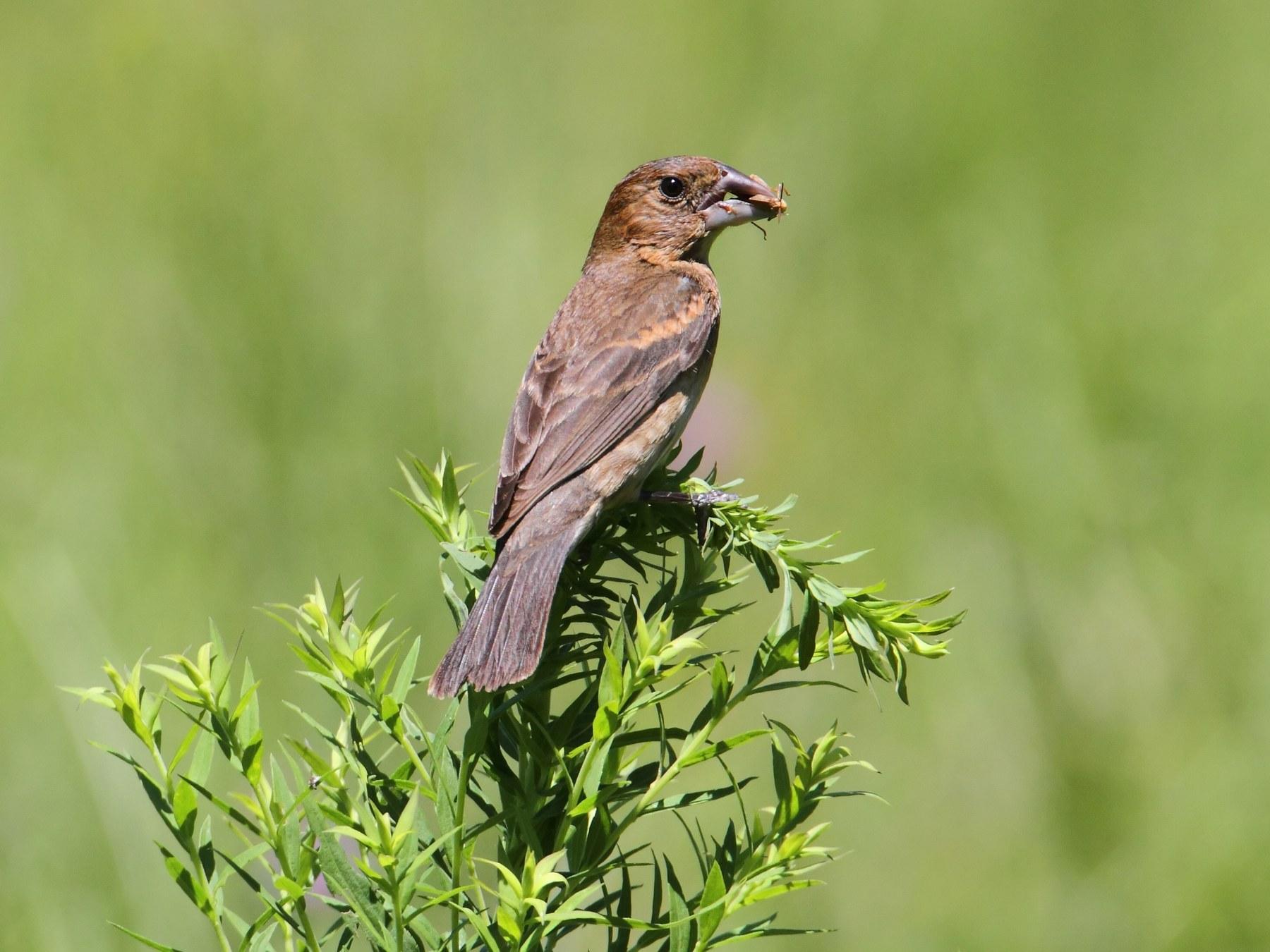
The female is warm cinnamon-brown, richest on the head and paler and unstreaked below. She has two buff to rusty-brown wing bars, paler than the male's, and sometimes a bluish tinge on the shoulders, rump or tail. She has the same huge two-toned bill.
It often swishes its tail from side to side or spreads it, a habit worth watching for.
Size and shape
It is about 6 in (15–16 cm) long, with a wingspan of 11–12 in (28–30 cm), and weighs 0.9–1.1 oz (26–31 g). Among its lookalikes, the Indigo Bunting is smaller and the Brown-headed Cowbird slightly bigger. The male is slightly larger than the female.
Size varies across the range: wings get longer from east to west across the southern US and south into Mexico.
Male, female and young
A young male spends his first year mostly light brown with a varying amount of blue. He gains blue slowly through fall and winter, is usually bluest on the head by his first summer, and after that looks like any other adult male.
A patchy blue-and-brown male is not always a first-year bird, though. After the fall molt the adult male's blue feathers have brown tips, so from September to December he looks mostly brown, or blue heavily mottled with brown. The tips wear off through winter and spring until he is entirely blue by March to July, and some adults keep a few brown tips into early summer. The adult male probably gets his bright spring blue mainly by this wear rather than by a molt, though that still needs confirming.1
Juveniles, seen from June to August, are brown all over in both sexes, with soft, fluffy feathers, dusky wings and two conspicuous buff wing bars tipped rusty. Some young males show a blue wash on the blackish tail.
The male's blue is a structural color that reflects most strongly in the blue and ultraviolet, so much of the difference between males is invisible to people. In one wild population, the bluest males had the largest bodies, held the largest territories with the most prey, and fed their nestlings most often at the first nest.2
Identification: similar birds
An Indigo Bunting is much smaller, about half the weight, with a smaller bill. The male Indigo has no chestnut wing bars, and the female has a paler throat and faint streaks below. Indigo Buntings also move the tail much less.
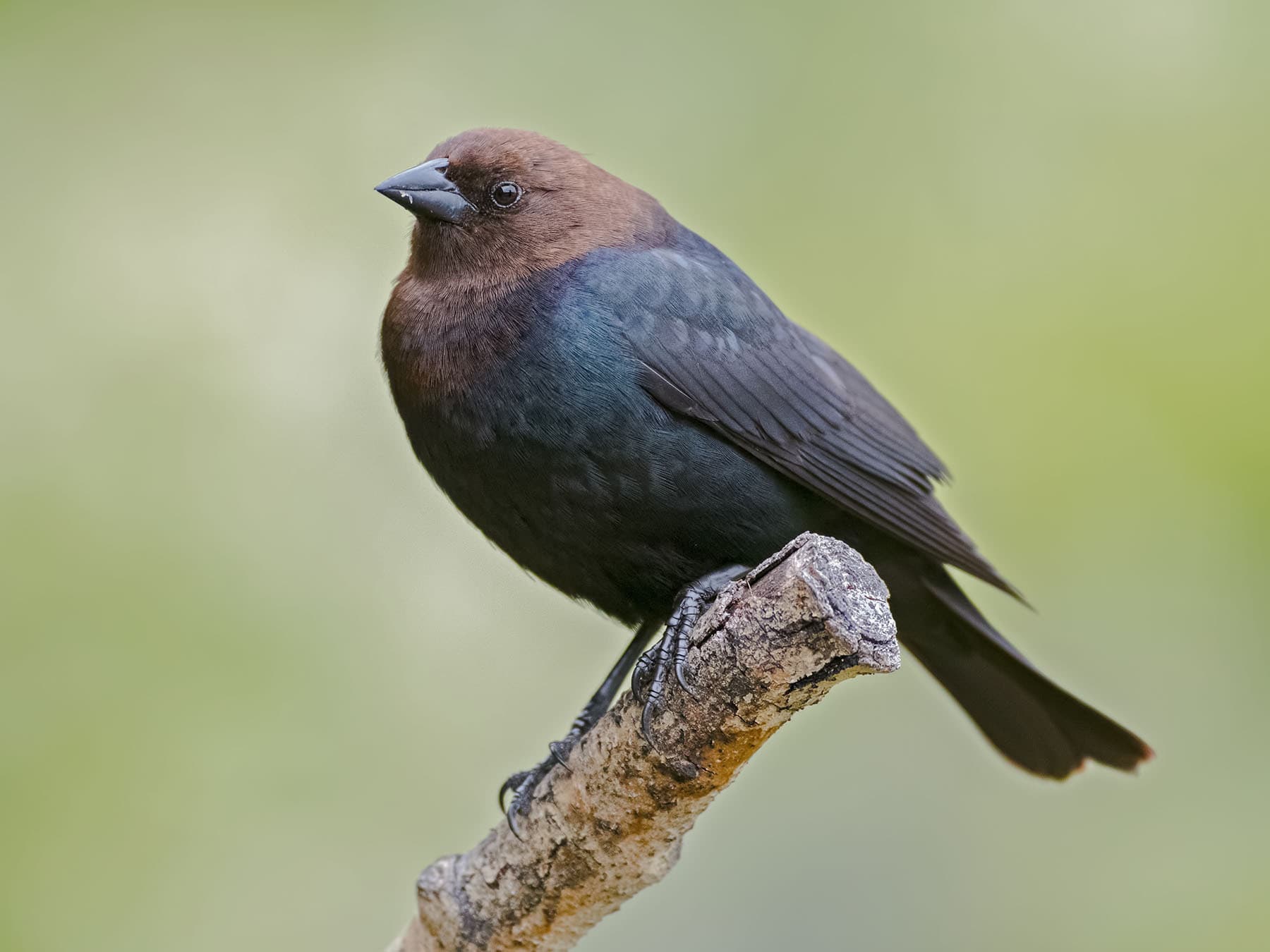
A female Brown-headed Cowbird is slightly larger and plain grayish brown, with a smaller bill and at most faint wing bars. Female and young Blue Grosbeaks have the big bill and two buff to chestnut wing bars.
A male Lazuli Bunting is smaller, with a cinnamon band across the breast, a white belly and two white wing bars. An adult male Blue Grosbeak is blue all over, with chestnut wing bars and a heavier bill.
Not sure it’s a Blue Grosbeak? Check your photo: Birdfact names the bird and shows the look-alike side by side.
Its size
Adults- Length
- 15–16 cm
- Wingspan
- 28–30 cm
- Weight
- 26–31 g
Its song and calls
The song is a long, rich, jumbled warble. Listeners have likened it to the songs of the Orchard Oriole, the Indigo Bunting and the Purple and House Finches. Only males sing, often from a high, open perch such as a treetop or a roadside wire, though they may also sing from deep in cover.
The usual call is a loud, sharp, metallic chink, also written tink or klink, probably used in alarm. It also gives a short, low, buzzy bzzt, and migrants passing low overhead at night often give a sharp pink.
In Texas it is said to sing from late April until the young have left the nest. Late arrivals are still singing in July.
A song lasts about 2.5 seconds on average. Each male has a single song type that he varies from one song to the next, and older males sing longer songs than males in their first breeding season, about 20 elements against 16.1 Males sing more varied songs while their mate is fertile.3 In a Kentucky study, males sang most before pairing, kept singing often through nest-building and laying, sang less from incubation onwards, and used longer songs when facing rival males.4
- Song0:00 / 0:04
Recorded in Texas, United States · June 2026
- Song (quiet)0:00 / 0:10
Recorded in Missouri, United States · May 2022
- Call0:00 / 0:09
Recorded in North Carolina, United States · May 2023
Heard one and not sure? Let the bird song identifier listen.
When and where to see it
November
Mostly absent
The year across North America
Choose a place on the map to see its year, or find yours.
Most recorded in November
Up to 1.0% of a place’s bird records that monthHere in other months
How this map is made
Each county, state or province is shaded by the Blue Grosbeak’s share of all the bird records there that month: the darker, the larger the share. A place with only a trace of records in a month is left unshaded. Shades compare places on this map with each other, not one bird with another. Records: GBIF eBird Observation Dataset, 2019–2024. Map: Natural Earth; place centres © OpenStreetMap contributors.
How often the Blue Grosbeak turns up in the United States and Canada through the year, from birdwatchers' records.
United States
Summer visitor · regularly Apr–Oct · most records in August
Canada
Summer visitor · regularly Apr–Nov · most records in October
Show as a table
| Month | United States | Canada |
|---|---|---|
| January | 0.001% | <0.001% |
| February | 0.001% | – |
| March | 0.001% | – |
| April | 0.094% (regular) | <0.001% (regular) |
| May | 0.16% (regular) | 0.001% (regular) |
| June | 0.22% (regular) | <0.001% (regular) |
| July | 0.27% (regular) | 0.003% (regular) |
| August | 0.29% (regular) | <0.001% |
| September | 0.12% (regular) | <0.001% (regular) |
| October | 0.036% (regular) | 0.004% (regular) |
| November | 0.003% | <0.001% (regular) |
| December | <0.001% | <0.001% |
Worldwide: recorded regularly in 18 countries
Countries where it was recorded in at least 3 of the 6 years 2019–2024. Linked countries have their own bird list.
North America (17)
South America (1)
Data: EOD – eBird Observation Dataset (Cornell Lab of Ornithology), accessed via GBIF.org, CC BY 4.0. Records from 2019–2024, aggregated and filtered by Birdfact. How these lists are made
In summer it breeds across the southern US, north and west to central California, southern Nevada, Utah, southern Colorado and the Dakotas, and east to southern Ohio, Pennsylvania and New Jersey. It is missing from most of the Gulf Coast. Farther south it breeds through Mexico and Central America to Costa Rica.
Look in old fields growing back to woodland, along hedgerows, overgrown roadsides and power-line cuts, at forest edges, in thickets beside streams and in southern pine forests of mixed ages. In the dry West it keeps to shrubby growth along watercourses, mesquite and saltcedar. It generally avoids suburbs. It is widespread but generally scarce, and as long ago as the 1870s it was described as never found in large numbers.
Spring migrants reach the Gulf Coast of Alabama, Mississippi and Louisiana from the first week of April, with passage into mid-May. They arrive in southern California in mid-April and in South Dakota in mid- to late May. In fall they leave South Dakota from mid-August to mid-September and coastal southern California from late August to early September, and elsewhere migration may continue into October.
Its US breeding range lies farther north than in the early 20th century, and by 2011 it reached central New Jersey, southern Ohio and southern North Dakota. It has bred regularly in central New Jersey and Ohio only from the late 1970s. When the spread began and what drove it are unclear, though forest clearing was suggested as a cause as early as the 1870s. Strays reach Connecticut, Massachusetts, Wisconsin, Nova Scotia and southern Canada, where it had not been found breeding as of 2011.1
At the northern edge, in eastern and central South Dakota, 57–76% of the breeding birds arrived after mid-June in 2019–2020.5 The study's authors suggest some may nest first farther south and then again in the north, but other explanations, such as wandering birds that failed to find territories, have not been ruled out.5
Migration and winter range
The birds that breed in the US are long-distance migrants, while the races of central and southern Mexico and Central America's Pacific slope stay there all year. US breeders winter from Mexico through Central America to central Panama, and in the western Greater Antilles, including Cuba; there are records from Colombia and Ecuador. In winter they use brushy fields, clearings with thickets and scrubby open country in the lowlands.
Eastern birds probably cross the Gulf of Mexico or the Caribbean, as records on islands from the Bahamas to Puerto Rico suggest, while western birds probably travel south overland through Mexico. Before and during fall migration, young and adults gather in flocks to feed in grasslands, rice fields and grain fields.
A few linger. There are many early-winter records in the southern US, from Florida to California, and frequent ones on the New England coast, where some visit feeders into January. Few of the New England birds are thought to survive the winter.
Tips for seeing it
What it eats
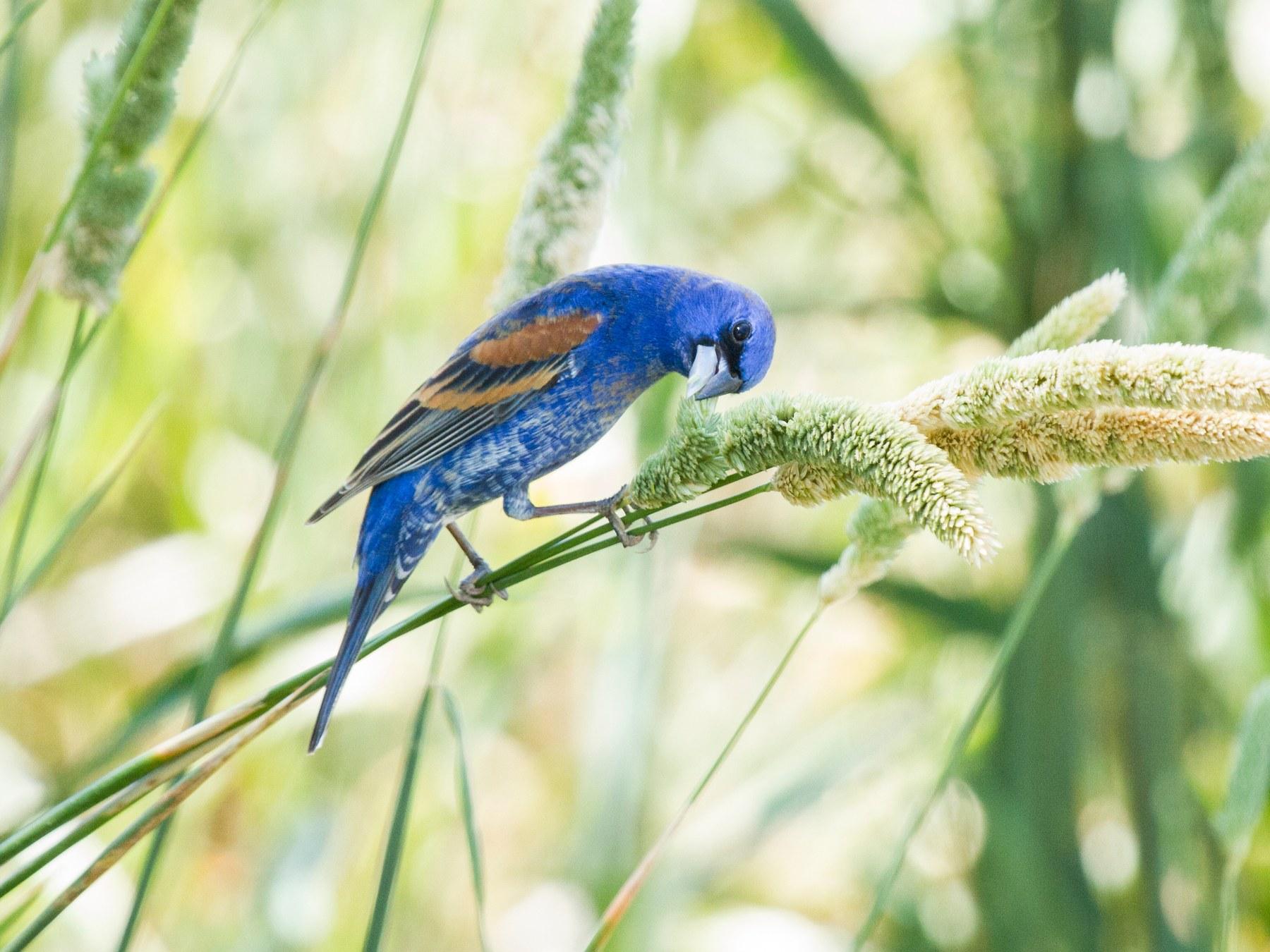
Blue Grosbeaks eat mainly insects, above all grasshoppers and crickets, along with beetles, bugs, cicadas and caterpillars, plus snails and seeds. The seeds come from wild grasses and from grain crops such as corn, rice, oats and wheat, and at some seasons they may make up most of the diet.
They feed on the ground and in low plants, gleaning from leaves, sometimes while hovering, flying out from a perch or the ground after flying insects, or dropping down to hop after prey. On the ground they can look awkward, searching one spot thoroughly before moving on. The big bill handles large seeds such as corn and large insects such as mantids and grasshoppers. In Alabama, they spent more than half their foraging time along the edges of fields and pastures.1
Nestlings are fed mostly insects: grasshoppers and their relatives in Alabama, and almost nothing but large mantids in one Tennessee population.1 Before giving a large insect to its young, a parent removes the head, the wings and most of the legs.
Feeders and yards
Blue Grosbeaks may visit feeders, especially in yards with plenty of shrubby cover, where grain and seed may draw one in. Beyond grain and seed, we found no source that names a food for them at feeders.
Nesting and breeding
The nest is a compact cup of twigs, dead leaves, rootlets and strips of bark, lined with fine grass, hair and rootlets. It is about 2.4–3.1 in (6–8 cm) across inside and 2 in (5 cm) deep. The female does most of the building: she builds at least the second nest and probably the first, though males have been seen building.
Nests sit low in a small tree, a shrub or a tangle of vines and briars, often near open ground or a road. They are usually 3–10 ft (1–3 m) up, but they have been found from 6 in (15 cm) to 25.6 ft (7.8 m). Along two New Mexico rivers, a few nests in tall trees were up to 49 ft (15 m).6 There, nests averaged 11 ft (3.4 m) up on the Gila River, where tall boxelder nests raised the average (the median was 7 ft, 2.1 m), and 7 ft (2.2 m) on the Rio Grande.6 Of 105 Gila River nests, 95% were in native shrubs or trees, but 64% of 85 Rio Grande nests were in saltcedar.6
Nests may include odd materials such as paper, string, rags, cellophane or plastic. Birds of the World says many nests include a shed snakeskin; along the Gila River in New Mexico it turned up only occasionally.1, 6 Why it uses snakeskin is unclear.
Eggs and young
Laying starts mainly in May, from mid-April in California, with first eggs in June in Colorado and Indiana. The latest egg date in Birds of the World's account is 6 August, in Oklahoma, but along the two New Mexico rivers eggs were typically found from early June to mid-August.1, 6
The clutch is 3–5 eggs, usually 4. They are plain pale blue to bluish white, with brown spots only rarely, and about 0.87 x 0.65 in (22 x 16.5 mm).
The female incubates for 12–13 days at the three nests timed (some guides give 11–12 days), and the male may feed her.1, 7 The young fledge at about 9–10 days old. Both parents feed them, the female far more often: at nests filmed in Alabama, females brought food 3.3 times an hour and males 0.52 times.1
Pairs often raise two broods a year, especially in the south. After fledging, the young form small flocks, which the parents and the second brood's young join later.
Cowbirds at the nest
The Blue Grosbeak is a known host of the Brown-headed Cowbird, and limited data suggest it is quite heavily parasitized, with rates in small studies ranging from none of 6 nests in Louisiana to all 7 found one year in Orange County, California.1 Grosbeaks sometimes raise their own young alongside cowbirds; they are known to eject cowbird eggs at times and may sometimes bury them.
In a South Carolina old-field study, parasitized nests held about one egg fewer than unparasitized ones (2.5 against 3.5 eggs, from 6 and 11 nests).1, 8 Of the six host species in that study, only in Blue Grosbeak nests did parasitism reduce the number of young fledged, but over a whole season the study found it made little difference to how many young these hosts raised.8
Along the two New Mexico rivers, about half the nests watched raised young (54% of 67 on the Gila, 47% of 60 on the Rio Grande), and cowbirds caused 19% of 31 nest failures on the Gila and 28% of 32 on the Rio Grande.6
Behaviour
Blue Grosbeaks hop on the ground, said to be awkwardly, and move more easily in trees, sometimes sidling along a branch like a parrot. The flight is swift and low between thickets, and undulating over longer distances.
In spring, males arrive before the females and form feeding flocks. Pairs then hold territories through the breeding season: in Lee County, Alabama, territories averaged 12.8 acres (5.2 ha) and ranged from 2 to 21.5 acres (0.8–8.7 ha) across 36 territories.1
Pairs are assumed to be socially monogamous, but in an Alabama study, 29 of 55 nestlings (53%), in 14 of 20 broods, were fathered by a male other than the female's mate.1, 9 Duller males were more likely to be cuckolded, and males with brightly colored neighbors guarded their mates more closely.9
A male Indigo Bunting has been seen chasing a male Blue Grosbeak where both bred, though such clashes are thought to be rare.
Lifespan and predators
The oldest Blue Grosbeak on the US Bird Banding Laboratory's list was at least 11 years 11 months old: a female banded in Maryland in May 2012, in her second year, and caught and released there in May 2023.10 The previous record holder was a female of at least 10 years 1 month, banded in Ohio in 2008 and caught and released there in 2017.10
We found no survival rate or typical lifespan in Birds of the World (2011 text) or any other source we read.
Predators and other dangers
Conservation
The Blue Grosbeak is listed as Least Concern on the IUCN Red List (2018 assessment),12 and NatureServe ranks it G5, globally secure (reviewed 2016).13 Partners in Flight estimates about 35 million breeding-age birds worldwide, about 21 million of them in the US, calculated from survey counts for about 2010.14 The bird scores 7 out of 20 on the Partners in Flight Continental Concern Score, though its threat scores rest on a lack of information rather than on evidence that threats are low.14
The North American Breeding Bird Survey shows a significant long-term increase of 0.81% a year from 1966 to 2025 (95% credible interval +0.63 to +0.97, from 1,947 routes), and the survey index was at its highest in 2025, about 61% above 1966.15 The latest ten-year trend, for 2015–2025, is also a significant rise, of 0.91% a year, though ten-year windows ending from 2017 to 2022 showed no significant change.15
No state shows a significant long-term decline, and significant increases include Indiana (6.2% a year), Kentucky (5.6%), Illinois (3.9%), Louisiana (3.1%) and Texas (1.3%).15
How tropical farming and forest clearance affect it on its wintering grounds is unknown. Where it breeds, it may be expected to benefit from farmland going out of use, and in the lower Colorado River valley it has gained from habitat plots planted in residential areas and from the spread of saltcedar.1 On the Dolores River in Colorado, its density was lower in 2010–2014 where introduced tamarisk beetles had defoliated saltcedar the year before.16
Legal status
In the US it is a protected migratory bird under the Migratory Bird Treaty Act regulations: taking, keeping or selling one, or its nest or eggs, needs a permit.17, 18 It is not listed under the US Endangered Species Act.19 In Canada, where it is a rare vagrant, it is covered by the Migratory Birds Convention Act, 1994, as one of the grosbeaks.20
Similar birds
Often mistaken for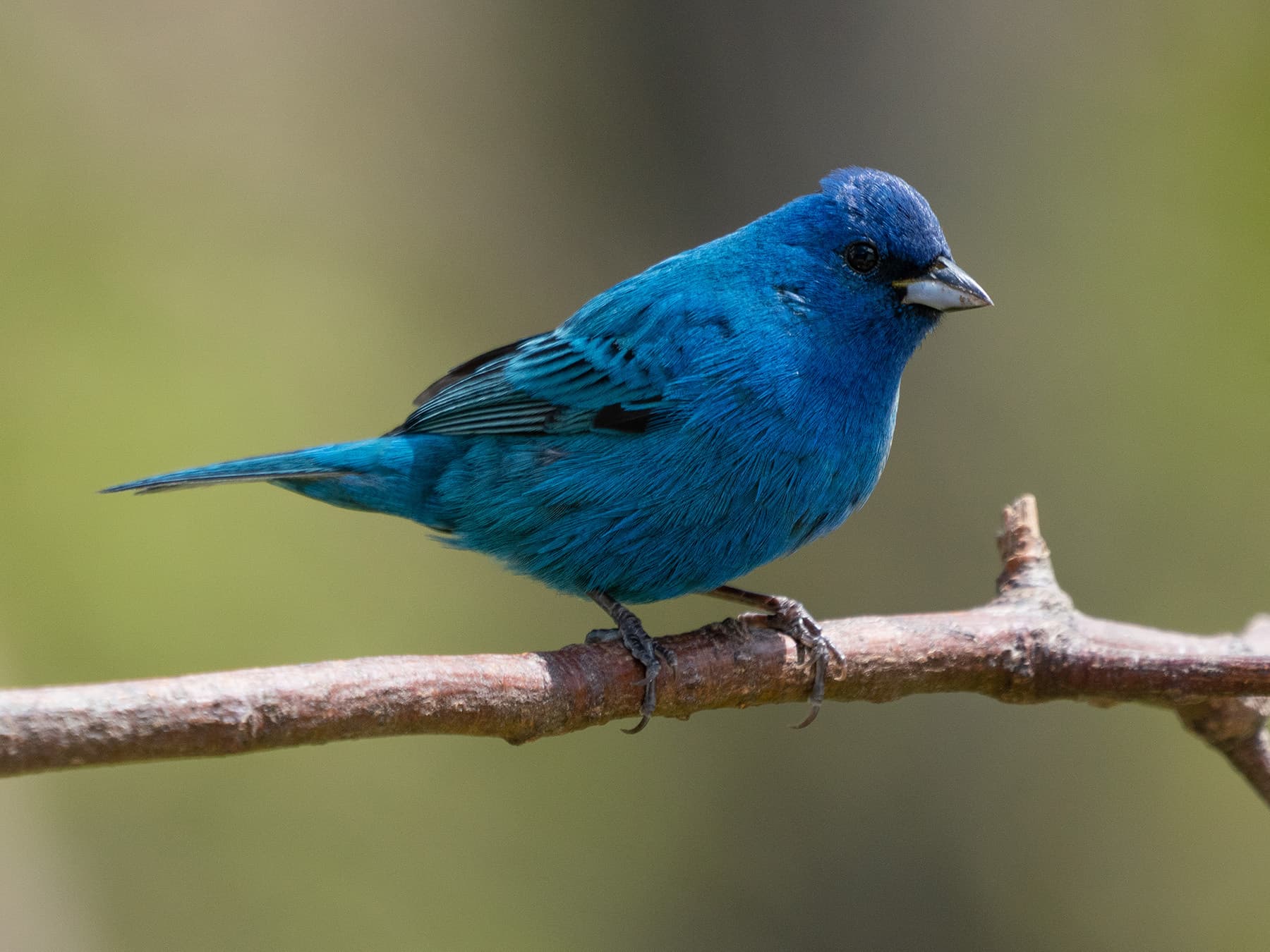
More photos
1 photos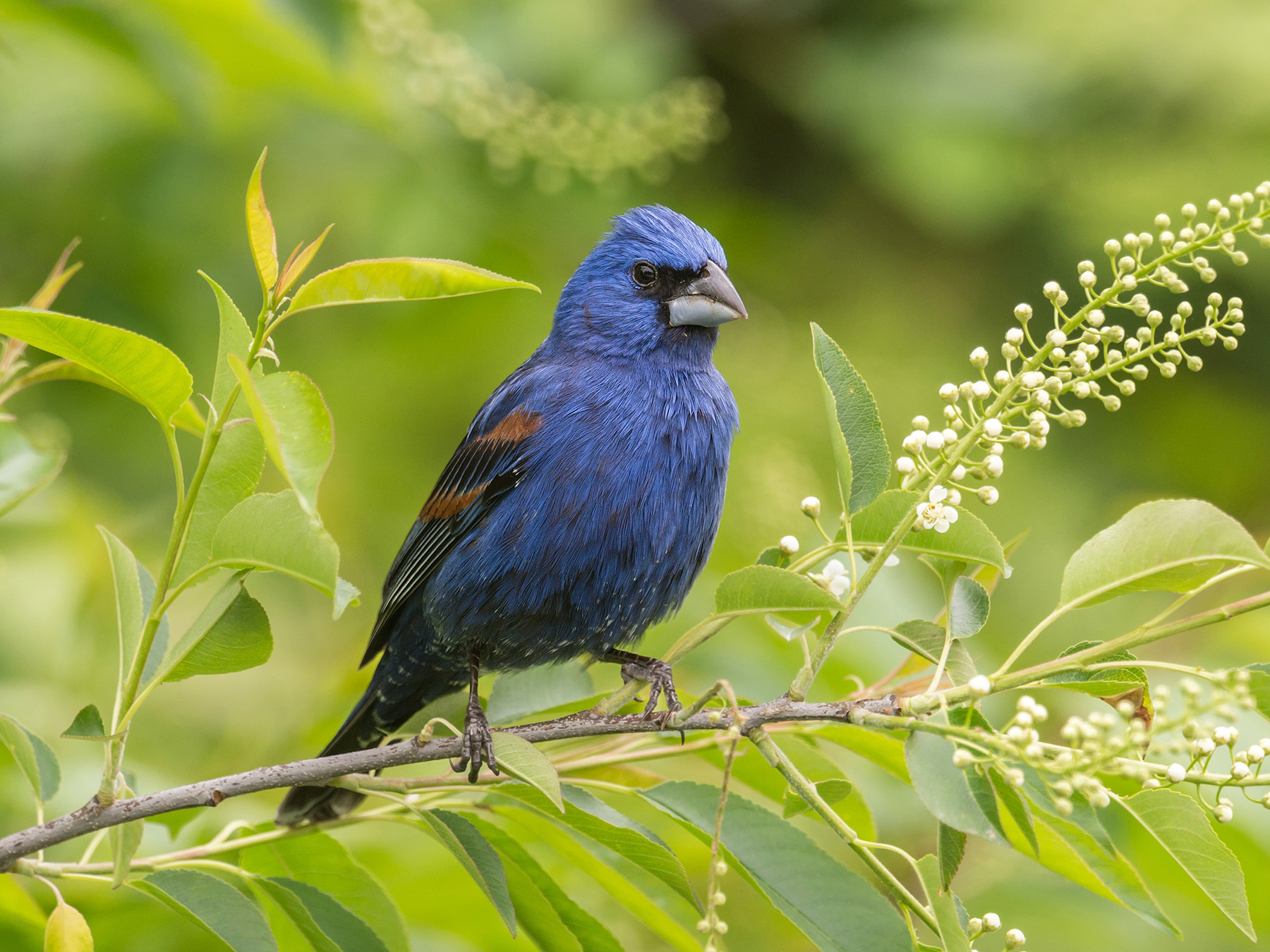
Quick facts
- Length
- 15–16 cm
- Wingspan
- 28–30 cm
- Weight
- 26–31 g
- Lifespan
- oldest recorded 11 years 11 months
- Family
- Cardinals & Grosbeaks
- Migration
- Long-distance Migrant
- Global status (IUCN)
- Least Concern
- World population
- About 35 million worldwide, about 21 million in the US (Partners in Flight, about 2010)
- Population trend
- Increasing: the Breeding Bird Survey shows a significant rise of about 0.8% a year from 1966 to 2025, with the index at its highest in 2025, and the last ten years also rising (about 0.9% a year)
- Scientific name
- Passerina caerulea
Questions
4Are Blue Grosbeaks rare?
No. There are an estimated 35 million breeding-age birds (a figure calculated for about 2010), and survey counts in the US have risen since 1966. They are widespread across the southern US, but generally scarce, so you rarely see many together.
Are Blue Grosbeaks related to cardinals?
Yes. The Blue Grosbeak belongs to the cardinal family, Cardinalidae, and sits in the bunting genus Passerina with the Indigo and Lazuli Buntings. It was long placed in a genus of its own, Guiraca, until a 2001 mitochondrial DNA study placed it inside Passerina, a move the American Ornithologists' Union accepted in 2002.21, 13
What is the Blue Grosbeak's four-letter code?
Do Blue Grosbeaks pair for life?
We found no study of whether pairs stay together from one year to the next. Within a season they are assumed to be socially monogamous, but in one study about half the nestlings had a father other than their mother's partner (see Behavior).
Sources
34- 1Lowther, P. E. and Ingold, J. L. (2020). Blue Grosbeak (Passerina caerulea), version 1.0. Birds of the World (A. F. Poole, editor). Cornell Lab of Ornithology. doi:10.2173/bow.blugrb1.01 (opens in a new tab)
- 2Keyser, A. J. (2000). Structurally based plumage coloration is an honest signal of quality in male blue grosbeaks. Behavioral Ecology 11(2): 202-209. doi:10.1093/beheco/11.2.202 (opens in a new tab)
- 3Ballentine, Barbara, Badyaev, Alexander and Hill, Geoffrey E (2003). Changes in Song Complexity Correspond to Periods of Female Fertility in Blue Grosbeaks ( Guiraca caerulea ). Ethology 109(1): 55-66. doi:10.1046/j.1439-0310.2003.00852.x (opens in a new tab)
- 4Lattin, Christine and Ritchison, Gary (2009). Intra- and Intersexual Functions of Singing by Male Blue Grosbeaks: the Role of Within-Song Variation. The Wilson Journal of Ornithology 121(4): 714-721. doi:10.1676/09-026.1 (opens in a new tab)
- 5Swanson, David L. and Goljani Amirkhiz, Reza (2021). Mid‐summer arrival by Blue Grosbeaks at the northern extent of their breeding range: evidence for dual breeding?. Journal of Field Ornithology 92(2): 127-142. doi:10.1111/jofo.12367 (opens in a new tab)
- 6CARTRON, JEAN-LUC E., FINCH, DEBORAH M., HAWKSWORTH, DAVID L. and STOLESON, SCOTT H. (2013). NESTING ECOLOGY AND NEST SUCCESS OF THE BLUE GROSBEAK ALONG TWO RIVERS IN NEW MEXICO. Western Birds 44(1): 33-44. doi:10.21199/wb44.1.3 (opens in a new tab)
- 7National Audubon Society. Blue Grosbeak. Guide to North American Birds. Accessed 29 November 2026. Source (opens in a new tab)
- 8Whitehead, Maria A., Schweitzer, Sara H. and Post, William (2000). Impact of Brood Parasitism on Nest Survival Parameters and Seasonal Fecundity of Six Songbird Species in Southeastern Old-Field Habitat. The Condor 102(4): 946-950. doi:10.1093/condor/102.4.946 (opens in a new tab)
- 9Estep, Laura K et al. (2005). Effects of breeding density and plumage coloration on mate guarding and cuckoldry in blue grosbeaks ( Passerina caerulea ). Canadian Journal of Zoology 83(9): 1143-1148. doi:10.1139/z05-110 (opens in a new tab)
- 10USGS Bird Banding Laboratory. Longevity records of North American birds: Blue Grosbeak (AOU 5970). USGS Bird Banding Laboratory. Accessed 29 November 2026. Source (opens in a new tab)
- 11DeGregorio, Brett A., Weatherhead, Patrick J., Ward, Michael P. and Sperry, Jinelle H. (2016). Do seasonal patterns of rat snake ( Pantherophis obsoletus ) and black racer ( Coluber constrictor ) activity predict avian nest predation?. Ecology and Evolution 6(7): 2034-2043. doi:10.1002/ece3.1992 (opens in a new tab)
- 12BirdLife International (2018). Passerina caerulea. The IUCN Red List of Threatened Species 2018: e.T22723939A132170886. IUCN Red List (via the GBIF IUCN checklist). Accessed 29 November 2026. Source (opens in a new tab)
- 13NatureServe (2016). Passerina caerulea (ELEMENT_GLOBAL.2.103868). NatureServe Explorer. Accessed 29 November 2026. Source (opens in a new tab)
- 14Partners in Flight (2024). Avian Conservation Assessment Database, version 2024.05.23 (global). Partners in Flight / Bird Conservancy of the Rockies. Accessed 29 November 2026. Source (opens in a new tab)
- 15Hostetler, J. A. et al. (2026). The North American Breeding Bird Survey, Analysis Results 1966-2025. U.S. Geological Survey. doi:10.5066/P1OSNSFC (opens in a new tab)
- 16Darrah, Abigail J. and van Riper, Charles (2017). Riparian bird density decline in response to biocontrol of Tamarix from riparian ecosystems along the Dolores River in SW Colorado, USA. Biological Invasions 20(3): 709-720. doi:10.1007/s10530-017-1569-z (opens in a new tab)
- 17U.S. Fish and Wildlife Service. 50 CFR 10.13: List of Migratory Birds. Electronic Code of Federal Regulations (version of 17 Nov 2026). Accessed 29 November 2026. Source (opens in a new tab)
- 18U.S. Fish and Wildlife Service. 50 CFR 21.10 and Part 21. Electronic Code of Federal Regulations (version of 17 Nov 2026). Accessed 29 November 2026. Source (opens in a new tab)
- 19U.S. Fish and Wildlife Service. ECOS species profile: Blue Grosbeak (Passerina caerulea). Environmental Conservation Online System. Accessed 29 November 2026. Source (opens in a new tab)
- 20Government of Canada. Migratory Birds Convention Act, 1994 (S.C. 1994, c. 22). Justice Laws Website (current to 12 Nov 2026). Accessed 29 November 2026. Source (opens in a new tab)
- 21Klicka, John, Fry, Adam J., Zink, Robert M. and Thompson, Christopher W. (2001). A Cytochrome-b Perspective on Passerina Bunting Relationships. The Auk 118(3): 610-623. doi:10.1093/auk/118.3.610 (opens in a new tab)
- 22Gutierrez Ramirez, Mariamar et al. (2025). Lean mass deposition occurs at a greater rate than fat deposition during pre-breeding stopover in highly depleted songbirds in the northern Gulf of Mexico. Conservation Physiology 13(1). doi:10.1093/conphys/coaf029 (opens in a new tab)
- 23Cornell Lab of Ornithology. Blue Grosbeak. All About Birds. Accessed 29 November 2026. Source (opens in a new tab)
- 24Missouri Department of Conservation. Blue Grosbeak. MDC Field Guide. Accessed 29 November 2026. Source (opens in a new tab)
- 25Payne, R. B. (2020). Indigo Bunting (Passerina cyanea), version 1.0. Birds of the World (A. F. Poole, editor). Cornell Lab of Ornithology. doi:10.2173/bow.indbun.01 (opens in a new tab)
- 26Greene, E., Muehter, V. R. and Davison, W. (2020). Lazuli Bunting (Passerina amoena), version 1.0. Birds of the World (A. F. Poole, editor). Cornell Lab of Ornithology. doi:10.2173/bow.lazbun.01 (opens in a new tab)
- 27Chamberlain, M. L., Lowther, P. E. and Hauber, M. E. (2026). Brown-headed Cowbird (Molothrus ater), version 2.1. Birds of the World (S. M. Billerman, editor). Cornell Lab of Ornithology. doi:10.2173/bow.bnhcow.02.1 (opens in a new tab)
- 28AviList Core Team (2025). AviList: The Global Avian Checklist, v2025b. AviList. doi:10.2173/avilist.v2025b (opens in a new tab)
- 29Keyser, Amber J. and Hill, Geoffrey E. (1999). Condition–dependent variation in the blue–ultraviolet coloration of a structurally based plumage ornament. Proceedings of the Royal Society of London. Series B: Biological Sciences 266(1421): 771-777. doi:10.1098/rspb.1999.0704 (opens in a new tab)
- 30Ballentine, Barbara and Hill, Geoffrey E. (2003). Female Mate Choice in Relation to Structural Plumage Coloration in Blue Grosbeaks. The Condor 105(3): 593-598. doi:10.1093/condor/105.3.593 (opens in a new tab)
- 31Risch, Thomas S. and Robinson, Thomas J. (2006). First Observation of Cavity Nesting by a Female Blue Grosbeak. The Wilson Journal of Ornithology 118(1): 107-108. doi:10.1676/04-094.1 (opens in a new tab)
- 32Stricker, C.. Blue Grosbeak, iNaturalist observation 375391573 (sound 2043114). iNaturalist. Accessed 29 November 2026. Source (opens in a new tab)
- 33McClarren, C. and Reago, A.. Blue Grosbeak, iNaturalist observation 115373152 (sound 436882). iNaturalist. Accessed 29 November 2026. Source (opens in a new tab)
- 34Kneidel, K.. Blue Grosbeak, iNaturalist observation 168114501 (sound 743405). iNaturalist. Accessed 29 November 2026. Source (opens in a new tab)

Checked by
Nathan Cope, founder and editor
Nathan founded Birdfact and leads its writers and contributors in the UK, the US and Canada. He has watched and studied birds for more than ten years, and checks every article and species guide before it’s published.