


Indigo Bunting
Indigo bird · Passerina cyanea
By the Birdfact teamChecked by Nathan Cope
On this page14 sections
How to recognise it
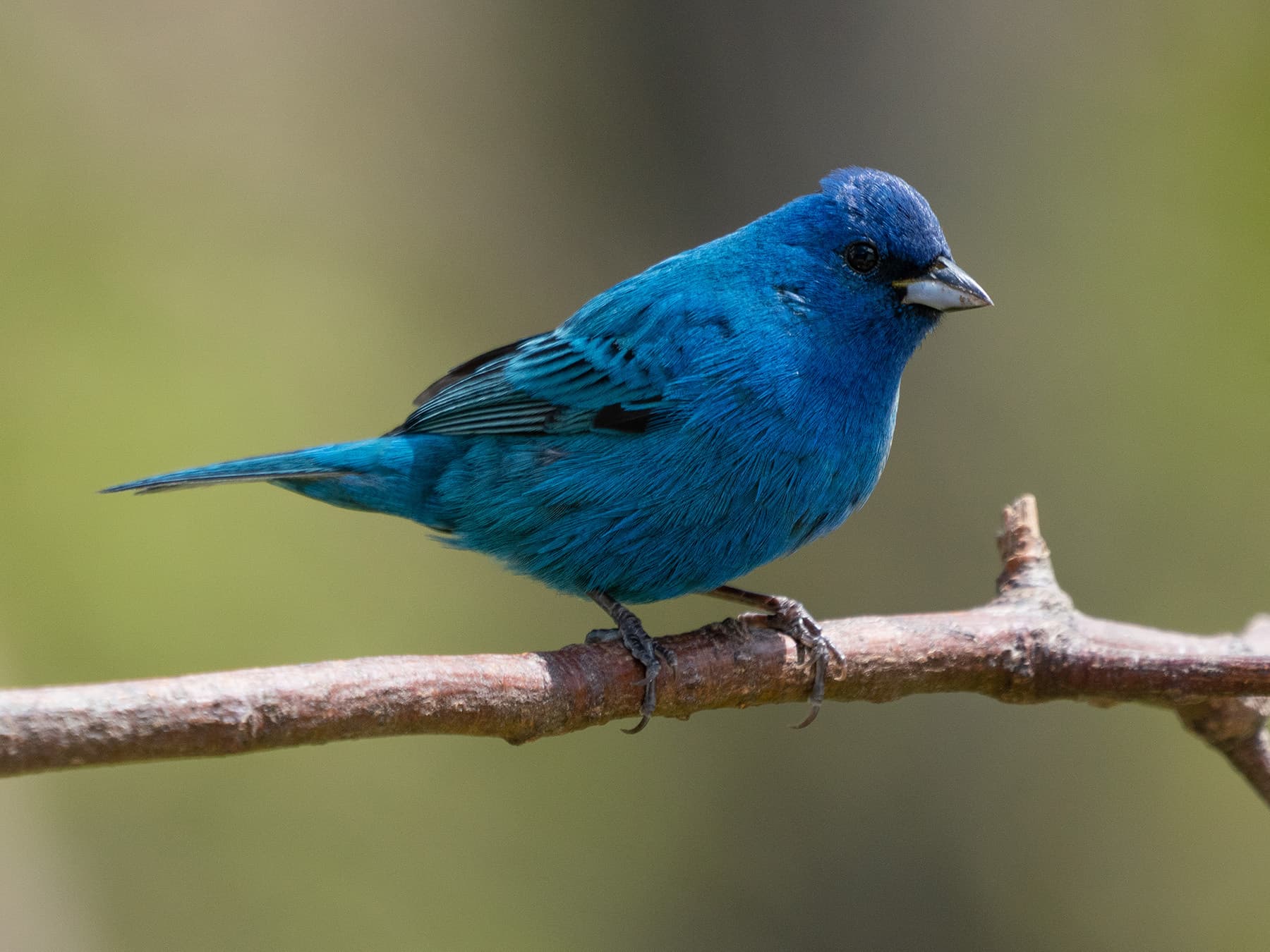
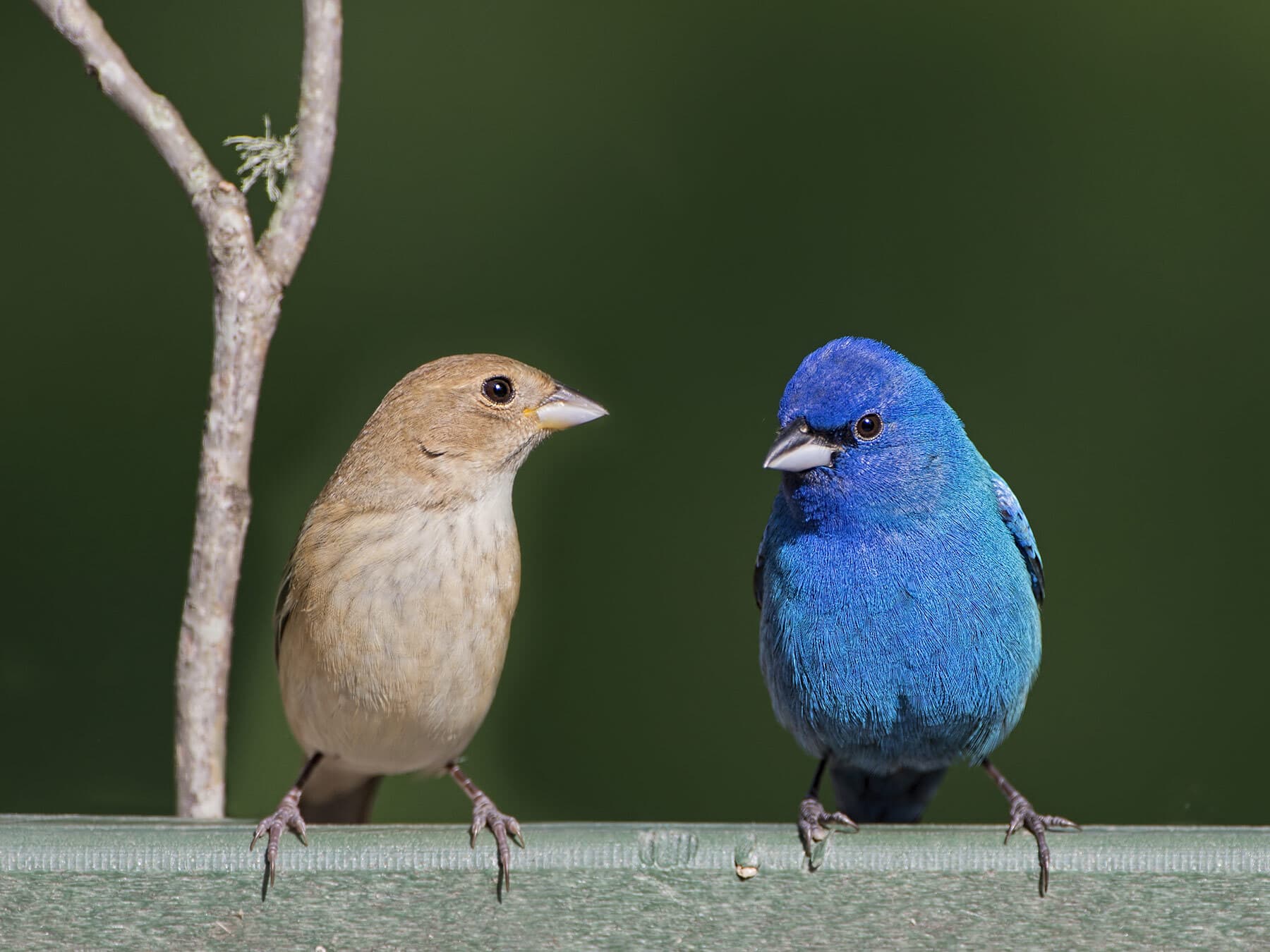
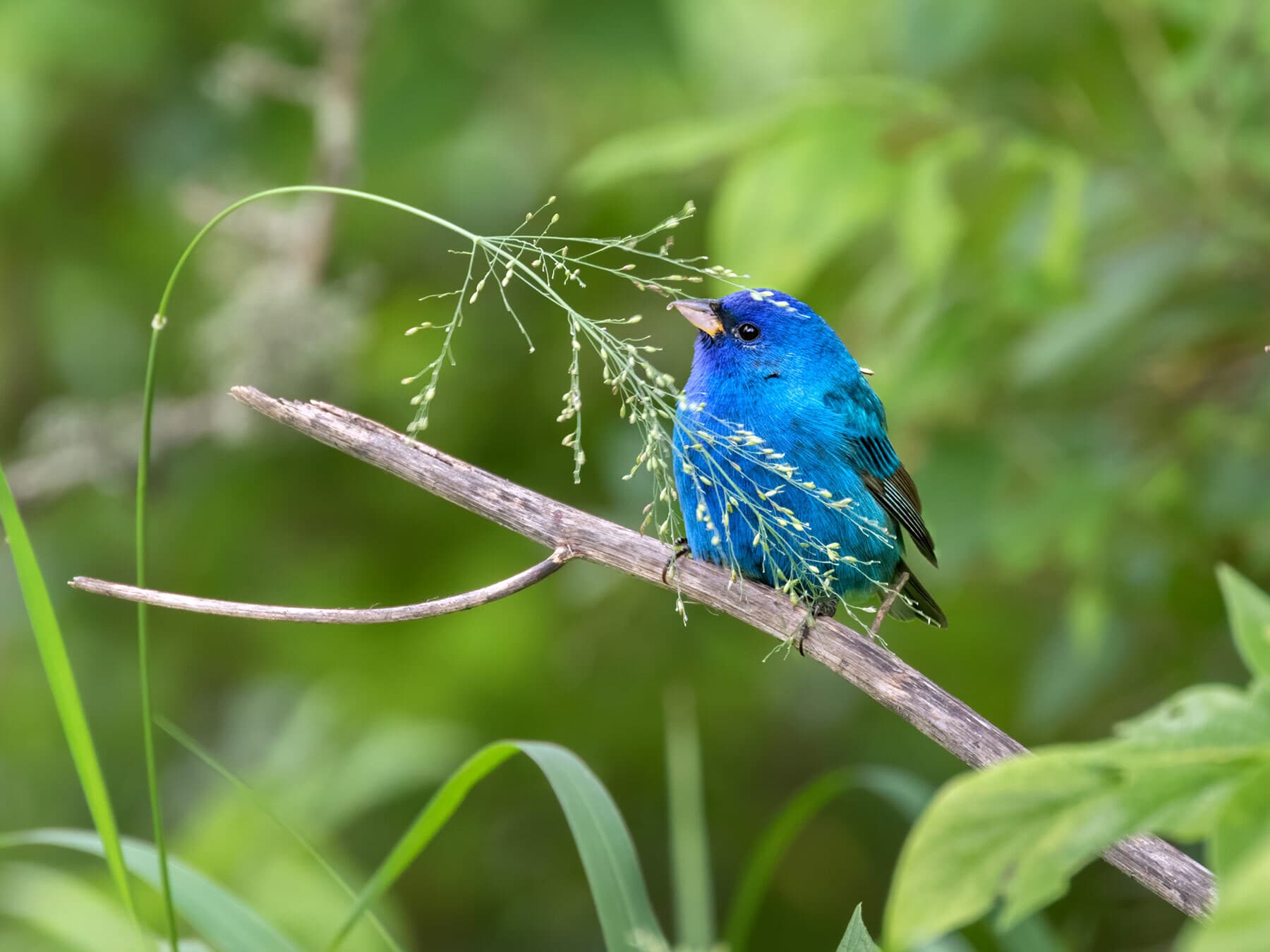
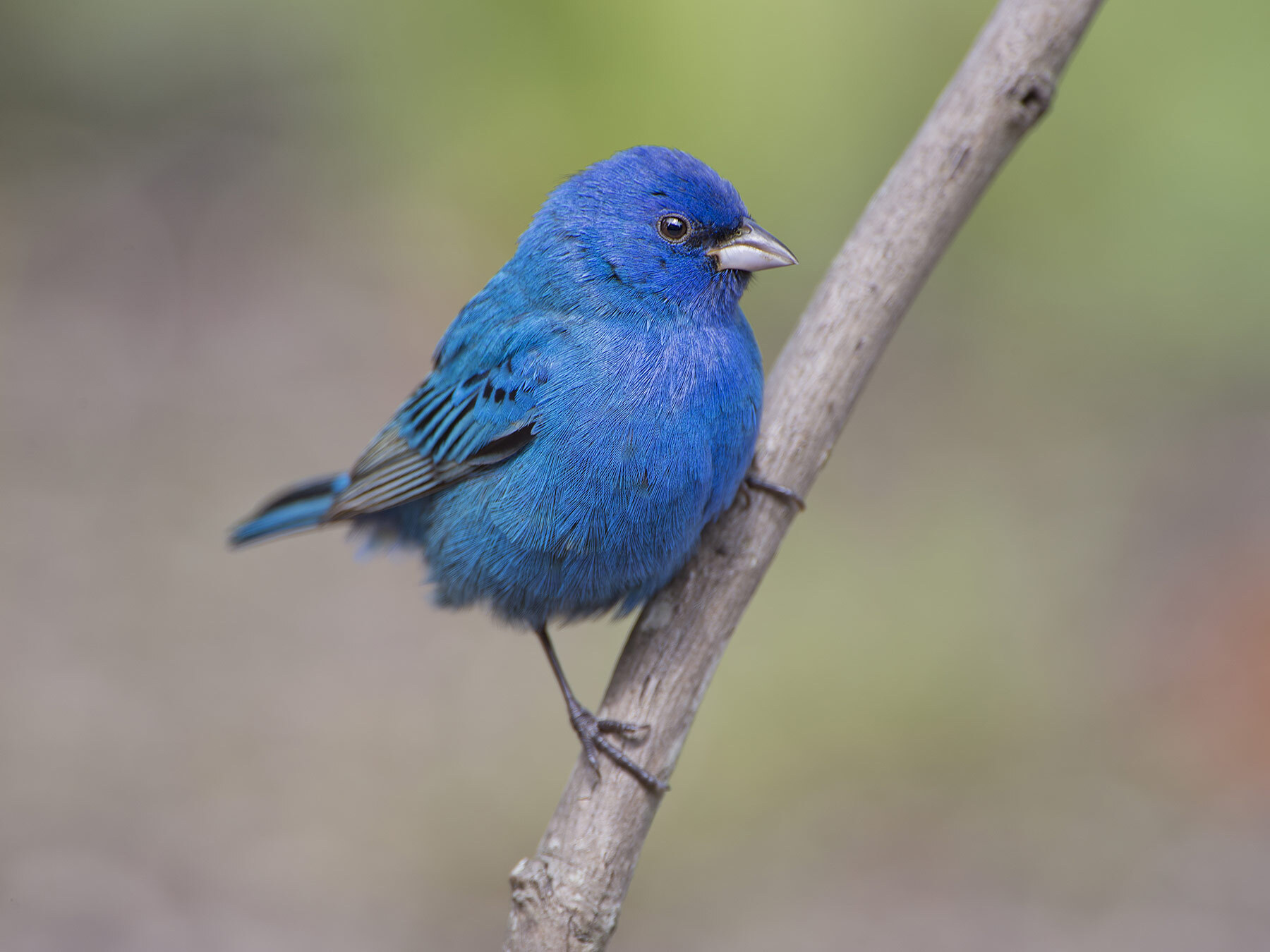
The Indigo Bunting is a small, stocky songbird with a short, thick, cone-shaped bill and a short tail. In spring and summer the adult male is blue all over, deepest and slightly purple-blue on the head, with a blackish spot between the bill and the eye. His wing feathers are dark with blue edges, and he has no wing bars. In breeding season his upper bill is blackish and the lower bill blue-gray.
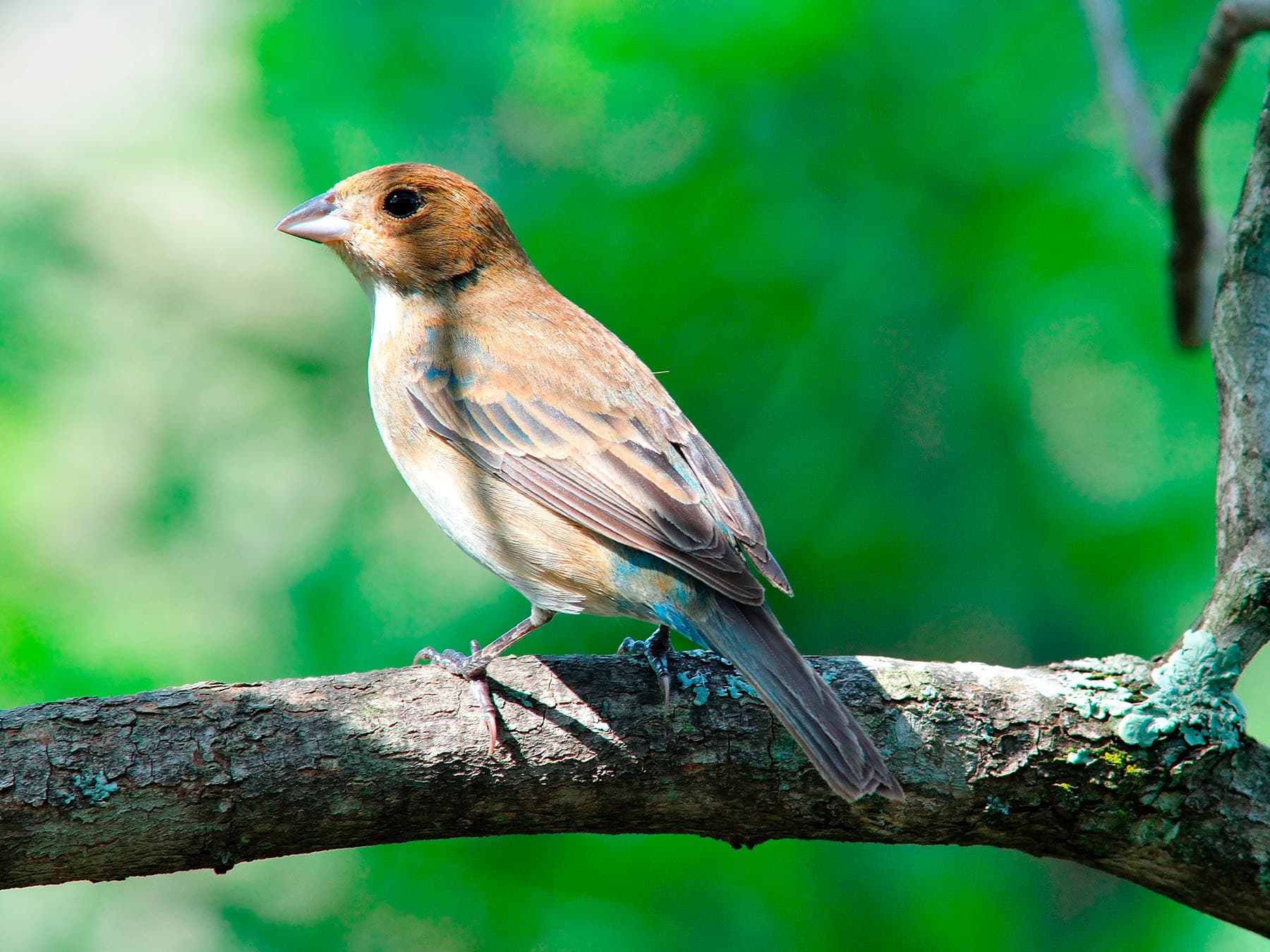
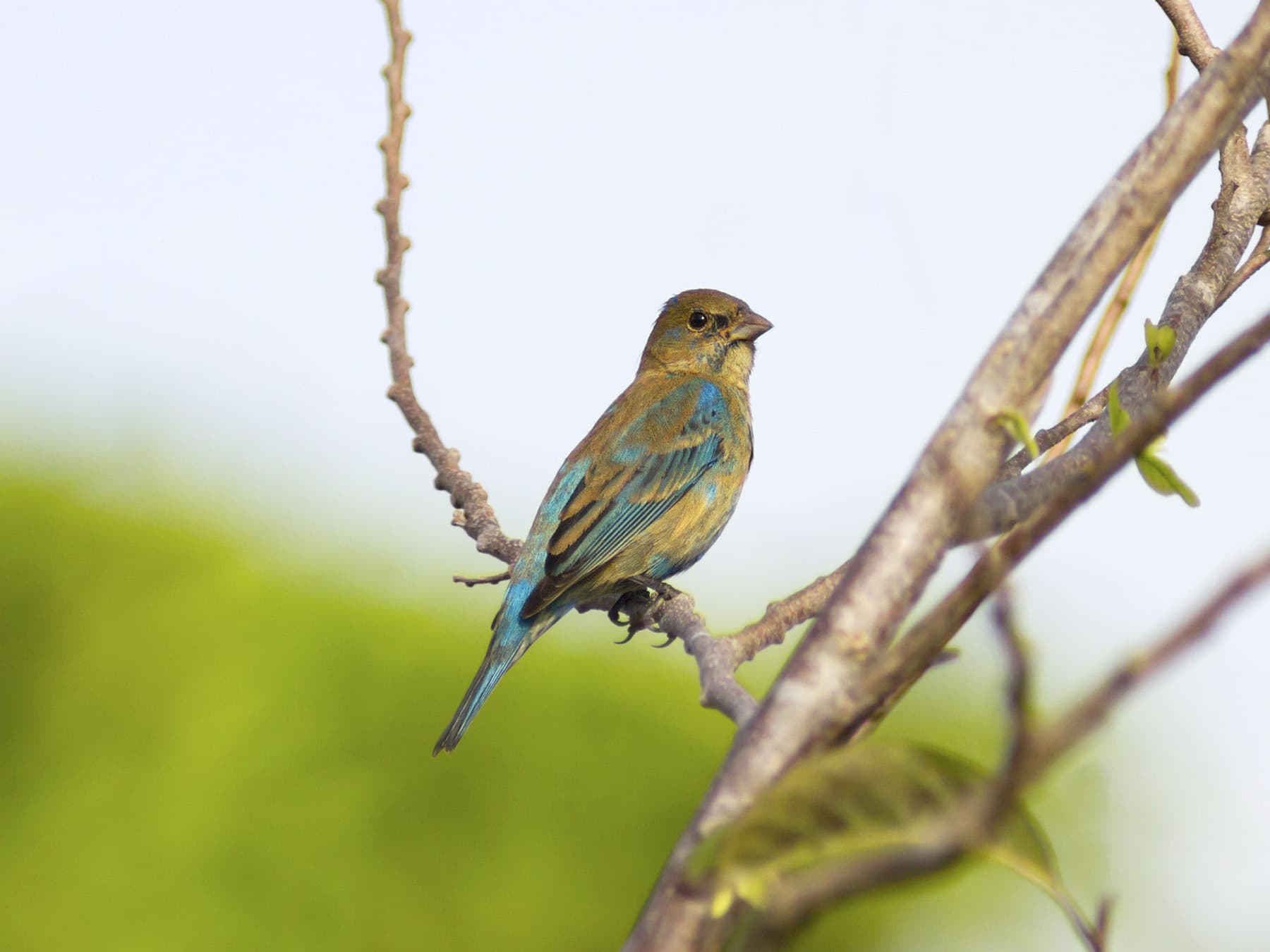
Females are plain brown above and paler below, with a whitish throat and belly and faint, blurry streaks on the breast. Most show a touch of blue on the shoulder, rump or tail edges, and their buff wing bars wear thin by late summer. Females are seen far less often than males: they keep to shrubs, mostly within 3 feet (1 m) of the ground.
Size and shape
Indigo Buntings are 4.5 to 5 inches (11.5-13 cm) long, with a wingspan of 7.5 to 8.7 inches (19-22 cm), and weigh 0.4 to 0.6 ounces (12-18 g): sparrow-sized, a little smaller than a House Finch.
Males, females and young
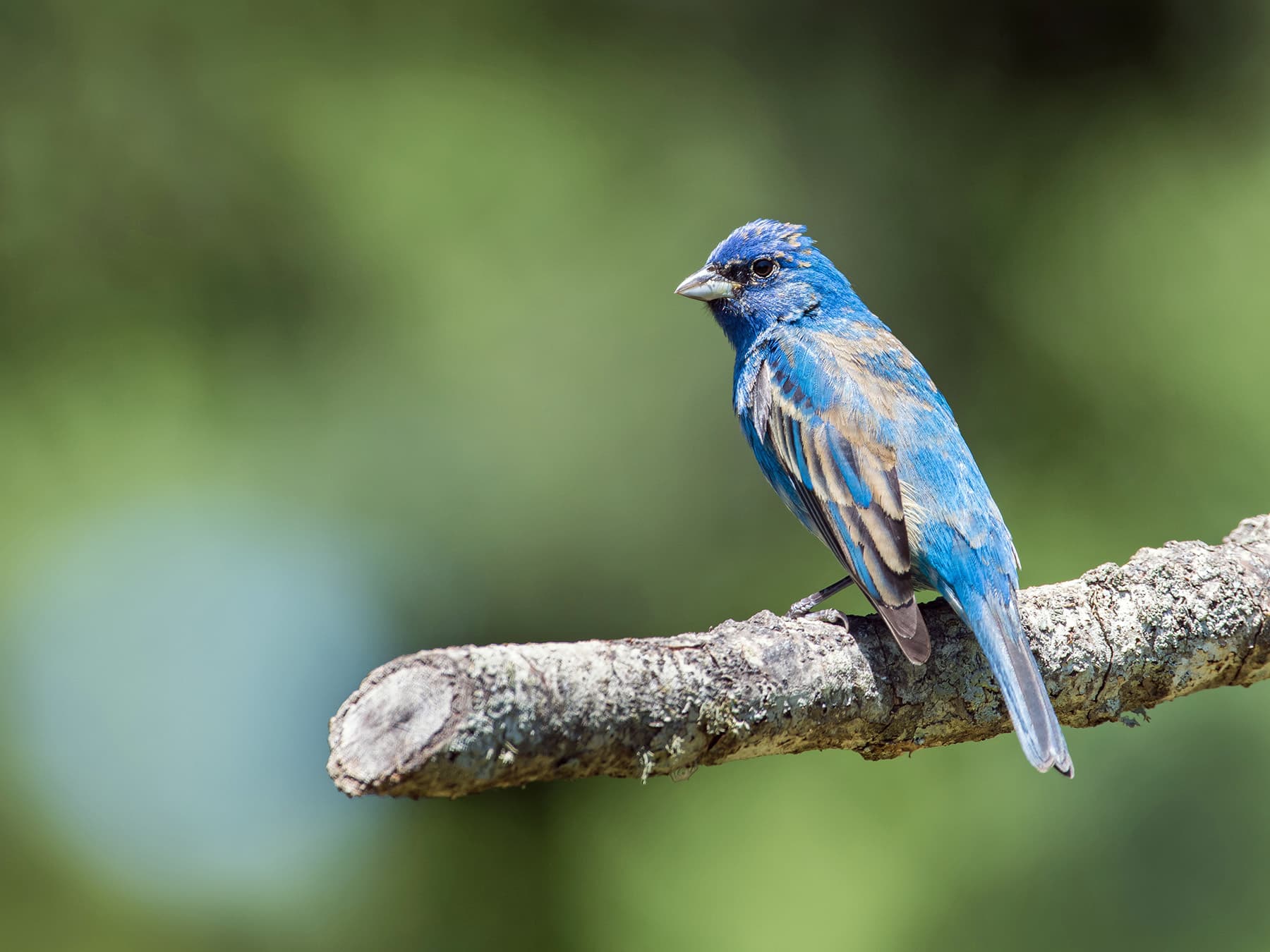
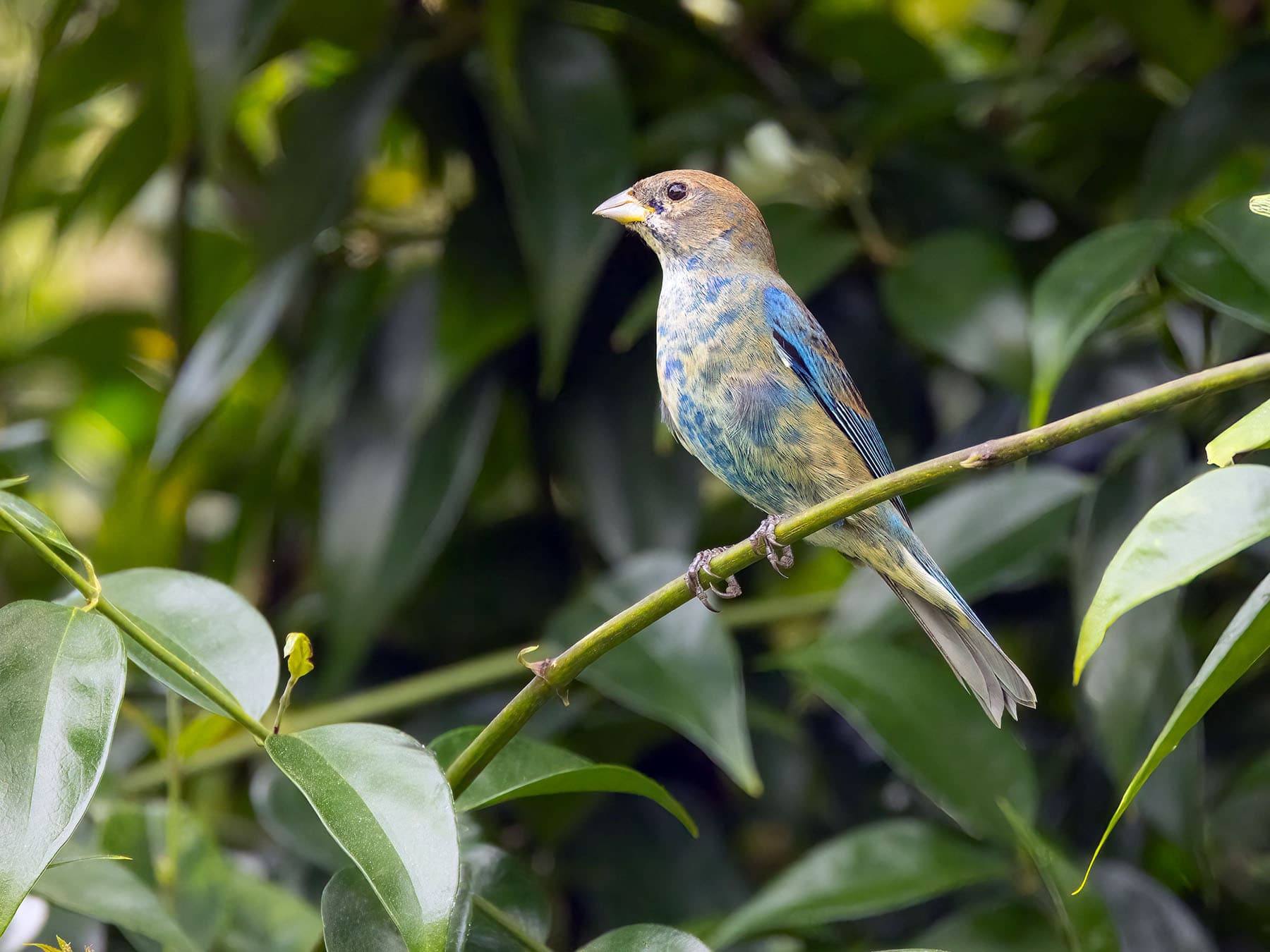
Not every blue-and-brown bunting is a female. A male in his first spring and summer can be blue all over apart from brown feathers on the wing, or a patchwork of blue, brown and white. About half the first-year males in the eastern US show some white on the belly, and some are as much as 80% brown and white.1 Males that hatched early in the year tend to be bluer.
After nesting, in late summer, adults molt into a brown winter plumage. Males turn mostly brown, with blue left on the wings, tail and rump and in patches on the body, and molt back into blue on the wintering grounds from February to April. In fall almost all young males are brown, so look for a hint of blue on the wings or tail.
Juveniles, this year's young, are brown with fine dark streaks on the breast, buff flanks and two buff wing bars. A young Indigo Bunting can look almost identical to a young Lazuli or Varied Bunting. Plumages also vary between individuals: a few older males come back partly brown in some years, and some females show more blue than the brownest young males.
Why the plumage looks blue
An Indigo Bunting has no blue pigment. Its feathers hold dark melanin, and the blue comes from microscopic structures in the feathers that scatter light. Backlit, a blue feather looks dull and dark.
In blue feathers the inner layer of each barb is a sponge of keratin and tiny air pockets. The pockets are spaced so that light waves bouncing off them reinforce each other at blue wavelengths, a different process from the scattering that makes the sky blue.2 In one set of measurements from five males, the breast reflected most in blue light, with a second peak in the ultraviolet.1
The amount of blue may say something about the bird. In a study of wild males, those with more blue feathers were in better body condition, had higher testosterone and lower stress measures, and were less likely to carry blood parasites.3
Identification: similar birds
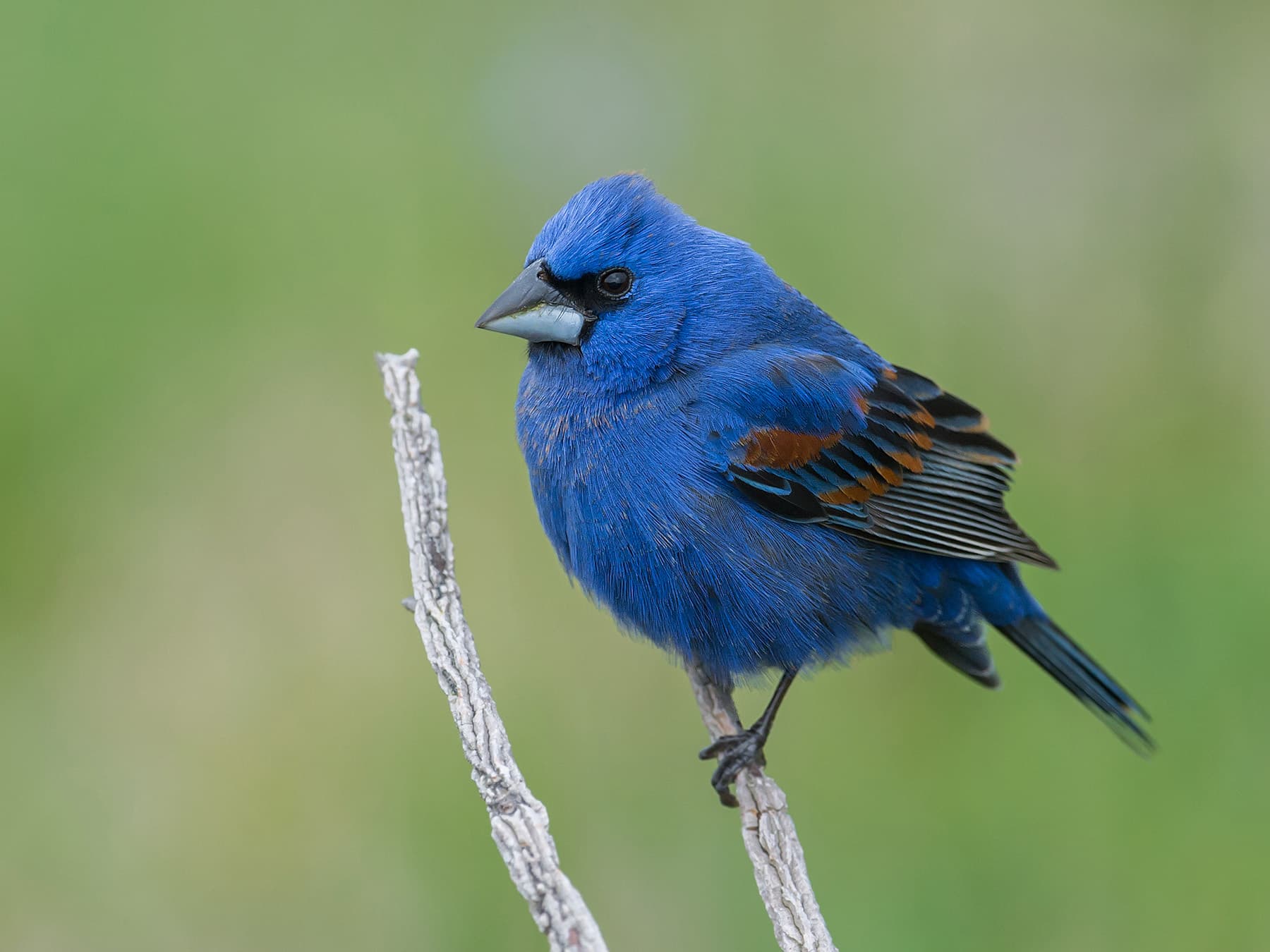
Blue Grosbeak. Bigger, 6 to 7.5 inches (15-19 cm), with a much heavier bill and two broad cinnamon or buff wing bars. The male is very dark blue and the female brown.
Lazuli Bunting. The male is paler sky-blue with a rusty chest, white belly and white wing bars. The female usually has a buff, unstreaked chest and bolder wing bars than a female Indigo Bunting. The two interbreed in parts of the Great Plains and the West where their ranges meet, and female-plumaged hybrids probably cannot all be told apart.
Eastern Bluebird. Bigger, 6 to 8 inches (15-20 cm), a thrush with a thin bill, the male bright blue above with a reddish-brown throat and chest and a white belly, the female paler and duller.
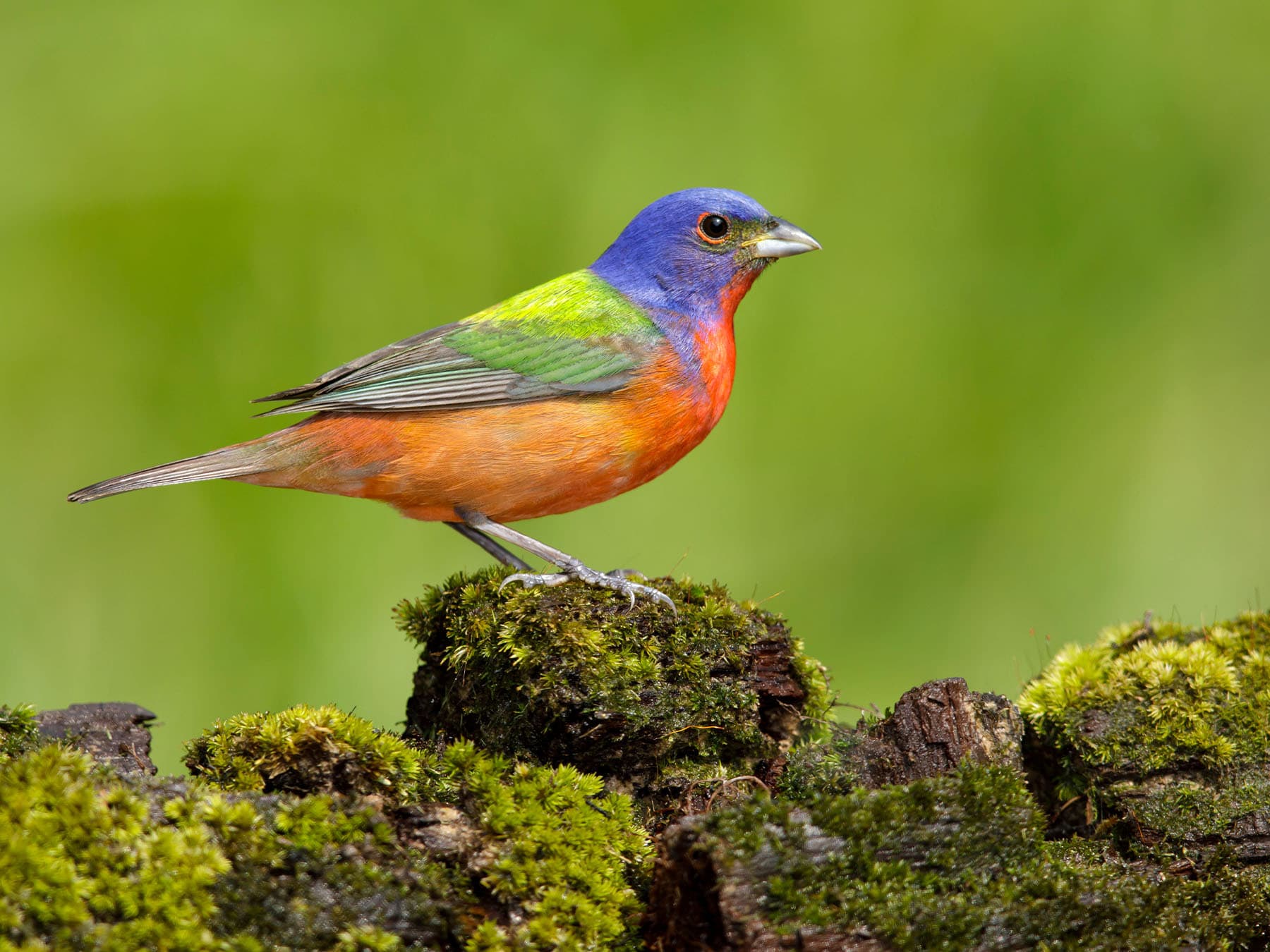
Painted Bunting. The female is the same size but plain green above and yellow-green below, with a pale eye-ring. The male has a blue head, green back and red underparts.
Not sure it’s a Indigo Bunting? Check your photo: Birdfact names the bird and shows the look-alike side by side.
Its size
Adults- Length
- 11.5–13 cm
- Wingspan
- 19–22 cm
- Weight
- 12–18 g
Its song and calls
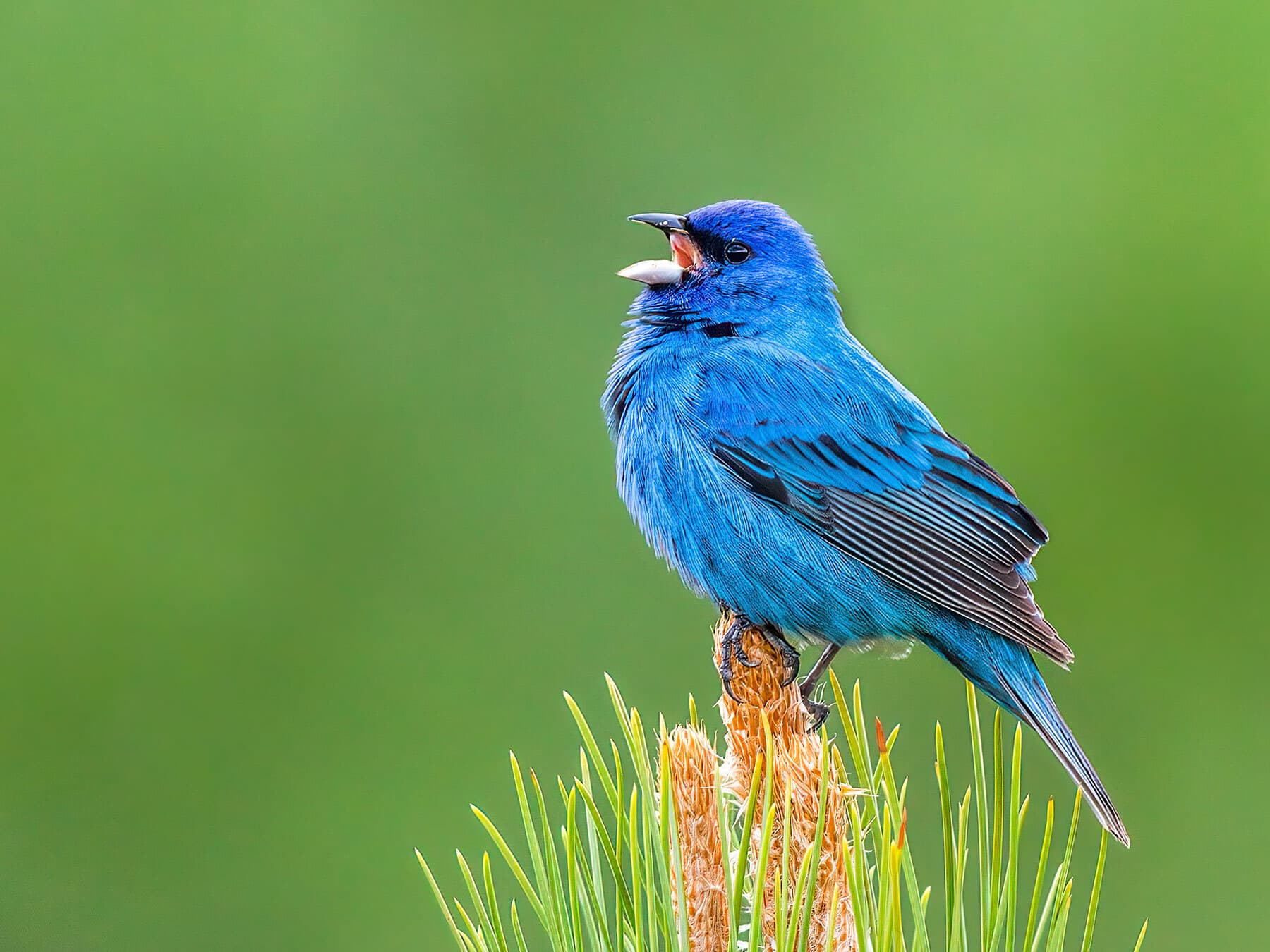
The song is bright, high and quick: a string of sharp, ringing notes, most of them in pairs, lasting about 2 seconds. An old way to remember it is "sweet, sweet, where, where, here, here, see it, see it", from a 1933 description. Only males sing. Almost every male has one main song pattern, kept from his first spring on, though a few switch later or sing two.
Males sing from arrival in spring through summer, some stopping in late June and others singing until mid-August, when they molt; they do not sing in winter. They keep singing through the heat of a summer day, from treetops, wires and roadside perches. Singing is fastest before sunrise, at over 200 songs an hour, then about 60 an hour through the day; unmated males have been timed at 680 songs an hour.
The common call is a short, sharp chip, given when disturbed and in a rapid series near a nest with large young. A high, buzzy cheet is used in chases and in winter flocks, and a high, thin tink is the strongest alarm, given when a hawk passes over, a predator comes close or a rival male intrudes.
How the song is learned
Most young males learn their song in their first spring from a neighboring territorial male, not from their father. About 80% copy a neighbor, only about 1 in 80 first-year males sings his father's song, and brothers from one brood usually end up with different songs.4 Older males that arrive early in spring, and the bluer young males, are the likeliest to be copied.5
Experiments show how much the social setting matters. Males raised without hearing other buntings develop an abnormal song that wild buntings ignore, and caged young males copied an adult they could watch and deal with face to face, rather than one they could only hear.6, 7
The result is song neighborhoods. Neighbors often share nearly the same song, in neighborhoods that average 3 or 4 males and reach 22, while males a few hundred meters apart usually sing differently.4 A neighborhood song can last up to about 20 years, changing a little as new males add their own twists. At one Michigan reserve, not one of the song types sung by nearly 100 males in 1978 was still in use by 1994.8
- Song0:00 / 0:04
Recorded in Michigan, United States · June 2024
- Song0:00 / 0:04
Recorded in North Carolina, United States · June 2022
Heard one and not sure? Let the bird song identifier listen.
When and where to see it
Indigo Buntings breed across eastern North America, from southern Manitoba, Ontario, Quebec, Maine and New Brunswick south to the Gulf Coast and central Florida, and west across the Great Plains to Colorado and Texas, with smaller numbers in the Southwest: Arizona, New Mexico, southern Utah and southern California. Surveys have found them commonest in Arkansas, Missouri, Kentucky, Tennessee, southern Illinois and Indiana, and Virginia and North Carolina, and in parts of the East they may be the most abundant songbird.
Look for them in brushy and weedy places where woods meet open ground: woodland edges, thickets, overgrown fields, roadsides, railroad and power-line rights-of-way, clearings, and woods a few years after logging. In one study they moved into old fields only in the sixth or seventh year after farming stopped, as shrubs returned. They are generally absent from built-up areas, intensively farmed land, closed forest and desert.
The range has grown. Indigo Buntings were first recorded in California in 1908 and Arizona in 1917 and were breeding in the Southwest by the 1940s. They colonized Canada's Maritime Provinces in the 1970s, and in Florida they spread from the panhandle into the peninsula during the early and middle 1900s.
Migration and the night sky
Spring migrants reach the Gulf Coast from late March, and breeding birds arrive from late April in the South to early June in the North. The first males reach Missouri and southern Indiana in late April and southern Michigan in early May, and the first females come about two weeks after the first males. They leave the north in September, and nearly all have gone by mid-October.
Indigo Buntings migrate at night, about 1,200 miles (2,000 km) each way. Many, probably most, cross the Gulf of Mexico, a flight of about 620 miles (1,000 km), though some go around it. Birds keep their east-west order between seasons: eastern breeders winter in the east of the range and midwestern breeders further west.
They find their way by the stars. In planetarium experiments in the 1960s, caged buntings faced south in fall and north in spring under the star patterns of the night sky.9 Young birds appear to learn the sky's center of rotation: buntings raised under a planetarium sky turning around a false pole later headed "south" away from that false pole.10 In another experiment, males kept indoors over winter and released far to the south in spring included some that flew back north to their old territories.11
Where they spend the winter
Indigo Buntings winter from Mexico through Central America to northern Panama, and in southern Florida, Cuba and Jamaica; a few winter along the Gulf and Atlantic coasts of the US. In winter they live in flocks in grassy fields, rice fields and brushy farmland, feeding on grass seeds, and can roost in groups of hundreds or thousands.
Banded birds come back to the same wintering sites year after year. At a feeder in southern Florida, 130 of 666 banded buntings returned, one for seven winters.12
Tips for seeing it
What it eats
In summer Indigo Buntings eat mainly small insects and spiders, with the seeds of grasses and weeds such as thistles, dandelions and goldenrods, and berries like blackberries, blueberries and elderberries. On migration and in winter they eat mainly small grass seeds. In Michigan, on arrival in spring, they also eat the buds, young leaves and flowers of trees such as cottonwood, elm and maple, and the caterpillars on the new leaves.
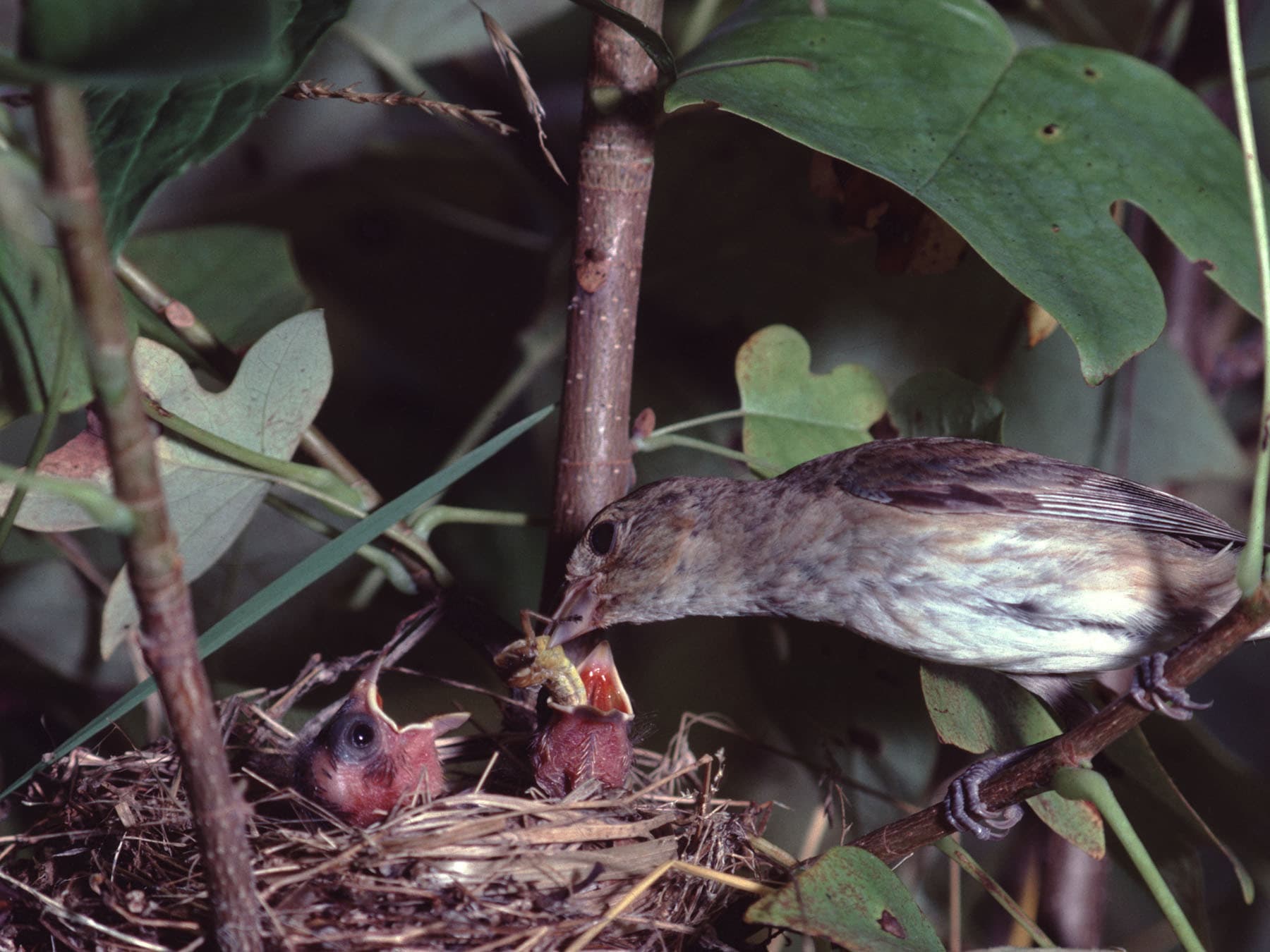
Old stomach studies found caterpillars (including cankerworms and hairy browntail moth caterpillars), small beetles such as click beetles and weevils, grasshoppers, aphids and cicadas. Nestlings are fed mainly small insects and spiders, such as grasshoppers and small caterpillars.
To reach seeds, a bunting lands on a grass stem and shuffles up until the stem bends under its weight, then picks the seeds from the head. It husks seeds with its bill and tongue, and picks food from the ground rather than scratching for it.
Feeders and yards
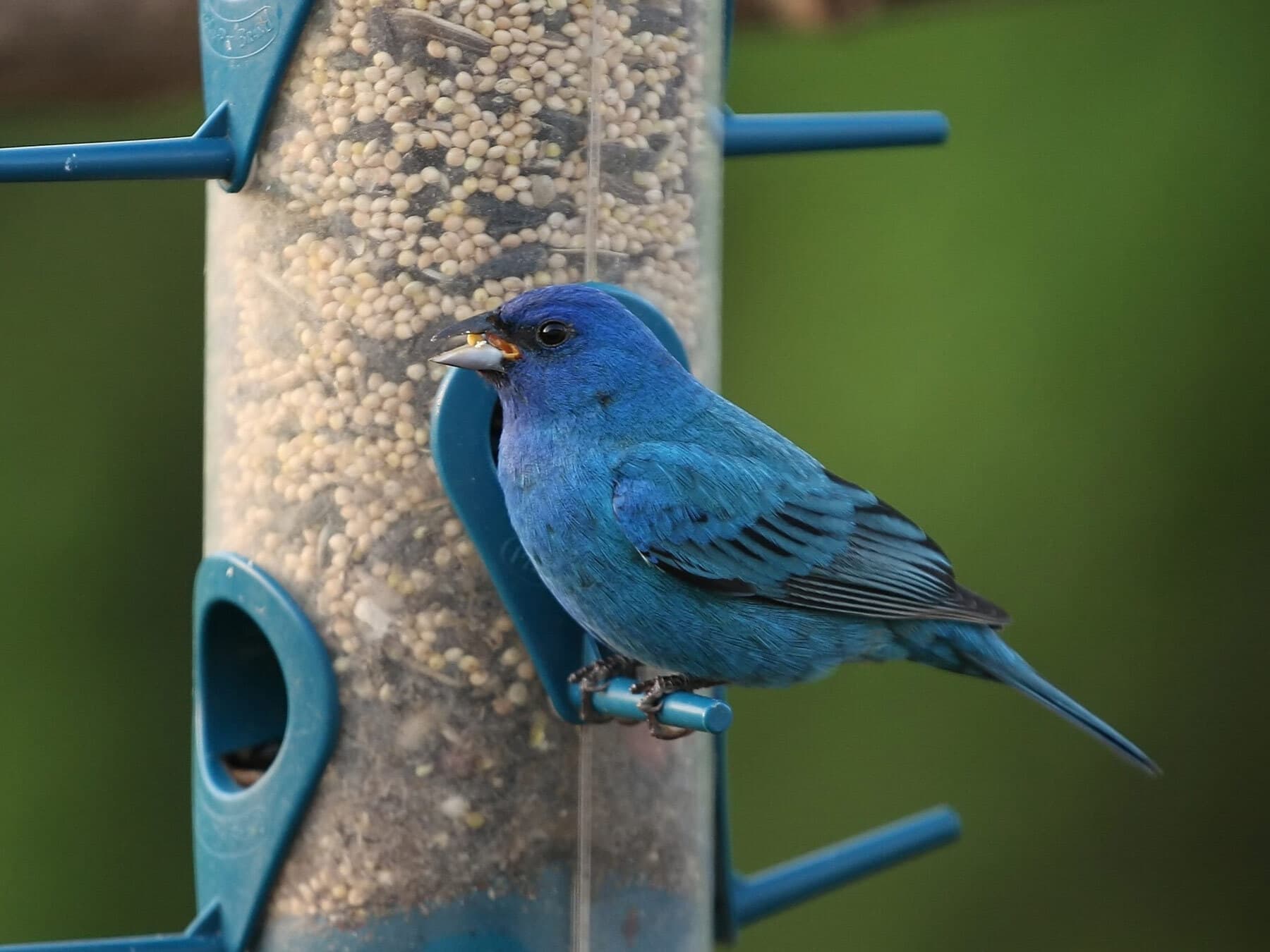
Indigo Buntings occasionally visit feeders, mostly on migration and in winter. Small seeds such as nyjer (thistle) and live mealworms can draw them in. They seldom drink and may get much of their water from insects and berries, though wintering flocks in Jamaica used bird baths near feeders. They live near brushy field edges and are generally absent from built-up areas.
Nesting and breeding
Most males have one mate, but about 15% have two or more, at once or one after another.1 Pairs are less faithful than they look: in a DNA study of one North Carolina population, about a third of nestlings (22 of 63) had been fathered by a male other than the female's mate.13
Breeding territories average about 3.5 acres (1.4 ha), from 1 to 20 acres (0.4-8 ha) in Michigan. Older males that come back nearly always reclaim the same territory (only 4% moved), while 44% of returning females settle somewhere new.1
The nest
The female chooses the site and builds alone, in a low fork of a shrub, bramble or tall weed, usually 1 to 3 feet (0.3-1 m) up and hidden under leaves at the edge of a thicket. Over 40 kinds of plants have held nests in Michigan, where black raspberry and gray dogwood held half, and late nests are often in goldenrod. It is not a nest box species.
The nest is an open cup of leaves, grass, stems and strips of bark, bound with spider silk and lined with fine grass, rootlets, thistle down and sometimes deer hair, about 3 inches (8 cm) across outside. Building can take up to 8 to 10 days early in the season but as little as 2 days in late summer; the male may watch but does not help. Each nest is used once, and a new one is built for each attempt.
Eggs and young
In southern Michigan, first eggs were laid from mid-May to mid-August, and half the young came from nests started in July and August. The usual clutch is 3 or 4 eggs (sometimes 1 or 2), white and unmarked, rarely with a few brown spots, about 0.7 by 0.6 inches (19 x 14 mm).
The female alone incubates, for 12 to 13 days (11-14). The young leave the nest 9 to 12 days after hatching (8-14) and are independent about 3 weeks later. The female does nearly all the feeding of nestlings, and males bring food at only about 1 in 10 nests, mostly just before the young leave; after fledging, males sometimes feed part of the brood while the female starts again. A female can raise two broods in a summer, though in Michigan only about 1 in 8 did and three was very rare; when nests fail she may make six or seven attempts in a season.
Nest predators and cowbirds
About half of nests fail. In southern Michigan 48% of broods fledged young,1 and predators caused most of the losses there and in an Indiana study.14 Nest predators are thought to include raccoons, opossums, skunks, foxes, cats and Blue Jays; in a Missouri video study, snakes were the predator at 5 of the 6 nests where one was filmed.15
Brown-headed Cowbirds lay in roughly a quarter of nests, 20 to 30% in season-long studies in Michigan, Ontario and West Virginia,1 and the buntings raise the cowbird chick. A parasitized nest fledged about one fewer bunting, and each cowbird that fledges costs 1.5 to 2 bunting young. In Michigan no cowbird eggs were laid after mid-July, so later nests escaped.16
Edges can be a trap. In an experiment in South Carolina, buntings chose patches with more edge but raised fewer young there than in compact patches.17
Behaviour
Territorial males fly a slow, fluttering "butterfly flight" with their wings held out and quivering, and rivals sometimes grapple in mid-air and tumble to the ground with their feet locked, still singing. An alarmed bird raises a small crest and flicks or swings its tail from side to side, and when a predator nears a nest with large young, the parents chip rapidly and may flutter away as if injured.
Indigo Buntings are solitary in the breeding season but live in loose flocks on migration and in winter, though they appear to fly alone at night; young birds flock together in late summer. They interbreed with the Lazuli Bunting in parts of the Great Plains and the West where their ranges meet, and the males of the two defend territories against each other and may share songs. A few hybrids with Painted Buntings have been reported.
Lifespan and predators
About half of adults survive from one year to the next: in Michigan, 52 to 59% of males and 34 to 47% of females, and a male that has reached his first breeding season lives, on average, about 2 to 2.5 more years.18 In field studies both sexes have bred for 9 years, and one bird was followed for 11.
The oldest on the North American banding records was at least 13 years 3 months old: a male banded in Ohio in 2001 and caught again, alive, in Ohio in 2013.19
Conservation
The Indigo Bunting is still common, with about 77 million birds in a Partners in Flight estimate for around 2010, and of low conservation concern: Partners in Flight scores it 10 on its 4 to 20 Continental Concern scale.20 It probably became more common through the 1900s as forests were cut and brushy edges spread, before declines began in the last quarter of the century.
On the North American Breeding Bird Survey its numbers fell by 0.61% a year from 1966 to 2025, about 30% in all, though Canadian numbers, at the northern edge of the range, appear to have risen.21 The survey index has changed little from 2021 to 2025.
It does poorly where fields are farmed intensively, roadsides are mown often, old fields grow back into forest or land is built on. Migrants hit buildings and towers at night, and singing males are hit by cars on roadsides. In the 2000s it was a popular cage bird in the Yucatán and Cuba and was trapped and sold illegally in southern Florida. In the US the Indigo Bunting is protected under the Migratory Bird Treaty Act.22
Similar birds
Often mistaken for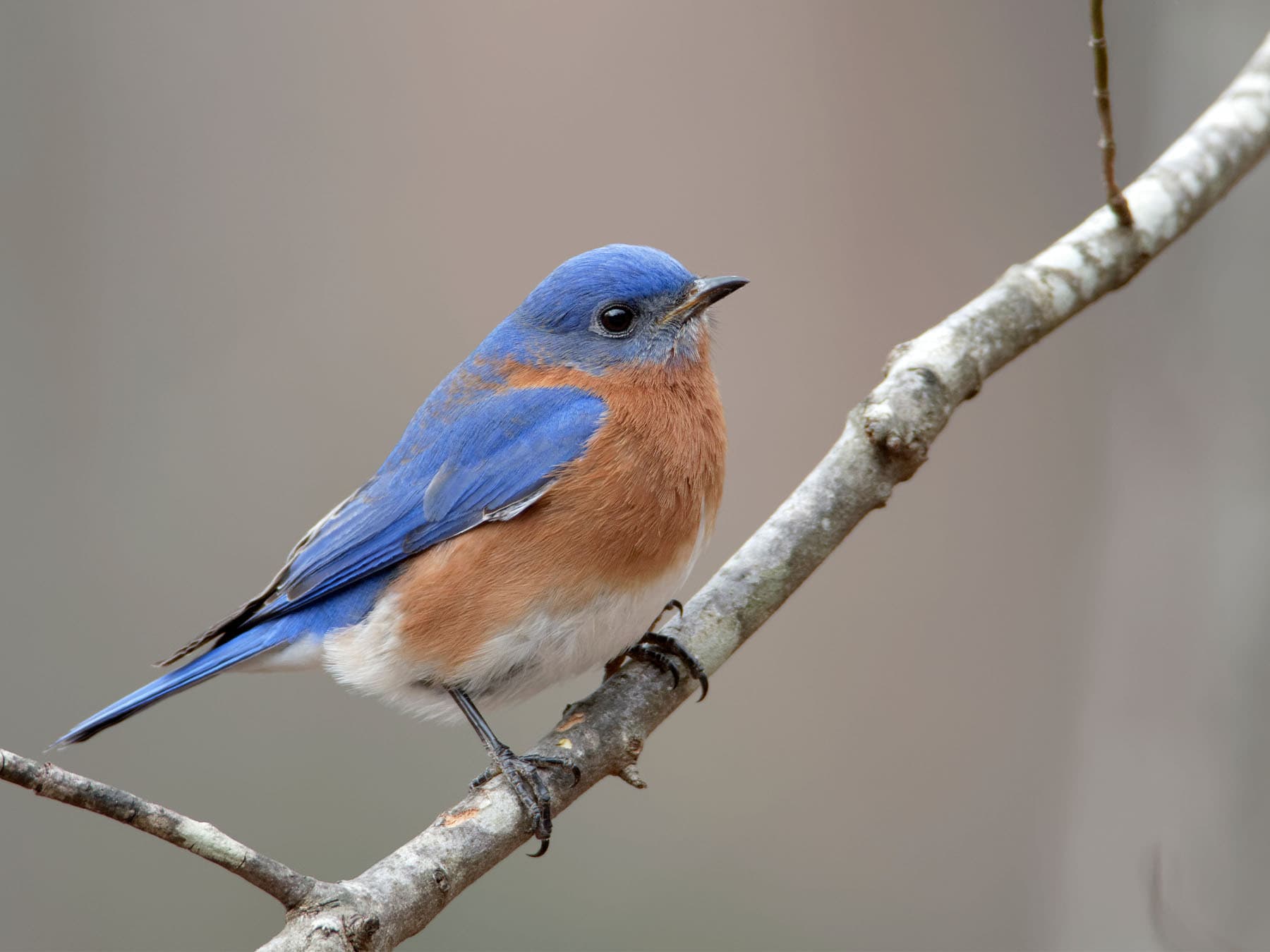
More photos
2 photos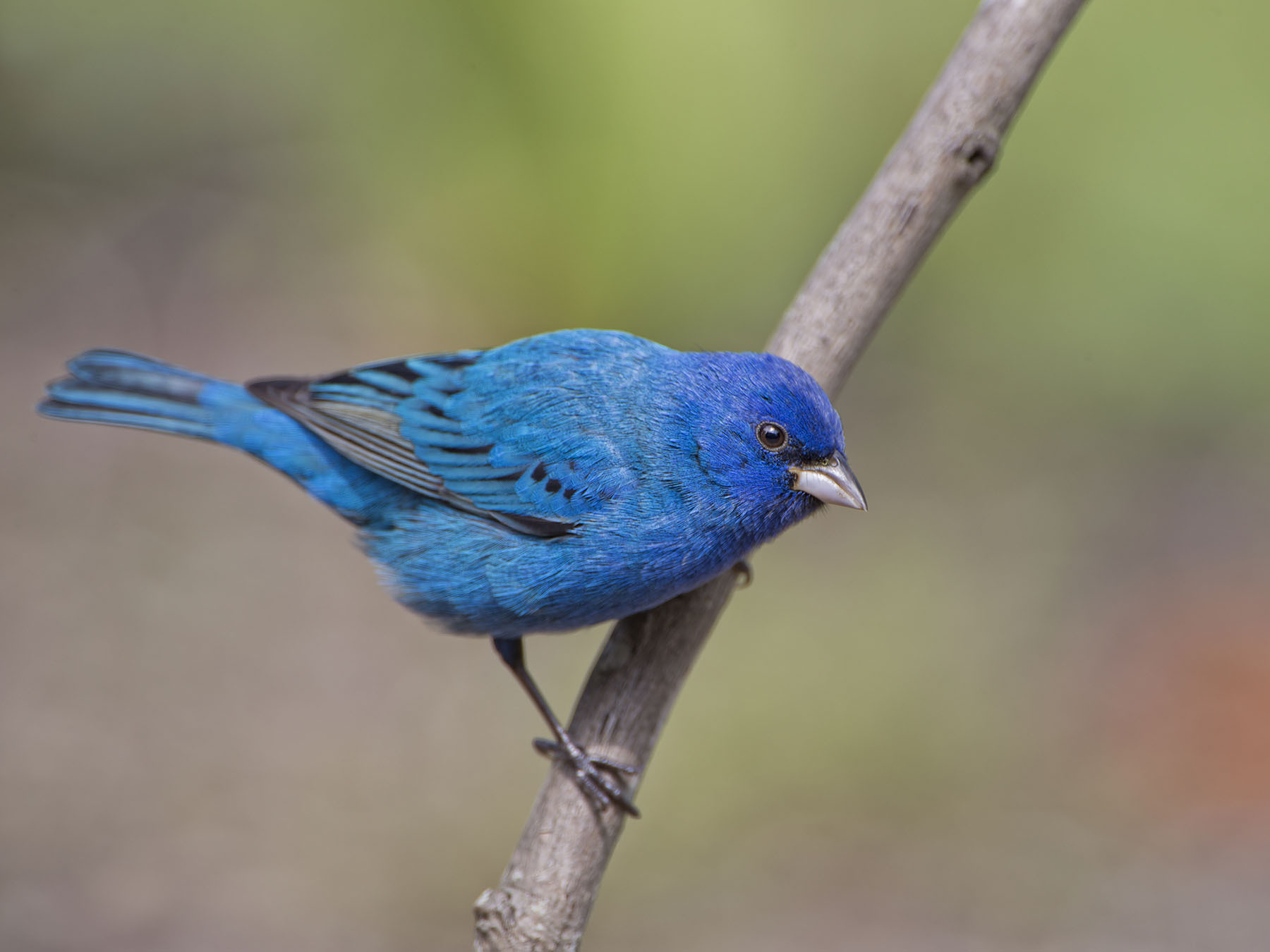
Quick facts
- Length
- 11.5–13 cm
- Wingspan
- 19–22 cm
- Weight
- 12–18 g
- Lifespan
- oldest recorded at least 13 years 3 months
- Family
- Cardinals & Grosbeaks
- Migration
- Long-distance Migrant
- Global status (IUCN)
- Least Concern
- World population
- About 77 million (Partners in Flight, about 2010)
- Population trend
- Common and widespread but slowly declining; of low conservation concern (Partners in Flight)
- Also called
- Indigo bird
- Scientific name
- Passerina cyanea
Questions
3Is the Indigo Bunting a finch?
No. It belongs to the cardinal family, Cardinalidae, with the cardinals, the Blue Grosbeak and the other Passerina buntings, and it has no subspecies. Linnaeus described it in 1766.
Do Indigo Buntings mate for life?
No. A female may change mates between nests, and 11% of pairs split after a nesting attempt. Some pairs do breed together for three to five years, mainly because both birds return to the same territory. See nesting and breeding.
Are Indigo Buntings rare?
No. They are common in summer across much of the eastern US, though their numbers have fallen by about 30% since 1966. See conservation status.
Sources
31- 1Payne, R. B. (2020). Indigo Bunting (Passerina cyanea), version 1.0. Birds of the World (A. F. Poole, editor). Cornell Lab of Ornithology. doi:10.2173/bow.indbun.01 (opens in a new tab)
- 2Prum, R. O., Torres, R., Williamson, S. and Dyck, J. (1999). Two-dimensional Fourier analysis of the spongy medullary keratin of structurally coloured feather barbs. Proceedings of the Royal Society B 266: 13-22. doi:10.1098/rspb.1999.0598 (opens in a new tab)
- 3Hudson, S. B. and Wilcoxen, T. E. (2018). Condition dependence of structural plumage coverage in Indigo Buntings Passerina cyanea. Avian Biology Research 11: 54-61. doi:10.3184/175815617X15063340995383 (opens in a new tab)
- 4Payne, R. B., Payne, L. L. and Doehlert, S. M. (1988). Biological and cultural success of song memes in Indigo Buntings. Ecology 69: 104-117. doi:10.2307/1943165 (opens in a new tab)
- 5Payne, R. B. and Payne, L. L. (1993). Song copying and cultural transmission in Indigo Buntings. Animal Behaviour 46: 1045-1065. doi:10.1006/anbe.1993.1296 (opens in a new tab)
- 6Rice, J. O. and Thompson, W. L. (1968). Song development in the Indigo Bunting. Animal Behaviour 16: 462-469. doi:10.1016/0003-3472(68)90041-9 (opens in a new tab)
- 7Payne, R. B. (1981). Song learning and social interaction in Indigo Buntings. Animal Behaviour 29: 688-697. doi:10.1016/S0003-3472(81)80003-6 (opens in a new tab)
- 8Payne, R. B. (1996). Song traditions in Indigo Buntings: origin, improvisation, dispersal, and extinction in cultural evolution. Ecology and Evolution of Acoustic Communication in Birds (D. E. Kroodsma and E. H. Miller, eds), pp. 198-220. Cornell University Press, Ithaca. ISBN 9780801430497.
- 9Emlen, S. T. (1967). Migratory orientation in the Indigo Bunting, Passerina cyanea. Part I: evidence for use of celestial cues. The Auk 84: 309-342. doi:10.2307/4083084 (opens in a new tab)
- 10Emlen, S. T. (1970). Celestial rotation: its importance in the development of migratory orientation. Science 170: 1198-1201. doi:10.1126/science.170.3963.1198 (opens in a new tab)
- 11Sniegowski, P. D., Ketterson, E. D. and Nolan, V., Jr. (1988). Can experience alter the avian annual cycle? Results of migration experiments with Indigo Buntings. Ethology 79: 333-341. doi:10.1111/j.1439-0310.1988.tb00722.x (opens in a new tab)
- 12Fisk, E. J. (1979). Fall and winter birds near Homestead, Florida. Bird-Banding 50: 224-243, 297-303. doi:10.2307/4512458 (opens in a new tab)
- 13Westneat, D. F. (1990). Genetic parentage in the Indigo Bunting: a study using DNA fingerprinting. Behavioral Ecology and Sociobiology 27: 67-76. doi:10.1007/BF00183315 (opens in a new tab)
- 14Carey, M. and Nolan, V., Jr. (1979). Population dynamics of Indigo Buntings and the evolution of avian polygyny. Evolution 33: 1180-1192. doi:10.2307/2407476 (opens in a new tab)
- 15Thompson, F. R., III, Dijak, W. D. and Burhans, D. E. (1999). Video identification of predators at songbird nests in old fields. The Auk 116: 259-264. doi:10.2307/4089477 (opens in a new tab)
- 16Payne, R. B. and Payne, L. L. (1998). Brood parasitism by cowbirds: risks and effects on reproductive success and survival in Indigo Buntings. Behavioral Ecology 9: 64-73. doi:10.1093/beheco/9.1.64 (opens in a new tab)
- 17Weldon, A. J. and Haddad, N. M. (2005). The effects of patch shape on Indigo Buntings: evidence for an ecological trap. Ecology 86: 1422-1431. doi:10.1890/04-0913 (opens in a new tab)
- 18Payne, R. B. and Payne, L. L. (1990). Survival estimates of Indigo Buntings: comparison of banding recoveries and local observations. The Condor 92: 938-946. doi:10.2307/1368730 (opens in a new tab)
- 19USGS Bird Banding Laboratory. Longevity records of North American birds. USGS Eastern Ecological Science Center, Bird Banding Laboratory. Accessed 2 November 2026. Source (opens in a new tab)
- 20Partners in Flight (2023). Avian Conservation Assessment Database and Population Estimates Database. Bird Conservancy of the Rockies. Accessed 2 November 2026. Source (opens in a new tab)
- 21Hostetler, J. A. et al. (2026). The North American Breeding Bird Survey, Analysis Results 1966-2025. U.S. Geological Survey data release. doi:10.5066/P1OSNSFC (opens in a new tab)
- 22U.S. Fish and Wildlife Service (2026). 50 CFR 10.13: List of Birds Protected by the Migratory Bird Treaty Act. Electronic Code of Federal Regulations. Accessed 2 November 2026. Source (opens in a new tab)
- 23Cornell Lab of Ornithology. Indigo Bunting. All About Birds. Accessed 2 November 2026. Source (opens in a new tab)
- 24National Audubon Society. Indigo Bunting. Guide to North American Birds. Accessed 2 November 2026. Source (opens in a new tab)
- 25National Audubon Society. Blue Grosbeak. Guide to North American Birds. Accessed 2 November 2026. Source (opens in a new tab)
- 26National Audubon Society. Lazuli Bunting. Guide to North American Birds. Accessed 2 November 2026. Source (opens in a new tab)
- 27National Audubon Society. Eastern Bluebird. Guide to North American Birds. Accessed 2 November 2026. Source (opens in a new tab)
- 28National Audubon Society. Painted Bunting. Guide to North American Birds. Accessed 2 November 2026. Source (opens in a new tab)
- 29Thompson, W. L. (1970). Song variation in a population of Indigo Buntings. The Auk 87: 58-71. doi:10.2307/4083658 (opens in a new tab)
- 30Johnston, D. W. and Downer, A. C. (1968). Migratory features of the Indigo Bunting in Jamaica and Florida. Bird-Banding 39: 277-293. doi:10.2307/4511514 (opens in a new tab)
- 31Baker, M. C. and Boylan, J. T. (1999). Singing behavior, mating associations and reproductive success in a population of hybridizing Lazuli and Indigo Buntings. The Condor 101: 493-504. doi:10.2307/1370179 (opens in a new tab)

Checked by
Nathan Cope, founder and editor
Nathan founded Birdfact and leads its writers and contributors in the UK, the US and Canada. He has watched and studied birds for more than ten years, and checks every article and species guide before it’s published.