


Published 26 Oct 2026
Siskin or Yellowhammer? How to Tell Them Apart
By the Birdfact teamChecked by Nathan Cope
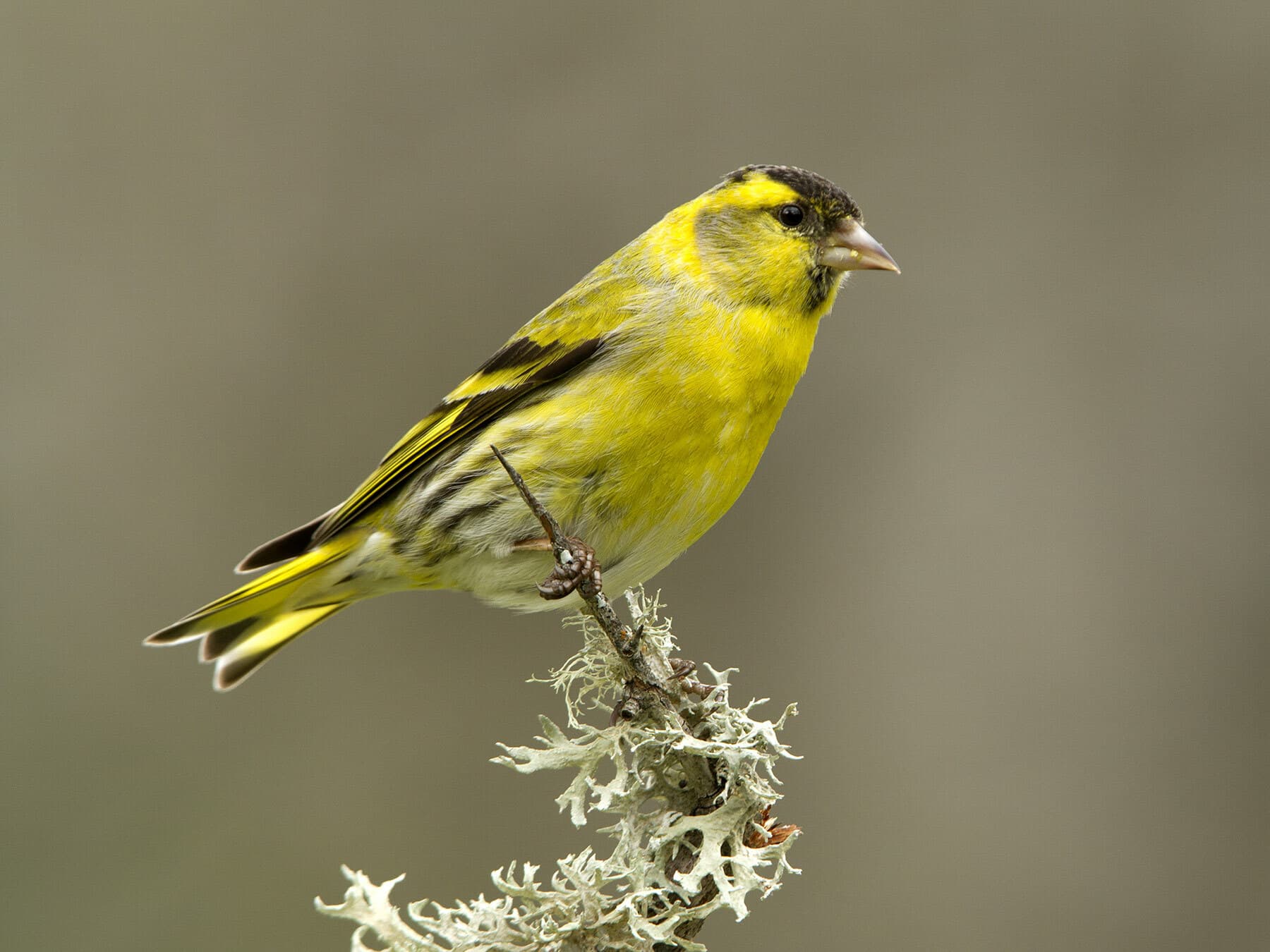
A male Siskin has a black cap and bright yellow bars on black wings. A Yellowhammer has a yellow head with no black cap, and brown wings streaked with black
A Yellowhammer is also much bigger, about twice a Siskin’s weight, with a chestnut rump and a long tail that shows white outer feathers in flight. Siskins feed in trees and at hanging feeders; Yellowhammers feed on the ground.
On this page13 sections
Siskin or Yellowhammer? Look at the cap and the wings

| Feature | Siskin | Yellowhammer |
|---|---|---|
| Head (male)Decisive | Siskin: Black cap and small black bib | Yellowhammer: Yellow, no black cap |
| WingsDecisive | Siskin: Black, with bright yellow bars | Yellowhammer: Brown, streaked with black; no yellow bars |
| Rump and tail | Siskin: Yellow rump; short, forked tail | Yellowhammer: Chestnut rump; long tail, white outer feathers |
| Size | Siskin: 11-12 cm, about 13 g | Yellowhammer: 16-16.5 cm, about 26 g |
| Bill | Siskin: Fine and pointed | Yellowhammer: Short and blue-grey |
| Song | Siskin: A fast, twittering jumble with long wheezes | Yellowhammer: A run of short notes, often ending in a long one |
| Feeds | Siskin: In trees and at hanging feeders | Yellowhammer: On the ground |
Females are the harder pair: look for the Siskin’s fine bill and pale wing bars, and the Yellowhammer’s chestnut rump and long tail.
Seen one and not sure which? Identify it from a photo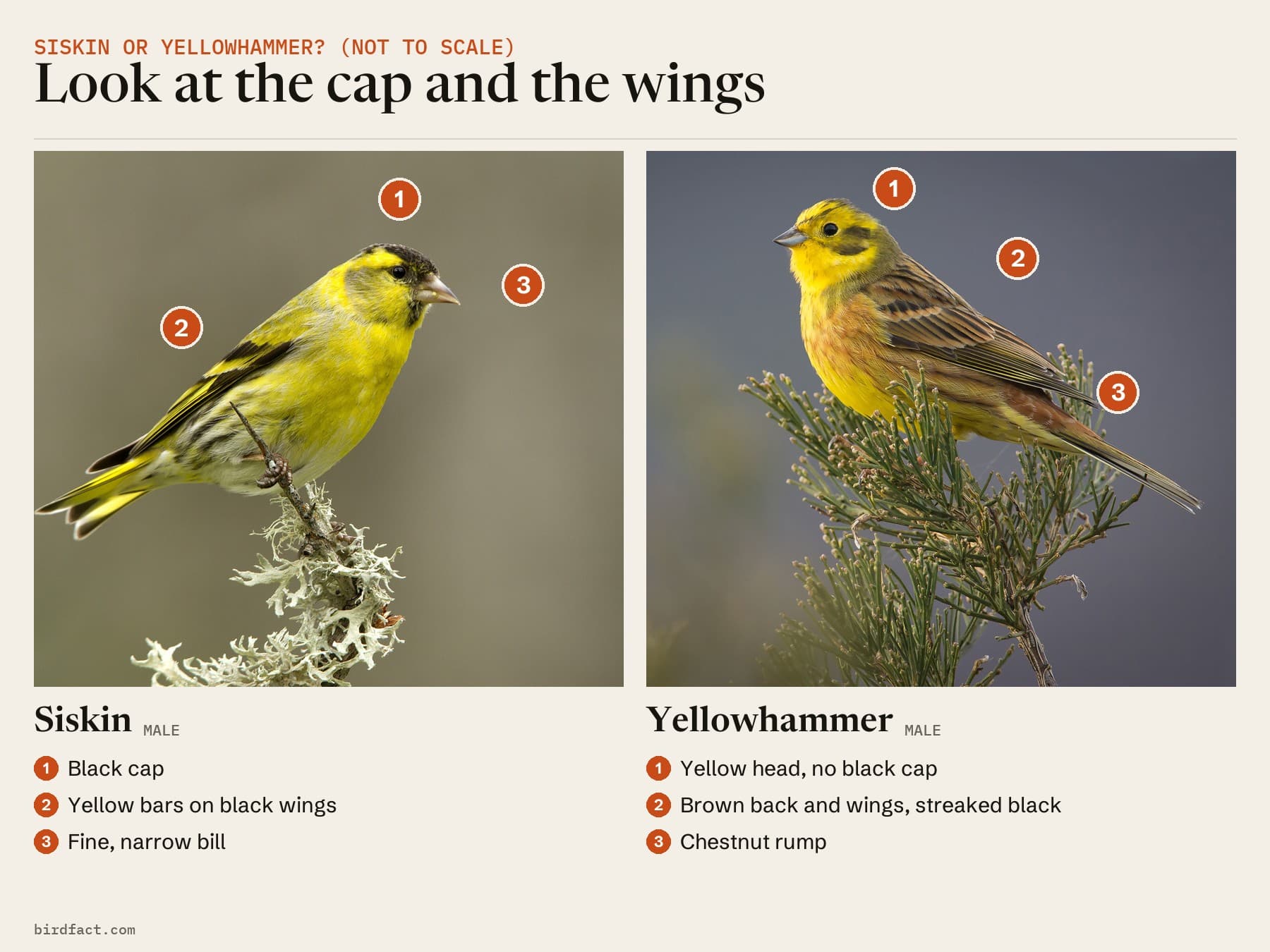
Look at the cap and the wings. A male Siskin has a black cap and yellow bars on black wings; a Yellowhammer is bigger, with a yellow head, no cap, and brown wings streaked with black. Males, females, young birds, songs and where each lives, compared.
Look at the cap and the wings. A male Siskin has a black cap and bright yellow bars across black wings; a Yellowhammer has a yellow head with no black cap, and brown wings and back streaked with black, above a chestnut rump. The Yellowhammer is also much bigger: a bunting of farmland hedges, where the Siskin is a small finch of conifers, alders and garden feeders.1, 2
This page compares males, females and young birds, their songs and calls, and where each lives. For each bird in full, see the Siskin and the Yellowhammer.
Comparison table
| Siskin | Yellowhammer | |
|---|---|---|
| Length | 11-12 cm | 16-16.5 cm |
| Weight | About 13 g | About 26 g |
| Bill | Fine and narrow | Short and blue-grey |
| Male's head | Black cap and small black bib, yellow face | Yellow, with no black cap |
| Wings | Black, with bright yellow bars | Brown, streaked with black; no yellow bars |
| Rump and tail | Yellow rump; forked tail with yellow sides | Chestnut rump; white outer tail feathers |
| Song | A fast, twittering jumble with wheezy notes | A run of short notes and a drawn-out last note |
| Feeds | In trees, often hanging upside-down | Almost always on the ground |
| Where | Conifer woods, alders and birches, gardens | Farmland, hedges, scrub and heath |
| UK status | Green-listed, increasing | Red-listed, declining |
Size and shape
Males
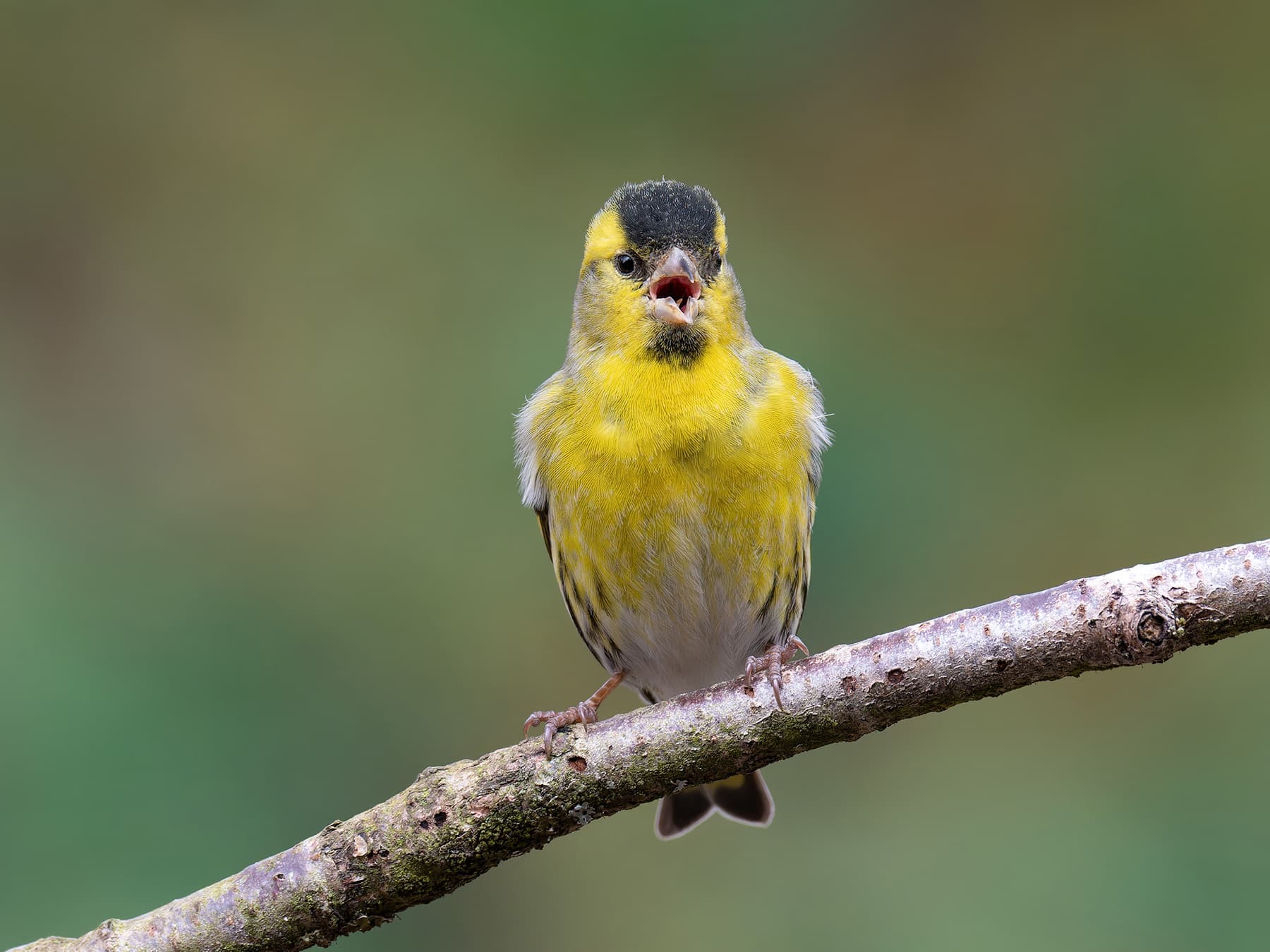
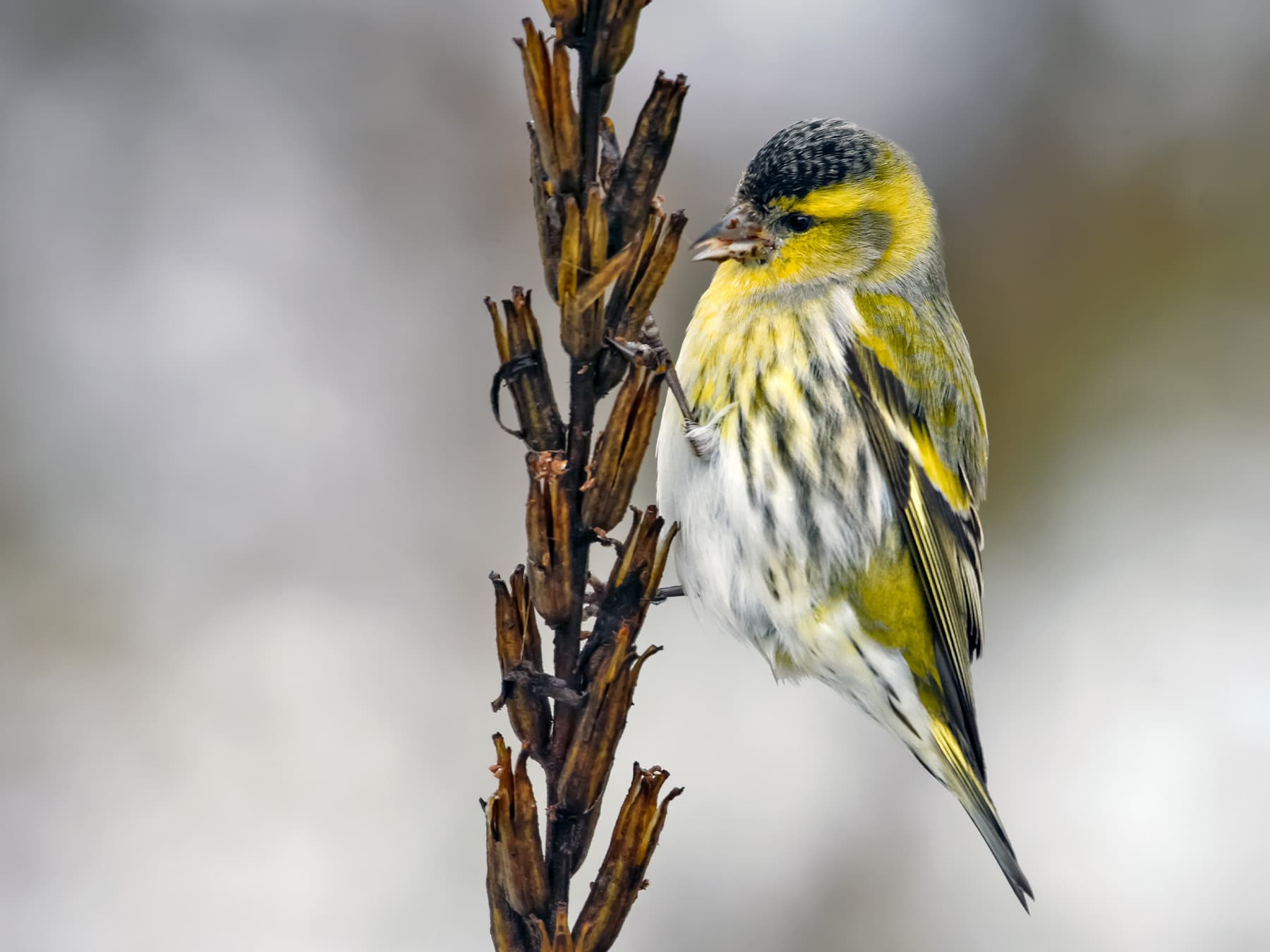
A male Siskin has a black cap from the forehead to the crown, a small black bib, a yellow stripe over the eye and a yellow face and breast. His back is olive-green, streaked with black, and his black wings carry a broad yellow bar and a yellow band along the flight feathers.1
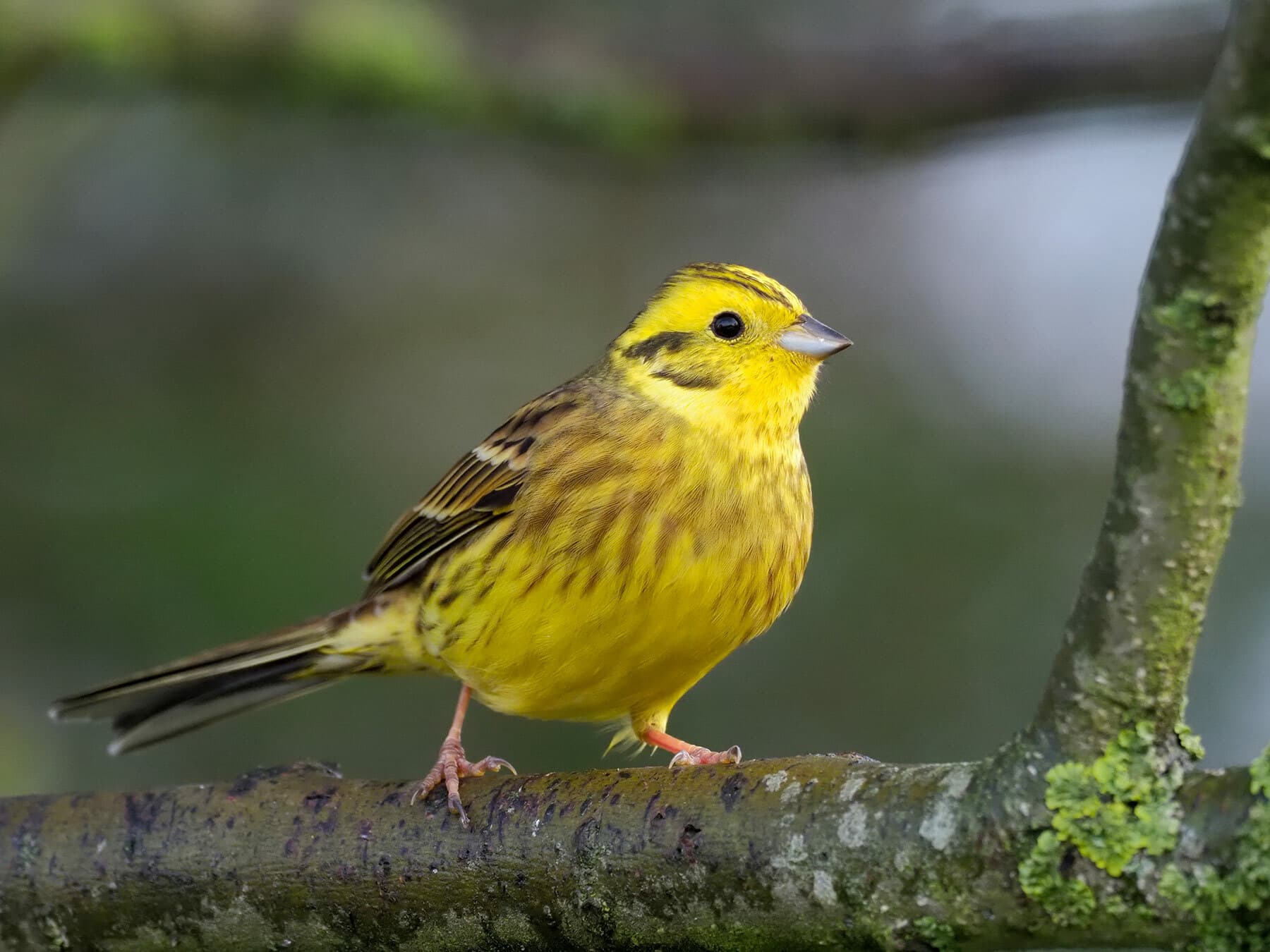
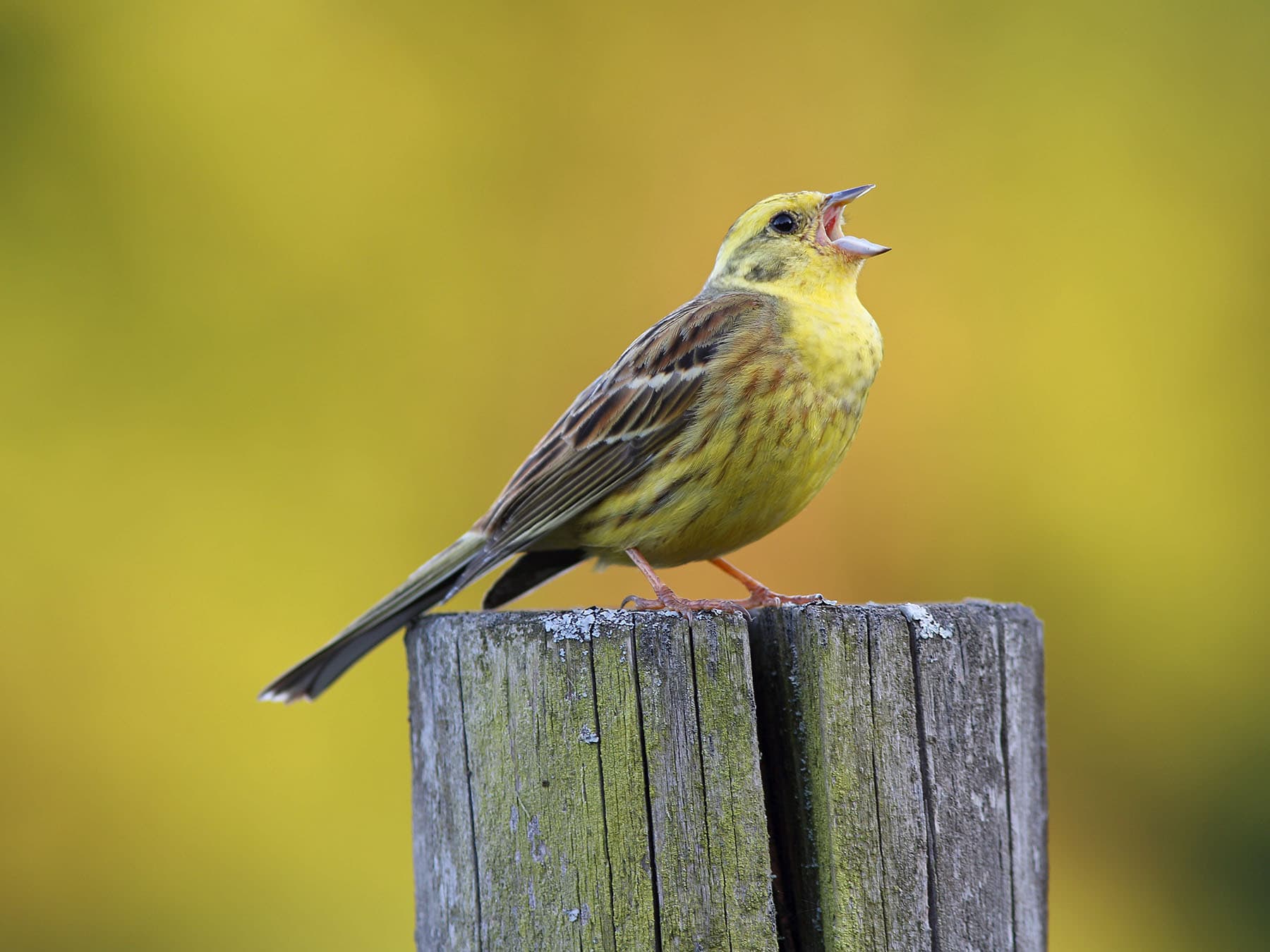
A male Yellowhammer has no black cap. His head is yellow, with dark marks along the sides of the crown and around the cheek, and his underparts are yellow with dark streaks and some chestnut on the breast sides. His back and wings are warm brown streaked with black, with no yellow bars, and his rump is chestnut. The bill is blue-grey. In summer, as the plumage wears, a male's head becomes more extensively yellow, the dark marks reduced to narrow streaks.2
Females
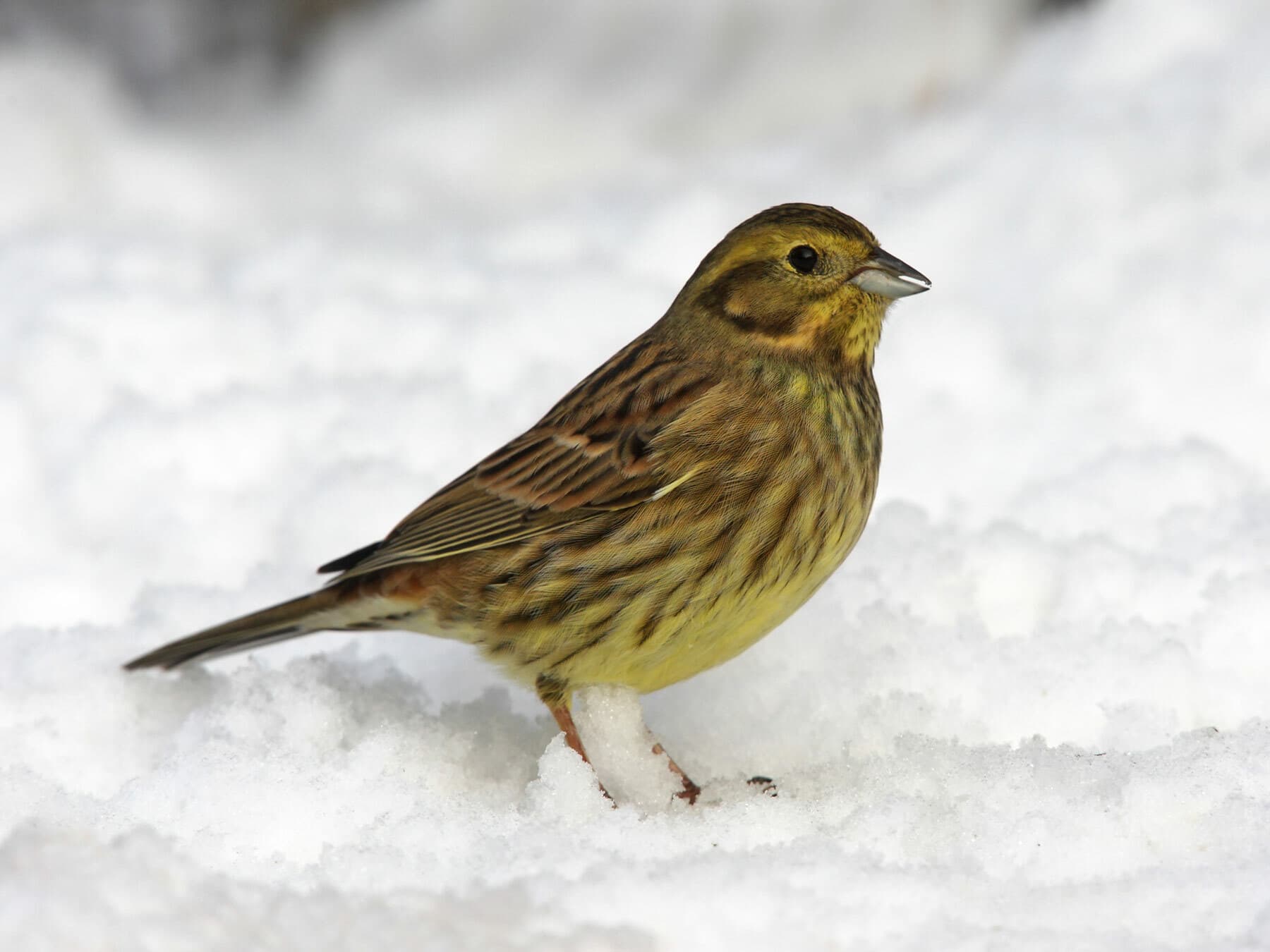
Females are the harder pair: the female Siskin has no black cap, and the female Yellowhammer has much less yellow on the head than the male. The female Siskin's head is greyish-green, she is heavily streaked above and on her pale, faintly yellow breast and flanks, with a white belly, and her wing bars are pale yellowish-green, cream or whitish. Look for the fine bill and the small size.1
A female Yellowhammer is a duller copy of the male, with much more olive on the crown and face and less yellow on the head, and paler yellow underparts with stronger dark streaks. She has the male's streaked brown back and chestnut rump, and no yellow wing bars.2

Young birds
Young Siskins out of the nest look like females but browner: buffish-brown and streaked, with a pale buff stripe over the eye and two buff wing bars.1 Young Yellowhammers are duller than females and more heavily streaked below, with a faint eyebrow and broad dark streaks on the back; in their first winter many have an almost wholly brown head and only a faint yellow tinge below.2 With either, look at the bill and the size: a small bird with a fine bill is a Siskin; a bigger bird with a short, greyish bill and a chestnut rump is a Yellowhammer.
In flight

Songs and calls
The songs could hardly be more different. A Yellowhammer sings a run of short, similar notes, usually ending in a long note of a different pitch, often after a slightly higher second-last note; in Britain the rhythm is remembered as "a little bit of bread and no cheese". It sings from the top of a tree, a bush or a wire.23 A Siskin sings a fast, rambling jumble of thin twitters, trills and wheezy notes, often from a treetop or in a display flight.1
The figure shows a Yellowhammer song and part of a Siskin song from the British Library's recordings. In the Yellowhammer's song, from Devon in 1966, a run of short notes near 4.5 kHz is followed by a higher note near 7-8 kHz and a drawn-out last note of about 0.6 seconds, sliding from about 5.8 to 5.3 kHz. Only two of the seven songs on that recording end with the long note: this bird often stopped short. In the Siskin's song, from Surrey in 1976, a long, buzzy wheeze sits in the middle of the twittering.7
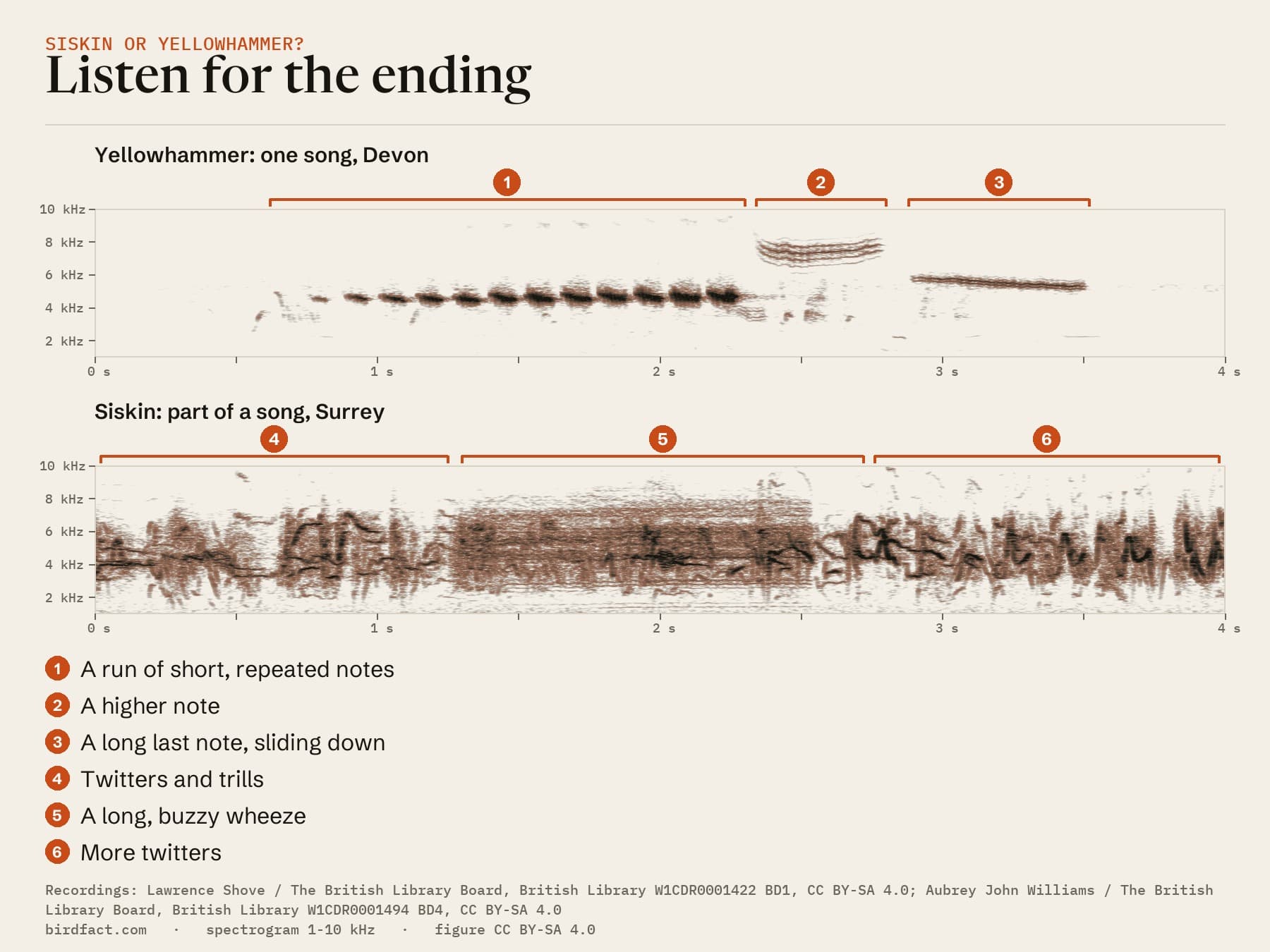
Yellowhammers have local dialects, which differ in the last part of the song.8 Birds taken from Britain to New Zealand in the 19th century may have kept dialects that have since gone from Britain: New Zealand Yellowhammers sing seven dialects, five of them not found in Britain today but known from continental Europe, and the authors of the study think they survived there after disappearing here.9
The calls differ too. A Siskin's best-known call, often given in flight, is a high, ringing "tsuu-ee" or "toolee"; a Yellowhammer's commonest call is a short "stif".1, 2
Where and how they feed
Siskins feed in trees, mostly on seeds from cones and catkins of spruce, pine, larch, alder and birch, hanging upside-down like tits to reach them. In late winter many come to hanging seed feeders in gardens.1 Yellowhammers feed almost entirely on the ground, picking through seeds and grain in fields, stubbles and field margins, and feed insects to their chicks.23 So a yellow bird hanging from an alder cone or a feeder is a Siskin; one feeding on a field edge or singing from the top of a hedge is probably a Yellowhammer.
Where and when to see them
Both live in Britain and Ireland all year. Siskins breed across most of Scotland and Wales and much of the north and south-west of England, in conifer woods and plantations, and in winter turn up almost anywhere, joined by birds from the Continent.5 Yellowhammers stay on farmland all year, mostly in low-lying areas, and are densest in eastern Britain; they rarely breed on the Outer Hebrides or the Northern Isles.4
Which is more common?
The two are going in opposite directions. The Siskin is Green-listed: the UK has about 445,000 pairs (2016), and the Breeding Bird Survey shows a rise of 55% from 1995 to 2024.510 The Yellowhammer is Red-listed: there are about 700,000 territories (2016), but numbers have fallen by 68% since 1967 and by 38% from 1995 to 2024, with a fall of 75% in Wales.410
Other yellow birds
A Greenfinch is bigger, at 15 cm, with a chunky bill; a Siskin is smaller and streakier.11 See Siskin or Greenfinch?. A Serin is a small, streaky finch with a stubby bill and a lemon-yellow rump, and only a few are seen in the UK each year.12 A Goldfinch has a bright red face and a yellow wing patch.13 More: yellow birds in the UK.
Questions
Is a Yellowhammer a finch?
No. The Yellowhammer is a bunting, in the family Emberizidae; the Siskin is a finch, in the family Fringillidae.4, 5
What is another name for the Yellowhammer?
Another English name for it is Yellow Bunting.4
Are Yellowhammers rare in the UK?
Not rare, but declining: they are still widespread on lowland farmland, with about 700,000 territories, but the species is Red-listed after numbers fell by more than two-thirds since 1967.
Sources
- Clement, P. (2020). Eurasian Siskin (Spinus spinus), version 1.0. Birds of the World (J. del Hoyo, A. Elliott, J. Sargatal, D. A. Christie and E. de Juana, editors). Cornell Lab of Ornithology. doi:10.2173/bow.eursis.01
- Copete, J. L. (2020). Yellowhammer (Emberiza citrinella), version 1.0. Birds of the World (J. del Hoyo, A. Elliott, J. Sargatal, D. A. Christie and E. de Juana, editors). Cornell Lab of Ornithology. doi:10.2173/bow.yellow2.01
- RSPB. Yellowhammer. RSPB Birds A-Z. Accessed 26 October 2026. Source
- BTO. Yellowhammer (Emberiza citrinella). BTO BirdFacts. Accessed 26 October 2026. Source
- BTO. Siskin (Spinus spinus). BTO BirdFacts. Accessed 26 October 2026. Source
- RSPB. Siskin. RSPB Birds A-Z. Accessed 26 October 2026. Source
- British Library recordists. Recordings on the Siskin or Yellowhammer page. Wikimedia Commons (British Library). Accessed 26 October 2026. Source
- Diblíková, L., Pipek, P., Petrusek, A., Svoboda, J., Bílková, J., Vermouzek, Z., Procházka, P., Petrusková, T. (2019). Detailed large-scale mapping of geographical variation of Yellowhammer Emberiza citrinella song dialects in a citizen science project. Ibis 161: 401-414. doi:10.1111/ibi.12621
- Pipek, P., Petrusková, T., Petrusek, A., Diblíková, L., Eaton, M. A., Pyšek, P. (2018). Dialects of an invasive songbird are preserved in its invaded but not native source range. Ecography 41: 245-254. doi:10.1111/ecog.02779
- Heywood, J. J. N., Massimino, D., Baker, L., Balmer, D. E. et al. (2026). The Breeding Bird Survey 2025. BTO Research Report 802. British Trust for Ornithology, Thetford. Accessed 26 October 2026. Source
- RSPB. Greenfinch. RSPB Birds A-Z. Accessed 26 October 2026. Source
- RSPB. Serin. RSPB Birds A-Z. Accessed 26 October 2026. Source
- RSPB. Goldfinch. RSPB Birds A-Z. Accessed 26 October 2026. Source