


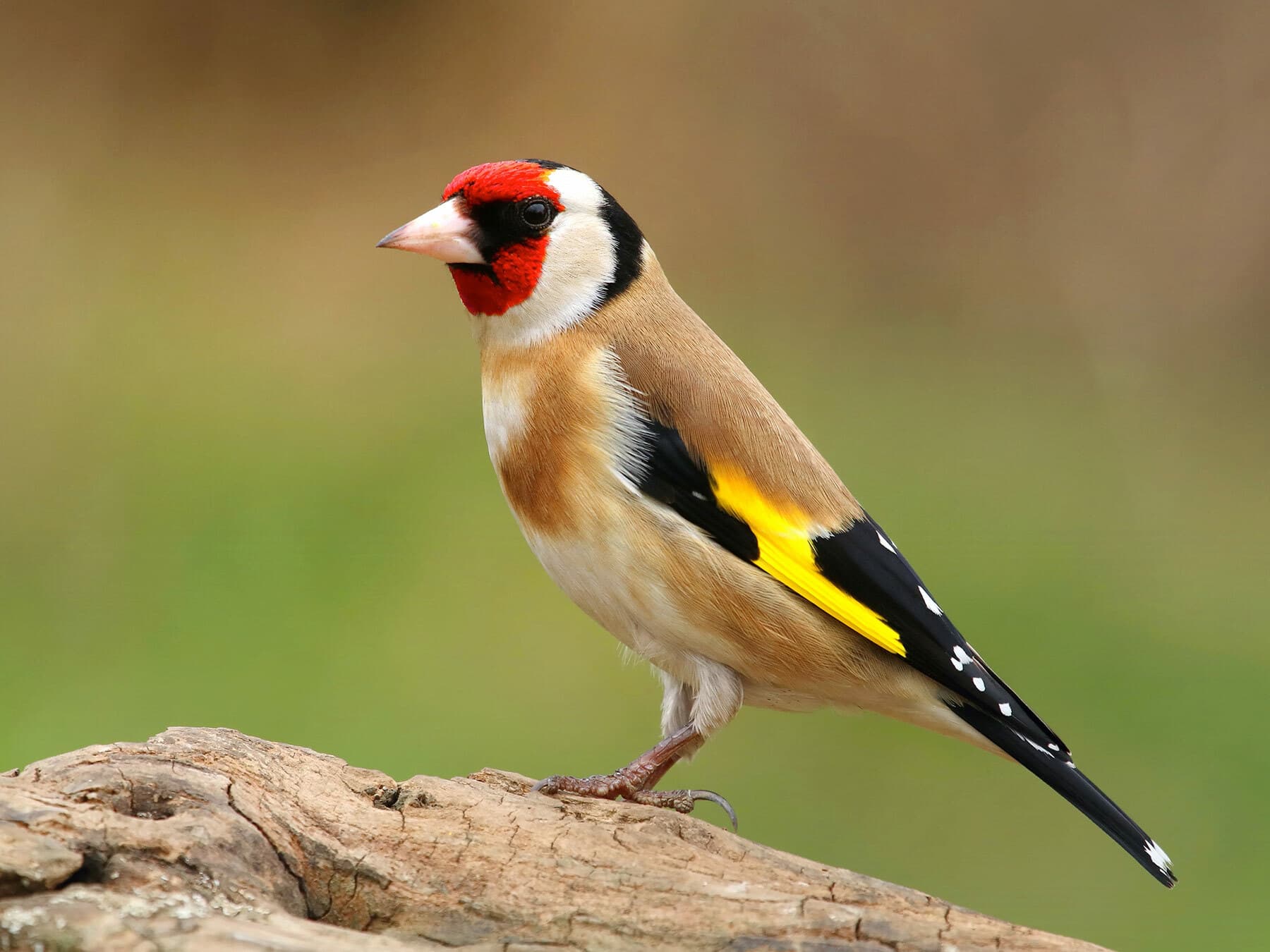
European Goldfinch
Goldfinch · Carduelis carduelis
By the Birdfact teamChecked by Nathan Cope
See it in 3D
3D model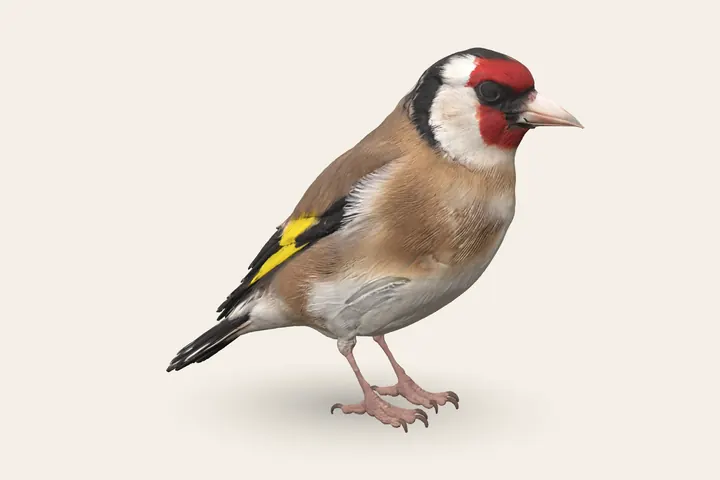 3D model
A European Goldfinch is 12–13 cm (4.5–5 in) long, bill to tail.
3D model · Adult · Length 12–13 cm (4.5–5 in) · How we make our birds · Report a problem
© 2026 NC Digital Limited (Birdfact). All rights reserved. This 3D model may be viewed on this page and shared by link only. Downloading, extracting, copying or reusing it, or using it to train machine-learning models, is not permitted without our written permission. Using our models
On this page16 sections
How to recognise it
This page is about the European Goldfinch, the bird of British gardens. The yellow American Goldfinch is a different bird, in a different genus: see American Goldfinch.
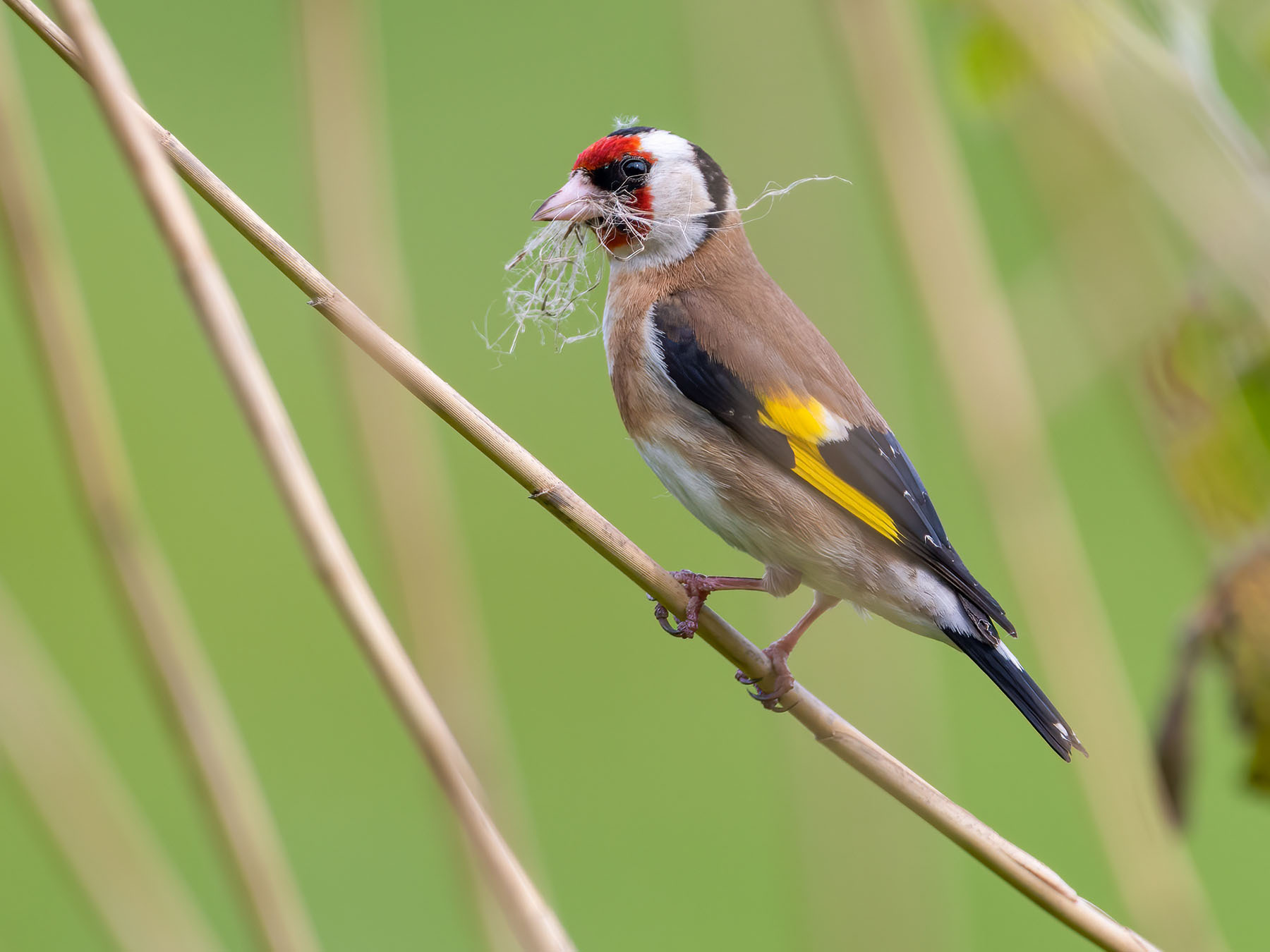
Look for the face and the wings. An adult Goldfinch has a red mask over the front of its face, white cheeks and a black band over the crown and down the sides of the neck. Its wings are black with a broad golden-yellow band along their whole length, which shows whether the bird is perched or flying. That wing is distinctive among finches.1
The back and breast sides are warm sandy-buff and the belly white. The tail is black with white spots, and in flight there is a white rump. The bill is fine and pointed, whitish to pale pink in spring and summer and duller, with a darker tip, in winter. The legs are pinkish to pale brown.2
It is small: about 12 cm long and about 16 g. BTO measurements of live adults put most between 14 and 18 g.3
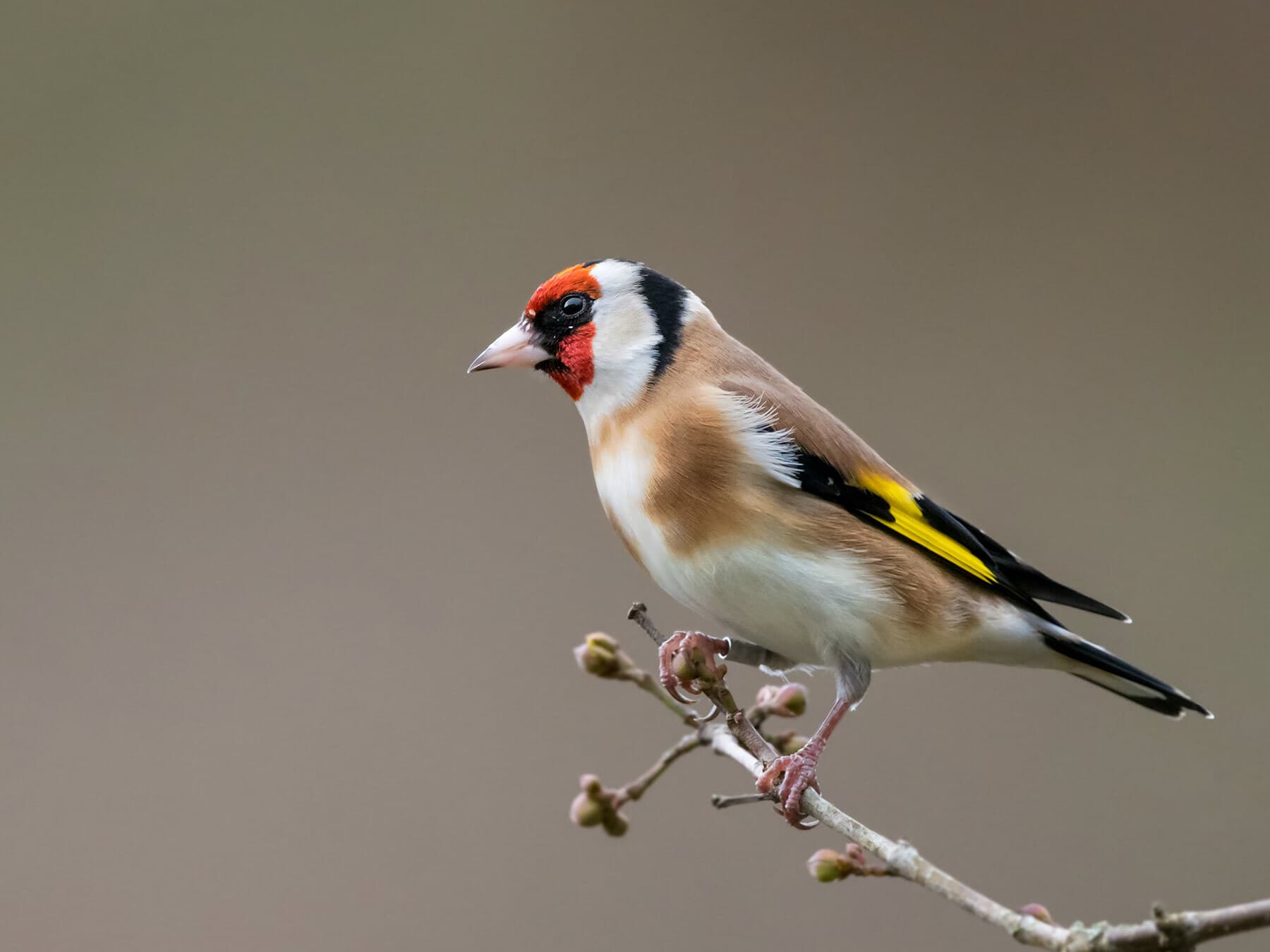
Male, female and young
Males and females look alike at a glance. Up close, a male's red usually reaches back past the eye, his black crown is glossier and his wings blacker; a female's red stops at about the eye, and her buff breast sides usually meet in a band across the breast. The differences are small, and the BTO simply calls the sexes alike, so many birds are hard to sex.1
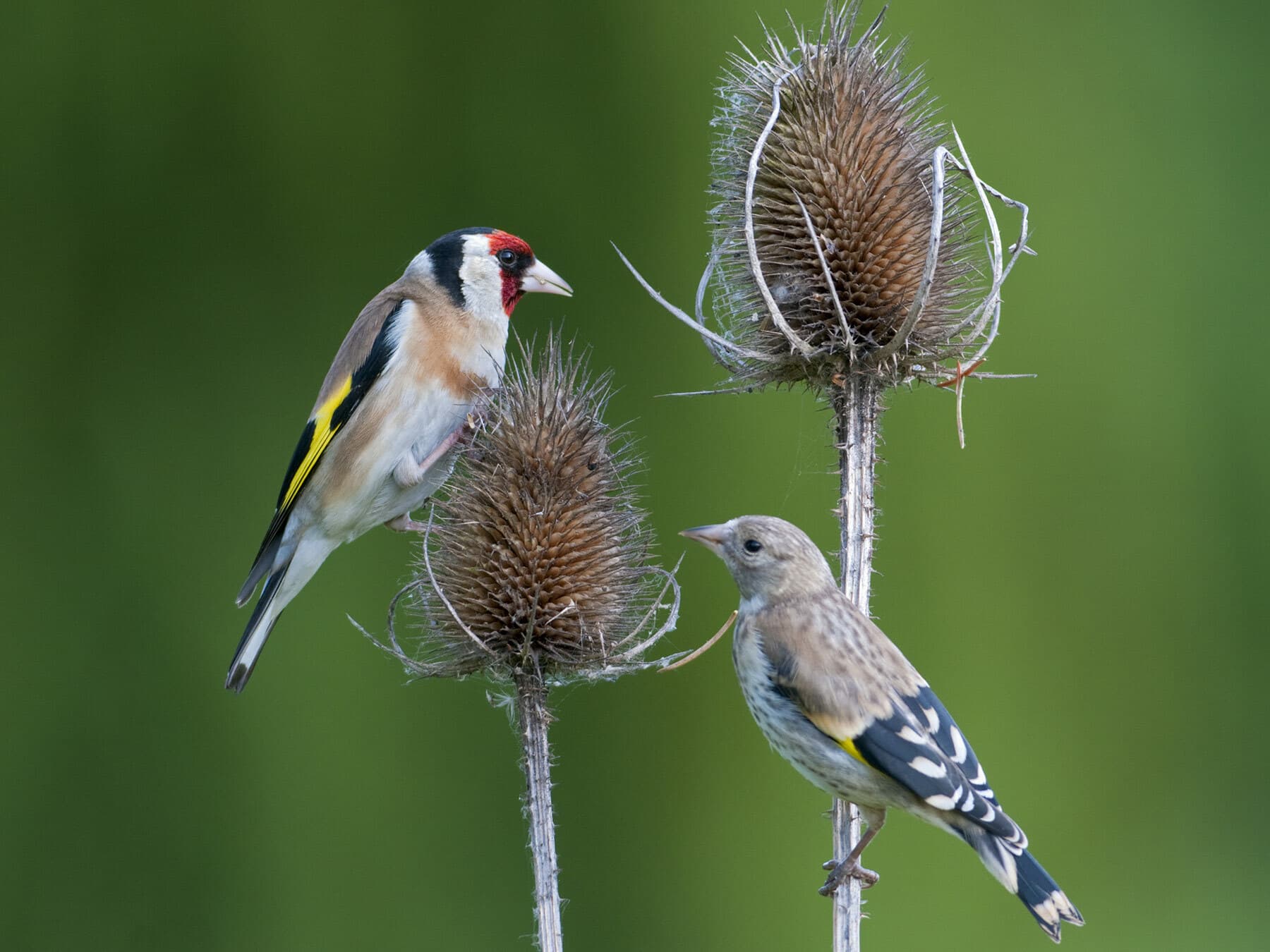
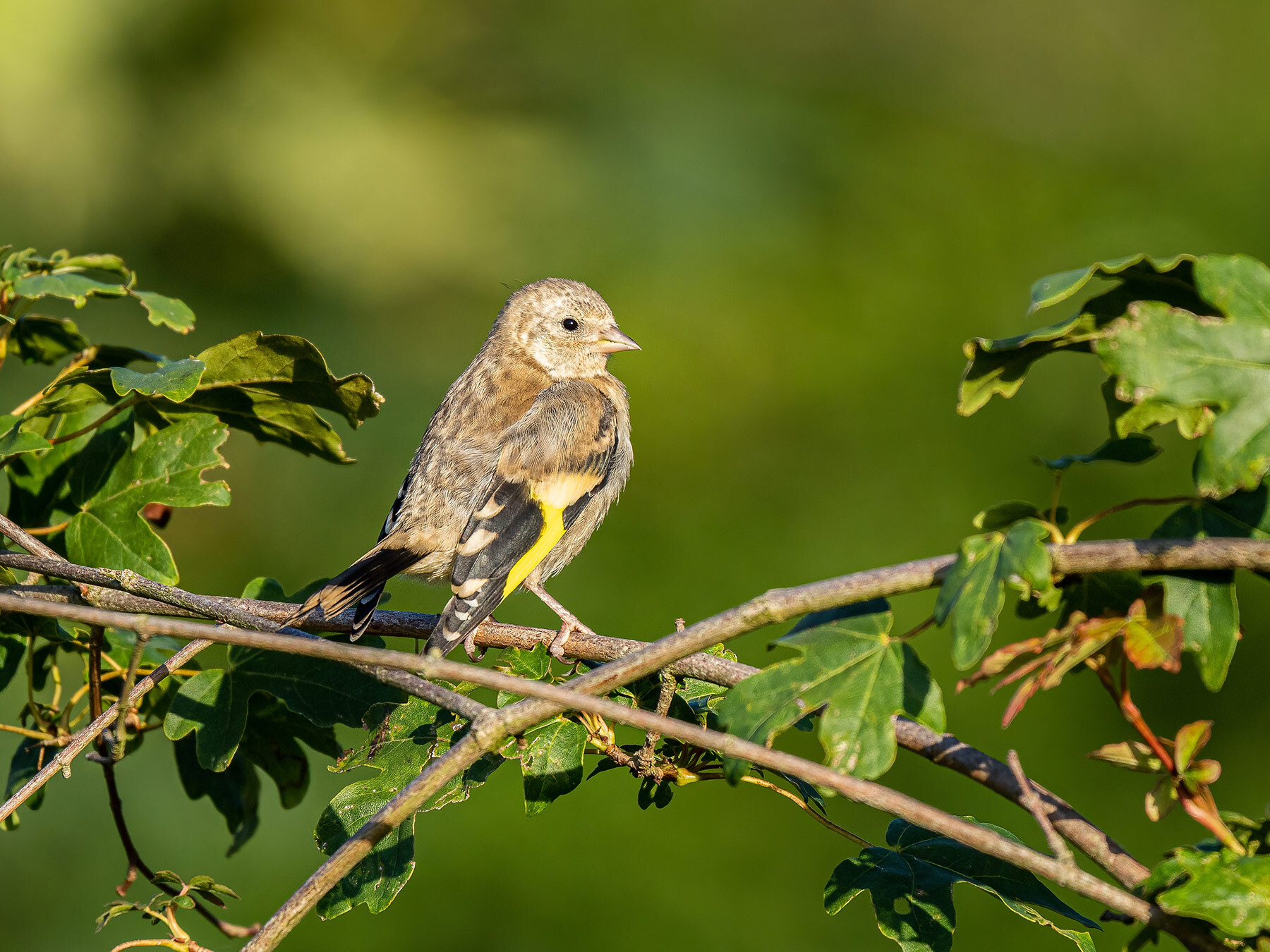
Young Goldfinches, out of the nest from June to August, have no red, black or white on the head at all: the head is plain pale buff-brown, finely streaked, and the body is streaky too. But they already have the black-and-gold wings and the black-and-white tail, so the wings still give them away. They moult into the adult face from July to October.2
More detail, with photos: male, female and young Goldfinches.
Identification: similar birds
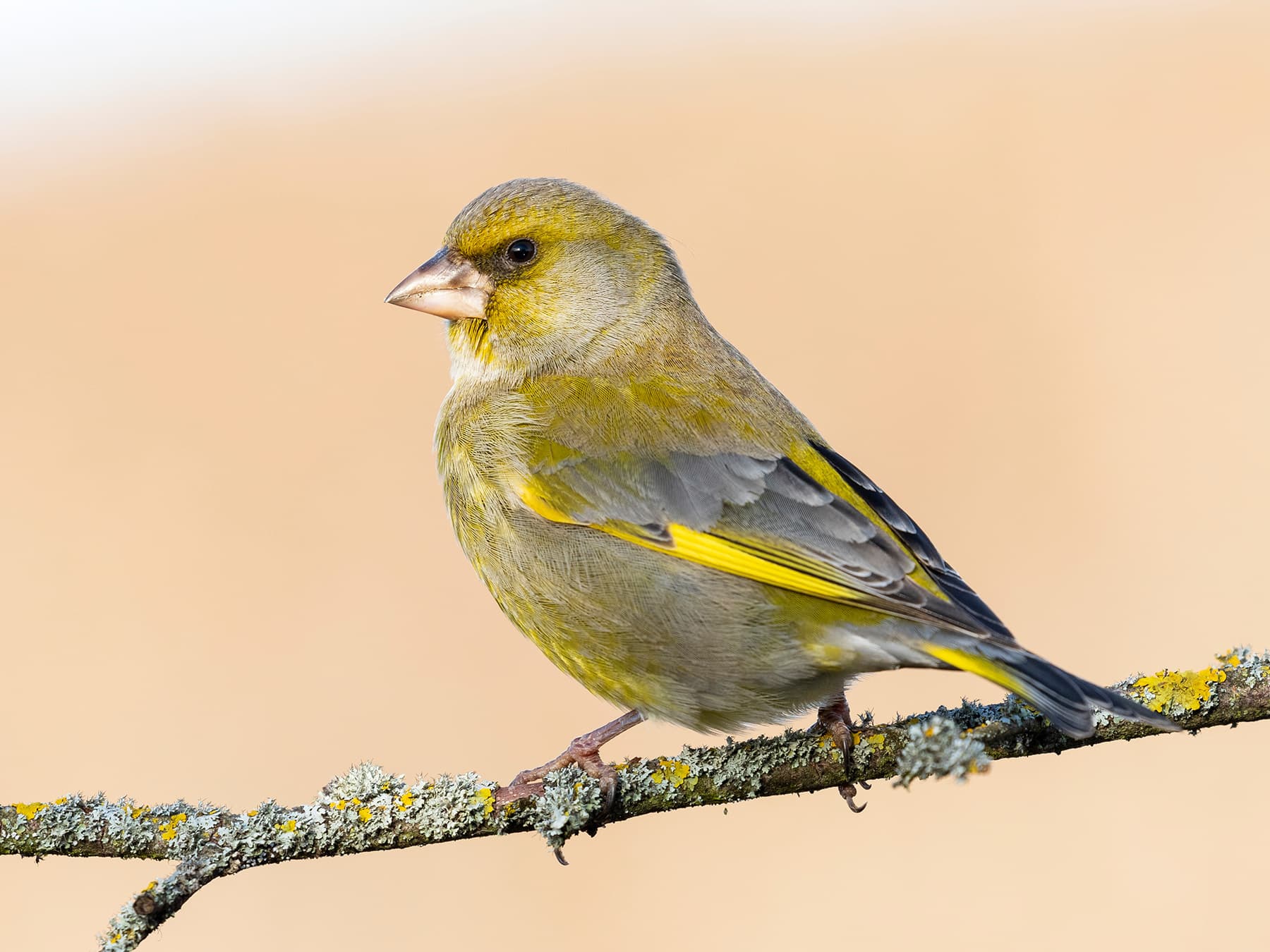
An adult is hard to confuse with anything else. Young birds cause the doubts: a young Greenfinch is brown and streaky too, but stockier, with a heavy bill and only a thin yellow edge to the wing; a Siskin is streaked yellow-green with yellow in the tail. In North America, where escaped European Goldfinches have been seen in 41 states, the red face separates them from American Goldfinches.
Its size
Adults- Length
- 12–13 cm
- Wingspan
- 21–25.5 cm
- Weight
- 14–18 g
Its song and calls
Goldfinches are usually heard before they are seen. The flight call is a quick, tinkling two or three notes, and a flock calling together makes a continuous, liquid twitter overhead. The German name Stieglitz comes from this call.1
The song is a fast, flowing run of those tinkling notes mixed with twitters, trills and a few harsher buzzes, sung from an open perch or in a slow, deep-winged song flight. It is most often heard from mid-March to mid-July, but Goldfinches can be heard singing in any month. Both sexes sing; the female less vigorously.
Squabbling birds give a harsh "zeez", and young birds keep a "dee-wit-wit" call well into autumn. Listen to recordings: Goldfinch song and calls.
- Song0:00 / 0:34
Recorded in Occitanie, France · May 2026
- Call0:00 / 0:18
Recorded in Hauts-de-France, France · May 2024
When and where to see it
OctoberHere all year
Most recorded in October
- 1. Blaenau Gwent4.7%
- 2. Wiltshire3.5%
- 3. Down3.0%
- 4. Bristol2.9%
- 5. Monmouthshire2.9%
Each dot is a county, state or province: the bigger and darker, the larger the bird’s share of that place’s bird records that month. Grey dots: no regular records. The ringed point is the centre of the bird’s records this month; the arrow shows how it moved since last month, and the dashed loop its path through the year. “Arrivals” colours places where it becomes regular this month (orange) or is in its last regular month (grey). GBIF eBird Observation Dataset, 2019–2024. Map data: Natural Earth, US Census Bureau; place centres © OpenStreetMap contributors.
In your area
See when the European Goldfinch is recorded in your county, state or province.
How often the European Goldfinch turns up in the UK, Ireland, the United States and Canada through the year, from birdwatchers' records.
United Kingdom
Resident · all year · most records in July
Ireland
Resident · all year · most records in April
United States
Resident · all year · most records in March
Canada
Passage migrant · regularly Nov–Mar · most records in January
Show as a table
| Month | United Kingdom | Ireland | United States | Canada |
|---|---|---|---|---|
| January | 1.9% (regular) | 1.5% (regular) | 0.001% (regular) | 0.003% (regular) |
| February | 2.0% (regular) | 1.6% (regular) | 0.001% (regular) | <0.001% |
| March | 2.1% (regular) | 1.8% (regular) | 0.002% (regular) | <0.001% (regular) |
| April | 2.2% (regular) | 2.1% (regular) | 0.002% (regular) | <0.001% |
| May | 2.1% (regular) | 2.0% (regular) | 0.001% (regular) | <0.001% |
| June | 2.3% (regular) | 2.0% (regular) | 0.001% (regular) | – |
| July | 2.5% (regular) | 2.0% (regular) | 0.001% (regular) | <0.001% |
| August | 2.1% (regular) | 1.5% (regular) | <0.001% (regular) | <0.001% |
| September | 1.8% (regular) | 1.4% (regular) | <0.001% (regular) | – |
| October | 1.9% (regular) | 1.5% (regular) | <0.001% (regular) | <0.001% |
| November | 2.0% (regular) | 1.5% (regular) | 0.001% (regular) | <0.001% (regular) |
| December | 2.0% (regular) | 1.5% (regular) | <0.001% (regular) | <0.001% (regular) |
Recorded regularly in
Worldwide: recorded regularly in 80 countries
Countries where it was recorded in at least 3 of the 6 years 2019–2024. Linked countries have their own bird list.
Europe (49)
- Åland Islands
- Albania
- Andorra
- Austria
- Belarus
- Belgium
- Bosnia & Herzegovina
- Bulgaria
- Croatia
- Czechia
- Denmark
- Estonia
- Finland
- France
- Germany
- Gibraltar
- Greece
- Guernsey
- Hungary
- Ireland
- Isle of Man
- Italy
- Jersey
- Kosovo
- Latvia
- Liechtenstein
- Lithuania
- Luxembourg
- Malta
- Moldova
- Monaco
- Montenegro
- Netherlands
- North Macedonia
- Norway
- Poland
- Portugal
- Romania
- Russia
- San Marino
- Serbia
- Slovakia
- Slovenia
- Spain
- Sweden
- Switzerland
- Ukraine
- United Kingdom
- Vatican City
Asia (20)
- Armenia
- Azerbaijan
- China
- Cyprus
- Georgia
- India
- Iran
- Iraq
- Israel
- Jordan
- Kazakhstan
- Kyrgyzstan
- Lebanon
- Mongolia
- Nepal
- Pakistan
- Palestinian Territories
- Tajikistan
- Turkey
- Uzbekistan
North America (3)
South America (2)
- Argentina
- Uruguay
Oceania (3)
- Australia
- New Zealand
- Norfolk Island
Data: EOD – eBird Observation Dataset (Cornell Lab of Ornithology), accessed via GBIF.org, CC BY 4.0. Records from 2019–2024, aggregated and filtered by Birdfact. How these lists are made
Goldfinches live across Britain and Ireland all year, everywhere except the highest ground and the interior of north-west Scotland. In BTO surveys they are found most often around villages. They bred in 86% of the UK's 10-km squares in the last national atlas, and are most numerous in southern England.3
Look wherever there are scattered trees and bushes next to rough ground with seeding plants: gardens, parks, orchards, hedgerows, heaths, commons, roadside verges and overgrown fields with thistles and teasels.
Spotting tips
Listen for the tinkling flight call and look up. Watch thistle and teasel heads in late summer and autumn, birch and alder trees in winter, and hanging seed feeders from November to April. In flight, look for the flash of gold and the white rump in the bounding, up-and-down flight.
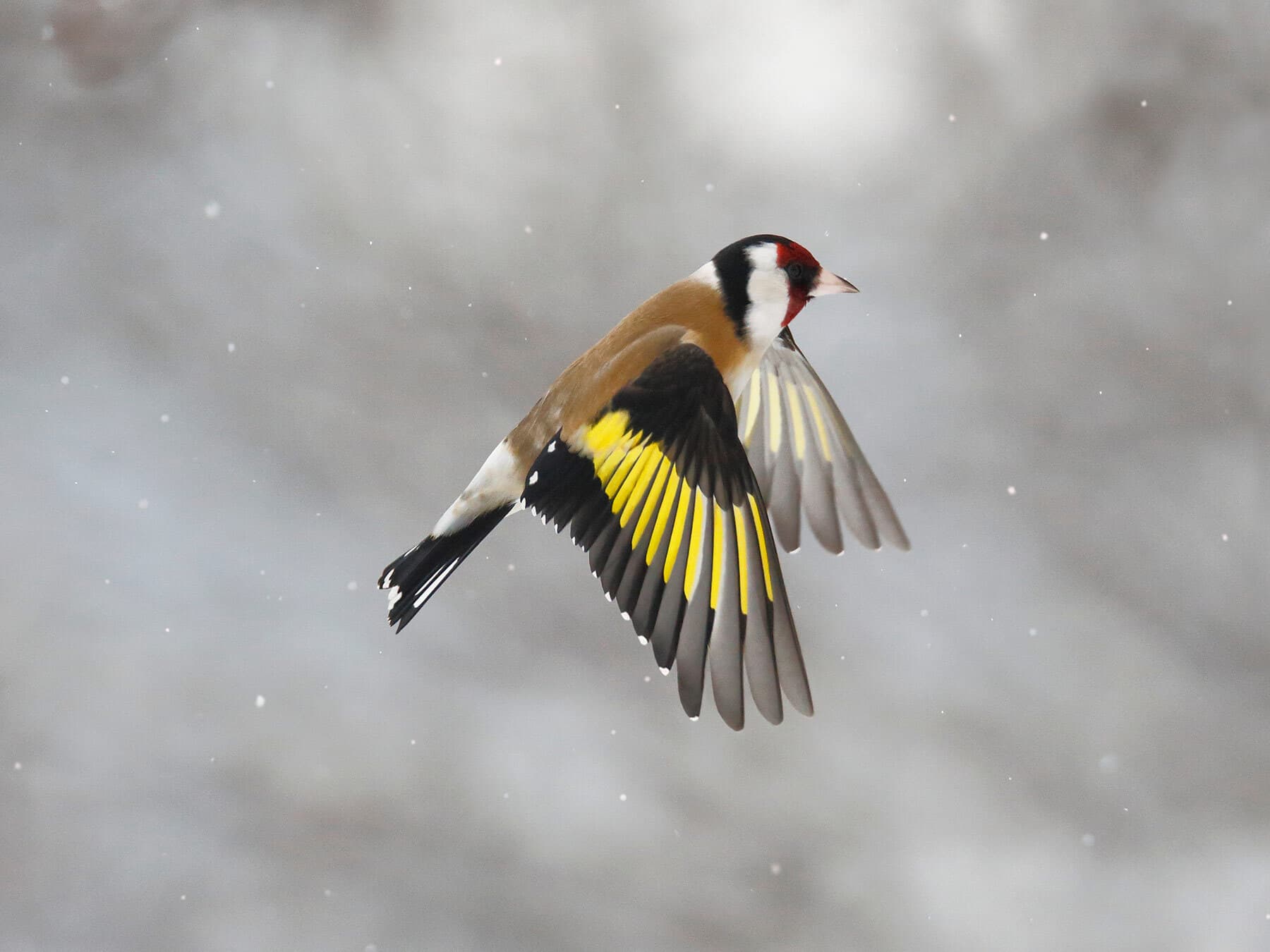
Do Goldfinches migrate?
Some do. British Goldfinches are partial migrants: many stay all year, while others fly south for the winter to Belgium, France and Spain, and a few reach Morocco. The same bird may go in one year and stay in another. Across Europe, ringing shows more females than males on the move.1
Bird ringing shows where they go. The BTO has 464 reports of British- and Irish-ringed Goldfinches from France, 281 from Spain and 162 from Belgium (a bird can be reported more than once). One young bird ringed in Wiltshire in August 1983 was trapped in Morocco that December, 1,939 km away; another, ringed at Zumaia in Spain on 12 April 2022, was caught on Bardsey Island 13 days later, 1,071 km to the north.4
Across Europe, migrating Goldfinches leave between the end of July and November, reach Spain mostly from mid-October to early November, and come back from March to early May. A small number of continental Goldfinches pass through Britain too, and one ringed in Denmark was caught near Wrexham in February 2023.
So if your garden Goldfinches vanish in autumn, some may be on their way south. Natural seed is also plentiful in the countryside in late summer and autumn.5
What it eats
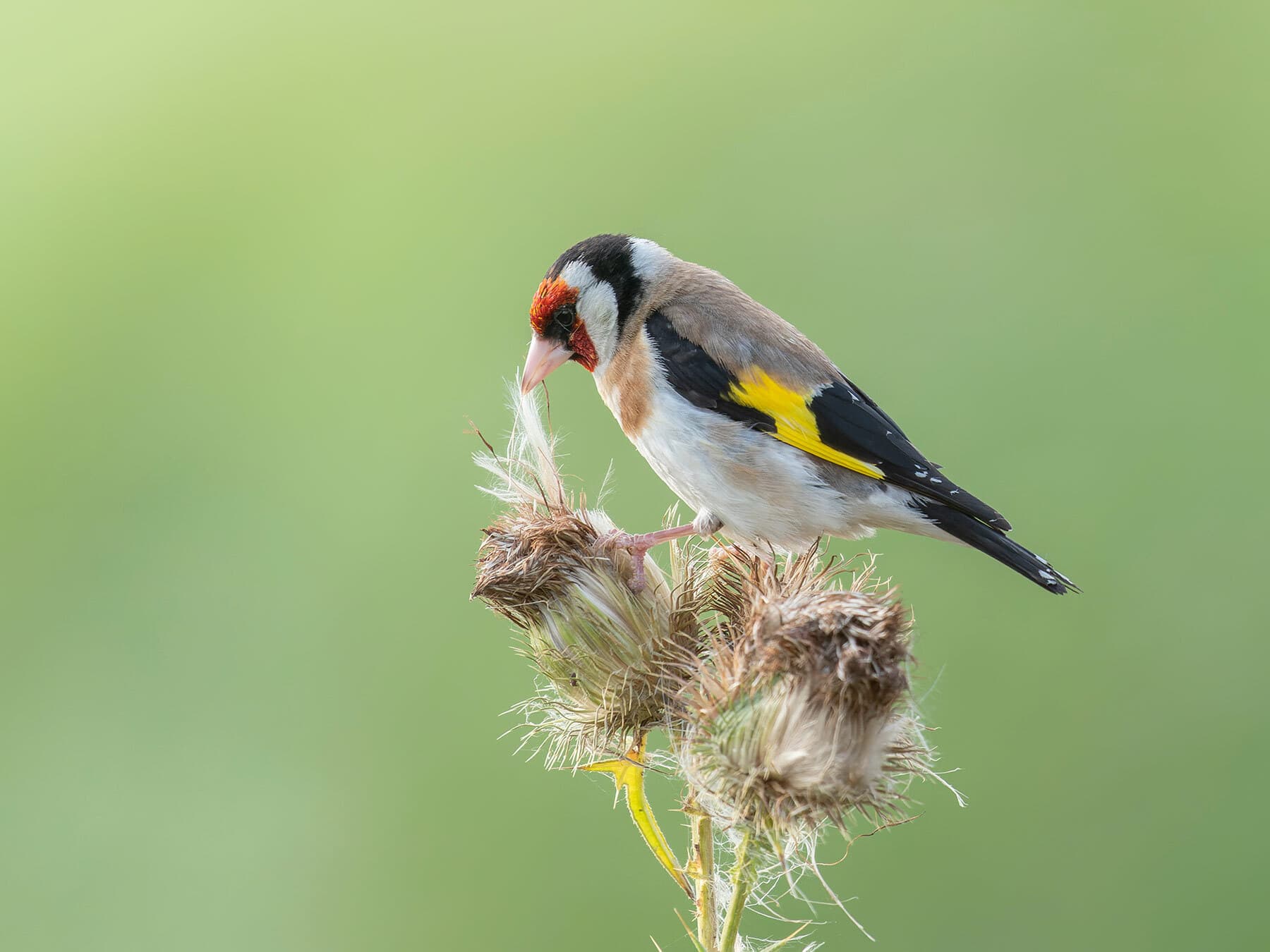
Mostly small seeds, picked straight from the flower head. A Goldfinch's fine, tweezer-like bill reaches seeds that other finches cannot, even between the spines of a thistle or teasel, and it will hang upside down to get them.
Its favourites are the seeds of the daisy family: thistles, knapweeds, dandelions, groundsel, ragwort and burdock. In winter it turns more to birch and alder seeds. In one English study in the breeding season, seeds made up 76% of the diet, other plant material (mostly leaves) 21%, and insects, mainly caterpillars and aphids, just 3%.6
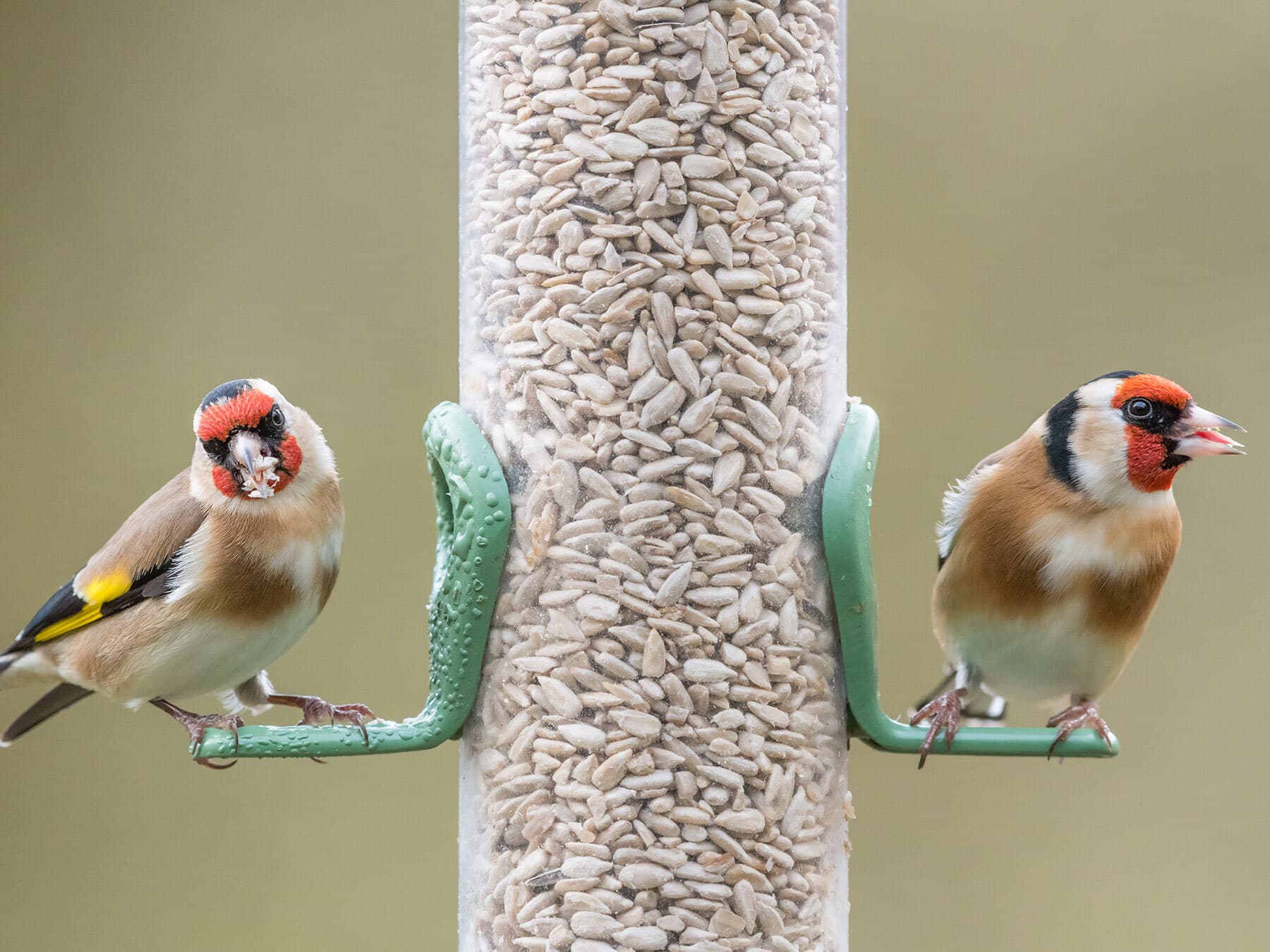
Feeding them in your garden
Goldfinches now visit gardens far more than they used to. By the winter of 2015/16, 70% more BTO Garden BirdWatch participants were reporting them than 20 years earlier, and in a BTO survey of 5,183 households that winter, sunflower hearts were by far their favourite food, with nyjer seed second.7
The RSPB's current advice, to slow the spread of disease among garden birds, is to offer seed only from November to April, from hanging feeders rather than bird tables or trays, cleaned every week. Through summer and autumn, a patch of teasels, thistles or sunflowers left to seed feeds them naturally. More: what Goldfinches eat and how to feed them.
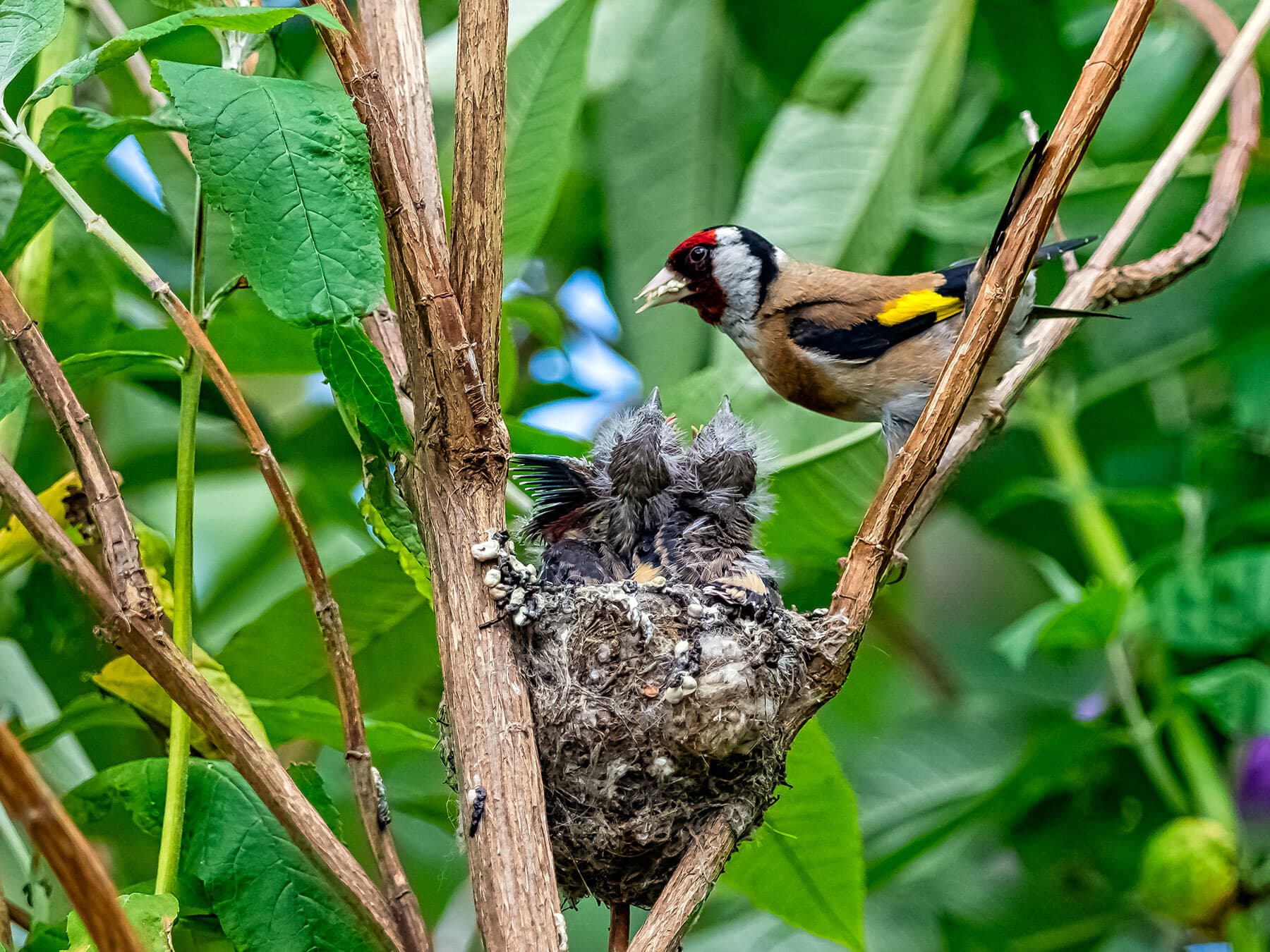
Nesting and breeding
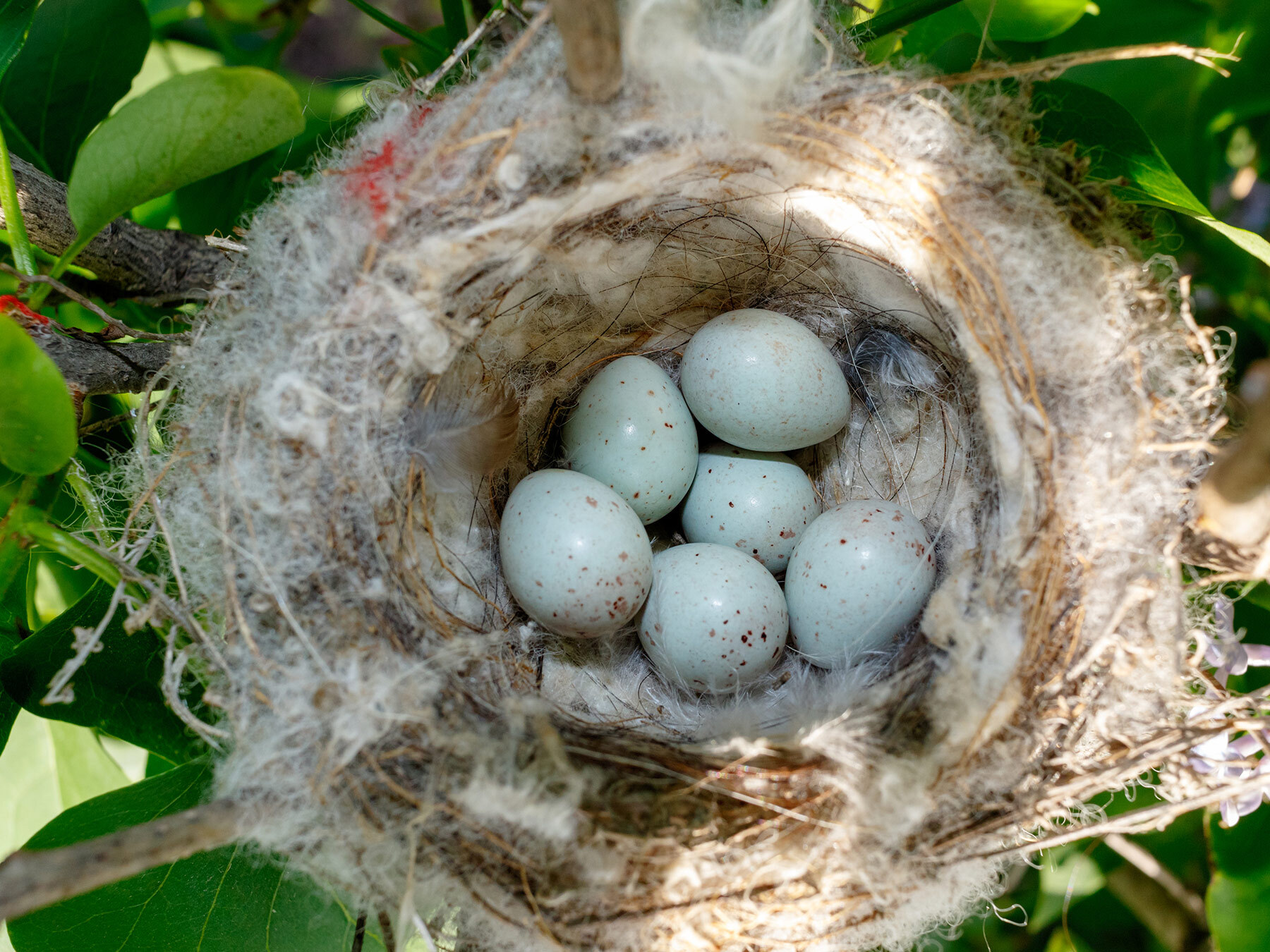
Goldfinches nest in trees, bushes and tall hedges, often in orchards and gardens, hiding a neat, deep cup of wool, plant down and spider silk out at the end of a twig. The female builds it and incubates the eggs while the male feeds her. In Britain the first eggs are laid on 25 May on average, and clutches are usually of 5 pale bluish, finely spotted eggs.3
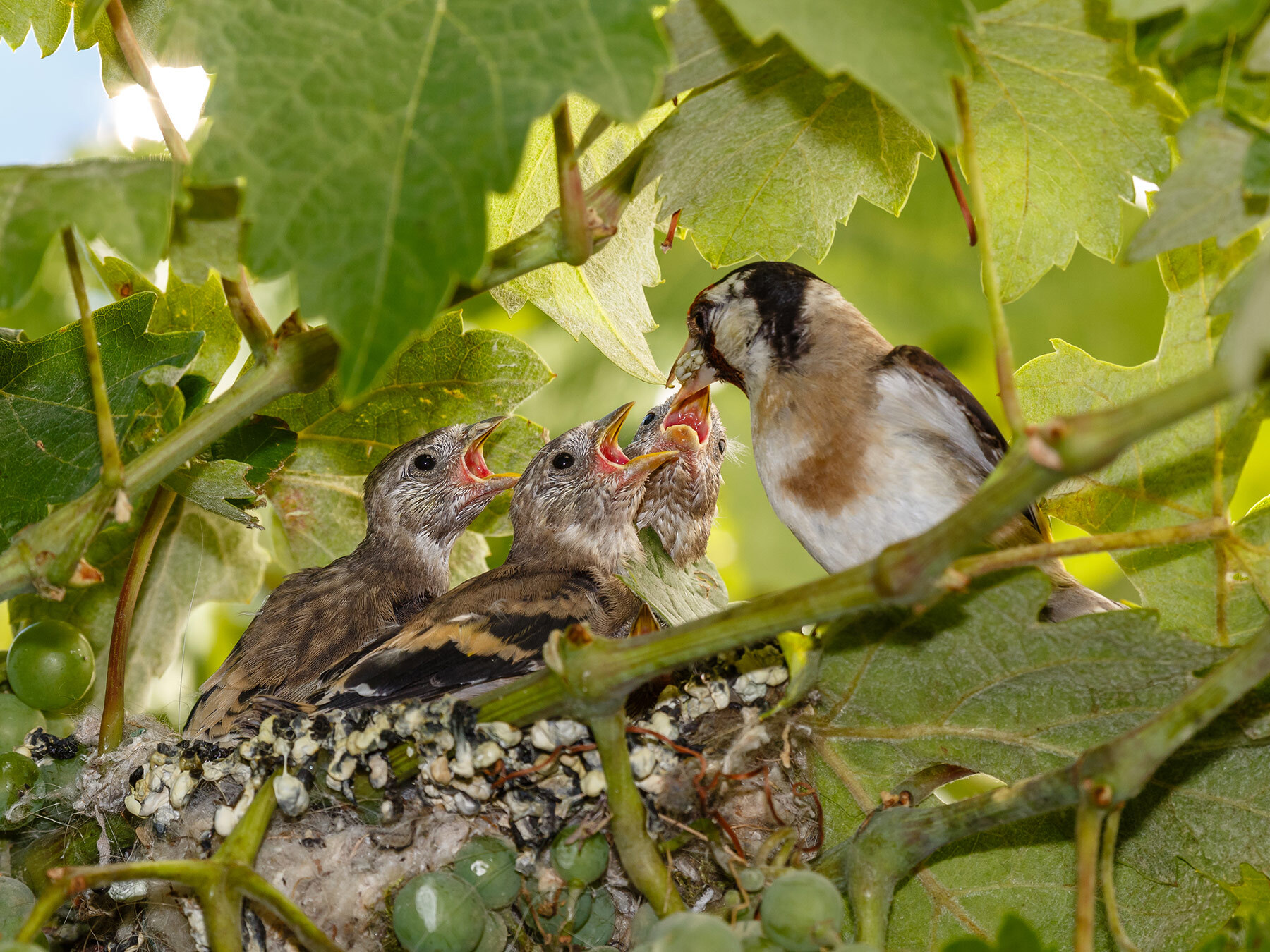
The eggs hatch after 12 to 14 days, and the young leave the nest at about 15 days old. Most pairs raise two broods, a few three, so nesting runs on late into summer. Goldfinches do not use nest boxes.
More detail: Goldfinch nests, eggs and young.
Behaviour
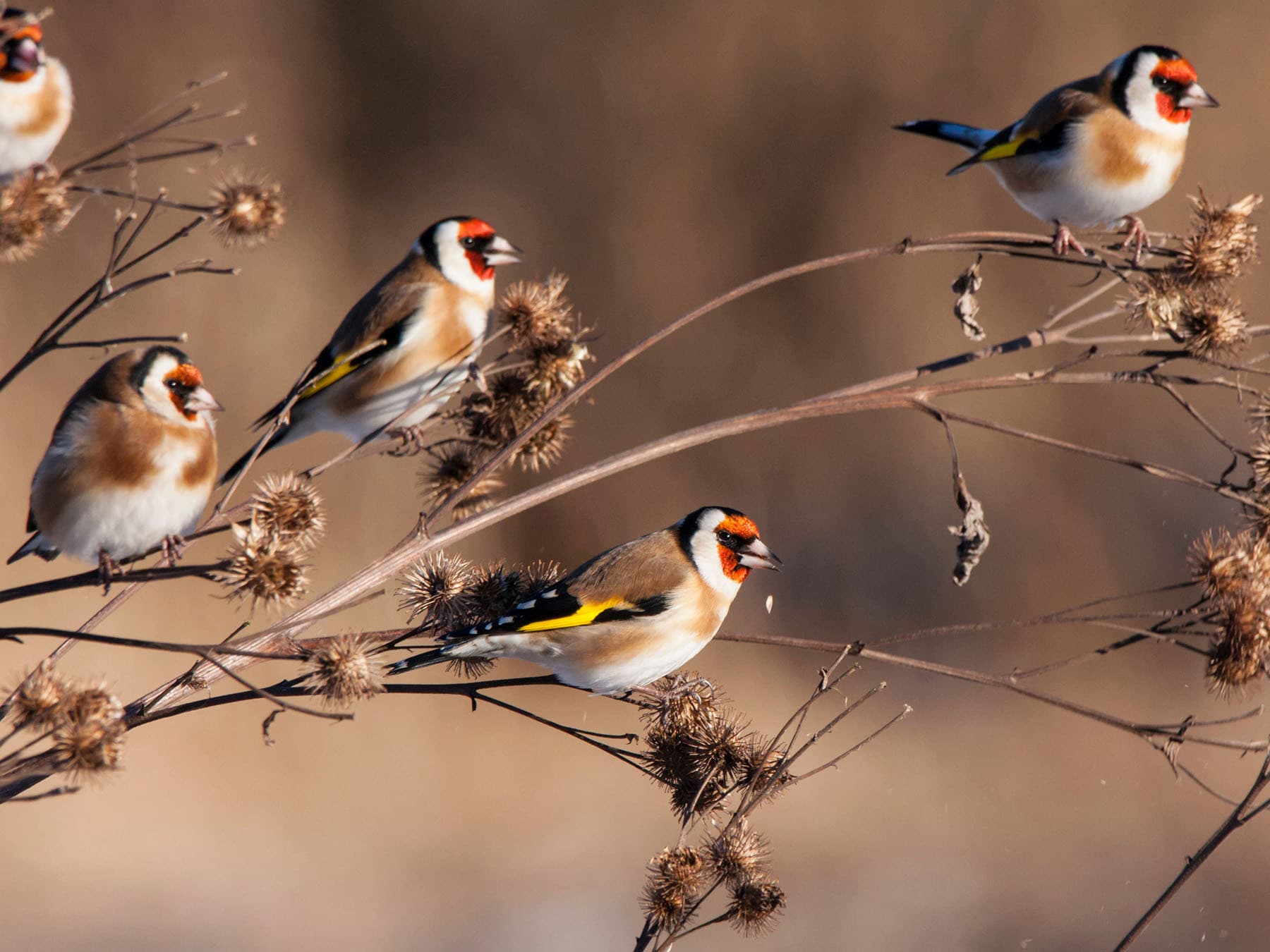
Goldfinches are sociable. In the breeding season they feed in pairs or small parties, and pairs sometimes nest close together in small, loose groups. Afterwards they gather in flocks, occasionally of hundreds or thousands where seed is plentiful, sometimes mixed with Linnets, Siskins and other finches. A flock of Goldfinches is called a charm.
Their flight is deeply bounding. In late winter, pairs form in the flocks: the two perch close together, swing from side to side to show off their red faces, touch bills, and the male feeds the female.
Lifespan and predators
A Goldfinch that survives to breed typically lives about 2 years, and starts breeding at a year old. About 37% of adults survive from one year to the next.3
Lifespan records
Much longer, occasionally. The record for a Goldfinch ringed in Britain and Ireland is 10 years 2 days: a young male ringed at Chelmondiston, Suffolk, in December 2006 and caught there again in December 2016.8 The BTO lists an even older bird among those reported in Britain: a young male ringed in Denmark in November 2008 and caught by a ringer near Wrexham in February 2023, 14 years 3 months later.4 That bird is not on the 2023 European longevity list, where the oldest is a Czech Goldfinch found dead at 13 years 10 months.9
Conservation
The Goldfinch is on the UK Green List. UK numbers fell sharply from the mid-1970s to the mid-1980s, then recovered; they rose by 148% between 1995 and 2024, and there were about 1.7 million pairs in 2016. Its breeding range in Britain and Ireland has grown too.3
The BTO links the rise mainly to better survival, probably helped by the variety of food in gardens, and expects the Goldfinch to keep doing well provided it does not fall victim to trichomonosis, the disease that has hit Greenfinches. Its rise in Britain since 1950 has also been put down to the decline of commercial bird-catching.1
Worldwide it is of Least Concern. But in Morocco, Algeria and Tunisia it lost nearly 57% of its range between 1990 and 2016, mainly through trapping for the cage-bird trade, with drought and forest fires adding to the damage; across most of Tunisia and Algeria, wild Goldfinches may now be gone or nearly so.10
Similar birds
Often mistaken for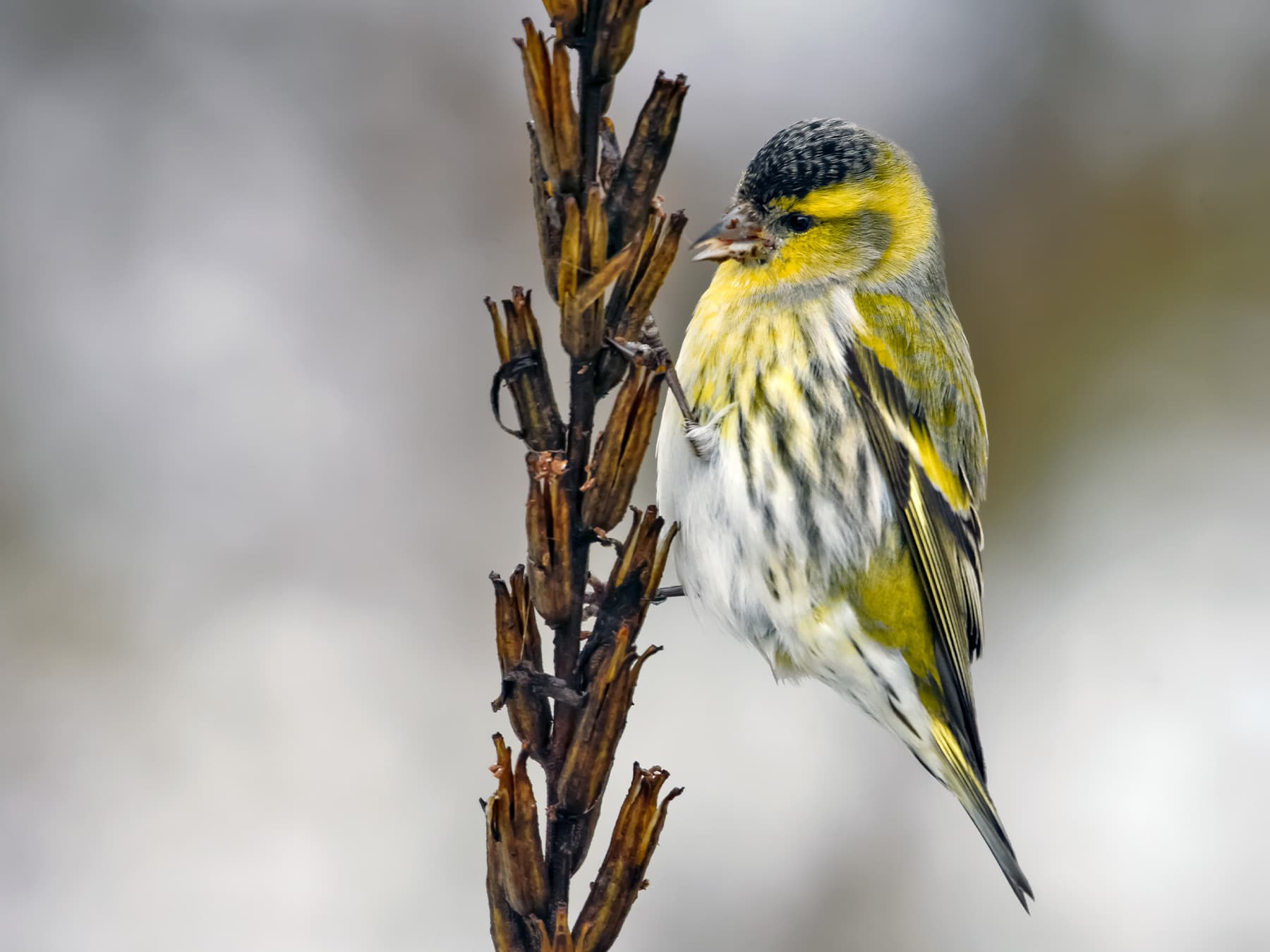
More photos
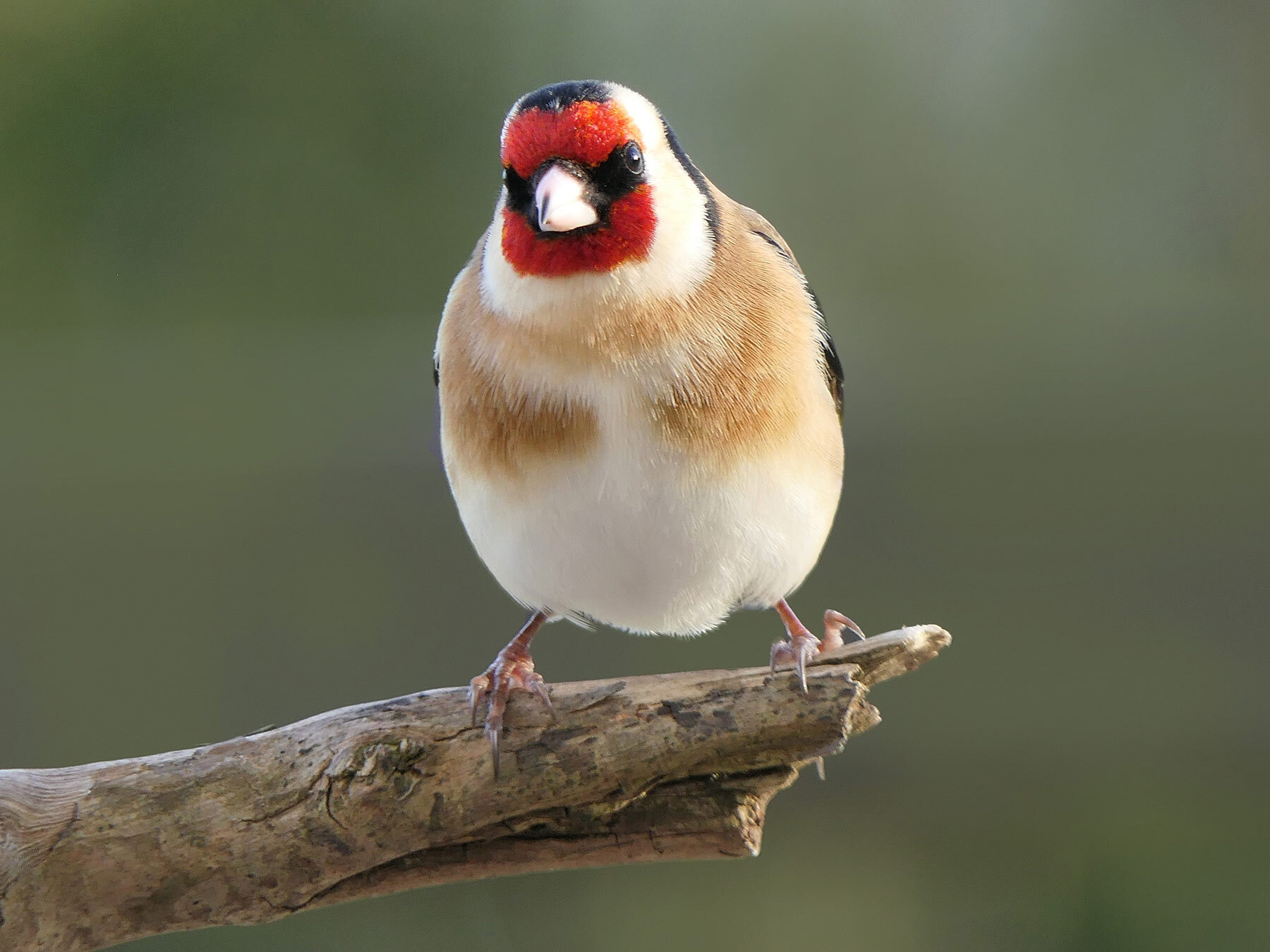
10 photos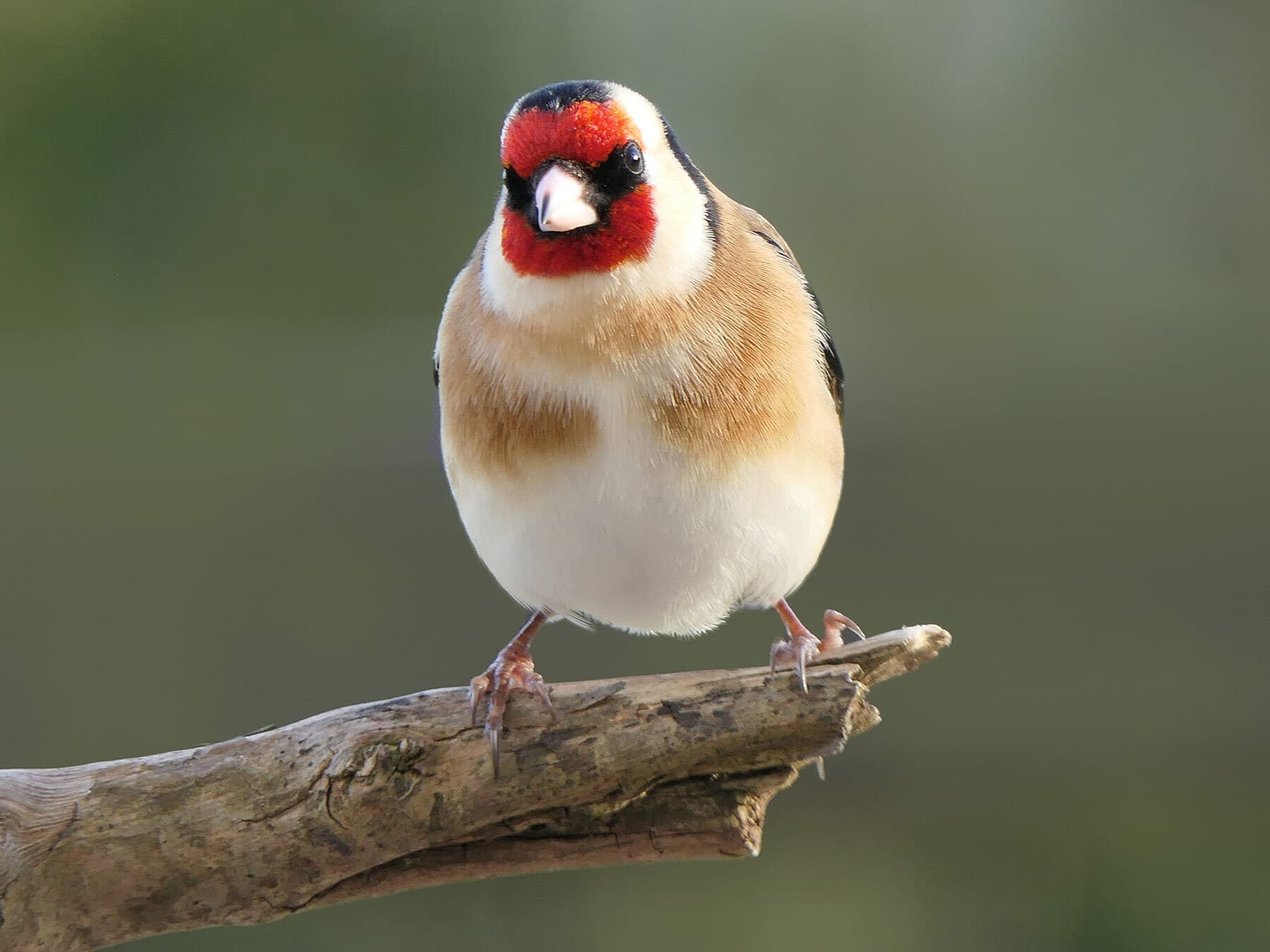 A Goldfinch from the front: red face, white cheeks and a buff band across the breast
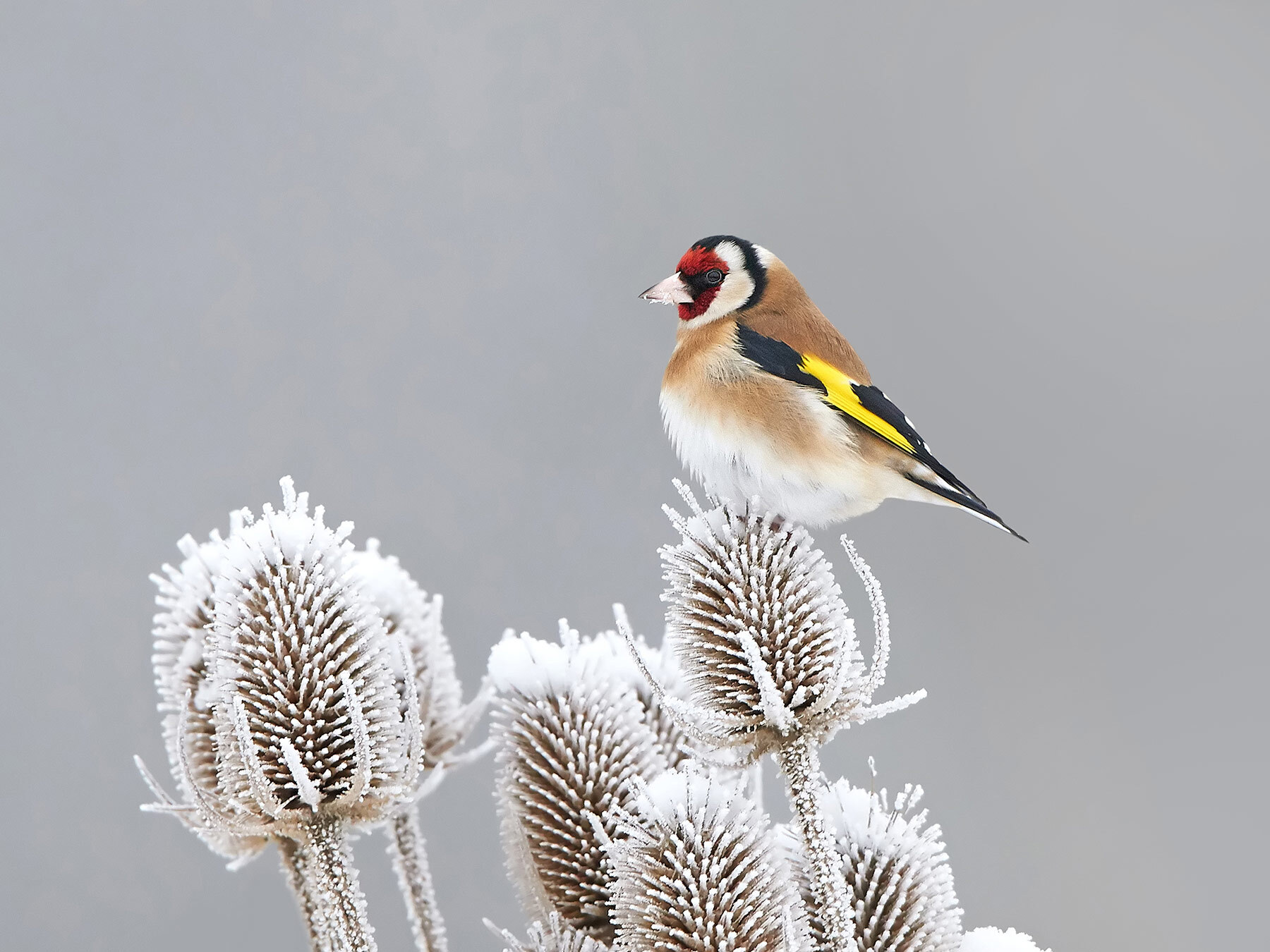
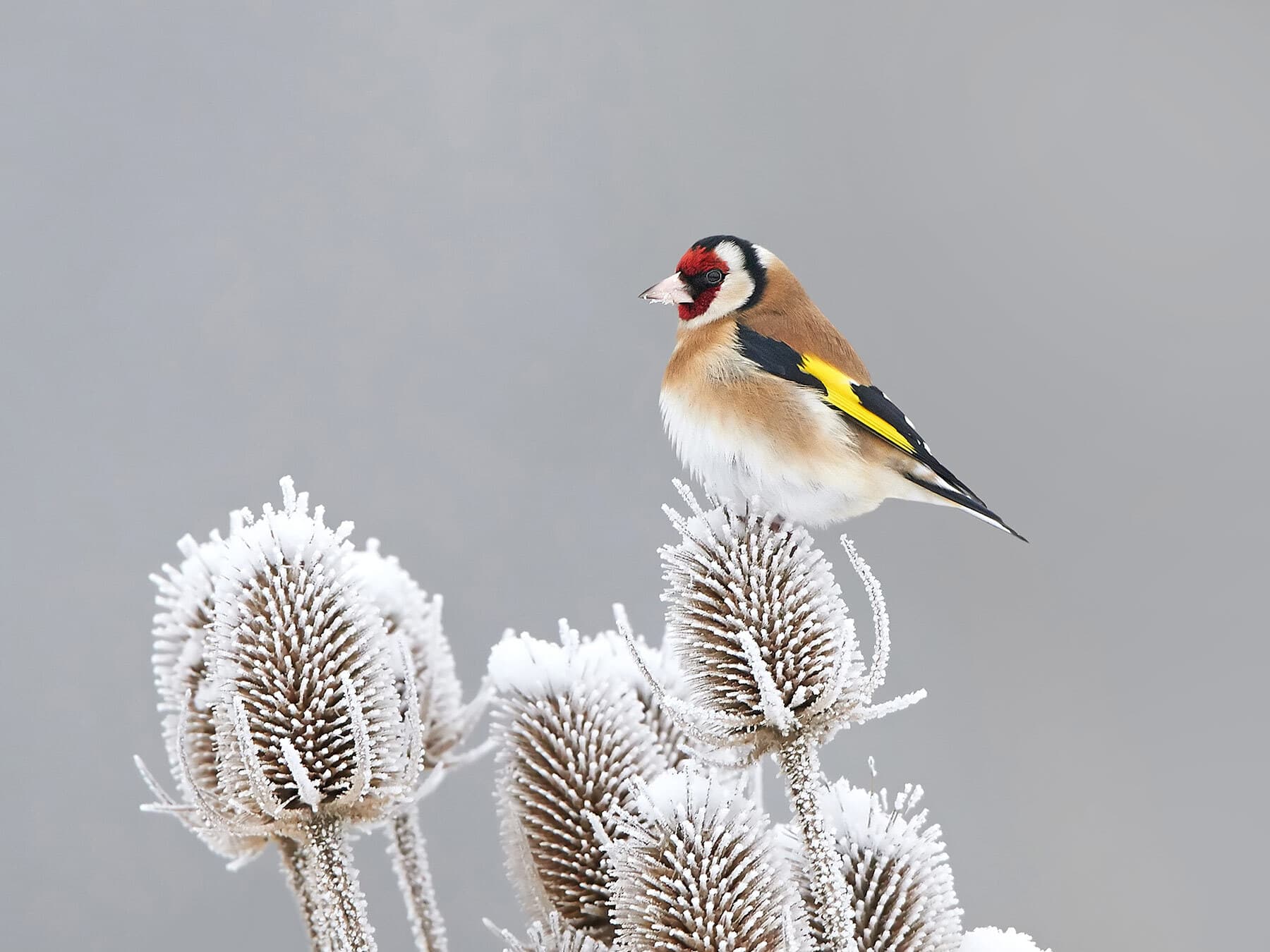 A Goldfinch on a frosted teasel
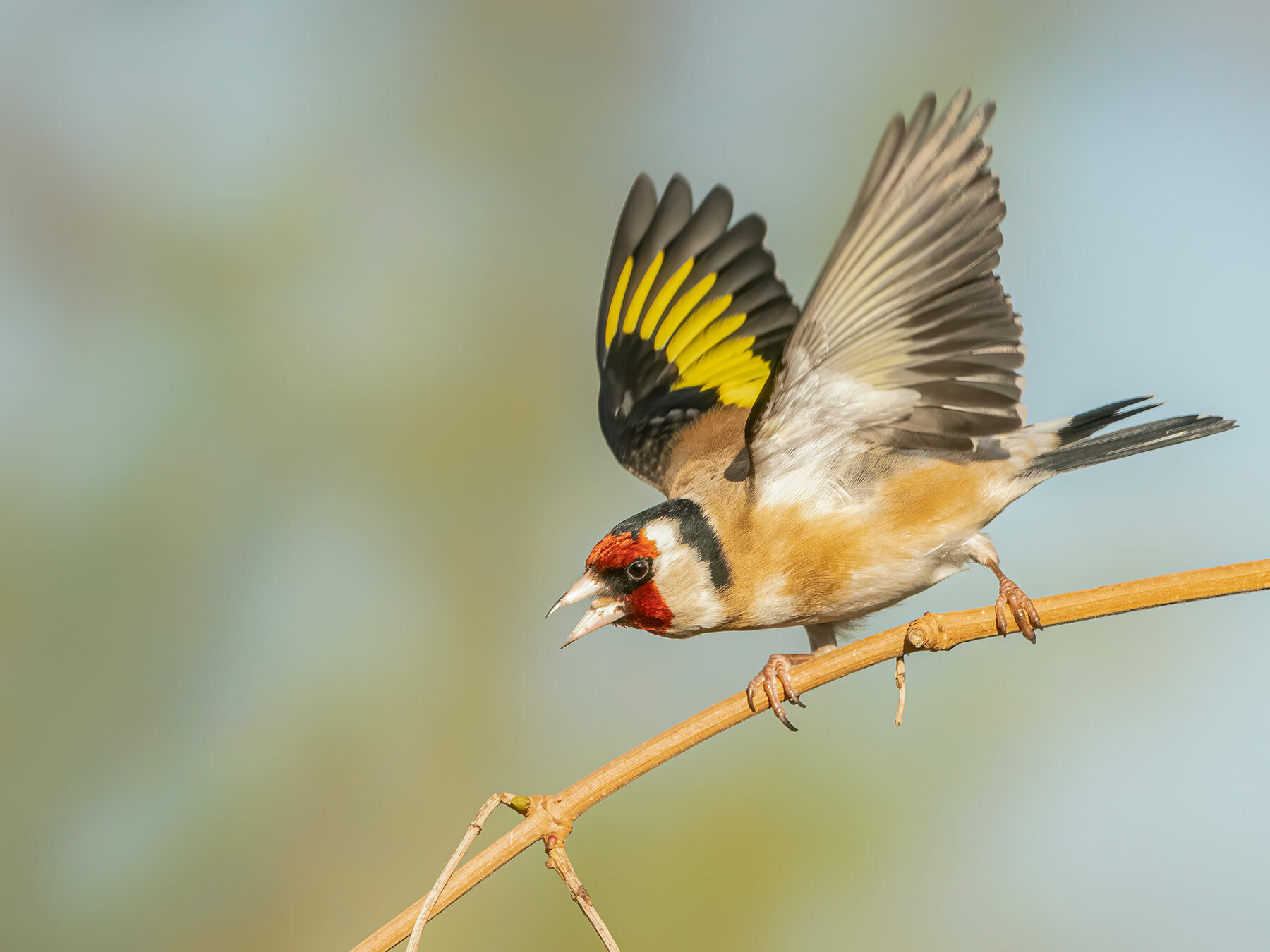
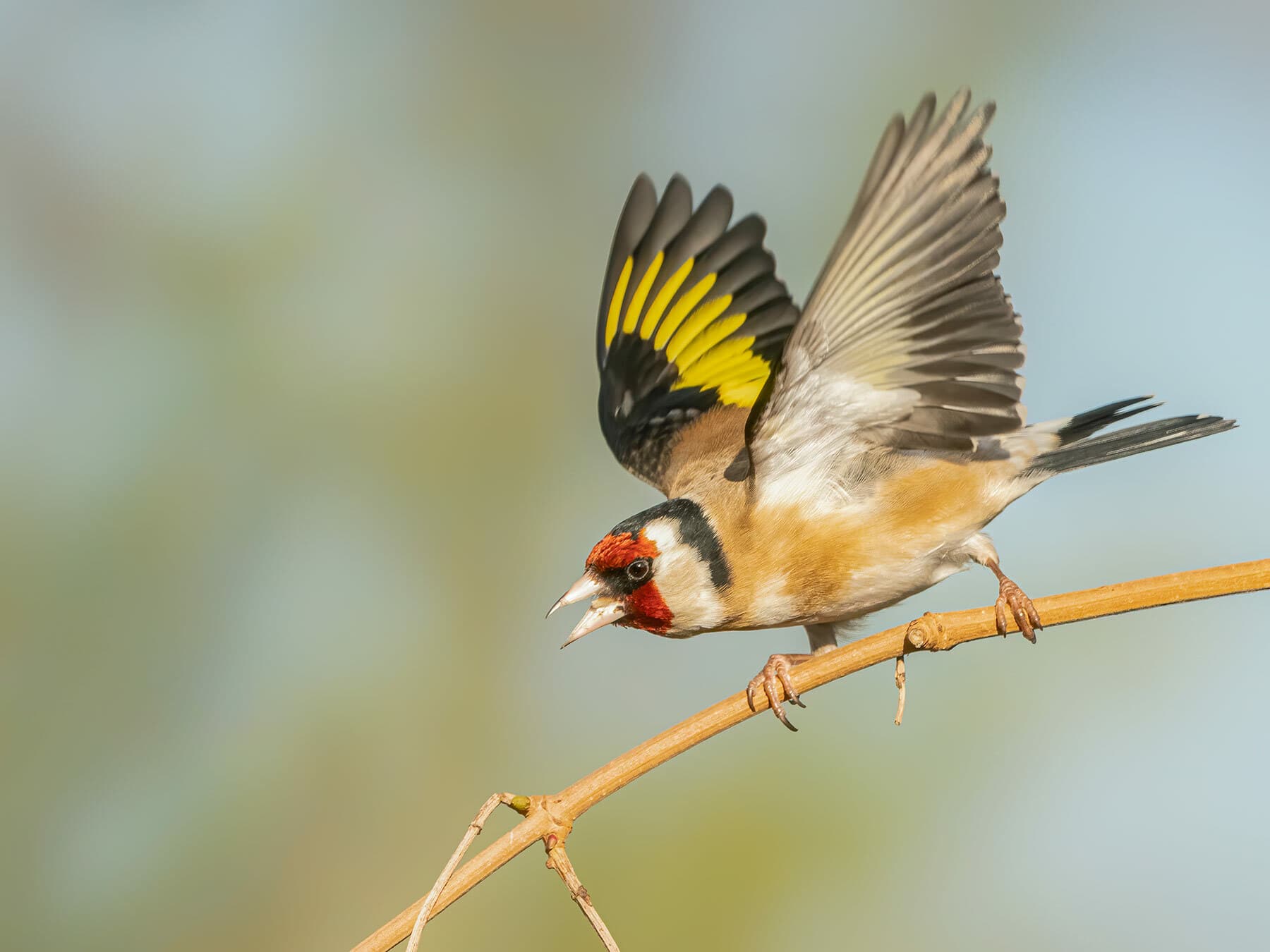 A Goldfinch spreading its wings, showing the gold bands
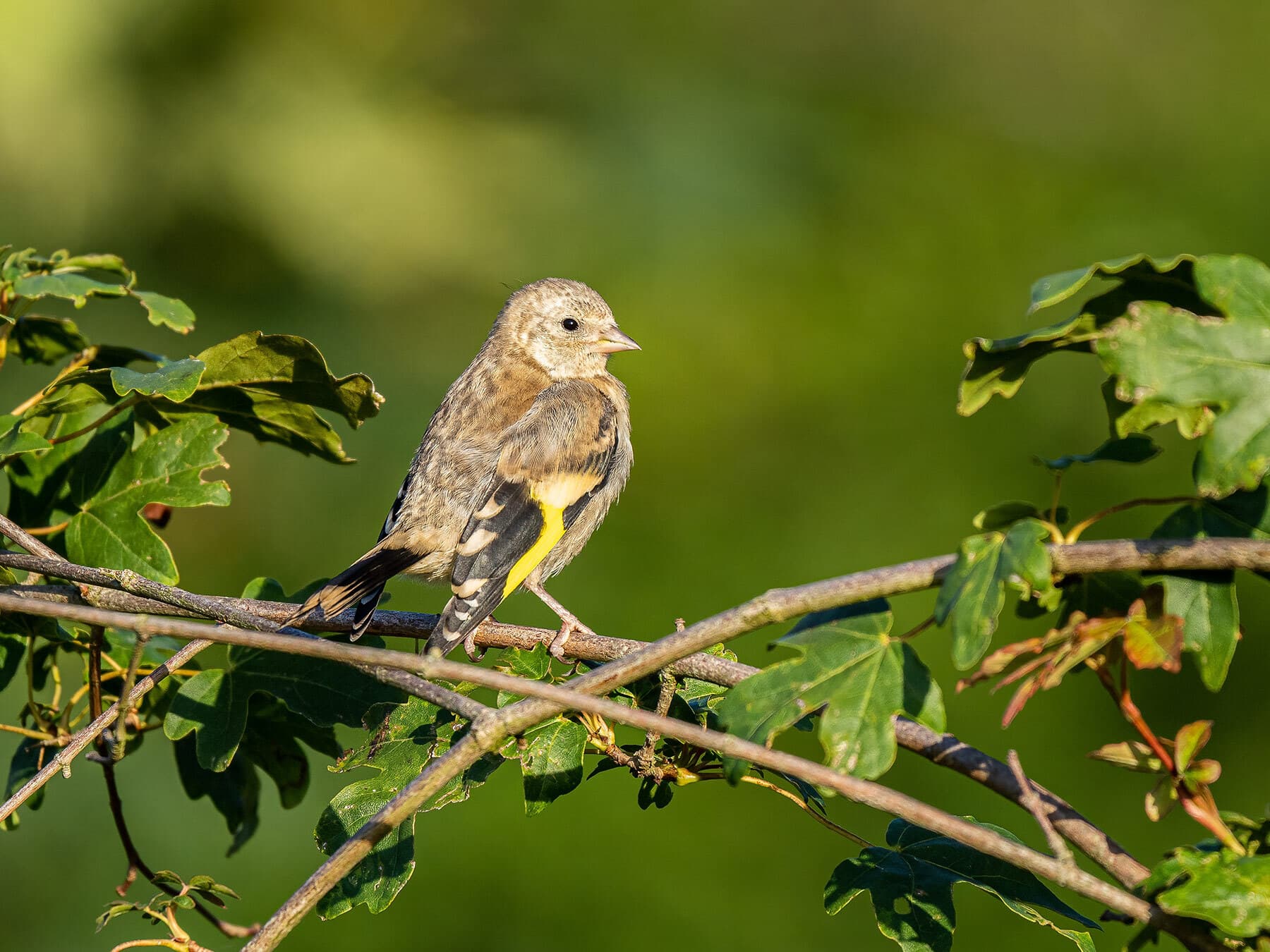 A young Goldfinch: streaky, with no red face, but already with black and gold wings
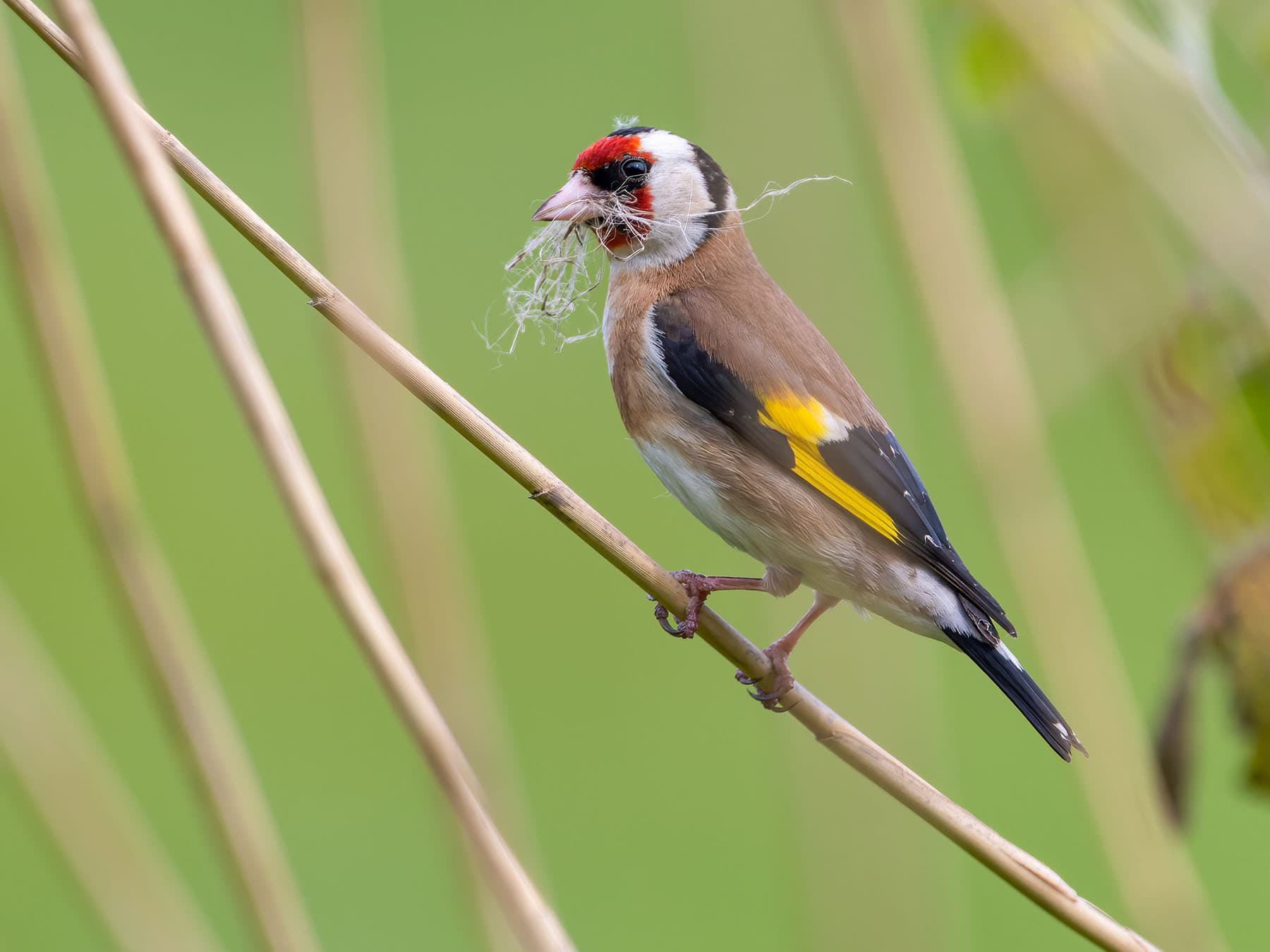 A Goldfinch with nest material in its bill
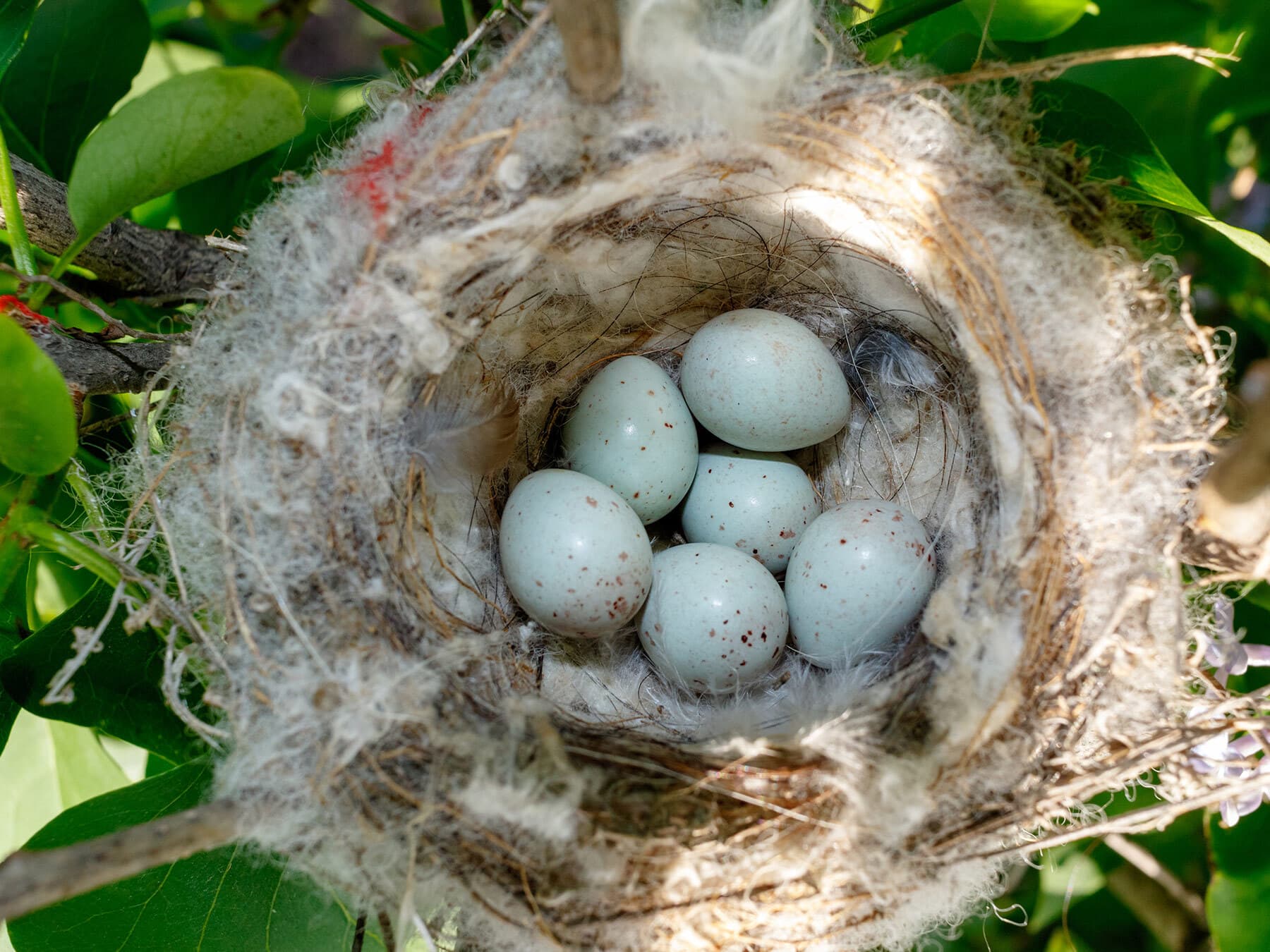 A Goldfinch nest with six pale bluish, speckled eggs
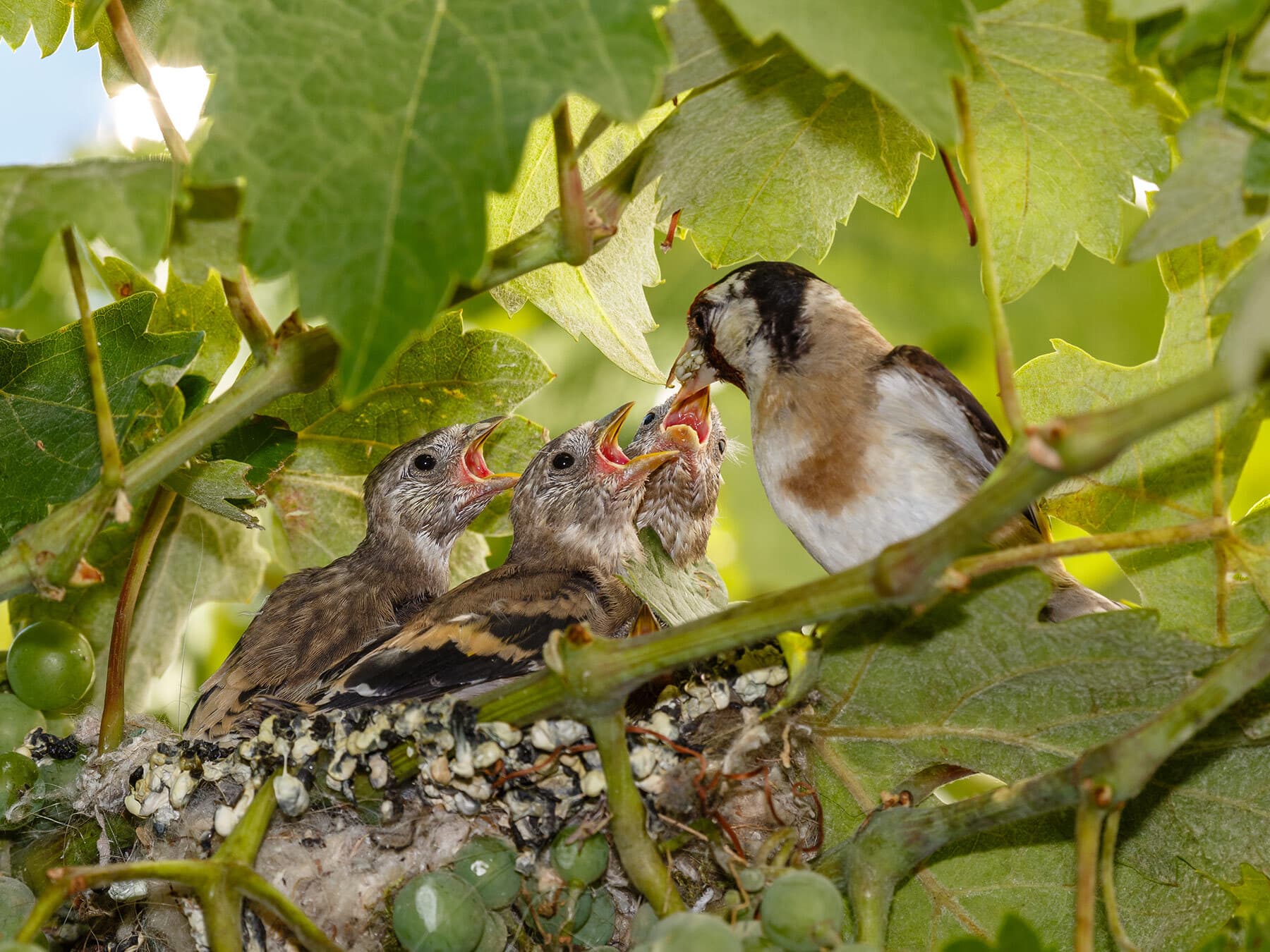 A Goldfinch feeding its chicks
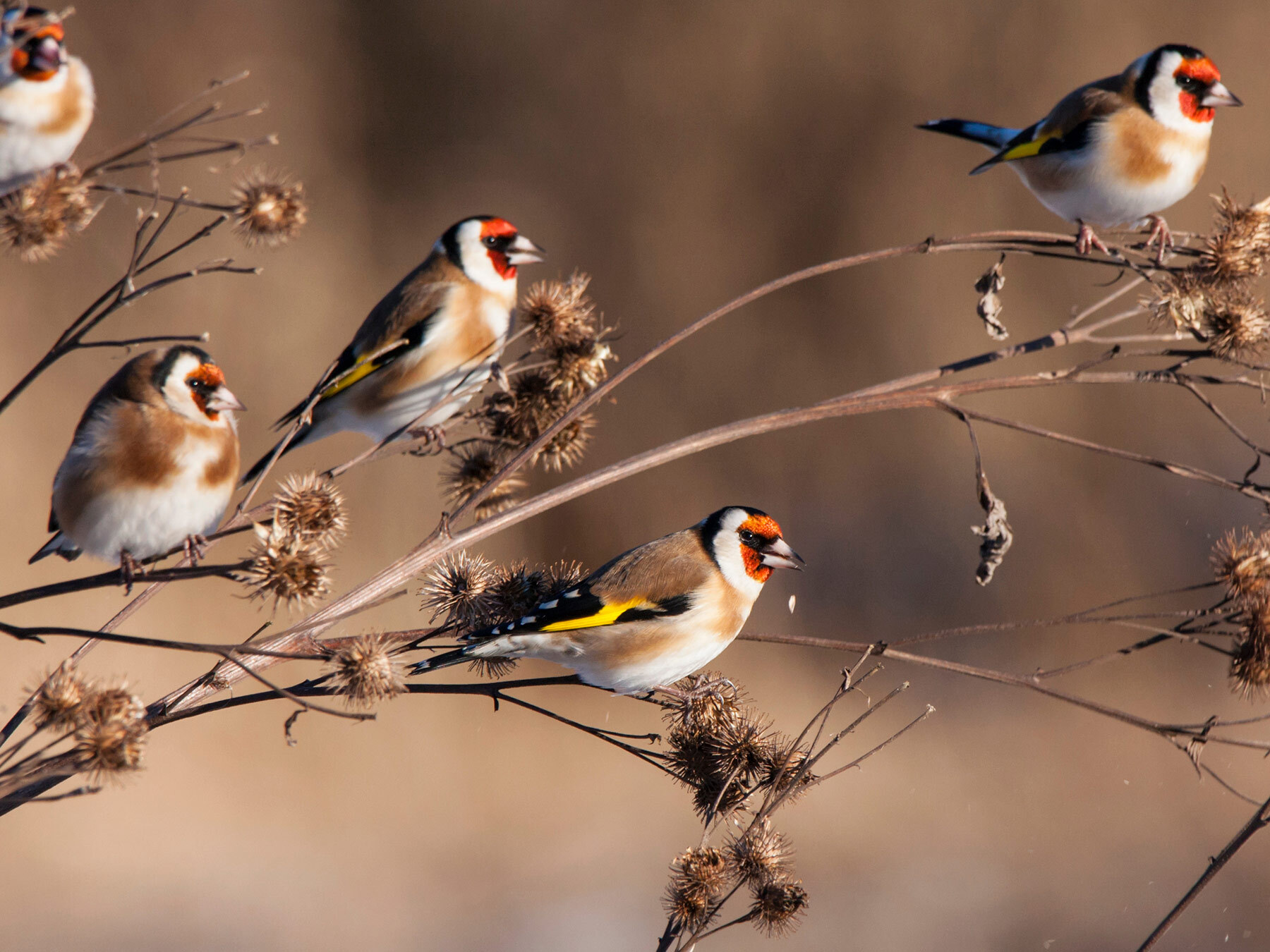
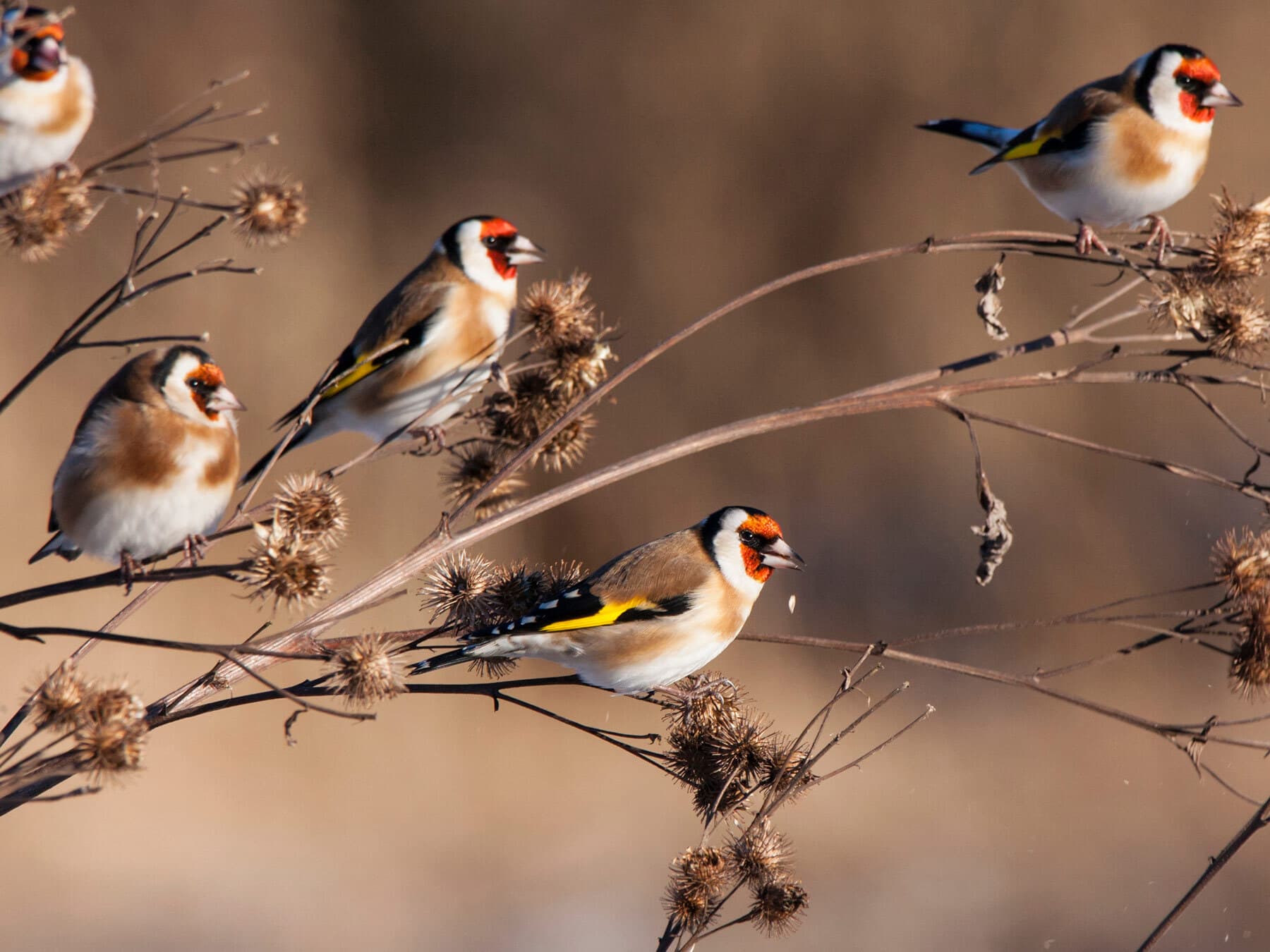 Goldfinches feeding on the seeds of burdock
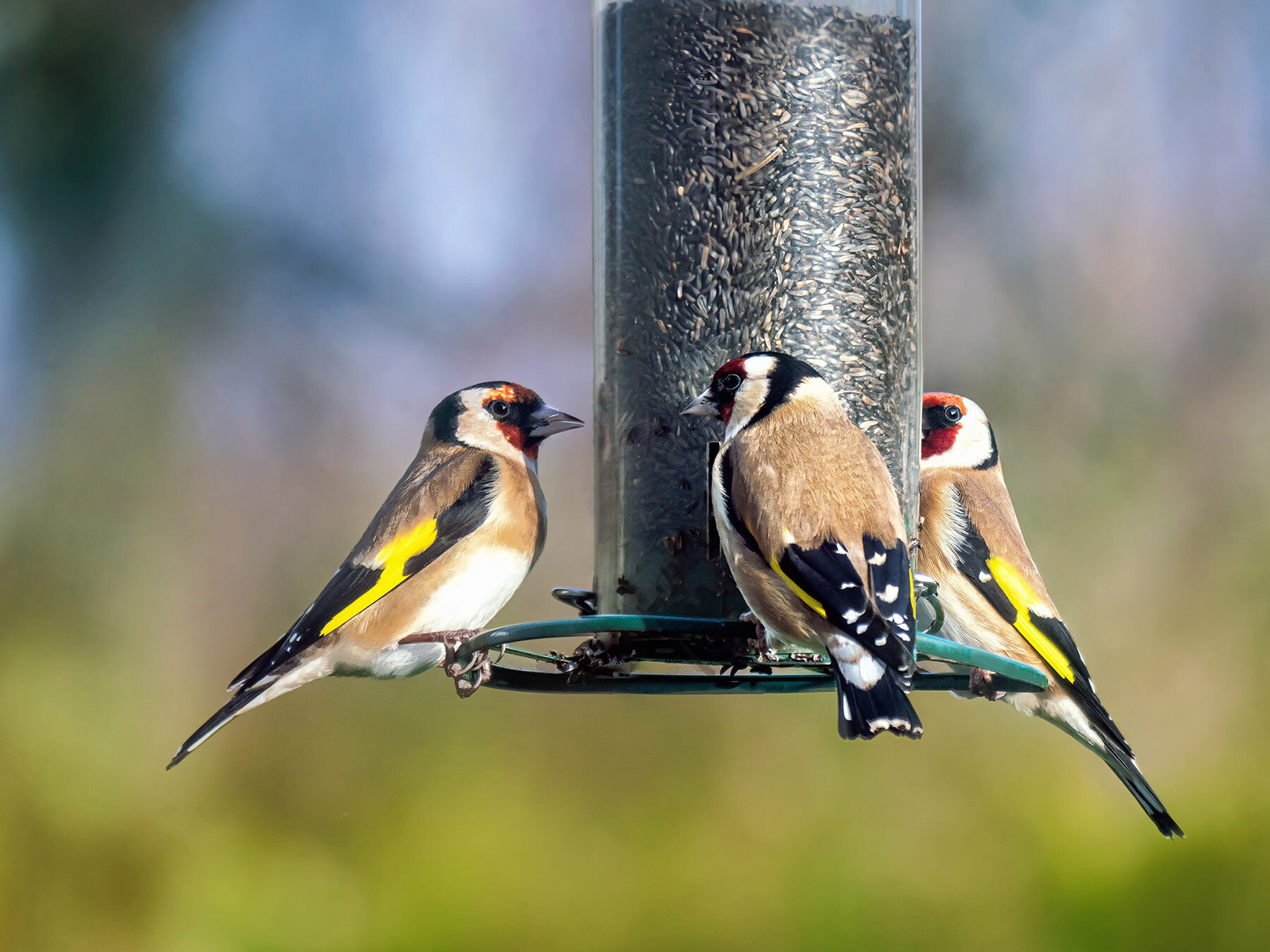
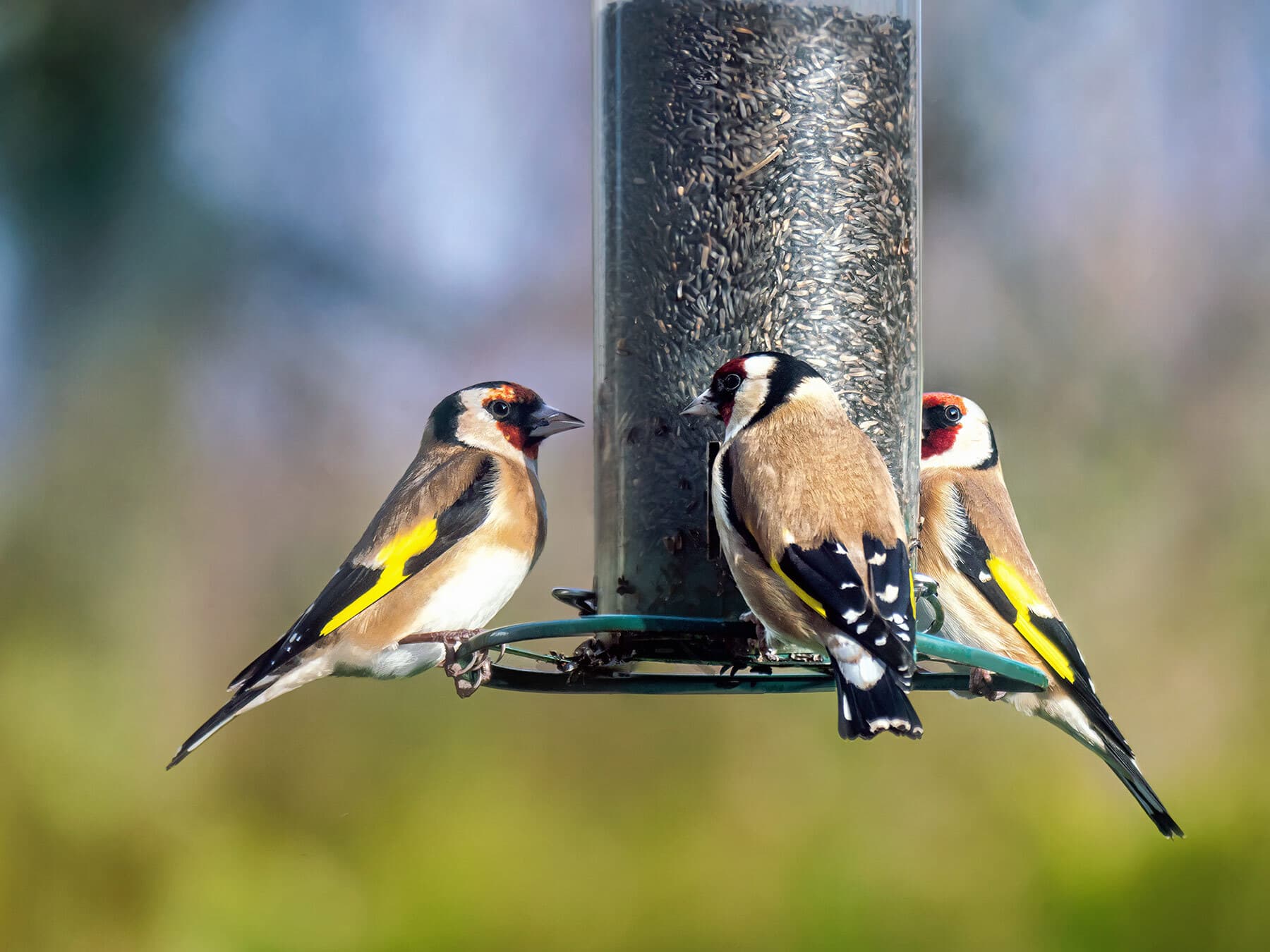 Three Goldfinches at a hanging nyjer feeder
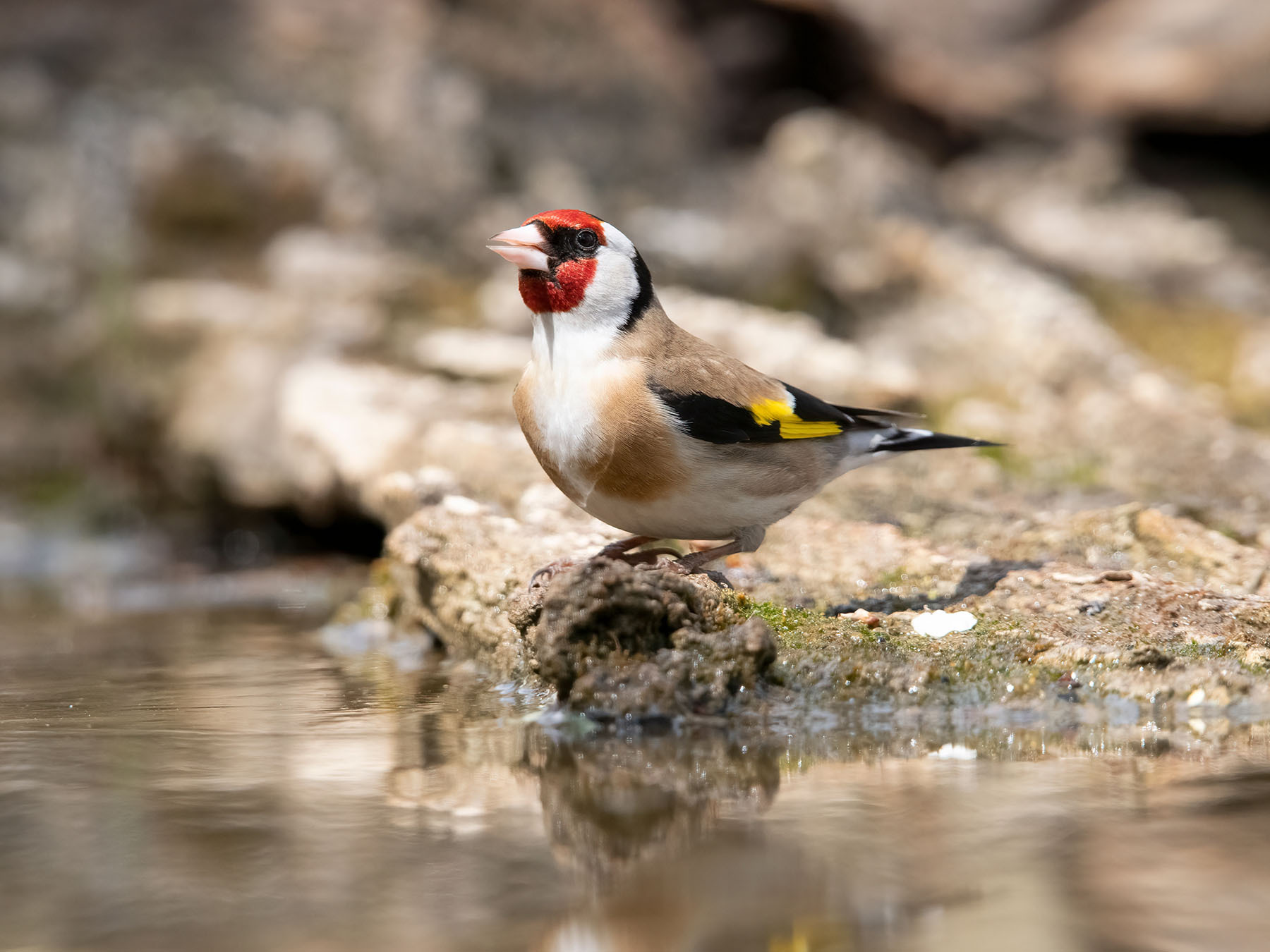
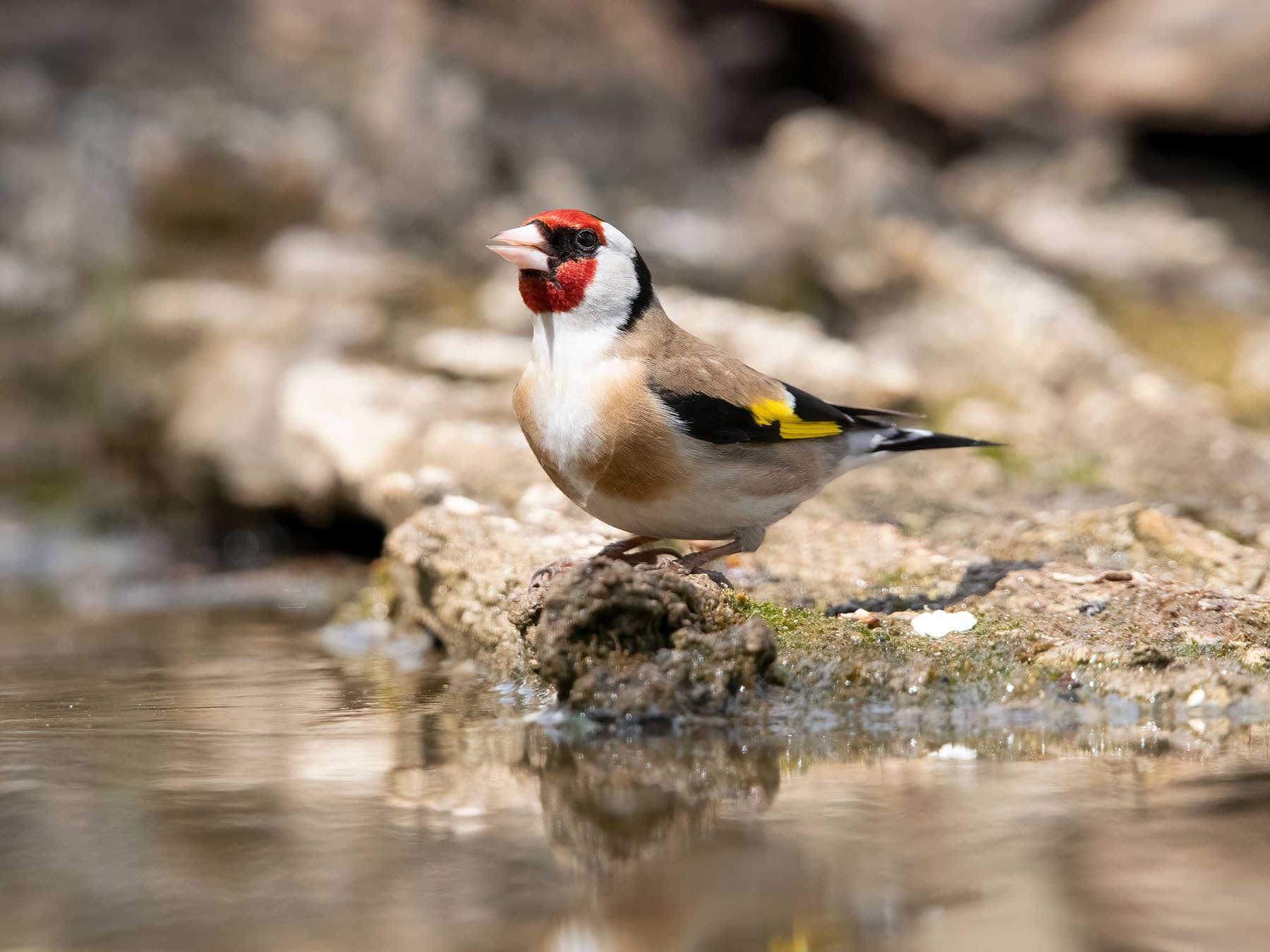 A Goldfinch drinking at the edge of a pool
European Goldfinch guides
5 guidesQuick facts
- Length
- 12–13 cm
- Wingspan
- 21–25.5 cm
- Weight
- 14–18 g
- Lifespan
- 2 years · oldest recorded 14.3 years · UK record 10 years
- Family
- Finches
- Migration
- Partial migrant
- Global status (IUCN)
- Least Concern
- Population trend
- Increasing in the UK (up 148% since 1995); Green-listed
- Also called
- Goldfinch
- Scientific name
- Carduelis carduelis
Questions
8How big is a Goldfinch?
About 12 cm long, with a wingspan of 21 to 25.5 cm, and around 16 g. See how to recognise it.
Are Goldfinches rare in the UK?
No. There were about 1.7 million pairs in 2016, and numbers have more than doubled since 1995. See conservation status.
Do Goldfinches stay in the UK over winter?
Many do; others spend the winter in Belgium, France or Spain. See do Goldfinches migrate.
Why have the Goldfinches disappeared from my garden?
Often for a season. From late summer, natural seed is plentiful in the countryside, some British Goldfinches go south for the winter, and the RSPB now advises pausing seed feeders from May to October. See where and when to see them.
What does a female Goldfinch look like?
Almost like the male, but her red usually stops at the eye. See male, female and young Goldfinches.
What does a young Goldfinch look like?
A streaky, buff-brown bird with no red face, but with the adult's black and gold wings. See young Goldfinches.
What does the Goldfinch symbolise?
In European religious art it often stands for Christ's Passion, and it appears in many paintings of the Madonna and Child. See Goldfinch symbolism and art.
Is the European Goldfinch the same as the American Goldfinch?
No. They are different species in different genera; the American Goldfinch has no red face. See American Goldfinch.
Sources
16- 1Kirwan, G. M. et al. (2024). European Goldfinch (Carduelis carduelis), version 1.2. Birds of the World (G. M. Kirwan, B. K. Keeney and S. M. Billerman, editors). Cornell Lab of Ornithology. doi:10.2173/bow.eurgol.01.2 (opens in a new tab)
- 2RSPB. Goldfinch. RSPB Birds A-Z. Accessed 7 October 2026. Source (opens in a new tab)
- 3BTO. Goldfinch (Carduelis carduelis). BTO BirdFacts. Accessed 7 October 2026. Source (opens in a new tab)
- 4Robinson, R. A., Leech, D. I. and Clark, J. A. (2025). Summary of all recoveries for Goldfinch (Carduelis carduelis). The Online Demography Report: bird ringing and nest recording in Britain & Ireland in 2024 (BTO). Accessed 7 October 2026. Source (opens in a new tab)
- 5RSPB (2026). Our latest guidance on feeding garden birds. RSPB news. Accessed 7 October 2026. Source (opens in a new tab)
- 6Newton, I. (1967). The adaptive radiation and feeding ecology of some British finches. Ibis 109: 33-98. doi:10.1111/j.1474-919x.1967.tb00005.x (opens in a new tab)
- 7BTO. Goldfinch Feeding Survey. BTO Garden BirdWatch. Accessed 7 October 2026. Source (opens in a new tab)
- 8BTO. Longevity records for Britain & Ireland in 2024. BTO Online Ringing and Nest Recording Report. Accessed 7 October 2026. Source (opens in a new tab)
- 9Fransson, T., Kolehmainen, T., Moss, D. and Robinson, R. (2023). EURING list of longevity records for European birds (1 September 2023). EURING. Accessed 7 October 2026. Source (opens in a new tab)
- 10Khelifa, R. et al. (2017). Unravelling the drastic range retraction of an emblematic songbird of North Africa: potential threats to Afro-Palearctic migratory birds. Scientific Reports 7: 1092. doi:10.1038/s41598-017-01103-w (opens in a new tab)
- 11RSPB. How and what to feed your garden birds. RSPB. Accessed 7 October 2026. Source (opens in a new tab)
- 12Hanmer, H. J. and Leech, D. I. (2024). Breeding periods of hedgerow-nesting birds in England. BTO Research Report 762. British Trust for Ornithology, Thetford. Accessed 7 October 2026. Source (opens in a new tab)
- 13Cornell Lab of Ornithology. European Goldfinch life history. All About Birds. Accessed 7 October 2026. Source (opens in a new tab)
- 14AviList Core Team (2025). AviList: The Global Avian Checklist, v2025b. doi:10.2173/avilist.v2025b (opens in a new tab)
- 15RSPB. Siskin. RSPB Birds A-Z. Accessed 7 October 2026. Source (opens in a new tab)
- 16Clement, P. and de Juana, E. (2020). European Greenfinch (Chloris chloris), version 1.0. Birds of the World (J. del Hoyo, A. Elliott, J. Sargatal, D. A. Christie and E. de Juana, editors). Cornell Lab of Ornithology. doi:10.2173/bow.eurgre1.01 (opens in a new tab)

Checked by
Nathan Cope, founder and editor
Nathan founded Birdfact and leads its writers and contributors in the UK, the US and Canada. He has watched and studied birds for more than ten years, and checks every article and species guide before it’s published.