Published 9 Oct 2026
Eurasian Collared-Dove vs Mourning Dove: How to Tell Them Apart
By the Birdfact teamChecked by Nathan Cope
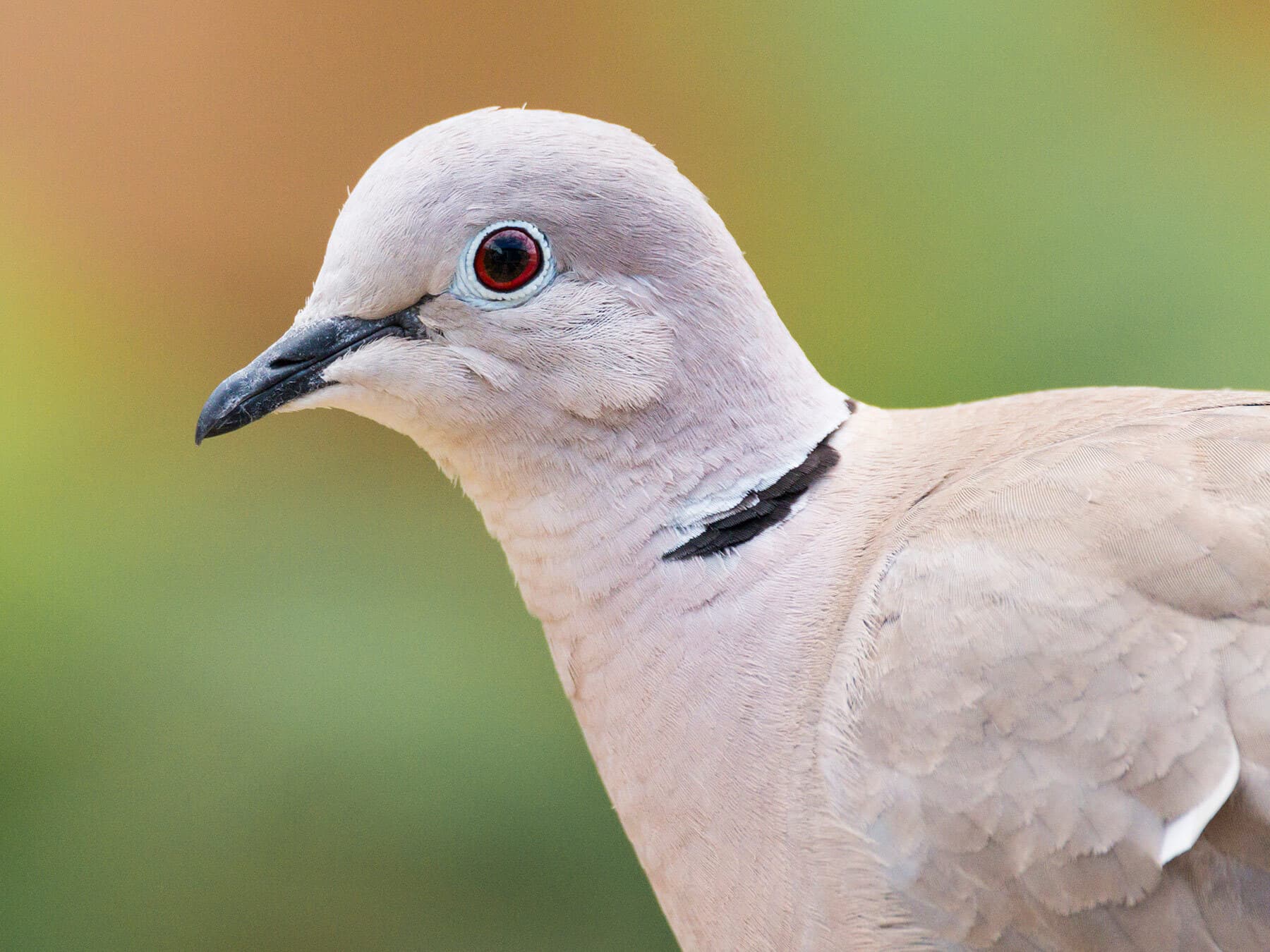
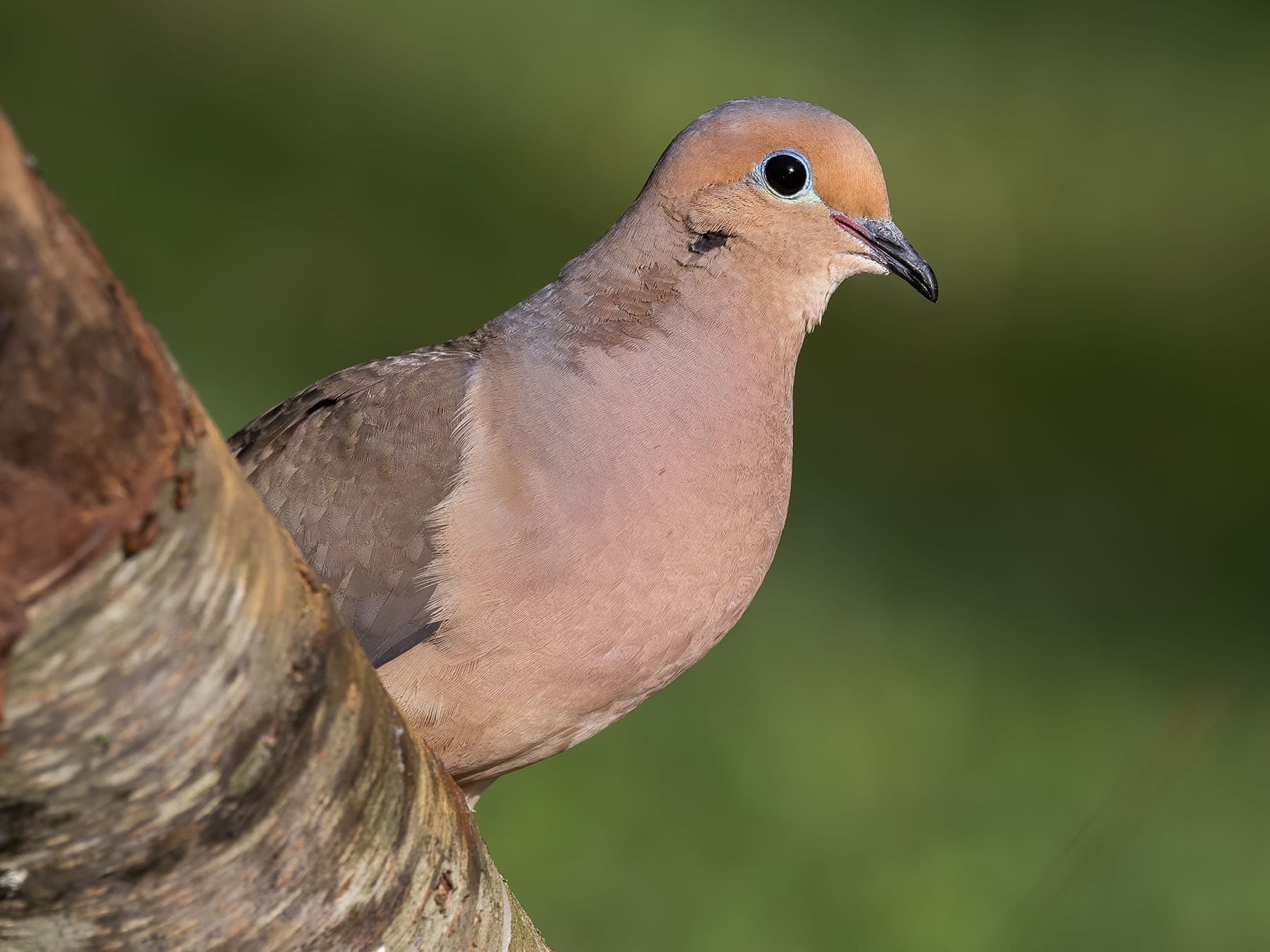
A Eurasian Collared-Dove has a black half-collar on the back of its neck. A Mourning Dove has no collar, and black spots on its wings
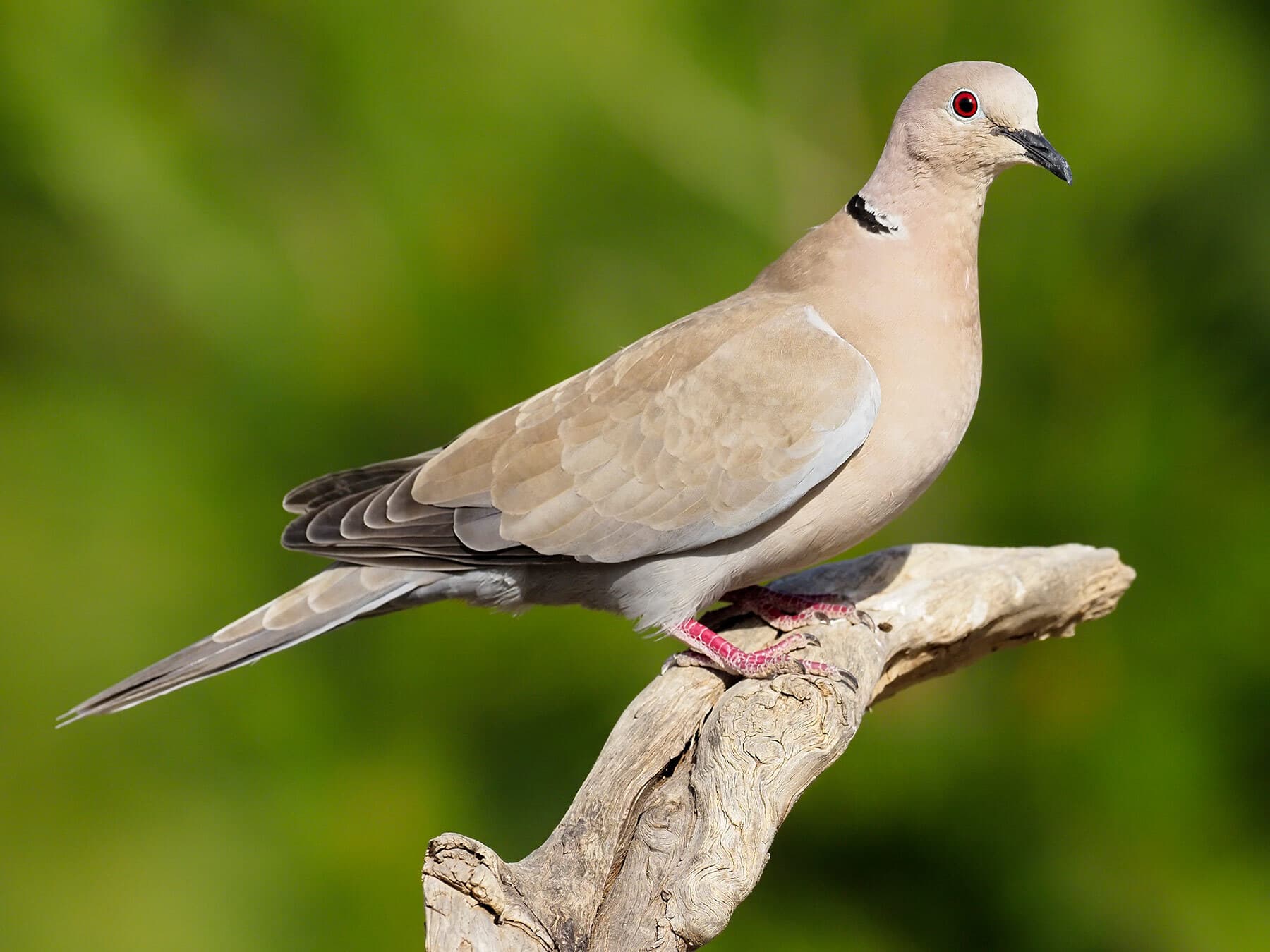
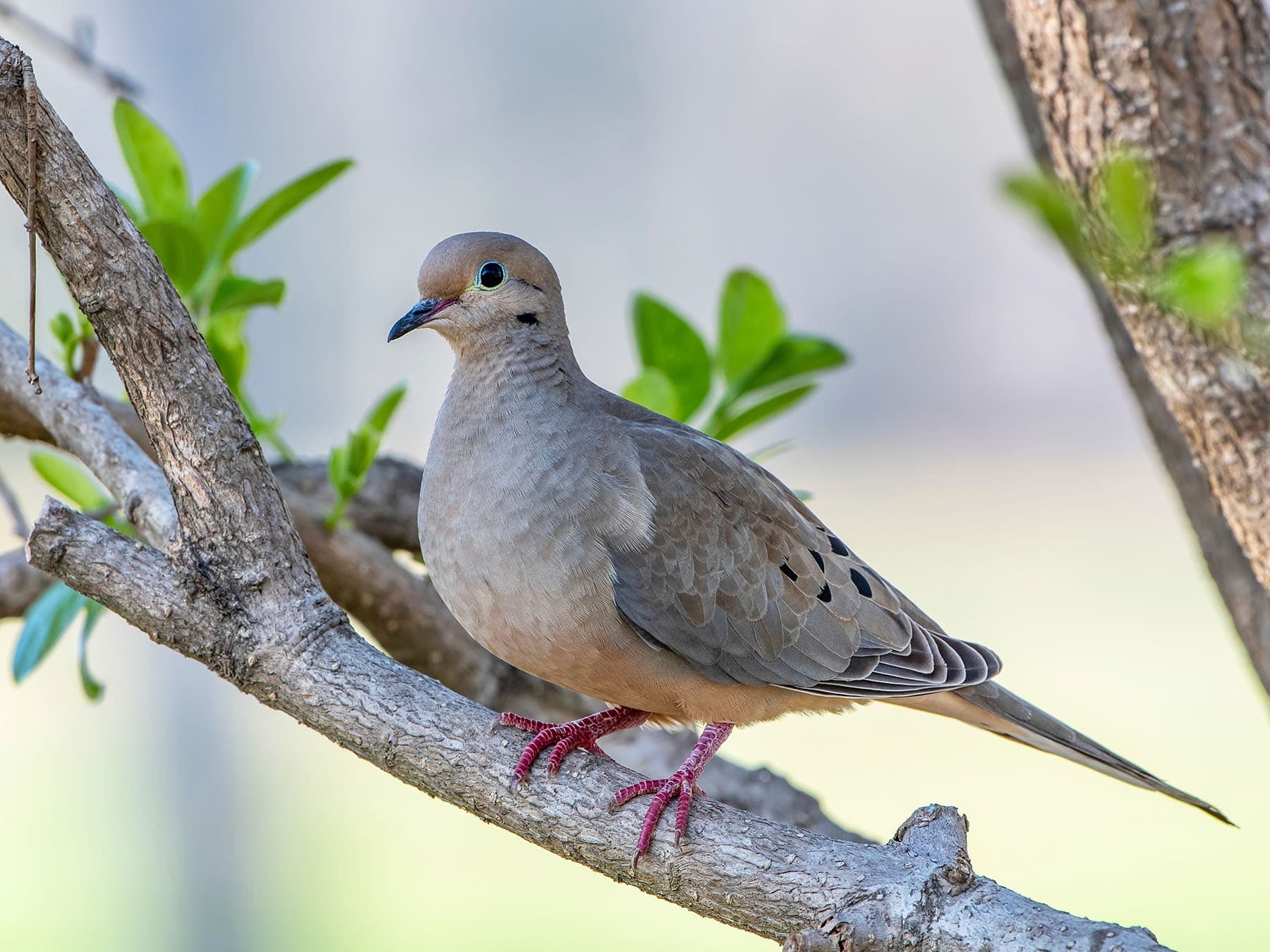
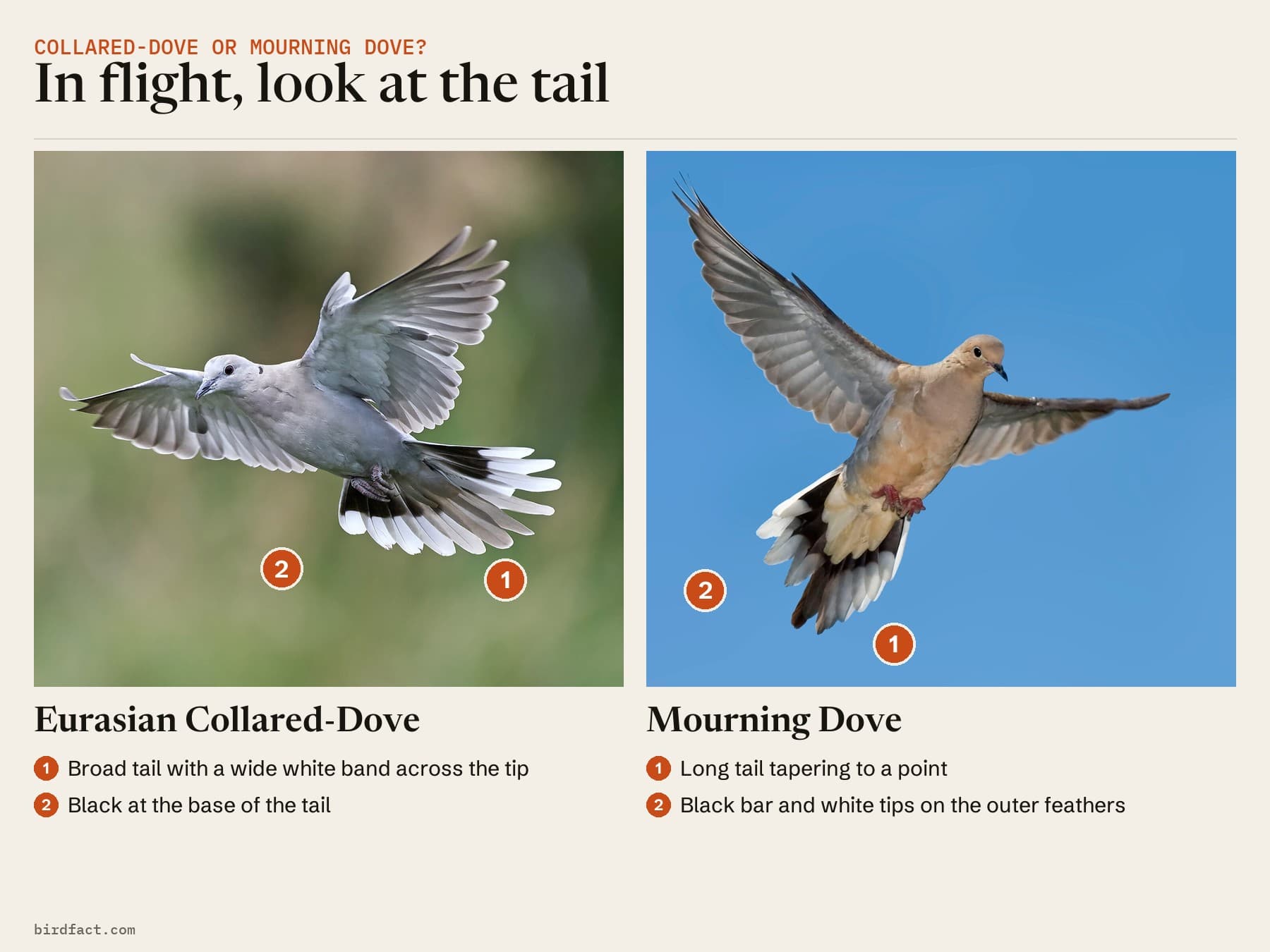
Then look at the tail: long and pointed on a Mourning Dove, broad and square-ended on a Collared-Dove, with a wide white band underneath. The Collared-Dove is also paler and about a third heavier.
On this page15 sections
Collared-Dove or Mourning Dove? Look at the neck
| Feature | Eurasian Collared-Dove | Mourning Dove |
|---|---|---|
| NeckDecisive | Eurasian Collared-Dove: A narrow black half-collar | Mourning Dove: No collar; a black spot below the ear |
| Wings | Eurasian Collared-Dove: Plain, with darker tips | Mourning Dove: Black spots |
| Tail | Eurasian Collared-Dove: Broad and square-ended; a wide white band underneath | Mourning Dove: Long and pointed; outer feathers tipped white |
| Color | Eurasian Collared-Dove: Pale sandy gray-buff | Mourning Dove: Warmer tan, peach below |
| Weight | Eurasian Collared-Dove: 4.9-6.3 oz (140-180 g) | Mourning Dove: 3.0-6.0 oz (86-170 g) |
| Song | Eurasian Collared-Dove: A quick three-note koo-KOO-kook | Mourning Dove: A slow, soft coo-oo, then two or three more coos |
| Other sounds | Eurasian Collared-Dove: A loud, nasal hwaah as it lands | Mourning Dove: Wings whistle at take-off and landing |
A young Collared-Dove can lack the full collar for about three months, so check the wings and tail too.
Seen one and not sure which? Identify it from a photo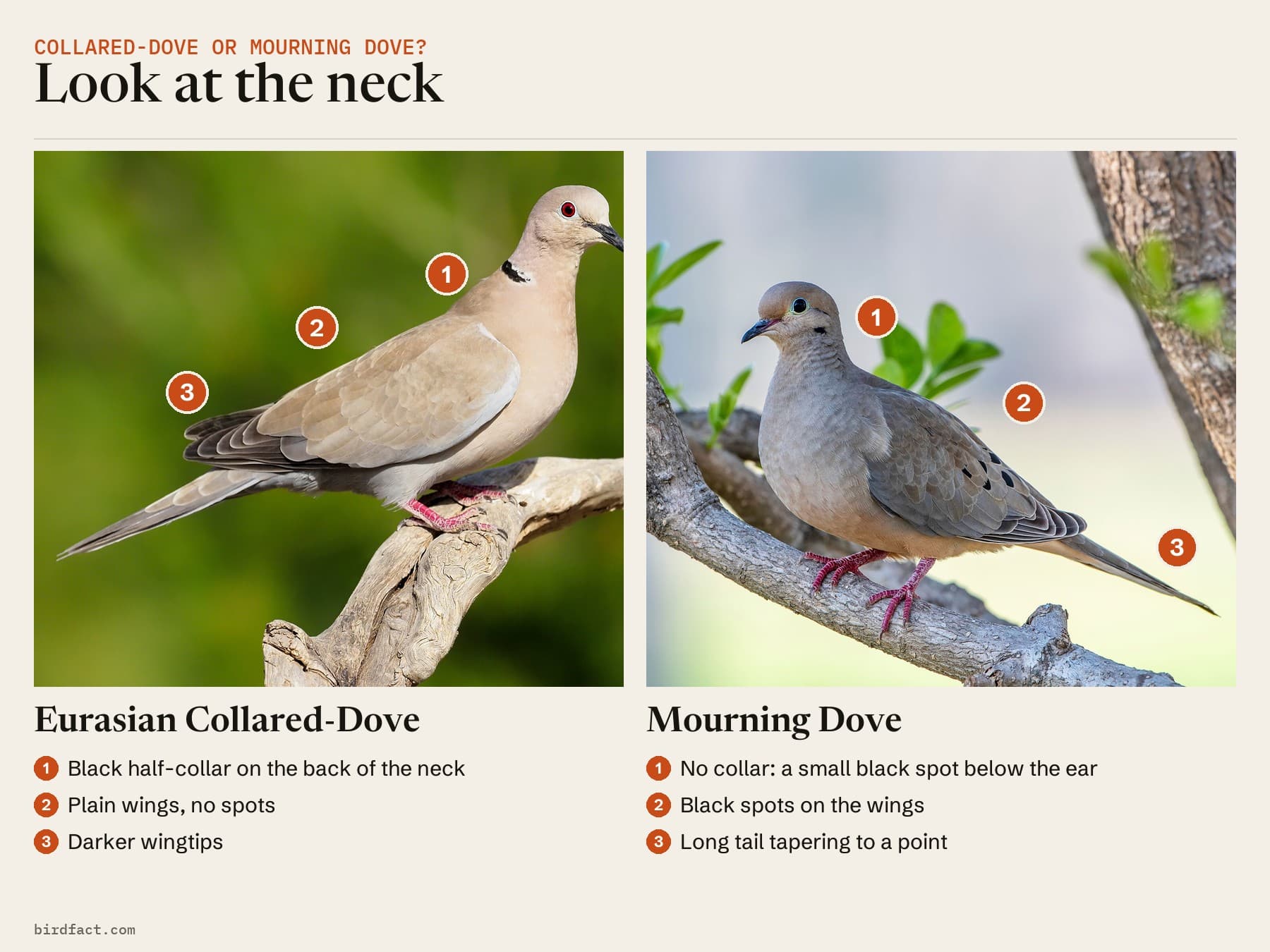
A Eurasian Collared-Dove has a black half-collar, plain sandy wings and a broad, square tail with a wide white band underneath. A Mourning Dove has no collar, black spots on its wings and a long, pointed tail. Compare their size, songs, flight, nests and where each lives, with photos, recordings and a state-by-state table.
Across much of the western and central United States, and in Florida and Texas, two doves share backyards, wires and grain fields: the native Mourning Dove and the Eurasian Collared-Dove, which reached Florida from the Bahamas around 1980 and has spread across most of the country since. They are much the same length, both soft brownish-gray, and they coo. Here is how to tell them apart in a few seconds, by eye and by ear.
The quickest clues
- The back of the neck. A narrow black half-collar means a Collared-Dove. A Mourning Dove has no collar, just a small black spot below the ear.1, 2
- The wings. Black spots on the folded wing mean a Mourning Dove. A Collared-Dove's wings are plain, with darker tips.
- The tail. Long and pointed on a Mourning Dove, a shape no other North American dove has. A Collared-Dove's tail is broad and square-ended, and from below it shows a wide white band at the tip.
- The color. A Collared-Dove is pale, sandy gray-buff, almost frosty. A Mourning Dove is warmer: tan to buffy brown, peach below.
- The sound. A Collared-Dove sings a quick three-note koo-KOO-kook and gives a loud, nasal hwaah as it lands. A Mourning Dove's song is slower and sadder, and its wings whistle when it takes off.
A young Collared-Dove can lack the full collar for its first three months or so, so check the wings and tail as well.3
Size and weight
| Eurasian Collared-Dove | Mourning Dove | |
|---|---|---|
| Length | 11.4-12.6 in (29-32 cm) | 9-13 in (23-34 cm) |
| Weight | 4.9-6.3 oz (140-180 g) | 3.4-6.0 oz (96-170 g) males; 3.0-5.5 oz (86-156 g) females |
| Wingspan | 18-19 in (46-48 cm) | about 18 in (45 cm) |
The two are close in length, and the ranges overlap.4 Project FeederWatch's rule of thumb puts the Collared-Dove at about 13 inches and the Mourning Dove at about 12.5 Much of a Mourning Dove's length is tail: its central tail feathers alone are 5 to 6 inches (13-15 cm) long.6
The real difference is bulk. Mourning Doves average about 3.8 to 4.6 ounces (108-130 g), depending on sex and region, while a Collared-Dove is typically 4.9 to 6.3 ounces (140-180 g): about a third heavier, with a chunkier body and a broader tail. Side by side the Collared-Dove looks the bigger bird.
Neck, face and wings
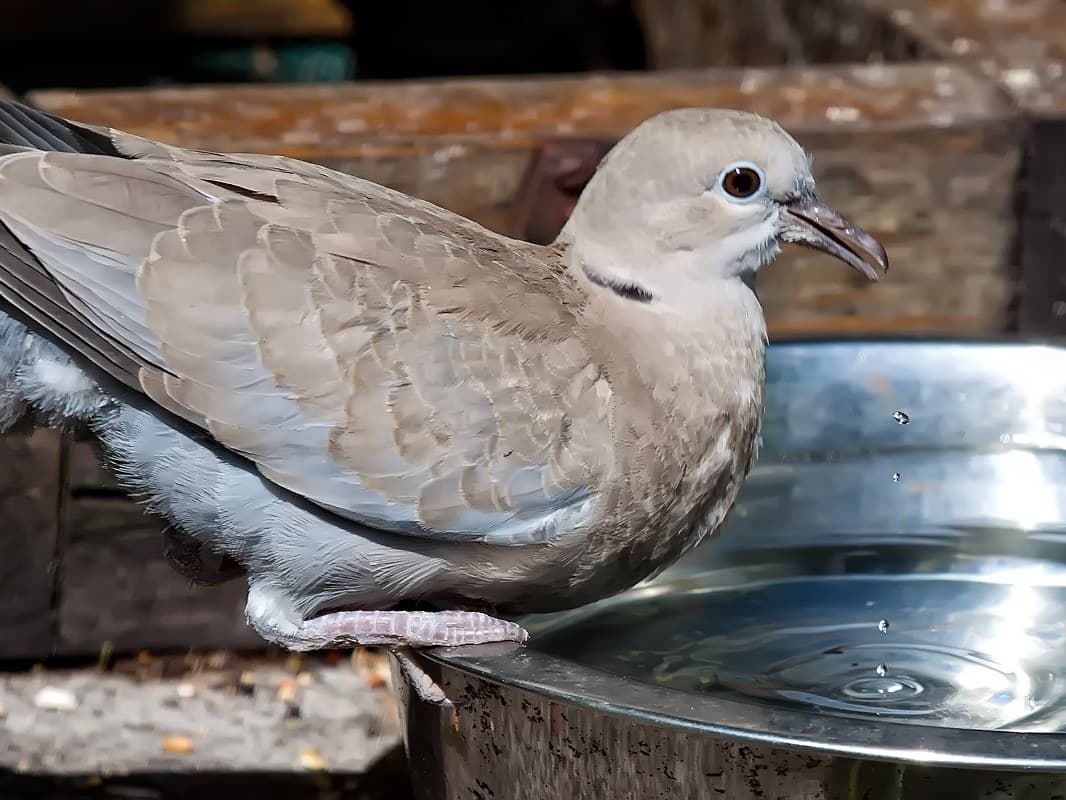
The Collared-Dove is named for its collar: a narrow black crescent across the back of the neck, edged with white. Its face is plain, with a deep red eye, and its wings are plain sandy gray-buff, with darker wingtips that show both perched and in flight.
A Mourning Dove has no collar. It has a black spot low on the side of the face, below the ear, which can be hidden from some angles, and a short black mark just behind the eye; its eye is dark, ringed with bluish skin. The folded wings carry a scatter of large black spots. Males are a little brighter than females, with a bluish-gray crown and a rosy breast, but the difference is slight and many birds cannot be sexed by eye.
Both have a thin black bill and reddish legs.
The tail
In flight, or when a bird spreads its tail to land, the tails settle it. A Mourning Dove's tail is long and graduated: the central feathers are the longest and the outer ones about half their length, so the tail fans into a long point. The outer feathers have a black bar and white tips.
A Collared-Dove's tail is broad and square-ended. From below it is black at the base and broadly white at the tip, and the feathers under the base of the tail are gray. The white flashes most when a Collared-Dove lands or glides down in its display flight.
Songs and calls
A male Collared-Dove sings a three-note koo-KOO-kook, the middle note the longest, and repeats it, usually 3 to 12 times in a row7, from a roof, pole or wire. Each phrase lasts a little over a second. A Mourning Dove's song starts with a soft, two-part coo-oo, then two or three stronger notes, and it is mostly unmated males that sing it8; in our recording it takes about 4 seconds. It is slower and more mournful, and gave the bird its name.
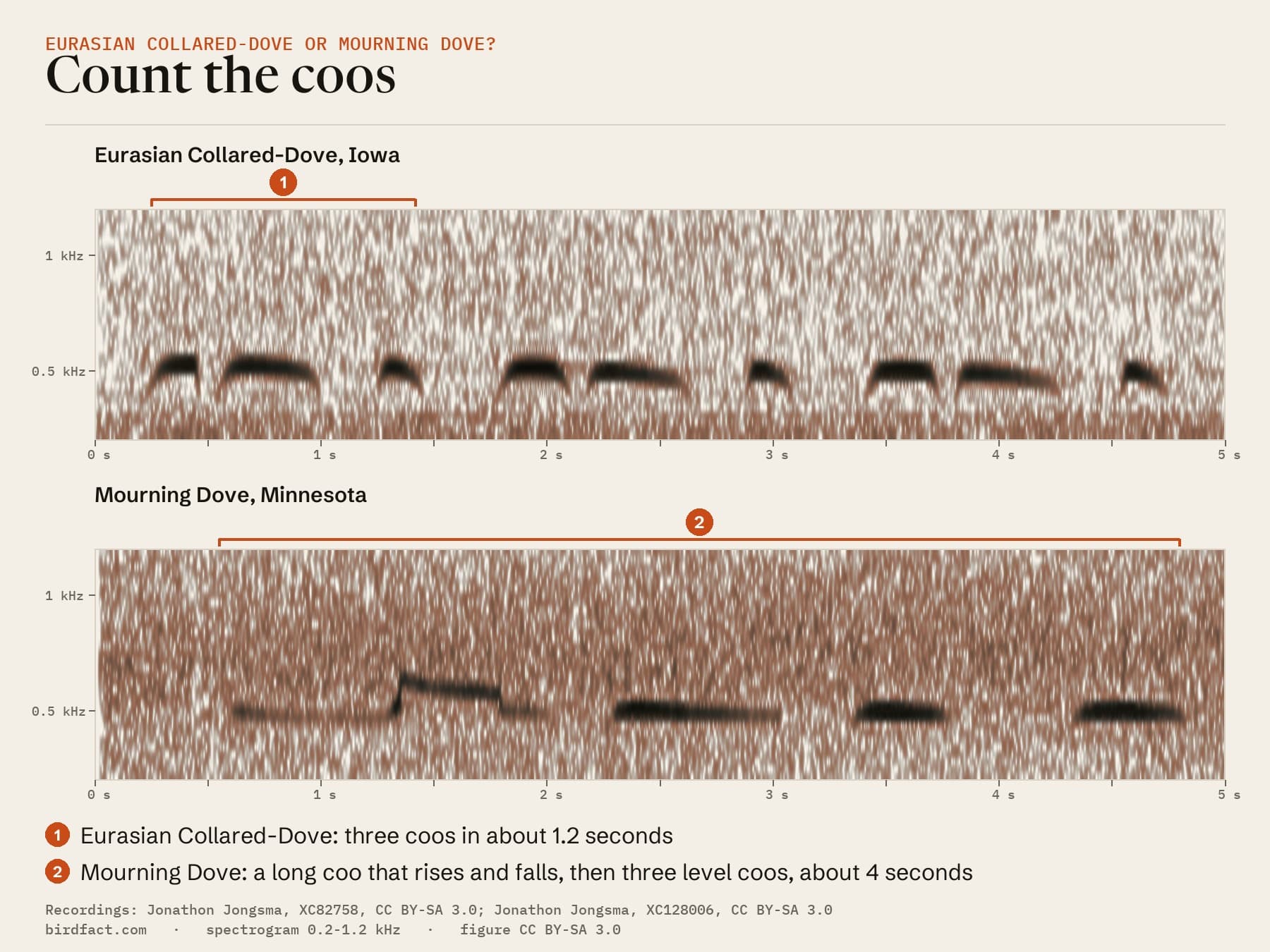
Two traps. Paired Mourning Dove males also give a short three-note nest call, coo-OO-oo, the middle note the highest, at nest sites, so a three-note coo is not always a Collared-Dove; look for the collar. And the Collared-Dove has a sound the Mourning Dove lacks: a loud, nasal hwaah when it is excited, often given just before it lands.7, 3 Listen too for a Mourning Dove's wings: they whistle as it takes off and lands. More on the Collared-Dove's voice, with spectrograms, is on our Eurasian Collared-Dove call page.
Flight and behavior
A Mourning Dove is a fast, direct flier that can jink and change height suddenly, its long pointed tail trailing. A Collared-Dove's flight is strong too, but it alternates quick runs of short, clipped wingbeats with swooping glides, and it is reported not to change pace and height as nimbly as a Mourning Dove.
In the breeding season both males show off in the air. A Mourning Dove leaves his perch with loud claps of his wings, climbs 100 feet (30 m) or more, then glides down in a long spiral on wings held below his body.6 A Collared-Dove climbs steeply, clapping, then glides down with its tail spread, often spiraling and calling hwaah.3
Both feed on the ground, walking rather than hopping, and both come to seed scattered on the ground or on platform feeders. Mourning Doves live almost entirely on seeds; Collared-Doves take seed and grain too, with millet a favorite, and seem more willing to eat bigger, thicker seeds such as corn and sunflower. Outside the nesting season both gather in flocks, and both perch in the open on wires and poles.
Where you'll see each one
The Mourning Dove breeds from southern Canada across every one of the lower 48 states and south into Mexico. Most northern birds move south for the winter, but the species stays year-round through most of its range, missing only central Canada and the north-central states in winter.
The Collared-Dove is a bird of towns, suburbs and farms with spilled grain, and in North America it is scarce in the Northeast. Our records of the two birds, from eBird records shared through GBIF, 2019-2024, show where you are most likely to meet each:
| Collared-Dove records per 100 Mourning Dove records | States |
|---|---|
| 80 or more: about as often as Mourning Doves, or more often | Wyoming, Montana, Utah, Washington, Colorado, Oregon, Idaho |
| 15-61: common, but Mourning Doves outnumber them | New Mexico, Nevada, Nebraska, South Dakota, California, Oklahoma, Arizona, North Dakota, Kansas, Texas, Florida, Mississippi, Louisiana, Arkansas, Iowa |
| 3-11: uncommon | Alabama, Minnesota, Georgia, Missouri, South Carolina, Illinois, Tennessee, Kentucky |
| Under 2: rare or absent | North Carolina, Indiana, Wisconsin, Virginia, Pennsylvania, Ohio, Michigan, Maryland, Delaware, West Virginia, New Jersey, New York, Maine and Rhode Island; none in Massachusetts, Connecticut, Vermont or New Hampshire |
These are records, not birds, but the pattern is clear. In New England a dove at the feeder is almost certainly a Mourning Dove; in Wyoming or Montana there are more Collared-Dove records than Mourning Dove ones. Across Canada there are about 10 Collared-Dove records for every 100 Mourning Dove records, and in Hawaii only Mourning Doves appear in our records.
Nests and young
Both build a flimsy platform of twigs, often reusing an old nest, and both lay two white eggs. Both parents sit on the eggs and feed the chicks crop milk, a rich food made in the lining of the crop.
Mourning Dove eggs hatch after 14 days and the young leave the nest 12 to 15 days later; the father keeps feeding them for about 12 days more. A pair can start a new clutch about every 30 days, and one pair in Texas made six nesting attempts in a season. Collared-Doves incubate for 14 to 19 days, the young leave at about 17 days, and a pair may lay 3 to 6 clutches a year. Both species can nest in almost any month in warm southern states.
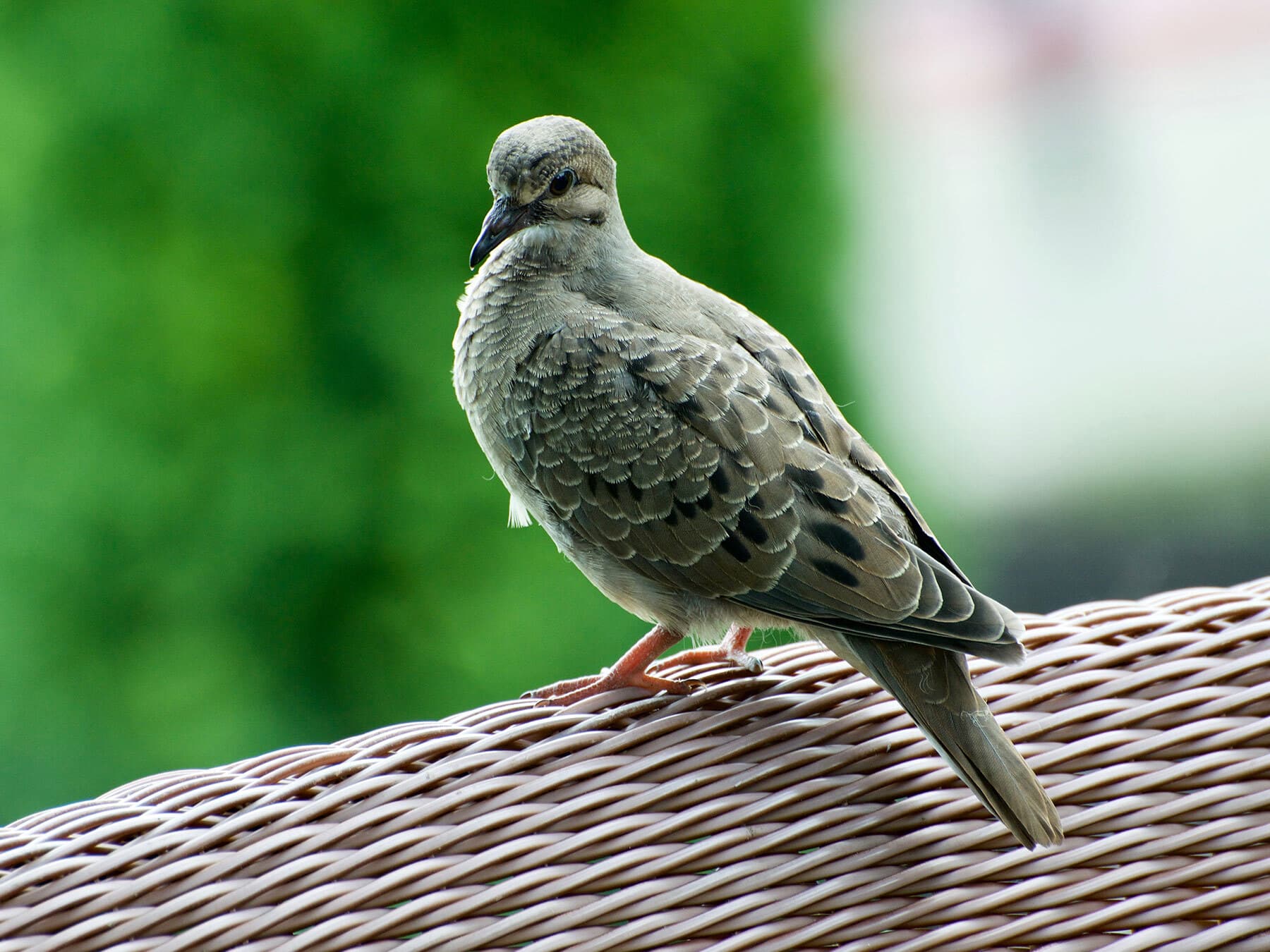
Young birds trip people up. A juvenile Mourning Dove looks scaly, with pale edges to its feathers, and has no black ear spot yet. A young Collared-Dove is scaly too, with a brown eye and no complete collar. More on young Mourning Doves: baby Mourning Doves.
How long they live
A Mourning Dove that reaches adulthood lives only about a year on average.6 The oldest on record was banded in Georgia in 1968 and shot in Florida in 1998, at least 30 years 4 months old. The North American record for a Eurasian Collared-Dove is 9 years 3 months, a bird banded in South Carolina.9 In Europe one reached an estimated 22 years 2 months.10
Do Collared-Doves harm Mourning Doves?
Not as far as anyone has shown. Birds of the World finds no evidence that the Collared-Dove's spread has harmed the Mourning Dove or other native doves; competition has been suggested but not demonstrated.3, 6 In Florida, a study of 444 sites in the winters from 1999 to 2008 found that four other dove species were, if anything, more numerous where Collared-Doves were more numerous.11 In captivity, Collared-Doves ate much the same food as Mourning Doves but did not appear more aggressive or better at getting it.12
At feeders they do chase each other: Collared-Doves have been seen driving off Mourning Doves in southern Florida, but Mourning Doves chase Collared-Doves too. And the numbers are far apart. There are about 329 million Mourning Doves in the United States, against roughly 8.7 million Collared-Doves in the United States and Canada together (estimates made in different years and different ways).13, 3
Hunting and the law
The Mourning Dove is a migratory game bird under the Migratory Bird Treaty Act. Federal frameworks set the seasons and bag limits, and states may be stricter but not more liberal. It has long been North America's most-hunted game bird: in the United States in 2025 about 948,500 hunters took about 15.5 million.
The Eurasian Collared-Dove, as a species introduced by people, is not covered by the Act, and several states allow it to be hunted.14, 3 Rules differ from state to state, and in the field the two can be hard to tell apart, so check your state's regulations.
Related, but not closely
Both belong to the pigeon and dove family, but to different genera: the Collared-Dove to Streptopelia, with the African Collared-Dove, and the Mourning Dove to Zenaida, with the White-winged Dove.
Other doves people mix up
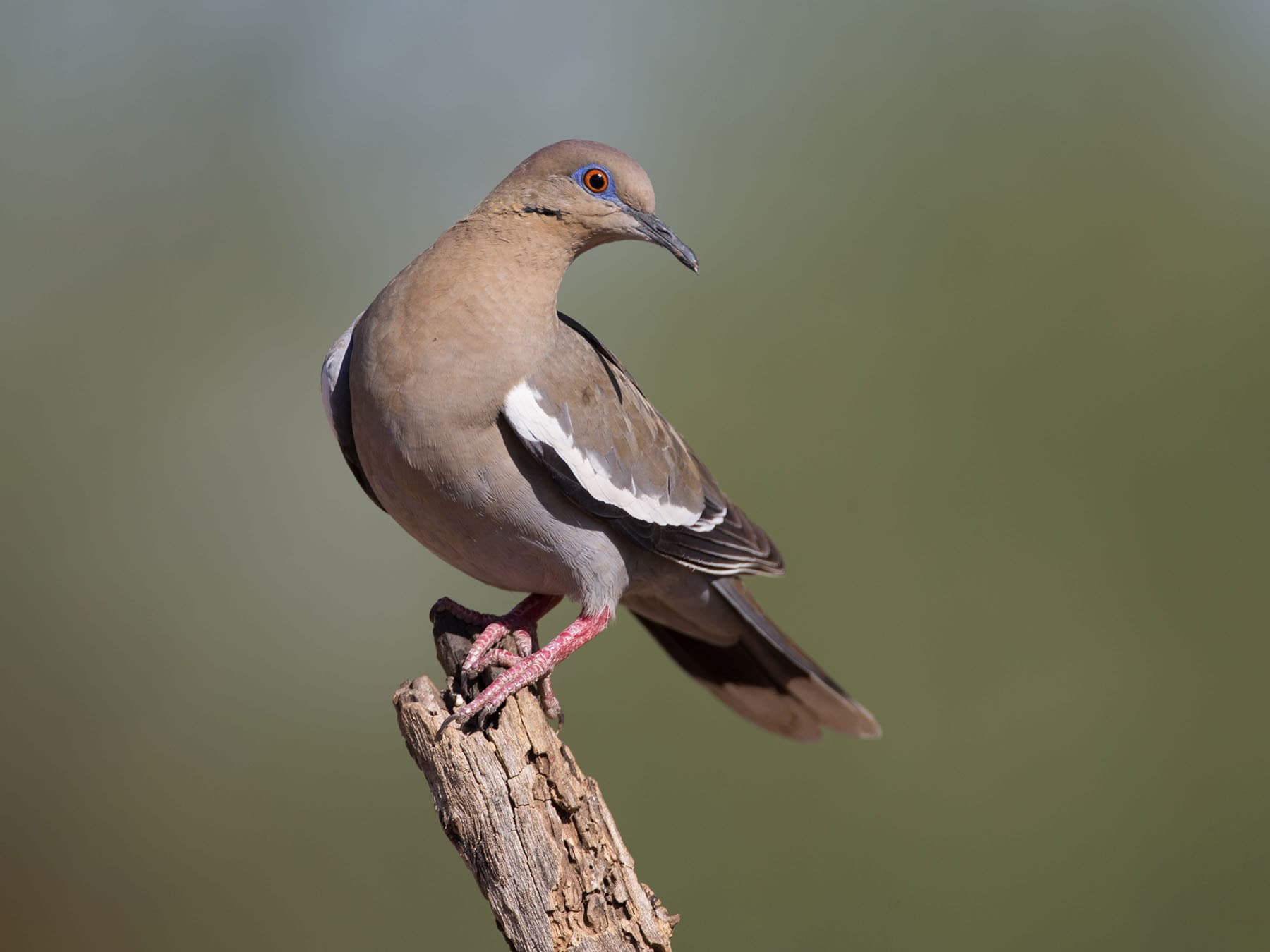
White-winged Dove: a white stripe along the edge of the folded wing, which shows as big white patches in flight, and a blunt-tipped tail. No black collar, no pointed tail.
African Collared-Dove (Ringed Turtle-Dove or ringneck dove): the domestic form is kept widely as a cage bird, but free-flying birds are rare in North America. It has a collar like the Eurasian's, but it is paler, with white feathers under the tail, wingtips barely darker than the wing, and a two-part, rolling coo. Hybrids between it and the Eurasian Collared-Dove are reported in the wild and would be expected to look and sound in between.
Rock Pigeon: bigger and chunkier than either, with a shorter tail than a Collared-Dove.
About the recordings
The Iowa recording shows how easily the two are confused: its original file name carries MODO, the four-letter code for Mourning Dove, and two months after it was uploaded in 2011 another xeno-canto user identified it as a Eurasian Collared-Dove.15 Its three-note phrases match a Collared-Dove's. The excitement calls come from France, because we found no openly licensed North American recording of them. The species has no subspecies, and All About Birds describes the same loud hwaah in North America.
Sources
- Cornell Lab of Ornithology. Eurasian Collared-Dove. All About Birds. Accessed 9 October 2026. Source
- Cornell Lab of Ornithology. Mourning Dove Identification. All About Birds. Accessed 9 October 2026. Source
- Romagosa, C. M., Mlodinow, S. G. (2022). Eurasian Collared-Dove (Streptopelia decaocto), version 1.1. Birds of the World (P. Pyle, P. G. Rodewald and S. M. Billerman, editors). Cornell Lab of Ornithology. doi:10.2173/bow.eucdov.01.1
- National Audubon Society. Eurasian Collared-Dove. Guide to North American Birds (text adapted from Kaufman 1996). Accessed 9 October 2026. Source
- Project FeederWatch (Cornell Lab of Ornithology and Birds Canada). Tricky Bird ID: Common Doves. Project FeederWatch. Accessed 9 October 2026. Source
- Otis, D. L., Schulz, J. H., Miller, D., Mirarchi, R. E., Baskett, T. S. (2020). Mourning Dove (Zenaida macroura), version 1.0. Birds of the World (A. F. Poole, editor). Cornell Lab of Ornithology. doi:10.2173/bow.moudov.01
- Cornell Lab of Ornithology. Eurasian Collared-Dove: Sounds. All About Birds. Accessed 9 October 2026. Source
- Cornell Lab of Ornithology. Mourning Dove: Sounds. All About Birds. Accessed 9 October 2026. Source
- USGS Bird Banding Laboratory. Longevity records of North American birds. USGS Patuxent Wildlife Research Center, Bird Banding Laboratory. Accessed 9 October 2026. Source
- Fransson, T., Kolehmainen, T., Moss, D., Robinson, R. (2023). EURING list of longevity records for European birds (1 September 2023). EURING. Accessed 9 October 2026. Source
- Bonter, D. N., Zuckerberg, B., Dickinson, J. L. (2010). Invasive birds in a novel landscape: habitat associations and effects on established species. Ecography 33(3): 494-502. doi:10.1111/j.1600-0587.2009.06017.x
- Poling, T. D., Hayslette, S. E. (2006). Dietary overlap and foraging competition between Mourning Doves and Eurasian Collared-Doves. Journal of Wildlife Management 70(4): 998-1004. doi:10.2193/0022-541X(2006)70[998:DOAFCB]2.0.CO;2
- U.S. Fish and Wildlife Service (2026). Mourning Dove Population Status, 2026. U.S. Fish and Wildlife Service, Division of Migratory Bird Management. Accessed 9 October 2026. Source
- U.S. Fish and Wildlife Service (2020). List of Bird Species To Which the Migratory Bird Treaty Act Does Not Apply. Federal Register 85(74): 21262-21264. Accessed 9 October 2026. Source
- Jongsma, J., xeno-canto contributors. XC82758 Eurasian Collared Dove, and forum topic 2513 'ID X82758'. xeno-canto. Accessed 9 October 2026. Source
- Cornell Lab of Ornithology. Eurasian Collared-Dove: Similar Species Comparison. All About Birds. Accessed 9 October 2026. Source
- Birds Ontario. Species 4-letter codes. Birds Ontario. Accessed 9 October 2026. Source