
Wilson's Warbler
Cardellina pusilla
By the Birdfact teamChecked by Nathan Cope
On this page13 sections
How to recognise it
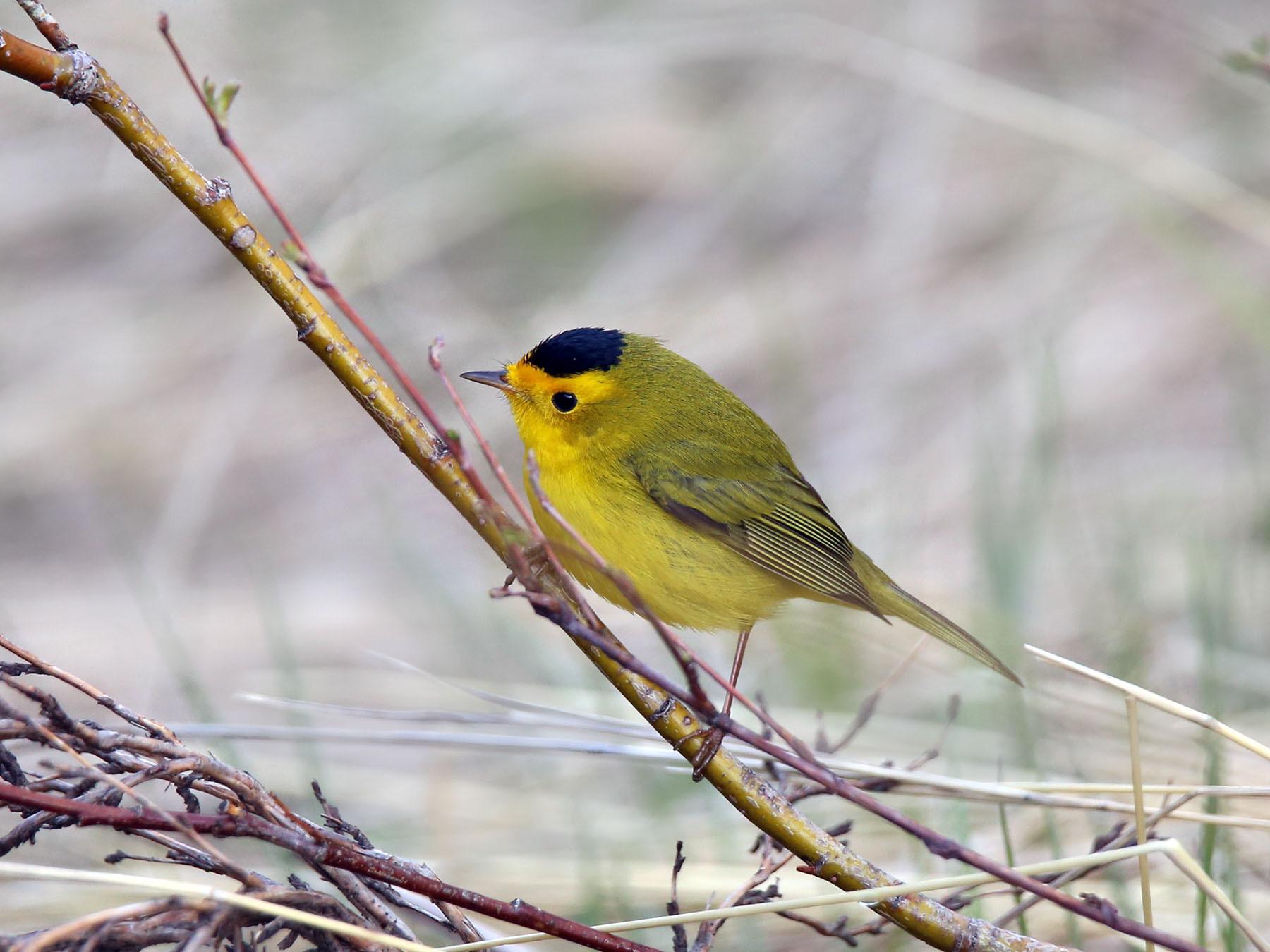
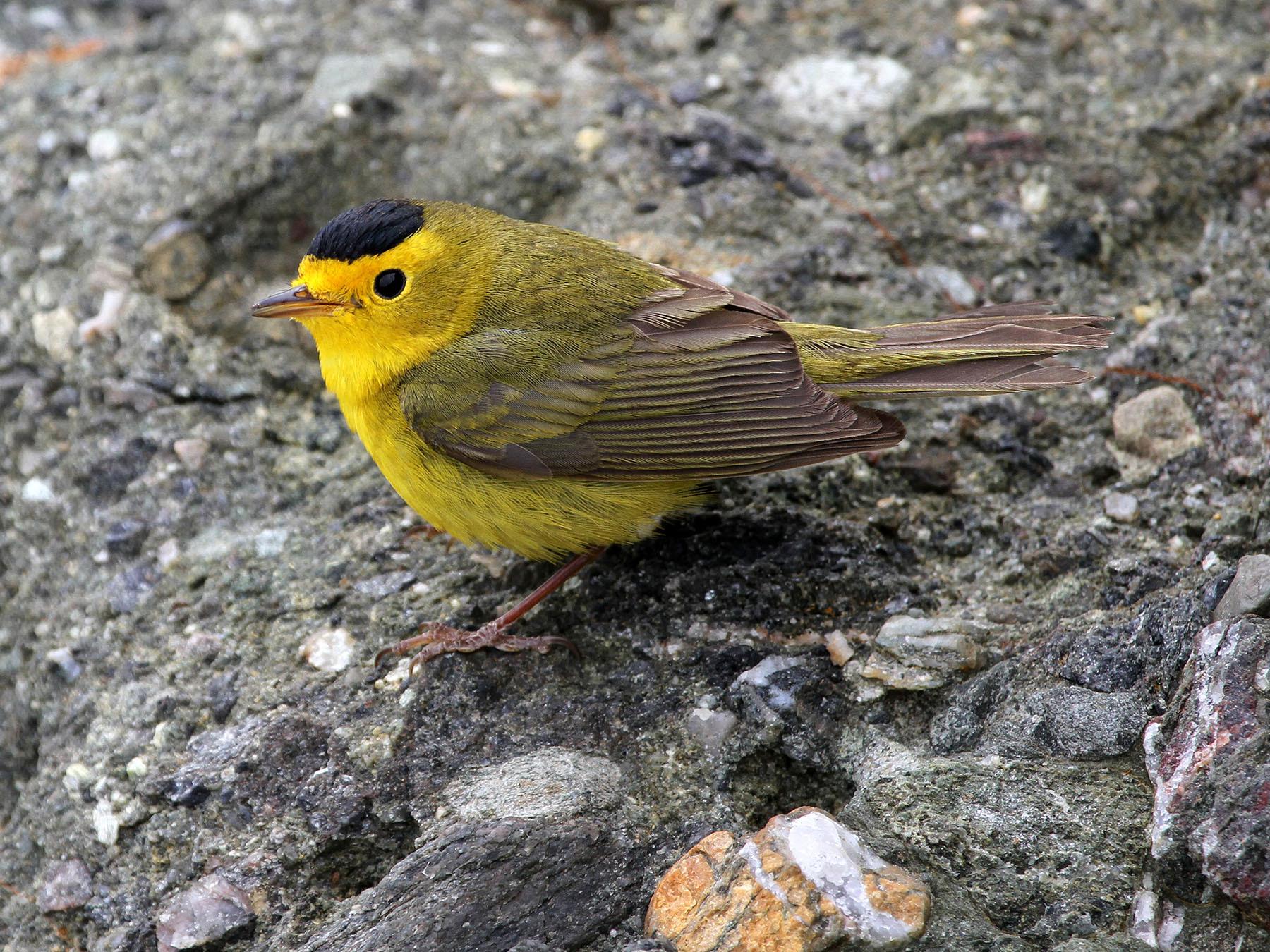
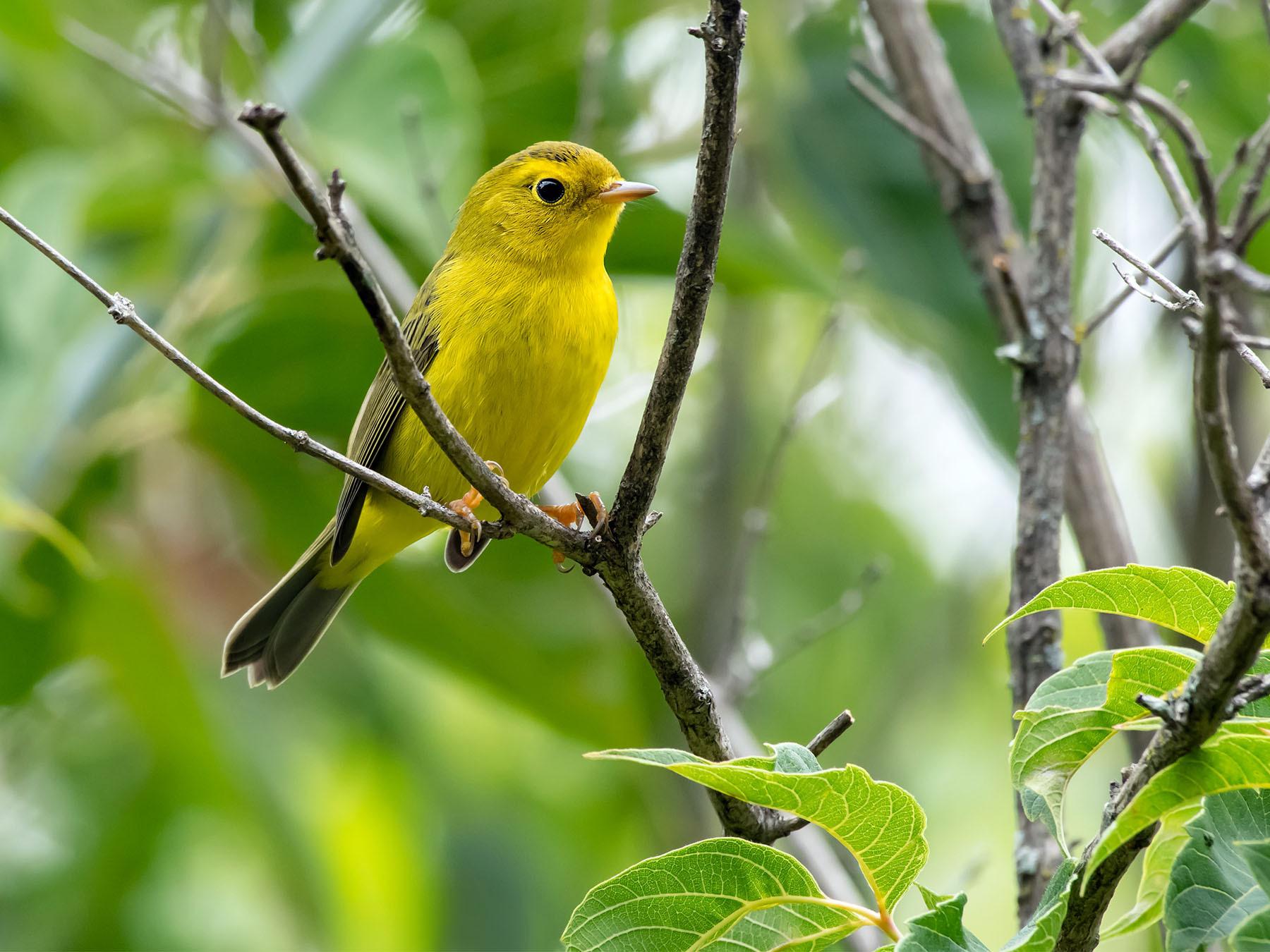
This is a plain bird in two colors: olive-green on the back, wings and tail, and bright yellow on the face and underparts, with no wing bars and no spots in the tail. The male adds a neat, glossy black cap, the mark most people remember.
Up close, look for the dark eye standing out on a plain yellow face, a short bill and a fairly long, rounded tail. It is round-bodied and large-headed for its size. It rarely keeps still: it hops from twig to twig low in shrubs, flicks its tail sideways and waves it, and flutters into the air after insects.
Color changes across the range. Pacific coast birds are the brightest, with an orange wash on the forehead and above and in front of the eye, and more extensive black caps. Eastern birds are the dullest: an olive wash on the face makes a yellow eye-ring show, and their black caps are limited.
Size and weight
It is 3.9–4.7 in (10–12 cm) long and weighs about 0.2–0.4 oz (5.4–10.5 g). Field guides differ on the wingspan: one gives 5.5–6.7 in (14–17 cm),1 another 6.7–7.5 in (17–19 cm).2 It is among the smallest warblers in the US and the smallest in Canada, bigger than a Ruby-crowned Kinglet but smaller than a Common Yellowthroat.
Male, female and young birds
The adult male's black cap is sharply edged and set off by a yellow forehead. He looks much the same all year, though in fall a few black crown feathers may have olive tips.
The adult female is duller overall, with olive cheeks, and her crown varies a great deal: it can be all olive, black heavily mottled with olive, or a full black cap. Where she has a cap, it is usually smaller than a male's. Even so, male and female cap sizes overlap in every population, so the cap alone cannot sex every bird, especially on the Pacific coast, where females carry the largest and blackest caps; interior females from the Rockies to Alaska have the smallest on average.3
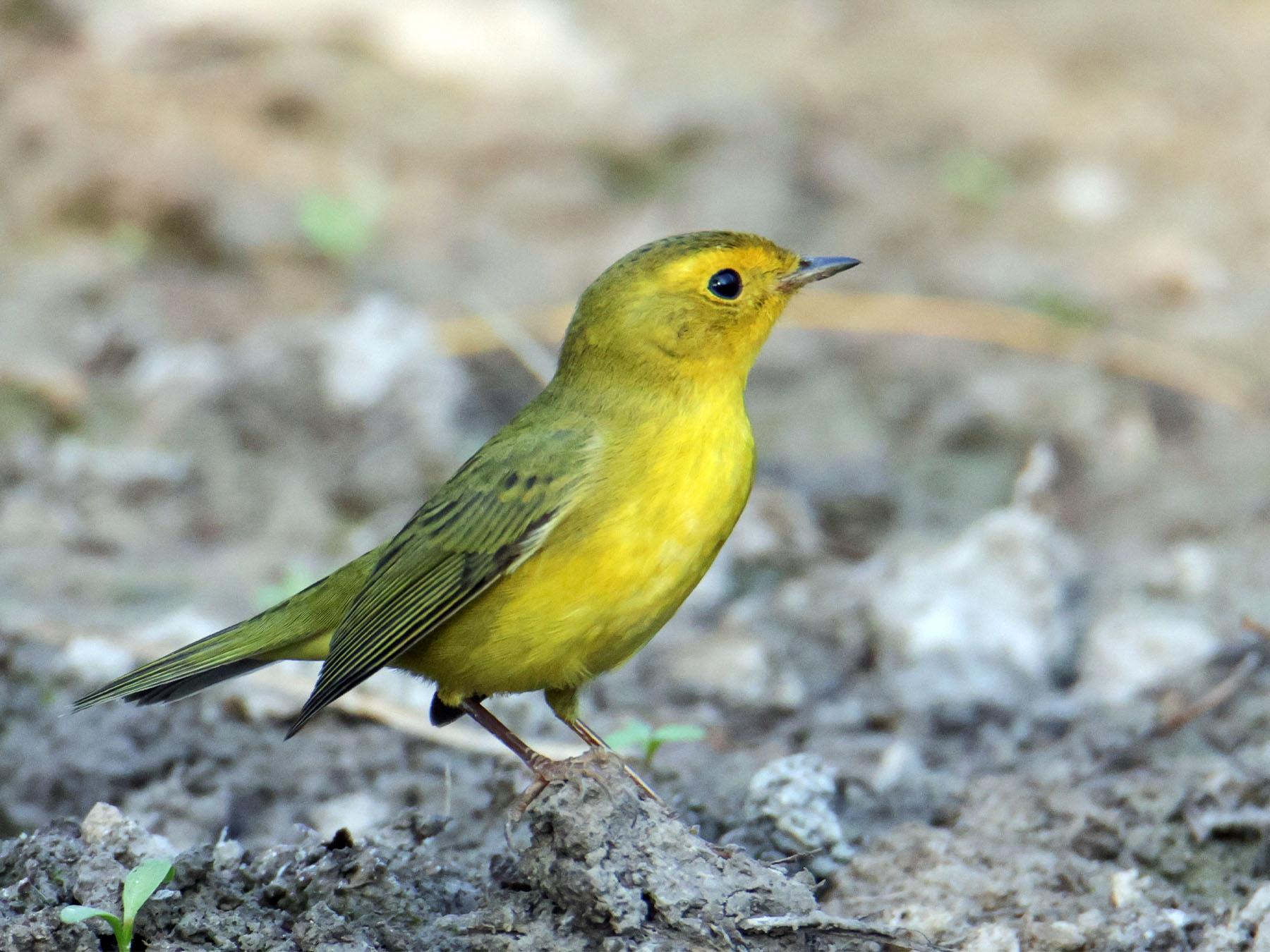
Young birds are duller than adults. In its first fall a young male has a black cap speckled with olive feather tips, which blurs its back edge. A young female has a dusky olive crown, almost never with any black, and a more olive forehead and face that make a yellow eye-ring stand out. About half of young females still show no black on the crown in their first spring.3
The juvenile is worn for only about a week, in and just out of the nest. It is brown above and dull yellow below, washed pale brown on the throat and flanks, with two faint buff wing bars that adults lack. So a dull, capless bird seen in fall is a female or a first-year bird, not a juvenile.
Identification: similar birds
A male, with his black cap on plain yellow and olive, is unlikely to be mistaken for any other warbler. Females and young birds without a cap are the problem.
A female or young Hooded Warbler is the likeliest confusion, and the tail is the best place to look. It is larger, with a bigger bill and white spots that flash in its fanned tail, and its plain yellow face is framed by an olive border; a female Wilson's has olive cheeks and no tail spots.
A young Northern Yellow Warbler also shows a dark eye on a yellow face, but it has yellow spots in the tail and pale edges to the wing feathers, both missing on Wilson's. It also has a shorter tail and waves it much less.
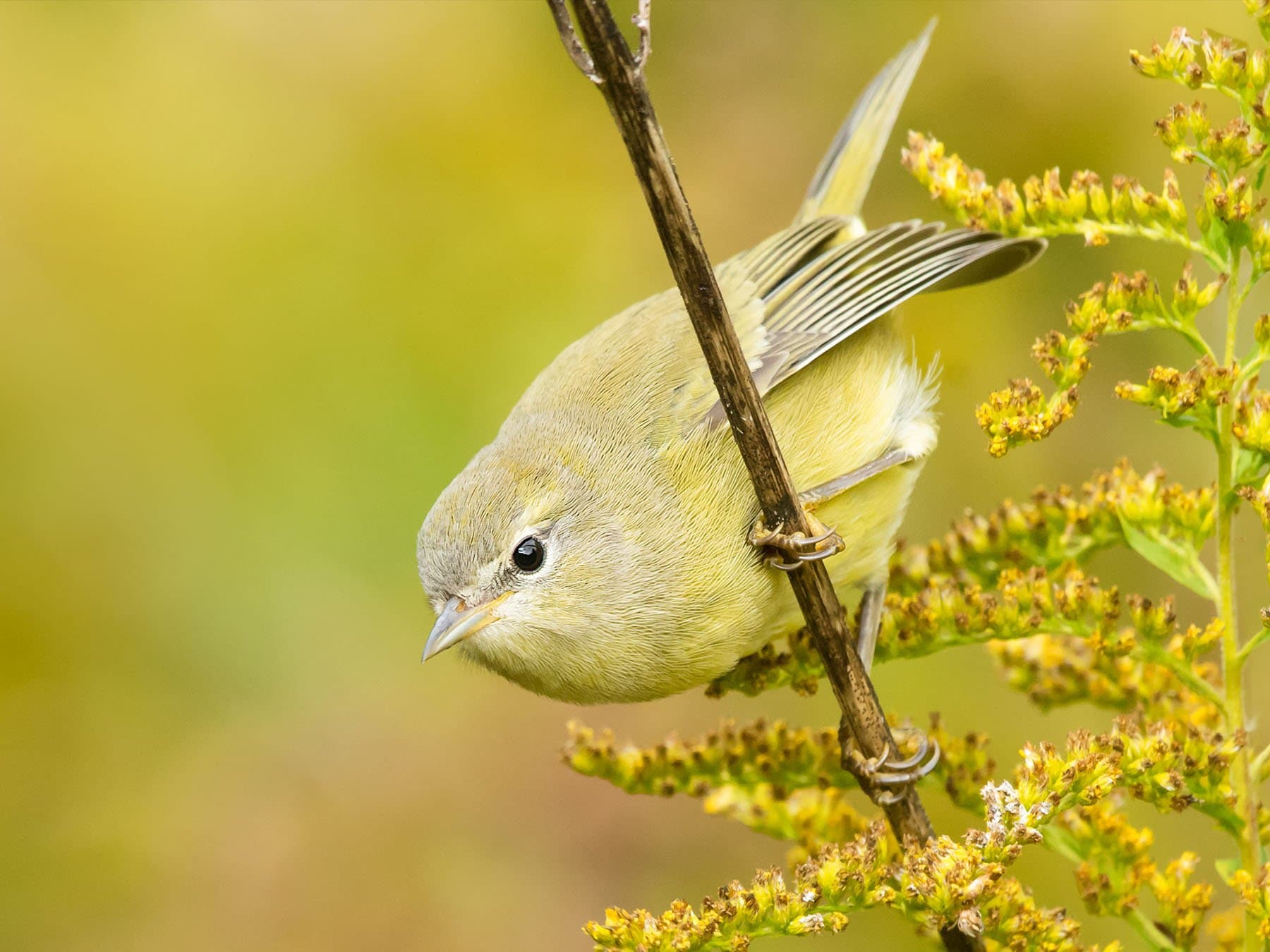
An Orange-crowned Warbler, especially a bright Pacific bird in fall, is drabber, with a dark line through the eye, often faint streaks below, a longer, more pointed bill and a shorter tail, and it moves and waves its tail less.
A juvenile Canada Warbler, in the same genus, can look like a juvenile Wilson's in its brief brown plumage and is best told by the adults with it. Older Canada Warblers are gray above, with a dark necklace and white under the tail.
Not sure it’s a Wilson's Warbler? Check your photo: Birdfact names the bird and shows the look-alike side by side.
Its size
Adults- Length
- 10–12 cm
- Wingspan
- 14–17 cm
- Weight
- 5.4–10.5 g
Its song and calls
The song is a rapid, chattering run of loud chips, about 4–15 notes long and averaging about 10, that drops in pitch toward the end. It is not especially musical.
Songs differ across the range. Eastern birds give a two-part song, the second half slightly lower and faster, while Rocky Mountain birds sing a shorter run of 4–7 even notes that grows louder. Each male usually sings one basic song, which a listener can often recognize.3
The call is a short chip, and descriptions of it differ: a dry, flat "djep" in one account,4 soft and nasal but ringing in another. In winter both sexes defend their territories with single call notes, and only rarely with song.3
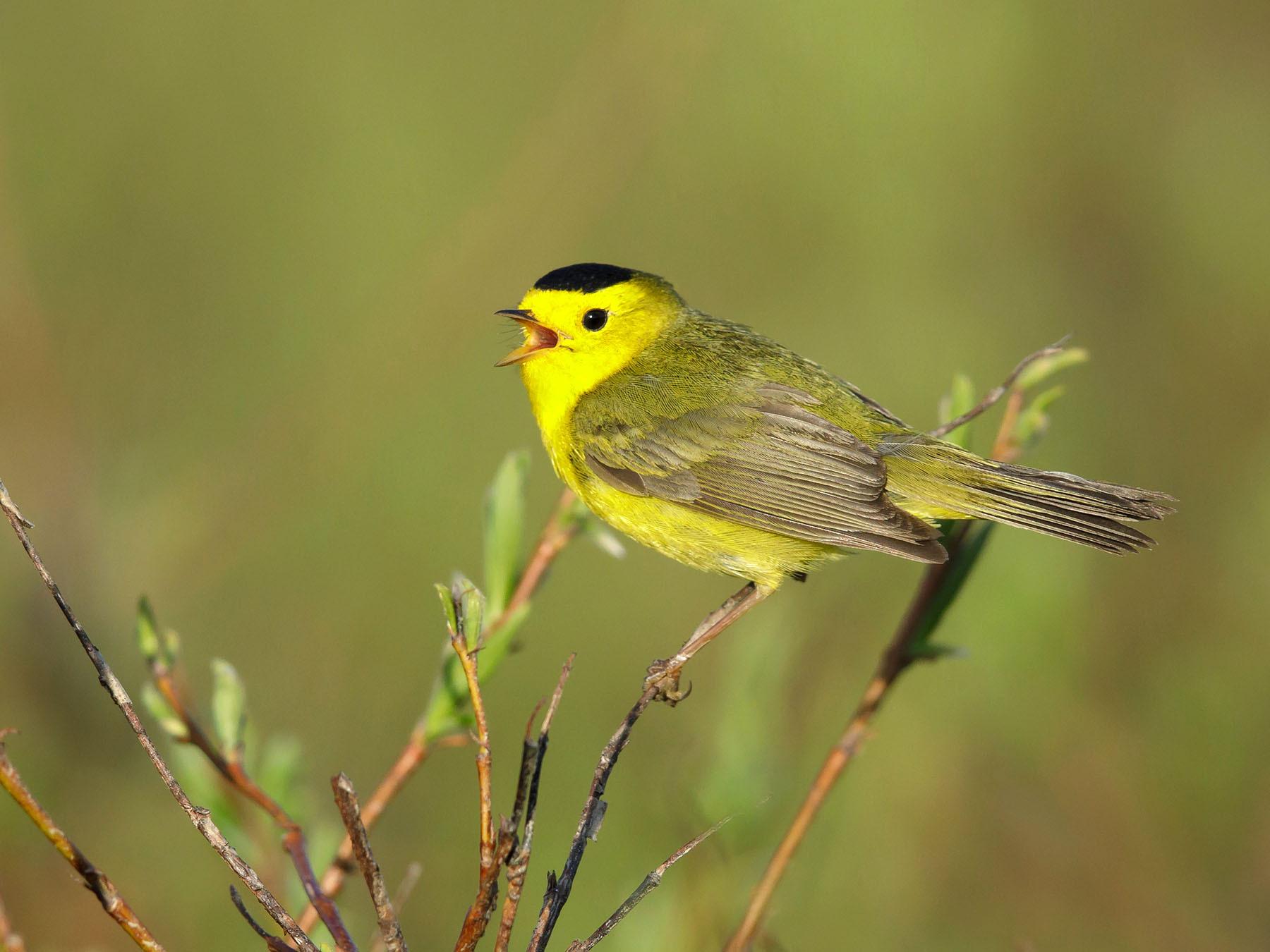
Males sing on the wintering grounds before they leave and on migration. In inner-coastal California, unmated males start singing persistently a few days after they arrive, and song falls away once they pair. Males in California showed no dawn chorus, unlike many wood-warblers: in one observer's data they sang 4–6 songs a minute both before and after sunrise.3
The handbook account, written in 1999, records female song once: a mated female in inner-coastal California in April 1996, whose song sounded nothing like a male's.3
- Song0:00 / 0:20
Recorded in Washington, United States · May 2025
- Song0:00 / 0:32
Recorded in California, United States · April 2020
- Call0:00 / 0:12
Recorded in Oregon, United States · July 2021
Heard one and not sure? Let the bird song identifier listen.
When and where to see it
November
Mostly absent
The year across North America
Choose a place on the map to see its year, or find yours.
Most recorded in November
Up to 1.2% of a place’s bird records that monthHere in other monthsThe way its records moved since last month
How this map is made
Each county, state or province is shaded by the Wilson's Warbler’s share of all the bird records there that month: the darker, the larger the share. A place with only a trace of records in a month is left unshaded. The arrow follows the middle of the bird’s records from last month to this one, and the faint line its path through the year: it shows where the records move, not any one bird’s route. Shades compare places on this map with each other, not one bird with another. Records: GBIF eBird Observation Dataset, 2019–2024. Map: Natural Earth; place centres © OpenStreetMap contributors.
How often the Wilson's Warbler turns up in the United States and Canada through the year, from birdwatchers' records.
United States
Summer visitor · regularly Mar–Jan · most records in September
Canada
Summer visitor · regularly Apr–Oct · most records in May
Show as a table
| Month | United States | Canada |
|---|---|---|
| January | 0.022% (regular) | 0.001% |
| February | 0.016% | <0.001% |
| March | 0.028% (regular) | <0.001% |
| April | 0.13% (regular) | 0.021% (regular) |
| May | 0.30% (regular) | 0.28% (regular) |
| June | 0.15% (regular) | 0.19% (regular) |
| July | 0.084% (regular) | 0.091% (regular) |
| August | 0.19% (regular) | 0.23% (regular) |
| September | 0.37% (regular) | 0.25% (regular) |
| October | 0.065% (regular) | 0.015% (regular) |
| November | 0.027% (regular) | 0.005% |
| December | 0.021% (regular) | 0.003% |
Worldwide: recorded regularly in 12 countries
Countries where it was recorded in at least 3 of the 6 years 2019–2024. Linked countries have their own bird list.
North America (12)
- Belize
- Canada
- Costa Rica
- Cuba
- El Salvador
- Guatemala
- Honduras
- Mexico
- Nicaragua
- Panama
- St Pierre & Miquelon
- United States
Data: EOD – eBird Observation Dataset (Cornell Lab of Ornithology), accessed via GBIF.org, CC BY 4.0. Records from 2019–2024, aggregated and filtered by Birdfact. How these lists are made
Wilson's Warbler breeds across Alaska and most of Canada, and south through the western mountains and along the Pacific coast. It spends the winter from Mexico to Panama. Every one of the lower 48 states sees it in spring and fall, so for many people migration is the best time to find it.
In the East it breeds south only to south-central Maine and northern New Hampshire, with small groups in Vermont, the Adirondacks and far northern Minnesota. In the West it breeds through the Rockies to the high mountains of west-central Colorado, above about 8,860 ft (2,700 m), and to central Utah and northern New Mexico. Along the coast it breeds south to Santa Barbara County and the mountains around Los Angeles. That is the range as the handbook mapped it in 1999. In the US it breeds most densely on the Washington, Oregon and California coast and in eastern Montana and the mountains of north-central Colorado.3
Look for it in wet shrub thickets: willows and alders along streams, the edges of beaver ponds, lakes and bogs, wet meadows and overgrown clearcuts, from sea level up to the alpine zone, to about 11,500 ft (3,500 m). Away from the Pacific coast it does not normally breed under a closed tree canopy. On the Pacific coast it also uses the shrubby understory of humid forest, young conifers, blackberry and coyote brush.
On migration it turns up in almost any shrubby place, especially streamside thickets, but also woodland, suburbs, farmland and desert scrub. It feeds lower than most warblers, which makes it easier to watch.
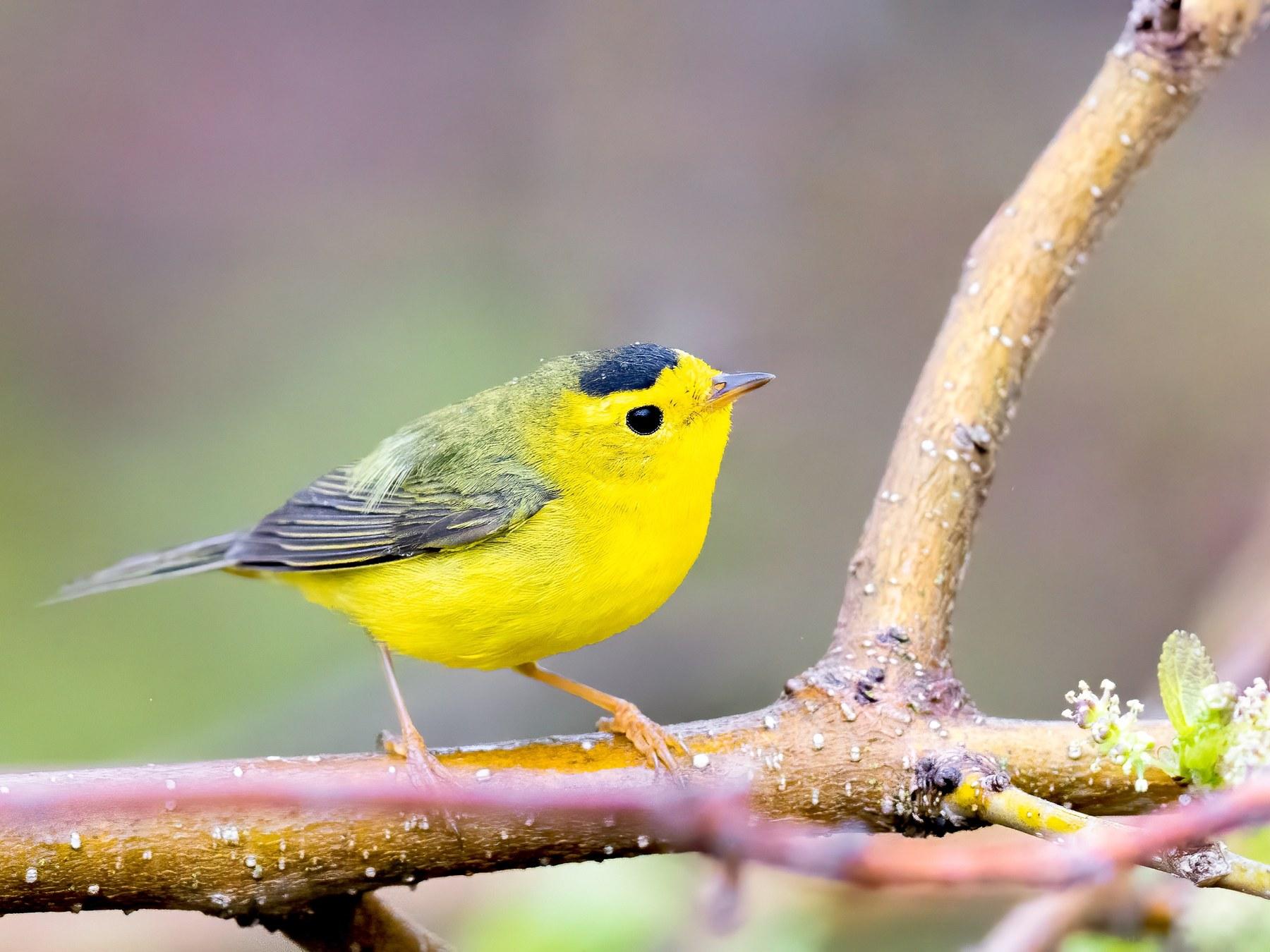
It winters from southern Baja California Sur, southern Sonora and Tamaulipas through Mexico and Central America as far as central Panama, mainly in the foothills and highlands in Costa Rica and Panama. It is one of the commonest wintering wood-warblers in Mexico. In the US it winters regularly in far southeastern Texas, on the upper Texas coast and in southern Louisiana, and in small numbers on the central and lower Texas coast and the California coast.
In winter almost any habitat will do, from tropical forest and cloud forest to pine-oak woods, mangrove undergrowth, thorn scrub, plantations and brushy fields, and it is one of the few migrant warblers regularly found in the high, treeless páramo.
It is very rare in Bermuda, the northern Bahamas, Cuba and Jamaica. The 1999 handbook text lists one bird that reached Cornwall, England, on 13 October 1985, and one reported from Greenland.3
Migration
It migrates at night, alone or in small groups. On the Pacific coast spring passage runs from mid-March to early June, peaking from mid-April to mid-May in southern California. In the East it is one of the later warblers back: passage peaks on 10–18 May in Missouri, 12–24 May in Ohio and in the last week of May in Massachusetts, and most eastern birds pass west of the Appalachians.3 Fall migration runs mainly from August to October and peaks in early September, and a few late birds stay on into midwinter north of the usual winter range.
In spring males pass through ahead of females, presumably so they can set up territories before the females arrive; studies on the west coast, along the middle Rio Grande and in Ontario show the pattern.3 At banding sites in Alaska, males passed the two northern sites ahead of females in spring, adult males and females passed at the same time in fall, and young birds went through before adults at all four sites.5
Populations also travel at different times. At a stopover site in southwestern Arizona, the earliest spring migrants were mostly bound for the West Coast, while later ones included many birds heading for Alaska and western Canada.6 Isotope and genetic studies suggest a leapfrog pattern in the western part of the range, with birds that breed farthest north wintering farthest south.7, 8 Coastal western breeders appear to winter in western Mexico, and western birds from farther inland and higher up in eastern Mexico.8
Accounts differ on eastern birds. One guide says eastern Canadian birds winter mostly on the Yucatán Peninsula;1 the 1999 handbook text places the eastern subspecies on the Atlantic slope from Tamaulipas to northern Costa Rica and calls its status in the Yucatán unclear.3
Tips for seeing it
What it eats
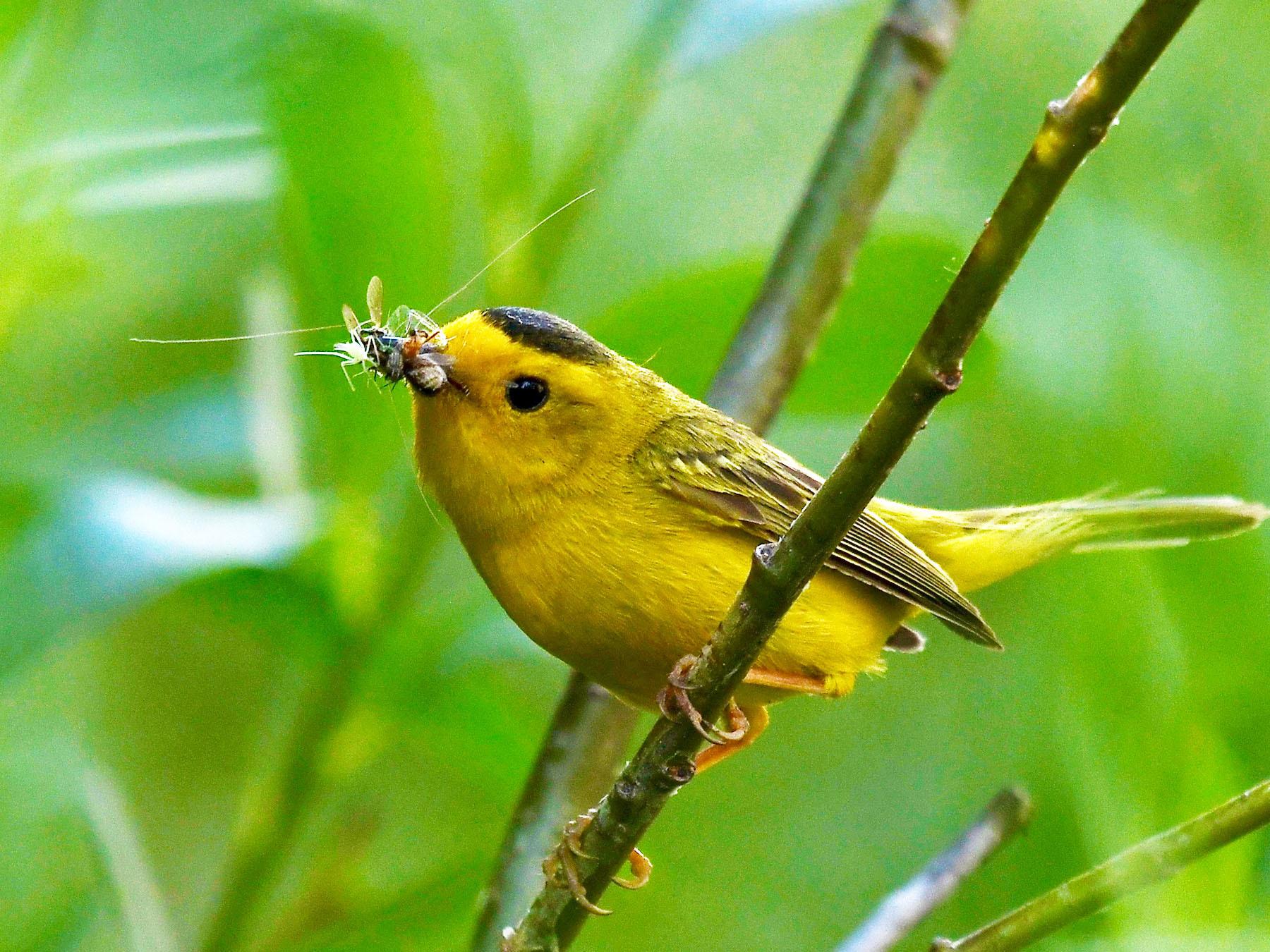
Wilson's Warbler eats mainly insects and spiders, both adults and larvae: bees and wasps, flies, mayflies, beetles and caterpillars. It occasionally eats berries, and on its wintering grounds, in oak woodland, it takes sweet honeydew from scale insects. It does not visit feeders; native trees and shrubs give passing migrants food and cover.
It feeds mostly low in shrubs, picking insects off leaves and twigs, hovering to take them from foliage and flying out to catch them in midair, and it rarely feeds on the ground. In a Rocky Mountains study, gleaning made up 75% of 427 foraging observations, hovering 15% and sallying out 10%.3
Nesting and breeding
Most Wilson's Warblers nest on the ground, the nest sunk into moss or sedge at the base of a shrub or under grass, often in a wet meadow or beside a bog. Pacific lowland birds are the exception: they build mostly in shrubs, blackberry or sword fern, and 274 of 281 nests in coastal California and Oregon were off the ground, at an average height of 5.6 ft (1.7 m).3
The female builds the nest alone, a bulky open cup of leaves and sedge with an outer layer of stems and moss, lined with fine grass and hair.
Eggs and young
A clutch is usually 4 eggs, but anywhere from 2 to 7. Clutches average smaller on the Pacific coast (3.9 eggs) than inland and in the East (4.4–4.5) or in Alaska (5.3).3 The eggs are white or creamy, finely speckled reddish-brown, often in a ring at the large end. The female incubates alone for about 11–13 days.
Both parents feed the young, which leave the nest 9–11 days after hatching and cannot fly for a few hours to a day. In inner-coastal California, where late-season broods are tended by the female alone, young were still being fed 24–25 days after leaving the nest, and in a Marin County study they mostly fed themselves about a month after fledging.3
The earliest first eggs are laid about 12 April in inner-coastal California, 20 May in Alaska, in early June in Maine, New Brunswick and Colorado, and in mid-June in the high Sierra Nevada.3 At high elevations a pair raises one brood a season, while in coastal California pairs readily nest again after a failure and some raise a second brood.
Cowbirds and nest success
The Brown-headed Cowbird is its only known brood parasite. Parasitism is generally uncommon, at 0–3% in Colorado studies, but it can be high locally in coastal California: 6 of 11 nests in Santa Barbara and San Luis Obispo counties and 21 of 49 in Marin County held cowbird eggs.3 The handbook judges the overall effect on the species probably small.3
Nests do much worse in Pacific lowland populations, where 15–33% succeed, than in the mountains, where most studies found over 70%, and predators cause most failures.3 In a northern California study in 1997–2000, cowbirds laid in 30 of 90 nests, only 16 of the 90 produced young, and predators caused 73% of failures.9
Behaviour
Wilson's Warbler is a busy bird. It hops restlessly from perch to perch, flicks and waves its tail, and flies with quick wingbeats, usually in a direct line. Outside the pair and family it is mostly solitary. In winter many hold territories, some wander without one, and others join mixed flocks of other birds.
Males defend breeding territories of about 0.5–1.5 acres (0.2–0.6 ha) in most California and Colorado studies; on the wintering grounds both sexes hold territories, some for up to 148 days, and banded birds have come back to the same winter sites in later years.3
Most pairs are socially monogamous, but that varies by place. Studies over several years in coastal California and Colorado found no clear polygyny, in which a male has more than one mate, while in a four-year Sierra Nevada study 59% of males had one mate, 26% had more than one and 15% had none.3
Year-old birds can breed, but year-old males seem to do poorly: in northern Colorado they held only 2 of 37 territories, and neither attracted a mate.3 At a central California site, nearly all the birds that came back early and set up territories were older birds. A second wave arrived 3–5 weeks later and held no territories at first; no male from that wave ever did, though some of its females later replaced the mates of earlier males.10
Lifespan and predators
The oldest Wilson's Warbler on record was at least 8 years 11 months old: a male banded in California on 28 May 2000, when he had hatched in 1999 or earlier, and caught and released alive in California on 8 May 2008.11
We found no source that gives a typical lifespan in years. In a coastal California population, about 50% of breeding adults were estimated to survive from one year to the next, from 18 years of catching and banding in the breeding season.12 Males usually return to the same or a neighboring territory, and females less often. In a Sierra Nevada study 8 of 9 males returned but only 3 of 8 females; very few young come back to where they hatched, 2.1% of 2,289 in Marin County and 3% of 214 in central Colorado.3
Predators and dangers
Domestic cats and ridge-nosed rattlesnakes are known to take adults, and small hawks, weasels, snakes, jays and mammals that hunt at night are likely predators. The 1999 handbook account had no firm evidence of which animals take the nests. Banding recoveries suggest cats may cause many adult deaths, especially at migration stopovers: they accounted for 5 of 15 recorded deaths.3
Conservation
Wilson's Warbler is still common, but it is declining. The IUCN Red List rates it Least Concern (2021).13 Partners in Flight estimates about 81 million breeding-age birds, for a population year around 2010.14 About 42 million of them (51%) breed in Canada. Another 35 million breed in Alaska and pass through Canada on migration, so 95% of the population passes through the country.15
The North American Breeding Bird Survey shows a clear long-term decline of 1.91% a year from 1966 to 2025 across the survey area, with a 95% credible interval of −2.69 to −1.30. Counts fell from 3.03 birds a route in 1966 to 0.97 in 2025, about two-thirds lower, and the fall has steepened to 3.72% a year from 2015 to 2025.16 The declines are clearest in British Columbia, the Pacific coast states, the Northern Rockies and Colorado, while Alaska, Alberta and the northwest interior forest show no clear change.16
The State of Canada's Birds rates the Canadian trend a moderate decrease, with medium confidence because the survey covers the north poorly. It also reports a rise over the past decade,15 which the 2025 survey release does not show.16
Loss of streamside (riparian) habitat in the West is likely among the leading causes of the decline, and in southern California large breeding populations were lost within historic times to riparian habitat loss, urban growth and possibly cowbird parasitism.3 On its breeding grounds it was scarcer in clearcuts up to 10 years old, and commoner in 11–20-year-old clearcuts, than in uncut forest; in one Oregon study numbers fell after herbicide spraying, and a review links heavy cattle grazing with lower numbers.3
Winter matters too. A population model for western birds over 1992–2008 found that drought on the northwest Mexican wintering grounds strongly predicted adult survival of coastal California and Sierra Nevada birds, though adult survival played a relatively minor role in year-to-year change.17
A genomic study of 1,626 samples found distinct breeding groups at fine scales, and later work names six.18, 19 A 2020 model built on those groups points two ways: to keep the most vulnerable lineages, protect the California Sierra, Basin Rockies or Coastal California breeding areas, or western Mexico; to protect the most birds, protect the Pacific Northwest or Central America.20 The handbook account, written in 1999, notes no conservation measures aimed at this species and says protecting and restoring native streamside habitat will likely be key.3
Legal status
In the United States, Wilson's Warbler is on the federal list of birds protected under the Migratory Bird Treaty Act.21 The Act makes it unlawful to take, capture, kill or possess such birds, among other acts, except as its regulations permit.22 It has no Endangered Species Act status.23
In Canada it is protected under the Migratory Birds Convention Act, 1994, whose schedule names warblers among the migratory insectivorous birds, with no open season at any time of year,24 and it is named on the Government of Canada's list of birds the Act protects.25 The Migratory Birds Regulations, 2022 forbid capturing, killing, injuring or harassing the birds and destroying or disturbing their eggs or nests, unless a permit or the Regulations allow it. As the species is not listed in the Regulations' Schedule 1, the nest clause covers its nests while they hold a live bird or viable egg.26 We found no listing under Canada's Species at Risk Act, though we did not search the registry itself.
Similar birds
Often mistaken for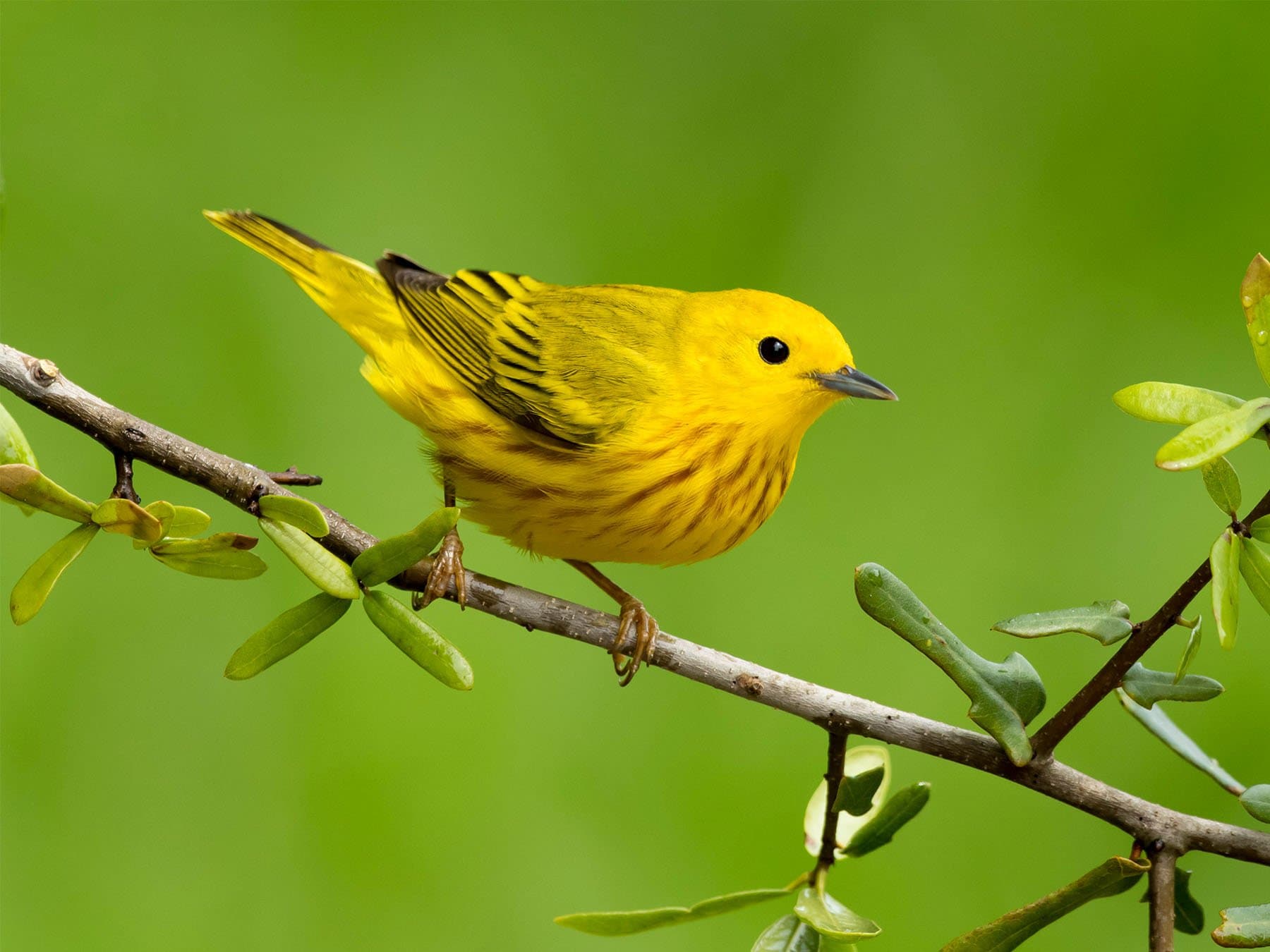
Quick facts
- Length
- 10–12 cm
- Wingspan
- 14–17 cm
- Weight
- 5.4–10.5 g
- Lifespan
- oldest recorded 8 years 11 months
- Family
- New World Warblers
- Migration
- Long-distance Migrant
- Global status (IUCN)
- Least Concern
- World population
- About 81 million breeding-age birds (Partners in Flight, around 2010)
- Population trend
- Breeding Bird Survey counts have fallen by about 1.9% a year since 1966, roughly two-thirds in all, and the decline has been steeper in the last decade; losses are clearest along the Pacific coast and in the Rockies, while Alaska shows no clear change
- Scientific name
- Cardellina pusilla
Questions
3Who was Wilson's Warbler named after?
Its English name carries the name of Alexander Wilson, the naturalist often called the father of American ornithology. He described the bird in 1811 as Muscicapa pusilla, in a flycatcher genus, and called it the "green black-capt flycatcher."1 Older books called it the Black-capped Green Warbler, and western birds the Pileolated Warbler.27
Is Wilson's Warbler being renamed?
On 1 November 2023 the American Ornithological Society committed to changing the English names of birds in its area that are named directly after people, starting with species found mainly in the US or Canada.28 As of November 2026, every list we read still uses the name Wilson's Warbler, and we found no new name or date for a change.
What is its scientific name?
Cardellina pusilla. It was long placed in the genus Wilsonia, until a 2010 study of wood-warbler relationships showed that genus was not a natural group. In 2011 Wilson's and Canada Warblers were moved into Cardellina, which also holds the Red-faced, Red and Pink-headed Warblers.3 There are three subspecies: pusilla in the East, pileolata from Alaska through the Rockies, and chryseola on the Pacific coast.
Eastern and western breeders also differ genetically. One 2011 study estimated the two groups split about 2.3 million years ago, and its authors say they are likely cryptic species, a view a 2015 niche study supports.29, 30 None of the checklists we read splits them.
Sources
36- 1Cornell Lab of Ornithology. Wilson's Warbler: Overview, Identification and Life History. All About Birds. Accessed 28 November 2026. Source (opens in a new tab)
- 2National Audubon Society and Kaufman, K.. Wilson's Warbler. Audubon Guide to North American Birds. Accessed 28 November 2026. Source (opens in a new tab)
- 3Ammon, E. M. and Gilbert, W. M. (2020). Wilson's Warbler (Cardellina pusilla), version 1.0. Birds of the World (P. G. Rodewald, editor). Cornell Lab of Ornithology. doi:10.2173/bow.wlswar.01 (opens in a new tab)
- 4Valdez-Juárez, S. O. et al. (2025). Northern Yellow Warbler (Setophaga aestiva), version 1.1: Identification. Birds of the World (S. M. Billerman, editor). Cornell Lab of Ornithology. doi:10.2173/bow.yelwar1.01.1 (opens in a new tab)
- 5Benson, A.-M. et al. (2006). Differential timing of Wilson's Warbler migration in Alaska. The Wilson Journal of Ornithology 118(4): 547-551. doi:10.1676/05-085.1 (opens in a new tab)
- 6Paxton, K. L., Yau, M., Moore, F. R. and Irwin, D. E. (2013). Differential migratory timing of western populations of Wilson's Warbler (Cardellina pusilla) revealed by mitochondrial DNA and stable isotopes. The Auk 130(4): 689-698. doi:10.1525/auk.2013.13107 (opens in a new tab)
- 7Kelly, J. F., Atudorei, V., Sharp, Z. D. and Finch, D. M. (2002). Insights into Wilson's Warbler migration from analyses of hydrogen stable-isotope ratios. Oecologia 130(2): 216-221. doi:10.1007/s004420100789 (opens in a new tab)
- 8Clegg, S. M., Kelly, J. F., Kimura, M. and Smith, T. B. (2003). Combining genetic markers and stable isotopes to reveal population connectivity and migration patterns in a Neotropical migrant, Wilson's warbler (Wilsonia pusilla). Molecular Ecology 12(4): 819-830. doi:10.1046/j.1365-294x.2003.01757.x (opens in a new tab)
- 9Michaud, J. C., Gardali, T., Nur, N. and Girman, D. J. (2004). Effects of nest predation and brood parasitism on population viability of Wilson's Warblers in coastal California. The Wilson Bulletin 116(1): 41-47. doi:10.1676/03-062 (opens in a new tab)
- 10Gilbert, W. M. (2024). Territorial and Non-Territorial Subpopulations of Wilson's Warblers Return to Central California Breeding Grounds in Two Migratory Waves. Ecology and Evolution 14(12): e70672. doi:10.1002/ece3.70672 (opens in a new tab)
- 11USGS Bird Banding Laboratory. Longevity records, AOU 6850 (current and historical tables). U.S. Geological Survey, Eastern Ecological Science Center. Accessed 28 November 2026. Source (opens in a new tab)
- 12Chase, M. K., Nur, N. and Geupel, G. R. (1997). Survival, productivity, and abundance in a Wilson's Warbler population. The Auk 114(3): 354-366. doi:10.2307/4089238 (opens in a new tab)
- 13BirdLife International (2021). Cardellina pusilla. The IUCN Red List of Threatened Species 2021 (via GBIF's copy of the IUCN checklist). IUCN Red List / GBIF. doi:10.2305/IUCN.UK.2021-3.RLTS.T22721879A137211627.en (opens in a new tab)
- 14Partners in Flight (2024). Avian Conservation Assessment Database, Global (version 2024.05.23). Partners in Flight. Accessed 28 November 2026. Source (opens in a new tab)
- 15Environment and Climate Change Canada and Birds Canada (2024). The State of Canada's Birds - Wilson's Warbler. NatureCounts, Birds Canada (Internet Archive capture of 19 Mar 2025). Accessed 28 November 2026. Source (opens in a new tab)
- 16Hostetler, J. A. et al. (2026). The North American Breeding Bird Survey, Analysis Results 1966 - 2025. U.S. Geological Survey. doi:10.5066/P1OSNSFC (opens in a new tab)
- 17Saracco, J. F. and Rubenstein, M. (2020). Integrating broad-scale data to assess demographic and climatic contributions to population change in a declining songbird. Ecology and Evolution 10(4): 1804-1816. doi:10.1002/ece3.5975 (opens in a new tab)
- 18Ruegg, K. C., Anderson, E. C., Paxton, K. L., Apkenas, V., Lao, S., Siegel, R. B., DeSante, D. F., Moore, F. et al. (2014). Mapping migration in a songbird using high-resolution genetic markers. Molecular Ecology 23(23): 5726-5739. doi:10.1111/mec.12977 (opens in a new tab)
- 19Rodríguez Otero, G. et al. (2026). Climatic niche variation in genetically distinct populations throughout the annual cycle for a migratory parulid bird, Cardellina pusilla. PeerJ 14: e21540. doi:10.7717/peerj.21540 (opens in a new tab)
- 20Ruegg, K. C. et al. (2020). A genoscape-network model for conservation prioritization in a migratory bird. Conservation Biology 34(6): 1482-1491. doi:10.1111/cobi.13536 (opens in a new tab)
- 21U.S. Fish and Wildlife Service (2023). 50 CFR 10.13, List of Migratory Birds. Electronic Code of Federal Regulations (issue of 2026-11-17). Accessed 28 November 2026. Source (opens in a new tab)
- 22United States Congress (1918). 16 U.S.C. 703, Taking, killing, or possessing migratory birds unlawful. United States Code (Cornell LII copy). Accessed 28 November 2026. Source (opens in a new tab)
- 23U.S. Fish and Wildlife Service. ECOS species report, scientific name 'Cardellina pusilla'. Environmental Conservation Online System. Accessed 28 November 2026. Source (opens in a new tab)
- 24Parliament of Canada (1994). Migratory Birds Convention Act, 1994 (S.C. 1994, c. 22). Justice Laws Website (current to 2026-11-12). Accessed 28 November 2026. Source (opens in a new tab)
- 25Environment and Climate Change Canada. Birds protected in Canada under the Migratory Birds Convention Act, 1994 (partial list). Government of Canada (Internet Archive copy of 4 Oct 2026). Accessed 28 November 2026. Source (opens in a new tab)
- 26Government of Canada (2022). Migratory Birds Regulations, 2022 (SOR/2022-105). Justice Laws Website (current to 2026-11-12). Accessed 28 November 2026. Source (opens in a new tab)
- 27Bent, A. C. (1953). Life Histories of North American Wood Warblers (quoted old names only). Bulletin of the United States National Museum 203 (Project Gutenberg #40100). Accessed 28 November 2026. Source (opens in a new tab)
- 28American Ornithological Society. English Common Names Pilot Project. American Ornithological Society. Accessed 28 November 2026. Source (opens in a new tab)
- 29Irwin, D. E., Irwin, J. H. and Smith, T. B. (2011). Genetic variation and seasonal migratory connectivity in Wilson's warblers (Wilsonia pusilla): species-level differences in nuclear DNA between western and eastern populations. Molecular Ecology 20(15): 3102-3115. doi:10.1111/j.1365-294x.2011.05159.x (opens in a new tab)
- 30Ruiz-Sánchez, A. et al. (2015). Ecological niche variation in the Wilson's warbler Cardellina pusilla complex. Journal of Avian Biology 46(5): 516-527. doi:10.1111/jav.00531 (opens in a new tab)
- 31NatureServe. Cardellina pusilla, Wilson's Warbler (ELEMENT_GLOBAL.2.100788). NatureServe Explorer. Accessed 28 November 2026. Source (opens in a new tab)
- 32Mumme, R. L., Chiver, I., Evans Ogden, L. J. and Stutchbury, B. J. (2023). Hooded Warbler (Setophaga citrina), version 2.0: Identification. Birds of the World (P. G. Rodewald, editor). Cornell Lab of Ornithology. doi:10.2173/bow.hoowar.02 (opens in a new tab)
- 33Gilbert, W. M., Sogge, M. K. and van Riper, C. (2020). Orange-crowned Warbler (Leiothlypis celata), version 1.0: Identification. Birds of the World (P. G. Rodewald, editor). Cornell Lab of Ornithology. doi:10.2173/bow.orcwar.01 (opens in a new tab)
- 34Reitsma, L. R., Hallworth, M. T., McMahon, M. and Conway, C. J. (2020). Canada Warbler (Cardellina canadensis), version 2.0: Identification. Birds of the World (P. G. Rodewald and B. K. Keeney, editors). Cornell Lab of Ornithology. doi:10.2173/bow.canwar.02 (opens in a new tab)
- 35AviList Core Team (2026). AviList: The Global Avian Checklist, v2025b. doi:10.2173/avilist.v2025b (opens in a new tab)
- 36Eisermann, K. and Schulz, U. (2005). Birds of a high-altitude cloud forest in Alta Verapaz, Guatemala. Revista de Biología Tropical 53(3-4): 577. doi:10.15517/rbt.v53i3-4.14672 (opens in a new tab)

Checked by
Nathan Cope, founder and editor
Nathan founded Birdfact and leads its writers and contributors in the UK, the US and Canada. He has watched and studied birds for more than ten years, and checks every article and species guide before it’s published.