Species Profile
Common Yellowthroat
Geothlypis trichas
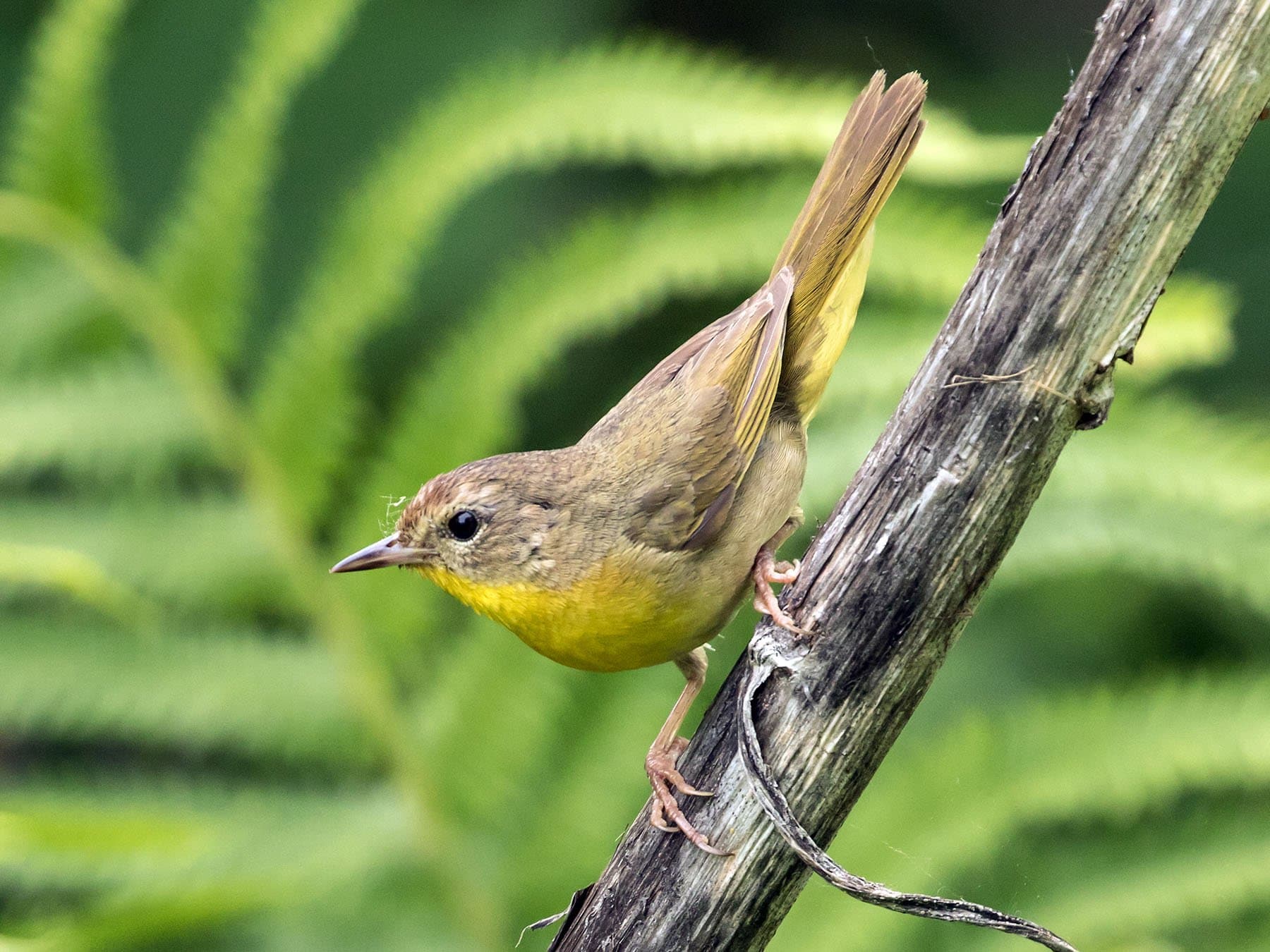
Common Yellowthroat perched on a weathered branch, looking left. Features yellow throat, olive back, and dark eye with green background.
Quick Facts
Conservation
LCLeast ConcernLifespan
1–3 years
Length
11–13 cm
Weight
7.6–15.5 g
Wingspan
15–19 cm
Migration
Partial migrant
The male Common Yellowthroat wears one of North American birdlife's most distinctive accessories: a bold black "bandit" mask stretching from forehead to neck, sharply edged in white and set against a blazing yellow throat. This small, skulking warbler is also one of the continent's most widespread — breeding in every US state and across Canada, from Pacific marshes to Atlantic reed-beds — and its rolling witchety-witchety-witchety song is the defining sound of summer wetlands.
Think you've spotted a Common Yellowthroat?
Upload a photo and we'll confirm it instantly
Confirm with a PhotoAppearance
The Common Yellowthroat is a small, chunky warbler — 11–13 cm long, with a wingspan of 15–19 cm and weighing 7.6–15.5 g — with a rounded head, plump belly, and a medium-length tail that it often cocks upward. The species is strongly sexually dimorphic, and the adult male is essentially unmistakable.
Males carry bright yellow on the throat, breast, and undertail coverts, with olive-brown upperparts across the back, wings, and tail, and a whitish belly. The defining feature is the broad black mask that sweeps from the forehead across the eyes and down the sides of the neck. This mask is sharply bordered above by a white or pale grey band that separates it from the olive crown, creating the impression of a highwayman's disguise. The bill is black; the legs are pinkish. Southwestern subspecies tend to be the most intensely yellow below, while eastern birds are slightly duller. The chapalensis subspecies around Lake Chapala, Mexico, is distinctive in having a larger black mask bordered by yellow rather than white or pale grey.
First-year males have a faint, patchy black mask that darkens progressively through their first winter, becoming fully developed by the following spring. They otherwise closely resemble adult males. Adults undergo a complete moult in autumn, so the mask is present year-round — there is no eclipse plumage.
Females lack the black mask entirely and are considerably plainer: olive-brown above, with a yellow throat and undertail coverts, a plain brownish face, and buff or pale yellow washes on the breast and flanks. Immature females are the dullest of all, with yellow largely restricted to the undertail coverts. The combination of yellow throat, olive-brown upperparts, and skulking marsh habitat is usually enough to identify a female, though confusion with other plain warblers is possible in autumn.
Identification & Characteristics
Male Colors
- Primary
- Yellow
- Secondary
- Olive
- Beak
- Black
- Legs
- Pink
Female Colors
- Primary
- Olive
- Secondary
- Yellow
- Beak
- Black
- Legs
- Pink
Male Markings
Bold black "bandit" mask from forehead across eyes and down sides of neck, sharply bordered above by white or pale grey; bright yellow throat, breast, and undertail coverts; olive-brown upperparts
Tail: Medium-length, slightly rounded tail; olive-brown; often cocked upward
Female Markings
Plain olive-brown face lacking any mask; yellow throat and undertail coverts; buff or pale yellow wash on breast and flanks; olive-brown upperparts
Tail: Medium-length, slightly rounded tail; olive-brown; often cocked upward
Attributes
Understanding Attributes
Rated 0–100 based on research and observation. A score of 50 is average across all bird species. These attributes are relative and don't necessarily indicate superiority.
Habitat & Distribution
Dense, low vegetation close to the ground is the one non-negotiable requirement for Common Yellowthroats — everything else is negotiable. They breed most abundantly in freshwater and saltwater marshes with cattails, bulrushes, sedges, and willows. They also colonise briars, moist brushy tangles along streams, overgrown fields, drainage ditches, and hedgerows — and further afield, orchards, dry upland pine forests, palmetto thickets, and burned-over oak scrub. They are habitat generalists compared to most warblers.
The breeding range covers virtually the entire continental United States and Canada, from southern Alaska east to Labrador and Newfoundland, and south through Mexico to the Yucatán Peninsula. An estimated 23% of the North American population breeds within the Boreal Forest. The species breeds in every US state, making it one of the most widespread warblers on the continent.
Year-round residents occur in parts of the southern US — the Gulf Coast states, Florida, coastal California, Arizona, and the Rio Grande delta in Texas. The sedentary Rio Grande subspecies (G. t. insperata) actively excludes migrant yellowthroats of other races from its territory. Wintering birds range across the southern United States, Mexico, Central America, the Caribbean, and occasionally into northern South America.
In the UK and Ireland, the Common Yellowthroat is a very rare vagrant — rated "Mega" by BirdGuides. The first British record was a bird on Lundy Island, Devon, in November 1954. Subsequent records include Fetlar, Shetland (June 1984); Bryher, Isles of Scilly (October 1984); Murston Gravel Pits, Kent (January–April 1989); Bardsey Island, Wales (September 1996); Unst, Shetland (May 1997); Isles of Scilly (October 1997); Foula, Shetland (October 2004); and Penryn, Cornwall (October 2006, found dead). The first Irish record was at Loop Head Lighthouse, Co. Clare, in October 2003. Most European records involve first-winter males in autumn, displaced westward by Atlantic storms during nocturnal migration. Vagrant records also exist from Iceland and the Azores.
Where to See This Bird
Explore regional guides for locations where this bird has been recorded.
United States
Montana
Georgia
Idaho
Iowa
Illinois
Nevada
Indiana
Nebraska
New Hampshire
Kentucky
Kansas
Massachusetts
Louisiana
Maryland
Maine
Michigan
New Mexico
Minnesota
Missouri
Alabama
Arkansas
Arizona
Mississippi
North Carolina
North Dakota
California
Colorado
Connecticut
District of Columbia
New Jersey
Delaware
Florida
New York
Ohio
Oklahoma
Oregon
Utah
South Carolina
Pennsylvania
Rhode Island
South Dakota
Virginia
Tennessee
Texas
Vermont
Washington
Wisconsin
West Virginia
Wyoming
Canada
Alberta
British Columbia
Manitoba
New Brunswick
Newfoundland and Labrador
Nova Scotia
Ontario
Quebec
Prince Edward Island
Yukon Territory
Saskatchewan
Diet
Common Yellowthroats are primarily insectivores, foraging on or near the ground by gleaning invertebrates from the surfaces of leaves, bark, branches, flowers, and fruit in low vegetation. Their prey list is broad: beetles, ants, termites, bees, wasps, grasshoppers, dragonflies, damselflies, mayflies, moths, butterflies, caterpillars and other larvae, flies, aphids, leafhoppers, cankerworms, and spiders all feature regularly.
Although gleaning while perched is their main technique, they occasionally hover briefly to take insects from foliage, or make short sallying flights to catch prey in mid-air. They also forage directly on the ground, particularly in damp areas where invertebrate activity is high. Like many small birds, they consume grit, which may aid digestion or provide minerals.
In winter, the diet shifts somewhat. Birds on their southern wintering grounds incorporate more fruit and seeds alongside insects — a pragmatic adjustment to seasonal changes in invertebrate availability. This dietary flexibility is part of what makes the species so widespread across such a range of habitats.
Their insectivorous habits make them sensitive indicators of wetland health. Pesticide use and poor water quality in marshes directly reduce the invertebrate prey base, and declines in local yellowthroat populations have been linked to agricultural intensification in wetland catchments.
Behaviour
Common Yellowthroats are secretive birds by nature, spending most of their time low in dense vegetation where they move with a mouse-like agility through stems and tangles. Despite this skulking tendency, males are conspicuous singers — they regularly perch atop tall marsh stalks or shrubs to deliver their song, and they respond vigorously to intruders in their territory.
Territories can be as small as 0.5 acres, and males defend them through persistent song and aggressive chasing. The black mask is central to this: experimental evidence shows that the mask alone is sufficient to trigger full territorial aggression in rival males, independent of any other cue.
Outside the breeding season, Common Yellowthroats are largely solitary. During migration, however, they may join loose mixed-species flocks moving through woodland edges and scrub. They are inquisitive birds and often respond to "pishing" sounds by popping briefly into the open — a useful trait for birdwatchers trying to get a view of an otherwise hidden individual.
Males sing more frequently when humans or potential predators enter their territories, and they approach the nest secretively through dense vegetation, departing by a different route to avoid leading predators to it. This combination of boldness in song and caution in movement is characteristic of the species.
Calls & Sounds
The male's song is one of the most recognisable sounds of North American wetlands. It is a loud, fast, rolling phrase typically rendered as witchety-witchety-witchety-witch or wichity-wichity-wichity — high and clear, with a rising and falling rhythm, lasting around two seconds and repeated persistently throughout the breeding season. Males sing from exposed perches atop tall marsh stalks or shrubs, and increase their singing rate when humans or potential predators enter the territory.
Separate from the territorial song is the flight song, performed during the courtship display: the male ascends 7.5–30 m into the air while uttering a jumble of high-pitched, varied notes, then drops back to a low perch while resuming the usual song. This aerial performance both attracts females and signals fitness to rival males.
The call note is a soft, husky jip or chip — described variously as a sharp chip, a full-sounding chuck, or a low, harsh note. Both sexes give this call, and it is a reliable cue for detecting birds hidden in dense vegetation. A rattle call is also documented. During nocturnal migration, birds give a thin, high flight call.
Females are less vocal than males but give chip calls and a rapid series of chips as part of the mating display — fluttering their wings and calling rapidly to signal readiness to mate. The species responds readily to pishing, making it more detectable than its secretive habits might suggest.
Flight
In flight, the Common Yellowthroat appears small, compact, and slightly round-winged — the short, rounded wings are characteristic of a short-distance migrant rather than a long-haul traveller. Flight is typically low and direct, with rapid wingbeats, and birds rarely travel far in the open before dropping back into cover. They are not aerial specialists and spend little time in sustained open flight during the breeding season.
During the male's courtship display, however, flight takes on a very different character: the bird ascends steeply 7.5–30 m into the air, singing a jumbled flight song, before dropping back down to a low perch. This display flight is bouncy and conspicuous — a deliberate contrast to the species' usual secretive movement.
During migration, Common Yellowthroats travel nocturnally, and their short, rounded wings make them vulnerable to being blown off course by Atlantic storms — which accounts for the vagrant records in the UK, Ireland, Iceland, and the Azores. Many individuals that winter in Central America cross the Gulf of Mexico during spring migration, a significant overwater journey for a bird of this size. At stopover sites such as Appledore Island, Maine, males arrive on average five days earlier than females and weigh more upon arrival, suggesting they fuel up more heavily before departure.
Nesting & Breeding
The breeding season runs from approximately April to July, varying by latitude. Males arrive on the breeding grounds one to two weeks before females and immediately begin establishing territories through song and aggressive chasing. The female alone selects the nest site and builds the nest, typically over 4–5 days.
Nests are placed on or near the ground — usually less than 1 m up — supported by sedges, grasses, reeds, cattails, briars, or other low plants. The nest is a bulky, open cup constructed from dead leaves, coarse grass, weed stems, sedges, bark, and ferns, lined with fine grass, bark fibres, hair, and rootlets. The outer cup averages 8.9 cm wide and 7.6 cm deep; the inner cup averages 5.6 cm wide and 4.6 cm deep. Occasionally the nest has a partial roof of loosely attached material, giving it a passing resemblance to an Ovenbird's nest. In marshy areas, nests are placed slightly higher off the ground to avoid flooding.
Clutch size is typically 3–5 eggs (range 1–6), creamy white with markings of grey, lilac, reddish-brown, or black concentrated at the larger end. Incubation is by the female only and lasts 12 days; the male feeds her on the nest during this period. Nestlings hatch helpless, with dark orange skin and wisps of grey down. Both parents feed the young, which leave the nest after 8–10 days. Young remain dependent on their parents for longer than most other warblers after fledging. Normally 1–2 broods per year.
Common Yellowthroats are among the most frequent victims of Brown-headed Cowbird (Molothrus ater) brood parasitism — one of the three most commonly parasitised hosts in North America. Females have evolved multiple counter-strategies: deserting a parasitised nest, building a new nest lining over cowbird eggs to bury them, or constructing a second or even third nest directly on top of a parasitised one. These multi-layered nest stacks entomb the cowbird eggs entirely. Other nest predators include snakes, mice, chipmunks, raccoons, skunks, and opossums.
Lifespan
Common Yellowthroats typically live 1–3 years in the wild, with many birds — particularly first-year individuals — failing to survive their first winter or first migratory journey. Annual survival rates are affected by predation, brood parasitism, collision mortality during nocturnal migration, and the energetic demands of crossing the Gulf of Mexico.
The maximum recorded lifespan is 11 years and 6 months, set by a bird recaptured during banding operations in Massachusetts in 2015. This is exceptional: reaching double figures is vanishingly rare for a warbler of this size, and the record underscores how much individual variation exists in survival. For comparison, the Prothonotary Warbler, a close relative in the same family, has a maximum recorded age of around 8.9 years.
Nest predation and Brown-headed Cowbird parasitism are significant sources of mortality at the breeding stage, reducing the number of young that successfully fledge each year. Birds that do survive to adulthood and establish territories have substantially better survival prospects than first-year birds. The species' high reproductive rate — up to two broods per year, with clutches of 3–5 eggs — compensates for these losses and sustains the large global population of approximately 77 million individuals.
Conservation
The Common Yellowthroat is listed as Least Concern on the IUCN Red List (2021), with a global population estimated at approximately 77 million mature individuals. Despite this healthy total, the species has been declining steadily: the North American Breeding Bird Survey recorded a fall of approximately 0.6% per year between 1966 and 2019, amounting to a cumulative decline of around 26%. Partners in Flight rates it 9 out of 20 on the Continental Concern Score, indicating low overall concern — but the headline figure masks more serious problems at the subspecies level.
The San Francisco Bay subspecies (G. t. sinuosa), known as the Salt Marsh Yellowthroat, has declined by an estimated 80–95% over the past century. Restricted to coastal and brackish wetlands around San Francisco and San Pablo Bays, California, it faces ongoing habitat loss and disturbance. The Rio Grande delta subspecies (G. t. insperata) was once thought to be extinct. Both local populations face potential extinction — a sobering reminder that a species can be globally abundant while individual populations collapse.
The primary threats across the range are wetland drainage and degradation, urbanisation, and conversion of wetland catchments to agricultural land. Brood parasitism by Brown-headed Cowbirds adds pressure during the breeding season. Pesticides and poor water quality reduce the invertebrate prey base in wetland habitats.
During nocturnal migration, collisions with communications towers, reflective buildings, and windows cause significant mortality. Climate change is also projected to affect the species' range (Audubon Society climate models), adding further long-term pressure.
The Common Yellowthroat is not the focus of specific targeted management, but benefits indirectly from wetland conservation programmes and waterfowl habitat management across North America.
Population
Estimated: Approximately 77 million mature individuals
Trend: Decreasing
Declining approximately 0.6% per year since 1966; cumulative decline of around 26% according to the North American Breeding Bird Survey (1966–2019).
Elevation
Lowlands to moderate elevations; primarily below 2,000 m
Additional Details
- Family:
- Parulidae (New World Warblers)
- Predators:
- Snakes, mice, chipmunks, raccoons, skunks, and opossums (nest predators); raptors (adults). Brown-headed Cowbird is a major brood parasite — one of the three most frequently parasitised hosts in North America.
- Subspecies:
- Approximately 13 recognised subspecies showing variation in yellow intensity, mask border colour, and size. Notable forms include sinuosa (Salt Marsh Yellowthroat, San Francisco Bay), insperata (Rio Grande delta, Texas), and chapalensis (Lake Chapala, Mexico — larger black mask bordered by yellow rather than white).
- First described:
- Formally described by Carl Linnaeus in 1766, based on a Maryland specimen collected and illustrated by George Edwards in 1758. Type locality restricted to Maryland by the AOU in 1931.
Courtship & Display
Male Common Yellowthroats arrive on the breeding grounds one to two weeks before females and immediately begin advertising their territories through song. When a female appears, the male's behaviour shifts into a more elaborate display: he flicks his wings and tail repeatedly, follows the female closely through the vegetation, and performs a distinctive flight display in which he ascends 7.5–30 m into the air while calling and singing a jumbled series of high-pitched notes, then drops back to a low perch to resume his territorial song.
The female signals her readiness to mate by fluttering her wings and giving a rapid series of chip notes. Common Yellowthroats are predominantly polygynous — one male may pair with multiple females in the same season — though some pairs are serially monogamous. Females are not entirely passive in mate choice: they may mate with neighbouring males behind their primary partner's back, and extra-pair paternity has been documented in the species.
The black mask plays a central role in male–male competition as well as mate attraction. Experimental evidence shows that mask size and intensity correlate with male dominance, and that females prefer males with larger, more symmetrical masks. The white border above the mask appears to enhance its visual contrast, making it more striking against the olive crown — a detail that may matter more than it looks to a casual observer.
Subspecies And Geographic Variation
The Common Yellowthroat is one of the most geographically variable warblers in North America, with around 13 recognised subspecies showing consistent differences in the intensity of yellow colouring, the width and border colour of the male's black mask, and overall size. The nominate subspecies (G. t. trichas) breeds in the eastern United States; southwestern forms such as G. t. chryseola are the brightest, with the most intensely yellow underparts.
Two subspecies face particularly serious conservation concerns. The Salt Marsh Yellowthroat (G. t. sinuosa) is restricted to coastal riparian, freshwater, and brackish wetlands around San Francisco Bay and San Pablo Bay in California. It has declined by an estimated 80–95% over the past century due to wetland loss and degradation, and remains at risk of local extinction. The US Fish & Wildlife Service monitors it as a species of conservation concern.
The Rio Grande delta subspecies (G. t. insperata) of south Texas was once thought to be extinct. It survives as a sedentary year-round resident in the Rio Grande delta, where it actively excludes migrant yellowthroats of other races from its territory during winter — an unusual behaviour that reflects its highly localised, non-migratory lifestyle. The chapalensis subspecies around Lake Chapala, Mexico, is visually distinctive: its black mask is both larger and bordered by yellow rather than the white or pale grey seen in other forms, giving the male a noticeably different facial pattern.
Birdwatching Tips
Marshes and wet scrub from late April onwards are the place to start. The male's witchety-witchety-witchety song carries well across open water and is often the first indication of the species' presence — learn it and you will realise how common this bird is in suitable habitat. Males regularly sing from exposed perches atop cattails or shrub tops, making them easier to see than most warblers.
For a view of the skulking female, try "pishing" — making a soft, repetitive pssh-pssh-pssh sound near dense vegetation. Common Yellowthroats are inquisitive and often pop briefly into the open to investigate. The male's chip call — a soft, husky jip — is also worth learning, as it frequently betrays birds hidden in thick cover.
In the US and Canada, virtually any freshwater marsh, wet meadow, or overgrown drainage ditch from coast to coast is worth checking during the breeding season (May–July). In the southern states, year-round residents are present in suitable habitat. During migration (August–October in autumn; February–May in spring), birds turn up in a much wider range of habitats including woodland edges, parks, and suburban gardens.
The male's black mask makes him unmistakable. Females can be confused with other plain warblers, but the combination of yellow throat, olive-brown upperparts, and low, dense habitat is usually diagnostic. In autumn, immature males show a partial, patchy mask — enough to confirm the species. In the UK and Ireland, any small warbler with a yellow throat in autumn coastal scrub deserves a very close look.
Did You Know?
- The mask is a weapon: When researchers placed a black paper mask on a stuffed female Common Yellowthroat, territorial males attacked it immediately as if it were a rival male — proving that the mask alone triggers aggression, with no other cues needed.
- An 11-year-old warbler: The oldest Common Yellowthroat on record was at least 11 years and 6 months old when recaptured during banding operations in Massachusetts in 2015, placing it among the longest-lived small warblers on record.
- One of the first New World birds described: Carl Linnaeus formally named the Common Yellowthroat in 1766, based on a Maryland specimen collected and illustrated by English naturalist George Edwards in 1758. The American Ornithologists' Union later formally restricted the type locality to Maryland in 1931, making it one of the earliest North American birds to receive a scientific name.
- The multi-layered nest stack: When a Brown-headed Cowbird lays in a Common Yellowthroat's nest, the female may build a second — or even third — nest directly on top, entombing the cowbird eggs in a stack of nest floors. It is among the more elaborate counter-strategies documented in North American warblers.
- The only warbler of the open marsh: The Common Yellowthroat is the only North American warbler that regularly nests in open reed-beds and cattail marshes — a habitat largely avoided by other members of the family Parulidae. This unique niche has allowed it to colonise practically every marsh from coast to coast.
Records & Accolades
The Bandit Mask
Most Distinctive Facial Marking
The male's bold black mask, sharply edged in white, is one of the most recognisable features of any North American warbler — and doubles as a social weapon that triggers immediate aggression in rival males.
Coast to Coast
Breeds in Every US State
The Common Yellowthroat breeds across virtually the entire continental United States and Canada — one of the most widespread warblers on the continent, with an estimated 77 million individuals.
Record Longevity
11 Years 6 Months
The oldest Common Yellowthroat on record was recaptured during banding in Massachusetts in 2015 — an extraordinary age for a warbler that typically lives just 1–3 years in the wild.
Community Photos
Be the first to share a photo of the Common Yellowthroat
Upload a PhotoIdentify Any Bird Instantly
- Upload a photo from your phone or camera
- Get an instant AI identification
- Ask follow-up questions about the bird
Monthly Birds in Your Area
- Personalised for your location
- Seasonal tips and garden advice
- Updated every month with new species