Species Profile
Swamp Sparrow
Melospiza georgiana
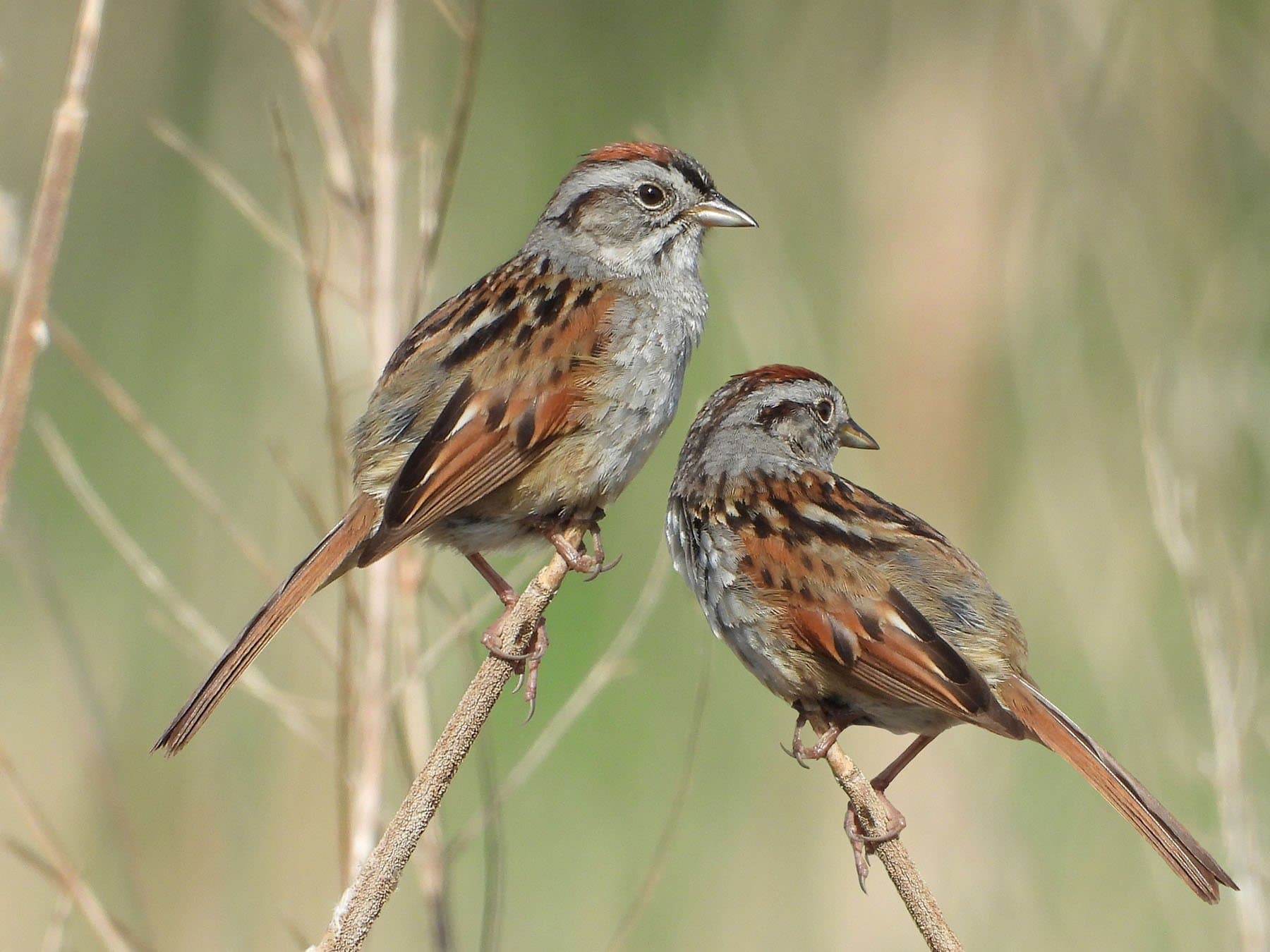
Swamp Sparrow perched on a thin branch, showing its reddish-brown cap, streaked back, and grayish underparts, with another sparrow nearby.
Quick Facts
Conservation
LCLeast ConcernLifespan
2–6 years
Length
12–15 cm
Weight
15–23 g
Wingspan
18–19 cm
Migration
Partial migrant
Lurking in the reeds of a cattail marsh, the Swamp Sparrow is more often heard than seen — its slow, sweet, monotone trill drifting across the water from well before dawn. What makes this stocky little bird genuinely extraordinary is its song: research published in Nature Communications found that Swamp Sparrows have been singing essentially the same syllable patterns for over 1,000 years, making their vocal traditions among the most stable cultural behaviours documented in any non-human animal.
Think you've spotted a Swamp Sparrow?
Upload a photo and we'll confirm it instantly
Confirm with a PhotoAppearance
The Swamp Sparrow is a compact, chunky bird with a short conical bill, rounded tail, and notably long legs — longer, proportionally, than those of either the Song Sparrow or Lincoln's Sparrow. In breeding plumage, the male's most eye-catching feature is a bright rufous crown, often lightly streaked with black and set off by a broad grey supercilium. A small blackish patch marks the forehead. The face is grey with a narrow dark brown eye-stripe behind the eye and a thin moustachial stripe framing the ear-coverts.
The upperparts are streaked rusty, buff, and black, with strikingly reddish-brown wings that catch the eye at distance. The lesser coverts are chestnut; the greater and median coverts are blackish with broad chestnut edges. The underparts are largely unstreaked: the breast is grey, the belly whitish, and the flanks washed with buff. The throat is clean white. The bill is dusky-grey with a flesh-coloured lower mandible; the legs are flesh-pink; the iris is dark reddish-brown.
In non-breeding plumage, the crown becomes duller and more heavily streaked with black, often showing a narrow pale grey median stripe. The ear-coverts are buffier. Juvenile birds are much buffier overall, with heavy black streaking on the crown, nape, breast, and flanks. First-year non-breeding birds resemble non-breeding adults but show little or no rufous on the crown and have a brownish or buffy-grey supercilium rather than a clean grey one.
Three subspecies are recognised. The nominate M. g. georgiana is the most widespread. M. g. ericrypta, breeding in Canada and northern Minnesota, is larger-bodied with paler upperparts and broader, whiter feather edgings. The 'Coastal Plain' subspecies M. g. nigrescens, breeding in tidal marshes from northern Virginia to the Hudson River Estuary, is distinctly darker — more blackish on the head and nape, with a larger bill and different songs — a striking example of rapid local adaptation despite close genetic similarity to inland relatives.
Identification & Characteristics
Male Colors
- Primary
- Rufous
- Secondary
- Grey
- Beak
- Dark Grey
- Legs
- Pink
Female Colors
- Primary
- Rufous
- Secondary
- Grey
- Beak
- Dark Grey
- Legs
- Pink
Male Markings
Bright rufous crown (breeding male); strikingly reddish-brown wings; unstreaked grey breast; clean white throat; broad grey supercilium
Tail: Moderately long, rounded; rufous-brown with pale buff feather edges
Female Markings
Similar to male but rufous crown less extensive and more heavily streaked with black; differences most apparent when pair is observed together; sexes largely indistinguishable in non-breeding plumage
Tail: As male
Attributes
Understanding Attributes
Rated 0–100 based on research and observation. A score of 50 is average across all bird species. These attributes are relative and don't necessarily indicate superiority.
Habitat & Distribution
Swamp Sparrows are strongly tied to wetlands during the breeding season. Their primary breeding habitat is freshwater marsh with good stands of cattails, sedges, rushes, or other tall emergent vegetation, often with thickets of alder or willow at the margins. They also breed in fens and bogs with patches of open water, peat bogs dotted with shrubs, and wet meadows. Nests are rarely placed more than 1.5 m above the ground or water surface.
The breeding range stretches across the northern United States and boreal Canada, from Newfoundland west to the eastern slopes of the Rockies. An estimated 79% of the entire North American population breeds within the Boreal Forest — making the health of that vast ecosystem directly relevant to this species' long-term future. The southern edge of the breeding range reaches northern Missouri, Ohio, Maryland, and Delaware. The distinct nigrescens subspecies breeds in tidal marshes from northern Virginia to the Hudson River Estuary in New York.
In winter, the species concentrates in the eastern United States, from Texas, the Gulf Coast, and Florida north to Iowa, the southern Great Lakes, and southern New England. Birds breeding in western Canada move eastward in autumn before heading south, rather than migrating directly southward. Small numbers winter in coastal marshes of the Carolinas. Vagrant individuals have been recorded as far west as California, Nevada, Utah, Arizona, and Alaska.
The species is most abundant at lower elevations: more than half of all birds breed below 500 m, and only around 10% breed between 1,000 and 1,250 m. During migration and winter, Swamp Sparrows are more flexible, using streamside thickets, rank weedy fields, and brushy areas near water — though they are almost always found close to a wetland even in the coldest months.
Where to See This Bird
Explore regional guides for locations where this bird has been recorded.
United States
Georgia
Iowa
Illinois
Indiana
Kentucky
Kansas
Louisiana
Massachusetts
Maryland
Michigan
Maine
New Jersey
Missouri
Mississippi
Minnesota
Alabama
Arkansas
North Carolina
District of Columbia
Connecticut
Florida
New Hampshire
Delaware
Ohio
New York
Oklahoma
Virginia
Rhode Island
Pennsylvania
South Carolina
Tennessee
Texas
Vermont
Wisconsin
Canada
Manitoba
New Brunswick
Newfoundland and Labrador
Nova Scotia
Northwest Territories
Ontario
Prince Edward Island
Quebec
Diet
The Swamp Sparrow is the most insectivorous species in its genus, and its diet shifts dramatically across the year. During the breeding season, animal matter makes up approximately 85–88% of the diet. By late summer and autumn, the balance reverses sharply, with seeds and other plant material accounting for 84–97% of intake. In winter, plant matter dominates at around 55%, with invertebrates making up the remainder.
Known invertebrate prey includes ants, bees, wasps, beetles, aphids, caterpillars, grasshoppers, crickets, and aquatic invertebrates such as moulting damselflies and dragonflies. Plant foods include blueberries and the seeds of sedges, foxtail grass, panic grass, swamp dock, smartweed, and vervain.
Most foraging takes place on the ground, particularly on wet mud near the water's edge. Birds will walk directly into open water and immerse their heads to capture aquatic invertebrates — a technique that sets this species apart from virtually all other North American sparrows. During warmer months, birds also glean insects from shrubs, flip leaves, and scratch through leaf litter with their feet. Seeds are sometimes picked directly from vegetation while the bird is perched.
The species' notably long legs are a key foraging adaptation, allowing it to wade into shallow water with ease. This wading behaviour is most frequently observed during the breeding season when protein-rich invertebrates are critical for feeding nestlings.
Behaviour
Swamp Sparrows are secretive birds that spend most of their time skulking through dense marsh vegetation, but males become conspicuous during the breeding season, singing from the tops of cattails and shrubs. They are most active from well before dawn through mid-morning, and one researcher recorded a male singing at 02:30 AM on a moonlit night — nocturnal singing is not a rarity in this species.
Males establish territories by singing and will engage in direct confrontations with rivals early in the season. Territorial aggression extends beyond their own species: males actively defend against Song Sparrows, Marsh Wrens, and Common Yellowthroats. Outside the breeding season, Swamp Sparrows are less combative and often mix with other sparrow species — Song, Lincoln's, and White-throated Sparrows — particularly at coastal migration stopover sites prone to 'fallouts' of migrants.
On the ground, Swamp Sparrows move with a deliberate, walking gait rather than hopping. Their proportionally long legs are a genuine adaptation: birds will wade directly into shallow water to forage, and will even submerge their entire head to snatch aquatic invertebrates — a behaviour highly unusual among sparrows, more reminiscent of a small wader than a seed-eating passerine. When alarmed, they typically drop into dense vegetation rather than flushing into the open, making them frustrating to observe but rewarding when a clear view is obtained.
Pairs form monogamous bonds each season. The female selects the nest site and does most of the construction, though the male may contribute some material. Both parents feed the nestlings, and parental care continues for up to 17 days after fledging.
Calls & Sounds
The song is a slow, sweet, monotone trill — a rapid series of repeated syllables, often transcribed as swee-swee-swee or weet-weet-weet, all delivered on a single pitch. Each syllable consists of 2–5 notes or elements. The overall effect is distinctly more musical and unhurried than the dry mechanical rattle of the Chipping Sparrow. Males typically carry a repertoire of around three different trill types (range 1–6), and populations in different regions tend to favour slightly different patterns — birds in New York may repeat three-note syllables while those in Minnesota favour four-note ones.
Males sing primarily during the breeding season to establish territory and attract mates, delivering songs from elevated perches above the marsh. Singing begins well before dawn and continues through mid-morning; nocturnal singing is documented, with one researcher recording a male at 02:30 AM on a moonlit night. Males also produce a flight song. Both sexes give a rich, resonant 'seet' or 'chip' call — loud and somewhat reminiscent of an Eastern Phoebe. Males in conflict utter low, buzzy notes. Females flushed from the nest give a series of stuttering chip calls. A quiet, sibilant contact call is exchanged between separated pairs, and a 'tink' call has also been recorded.
The stability of Swamp Sparrow song traditions is extraordinary. Research by Lachlan et al. (2018), published in Nature Communications, recorded 615 males across six populations and found that syllables are learned with an error rate of only 1.85%. Birds also show a 'conformist bias' — they preferentially copy the most common songs in their local population rather than rare variants. This combination of precision and conformity means that specific syllable types can persist for more than 500 years, and likely over 1,000 years, rivalling the stability of human cultural traditions and making the Swamp Sparrow one of the best-documented examples of stable cultural transmission in any non-human animal.
Flight
In flight, the Swamp Sparrow appears compact and short-winged, with a rounded tail that is moderately long relative to the body. The flight style is typically low and direct over short distances — birds flushed from marsh vegetation usually drop back into cover within a few metres rather than making long open-air flights. Over longer distances, the flight is slightly undulating, as is typical of small passerines.
The rufous wings are the most useful feature to note in flight: the warm reddish-brown of the wing panel contrasts with the streaked brown back and is visible even in brief, low flushes over the marsh. The rounded tail, often pumped slightly as the bird lands, and the compact body shape help distinguish a flushed Swamp Sparrow from the slightly slimmer, longer-tailed Song Sparrow.
During migration, Swamp Sparrows travel mostly at night, as is typical of short- to medium-distance passerine migrants. Daytime movement is occasionally observed at coastal watchpoints during periods of strong northwest winds in autumn, when birds can be seen moving low over marshes and wet fields. The species is not known for spectacular migratory flights, but the distances involved are considerable: birds breeding in boreal Canada may travel well over 1,500 km to reach their wintering grounds in the southeastern United States.
Nesting & Breeding
Males arrive on the breeding grounds before females and immediately begin singing to establish territories. Females arrive a few days later, and pairs form monogamous bonds. The female selects the nest site — always within marsh vegetation such as a cattail stand, sedge tussock, or low shrub — and builds the nest largely alone, though the male may bring some material.
The nest has a bulky outer foundation of coarse dead marsh grasses, cattail blades, twigs, and fern fronds, with an inner cup finely woven with grasses, sedges, hair, rootlets, plant fibres, and plant down. Dead cattail blades or other leaves often arch over the nest so that birds must enter from the side. Nests average approximately 7.5 cm tall by 11 cm across, with the cup around 5.7 cm across and 4 cm deep. They are typically placed less than 1 m above the ground or water.
Clutch size is typically 4–5 eggs (range 1–6), pale green to greenish-white with reddish-brown spots and blotches. The coastal nigrescens subspecies lays one fewer egg on average than inland relatives. Incubation is by the female alone and lasts 12–14 days; the male may feed the female on the nest during this period. Females give a series of chip notes as they leave the nest, thought to deter attacks from the mate or neighbouring males.
Nestlings hatch helpless with sparse dark brown down. Both parents feed the young, which leave the nest 7–14 days after hatching. Parental care continues for a further 6–17 days after fledging. Pairs typically raise 1–2 broods per year. If a clutch is destroyed by flooding or predation, a replacement clutch is laid. Sexual maturity is reached at approximately one year of age.
Lifespan
The typical lifespan of a wild Swamp Sparrow is around 2–6 years, with most birds that survive their first winter living for 3–4 years in practice. The maximum recorded longevity is 7 years and 10 months (approximately 7.83 years), based on banding recovery data — a respectable age for a small passerine exposed to the full range of predators and environmental hazards that marsh life entails.
As with most small songbirds, the first year of life is the most dangerous. Nest predation, flooding, and the hazards of a first long-distance migration all take a heavy toll before birds reach sexual maturity at around one year of age. Adults that survive their first breeding season have a reasonable chance of returning for several subsequent years.
Compared to close relatives, the Swamp Sparrow's maximum recorded lifespan is broadly similar to that of the Song Sparrow (maximum around 11 years) and Lincoln's Sparrow, though the Song Sparrow's record is notably higher, likely reflecting the larger sample sizes available for a more abundant and well-studied species. Predation by raptors, snakes, and small mammals is the primary cause of adult mortality, with nest flooding representing an additional source of reproductive failure rather than direct mortality.
Conservation
The Swamp Sparrow is listed as Least Concern on the IUCN Red List (2018 assessment). The global population is estimated at approximately 23 million individuals (Partners in Flight, 2020), and North American Breeding Bird Survey data show populations have been broadly stable or slightly increasing over the past half-century. Partners in Flight rates the species 6 out of 20 on the Continental Concern Score, indicating low conservation concern at present.
Wetland loss and degradation are the primary threats. Vast areas of North American wetland have been drained and filled since European settlement, and Swamp Sparrow populations likely declined substantially in the decades before systematic monitoring began. The localised nigrescens subspecies of the Atlantic tidal marshes is considered potentially vulnerable to habitat loss, given its restricted range and dependence on a specialised habitat type.
Nest flooding is an inherent risk for a species that nests just above the water surface. Where nearby development or wetland alteration increases flood frequency, entire clutches can be lost. Climate change projections suggest that suitable breeding habitat will shift northward out of the contiguous United States and into northern Canada over coming decades, potentially reducing the accessible breeding range for many populations. The species is protected under the U.S. Migratory Bird Treaty Act. Long-term prospects depend heavily on the conservation of boreal wetlands, given that roughly four in five Swamp Sparrows breed within the Boreal Forest.
Population
Estimated: Approximately 23 million (Partners in Flight, 2020)
Trend: Stable
Stable to slightly increasing; broadly stable or rising over the past half-century according to the North American Breeding Bird Survey, with moderate range expansions noted in recent decades.
Elevation
Mostly below 500 m; up to approximately 1,250 m
Additional Details
- Family:
- Passerellidae (New World Sparrows)
- Predators:
- Raptors, snakes, and small mammals are the primary predators of adults and nestlings; nest flooding is a significant cause of clutch loss
- Subspecies:
- Three: M. g. georgiana (nominate, widespread); M. g. ericrypta (Canada and northern Minnesota, larger and paler); M. g. nigrescens (Atlantic tidal marshes, darker with larger bill)
- Similar species:
- Song Sparrow (heavier breast streaking, no rufous cap), Lincoln's Sparrow (finely streaked buffy breast band, more delicate facial pattern)
Subspecies & Variation
Three subspecies of Swamp Sparrow are currently recognised, and the differences between them are more than skin-deep. The nominate M. g. georgiana is the most widespread, breeding across the bulk of the species' range from the northeastern United States through central Canada. M. g. ericrypta, which breeds in Canada and northern Minnesota, is generally larger-bodied, with paler upperparts, a greyer back and rump, and broader, whiter feather edgings — adaptations that may reflect the colder, more open environments of the northern boreal zone.
The most distinctive form is M. g. nigrescens, the 'Coastal Plain' Swamp Sparrow, described only in 1951. This subspecies breeds in tidal marshes from northern Virginia to the Hudson River Estuary in New York and winters in coastal marshes of the Carolinas. It is noticeably darker than inland birds — more blackish on the head and nape, with a greyer overall plumage — and carries a larger bill, thought to help access invertebrates in tidal mud crevices. It also sings differently from inland populations and lays a smaller average clutch.
What makes nigrescens particularly interesting is that these differences have evolved despite the subspecies being genetically very similar to its inland relatives. The suite of adaptations — darker plumage, larger bill, different songs, smaller clutch — mirrors convergent changes seen in other tidal marsh sparrows such as the Seaside Sparrow and Nelson's Sparrow, suggesting that tidal marsh environments exert strong and predictable selective pressures on the birds that colonise them. The nigrescens subspecies is considered potentially vulnerable to habitat loss given its restricted range and dependence on a specialised and threatened habitat type.
Birdwatching Tips
The Swamp Sparrow's secretive habits mean that hearing it is usually easier than seeing it. Learn the song — a slow, sweet, monotone trill, distinctly more musical and unhurried than the dry rattle of a Chipping Sparrow — and you will locate far more birds than by searching visually. Males sing most persistently from late April through June, often from the top of a cattail or a low shrub at the marsh edge. Arrive early: singing begins well before dawn and tapers off by mid-morning.
Once you have located a singing male, patience usually pays off. Stand quietly at the marsh edge and scan the tops of cattails and sedge clumps. The rufous wings and bright rusty cap are the key features to look for; the grey breast and clean white throat help confirm the identification once the bird is in view. In non-breeding plumage, the crown is duller and more streaked, but the rusty wings remain distinctive at any season.
In the United States, Swamp Sparrows are widespread migrants and winter visitors across the eastern half of the country. In autumn and winter, check the edges of freshwater marshes, wet thickets, and rank weedy fields near water from Texas and Florida north to the southern Great Lakes. During migration, coastal locations in the mid-Atlantic and New England states can produce impressive concentrations, with Swamp Sparrows mixing with Song, Lincoln's, and White-throated Sparrows in low dense cover.
The most likely confusion species are the Song Sparrow (heavier breast streaking, no rufous cap) and Lincoln's Sparrow (finely streaked buffy breast band, more delicate facial pattern). The Swamp Sparrow's unstreaked grey breast and plain rufous wings are the quickest way to separate it from both.
Did You Know?
- Swamp Sparrow song traditions may be over 1,000 years old. A 2018 study in Nature Communications found that syllables are learned with an error rate of just 1.85%, and that birds show a 'conformist bias' — copying the most popular songs in their local population. This precision and conformity keeps specific song types stable for centuries, possibly millennia.
- The Swamp Sparrow will wade into open water and submerge its entire head to catch aquatic invertebrates — a foraging technique more typical of a small wader than a sparrow, and unique among North American sparrows in its regularity.
- An estimated 79% of the entire North American Swamp Sparrow population breeds within Canada's Boreal Forest, making this vast and largely intact ecosystem the single most important habitat for the species' survival.
- A bird banded in eastern Massachusetts on 4 October 1937 was recovered in central Florida in January 1938 — a migration distance of approximately 1,810 km, illustrating the scale of movement for a bird that weighs as little as 15 g.
- The species was originally named the 'Reed Sparrow' by John Latham in 1790, who described it from a specimen collected in Georgia. American ornithologist Alexander Wilson later renamed it the Swamp Sparrow — the name that has stuck ever since.
Records & Accolades
Ancient Songster
1,000+ year song traditions
Swamp Sparrow syllable types are learned with an error rate of just 1.85%, allowing specific song traditions to persist for over a millennium — among the most stable cultural behaviours documented in any non-human animal (Lachlan et al., 2018).
Boreal Specialist
79% breed in Boreal Forest
An estimated 79% of the entire North American Swamp Sparrow population breeds within Canada's Boreal Forest, making this species one of the most boreal-dependent songbirds in North America.
Community Photos
Be the first to share a photo of the Swamp Sparrow
Upload a PhotoIdentify Any Bird Instantly
- Upload a photo from your phone or camera
- Get an instant AI identification
- Ask follow-up questions about the bird
Monthly Birds in Your Area
- Personalised for your location
- Seasonal tips and garden advice
- Updated every month with new species