Species Profile
Lincoln's Sparrow
Melospiza lincolnii
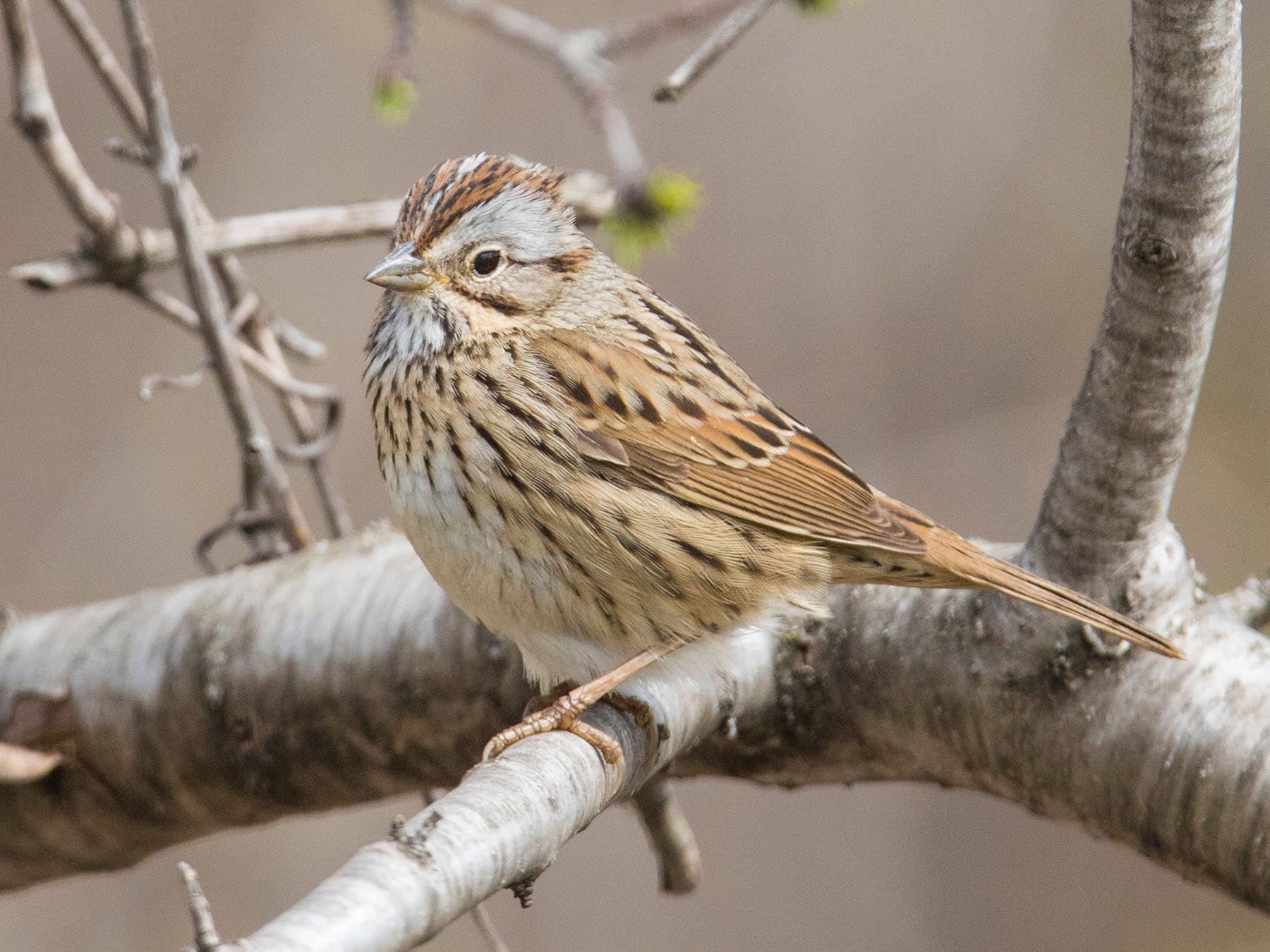
Lincoln's Sparrow perched on a bare tree branch, showing its streaky brown and white plumage with a distinctive striped head pattern.
Quick Facts
Conservation
LCLeast ConcernLifespan
2–5 years
Length
13–15 cm
Weight
17–19 g
Wingspan
19–22 cm
Migration
Full migrant
Dressed in a finely streaked buff-and-grey suit that makes it look almost too neat for the boggy thickets it calls home, Lincoln's Sparrow is one of North America's most secretive songbirds. Despite a population estimated at 88 million, it remains among the least-studied birds on the continent — partly because it runs mouse-like through dense vegetation rather than showing itself, and partly because its wren-like, gurgling song is so unlike what you'd expect from a sparrow.
Think you've spotted a Lincoln's Sparrow?
Upload a photo and we'll confirm it instantly
Confirm with a PhotoAppearance
Lincoln's Sparrow wears one of the most precisely patterned plumages of any North American sparrow. The upperparts are dark-streaked olive-brown with rusty edges on the wings and tail, giving the bird a warm, earthy tone. The underparts are where the real detail lies: a rich buffy wash across the breast and flanks is overlaid with very fine, crisp black streaks — far more delicate than the bold blotching of the similar Song Sparrow — contrasting sharply with a clean white belly and white throat.
The face is grey with brown cheeks, a buffy mustachial stripe running below the eye, and a thin brown line through the eye itself. A narrow, pale buffy eye ring is one of the most reliable identification features in the field. The crown is brown with a pale grey central stripe flanked by darker brown stripes streaked with black — and the crown feathers can be raised into a small, peaked crest when the bird is alert or alarmed, giving it a briefly spiky appearance.
The bill is small and conical, typical of a seed-eating passerine. A faint central breast spot may sometimes be visible where the fine streaks converge. Males and females are identical in plumage — the species is not sexually dimorphic. Lincoln's Sparrow is slightly smaller and trimmer than the Song Sparrow, with a narrower tail.
Juveniles strongly resemble juvenile Swamp Sparrows, showing a streaky chest without the buffy wash of adults. The key distinction is the crown: juvenile Lincoln's Sparrows always show a light-and-dark-streaked cap, never the solid-looking, unicoloured crown typical of juvenile Swamp Sparrows. Three subspecies are recognised: the nominate M. l. lincolnii (breeding across most of Canada and the northern US), M. l. gracilis (breeding in coastal British Columbia and southeastern Alaska, slightly smaller and darker), and M. l. alticola (breeding in the montane western US, slightly larger and paler).
Identification & Characteristics
Colors
- Primary
- Brown
- Secondary
- Buff
- Beak
- Grey
- Legs
- Pink
Markings
Buffy breast with very fine crisp black streaks; pale buffy eye ring; grey face with buffy mustachial stripe; brown-and-grey striped crown that can be raised into a small peaked crest; clean white belly contrasting with buffy breast.
Tail: Narrow, brown, streaked tail; slightly narrower than Song Sparrow's tail. Tail pumped slightly during flight.
Attributes
Understanding Attributes
Rated 0–100 based on research and observation. A score of 50 is average across all bird species. These attributes are relative and don't necessarily indicate superiority.
Habitat & Distribution
Lincoln's Sparrow breeds across a broad arc of boreal and montane North America. In Canada, it nests from the Alaskan border east across the boreal zone all the way to Newfoundland and Nova Scotia. In the United States, breeding populations occur in the Rocky Mountain states (Montana, Colorado, Idaho, Wyoming, Utah), the Pacific states (Washington, Oregon, and the mountains of California), and in the northeastern states — though in New Hampshire and Maine it is uncommon. Breeding elevation varies considerably by region: above 1,000 m in the northern Rockies, above 2,000 m in the central Sierra Nevada of California, and above 2,500 m in Arizona's White Mountains and San Francisco Peaks.
The breeding habitat is consistently wet and shrubby: subalpine and montane meadows dotted with willows, alders, sedges, and flowering plants such as corn lily and buttercup. The species is strongly associated with shrubby bogs, muskeg, wet thickets, and sphagnum moss-dominated habitats. At lower elevations it also uses mixed deciduous groves (aspen, cottonwood), shrubby stream edges, and black spruce-tamarack bogs. Low willow cover with dense ground vegetation is especially preferred for nesting.
The wintering range extends from the southern United States — California, Arizona, New Mexico, Texas, and the Gulf Coast states — south through Mexico and into northern Central America, including Honduras and El Salvador. Some breeding and wintering ranges overlap in central New Mexico and northern California. In the Sacramento Valley of California, wintering birds arrive in September and depart in April.
During migration, Lincoln's Sparrow passes through the Great Plains, Great Basin, and riparian zones across the central and eastern United States. It is uncommon to rare in the East during passage. Vagrant records include the first Dominican Republic record in 2010 and several records from montane Haiti. The species is strictly a New World bird and does not occur in the UK or Europe.
Where to See This Bird
Explore regional guides for locations where this bird has been recorded.
Montana
Iowa
Kansas
Nevada
New Mexico
Alaska
Minnesota
Arizona
Colorado
California
Oklahoma
Texas
Wyoming
Canada
British Columbia
Alberta
Newfoundland and Labrador
Manitoba
Northwest Territories
Quebec
Yukon Territory
Saskatchewan
Diet
Lincoln's Sparrow's diet shifts markedly between seasons. During the breeding season, arthropods dominate: the bird takes insect larvae, ants, beetles, flies, moths, caterpillars, mayflies, leafhoppers, aphids, spiders, and millipedes. Adults tend to take prey from higher trophic levels — spiders and larger insects — while nestlings are fed a greater proportion of grasshoppers and softer invertebrates. This trophic partitioning between adult and nestling diet is a pattern seen in several ground-nesting sparrows.
In winter, the diet shifts predominantly to small seeds of weeds and grasses, though invertebrates are still taken opportunistically. The bird forages almost exclusively on the ground, hopping under or close to dense thickets and scratching the surface to uncover seeds and insects. It occasionally perches in low shrubs to pick food directly from stems, but ground foraging is the norm.
Lincoln's Sparrow infrequently visits bird feeders, particularly in winter, where it may take seeds from the ground beneath feeders. It tends to be shy at feeders and is easily displaced by more assertive species. Birders who scatter millet on the ground near dense cover in winter stand the best chance of attracting one. The species' preference for foraging under cover rather than in the open is consistent with its generally secretive character — even when feeding, it rarely exposes itself for long.
Behaviour
Lincoln's Sparrow is one of North America's most secretive passerines. When disturbed, it doesn't flush into the open — it drops to the ground and runs mouse-like with its head down through dense vegetation for several feet before eventually flying up. This behaviour makes it easy to overlook even where it is common. On the breeding grounds, males do sing from exposed perches such as tall trees and willow branches, but they retreat quickly into cover at any sign of disturbance.
The species is largely solitary outside the breeding season, though during migration it regularly joins mixed sparrow flocks alongside White-crowned, Song, and Swamp Sparrows. On the wintering grounds it tends to forage alone or in loose associations near dense cover, rarely straying far from thickets or shrubby edges.
On the breeding grounds, males arrive in mid to late May and establish territories through song. Where Lincoln's Sparrow and Song Sparrow territories overlap, Song Sparrows typically dominate in direct encounters — Lincoln's Sparrows tend to yield rather than escalate. Females signal readiness to mate by approaching the male and fluttering their wings in the manner of a begging juvenile, a behaviour seen in several sparrow species.
The species is most active in the early morning, when males sing most frequently. During the heat of the day, birds tend to remain hidden in dense vegetation. Foraging takes place almost entirely on the ground, where the bird hops and scratches under the base of shrubs and thickets. Despite its skulking reputation, a singing male on a willow branch in early June can be surprisingly confiding — it is the rest of the year when the bird seems to vanish.
Calls & Sounds
Only males sing. The song is unlike anything else in the sparrow world — rich, gurgling, and bubbly, it is far more reminiscent of a House Wren than a typical sparrow. It typically begins with several rapid, high-pitched introductory notes, then transitions into a complex, multisyllabic trill that starts at a low pitch, rises abruptly, and then drops. The overall effect is warbling and varied, with a musical quality that surprises many birders hearing it for the first time.
Each male has a relatively small repertoire, averaging 3.7 different song types per individual. What makes Lincoln's Sparrow unusual among its genus is that it shows less geographical variation in song than either the Song Sparrow or the Swamp Sparrow. Scientists believe this song uniformity across the species' vast range results from high juvenile dispersal rates — young birds scatter widely after fledging, preventing local dialects from becoming established in the way they do in more sedentary species.
The species has three distinct call types, each used in different contexts. The first is an aggressive, flat "tup" or "chip" (also rendered as "chep" or "chup"), used while exposed on perches to attract attention or during antagonistic encounters. The second is a soft, high-pitched buzzy "zeet" (or "zeee"), used while under dense cover, often followed by the male's song. The third is a distinct, hoarse, buzzing "zrrr-zrrr-zrrr" sequence used during mating, territorial disputes, and mate-guarding. Both the chip and zeet calls are used in nest defence.
Males sing most frequently in the early morning and primarily during the early breeding season, before incubation begins. Research has shown that female Lincoln's Sparrows actively assess male song quality — preferring males with higher trill performance and longer, more complex songs. Females are also more attracted to males that sing during colder mornings, because cold-weather singing is energetically costly and serves as an honest signal of fitness.
Flight
Lincoln's Sparrow's flight is typical of a small, ground-loving passerine: low, fast, and direct over short distances, with rapid wingbeats interspersed with brief closed-wing glides that give it a slightly undulating trajectory. When flushed from cover, it rarely flies far — usually dropping back into dense vegetation after 20–50 metres rather than making a sustained escape flight. This short-distance flush-and-drop pattern is one reason the species is so difficult to observe well in the field.
The wings are relatively short and rounded, suited to manoeuvring through dense shrubby vegetation rather than sustained open-air flight. In flight, the streaked brown upperparts and narrow tail are visible, and the bird appears slightly smaller and trimmer than a Song Sparrow. The tail is pumped slightly during flight, a common sparrow behaviour.
During migration, Lincoln's Sparrow undertakes sustained nocturnal flights, as do most migratory passerines. Spring migration passes through the Great Plains and Great Basin from mid-May, with birds arriving on Montana breeding grounds between 13 and 30 May. Autumn migration begins in late August, with the main movement through Montana from 20 August to 20 September, peaking around 7 September. The species migrates later in autumn than the Swamp Sparrow where the two co-occur. Wintering birds in the Sacramento Valley of California arrive in September and depart in April, suggesting a migration window of several weeks in each direction.
Nesting & Breeding
Males arrive on the breeding grounds in mid to late May and begin singing immediately to establish territories and attract mates. The female builds the nest alone, typically in early June. Before construction begins, she often excavates a small depression in the ground — a preparatory step that helps anchor the finished structure. Over two to three days she weaves together willow bark, dried sedges, and grasses to form a shallow open cup approximately 10 cm in diameter and 5 cm tall, then lines the interior with fine grass and sometimes animal hair.
The completed nest is placed on the ground or just above it, very well hidden under a clump of grass or dense shrubbery — often sunken in a depression of sphagnum moss so the rim sits level with the ground surface, inside a low willow, mountain birch, or similar shrub. This flush-with-the-ground placement makes nests extraordinarily difficult to find, even when the general area is known.
Clutch size is typically 3–5 eggs, occasionally up to 6. Eggs are pale green to greenish-white (sometimes pinkish-white), heavily spotted with reddish-brown blotches, and measure approximately 1.7–2.2 cm long by 1.3–1.6 cm wide. One egg is laid per day. Incubation is performed by the female only and lasts approximately 10–14 days, beginning before the clutch is complete.
Young hatch altricial — eyes closed, naked except for fine greyish-black down along the back. Both parents feed the nestlings. Young leave the nest 9–12 days after hatching. Fledglings are mostly flightless on their first day but develop rapidly: by day six they can fly more than 10 metres. Parents continue to tend and feed the young for a further two to three weeks after fledging. When disturbed on the nest, the female slips quietly off and runs mouse-like through the vegetation for several feet before flying up — the same escape behaviour adults use year-round.
Lifespan
Lincoln's Sparrow typically lives two to five years in the wild, with most individuals not surviving beyond their third or fourth year. Annual survival rates for small passerines are generally low, with predation, migration hazards, and harsh winter conditions all taking a toll. The oldest recorded individual was a male banded in Colorado in 1995 and recaptured at the same location in 2002, making him at least 7 years and 11 months old — a longevity record documented by the USGS Bird Banding Laboratory that is notable for a bird of this size.
Banding data reveal that some individuals show strong site fidelity on the wintering grounds, with one bird recaptured at the same wintering site over a nine-year span. This fidelity to wintering sites may help experienced birds exploit familiar food resources more efficiently, potentially contributing to longer survival.
The main causes of mortality include predation by domestic cats, birds of prey (particularly accipiters and falcons during migration), snakes, and small mammals on the breeding grounds. Collision with structures — TV towers, buildings, and windows — is a significant source of mortality during nocturnal migration, as it is for virtually all migratory passerines. Climate-related habitat degradation on the breeding grounds may increasingly affect juvenile survival and recruitment, particularly in eastern populations that have shown declines since around 1980.
Conservation
Lincoln's Sparrow is listed as Least Concern on the IUCN Red List, with a global population estimated at approximately 88 million mature individuals (Partners in Flight 2019; BirdLife International). North American Breeding Bird Survey data from 1966 to 2019 show the overall population trend as stable, and Partners in Flight rates the species 7 out of 20 on the Continental Concern Score — indicating low conservation concern at the continental scale.
Regional trends, however, are more nuanced. Western populations appear stable or increasing. Eastern populations tell a different story: in New Hampshire, where the species breeds at the southern edge of its northeastern range, numbers have been declining since around 1980. The species has fairly specialised breeding habitat requirements — subalpine wet meadows and bogs — making it potentially vulnerable to any degradation of these habitats.
The principal threats are habitat loss through wetland drainage, deforestation, livestock grazing, and water diversions that degrade subalpine wetland breeding habitat. Climate change poses a longer-term risk: altered water flows and reduced wet meadow quality could shrink the available breeding habitat, particularly at the southern edges of the range. As a northerly breeder dependent on cool, moist conditions, Lincoln's Sparrow may be more exposed to climate-driven range shifts than many other sparrows.
Like virtually all migrant songbirds, Lincoln's Sparrow is also subject to collision mortality with TV towers and buildings during migration, and to predation by domestic cats, birds of prey, snakes, and small mammals. The species' secretive behaviour and preference for remote boreal and subalpine habitats means that monitoring its population accurately remains challenging — its full range and local abundance are likely underestimated.
Population
Estimated: Approximately 88 million mature individuals
Trend: Stable
Stable overall (North American Breeding Bird Survey 1966–2019), with regional declines in eastern populations (notably New Hampshire since c.1980) and stable or increasing western populations.
Elevation
Sea level to above 2,500 m (breeding); varies by region — above 1,000 m in northern Rockies, above 2,000 m in Sierra Nevada, above 2,500 m in Arizona mountains
Additional Details
- Family:
- Passerellidae (New World Sparrows)
- Predators:
- Domestic cats, birds of prey (accipiters, falcons), snakes, and small mammals. Collision with structures (towers, buildings) is a significant migration mortality source.
- Subspecies:
- Three: M. l. lincolnii (nominate, most of range), M. l. gracilis (coastal BC and SE Alaska, smaller and darker), M. l. alticola (montane western US, larger and paler)
- Similar species:
- Song Sparrow (bolder streaking, no eye ring, larger central breast spot), Swamp Sparrow (plainer face, no buffy breast wash, unicoloured crown in juveniles)
Subspecies
Three subspecies of Lincoln's Sparrow are currently recognised, differing subtly in size and plumage tone. The nominate subspecies, Melospiza lincolnii lincolnii, breeds across the vast majority of the species' range — from Alaska and Canada east to Newfoundland and Nova Scotia, and south through the Rocky Mountain states and northeastern US. It represents the 'standard' Lincoln's Sparrow against which the other two are compared.
Melospiza lincolnii gracilis breeds in coastal British Columbia and southeastern Alaska. It is slightly smaller and darker than the nominate, with more saturated brown tones on the upperparts and a slightly deeper buffy wash on the breast. The coastal rainforest environment of its breeding range may drive this darker colouration through Gloger's Rule, which predicts darker pigmentation in humid environments.
Melospiza lincolnii alticola breeds in the montane western United States, including the Rocky Mountains south through Arizona and New Mexico. It is slightly larger and paler than the nominate, with a less saturated buffy breast wash and slightly paler upperparts — consistent with the paler, drier environments of the interior mountain West. In practice, subspecific identification in the field is very difficult and rarely attempted; the differences are subtle enough that even museum specimens require careful measurement.
All three subspecies are fully migratory and winter in broadly overlapping areas of the southern United States, Mexico, and Central America. There is no evidence of assortative mating between subspecies on the wintering grounds, and the genetic boundaries between them are not well characterised.
Courtship & Display
Male Lincoln's Sparrows arrive on the breeding grounds in mid to late May and begin singing immediately from exposed perches — tall trees, willow branches, and occasionally in flight. Song is the primary mechanism of both territory establishment and mate attraction. Males sing most intensively in the early morning during the pre-incubation period, and research has shown that females are active judges of song quality: they move preferentially toward males with higher trill performance and longer, more complex songs.
One of the more counterintuitive findings from Lincoln's Sparrow research is that females show a stronger preference for males that sing during cold mornings. Because singing in cold conditions is energetically costly — muscles work less efficiently at low temperatures — cold-morning singing functions as an honest signal of a male's physical condition. A male willing and able to sing vigorously on a cold morning is advertising genuine fitness, not just vocal ability.
Intriguingly, a male's bill shape is directly correlated with his vocal performance quality, linking physical morphology to song attractiveness in a way that females appear to detect and respond to. This bill-song-fitness link has been documented in relatively few passerine species and makes Lincoln's Sparrow an unusually well-studied system for understanding honest signalling in mate choice.
Females signal readiness to mate by approaching the male and fluttering their wings in the manner of a begging juvenile — a solicitation display seen in several sparrow species. Pair bonds are monogamous during the breeding season but are not maintained outside it. The male's role in nest building is minimal; the female constructs the nest alone while the male continues to sing and guard the territory.
Birdwatching Tips
Lincoln's Sparrow rewards patience and a good ear more than sharp eyes. The best strategy is to learn the song — a rich, gurgling, wren-like warble quite unlike the typical sparrow trill — and then stand quietly near suitable habitat. In the breeding season (late May through July), males sing from exposed willow branches and treetops in subalpine meadows and bogs, and a singing bird can be surprisingly approachable if you move slowly.
During migration (late August through October in the West; September through October in the East), Lincoln's Sparrow turns up in brushy field edges, riparian thickets, and weedy areas. It often associates with mixed sparrow flocks — scan any group of White-crowned, Song, or Swamp Sparrows carefully for the finer streaking, buffy breast, and pale eye ring that distinguish Lincoln's. The eye ring is the single most reliable field mark: a thin, pale buffy ring around the eye that neither Song nor Swamp Sparrow shows.
In the United States, the species is easiest to find in winter in California, Arizona, New Mexico, and Texas, where it inhabits dense shrubby cover near wetlands and weedy fields. In the Sacramento Valley, birds are present from September through April. Scatter millet on the ground beneath dense cover near a feeder and check it regularly — a Lincoln's Sparrow may appear, though it will likely stay at the edge of cover rather than venturing into the open.
The key identification pitfall is confusion with Song Sparrow. Lincoln's is smaller and trimmer, with finer streaking, a buffy (not white) breast wash, a peaked crown, and that distinctive eye ring. The streaks on Lincoln's breast are pencil-thin; on Song Sparrow they are bolder and often converge into a central breast spot. If the bird looks like a Song Sparrow that's been drawn with a finer pen, it's probably a Lincoln's.
Did You Know?
- Lincoln's Sparrow was named by John James Audubon in 1834 after his young travelling companion Thomas Lincoln of Dennysville, Maine — the only member of their Labrador expedition to successfully collect a specimen of this elusive bird. Audubon originally called it 'Lincoln's Pinewood-finch' and wrote: 'We found more wildness in this species than in any other inhabiting the same country.'
- A male's bill shape directly predicts his vocal performance quality — and females use this as a mate-choice cue. Research published in Behavioral Ecology (Caro et al. 2010) showed that females move preferentially toward males singing higher-quality songs, and are especially attracted to males that sing during cold mornings, because cold-weather singing is energetically costly and signals superior fitness.
- The oldest recorded Lincoln's Sparrow was a male banded in Colorado in 1995 and recaptured at the same location in 2002 — at least 7 years and 11 months old. Banding data also show that some individuals return faithfully to the same wintering sites across multiple years, with one bird recaptured over a nine-year span.
- Despite an estimated population of 88 million, Lincoln's Sparrow remains one of the least-studied widespread songbirds in North America. Its skulking behaviour, preference for remote boreal and subalpine habitats, and tendency to run mouse-like through dense cover rather than flush into the open mean that basic aspects of its ecology are still poorly understood.
- Lincoln's Sparrow shows less geographical song variation than any other species in its genus — a consequence of unusually high juvenile dispersal rates that prevent local dialects from becoming established across its vast range.
Records & Accolades
Most Uniform Song
Least geographic song variation of any Melospiza sparrow
Lincoln's Sparrow shows less geographical variation in song than either the Song Sparrow or Swamp Sparrow — likely because high juvenile dispersal rates prevent local dialects from forming.
Longevity Record
At least 7 years 11 months
The oldest recorded Lincoln's Sparrow was banded in Colorado in 1995 and recaptured at the same site in 2002, documented by the USGS Bird Banding Laboratory.
Population
~88 million mature individuals
One of North America's most numerous sparrows, yet also one of the least studied — its secretive behaviour keeps it under the radar despite its abundance.
Community Photos
Be the first to share a photo of the Lincoln's Sparrow
Upload a PhotoIdentify Any Bird Instantly
- Upload a photo from your phone or camera
- Get an instant AI identification
- Ask follow-up questions about the bird
Monthly Birds in Your Area
- Personalised for your location
- Seasonal tips and garden advice
- Updated every month with new species