


Hooded Merganser
Masked Diver, Hooded Sheldrake, Sawbill · Lophodytes cucullatus
By the Birdfact teamChecked by Nathan Cope
On this page12 sections
How to recognise it
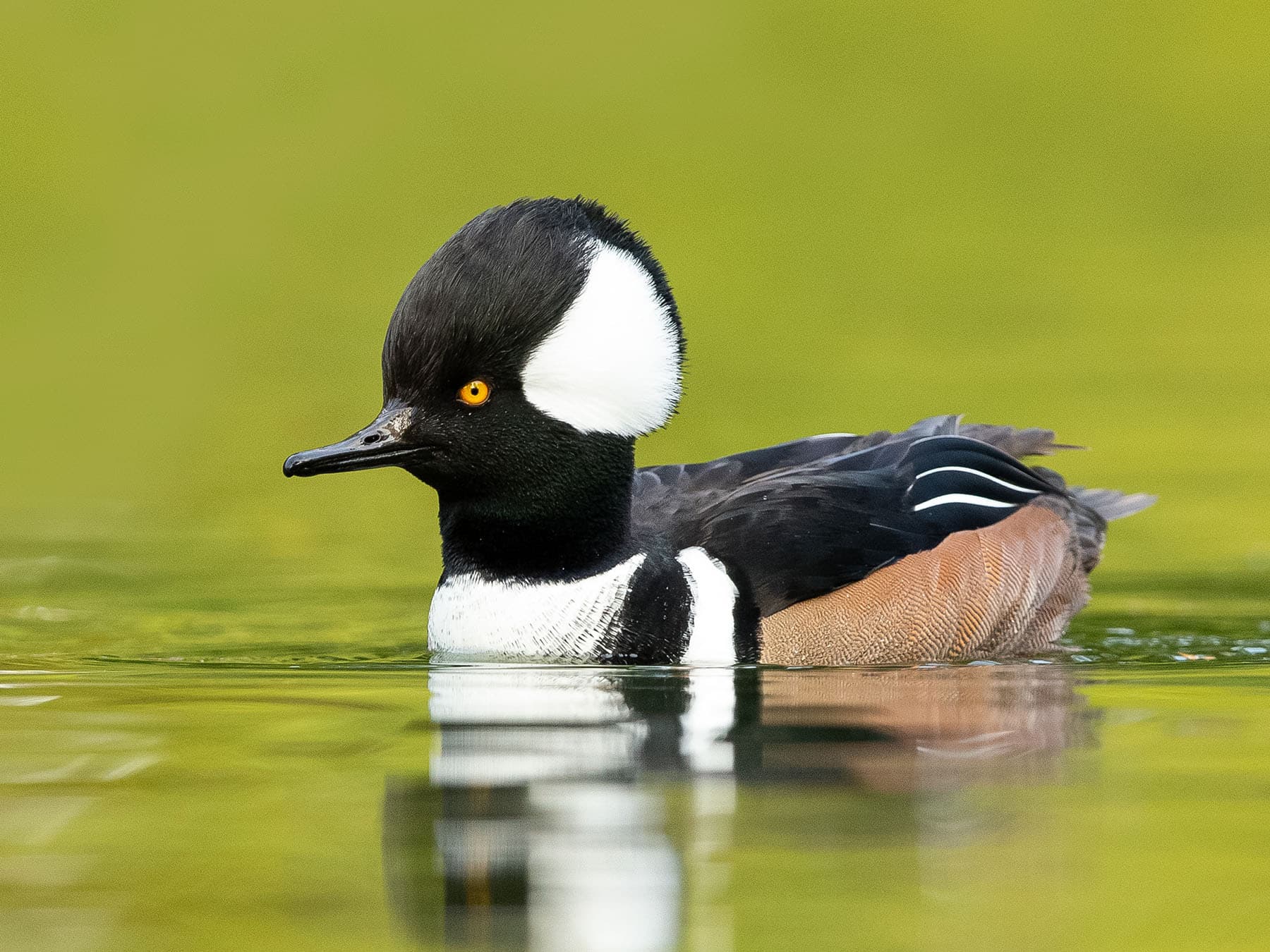
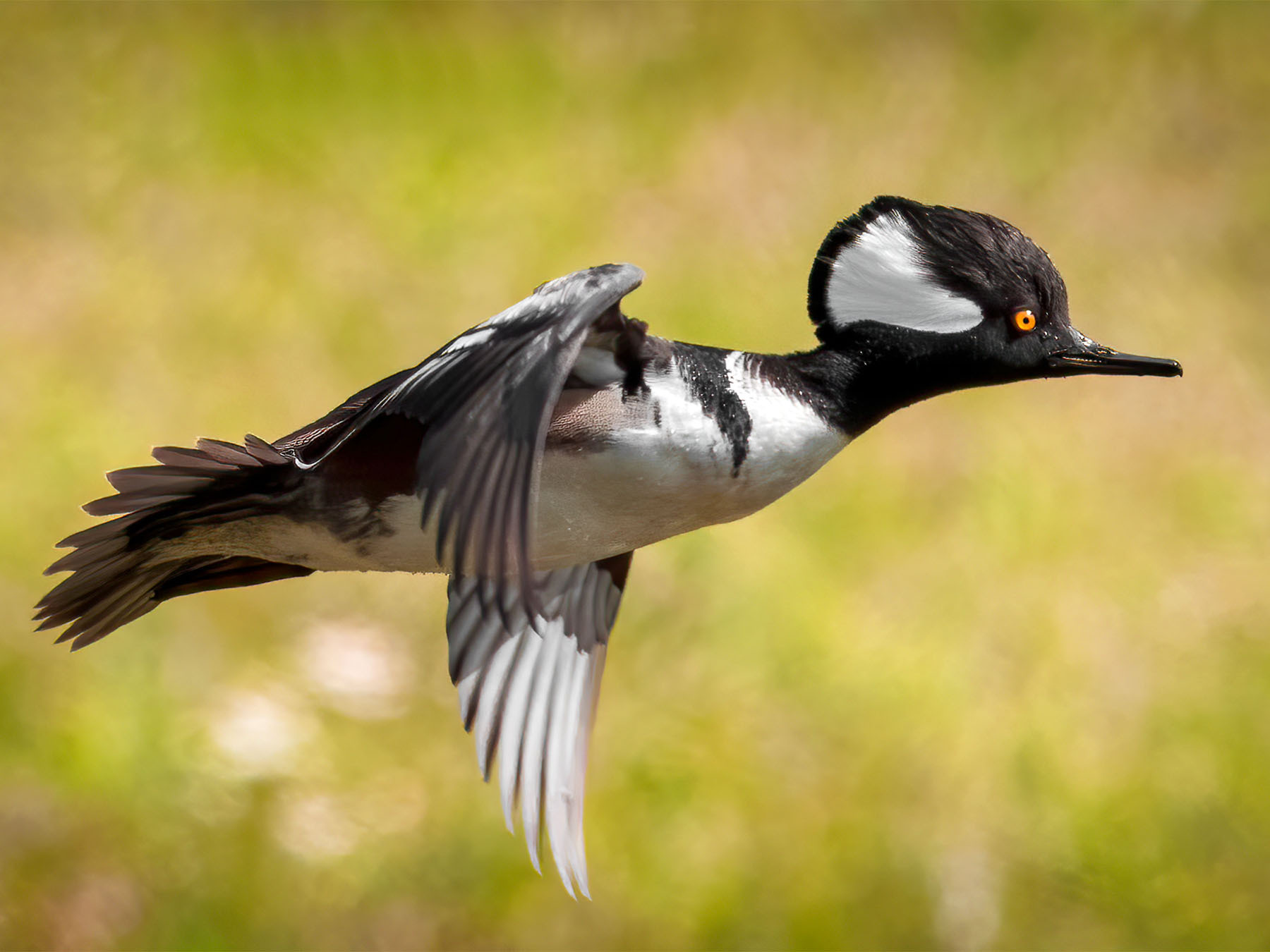
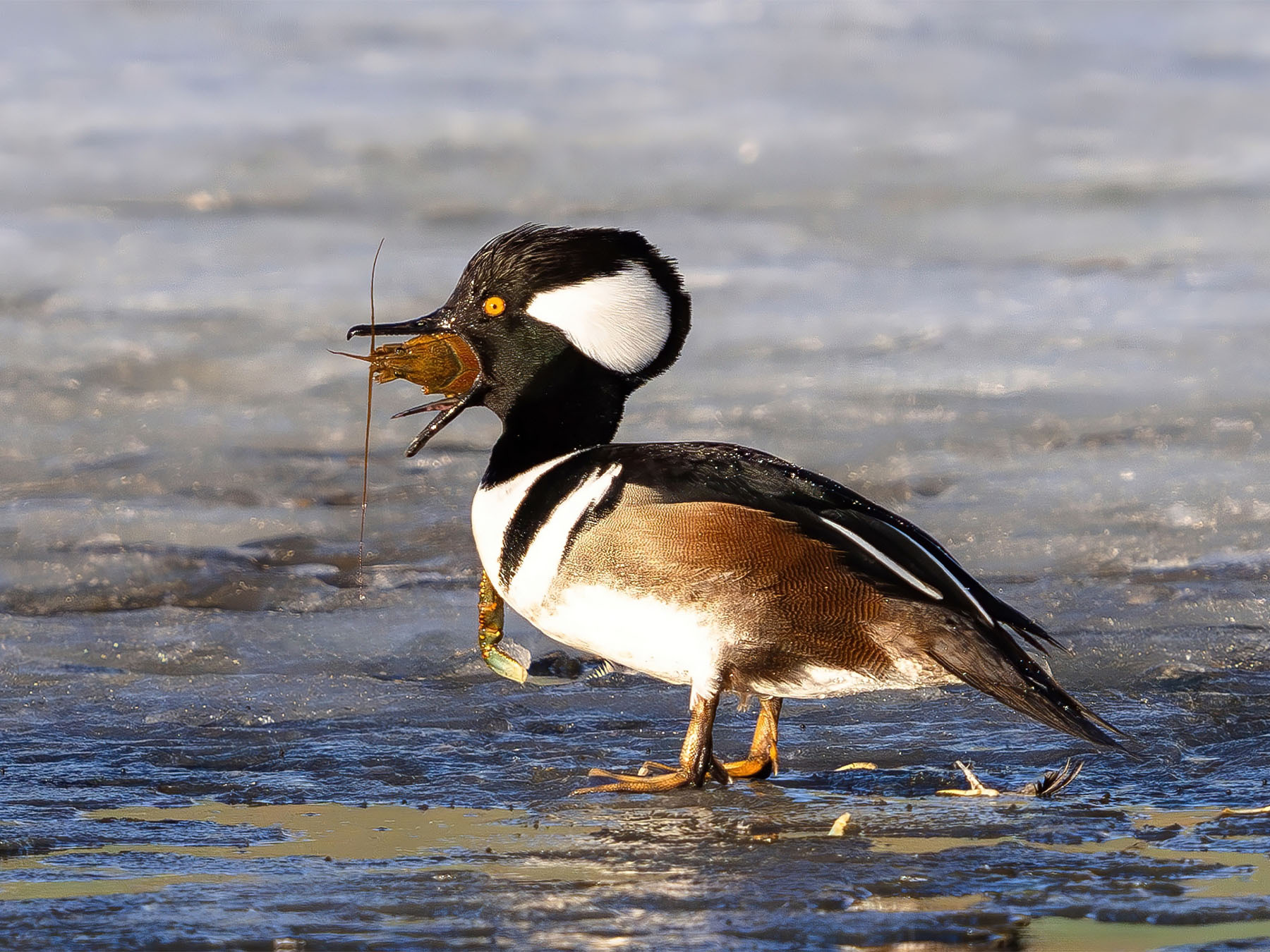
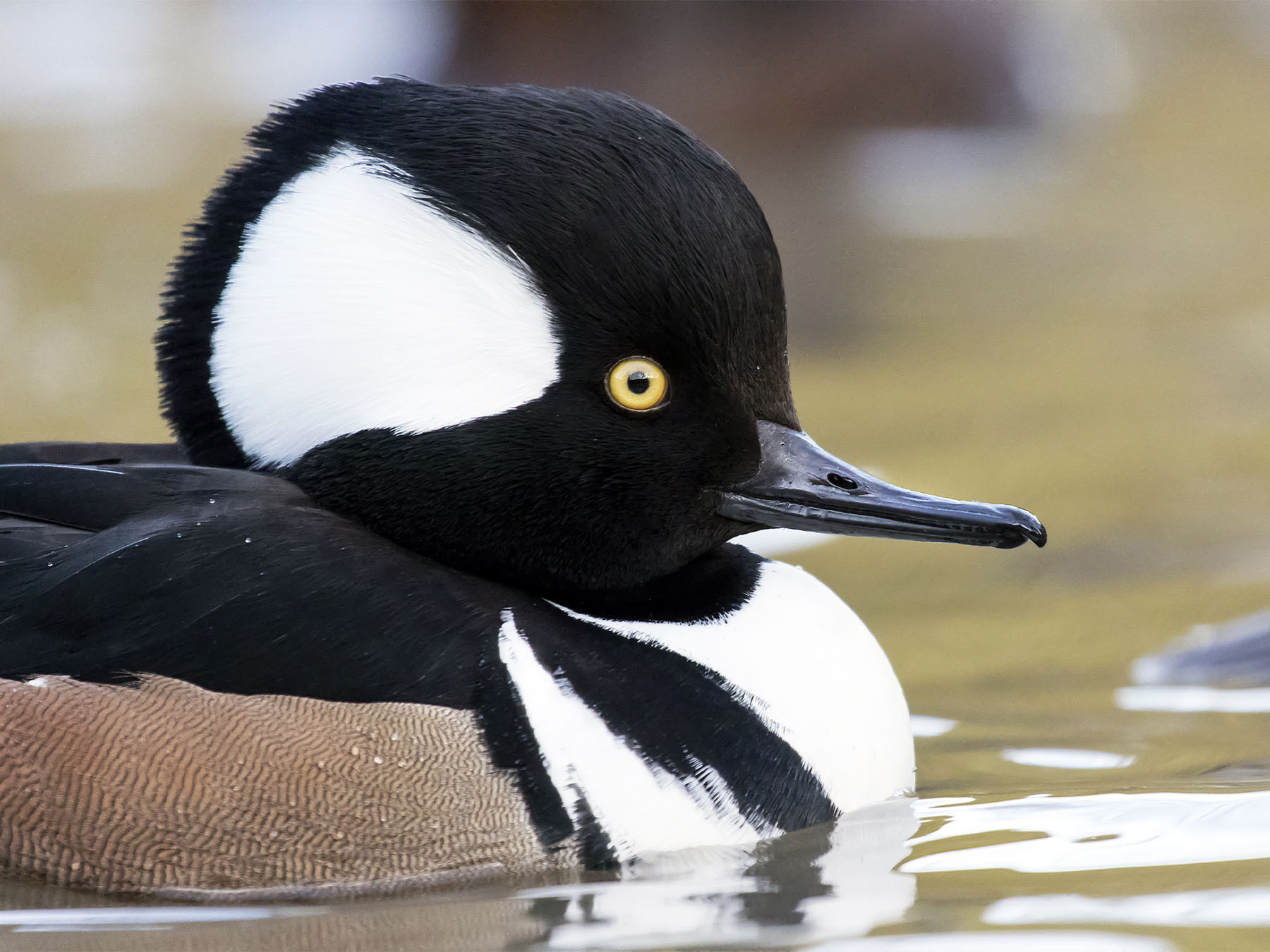
The Hooded Merganser is a striking duck with a distinctive, fan-shaped crest. Males display a black and white crest, chestnut flanks, and a black back. Their white breast is marked with two black bars.
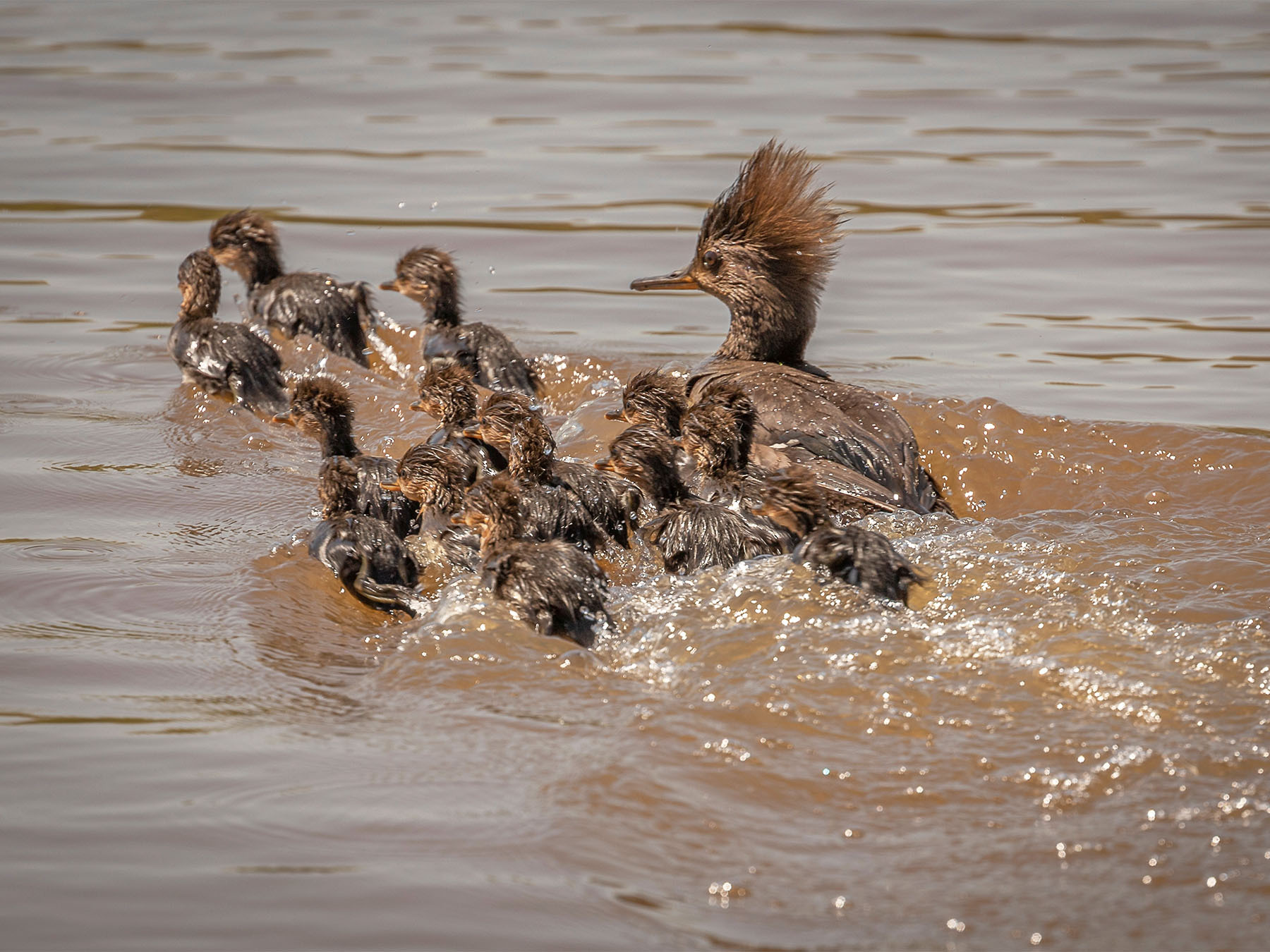
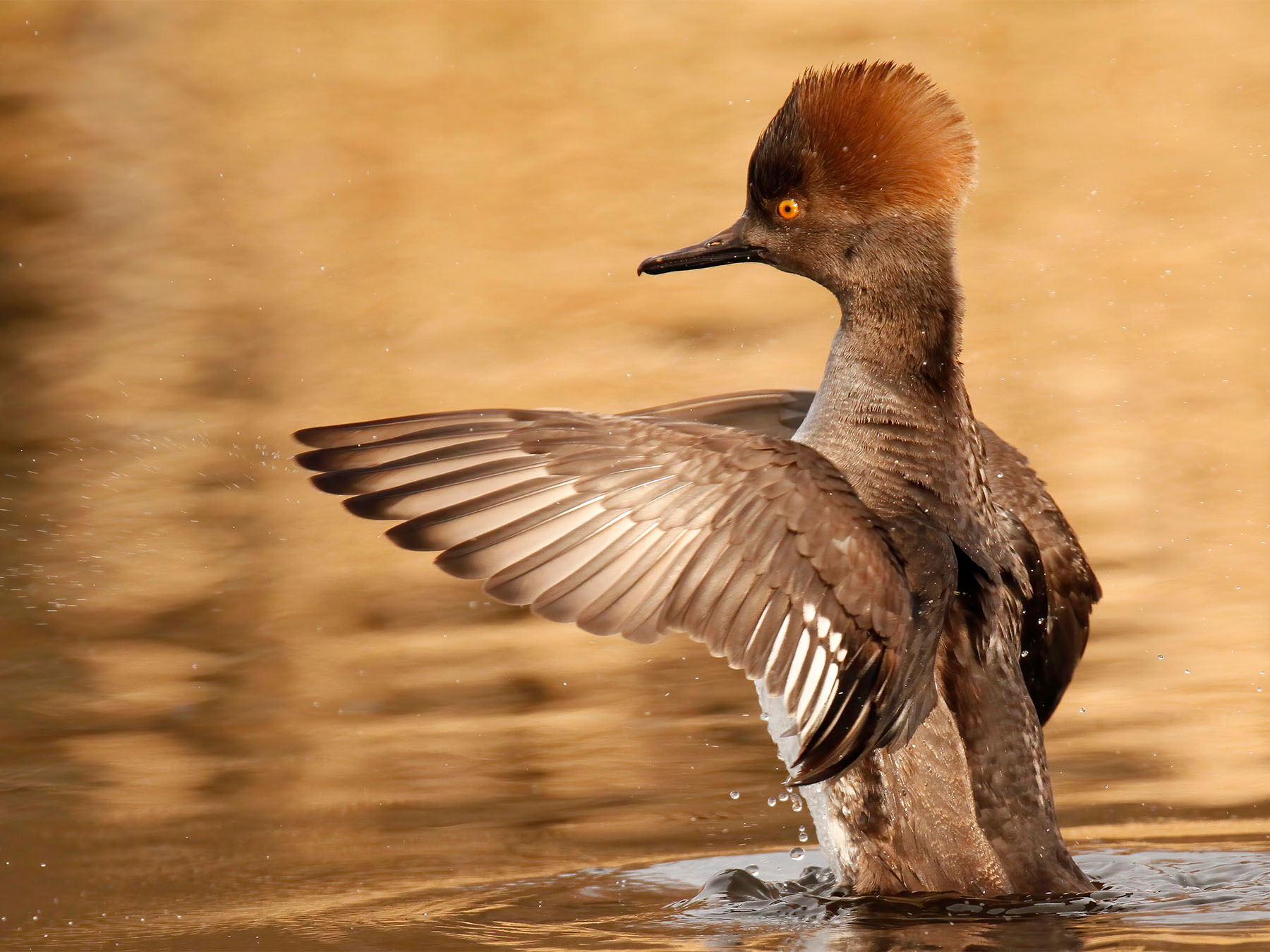
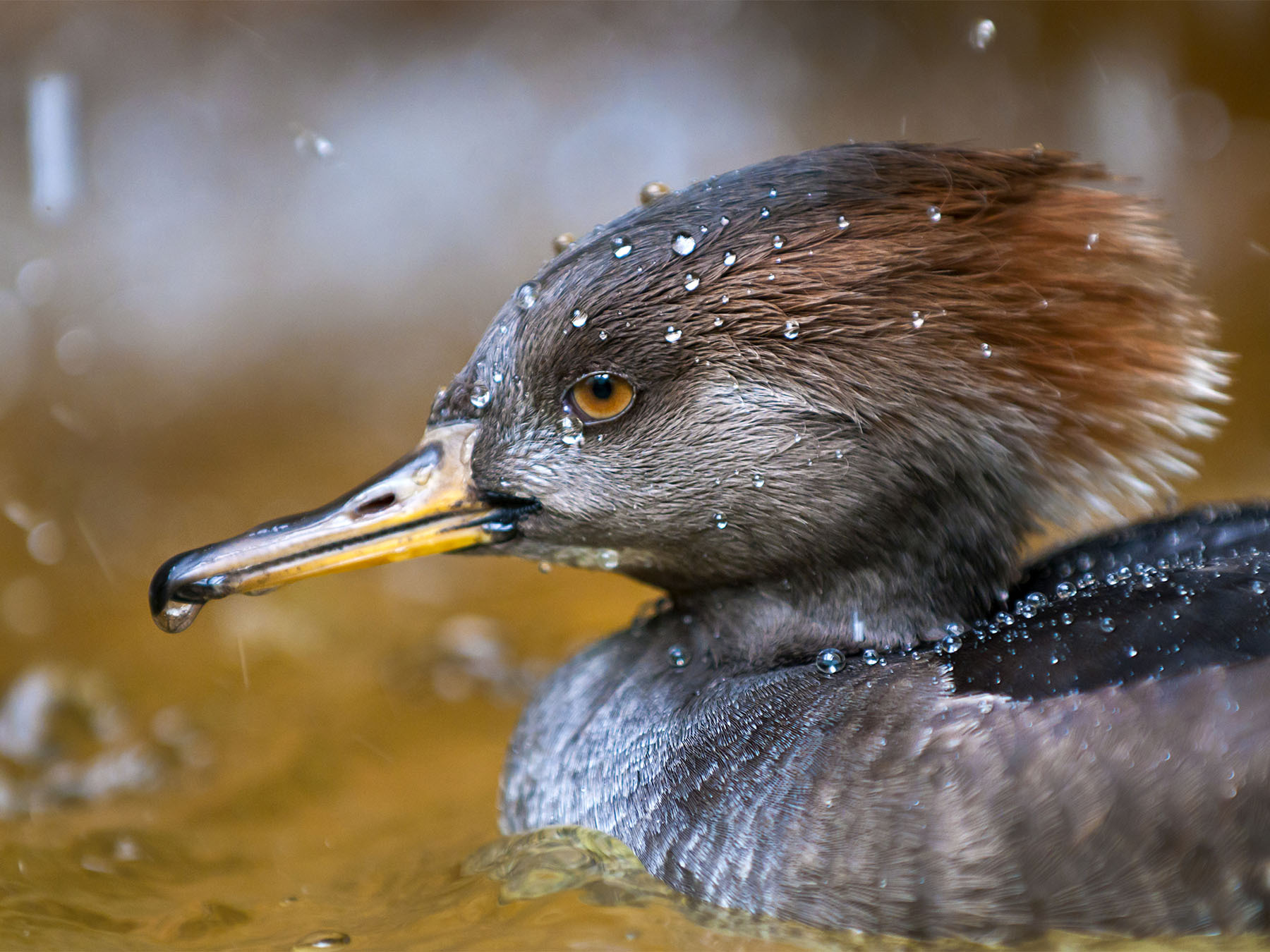
Females are more subdued, with a cinnamon-colored crest and greyish-brown body. Both sexes have a thin, serrated bill and golden-yellow eyes, which turn bright yellow in breeding males.
Its size
Adults- Length
- 40–49 cm
- Wingspan
- 61–66 cm
- Weight
- 540–935 g
Its song and calls
Hooded Mergansers are generally quiet but become more vocal during breeding season. Males produce a low, rolling, frog-like croak, often described as 'croo-croo-crrrooo'. Females make a hoarse, guttural 'gak-gak-gak' call, particularly when disturbed or leading young.
- Alarm call0:00 / 0:34
Recorded in Michigan, United States · July 2013
When and where to see it
OctoberArriving
Most recorded in October
- 1. Perthshire and Kinrossunder 0.1%
- 2. Rutlandunder 0.1%
- 3. Norfolkunder 0.1%
- 4. Londonunder 0.1%
- 5. Suffolkunder 0.1%
Each dot is a county, state or province: the bigger and darker, the larger the bird’s share of that place’s bird records that month. Grey dots: no regular records. The ringed point is the centre of the bird’s records this month; the arrow shows how it moved since last month, and the dashed loop its path through the year. “Arrivals” colours places where it becomes regular this month (orange) or is in its last regular month (grey). GBIF eBird Observation Dataset, 2019–2024. Map data: Natural Earth, US Census Bureau; place centres © OpenStreetMap contributors.
In your area
See when the Hooded Merganser is recorded in your county, state or province.
How often the Hooded Merganser turns up in the UK, the United States and Canada through the year, from birdwatchers' records.
United Kingdom
Winter visitor · regularly Oct–May · most records in May
United States
Winter visitor · all year · most records in January
Canada
Winter visitor · all year · most records in November
Show as a table
| Month | United Kingdom | United States | Canada |
|---|---|---|---|
| January | 0.001% (regular) | 0.59% (regular) | 0.61% (regular) |
| February | <0.001% (regular) | 0.48% (regular) | 0.50% (regular) |
| March | <0.001% (regular) | 0.46% (regular) | 0.78% (regular) |
| April | <0.001% (regular) | 0.17% (regular) | 0.54% (regular) |
| May | 0.002% (regular) | 0.065% (regular) | 0.15% (regular) |
| June | <0.001% | 0.053% (regular) | 0.11% (regular) |
| July | <0.001% | 0.051% (regular) | 0.14% (regular) |
| August | <0.001% | 0.056% (regular) | 0.23% (regular) |
| September | <0.001% | 0.048% (regular) | 0.28% (regular) |
| October | <0.001% (regular) | 0.099% (regular) | 0.55% (regular) |
| November | <0.001% | 0.50% (regular) | 1.2% (regular) |
| December | 0.001% (regular) | 0.57% (regular) | 0.75% (regular) |
Recorded regularly in
Worldwide: recorded regularly in 10 countries
Countries where it was recorded in at least 3 of the 6 years 2019–2024. Linked countries have their own bird list.
Europe (4)
North America (6)
Data: EOD – eBird Observation Dataset (Cornell Lab of Ornithology), accessed via GBIF.org, CC BY 4.0. Records from 2019–2024, aggregated and filtered by Birdfact. How these lists are made
Tips for seeing it
- Look for Hooded Mergansers in wooded swamps and quiet, forested ponds
- Listen for their distinctive, frog-like croaking call during breeding season
- Observe their diving behavior, as they frequently submerge to hunt for food
- In North America, watch for them in winter along coastal areas and unfrozen inland waters
What it eats
Hooded Mergansers primarily feed on small fish, aquatic insects, and crustaceans. They use their serrated bills to grip slippery prey, diving underwater and swimming with their eyes open to locate food. Occasionally, they also consume plant material, especially during breeding season.
Nesting and breeding
Breeding season for Hooded Mergansers typically begins in late winter or early spring. Males perform elaborate courtship displays to attract females, including head-pumping and crest-raising.
Females select nest sites in tree cavities or nest boxes, often near water. They lay 7-15 cream-colored eggs and line the nest with down. Nests are sometimes shared with other female mergansers or wood ducks.
Incubation lasts about 30 days, performed solely by the female. Ducklings leave the nest within 24 hours of hatching, jumping from heights of up to 50 feet to reach water.
Behaviour
Hooded Mergansers are agile swimmers and divers, using their keen eyesight to locate prey underwater. They often shake their crests when alarmed or during courtship displays.
These ducks are generally quiet but become more vocal during breeding season, especially when performing elaborate courtship rituals.
Conservation
While currently listed as Least Concern, Hooded Mergansers face threats from habitat loss, particularly the destruction of mature forests near wetlands. Conservation efforts focus on protecting nesting habitats and maintaining water quality in their aquatic environments.
Similar birds
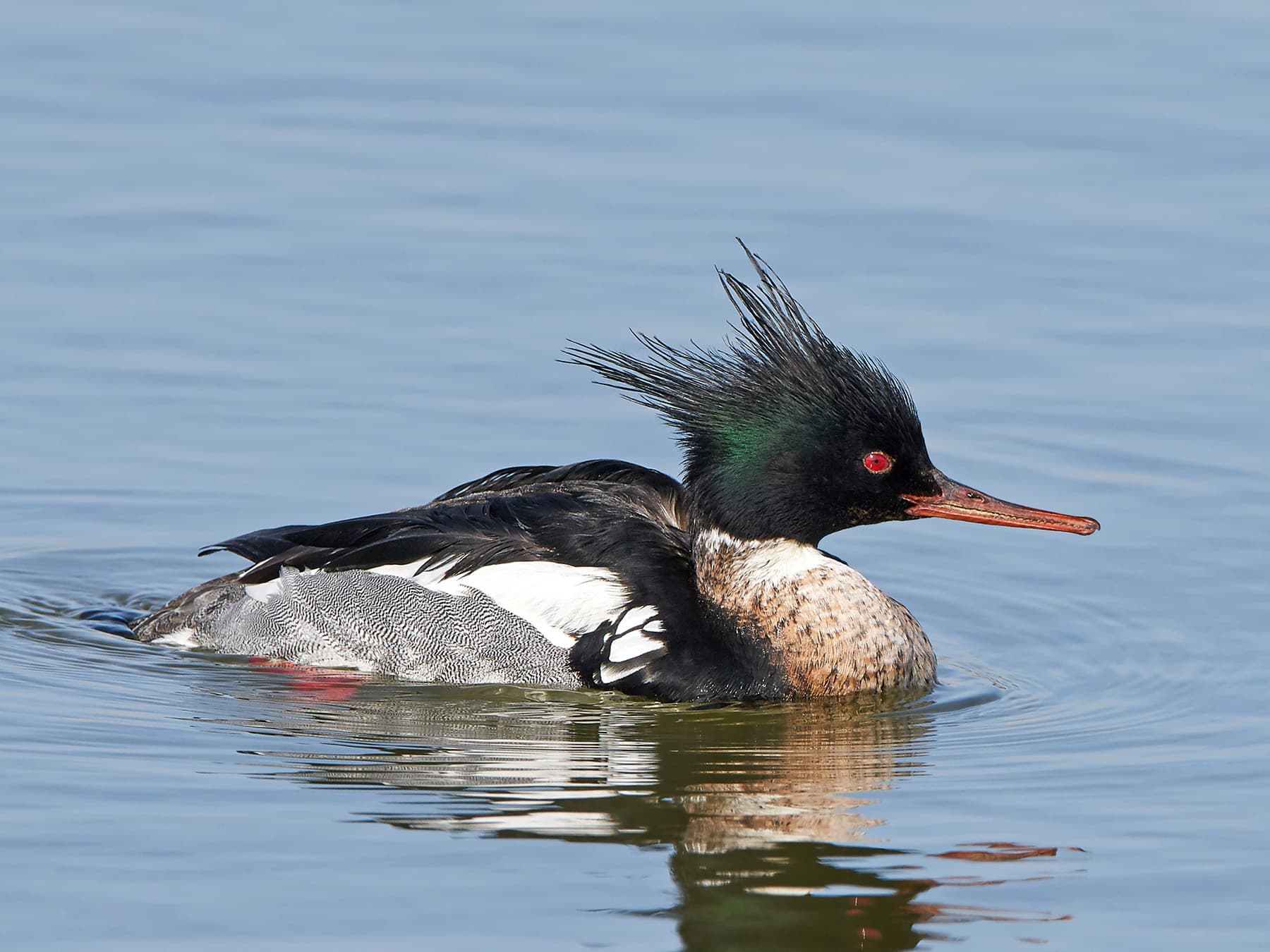
Often mistaken for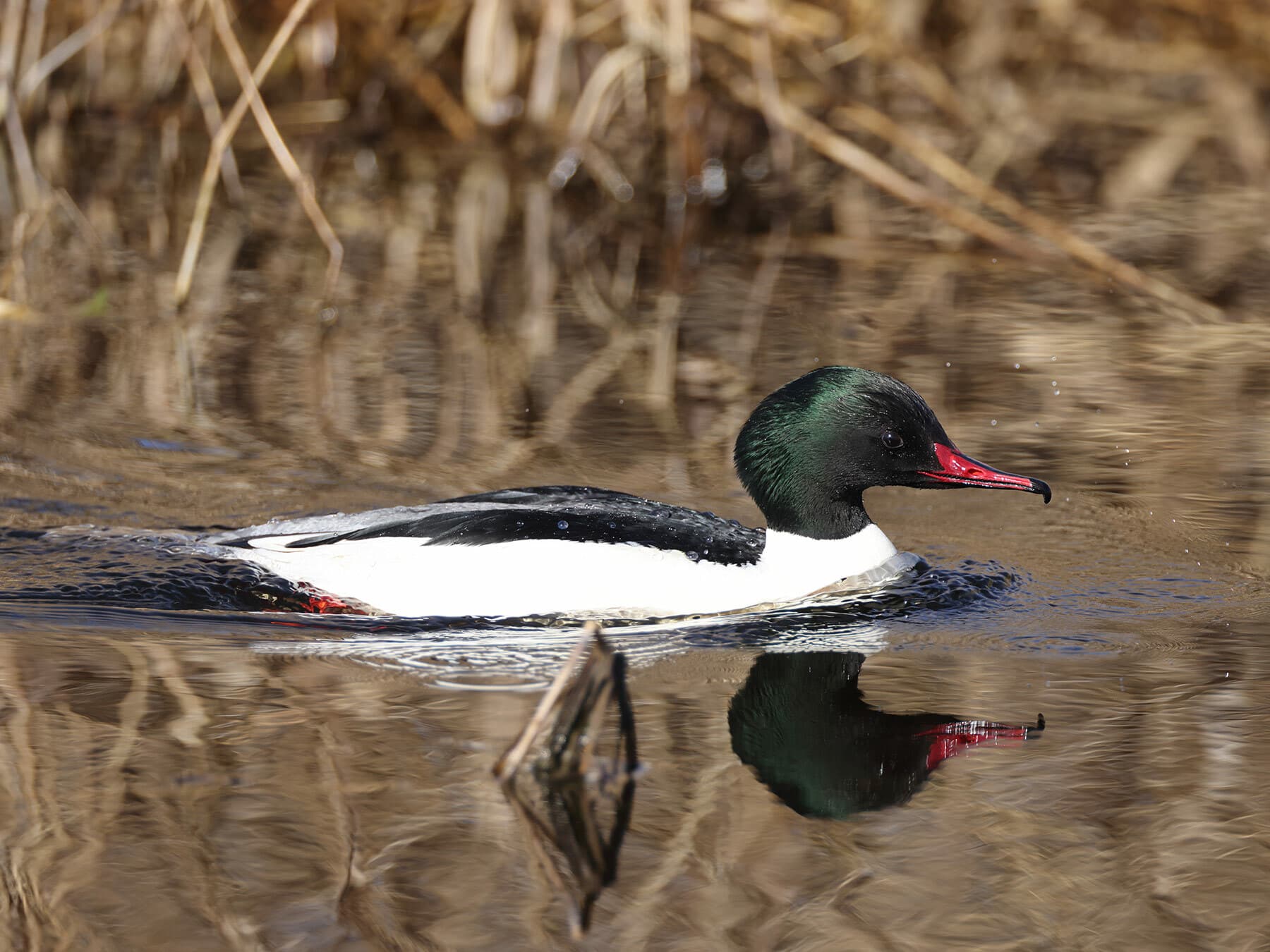
More photos
7 photos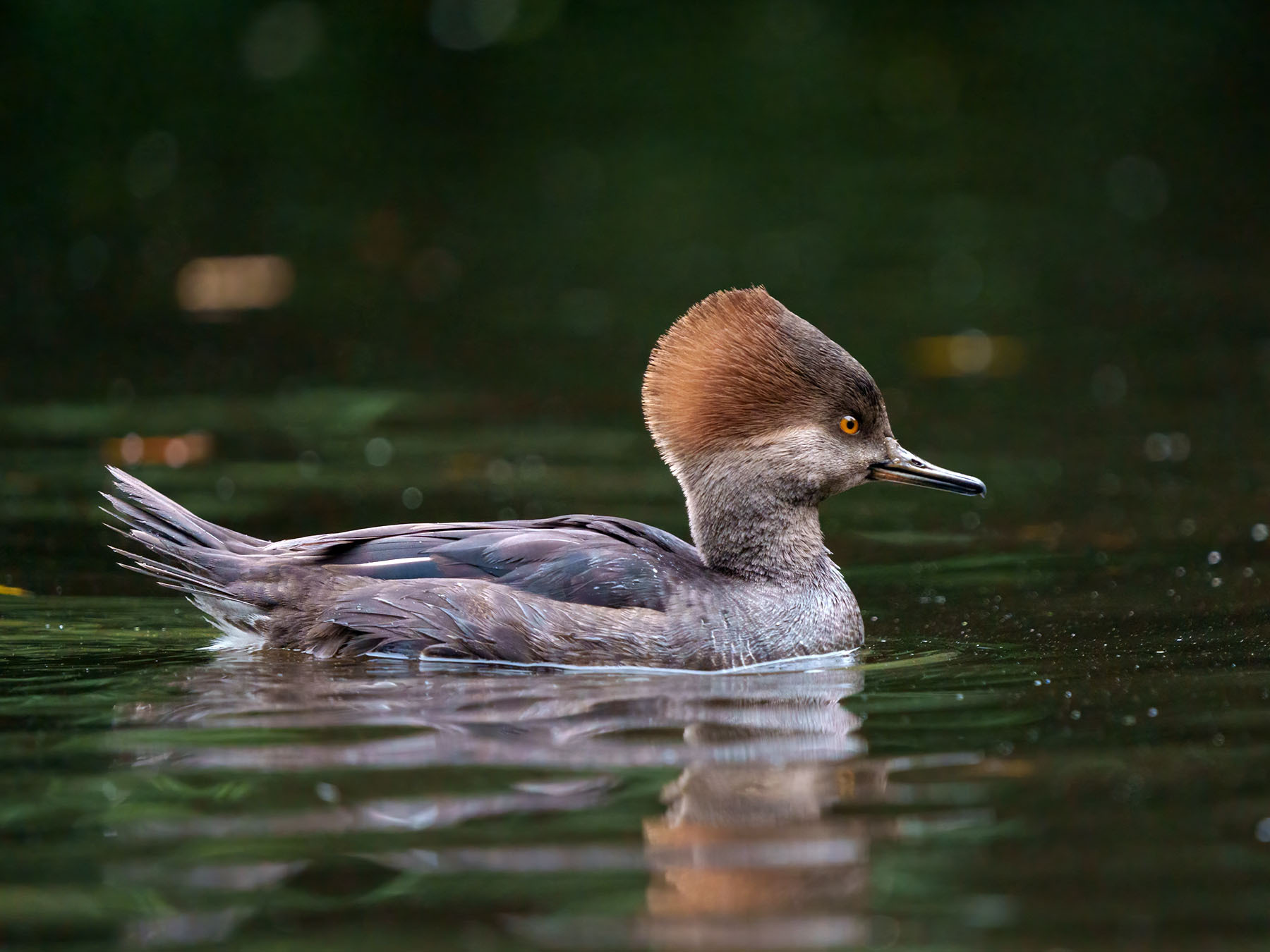
Quick facts
- Length
- 40–49 cm
- Wingspan
- 61–66 cm
- Weight
- 540–935 g
- Lifespan
- 10–12 years
- Family
- Ducks, Geese & Swans
- Migration
- Short-distance migrant
- Global status (IUCN)
- Least Concern
- World population
- 1,100,000 mature individuals
- Population trend
- Population slowly increasing overall, but some local declines
- Also called
- Masked Diver, Hooded Sheldrake, Sawbill
- Scientific name
- Lophodytes cucullatus
Sources
3- 1BirdLife International. 2021. Lophodytes cucullatus. The IUCN Red List of Threatened Species 2021: e.T22680472A137932133. Source (opens in a new tab)
- 2Meehan et al. 2018; Partners in Flight 2020; Wetlands International 2020
- 3Partners in Flight (2020) Source (opens in a new tab)

Checked by
Nathan Cope, founder and editor
Nathan founded Birdfact and leads its writers and contributors in the UK, the US and Canada. He has watched and studied birds for more than ten years, and checks every article and species guide before it’s published.