


Goldeneye
Common Goldeneye, Whistler · Bucephala clangula
By the Birdfact teamChecked by Nathan Cope
On this page14 sections
How to recognise it
What do Goldeneyes look like?
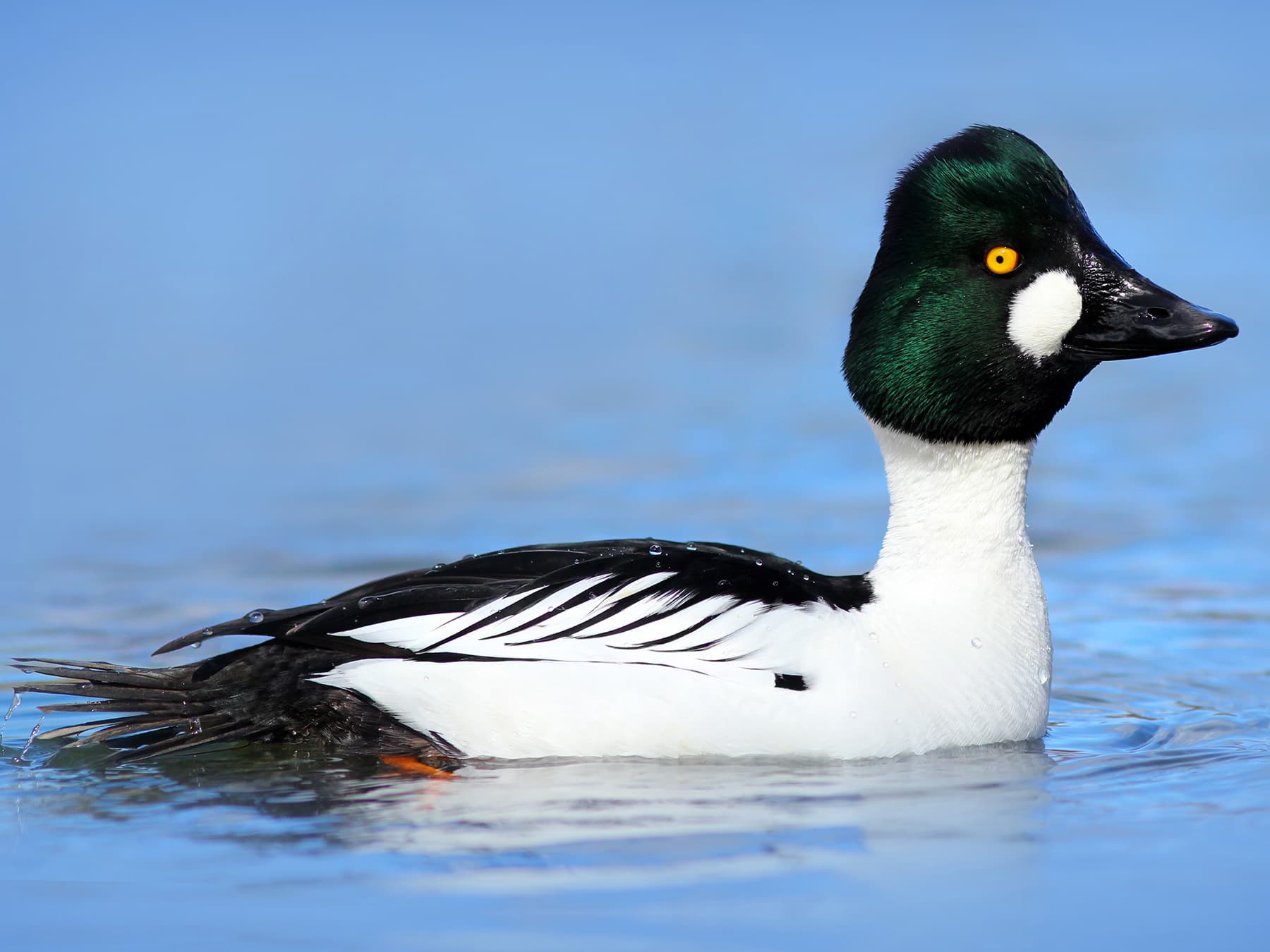
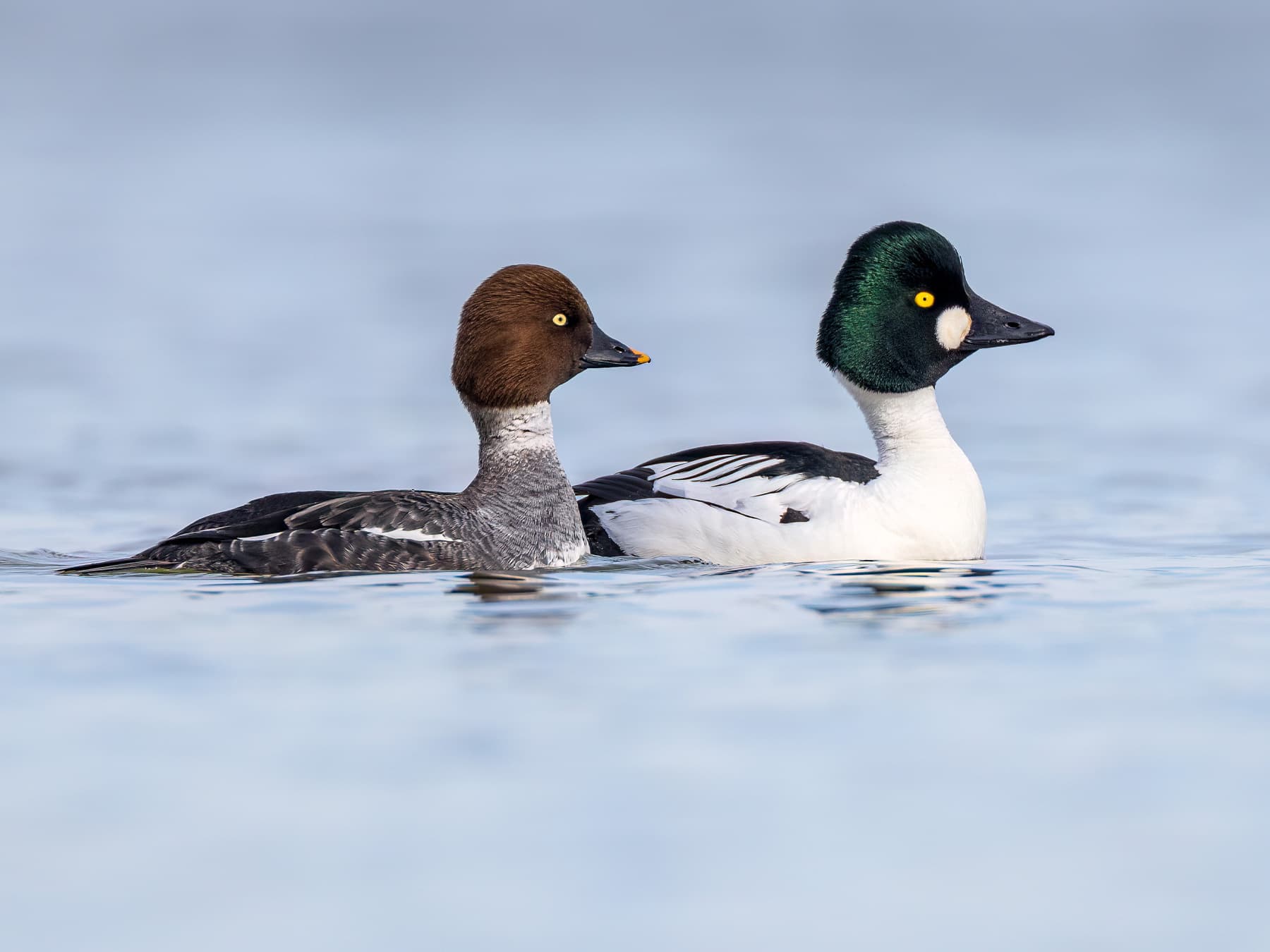
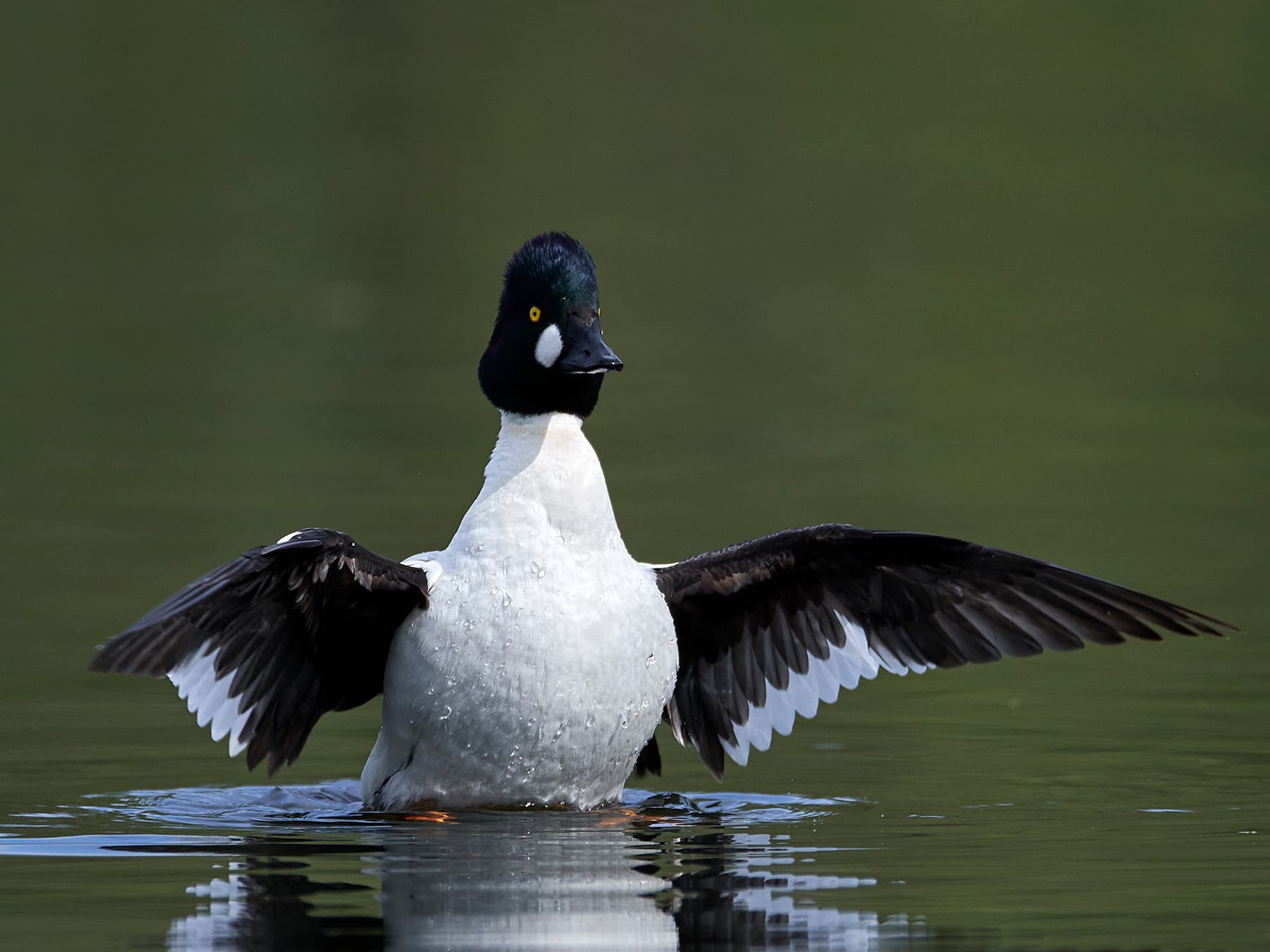
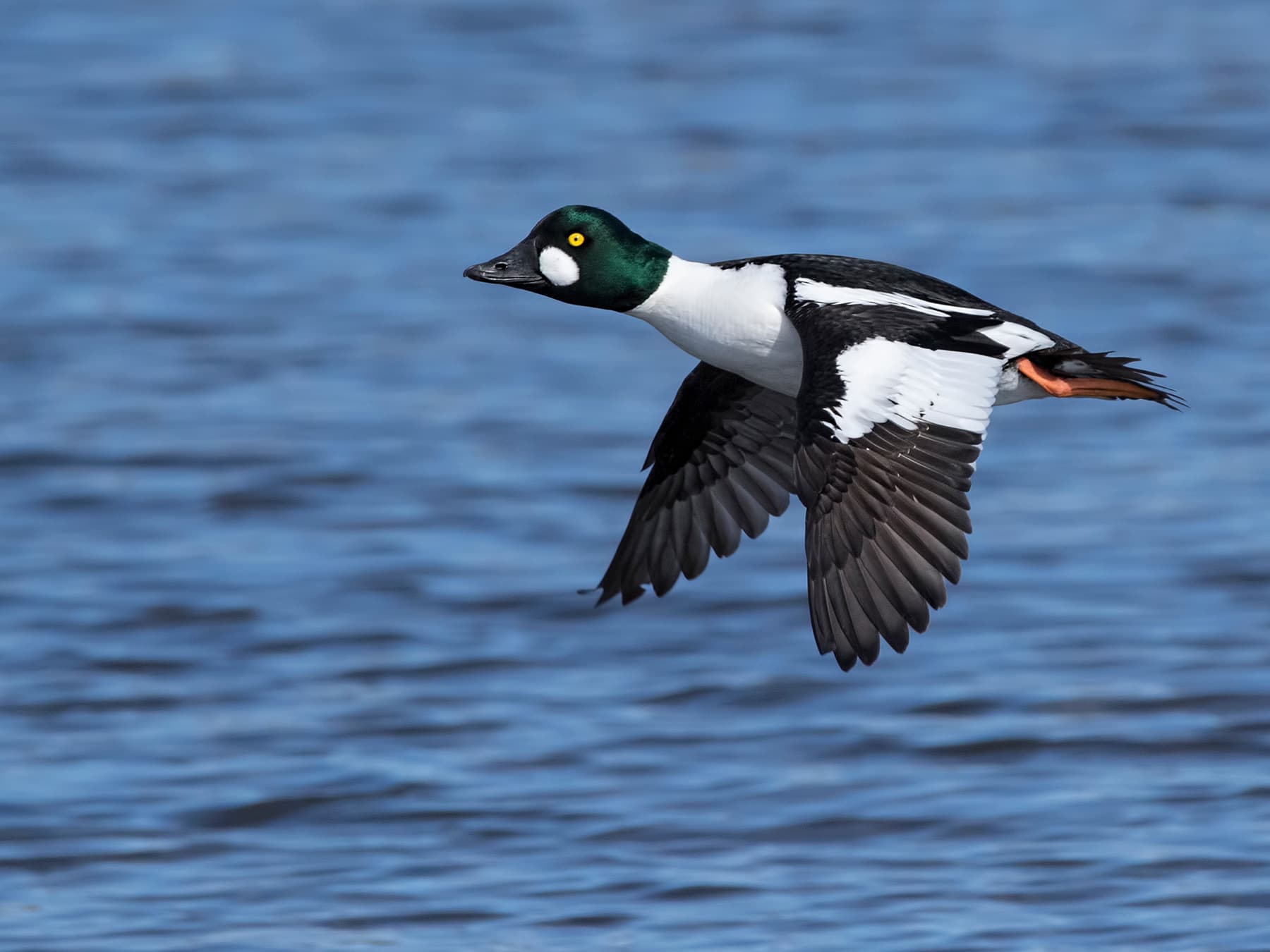
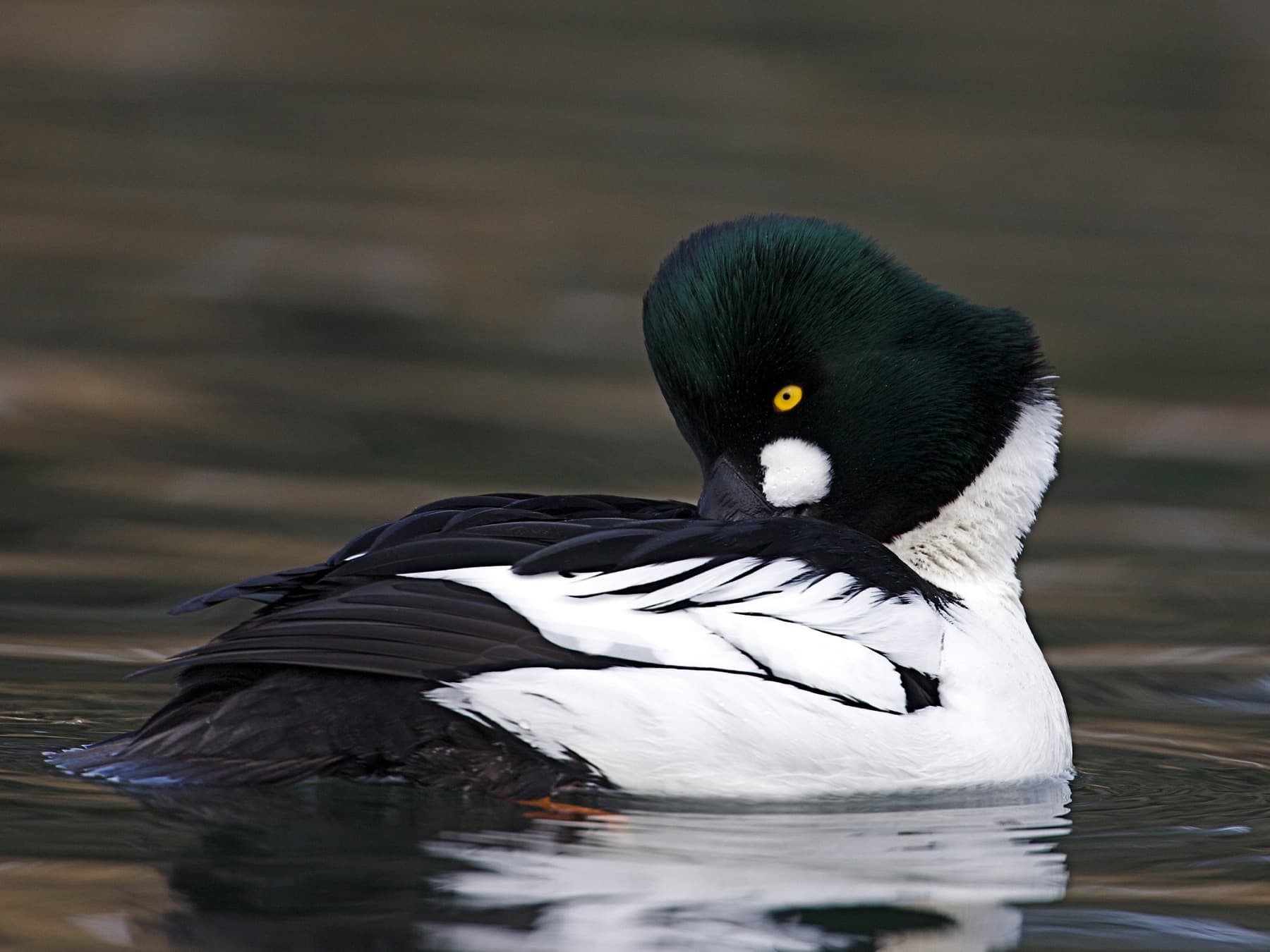
Male goldeneyes in breeding plumage are unmistakable, with their golden eye being one of their key distinguishing features. Their dark green head is dome-shaped, with a steep forehead and sharply sloping back. Under the eye is a large white spot. The bill is blue-gray and the feet are bright orange.
The breast and underparts of a male goldeneye are white, the upper wings and mantle are black and the tail is gray. The flanks are barred white and black, and there is a prominent white patch on the wings, which is clearly visible in flight.
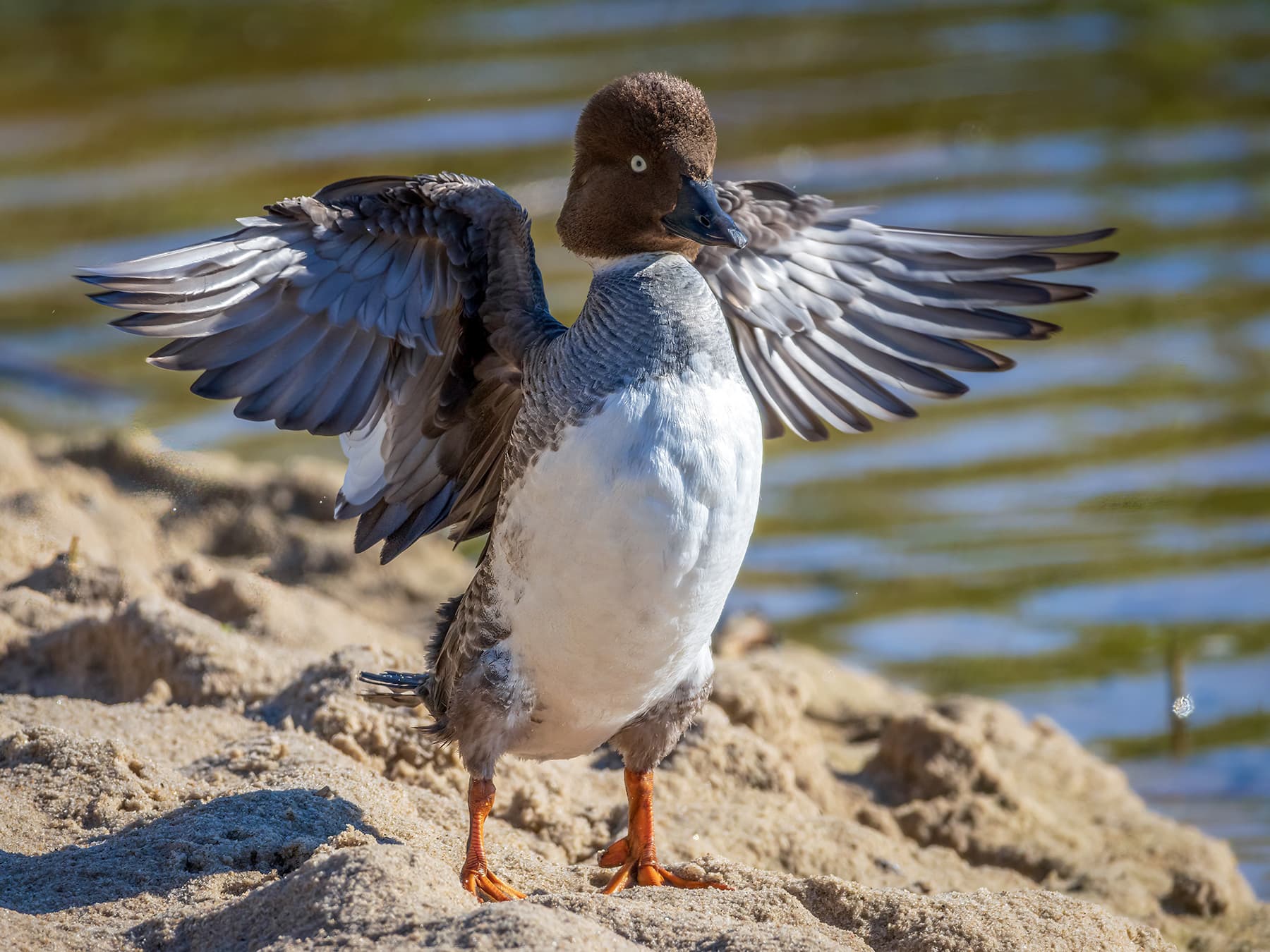
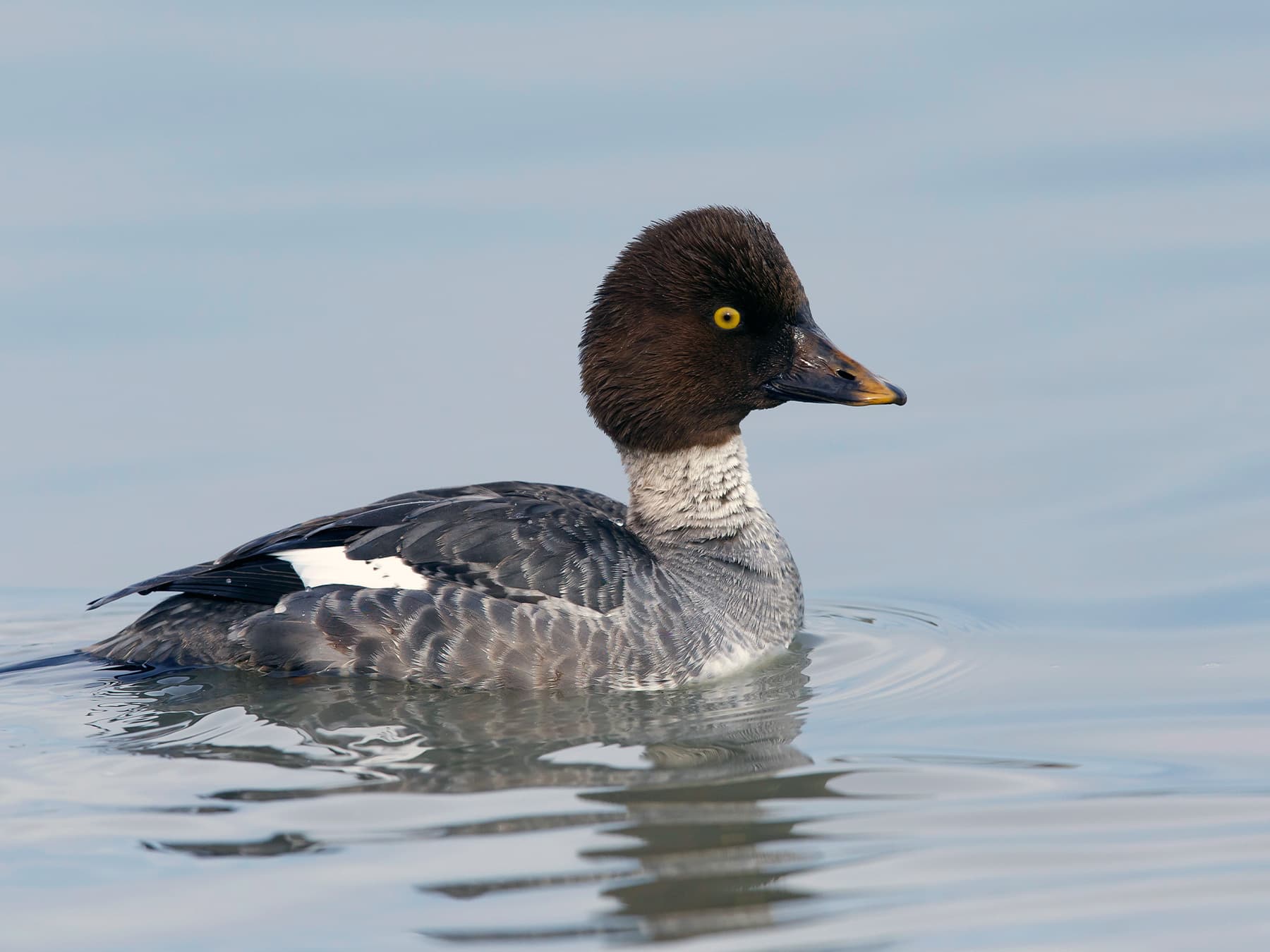
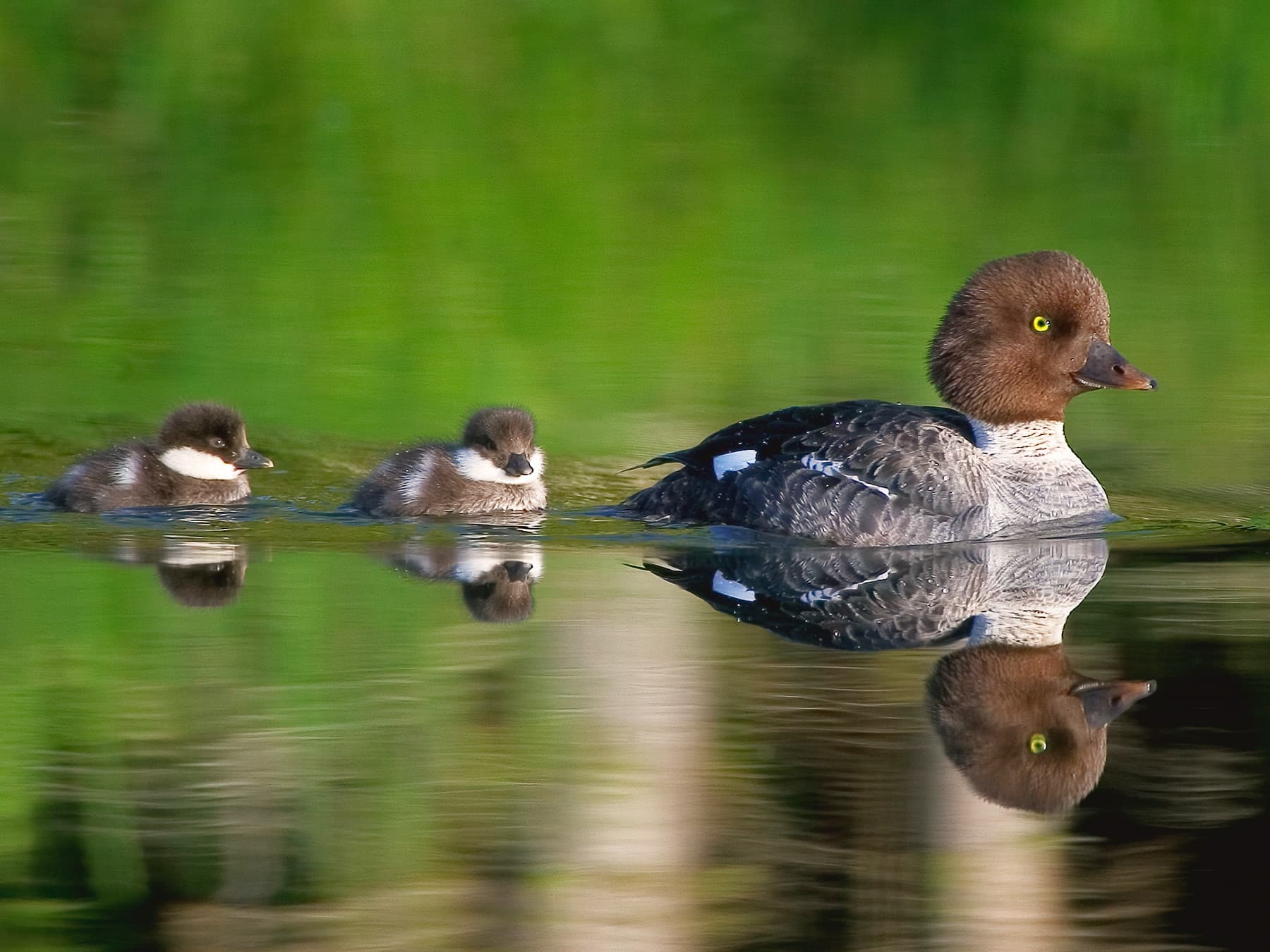
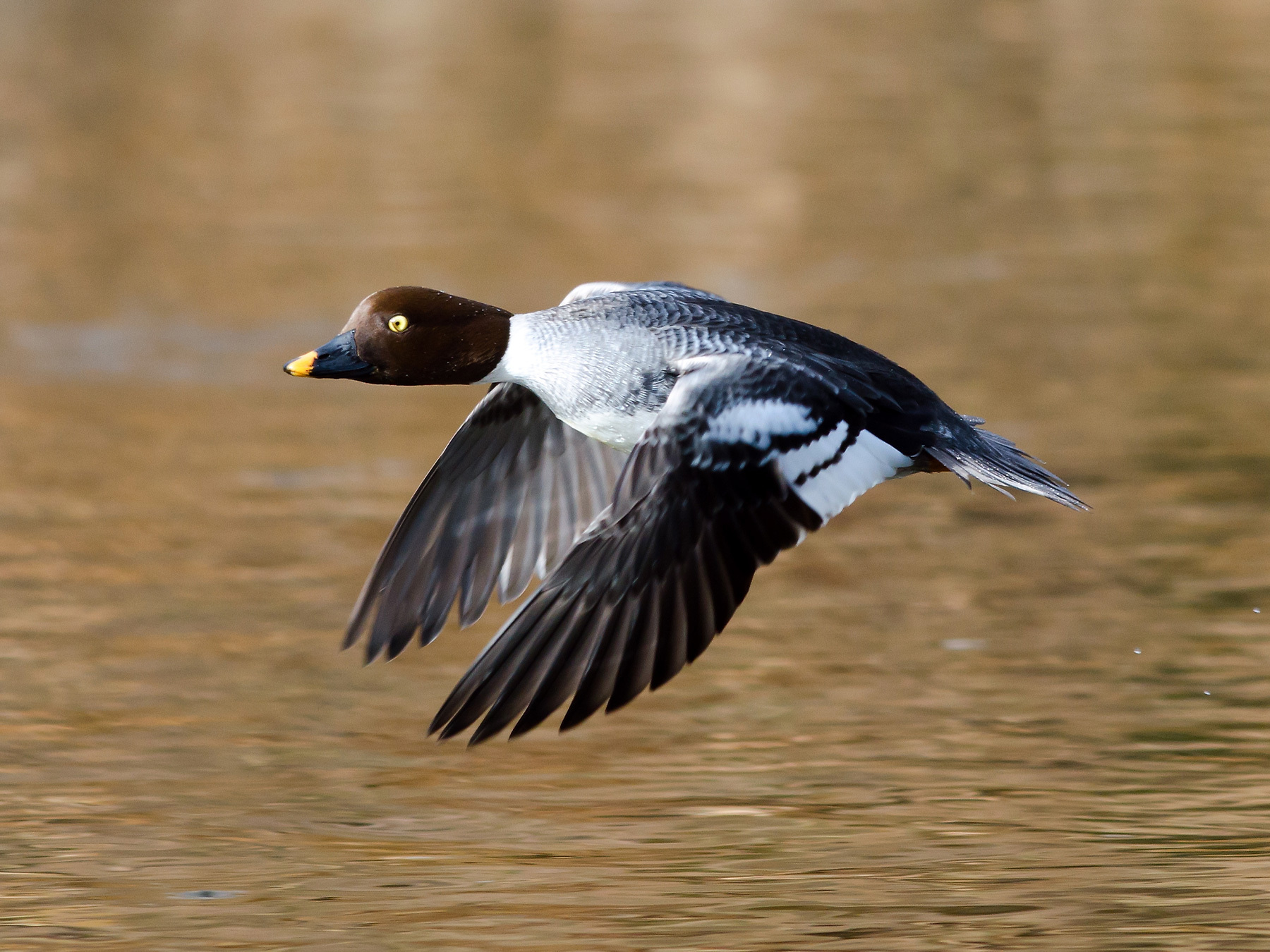
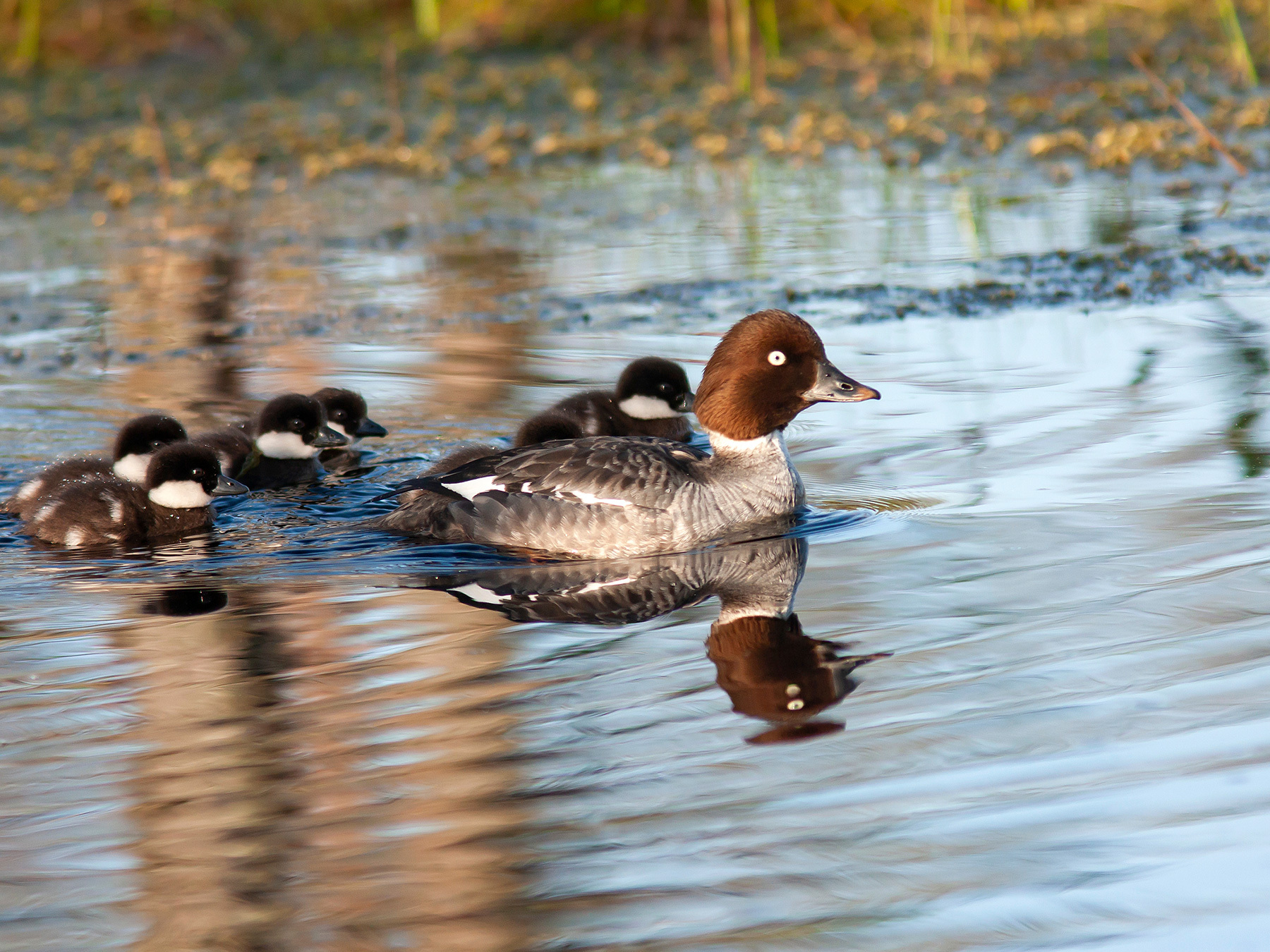
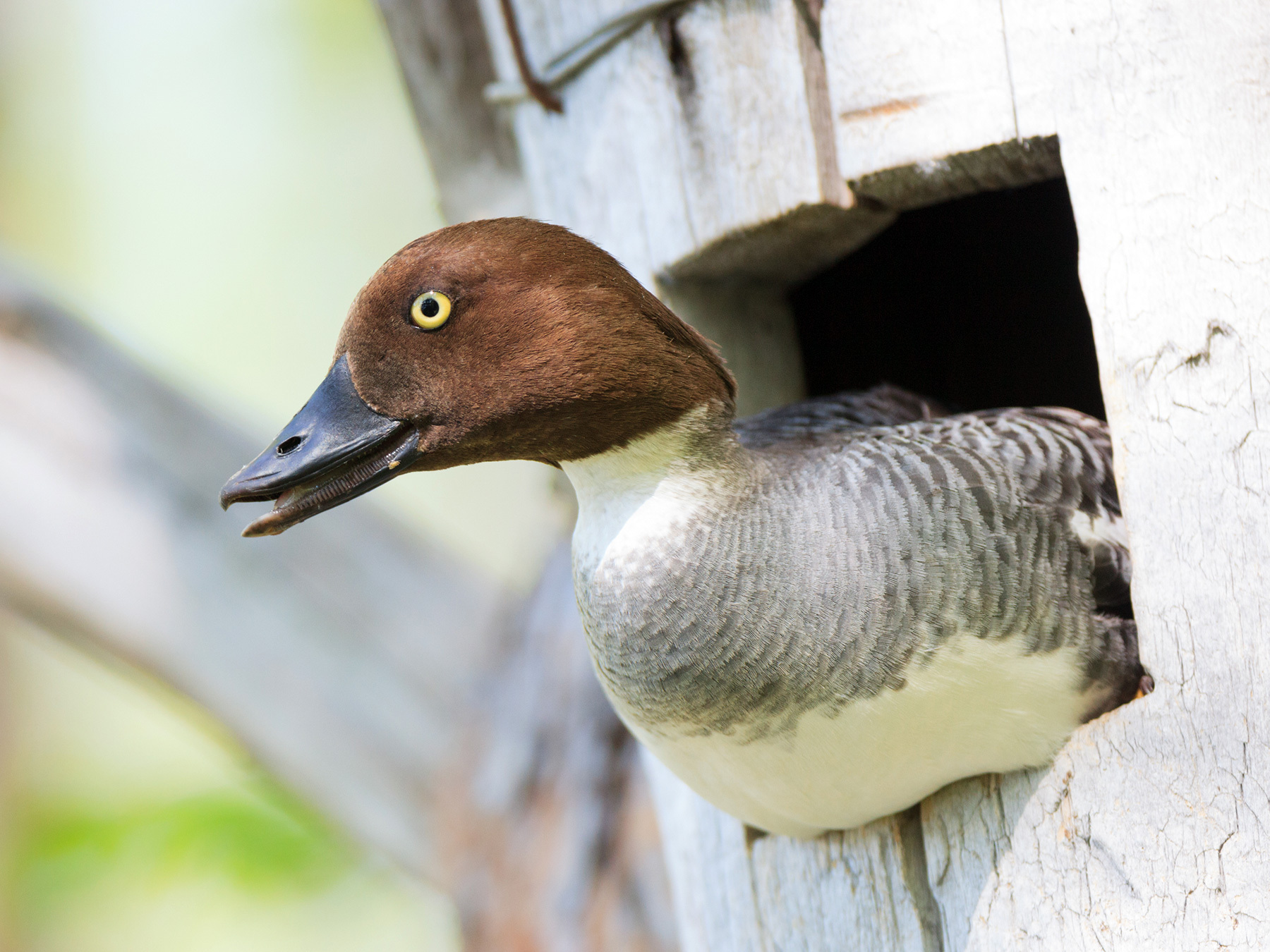
Female goldeneyes are unlike males in coloring but share the same almost-triangular head shape. They have mottled gray-white flanks, slate gray upperparts, wings, and tails. Their head is a rich chocolate brown, with a pale yellow eye, a faint white neck band, and a short black bill that is tipped with yellow.
Once breeding is complete, male goldeneyes molt into a basic plumage similar to the female, although the non-breeding male’s head is a darker shade of brown-black and the bold wing patterning remains.
Juvenile goldeneyes are similar to females and may also be easily confused with non-breeding males. Immature birds lack the yellow bill tip seen in adult females and their eyes are darker brown.
How big are Goldeneyes?
Around the same size as a redhead, goldeneyes are classed as a medium-sized diving duck species. Females are noticeably smaller than males.
- Length: 42 cm to 50 cm (17 in to 20 in)
- Wingspan: 65 cm to 80 cm (26 in to 31 in)
- Weight: 650 g to 1200 g (1.4 lb to 2.6 lb)
Its size
Adults- Length
- 40–51 cm
- Wingspan
- 65–80 cm
- Weight
- 600–1400 g
Its song and calls
What sound does a Goldeneye make?
Goldeneyes are a quiet species, with females usually only heard when defending the nest site against potential intruders by making a guttural grunting sound. Males may make high-pitched peeping cries during courtship but are otherwise mostly silent.
Goldeneyes are sometimes known as ‘whistlers’, not because of any vocal sounds the species make, but due to the high-pitched whirring sound made by a goldeneye’s wingbeat in flight.
- Song0:00 / 0:21
When and where to see it
OctoberIn season
Most recorded in October
- 1. Perthshire and Kinross1.1%
- 2. Renfrewshire1.0%
- 3. Clackmannanshire0.70%
- 4. Angus0.68%
- 5. Aberdeenshire0.61%
Each dot is a county, state or province: the bigger and darker, the larger the bird’s share of that place’s bird records that month. Grey dots: no regular records. The ringed point is the centre of the bird’s records this month; the arrow shows how it moved since last month, and the dashed loop its path through the year. “Arrivals” colours places where it becomes regular this month (orange) or is in its last regular month (grey). GBIF eBird Observation Dataset, 2019–2024. Map data: Natural Earth, US Census Bureau; place centres © OpenStreetMap contributors.
In your area
See when the Goldeneye is recorded in your county, state or province.
How often the Goldeneye turns up in the UK, Ireland, the United States and Canada through the year, from birdwatchers' records.
United Kingdom
Winter visitor · regularly Sep–Apr · most records in January
Ireland
Winter visitor · regularly Oct–Apr · most records in January
United States
Winter visitor · regularly Nov–Apr · most records in January
Canada
Winter visitor · all year · most records in January
Show as a table
| Month | United Kingdom | Ireland | United States | Canada |
|---|---|---|---|---|
| January | 0.50% (regular) | 0.25% (regular) | 0.58% (regular) | 1.6% (regular) |
| February | 0.41% (regular) | 0.21% (regular) | 0.50% (regular) | 1.4% (regular) |
| March | 0.33% (regular) | 0.089% (regular) | 0.37% (regular) | 1.4% (regular) |
| April | 0.038% (regular) | 0.014% (regular) | 0.098% (regular) | 0.76% (regular) |
| May | 0.018% | <0.001% | 0.019% | 0.24% (regular) |
| June | 0.020% | – | 0.014% | 0.18% (regular) |
| July | 0.012% | – | 0.011% | 0.17% (regular) |
| August | 0.017% | <0.001% | 0.010% | 0.18% (regular) |
| September | 0.026% (regular) | – | 0.009% | 0.22% (regular) |
| October | 0.10% (regular) | 0.018% (regular) | 0.026% | 0.43% (regular) |
| November | 0.35% (regular) | 0.15% (regular) | 0.26% (regular) | 1.3% (regular) |
| December | 0.44% (regular) | 0.20% (regular) | 0.44% (regular) | 1.5% (regular) |
Recorded regularly in
Worldwide: recorded regularly in 55 countries
Countries where it was recorded in at least 3 of the 6 years 2019–2024. Linked countries have their own bird list.
Europe (37)
Asia (14)
- Azerbaijan
- China
- Georgia
- India
- Iran
- Japan
- Kazakhstan
- Kyrgyzstan
- Mongolia
- Nepal
- South Korea
- Taiwan
- Turkey
- Uzbekistan
North America (4)
Data: EOD – eBird Observation Dataset (Cornell Lab of Ornithology), accessed via GBIF.org, CC BY 4.0. Records from 2019–2024, aggregated and filtered by Birdfact. How these lists are made
What is the habitat of a Goldeneye?
Goldeneyes nest in coniferous forest habitats in the far northern hemisphere, within close range of clear freshwater lakes, pools, and fast-flowing rivers. Bodies of water without many fish are their preferred foraging grounds, where there are fewer duck species competing for food.
During migration passage, larger lakes and rivers serve as important stopover points en route to wintering grounds in coastal lagoons, estuaries, and harbors, as well as ice-free inland lakes, reservoirs and rivers.
What is the range of a Goldeneye?
The distribution range of goldeneyes extends across the boreal forest zone of Canada, Alaska, the northern United States and across the Atlantic Ocean to Scandinavia, eastern Europe, Russia, Mongolia and northern China.
In winter, most populations of goldeneyes shift southwards, and the wintering range of the species includes the Pacific coast of Canada, the coast of Alaska, and further inland into the United States. In Europe, overwintering goldeneyes are found across the northern part of the continent, in the United Kingdom, Norway, the Netherlands, Belgium, and Germany, with scattered populations in Turkey and Central Asia. Further east, wintering grounds of goldeneyes are present in eastern China, Korea, Japan, and Russia’s Kamchatka Peninsula.
Where do Goldeneyes live?
Up to 1.5 million goldeneyes live in North America, with the majority breeding in Canada where the population is loosely estimated at between 500,000 to 1 million individuals. Of Europe’s estimated 977,000 to 1.25 million goldeneyes, Finland and Sweden have the highest numbers, with increasing populations in Germany and Estonia. Russia has between 100,000 and 1 million breeding pairs.
How rare are Goldeneyes?
The global population of goldeneyes is estimated at between 2.7 million and 4.7 million individuals, with up to 1.5 million of those in North America. They are most abundant among lake regions of the boreal forest in Canada and the northern United States, and in winter can be found in large numbers at coastal bays from northern New England as far south as Chesapeake Bay and on the coasts of southeastern Alaska and British Columbia.
Goldeneyes first nested in the UK in the 1970s, but since then breeding populations of around 200 pairs have developed, meaning that the species continues to be a rare breeding bird in Britain, but sites are well established. During winter, sightings become far more common, with the arrival of up to 21,000 goldeneyes from northern Europe.
Where can you see Goldeneyes in the US?
Goldeneyes’ breeding territories within the US include much of inland Alaska, with an absence in the extreme coastal regions. Minnesota and Michigan also have resident populations on inland lakes and freshwater marshes. In winter, goldeneyes are common along the Mississippi and Snake rivers.
Where can you see Goldeneyes in Canada?
Goldeneyes breed in forested regions throughout Canada, mainly concentrated in the region from Labrador through central Ontario to British Columbia. In winter, they are particularly at the Great Lakes and on the St. Lawrence River. After the summer breeding season ends, populations move towards the coast, and British Columbia’s coastline offers some good opportunities for guaranteed sightings.
Where can you see Goldeneyes in the UK?
The UK’s breeding population of around 200 goldeneye pairs is concentrated in the north-central Highlands of Scotland, where custom-made breeding boxes have been placed in trees to encourage nesting. In winter, up to 21,000 individuals arrive across the UK from northern breeding territories in Scandinavia, and the best chances of a sighting are at lakes and sheltered bays in northern and western England, between August and March.
Migration
Do Goldeneyes migrate?
Goldeneyes are a migratory species of waterfowl, breeding in the extreme northern latitudes of North America and Eurasia, before heading south to spend winters in the US, western Europe and East Asia.
Where do Goldeneyes migrate to?
Goldeneyes are a fully migratory species, undertaking relatively short migrations from their breeding grounds of the boreal forests of northern North America, Scandinavia, and Russia south into the United States, northern Europe, eastern China, the Korean peninsula and Japan.
Why do Goldeneyes migrate?
When water bodies on their northern breeding grounds begin to freeze over, goldeneyes lose access to their vital foraging grounds and need to move south in search of milder weather conditions and more abundant food resources. They are one of the latest species to migrate each fall.
Tips for seeing it
- Look for Goldeneyes on lakes, rivers, and coastal areas, especially during winter.
- Listen for the whistling sound of their wings during flight.
- Observe their diving behavior, as they frequently submerge for food.
- In North America, watch for them at wildlife refuges along major waterways.
- The UK’s breeding population of around 200 Goldeneye pairs is concentrated in the north-central Highlands of Scotland, where custom-made breeding boxes have been placed in trees to encourage nesting.
What it eats
What do Goldeneyes eat?
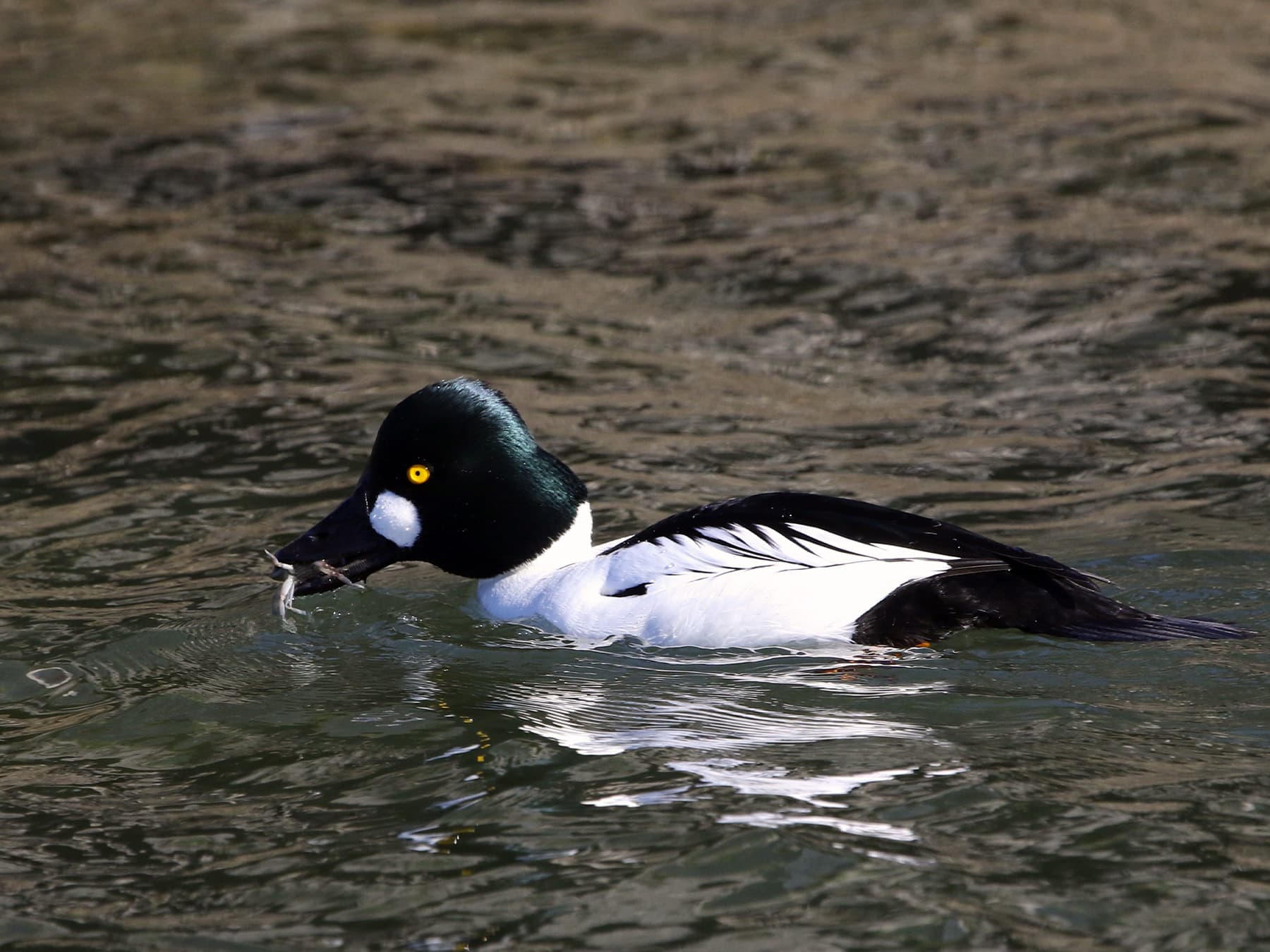
The diet of a goldeneye consists mainly of aquatic invertebrates, including such as molluscs, worms, crustaceans, and aquatic insects and their larvae, especially dragonflies, damselflies and mayflies. Some amphibians and small fish are eaten, and, particularly in the fall, plant matter, for example, seeds, roots, and shoots are also important.
What do Goldeneye ducklings eat?
The initial diet of goldeneye ducklings is animal-based and includes many aquatic invertebrates including beetles, larvae of caddisflies, water boatmen, and nymphs of dragonflies, damselflies and mayflies.
Nesting and breeding
Where do Goldeneyes nest?
Nest cavities in forest environments are the favored breeding spots for goldeneyes, although when no suitable natural sites are available, artificial nest boxes will readily be used. Holes excavated by black woodpeckers and pileated woodpeckers may be reused by nesting goldeneyes, as well as naturally occurring cavities in dead tree trunks, or occasionally abandoned rabbit burrows or crevices in between rocks.
Nests are usually at least 1.3 m above the ground and can be as high as 13 m (40 ft). Sites near water are preferred, and cavities are almost always located within 1.3 km (0.8 mi) of a lake or pond.
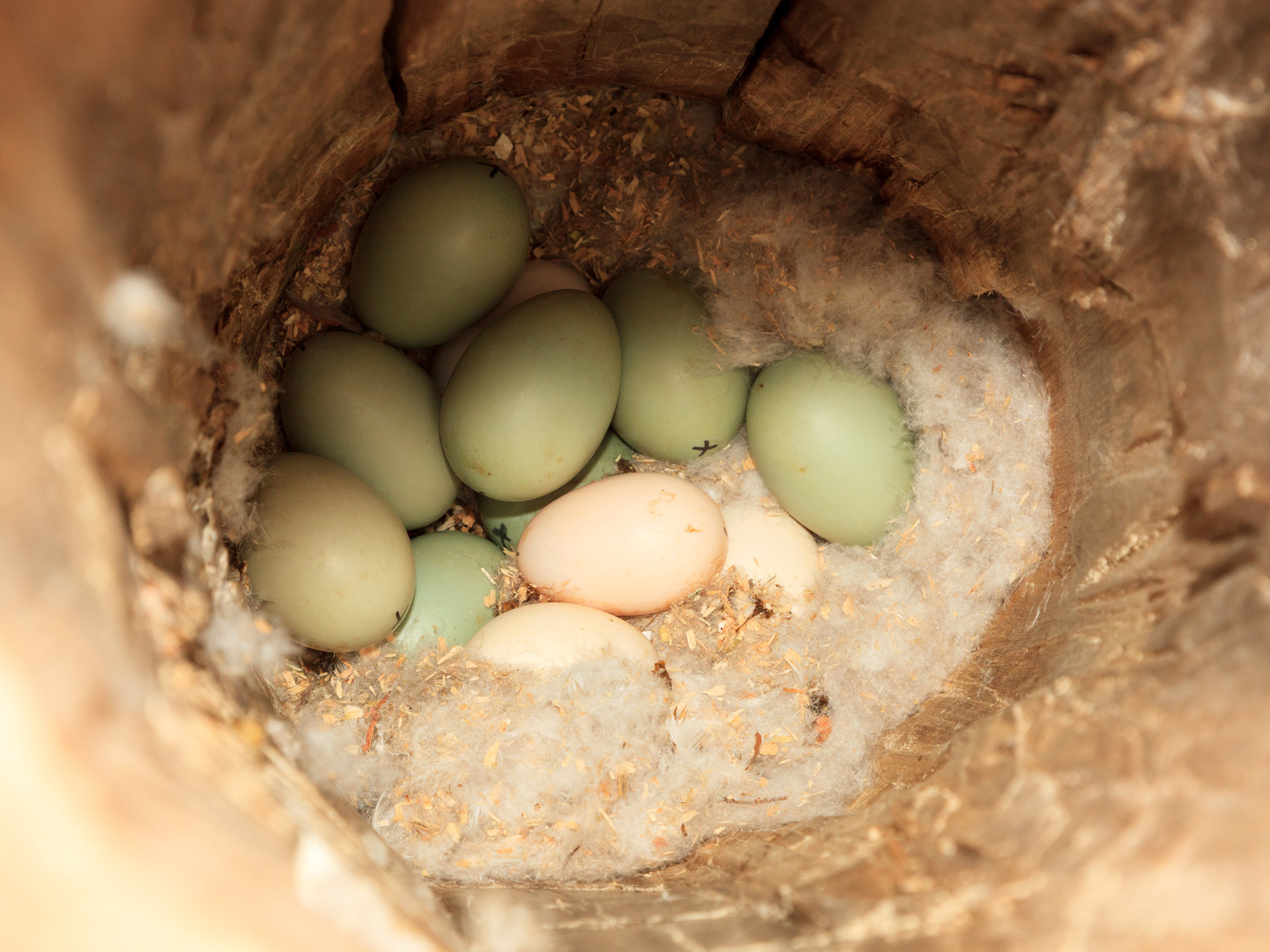
Inside the cavity, the female goldeneye crafts a rough bowl-shaped nest from whatever materials, if any, are available there. An inner lining of downy feathers is added to the interior before the eggs are laid. Females that have bred successfully in previous seasons are likely to return to their former nests in successive seasons.
When do Goldeneyes nest?
In North America, egg laying begins from late March onwards, with the peak hatching period in May and June. The European nesting period begins slightly later, with April being the earliest month for eggs to be laid, and most of the Russian breeding population not laying until mid-May. Incubation, by the female alone, varies from 28 to 32 days, and the young are brooded in the nest cavity for the first day after hatching.
What do Goldeneye eggs look like?
Goldeneyes’ eggs are smooth and glossy, and from light green to pale blue in color. A typical clutch contains between 8 and 11 eggs, which measure 59 mm by 43 mm (2.3 in to 17 in).
Do Goldeneyes mate for life?
No data is available for the long-term duration of goldeneye pairs and whether they reunite in future years. Males leave the female during the first two weeks of incubation, and the pair bond dissolves. Courtship displays begin in winter and most goldeneyes arrive on breeding grounds already paired. One single brood is raised per season.
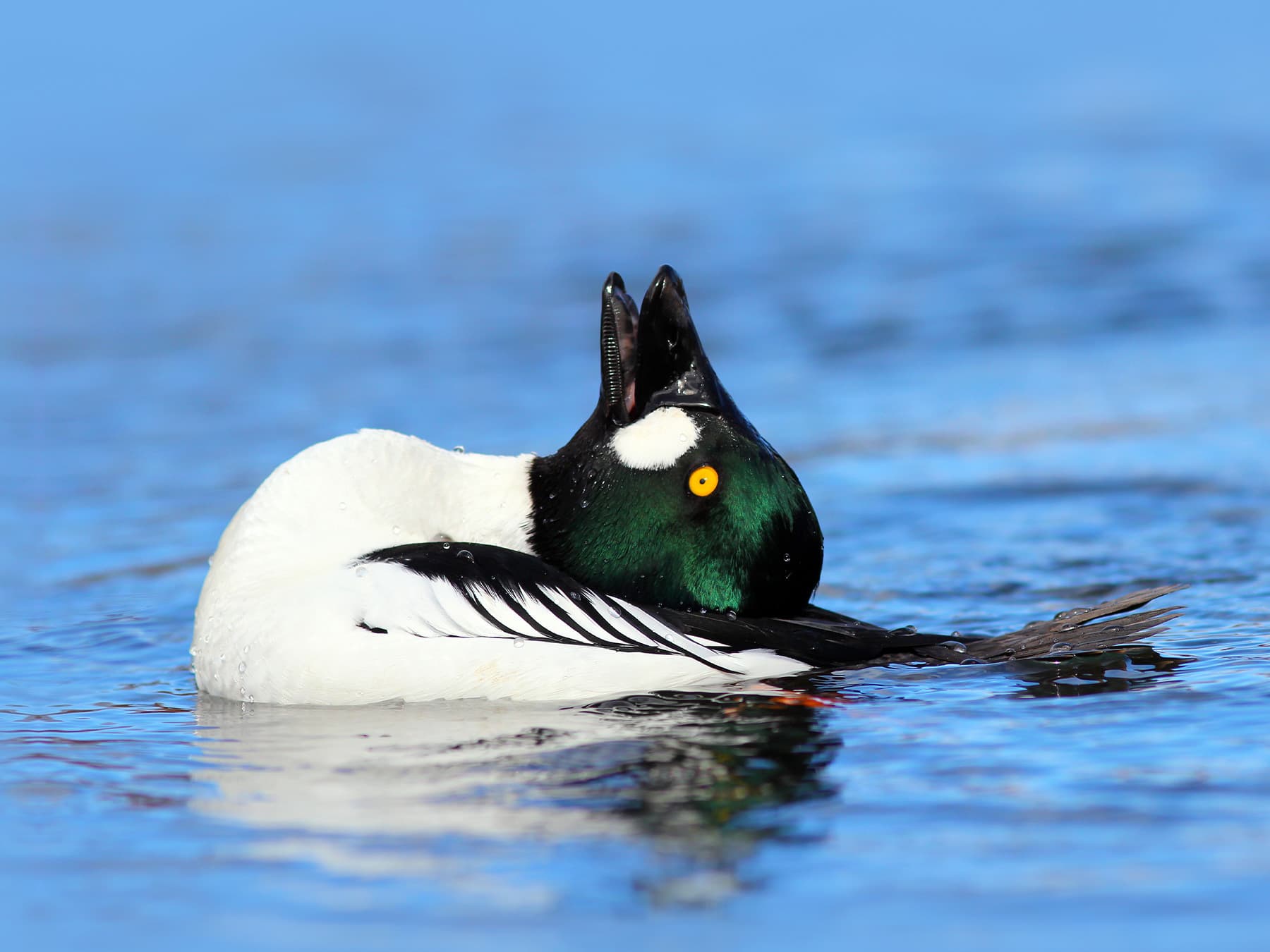
Courtship rituals of goldeneyes are particularly impressive, involving the male circling the female on the water with his head reclining and tail flicked upwards, kicking up water as he swims.
Behaviour
Are Goldeneyes aggressive?
Short-lived fights and bursts of aggressive behavior may be witnessed between males on breeding grounds, involving underwater pursuits and challenges to intruders until they leave the territory. Females are particularly defensive of their nest sites and dive to attack any ducks that come too near to their territory and may kill ducklings of other birds in the process.
Where do Goldeneyes sleep at night?
Offshore waters provide safe overnight roosting spots for goldeneyes. They head to open ocean sites from their foraging ponds and lakes shortly after sunset each evening.
Lifespan and predators
How long do Goldeneyes live?
The average lifespan for a goldeneye is around 6 years, although much older individuals have been identified by banding records, including one that reached 12 years in 2008. Breeding occurs for the first time from two years of age.
What are the predators of Goldeneyes?
Pine martens, mink, raccoons, and black bears are among the more common land predators of goldeneyes, particularly females. In nest cavities, females and their eggs are at risk of predation by red squirrels and northern flickers. Once young have hatched and are being raised by the female on the water, hawks, owls, and large predatory fish, such as northern pike, pose a threat.
Are Goldeneyes protected?
The Migratory Bird Treaty Act of 1918 protects goldeneyes in the United States, with limits on hunting and seasonal restraints as to when and how many can be hunted.
In the UK, goldeneyes are protected as a Schedule I species under the Wildlife and Countryside Act, 1981, which makes it an offense to disturb or destroy nest sites and eggs, or to kill, injure or take a goldeneye into captivity.
Are Goldeneyes endangered?
Goldeneye populations are stable and the species is considered of least concern globally. However, some future concerns exist over the threats to boreal forest habitats on their Canadian breeding grounds.
In the UK, goldeneyes are a Red category species in the British Birds of Conservation Concern list due to the limited number of breeding sites.
Conservation
While the Common Goldeneye is currently listed as Least Concern, it faces threats from habitat loss, particularly the destruction of mature forests near water bodies where they nest. Climate change may also impact their breeding range and timing.
Conservation efforts focus on protecting nesting habitats and maintaining water quality in their aquatic environments.
More photos
5 photos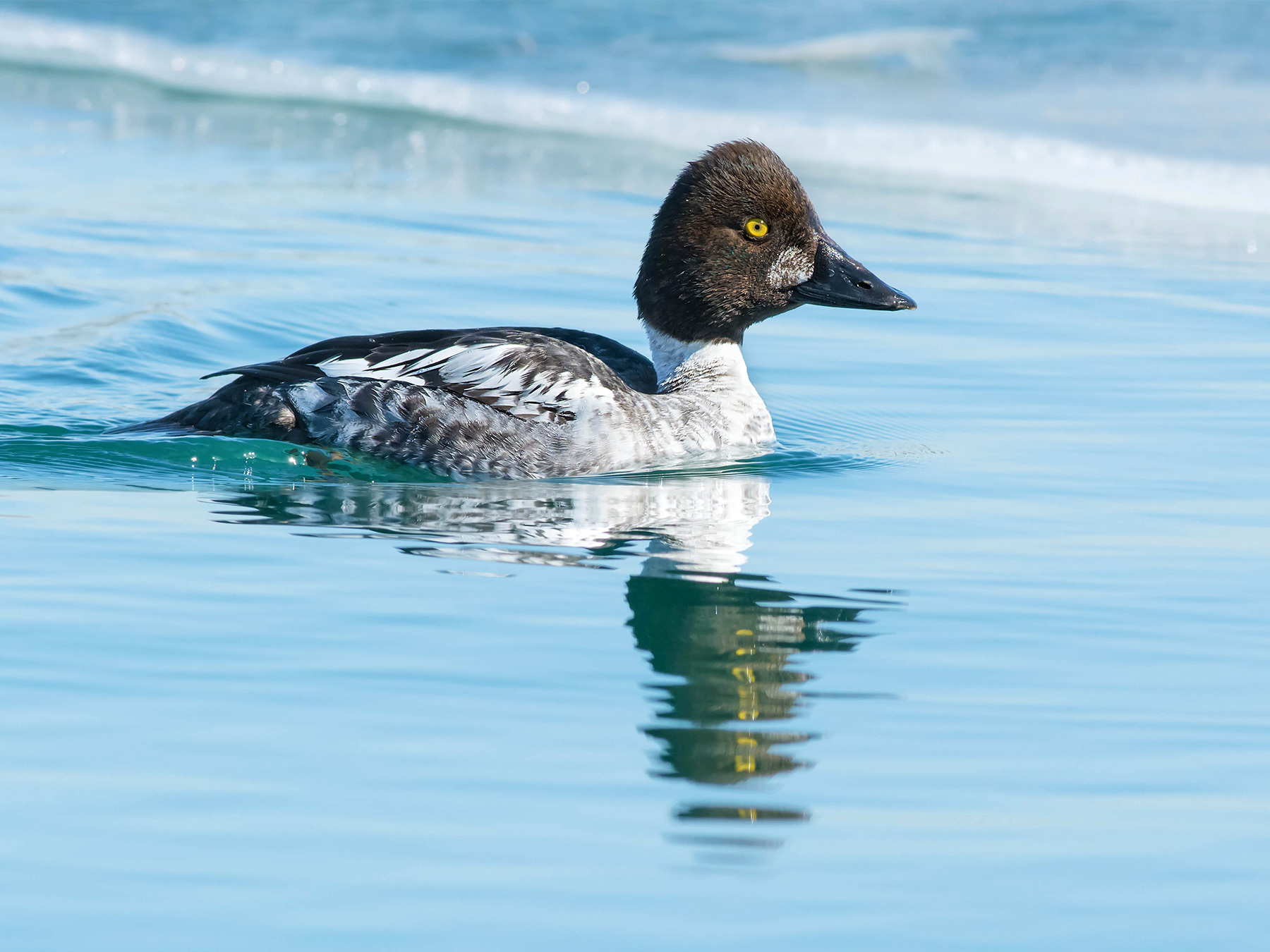
Goldeneye guides
5 guidesQuick facts
- Length
- 40–51 cm
- Wingspan
- 65–80 cm
- Weight
- 600–1400 g
- Lifespan
- 10–15 years
- Family
- Ducks, Geese & Swans
- Migration
- Short-distance migrant
- Global status (IUCN)
- Least Concern
- World population
- 2,700,000 - 4,700,000 mature individuals
- Population trend
- Stable
- Also called
- Common Goldeneye, Whistler
- Scientific name
- Bucephala clangula
Questions
1Is a Goldeneye a duck?
Goldeneyes are medium-sized ducks and are classed as diving ducks, a category that includes other waterbirds such as canvasbacks, redheads and scaup.
Sources
3- 1BirdLife International. 2018. Bucephala clangula. The IUCN Red List of Threatened Species 2018: e.T22680455A132529366. Source (opens in a new tab)
- 2Wetlands International (2015)
- 3Wetlands International (2015)

Checked by
Nathan Cope, founder and editor
Nathan founded Birdfact and leads its writers and contributors in the UK, the US and Canada. He has watched and studied birds for more than ten years, and checks every article and species guide before it’s published.