


Eastern Wood-Pewee
Wood Pewee · Contopus virens
By the Birdfact teamChecked by Nathan Cope
On this page14 sections
How to recognise it
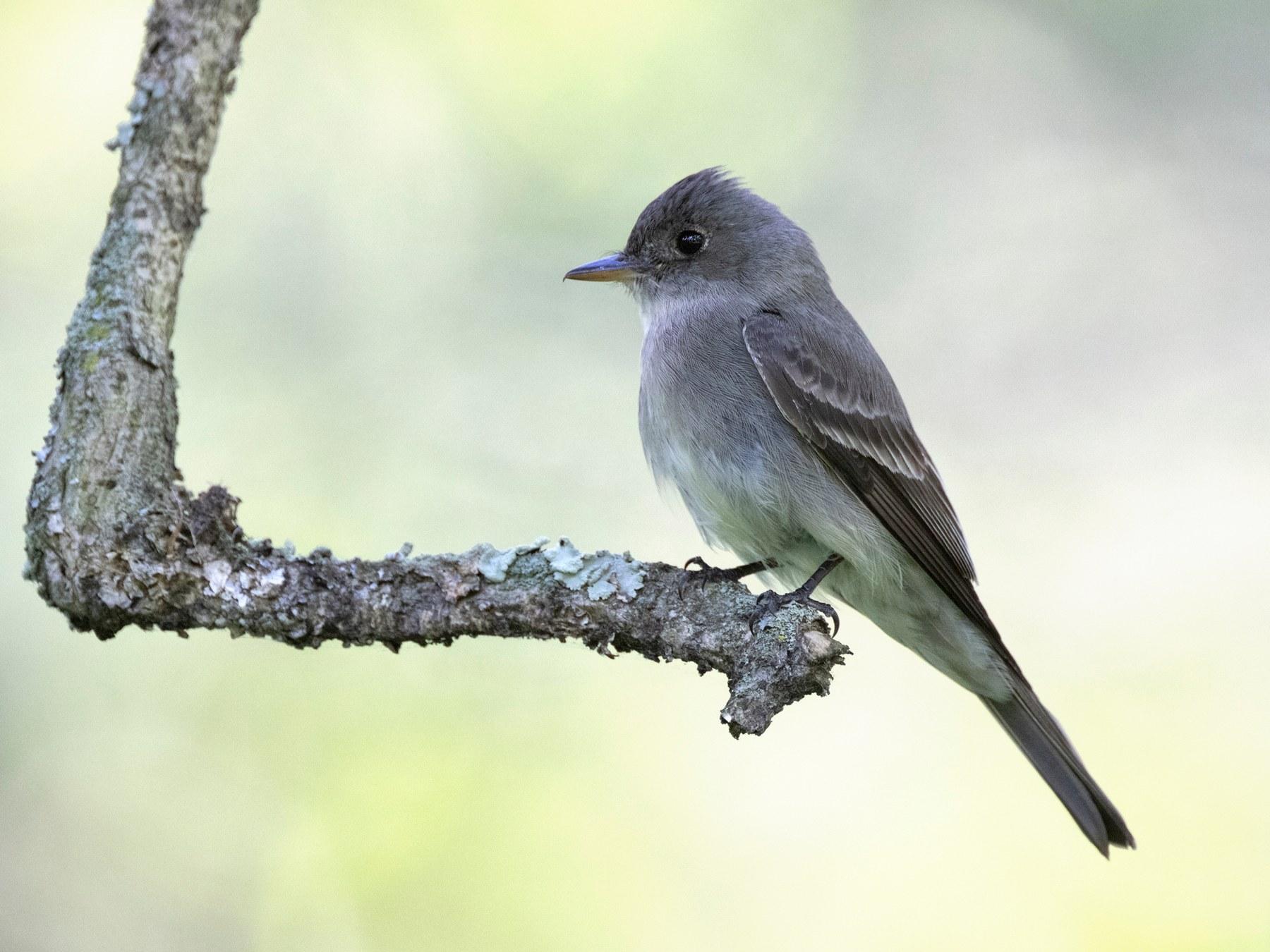
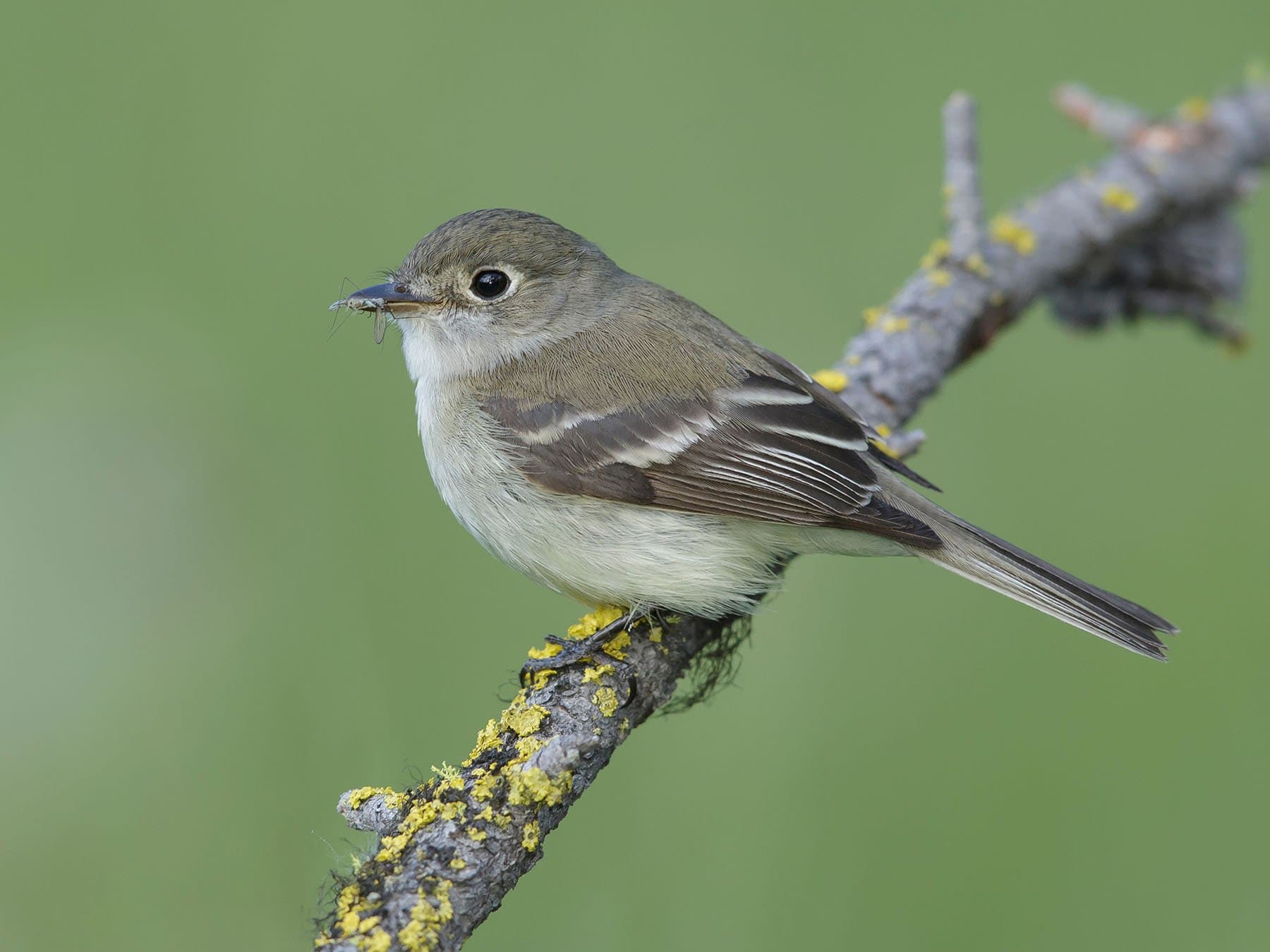
Look for a slim, upright flycatcher that is grayish olive above, with a slightly darker crown and a dark tail. Two pale wing bars cross the dusky wings, and the long wingtips reach at least halfway down the tail. Below, a darker olive-gray wash across the chest and sides sits between a pale throat and a pale belly, often split down the middle, so the bird looks as if it wears an open vest. The crown is peaked, which gives the head a triangular look.
Two more details help. The bill is dark above and orange-yellow below with a dark tip, and there is no clear eye-ring, at most a few white feathers behind the eye. A perched pewee also keeps still: it does not wag its tail or flick its wings, which helps separate it from the Eastern Phoebe and the Empidonax flycatchers.
Size and weight
Male, female and young birds
Males and females look alike in every plumage and are not told apart in the field. Males average slightly longer wings, and a statistical analysis of museum specimens' measurements can separate the sexes, but that is no help with a bird in a tree.3
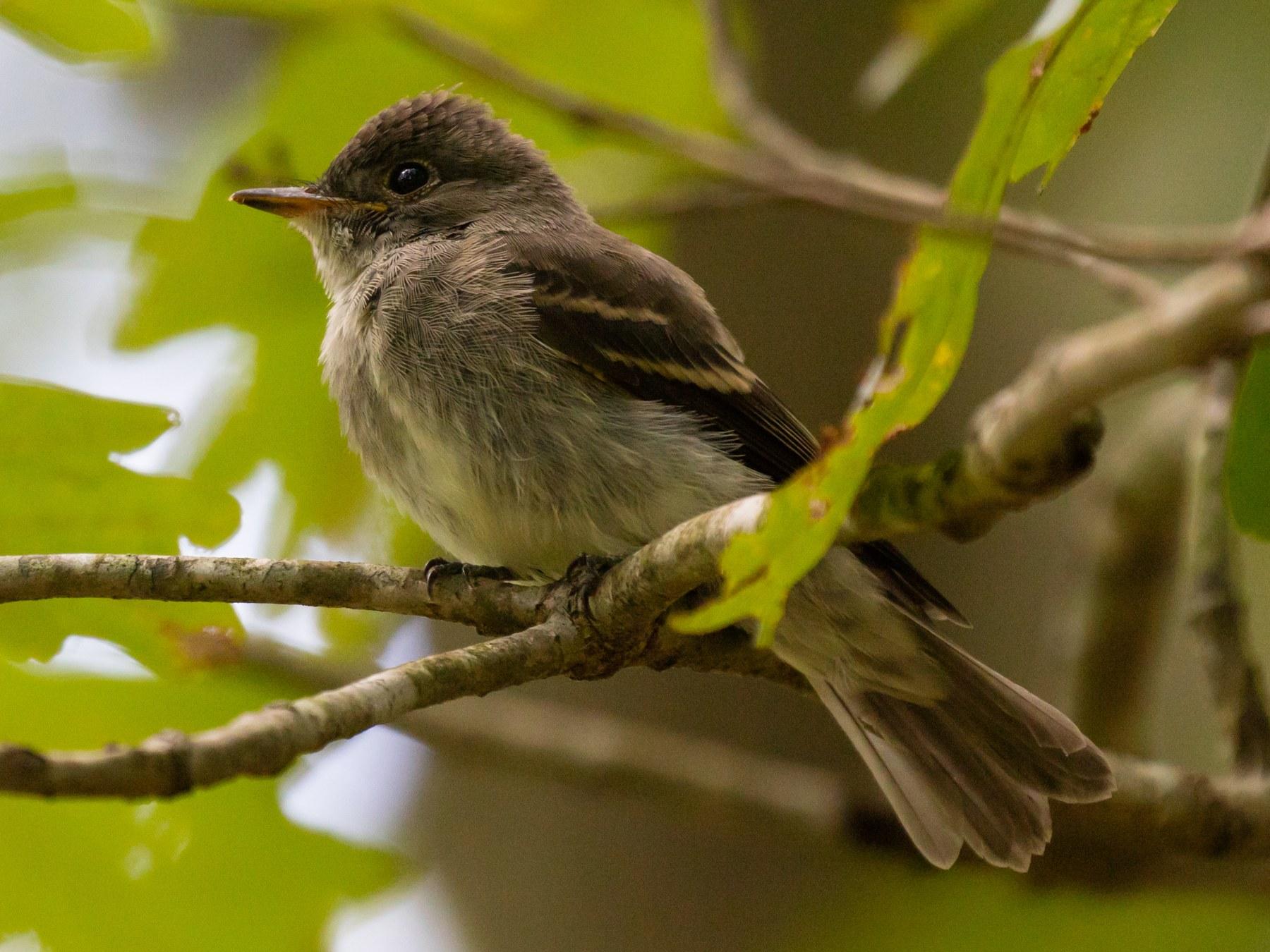
Young birds, seen mainly from July to October, are darker than adults, with dull cinnamon to brown edges on the back feathers, buff to cinnamon wing bars, yellower underparts, and a lower bill that may average darker. On fall migration they are in fresh feathers while the adults look worn. After its first winter a young bird looks like an adult. Only a few faded outer primary coverts, a detail for the hand or a sharp photo, give it away, and it typically takes full adult plumage at its second annual (prebasic) molt.
Identifying it from similar birds
The bird most like it is the Western Wood-Pewee, which cannot be safely told from an Eastern by plumage alone. Song and range separate them. The Western breeds in the West and meets the Eastern only in a narrow zone on the Great Plains, and its song is a burry or nasal pee-er, not a clear pee-a-wee or a pee-yur that slurs downward. The Western's dawn song is one long note and two short ones, peee-pip-pip. Calls other than the song may not tell them apart, so treat any wood-pewee near the Plains that is not singing with caution.
An adult Eastern Phoebe is larger, with no wing bars (young phoebes can show buff ones), an all-black bill and shorter wingtips, and it bobs its tail often, which a wood-pewee does not. Timing helps too: the phoebe winters in the southern US and is among the first migrants back in spring, while the pewee winters in the tropics and comes back late.
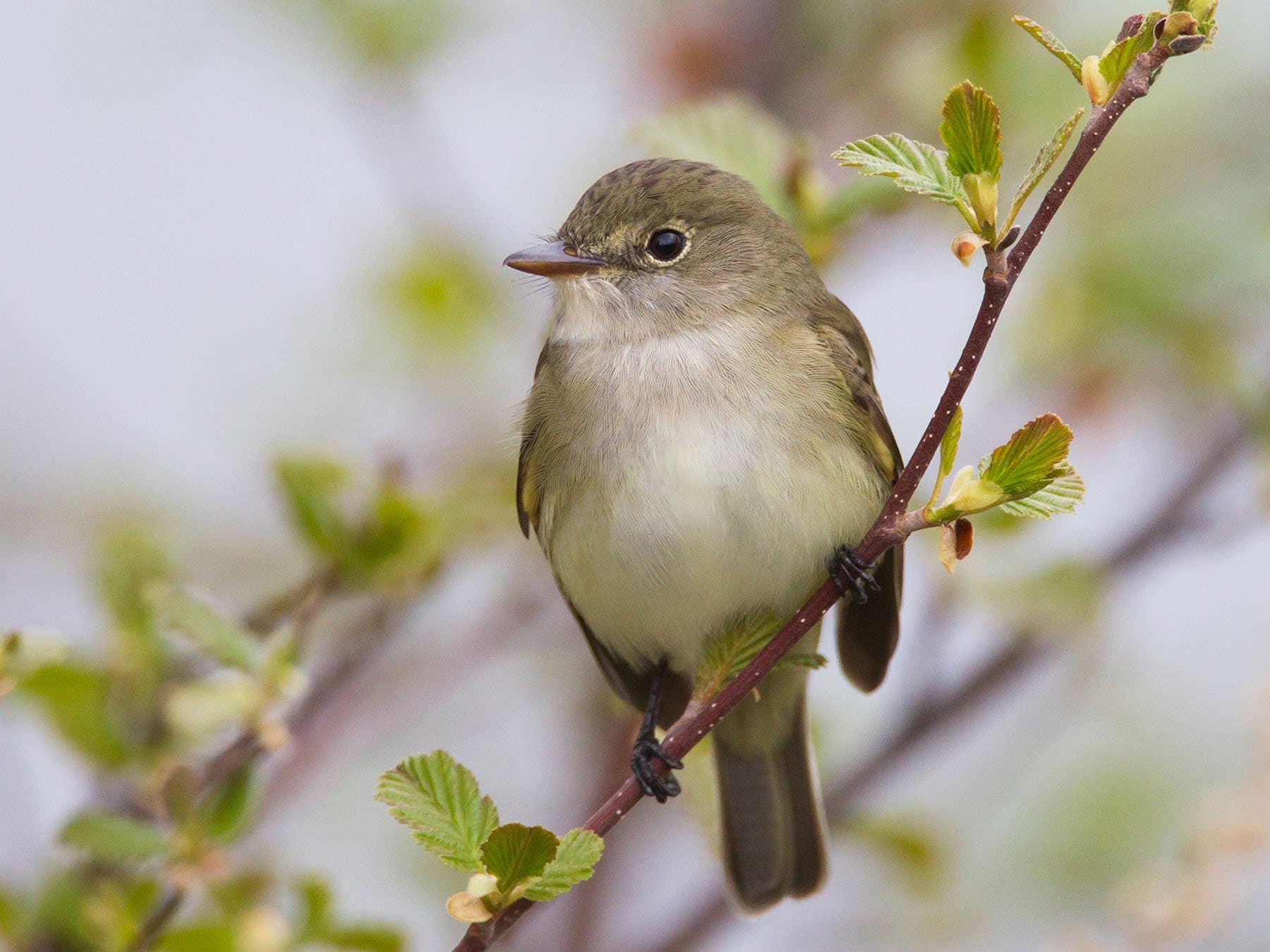
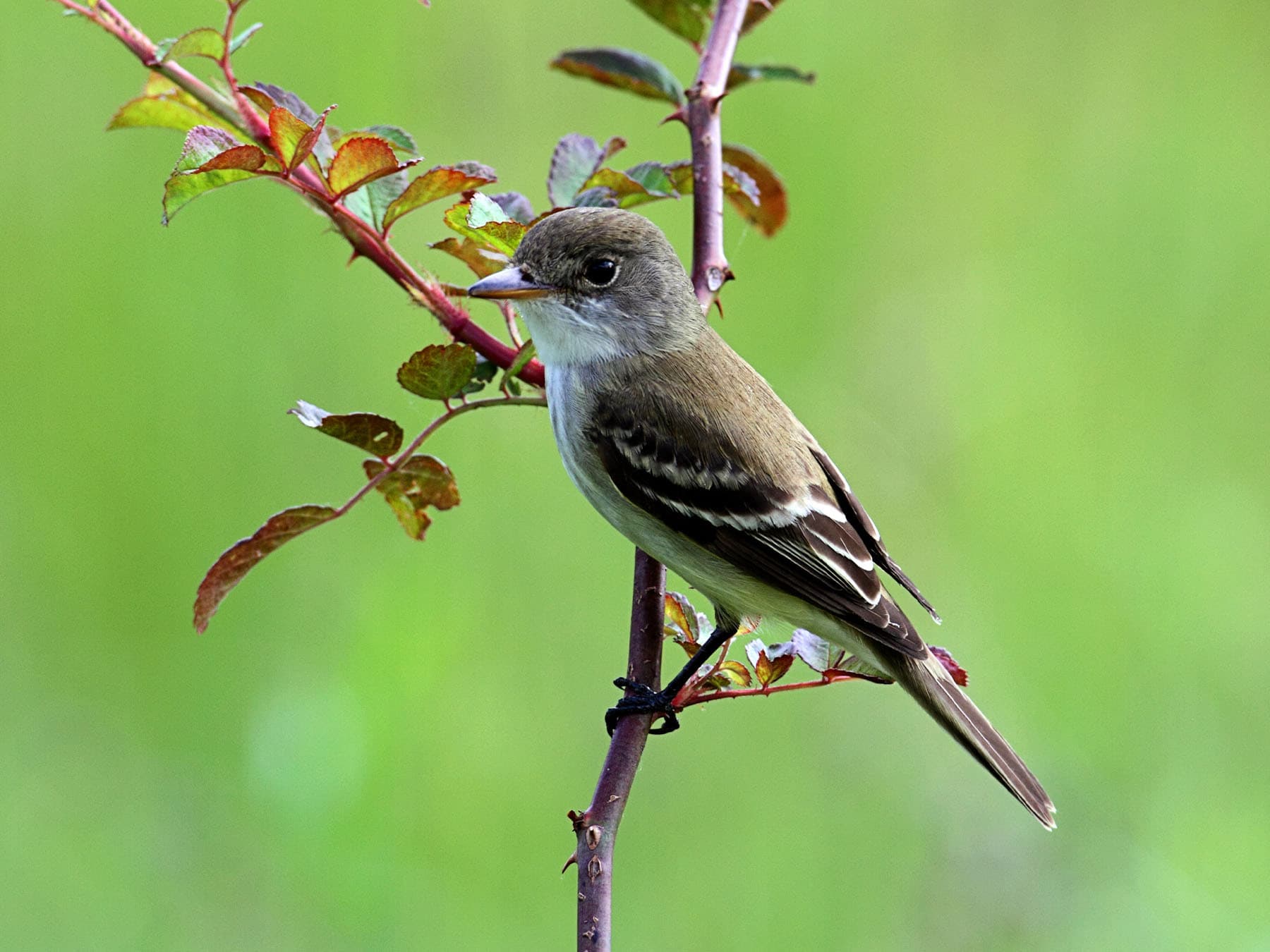
The Empidonax flycatchers have shorter wings that do not reach as far down the tail. An Alder Flycatcher is smaller, with a narrow whitish eye-ring (sometimes faint), bold whitish wing bars and a burry fee-BEE-o song. A Willow Flycatcher is slightly smaller and sings FITZ-bew. A Least Flycatcher is smaller, 4.9–5.5 in (12.5–14 cm), with a white eye-ring that is complete or nearly so and short, rounded wings. An Acadian Flycatcher is greener above, with a narrow, distinct eye-ring, a yellow wash on the belly and an explosive peet-sah song.
An Olive-sided Flycatcher is bigger, 7.1–7.9 in (18–20 cm), and bull-headed, with dark sides like an unbuttoned vest on a white breast, often a white tuft by the rump, and a quick three-beers song.
Not sure it’s a Eastern Wood-Pewee? Check your photo: Birdfact names the bird and shows the look-alike side by side.
Its size
Adults- Length
- 15–17 cm
- Wingspan
- 25–28 cm
- Weight
- 10–19 g
Its song and calls
Song is the easiest way to find an Eastern Wood-Pewee, and the singer is often heard long before it is seen. By day it repeats a slow, slurred, whistled pee-ah-wee, about a second long, every few seconds, now and then dropping in a plaintive, falling wee-ooo. Other guides write it as pee-a-weeeee, or as pee-weee with the last note dropping.
Singing is at its height as soon as the birds arrive; at Philadelphia it was strongest from mid May to mid June. Males with incubating mates sing less, but some sing again in late summer, into late August and September, and few songbirds keep singing once nesting is over: the pewee and the Red-eyed Vireo are two that do.3 On the wintering grounds it calls often and sometimes sings.
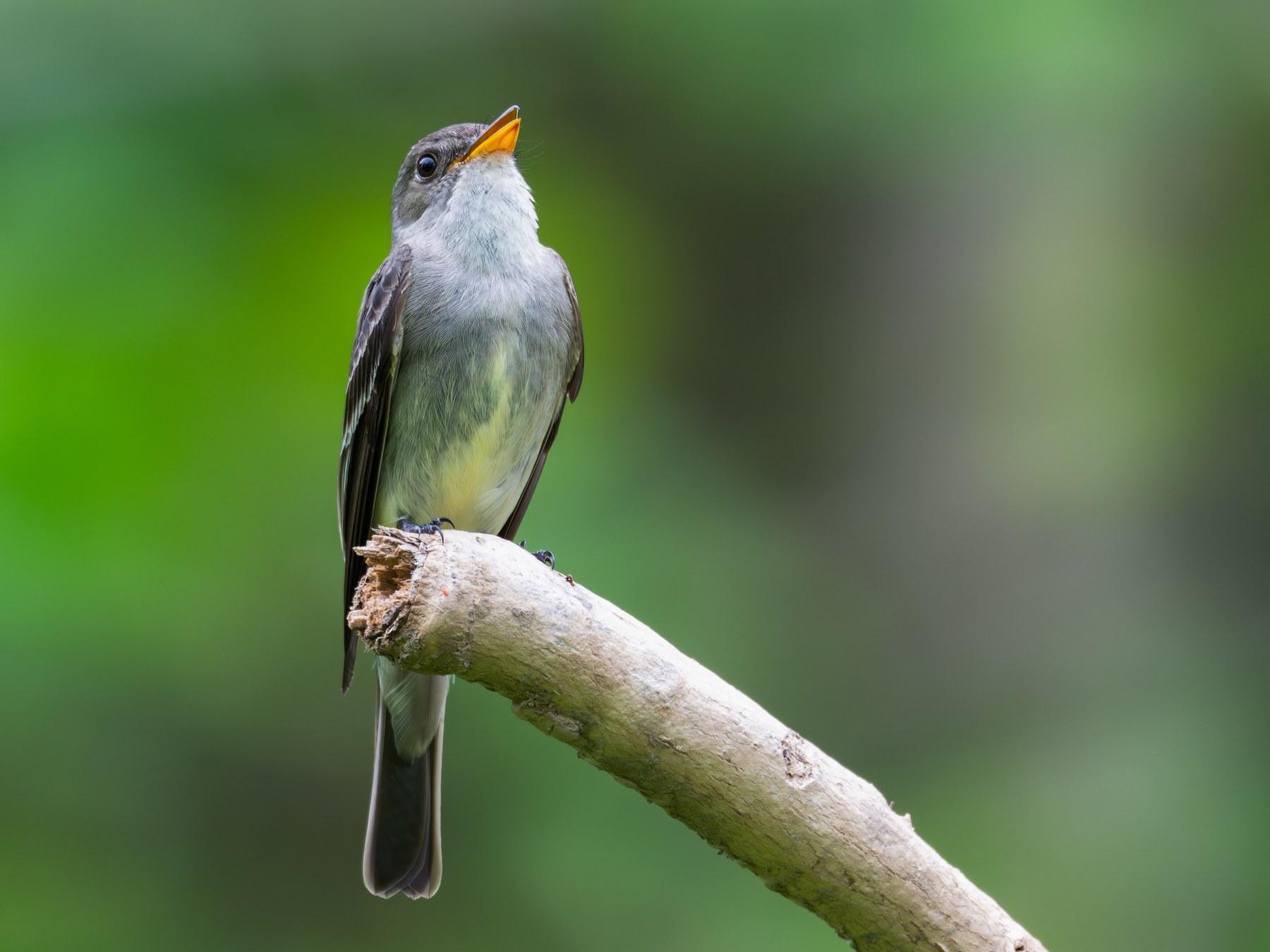
The usual call is a short chip, softer and lower than the phoebe's.4 A pair disturbed at the nest gives a shrill, rapid pe-e-e-e-e-e, courting birds twitter, chases bring squeaks, chips and fast chatter, and adults snap their bills near the nest. Recently fledged young give a churring chip. As in other suboscine flycatchers, the song is thought to be innate, and no regional differences in it have been documented.
The player on this page has three daytime song recordings: from Oneonta, New York, in July 2024; Gatineau, Quebec, in May 2025; and Montgomery County, Maryland, in July 2025. None of the three is the twilight song.
Twilight song
Before sunrise the pewee sings a different, much faster song. It adds a third phrase, a slurred ah-di-dee, which is very rarely heard by day,5 and runs the phrases together at 20 to 36 phrases a minute, the fastest singing of the day. Calculated from 43 of the records in a 1943 study, the full twilight song typically starts 43 minutes before sunrise (25 to 64 minutes) and ends about 14 minutes before it. A bird sings it from the same spot each morning and may sing it again at sunset, and pewees also sing frequently at night.3 A pewee may keep singing late in the evening, after most songbirds have stopped.1
Much of what is known comes from one study. Wallace Craig's 1943 monograph pooled 144 morning records, more than 93,000 phrases, from 22 observers listening by ear. He found the rhythmic morning song lasted 16 to 32 minutes, 24 on average, at about 27 phrases a minute, against 5 or 6 a minute in the unhurried daytime style.5
- Song phrases0:00 / 0:31
Recorded in New York, United States · July 2024
- Two phrases0:00 / 0:08
Recorded in Quebec, Canada · May 2025
- Song, quiet0:00 / 0:34
Recorded in Maryland, United States · July 2025
Heard one and not sure? Let the bird song identifier listen.
When and where to see it
Eastern Wood-Pewees breed across the eastern half of North America. In Canada they range from southeastern Saskatchewan and southern Manitoba through southern Ontario and Quebec to the Maritime provinces. In the US they reach south to the Gulf Coast, northern Florida and southeastern Texas, and west to the central Dakotas, eastern Nebraska, central Kansas and central Oklahoma. They are summer birds only. In winter they live in northern South America, from Colombia and Venezuela south to Peru, Bolivia and the Amazon basin of Brazil.
Winter reports from southern Florida, Louisiana and southern Texas are unconfirmed, and misidentification is probable. Outside its normal range it is seldom reported, and in the western states a record not based on song is questionable.
Spotting tips
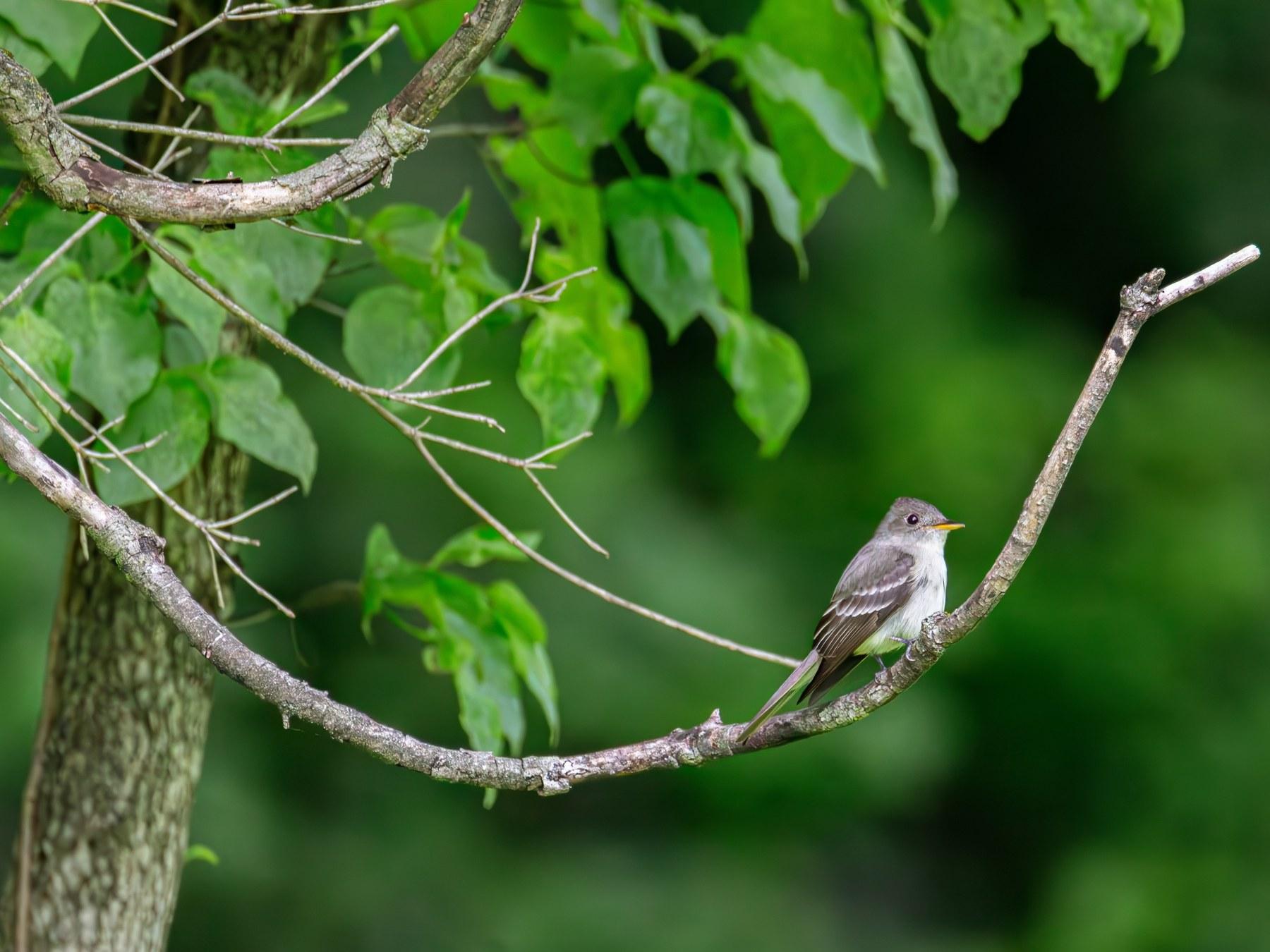
Listen first, then look for an upright bird on a bare or dead branch at a clearing or woodland edge, in the middle to upper levels of the trees. It flies out after a passing insect and often comes back to the same perch, so keep watching the branch.
Habitat
It breeds in almost every kind of eastern woodland, deciduous and coniferous, often at clearings and edges. Compared with the Least and Acadian Flycatchers it uses more open sites, with thinner canopy cover. A 1971 study found it typically absent under a closed canopy, but in southwestern Virginia territories were as common under closed canopy as under open, and in the Missouri Ozarks it was most numerous where canopy cover was high.3
The size of a wood seems to matter little: it uses small woodlots, forest edges and narrow streamside woods, though densities may be higher in larger forests. In Nebraska, by contrast, it was generally absent where forest covered less than 24% of the land, and in Ontario and Pennsylvania it was found less often in woodlots with houses around them than in those without.6 Field guides and the main handbook include town shade trees, suburban habitats and orchards, but one Partners in Flight reviewer notes it does not occur in highly altered farm or suburban landscapes.7
In winter it uses woods, part-cleared land and scrub, mostly below about 4,300 ft (1,300 m). A 2012 Canadian status report found almost nothing known about its winter habitat needs.6
Does it migrate?
Yes, a long way: it is a long-distance migrant between North America and northwestern South America. Unlike most eastern tyrant flycatchers, it is more likely to travel through eastern Mexico than to cross the Gulf of Mexico, and then on through Central America; a few cross the Caribbean, where it is rare or accidental.
It is a late spring migrant. The first birds reach the far southern US in early to mid April, and it becomes common across the breeding range in early to mid May. March and early April reports are poorly documented, and some may be Eastern Phoebes, or European Starlings copying the song.
Southward passage starts in the second half of August and is heaviest in the first half of September. Few remain after early October,1 though there are records in the northern US as late as mid October and into November farther south. Kills at TV towers suggest it travels mainly at night, yet birds are also seen flying past in the morning at Cape May, New Jersey.3
What it eats
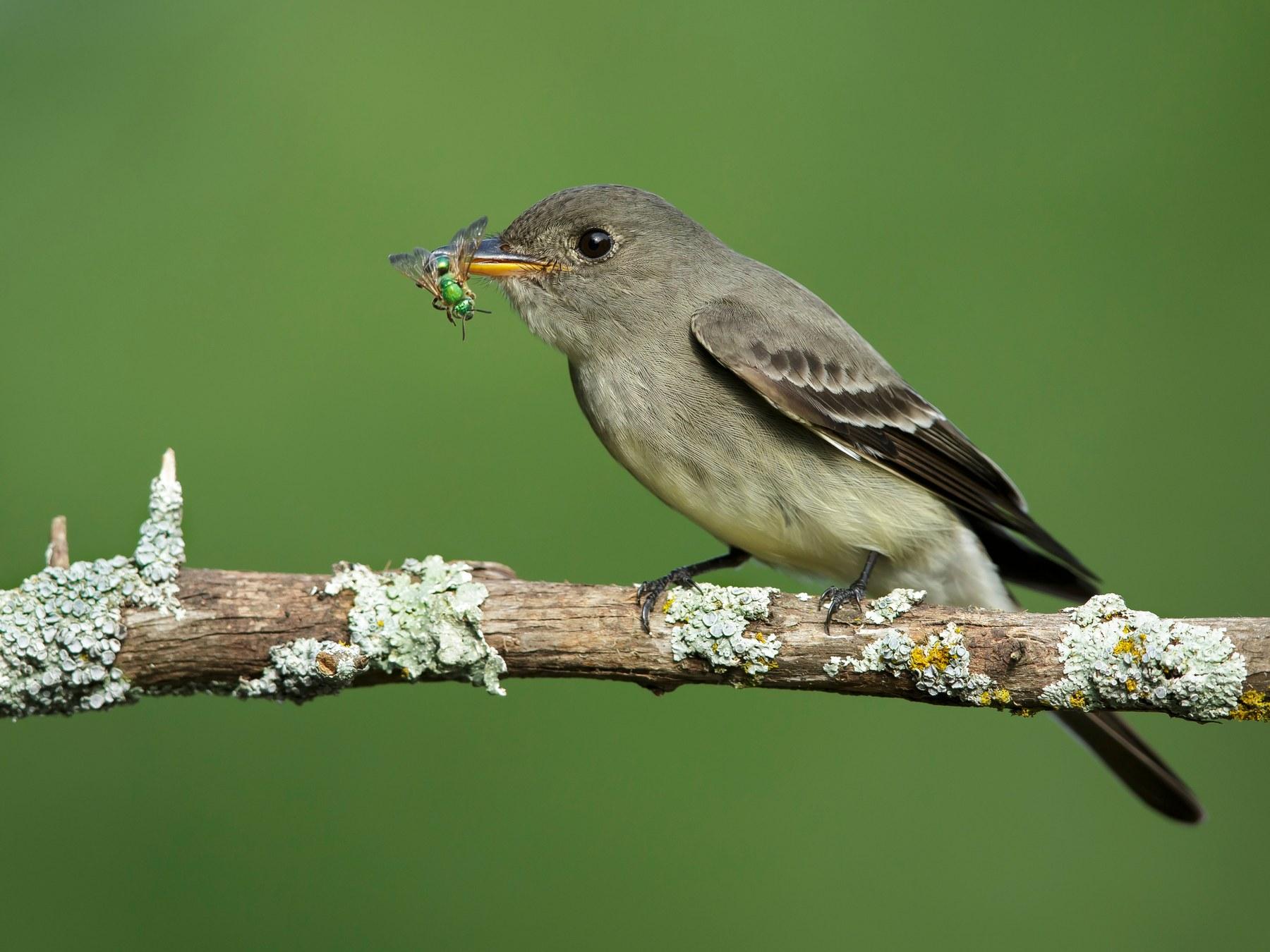
Almost all its food is small flying insects, most under 0.6 in (15 mm) long: flies, bees and wasps, moths and butterflies and their caterpillars, true bugs, beetles, grasshoppers, stoneflies and mayflies, with a few spiders. Now and then it picks an insect off leaves or the ground.
The broadest picture comes from an early stomach study of 359 adults from 20 states and 3 provinces, published in 1912. It found 99% small invertebrates: bees, wasps and ants and flies each about 30%, beetles 14.2%, moths and butterflies 12%, true bugs 6% and grasshoppers 3.4%. Plant matter, about 1% of the total, turned up in a few stomachs, as berries and seeds of dogwood, blueberry, Rubus, poison ivy and Panicum grass.3
Pewees usually stay away from feeders, as other flycatchers do, but a wooded backyard beside woods may draw one.
How it catches its food
It waits on an exposed perch, usually a dead branch in the subcanopy or canopy, and sallies out to take an insect in the air. When insects emerge in numbers it gathers where they are thickest and may take them just above the water.
It hunts from higher perches than the Least Flycatcher, Acadian Flycatcher and Eastern Phoebe, and from lower ones than the Great Crested Flycatcher. In one Illinois study it returned to the same perch after 23% of its sallies, more often than the Eastern Phoebe (15%) or Great Crested Flycatcher (5%). Its foraging flights there ran from less than 3.3 ft to more than 98 ft (1–30 m), 17 ft (5.2 m) on average. Birds there sallied about 36 times an hour, and 68 times an hour when they had young to feed.3
Nesting and breeding
The nest is a small, shallow cup of grass and fine fibers, bound with spider silk and covered outside with lichens. It always sits in a tree or sapling, on a limb well out from the trunk, usually a horizontal one and often in a fork or on a dead branch. From below it looks like a knot or bump on the branch. Only the female has been seen building, sometimes with the male nearby.
Nests are often high. In studies they ranged from about 4 ft (1.2 m) to 95 ft (29 m) up. The average was 28 ft (8.6 m) on North American nest record cards, 40 ft (12.2 m) in the Missouri Ozarks (310 nests) and 59 ft (17.9 m) in an Ohio oak forest (236 nests).3
Nesting runs from early May into September, with most nests from late May to late July; late nests are probably second broods.
Eggs and young
A clutch is typically 3 eggs, sometimes 2 or 4. The eggs are milky white to cream, speckled brown to purple in a ring around the large end.
The female incubates alone for 12 to 14 days while the male brings her food. Both parents feed the young, which leave the nest at about 15 to 18 days and then depend on their parents for probably 3 to 4 weeks.
One brood a year is the usual assumption, but second broods may be commoner than known. Double-brooding estimates in an Ohio population were 6–12%, and in the Missouri Ozarks 21% of 92 successful pairs tried a second brood, of which 3 succeeded.3 After a failure a pair builds a new nest and may try again several times.
In south-central Ontario in 2007–2008, nest success was 35% in deciduous forest and 22% in red pine plantations, where red squirrels and Blue Jays were more numerous.8
A 1963 account of cowbird hosts counted it a fairly regular host of the Brown-headed Cowbird, but not a favored one. Reported parasitism rates range from none in 32 Manitoba nests and 0.9% of 110 in Maryland to 5.5% of 165 in Canada and 15% of 40 in Michigan, with higher figures only from small Illinois samples. Pewees accept cowbird eggs.3
Behaviour
Outside the breeding season a pewee is generally a loner, and it usually holds a territory even on migration and in winter. Breeding territories estimated from pair densities run from about 5.4 acres (2.2 ha) in Iowa to 19 acres (7.7 ha) in Wisconsin.3
Its territories overlap those of Great Crested and Least Flycatchers, which it does not treat as rivals. Adults defend the nest area with chases and bill snaps. In Missouri they defended a 33-ft (10 m) radius around the nest, chasing and bill-snapping at Blue Jays, Red-bellied Woodpeckers, cowbirds and even butterflies.3
Pairs are usually monogamous, but in a color-banded Ohio population polygyny estimates ranged from 6% to 22%, higher in a dry year, and the males with two mates were all older birds that fledged more young.3 Courtship is barely described, beyond the male feeding the female, and as of the 2017 handbook account no in-depth study of its behavior apart from its song had been published.3
Lifespan and predators
How long a typical pewee lives is not known. The oldest on the US Bird Banding Laboratory's record was at least 10 years old: a male banded as an adult in Ohio on 13 June 2014 and caught and released alive there on 22 June 2023.9
Few banded pewees are ever met again. By 2017 there had been only 85 re-encounters of the more than 50,000 banded from 1922 on, with an average minimum age of 2.35 years for 82 of them. In Ohio 29–57% of 74 color-banded older males came back each year over three years, but a return rate is not a survival rate. The 2017 handbook account has no information on what kills adults, and it rates collisions with TV towers as probably a minor cause.3
Conservation
The Eastern Wood-Pewee is a species of Least Concern worldwide.10 Over the long term the Breeding Bird Survey shows a decline: counts fell 0.70% a year from 1966 to 2025 across the survey (95% credible interval –0.83 to –0.58, from 2,668 routes). The survey's modeled index fell from 4.13 birds per route in 1966 to a low of 2.24 in 2013.11 The last ten years have gone the other way. From 2015 to 2025 counts rose 1.78% a year (+1.43 to +2.13), and the index stood at 2.73 in 2025, about a fifth above the 2013 low and about a third below 1966.11
Partners in Flight estimates about 6.5 million Eastern Wood-Pewees for a population year around 2010, all of them in the US and Canada. It gives the species a Continental Concern Score of 9 out of 20, and it is not on the Watch List.7
Why the population declined
Why it declined over the long term is not known. Canada's 2012 status report and its 2017 listing name only possible factors, poorly understood for lack of research. They are loss and change of habitat where it breeds and winters, fewer flying insects, deaths on migration, nest predation and browsing by deer.6, 12 The report rated deer browsing and nest predation as low threats, but said poor survival from causes on the wintering grounds or on migration could be a high one.6 A study of survey data for 1997–2012 found that changes in hours of extreme temperature and in nesting habitat together explained only 20% of the year-to-year variation in where pewees colonized or disappeared, according to its summary.13
In forests sprayed with the insecticide diflubenzuron against the moth Lymantria dispar, pewees carried less body fat, likely because there were fewer insects to eat, though further study is needed. In Pennsylvania experiments none were detected on plots with more than about 20 deer per square mile (7.9 per km²), reportedly because browsing changed the middle layer of the forest.3 A Virginia study found no link between deer numbers and pewees.6
Several studies find more pewees where woods have been partly harvested, thinned or burned. In southeastern Ohio, densities were higher in oak stands shortly after a partial (shelterwood) harvest than in nearby unharvested forest, and birds there settled and started nesting about 3 days earlier, though the first gains after a harvest may be sporadic.3 In the Missouri Ozarks it was more abundant with recent or frequent fire and intermediate to high canopy cover.14 For forestry, the 2017 handbook account suggests large tracts of intermediate-aged, closed-canopy forest, thinned to remove mature trees and small woody growth, with clear cuts of about 25 acres (10 ha) or less.3
Legal status
In the US the Eastern Wood-Pewee is protected under the Migratory Bird Treaty Act and appears on the federal list of the birds the Act covers.15 The regulations allow no one to take, possess, sell or transport the bird, its parts, nests or eggs except under a permit or as the regulations allow.16 No federal depredation order names it,17 and it is not listed under the Endangered Species Act.18
In Canada it is protected under the Migratory Birds Convention Act, 1994.19 Since 2 November 2017 it has been on Schedule 1 of the Species at Risk Act as a species of Special Concern, after COSEWIC, Canada's national status committee, assessed it as Special Concern in November 2012. The listing notice says this brings no additional general prohibitions and no critical habitat, and that the species may become threatened if its decline continues.12
Names, relatives and hybrids
Older writers called it simply the wood pewee. The pewee, like the phoebe, is named for its song.20 Its scientific name is Contopus virens. Linnaeus described it in 1766 as Muscicapa virens, from Carolina.21 Bent in 1942 and Craig in 1943 used the older genus name Myiochanes.
The genus Contopus holds 14 species, and this bird is its type species. Its closest relative is the Western Wood-Pewee: the two diverged recently, and early taxonomists treated them as one species.
The two wood-pewees meet only in a narrow, recent contact zone on the Great Plains. A 1980 study of 12 museum birds from north-central Montana, western Kansas and western Texas found no sign of hybrids. Genomic work published in 2016 then showed hybridization clearly in north-central Nebraska, and the contact zone is linked to land-use change that likely brought the two together.3 Whole-genome sequencing in the same central Nebraska zone, in woods along the Niobrara and Platte rivers, confirmed early-generation hybrids and heavily backcrossed birds.22
Similar birds
Often mistaken for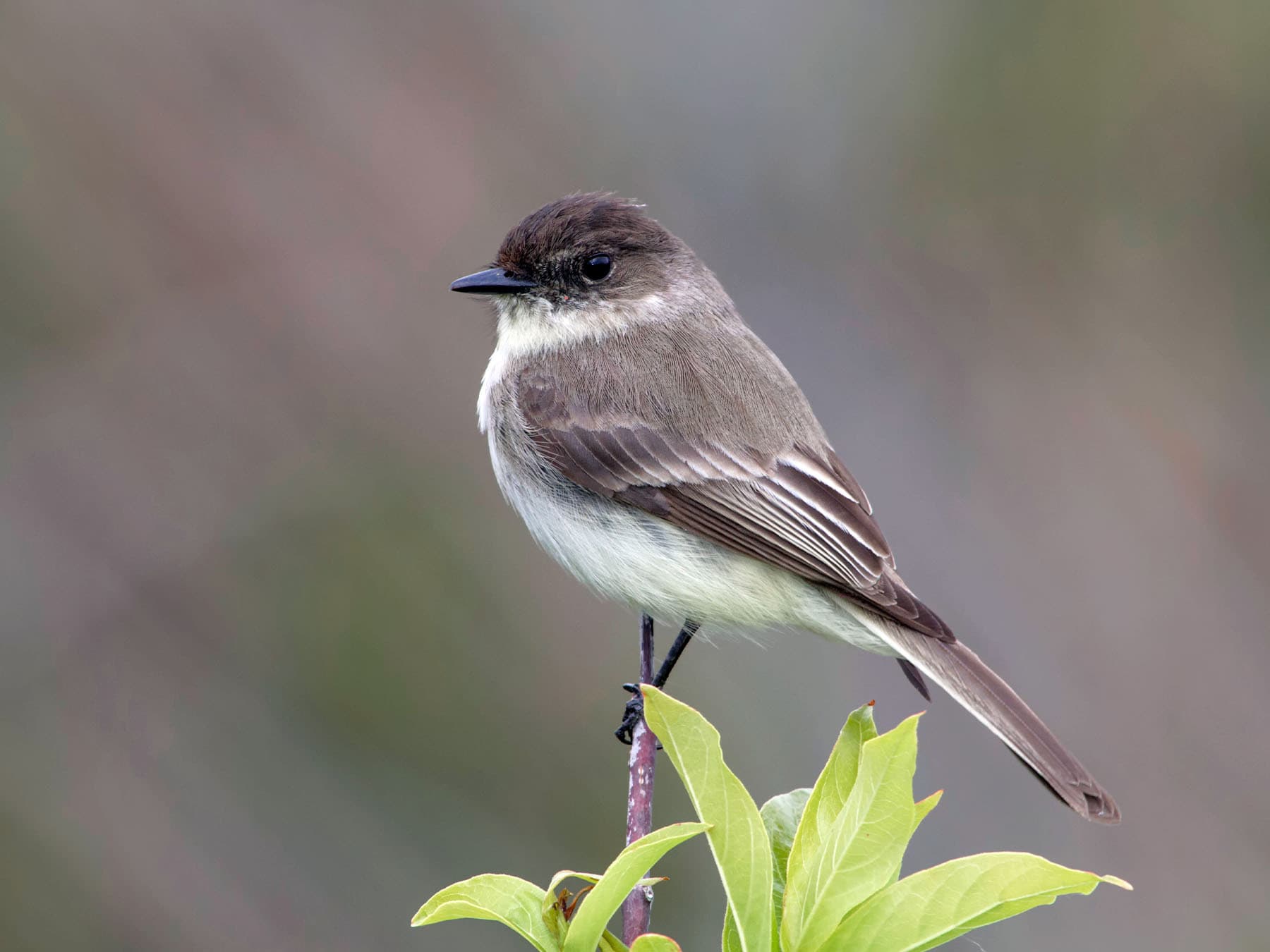
Quick facts
- Length
- 15–17 cm
- Wingspan
- 25–28 cm
- Weight
- 10–19 g
- Lifespan
- oldest recorded 10 years
- Family
- Tyrant Flycatchers
- Migration
- Full migrant
- Global status (IUCN)
- Least Concern
- World population
- About 6.5 million (Partners in Flight, around 2010)
- Population trend
- Down 0.7% a year in Breeding Bird Survey counts since 1966, though numbers have risen over the last ten years
- Also called
- Wood Pewee
- Scientific name
- Contopus virens
Questions
1Is the Eastern Wood-Pewee rare?
No. It is common in eastern woods in summer, with about 6.5 million birds around 2010, and is a species of Least Concern. Survey counts fell over the long term, though they have risen in the last ten years, and Canada lists it as a species of Special Concern. See Conservation status.
Sources
33- 1National Audubon Society. Eastern Wood-Pewee. Guide to North American Birds. Accessed 20 November 2026. Source (opens in a new tab)
- 2Cornell Lab of Ornithology. Eastern Wood-Pewee. All About Birds. Accessed 20 November 2026. Source (opens in a new tab)
- 3Watt, D. J. et al. (2020). Eastern Wood-Pewee (Contopus virens), version 1.0. Birds of the World (P. G. Rodewald, editor). Cornell Lab of Ornithology. doi:10.2173/bow.eawpew.01 (opens in a new tab)
- 4Bent, A. C. (chapter by W. M. Tyler) (1942). Life histories of North American flycatchers, larks, swallows, and their allies. U.S. National Museum Bulletin 179. Accessed 20 November 2026. Source (opens in a new tab)
- 5Craig, W. (1943). The song of the wood pewee Myiochanes virens Linnaeus: a study of bird music. New York State Museum Bulletin 334. Accessed 20 November 2026. Source (opens in a new tab)
- 6COSEWIC (2012). COSEWIC assessment and status report on the Eastern Wood-pewee Contopus virens in Canada. Committee on the Status of Endangered Wildlife in Canada, Ottawa. x + 39 pp. Accessed 20 November 2026. Source (opens in a new tab)
- 7Partners in Flight (2024). Avian Conservation Assessment Database, version 2024.05.23 (global). Partners in Flight. Accessed 20 November 2026. Source (opens in a new tab)
- 8Falconer, C. and Nol, E. (2020). Eastern Wood-Pewee (Contopus virens) reproductive success in red pine plantations and deciduous forests in Ontario, Canada. The Wilson Journal of Ornithology. doi:10.1676/20-75 (opens in a new tab)
- 9USGS Bird Banding Laboratory. Longevity records of North American birds: Eastern Wood-Pewee (AOU 4610). Bird Banding Laboratory, Bander Portal longevity tables. Accessed 20 November 2026. Source (opens in a new tab)
- 10BirdLife International (2021). Contopus virens (Linnaeus, 1766). The IUCN Red List of Threatened Species 2021. IUCN Red List. doi:10.2305/IUCN.UK.2021-3.RLTS.T22699816A138032856.en (opens in a new tab)
- 11Hostetler, J. A. et al. (2026). The North American Breeding Bird Survey, Analysis Results 1966-2025. U.S. Geological Survey data release. doi:10.5066/P1OSNSFC (opens in a new tab)
- 12Government of Canada (2017). Order Amending Schedule 1 to the Species at Risk Act, SOR/2017-229, and its Regulatory Impact Analysis Statement. Canada Gazette Part II, Vol. 151, No. 23 (15 Nov 2017). Accessed 20 November 2026.
- 13Clement, M. J. et al. (2019). Partitioning global change: Assessing the relative importance of changes in climate and land cover for changes in avian distribution. Ecology and Evolution 9(4): 1985-2003. doi:10.1002/ece3.4890 (opens in a new tab)
- 14Reidy, J. L., Thompson, F. R. and Kendrick, S. W. (2014). Breeding bird response to habitat and landscape factors across a gradient of savanna, woodland, and forest in the Missouri Ozarks. Forest Ecology and Management 313: 34-46. doi:10.1016/j.foreco.2013.10.042 (opens in a new tab)
- 15US Fish and Wildlife Service (2026). 50 CFR 10.13, List of Birds Protected by the Migratory Bird Treaty Act. Electronic Code of Federal Regulations (version up to date as of 2026-11-18). Accessed 20 November 2026. Source (opens in a new tab)
- 16US Fish and Wildlife Service (2026). 50 CFR 21.10, General permit requirements. Electronic Code of Federal Regulations (version up to date as of 2026-11-18). Accessed 20 November 2026. Source (opens in a new tab)
- 17US Fish and Wildlife Service (2026). 50 CFR Part 21, Migratory bird permits (whole part searched). Electronic Code of Federal Regulations (version up to date as of 2026-11-18). Accessed 20 November 2026. Source (opens in a new tab)
- 18US Fish and Wildlife Service (2026). 50 CFR 17.11, Endangered and threatened wildlife. Electronic Code of Federal Regulations (version up to date as of 2026-11-18). Accessed 20 November 2026. Source (opens in a new tab)
- 19Environment and Climate Change Canada. Birds protected in Canada. Canada.ca (Migratory Birds Convention Act, 1994). Accessed 20 November 2026. Source (opens in a new tab)
- 20BirdNote (2018). Is That a Phoebe or Pewee Calling?. Audubon (BirdNote transcript, 9 Oct 2018). Accessed 20 November 2026. Source (opens in a new tab)
- 21AviList Core Team (2025). AviList: The Global Avian Checklist, v2025b. AviList. doi:10.2173/avilist.v2025b (opens in a new tab)
- 22Manthey, J. D. and Robbins, M. B. (2025). Hybridization and genome-wide introgression in sympatric populations of North American wood-pewees (Contopus sordidulus and Contopus virens). Ibis 167(3): 750-764. doi:10.1111/ibi.13401 (opens in a new tab)
- 23Halley, M. R. (2023). The composite identity of Muscicapa virens Linnaeus, and a neotype designation for Eastern Wood Pewee Contopus virens (Tyrannidae). Bulletin of the British Ornithologists' Club 143(2): 196-211. doi:10.25226/bboc.v143i2.2023.a5 (opens in a new tab)
- 24Whitney, K. (2026). Making Nature Accessible: Wallace Craig and the Wood Pewee. Transactions of the American Philosophical Society 115(1): 57-71. doi:10.1353/tap.2026.a985543 (opens in a new tab)
- 25Snyder, W. E. (1913). The wood pewee as a foster parent. The Auk 30 (General Notes): 273-274. Accessed 20 November 2026.
- 26US Fish and Wildlife Service (2026). 50 CFR 10.12, Definitions. Electronic Code of Federal Regulations (version up to date as of 2026-11-18). Accessed 20 November 2026. Source (opens in a new tab)
- 27Bemis, C. and Rising, J. D. (2020). Western Wood-Pewee (Contopus sordidulus), version 1.0. Birds of the World, Cornell Lab of Ornithology. doi:10.2173/bow.wewpew.01 (opens in a new tab)
- 28Weeks, H. P., Jr. (2020). Eastern Phoebe (Sayornis phoebe), version 1.0. Birds of the World, Cornell Lab of Ornithology. doi:10.2173/bow.easpho.01 (opens in a new tab)
- 29Lowther, P. E. (2020). Alder Flycatcher (Empidonax alnorum), version 1.0. Birds of the World, Cornell Lab of Ornithology. doi:10.2173/bow.aldfly.01 (opens in a new tab)
- 30Sedgwick, J. A. (2020). Willow Flycatcher (Empidonax traillii), version 1.0. Birds of the World, Cornell Lab of Ornithology. doi:10.2173/bow.wilfly.01 (opens in a new tab)
- 31Tarof, S. and Briskie, J. V. (2020). Least Flycatcher (Empidonax minimus), version 1.0. Birds of the World, Cornell Lab of Ornithology. doi:10.2173/bow.leafly.01 (opens in a new tab)
- 32Allen, M. C. et al. (2020). Acadian Flycatcher (Empidonax virescens), version 1.0. Birds of the World, Cornell Lab of Ornithology. doi:10.2173/bow.acafly.01 (opens in a new tab)
- 33Altman, B. and Sallabanks, R. (2020). Olive-sided Flycatcher (Contopus cooperi), version 1.0. Birds of the World, Cornell Lab of Ornithology. doi:10.2173/bow.olsfly.01 (opens in a new tab)

Checked by
Nathan Cope, founder and editor
Nathan founded Birdfact and leads its writers and contributors in the UK, the US and Canada. He has watched and studied birds for more than ten years, and checks every article and species guide before it’s published.