Species Profile
Alder Flycatcher
Empidonax alnorum
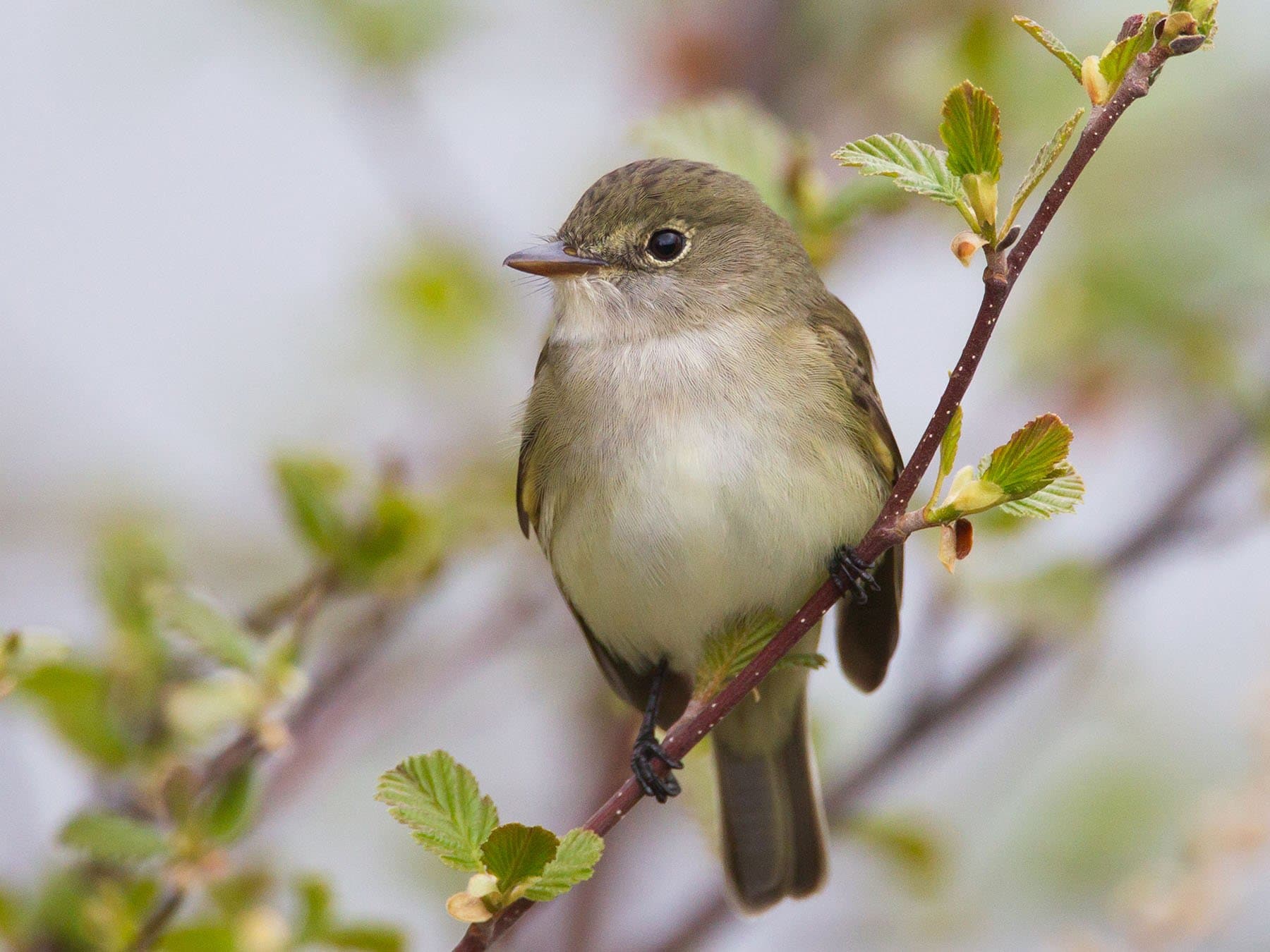
Alder Flycatcher perched on a branch with new green leaves. Features brownish-olive upperparts, pale underparts, and a faint eye-ring.
Quick Facts
Conservation
LCLeast ConcernLength
13–17 cm
Weight
12–14.9 g
Wingspan
21–24 cm
Migration
Long-distance Migrant
Peer into a dense alder thicket in June and you might catch a glimpse of one of North America's most confounding birds — a small, upright flycatcher that is virtually impossible to identify by sight alone. The Alder Flycatcher's three-syllable song, a buzzy fee-BEE-o thrown back over its shoulder, is the only reliable way to tell it from its near-identical twin, the Willow Flycatcher. What makes that song even more extraordinary is that the bird was born knowing it.
Think you've spotted a Alder Flycatcher?
Upload a photo and we'll confirm it instantly
Confirm with a PhotoAppearance
The Alder Flycatcher is a small, upright bird — one of the larger members of the notoriously difficult Empidonax genus, measuring 13–17 cm in length with a wingspan of 21–24 cm. The overall impression is of a compact, round-headed flycatcher with a broad, straight bill and short, rounded wings. Upperparts are dull greyish-olive, with the crown a shade darker than the back. The throat is clearly white, contrasting with a brownish-olive wash across the breast and sides. The belly and undertail-coverts are tinged pale yellow — most visible in spring birds fresh from the wintering grounds, fading noticeably with wear by late summer.
The wings are darker than the back and carry two bold white wingbars, with white-edged tertials forming a pale panel on the closed wing. These markings are broadest and most striking in fresh autumn plumage, becoming narrower and duller as the season progresses. The tail is dark brown to blackish. The bill is bicoloured: black on the upper mandible and dull yellow-orange or pinkish on the lower mandible. Legs and feet are blackish. The eyes are dark brown.
The eyering is the key identification feature — or rather, its near-absence. The Alder Flycatcher has a narrow, whitish eyering that is notably indistinct and often invisible in the field. This sets it apart from most other Empidonax species, which show a more prominent eye-ring, but it shares this feature with the Willow Flycatcher (Empidonax traillii), making the two essentially indistinguishable by sight. Even in the hand, specialists sometimes resort to measuring primary feather ratios — particularly the P6:P7 ratio — to separate the two species from high-quality photographs or museum specimens. Sexes are identical in plumage; males and females cannot be told apart visually in the field.
Identification & Characteristics
Colors
- Primary
- Olive
- Secondary
- White
- Beak
- Black
- Legs
- Black
Markings
Two bold white wingbars; white-edged tertials forming pale panel on closed wing; bicoloured bill (black upper, yellow-orange lower mandible); indistinct narrow white eyering; white throat contrasting with brownish-olive breast wash; pale yellow belly
Tail: Dark brown to blackish; frequently flicked upward during perching
Attributes
Understanding Attributes
Rated 0–100 based on research and observation. A score of 50 is average across all bird species. These attributes are relative and don't necessarily indicate superiority.
Habitat & Distribution
The Alder Flycatcher breeds across a vast arc of northern North America, from western Alaska — including the Kenai Peninsula, the northernmost breeding point of any member of the 400-plus-species tyrant flycatcher family — east through the Yukon, Northwest Territories, and all Canadian provinces to the Atlantic Maritimes (New Brunswick, Nova Scotia, Prince Edward Island, Newfoundland). An estimated 63% of the global population breeds in Canada's boreal forest. The range extends south into the northeastern United States, including New England, the Great Lakes states, Pennsylvania, and south along the Appalachian Mountains to North Carolina.
Classic breeding habitat is wet, dense, shrubby thicket — typically alder (Alnus spp.), willow (Salix spp.), birch (Betula spp.), or maple scrub, usually 3–8 years old and growing beside streams, ponds, bogs, or beaver ponds. Revegetating clearcuts and second-growth near water are also used. Breeding occurs from sea level up to around 1,300 m elevation; in the Appalachians, where its range overlaps with the Willow Flycatcher, the Alder tends to occupy higher ground.
During migration, the species uses a wider range of habitats — forest edges, fields, and scrub — at elevations up to 2,500 m. The autumn route passes south through the eastern United States, Mexico, and Central America, with birds moving through Costa Rica from late August to early November. The wintering range spans western South America from northwestern Venezuela, Colombia, and eastern Ecuador south to eastern Peru, Bolivia, and northern Argentina, including the Chaco region and Yungas foothill forests, generally below 1,100 m. Wintering birds favour early successional scrubby vegetation and woodland edges near water.
In the UK, the Alder Flycatcher is an extreme vagrant with just two accepted records: the first for Britain was trapped at Nanjizal Valley, West Cornwall, on 8–9 October 2008 (confirmed as a female by DNA analysis); the second appeared at Blakeney Point, Norfolk, on 25–27 September 2010. Both records generated intense debate among birders, as the species is essentially unidentifiable without its song.
Where to See This Bird
Explore regional guides for locations where this bird has been recorded.
Maine
New Hampshire
Vermont
Canada
Alberta
Manitoba
New Brunswick
Nova Scotia
Ontario
Prince Edward Island
Quebec
Yukon Territory
Diet
Insects make up the overwhelming majority of the Alder Flycatcher's diet. Studies of wintering birds in Manu National Park, Peru, found that insects accounted for approximately 96% of all food items taken. Prey recorded includes wasps, bees, and winged ants (Hymenoptera), beetles (Coleoptera), flies (Diptera), butterflies, moths and caterpillars (Lepidoptera), grasshoppers (Orthoptera), and true bugs. Spiders are taken occasionally.
The primary foraging technique is aerial hawking — the classic flycatcher method. The bird watches from a perch within tall shrubs or low trees, then launches out to intercept an insect in mid-air before looping back to a perch. In Peru, aerial hawking accounted for 91% of all foraging attempts. The remaining 9% was split between perch gleaning (picking insects directly from foliage, 6%) and hover gleaning (brief hovering flights to pluck prey from leaves, 3%). Foraging is concentrated in the airspace below the canopy of tall alders and willows.
On the wintering grounds, the diet is supplemented with fruit and berries, which can form a significant proportion of intake during the non-breeding season. Foraging activity peaks in the morning and evening, with a quieter midday period — a pattern common among insectivorous passerines in the tropics. On the breeding grounds, the short northern summer provides a flush of flying insects that the species exploits intensively during the nesting period.
Behaviour
The Alder Flycatcher is a bird of dense, shrubby cover, and its behaviour reflects that preference for concealment. It perches upright within tall alders and willows, typically below the canopy, sallying out to snatch insects from the air before returning to the same or a nearby perch. The posture is characteristically erect, and birds frequently flick their wings and tail — a restless habit shared across the Empidonax genus.
Males are strongly territorial during the breeding season, defending their patch primarily through song. A singing male will throw his head back and shake his tail as he delivers the fee-BEE-o phrase, often from a prominent perch within the thicket. When a rival approaches, the tempo of calling escalates — a rapid series of pit notes signals heightened agitation — and physical chases through the vegetation follow if the intruder persists. Wing-flicking and crest-raising accompany these confrontations.
On the South American wintering grounds, the species maintains individual territories in riparian scrub, a behaviour documented in detail at Manu National Park, Peru. Territory sizes ranged from 0.04 to 0.25 hectares, and territories were often shared by two birds — typically a dominant adult male who sang and actively defended the area, and a subordinate associate, likely a female or immature male. Territorial disputes involved vocal duels, boundary patrols, and chases, mirroring the behaviour seen on the breeding grounds. This year-round territoriality is unusual among long-distance migrants and suggests the species is highly site-faithful on its wintering grounds.
The Alder Flycatcher is generally solitary outside the breeding season. During migration, silent birds pass largely undetected, blending invisibly with Willow Flycatchers moving through the same corridors.
Calls & Sounds
The Alder Flycatcher's voice is its identity. In the field, it is the only reliable way to separate this species from the Willow Flycatcher, and the two were not formally recognised as distinct species until 1973 — precisely because their songs are so different while their plumage is so alike. The primary song is a harsh, buzzy three-syllable phrase rendered as fee-BEE-o or free-BEER, with a strong accent on the middle syllable and a drop in pitch on the final note. Some observers transcribe it as rreeBEEa or ree-BE-o. When delivering the song, males throw their heads back and shake their tails — a visible performance that accompanies the sound.
The contrast with the Willow Flycatcher is immediate once you know both: the Willow sings a wheezy, sneezing FITZ-bew accented on the first syllable, with no buzzy quality. The most common call of the Alder is a short, emphatic pit or pip note, given frequently while foraging — reminiscent of the Olive-sided Flycatcher's call. Other vocalisations include a longer wee-oo with a buzzing end, a zwee-oo, and a rapid series of pit notes that escalates during territorial encounters. Bill-snapping occurs in aggressive confrontations.
Males sing most frequently at dawn and dusk. Females are not known to sing in nature. Immature males do not produce the full song. On the wintering grounds in South America, birds continue to give the fee-bee-o song, a two-syllable variant, and the pit call — making vocalisation useful for identification year-round, if you happen to hear one. Silent autumn migrants, however, are routinely left unidentified.
Flight
The Alder Flycatcher's flight is direct and slightly fluttering, with shallow, rapid wingbeats that give it a somewhat weak, undulating quality over longer distances. This is typical of the Empidonax flycatchers, which are built for short, explosive sallies from a perch rather than sustained aerial travel. The wings are short and rounded — a shape suited to manoeuvring within dense shrubby vegetation rather than covering open ground at speed.
When hawking insects, the bird launches from a perch with a quick burst of acceleration, twisting and turning to intercept prey in mid-air before curving back to land. These sallies are typically brief — a few metres at most — and the bird returns to the same general area of the thicket. The tail is often fanned or flicked during these manoeuvres, and the white wingbars and pale tertial panel flash briefly as the bird turns.
During migration, the Alder Flycatcher travels primarily at night, as do most small insectivorous migrants. The flight style over longer distances is a steady, low-level progression rather than the soaring or gliding seen in larger migrants. The species is a longer-distance migrant than the closely related Willow Flycatcher, travelling from the boreal forests of Canada and Alaska to wintering grounds in western South America — a round trip that may exceed 10,000 km. Despite this, the bird's physical build gives little outward indication of such endurance.
Nesting & Breeding
The Alder Flycatcher's breeding season is short and tightly timed, running from mid-June to early August — a narrow window dictated by the brief northern summer. Males arrive on territory and begin singing immediately, with territorial establishment and pair formation happening rapidly. The species is seasonally monogamous.
Nest sites are placed low in dense deciduous shrubs, typically in a vertical or diagonal fork in a branch, averaging around 60 cm above the ground and rarely exceeding 180 cm. The female builds the nest alone — a somewhat bulky, loosely constructed open cup of coarse grass, weed stems, strips of bark, small twigs, and rootlets, lined inside with plant down, fine grasses, or other soft materials. A distinctive feature is the presence of streamers: loose strips of grass, bark, moss, or cattail that dangle from the bottom or rim of the nest, giving it a characteristically untidy, shaggy appearance.
Clutch size is 3–4 eggs, occasionally 2. Eggs are creamy-white or buff, smooth and non-glossy, either unmarked or lightly spotted with reddish-brown markings concentrated at the larger end. Egg dimensions are approximately 18 × 13 mm. Incubation lasts 12–15 days and is performed primarily by the female. Hatchlings are altricial, emerging with only small patches of olive-brown down. Both parents feed the nestlings, and fledging occurs at approximately 13–14 days of age. The species raises a single brood per season — there is simply not enough time in the northern summer for a second attempt.
Lifespan
The maximum recorded lifespan for an Alder Flycatcher is at least 9 years — a figure that puts it at the upper end of what might be expected for a small insectivorous bird undertaking a demanding long-distance migration each year. Typical lifespans in the wild are likely considerably shorter; small passerines of this size commonly average 2–5 years in the wild, with annual survival rates heavily influenced by the hazards of migration, predation, and winter conditions on the South American wintering grounds.
The annual cycle is physically demanding. Birds must complete a long northward migration in spring, establish and defend a territory, breed, and then begin the southward journey again — all within a few months. The short breeding season in the boreal north means there is no opportunity for a second brood if the first fails, which may limit lifetime reproductive output compared to species with longer breeding seasons at lower latitudes.
Mortality causes include predation at the nest (particularly by snakes and corvids), Brown-headed Cowbird parasitism reducing nest success, and the general attrition of long-distance migration. Climate change is projected to reduce available habitat, particularly at the southern and peripheral edges of the breeding range, which may affect survival and recruitment rates in coming decades.
Conservation
The Alder Flycatcher is listed as Least Concern on the IUCN Red List, with a global population estimated at approximately 120 million mature individuals (Partners in Flight, 2019). Despite this large total, the trend is downward. The combined North American population has declined by an estimated 0.9% per year between 1966 and 2014 — roughly 5% per decade. In Canada, where 63% of the global population breeds, numbers fell by approximately 44% over that same period according to the North American Breeding Bird Survey. Particularly steep declines have been recorded in the Boreal Taiga Plains Bird Conservation Region. Partners in Flight projects that if current rates continue, the species will lose half its remaining population by 2082.
The causes of decline are not fully understood. The Alder Flycatcher fits a broader pattern of decline among aerial insectivores — birds that catch insects in flight — which may be linked to reductions in flying insect abundance across North America. Brown-headed Cowbird (Molothrus ater) nest parasitism is a documented threat on the breeding grounds. On the wintering grounds in South America, the riparian habitats the species depends on are threatened by commercial harvest for paper pulp. Climate change poses a particular risk in peripheral range areas such as Montana, where the species is already rare.
The Alder Flycatcher holds a Continental Concern Score of 9/20 (Partners in Flight) and is designated a US–Canada Stewardship species. It is protected under the US Migratory Bird Treaty Act. Much of the core breeding habitat in the boreal north remains remote from direct human disturbance, which provides some buffer — but the wintering grounds present a less well-understood and potentially more acute vulnerability.
Population
Estimated: Approximately 120 million mature individuals (Partners in Flight, 2019)
Trend: Declining
Declining at approximately 0.9% per year (1966–2014); Canadian population fell ~44% over the same period. Partners in Flight projects a further 50% loss by 2082 if current trends continue.
Elevation
Sea level to 1,300 m (breeding); up to 2,500 m (migration); below 1,100 m (wintering)
Additional Details
- Family:
- Tyrannidae (Tyrant Flycatchers)
- Clutch size:
- 3–4 eggs
- Diet summary:
- Primarily insects (aerial hawking 91% of foraging attempts); supplemented with fruit on wintering grounds
- Fledging age:
- 13–14 days
- Broods per year:
- 1
- Egg description:
- Creamy-white or buff, smooth, unmarked or lightly spotted reddish-brown at larger end; approximately 18 × 13 mm
- Similar species:
- Willow Flycatcher (Empidonax traillii), Least Flycatcher (Empidonax minimus), Eastern Wood-Pewee (Contopus virens)
- Incubation period:
- 12–15 days
- Conservation score:
- Continental Concern Score 9/20 (Partners in Flight)
Similar Species
The Alder Flycatcher's closest lookalike is the Willow Flycatcher (Empidonax traillii), and the two are genuinely indistinguishable by sight — even in the hand, with the bird in front of you. Both share the same dull greyish-olive upperparts, white throat, pale yellow belly, bold white wingbars, bicoloured bill, and indistinct eyering. The only reliable field separation is voice: the Alder's buzzy fee-BEE-o versus the Willow's sneezing FITZ-bew. In areas of range overlap, habitat provides a weak clue — Alders tend to use wetter ground and higher elevations — but this is far from definitive. Specialists examining birds in the hand can sometimes use primary feather ratios (particularly the P6:P7 ratio) as a supporting character.
Other Empidonax species present a similar challenge. The Least Flycatcher (Empidonax minimus) is smaller and shows a more prominent, complete white eyering. The Yellow-bellied Flycatcher (Empidonax flaviventris) has a distinctly yellower throat and more saturated yellow underparts. The Acadian Flycatcher (Empidonax virescens) is greener above and has a longer primary projection.
Beyond the Empidonax genus, the Eastern Wood-Pewee (Contopus virens) is superficially similar but larger, lacks wingbars as bold, and has a different posture. The Eastern Phoebe (Sayornis phoebe) is larger, lacks wingbars, and pumps its tail downward rather than flicking it upward — a useful behavioural distinction in the field.
Taxonomy And History
The Alder Flycatcher belongs to the genus Empidonax, a group of around 15 closely related North American flycatchers within the family Tyrannidae — the tyrant flycatchers, the largest family of birds in the world by species count. The genus is notorious among birders for the near-identical appearance of its members, and the Alder Flycatcher sits at the extreme end of that challenge.
For over a century, the Alder Flycatcher was not recognised as a distinct species. It was classified together with the Willow Flycatcher (Empidonax traillii) as a single species called 'Traill's Flycatcher' — a name bestowed by John James Audubon in 1828 in honour of Thomas Stewart Traill, a Scottish physician and naturalist who assisted Audubon in finding a publisher for his monumental The Birds of North America. The two forms were known to differ in song, but the significance of that difference was debated for decades.
It was not until 1973 that the American Ornithologists' Union formally split Traill's Flycatcher into two species, based on the consistent differences in song, the absence of interbreeding where the two forms overlap, and subsequent research confirming that the songs are innate rather than learned. The Alder Flycatcher received the scientific name Empidonax alnorum — alnorum being the Latin genitive plural of alnus, meaning 'of the alders', a direct reference to its preferred breeding habitat. The Willow Flycatcher retained the original traillii epithet honouring Traill.
Birdwatching Tips
Finding an Alder Flycatcher is straightforward once you know the song. Head to wet alder or willow thickets near streams, beaver ponds, or boggy ground from mid-June onwards, and listen for the buzzy, emphatic fee-BEE-o — a three-syllable phrase with a hard accent on the middle note that drops away at the end. Males sing most persistently in the early morning and again in the evening. Once you hear one, patience and stillness will usually bring the bird into view as it sallies from a perch within the shrubs.
The identification challenge is real. Without hearing the song, an Alder Flycatcher is essentially indistinguishable from a Willow Flycatcher (Empidonax traillii) — even experienced birders leave silent birds unidentified. The Willow's song is a wheezy FITZ-bew, accented on the first syllable, quite different once you know both. In areas of range overlap — particularly the Appalachians — habitat can offer a clue: Alders tend to occupy higher elevations and wetter ground than Willows. The indistinct eyering (compared to the bold rings of species like the Least Flycatcher) and the bicoloured bill are useful supporting features, but neither is definitive.
In the US and Canada, the best time to look is late May through July on the breeding grounds. In New England, the Great Lakes states, and across the boreal provinces, any wet shrubby thicket is worth checking. During autumn migration (August–September), silent birds pass through the eastern US — they are best left as 'Empidonax sp.' unless they call. In the UK, the species is a mega-rarity; both accepted records arrived in late September to early October on the southwest and east coasts, suggesting a pattern consistent with transatlantic drift.
Did You Know?
- The Alder Flycatcher's song is genetically hardwired, not learned. In a landmark experiment, ornithologist Donald Kroodsma raised young Alder Flycatchers in the lab and exposed them exclusively to Willow Flycatcher songs during their first two months of life. The following spring, every single bird sang a perfect, normal Alder Flycatcher song — demonstrating that, unlike most songbirds, these flycatchers are born knowing their own species' song without any tutoring from adults.
- The Alder Flycatcher breeds farther north than any other member of the tyrant flycatcher family (Tyrannidae) — a group of over 400 species that is overwhelmingly tropical in distribution. It nests as far north as the Kenai Peninsula in Alaska, a remarkable outlier for a family centred on South and Central America.
- For over a century, the Alder Flycatcher was not recognised as a separate species at all. It was lumped with the Willow Flycatcher under the name 'Traill's Flycatcher' — named by John James Audubon in honour of Scottish physician Thomas Stewart Traill, who helped Audubon find a publisher for The Birds of North America. The American Ornithologists' Union only formally split the two in 1973.
- The oldest known Alder Flycatcher on record was at least 9 years old — a remarkable age for a small insectivorous bird making a round trip of thousands of kilometres to South America every year.
- Britain has just two accepted records of this species, both from autumn coastal watchpoints. The first — trapped at Nanjizal Valley, Cornwall, in October 2008 — was confirmed as a female only by DNA analysis, since the bird never sang. Without that test, it would have been unidentifiable.
Records & Accolades
Northernmost Tyrannidae
Kenai Peninsula, Alaska
Breeds farther north than any of the 400+ species in the tyrant flycatcher family
Innate Song
Genetically encoded
One of very few birds proven to sing its species-specific song without ever hearing it from another individual
Oldest on Record
9+ years
Maximum recorded lifespan for a small insectivore making annual migrations to South America
Community Photos
Be the first to share a photo of the Alder Flycatcher
Upload a PhotoIdentify Any Bird Instantly
- Upload a photo from your phone or camera
- Get an instant AI identification
- Ask follow-up questions about the bird
Monthly Birds in Your Area
- Personalised for your location
- Seasonal tips and garden advice
- Updated every month with new species