Species Profile
Great Crested Flycatcher
Myiarchus crinitus
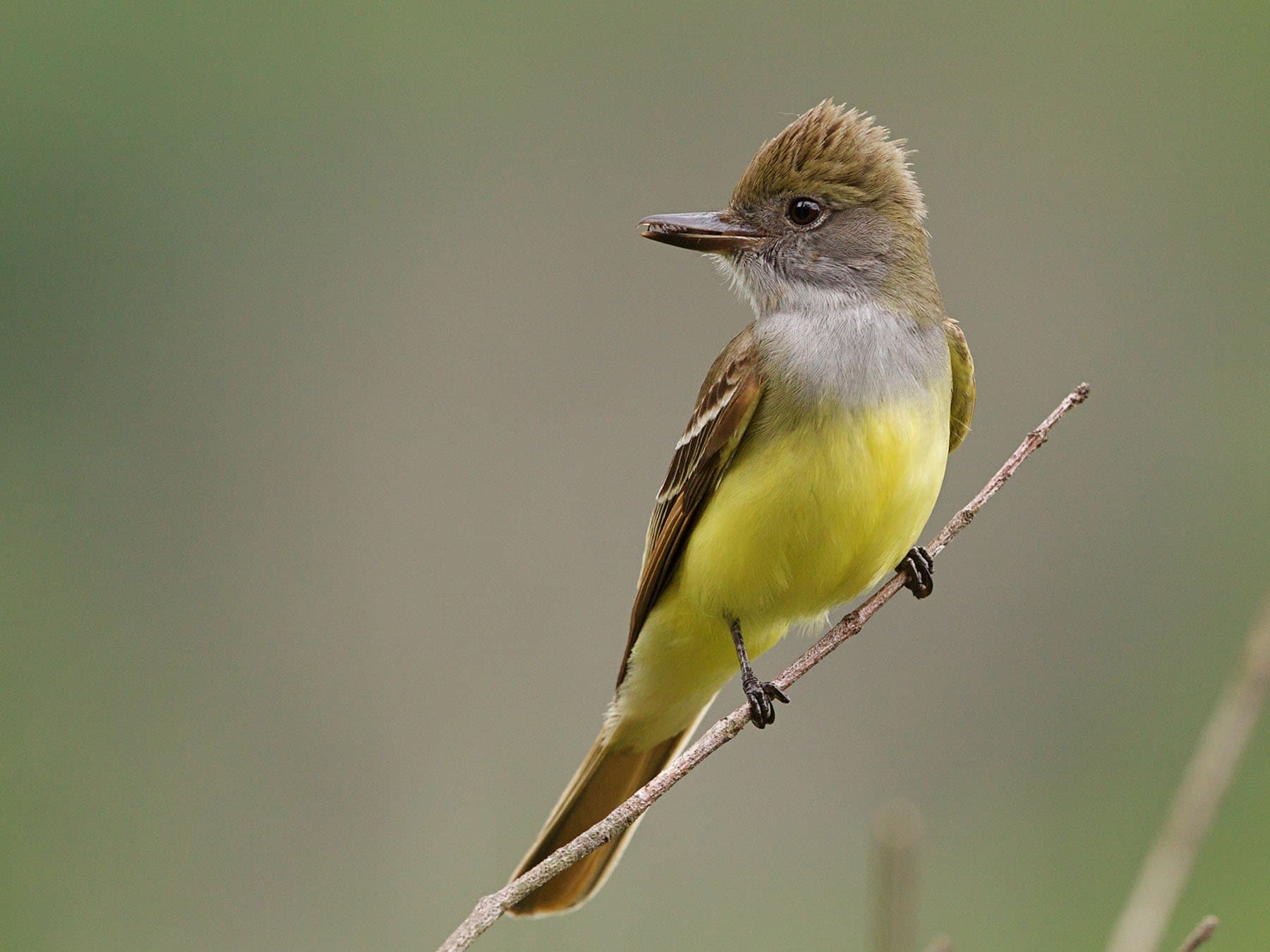
Great Crested Flycatcher perched on a bare branch, showing its yellow belly, gray chest, and olive-brown crest.
Quick Facts
Conservation
LCLeast ConcernLifespan
2–10 years
Length
17–22 cm
Weight
27–40 g
Wingspan
33–38 cm
Migration
Partial migrant
Loud, brash, and dressed in lemon-yellow and cinnamon-rust, the Great Crested Flycatcher is the only cavity-nesting flycatcher in eastern North America — and one of the most distinctive voices of its summer woodlands. Its emphatic rising whistle, a buzzy wee-eep that carries through the canopy, is far more often heard than the bird itself is seen.
Think you've spotted a Great Crested Flycatcher?
Upload a photo and we'll confirm it instantly
Confirm with a PhotoAppearance
The Great Crested Flycatcher is the most boldly coloured member of the genus Myiarchus in North America, and no other eastern flycatcher combines its particular palette. Adults measure 17–22 cm in length and carry a broad-shouldered, big-headed build that gives them a slightly top-heavy look on a perch. The belly is a clean, bright lemon-yellow — vivid enough to catch the eye even in dappled woodland light. The throat and breast are a clear medium grey, forming a sharp boundary with the yellow below. Upperparts are dark olive-brown to olive-grey, and the large, rounded head is darkest on the crown, which can be raised into a bushy, rounded crest. The crest is not always prominent at rest, but when the bird is agitated or alert it fans out noticeably.
The tail and wings are where the rufous-orange really announces itself. The inner webs of the tail feathers are a rich cinnamon-rust, blazingly obvious when the bird fans its tail or takes flight. The secondary wing feathers are bright rufous, and the primaries show rufous-orange edging. The bill is heavy and broad at the base — well-suited to snatching large insects — mostly black above, with an extensive pale pinkish-orange base to the lower mandible. Legs and feet are dark brown to black.
There is no sexual dimorphism in plumage: males and females are identical in colour. Males average very slightly larger, but this difference is not reliably detectable in the field. Juveniles closely resemble adults but show slightly paler, more washed-out rufous tones in the wings and tail, and the crest is less developed in the first weeks after fledging.
Identification & Characteristics
Colors
- Primary
- Olive
- Secondary
- Yellow
- Beak
- Black
- Legs
- Brown
Markings
Bright lemon-yellow belly; clear grey throat and breast; rich rufous-orange inner tail feathers and secondary wing feathers; dark olive-brown upperparts; heavy black bill with pale pinkish-orange base to lower mandible; bushy rounded crest.
Tail: Medium-length tail with broad rufous-orange inner webs on the feathers, conspicuous in flight and when the tail is fanned. Tail is often pumped or fanned during perching and display.
Attributes
Understanding Attributes
Rated 0–100 based on research and observation. A score of 50 is average across all bird species. These attributes are relative and don't necessarily indicate superiority.
Habitat & Distribution
Great Crested Flycatchers are birds of open deciduous and mixed woodlands, with a strong preference for edge habitats and semi-open canopy over dense, closed-canopy forest. Second-growth woodlands, selectively logged areas, wooded hedgerows, isolated woodlots, old orchards, riparian corridors, wooded swamps, parks, cemeteries, and suburban areas with large shade trees all attract the species. Dead snags and dying trees are critical habitat components — as an obligate secondary cavity nester, the bird depends entirely on pre-existing holes for breeding. Pure coniferous boreal forest is avoided.
The breeding range covers the entire eastern and mid-western United States, from the Atlantic coast west to the Great Plains, and from the Gulf Coast north into southern Canada. In the US, the species breeds across all states east of the Great Plains, including Florida, Texas, Oklahoma, and North Dakota. Highest breeding densities occur in the southeastern states from North Carolina south to northern Florida and west to southern Alabama. In Canada, breeding populations are established across southern Manitoba, the extreme southern portions of Ontario and Quebec, northeastern Nova Scotia, and parts of Prince Edward Island. Notably, the species has expanded its range northward and westward in recent decades, colonising areas of fragmented parkland in central Canada as reduced prairie fires have allowed woody vegetation to establish.
The majority of the population winters in southern Mexico (including the Yucatán Peninsula), along both coasts of Central America south to central Panama, and in northwestern South America including Colombia and Venezuela. A smaller but regular wintering population persists year-round in southern peninsular Florida and Cuba. Vagrant records exist from western US states including California, Nevada, Arizona, Colorado, Oregon, and even Alaska. The species does not occur in the UK, Europe, or Australasia.
For North American birdwatchers, the species is a reliable summer presence across the eastern US and southern Canada from late April through September. In Texas, northbound migrants pass through from approximately 9 March to 15 June, with peak movement from late March to mid-May.
Where to See This Bird
Explore regional guides for locations where this bird has been recorded.
United States
Georgia
Iowa
Illinois
Kansas
Nebraska
Indiana
Kentucky
Louisiana
Massachusetts
Maryland
Maine
Michigan
Mississippi
Missouri
Minnesota
Arkansas
Alabama
North Carolina
North Dakota
District of Columbia
Connecticut
New Hampshire
Delaware
Florida
New Jersey
Ohio
New York
Oklahoma
Pennsylvania
Rhode Island
South Dakota
South Carolina
Texas
Tennessee
Virginia
Vermont
Wisconsin
West Virginia
Canada
Manitoba
Ontario
Quebec
Diet
Despite the name, flies make up only a small fraction of this bird's diet. Great Crested Flycatchers prefer larger, more energy-rich prey: butterflies and moths (including caterpillars), beetles (particularly weevils), grasshoppers, crickets, katydids, tree crickets, bees, wasps, and dragonflies. Spiders are taken occasionally. The sit-and-wait strategy is the primary foraging method — the bird perches high in the canopy, scans with rapid head movements, then sallies out to catch prey in mid-air, pluck it from leaf surfaces, snatch it from bark crevices, or even take it from the ground. They can hover briefly to pick insects from foliage, and will crash directly into vegetation when prey is spotted close to a branch.
Fruit and berries form a regular supplement to the diet, particularly on the tropical wintering grounds where insect availability can be seasonal. Birds swallow small fruits whole and regurgitate the pits — sometimes several at once — a behaviour more typical of frugivorous species. Small lizards are taken occasionally. When feeding nestlings, parents offer dragonflies, moths, and butterflies whole; if a chick rejects an item, the parent crushes it and re-offers it, showing a degree of problem-solving in provisioning behaviour.
Foraging activity peaks in the early morning and again in the late afternoon, with a quieter midday period. On the breeding grounds, the diet shifts heavily towards insects during the nesting season, when the protein demands of growing chicks are highest. The species' willingness to take both invertebrates and fruit gives it dietary flexibility that likely contributes to its success across a wide range of habitats.
Behaviour
Great Crested Flycatchers spend most of their time in the mid-to-upper canopy, where their bold colours are surprisingly well-camouflaged against dappled foliage and sunlit bark. They are sit-and-wait predators at heart: a bird will perch motionless for extended periods, rotating its head in sharp, jerky movements to scan in all directions, before launching a sudden sally to snatch prey from the air or from a leaf surface. They are persistent hunters — if a first strike misses, they will continue chasing prey through the canopy rather than returning empty-handed to the perch.
Territories during the breeding season typically cover 1.6–3.2 hectares. Males are vigorously territorial and will confront intruders with a combination of loud calling, crest-raising, tail-fanning, and bill-snapping. Physical chases are common when a rival fails to retreat. Despite this aggression towards conspecifics, Great Crested Flycatchers are generally tolerant of other species sharing their woodland, though they will mob potential predators — including snakes and squirrels — near the nest with considerable determination.
Outside the breeding season, the species is largely solitary. On the wintering grounds in Central America and northern South America, individuals hold loose feeding territories in forest edge and second-growth habitats. Migration occurs mostly at night, and birds are rarely seen in large groups at any time of year. After fledging, family groups remain together for up to three weeks, with both parents continuing to feed and defend the young — a post-fledging dependency period that is longer than many comparable flycatchers and rarely noted in popular accounts.
Calls & Sounds
The Great Crested Flycatcher has one of the most distinctive vocal signatures of any North American woodland bird, and its calls are far better known than the bird itself. The most iconic is the contact call: a loud, emphatic, rising whistle rendered as wee-eep, wheep, or queeEEEP — a slightly buzzy, up-slurred note that carries powerfully through the forest canopy. This call is used between mates, between parents and young, and as a general contact signal throughout the year; a faster, more urgent repetition of the same note signals the presence of a predator near the nest.
The dawn song — also called the twilight song — is a three-part vocalisation given by males just before sunrise during the breeding season. It begins with a drawn-out wheerreep, rises to a higher-pitched whee, and ends with a soft, low churr. Crucially, males deliver this song from within the canopy foliage rather than from an exposed perch — the opposite of most songbirds, which seek prominent positions to maximise broadcast range. The dawn song appears designed to be heard at short distances by the mate, and its intensity increases during periods of low disturbance around the nest.
During territorial disputes, a rapid ascending series of huit-huit-huit or wit-wit-wit calls is given, often accompanied by physical displays: hunching low over the perch, fanning and flitting the tail, erecting the crest, and snapping the bill audibly. A harsh, rolling prrreet! is also described in the literature. Alarm calls consist of rapid, harsh rasping sounds. The characteristic wee-eep contact call is given on both the breeding and wintering grounds, making it a useful identification tool throughout the year wherever the species occurs.
Flight
In flight, the Great Crested Flycatcher is immediately identifiable by the broad rufous-orange panels on the inner tail feathers, which blaze conspicuously against the darker upperparts every time the bird fans or pumps its tail. The wings show rufous edging on the primaries and bright rufous secondaries, adding to the warm-toned impression in direct sunlight. The overall silhouette is stocky and broad-shouldered, with a relatively large head and a medium-length tail that is often fanned or pumped during manoeuvring.
Flight style is direct and purposeful when moving between perches, with a slightly undulating quality produced by brief wing-closures between wingbeats — typical of the tyrant flycatcher family. Sallying flights after prey are agile and fast, with rapid direction changes and the ability to hover briefly to pluck insects from foliage. The species is a capable aerial pursuer and will continue chasing prey through the canopy after an initial miss, threading between branches with precision.
During migration, the species travels mostly at night, and daytime flight is typically low and direct through woodland corridors. Migrants are rarely seen in open sky. The wingspan of 33–38 cm gives the bird good lift relative to its weight of 27–40 g, contributing to the endurance needed for its medium- to long-distance Neotropical migration between eastern North America and Central America or northern South America.
Nesting & Breeding
The Great Crested Flycatcher is the only cavity-nesting flycatcher in eastern North America — a distinction that shapes almost every aspect of its breeding biology. Both sexes inspect potential cavities, but nest construction is performed almost entirely by the female while the male guards her closely. Natural cavities in live or dead trees and old woodpecker holes are preferred, but the species readily uses nest boxes, hollow fence posts, drainpipes, buckets, and even mailboxes. Cavities are typically 2–6 m above the ground, though heights range from 1 to 23 m. If a cavity is much deeper than 30 cm, the female first backfills it with debris — leaves, bark, and other loose material — before building the nest cup on top. This backfilling behaviour is rarely mentioned in popular accounts but is a consistent and practical adaptation to the variable dimensions of natural cavities.
Nest materials include grasses, leaves, twigs, bark strips, moss, feathers, animal fur, snail shells, and eggshells. The inner cup measures 7–9 cm in diameter and 4–5 cm deep. Most famously, shed snakeskin is almost always woven into the nest — a behaviour that has been scientifically validated as an anti-predator strategy (see Did You Know). Where real snakeskin is scarce, birds substitute crinkly synthetic materials such as cellophane, onion skins, and plastic wrappers, suggesting they are specifically seeking the texture and visual appearance of shed skin rather than using whatever is available.
Nest building begins as early as mid-April in southern populations and as late as June in Manitoba. A single clutch of 4–8 eggs (typically 5) is laid per season. Eggs are creamy white to pinkish buff, heavily splotched and streaked with brown, purple, or lavender markings; they measure approximately 2.1–2.4 cm long by 1.5–1.8 cm wide. Incubation is performed by the female alone and lasts 13–15 days. Hatchlings are altricial — helpless, sightless, and initially naked, developing a grey down within days. Both parents feed the nestlings, though the female makes more frequent visits. Nestlings fledge at 13–15 days. The family group then remains together for up to three weeks post-fledging, with both parents continuing to feed and defend the young. There is only one brood per season.
Lifespan
The typical lifespan of a Great Crested Flycatcher in the wild is estimated at 2–10 years, with most individuals in the lower part of that range due to the high mortality rates common in the first year of life. The maximum recorded lifespan is 14 years and 11 months — a bird banded in New Jersey in 1953 and recovered in Vermont in 1967, making it one of the longest-lived small flycatchers on record for North America.
Survival rates improve significantly after the first breeding season. Adults show strong site fidelity, returning to the same breeding territories year after year, which likely contributes to their longevity by reducing the risks associated with finding new habitat. Natal dispersal, however, is high — nestlings rarely return to breed near where they were born, which is one reason why long-term banding recaptures are uncommon despite the species' potential longevity.
The main mortality factors are predation (particularly of eggs and nestlings by snakes and squirrels), collisions with man-made structures during nocturnal migration, and exposure to pesticides that reduce insect prey availability. Compared to open-cup nesters of similar size, the cavity nest provides meaningful protection against nest predation, likely contributing to higher adult survival rates. Within the genus Myiarchus, lifespan data are limited for most species, but the Great Crested Flycatcher's 14-year record is consistent with the upper range seen in other medium-sized tyrant flycatchers.
Conservation
The Great Crested Flycatcher is listed as Least Concern by the IUCN, with an estimated global population of approximately 8.8 million mature individuals (Partners in Flight / BirdLife International). North American Breeding Bird Survey data from 1966 to 2019 show populations have remained stable across the breeding range. Partners in Flight rates the species 8 out of 20 on the Continental Concern Score, indicating low conservation concern. Local population increases have been recorded in areas of increased forest fragmentation, which expands the edge habitats the species favours — a paradox in conservation terms, since fragmentation harms many other woodland species.
The primary potential threats are loss of forest habitat and the reduction of suitable nesting cavities. 'Clean' forestry practices that remove dead snags from managed forests directly reduce the availability of natural nest holes. Competition for cavities from European Starlings, Tree Swallows, House Wrens, Eastern Bluebirds, and squirrels can cause local breeding failures. Collisions with buildings, vehicles, and communication towers during nocturnal migration are an additional mortality factor, as is exposure to pesticides that reduce insect prey availability. Brood parasitism by Brown-headed Cowbirds is infrequent, likely because the cavity nest and the species' aggressive nest defence make successful parasitism difficult.
The species is resilient and benefits from its tolerance of human-modified habitats. Its willingness to adopt nest boxes makes it a straightforward target for active conservation support — erecting nest boxes in suitable woodland edge habitat is one of the most effective ways to support local populations where natural cavities are scarce. Climate change is projected to affect the species' range over the longer term, though current populations show no sign of decline.
Population
Estimated: Approximately 8.8 million mature individuals
Trend: Stable
Stable. North American Breeding Bird Survey data from 1966–2019 show populations have remained stable across the breeding range. Partners in Flight Continental Concern Score: 8/20 (low concern). Local increases noted in areas of increased forest fragmentation.
Elevation
Sea level to approximately 1,000 m on the breeding grounds; similar elevations on the wintering grounds in Central America and northern South America.
Additional Details
- Family:
- Tyrannidae (Tyrant Flycatchers)
- Predators:
- Snakes and squirrels are the primary nest predators. Adults are taken by raptors including Accipiter hawks. Brown-headed Cowbird brood parasitism is infrequent.
- Territory size:
- 1.6–3.2 hectares during the breeding season
Similar Species
Within eastern North America, the Great Crested Flycatcher has no close lookalikes — the combination of bright lemon-yellow belly, grey breast, and rufous-orange tail is unique among the region's flycatchers. The challenge arises when comparing it to its western relatives in the genus Myiarchus. The Ash-throated Flycatcher (Myiarchus cinerascens), which breeds across the western US and occasionally strays east, is the most similar in structure but is noticeably paler overall: the belly is a very pale yellow (almost white in some individuals), the grey of the breast is lighter, and the rufous in the tail is less saturated. The Brown-crested Flycatcher (Myiarchus tyrannulus) of the southwestern US and Texas is larger than the Ash-throated but still shows a paler yellow belly than the Great Crested.
In the limited overlap zones along the Gulf Coast and in southern Texas, careful attention to belly colour saturation and the depth of rufous in the tail is the most reliable field mark. Vocalisation is also diagnostic: the Great Crested's wee-eep is distinctly buzzy and up-slurred, while the Ash-throated gives a rougher, more burry ka-brick or prrit. In the hand, wing formula and bill dimensions separate the species reliably, but in the field, the Great Crested's richer, more saturated colours and louder, buzzier calls are the key features to focus on.
Courtship & Display
Courtship in the Great Crested Flycatcher is closely tied to cavity inspection, with the male leading the female on tours of potential nest sites as a central part of pair formation. Males arrive on the breeding grounds before females — typically by one to two weeks — and begin establishing territories and prospecting cavities immediately. When a female arrives, the male pursues her through the canopy in rapid, twisting chases, calling persistently with the emphatic wee-eep contact call.
Once a pair bond forms, the male guards the female closely throughout the nest-building period, following her on foraging trips and returning with her to the nest cavity. This mate-guarding behaviour is thought to reduce the risk of extra-pair copulations, which have been documented in the species. The male does not assist with nest construction but remains in close attendance, calling frequently and chasing away rival males from the territory.
Display behaviours during territorial confrontations — hunching low over the perch, erecting the crest, fanning the rufous tail, and snapping the bill — are also used in a modified form during courtship, with the male performing these postures towards the female in a less aggressive context. The pair is socially monogamous, and some pairs are known to reform in subsequent breeding seasons, suggesting a degree of mate fidelity beyond a single year.
Birdwatching Tips
The Great Crested Flycatcher is far more often heard than seen, so learning the call is the single most useful identification skill. The loud, rising wee-eep or wheep — a slightly buzzy, up-slurred whistle — carries well through the canopy and is one of the most distinctive sounds of eastern North American woodlands from May to August. Once you hear it, scan the mid-to-upper canopy rather than the treetops or exposed branch tips: this species tends to perch within the foliage rather than on prominent lookout posts, which is why it can be so hard to pin down visually despite its loud voice.
When you do get a view, the combination of bright lemon-yellow belly, grey breast, and rufous-orange tail is unmistakable among eastern flycatchers. In flight, the cinnamon tail panels flash conspicuously. The two most similar species are the Ash-throated Flycatcher of the western US and the Brown-crested Flycatcher of the southwest — both are paler overall, with a whiter or very pale yellow belly and less saturated rufous in the tail. In the east, no other flycatcher shares the Great Crested's combination of yellow underparts and rufous tail.
In the US and Canada, the best time to look is from late April through August. Woodland edges, old orchards, parks with large trees, and any area with dead snags are productive. Listen for the wee-eep call and follow it patiently — the bird will often move to a more exposed perch after a few minutes of calling. Nest box schemes in suitable habitat can bring birds into gardens and give extended close views during the breeding season. Migration watch-points along the Gulf Coast and Atlantic seaboard can produce good numbers of southbound birds from late July through September.
Did You Know?
- A 2025 study published in The American Naturalist (Rohwer et al., Cornell Lab of Ornithology) found that cavity nests containing snakeskin were significantly less likely to be predated by small mammals such as flying squirrels — which are hardwired to avoid snakes. Cavity-nesting birds were found to be 6.5 times more likely to incorporate snakeskin than open-cup nesters. Where real snakeskin is unavailable, Great Crested Flycatchers substitute crinkly synthetic materials such as cellophane and plastic wrappers, suggesting they are specifically seeking the texture and appearance of shed skin.
- The oldest recorded Great Crested Flycatcher was at least 14 years and 11 months old when found in Vermont in 1967 — it had been banded in New Jersey in 1953. This remarkable longevity is especially notable given that nestlings rarely return to breed near where they were born, making long-term banding recaptures genuinely rare.
- Despite being called a 'flycatcher,' flies make up only a small fraction of this bird's diet. It actually prefers larger prey such as butterflies, moths, beetles, grasshoppers, and bees — and it regularly swallows small fruits whole, regurgitating the pits several at a time, a behaviour more typical of frugivorous birds.
- The male Great Crested Flycatcher deliberately sings its dawn song from within the canopy foliage, away from exposed branch tips — the opposite strategy to most territorial songbirds. This makes it one of the most commonly heard yet least-seen birds of eastern North American woodlands in summer.
- If a natural cavity is much deeper than 30 cm, the female first backfills it with leaves and debris before building the nest cup on top — a practical engineering solution to the variable dimensions of woodpecker holes and rotting snags that is rarely mentioned in popular accounts.
Records & Accolades
Oldest Recorded Individual
14 years, 11 months
A banded individual recovered in Vermont in 1967, originally banded in New Jersey in 1953 — one of the longest-lived small flycatchers on record in North America.
Snake-Skin Nest Decorator
6.5× more likely than open-cup nesters
Cavity-nesting birds including the Great Crested Flycatcher are 6.5 times more likely to incorporate shed snakeskin into their nests than open-cup nesters, validated by a 2025 Cornell study as an anti-predator strategy.
Only Eastern Cavity-Nesting Flycatcher
Unique ecological niche
The Great Crested Flycatcher is the only flycatcher species in eastern North America to nest exclusively in pre-existing cavities — a unique niche among the region's many Tyrannidae.
Community Photos
Be the first to share a photo of the Great Crested Flycatcher
Upload a PhotoIdentify Any Bird Instantly
- Upload a photo from your phone or camera
- Get an instant AI identification
- Ask follow-up questions about the bird
Monthly Birds in Your Area
- Personalised for your location
- Seasonal tips and garden advice
- Updated every month with new species