


Eastern Kingbird
Bee martin (old name) · Tyrannus tyrannus
By the Birdfact teamChecked by Nathan Cope
On this page14 sections
How to recognise it
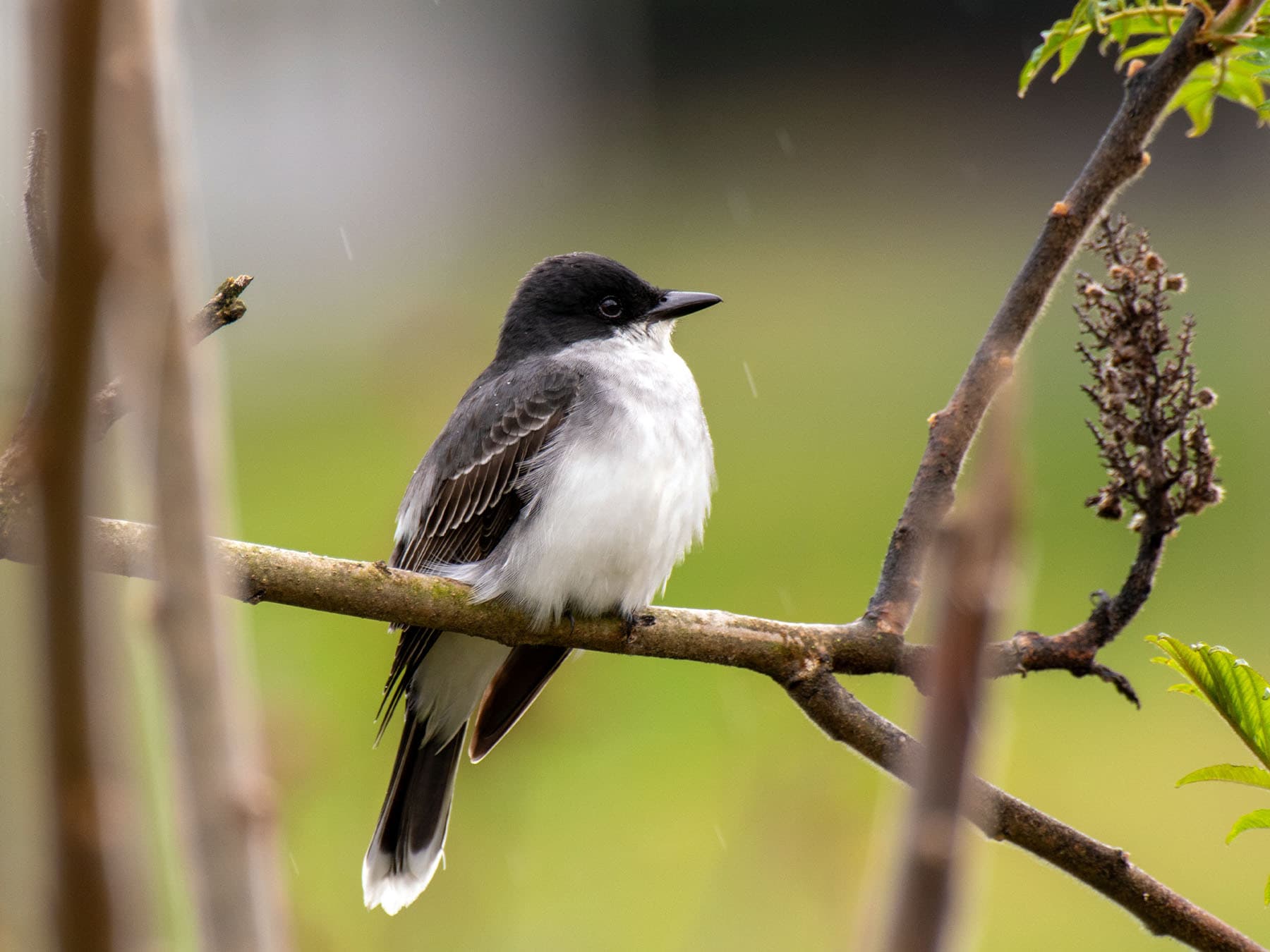
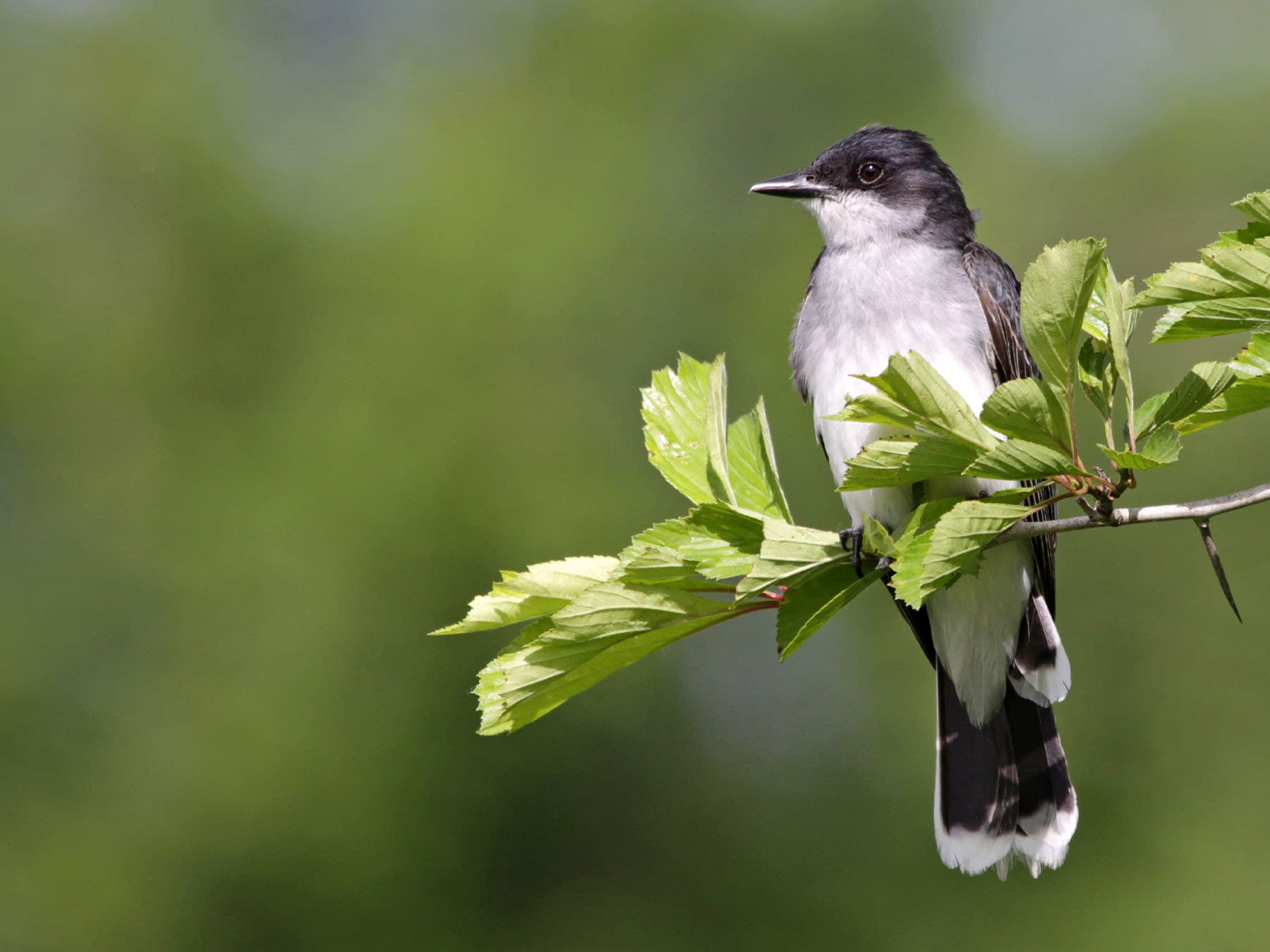
The Eastern Kingbird is a big-headed, broad-shouldered flycatcher that is blackish above and clean white below. The head is the darkest part, almost black, shading to slate gray on the back, and a faint gray wash crosses the upper breast. Its best mark is the tail: black, with a broad white band across the tip. No other perching bird that breeds in North America has one.1
Look for it sitting upright in the open, on a fence, a utility wire or the top of a tree, then flying out to snap up an insect. The bill is short, straight and black, and the head often looks slightly crested.
A small patch of orange to red, sometimes yellow, feathers is hidden in the middle of the crown. It is usually covered and seldom seen, but a kingbird may raise it in display or when it dives at a predator.
Size and shape
Eastern Kingbirds are 7.5 to 9 inches (19-23 cm) long, with a wingspan of 13 to 15 inches (33-38 cm), and weigh 1.2 to 1.9 ounces (33-55 g): a little smaller than an American Robin and bigger than an Eastern Phoebe. They look sturdy, with a large head, a square-ended tail and an upright stance.
Males, females and young
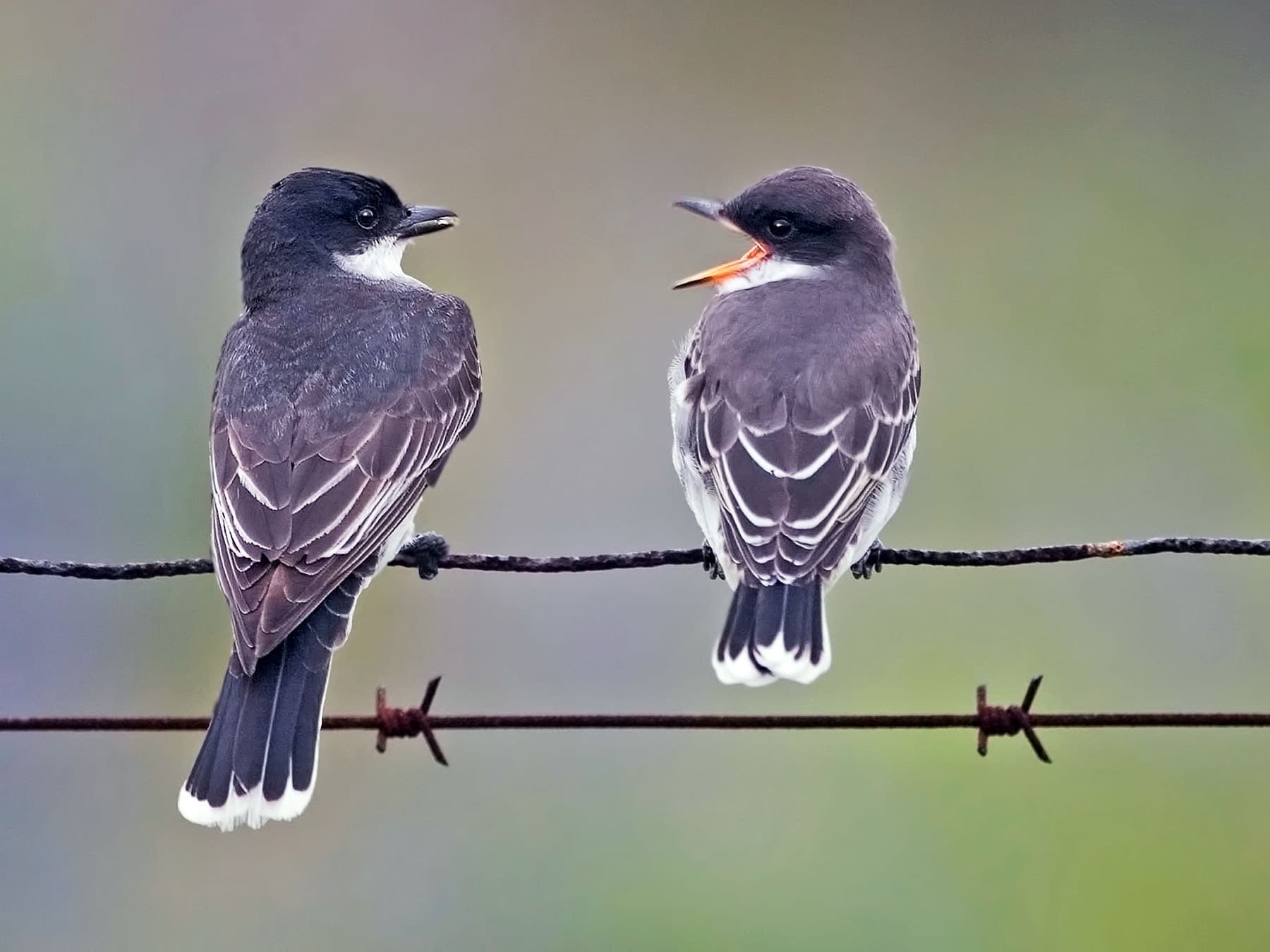
Males and females look alike. Males tend to perch more upright and keep a slight crest, while females often sit more level with a rounder head, but these are tendencies, not rules. Males are only slightly bigger, with wings and tail about 6% longer. In the hand, a male's two outermost flight feathers are deeply notched at the tip; a female's outermost one is only moderately notched.
Juveniles, seen from July to October, look like adults but are browner and paler above, with buff edges to the wing feathers and a narrower, less clean white tip to the tail, washed with brown. They have no crown patch. Young birds molt into adult-like plumage, mostly on the wintering grounds, and look like adults by their first spring.
Identification in flight
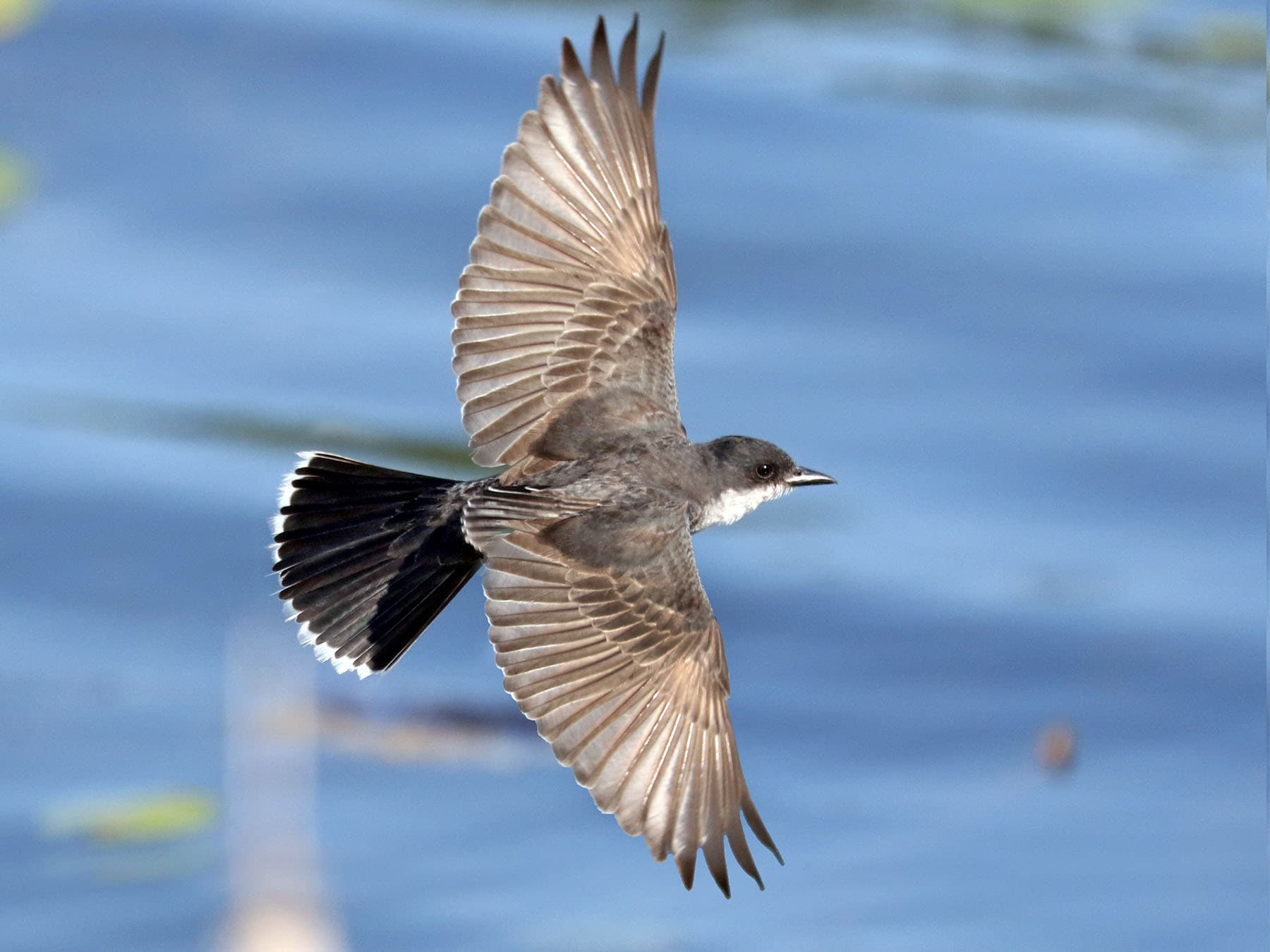
In flight the white band across the end of the tail shows clearly, especially when the tail is fanned. A kingbird flies on rapid, very shallow, rowing or fluttering wingbeats, often calling as it goes. Its flight is direct and fast, strong enough to chase down swallows, and it rarely glides.
Identification: similar birds
Eastern Phoebe. Smaller, 5.5 to 7 inches (14-18 cm), gray-brown with a sooty head. A phoebe wags its tail when perched and has no white tip to it.
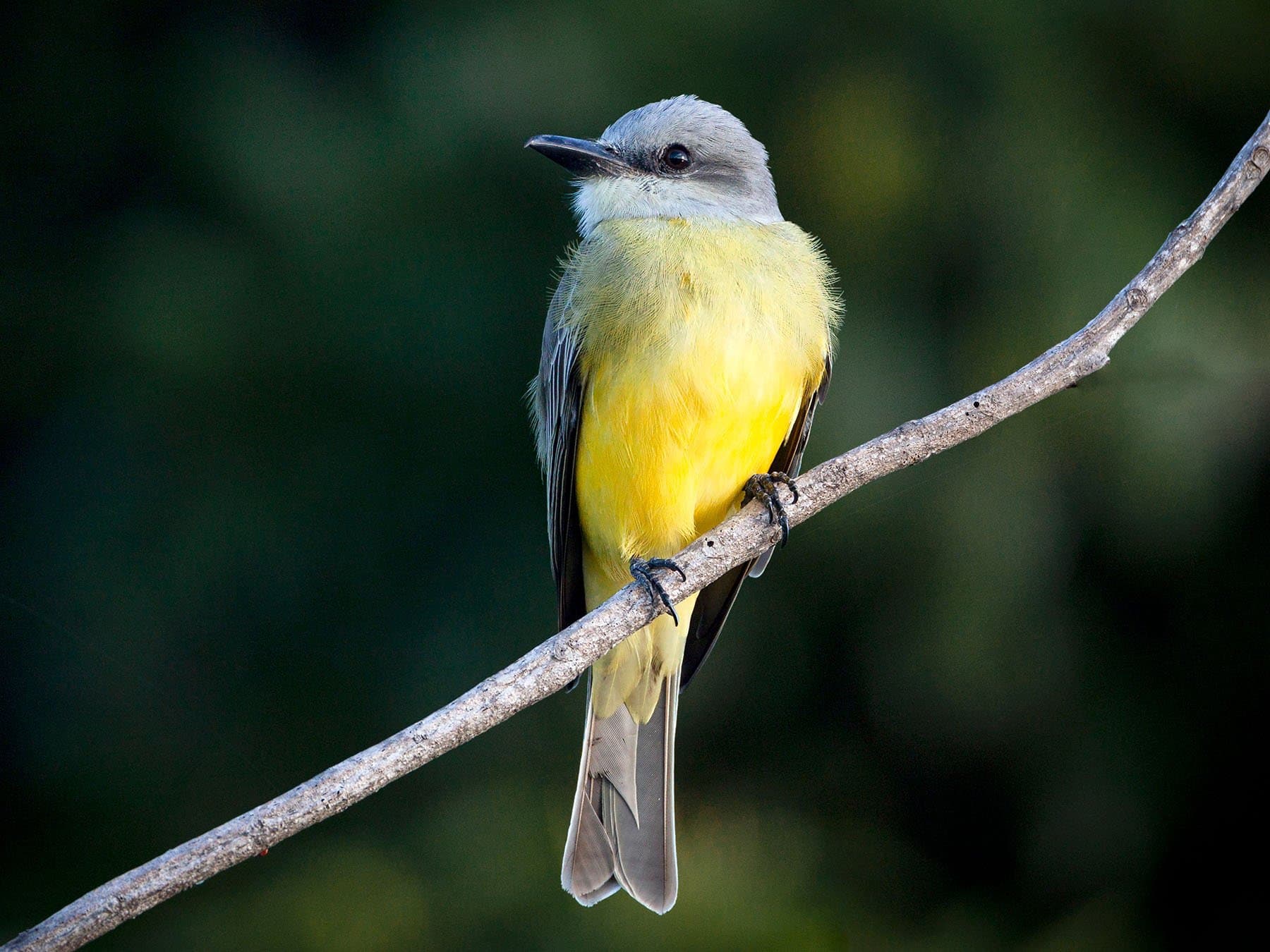
Western Kingbird. A gray head and chest, a yellow belly and a black tail edged white along the sides rather than at the tip. Where the two overlap, the Western is usually in more open country.
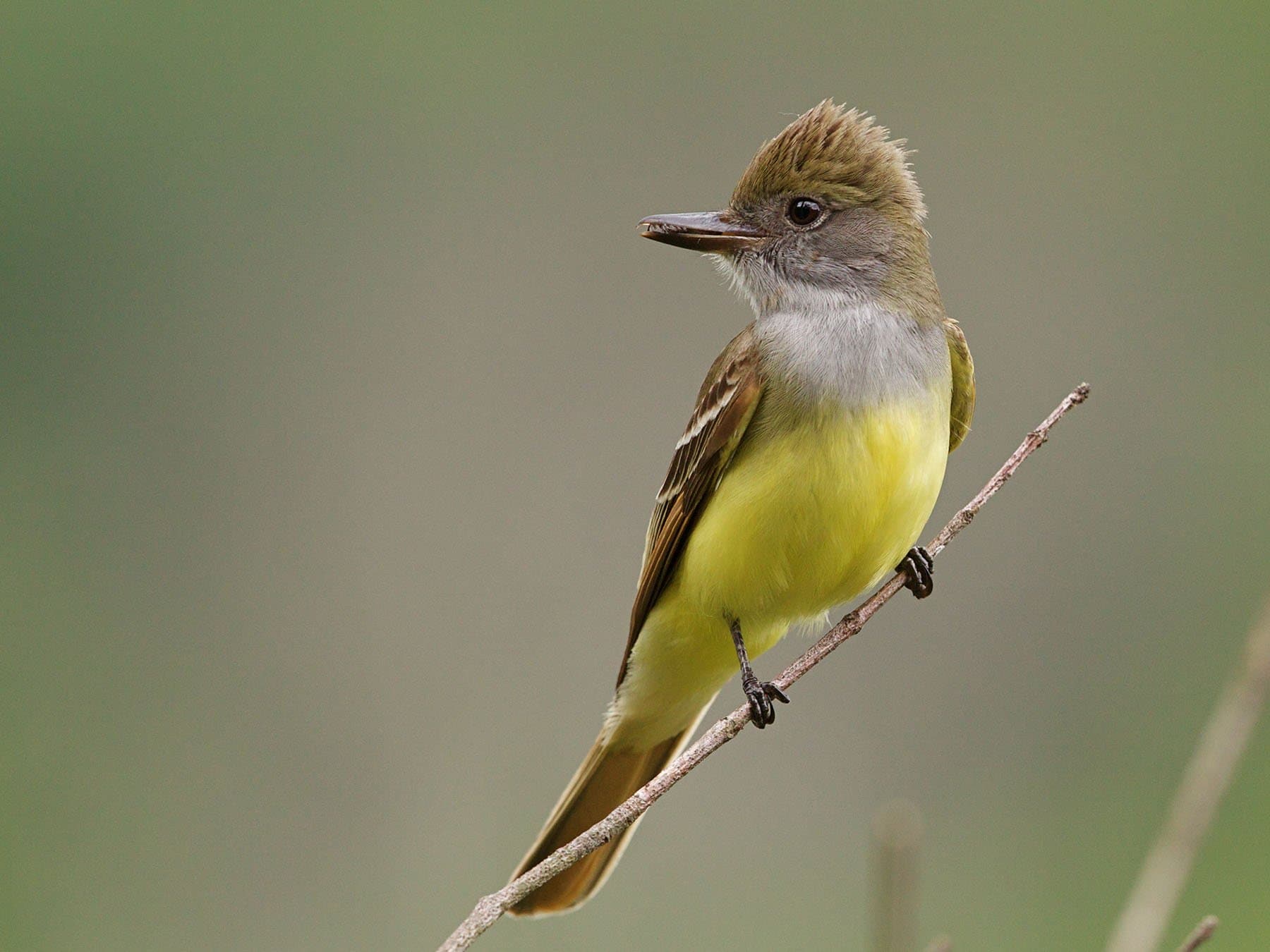
Great Crested Flycatcher. Olive-brown above with a gray throat, a bright yellow belly and reddish-brown in the wings and tail; a bird of woods and groves.
Gray Kingbird. A bird of Florida's coasts: bigger and paler gray above, with a dark mask, a heavier bill and no white band on its notched tail.
Eastern Wood-Pewee. Much smaller, 5.9 to 6.7 inches (15-17 cm), very plain, with faint wing bars, no eye-ring and very long wingtips, and no white band at the tip of the tail.
Not sure it’s a Eastern Kingbird? Check your photo: Birdfact names the bird and shows the look-alike side by side.
Its size
Adults- Length
- 19–23 cm
- Wingspan
- 33–38 cm
- Weight
- 33–55 g
Its song and calls
The call you are most likely to hear is probably a short, very high, buzzy dzeer, given alone or in a series, with an electric, sparking quality. Kingbirds also give fast, high, sputtering twitters, often as a greeting between mates, and long chattering series when they meet other kingbirds. They call little on migration but often once territories are set up.
The male's song is a dawn song: sputtering notes and a buzzy zeer repeated over and over, sung in the dark about an hour before first light, usually for half an hour or more. In sparse populations some males do not sing it at all. At its peak a male averages about 14 phrases a minute.2 Males that start earliest tend to be the best-quality birds and father the most young in other pairs' nests, and the earliest-nesting females pair with the fastest singers.3, 4
As a suboscine, not a songbird, a kingbird probably does not learn its calls: young birds give adult-like calls at about two weeks old. Adults and older nestlings also snap their bills at predators, people included.
- Calls0:00 / 0:20
Recorded in Michigan, United States · May 2019
- Calls0:00 / 0:05
Recorded in Maryland, United States · May 2024
Heard one and not sure? Let the bird song identifier listen.
When and where to see it
The Eastern Kingbird is the most widespread kingbird in North America and the only widespread one in the East. It breeds from Nova Scotia and the Atlantic coast to the tip of Florida, west across the Great Plains to eastern Oregon and Washington, and north to British Columbia, southern Yukon and the Prairie Provinces. It is absent from most of the Southwest and is not a regular breeder in California, and it is commonest on the Great Plains, especially in Kansas, Nebraska and the Dakotas.
Look for it in open country with scattered trees and shrubs: fields and pastures, orchards, shelterbelts, woodland edges, the shores of rivers and lakes, marshes, beaver ponds, golf courses and towns with tall trees. It is drawn to water, and it is commonest at low elevations, though it breeds up to 6,070 feet (1,850 m).
Migration
Kingbirds arrive from early April in the South to mid-May in the North (from March in Florida, mid to late May in Alberta), males before females and older birds before yearlings. They leave early: the main fall movement runs from mid-August to the first week of September, and by mid-October they are very rare in most of the eastern US and Canada.
Kingbirds migrate by day, in flocks of 10 to 60 that can build to hundreds or thousands where they gather to cross water. Great Plains kingbirds tracked with geolocators mostly crossed the Gulf of Mexico from Mexico's Yucatán or Isthmus of Tehuantepec in spring, and took about 26 days over spring migration and 56 in fall.5
Where they spend the winter
Eastern Kingbirds winter in South America, mainly in western Amazonia. Most birds tracked from Nebraska, Oklahoma and New York spent about 100 days, mainly in Bolivia and western Brazil, then moved northwest to Colombia, Ecuador or northern Peru for about 75 more; birds tracked from Oregon stayed in one area.1
There they lead a different life: they travel in flocks, eat mostly fruit, and roost in groups of hundreds to thousands, even in the trees of city plazas such as Santa Cruz, Bolivia. In southeastern Peru they feed in the forest canopy along rivers and lakes.
Tips for seeing it
What it eats
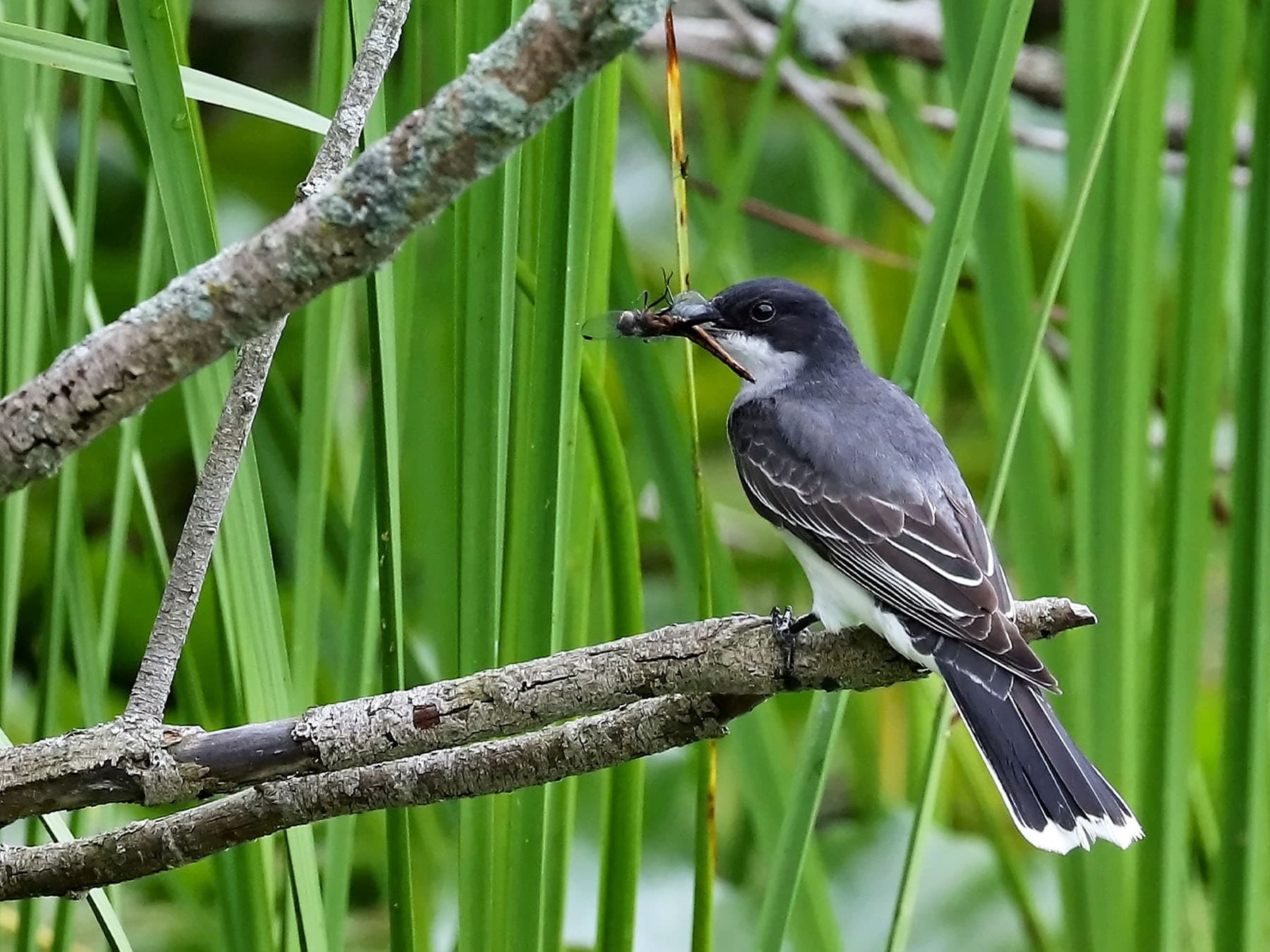
In summer, mostly large flying insects: bees and wasps, beetles, grasshoppers and crickets, flies and, near water, dragonflies. As summer goes on they add berries, and in winter they live mostly on fruit.
In a 1912 study of 665 stomachs collected from May to September across the breeding range, 85.5% of the food was insects: bees, wasps and ants 32.4%, beetles 25.4%, grasshoppers and crickets 11.8%. They had also eaten the fruits and seeds of 40 plants.6
An old name for the kingbird was bee martin, and beekeepers once shot kingbirds, believing they killed many honeybees. But most of the honeybees in the 1912 stomachs were drones, the males, and there is little evidence that it is a serious predator of them. Summer fruits include mulberries, serviceberries, cherries, blackberries, elderberries and currants, which are also fed to nestlings. Kingbirds have been seen catching small frogs, and an old report describes one taking small fish.
How they feed
The kingbird is a sit-and-wait hunter. It watches from a perch, usually 3 to 13 feet (1-4 m) up, flies out to snap an insect from the air and, about half the time, returns to the same perch. It beats big insects on the perch before swallowing them whole.
In a Kansas study, of 406 attempts to catch prey, half were made in mid-air, 40% by darting out to snatch prey from plants, 8% by hovering and 2% by dropping to the ground.7 Where there are no perches it faces into the wind and hangs over a field on fluttering wings, dipping to pick insects off the grass. In cold or wet weather, with few insects flying, it hunts in the canopy of tall trees or may feed on the ground.
Nesting and breeding
Pairs that have bred together before re-pair quickly. If both return from South America, they usually re-form the pair, often on the old territory: in one study, 85% of 32 such pairs re-paired.8
Pairs stay together through the season, but many chicks have a different father: in about 60% of nests some of the chicks are fathered by another male, one of the highest rates known in perching birds.9
The nest
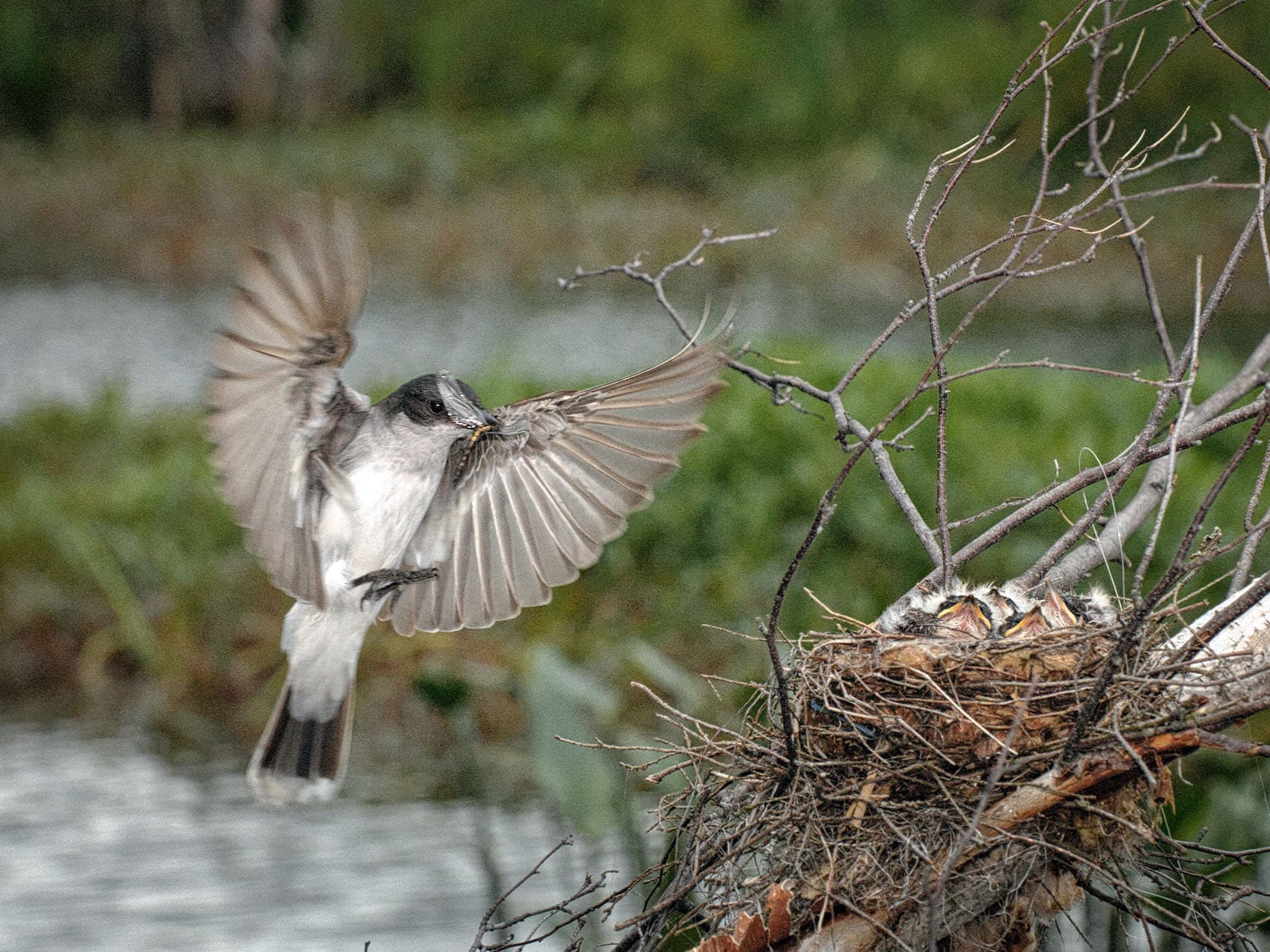
Kingbirds nest out on a horizontal branch of a tree in the open, often near the edge of the canopy or on a dead snag, and often over or near water. Hawthorn, apple, elm, mulberry and Osage orange are favorites. Most nests are 7 to 26 feet (2-8 m) up, though they range from near the ground to more than 65 feet (20 m). They also use utility poles, fence posts, power-line towers, dead snags standing in water, old robin nests, and oriole nests taken over before the orioles lay.
The female builds the nest over one to two weeks, mostly in the morning, while the male escorts her. It is a bulky cup of twigs, weed stems, coarse roots and strips of bark, lined with rootlets, plant down and hair: untidy outside, but sturdy and neat inside. Nests sometimes include twine, plastic, cigarette butts and fishing line, and a female has been found dead, caught in a loop of fishing line hanging from her nest.
Eggs and young
Most first clutches are laid in early June across the main range, from early May in Florida; cool, wet springs delay laying. The usual clutch is 3 or 4 eggs (2-5), white to pinkish with a striking ring of reddish-brown spots around the broad end, about 0.9 by 0.7 inches (24 x 18 mm).
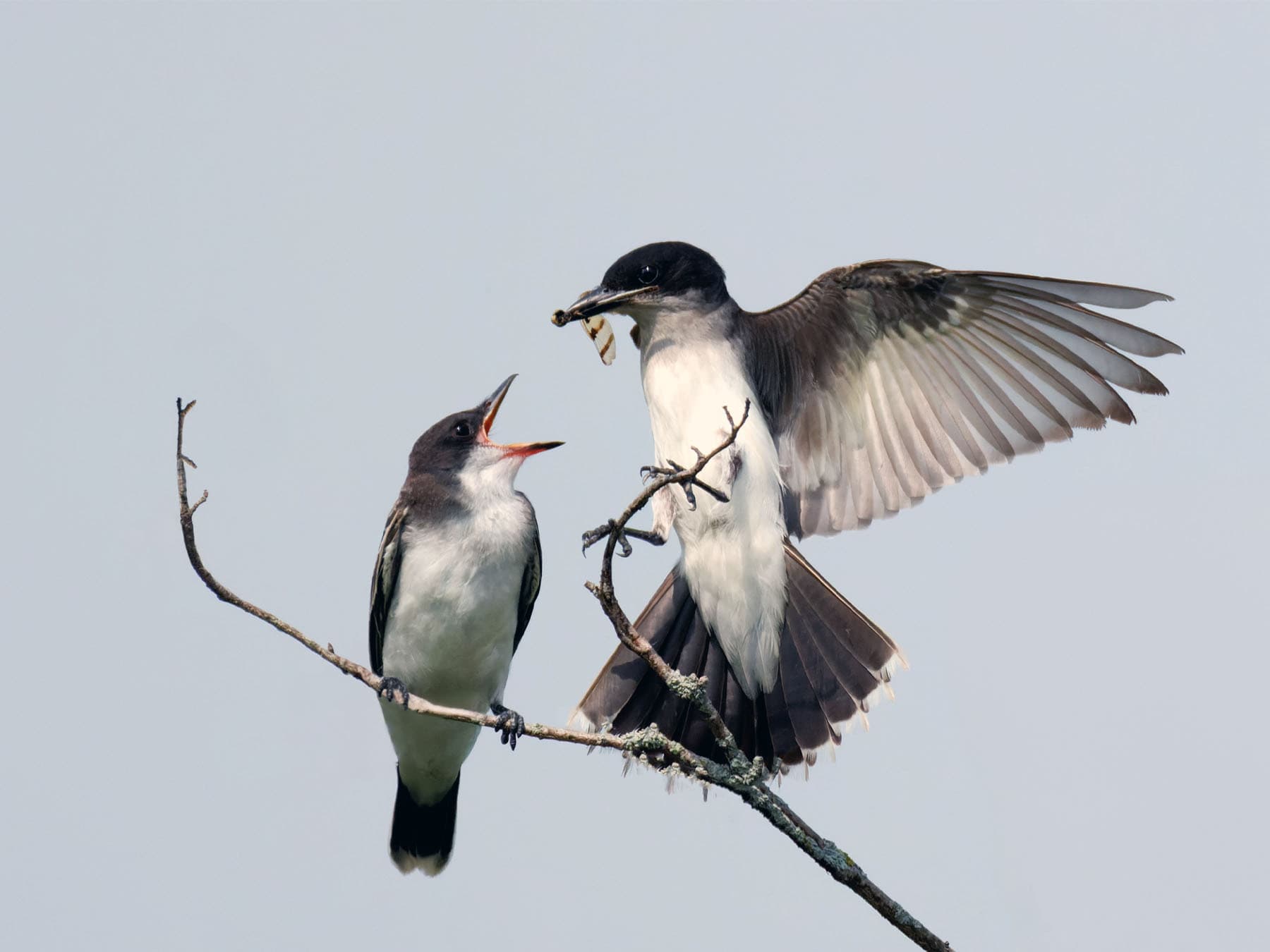
The female alone incubates, for 14 to 17 days. The male does not feed her, but when she leaves to feed he keeps watch near the nest until she returns. Guarding is mostly the male's job: in a New York study, males spent about half of each hour watching the nest. The chicks hatch blind and almost naked, with bright orange skin that turns dark gray within a day. Both parents feed them, one chick per trip, mostly with large, whole insects, killing the prey and removing the stings from bees and wasps first. The young leave the nest at 16 to 17 days and fly weakly at first.
In a Michigan study the parents went on feeding the young for at least 3 and often 4 weeks after they left the nest, at a high rate until they were about 5 weeks old and then less over about 2 more weeks.10 Parents defend their young until they are 7 to 8 weeks old. Probably because care lasts so long, a pair raises only one brood a year, though a female may lay up to four clutches in a season if her nests keep failing.
About 41% of nests raised at least one young across 25 study-years in New York, Kansas and Oregon.1 Predators cause most of the losses: Blue Jays, American Crows and squirrels in the East, climbing snakes in Kansas, and probably Black-billed Magpies and crows in the West, and on the Great Plains storms also wreck many nests. Kingbirds usually throw out Brown-headed Cowbird eggs, so cowbirds rarely succeed with them.
Behaviour
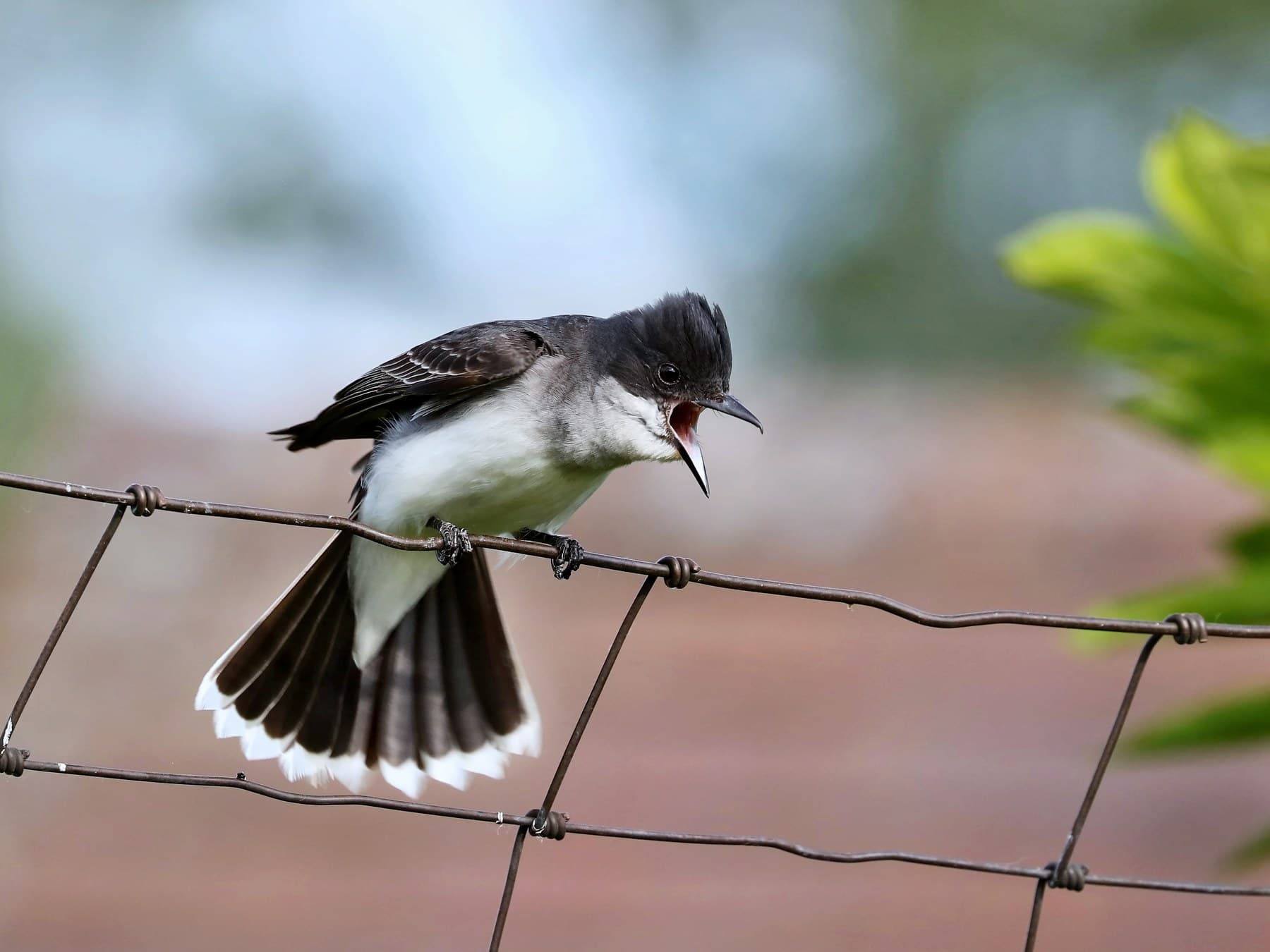
Kingbirds are famously bold in defense of their nests. They chase and dive at crows, hawks, herons and other large birds that fly over, have knocked Blue Jays out of trees, and dart at squirrels and weasels near the nest. One study found that this aggression raises the chance that a nest fledges young, though not every study agrees.11 Its genus name, Tyrannus, translates as a tyrant, a despot or a king, a nod to the way kingbirds dominate other birds. In a steep dive at a predator, a kingbird may raise its red crown patch and open its mouth wide to flash the red inside.
Rivals face off with tails spread to show the white band and may lock feet, pull feathers and tumble to the ground. In the tumble-flight display, a kingbird rises 50 to 165 feet (15-50 m) on stiff, quivering wings along the edge of its territory, then twists and jerks as it flies. Mates greet each other by fluttering on rapid, shallow wingbeats.
A kingbird almost never walks: on the ground it hops or flies a short way. It bathes by flying low over water and dipping its breast and head. Solitary and territorial while breeding, it becomes a flocking bird in late summer, as families gather for migration. Four South Carolina territories, measured in 1955, averaged 21 acres (8.4 ha) during the nestling stage.1
Lifespan and predators
In studies in New York and Oregon, about two-thirds of adults survived each year.8 In central New York, most breeders lived 2 years, and a female that reached her second breeding season lived about 3 years on average, with 4 or 5 not unusual.12, 13 The longest-lived birds in that study reached about 10 years.
The oldest on the North American banding records was at least 11 years old: a male banded as an adult in Maryland in 2012 and caught again, alive, in Maryland in 2022.14 Few predators take adults, probably mainly hawks and falcons.
Conservation
The Eastern Kingbird is still common, with about 26 million birds in a Partners in Flight estimate for around 2010, and of low conservation concern.15 But it is declining. On the North American Breeding Bird Survey its numbers fell by 0.73% a year from 1966 to 2025, about 35% in all, with declines in most states and provinces and the steepest in the Northeast and Florida.16 The survey index reached a low in 2019 and has risen slightly since, back to its 2010 level by 2025.
In eastern and central North America, the likely causes are the loss of open farmland, small farms, orchards, hayfields and fencerows to development, cleaner farming and regrowing forest.17 Conditions on migration and in winter may also play a part, but they have not been studied. It is one of many birds that catch insects in the air to be in decline, and pesticides are a possible factor. Kingbirds that hunt or nest by roads are regularly hit by cars: on one Ontario causeway they were the 13th most often killed of 40 native perching-bird species.18 In the US the Eastern Kingbird is protected under the Migratory Bird Treaty Act.19
Similar birds
Often mistaken for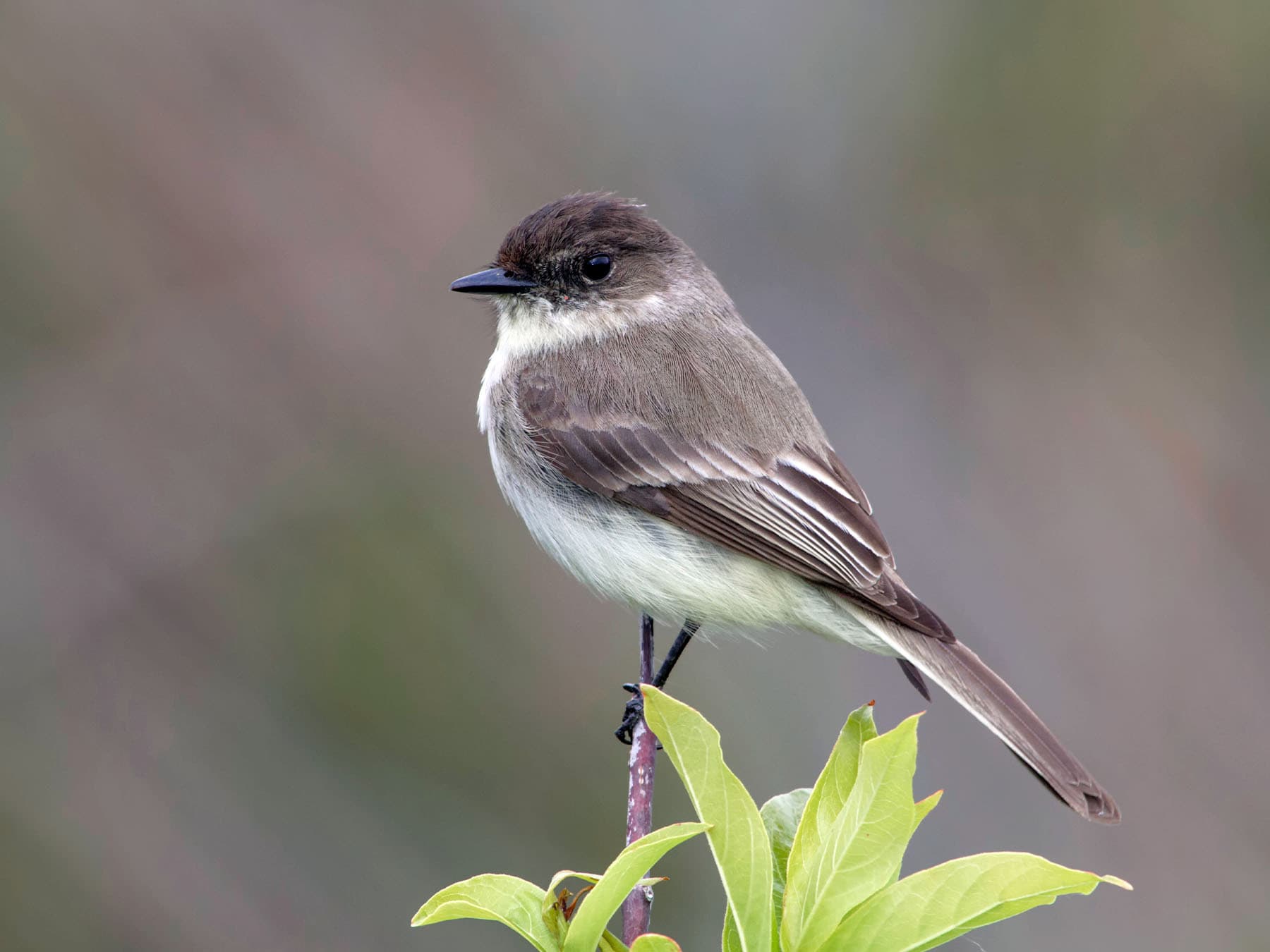
More photos
1 photos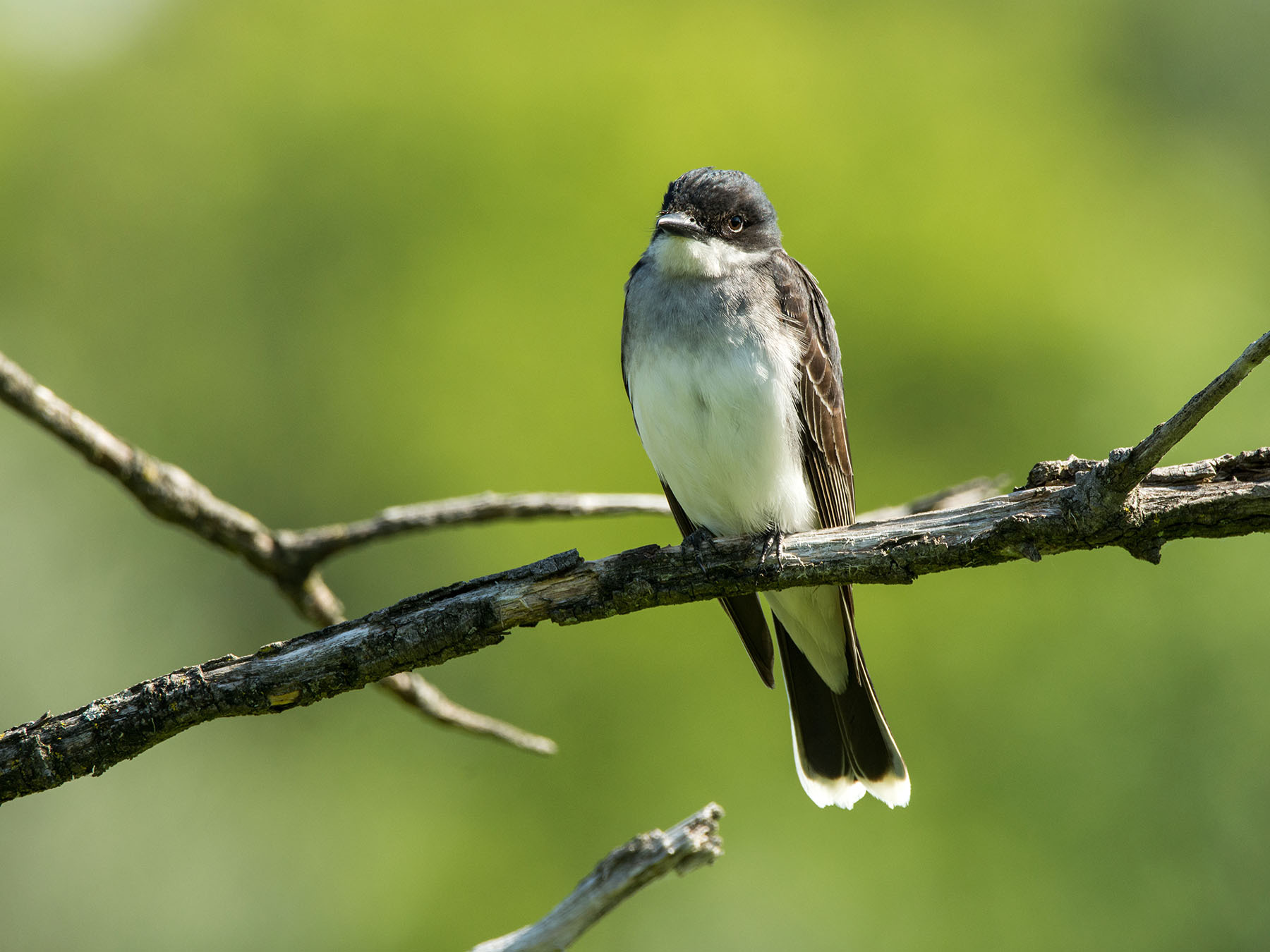
Quick facts
- Length
- 19–23 cm
- Wingspan
- 33–38 cm
- Weight
- 33–55 g
- Lifespan
- oldest recorded 11 years
- Family
- Tyrant Flycatchers
- Migration
- Long-distance Migrant
- Global status (IUCN)
- Least Concern
- World population
- About 26 million (Partners in Flight, about 2010)
- Population trend
- Common and widespread but declining; of low conservation concern (Partners in Flight)
- Also called
- Bee martin (old name)
- Scientific name
- Tyrannus tyrannus
Questions
3Do Eastern Kingbirds mate for life?
Partly. Pairs stay together through the season, and when both birds survive and come back from South America they usually re-form the pair on the old territory. But most kingbirds breed for only a few years, and in about 60% of nests some chicks have a different father. See nesting and breeding.
How do you attract Eastern Kingbirds?
Feeders are unlikely to help: they live on flying insects and fruit. Open yards with tall trees nearby and berry bushes may draw them, mainly in late summer. See what they eat.
Are Eastern Kingbirds rare?
No. They are common across most of North America in summer, though their numbers have fallen by about a third since 1966. See conservation status.
Sources
30- 1Murphy, M. T. and Pyle, P. (2020). Eastern Kingbird (Tyrannus tyrannus), version 1.0. Birds of the World (P. G. Rodewald, editor). Cornell Lab of Ornithology. doi:10.2173/bow.easkin.01 (opens in a new tab)
- 2Sexton, K., Murphy, M. T., Redmond, L. J. and Dolan, A. C. (2007). Dawn song of Eastern Kingbirds: intrapopulation variability and sociobiological correlates. Behaviour 144: 1273-1295. doi:10.1163/156853907781890922 (opens in a new tab)
- 3Murphy, M. T., Sexton, K., Dolan, A. C. and Redmond, L. J. (2008). Dawn song of the Eastern Kingbird: an honest signal of male quality?. Animal Behaviour 75: 1075-1084. doi:10.1016/j.anbehav.2007.08.020 (opens in a new tab)
- 4Dolan, A. C. et al. (2007). Extra-pair paternity and the opportunity for sexual selection in a socially monogamous passerine. Behavioral Ecology 18: 985-993. doi:10.1093/beheco/arm068 (opens in a new tab)
- 5Jahn, A. E. et al. (2013). Migration timing and wintering areas of three species of flycatchers (Tyrannus) breeding in the Great Plains of North America. The Auk 130: 247-257. doi:10.1525/auk.2013.13010 (opens in a new tab)
- 6Beal, F. E. L. (1912). Food of our important flycatchers. U.S. Department of Agriculture, Biological Survey Bulletin 44. Accessed 2 November 2026.
- 7Murphy, M. T. (1987). The impact of weather on kingbird foraging behavior. The Condor 89: 721-730. doi:10.2307/1368518 (opens in a new tab)
- 8Murphy, M. T. (1996). Survivorship, breeding dispersal and mate fidelity in Eastern Kingbirds. The Condor 98: 82-92. doi:10.2307/1369511 (opens in a new tab)
- 9Rowe, D. L., Murphy, M. T., Fleischer, R. C. and Wolf, P. G. (2001). High frequency of extra-pair paternity in Eastern Kingbirds. The Condor 103: 845-851. doi:10.1650/0010-5422(2001)103[0845:HFOEPP]2.0.CO;2 (opens in a new tab)
- 10Morehouse, E. L. and Brewer, R. (1968). Feeding of nestling and fledgling Eastern Kingbirds. The Auk 85: 44-54. doi:10.2307/4083623 (opens in a new tab)
- 11Blancher, P. J. and Robertson, R. J. (1982). Kingbird aggression: does it deter predation?. Animal Behaviour 30: 929-930. doi:10.1016/S0003-3472(82)80167-X (opens in a new tab)
- 12Murphy, M. T. (2014). Survival, longevity, and breeding dispersal by Eastern Kingbirds in central New York. The Kingbird 64: 290-300. Accessed 2 November 2026.
- 13Murphy, M. T. (2007). Lifetime reproductive success of female Eastern Kingbirds (Tyrannus tyrannus): influence of lifespan, nest predation, and body size. The Auk 124: 1010-1022. doi:10.1642/0004-8038(2007)124[1010:LRSOFE]2.0.CO;2 (opens in a new tab)
- 14USGS Bird Banding Laboratory. Longevity records of North American birds. USGS Eastern Ecological Science Center, Bird Banding Laboratory. Accessed 2 November 2026. Source (opens in a new tab)
- 15Partners in Flight (2023). Avian Conservation Assessment Database and Population Estimates Database. Bird Conservancy of the Rockies. Accessed 2 November 2026. Source (opens in a new tab)
- 16Hostetler, J. A. et al. (2026). The North American Breeding Bird Survey, Analysis Results 1966-2025. U.S. Geological Survey data release. doi:10.5066/P1OSNSFC (opens in a new tab)
- 17Murphy, M. T. (2003). Avian population trends within the evolving agricultural landscape of eastern and central United States. The Auk 120: 20-34. doi:10.1642/0004-8038(2003)120[0020:APTWTE]2.0.CO;2 (opens in a new tab)
- 18Ashley, E. P. and Robinson, J. R. (1996). Road mortality of amphibians, reptiles and other wildlife on the Long Point causeway, Lake Erie, Ontario. Canadian Field-Naturalist 110: 403-412. doi:10.5962/p.357494 (opens in a new tab)
- 19U.S. Fish and Wildlife Service (2026). 50 CFR 10.13: List of Birds Protected by the Migratory Bird Treaty Act. Electronic Code of Federal Regulations. Accessed 2 November 2026. Source (opens in a new tab)
- 20National Audubon Society. Eastern Phoebe. Guide to North American Birds. Accessed 2 November 2026. Source (opens in a new tab)
- 21National Audubon Society. Western Kingbird. Guide to North American Birds. Accessed 2 November 2026. Source (opens in a new tab)
- 22National Audubon Society. Great Crested Flycatcher. Guide to North American Birds. Accessed 2 November 2026. Source (opens in a new tab)
- 23National Audubon Society. Gray Kingbird. Guide to North American Birds. Accessed 2 November 2026. Source (opens in a new tab)
- 24National Audubon Society. Eastern Wood-Pewee. Guide to North American Birds. Accessed 2 November 2026. Source (opens in a new tab)
- 25Cornell Lab of Ornithology. Eastern Kingbird. All About Birds. Accessed 2 November 2026. Source (opens in a new tab)
- 26National Audubon Society. Eastern Kingbird. Guide to North American Birds. Accessed 2 November 2026. Source (opens in a new tab)
- 27Tennessee Wildlife Resources Agency. Eastern Kingbird, Tyrannus tyrannus. TWRA Wildlife: Birds. Accessed 2 November 2026. Source (opens in a new tab)
- 28Redmond, L. J., Murphy, M. T. and Dolan, A. C. (2007). Nest reuse by Eastern Kingbirds: adaptive behavior or ecological constraint?. The Condor 109: 463-468. doi:10.1650/0010-5422(2007)109[463:NRBEKA]2.0.CO;2 (opens in a new tab)
- 29Murphy, M. T. (1983). Ecological aspects of the reproductive biology of Eastern Kingbirds: geographic comparisons. Ecology 64: 914-928. doi:10.2307/1937213 (opens in a new tab)
- 30Murphy, M. T. (1986). Brood parasitism of Eastern Kingbirds by Brown-headed Cowbirds. The Auk 103: 626-628. Accessed 2 November 2026.

Checked by
Nathan Cope, founder and editor
Nathan founded Birdfact and leads its writers and contributors in the UK, the US and Canada. He has watched and studied birds for more than ten years, and checks every article and species guide before it’s published.