Species Profile
Western Kingbird
Tyrannus verticalis
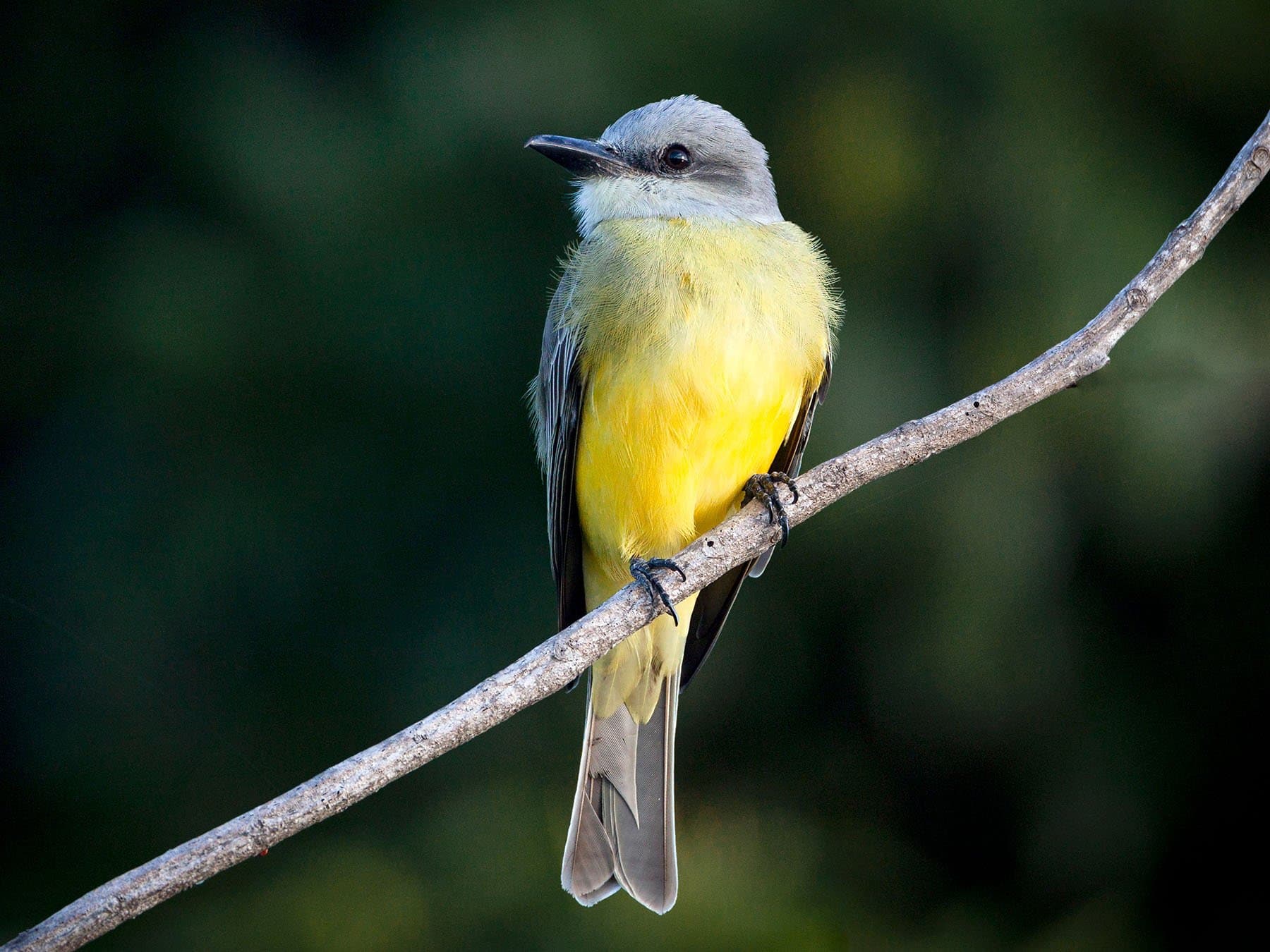
Western Kingbird perched on a bare branch, showing its gray head, yellow belly, and dark beak against a dark green background.
Quick Facts
Conservation
LCLeast ConcernLifespan
3–5 years
Length
20–24 cm
Weight
35–45 g
Wingspan
38–41 cm
Migration
Long-distance Migrant
Bold, brash, and lemon-yellow below, the Western Kingbird is the quintessential bird of the open American West — a perch-hunting flycatcher that will unhesitatingly chase a Red-tailed Hawk three times its size off its territory. Concealed beneath its grey crown feathers is a reddish-orange patch, normally hidden but raised like a battle flag during confrontations. Few birds have adapted so readily to human infrastructure: in parts of Houston, Texas, the species nests almost exclusively at electric power substations.
Think you've spotted a Western Kingbird?
Upload a photo and we'll confirm it instantly
Confirm with a PhotoAppearance
The Western Kingbird is a boldly patterned flycatcher measuring 20–24 cm in length with a wingspan of 38–41 cm. The head, neck, and breast are pale ashy grey, with dark lores — the area between the eye and the base of the bill — giving the face a subtly masked look. The malar area is whitish. The back is olive-green, contrasting with darker wing coverts, and the belly and undertail coverts are bright lemon-yellow: a vivid two-tone effect that makes the bird instantly recognisable in the field.
The bill is small and black, the legs and feet are black, and the eyes are dark. The tail is black and distinctively square-tipped, with narrow white edges on the outer tail feathers — the single most reliable feature for separating this species from similar yellow-bellied kingbirds such as Cassin's, Tropical, and Couch's Kingbirds, all of which lack those clean white outer margins.
Concealed beneath the grey crown feathers is a reddish-orange (sometimes described as crimson) central crown patch. Normally invisible, it is raised and fanned during aggressive encounters and courtship displays. Both sexes are identical in external plumage — the species shows no sexual dimorphism — and both possess this hidden crown patch. Juveniles are similar to adults but paler overall, with a more washed-out lemon-yellow below and broadly pale-fringed upperwing coverts. The species is monotypic, with no recognised subspecies.
Identification & Characteristics
Colors
- Primary
- Grey
- Secondary
- Yellow
- Beak
- Black
- Legs
- Black
Markings
Bright lemon-yellow belly contrasting with pale grey breast and head; black square-tipped tail with narrow white edges on outer tail feathers (key identification feature); concealed reddish-orange crown patch raised during display and aggression; dark lores giving a subtly masked facial expression
Tail: Black, square-tipped, with narrow white edges on the outer tail feathers — the key feature distinguishing this species from Cassin's, Tropical, and Couch's Kingbirds
Attributes
Understanding Attributes
Rated 0–100 based on research and observation. A score of 50 is average across all bird species. These attributes are relative and don't necessarily indicate superiority.
Habitat & Distribution
Western Kingbirds breed across a broad sweep of western North America, from southern British Columbia east to southwestern Ontario in Canada, south through the western United States to northern Mexico. The core breeding range encompasses the Great Plains states — North Dakota and Montana south through Nebraska, Kansas, Oklahoma, and Texas — as well as the intermountain west: Nevada, Utah, Colorado, Arizona, New Mexico, Idaho, Oregon, and California. Highest breeding densities occur in the Central Plains, particularly northwestern Texas and eastern New Mexico.
The key habitat requirement is a combination of open ground for foraging and elevated perches for hunting and nesting. Grasslands, desert shrub, savannahs, pastures, cultivated fields, riparian woodlands with scattered trees, and open suburban areas all qualify. The species avoids dense forest and true desert. Breeding typically occurs below 2,130 m (7,000 feet), in lowland areas or mountain valleys. Preferred nest trees include cottonwoods, willows, elms, mesquite, sycamores, and ponderosa pines, but the species has adapted readily to utility poles, windmills, and building ledges wherever natural trees are scarce.
In winter, Western Kingbirds migrate to open woodlands, plantations, grasslands, and agricultural fields in southern Mexico and Central America, ranging as far south as Costa Rica. Since 1915, a small but regular wintering population has established itself in southern Florida — a genuine range expansion into a non-breeding area that did not exist before the 20th century. During fall migration, the species regularly wanders eastward, appearing along the entire Atlantic Coast from Florida to Newfoundland. For North American birdwatchers, the species is easiest to find in the western US from May through August; fall migrants along the East Coast are a bonus for Atlantic birders from late August into October.
In the Western Palearctic, the Western Kingbird remains a genuine rarity. It has been recorded in Norway, Finland, France, Portugal, Italy, and the Azores (eight records to date), but has not yet appeared in Britain or Ireland and remains absent from the British List. Its close relative the Eastern Kingbird was added to the British List following a record in the Outer Hebrides in 2016, making a future Western Kingbird record in the UK a plausible — if still distant — prospect.
Where to See This Bird
Explore regional guides for locations where this bird has been recorded.
United States
Montana
Nebraska
Idaho
Kansas
Nevada
New Mexico
North Dakota
Arizona
California
Colorado
Oklahoma
Utah
Oregon
South Dakota
Texas
Washington
Wyoming
Manitoba
Saskatchewan
Diet
Insects make up the overwhelming majority of the Western Kingbird's diet. It hunts by sight from an elevated perch — a fence post, utility wire, or exposed branch — making acrobatic aerial sallies to catch flying prey, then returning to the same perch to eat. It may capture two or more insects before returning, and beats larger prey against the perch to subdue it before swallowing. Studies of stomach contents show the diet is dominated by Coleoptera (beetles) and Orthoptera (grasshoppers and crickets), with bees, wasps, moths, butterflies, caterpillars, flies, true bugs, robber flies, and winged ants also taken regularly.
The species tends to take relatively large insects compared to other flycatchers, and shows a preference for prey flying less than 1.5 m (5 feet) above the ground. It also swoops down to take terrestrial prey from the ground, and will hover briefly to glean insects from vegetation. Spiders and millipedes are taken occasionally. Foraging height varies with habitat: birds in riparian zones tend to perch higher than those in desert landscapes.
Fruit and berries supplement the diet in small quantities, particularly during migration and in late summer when insect abundance declines. Recorded plant foods include elderberry, hawthorn, Texas mulberry, woodbine, buckthorn, sumac, and poison ivy seeds. This dietary flexibility — insects as the staple, fruit as a seasonal supplement — helps the species maintain condition during the energetically demanding moult-migration stopover in New Mexico and Arizona each autumn.
Behaviour
Western Kingbirds are among the most aggressively territorial birds in North America relative to their size. Males defend their breeding territories with relentless energy, attacking intruders far larger than themselves — Red-tailed Hawks, American Kestrels, Common Ravens, and even humans who venture too close to a nest. Coordinated group attacks involving up to ten individuals have been recorded against a single predator, a level of collective mobbing behaviour unusual in flycatchers.
Despite this ferocity, the defended territory shrinks dramatically as the breeding season progresses. What begins as a broad area around the nest site contracts to little more than the nest tree itself by mid-incubation — a behavioural shift that allows multiple pairs to nest in the same tree without constant conflict. When threatened at close range, birds snap their bills audibly, fluff and raise their hidden crown feathers, flutter their wings, and crouch in a threat posture.
Outside the breeding season, Western Kingbirds are less combative. Fall migrants sometimes travel in loose flocks of up to 200 birds. The species has adapted with striking success to human-modified landscapes: utility poles, windmills, antennae, and building ledges are all used as hunting perches and nest sites. In some areas of Trans-Pecos Texas, over 40% of nests are placed on man-made structures, and in parts of Houston the species nests almost exclusively at electric power substations.
Calls & Sounds
The Western Kingbird's song is a high, squeaky, sputtering chatter, often phonetically rendered as pidik pik pidik PEEKado — a rapid, rising series of notes delivered with considerable energy. A second vocalisation is a sharp, hard kit or kip (also described as whit), used frequently as a contact and alarm note. A third call — a shrill, sputtering widik pik widi pik pik — is given during aggressive interactions and aerial pursuits.
The dawn song deserves special mention. Males begin singing incessantly at the first hint of daylight, well before sunrise, delivering a persistent territorial broadcast that carries across open country. This pre-dawn performance serves both to defend territory and to attract or maintain the pair bond. Flight songs are also given during the tumble-flight courtship display (see Courtship and Display). The species occasionally sings before sunrise even outside the breeding season.
Like all tyrant flycatchers, the Western Kingbird is a suboscine — its syrinx (vocal organ) is structurally simpler than that of true songbirds (oscines), and crucially, its song is innate rather than learned. A Western Kingbird raised in isolation will develop its full vocal repertoire without ever hearing an adult of its species. This contrasts sharply with oscine songbirds such as thrushes or warblers, which must hear and practise adult song during a critical developmental window. Non-vocal displays supplement the vocal repertoire: agitated birds snap their bills audibly, raise their hidden crown feathers, and flutter their wings.
Flight
In level flight, the Western Kingbird moves with shallow, rapid wingbeats interspersed with brief glides — a style typical of the larger tyrant flycatchers, purposeful rather than undulating. The broad, rounded wings and relatively short, square-tipped tail give the bird a compact silhouette in the air. The black tail with its narrow white outer edges is often visible in flight, particularly when the bird fans its tail on landing or during a banking turn.
Foraging flights are the most distinctive: the bird launches from its perch, makes a sharp aerial sally — often with rapid twisting and turning to intercept a flying insect — then returns to the same perch in a smooth arc. These sallies are typically short, rarely exceeding 20–30 m, but are executed with impressive precision. The bird may also hover briefly while gleaning insects from vegetation, though sustained hovering is uncommon.
During the courtship tumble-flight display, the male's flight becomes dramatically acrobatic: he climbs steeply, stalls, then falls rapidly through the air, twisting, tumbling, and flipping while vocalising before recovering and returning to his perch. This display — performed repeatedly at dawn and dusk — showcases the species' aerial agility at its most extreme. Migrating birds travel individually or in loose flocks, with a direct, sustained flight style quite different from the short sallies of the breeding season.
Nesting & Breeding
The female selects the nest site and builds the nest alone while the male guards the territory. Nests are placed in the upper third of a tree or shrub — typically in a vertical fork or on a horizontal limb 4.6–9.1 m (15–30 feet) above the ground, though nests as low as 1.5 m and as high as 12.2 m have been recorded. Preferred trees include cottonwoods, willows, elms, mesquite, sycamores, and ponderosa pines. In the absence of suitable trees, nests go on utility poles, windmills, antennae, building ledges, or in the abandoned nests of other species.
The nest is a bulky open cup of grass stems, rootlets, fine twigs, cottonwood bark, cotton, and plant fibres, lined with softer materials such as wool, hair, feathers, string, or cloth. Externally it measures approximately 15 cm (6 inches) across and 10 cm (4 inches) deep; the inner cup is about 7.5 cm (3 inches) across and 5 cm (2 inches) deep. Clutch size is 2–7 eggs, typically 3–5 and averaging 4. Eggs are white, creamy, or pinkish, heavily blotched with brown, black, or lavender, and weigh approximately 3.83 g each.
Incubation is performed solely by the female and lasts 18–19 days. Chicks hatch helpless and sparsely covered in white down with eyes closed. Both parents feed the nestlings, which leave the nest 16–17 days after hatching. Parents continue to feed fledglings for up to three weeks after they leave the nest. The species typically produces one to two broods per year, with laying from early May to mid-July depending on latitude. Predation causes up to 50% of nest failures; major nest predators include Cooper's Hawks, Chihuahuan Ravens, snakes, squirrels, woodrats, owls, falcons, magpies, and shrikes.
Lifespan
The maximum recorded lifespan for a Western Kingbird is at least 6 years and 11 months, based on a male banded in South Dakota in 1941 and recovered by the USGS Bird Banding Laboratory at the Patuxent Wildlife Research Center. General sources cite a maximum lifespan of approximately 6 years, consistent with this record. Typical lifespans in the wild are likely shorter — probably 3–5 years for birds that survive their first year — though detailed survival rate data for this species are limited.
As with most small to medium-sized passerines and near-passerines, the first year of life carries the highest mortality risk. Predation at the nest accounts for up to 50% of breeding failures, and juveniles dispersing from the nest face additional predation pressure before they develop the territorial confidence of adults. The long-distance migration to Central America introduces further mortality risk each year.
Compared to other tyrant flycatchers, the Western Kingbird's maximum recorded age is broadly similar to that of the Eastern Kingbird, which has a recorded maximum of around 10 years — suggesting the Western Kingbird may be capable of longer lifespans than the current banding record indicates. Pesticide exposure, which reduces insect prey and may cause direct poisoning, is considered the most significant human-related mortality factor beyond habitat loss.
Conservation
The Western Kingbird is listed as Least Concern on the IUCN Red List (assessed 2016), with a global population estimated at approximately 29–30 million mature individuals by Partners in Flight and BirdLife International. North American Breeding Bird Survey data from 1966 to 2019 show populations remained broadly stable, with slight increases across most of the nesting range. The species carries a Continental Concern Score of just 9 out of 20 from Partners in Flight, indicating low conservation concern overall.
The primary identified threat is pesticide exposure. Because Western Kingbirds nest near and forage in cultivated agricultural land, they are vulnerable both to direct poisoning and to the reduction of insect prey caused by pesticide application — including neonicotinoids, which have been linked to insect population declines across North America. Some local contractions have been documented: in Minnesota, populations declined significantly from the 1920s to the 1970s, a decline attributed in part to agricultural pesticide use, though numbers have since partially recovered.
Habitat loss from urbanisation and agricultural intensification could reduce open foraging areas in the longer term, and climate change may shift the species' range. However, the Western Kingbird has demonstrated a strong capacity to exploit human-modified landscapes — utility poles, power substations, and suburban trees have all expanded available nesting habitat — which provides some buffer against habitat loss. The species is protected under the US Migratory Bird Treaty Act.
Population
Estimated: Approximately 29–30 million mature individuals
Trend: Stable
Stable to slightly increasing. North American Breeding Bird Survey data (1966–2019) show populations remained broadly stable, with slight increases across most of the nesting range. The species has expanded its breeding range eastward since the late 1800s. Some local declines have been noted, notably in Minnesota, where populations declined significantly from the 1920s to 1970s, likely linked to agricultural pesticide use.
Elevation
Typically below 2,130 m (7,000 ft); breeds in lowland areas and mountain valleys
Additional Details
- Family:
- Tyrannidae (Tyrant Flycatchers)
- Predators:
- Cooper's Hawk, Chihuahuan Raven, snakes, squirrels, woodrats, owls, falcons, magpies, shrikes; predation causes up to 50% of nest failures
- Subspecies:
- Monotypic — no subspecies recognised
- Original name:
- Arkansas Kingbird (used by AOU until the 20th century)
- First described:
- Thomas Say, 1822, from specimens collected along the Arkansas River during Major Stephen H. Long's Rocky Mountain expedition
- Legal protection:
- Protected under the US Migratory Bird Treaty Act
- Continental concern score:
- 9/20 (Partners in Flight) — low conservation concern
Courtship & Display
The Western Kingbird's courtship display is one of the most spectacular aerial performances of any North American flycatcher. The male flies high above his territory, stalls, then falls rapidly through the air — twisting, tumbling, and flipping while delivering a burst of excited vocalisations. He recovers, returns to his perch, and repeats the performance, often for extended periods at dawn and dusk. One displaying male frequently triggers neighbouring rivals into their own courtship flights, creating a chain reaction of aerial acrobatics across the territory.
This tumble-flight display serves multiple functions: it advertises the male's fitness to prospective mates, reinforces the pair bond after pairing, and signals territorial ownership to rival males. The hidden reddish-orange crown patch — normally invisible beneath the grey crown feathers — is raised and fanned during both courtship and aggressive encounters, adding a flash of colour to interactions that would otherwise appear monochrome at a distance.
After pairing, the female takes sole responsibility for nest construction while the male guards the territory. The male's role shifts from display to active defence: he sings the persistent dawn song incessantly at first light, patrols territory boundaries, and launches aggressive attacks on any intruder. As incubation progresses, the defended territory contracts dramatically — from a broad area around the nest to little more than the nest tree itself — but the intensity of defence at that reduced perimeter, if anything, increases.
Cultural And Historical Significance
The Western Kingbird carries a piece of American exploration history in its original name. Thomas Say — the naturalist accompanying Major Stephen H. Long's 1820 expedition to the Rocky Mountains — collected the specimens from which he formally described the species in 1822, naming it after the Arkansas River drainage where the birds were found. The American Ornithologists' Union retained the name 'Arkansas Kingbird' in all editions of its checklist until the 20th century, when it was finally changed to 'Western Kingbird' to better reflect the bird's broad range across the American West.
The species' range expansion since the late 1800s is a striking case study in unintended ecological consequences of European settlement. By planting trees on the open prairies, erecting utility poles and telegraph wires, and clearing eastern forests, settlers inadvertently created ideal habitat for a bird that requires open ground combined with elevated perches. The Western Kingbird spread eastward across the Dakotas, into Minnesota, Arkansas, Missouri, and Texas — a documented expansion tracked by ornithologists since the 1870s. The bird essentially followed the infrastructure of westward settlement, colonising the transformed landscape as fast as humans could build it.
Today, the species' relationship with human infrastructure continues to evolve. In Houston, Texas, Western Kingbirds have been documented nesting almost exclusively at electric power substations — a concentration of metal girders, insulators, and elevated perches that apparently mimics the open-tree-in-grassland structure the species evolved to exploit. It is an adaptation that would have been unimaginable to Thomas Say in 1822.
Birdwatching Tips
The Western Kingbird is one of the easier western flycatchers to identify. The combination of pale grey head and breast, bright lemon-yellow belly, and black tail with white outer edges is distinctive and visible at a reasonable distance. The white tail edges are the clinching feature: look for them as the bird fans its tail on landing or during aerial sallies. Cassin's Kingbird, the most likely confusion species, has a darker grey breast, a white chin that contrasts sharply with the breast, and lacks the white tail edges.
The best strategy is to scan fence lines, utility wires, and exposed treetops in open country across the western US from late April through August. The species is conspicuous and vocal, often returning to the same perch repeatedly after each foraging sally. Ranch buildings, corrals, and roadsides through grassland or agricultural land are productive search areas. In Texas and New Mexico, the species is abundant and easy to find; in California and the Pacific Northwest, it is common in drier, open valleys.
For East Coast birders in North America, late September and October bring a reliable trickle of fall vagrants along the Atlantic seaboard — check coastal scrub and open areas from Florida to New England. In southern Florida, small numbers now winter annually, making the species findable year-round in that state. European birders should be aware that the species has reached the Azores eight times and has been recorded in Norway, Finland, France, Portugal, and Italy — making it a candidate for any future Western Palearctic rarity review.
Did You Know?
- The Western Kingbird was originally known as the Arkansas Kingbird — not because it is especially associated with Arkansas, but because it was first scientifically described by Thomas Say in 1822 from specimens collected along the Arkansas River during Major Stephen H. Long's expedition to the Rocky Mountains. The American Ornithologists' Union used the name 'Arkansas Kingbird' in all editions of its checklist until the 20th century.
- Fall migration for this species is a two-stage molt-migration: birds first fly to staging areas in New Mexico, Arizona, and northern Mexico, where they pause to complete a full post-breeding moult before continuing south to their Central American wintering grounds. This strategy — documented in a 2009 study by Barry, Butler, Rohwer, and Rohwer — is unusual among North American migrants.
- A small wintering population of Western Kingbirds has been established in southern Florida since 1915 — a genuine range expansion into a non-breeding wintering area that simply did not exist before the 20th century, and one that has grown steadily over the decades.
- The species' song is innate, not learned. As a suboscine flycatcher, a Western Kingbird raised in complete acoustic isolation will still develop its full vocal repertoire — no tutor required. This is the opposite of most familiar songbirds, which must hear and practise adult song during a critical developmental window.
- During coordinated nest defence, up to ten Western Kingbirds have been observed attacking a single predator simultaneously — a level of collective mobbing behaviour that regularly overwhelms birds as large as Red-tailed Hawks and Common Ravens.
Records & Accolades
Most Aggressive Defender
Up to 10 vs. 1
Up to ten Western Kingbirds have been recorded mounting a coordinated attack on a single predator — including Red-tailed Hawks and Common Ravens many times their size.
Molt-Migration Pioneer
Two-stage migration
Uniquely among North American migrants, Western Kingbirds pause in New Mexico and Arizona each autumn to complete a full moult before continuing south to Central America — a strategy documented in a 2009 study.
Urban Adapter
40%+ man-made nests
In Trans-Pecos Texas, over 40% of nests are on man-made structures. In parts of Houston, the species nests almost exclusively at electric power substations.
Community Photos
Be the first to share a photo of the Western Kingbird
Upload a PhotoIdentify Any Bird Instantly
- Upload a photo from your phone or camera
- Get an instant AI identification
- Ask follow-up questions about the bird
Monthly Birds in Your Area
- Personalised for your location
- Seasonal tips and garden advice
- Updated every month with new species