


Brown Creeper
American Treecreeper · Certhia americana
By the Birdfact teamChecked by Nathan Cope
On this page13 sections
How to recognise it
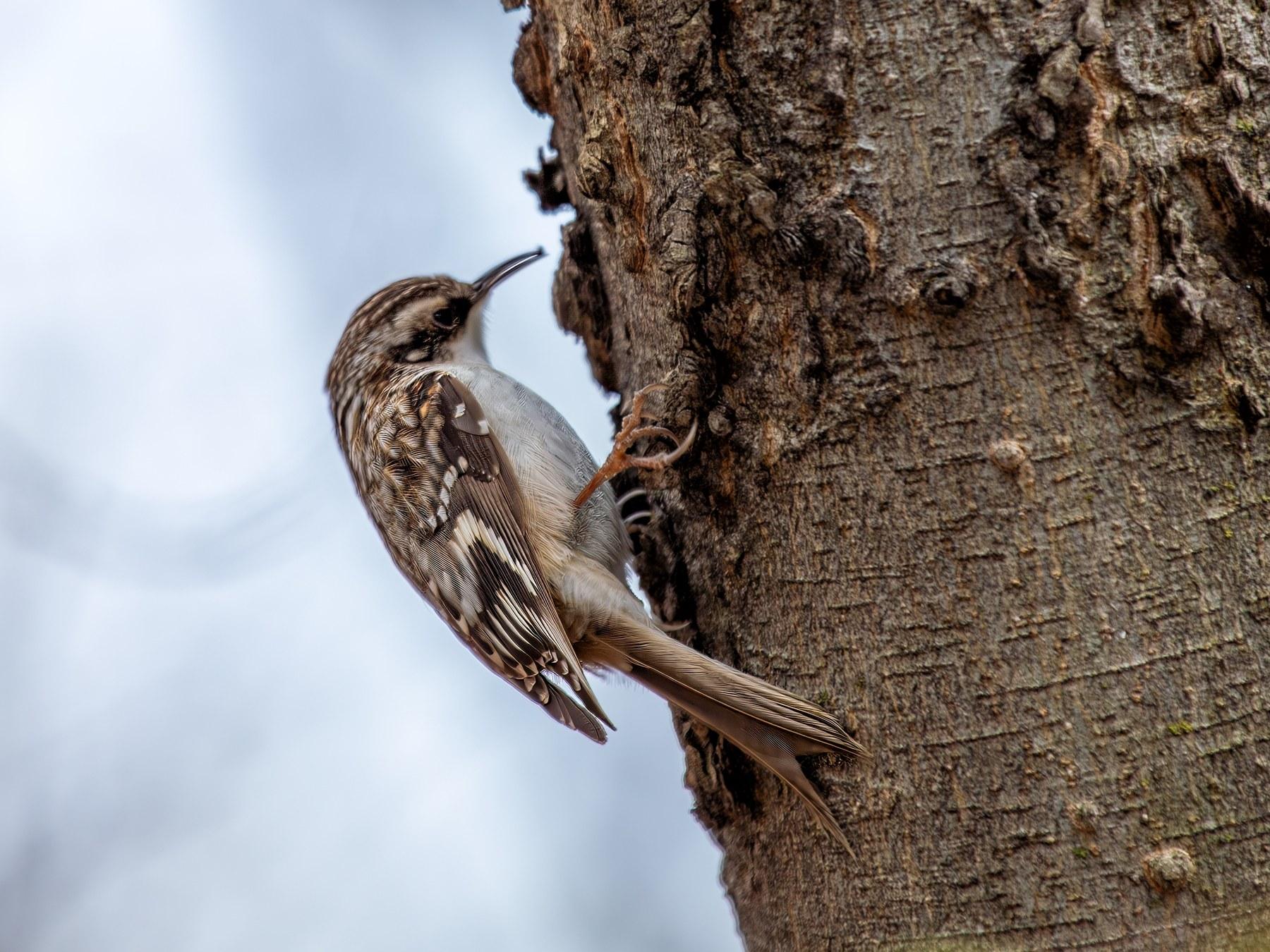
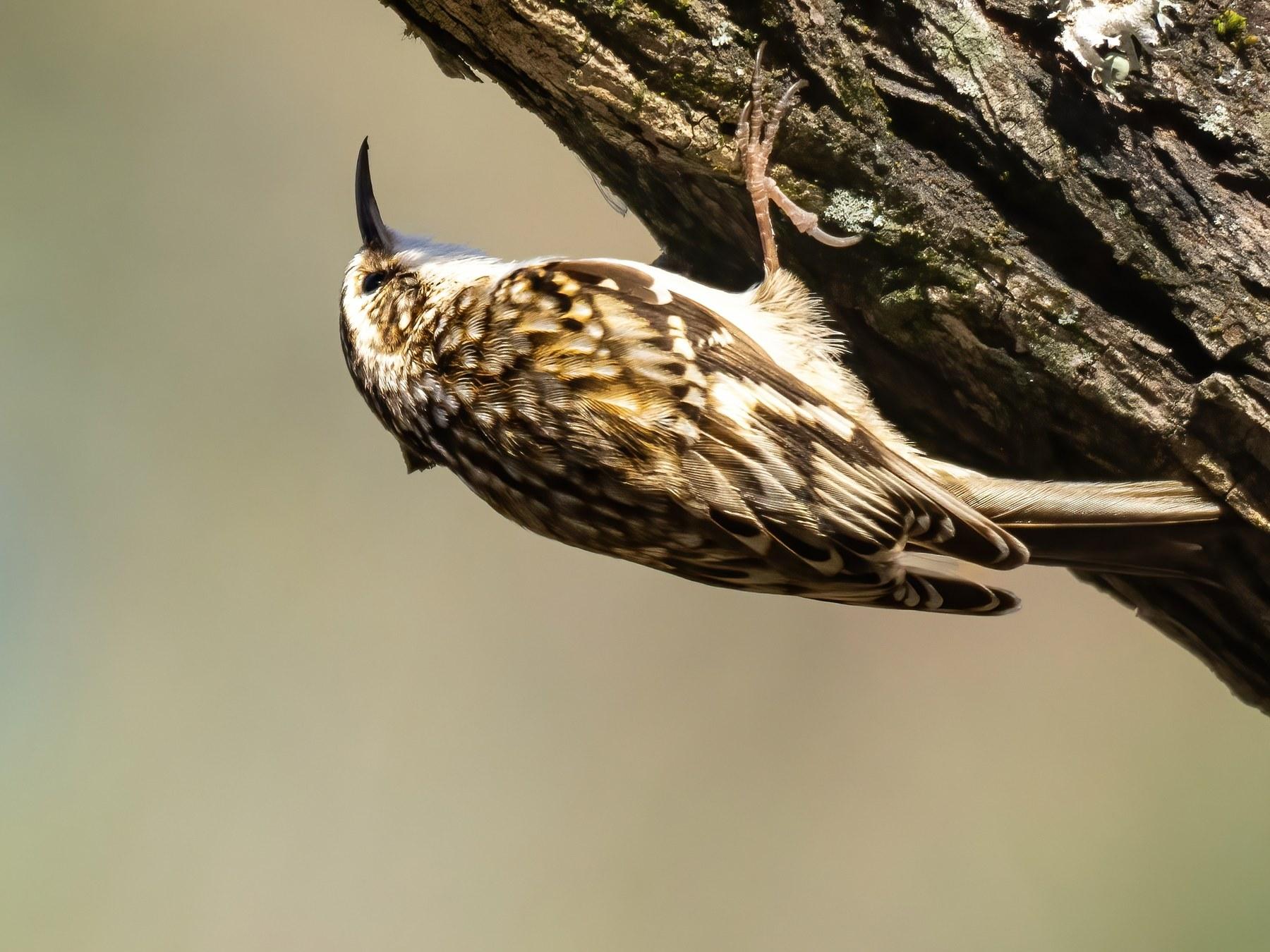
Look for a small brown bird hitching up a large trunk in short hops, its tail pressed against the bark. Brown above and white below, with a thin, down-curved bill and a long, stiff tail, it is easy to overlook. This is the treecreeper of North America; in New Zealand, "brown creeper" is also a name for a different bird, the Pīpipi.1
Up close, the upperparts are brown, streaked and flecked with dull white, and a creamy-white eyebrow runs over the eye. The underparts are white, washed cinnamon toward the tail, and the rump is cinnamon to tawny. The tail feathers end in stiff spines. In flight a pale stripe shows across the wing, made by pale bands on the flight feathers.
Shade varies across the range. Northern birds are grayer above and southern ones browner, darkest in northwestern Mexico; Rocky Mountain birds are grayer with narrow gray streaks, and Pacific birds browner with buff streaks. Subspecies are hard to tell apart in the field, and in many cases it may not be possible.
Size and weight
It is 4.7–5.5 in (12–14 cm) long, with a wingspan of 6.7–7.9 in (17–20 cm), and weighs about 0.25–0.35 oz (7–10 g).2 That makes it smaller than a White-breasted Nuthatch and larger than a Golden-crowned Kinglet. Its tail is about as long as its wing.
Males are generally a little larger than females, and the female's bill averages slightly shorter, which may be the only way to sex a bird in the hand.
Male, female and young birds
Males and females look alike all year. There is no separate breeding plumage: adults replace all their feathers once a year, after breeding, mainly from July to September.
Juveniles, seen mainly from June to August, look much like adults. Look for pale brownish-gray flecks or dusky spots on the breast that give a slightly scaly look, a fainter eyebrow, paler upperparts that are both spotted and streaked, and loose, fluffy feathers, especially under the tail. By their first fall they can hardly be told from adults. Recently fledged young have a red mouth lining.
The tail is probably molted from the pair next to the center outward on each side, with the central pair last, as in woodpeckers, which would leave the bird a stronger tail to lean on.3
Identification: similar birds
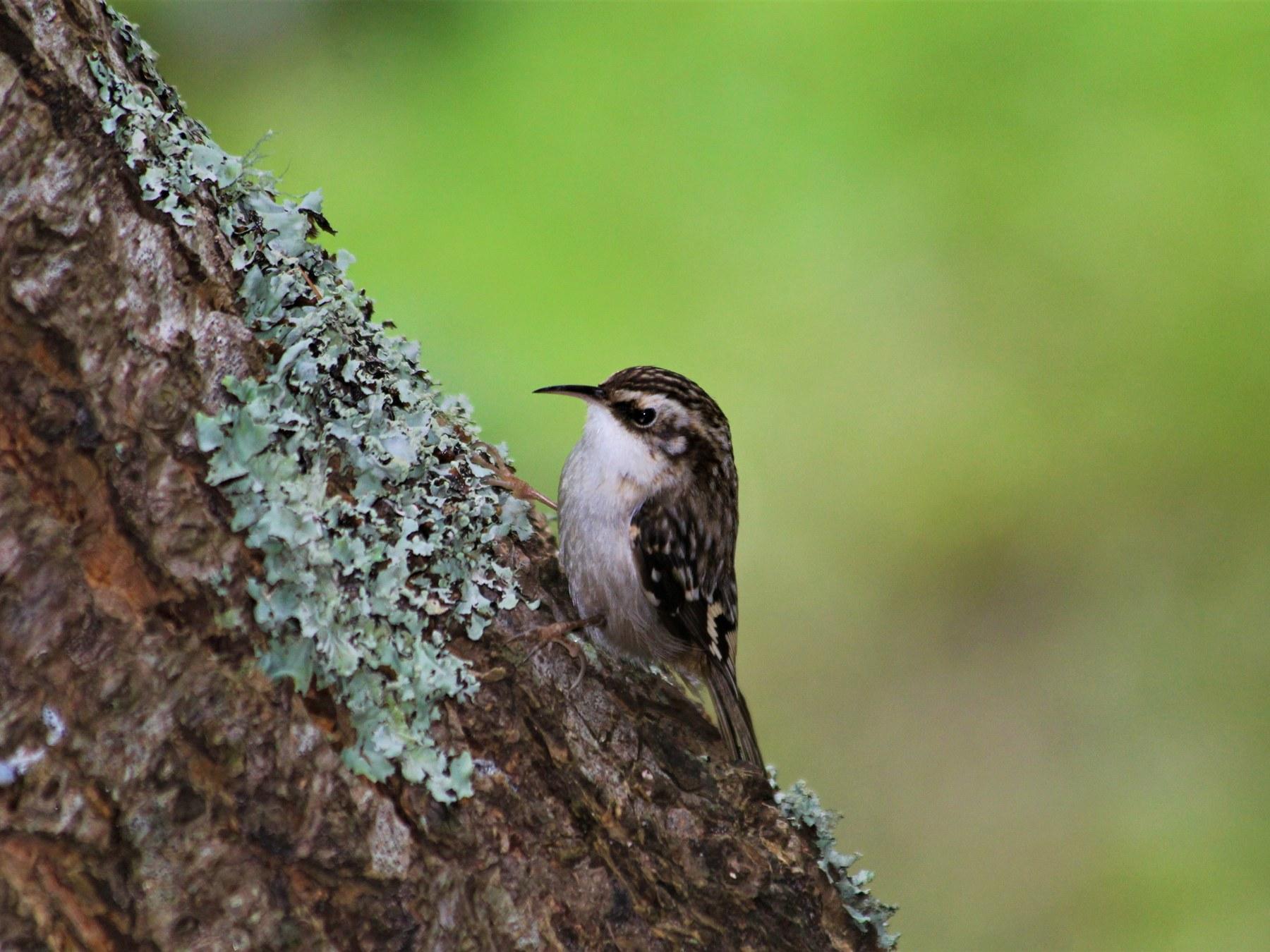
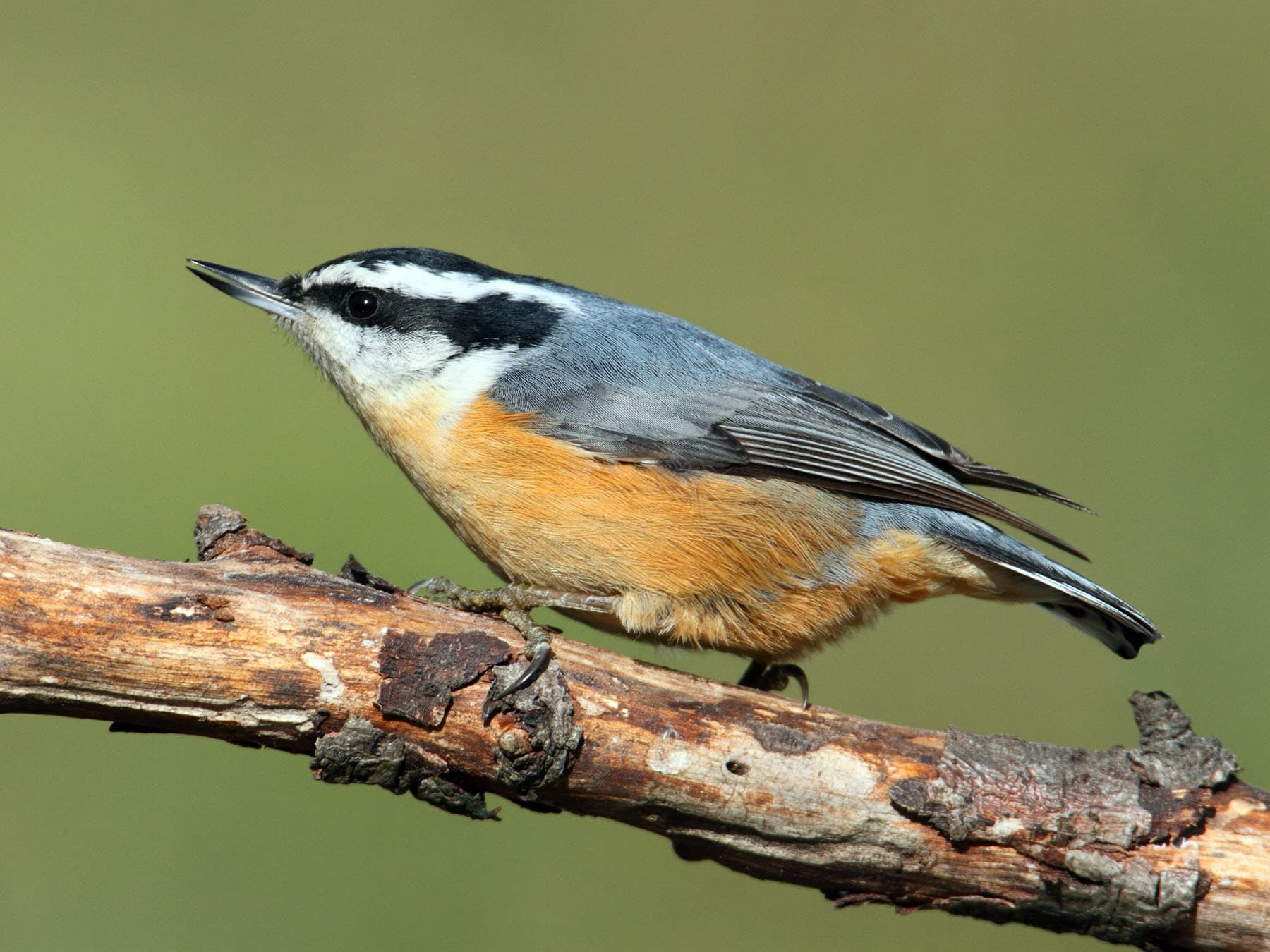
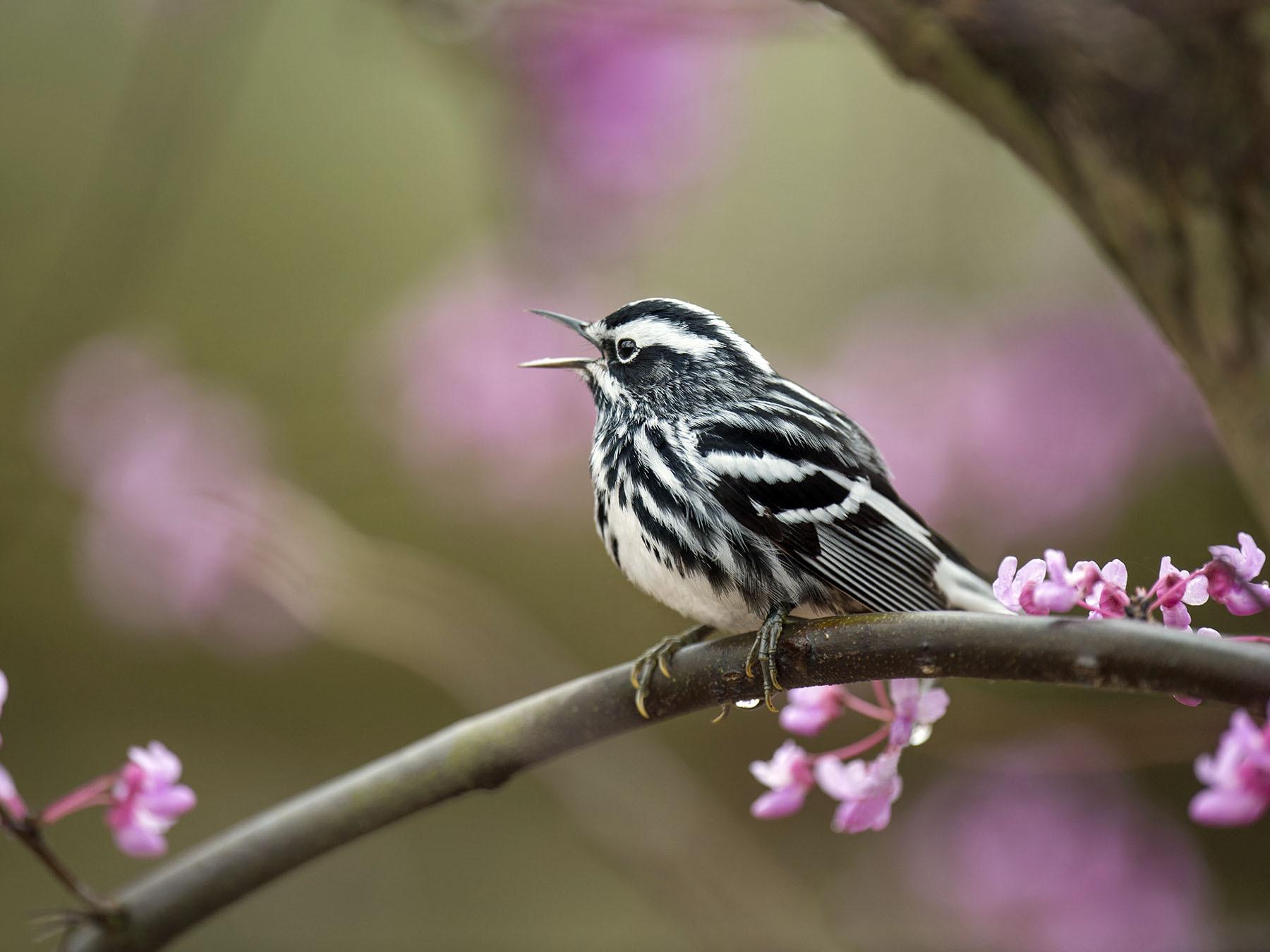
Few North American birds look like it. Its brown-and-white plumage, tiny size and trunk-creeping habit set it apart, and although it forages like a nuthatch or a woodpecker, its plumage and shape are quite different. The birds most worth comparing with it are nuthatches and the Black-and-white Warbler.
Nuthatches are blue-gray above. The White-breasted Nuthatch is bigger, with a white face and breast, a black or grayish crown and a short tail with white corners. The Red-breasted Nuthatch has a black eye-stripe below a white eyebrow and usually rufous-cinnamon underparts, paler in females, and it gives a nasal, tin-horn call. A Black-and-white Warbler creeps along trunks and branches too, but it is striped black and white all over, with white wing-bars, and it also feeds among leaves. A creeper is brown, nearly always climbs upward and keeps its tail pressed to the bark.
By ear it is harder. Its high call notes are nearly identical in pitch and timing to a Golden-crowned Kinglet's, so a call alone may not settle it.
Not sure it’s a Brown Creeper? Check your photo: Birdfact names the bird and shows the look-alike side by side.
Its size
Adults- Length
- 12–14 cm
- Wingspan
- 17–20 cm
- Weight
- 7–10 g
Its song and calls
The sound you are most likely to hear is a high, sibilant "tsee", given by both sexes all year, especially while feeding, and very like a Golden-crowned Kinglet's call. In the breeding season the male adds a short, high song, thin yet rich and delicate, that usually starts on a high note and falls.
Only the male sings, mostly on the breeding grounds and rarely on migration. In West Coast birds the song has 4–9 high, sibilant notes between 3.0 and 8.5 kHz and lasts about 1.2 seconds.3 Males sing most while setting up territories, more before and during nest building than later in the season, and again after the young fledge. In Michigan two males countersang 53 times in under 10 minutes, and song could be heard up to about 390 ft (120 m) away in the forest.3
Other calls include a bell-like "zi-i-i-it" and, in flight, a short "tsit" or a sharp "tseet-tseet". West Coast birds also have two aggressive calls, one of them given in answer to a played song and in full threat display.
The main handbook account, written in 2013, says there is apparently no dawn chorus, though it calls for more study.3 At one Ontario site, Sault Ste. Marie, recorders running from 2015 to 2017 picked up creeper song on 726 of 1,335 recordings, 466 of them with song before sunrise. On those mornings singing began on average about 22 minutes before sunrise, and the song rate was significantly higher before sunrise than after; the birds themselves were not identified or followed in the field.4
- Song0:00 / 0:05
Recorded in Concord, United States · February 2025
- Calls0:00 / 0:18
Recorded in Minnesota Valley National Wildlife Refuge, United States · February 2013
Heard one and not sure? Let the bird song identifier listen.
When and where to see it
The Brown Creeper breeds in mature forest from southeast Alaska across southern and central Canada to Newfoundland, and south through the Rockies, the Pacific states and the mountains of Mexico to Guatemala, Honduras and northwestern Nicaragua. In the eastern US it breeds south to Minnesota, Michigan, Pennsylvania, northern Virginia and New England, with outlying populations down the Appalachians to North Carolina and Tennessee.
In winter it is far more widespread. It leaves most of Canada and becomes scarcer in the northern US, but winters across the lower 48 states apart from much of the Great Basin, the Sonoran Desert, the highest mountains, and southern Texas and southern Florida, where there are only a few records. In some years it reaches the Gulf Coast. Across much of the South it is a winter visitor only, present in the Southeast from early October to mid-April.
In the breeding season look for it in mature and old coniferous, mixed or deciduous forest, especially undisturbed old growth. The one constant appears to be big trees: large live trees to feed on and large dead ones, or snags, to nest in. In winter it uses a wider range of wooded places, including deciduous woods, wooded suburbs, parks and orchards, and it is especially common in the tree savannas from northern Texas through the Midwest.
Northern and Pacific Coast birds breed from sea level to timberline, while farther south it breeds mainly in the mountains; one nest was found at treeline in Colorado, at about 11,500 ft (3,500 m).3
Does it migrate?
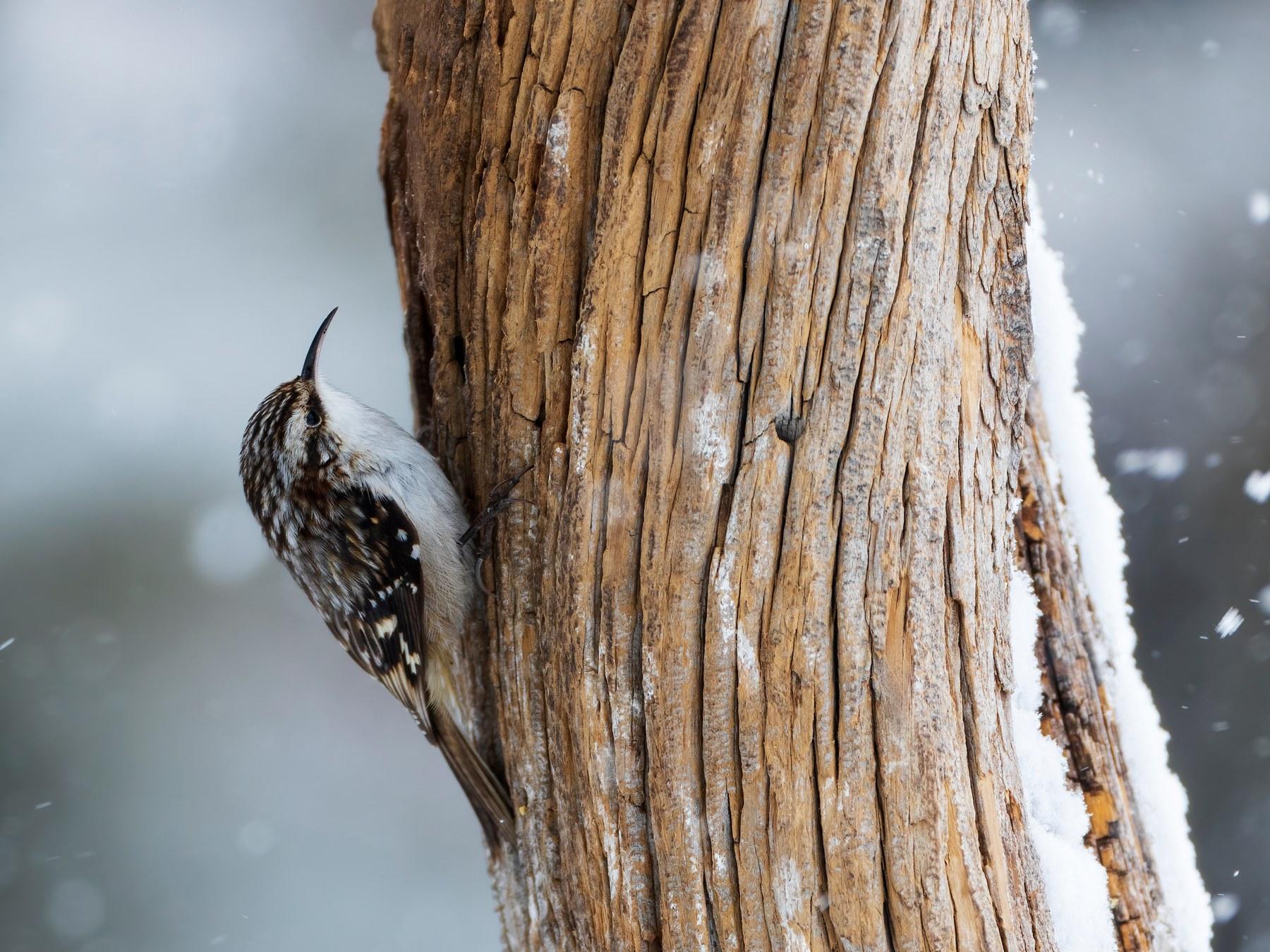
Some populations do. It is generally considered a year-round resident over most of its range, but many northern and high-altitude birds move south or downslope for the winter, and the eastern and northern races appear strongly migratory. Mexican and Central American birds appear to stay put.
In the East, fall migrants pass mainly from late September to early November and spring migrants in April and early May, varying by state. Banding shows some long journeys: one bird went from Wisconsin in September to Arkansas in January, about 784 miles (1,262 km), and a young bird banded at Port Huron, Michigan, was caught about 275 miles (442 km) west in Wisconsin 10 days later.3
Migrants may save energy at night. In a respirometry study of four songbird species caught on migration, the Brown Creeper among them, 69–98% of the birds of each species used shallow torpor at night, cutting their energy use at rest; the study summary gives no figure for creepers alone.5
Range changes
The northern edge of the range is poorly known because few surveys reach it. The first confirmed breeding in the Northwest Territories, at Fort Liard, about 60°N, was published in 2009, and the study's authors think poor detection means the bird's northern numbers are likely underestimated.6
The 2013 handbook account says the breeding range seems to be spreading in the mid-Atlantic states, the Midwest, Georgia and California. It adds that numbers have risen in northern hardwood forests and New England, possibly helped by reforestation and by trees killed by Dutch elm disease, gypsy moths and other introduced pests.3 Older studies record local losses where forest was cleared: in cut-over parts of the Hudson Valley, New York, in a 1946 study, and in farmed south-central Michigan, in a 1991 study.3
Tips for seeing it
What it eats
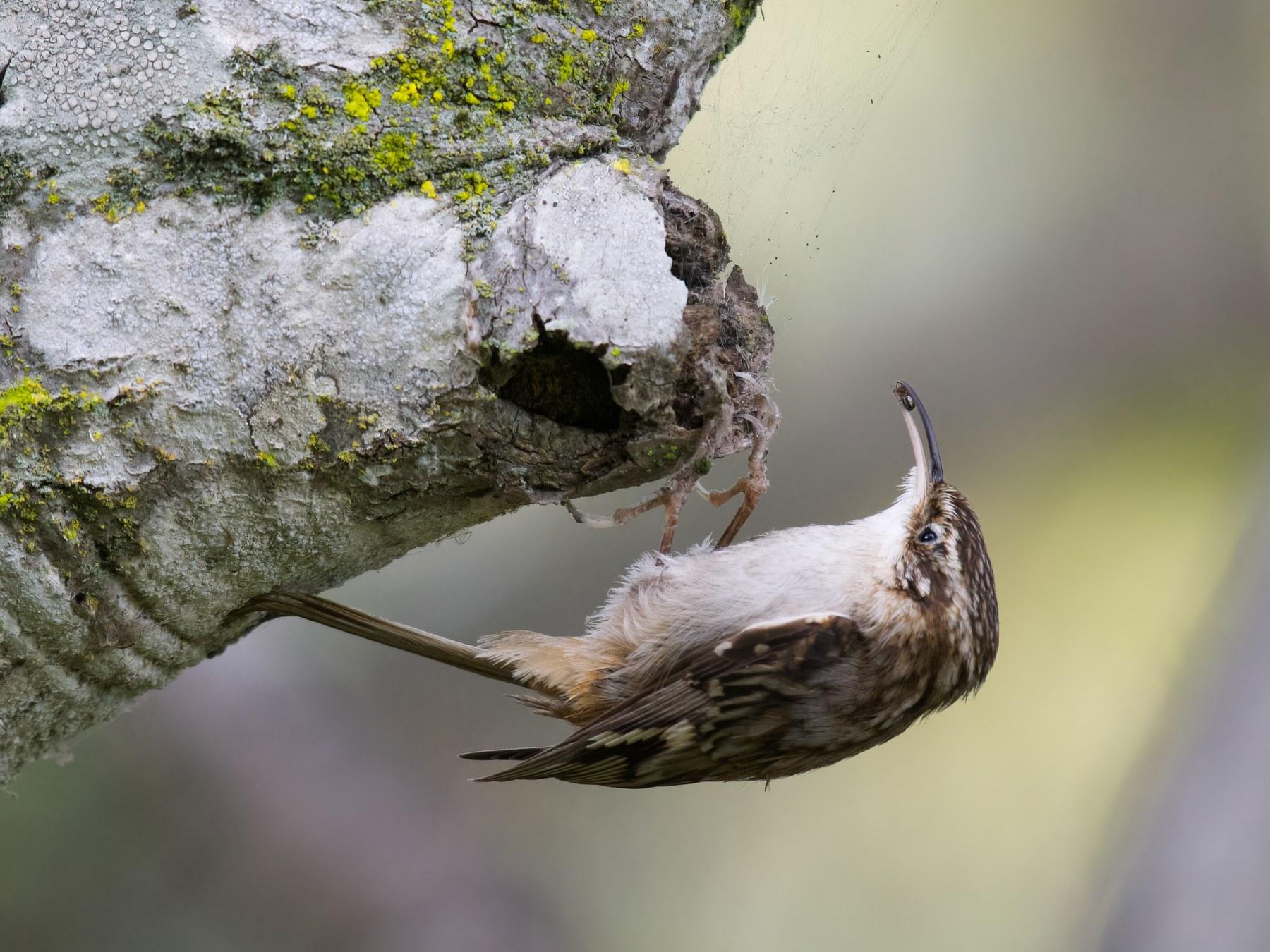
Brown Creepers eat mainly tiny insects and spiders picked from bark: beetles, true bugs, hoppers, scale insects and ants, with their eggs and larvae, along with spiders and their egg cases, and pseudoscorpions. In winter they also take a little plant food, such as seeds and corn, but possibly none in the breeding season. Nestlings appear to be fed only insects and other invertebrates.
It feeds in a set pattern. It lands near the foot of a trunk and climbs upward, sometimes spiraling around, until it is about 3–10 ft (1–3 m) from the top, then drops to the base of another tree, sometimes the same one, and starts again. It gleans and probes the bark almost nonstop, mostly on live trunks, occasionally on large branches and rarely on the ground. It favors large trees, averaging over 12 in (30 cm) across, whose deeply furrowed bark holds more prey. In a Sierra Nevada study it spent 79% of its foraging time on the move.3
One published report describes a creeper tucking bits of sunflower seed into the bark of nearby red pines in late winter, though it was never seen coming back for them.3
Feeding in your garden
In winter a Brown Creeper may visit feeders for suet and peanut butter, and now and then for sunflower, pine and grass seeds or corn. Big old trees nearby make a visit more likely.7
Nesting and breeding
The nest is hidden in an unusual place: nearly always behind a loose strip of bark on a big tree, usually a dead or dying one, with a gap barely wide enough for the bird to slip in. A few nests are in live trees with peeling bark. Odd sites include a stack of concrete blocks, loose roof shingles, window shutters, fence posts and the metal on a utility pole. The first nest reported from Central America, in a 2012 paper from El Salvador, was in a cavity in a pine trunk and was built in the dry season, in January and February.8
The nest has two parts. A hammock-shaped base of twigs and bark strips, held together with insect cocoons and spider egg cases, is fixed to the inner bark by "horns" rather than to the trunk. Inside it sits a cup of fine bark and wood fibers, hair, feathers, moss and lichens. The female builds while the male brings some material: building took 6–7 days for two Michigan renests and 7–14 days at three nests in central Arizona.3
In the larger studies nearly all nests were in dead trees: 98% of 222 in northern New Brunswick and 94% of 102 in central Arizona.3 Heights vary widely, from very low to 50 ft (15 m) or more.
In central Arizona and northern New Brunswick, nests often have two openings: the parents arrive from below with food and leave through the top, often in under 3 seconds. Nests apparently are not reused, probably because they are fragile.3
Creepers have nested in a box built for them from pieces of Douglas-fir bark and in one made of cedar boards,3 but we found no recommended nest-box design for the species in the sources we read.
Eggs and young
Nesting begins in April in most US and Canadian populations and peaks from May to July. The female usually lays 5 or 6 eggs, white with pink or reddish-brown speckles, mostly at the larger end, and occasionally plain white. Each is about 0.6 by 0.5 in (15 by 12 mm).
She incubates alone, apparently starting after the last egg, for about 15 days: an average of 15 days (15–17) at five Michigan nests and 15 (13–16) at four nests in Montana and Idaho. The male feeds her during incubation.3
The female alone broods the chicks, and both parents feed them. Feeding trips averaged 17.2 an hour at 38 nests in central Arizona and 20.6 an hour in northern New Brunswick.3 In Michigan, by 11–12 days old the young were already climbing inside the nest using their tails. They leave at 15–16 days in Michigan and at about 17 days (14–20) in Montana and Idaho.3
On leaving, fledglings fly to nearby trunks and at once start climbing in short hops, using their tails. In Michigan, families stayed within about 1,640 ft (500 m) of the nest for up to several weeks, often splitting into two groups that each followed one parent.3 Pairs probably raise one brood in most areas and likely renest only after a failure.
Behaviour
A Brown Creeper spends most of its time hitching up tree trunks. It hops head-up with both feet together, and its tail props it at all times except for a moment in each hop or when it is on a branch. It nearly always climbs upward and rarely climbs down. Flights are mostly short hops from one trunk to the next.
When a hawk, a squirrel or a person comes close, an adult goes silent and freezes with its body pressed tight to the bark. Its intricate streaked plumage makes it very hard to pick out on a trunk.9
In the breeding season pairs hold territories, and neighboring males sing against each other in intense bouts. Pairs are probably monogamous. In a Michigan study, territories were about 6–16 acres (2.3–6.4 ha), and the courting male chased the female in fast spirals around trunks and fed her, and kept feeding her until the eggs hatched.3
Outside the breeding season it may be alone, with others of its kind or in mixed flocks with woodpeckers, chickadees, titmice, nuthatches, kinglets, warblers and juncos, often alongside Red-breasted Nuthatches. In a fall and winter study, creepers were in 44–48% of mixed flocks in southeastern Louisiana, 32–75% in Maryland and 21–29% in Maine.3
In winter it roosts in small groups. Two or three birds slept each night in a crack in a Russian olive in Colorado, using the same tree in consecutive years, and 11 birds were reported roosting each night in April in a hollow barn beam about 25 ft (8 m) up. A Michigan family of fledglings huddled in a tight circle with their bills pointing inward.3
Lifespan and predators
The oldest known wild Brown Creeper was at least 6 years 2 months old: a female banded as an adult in British Columbia in May 2013 and caught and released alive during banding operations there in August 2018.10 The previous record, at least 5 years 5 months, was a bird banded in Illinois in its hatching year, 2005, and recaptured alive there in 2010.10 No source we read gives a typical lifespan, and the 2013 handbook account says there are no accurate estimates of survival.3
Nest predators include red squirrels, which take eggs, and northern flying squirrels, which take nestlings, and deer mice are suspected. Adults are taken by domestic cats, Northern Shrikes, Sharp-shinned and Cooper's Hawks and Northern Pygmy-Owls.
Nest success varies between studies, from 58% of 11 Michigan nests over three years to 83% of 150 nests over nine years in central Arizona.3 In Algonquin Park, Ontario, 64% of 88 nests succeeded, and predation caused 88% of the failures among nests that held eggs or young.11
It is an extremely rare host of the Brown-headed Cowbird, because its nest entrances are generally too small and well hidden for cowbirds.
Conservation
It is widespread but easily overlooked: the Brown Creeper is rated Least Concern on the IUCN Red List.12 It breeds at low density over most of its range, and its quiet habits and calls likely make it hard to detect. Partners in Flight estimates about 11 million breeding-age birds, as of around 2010, about 9.5 million of them in the US and Canada.13 About 4.8 million, or 43% of the world population, are in Canada.9
Across the whole North American Breeding Bird Survey, numbers rose by 0.79% a year from 1966 to 2025, a clear long-term increase, and by 1.71% a year in Canada.14 In the lower 48 states, though, the long-term trend of 0.17% a year shows no clear change, and no shorter window there is clear either.14 Survey-wide, the trend was flat from 1995 to 2015; the index sat at about 0.33 birds per route from 2012 to 2022 before rising to 0.45 in 2025, its highest level.14
The State of Canada's Birds rates Canada's trend a moderate increase, with medium confidence: steady growth from the 1970s to the early 1990s, then largely stable to slightly declining, leaving numbers nearly 50% above 1970.9
Conservation: forests and logging
The main handbook account, written in 2013, names the harvesting of large live trees, salvage logging of dead and dying trees, and forest fragmentation as the greatest known threats, especially in the West.3 Studies across the range find fewer creepers where big trees are cut. In Algonquin Park, Ontario, density was about 42% lower in logged than in unlogged control stands.11 In northwestern New Brunswick an experiment found lower nest density and breeding success in the first two years after single-tree selection harvesting.15
Logging effects are not uniform, though: in northwestern California, numbers in pole and sawtimber stands that followed logging, fire, windthrow or landslides were similar to those in mature Douglas-fir forest, and creepers can reach fairly high densities in disturbed forest left to regrow naturally.3
Legal status
In the United States the Brown Creeper is on the federal list of birds protected under the Migratory Bird Treaty Act.16 The Act makes it unlawful, except as its regulations permit, to pursue, hunt, take, capture, kill or possess such birds, or any part, nest or egg of them.17 It is not listed under the Endangered Species Act.18
In Canada the Migratory Birds Convention Act, 1994 protects it, the Act's schedule naming the creepers among migratory insectivorous birds,19 and it is on the Government of Canada's list of birds the Act protects.20 The Migratory Birds Regulations, 2022 forbid, without a permit or the Regulations' authority, capturing, killing, taking, injuring or harassing such birds and destroying, taking or disturbing their eggs.21 Because the Brown Creeper is not in the Regulations' Schedule 1, its nest is covered while it holds a live bird or a viable egg.21
Names and relatives
The Brown Creeper, Certhia americana, is the only North American member of the treecreeper family, the Certhiidae. Despite climbing trunks propped on its tail like a woodpecker, it is a songbird, and molecular studies place its family with the nuthatches, wrens and gnatcatchers, apart from the chickadees. BirdLife International and the IUCN Red List call it the American Treecreeper.
It is almost indistinguishable from the Eurasian Treecreeper and was long treated as the same species. Studies of voice, measurements and DNA in the decade to 2013 confirmed that the two should be separate species, and Brown Creeper song draws little or no response from Eurasian or Short-toed Treecreepers.3 In a one-gene study of the seven treecreeper species recognized in 2006, its closest relative was the Short-toed Treecreeper of western Europe, though support for the grouping was weak.22 A study of its voice found some western Brown Creeper songs "remarkably similar" to those of Short-toed Treecreepers in France and Spain, and left open whether the two are close relatives or share traits from a common ancestor.23
Thirteen subspecies are recognized, in Pacific, Rocky Mountain, eastern and Mexican and Central American groups. Genetic studies find a deep split between northern and southern lineages, which one 2011 study calls "likely cryptic species".24 In the sky islands of Arizona the two lineages breed completely apart, with no sign of hybridization.25 No checklist we read treats them as separate species.
Similar birds
Often mistaken for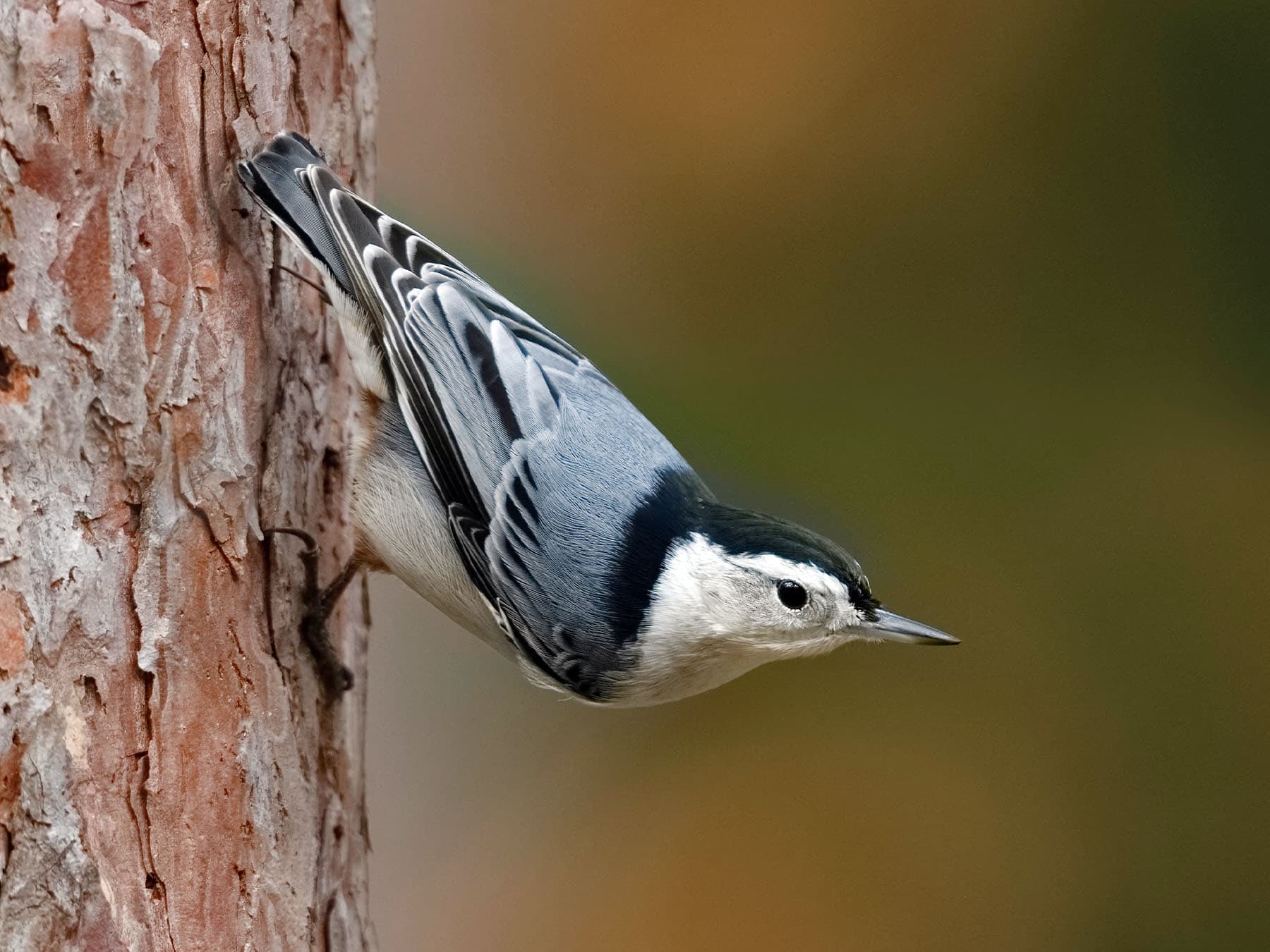
Quick facts
- Length
- 12–14 cm
- Wingspan
- 17–20 cm
- Weight
- 7–10 g
- Lifespan
- oldest recorded 6 years 2 months
- Family
- Treecreepers
- Migration
- Partial migrant
- Global status (IUCN)
- Least Concern
- World population
- About 11 million breeding-age birds (Partners in Flight, around 2010)
- Population trend
- A slow long-term increase across the whole Breeding Bird Survey since 1966, clearest in Canada; in the lower 48 states the trend shows no clear change, and the survey-wide index was flat from the mid-1990s to 2022, with a sharp rise in the last three survey years
- Also called
- American Treecreeper
- Scientific name
- Certhia americana
Sources
37- 1New Zealand Birds Online. Brown creeper | Pīpipi (Mohoua novaeseelandiae). New Zealand Birds Online. Accessed 21 November 2026. Source (opens in a new tab)
- 2National Audubon Society and Kaufman, K.. Brown Creeper. Audubon Guide to North American Birds. Accessed 21 November 2026. Source (opens in a new tab)
- 3Poulin, J. et al. (2020). Brown Creeper (Certhia americana), version 1.0. Birds of the World (A. F. Poole, editor). Cornell Lab of Ornithology. doi:10.2173/bow.brncre.01 (opens in a new tab)
- 4Marini, K. L. D., Nadon, S. and Foote, J. R. (2020). Dawn singing in Brown Creeper (Certhia americana). The Canadian Field-Naturalist 134(2): 117-124. doi:10.22621/cfn.v134i2.2139 (opens in a new tab)
- 5Leys, R. A. C., Hou, L. and McGuire, L. P. (2026). Torpor-assisted migration: Regular use of shallow torpor reduces rest-phase energy expenditure for songbirds during migration. Journal of Animal Ecology 95(10): 1876-1886. doi:10.1111/1365-2656.70244 (opens in a new tab)
- 6Olson, C. R., Hannah, K. C. and Gray, C. (2009). First confirmed record of breeding Brown Creepers in the Northwest Territories, Canada. Northwestern Naturalist 90(2): 156-159. doi:10.1898/nwn08-36.1 (opens in a new tab)
- 7Cornell Lab of Ornithology. Brown Creeper: Overview, Identification, Life History and Range Map. All About Birds. Accessed 21 November 2026. Source (opens in a new tab)
- 8Funes, C., Bolaños, O. and Komar, O. (2012). Breeding of the Brown Creeper (Certhia americana) in Central America. The Wilson Journal of Ornithology 124(1): 177-179. doi:10.1676/11-076.1 (opens in a new tab)
- 9Environment and Climate Change Canada and Birds Canada (2024). The State of Canada's Birds - Brown Creeper. NatureCounts, Birds Canada. Accessed 21 November 2026. Source (opens in a new tab)
- 10USGS Bird Banding Laboratory. Longevity records, AOU 7260 (current and historical tables). U.S. Geological Survey, Eastern Ecological Science Center. Accessed 21 November 2026. Source (opens in a new tab)
- 11Geleynse, D. M., Nol, E., Burke, D. M. and Elliott, K. A. (2016). Brown Creeper (Certhia americana) demographic response to hardwood forests managed under the selection system. Canadian Journal of Forest Research 46(4): 499-507. doi:10.1139/cjfr-2015-0112 (opens in a new tab)
- 12BirdLife International (2021). Certhia americana. The IUCN Red List of Threatened Species 2021 (via GBIF's copy of the IUCN checklist). IUCN Red List / GBIF. doi:10.2305/IUCN.UK.2021-3.RLTS.T22711244A137629174.en (opens in a new tab)
- 13Partners in Flight (2024). Avian Conservation Assessment Database, Global (version 2024.05.23). Partners in Flight. Accessed 21 November 2026. Source (opens in a new tab)
- 14Hostetler, J. A. et al. (2026). The North American Breeding Bird Survey, Analysis Results 1966 - 2025. U.S. Geological Survey. doi:10.5066/P1OSNSFC (opens in a new tab)
- 15Poulin, J.-F., Villard, M.-A. and Haché, S. (2010). Short-term demographic response of an old forest specialist to experimental selection harvesting. Écoscience 17(1): 20-27. doi:10.2980/17-1-3297 (opens in a new tab)
- 16U.S. Fish and Wildlife Service (2023). 50 CFR 10.13, List of Migratory Birds. Electronic Code of Federal Regulations (version of 2026-11-18). Accessed 21 November 2026. Source (opens in a new tab)
- 17United States Congress (1918). 16 U.S.C. 703, Taking, killing, or possessing migratory birds unlawful. United States Code (Cornell LII copy). Accessed 21 November 2026. Source (opens in a new tab)
- 18U.S. Fish and Wildlife Service. ECOS species profile 4607, Brown creeper (Certhia americana). Environmental Conservation Online System. Accessed 21 November 2026. Source (opens in a new tab)
- 19Parliament of Canada (1994). Migratory Birds Convention Act, 1994 (S.C. 1994, c. 22). Justice Laws Website (current to 2026-10-29). Accessed 21 November 2026. Source (opens in a new tab)
- 20Environment and Climate Change Canada. Birds protected in Canada under the Migratory Birds Convention Act, 1994 (partial list). Government of Canada (Internet Archive copy of 4 Oct 2026). Accessed 21 November 2026. Source (opens in a new tab)
- 21Government of Canada (2022). Migratory Birds Regulations, 2022 (SOR/2022-105). Justice Laws Website (current to 2026-10-29). Accessed 21 November 2026. Source (opens in a new tab)
- 22Tietze, D. T., Martens, J. and Sun, Y.-H. (2006). Molecular phylogeny of treecreepers (Certhia) detects hidden diversity. Ibis 148(3): 477-488. doi:10.1111/j.1474-919x.2006.00547.x (opens in a new tab)
- 23Baptista, L. F. and Krebs, R. (2000). Vocalizations and relationships of Brown Creepers Certhia americana: a taxonomic mystery. Ibis 142(3): 457-465. doi:10.1111/j.1474-919x.2000.tb04442.x (opens in a new tab)
- 24Manthey, J. D., Klicka, J. and Spellman, G. M. (2011). Cryptic diversity in a widespread North American songbird: Phylogeography of the Brown Creeper (Certhia americana). Molecular Phylogenetics and Evolution 58(3): 502-512. doi:10.1016/j.ympev.2010.12.003 (opens in a new tab)
- 25Manthey, J. D., Robbins, M. B. and Moyle, R. G. (2016). A genomic investigation of the putative contact zone between divergent Brown Creeper (Certhia americana) lineages: chromosomal patterns of genetic differentiation. Genome 59(2): 115-125. doi:10.1139/gen-2015-0093 (opens in a new tab)
- 26BOW authors (White-breasted Nuthatch account) (2020). White-breasted Nuthatch (Sitta carolinensis), version 1.0: Introduction and Identification. Birds of the World. Cornell Lab of Ornithology. doi:10.2173/bow.whbnut.01 (opens in a new tab)
- 27BOW authors (Red-breasted Nuthatch account) (2020). Red-breasted Nuthatch (Sitta canadensis), version 1.0: Identification. Birds of the World. Cornell Lab of Ornithology. doi:10.2173/bow.rebnut.01 (opens in a new tab)
- 28BOW authors (Black-and-white Warbler account) (2020). Black-and-white Warbler (Mniotilta varia), version 1.0: Introduction and Identification. Birds of the World. Cornell Lab of Ornithology. doi:10.2173/bow.bawwar.01 (opens in a new tab)
- 29BOW authors (Eurasian Treecreeper account) (2020). Eurasian Treecreeper (Certhia familiaris), version 1.0: Introduction. Birds of the World. Cornell Lab of Ornithology. doi:10.2173/bow.eurtre1.01 (opens in a new tab)
- 30BOW authors (Short-toed Treecreeper account) (2020). Short-toed Treecreeper (Certhia brachydactyla), version 1.0: Introduction. Birds of the World. Cornell Lab of Ornithology. doi:10.2173/bow.shttre1.01 (opens in a new tab)
- 31NatureServe. Certhia americana, Brown Creeper (ELEMENT_GLOBAL.2.102429). NatureServe Explorer. Accessed 21 November 2026. Source (opens in a new tab)
- 32AviList Core Team (2026). AviList: The Global Avian Checklist, v2025b. AviList. doi:10.2173/avilist.v2025b (opens in a new tab)
- 33Cornell Lab of Ornithology. eBird taxonomy record, brncre. eBird API. Accessed 21 November 2026. Source (opens in a new tab)
- 34GBIF. Certhia americana: vernacular names (usageKey 9581157). GBIF API. Accessed 21 November 2026. Source (opens in a new tab)
- 35Blais, J., Savard, J.-P. L. and Gauthier, J. (2001). Impact of an ice storm on resident bird populations in eastern North America. The Forestry Chronicle 77(4): 661-666. doi:10.5558/tfc77661-4 (opens in a new tab)
- 36D'Astous, E. and Villard, M.-A. (2012). Effects of selection harvesting on bark invertebrates and nest provisioning rate in an old forest specialist, the brown creeper (Certhia americana). Écoscience 19(2): 106-112. doi:10.2980/19-2-3472 (opens in a new tab)
- 37Cartron, J.-L. E., Hawksworth, D. L. and Finch, D. M. (2008). First records of the Brown Creeper breeding along the middle Rio Grande in central New Mexico. Western Birds 39(3): 176-178. doi:10.21199/wb39.3.5 (opens in a new tab)

Checked by
Nathan Cope, founder and editor
Nathan founded Birdfact and leads its writers and contributors in the UK, the US and Canada. He has watched and studied birds for more than ten years, and checks every article and species guide before it’s published.