


Brewer's Blackbird
Euphagus cyanocephalus
By the Birdfact teamChecked by Nathan Cope
On this page14 sections
How to recognise it
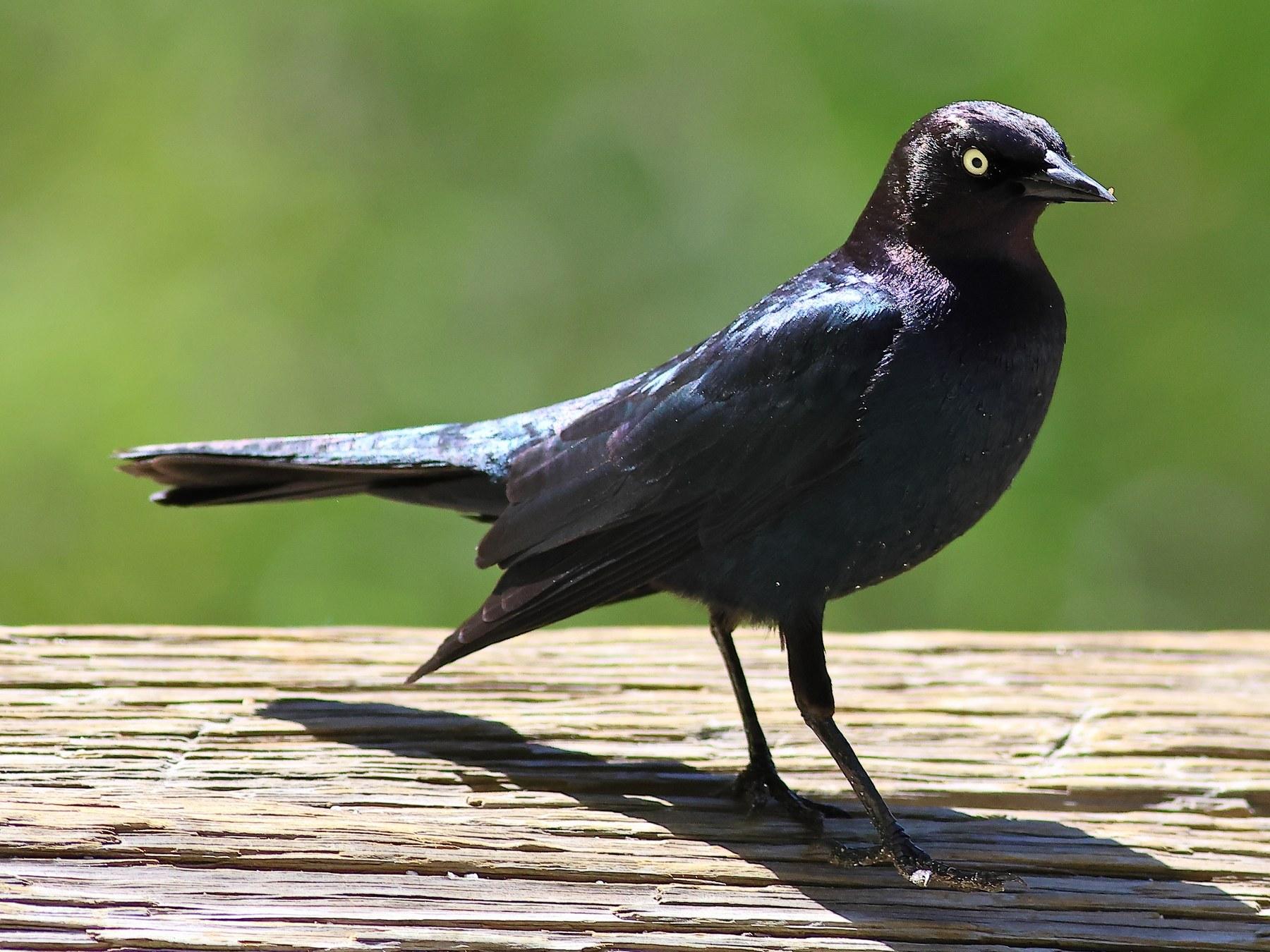
A medium-sized blackbird, it has fairly long legs, a fairly long tail, a round head and a straight, pointed black bill. The male is black all over with a strong gloss, violet to purple on the head and neck and blue-green on the body. His pale yellow eye can look white in bright sun, and in poor light the gloss fades and he can look dull. The female is plain grayish brown with no streaks, and most females have a brown eye. On the ground it walks rather than hops, its head jerking forward and back with every step.
Size and weight
It is about the size of a Red-winged Blackbird, a little bigger than a Brown-headed Cowbird and shorter-tailed than a Common Grackle. Taking both sexes together, it is 7.9–9.8 in (20–25 cm) long and weighs 1.8–3.0 oz (50–86 g). Males are the bigger sex: a male is 8.3–9.8 in (21–25 cm) long and averages about 2.4 oz (67 g), a female 7.9–8.7 in (20–22 cm) and about 2.0 oz (58 g).1, 2 Published wingspans disagree: one guide gives 14.6 in (37 cm) for both sexes, while Audubon's gives 16–17 in (41–43 cm).1, 3
Male, female and young birds
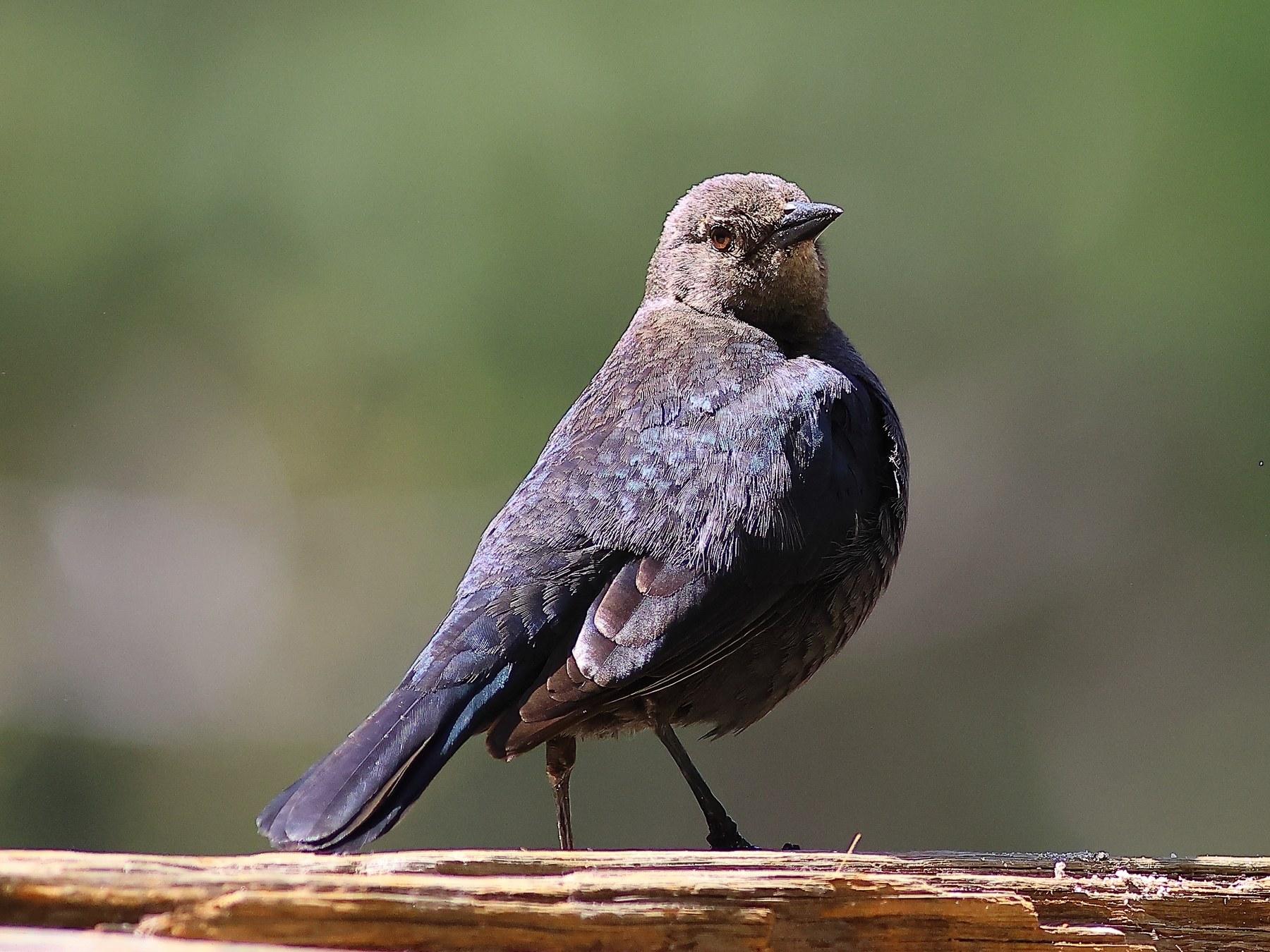
The sexes look quite different. The female is grayish brown all over, darker and a little glossier on the wings and tail, with a paler face, slightly darker lores and a faint dark line behind the eye. In good light she shows a faint violet sheen on the head and a greenish one on the body. Most females have a light to dark brown eye, but eye color needs care, since up to 10% of females may have a pale iris.2
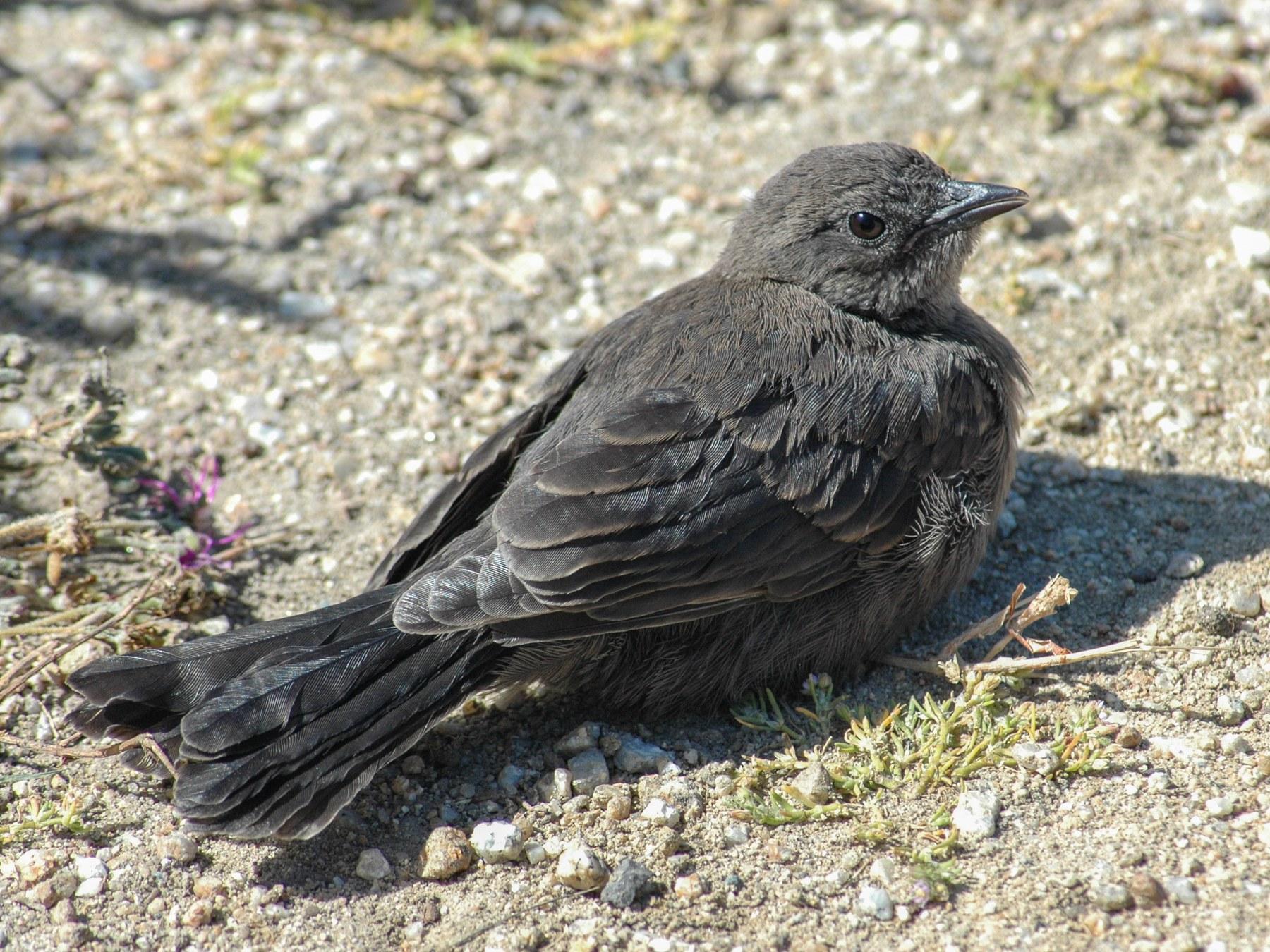
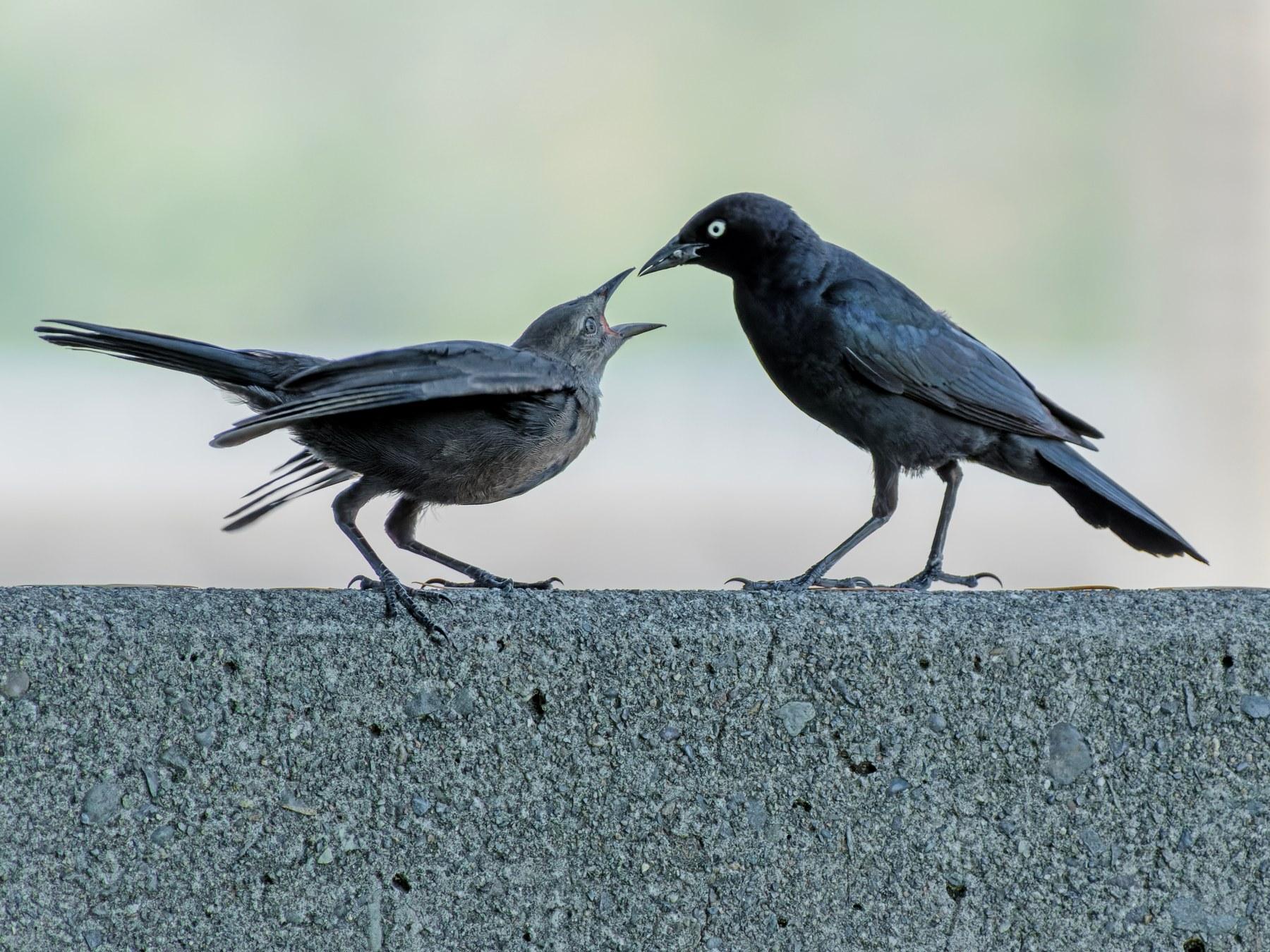
Young birds look like females without the gloss: dull brown above, brownish gray below and light gray on the throat, the young females lighter and more rufous than the young males. Every nestling has a dark brown eye at first. A young male's eye turns grayish white by about three weeks and then slowly yellow, while a female's stays brown.4, 2
Adults replace all their feathers once a year, in July and August, and young birds replace almost all theirs in a first molt from July to as late as September. Afterwards a male in his first fall has his body feathers broadly tipped dull grayish brown, nearly hiding the gloss in places, and pale tips almost cover the gloss on his crown. Adult males in fall are glossier, with brownish tips mostly on the back. The tips wear away over the winter, leaving the spring male faintly scaled.
Identification: telling it from lookalikes
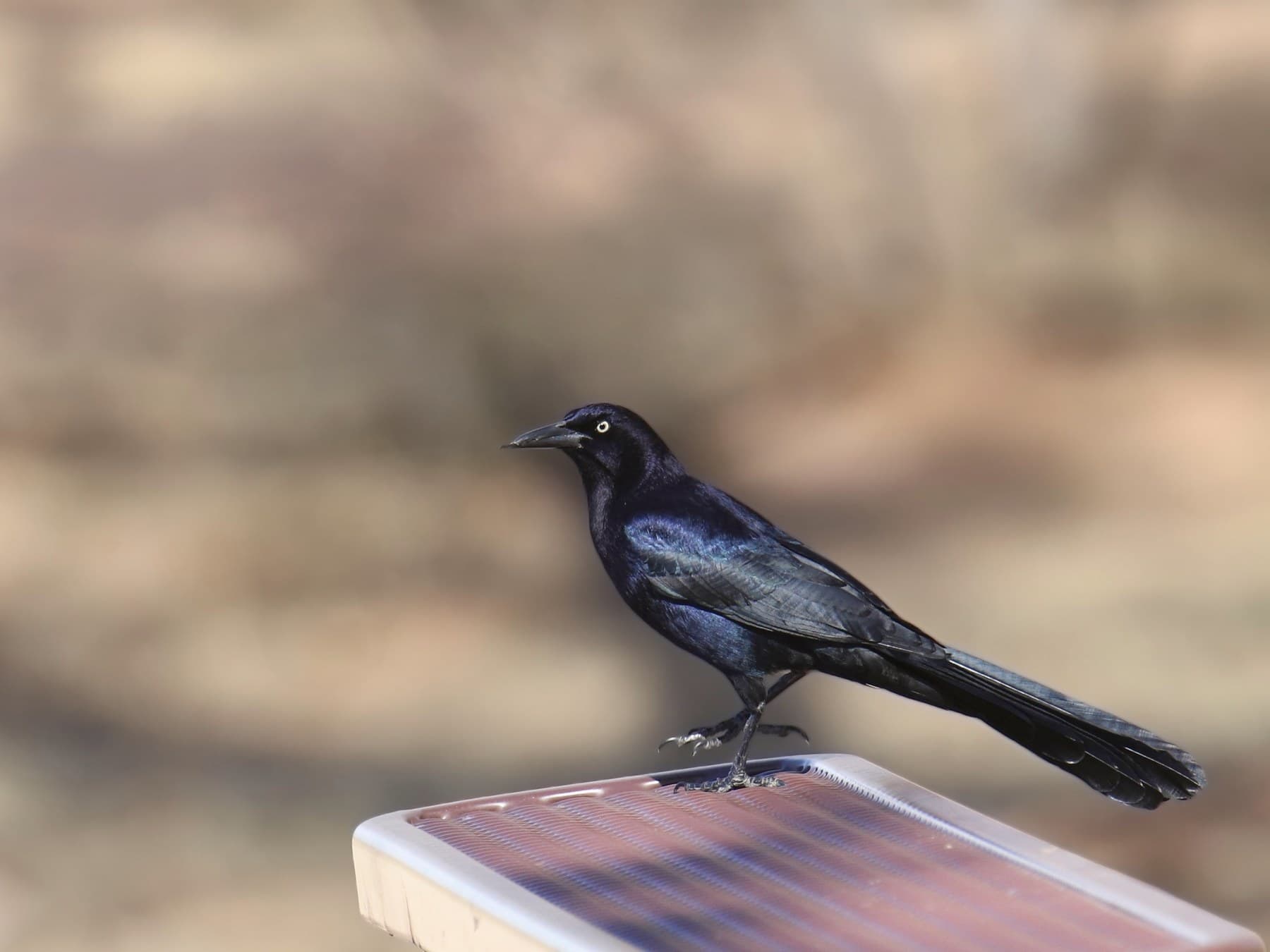
A Common Grackle is clearly bigger, 11–13 in (28–34 cm), with a longer, heavier bill and a much longer, keel-shaped tail, and its female is blackish with a yellow eye, where a female Brewer's is grayish brown and usually brown-eyed. A Great-tailed Grackle is far bigger again, 15–18 in (38–46 cm), with a long, keel-shaped tail; its brown female has a pale eye and a buff eyebrow and throat.
The Rusty Blackbird, the only other member of its genus, is the closest lookalike. A breeding male Brewer's shows a purple-violet head against a greener body, a contrast the male Rusty lacks, and Brewer's has a thicker, straighter, blunter bill, a longer tail and longer legs. A Rusty female in the breeding season is slate gray with a yellowish eye; a female Brewer's is grayish brown, and although most are brown-eyed, up to 10% have a pale eye, so go by body color rather than eye color. The two breed apart, the Rusty mostly farther north, and the Rusty winters mostly east of Brewer's range.
Fall is the tricky season. Rusty Blackbirds in fresh fall plumage have sharp, rusty feather edges, the females a pale buff eyebrow as well, and a first-fall male Brewer's can have grayish-brown edges too. A 2017 study of museum specimens and photographs found that occasional first-fall male Brewer's show pale brownish edges even on the tertials and wing coverts, where they had been said never to occur.5 On Brewer's the edges tend to be browner and more diffuse, blending into the black, though especially in photographs the light and the viewing angle can make them look rusty. The edging wears away over the winter, and by about January or February a Rusty may resemble a Brewer's.
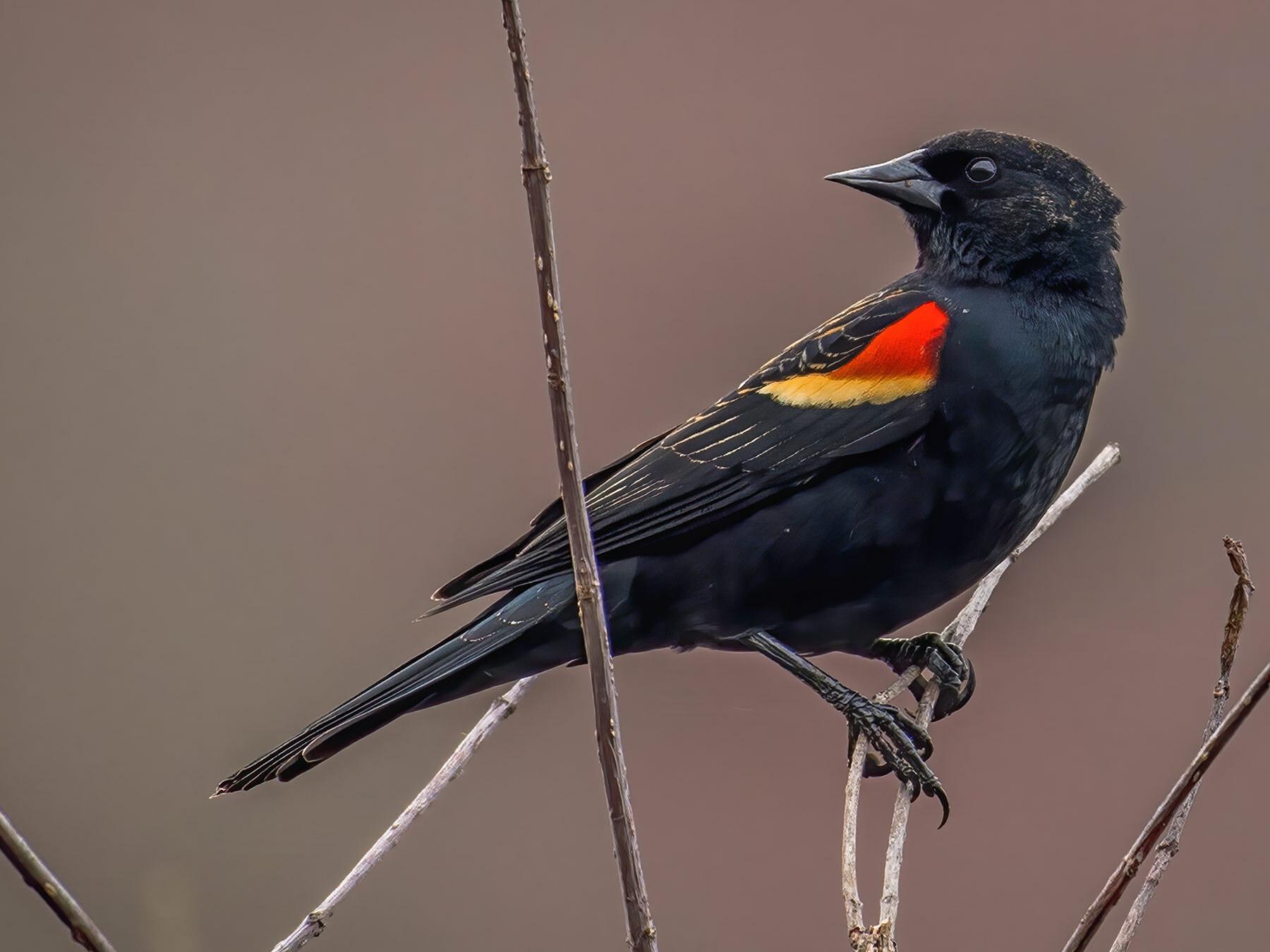
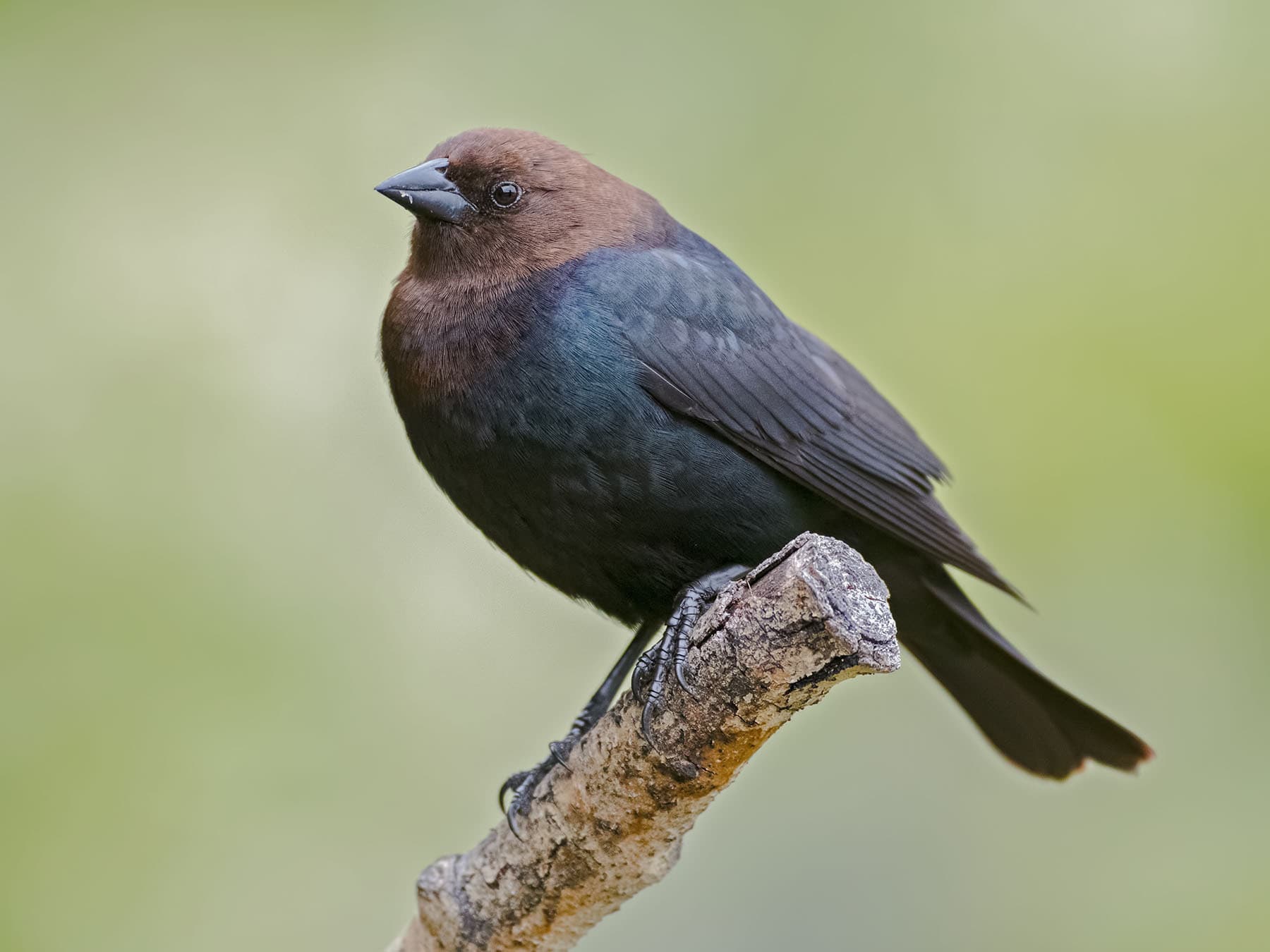
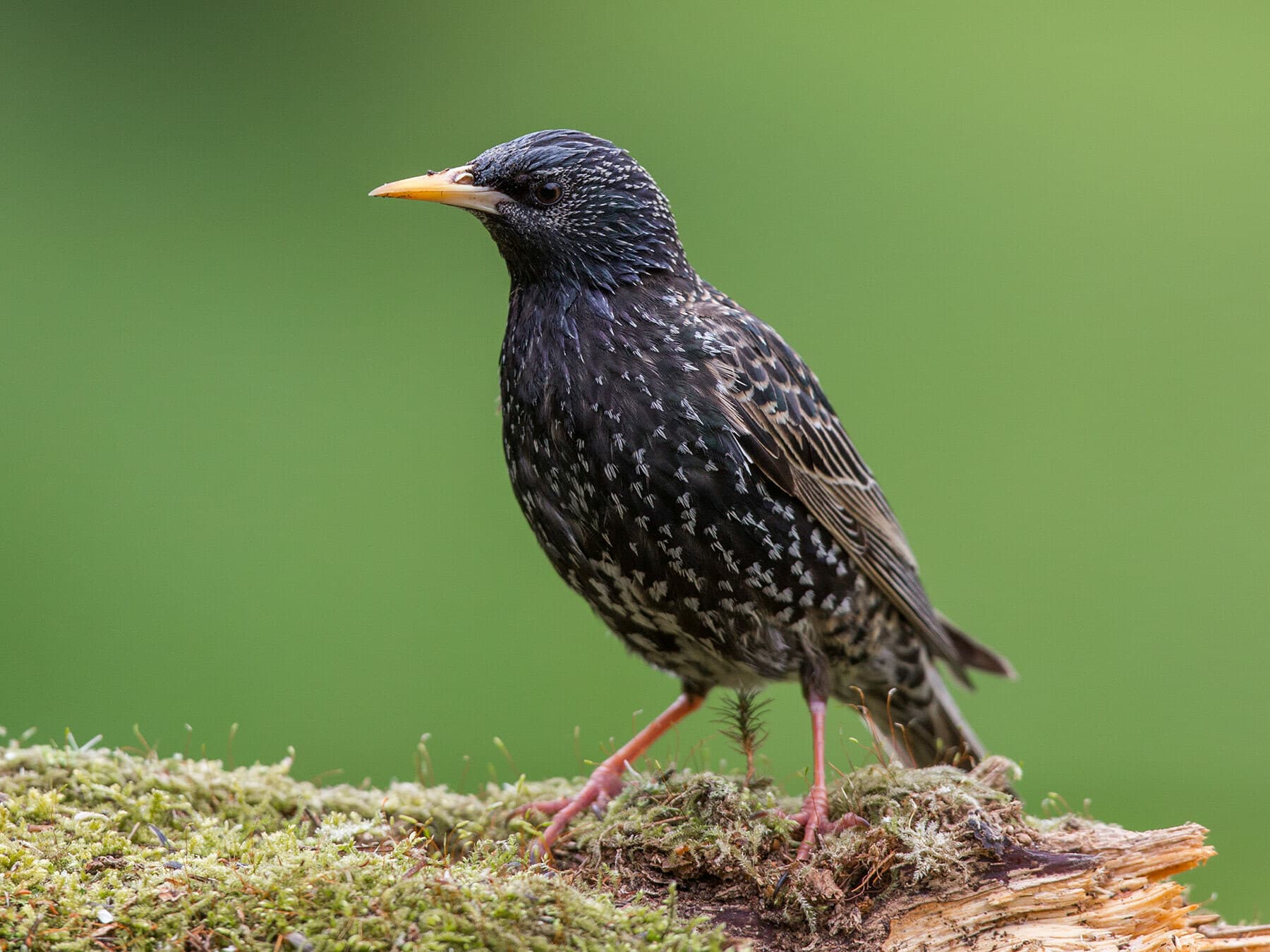
Cowbirds have shorter, thicker, more conical bills. A female Brown-headed Cowbird is smaller, plain grayish brown and sometimes faintly streaked below, where a female Brewer's has a longer, straight, pointed bill, and an adult Bronzed Cowbird has a red eye. A female Red-winged Blackbird is heavily streaked below with a pale eyebrow, and a European Starling has a short, square tail, pointed wings, pale spots after its fall molt and a yellow bill in spring.
Even dead birds can be hard to name. When the remains of 40 blackbirds from wind farms at Altamont Pass, California, half of them only feathers, were identified genetically, the results suggested the true number of Brewer's Blackbirds was about a third lower than the field tallies.6
Not sure it’s a Brewer's Blackbird? Check your photo: Birdfact names the bird and shows the look-alike side by side.
Its size
Adults- Length
- 20–25 cm
- Wingspan
- 37 cm
- Weight
- 50–86 g
Its song and calls
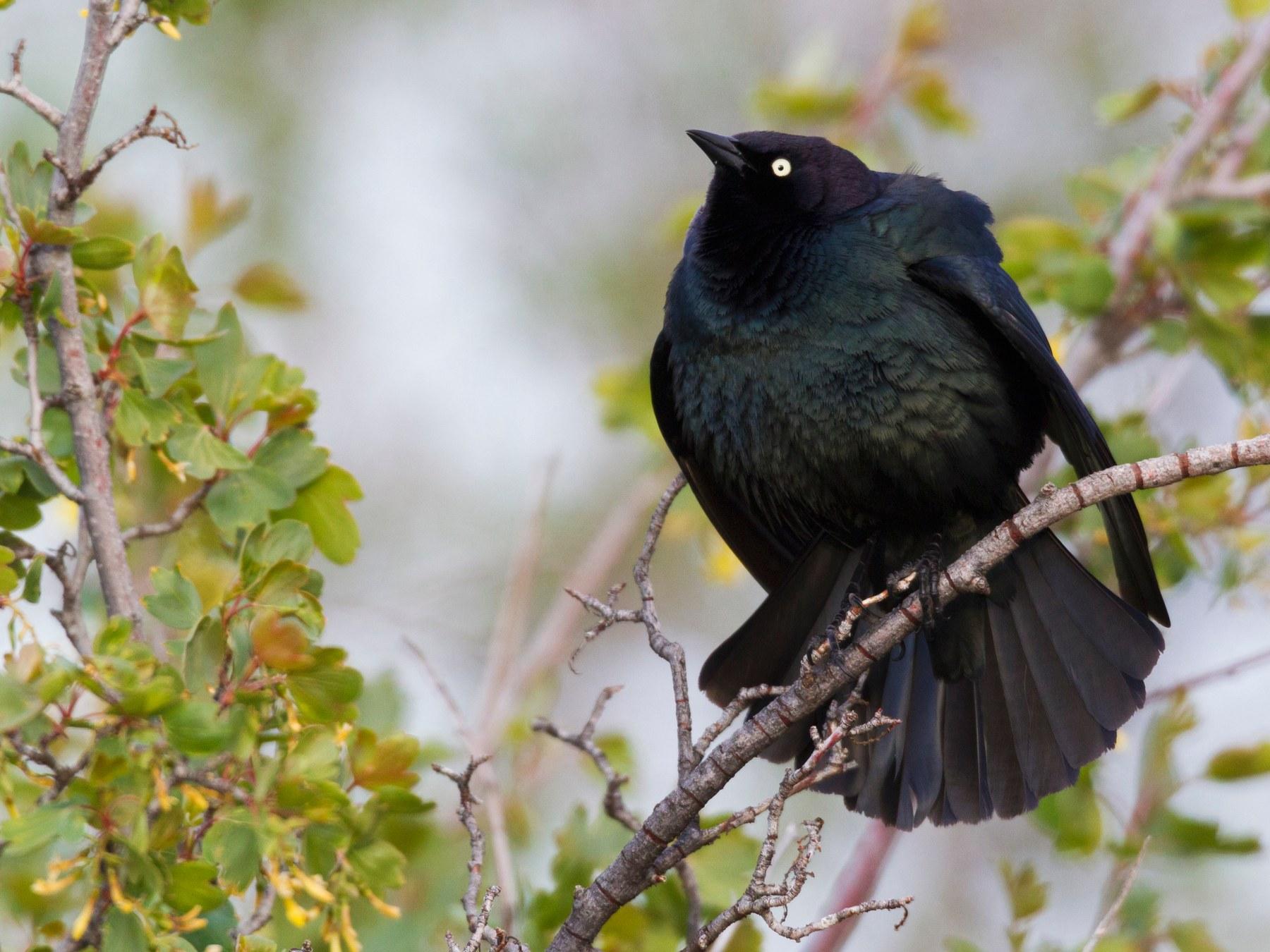
One song is a short, wheezy whistle that rises at the end, written "squeee" and lasting about 0.8 second.2 Both sexes give it, males more often, usually with the body feathers fluffed, the tail fanned and the wings partly spread. The second song is a short, harsh, whirring gurgle of 0.4–0.9 second, toneless and with nothing musical about it, given all year and most often in the breeding season.2
A short, harsh chuck is the contact call of flocks, given often by both sexes all year. A louder, higher version is the alarm, repeated excitedly when the birds are disturbed or something comes near the colony. A clear whistle that falls in pitch, apparently given only by males, usually warns of a hawk or another large bird, and females rattle at each other in quarrels at nests and roosts.
The player on this page has a rising whistle recorded in British Columbia and a series of calls from South Dakota. Males sing all year, most while courting and guarding a mate, and evening flocks on wires give a mix of calls and song. Its voice had been little studied by 2002, mostly in resident West Coast birds; in short recordings, ten males in California averaged 3.6 song types each.2
- Upslurred whistle0:00 / 0:09
Recorded in Okanagan, Canada · May 2024
- Calls0:00 / 0:14
Recorded in South Dakota, United States · June 2012
Heard one and not sure? Let the bird song identifier listen.
When and where to see it
This is a bird of the West. It breeds from interior British Columbia, southeastern Vancouver Island, Alberta, Saskatchewan and southern Manitoba east to southwestern Ontario and the north shores of Lakes Superior and Huron, and south to northwestern Baja California, southern California, southern Nevada, central Arizona, New Mexico and Colorado. In the east its breeding range reaches southern Minnesota, Wisconsin and Michigan and, very locally, southern Ontario. It is generally absent from the higher mountains.
Look for it in open places with trees or bushes nearby: farmyards, pastures, hay and grain fields, feedlots, roadsides and railroad edges, clearcuts and the brushy margins of marshes, streams and ditches. In towns it uses lawns, golf courses, cemeteries, parks, campuses and vacant lots, and it often forages on suburban lawns and in city parking lots. A colony appears to need three things: places to nest, high perches where the males can keep watch, and feeding ground nearby; in Ontario, birds nested only where short grass to feed on lay close by. It breeds from about 200 ft (60 m) below sea level in the Salton Sea basin up to 8,500 ft (2,600 m) in the Sierra Nevada and about 10,000 ft (3,050 m) in the Colorado mountains. Flocks after nesting have been recorded as high as about 12,000 ft (3,650 m).2
Migration and winter
Some birds migrate and some stay. Breeders in the Great Basin, on the Colorado Plateau and across the central plains head south for the winter. Coastal California birds and many in western Oregon and around Vancouver stay all year, joined in winter by birds presumably from farther north or higher up. In the California mountains birds move only a short way downhill.
It migrates by day. Northern breeders leave from mid- to late September and most are gone by late October, reaching the winter range, Mexico included, from about mid-October to mid-November. In spring most leave the wintering grounds in March, arriving across the northern states from late March to early April and in Manitoba, Montana, Alberta and northern British Columbia from mid- to late April. In winter it spreads east and south across the southern states to the Gulf Coast, northern Florida and South Carolina, and through Mexico to Jalisco, Michoacán, Oaxaca and Veracruz. It feeds there on lawns, in parks, fields and feedlots, and in southern California and western Mexico wherever livestock are kept.
Banded nestlings show how far some travel: birds from Alberta and Saskatchewan were found in Texas more than 1,550 miles (2,500 km) away, and Colorado nestlings in Jalisco and Guanajuato, Mexico, more than 1,370 miles (2,200 km) away.2 Winter flocks in the north are mostly males, which suggests females go farther. Migrating flocks mix with other blackbirds, cowbirds, grackles and starlings, but the Brewer's tend to stay at the edge or travel as a group of their own.2
Range expansion
Before about 1900 it did not breed east of the Red River Valley in western Minnesota, where a belt of maple-basswood forest stood in the way. It was first recorded nesting east of western Minnesota in 1914 and then spread east around the Great Lakes in leaps, at an average of about 11 miles (18 km) a year.2 Forest clearing for farms and logging helped, and the first birds followed railroad and highway corridors through country that would otherwise have held them back. By the early 1970s it had spread about 700 miles (1,130 km) from western Minnesota to Sudbury, Ontario, but not into southeastern Michigan or southern Ontario apart from a few isolated nestings, possibly held back by competition with the Common Grackle.7
Tips for seeing it
What it eats
In the breeding season it eats mainly insects and other small invertebrates, with some grain, weed seeds and a few small fruits. In fall and winter it turns largely to plants, about 84% of its food, taking waste grain, weed and grass seeds and spilled livestock feed, but it goes back to insects whenever they turn up, for example behind a plow.2
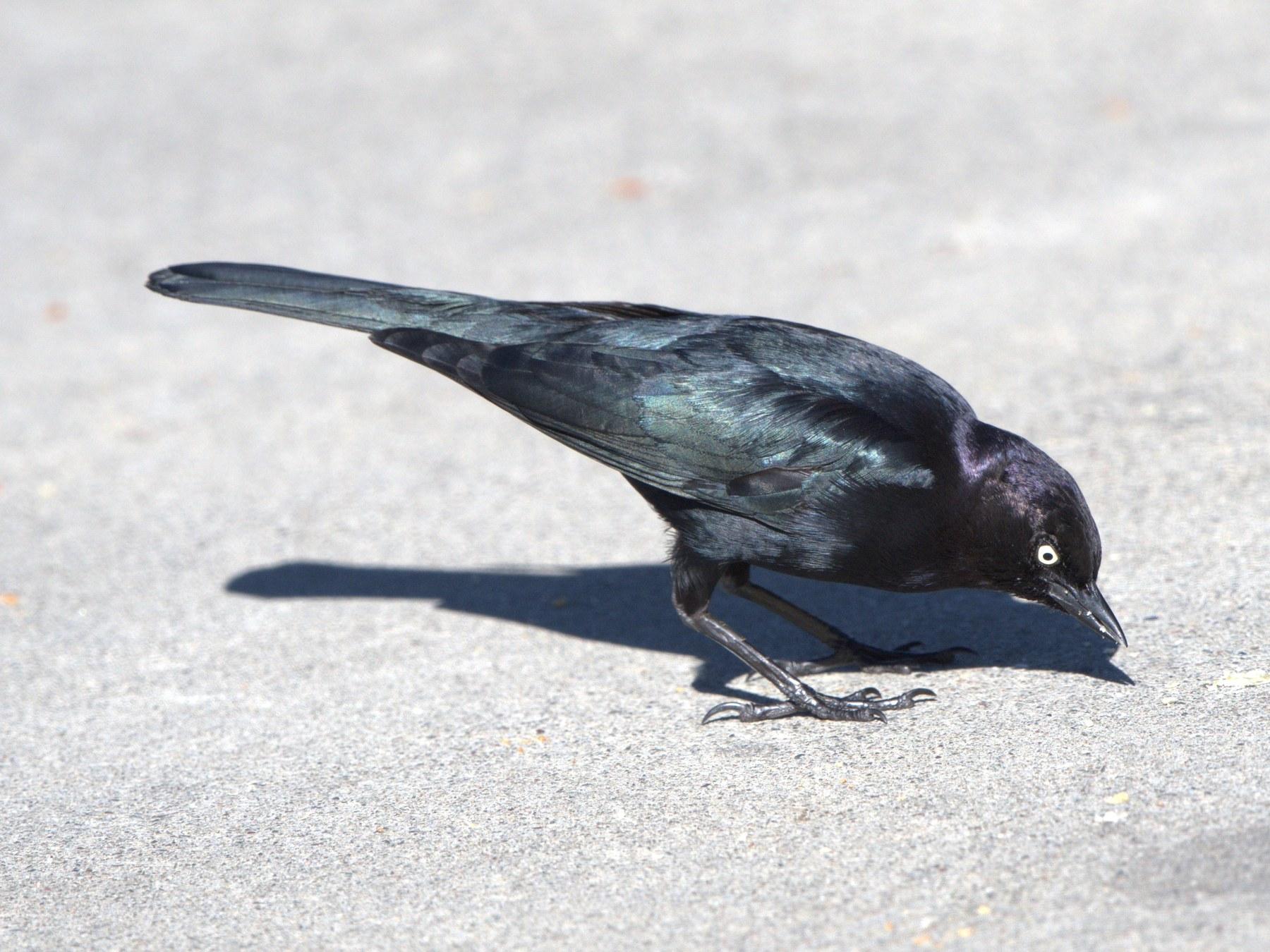
It feeds by walking over bare or short-grass ground, pausing briefly to look and pecking as it goes, and it flips dried cow dung, stones and twigs to find what is underneath; it does not normally probe or dig. It also flies up after passing insects, follows plows and disks, and sometimes hovers over water to pick up food. Outside the nesting season it feeds in flocks, the birds at the back flying over those in front, so the flock seems to roll across the ground.
Flocks gather at outbreaks of insects such as Mormon crickets, grasshoppers, alfalfa weevils, cutworms, swarming termites and forest tent caterpillars, and one stomach held 53 grasshoppers. An old survey of 146 stomachs from six states found about 68% plant food, mostly grain, and 32% animal food, mostly insects, across the year.2 Birds of the World's account, citing a 1957 Arkansas study, says it plays little part in damage to field crops because most of the grain it eats is waste grain.2
Nestlings are fed almost entirely on invertebrates, with caterpillars and moths the top food in most studies.2 At one California colony, adults carrying grasshoppers to their young dunked them in a stock pond on 35 of 48 visits. The author worked out that, if none was lost on the way, dunking could supply about 28% of the water in a grasshopper fed to a nestling.8
Feeders and yards
It comes to feeders readily but perches clumsily, so scatter seed on the ground or put it on an open platform.1
Nesting and breeding
It nests in colonies, from a few pairs to more than 100, and only occasionally as a lone pair. In northwestern Minnesota colonies averaged about 5 pairs east of the Red River and 13 west of it, in eastern Washington they held 10–60 pairs, and two Nevada colonies held more than 100.2 Nesting within a colony is closely synchronized. A study in eastern Washington concluded that colonies are mainly a way of coping with patchy, shifting food, since birds can follow successful neighbors to good feeding places.9
Pairs are mostly monogamous. The male guards his mate rather than a patch of ground, keeping close to her from pairing well into nesting, while the female defends a small area around the nest against other females. Pairs form gradually in flocks in late winter or spring and split up once the young are independent. Both sexes can breed in their first spring.
By 2002, males with more than one mate had been confirmed in print at only one colony, near the mouth of the Carmel River in Monterey County, California.2 In a six-year banding study there (1942–1947), 80 pairings were monogamous and 35 polygynous as the sex ratio rose to two females for every male, and 42 of 45 former pairs re-paired when both birds came back; one pair stayed together for five breeding seasons.10 The polygyny may have been a quirk of that lopsided ratio, and studies in Ontario, Colorado, Nevada and eastern Washington reported only monogamy.2
The nest and eggs
Nest sites are extremely varied: shrubs and sagebrush, trees, cattails and other marsh plants, the ground among grass or against a bank, tree cavities, and structures such as beams, ledges and utility poles. Water is often close by. Within one colony one kind of site tends to win out, and the same birds may nest low in bushes one year and high in trees the next. On mixed-grass prairie, a study of 56 ground nests found the birds far more likely to nest in patches burned in the last year or two than in unburned grass.11
The female chooses the site and builds alone, over about 9–10 days in an Ontario study and 5–9 days in California.2 The nest is a cup with a rim of coarse stems and twigs, often stiffened with mud or dried dung and lined with fine grass, rootlets or hair; a ground nest sits in a scraped hollow. In Ontario, 17 ground nests averaged about 6 in (15 cm) across, with a cup about 4 in (10 cm) wide and 2 in (5 cm) deep.2
The eggs vary a great deal: pale gray to greenish white, sometimes washed brown, pink or violet, and blotched or streaked with browns, lavenders and grays. A clutch is usually 4–6 eggs, and samples from across the range averaged about 5. The female incubates alone for 12–13 days, and the male may now and then bring her food. One brood a year is usual over most of the range, but second broods are fairly common in coastal California and Oregon, and pairs that lose a nest try again, some up to three times.
Young birds
The chicks hatch nearly naked with their eyes closed. Both parents feed them, almost entirely on insects and other invertebrates, and undisturbed young leave the nest at about 13 days (12–16 days), though disturbed young may leave as early as 9 days. The parents keep feeding them until they are independent at about 34–39 days old.
Cowbirds and nest predators
Brown-headed Cowbirds lay in its nests heavily in some regions and hardly at all in others. In Washington 32% of 837 nests held cowbird eggs and in Colorado 40% of 45, against 1 of 196 nests in Ontario and none of 28 in the western Sierra Nevada. It does not throw cowbird eggs out, but in one Washington study parasitism had no significant effect on its breeding success.2
Predators cause most losses of eggs and young. They took 42% of 138 nests in one eastern Washington study and 43% of 65 in Ontario, and 47% of 521 eggs in Nevada, where about 39% of the eggs produced young that left the nest. In eastern Washington mammals took 63% of the nests lost to predators, snakes 32% and birds about 5%.2
Behaviour
It is a sociable bird that spends much of its time on the ground. Besides its head-bobbing walk, it now and then runs smoothly with its body held nearly level. In longer flights its path rises and falls slightly, about eight wingbeats then a short glide; one flock kept up 35 mph (56 km/h) for more than a mile (1.6 km) and reached about 38 mph (61 km/h).2
It roosts in flocks, which in migration and winter keep apart from other blackbirds and starlings, and in California it can join huge mixed flocks with Tricolored and other blackbirds that may number several million.2 Around nests and song perches it chases off cowbirds, House Finches, meadowlarks and robins, and Red-winged Blackbirds chase it in turn.
Behavior around people
In towns it can be very tame. It picks up crumbs and scraps on sidewalks, around beachfront restaurants and at outdoor cafes. One flock on a Vancouver campus searched a parking lot for students' food scraps in October.12 On the UCLA campus in 1951 the birds were so used to people that they could be watched at close range.13
Near a colony the birds are quick to raise the alarm. Males on lookout perches call at and dive on hawks, owls, gulls and other predators, sometimes striking them; this drives off predators in the air but not mammals, snakes or perched birds. Someone walking near a colony may get the alarm call from a bird hovering overhead or swooping at their head: at one Colorado colony with nestlings, a male gave it at an average of 22.4 calls a minute at the observer.2
Lifespan and predators
Typical lives are short, but the oldest on the US banding list was at least 12 years 6 months old: a male banded as an adult in California on 7 May 1978 and found dead there on 15 December 1989.14 Banding studies put yearly survival at 38–54% for males and 30% for females, from small samples that need caution, and a young bird alive on its first 1 January could expect about two more years on average.2
Conservation
It is still a common bird, about 23 million in the US and Canada around 2010 by Partners in Flight's estimate, but it is falling steadily.15 The North American Breeding Bird Survey shows a fall of 1.38% a year from 1966 to 2025 across the survey area (95% credible interval −1.70 to −1.10, from 1,784 routes), and every shorter window up to 2015–2025 shows a significant fall too.16 The survey's index, a model of birds per route rather than a count, peaked at 40.13 in 1973 and stood at 17.25 in 2025, about 57% lower.16
The fall is uneven. Among states and provinces, Wisconsin (−4.64% a year), Utah (−3.97), California (−2.25), Oregon (−2.05) and Saskatchewan (−2.02) fell fastest over the long term, while North Dakota (+2.10) and South Dakota (+2.40) rose and the prairie-pothole core changed little.16 Partners in Flight lists it as a "Common Bird in Steep Decline", though not on its Watch List.15 The IUCN Red List rated it Near Threatened in its 2025 assessment; NatureServe, in a review from 2016, ranks it globally secure (G5).17, 18
Over the longer run people have helped it. Birds of the World's account, written in 2002, says it took well to farming, irrigation and feedlots and undoubtedly grew in numbers and range after the West was settled, and that contact with farm chemicals is undoubtedly common but its effects unstudied.2 Windows kill some: at one San Francisco museum building over five years, Brewer's Blackbirds were 25 of 308 birds killed by window strikes, though fewer than their numbers nearby would predict.19
Legal status
It is on the federal list of birds protected under the Migratory Bird Treaty Act, so taking, possessing, selling or transporting the bird, its parts, nests or eggs needs a permit unless the regulations allow it.20, 21 It is also one of the species named in the federal depredation order covering blackbirds, cowbirds, grackles, crows and magpies. The order sets the conditions under which a permit is not needed, including a yearly attempt at nonlethal methods first and compliance with state, tribal or territorial law.22 It has no listing under the Endangered Species Act.23 In Canada, the Migratory Birds Convention Act leaves out icterid blackbirds, grackles and cowbirds, so this species is not covered by that federal law, though other laws, including provincial and territorial ones, may protect it.24, 25
Names and history
In June 1843, on the upper Yellowstone and Missouri, John James Audubon took specimens he thought were of a new bird and called it Quiscalus breweri, after his friend Thomas Mayo Brewer, a Boston physician and ornithologist. Johannes Wagler had already described it in 1829 as Psarocolius cyanocephalus, so Wagler's species name, meaning "blue-headed", stands and only the English name honors Brewer.2 Today it is Euphagus cyanocephalus; it shares the genus only with the Rusty Blackbird and has no recognized subspecies.26
Similar birds
Often mistaken for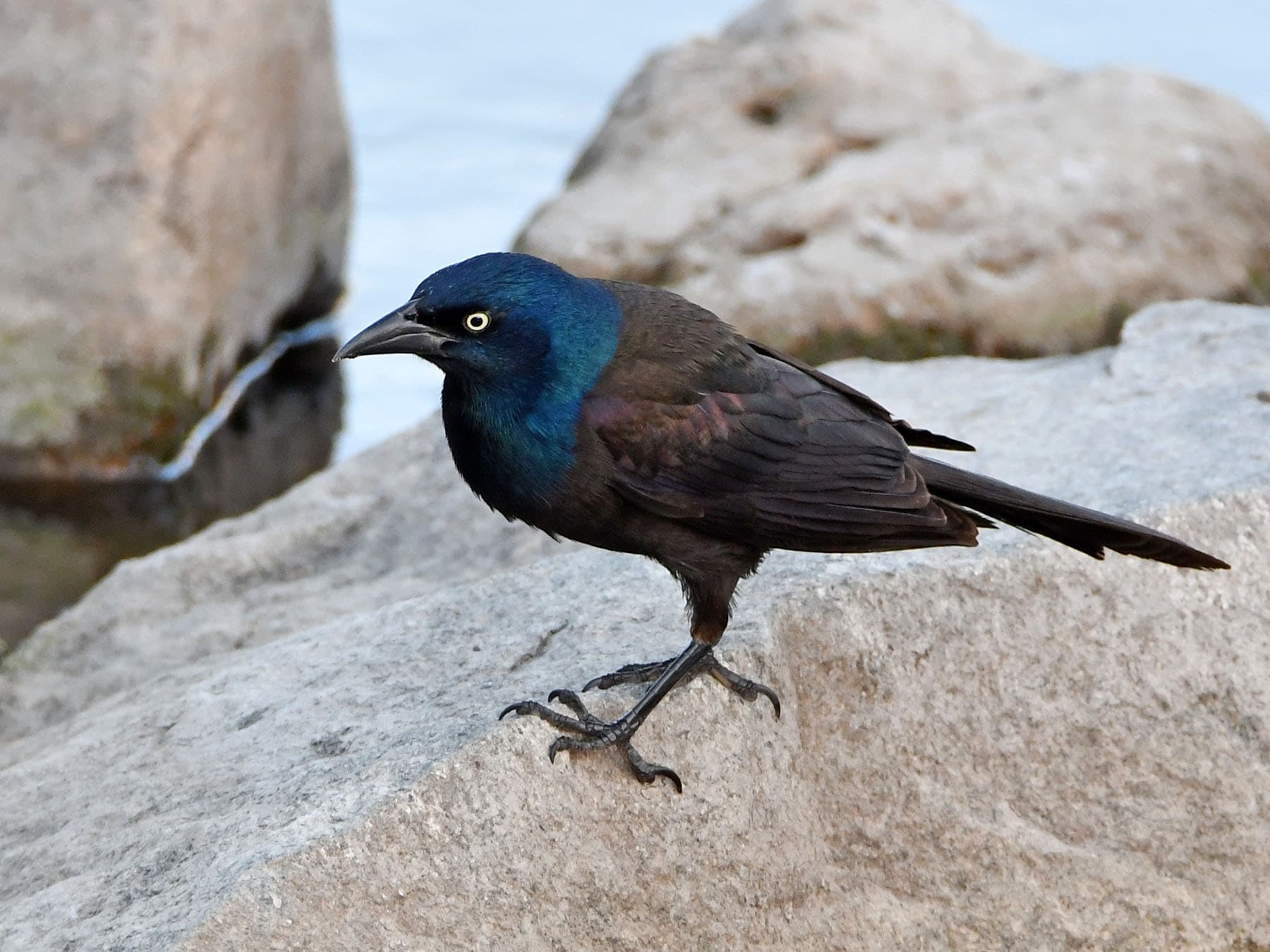
Quick facts
- Length
- 20–25 cm
- Wingspan
- 37 cm
- Weight
- 50–86 g
- Lifespan
- oldest recorded 12 years 6 months
- Family
- New World Blackbirds
- Migration
- Partial migrant
- Global status (IUCN)
- Near Threatened
- World population
- About 23 million (Partners in Flight, around 2010)
- Population trend
- A significant long-term fall in Breeding Bird Survey counts since 1966, about 1.4% a year, continuing in the most recent decade
- Scientific name
- Euphagus cyanocephalus
Questions
2Are Brewer's Blackbirds rare?
No. They are still common birds, about 23 million around 2010, but survey counts have fallen steadily since 1966, and it was rated Near Threatened in 2025 (see conservation status).
Why do some Brewer's Blackbirds have white patches?
Patches of white feathers, described as partial albinism, have been reported from many parts of the range, usually rarely. In one flock of about 500 in western Washington, described in 1928, more than 40% showed white spots or blotches, or white wing or tail feathers.2
Sources
34- 1Cornell Lab of Ornithology. Brewer's Blackbird. All About Birds. Accessed 20 November 2026. Source (opens in a new tab)
- 2Martin, S. G. (2020). Brewer's Blackbird (Euphagus cyanocephalus), version 1.0. Birds of the World (A. F. Poole and F. B. Gill, editors). Cornell Lab of Ornithology. doi:10.2173/bow.brebla.01 (opens in a new tab)
- 3National Audubon Society. Brewer's Blackbird. Guide to North American Birds. Accessed 20 November 2026. Source (opens in a new tab)
- 4Balph, M. H. (1975). Development of young Brewer's Blackbirds. Wilson Bulletin 87(2): 207-230. Accessed 20 November 2026. Source (opens in a new tab)
- 5Musher, L. J., Pyle, P., Irons, D. S. and Tietz, J. R. (2017). Identification of male Euphagus blackbirds in fresh fall plumages. Western Birds 48(3): 205-210. doi:10.21199/wb48.3.5 (opens in a new tab)
- 6Katzner, T. E., Spicer, A. M., Ortiz, P. A. and Conkling, T. J. (2026). Underestimated fatalities of a cryptic avian species of conservation concern at wind energy facilities in California. Ecology and Evolution 16(1). doi:10.1002/ece3.72855 (opens in a new tab)
- 7Stepney, P. H. R. and Power, D. M. (1973). Analysis of the eastward breeding expansion of Brewer's Blackbird plus general aspects of avian expansions. Wilson Bulletin 85(4): 452-464. Accessed 20 November 2026. Source (opens in a new tab)
- 8Koenig, W. D. (1985). Dunking of prey by Brewer's Blackbirds: a novel source of water for nestlings. The Condor 87(3): 444-445. doi:10.2307/1367239 (opens in a new tab)
- 9Horn, H. S. (1968). The adaptive significance of colonial nesting in the Brewer's Blackbird (Euphagus cyanocephalus). Ecology 49(4): 682-694. doi:10.2307/1935532 (opens in a new tab)
- 10Williams, L. (1952). Breeding behavior of the Brewer Blackbird. The Condor 54(1): 3-47. doi:10.2307/1364526 (opens in a new tab)
- 11Duquette, C. A. et al. (2020). Restored fire and grazing regimes influence nest selection and survival in Brewer's Blackbirds Euphagus cyanocephalus. Acta Ornithologica 54(2): 171-180. doi:10.3161/00016454AO2019.54.2.004 (opens in a new tab)
- 12Verbeek, N. A. M. (1964). A time and energy budget study of the Brewer Blackbird. The Condor 66(1): 70-74. doi:10.2307/1365240 (opens in a new tab)
- 13Howell, T. R. and Bartholomew, G. A. (1952). Experiments on the mating behavior of the Brewer Blackbird. The Condor 54(3): 140-151. doi:10.2307/1365064 (opens in a new tab)
- 14USGS Bird Banding Laboratory. Longevity records of North American birds: Brewer's Blackbird (AOU 5100). Bird Banding Laboratory, Bander Portal longevity tables. Accessed 20 November 2026. Source (opens in a new tab)
- 15Partners in Flight (2024). Avian Conservation Assessment Database, version 2024.05.23 (global). Partners in Flight. Accessed 20 November 2026. Source (opens in a new tab)
- 16Hostetler, J. A. et al. (2026). The North American Breeding Bird Survey, Analysis Results 1966-2025. U.S. Geological Survey data release. doi:10.5066/P1OSNSFC (opens in a new tab)
- 17BirdLife International (2025). Euphagus cyanocephalus. The IUCN Red List of Threatened Species 2025: e.T22724332A136648804. doi:10.2305/IUCN.UK.2025-2.RLTS.T22724332A136648804.en (opens in a new tab)
- 18NatureServe. Euphagus cyanocephalus: Brewer's Blackbird. NatureServe Explorer. Accessed 20 November 2026. Source (opens in a new tab)
- 19Kahle, L. Q., Flannery, M. E. and Dumbacher, J. P. (2016). Bird-window collisions at a West-Coast urban park museum: analyses of bird biology and window attributes from Golden Gate Park, San Francisco. PLoS ONE 11(1): e0144600. doi:10.1371/journal.pone.0144600 (opens in a new tab)
- 20U.S. Fish and Wildlife Service (2026). 50 CFR 10.13: List of Migratory Birds. Electronic Code of Federal Regulations. Accessed 20 November 2026. Source (opens in a new tab)
- 21U.S. Fish and Wildlife Service (2026). 50 CFR 21.10: General permit requirements. Electronic Code of Federal Regulations. Accessed 20 November 2026. Source (opens in a new tab)
- 22U.S. Fish and Wildlife Service (2026). 50 CFR 21.150: Depredation order for blackbirds, cowbirds, crows, grackles, and magpies. Electronic Code of Federal Regulations. Accessed 20 November 2026. Source (opens in a new tab)
- 23U.S. Fish and Wildlife Service. ECOS species pull report for the genus Euphagus. Environmental Conservation Online System. Accessed 20 November 2026. Source (opens in a new tab)
- 24Parliament of Canada (1994). Migratory Birds Convention Act, 1994 (S.C. 1994, c. 22). Justice Laws Website. Accessed 20 November 2026. Source (opens in a new tab)
- 25Environment and Climate Change Canada. Birds protected in Canada under the Migratory Birds Convention Act, 1994. Government of Canada. Accessed 20 November 2026. Source (opens in a new tab)
- 26AviList Core Team (2026). AviList: The Global Avian Checklist, v2025b. AviList. doi:10.2173/avilist.v2025b (opens in a new tab)
- 27Mettke-Hofmann, C., Winkler, H., Hamel, P. B. and Greenberg, R. (2013). Migratory New World blackbirds (icterids) are more neophobic than closely related resident icterids. PLoS ONE 8(2): e57565. doi:10.1371/journal.pone.0057565 (opens in a new tab)
- 28Avery, M. L. (2020). Rusty Blackbird (Euphagus carolinus), version 1.0. Birds of the World. Cornell Lab of Ornithology. doi:10.2173/bow.rusbla.01 (opens in a new tab)
- 29Peer, B. D. and Bollinger, E. K. (2020). Common Grackle (Quiscalus quiscula), version 1.0. Birds of the World. Cornell Lab of Ornithology. doi:10.2173/bow.comgra.01 (opens in a new tab)
- 30Johnson, K. and Peer, B. D. (2022). Great-tailed Grackle (Quiscalus mexicanus), version 2.0. Birds of the World. Cornell Lab of Ornithology. doi:10.2173/bow.grtgra.02 (opens in a new tab)
- 31Chamberlain, M. L., Lowther, P. E. and Hauber, M. E. (2026). Brown-headed Cowbird (Molothrus ater), version 2.1. Birds of the World. Cornell Lab of Ornithology. doi:10.2173/bow.bnhcow.02.1 (opens in a new tab)
- 32Ellison, K. S. and Lowther, P. E. (2020). Bronzed Cowbird (Molothrus aeneus), version 1.0. Birds of the World. Cornell Lab of Ornithology. doi:10.2173/bow.brocow.01 (opens in a new tab)
- 33Yasukawa, K. and Searcy, W. A. (2026). Red-winged Blackbird (Agelaius phoeniceus), version 1.1. Birds of the World. Cornell Lab of Ornithology. doi:10.2173/bow.rewbla.01.1 (opens in a new tab)
- 34Cabe, P. R. (2020). European Starling (Sturnus vulgaris), version 1.0. Birds of the World. Cornell Lab of Ornithology. doi:10.2173/bow.eursta.01 (opens in a new tab)

Checked by
Nathan Cope, founder and editor
Nathan founded Birdfact and leads its writers and contributors in the UK, the US and Canada. He has watched and studied birds for more than ten years, and checks every article and species guide before it’s published.