


Great-tailed Grackle
Quiscalus mexicanus
By the Birdfact teamChecked by Nathan Cope
On this page13 sections
How to recognise it
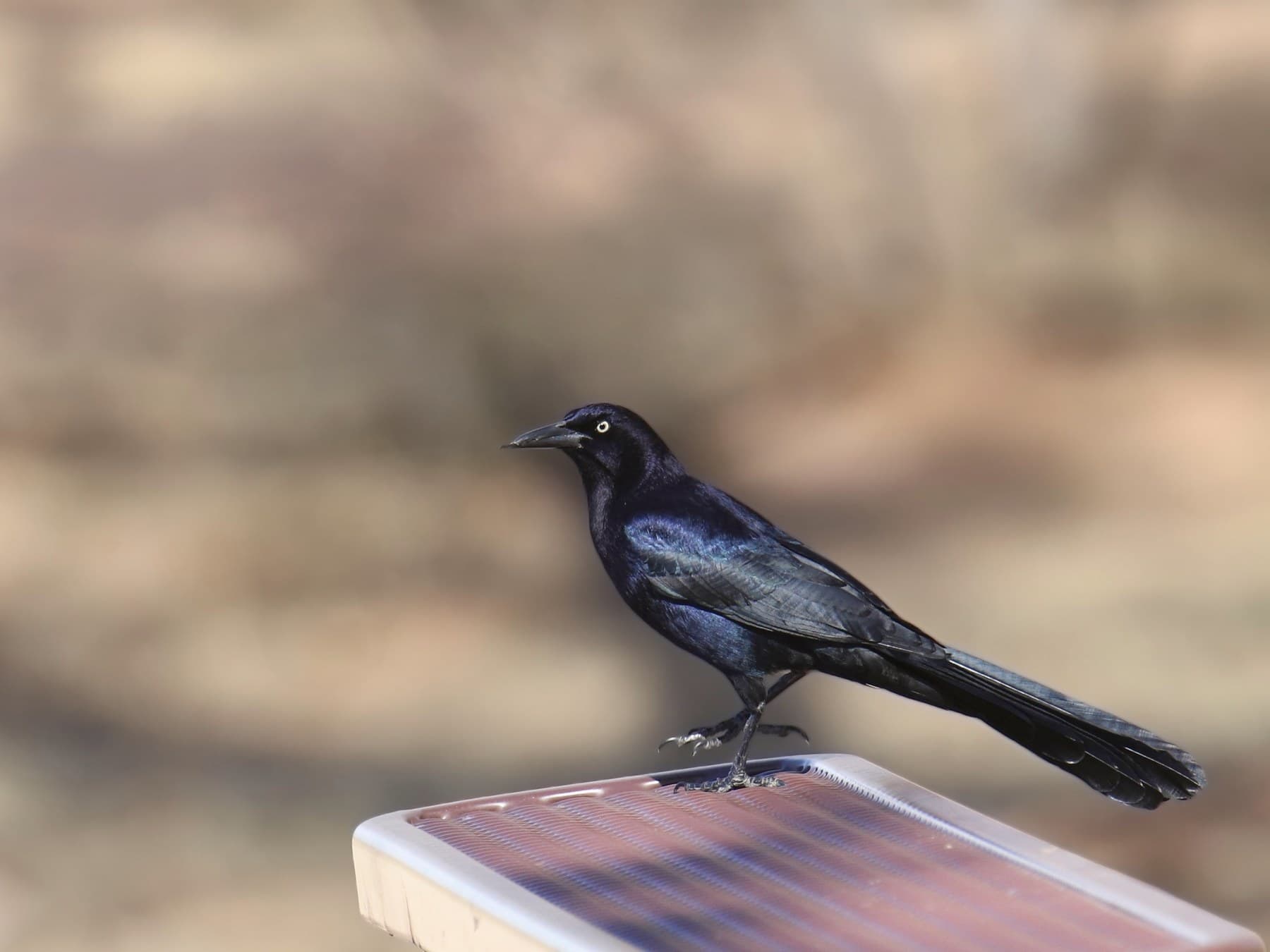
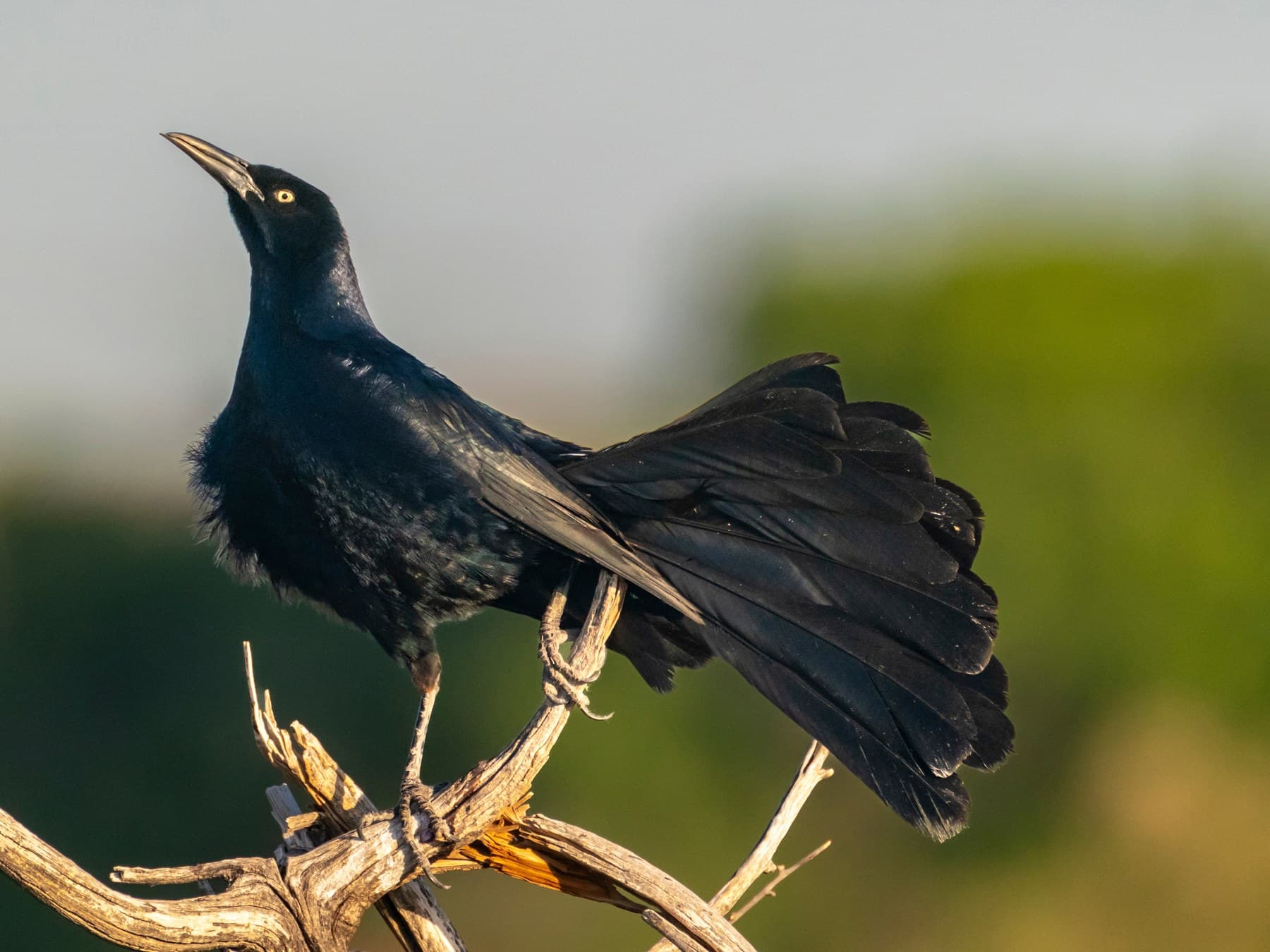
The Great-tailed Grackle is a big, long-legged blackbird, and the male is hard to miss. He is glossy black all over, the head, back and belly shot with purple-blue, a stout black bill on a flat-topped head, and pale to bright yellow eyes. Above all there is the tail: long, graduated and folded into a V or keel, nearly as long as the body.
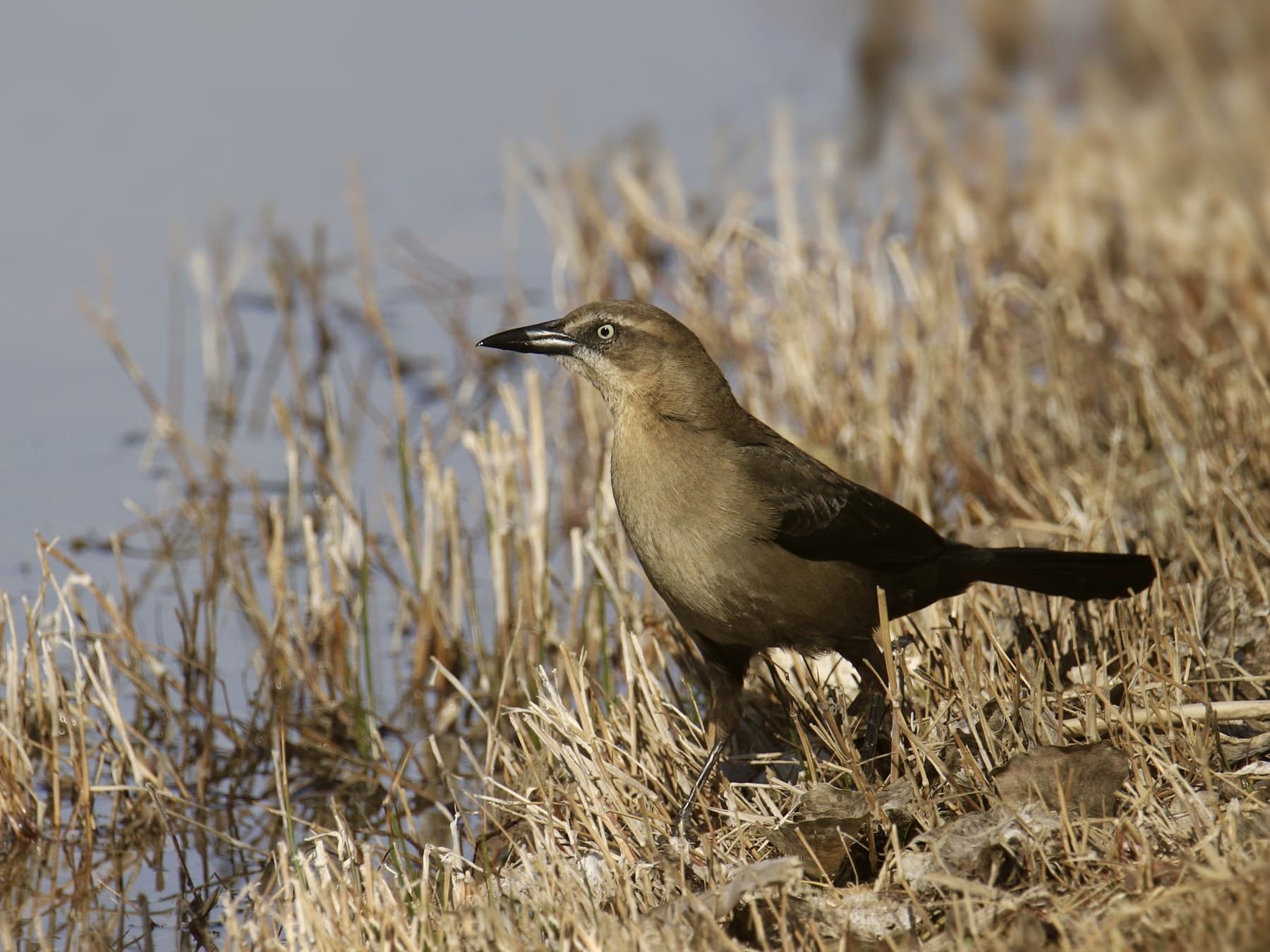
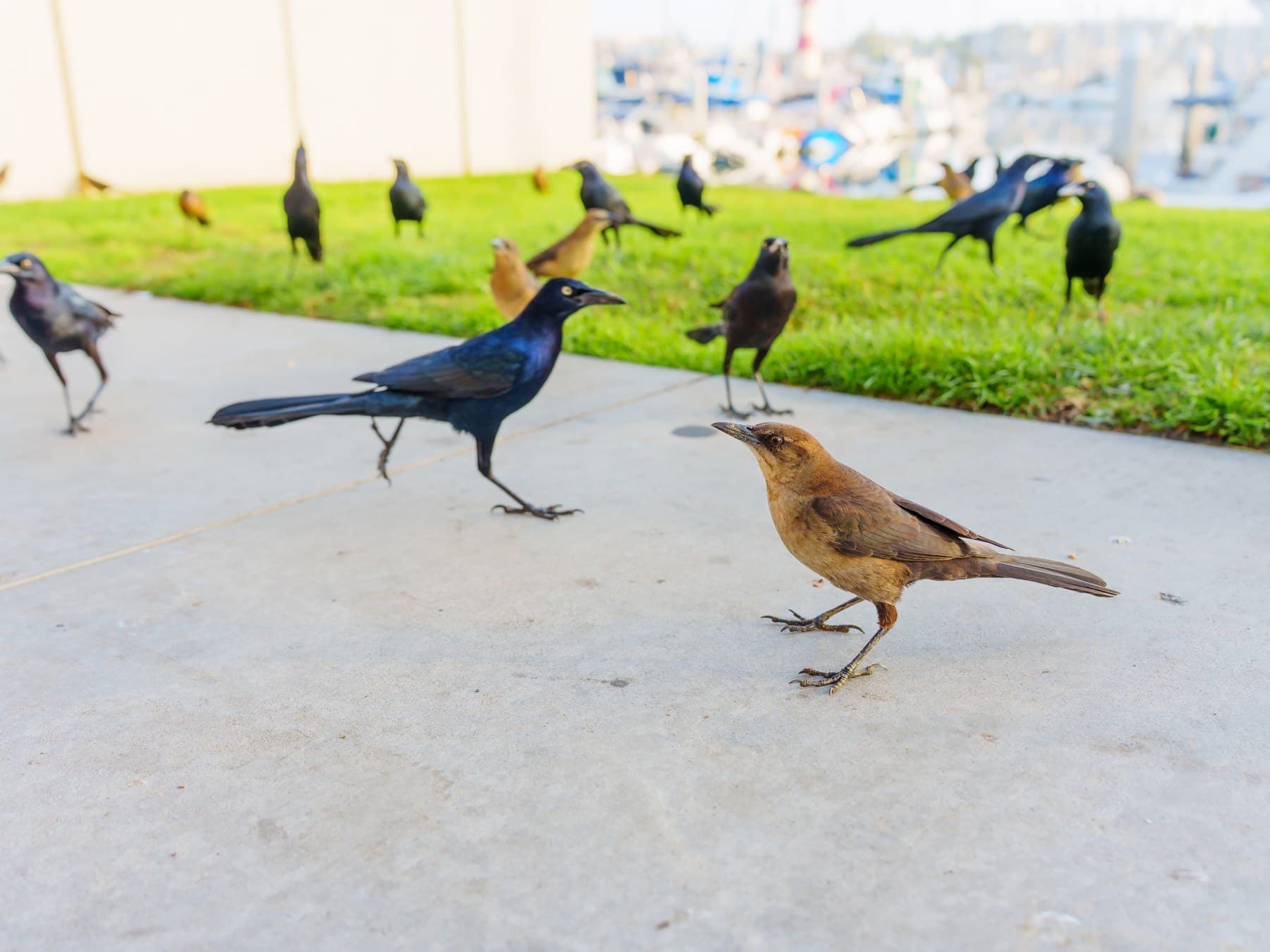
The female looks like a different bird. She is much smaller and dark brown, darker on the wings and tail and paler below, with a buff eyebrow and throat, a dark stripe below the cheek and pale yellow eyes. Her tail is shorter and only slightly keeled, or flat.1
Size and shape
Great-tailed Grackles are 15 to 18 inches (38-46 cm) long, with males at the top end; much of a male's length is tail. A male's tail averages about 8 inches (20 cm) and reaches about 9 inches (23 cm), some 40% longer than a female's.1 A male is about as long as an American Crow, though far lighter.
Males weigh about 6.7 to 9.4 ounces (190-265 g) and females about 3.3 to 5.3 ounces (94-150 g), so a female weighs about half as much as a male.2
Males, females and young
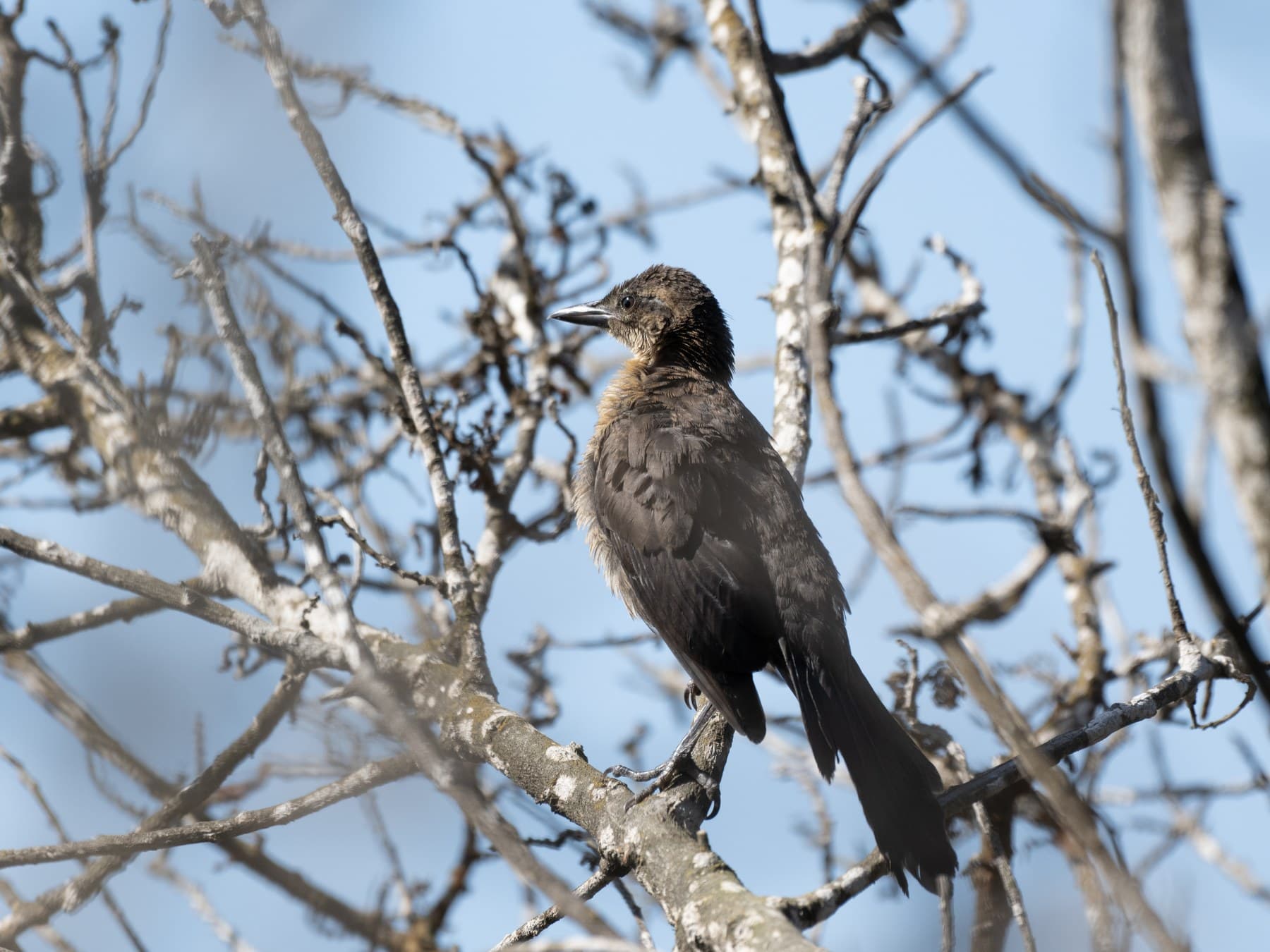
Juveniles look like females but are streaked and blotched below, with dark brown eyes; this plumage is worn mainly from May to August. Young males turn black in their first fall, but they look duller, more greenish and less purple than older males, with browner wings and a shorter, flatter tail. Their dark eyes turn pale yellow by fall and reach full adult color over the first winter: in a Texas study, all second-year males had adult eye color by April.1
Descriptions of the eight subspecies give adult eyes from straw-white to yellowish cream, though most accounts call the eye yellow. In the field, look for a pale eye in adults and a dark one in young birds.
Plumage and molt
From midsummer into fall, adults replace all their feathers. Late in the molt they drop the whole tail at once and are tailless for about two weeks, which is why an adult can suddenly look stubby-tailed in late summer or fall.
Identification in flight
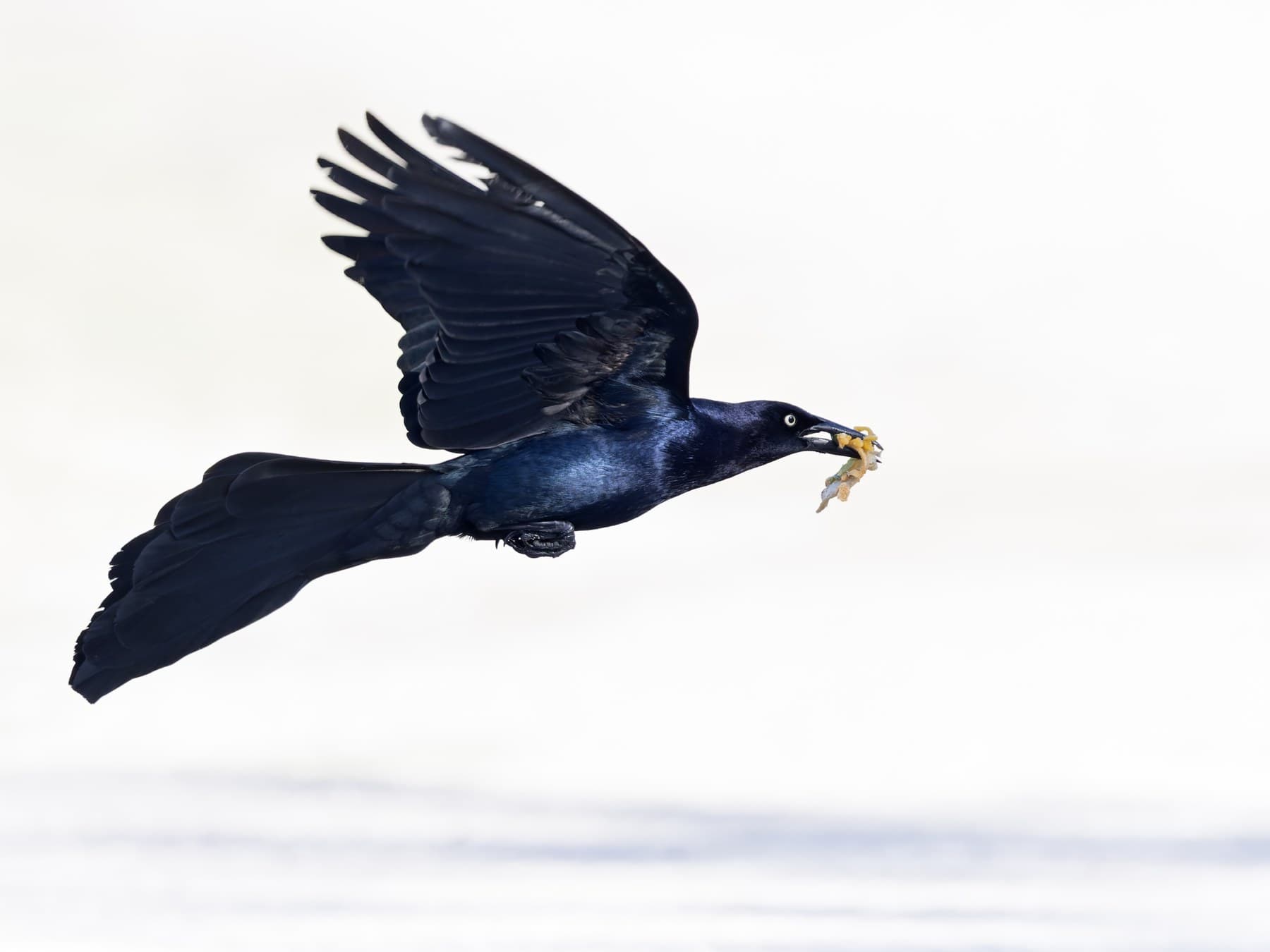
Flight is direct, not bouncing, with quick wingbeats; birds glide in to land with the tail angled up. In a breeze a male's big tail catches the wind and can push him sideways.
Identification: similar birds
Common Grackle. Smaller, 11 to 13.4 inches (28-34 cm), with a shorter tail creased down the middle. In its widespread bronzed form, the male's bronzy body contrasts with a blue-black head, and the female looks like the male but less glossy.
Boat-tailed Grackle. Very similar, and treated as the same species until 1973. It has a rounder head and a slightly shorter tail, and where the two meet on the Texas-Louisiana coast its eyes are darker and never bright yellow, though young Great-tailed Grackles are dark-eyed too. Females are paler brown, with a cinnamon crown.
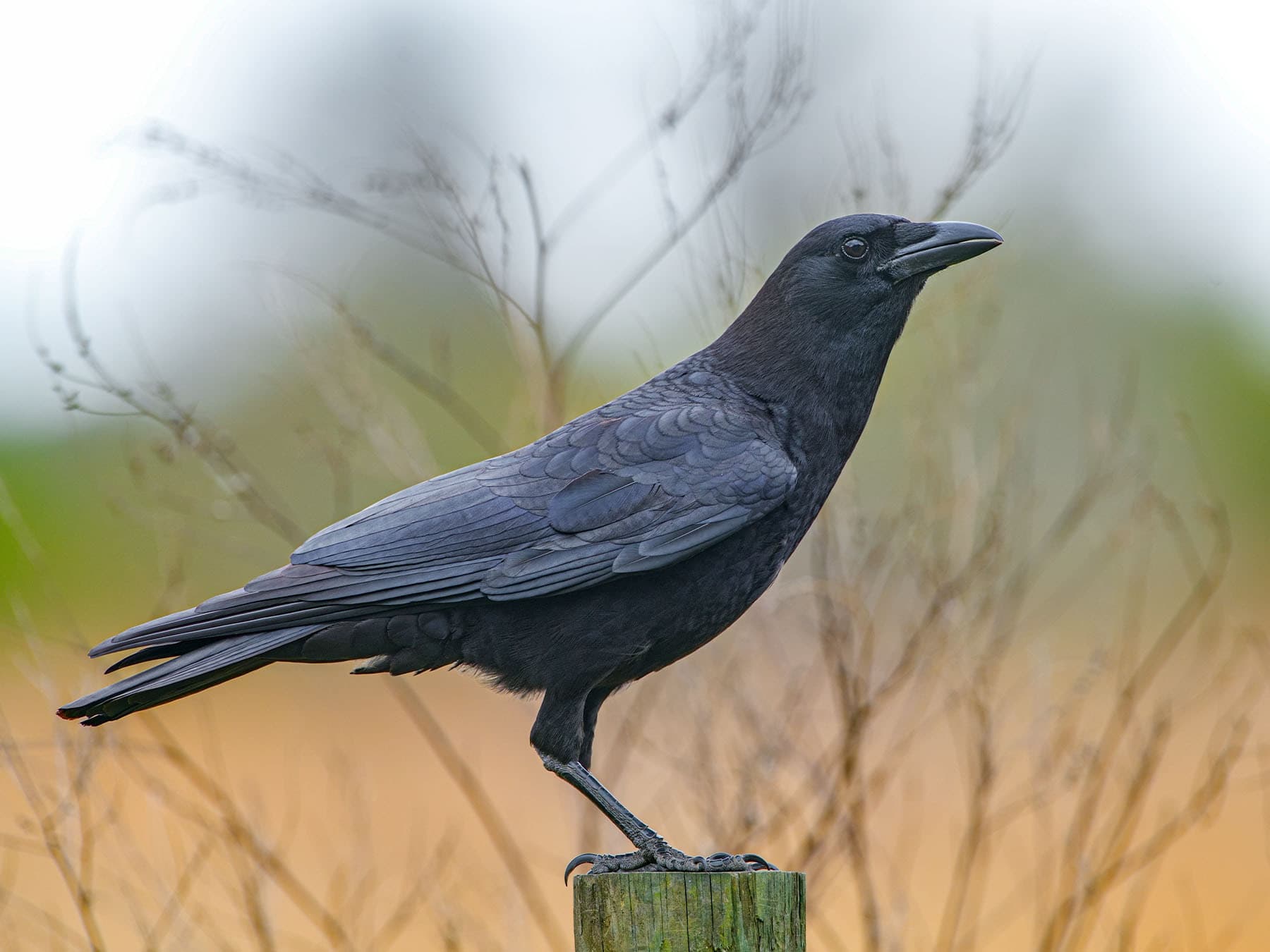
American Crow. About as long as a male grackle but far heavier, 11 to 22 ounces (311-623 g), with a strong bill, a relatively short square-tipped tail and a different voice. Grackles are blackbirds, not crows.
Brewer's Blackbird and Bronzed Cowbird. Both are much smaller, 8.3 to 9.8 inches (21-25 cm) and 7 to 8 inches (18-20 cm). Brewer's has a short tail; the cowbird has a neck ruff that gives it a hunched look, and red eyes that can be hard to see.
Not sure it’s a Great-tailed Grackle? Check your photo: Birdfact names the bird and shows the look-alike side by side.
Its size
Adults- Length
- 38–46 cm
- Wingspan
- 46–61 cm
- Weight
- 94–265 g
Its song and calls
The Great-tailed Grackle has an unusually large repertoire of whistles, clacks, clucks, squeals, hissing and harsh notes, and a busy breeding colony is full of very different sounds.
The male's territorial song, given while he puffs himself up, has four parts: a few crackling notes like breaking twigs, a rolling run of chewe notes, another crackle, then a series of loud cha-we notes. The crackle has 1 to 6 notes (usually 3), the rolling phrase 1 to 12 and the final series 1 to 11.3 Only males give the whistle, a long note rising in pitch, often twice in a row and aimed at other males. The loud clack is a male alarm note when people or predators come near a colony or roost; both sexes give a low chut, usually with a flick of the tail, and females give a chatter while building, incubating and feeding young.
Each male's song differs a little, and grackles recognize each other by voice: in one study, foraging females ignored the alarm clack of one jumpy male but flew off when a different male gave the same clack. Rarely, males in southern Texas give a call like a Northern Mockingbird's or Northern Cardinal's, possibly mimicry.
Calls at the roost
Grackles are noisiest at the start and end of the day. In one southern Texas study birds averaged about 75 calls and songs an hour in the breeding season. Calling starts before dawn at the roost, and at winter roosts it carries on after dark, as the birds settle in with constant calling and jostling for perches.
- Song0:00 / 0:05
Recorded in Utah, United States · March 2026
- Males displaying0:00 / 0:59
Recorded in New Mexico, United States · April 2021
- Evening roost0:00 / 0:32
Recorded in Arizona, United States · December 2025
Heard one and not sure? Let the bird song identifier listen.
When and where to see it
Great-tailed Grackles live in open country with scattered trees and water nearby: farmland, feedlots, pastures, marshes and mangroves, and especially towns, with their lawns, parks, golf courses, campuses, streets, strip malls and dumps. They avoid dense forest, and dry desert or prairie with no water, and are found from sea level to about 7,500 feet (2,300 m).
They breed from California, Oregon, Idaho and Iowa south through Texas, Mexico and Central America to the coasts of Colombia, Venezuela, Ecuador and northern Peru. Texas is the heart of the US range: they breed throughout the state except the Chisos Mountains and inland east Texas south of the Sabine River, and the highest US densities are in southern Texas.
Range expansion north
In the 1900s few native birds of the western United States expanded their range as much. In 1890 egg collections put the northern edge of the range in central Texas. During the 1900s, and mostly after 1960, the species spread north and northwest,4 and by 2020 it had nested in at least 17 states.1 It reached Austin by 1902, Houston by 1938 and the Texas Panhandle by 1975, and was first recorded in Arizona in 1935, Oklahoma in 1953, Kansas in 1963, California in 1964, Nevada and Colorado in 1970, Utah in 1977, Oregon in 1980, Iowa in 1983, Idaho in 1985, Washington in 1987 and Wyoming in 1989. A 1993 review found that on average 4.8 years passed from the first sighting in each state or province to the first nest found there.
The spread is generally put down to irrigation, farming, tree planting and towns, though it reached southern Arizona before the farming boom in neighboring Sonora. A 2023 study found the species has moved into drier, more urban places farther from natural water, while its closest living relative, the Boat-tailed Grackle, has stayed in warm, wet coastal places.5 At the leading edge, birds may disperse farther: a 2025 genetic study found birds at the northern edge in California less closely related to each other than birds in Arizona, and in both places females seemed generally to settle closer to where they hatched than males.6
Do they migrate?
Mostly not. Great-tailed Grackles are resident through most of their range, but birds at the northern edge move south in winter, and the far north of the breeding range, from Iowa, Nebraska and Kansas west to Colorado, Utah, Nevada and Oregon, empties to some extent in winter. Places they have newly settled often quickly become year-round homes.
Wanderers have reached southern Canada, from British Columbia to Nova Scotia, and east to Ohio, and there is a well-documented 2021 report, with photos, from coastal Massachusetts. As of 2022, apart from an unconfirmed Great-tailed or Boat-tailed Grackle on Oahu, Hawaii, in the early 1980s, the species had not been reported outside the Americas.
Tips for seeing it
What it eats
Great-tailed Grackles eat almost anything. In spring and summer grasshoppers, crickets, beetles, spiders and other invertebrates are the mainstay; grain, seeds and fruit matter more the rest of the year. They also take tadpoles, frogs, lizards, small fish, crayfish, mice, eggs and nestlings, and food scraps.
In a 1968-69 study of 129 birds in Brazos County, Texas, animal food made up 80% of the year's diet, and grasshoppers and crickets alone 51%. Animal food was 87% of the diet in the warm season and 46% in the cool season. Adult males ate more seeds, mostly grass seeds, with 52% animal food, while adult females ate 81% animal food.7 Nestlings are fed almost entirely animal food: 99% in that study (12 nestlings), mostly grasshoppers and spiders, and at another Texas site grasshoppers and crickets made up 45% and spiders 35% of 283 prey items.
They do take eggs and nestlings of other birds, and have been seen killing small birds such as a House Sparrow and a Barn Swallow, but they do not appear to raid other species' nests within their own colonies. No eggshell was found in any of the 129 birds in the Texas study, and Birds of the World suggests that, as with the Common Grackle, its name as a raider of nests may be overstated.1
How they feed
They feed mostly on the ground in flocks, often with cowbirds and other blackbirds, walking and turning things over with the bill. They also wade for tadpoles and small fish, pluck food from water in flight, follow tractors for the insects they turn up, and pick parasites off livestock. In towns they eat leftovers at dumps and outdoor restaurants; in Houston, females fed tortillas to their fledglings.
At feeders they take seed scattered on the ground below, and cracked corn and milo are favorites.
Nesting and breeding
Great-tailed Grackles nest in colonies, from a few pairs to hundreds. Three to 25 nests in a tree is typical, and over 100 have been counted in one tree. The female chooses the site, usually near water and open ground, as high as she can: from about 1.6 feet (0.5 m) above water in marshes to 66 feet (20 m) up in oaks or pines. She also uses palms, bamboo, cattails and bulrushes, and telephone poles or duck blinds where trees are scarce.
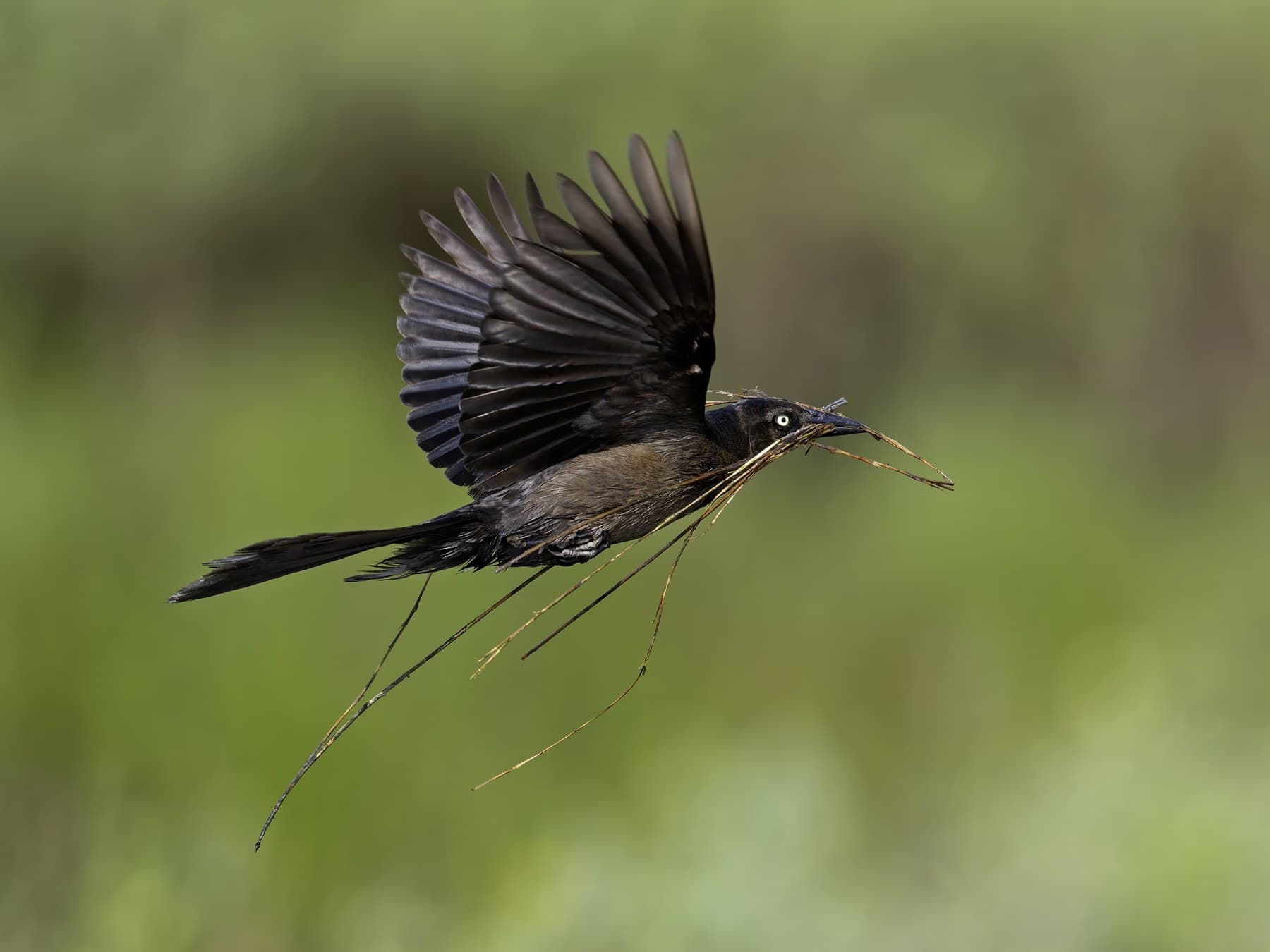
The nest is a bulky open cup woven around upright twigs from grass, weeds, rushes and bark strips, with mud or cow dung pressed into the base and a lining of fine grass. Plastic bags, ribbon, string and other trash may be woven in. The female builds alone, in 5 to 17 days, and other females often steal material, so males may stand guard.
Eggs and young
In Texas nesting runs from mid-March to mid-July; in Houston the first eggs were laid around March 26 on average, and the first fledglings were seen from April 21 to 27. The clutch is usually 3 or 4 eggs (1 to 5): in southern Texas, 55% of 276 clutches had 3 eggs and 33% had 4. The eggs range from bright blue to a pale bluish gray, with dark brown, black or purplish scrawls, about 1.3 by 0.9 inches (32 x 22 mm), usually laid one a day; in a small sample, 25 to 69 minutes after sunrise. Only the female incubates, for 13 to 14 days.1
The female broods and feeds the nestlings; one study timed her visits about every 15 minutes. Young leave the nest at 12 days at the earliest, spend several days on the ground or in the tree they hatched in, and cannot fly well for at least two weeks; field guides give about three weeks to leaving the nest. Males defend the nests and fledglings on their territory but rarely feed young. A female raises one or two broods a season, with up to four nest attempts; in Houston, second nests peaked in June.
Eggs hatch about half male and half female, but in lean years more male nestlings die, especially late-hatched ones, because they grow faster and need more food.8 Grackles also reject cowbird eggs: in experiments they rejected all 173 real and model cowbird eggs added to their nests, and 8% of 246 grackle eggs added the same way.9
Breeding: mates and territories
The mating system is polygynous. A territorial male defends one tree or a few, where several females nest. Only about a third of males hold territories, most of them at least 3 years old, while females usually breed in their second year. Pair bonds are loose: in one study females switched mates about twice as often as they stayed.
In a Houston colony, territorial males fathered 84% of nestlings, one male fathered 40% of the 120 young, 80% of males fathered none, and 37% of nestlings had a father other than their mother's mate.10 Adults are mostly female: 28% to 35% of birds at one breeding colony and 29% to 43% at Texas roosts were male.1
Behaviour
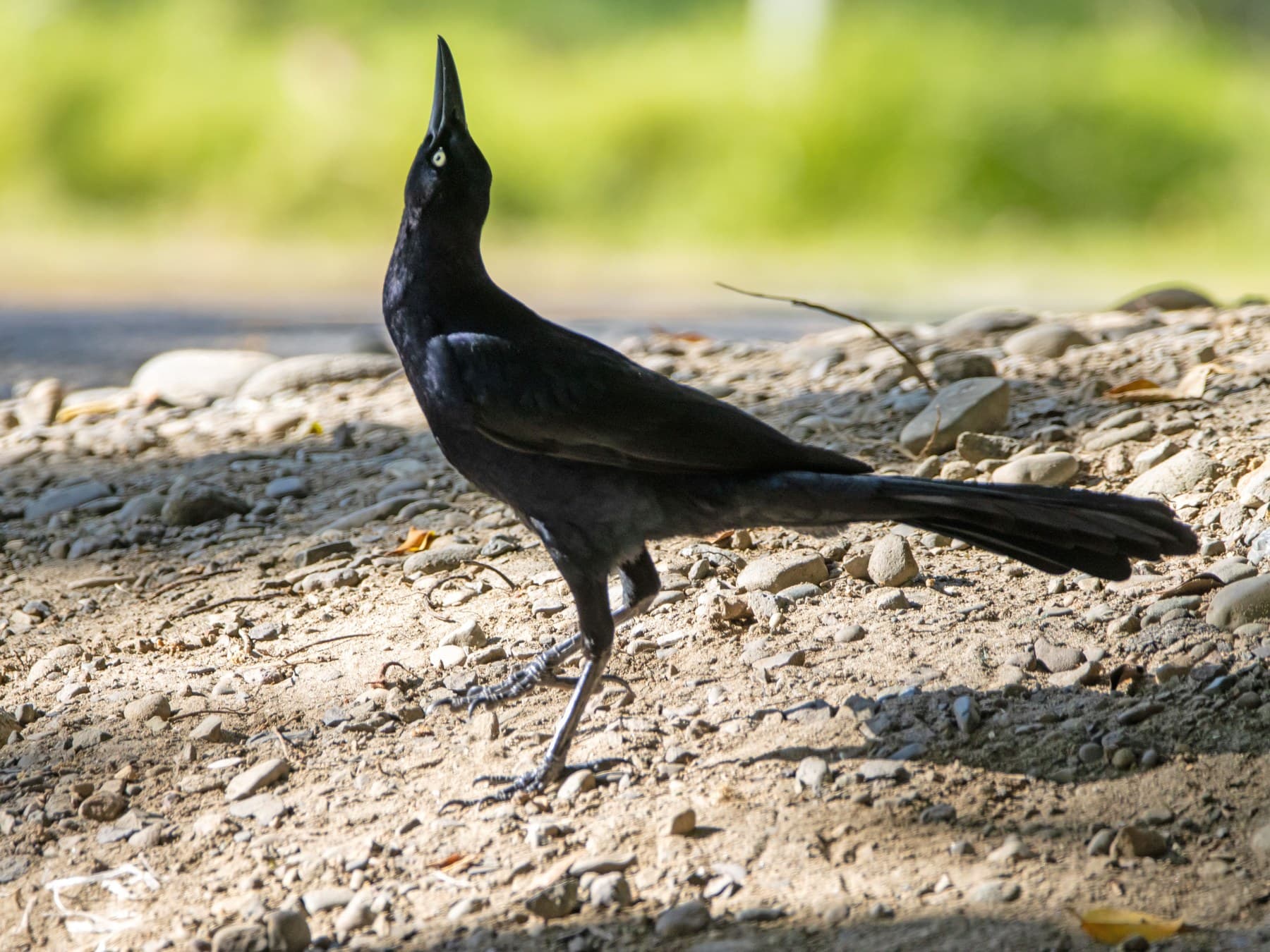
Grackles have two displays you will see often. In the ruff-out, a male fluffs out his body feathers, opens his bill, fans his tail and droops or lifts his wings, usually while singing: the "puffed-up" grackle. In the head-up, birds point the bill straight up at a rival with the feathers sleeked; at full intensity the head tips back until it touches the back. Both sexes do the head-up, all year, so a group of grackles staring at the sky is probably squaring off.
Rival males also grapple with their feet and peck, sometimes rolling locked together on the ground or in the street, and breeding males often have cut or swollen feet. Near nests, mainly males mob people, squirrels and large birds, and may strike a person's head from behind. Colony birds, especially females, come to know individual researchers by sight and give the chut alarm at them, at the colony and away from it.
Roosts and social behavior
Great-tailed Grackles roost together all year. Winter roosts in town trees can hold thousands, and up to 500,000 were counted in sugarcane fields in the Lower Rio Grande Valley in 1987.1 The birds leave before sunrise in small groups and return at sunset. They sunbathe by squatting on the ground with feathers raised and sometimes one wing spread, and bathe in shallow pools and lawn sprinklers.
Problem-solving behavior
Small lab studies show grackles are flexible learners: they relearn when the rewarded choice is switched, and in one study training made them faster at it.11 They have their limits: in a 2016 study they did not figure out stick tool use, string pulling or stone dropping.12 But in the later study, the birds quickest at their final switch were also quicker to move between options on a multi-access puzzle box, and solved more of them.
Lifespan and predators
The oldest Great-tailed Grackle on the US Bird Banding Laboratory's published longevity list lived at least 7 years 9 months: a male banded in Texas in October 1974 as a young bird and found there in March 1982.13 Birds of the World reports three Texas birds of at least 11 years in the laboratory's files, up to 11 years 11 months, which are not on the published list; a 12.5-year record once printed was an error. As of 2022 there was no published estimate of adult survival.1
Predators and dangers
Adults are taken by Aplomado Falcons, Red-tailed Hawks, Burrowing Owls and cottonmouths. Snakes probably take nests, and in towns fox squirrels and cats take nests and cats and dogs take fledglings. Storms can kill birds at roosts: one spring hailstorm killed 7% of the females and 12% of the males at a roost.
Conservation
The Great-tailed Grackle is listed as Least Concern on the IUCN Red List.14 Partners in Flight estimates about 30 million worldwide, about 8.2 million of them in the United States and Canada.15
The North American Breeding Bird Survey shows US numbers rising fast to a peak in 1987, then falling by about half by 2025, with Texas down about 61% from its peak. Over the whole survey, 1967 to 2025, there is no clear trend, and states it moved into, such as Colorado, New Mexico and Kansas, show long-term increases, though California has fallen by more than half since a 2007 peak.16 Partners in Flight, working from the same survey, puts the change over the 10 years to 2021 at about -23%, and gives the species a Continental Concern Score of 8 of 20.
Conservation, crops and people
Birds of the World describes it as an agricultural pest in places, and many people find it a nuisance; studies in Costa Rica found attitudes to it vary between groups but are often negative.1 It eats sprouting corn and sorghum in Mexico and citrus in southern Texas, where grapefruit damage was put at over $2.2 million in 1987.17 It is shot for its noise, droppings at roosts and crop damage, and illegal poisoning has been recorded.
Some charges look weaker on the evidence. It was once blamed for a decline in White-winged Doves in Texas, but a later study found no apparent effect on dove nesting,18 and the Texas diet study found no eggshell in any of its 129 birds.
Conservation and the law
In the United States the Great-tailed Grackle is protected by the federal Migratory Bird Treaty Act, which lists it with the Common and Boat-tailed Grackles.19, 20 It is also covered by a federal depredation order for blackbirds, cowbirds, crows, grackles and magpies. Under it, no federal permit is needed to control these birds where they cause serious injury to crops or livestock feed, a health hazard or structural damage, or to protect species listed as endangered, threatened, candidate or of special concern; each year, non-lethal methods must be tried before any lethal control, an annual report filed and state law followed.21
Similar birds
Often mistaken for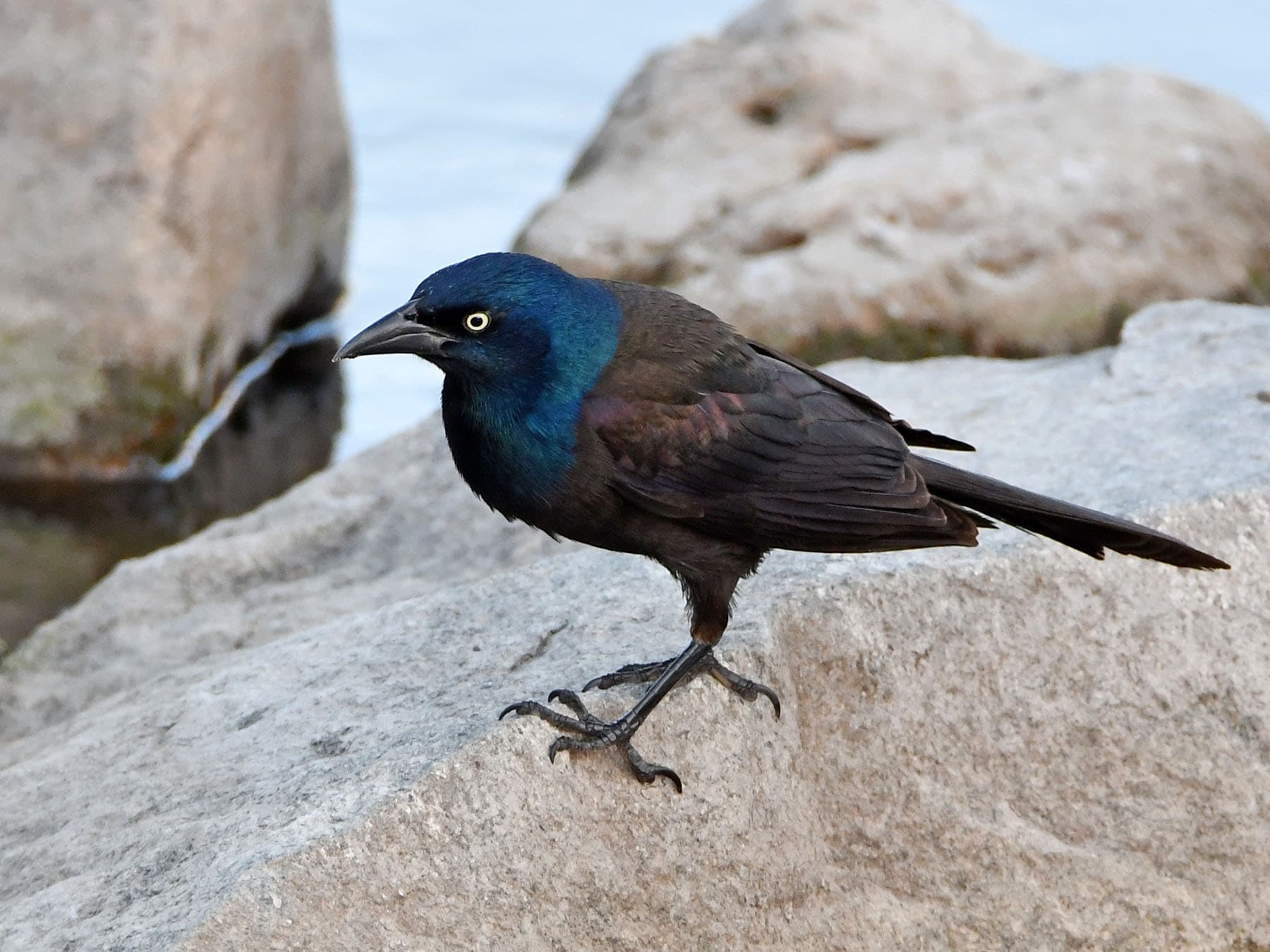
Quick facts
- Length
- 38–46 cm
- Wingspan
- 46–61 cm
- Weight
- 94–265 g
- Lifespan
- oldest recorded 7 years 9 months
- Family
- New World Blackbirds
- Global status (IUCN)
- Least Concern
- World population
- About 30 million worldwide (Partners in Flight, 2023)
- Population trend
- Abundant and spread far north since 1960, but fewer than in the late 1980s
- Scientific name
- Quiscalus mexicanus
Questions
5Is a Great-tailed Grackle a crow?
No. It is a New World blackbird, family Icteridae, in the same family as orioles, meadowlarks and cowbirds. It is about as long as an American Crow but far lighter. See similar birds.
Why are there so many grackles in Texas?
Texas is the heart of the US range: Partners in Flight's survey-based estimate put about 4.8 million of the 8.2 million US birds there, with the highest densities in the south of the state. Grackles thrive in towns, farmland and feedlots and gather in big roosts. See where to see them.
Are grackles in the UK?
Not this one. Great-tailed Grackles live in the Americas, and as of 2022 none had been reported in Britain or Europe.
Why do grackles look straight up?
It is the head-up display, a threat aimed at rivals: the bird points its bill at the sky, feathers sleeked. Both sexes do it, all year. See displays.
Are grackles protected?
The Great-tailed Grackle is, under the federal Migratory Bird Treaty Act, with a federal depredation order that allows control in set circumstances. See the law.
Sources
28- 1Johnson, K. and Peer, B. D. (2022). Great-tailed Grackle (Quiscalus mexicanus), version 2.0. Birds of the World (P. G. Rodewald and B. K. Keeney, editors). Cornell Lab of Ornithology. doi:10.2173/bow.grtgra.02 (opens in a new tab)
- 2National Audubon Society. Great-tailed Grackle. Guide to North American Birds. Accessed 2 November 2026. Source (opens in a new tab)
- 3Kok, O. B. (1971). Vocal behavior of the Great-tailed Grackle (Quiscalus mexicanus prosopidicola). Condor 73: 348-363. doi:10.2307/1365762 (opens in a new tab)
- 4Wehtje, W. (2003). The range expansion of the great-tailed grackle (Quiscalus mexicanus Gmelin) in North America since 1880. Journal of Biogeography 30(10): 1593-1607. doi:10.1046/j.1365-2699.2003.00970.x (opens in a new tab)
- 5Summers, J., Lukas, D., Logan, C. and Chen, N. X. (2023). The role of climate change and niche shifts in divergent range dynamics of a sister-species pair. Peer Community Journal 3. doi:10.24072/pcjournal.248 (opens in a new tab)
- 6Lukas, D. et al. (2025). Reduced levels of relatedness indicate that great-tailed grackles disperse further at the edge of their range. Peer Community Journal 5. doi:10.24072/pcjournal.591 (opens in a new tab)
- 7Davis, W. R. and Arnold, K. A. (1972). Food habits of the Great-tailed Grackle in Brazos County, Texas. Condor 74: 439-446. doi:10.2307/1365896 (opens in a new tab)
- 8Teather, K. L. and Weatherhead, P. J. (1989). Sex-specific mortality in nestling great-tailed grackles. Ecology 70: 1485-1493. doi:10.2307/1938207 (opens in a new tab)
- 9Peer, B. D. and Sealy, S. G. (2004). Fate of grackle (Quiscalus spp.) defenses in the absence of brood parasitism: implications for long-term parasite-host coevolution. Auk 121: 1172-1186. doi:10.1642/0004-8038(2004)121[1172:FOGQSD]2.0.CO;2 (opens in a new tab)
- 10Johnson, K. et al. (2000). Male mating strategies and the mating system of great-tailed grackles. Behavioral Ecology 11(2): 132-141. doi:10.1093/beheco/11.2.132 (opens in a new tab)
- 11Logan, C. J. et al. (2023). Behavioral flexibility is manipulable and it improves flexibility and innovativeness in a new context. Peer Community Journal 3. doi:10.24072/pcjournal.284 (opens in a new tab)
- 12Logan, C. J. (2016). How far will a behaviourally flexible invasive bird go to innovate?. Royal Society Open Science 3: 160247. doi:10.1098/rsos.160247 (opens in a new tab)
- 13USGS Bird Banding Laboratory. Longevity records of North American birds. USGS Eastern Ecological Science Center, Bird Banding Laboratory. Accessed 2 November 2026. Source (opens in a new tab)
- 14BirdLife International (2018). Species factsheet: Great-tailed Grackle Quiscalus mexicanus. BirdLife DataZone. Accessed 2 November 2026. Source (opens in a new tab)
- 15Partners in Flight (2023). Avian Conservation Assessment Database and Population Estimates Database. Bird Conservancy of the Rockies. Accessed 2 November 2026. Source (opens in a new tab)
- 16Hostetler, J. A. et al. (2026). The North American Breeding Bird Survey, Analysis Results 1966-2025. U.S. Geological Survey data release. doi:10.5066/P1OSNSFC (opens in a new tab)
- 17Johnson, D. B., Guthery, F. S. and Koerth, N. E. (1989). Grackle damage to grapefruit in the Lower Rio Grande Valley. Wildlife Society Bulletin 17: 46-50. Accessed 2 November 2026.
- 18Hayslette, S. E., Tacha, T. C. and Waggerman, G. L. (1996). Changes in White-winged Dove reproduction in southern Texas, 1954-93. Journal of Wildlife Management 60: 298-301. doi:10.2307/3802227 (opens in a new tab)
- 19United States Code. 16 U.S.C. 703: Taking, killing, or possessing migratory birds unlawful. Legal Information Institute, Cornell Law School. Accessed 2 November 2026. Source (opens in a new tab)
- 20U.S. Fish and Wildlife Service (2026). 50 CFR 10.13: List of Migratory Birds. Electronic Code of Federal Regulations. Accessed 2 November 2026. Source (opens in a new tab)
- 21U.S. Fish and Wildlife Service (2026). 50 CFR 21.150: Depredation order for blackbirds, cowbirds, crows, grackles, and magpies. Electronic Code of Federal Regulations. Accessed 2 November 2026. Source (opens in a new tab)
- 22Cornell Lab of Ornithology. Great-tailed Grackle. All About Birds. Accessed 2 November 2026. Source (opens in a new tab)
- 23National Audubon Society. Common Grackle. Guide to North American Birds. Accessed 2 November 2026. Source (opens in a new tab)
- 24National Audubon Society. Boat-tailed Grackle. Guide to North American Birds. Accessed 2 November 2026. Source (opens in a new tab)
- 25National Audubon Society. American Crow. Guide to North American Birds. Accessed 2 November 2026. Source (opens in a new tab)
- 26National Audubon Society. Brewer's Blackbird. Guide to North American Birds. Accessed 2 November 2026. Source (opens in a new tab)
- 27National Audubon Society. Bronzed Cowbird. Guide to North American Birds. Accessed 2 November 2026. Source (opens in a new tab)
- 28AviList Core Team (2025). AviList: The Global Avian Checklist, v2025. data/reference/avilist.csv. Accessed 2 November 2026. Source (opens in a new tab)

Checked by
Nathan Cope, founder and editor
Nathan founded Birdfact and leads its writers and contributors in the UK, the US and Canada. He has watched and studied birds for more than ten years, and checks every article and species guide before it’s published.