Published 7 Oct 2026
Blue Tit Song and Calls: What They Sound Like
By the Birdfact teamChecked by Nathan Cope
Blue Tits call a thin tsee and scold with a churring churrrrit; the song is clear and high, often ending in a trill. Listen to seven recordings, from songs to churring alarms and begging young.
On this page11 sections
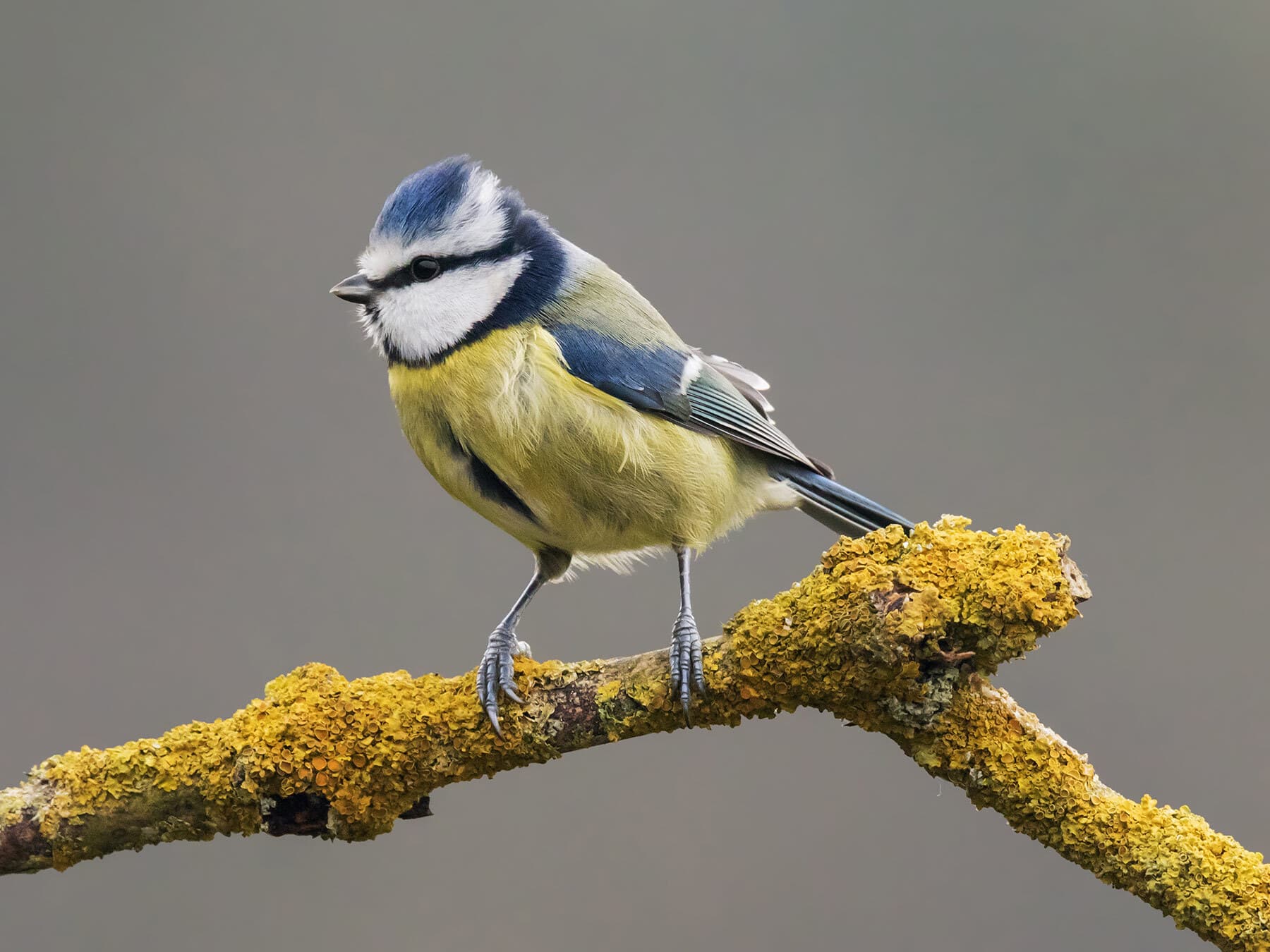
This page is a listening guide to the Blue Tit: its song and its many versions, when it sings, its churring scold and contact calls, the female's hiss at the nest and the begging of the young, with seven recordings. For the bird in general, see Blue Tit identification and facts.
What does a Blue Tit sound like?
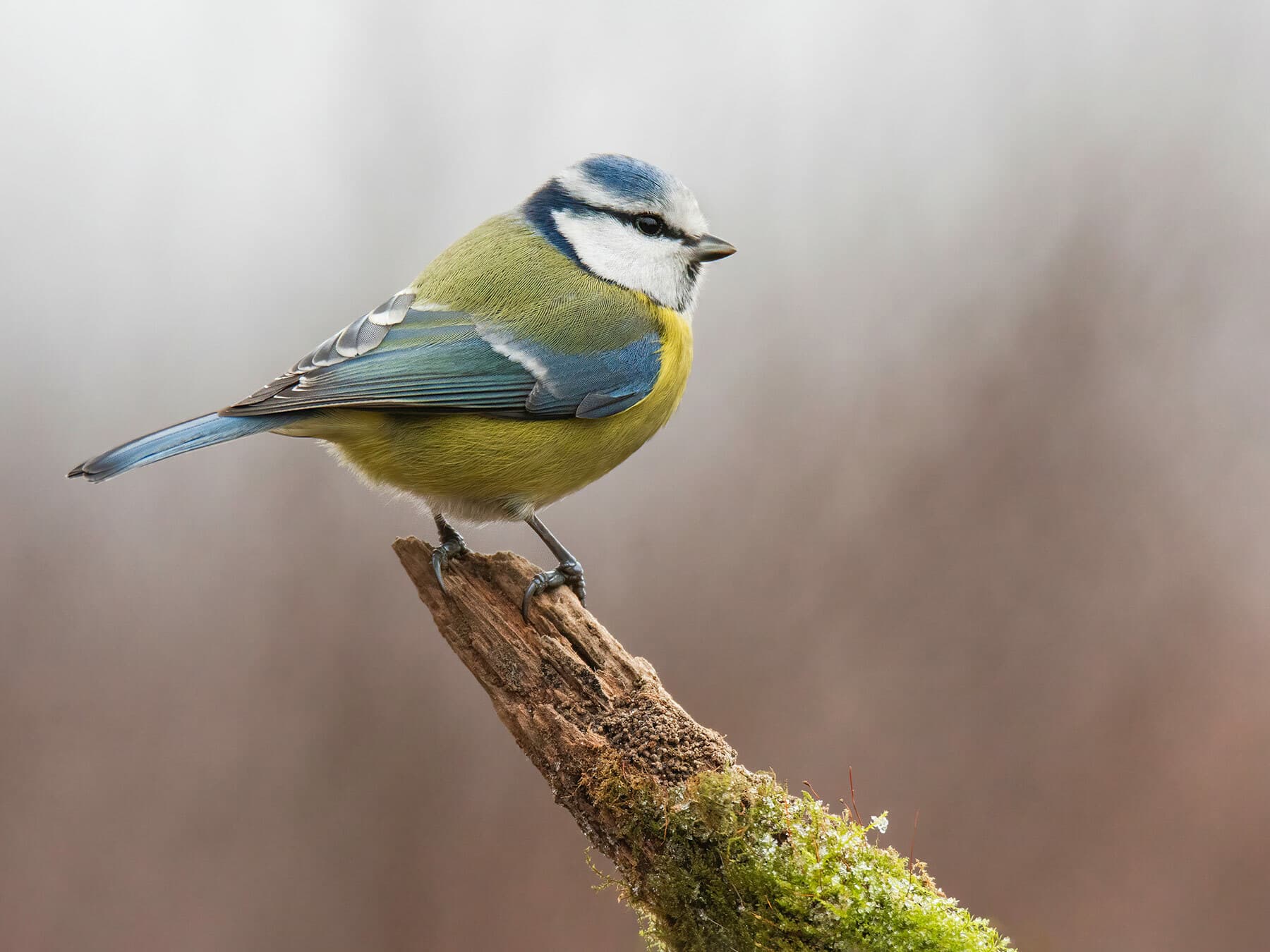
High, thin and frequent: Blue Tits are very vocal. The sound you hear most is a short, thin tsee, the contact call. When a Blue Tit is alarmed it scolds with a churring churrrrit. The song is clear, high and lilting, often ending in a trill; one version is written tsee-tsee-tsee-tsu-tsuhuhuhu, and it is repeated after short pauses.1
The RSPB's description is a pair of high tseep notes and then a lower rattle to finish.2 In this first recording, made at Woodford in London, the bird gives agitated, churring notes first, then the familiar song.
Blue Tit song
Listen for the shape: a high, falling note, then a drop into a lower, faster trill. The recording below, of a bird singing in allotment gardens, repeats the phrase again and again, the usual way Blue Tits sing.
Why do Blue Tits sound different from each other?
Each male has 3 to 8 different songs, and switches between them. Some are shorter versions of the phrase. Across Europe, though, there is little regional variation: a Blue Tit in France sounds much like one in Britain.
The next two recordings are other song types: a male repeating pairs of high notes, and a bird giving falling whistles, some ending in a short trill.
When do Blue Tits sing?
All year round. In spring and summer the song defends a territory and attracts a mate; in winter Blue Tits keep in touch in mixed feeding flocks with contact calls.
Dawn is the male's time. In a three-year study of Blue Tits nesting on the Lancaster University campus, males gave long displays of song at dawn in the breeding season, before the morning's mating.3
Artificial light changes things. In a study of five forest songbirds, males of four species started their dawn song earlier near street lights (the paper's summary does not say which four). Over seven years, Blue Tits nesting near the lights laid their eggs 1.5 days earlier on average, and males in lit territories were twice as successful at gaining mates outside their own pair.4
Do female Blue Tits sing?
Yes, and more than was thought. Female song had only been reported now and then until the Lancaster study found females singing frequently, in the same daytime situations as males: in disputes, in alarm, and singing on their own. They use the same song types as males, but sing less, with smaller repertoires and shorter trills, and they were not heard singing at dawn.3 Both sexes also give a high zeedle in courtship.
Alarm calls: the churr
A Blue Tit's scold is a churring churrrrit that rises at the end. It comes especially when a predator is near, sometimes with sharp tsee, thin seeee or pit notes before or after it, and it is repeated when the bird is agitated.1 The RSPB calls it "a distinct and angry 'churring'".2
This recording, made in Gloucestershire in 1978 and kept in the British Library's sound archive, has thin tsee notes and runs of churring. There is more churring at the start of the London recording at the top of the page.
Contact calls
The short, thin tsee, alone or in a series, keeps partners and flock mates in touch all year. In winter you hear it from mixed feeding flocks moving through the trees. This recording is of several Blue Tits calling as they fed in shrubs in a park.
The hiss at the nest
A female Blue Tit on the nest has a startling defence: a short, explosive hiss, given at an intruder or a predator. Researchers describe it as snake-like. In a population in Belgium, how much a female hissed at a model predator was a consistent trait of that female from one test to the next.5
The hiss seems to work. In a laboratory test, Yellow-necked Mice, which raid the nests of hole-nesting birds, entered holes playing tit hisses as often as silent ones, but left far sooner: after 3.9 seconds on average, against 26.3 seconds in the silent holes. Blue Tit hisses, one of three species tested, sound like a sharp exhale.6 If you hear it, close the box and leave her be: see Blue Tit nesting.
Sounds of young Blue Tits
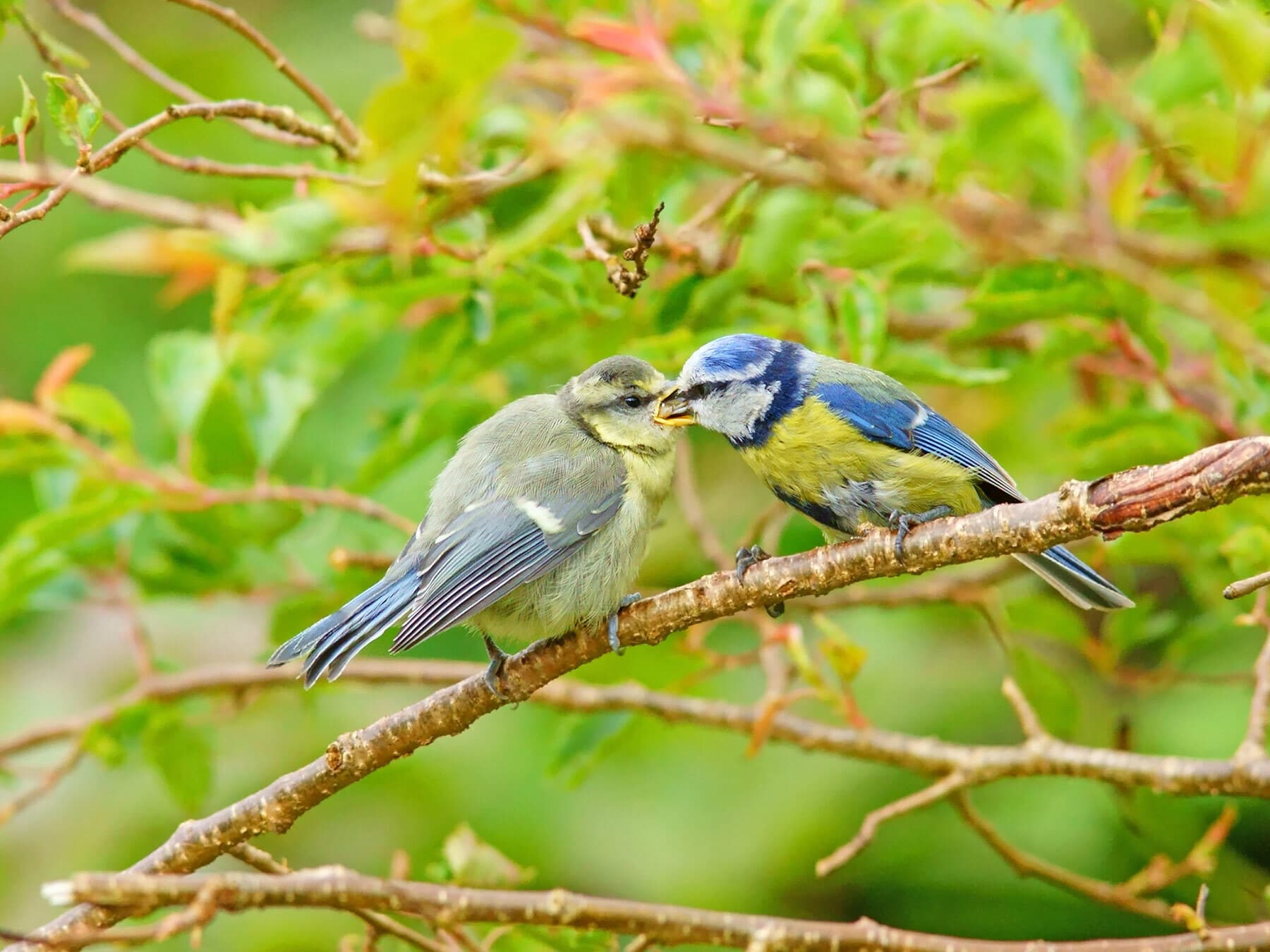
Chicks in the nest and fledglings that have just left it beg with a high, almost non-stop tsee-tsee-tsee-tsee. Most Blue Tit chicks leave the nest in early June, and their parents keep feeding them for a few weeks after, so June gardens can be full of the sound.7
Blue Tit or Great Tit song?
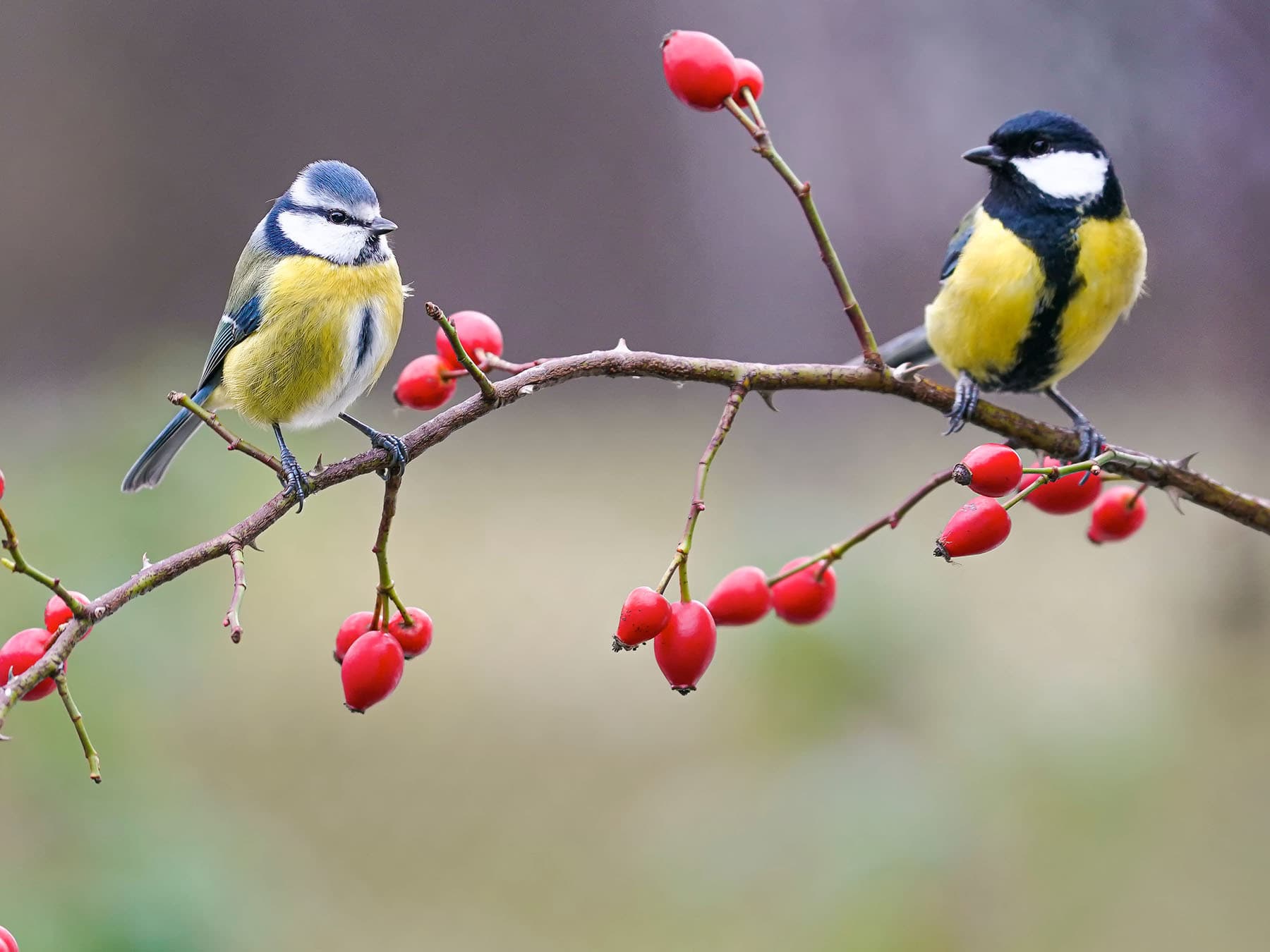
The Great Tit often feeds alongside Blue Tits, and people often ask how to tell the two apart by ear. The Great Tit's song is the familiar tea-cher, tea-cher: a short phrase of two or three parts, loud and sharp, said over and over.8 A Blue Tit's song is higher-pitched and runs into a trill rather than repeating a two- or three-part phrase. Listen to Great Tit song and calls, or see Blue Tit vs Great Tit for how to tell them apart by sight.
Sources
- Kirwan, G. M., Gosler, A., Clement, P., Christie, D. A., Pyle, P. (2024). Eurasian Blue Tit (Cyanistes caeruleus), version 1.1. Birds of the World (J. del Hoyo, A. Elliott, J. Sargatal, D. A. Christie, E. de Juana and M. G. Smith, editors). Cornell Lab of Ornithology. doi:10.2173/bow.blutit.01.1
- RSPB. Blue tit. RSPB Birds A-Z. Accessed 7 October 2026. Source
- Sierro, J., de Kort, S. R., Riebel, K., Hartley, I. R. (2022). Female blue tits sing frequently: a sex comparison of occurrence, context, and structure of song. Behavioral Ecology 33(5): 912-925. doi:10.1093/beheco/arac044
- Kempenaers, B., Borgström, P., Loës, P., Schlicht, E., Valcu, M. (2010). Artificial night lighting affects dawn song, extra-pair siring success, and lay date in songbirds. Current Biology 20(19): 1735-1739. doi:10.1016/j.cub.2010.08.028
- van Iersel, R., Boiten, G., Pinxten, R., Eens, M. (2023). Untangling behaviours: independent expressions of female-female aggression and snake-like hissing in the blue tit (Cyanistes caeruleus). Scientific Reports 13: 16346. doi:10.1038/s41598-023-43652-3
- Zub, K., Czeszczewik, D., Ruczyński, I., Kapusta, A., Walankiewicz, W. (2017). Silence is not golden: the hissing calls of tits affect the behaviour of a nest predator. Behavioral Ecology and Sociobiology 71: 79. doi:10.1007/s00265-017-2313-5
- McCambridge, H.. A Blue Tit Diary. BTO Masterclass articles. Accessed 7 October 2026. Source
- Kirwan, G. M., Sly, N. D., Gosler, A., Clement, P., Christie, D. A., Moura, N., Pyle, P. (2024). Great Tit (Parus major), version 2.0. Birds of the World (G. M. Kirwan and N. D. Sly, editors). Cornell Lab of Ornithology. doi:10.2173/bow.gretit1.02