Facts · Updated 8 Oct 2026
Blue Tit Nesting: When They Nest, Eggs, Chicks and Boxes
By the Birdfact teamChecked by Nathan Cope
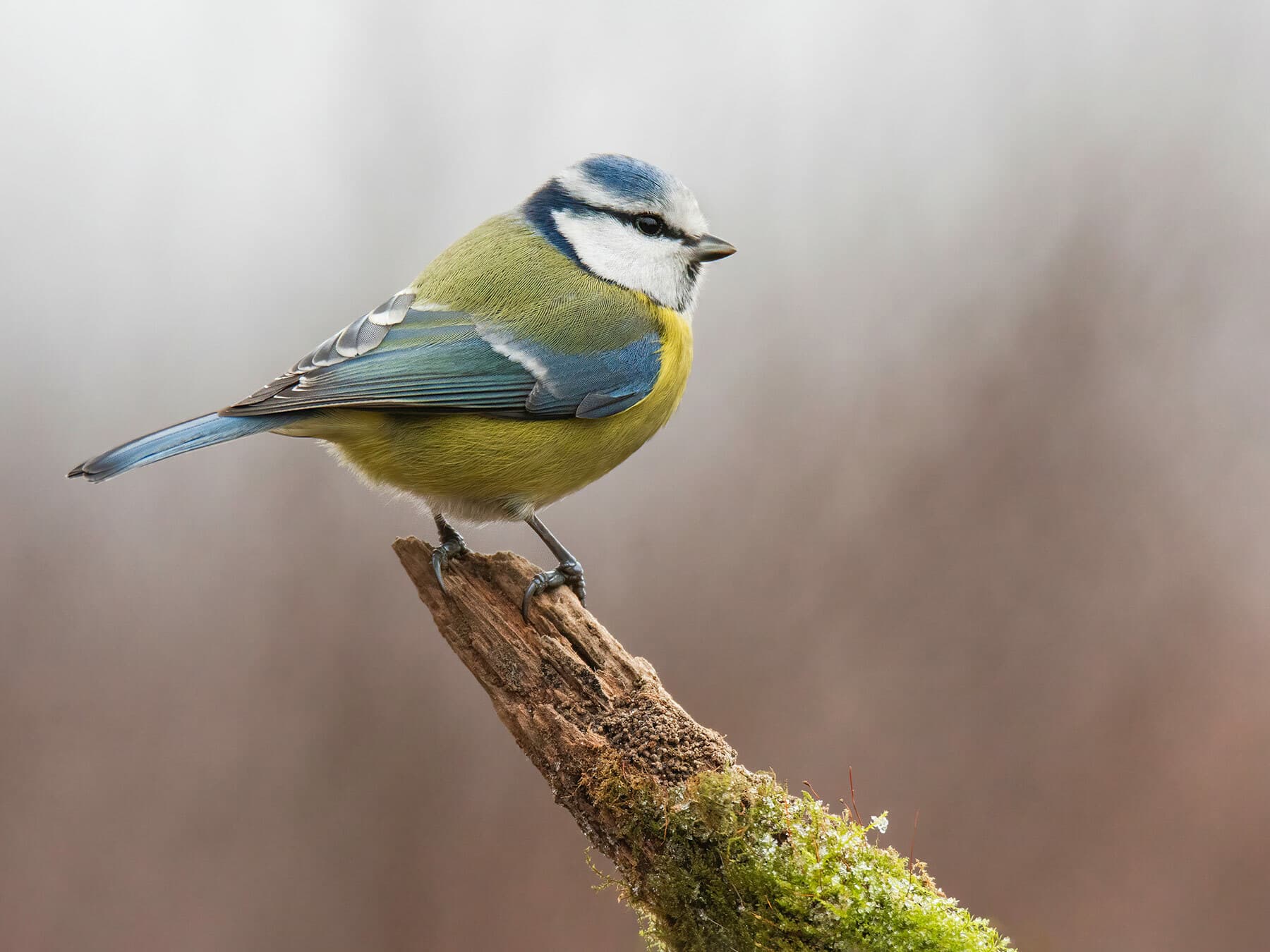
Blue Tits choose a hole in February, the female builds in April and lays 8 to 10 eggs from late April, and the chicks fly at 18 to 21 days, usually in early June.
On this page12 sections
This page follows a Blue Tit nest from the first visits to a hole in February to the fledglings in June: when and where they nest, the nest itself, eggs, incubation, chicks, fledging, and the nest box they will use. For the bird in general, see Blue Tit identification and facts.
When do Blue Tits nest?
Pairs hold a territory by early February and start looking at holes that month.1 The female builds in April, and in Britain the first eggs are laid on 26 April on average, with the BTO's range running from 12 April to 11 May.2 Most chicks hatch towards the end of May and leave the nest in early June.3
The timing follows the caterpillars. Laying date, clutch size and success are all tied to when the spring caterpillars appear and how many there are. Blue Tits now breed earlier than they did, but not as fast as the caterpillar peak has moved.
How long do Blue Tits nest for?
From the first egg to fledging takes about six weeks: a week or more of laying (one egg a day), 13 to 14 days of incubation, and 18 to 21 days in the nest for the chicks. Add one to two weeks of building before that, and a few weeks of feeding the fledglings after.
Nest sites
They nest in holes: in trees, in clefts, in posts (even metal signposts) and in walls, and very often in nest boxes. Occasionally they use another bird's old nest, and rarely a hole in the ground. They sometimes clear rotten wood out of a hole.
The site matters: they want a clear flight path to the entrance and a hole predators find hard to reach. Tits are often seen hammering at a box's entrance hole, probably as a display by the male, and Blue Tits also hammer inside the box.4
The nest
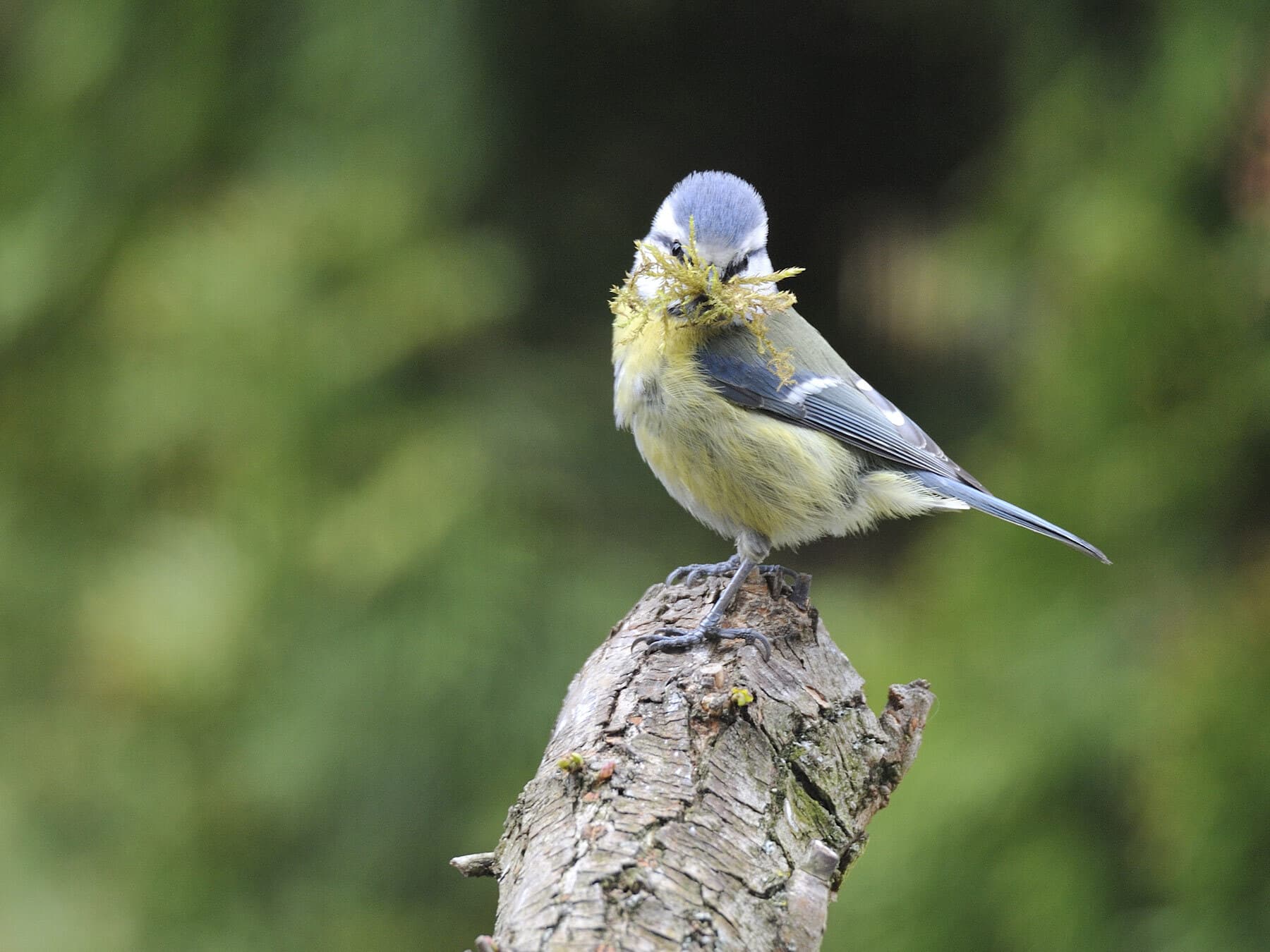
The female builds it alone. It is a cup of moss, dry grass, fine strips of bark, plant fibres and leaves, lined with animal hair and feathers. She can finish in a few days, but it usually takes her one to two weeks; moss from garden lawns is one of her materials.
Eggs
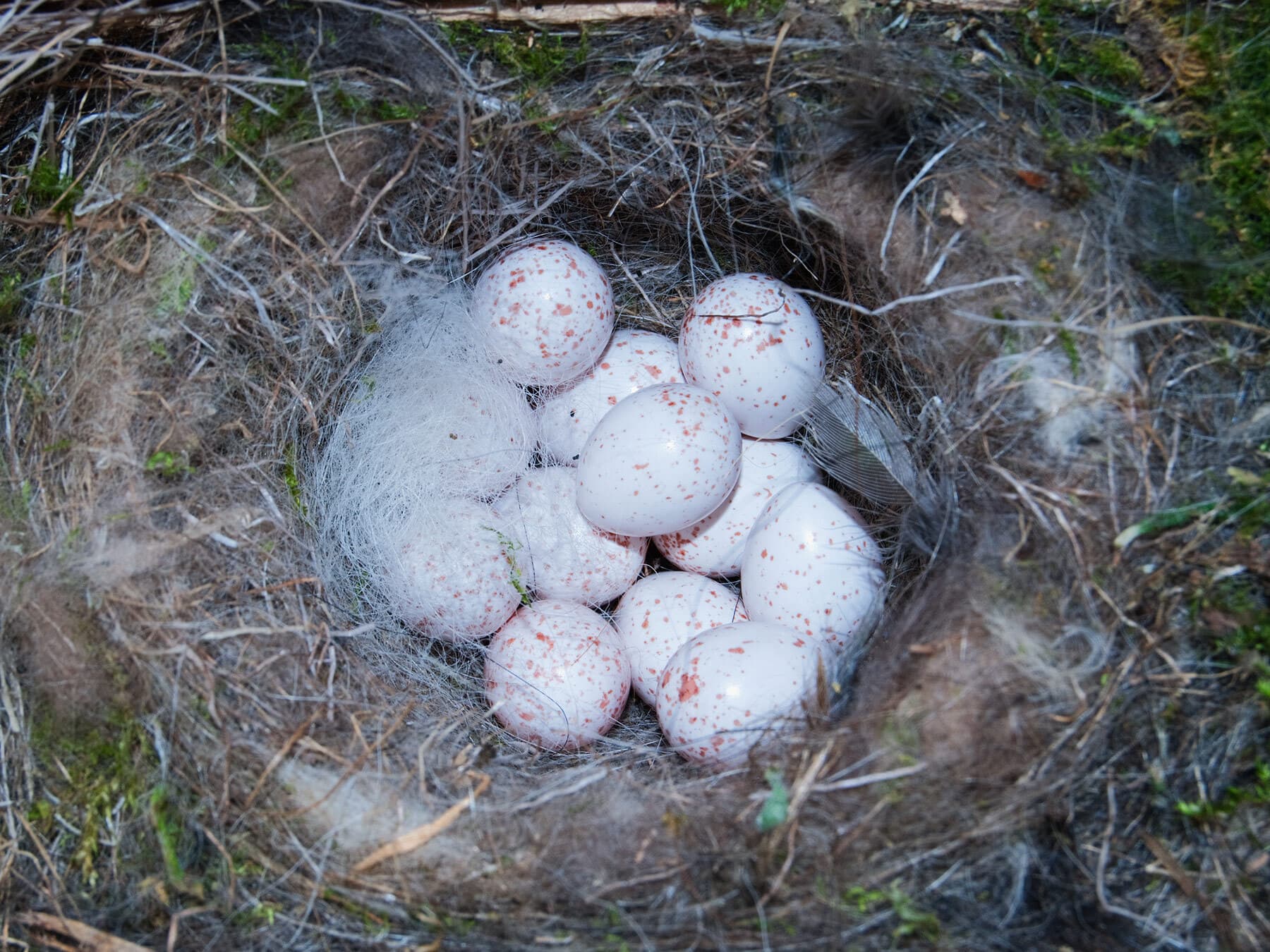
Blue Tits lay one of the largest clutches of any bird. In Britain a clutch is typically 8 to 10 eggs, and the BTO's nest records run from 2 to 16.2 Clutches of more than 18 are usually the work of two females laying in one nest.
The female lays one egg a day, usually first thing in the morning. The eggs are white with fine reddish-brown spots, mostly at the broad end, and a few are unmarked. Each is about 16 by 12 mm and weighs about 1.1 g.
Incubation
Only the female incubates, and the male brings her food. She starts about a day before the clutch is complete and sits for 13 to 14 days. She grows a bare, warm brood patch on her belly to keep the eggs warm, but still leaves the box to feed.
Chicks
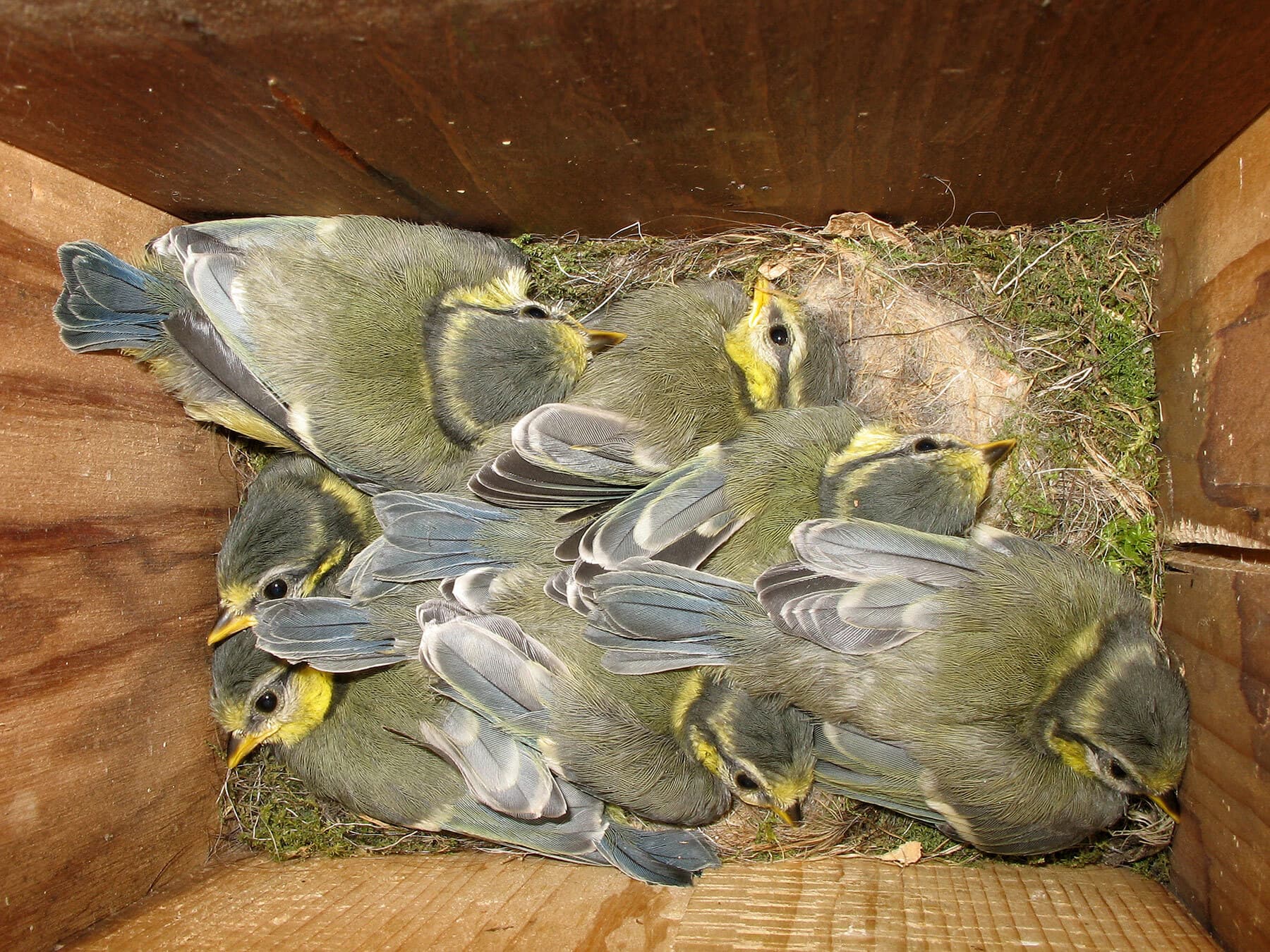
The chicks hatch blind and almost naked, with three small tufts of grey down on the head. The female broods them while both parents bring food.
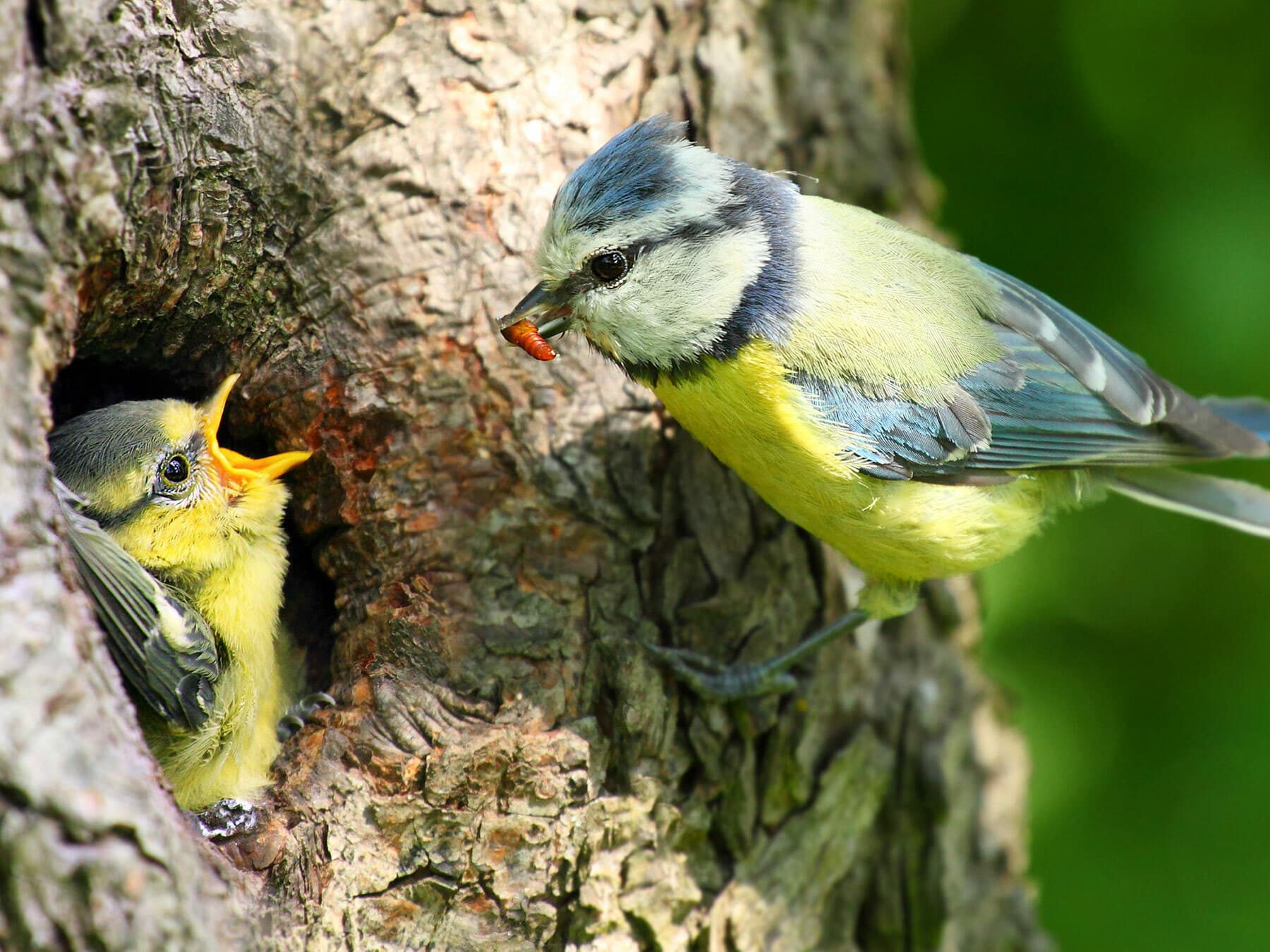
The demand is huge. By the BTO's reckoning one chick can get through 100 caterpillars in a day, and a brood of ten up to 1,000. The parents also carry the chicks' droppings out of the nest in neat sacs. In a study in a Polish primeval forest, caterpillars were about 74% of the chicks' food.5
Fledging
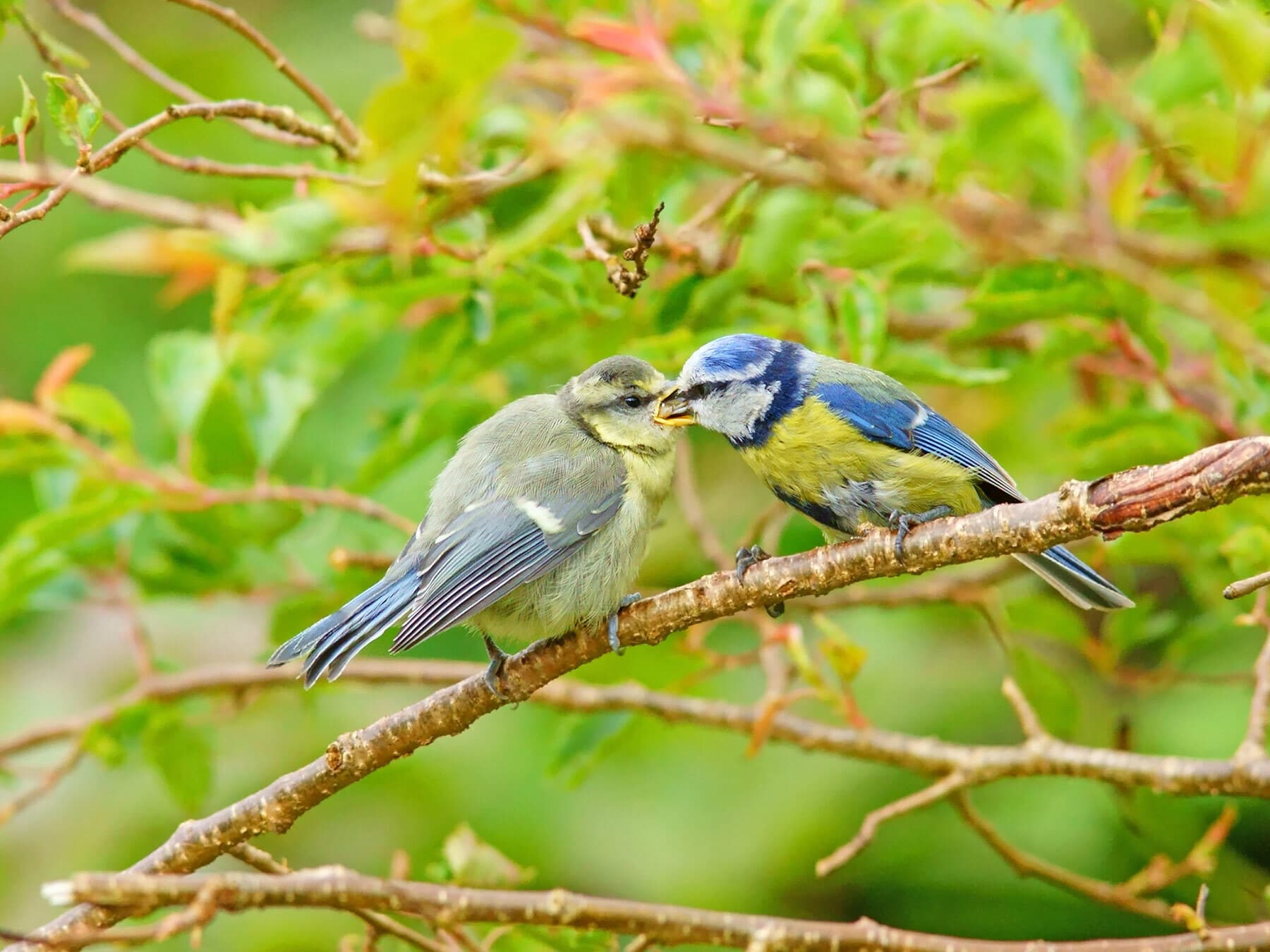
Chicks fledge at 18 to 21 days old, usually in early June in Britain.2 The parents call from outside, and the chicks come out one by one, making a first, often clumsy, flight to the nearest perch. The parents keep feeding them for a few weeks after they leave.
It is a dangerous time. About 70% of young Blue Tits die between leaving the nest and November. The young are easy to recognise: pale yellow faces and olive caps.
Broods
Most pairs in Britain raise one brood; a few try a second. Second broods are frequent in parts of Europe such as Belgium and Sweden, but rare in Britain and Germany.
Why nests fail
Nests fail for several reasons. Rain, sudden cold and food shortage kill chicks, and late-hatched young are often poorly grown. In British nest-box studies, losses were mainly to Weasels, Grey Squirrels, rodents and Great Spotted Woodpeckers, and in one Oxfordshire study Weasels cut success sharply after a few good years. Success was highest in gardens, at 86% in Britain.
Leave a nest alone if you find one. All wild birds and their active nests are protected, and old nests should only be cleared out of boxes between 1 September and 31 January.6
Nest boxes
Choose a small hole-fronted box with a 32 mm entrance hole, which suits all the small hole-nesting birds, or a 28 mm hole if you want to keep it for Blue Tits. Walls should be at least 15 mm thick, and roomy is better: in a cramped box, birds may lay smaller clutches. Leave off the perch.7
Fix it 1 to 3 m up a tree trunk, with a clear flight path to the hole, sheltered from the prevailing wind, rain and strong sun. Pairs start looking in the second half of February, and some birds roost in boxes in winter, so autumn is a good time to put one up.
Sources
- Kirwan, G. M., Gosler, A., Clement, P., Christie, D. A., Pyle, P. (2024). Eurasian Blue Tit (Cyanistes caeruleus), version 1.1. Birds of the World (J. del Hoyo, A. Elliott, J. Sargatal, D. A. Christie, E. de Juana and M. G. Smith, editors). Cornell Lab of Ornithology. doi:10.2173/bow.blutit.01.1
- BTO. Blue Tit (Cyanistes caeruleus). BTO BirdFacts. Accessed 7 October 2026. Source
- McCambridge, H.. A Blue Tit Diary. BTO Masterclass articles. Accessed 7 October 2026. Source
- RSPB. Our ultimate guide to nestboxes. Accessed 6 October 2026. Source
- Wesołowski, T., Rowiński, P. (2014). Do Blue Tits Cyanistes caeruleus synchronize reproduction with caterpillar peaks in a primeval forest?. Bird Study 61: 231-245. doi:10.1080/00063657.2014.899307
- BTO. Putting up a nest box. Accessed 6 October 2026. Source
- BTO. Buying a nest box. Accessed 7 October 2026. Source