


Yellow-headed Blackbird
Xanthocephalus xanthocephalus
By the Birdfact teamChecked by Nathan Cope
On this page14 sections
How to recognise it
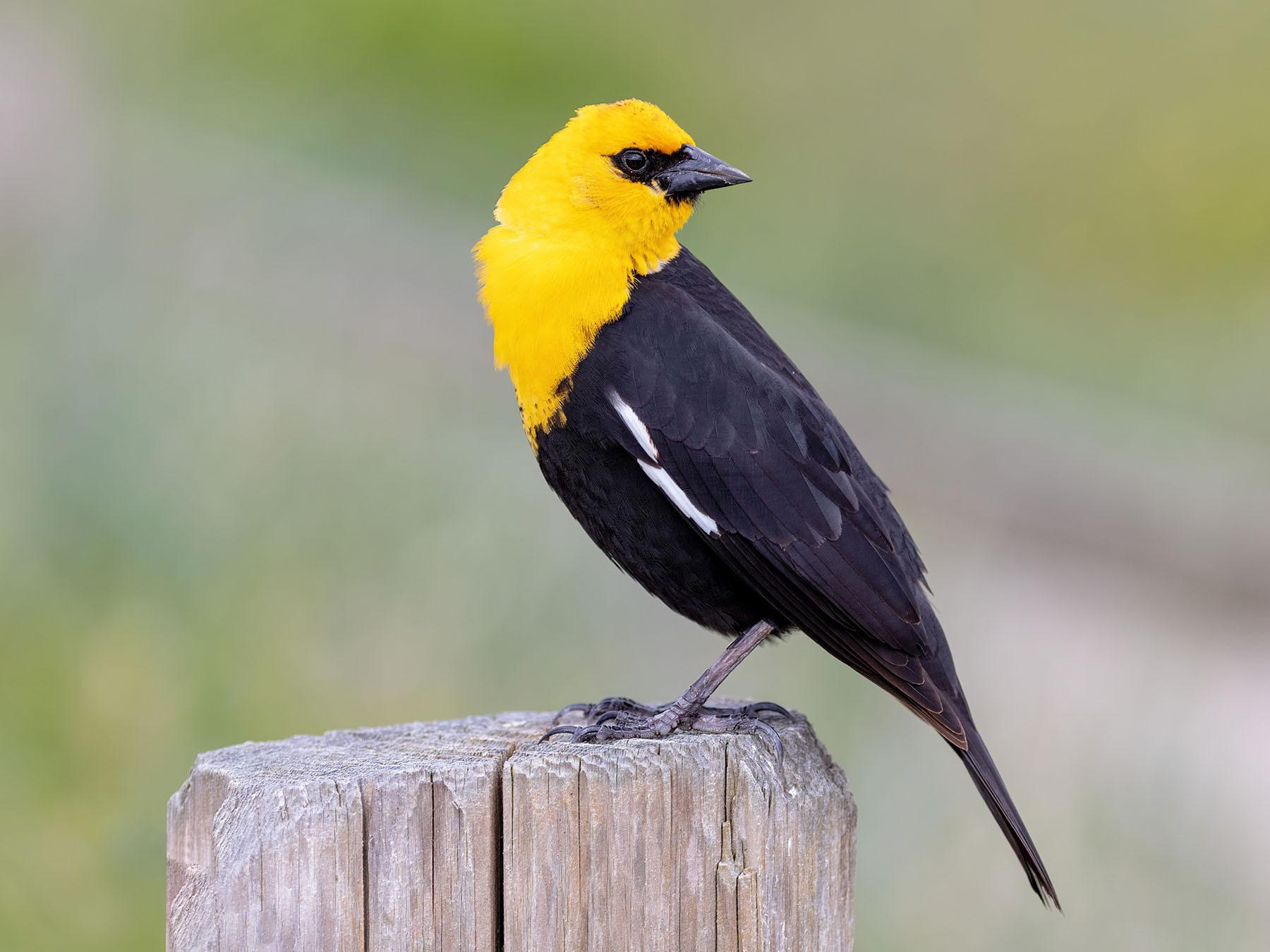
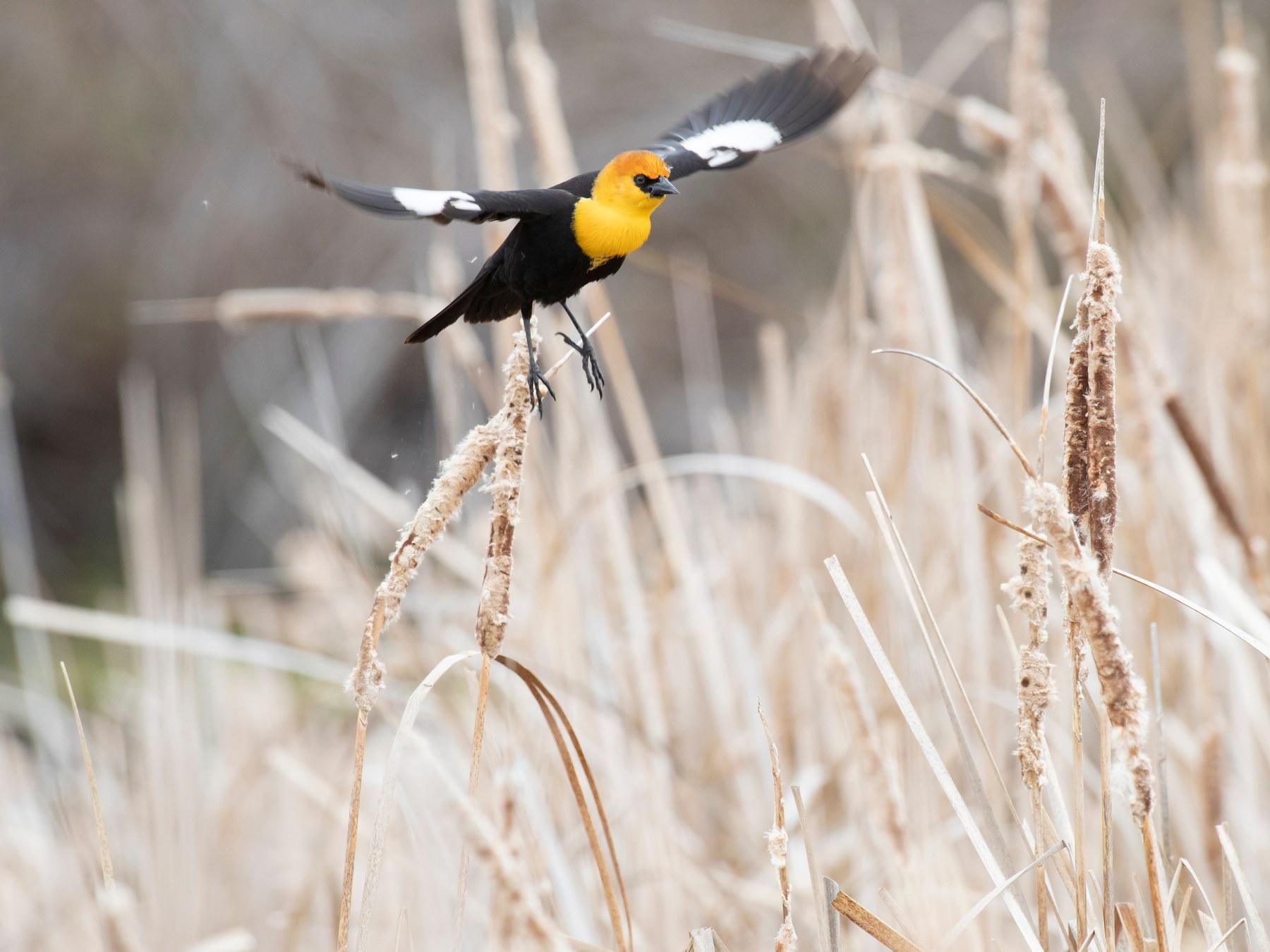
The Yellow-headed Blackbird is a robin-sized blackbird of cattail marshes in western and central North America. It is bigger than a Red-winged Blackbird and smaller than a Common Grackle, stout-bodied and big-headed, with a long, conical bill. The adult male is unmistakable: a bright yellow head, neck and upper breast on an otherwise black body, with black around the eye and a white patch on each wing, obvious in flight. The female is brown, not black, with yellow only on the throat, upper breast and eyebrow, and a young bird is a muddier brown and buff. Both sexes have a black bill and black legs.
Size and weight
Field guides give 8.3–10.2 in (21–26 cm) for length, 16.5–17.3 in (42–44 cm) for wingspan and 1.6–3.5 oz (44–100 g) for weight, covering both sexes together. The sexes differ a good deal: a male weighs about 3.5 oz (100 g) and measures about 10.4 in (265 mm), so a big male can top that range, while a female weighs under 2.1 oz (60 g) and is about 2 in (50 mm) shorter. Weights climb before fall migration: females average about 1.8 oz (51 g) at the end of June and over 2.1 oz (60 g) by the end of August, males about 3.2 oz (92 g) and over 3.5 oz (100 g). Birds are larger toward the northwest of the northern Great Plains and smaller toward the southeast.1, 2
Male, female and young birds
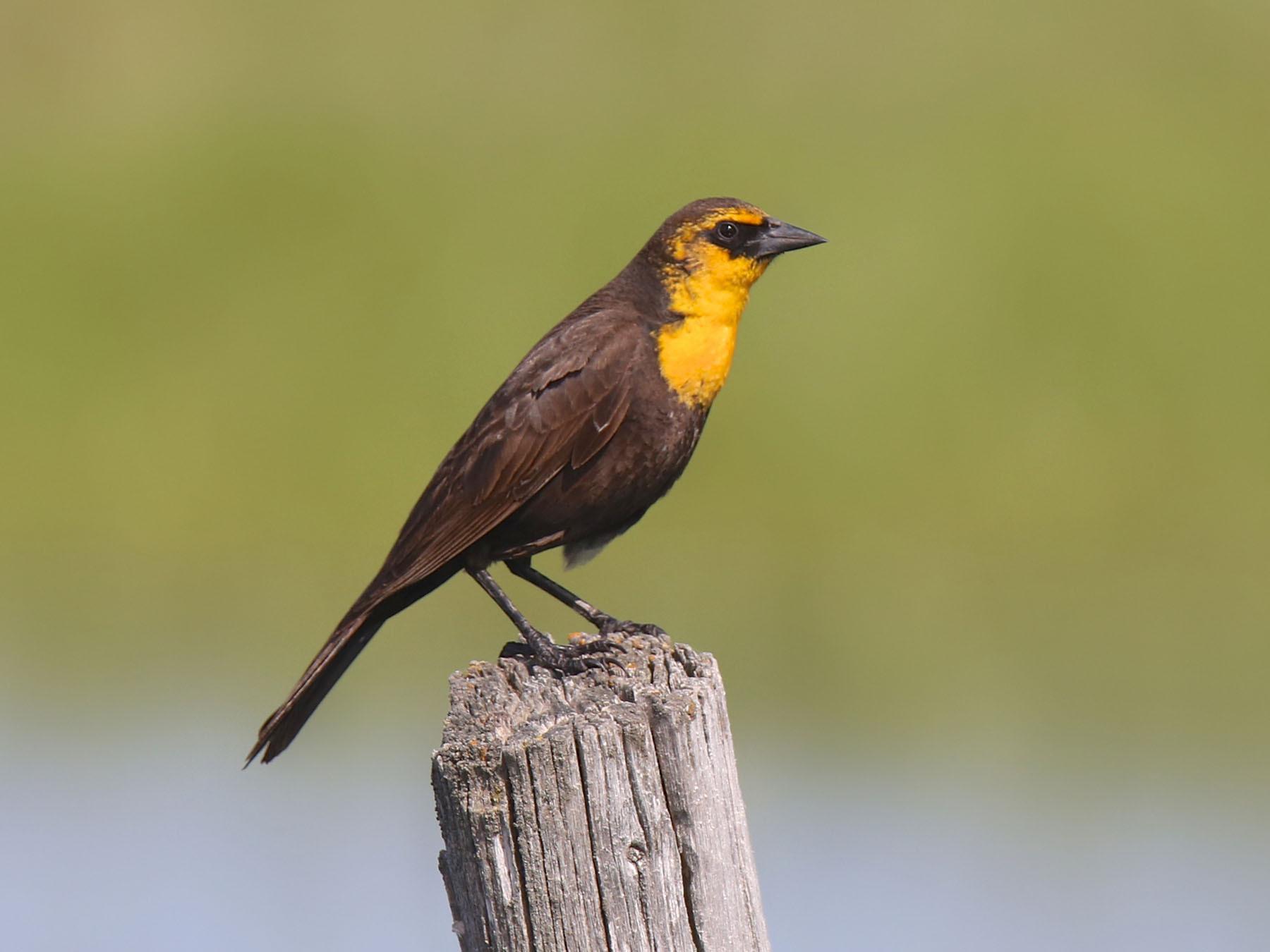
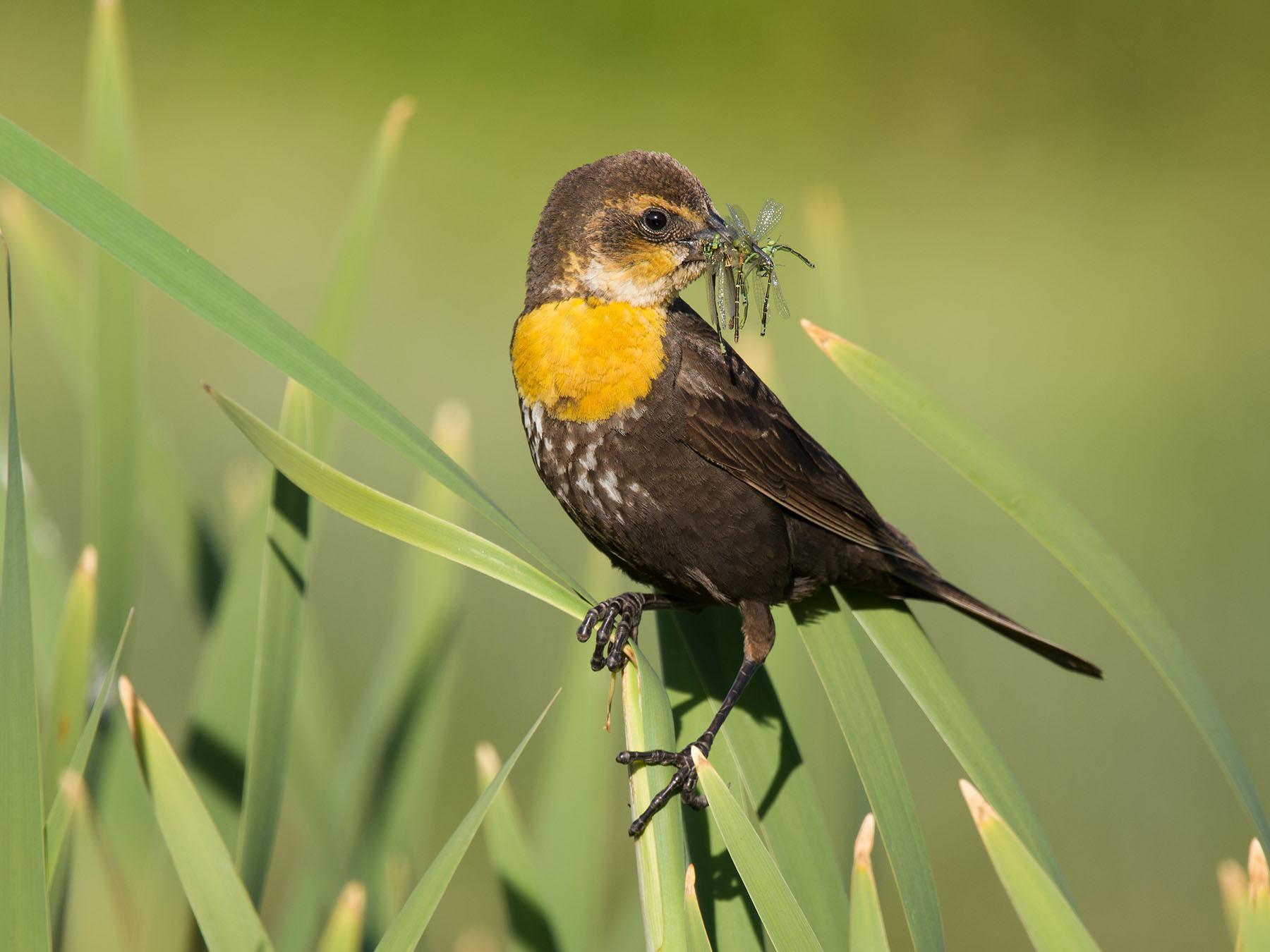
The adult female is a duller bird, brown where the male is black, with yellow restricted to the throat, upper breast and an eyebrow stripe, sometimes patchy on the face and neck. White streaks blend the yellow breast into the brown belly, and she has no white on the wing. Older females have brighter yellow than younger ones, and the clean yellow throat and breast set her apart from the females of other blackbirds in a mixed flock.
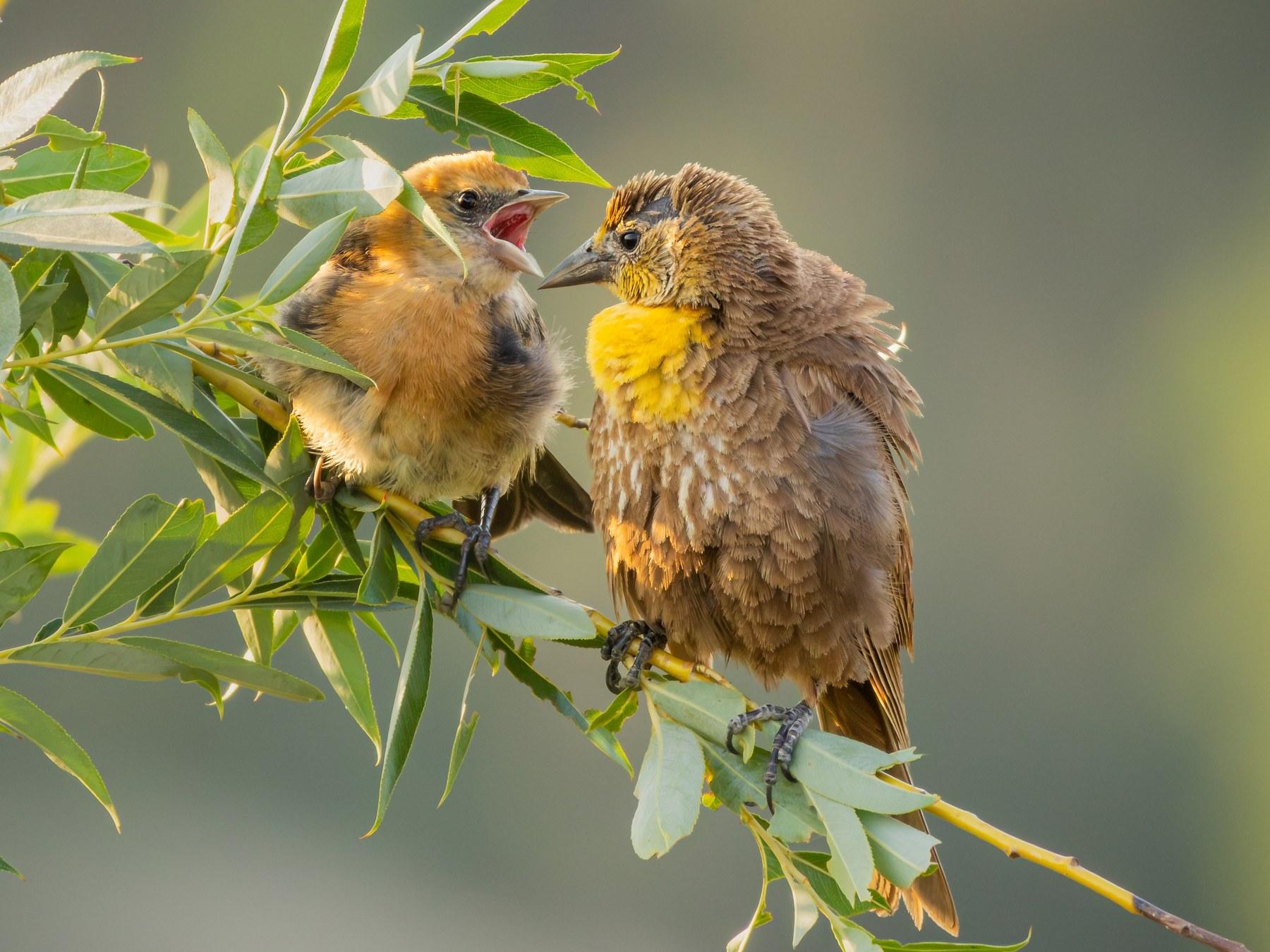
A young male in his first fall and winter looks like a muted adult. His face, chin, throat and upper breast are orange-yellow, but his crown, nape and back are rusty brown and the rest of him dark brown. He is more extensively yellow and larger than a first-year female, whose chin is cream to nearly white and whose ear patch is light buff-yellow to light brown, and he shows a little white at the wing's bend, which a female does not. First-year males do not normally hold territories or breed.
A juvenile, seen from about June to August, has a buff head and breast, often flecked with darker feathers, a paler throat and belly, a pinkish-cinnamon back and dark brown wings with two pale wing-bars; young males have lighter, tawnier backs and whiter wing-bars than young females.
Identification: telling it from lookalikes
An adult male needs little checking. In a mixed flock of blackbirds, look for the yellow head and the white wing patch before anything else. A female is the harder bird. A female Red-winged Blackbird is smaller and heavily streaked brown below with a pale eyebrow, sometimes with a peachy wash on the face, while a female Yellow-headed is bigger, with a clean yellow throat and breast and white streaks only below the yellow. A male Red-winged is black with a red-and-yellow shoulder patch, and the two share marshes and winter roosts; the Yellow-headed nests over deeper water and the Red-wings over shallower.
Not sure it’s a Yellow-headed Blackbird? Check your photo: Birdfact names the bird and shows the look-alike side by side.
Its size
Adults- Length
- 21–26 cm
- Wingspan
- 42–44 cm
- Weight
- 44–100 g
Its song and calls
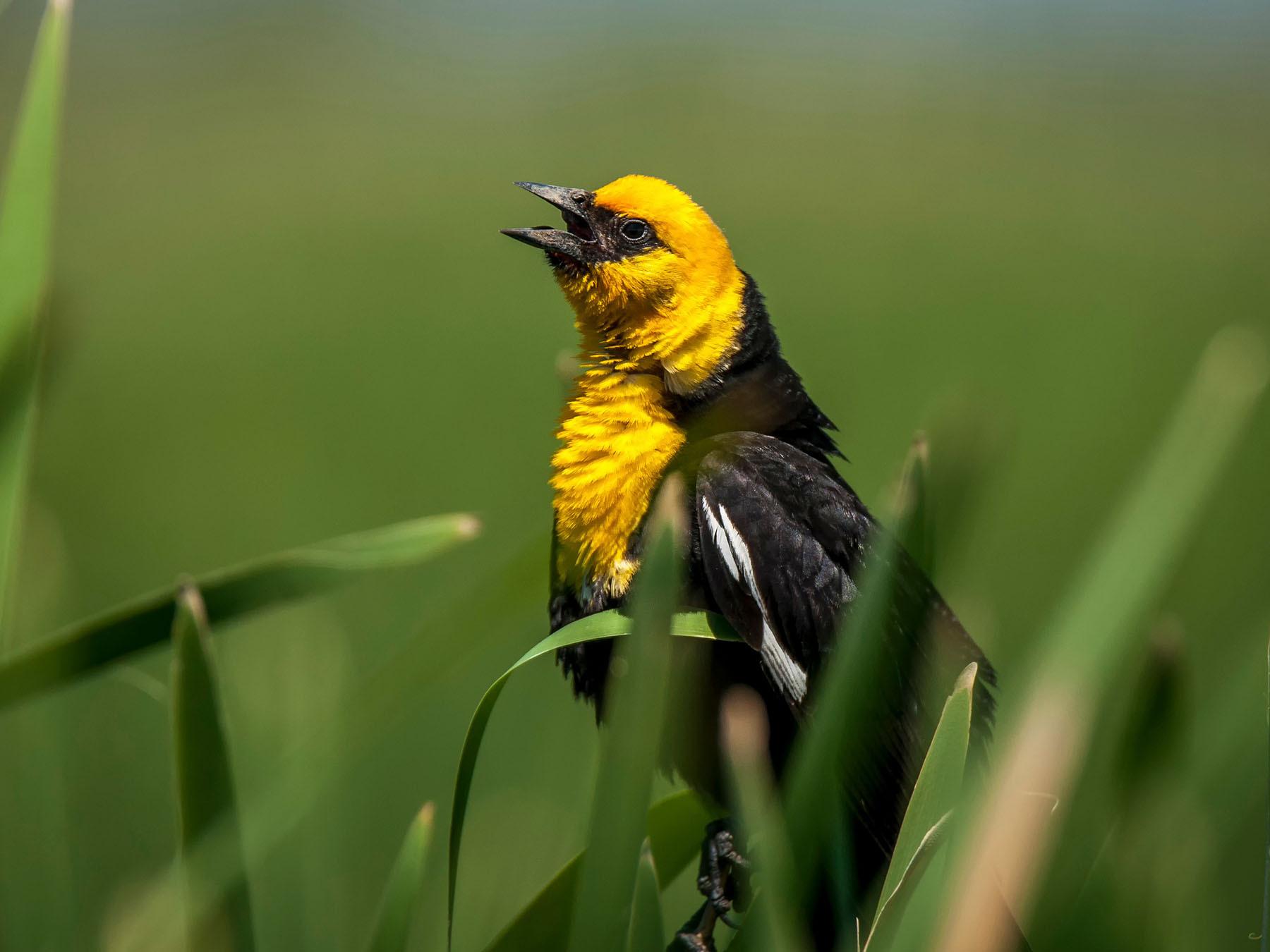
A male has two songs. The accenting song is the musical one, about 1.5 seconds long, with several fluid introductory notes and sometimes a trill, and it is aimed at distant birds. The buzzing song is longer, about 4 seconds, and more nasal: separate introductory notes, then a very long trill that ends as a harsh, grinding buzz, given to birds close by.2 A study of the structure of the two found that accenting songs should carry farther through marsh, and when songs or models of a male or a female were put on territories, males answered with more buzzing songs.3 Each male seems to sing both, almost always while perched on a cattail stem, a fence or a shrub, mostly in the morning and evening.
The player on this page has the song of a male recorded in Manitoba: a few separate notes and then a buzz. Singing peaks during laying and incubation, drops after the eggs hatch and is uncommon after mid-July; song in winter has not been described.
A female does not sing in this musical sense but gives a rapid, harsh, nasal chatter in aggression and when she leaves the nest. The commonest call of the breeding season is a loud "check", given in flight, while feeding and when males enter or leave a territory, and a softer "chuck" is heard more in fall and probably keeps flocks together. A male also gives a low, buzzy growl in chases and disputes and a harsh rattle when he mobs a hawk.
- Song0:00 / 0:03
Recorded in Manitoba, Canada · June 2021
Heard one and not sure? Let the bird song identifier listen.
When and where to see it
November
Mostly absent
The year across North America
Choose a place on the map to see its year, or find yours.
Most recorded in November
Up to 0.88% of a place’s bird records that monthHere in other months
How this map is made
Each county, state or province is shaded by the Yellow-headed Blackbird’s share of all the bird records there that month: the darker, the larger the share. A place with only a trace of records in a month is left unshaded. Shades compare places on this map with each other, not one bird with another. Records: GBIF eBird Observation Dataset, 2019–2024. Map: Natural Earth; place centres © OpenStreetMap contributors.
How often the Yellow-headed Blackbird turns up in the United States and Canada through the year, from birdwatchers' records.
United States
Summer visitor · all year · most records in June
Canada
Summer visitor · regularly Apr–Sep · most records in June
Show as a table
| Month | United States | Canada |
|---|---|---|
| January | 0.014% (regular) | 0.008% |
| February | 0.013% (regular) | 0.003% |
| March | 0.020% (regular) | 0.004% |
| April | 0.083% (regular) | 0.064% (regular) |
| May | 0.10% (regular) | 0.16% (regular) |
| June | 0.11% (regular) | 0.19% (regular) |
| July | 0.076% (regular) | 0.12% (regular) |
| August | 0.068% (regular) | 0.067% (regular) |
| September | 0.054% (regular) | 0.023% (regular) |
| October | 0.020% (regular) | 0.004% |
| November | 0.012% (regular) | 0.001% |
| December | 0.011% (regular) | 0.004% |
Worldwide: recorded regularly in 3 countries
Countries where it was recorded in at least 3 of the 6 years 2019–2024. Linked countries have their own bird list.
North America (3)
Data: EOD – eBird Observation Dataset (Cornell Lab of Ornithology), accessed via GBIF.org, CC BY 4.0. Records from 2019–2024, aggregated and filtered by Birdfact. How these lists are made
It breeds in deep marshes and potholes from central British Columbia and the Prairie Provinces south to northern New Mexico and Arizona, east to Minnesota, Wisconsin and northern Illinois, and west to southern California, though in Oregon and Washington it is mostly east of the Cascades. Its core is the prairie-pothole country of the northern Great Plains, and the supply of emergent wetland limits it. Small isolated populations breed at the eastern edge in northwestern Indiana and central Michigan, and in Texas it breeds in the northwest and winters in the west and extreme south.2
Look for it over marshes with tall, dense cattails or bulrushes, where males sing from the stem tops and perch on fences. After breeding it feeds in fields and pastures, sometimes 6 mi (10 km) or more from the marsh, and returns to wetland vegetation to roost at dusk. In winter, scan flocks of blackbirds in plowed fields and farmyards for a yellow head or a white wing patch.
Migration and winter
It is a migrant that leaves early. Most birds go in late August and early September as their molt ends, and in North Dakota they left in mid-September.2, 4 In spring males arrive first and females follow 7–14 days later: the first males reached Wisconsin between 11 and 23 April and the first females between 4 and 7 May, and in North Dakota the first adult males were noted on 6 May and the first adult females on 13 May. Second-year birds follow the adults, the males again about a week ahead of the females. In California, migrating flocks were nearly all adult males, or females with immature males.
It winters from the southwestern states through Mexico, in flocks that can reach several thousand, mostly in plowed and harvested fields and farmyards, roosting in wetland vegetation, often alongside Red-winged Blackbirds, Brewer's Blackbirds, Common Grackles and cowbirds. Flocks are often mostly one sex: in one study, males made up most of the wintering birds in Arizona, at the north of the winter range, while about 80% of those in Jalisco and Nayarit, farther south, were females.2 A few are reported in winter in California and northeastern Utah, and a few along the east coast from Massachusetts to Florida, where individuals are often found at feeders. By the early 1990s it was a rare but regular fall migrant in the east and increasingly seen in spring, and in Florida, with fewer than 15 records before the mid-1960s, it had been recorded in every month but July.
Range outside North America
It has strayed to Cuba, Barbados and Bermuda, and Birds of the World lists records in Iceland, Denmark, France, Norway and Sweden, and says birds have been seen in Britain.2 In Britain the British Ornithologists' Union lists it in Categories D and E, and it is not on the British List itself: Category D is a holding category for species where there is doubt that they arrived unaided, and Category E covers escapes and introductions, so a Yellow-headed Blackbird seen there is treated as a possible escape from captivity.5 Elsewhere in Europe, a male stayed on Texel in the Netherlands in May and June 1982 and was accepted as a genuine vagrant only after a review in 2007, and a male was collected in Iceland in July 1983, the first Icelandic record.6
Tips for seeing it
What it eats
In the breeding season it is an insect-eater that specializes in aquatic prey, and it feeds its young on the same. In Washington and British Columbia it forages mostly at the water surface while damselflies and dragonflies are emerging; in Washington, emerging damselflies and dragonflies were 60–90% of the food of young, and in a year of poor emergence nestlings starved and broods were reduced to two or three.2 Where aquatic insects are scarce, territories shrink and birds feed in uplands such as alfalfa fields.
After breeding it turns to cultivated grain and weed seeds, preferring ripening grain at the soft-dough stage and returning to the same fields day after day. Flocks "roll" across a field, the rear birds flying over those at the front. It forces its bill open to pry apart leaf sheaths and reach what is inside, a move called gaping, flips stones over, and hulls sunflower seeds.
A 1900 survey of 138 stomachs collected from April to October in ten Mississippi Valley states, California and Canada found about a third animal food and two-thirds plant food, with grain the largest item at 38.9% of the total.7 That sample is old, small and covers seven months only; the author himself called it too few for entirely reliable results. He judged that the bird does not attack fruit or garden produce and eats noxious insects and weed seed, but that where it is too abundant it is likely to harm grain.7 In north-central North Dakota, a later study of the contents of birds' esophagi found sunflower made up about half of the males' contents in spring and fall and under a fifth of the females', with females eating more weed seeds and insects.8
Blackbirds eat ripening sunflower, and the cost has been modeled. A model that pooled Yellow-headed Blackbirds with Red-winged Blackbirds and Common Grackles in the northern Great Plains put the damage a year at about $0.08 for a Yellow-headed male and $0.05 for a female, and the total for the three species at $5.4 million a year, about 1.7% of the region's 1999 sunflower crop value, with the Red-winged Blackbird responsible for 52% of it.9 North Dakota researchers who studied the species' molt reasoned that it probably does less crop damage there than the Red-winged Blackbird or the Common Grackle, because it finishes molting and leaves the state by mid-September and eats a more varied diet; that is their inference, not a measurement.4
Nesting and breeding
Males arrive first and claim territories in deeper water with sturdy emergent plants, packed close together in loose colonies. A male is polygynous, mating with generally one to six females; in a Washington study the average ranged from 1.7 to 4.2 females per territory, and the richest, dragonfly-laden marshes held more females per male.2 There is no sign that pairs form before or after the breeding season. One study found that females appeared to spread themselves at random through suitable habitat, which left the males with the largest territories holding the most mates.10 In a Manitoba study, half of 32 observed copulations were by males other than the territory owner, usually intruders while he was away.2 Second-year males do not normally hold territories, and over five years in one declining population, 30% of males that bred in two or more years skipped a year.2
The nest
The female chooses the site inside the male's territory and builds the nest alone, only over water. She carries long, wet strands in her bill and winds them around four or five upright stems of cattail, bulrush or reed, occasionally willow, weaving a base and outer wall and then an inner cup. The finished nest is a compact, open cup about 5–5.5 in (13–14 cm) across, with an inner cup about 2.6–3.0 in (6.5–7.5 cm) wide and 2.5 in (6.4 cm) deep. Water under nests has been measured from about 6 in (16 cm) deep in Wisconsin to 43 in (110 cm) in British Columbia, and in a Saskatchewan sample the nest averaged about 12 in (30.8 cm) above the water.2
Eggs and young
The eggs are grayish white to pale greenish white, thickly blotched with brown, rufous and pearl gray, and one is laid a day. A clutch is usually four eggs and can run from two to five: of 685 nests tallied, 499 held four, 144 three, 21 five, 20 two and one a single egg. A female whose nest is lost usually lays two eggs in a new nest, in a Utah study. The first egg averaged 26 May in a Manitoba sample of 351 nests and 18 May in a Washington sample of 274.2 The female alone incubates, for 12–13 days, and one brood is raised a year.
The young hatch helpless, with sparse down, and weigh about 0.13 oz (3.7 g); by 10 days a female nestling weighs about 1.1–1.4 oz (30–40 g) and a male about 1.6–1.9 oz (45–55 g).2 They leave the nest at 9–12 days, though 7–14 days have been recorded, and do not return. After leaving they hide in dead vegetation near the water until they can fly, making short flights of 3–7 ft (1–2 m) by 4–5 days out and flying up to 82 ft (25 m) by about three weeks old.2
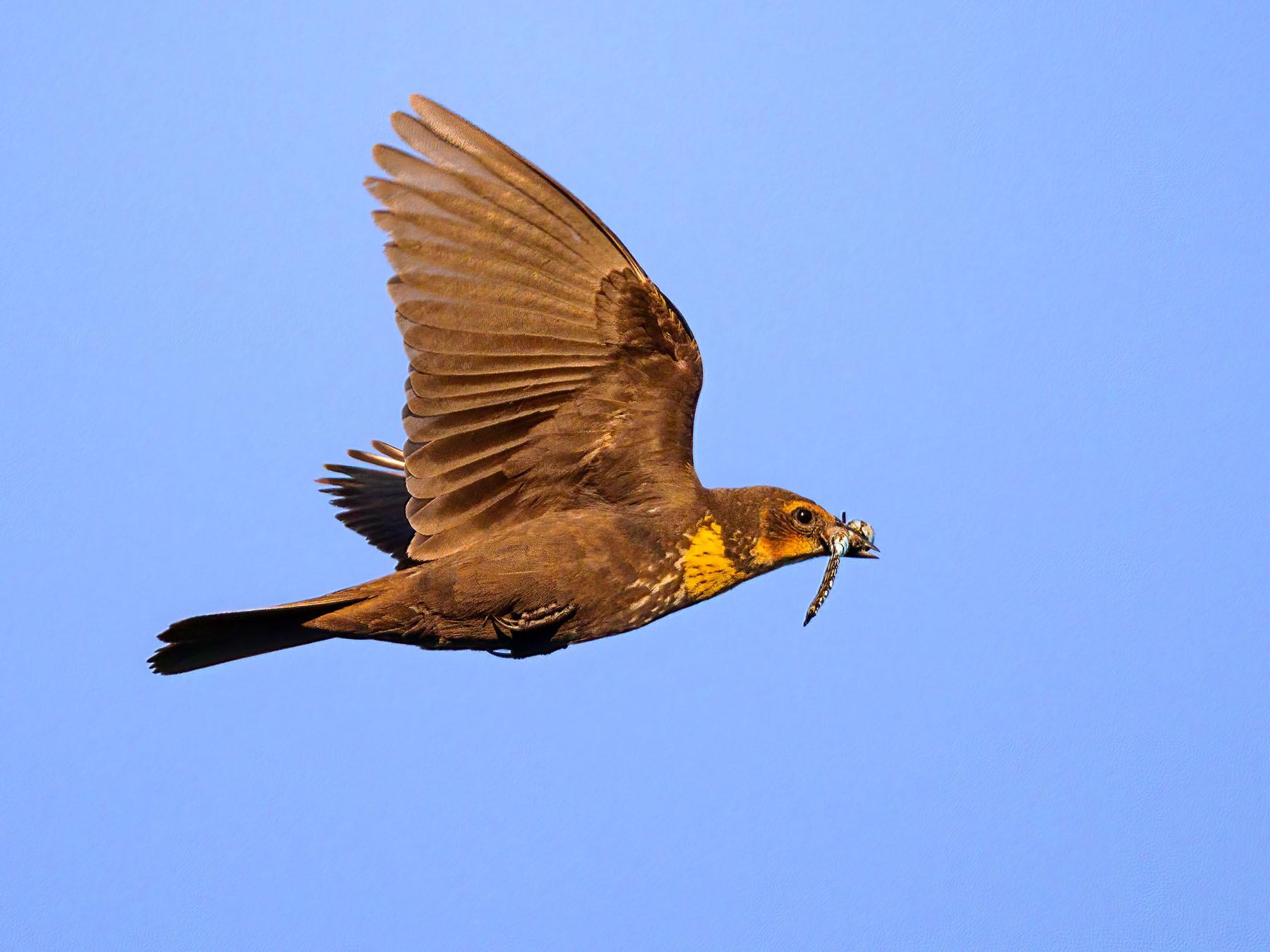
The female feeds all the young. From about day 4 males join in, nearly always at the primary female's nest, the earliest of the harem; in Manitoba, 39 males gave 12% of the feedings at their first female's nest, 4% at the second's and 1% at the third's.2 Cowbirds rarely lay in its nests. A Brown-headed Cowbird egg turned up in 2 of 266 nests in a Washington study and in 4 of 19 in Idaho, and the parasitism appears to be incidental.2
Behaviour
It is highly social, breeding in loose colonies, feeding in flocks and roosting together in wetland vegetation. A singing male spreads his wings to show the white patches, spreads and lowers his tail and raises his head. Territorial fights are mostly pecking, grabbing plumage and rolling on the ground, with face-to-face aerial scuffles using bill and feet, and serious injury is seldom seen. A calling female rouses the other females to mob an intruder, and a group of females severely attacked an American Bittern.
Arriving Yellow-headed males displace Red-winged Blackbirds from established territories, and once nesting begins the Red-wings are all but shut out of yellowhead territories; each takes the water it prefers, the Yellow-headed the deeper. Where trees or cliffs rise more than 30 degrees above the horizon, the Yellow-headed is less likely to hold territories and Red-winged Blackbirds replace it.2 Marsh Wrens are the other neighbor to watch. Wren territories expand into blackbird areas after the blackbirds leave and after nesting blackbirds are removed, which best supports the idea that the blackbirds actively keep the wrens out, and the blackbirds are strongly aggressive toward the wrens.11, 2
Lifespan and predators
The oldest on the US banding list was at least 11 years 8 months old, banded as a young bird not yet able to fly in Saskatchewan on 20 June 1983 and found dead in Nebraska in February 1995.12 The list's older table also holds a male banded in North Dakota in 1974 and shot in Mexico in 1984 at 10 years 11 months, and Birds of the World gives an earlier (1975) wild record of 9 years.12, 2 Typical lives are far shorter. In a North Dakota banding study, 58.5% of adult males and 75.3% of adult females survived a year, against 45.3% and 41.3% of immature males and females, and an adult male's average life span from banding was 1.9 years.2
Predators and dangers
Eggs and young are the weak point. In one study population, predators destroyed 51% of all nests over two years, and the Marsh Wren was the main culprit: every one of 26 photographs of predation at experimental nests showed a Marsh Wren pecking eggs.13 In Manitoba colonies, experimental nests placed nearer active blackbird nests were safer, and a wren can destroy a whole colony in a few days, which fits the idea that neighbors defend each other's nests.14 Gulls, magpies, Common Grackles, American Bitterns, coots and rails, snakes, mink, red foxes, raccoons, deer mice and skunks also take eggs and young, and weather matters too: at two Utah locations high winds, which loosened and tipped nests, accounted for 39% and 22% of nestling deaths.2
Adults are taken by Great Horned and Barn Owls at night roosts, and Northern Harriers harass colonies; in an Iowa study, 27 of 228 Great Horned Owl pellets held the species.2
Conservation
The IUCN Red List (2025) rates the Yellow-headed Blackbird Least Concern, and NatureServe ranks it G5 globally; Partners in Flight puts the population at about 11 million birds around 2010 and does not put it on its Watch List.15, 16, 17 Older North Dakota surveys show how far numbers swing with water: about 204,000 pairs in 1967, about 962,000 in 1981–82 and about 391,000 in 1990, a drought year, significantly fewer than in 1981–82 but no different from 1967.2
The Breeding Bird Survey shows no clear long-term change: +0.26% a year from 1966 to 2025, with a 95% credible interval from −0.42 to +0.89, which spans zero, across 1,172 routes and with the survey's top credibility rating. Its index peaked in 1986 at about 34 birds a route and stood at about 19 in 2025, a little above its 1966 level of about 17.18 The 2015–2025 window shows a fall of 2.70% a year (−4.77 to −0.60), the only window that excludes zero, and it starts from a local high: the index was 25.49 in 2015.18 Regions differ: Minnesota's long-term trend is −3.20% a year (−4.63 to −1.74), Alberta's 2005–2025 trend is a rise from its series low in 2005, +2.63 (+0.70 to +4.66), and North Dakota's 2015–2025 trend is −3.65 (−7.33 to −0.10).18
Birds of the World's account, written in 1995, calls wetland drainage a significant threat but judged that continental numbers appeared to be in no danger while wetland habitat stayed intact, partly because the bird uses deeper, larger wetlands; the Illinois Department of Natural Resources names drainage and development as one reason for its state listing.2, 19 A modeling study of 31 species in the US Prairie Pothole Region projected an average loss of occurrence of about 25% for this bird by the 2040s under two climate scenarios, against about 45% across all the species; it is a projection, not an observed decline.20
Legal status
The Yellow-headed Blackbird is on the federal list of species covered by the Migratory Bird Treaty Act, so it is unlawful to take, possess, transport, sell or buy the bird, its parts, nests or eggs except under a permit or as the regulations allow.21, 22 Someone who finds a sick, injured or orphaned bird can take it straight to a permitted rehabilitator or a licensed veterinarian without a permit.23 Along with Red-winged and Brewer's Blackbirds, grackles, cowbirds, crows and the Black-billed Magpie, it is named in a federal depredation order, which allows control without a federal permit in set circumstances but sets conditions of its own: nonlethal methods must be tried first each calendar year, an annual report is required and state law still applies.24 The US Fish and Wildlife Service's species database carries it as a "Species of Concern" in the category "Not Listed", so it is not listed under the Endangered Species Act.25 States differ: Illinois lists it as endangered, Indiana lists it among its endangered birds, and Wisconsin lists it as a Special Concern species.19, 26, 27 Canada's migratory bird list leaves out icterid blackbirds, though other law may apply.28
Names and history
Charles Lucien Bonaparte named the bird Icterus xanthocephalus in a paper read in Philadelphia on 28 February 1826, from the "Yellow-headed Troopial" brought back by Major Long's expedition. He had first taken it for the South American Icterus icterocephalus and gave it a name of its own after seeing the real one.29 The genus Xanthocephalus followed in 1850, has no other member, and its name means "yellow head"; Bent's 1958 account shortens the bird's name to "Yellowheads".30, 2, 31
Similar birds
Often mistaken for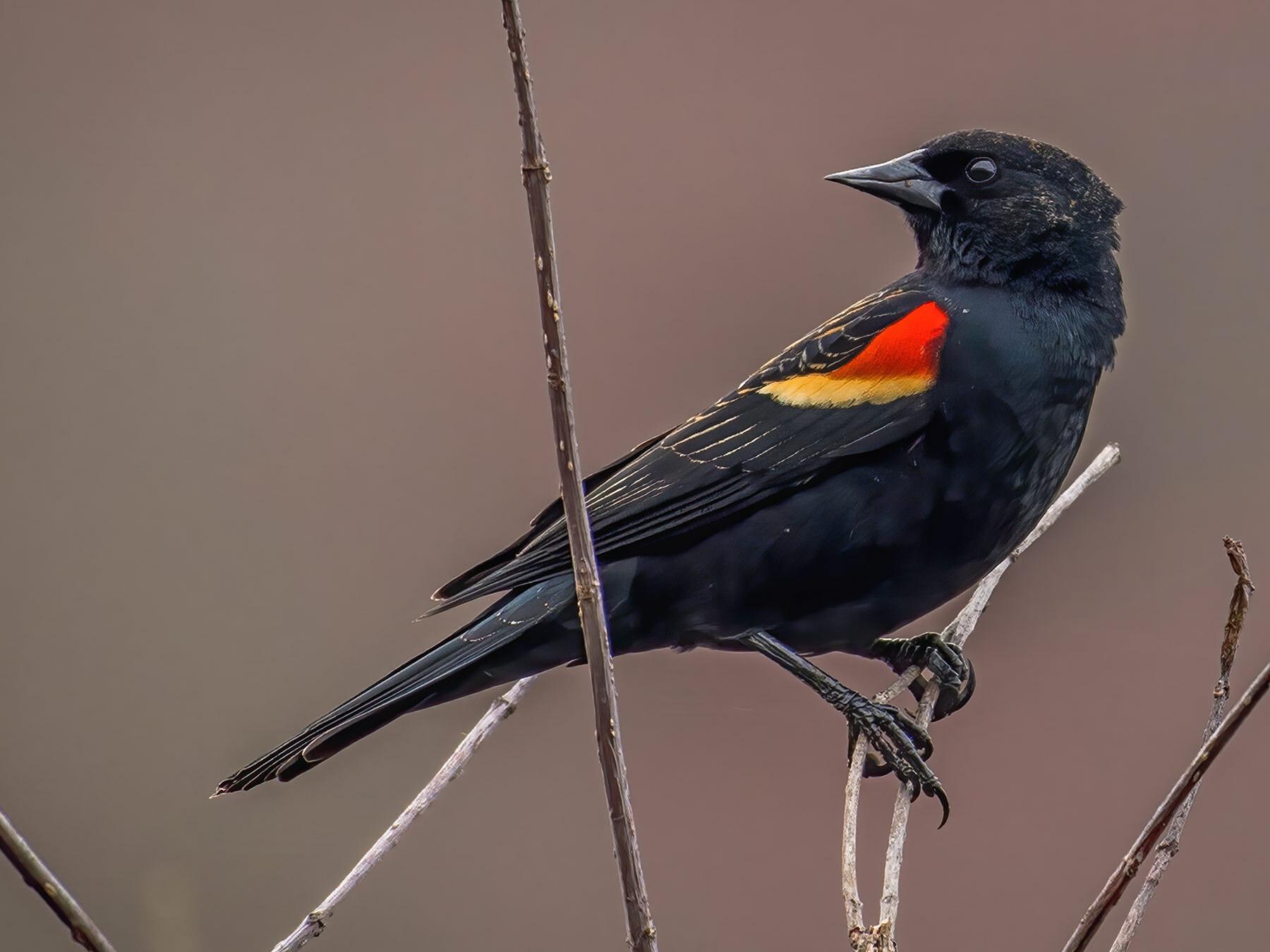
Quick facts
- Length
- 21–26 cm
- Wingspan
- 42–44 cm
- Weight
- 44–100 g
- Lifespan
- oldest recorded 11 years 8 months
- Family
- New World Blackbirds
- Migration
- Full migrant
- Global status (IUCN)
- Least Concern
- World population
- About 11 million (Partners in Flight, around 2010)
- Population trend
- No clear change in Breeding Bird Survey counts since 1966; the index peaked in 1986, and 2015-2025 shows a fall from a local high
- Scientific name
- Xanthocephalus xanthocephalus
Questions
2Why does the Yellow-headed Blackbird nest over water?
Is it closely related to the Red-winged Blackbird?
No. Despite sharing marshes, it is not a close cousin. A proposal to the American Ornithological Society, drawing on a DNA study of the whole blackbird family, says the Yellow-headed Blackbird is an old lineage that is sister to all the other icterids, the family that also holds orioles, meadowlarks and cowbirds.32
Sources
37- 1Cornell Lab of Ornithology. Yellow-headed Blackbird. All About Birds. Accessed 17 November 2026. Source (opens in a new tab)
- 2Twedt, D. J. and Crawford, R. D. (2020). Yellow-headed Blackbird (Xanthocephalus xanthocephalus), version 1.0. Birds of the World (A. F. Poole and F. B. Gill, editors). Cornell Lab of Ornithology. doi:10.2173/bow.yehbla.01 (opens in a new tab)
- 3Cosens, S. E. and Falls, J. B. (1984). Structure and use of song in the Yellow-headed Blackbird. Zeitschrift fur Tierpsychologie 66(3): 227-241. doi:10.1111/j.1439-0310.1984.tb01366.x (opens in a new tab)
- 4Twedt, D. J. and Linz, G. M. (2015). Flight feather molt in Yellow-headed Blackbirds in North Dakota. The Wilson Journal of Ornithology 127(4): 622-629. doi:10.1676/14-138.1 (opens in a new tab)
- 5British Ornithologists' Union (2025). The British List: Category D and Category E species (updated 30 November 2025). British Ornithologists' Union, Records Committee. Accessed 17 November 2026. Source (opens in a new tab)
- 6Hobbs, J. (2025). A List of Nearctic Passerines Recorded in the Western Palearctic, version 5.0. Published January 2025 (PDF from the Dutch Birding website). Accessed 17 November 2026.
- 7Beal, F. E. L. (1900). Food of the Bobolink, Blackbirds, and Grackles: the Yellow-headed Blackbird. U.S. Department of Agriculture, Division of Biological Survey, Bulletin 13. doi:10.5962/bhl.title.62939 (opens in a new tab)
- 8Twedt, D. J., Bleier, W. J. and Linz, G. M. (1991). Geographic and temporal variation in the diet of Yellow-headed Blackbirds. The Condor 93(4): 975-986. doi:10.2307/3247732 (opens in a new tab)
- 9Peer, B. D., Homan, H. J., Linz, G. M. and Bleier, W. J. (2003). Impact of blackbird damage to sunflower: bioenergetic and economic models. Ecological Applications 13(1): 248-256. doi:10.1890/1051-0761(2003)013[0248:iobdts]2.0.co;2 (opens in a new tab)
- 10Lightbody, J. P. and Weatherhead, P. J. (1988). Female settling patterns and polygyny: tests of a neutral-mate-choice hypothesis. The American Naturalist 132(1): 20-33. doi:10.1086/284835 (opens in a new tab)
- 11Leonard, M. L. and Picman, J. (1986). Why are nesting Marsh Wrens and Yellow-headed Blackbirds spatially segregated?. The Auk 103(1): 135-140. doi:10.1093/auk/103.1.135 (opens in a new tab)
- 12USGS Bird Banding Laboratory. Longevity records of North American birds: Yellow-headed Blackbird (AOU 4970). Bird Banding Laboratory, Bander Portal longevity tables. Accessed 17 November 2026. Source (opens in a new tab)
- 13Picman, J. (1995). Sources of nesting mortality and correlates of nesting success in Yellow-headed Blackbirds. The Auk 112(1): 183-191. doi:10.2307/4088777 (opens in a new tab)
- 14Picman, J., Pribil, S. and Isabelle, A. (2002). Antipredation value of colonial nesting in Yellow-headed Blackbirds. The Auk 119(2): 461-472. doi:10.1093/auk/119.2.461 (opens in a new tab)
- 15BirdLife International (2025). Xanthocephalus xanthocephalus. The IUCN Red List of Threatened Species 2025: e.T22724169A136670222. doi:10.2305/IUCN.UK.2025-2.RLTS.T22724169A136670222.en (opens in a new tab)
- 16NatureServe. Xanthocephalus xanthocephalus: Yellow-headed Blackbird. NatureServe Explorer. Accessed 17 November 2026. Source (opens in a new tab)
- 17Partners in Flight (2024). Avian Conservation Assessment Database, version 2024.05.23 (global). Partners in Flight. Accessed 17 November 2026. Source (opens in a new tab)
- 18Hostetler, J. A. et al. (2026). The North American Breeding Bird Survey, Analysis Results 1966-2025. U.S. Geological Survey data release. doi:10.5066/P1OSNSFC (opens in a new tab)
- 19Illinois Department of Natural Resources. Wild About Birds: Yellow-headed Blackbird. Illinois DNR. Accessed 17 November 2026. Source (opens in a new tab)
- 20Steen, V., Skagen, S. K. and Noon, B. R. (2014). Vulnerability of breeding waterbirds to climate change in the Prairie Pothole Region, U.S.A.. PLoS ONE 9(6): e96747. doi:10.1371/journal.pone.0096747 (opens in a new tab)
- 21U.S. Fish and Wildlife Service (2026). 50 CFR 10.13: List of Birds Protected by the Migratory Bird Treaty Act. Electronic Code of Federal Regulations. Accessed 17 November 2026. Source (opens in a new tab)
- 22U.S. Fish and Wildlife Service (2026). 50 CFR 21.10: General permit requirements. Electronic Code of Federal Regulations. Accessed 17 November 2026. Source (opens in a new tab)
- 23U.S. Fish and Wildlife Service (2026). 50 CFR 21.76: Rehabilitation permits. Electronic Code of Federal Regulations. Accessed 17 November 2026. Source (opens in a new tab)
- 24U.S. Fish and Wildlife Service (2026). 50 CFR 21.150: Depredation order for blackbirds, cowbirds, crows, grackles, and magpies. Electronic Code of Federal Regulations. Accessed 17 November 2026. Source (opens in a new tab)
- 25U.S. Fish and Wildlife Service. Environmental Conservation Online System: Yellow-headed Blackbird (species 11925). ECOS. Accessed 17 November 2026. Source (opens in a new tab)
- 26Natural Resources Commission, State of Indiana (2020). 312 IAC 9-4-14: Endangered species of birds. Indiana Administrative Code (Cornell LII copy). Accessed 17 November 2026. Source (opens in a new tab)
- 27Wisconsin Department of Natural Resources. Yellow-headed Blackbird (Xanthocephalus xanthocephalus): Wisconsin Natural Heritage Inventory species page. Wisconsin DNR. Accessed 17 November 2026. Source (opens in a new tab)
- 28Environment and Climate Change Canada. Birds protected in Canada under the Migratory Birds Convention Act, 1994. Government of Canada. Accessed 17 November 2026. Source (opens in a new tab)
- 29Bonaparte, C. L. (1826). On the distinction of two species of Icterus, hitherto confounded under the specific name of Icterocephalus. Journal of the Academy of Natural Sciences of Philadelphia 5: 222-224. Accessed 17 November 2026. Source (opens in a new tab)
- 30AviList Core Team (2026). AviList: The Global Avian Checklist, v2025b. AviList. doi:10.2173/avilist.v2025b (opens in a new tab)
- 31Bent, A. C. (1958). Life Histories of North American Blackbirds, Orioles, Tanagers, and Allies: Yellow-headed Blackbird. U.S. National Museum Bulletin 211. Accessed 17 November 2026. Source (opens in a new tab)
- 32Remsen, J. V., Jr. (2016). 2017-B-5: Revise the classification of the Icteridae: add seven subfamilies (and three further changes) (proposal text, Proposal Set 2017-B). American Ornithological Society, North and Middle American Classification Committee. Accessed 17 November 2026. Source (opens in a new tab)
- 33National Audubon Society. Yellow-headed Blackbird. Guide to North American Birds. Accessed 17 November 2026. Source (opens in a new tab)
- 34Roberts, T. S. (1909). A study of a breeding colony of Yellow-headed Blackbirds; including an account of the destruction of the entire progeny of the colony by some unknown natural agency. The Auk 26(4): 371-389. doi:10.2307/4071270 (opens in a new tab)
- 35Rohwer, S. and Roskaft, E. (1989). Results of dyeing male Yellow-headed Blackbirds solid black: implications for the arbitrary identity badge hypothesis. Behavioral Ecology and Sociobiology 25(1): 39-48. doi:10.1007/bf00299709 (opens in a new tab)
- 36Yasukawa, K. and Searcy, W. A. (2026). Red-winged Blackbird (Agelaius phoeniceus), version 1.1. Birds of the World (P. G. Rodewald and M. G. Smith, editors). Cornell Lab of Ornithology. doi:10.2173/bow.rewbla.01.1 (opens in a new tab)
- 37Cornell Lab of Ornithology. Red-winged Blackbird. All About Birds. Accessed 17 November 2026. Source (opens in a new tab)

Checked by
Nathan Cope, founder and editor
Nathan founded Birdfact and leads its writers and contributors in the UK, the US and Canada. He has watched and studied birds for more than ten years, and checks every article and species guide before it’s published.