Species Profile
Marsh Wren
Cistothorus palustris
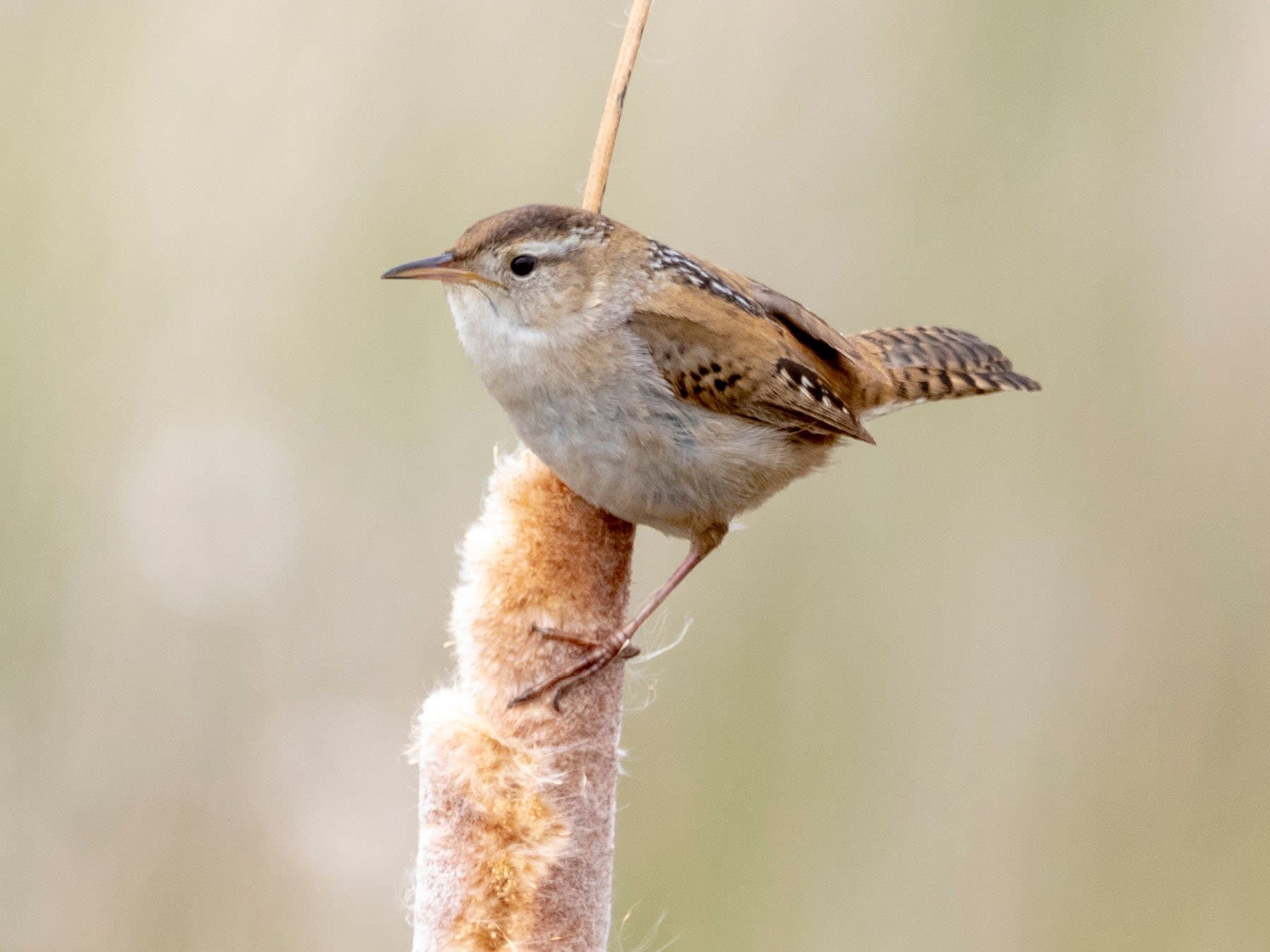
Marsh Wren perched on a cattail, showing brown plumage with streaked back and pale underside in a wetland environment.
Quick Facts
Conservation
LCLeast ConcernLifespan
3–6 years
Length
9.9–14 cm
Weight
8.5–14.2 g
Wingspan
15–15.2 cm
Migration
Partial migrant
A tiny, round-bodied songbird with a cocked tail and an outsized voice, the Marsh Wren is the soundtrack of North American cattail marshes — its rapid, mechanical trilling carrying across the reeds from well before dawn until long after dark. Males build up to 22 dome-shaped nests per territory, sing through the night to attract mates, and think nothing of destroying the eggs of their neighbours.
Appearance
The Marsh Wren is a compact, round-bodied bird — roughly 10–14 cm long and weighing between 8.5 and 14.2 g — with the characteristically short, upright tail that defines the wren family. That tail is frequently cocked almost vertically above the back, giving the bird a perky, alert posture even when it is standing still in the reeds.
The upperparts are warm rusty-brown, but the most striking feature is a bold black triangular patch on the upper back, heavily streaked with white. This patch is a reliable field mark at any range. The shoulders (scapulars) are plain, unstreaked brown — a key distinction from the Sedge Wren, which shows streaking on the crown and scapulars. The crown is dark brown to blackish, and a broad, bright white supercilium (eyebrow stripe) runs from the bill to behind the eye, giving the face a clean, well-defined look.
The underparts are whitish on the throat and breast, shading to buffy or tawny on the flanks. The tail is barred with dark brown or black. The bill is thin and slightly decurved — ideal for probing among reed stems — and brownish in colour. The legs and feet are pale brown. The wings are short and rounded, with faint barring, reflecting a lifestyle spent threading through dense vegetation rather than making long aerial journeys.
Males and females share essentially identical plumage; the species shows minimal sexual dimorphism in coloration, though males average slightly larger. There is no dramatic seasonal moult: the bird looks much the same year-round. Geographic variation is pronounced across the 15 recognised subspecies — eastern birds tend to be rustier and more brightly coloured, while western birds, particularly in Washington State, are noticeably paler and drabber, with less contrasting shoulders.
Identification & Characteristics
Colors
- Primary
- Brown
- Secondary
- White
- Beak
- Brown
- Legs
- Brown
Markings
Bold black triangular patch on upper back heavily streaked with white; broad bright white supercilium; plain unstreaked brown shoulders; short upright-cocked barred tail.
Tail: Short, frequently cocked almost vertically above the back; barred with dark brown or black.
Attributes
Understanding Attributes
Rated 0–100 based on research and observation. A score of 50 is average across all bird species. These attributes are relative and don't necessarily indicate superiority.
Habitat & Distribution
The Marsh Wren is an obligate wetland species — almost never found far from water. Its primary breeding habitat is freshwater and brackish marshes dominated by dense emergent vegetation, especially cattails (Typha spp.) and bulrushes (Scirpus spp.). It also uses cordgrass (Spartina) saltmarshes, sedge marshes, and stands of Phragmites. Nest placement over standing water in dense cattail is strongly preferred, though habitat use shifts through the season: in eastern Washington, early-season nests are typically built in cattails, but after mid-June over 90% of nests are built in bulrush, which grows in deeper water and may offer better protection.
The species will colonise created wetlands and has been recorded nesting in invasive plants including purple loosestrife and reed-canary grass. In winter, the habitat range expands to include tidal saltmarshes, brushy thickets near wetlands, wet meadows, coastal dune grass, and weedy agricultural canals and irrigation ditches.
The breeding range extends across much of the United States and southern Canada. In the east, birds breed from the Atlantic coast westward to Nebraska and from southern Illinois north through the Great Lakes region into southern Canada. In the west, breeding populations run along the Pacific coast from British Columbia south through California and through the intermountain west. In Canada, the species breeds in cattail marshes from Quebec and Ontario westward through the Prairie Provinces to British Columbia, reaching its northern limit around Lake Athabasca in northern Alberta and into the Northwest Territories. A small, disjunct resident population also occurs in central Mexico.
In the United States, the species is found across a wide range of states as a breeder, resident, or winter visitor. Notable concentrations occur in the coastal marshes of the Atlantic seaboard, the Great Lakes region, the Pacific coast, and the Gulf Coast. In Massachusetts, breeding populations are concentrated around large wetlands such as Great Meadows National Wildlife Refuge in Concord and Parker River National Wildlife Refuge in Newburyport. Western populations along the Pacific coast are largely year-round residents; eastern migratory birds winter along the Atlantic and Gulf coasts, in Florida, and in the southwestern states into Mexico and Baja California.
Where to See This Bird
Explore regional guides for locations where this bird has been recorded.
Montana
Louisiana
Nevada
New Jersey
Minnesota
Arizona
North Dakota
New Mexico
California
Connecticut
Delaware
Utah
Oregon
South Dakota
Washington
Wisconsin
British Columbia
Manitoba
Diet
Marsh Wrens are carnivorous insectivores, feeding on a wide variety of small invertebrates gleaned from the stems, leaves, and water surface of their marsh habitat. Beetles, flies, moths and caterpillars, ants, wasps, grasshoppers, dragonflies, and damselflies all feature regularly, along with aquatic insects and their larvae — including mosquito larvae. Spiders and snails round out the menu.
A stomach-content analysis of 53 Western Marsh Wrens in California gave a precise breakdown: bugs made up 29% of the diet, caterpillars and chrysalids 17%, beetles 16%, ants and wasps 8%, and spiders 5%. Carabid and coccinellid beetles accounted for a further 2%, with flies, grasshoppers, dragonflies, and unidentified insect remains making up over 11% combined. Ants and wasps were eaten predominantly in autumn, suggesting some seasonal opportunism.
Foraging is energetic and methodical. Birds work their way through dense low vegetation, gleaning prey from reed stems and leaf surfaces, picking items off the water surface, and occasionally launching short sallying flights to snatch flying insects in mid-air. Most foraging takes place close to the waterline, often entirely hidden within the reeds. The thin, slightly decurved bill is well suited to probing into crevices between stems and extracting small invertebrates from tight spaces.
Behaviour
Marsh Wrens are secretive by nature but far from quiet. They spend most of their time threading through dense cattail and bulrush stems just above the waterline, moving with a nimble, almost mouse-like agility. Spotting one requires patience; hearing one requires almost no effort at all.
Males are fiercely territorial and polygynous, holding territories that range from as little as 60 m² to over 10,000 m² depending on habitat quality and male condition. They advertise ownership through near-continuous song, and they back it up physically: both males and females routinely pierce the eggs and kill the nestlings of neighbouring birds. Victims include other Marsh Wrens, Red-winged Blackbirds, Yellow-headed Blackbirds, and even Least Bitterns. Males have been observed destroying their own eggs if the female is removed from the nest — an extreme behaviour that remains poorly understood.
One of the most distinctive behavioural traits is nocturnal singing. Unlike most songbirds, breeding males sing not only at dawn and dusk but often throughout the entire night. Unmated males are especially persistent, singing almost continuously in their effort to attract additional mates. Males can sustain a rate of up to 20 songs per minute.
Outside the breeding season, Marsh Wrens become somewhat more solitary and less conspicuous, though they remain active foragers in their wintering marshes and coastal habitats. Resident western populations maintain territories year-round, while migratory eastern birds disperse to coastal marshes and scrubby wetland edges for the winter months.
Calls & Sounds
The male Marsh Wren's song is one of the most distinctive sounds in North American wetlands: a loud, rapid-fire series of gurgling, trilling, and buzzy notes that typically lasts 1–2 seconds. Songs consist of several introductory notes followed by a trill of repeated syllables, usually with one to several concluding notes. Males can sustain a rate of up to 20 songs per minute and sing almost continuously throughout the breeding season — including at dawn, dusk, and often throughout the entire night.
Eastern and western populations differ so markedly in song that many ornithologists consider them candidates for separate species. Western Marsh Wrens produce harsh, grating, broad-band sounds with noisy, unmusical trills, almost always opening with two quick, low 'tuk' notes ('tuk tuk-RRRRRRRR'). Eastern birds produce more liquid, semi-musical songs with a single nasal or buzzy introductory note ('beer' or 'bzt'), and their trills have a semi-musical 'clinking' or 'coin-shaking' quality. Western males also have a dramatically larger repertoire: 100–200 song types per individual (one western male was recorded with 219 distinct songs), compared with just 40–60 for eastern males. Males almost never sing the same song type twice in a row, cycling through nearly their entire repertoire before repeating.
This difference has a neurological basis. Nestlings raised under identical laboratory conditions still develop population-specific songs and brain anatomy: western birds devote measurably more tissue to the forebrain regions HVC and RA — the neural centres that control vocal learning and production — than eastern birds. It is a rare example of population-level differences in brain anatomy driven by cultural selection on song.
Males begin learning songs at around 15 days of age by imitating adults, and can continue acquiring new song types throughout their lives. Only males sing. Both sexes use a grating, buzzy 'chit' as an alarm call; a nasal buzz accompanies nest building; and a melodious rolling warble is exchanged by paired birds when meeting at the nest.
Flight
The Marsh Wren is not built for long, sustained flight. Its wings are short and rounded — a shape optimised for threading through dense reed stems rather than covering distance in the open air. When flushed from cover, birds typically make brief, low, whirring flights of a few metres before dropping back into the vegetation, often disappearing almost immediately. The wingbeats are rapid and slightly buzzy, and the flight path tends to be direct and low over the marsh surface.
In flight, the short, barred tail and the warm rusty-brown upperparts are visible, along with the white supercilium if the light is good. The bird's small size and rounded wing profile give it a distinctly 'bumblebee' quality in the air — fast-flapping and purposeful, but not graceful. Longer flights between reed beds are uncommon during the breeding season.
Migratory flights are a different matter. Eastern populations undertake substantial nocturnal migrations between breeding grounds and wintering areas along the Atlantic and Gulf coasts, crossing open country and occasionally turning up in unexpected habitats far from water. Spring migration is compressed into approximately 2–4 weeks, while autumn departure is more leisurely, beginning in August and continuing through October. Despite the bird's apparently weak flight, banding records confirm that individuals regularly complete round trips of hundreds of kilometres between breeding and wintering sites.
Nesting & Breeding
Male Marsh Wrens arrive on the breeding grounds one to two weeks before females and immediately begin building nests — not just one, but many. In Washington State, males construct between 14 and 22 incomplete dome-shaped 'dummy' nests per territory; one male in the eastern United States was recorded building 22. Males build at least six dummy nests for every female they mate with. These structures serve as courtship display centres: when a female enters the territory, the male cocks his tail, sings, and escorts her from nest to nest, bowing and holding up his tail. The female may line one of the male's nests or build an entirely new one herself.
Nests are oval or football-shaped structures woven from wet grasses, cattails, and sedges, with a side entrance hole and a small internal ledge to prevent eggs from rolling out. They are anchored to standing cattails or bulrushes, typically 30–90 cm above the water, occasionally up to 1.5 m. The female lines the chosen nest with fine grass, sedge, cattail down, feathers, and rootlets.
Clutch size is typically 4–6 eggs, with a recorded range of 3–10. Eggs are pale to dark brown, heavily dotted with dark brown spots that sometimes nearly obscure the ground colour; occasionally eggs are all white. Egg dimensions are approximately 1.4–1.8 cm long by 1.1–1.4 cm wide. Incubation is performed solely by the female — only females develop a brood patch — and lasts 12–16 days. Nestlings hatch helpless, with only wisps of down, and remain in the nest for 13–15 days. Both parents may feed the young, though the female does most of the work; in western Washington males help feed nestlings, while in eastern Washington males typically do not assist with early-season clutches. Young become fully independent at around 27–29 days. The species typically raises two broods per year.
The proportion of polygynous males varies considerably by population: only 5% of males in Georgia had more than one mate, compared with 41–54% in Manitoba. Females defend a sub-territory around their nest against intruders, and both sexes are known to destroy the eggs and kill the nestlings of neighbouring marsh-nesting birds.
Lifespan
Marsh Wrens typically live for 3–6 years in the wild, with a maximum recorded lifespan of 9 years from banding data. As with most small passerines, first-year mortality is high: many birds do not survive their first winter, and the average life expectancy at hatching is considerably lower than the typical adult lifespan suggests.
Survival rates are influenced by several factors. Severe winters can reduce insect prey availability and increase energetic demands, particularly for migratory birds on their wintering grounds. Nest parasitism by blowfly larvae (Protocalliphora braueri) can reduce nestling survival in affected populations. Predation — by marsh hawks, mink, raccoons, and snakes — is a constant pressure, and the species' habit of nesting over water offers some protection but is not foolproof.
Compared with the closely related Eurasian Wren, which typically lives 2–3 years, the Marsh Wren's lifespan is somewhat longer, likely reflecting the lower predation pressure and more stable food supply of large North American wetlands compared with the exposed, variable habitats used by its Old World relative. The 9-year maximum is exceptional for a bird of this size and places the Marsh Wren among the longer-lived small passerines in North America.
Conservation
The Marsh Wren is listed as Least Concern on the IUCN Red List (assessed 2016), and its population trajectory is strongly positive. BirdLife International estimates the global population at approximately 11 million mature individuals, and North American Breeding Bird Survey data show a 130% population increase between 1966 and 2015. Canadian Breeding Bird Survey results similarly indicate a large, long-term increase since around 1970. The species scores 7 out of 20 on the Partners in Flight Continental Concern Score, placing it firmly in the low conservation concern category.
The primary threat is loss and degradation of wetland habitat through draining, filling, and conversion of freshwater marshes for agriculture and urban development. Wholesale marsh drainage could cause local extinctions in affected areas. Climate change poses additional risks: sea-level rise threatens tidal and saltmarsh habitats, particularly where urban development prevents the natural landward migration of marsh vegetation. Altered precipitation patterns and shifting spring temperatures affect wetland bird abundance more broadly.
Invasive species present a mixed picture. Phragmites australis can alter marsh structure in ways that reduce habitat suitability, though Marsh Wrens have been recorded nesting successfully in Phragmites stands. Insecticide applications in and around wetlands may reduce prey availability. Blowfly larvae (Protocalliphora braueri) parasitise nestlings in some populations, adding a further, localised pressure on breeding productivity.
Despite these threats, the species remains widespread, common, and increasing across its range. Conservation efforts focus on wetland protection and restoration — particularly the maintenance of large, structurally diverse cattail and bulrush marshes — and on managing water levels to sustain the emergent vegetation on which the species depends.
Population
Estimated: 9,400,000–11,000,000 mature individuals
Trend: Increasing
Increasing. North American Breeding Bird Survey data show a 130% population increase between 1966 and 2015. Canadian Breeding Bird Survey results also indicate a large, long-term increase since around 1970.
Elevation
Sea level to mid-elevations wherever suitable wetland vegetation exists
Additional Details
- Family:
- Troglodytidae (Wrens)
- Predators:
- Marsh hawks, mink, raccoons, and snakes are the primary predators; blowfly larvae (Protocalliphora braueri) parasitise nestlings in some populations.
- Subspecies:
- 15 recognised subspecies
- Similar species:
- Sedge Wren (Cistothorus stellaris) — distinguished by streaked crown and scapulars, narrower supercilium, and preference for drier, shorter vegetation.
Courtship & Display
Courtship in the Marsh Wren is built around architecture. Males arrive on the breeding grounds one to two weeks before females and immediately begin constructing multiple dome-shaped nests — not to breed in, but to impress. In Washington State, males build between 14 and 22 of these 'dummy' nests per territory before a single female arrives. The nests are woven from wet grasses, cattails, and sedges, with a side entrance hole and a small internal ledge. Resident birds in western populations build sturdier dummy nests than migratory birds, suggesting that nest quality may signal male quality to prospective mates.
When a female enters the territory, the male's display is immediate and theatrical. He cocks his tail high, sings at close range, and escorts her on a tour of his nests — bowing repeatedly and holding his tail upright as he leads her from structure to structure. The female inspects the nests and either selects one to line with soft material or builds an entirely new nest of her own. Males build at least six dummy nests for every female they mate with, meaning a male with two mates may have constructed 12 or more nests before the breeding season is properly underway.
The polygynous mating system means that some males attract multiple females while others attract none. Unmated males respond by singing almost continuously, including through the night — a sustained acoustic advertisement that can last for weeks. Territory size is positively correlated with male quality, ranging from 60 m² to over 10,000 m², and larger territories with more dummy nests appear to be more attractive to females.
Eastern Western Divergence
Few North American songbirds present as compelling a case for cryptic speciation as the Marsh Wren. Eastern and western populations have been diverging for long enough that they now differ not only in song but in genetics, brain anatomy, and behaviour — and where they meet, they largely do not mix.
The contact zone between the two forms runs through southern Saskatchewan, more than 400 km wide. Genetic analysis of birds from this zone shows that the vast majority are either pure western or pure eastern in ancestry, with very few hybrids. This pattern of near-complete reproductive isolation in the wild — despite the ability to interbreed in the laboratory — is one of the key criteria used to define separate species.
The vocal differences are the most immediately striking. Western birds produce harsh, grating, broad-band trills with a repertoire of 100–200 song types per male. Eastern birds produce more musical, liquid songs with a repertoire of 40–60 types. These differences are not learned from local adults in the conventional sense: nestlings raised in identical laboratory conditions still develop the song characteristics of their population of origin, and the neurological underpinning is measurably different — western birds have larger HVC and RA brain regions relative to body size.
The American Ornithological Society has not yet formally split the two forms into separate species, but the weight of genetic and behavioural evidence continues to build. Birders visiting the Great Plains contact zone in Saskatchewan may encounter birds that are genuinely difficult to assign to either form — a rare opportunity to observe evolution in progress.
Birdwatching Tips
The Marsh Wren is far more often heard than seen, so the first step is learning the song. The male's rapid, mechanical trilling — often likened to a sewing machine or typewriter — carries well across open marsh and is distinctive once known. In the eastern United States, listen for a single nasal or buzzy introductory note followed by a semi-musical clinking trill. In the west, the song is harsher and grittier, almost always opening with two quick, low 'tuk' notes before the buzzy rattle.
The best strategy for a sighting is to find a large cattail or bulrush marsh and wait quietly at the edge. Males will often pop up to the top of a reed stem to sing, especially early in the breeding season when they are most actively advertising. Dawn and dusk are productive, but because males sing through the night, even a late-evening visit to a known marsh can yield results. Scan the tops of cattail stems rather than the base — singing males frequently perch just below the seed heads.
In the United States, productive sites include the coastal marshes of the Atlantic seaboard (Parker River NWR and Great Meadows NWR in Massachusetts are reliable), the Great Lakes marshes, the Sacramento Valley in California, and the Chesapeake Bay region. In Canada, large Prairie Province wetlands and the Fraser River delta in British Columbia are good bets. Spring and early summer (May–July) offer the best combination of singing activity and relatively accessible vegetation before the reeds grow too dense.
The key identification pitfall is confusion with the Sedge Wren. Look for the Marsh Wren's plain, unstreaked shoulders and bold white supercilium — the Sedge Wren has a streaked crown and streaked scapulars, and its supercilium is narrower and less distinct. The Marsh Wren also tends to be found in taller, denser, wetter vegetation.
Did You Know?
- Western Marsh Wrens devote measurably more brain tissue to the song-control regions HVC and RA than eastern birds — a rare example of population-level differences in brain anatomy. One western male was recorded with 219 distinct song types in his repertoire, compared with a maximum of around 60 for eastern males.
- Male Marsh Wrens build up to 22 dome-shaped 'dummy' nests per territory — at least 6 for every female they mate with. Most are never used for raising young, but serve as courtship display centres, potential roost sites, and possibly as a predator-confusion strategy by filling the territory with empty nests.
- Eastern and western Marsh Wren populations are so genetically and vocally distinct that many ornithologists consider them two separate species. In a contact zone more than 400 km wide in southern Saskatchewan, genetic analysis shows that most birds are either pure western or pure eastern, with very few hybrids — suggesting strong reproductive isolation despite the ability to interbreed in the laboratory.
- Marsh Wrens are boisterous nocturnal singers: unlike most songbirds, breeding males sing not only at dawn and dusk but often throughout the entire night. Unmated males sing almost continuously in their effort to attract additional mates.
- Blowfly larvae (Protocalliphora braueri) parasitise Marsh Wren nestlings in some populations, feeding on the blood of chicks in the nest — an unusual and localised threat that can affect breeding productivity in affected marshes.
Records & Accolades
Largest Song Repertoire
Up to 219 song types
One western male Marsh Wren was recorded with 219 distinct song types — among the largest repertoires of any North American songbird.
Most Prolific Nest Builder
Up to 22 dummy nests per territory
Male Marsh Wrens build up to 22 dome-shaped dummy nests per territory — at least 6 for every female they mate with — before a single egg is laid.
Nocturnal Singer
Up to 20 songs per minute, all night
Unlike most songbirds, breeding male Marsh Wrens sing throughout the night at rates of up to 20 songs per minute to attract additional mates.
Community Photos
Be the first to share a photo of the Marsh Wren
Upload a PhotoIdentify Any Bird Instantly
- Upload a photo from your phone or camera
- Get an instant AI identification
- Ask follow-up questions about the bird
Monthly Birds in Your Area
- Personalised for your location
- Seasonal tips and garden advice
- Updated every month with new species