


Wood Duck
Aix sponsa
By the Birdfact teamChecked by Nathan Cope
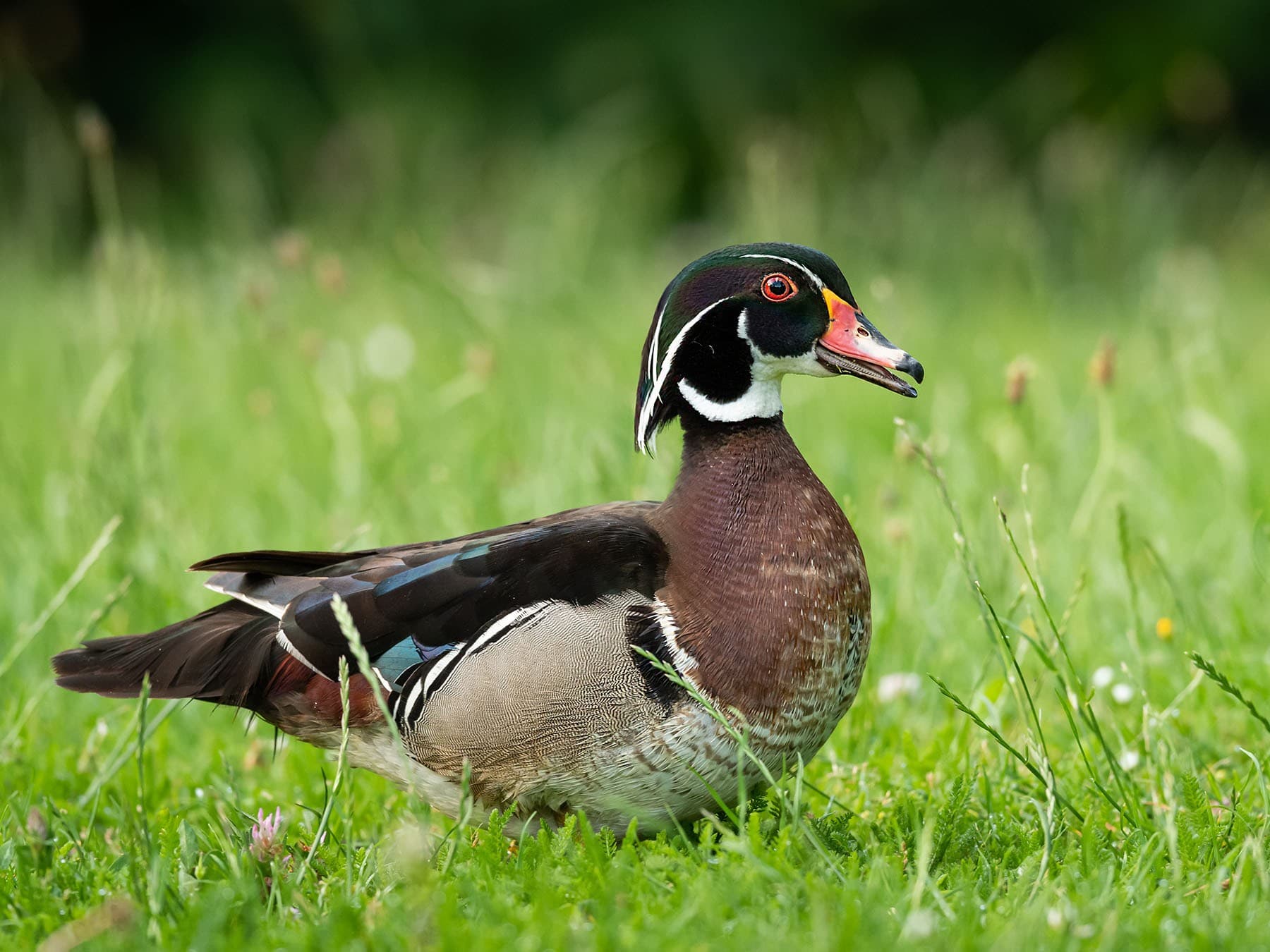
The adult male Wood Duck is draped in iridescent green, purple, and chestnut, with a swept-back crest, vivid red eyes, and a boldly patterned bill — a combination so ornate that early naturalists struggled to believe it was a wild bird rather than an exotic import. Its Latin name, Aix sponsa, means "a waterfowl in wedding dress." The species has thoroughly earned it.
On this page14 sections
How to recognise it
The adult male Wood Duck is unlike any other duck in North America. His head is a mosaic of iridescent green, blue, and purple, swept back into a prominent crest with two parallel white stripes — one running from the base of the bill to the crest tip, another arcing from behind the vivid red eye. The throat is white, with two distinctive finger-like white projections extending up onto the cheek. The bill is boldly patterned in red, white, and black. The breast is rich chestnut, flecked with white spots, and the flanks are golden-buff with fine dark vermiculation. The back and tail are glossy black with iridescent green or bronze tones, and the undertail coverts are reddish-violet. The belly is white, and the speculum is iridescent blue-green with a white trailing edge.
Eclipse plumage — worn from late spring through early autumn — sees the male moult into a drab brownish-grey that superficially resembles the female. But he retains two unmistakable features throughout: his vivid red eye and his red-and-white patterned bill. These are the key to identifying a moulting male at any time of year. The moult renders him flightless for several weeks while new flight feathers grow in.
The female is olive-grey to warm brown with subtle iridescent tones on the wings. Her most diagnostic feature is a bold white teardrop-shaped eye-ring, visible at considerable distance. The throat is white, the breast grey-brown with white speckles, and the belly white. Both sexes have crested heads, though the male's crest is considerably more pronounced. The Wood Duck's silhouette is distinctive: a boxy, crested head, thin neck, and a long, broad rectangular tail set it apart from all other North American ducks. Juveniles of both sexes closely resemble adult females, though immature males begin acquiring adult plumage in their first autumn.
Not sure it’s a Wood Duck? Check your photo: Birdfact names the bird and shows the look-alike side by side.
Its size
Adults- Length
- 47–54 cm
- Wingspan
- 66–73 cm
- Weight
- 454–862 g
Its song and calls
Wood Ducks are vocal birds, and neither sex produces anything resembling a typical duck quack. Adult Wood Ducks have approximately 12 distinct calls; ducklings have 5. The female is the more vocal of the two. Her primary call — given when flushed or in flight — is a loud, drawn-out rising squeal rendered as "oo-eek, oo-eek" or "wooo-eeek!", sometimes likened to a monkey-like screech. Once heard, it is unmistakable and carries well across open water. She also gives a sharp "cr-r-ek, cr-e-ek" alarm call and a soft, low maternal call used to summon ducklings from the nest cavity on the morning of their first leap.
The male's call is softer and higher-pitched: a thin, rising whistle described as "jeeeeee" or "ter-weeeee?", audible mainly at close range. During courtship, males use this whistling call alongside elaborate visual displays. Both sexes have pre-flight calls — short vocalisations that signal an imminent departure and help coordinate group movements.
Duckling communication begins before hatching: ducklings produce click calls 2–3 days before emerging, which may help synchronise hatching across the clutch. After hatching, ducklings use a high-pitched descending alarm peep to signal distress and a contact call to maintain cohesion with siblings and the female. By three months of age, juveniles begin producing adult-type calls.
Wood Ducks are most vocal during the breeding season and at dawn and dusk when flocks gather at communal roost sites. The female's "oo-eek" call is often the first indication that Wood Ducks are present in a wooded wetland — the birds themselves may be hidden in dense vegetation long before they come into view.
- Call0:00 / 0:20
Recorded in Minnesota, United States · October 2010
Heard one and not sure? Let the bird song identifier listen.
When and where to see it
OctoberLeaving
Most recorded in October
- 1. Renfrewshireunder 0.1%
- 2. Glasgowunder 0.1%
- 3. Suffolkunder 0.1%
- 4. Manchesterunder 0.1%
- 5. Tyne and Wearunder 0.1%
Each dot is a county, state or province: the bigger and darker, the larger the bird’s share of that place’s bird records that month. Grey dots: no regular records. The ringed point is the centre of the bird’s records this month; the arrow shows how it moved since last month, and the dashed loop its path through the year. “Arrivals” colours places where it becomes regular this month (orange) or is in its last regular month (grey). GBIF eBird Observation Dataset, 2019–2024. Map data: Natural Earth, US Census Bureau; place centres © OpenStreetMap contributors.
In your area
See when the Wood Duck is recorded in your county, state or province.
How often the Wood Duck turns up in the UK, the United States and Canada through the year, from birdwatchers' records.
United Kingdom
Resident · all year · most records in January
United States
Resident · all year · most records in April
Canada
Summer visitor · all year · most records in September
Show as a table
| Month | United Kingdom | United States | Canada |
|---|---|---|---|
| January | 0.002% (regular) | 0.13% (regular) | 0.16% (regular) |
| February | 0.002% (regular) | 0.18% (regular) | 0.18% (regular) |
| March | 0.002% (regular) | 0.51% (regular) | 0.41% (regular) |
| April | <0.001% (regular) | 0.58% (regular) | 0.70% (regular) |
| May | <0.001% (regular) | 0.43% (regular) | 0.45% (regular) |
| June | <0.001% (regular) | 0.32% (regular) | 0.36% (regular) |
| July | <0.001% (regular) | 0.39% (regular) | 0.44% (regular) |
| August | <0.001% (regular) | 0.51% (regular) | 0.69% (regular) |
| September | <0.001% (regular) | 0.49% (regular) | 0.72% (regular) |
| October | <0.001% (regular) | 0.40% (regular) | 0.56% (regular) |
| November | 0.001% (regular) | 0.22% (regular) | 0.25% (regular) |
| December | 0.001% (regular) | 0.14% (regular) | 0.13% (regular) |
Recorded regularly in
Worldwide: recorded regularly in 28 countries
Countries where it was recorded in at least 3 of the 6 years 2019–2024. Linked countries have their own bird list.
Europe (19)
Asia (1)
- United Arab Emirates
North America (7)
Oceania (1)
Data: EOD – eBird Observation Dataset (Cornell Lab of Ornithology), accessed via GBIF.org, CC BY 4.0. Records from 2019–2024, aggregated and filtered by Birdfact. How these lists are made
Tips for seeing it
Wooded swamps, beaver ponds, and slow-moving forest streams are the places to look for Wood Ducks — particularly in the early morning, when pairs and small groups move between roost sites and feeding areas. They are most easily seen in spring, when males are in full breeding plumage and pairs are actively searching for nest cavities. Listen for the female's loud, rising "oo-eek oo-eek" call as birds flush from the water — it is one of the most distinctive sounds of eastern North American wetlands.
In the United States, the Mississippi Alluvial Valley holds the highest breeding densities. Excellent sites include Chautauqua National Wildlife Refuge in Illinois (where the nest box programme began), Reelfoot Lake in Tennessee, and the Great Dismal Swamp in Virginia and North Carolina. In the Pacific states, look along wooded creeks and in riparian corridors from British Columbia south to California. In Canada, southern Ontario and the Maritime provinces offer good opportunities from April through September.
In eclipse plumage (late spring through early autumn), males can be confused with females. The key distinguishing features are the male's vivid red eye and his red-and-white patterned bill — both retained throughout the moult. Females are identified by the bold white teardrop eye-ring. In flight, both sexes show a dark body contrasting with a white belly, a long rectangular tail, and a distinctive head-up posture. The species' shorter, broader wings give it a rapid, manoeuvrable flight style quite unlike the heavier wingbeats of a Mallard.
Nest boxes installed on poles over water — with a metal baffle to deter predators — are a reliable way to attract breeding pairs to suitable wetland habitat. Check boxes in late winter for signs of occupation: down feathers lining the interior are a good indicator that a female has chosen the site.
What it eats
Plant material makes up around 80% of the adult Wood Duck's diet, with acorns the single most important food item, particularly in autumn and winter. Wood Ducks swallow acorns whole and crush them in their muscular gizzard — a feat that requires considerable digestive power. They forage both on water and on land, walking under oaks and other hardwoods to collect fallen mast. Other key plant foods include seeds of maple, ash, elm, tupelo, bald cypress, hickory, and buttonbush; aquatic seeds such as smartweed, wild rice, duckweed, panic grass, and waterlily; and fruits including blackberries, wild cherries, and grapes.
The remaining 20% of the diet — more important in summer and for egg-laying females — consists of aquatic invertebrates: insects (flies, beetles, caterpillars, dragonflies, caddisflies, wasps), crustaceans (shrimp, isopods), molluscs (snails, slugs), and spiders. Young ducklings feed almost exclusively on aquatic insects and other small invertebrates in their first weeks of life, when protein demand is highest. As they grow, plant material gradually takes over as the dominant food source.
Wood Ducks also visit harvested agricultural fields to feed on waste corn, wheat, rice, and soybeans — a habit that brings them into contact with human-modified landscapes and makes them easier to observe in autumn. Foraging is primarily by dabbling at the water surface or submerging the head and neck, though the species is equally willing to walk on land to find food. Feeding activity peaks in the early morning and late afternoon.
Nesting and breeding
Wood Ducks nest in tree cavities — natural hollows formed where branches have broken off and the heartwood has rotted — in large trees typically over 30 cm in diameter. Cavity openings as small as 10 cm are preferred, as they exclude larger predators. Nest heights range from less than a metre to 18 metres above the ground, and sites can be up to 1.2 miles (2 km) from water. The female makes the final cavity selection after the pair searches together during early morning flights. She lines the nest with down feathers plucked from her own breast.
Breeding begins in February–March in the south and mid-March to mid-April in northern areas. Clutch size is typically 9–14 eggs (range 6–16), glossy creamy-white to tan in colour and elliptical in shape (approximately 5 × 3.8 cm). Incubation is by the female alone for 28–37 days. Intraspecific brood parasitism is exceptionally common: females regularly lay eggs in neighbouring nests, sometimes producing clutches of 20–30 or more eggs that are too large to incubate successfully. The proliferation of conspicuous artificial nest boxes is thought to have amplified this behaviour by making cavities easier to locate.
Ducklings hatch alert and fully downy. On the morning after hatching — before they have eaten or drunk anything — the female calls from below and the ducklings climb to the cavity entrance using their sharp claws and leap to the ground or water. They survive falls of up to 15 metres unharmed, cushioned by their light weight and the elasticity of their downy bodies. The female leads them to water but does not physically assist them. Young are tended by the female for 5–6 weeks and can fly at approximately 8–9 weeks (56–70 days).
The Wood Duck is the only North American duck that regularly produces two broods per year. Second broods are most common in the southern parts of the range, where the breeding season is long enough to allow a female to raise a second clutch after successfully fledging the first. Nest boxes — predator-proofed with metal baffles on the supporting pole — have been a critical tool in supporting breeding populations where natural cavities are scarce.
Behaviour
In the air, Wood Ducks are fast, direct, and highly manoeuvrable. Their wings are shorter and broader relative to body size than those of most dabbling ducks, an adaptation that allows them to thread through dense woodland at speed — ducking under branches and banking sharply around tree trunks with a precision that heavier ducks cannot match. Wingbeats are rapid and produce a distinctive whistling sound audible at close range.
The flight silhouette is distinctive: a dark body with a sharply contrasting white belly, a long rectangular tail held level or slightly drooped, and a head carried high with the bill angled slightly downward. This head-up, tail-long profile is unlike any other North American duck and is a reliable identification feature even at distance. The speculum — iridescent blue-green with a white trailing edge — flashes briefly as the wings beat.
Wood Ducks often bob their heads in flight, particularly when approaching a landing site. They are capable of landing directly on branches and cavity entrances, gripping with their sharp claws — a behaviour that sets them apart from most other ducks, which land only on water or flat ground. When flushed from a wooded wetland, they typically rise steeply through the tree canopy before levelling off, often calling as they go. Migration flights occur mainly at night, in pairs or small loose flocks.
Lifespan and predators
The typical wild lifespan of a Wood Duck is 3–4 years, though this average is heavily skewed by high first-year mortality. Many ducklings do not survive their first autumn, falling prey to predators, starvation, or the hazards of migration. Adults that survive their first year have a considerably better outlook, and birds that reach breeding age often live for 5–8 years in the wild.
The maximum recorded lifespan is 22 years and 6 months — a male banded in Oregon and recovered in California, logged in the Cornell Lab / Patuxent Wildlife Research Center banding records. This is exceptional; most Wood Ducks live a fraction of this. The gap between typical and maximum lifespan reflects the high predation pressure on young birds and the cumulative risks of annual migration, hunting, and nest predation.
Key mortality factors include predation (raccoons, mink, foxes, and large raptors take both adults and ducklings), regulated hunting (approximately 976,325 birds harvested annually in the US), and nest failure due to brood parasitism and predation of eggs. Females face additional mortality risks during incubation, when they are confined to the nest cavity and vulnerable to predators that locate the site. Compared to longer-lived waterfowl such as the Whooper Swan, which can reach 26 years, Wood Ducks are relatively short-lived — but their capacity to raise two broods per year compensates for this with a higher reproductive rate.
Conservation
The Wood Duck's conservation story is one of the most dramatic recoveries in North American wildlife history. By the late 19th century, the species had been brought to the brink of extinction by two simultaneous pressures: the wholesale destruction of bottomland hardwood forests through logging and wetland drainage, and intensive market hunting for meat and feathers — the latter driven by demand from the European ladies' hat trade. By around 1900, Wood Ducks had disappeared from large parts of their former range.
Recovery began with the Migratory Bird Treaty Act of 1918, which banned Wood Duck hunting nationwide — a prohibition that remained in force until 1941. The Duck Stamp Act (1934), the Pittman-Robertson Act (1937), and the North American Wetlands Conservation Act (1989) provided further legislative and financial support for habitat protection. A pivotal practical contribution came from Dr. Frank C. Bellrose at Chautauqua National Wildlife Refuge in Illinois, who pioneered the use of predator-resistant nest boxes in the 1930s. The nest box programme has since expanded to hundreds of thousands of boxes across North America, compensating for the shortage of natural cavities caused by the removal of large dead trees from managed forests.
Today the Wood Duck is listed as Least Concern by the IUCN, with an estimated population of approximately 4.6 million mature individuals (Partners in Flight 2019; Waterbird Population Estimates 2020). The USFWS estimates as many as 3 million breeding pairs across North America. Populations grew by 9–16% per year in the Mississippi Flyway and 7–9% per year in the Atlantic Flyway between 1959 and 1986. The Mississippi Flyway population continues to increase at approximately 1.5% per year. Wood Ducks are now the most harvested duck in the Atlantic Flyway and second only to Mallards in the Mississippi Flyway, with approximately 976,325 birds harvested annually in the US (2019–2022 average).
Ongoing threats include the continued degradation and loss of forested wetlands, a shortage of natural nesting cavities due to the removal of large dead trees from managed woodlands, and regulated hunting. Predator-proofing of nest boxes remains important, as raccoons, squirrels, and other predators readily exploit unprotected boxes.
Conservation History
The Wood Duck's near-extinction and subsequent recovery is one of the defining conservation narratives of 20th-century North America. By the 1890s, the combination of industrial-scale logging — which stripped the bottomland hardwood forests that Wood Ducks depend on — and unregulated market hunting had reduced the species to a remnant of its former numbers. Hunters shot Wood Ducks for their meat and their feathers, the latter destined for the European millinery trade. Contemporary accounts described the species as effectively gone from large parts of its range.
The first turning point came with the Migratory Bird Treaty Act of 1918, which placed Wood Ducks under federal protection and banned hunting entirely — a ban that remained in force for 23 years, until 1941. The Duck Stamp Act of 1934 created a dedicated funding stream for wetland acquisition and protection, and the Pittman-Robertson Act of 1937 directed excise taxes on hunting equipment into wildlife restoration. The North American Wetlands Conservation Act of 1989 extended this framework to international wetland protection.
The practical breakthrough came from Dr. Frank C. Bellrose, a wildlife biologist at Chautauqua National Wildlife Refuge in Illinois, who began installing artificial nest boxes in the 1930s to compensate for the loss of natural cavities. His work demonstrated that Wood Ducks would readily adopt boxes and that predator-resistant designs — mounted on poles with metal baffles — could dramatically increase nesting success. The programme spread across the continent, and today hundreds of thousands of nest boxes support Wood Duck populations in areas where large hollow trees are scarce.
The results have been extraordinary. Population surveys in the Mississippi Flyway recorded growth rates of 9–16% per year between 1959 and 1986. The species is now the most harvested duck in the Atlantic Flyway — a status that would have been unimaginable a century ago. The Wood Duck's recovery is frequently cited as evidence that targeted conservation intervention, backed by legislation and sustained over decades, can reverse even severe population declines.
Courtship & Display
Courtship begins in autumn and intensifies through winter, with most pairs forming on the wintering grounds by January. The male's displays are among the most elaborate of any North American duck. The wing-and-tail-flash — in which he rapidly raises his wings and spreads his tail to expose the full iridescent glory of his plumage — is the centrepiece of his repertoire. He also performs ritualized drinking (dipping and raising the bill repeatedly), exaggerated preening of his wing feathers, head-tilting to show off the crest pattern, and swimming past the female with wings and tail elevated in a slow, deliberate display posture.
Mutual preening between paired birds is common and serves to reinforce the pair bond. The male accompanies his visual displays with his thin, rising whistle — "ter-weeeee?" — which is audible mainly at close range and quite different from the female's louder calls. Females signal receptivity through a specific inciting posture, stretching the neck forward and tilting the head.
Once paired, the male follows the female closely and guards her against rival males. Pair bonds are maintained through the breeding season but dissolve after the female begins incubation, at which point the male departs to moult. Because the male follows the female to her breeding area rather than the reverse, his genetic contribution is spread across the female's natal population — a subtle but significant consequence of this unusual migration arrangement. Females that successfully raise a brood typically return to the same nesting area the following year, while males may pair with a different female and travel to an entirely different location.
Wood Duck guides
3 guidesQuick facts
- Length
- 47–54 cm
- Wingspan
- 66–73 cm
- Weight
- 454–862 g
- Lifespan
- 3–4 years · oldest recorded 22.5 years
- Family
- Ducks, Geese & Swans
- Migration
- Partial migrant
- Global status (IUCN)
- Least Concern
- World population
- Approximately 4.6 million mature individuals (Partners in Flight 2019; Waterbird Population Estimates 2020); USFWS estimates up to 3 million breeding pairs
- Population trend
- Increasing. Mississippi Flyway population growing at approximately 1.5% per year; Atlantic Flyway population estimated at around 1 million birds (2022). Population grew 9–16% per year in the Mississippi Flyway and 7–9% per year in the Atlantic Flyway between 1959 and 1986.
- Scientific name
- Aix sponsa
Sources
15- 1Wood duck — Wikipedia Source (opens in a new tab)
- 2Wood Duck (Aix sponsa) — BirdLife International DataZone Source (opens in a new tab)
- 3Wood Duck — Audubon Field Guide Source (opens in a new tab)
- 4Wood Duck — eBird, Cornell Lab of Ornithology Source (opens in a new tab)
- 5Wood Duck Life History — All About Birds, Cornell Lab of Ornithology Source (opens in a new tab)
- 6Wood Duck Identification — All About Birds, Cornell Lab of Ornithology Source (opens in a new tab)
- 7Wood Duck Sounds — All About Birds, Cornell Lab of Ornithology Source (opens in a new tab)
- 8Aix sponsa (wood duck) — Animal Diversity Web Source (opens in a new tab)
- 9Wood Duck (Aix sponsa) — U.S. Fish & Wildlife Service Source (opens in a new tab)
- 10We're Not Wood Ducking Around: A Survival Story — USFWS Source (opens in a new tab)
- 11Wood Duck — Ducks Unlimited Source (opens in a new tab)
- 12Status of the Wood Duck — Ducks Unlimited Source (opens in a new tab)
- 13Wood Duck — Pennsylvania Game Commission Source (opens in a new tab)
- 14Wood Duck (Aix sponsa) longevity — AnAge Database Source (opens in a new tab)
- 15Wood Duck Calls — Bird Watching HQ Source (opens in a new tab)

Checked by
Nathan Cope, founder and editor
Nathan founded Birdfact and leads its writers and contributors in the UK, the US and Canada. He has watched and studied birds for more than ten years, and checks every article and species guide before it’s published.