
Western Gull
Larus occidentalis
By the Birdfact teamChecked by Nathan Cope
On this page14 sections
How to recognise it
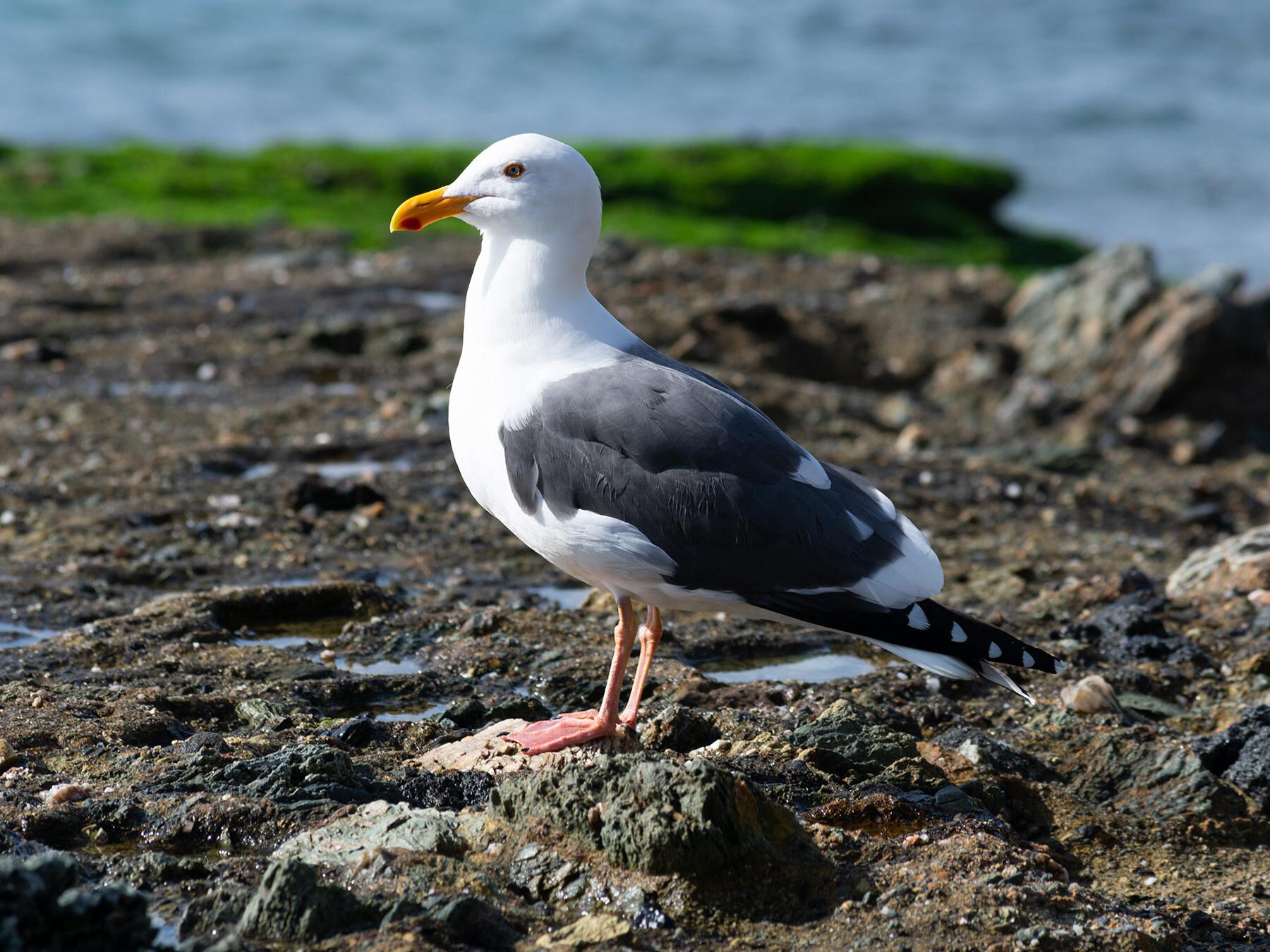
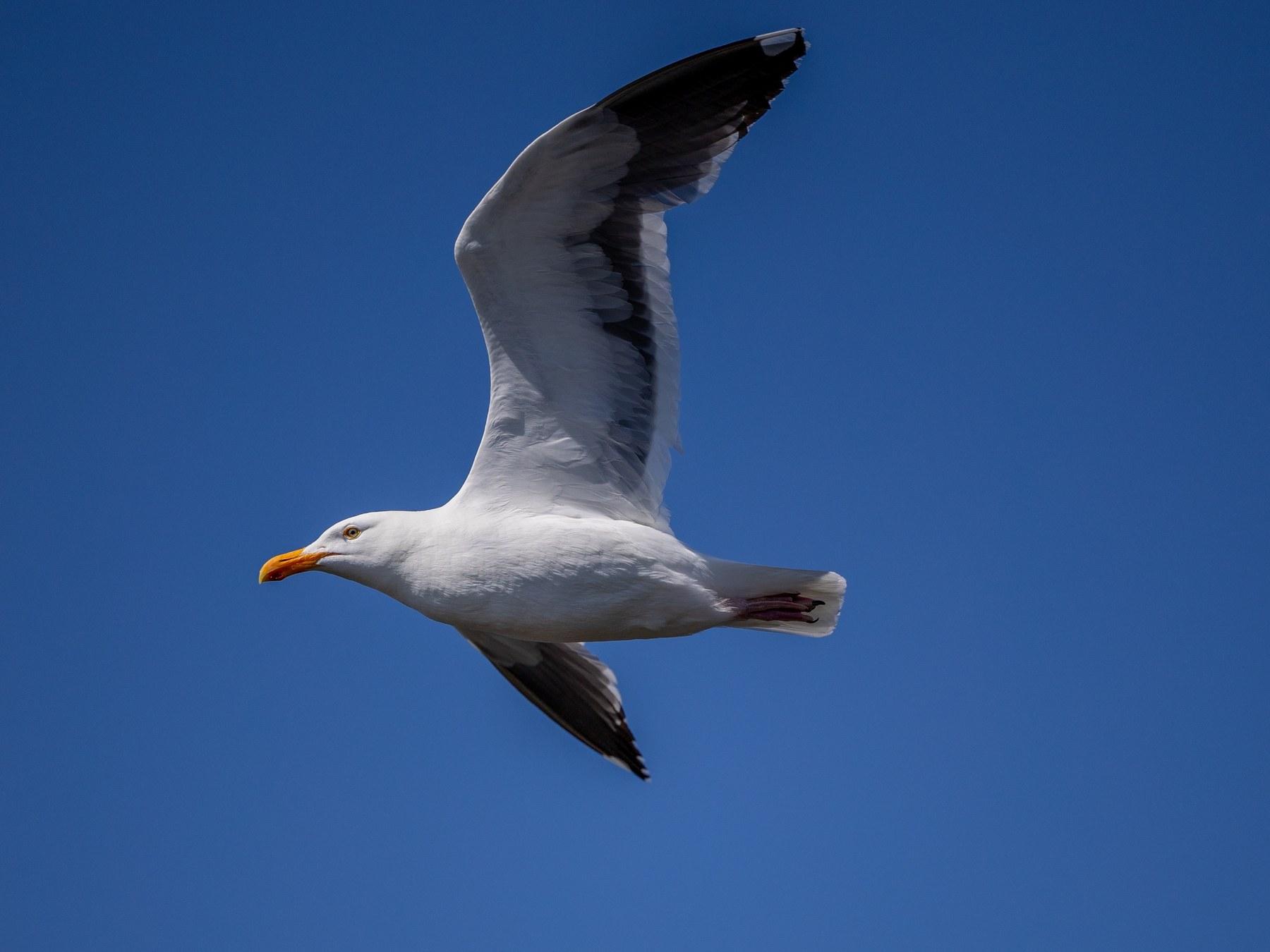
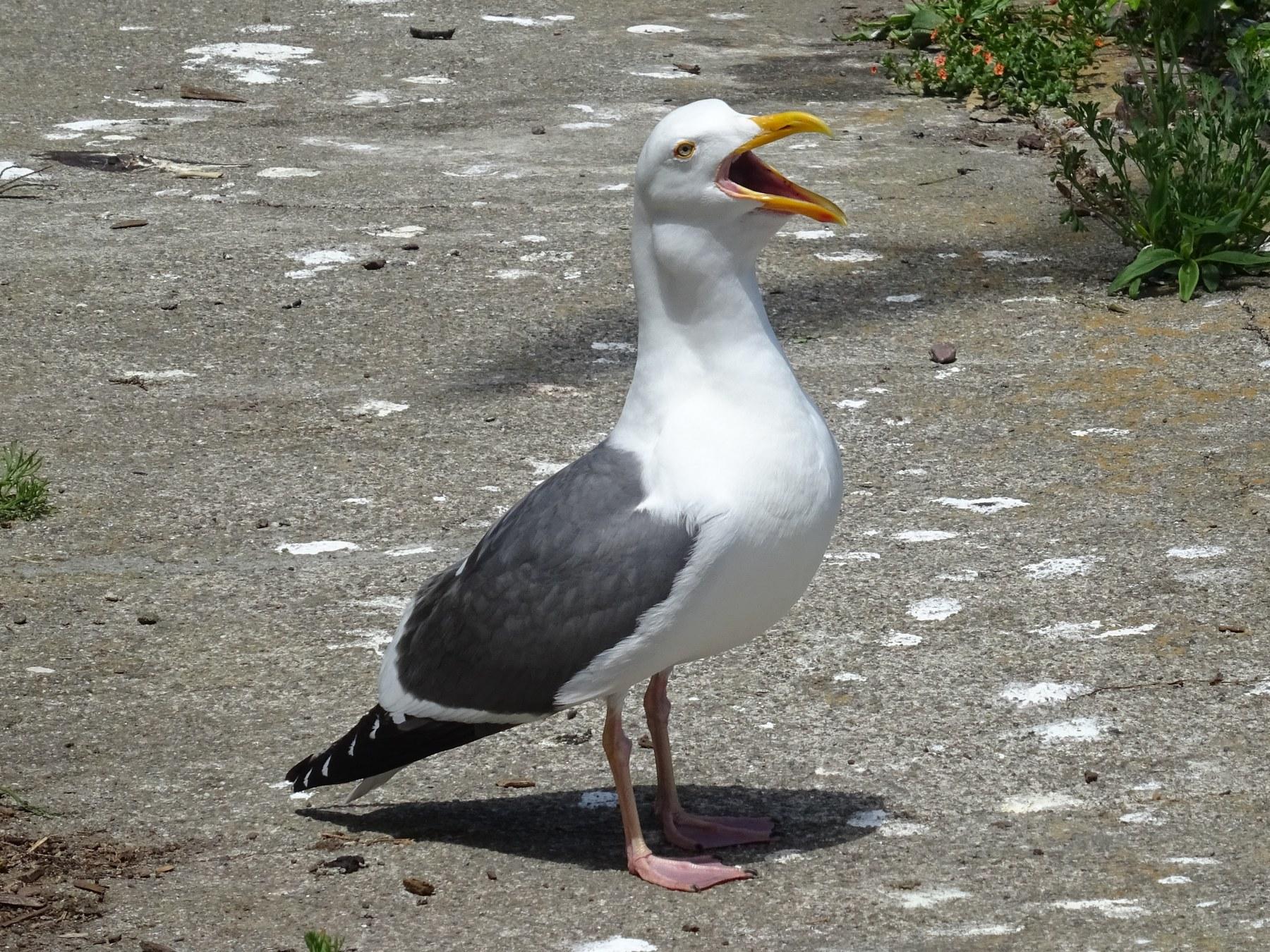
Look for a large, heavy-billed gull that is white below and dark above. Adults have a white head, body and tail, a dark gray to sooty back and wings, black wingtips, pink legs and a heavy yellow bill marked with a red spot near the tip of the lower half. Males and females look alike, though males are bigger.
Close up, look for a white spot, or mirror, near the tip of the outermost wing feather and a white crescent along the folded wing above the black tips. The eye is pale, anything from yellowish white or pale straw to golden brown or light brown, and it is ringed with yellow or orange skin. Legs vary from pale pink to dark or purplish pink.
There are two subspecies. Southern birds (wymani, from south of Monterey Bay into Mexico) have slightly darker backs and more black in the wingtip, and their heads usually stay white all year; northern birds (occidentalis) often grow fine gray streaks on the head in fall and winter. The main references disagree on which form has the darker eye, so eye color is no guide to the subspecies.
Size and weight
It is a large, stocky gull: 22-26 in (56-66 cm) long, with a wingspan of 47-57 in (120-144 cm) and a weight of 1.8-2.8 lb (800-1,250 g). That makes it bigger than an American Herring Gull and smaller than a Great Black-backed Gull.
Males average larger than females, though a few females are bigger than some small males, and the difference already shows in chicks before they fly. Males measure 23.6-26 in (60-66 cm) and weigh 37-44 oz (1,050-1,250 g); females measure 22-24.4 in (56-62 cm) and weigh 28-35 oz (800-980 g). In breeding-season samples from Southeast Farallon Island, males averaged about 40 oz (1,136-1,160 g) and females 31-33 oz (879-923 g). Southern birds are lighter: on Santa Barbara Island, males averaged 34.6 oz (981 g) and females 27.1 oz (769 g).1
Adult plumage through the year
Adults change little with the seasons, though northern birds often show fine gray head streaks from fall into winter, while southern birds usually stay white-headed. The bill and eye-ring are at their brightest in late winter and spring. Adult males often look scruffier than females, from their squabbles over territory.
Young gulls: plumage by age
This is a four-year gull: most birds reach adult plumage in their fourth winter, though some third-year birds look nearly adult and some older ones keep a few young-bird marks.
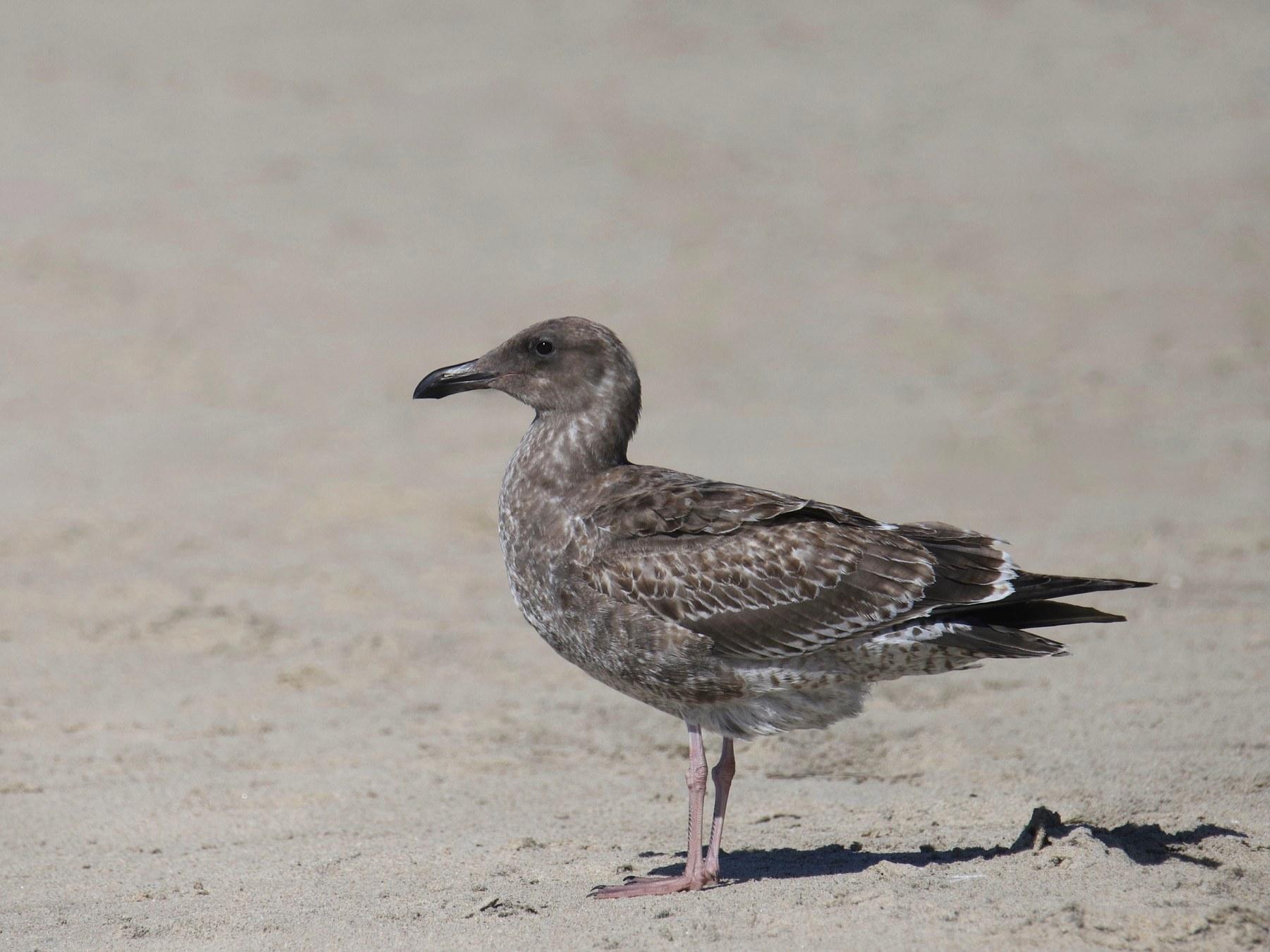
Juveniles, seen mainly from July to October, are dark brown to sooty, with pale feather edges that give the back and wings a scaly look. The rump is paler and barred against a blackish tail, the bill is solid black, the eye dark brown and the legs a dull pinkish. They get paler with wear through the fall.
In the first winter, dark gray feathers start to appear on the back, and the head and underparts turn paler and mottled, often mostly whitish by spring. The bill stays black, though by the end of the first year its base may be pale pink. By the second spring the back is often mostly the adult's dark gray, against checkered brownish wings. The outer wing feathers are blacker and have no white mirrors, the bill gains a pink or yellowish base with a black tip, and the eye starts to pale. Third-year birds are nearly adult, but slower ones keep some brownish feathers on the wing, a narrow dark tail band, small or no mirrors and a black smudge beside the red bill spot.
Identification: hybrids and the 'Olympic Gull'
In the Pacific Northwest the Western Gull interbreeds widely with the Glaucous-winged Gull. The hybrids are common enough that some birders give them their own name, the 'Olympic Gull'.
Hybrids can show any mix of the two parents' marks. Many have a dark eye, a red or purple eye-ring, and a back and wingtips much paler than a pure Western Gull's. Some look like an American Herring Gull, and backcrosses can look very like a pure Western Gull. The eye is a useful check on a Herring-like bird: Western and American Herring Gulls have pale eyes with yellow to orange rings, while a dark eye with a purplish or red ring points to Glaucous-winged genes.
In a survey of 706 specimens from 33 colony areas, the two species overlapped in most measurements, and the shade of the back and of the wingtips was among the best guides to hybrids.2
Identification: the hybrid zone
Where the zone lies depends on the study. A 1978 study described a stretch of about 112 mi (180 km) of the Washington coast.3 Bell's 1996 study ran it from the Strait of Juan de Fuca, Washington, to Coos Bay, Oregon,2 a 1997 study from Cape Flattery to central Oregon,4 and a 2024 model study, following earlier work, describes it as a narrow strip along the Washington coast.5 The main handbook account stretches the whole zone from Haida Gwaii, British Columbia, to Coos Bay and possibly as far south as San Francisco Bay.
The meeting began, the same account says, when the Western Gull spread north across the Columbia River in the late 1800s. In Washington, hybrids outnumber both parents, especially around Grays Harbor, so seabird counts there do not separate the two species. On Destruction Island, in the study published in 1978, over half the breeding birds were intermediates.1, 3
Bell (1996) found that the zone appeared to have expanded while its center near Grays Harbor stayed put, and that gene flow between the two was moderately high, though the zone still acts as a partial barrier.2 Genetic work cited in the handbook suggests it may now be shifting south.1 The 2024 study, modeling eBird records, found that Western, Glaucous-winged and hybrid gulls each use measurably different conditions, and its authors say the results best support the idea that hybrids do best in the zone's in-between habitat.5
Identification: similar gulls
In the breeding season the California Gull is the main source of confusion. It is smaller and slimmer-billed, with a paler gray back, yellow-green legs that are often grayer in winter, and a black-and-red spot on the bill. Young California Gulls are much smaller and usually have a pink bill with a black tip.
A Glaucous-winged Gull has a paler gray back, gray wingtips the same shade as the back rather than black, and a brown eye with a reddish-purple ring.
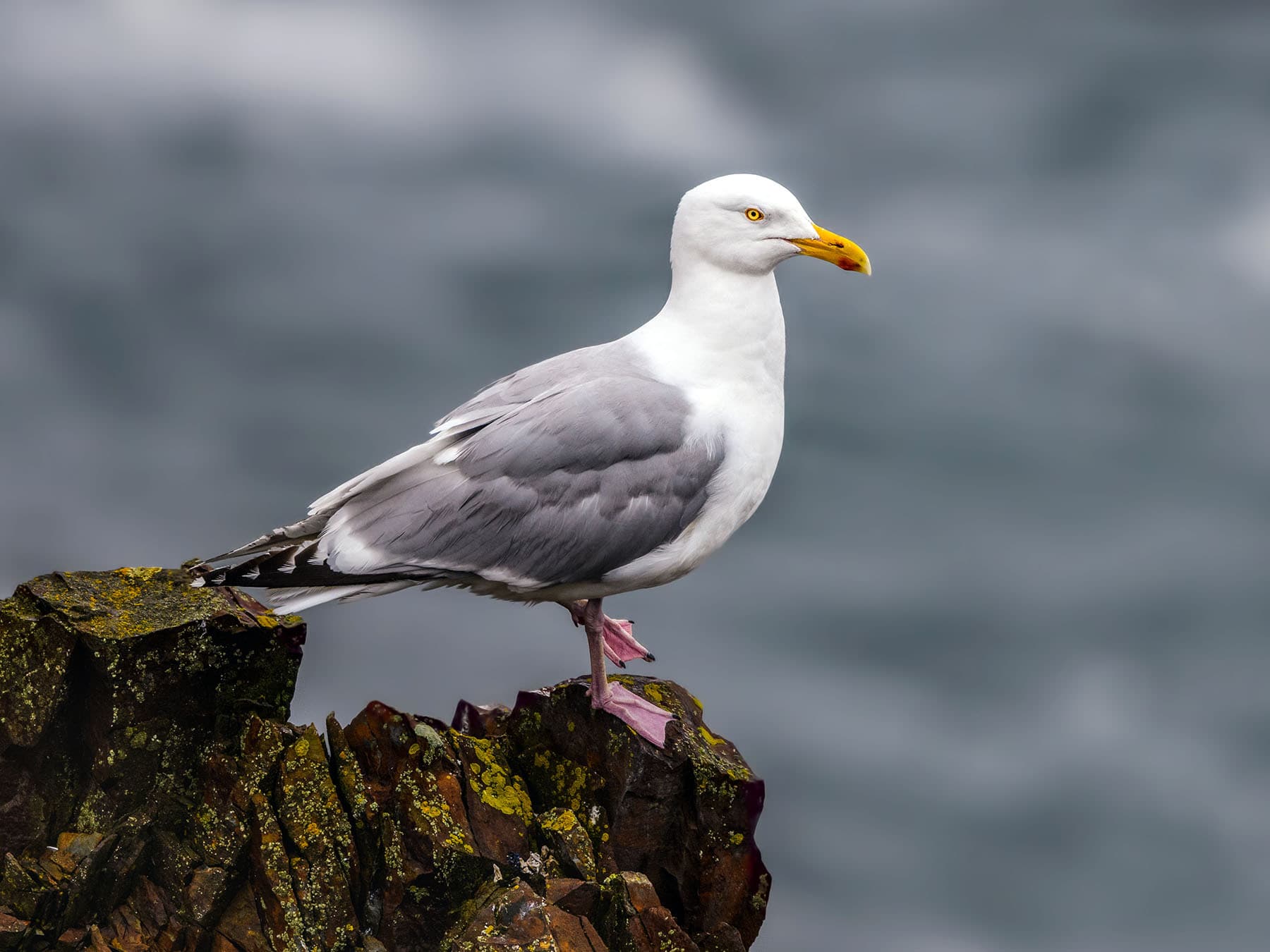
An American Herring Gull is paler gray above. First-year birds are the tricky ones: a young American Herring Gull has a thinner bill, a paler, less even head and a darker rump that stands out less against its dark tail than a young Western Gull's does.
The Yellow-footed Gull, once treated as a southern form of the Western Gull, has bright yellow legs and a slightly deeper bill. It breeds in the Gulf of California and visits the Salton Sea after breeding, arriving in late May and building to many hundreds by July and August.6 Its young get yellow legs sooner and can look very like a second-year Western Gull.
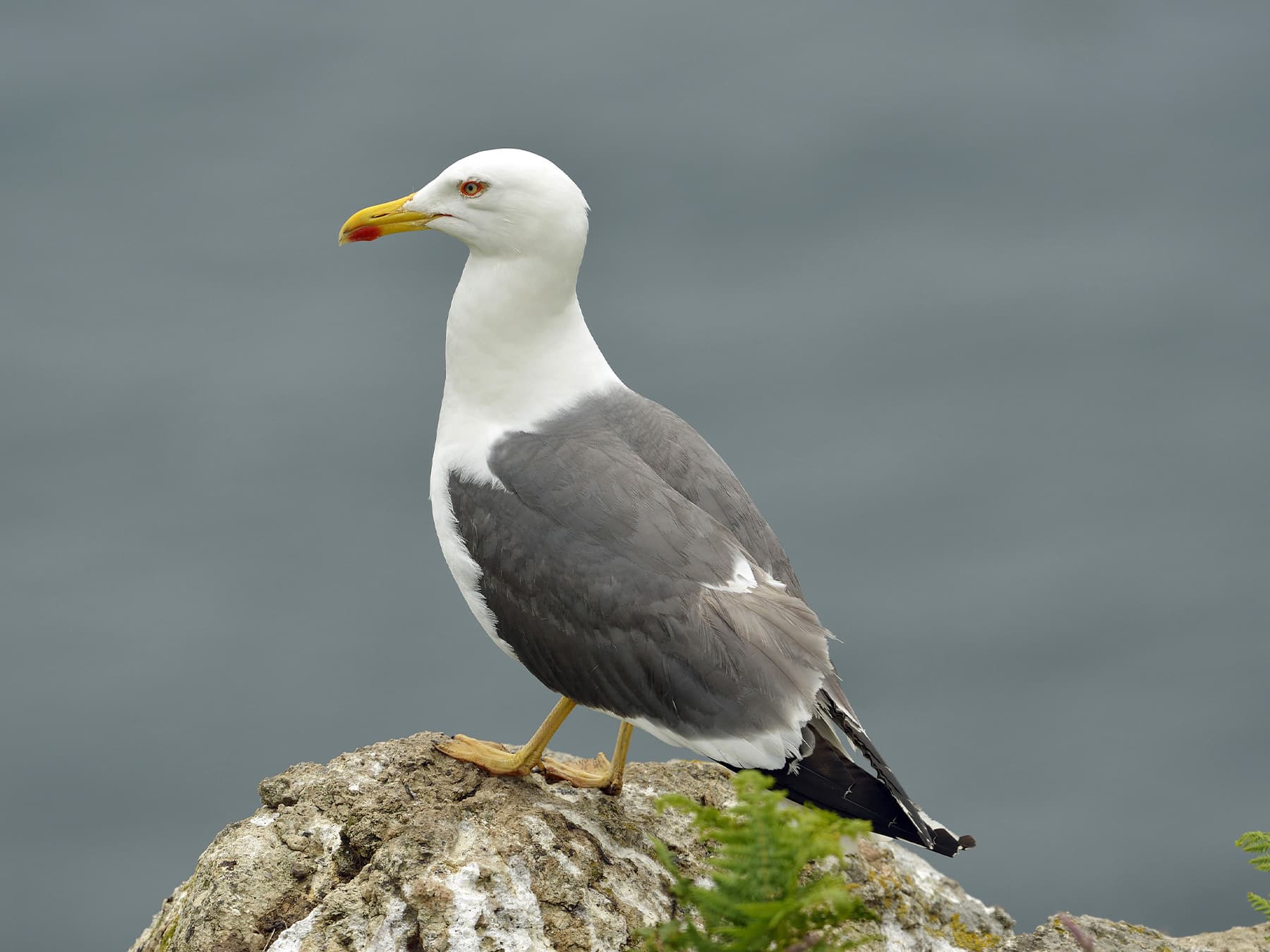
A Lesser Black-backed Gull has yellow legs rather than pink and is usually smaller. The Slaty-backed Gull, which visits Alaska regularly but is rare elsewhere in North America, shows whiter wingtips than a Western Gull, with a row of white spots across the outer wing, a slimmer bill and a pink to purple eye-ring.
Not sure it’s a Western Gull? Check your photo: Birdfact names the bird and shows the look-alike side by side.
Its size
Adults- Length
- 56–66 cm
- Wingspan
- 120–144 cm
- Weight
- 800–1250 g
Its song and calls
It has no song in the songbird sense, but it has plenty to say. It has at least 12 distinct calls, and the number of call types comes to about 15-20 depending on how finely they are split; none is unique to the Western Gull.1
The long call is a run of repeated notes given as the bird lowers and then raises its head. Mates give it when one of them returns, and it almost certainly helps birds recognize each other. A keow note is given when a predator comes near, and a clear, slightly falling yeow only in flight. The mew call is a long single note with a bowed posture, used in courtship, when mates swap places at the nest and with chicks. The alarm is a kek-kek or ha-ha-ha series. Chicks beg with high-pitched peeps, and adults have a similar klee-ew begging call, given with a toss of the head in courtship and at nest changeovers.
The mew call, choking and the copulation call are heard only from breeding adults. The keow is heard all year but most in the crowded breeding season; beyond that we found no study of when it calls most, and the handbook lists it as information needed.
- Calls, two birds0:00 / 0:10
Recorded in California, United States · December 2019
Heard one and not sure? Let the bird song identifier listen.
When and where to see it
November
In season
The year across North America
Choose a place on the map to see its year, or find yours.
Most recorded in November
Up to 1.6% of a place’s bird records that monthHere in other months
How this map is made
Each county, state or province is shaded by the Western Gull’s share of all the bird records there that month: the darker, the larger the share. A place with only a trace of records in a month is left unshaded. Shades compare places on this map with each other, not one bird with another. Records: GBIF eBird Observation Dataset, 2019–2024. Map: Natural Earth; place centres © OpenStreetMap contributors.
How often the Western Gull turns up in the United States and Canada through the year, from birdwatchers' records.
United States
Resident · all year · most records in September
Canada
Winter visitor · all year · most records in February
Show as a table
| Month | United States | Canada |
|---|---|---|
| January | 0.18% (regular) | 0.008% (regular) |
| February | 0.15% (regular) | 0.011% (regular) |
| March | 0.11% (regular) | 0.006% (regular) |
| April | 0.073% (regular) | 0.003% (regular) |
| May | 0.059% (regular) | <0.001% (regular) |
| June | 0.089% (regular) | <0.001% (regular) |
| July | 0.16% (regular) | 0.002% (regular) |
| August | 0.23% (regular) | 0.003% (regular) |
| September | 0.23% (regular) | 0.005% (regular) |
| October | 0.18% (regular) | 0.008% (regular) |
| November | 0.18% (regular) | 0.007% (regular) |
| December | 0.17% (regular) | 0.008% (regular) |
Worldwide: recorded regularly in 4 countries
Countries where it was recorded in at least 3 of the 6 years 2019–2024. Linked countries have their own bird list.
North America (4)
Data: EOD – eBird Observation Dataset (Cornell Lab of Ornithology), accessed via GBIF.org, CC BY 4.0. Records from 2019–2024, aggregated and filtered by Birdfact. How these lists are made
This is a bird of the immediate coast and inshore waters, found all year on North America's Pacific coast. Its breeding range runs from northern Washington, on Tatoosh and Protection Islands, to central Baja California in Mexico, mostly on offshore islands, rocky islets and rocks. In San Francisco Bay it nests on Alcatraz and other islands in the north of the bay. The only known mainland colony is at the Moss Landing salt ponds by Elkhorn Slough, California, though some pairs nest on roofs in San Francisco and Monterey.
In Mexico it breeds on the Pacific islands of Baja California, where, on a 2022 study's figures, more than 16,000 pairs breed, all of the southern subspecies.1, 7
In winter it spreads along the coast and offshore, from the Strait of Georgia and Juan de Fuca Strait south to the tip of Baja California, most thickly off central and southern California, and small numbers reach the Gulf of California. It is fairly common all year within about 19 mi (31 km) of shore but rare beyond 27 mi (43 km).
Look for it on beaches, rocky shores and harbors, at fish plants, picnic areas and dumps, and resting on parking lots, fields and helipads. It is almost never found far inland. In the Pacific Northwest, though, many follow rivers a few miles inland during fall and winter salmon runs, and nonbreeding birds have been seen at the Salton Sea and in California's Central Valley in summer and fall.
Migration and movements
Western Gulls are largely resident, and their movements are limited. Outside the breeding season birds disperse to feeding areas, with no fixed yearly journey, and young birds wander farther than adults. Many breeding males, especially on Southeast Farallon, are back on their territories from December to February, and almost all breeders return by March.
In a 1980s study on the Farallones, most adults were sedentary. By age 2, more than 60% of young gulls had settled at one nearby feeding area all year, and 80% of breeders aged 5 and older did the same until it was time to breed. Year-round tracking, not yet published, shows that most Southeast Farallon birds spend the winter around San Francisco Bay, mainly in San Francisco itself, on waterfronts, parks and piers, while a few go as far north as coastal Washington after breeding.1
In British Columbia it is a nonbreeding visitor. Some stay all year near Victoria and southern Vancouver Island, and birds arrive on Vancouver Island's outer coast in October-November and leave by mid-March. Strays have reached southeast Alaska, where a Farallon-banded bird turned up in 1975, and Mexico's southern Pacific coast and Central America, from Guatemala to Panama;1 a 2020 paper called an adult in southern Honduras the third Central American record.8
Spotting tips
On the West Coast, any big gull with a dark gray back, black wingtips and pink legs is worth a second look. Check the legs for California, Yellow-footed and Lesser Black-backed Gulls, which have yellow or yellow-green legs, and check the eye in Washington and Oregon, where a dark-eyed bird with a paler back may be a hybrid. Waterfronts, piers and beaches give the closest views, and island colonies such as Alcatraz and Anacapa show it nesting.
What it eats
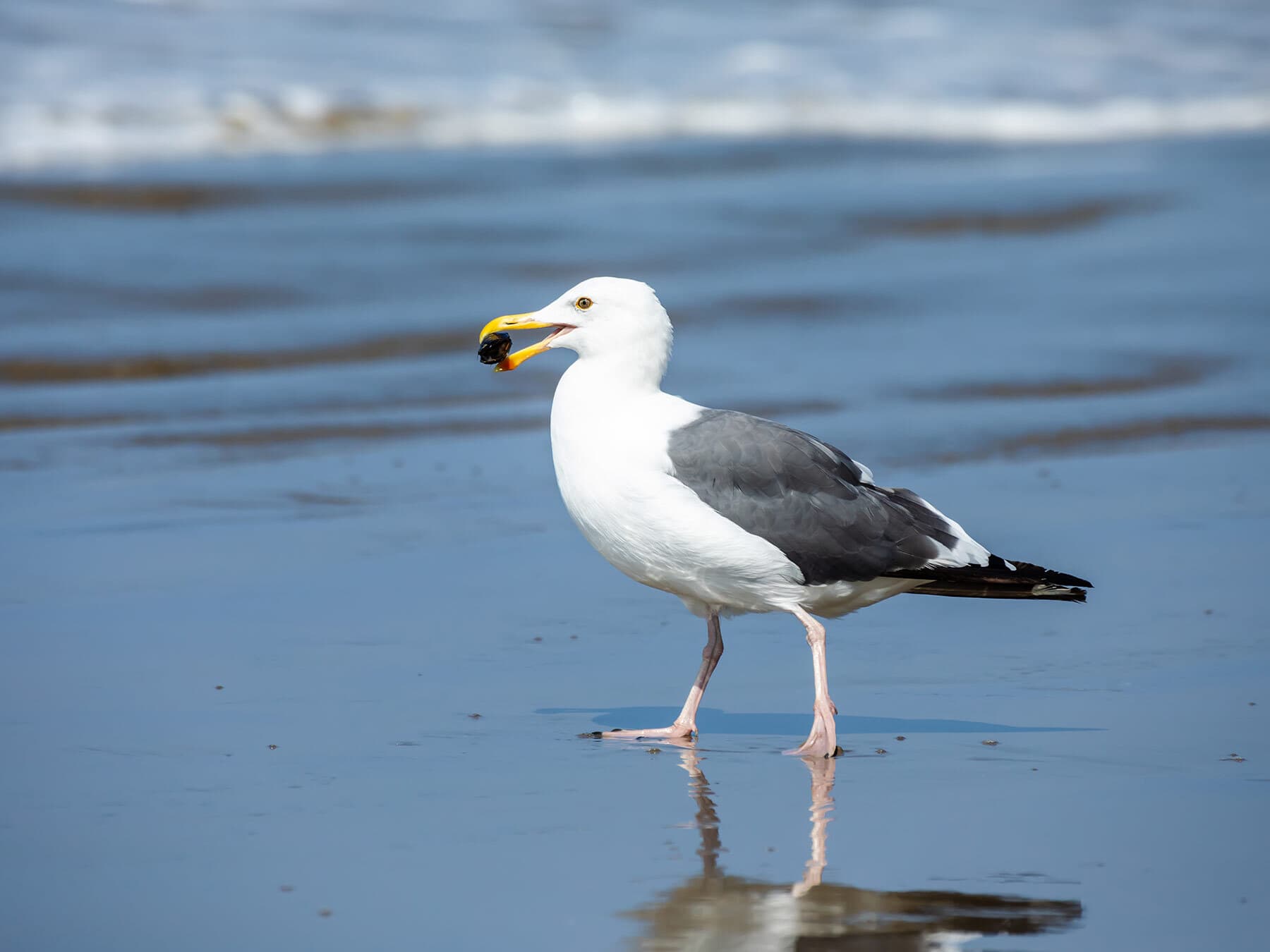
The Western Gull is mainly a hunter of fish, squid and other ocean animals. Fish come first in its diet, then marine invertebrates, then human refuse. At sea it takes schooling fish such as anchovies, eulachon and young rockfish, along with squid, krill and pelagic red crabs, and on the shore it eats mussels, barnacles, crabs, sea urchins, clams and limpets.
The main handbook account says the idea that it is mainly a scavenger is false: it is simply easier to see in towns than at sea, where most of the population spends most of the year.
It catches small fish by dipping at the surface, landing and grabbing, or making shallow plunge-dives, but it cannot get deeper than about 3-7 ft (1-2 m). It follows feeding whales, especially humpbacks, which drive fish up within its reach, and joins seals, sea lions and dolphins. It is often the first to spot prey or a small group of feeding birds or mammals, and it draws other birds to feeding flocks. On the shore it walks or swims along the water's edge at low tide, and it drops shellfish onto rocks or pavement to break them.
A few males steal food from other gulls, cormorants or murres, usually males nesting beside those birds. Other seabirds, their eggs and chicks are very rare prey, taken by only a few males: on the Farallones some kill Cassin's Auklets at dusk, and only 1-2 of several hundred males studied on Southeast Farallon ate chicks of their own kind.1
Feeding at sea and in towns
Diet varies from colony to colony and year to year. On Southeast Farallon, before the major El Niño events that began in 1982, fish made up 60-80% of the diet by number, above all while the gulls had chicks, and refuse 1-5% in good years but about 30% in El Niño years. A later study put refuse at 23% of the breeding-season diet on Año Nuevo Island but 6% on the Farallones.1
Refuse was not important in its diet until the 1980s, and then mainly in warm-water El Niño years. A stable-isotope study in Monterey Bay estimated that human food sources such as landfills made up 31% of modern gull diet (95% interval 18-44%), up from about 10% in the early 1900s.9 Chicks fed refuse grow more slowly and survive less well.1
In 2013-2015, GPS-tracked birds incubating eggs fed differently by colony. Southeast Farallon birds made 69% of their trips to sea, each of about 4 hours. Their mainland trips were longer, about 13 hours, and on land most of their visits and time (74%) were in urban places. Birds from Año Nuevo went to land on most trips, often to beaches and a landfill.10 At least half of the tracked Farallon gulls, about 200 birds, visit a food recycling center in South San Francisco.1
Feeding at sea has a cost. In a three-colony study, nearly 70% of tracked gulls fed mainly in ocean or coastal habitats, and these birds carried 55% more mercury in their blood than birds feeding on land and in fresh water.11
Nesting and breeding
Western Gulls nest mostly on islands: large offshore islands, rocky islets and rocks, and also old piers, channel markers and the dikes between salt ponds. Nesting in colonies seems to be optional, since many pairs nest alone on offshore rocks and raise young well.
In California the season runs from April to early August. Most pairs there start their clutch in early to mid-May, with eggs usually from late April through May, while in northern Oregon and Washington eggs are laid later, from early June to early July. A pair raises one brood a year and may lay again if the first clutch is lost.
The male holds the territory and both birds defend it, from February or March in northern California. In the mid-1970s, territories on Southeast Farallon averaged about 110 sq ft (10 m2), against about 1,600 sq ft (150 m2) on Santa Barbara Island.
Pairs are mostly monogamous and usually stay together for life. On Southeast Farallon, males that lost a mate soon found another, but widowed females could not.1
Males can first breed at 3 years old and females at 4.12 Most start later: in three cohorts on Southeast Farallon, the usual first breeding age was 4 for males and 5 for females.13 The handbook gives average first breeding ages of 4.8 years for males and 6.0 years for Farallon females, and says birds in growing colonies may start a year earlier.1
The nest and eggs
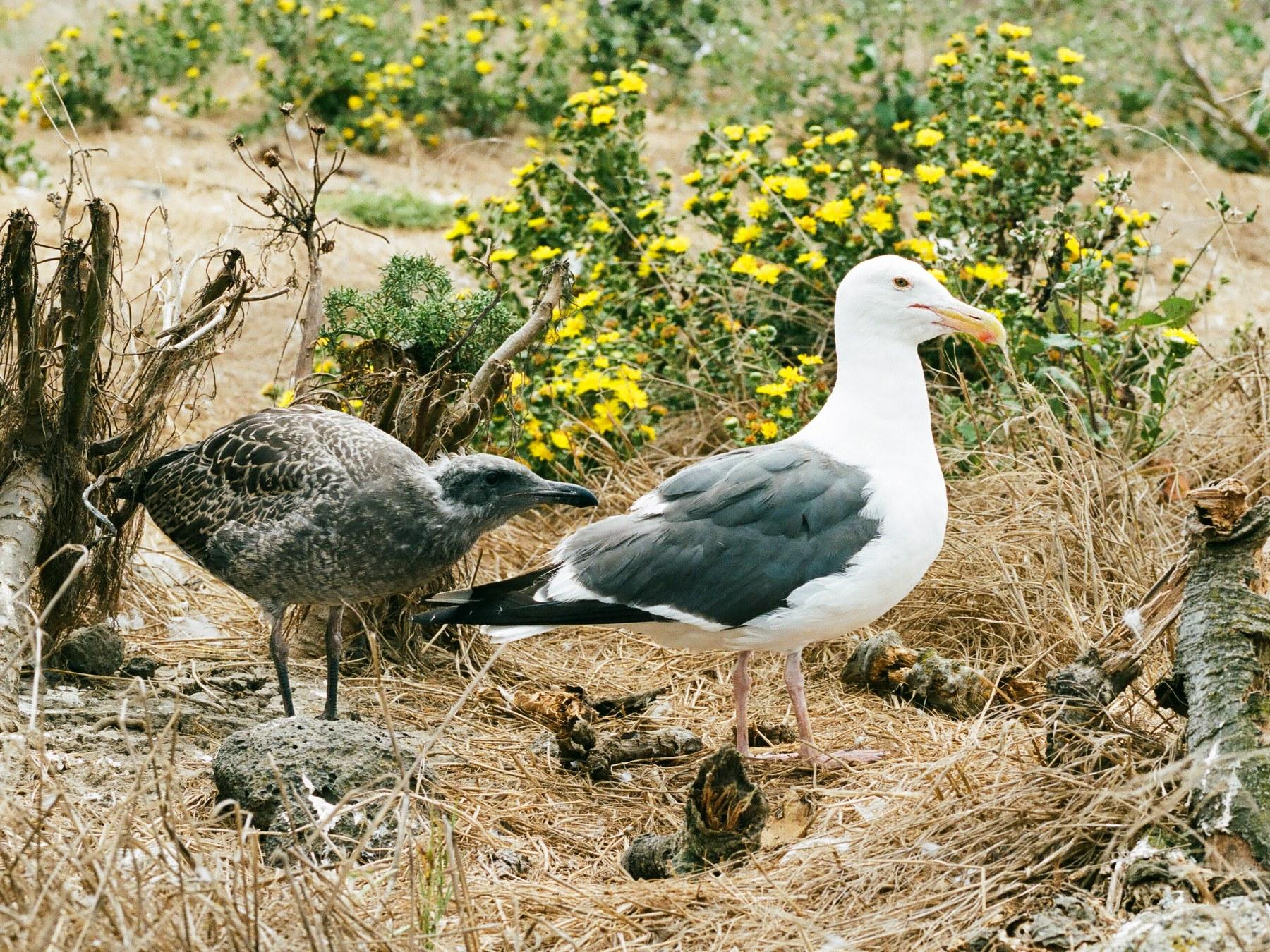
The nest is a scrape filled with plants, about 6 in (15 cm) across inside and 12 in (30 cm) outside, lined with weeds, grass, seaweed and feathers and now and then plastic or rope. Both birds build it, and the female chooses the spot.
The clutch is usually 3 eggs, sometimes 1 or 2. One guide gives 1-5, rarely 6, with clutches of more than 3 coming from two females laying in one nest.14 The eggs are light olive, buff or greenish, speckled with dark brown or black, about 2.8 x 1.9 in (71 x 49 mm) and 3.0-3.7 oz (85-105 g), or 10-12% of the female's weight.
Both parents incubate. The handbook has the first egg hatching about 28-30 days after it is laid and the third on day 31-32, with eggs laid about 2 days apart; other guides give 25-29 days.1, 15
Nestlings and fledging
Chicks hatch in thick gray down spotted with black, with a black bill and black to dark gray legs, and weigh about 2.1-2.6 oz (60-75 g). They leave the nest cup within a day but stay on the territory. They first get airborne at about 40-45 days and fly properly at 45-50 days.
Both parents feed the chicks until they are 11-12 weeks old, and a 1977 study recorded young fed on the territory where they hatched until 12-15 weeks; some are still cared for away from it for up to 6 months. In the six weeks before the young fly, the male brings bigger meals, and more often.1
Adults often attack strange chicks that wander onto their territory, yet adoption is common: 5-10% of pairs adopt. Of wandering chicks, 60-70% are attacked or killed, and those that survive are usually adopted by neighbors (30-40%).1
Breeding success
Even in a good food year only about 25% of colonial pairs raise the most they can, three young, while pairs nesting alone on offshore rocks averaged about 2.8 young a year over nine years in the handbook authors' own unpublished data. On Southeast Farallon, only 4 of 19 years in 1971-1990 had poor breeding success, against 22 of 26 years in 1991-2017, with near-total failure in 2009-2012. In 2017, pairs there raised 0.77 chicks each, against a 46-year average of 0.99.1
Hybrid pairs and breeding success
Studies disagree on how mixed pairs fare. On Destruction Island, pure pairs hatched fewer eggs than pairs with a hybrid.3 At two colonies in the zone, females paired with hybrid males did better, which the authors tied to nest cover and diet.16 In 1989, Western-type pairs had larger clutches and more even egg sizes than Glaucous-winged or mixed pairs, a result the author says may shift between years.4 On Protection Island, one season's study found equal hatching success for all types.1
Whether like pairs with like is disputed too. Two studies found that birds tend to pair with their own type,3, 1 one found only a weak tendency4 and one found little evidence for it.16 At Grays Harbor, the handbook adds, Bald Eagles wiped out the Western Gull nests on open sand, while pairs nesting in plant cover did better.1
Nesting on Santa Barbara Island in the 1970s
In the 1970s, pairs made up of two females formed on Santa Barbara Island, California, when the colony's sex ratio was strongly skewed toward females. They laid oversized clutches of 4-6 eggs, half or fewer of them fertile.1, 17 Since pesticide wastes stopped being dumped off southern California, the sex ratio there has returned to about even and such pairs are no longer seen.
Lab work injecting DDT into gull eggs at 1970-level doses feminized male embryos, which the handbook says probably explains the skewed sex ratio; other accounts say the imbalance may have been caused by pesticides acting like estrogen.1
Behaviour
On land the Western Gull walks or runs, and in flight it spends much of its time gliding on outstretched wings. GPS-tracked birds flew at about 19 mph (31 km/h) on average, with a mean top speed of 36 mph (58 km/h), in unpublished tracking data.1
It roosts in large groups, in winter often with other gulls, on beaches, parking lots, helipads and island meadows. In the breeding season it sleeps or rests about 10 hours a day, in short spells by day and longer ones at night. Pairs appear to leave the colony together after breeding, and outside the breeding season birds defend feeding spots on beaches and along the shore against other gulls.
It has at least 11 displays, among them the long call, grass-pulling, choking, head-tossing and the mew call. The handbook calls the Western Gull and the European Herring Gull behavioral counterparts, with no Herring Gull display missing from the Western Gull's repertoire.1
Lifespan and predators
The oldest Western Gull on the US Bird Banding Laboratory's longevity list was at least 33 years 11 months old. It was banded as a chick, not yet able to fly, in California on 22 June 1973 and seen alive there on 13 May 2007, its band read in the field. The lab's historical table lists a second bird of 27 years 10 months, banded as a chick in California in 1944 and found dead there in 1972.18
A more usual wild lifespan is 10-15 years, including five to ten breeding seasons. In 1970s-1990s studies adults survived about 90% of years up to age 10, possibly as few as 70-75% in El Niño years. In the same studies, 70-80% of eggs hatched and 50-70% of the chicks fledged. Fewer than half of fledglings live to breed, and only 10-15% of a year's young breed for five or more years, raising 10-30 chicks in a lifetime.1 Breeding early has a cost: birds that started at the youngest ages died at higher yearly rates than those that waited, and females that bred more often survived less well.12
Predators
Adults are taken by Bald Eagles, Peregrines, Red-tailed Hawks, dogs, harbor seals, Steller's sea lions and sharks. Chicks are taken by Glaucous-winged Gulls, Common Ravens, Black-crowned Night-Herons, Great Blue Herons, raccoons, striped skunks, dogs and cats, and skunks and raccoons caused near-total nesting failure at the Moss Landing colony.1
Conservation
The Western Gull is listed as Least Concern on the IUCN Red List, in a 2018 assessment.19 The authors of the 2024 handbook account say that listing deserves a fresh look and that the species could soon qualify as Near Threatened or even Vulnerable; that is their view, not a Red List change.1
NatureServe ranks it G5 worldwide, N5 in the US, S4 in Washington and Oregon, and S3N, a nonbreeding rank, in British Columbia; these are conservation ranks, not legal listings.15 Partners in Flight gives it a Continental Concern Score of 15 out of 20 and places it on its Orange Watch List as a 'Tipping Point' species.20
Population and trends
The handbook's 2024 regional counts add up to no more than about 50,000 pairs, around 100,000 breeding birds, at fewer than 200 colonies, a smaller population than most other North American gulls.1 Partners in Flight estimates 86,000 birds worldwide, 44,000 of them in the US and Canada, for around 2010.20 BirdLife's 2023 figures, as quoted in the handbook, give 115,500-118,500 birds and a rising trend, but the handbook says these appear to rest on an out-of-date source and that the trend is not the same everywhere.1
The North American Breeding Bird Survey finds no significant change from 1968 to 2025 (-0.72% a year, 95% credible interval -2.56 to +0.49) and none over the last ten years either (-0.05% a year, -4.39 to +4.44). The survey samples this island-nesting gull on only 29 routes, and its yearly figures carry very wide margins. Washington's own figures show steep falls in some periods, but they rest on six routes with the survey's weakest credibility rating.21 Partners in Flight, working from the 1970-2021 survey data with 90% intervals, estimates a fall of 1.54% a year, a 54.7% loss, significant at that level.20
On Mexico's Pacific islands, a 2022 study found the Western Gull among species with a significantly increasing trend in 2014-2019, tested at the 10% level.7
Population changes at the colonies
Southeast Farallon Island is its key colony. It held about 3,000 pairs in 1909; by the 1970s there were nearly 15,000, and in the 2000s fewer than 10,000.1 A 2018 Point Blue blog post put the island's breeding population at over 8,500 pairs.22 The handbook says the colony has been declining this century, likely because of climate change and its effects on the ocean.
Northern and central California, from Point Reyes to Point Conception, fell from about 17,000 pairs in the late 1970s to around 10,000 in the 2010s. Over the same years southern California rose from about 5,500 to about 12,000 pairs, so the southern subspecies is probably now the more numerous. Santa Barbara Island holds about 7,000 pairs and may now be the second largest colony. Alcatraz grew from about 250 pairs in 1985 to almost 1,200 in 2008. Año Nuevo grew from about 120 pairs in 1976 to 1,200 in 2005, then fell to 550 nests in 2022, its lowest since monitoring began in 1999, for reasons that are not known. Washington held 3,000-4,000 pairs and Oregon about 5,000 in 1975-1985, hard to count because of the hybrids.1
Conservation: pollution, fishing line and disease
The pressures on it include oil spills and pesticides, El Niño events and marine heat waves, changes in fish stocks, a small range, ocean acidification and climate change, and hybridization with the Glaucous-winged Gull. DDT was dumped through sewers into the sea off southern California from 1950 to 1971 and banned in the US in 1972.1
It is one of the seabirds most often found tangled in fishing line and nets. It was among the three most entangled species in 2001-2005 records from central California to the northwest coast,23 and 9.6% of entangled animals on California beach surveys in 1997-2017, which the authors put down to how common it is.24
In October 2019, at least 14 Western Gulls were affected at Huntington State Beach, California, and six of seven tested carried botulism type A toxin, which the authors say had not been linked before to deaths of free-living wild birds.25 The handbook, citing a 2022 government page, reports no Western Gull deaths from the 2021-2022 bird flu; we found no account of later outbreaks in this gull in the sources we read.1
Legal status
In the United States the Western Gull is protected under the Migratory Bird Treaty Act and is on the federal list of protected birds (50 CFR 10.13).26 In Canada it is on the list of birds protected under the Migratory Birds Convention Act, 1994.27 It has no Endangered Species Act, SARA or COSEWIC listing in the NatureServe record.15 We have not read its status under Mexican law.
Similar birds
Often mistaken for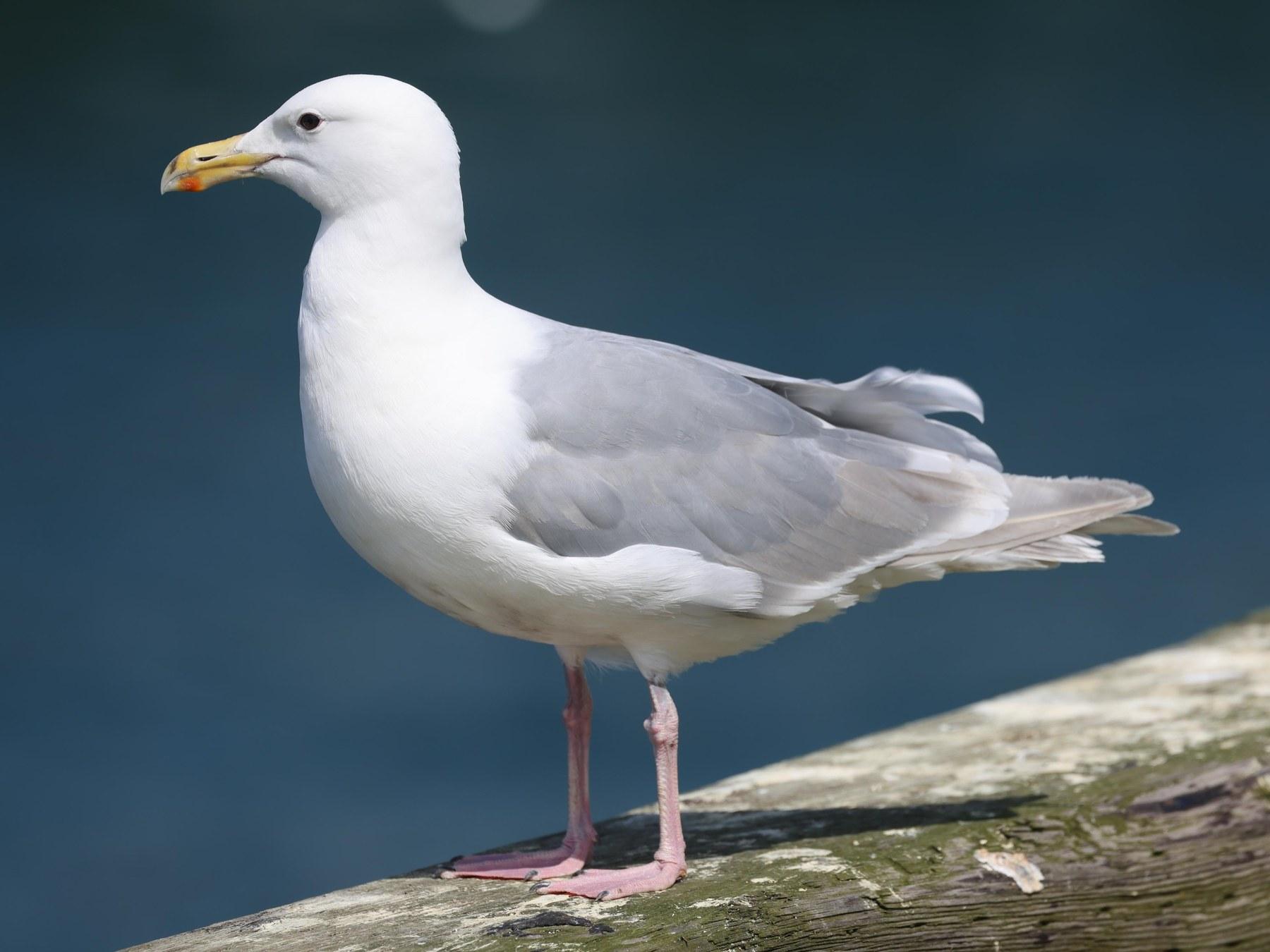
More photos
1 photos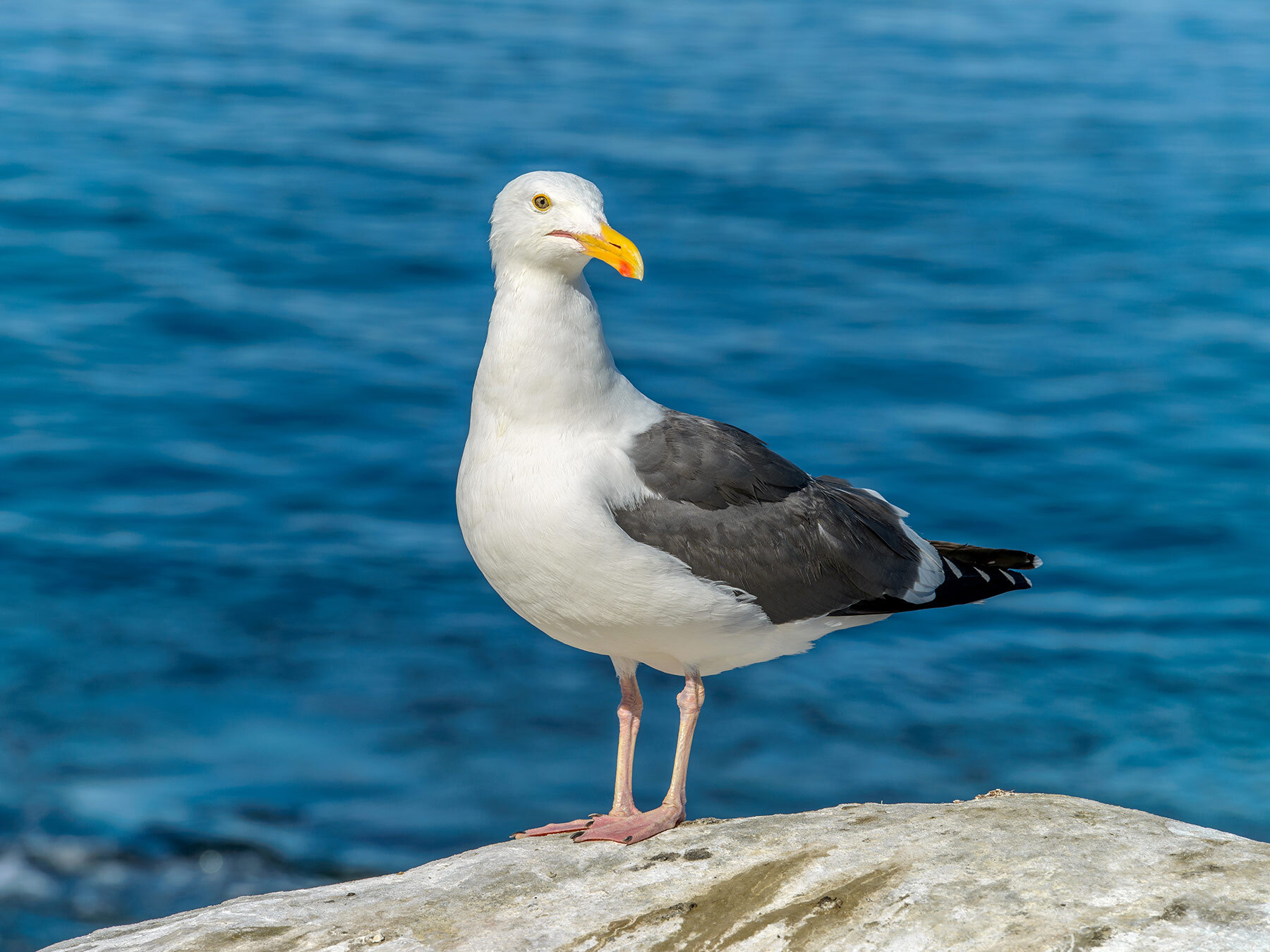
Quick facts
- Length
- 56–66 cm
- Wingspan
- 120–144 cm
- Weight
- 800–1250 g
- Lifespan
- oldest recorded 33 years 11 months
- Family
- Gulls & Terns
- Migration
- Resident
- Global status (IUCN)
- Least Concern
- World population
- No more than about 50,000 breeding pairs (around 100,000 breeding birds), Birds of the World 2024
- Population trend
- No significant change in the Breeding Bird Survey since 1968 (-0.72% a year, 95% credible interval -2.56 to +0.49) on 29 routes; Partners in Flight, from an earlier run of the same survey, lists it as a 'Tipping Point' species
- Scientific name
- Larus occidentalis
Questions
2What is its scientific name?
Larus occidentalis. Audubon described it in 1839 from two birds John Kirk Townsend collected in October 1836 near Cape Disappointment, Washington; where those two specimens are now is unknown.1, 28 AviList and the main handbook account recognize two subspecies, occidentalis and wymani, while the American Ornithological Society's checklist treats it as having none.29 Its place among the large white-headed gulls is still unsettled.
Is the Yellow-footed Gull a kind of Western Gull?
Not any more. The Yellow-footed Gull, which breeds in the Gulf of California, was described as a third subspecies of the Western Gull, Larus occidentalis livens, by Dwight in 1919, and is now treated as a separate species. We found no source giving the year or the body that first split them.
Sources
38- 1Pierotti, R. J., Annett, C. A., Shaffer, S. A. and Devincenzi, D. M. (2024). Western Gull (Larus occidentalis), version 2.0. Birds of the World. Cornell Lab of Ornithology. doi:10.2173/bow.wesgul.02 (opens in a new tab)
- 2Bell, D. A. (1996). Genetic Differentiation, Geographic Variation and Hybridization in Gulls of the Larus glaucescens-occidentalis Complex. The Condor 98(3): 527-546. doi:10.2307/1369566 (opens in a new tab)
- 3Hoffman, W., Wiens, J. A. and Scott, J. M. (1978). Hybridization between Gulls (Larus glaucescens and L. occidentalis) in the Pacific Northwest. The Auk 95(3): 441-458. doi:10.1093/auk/95.3.441 (opens in a new tab)
- 4Bell, D. A. (1997). Hybridization and Reproductive Performance in Gulls of the Larus glaucescens-occidentalis Complex. The Condor 99(3): 585-594. doi:10.2307/1370471 (opens in a new tab)
- 5Geng, X., Summers, J. and Chen, N. (2024). Ecological niche contributes to the persistence of the western x glaucous-winged gull hybrid zone. Ecology and Evolution 14(7): e11678. doi:10.1002/ece3.11678 (opens in a new tab)
- 6Patten, M. A. (2020). Yellow-footed Gull (Larus livens), version 1.0. Birds of the World. Cornell Lab of Ornithology. doi:10.2173/bow.yefgul.01 (opens in a new tab)
- 7Mendez Sanchez, F., Bedolla Guzman, Y., Rojas Mayoral, E. et al. (2022). Population trends of seabirds in Mexican Islands at the California Current System. PLOS ONE 17(10): e0258632. doi:10.1371/journal.pone.0258632 (opens in a new tab)
- 8van Dort, J. (2020). First record of Western Gull, Larus occidentalis Audubon, 1839 (Charadriiformes, Laridae), for Honduras. Check List 16(3): 781-784. doi:10.15560/16.3.781 (opens in a new tab)
- 9Osterback, A.-M. K. et al. (2015). Long-term shifts in anthropogenic subsidies to gulls and implications for an imperiled fish. Biological Conservation 191: 606-613. doi:10.1016/j.biocon.2015.07.038 (opens in a new tab)
- 10Shaffer, S. A., Cockerham, S., Warzybok, P., Bradley, R. W., Jahncke, J., Clatterbuck, C. A. et al. (2017). Population-level plasticity in foraging behavior of western gulls (Larus occidentalis). Movement Ecology 5: 27. doi:10.1186/s40462-017-0118-9 (opens in a new tab)
- 11Clatterbuck, C. A., Lewison, R. L., Orben, R. A. et al. (2021). Foraging in marine habitats increases mercury concentrations in a generalist seabird. Chemosphere 279: 130470. doi:10.1016/j.chemosphere.2021.130470 (opens in a new tab)
- 12Pyle, P., Nur, N., Sydeman, W. J. and Emslie, S. D. (1997). Cost of reproduction and the evolution of deferred breeding in the western gull. Behavioral Ecology 8(2): 140-147. doi:10.1093/beheco/8.2.140 (opens in a new tab)
- 13Spear, L., Sydeman, W. J. and Pyle, P. (1995). Factors affecting recruitment age and recruitment probability in the Western Gull Larus occidentalis. Ibis 137(3): 352-359. doi:10.1111/j.1474-919x.1995.tb08032.x (opens in a new tab)
- 14National Audubon Society. Western Gull. Guide to North American Birds. Accessed 28 November 2026. Source (opens in a new tab)
- 15NatureServe (2026). Larus occidentalis (ELEMENT_GLOBAL.2.102574). NatureServe Explorer. Accessed 28 November 2026. Source (opens in a new tab)
- 16Good, T. P., Ellis, J. C., Annett, C. A. and Pierotti, R. (2000). Bounded hybrid superiority in an avian hybrid zone: effects of mate, diet, and habitat choice. Evolution 54(5): 1774-1783. doi:10.1111/j.0014-3820.2000.tb00721.x (opens in a new tab)
- 17Hunt, G. L. and Hunt, M. W. (1977). Female-Female Pairing in Western Gulls (Larus occidentalis) in Southern California. Science 196(4297): 1466-1467. doi:10.1126/science.196.4297.1466 (opens in a new tab)
- 18U.S. Geological Survey Bird Banding Laboratory. Longevity Records of North American Birds. USGS Eastern Ecological Science Center. Accessed 28 November 2026. Source (opens in a new tab)
- 19BirdLife International (2018). Larus occidentalis. The IUCN Red List of Threatened Species 2018. IUCN Red List (read through GBIF's IUCN checklist). doi:10.2305/IUCN.UK.2018-2.RLTS.T22694337A132543621.en (opens in a new tab)
- 20Partners in Flight (2024). Avian Conservation Assessment Database (ACAD), global, version 2024.05.23. Bird Conservancy of the Rockies. Accessed 28 November 2026. Source (opens in a new tab)
- 21Hostetler, J. A. et al. (2026). The North American Breeding Bird Survey, Analysis Results 1966-2025. U.S. Geological Survey data release. doi:10.5066/P1OSNSFC (opens in a new tab)
- 22Bennett, S. (2018). Time to Fly. Point Blue Conservation Science, Los Farallones blog. Accessed 28 November 2026. Source (opens in a new tab)
- 23Moore, E., Lyday, S., Roletto, J. et al. (2009). Entanglements of marine mammals and seabirds in central California and the north-west coast of the United States 2001-2005. Marine Pollution Bulletin 58(7): 1045-1051. doi:10.1016/j.marpolbul.2009.02.006 (opens in a new tab)
- 24Donnelly-Greenan, E. L., Nevins, H. M. and Harvey, J. T. (2019). Entangled seabird and marine mammal reports from citizen science surveys from coastal California (1997-2017). Marine Pollution Bulletin 149: 110557. doi:10.1016/j.marpolbul.2019.110557 (opens in a new tab)
- 25Rogers, K. H. et al. (2021). Mortality of Western Gulls (Larus occidentalis) Associated with Botulism Type A in Coastal Southern California, USA. Journal of Wildlife Diseases 57(3): 657-661. doi:10.7589/jwd-d-20-00153 (opens in a new tab)
- 26U.S. Fish and Wildlife Service (2026). 50 CFR 10.13: List of Birds Protected by the Migratory Bird Treaty Act. Electronic Code of Federal Regulations. Accessed 28 November 2026. Source (opens in a new tab)
- 27Environment and Climate Change Canada. Birds protected in Canada. Government of Canada (Wayback copy of 4 Oct 2026). Accessed 28 November 2026. Source (opens in a new tab)
- 28AviList Core Team (2025). AviList: The Global Avian Checklist, v2025b. doi:10.2173/avilist.v2025b (opens in a new tab)
- 29American Ornithological Society. Checklist of North and Middle American Birds (taxa.csv). AOS. Accessed 28 November 2026. Source (opens in a new tab)
- 30Cimino, M. A., Welch, H., Warzybok, P. and Shaffer, S. A. (2025). The First GPS Observation of a Western Gull (Larus occidentalis) Riding in a Long-Haul Garbage Transfer Truck. Waterbirds 48(1): 1-5. doi:10.1675/063.048.0101 (opens in a new tab)
- 31Cornell Lab of Ornithology. Western Gull. All About Birds. Accessed 28 November 2026. Source (opens in a new tab)
- 32National Park Service, Channel Islands National Park. Western Gull. nps.gov. Accessed 28 November 2026. Source (opens in a new tab)
- 33Aragon, J. (2011). The Wonderful WEGU. Point Blue Conservation Science, Los Farallones blog. Accessed 28 November 2026. Source (opens in a new tab)
- 34Hayward, J. L. and Verbeek, N. A. (2020). Glaucous-winged Gull (Larus glaucescens), version 1.0. Birds of the World. Cornell Lab of Ornithology. doi:10.2173/bow.glwgul.01 (opens in a new tab)
- 35Pierotti, R. J. et al. (2026). American Herring Gull (Larus smithsonianus), version 2.0. Birds of the World. Cornell Lab of Ornithology. doi:10.2173/bow.amhgul1.02 (opens in a new tab)
- 36Winkler, D. W. (2020). California Gull (Larus californicus), version 1.0. Birds of the World. Cornell Lab of Ornithology. doi:10.2173/bow.calgul.01 (opens in a new tab)
- 37Burger, J. et al. (2020). Lesser Black-backed Gull (Larus fuscus), version 1.0. Birds of the World. Cornell Lab of Ornithology. doi:10.2173/bow.lbbgul.01 (opens in a new tab)
- 38Burger, J., Gochfeld, M., Garcia, E. and Kirwan, G. M. (2020). Slaty-backed Gull (Larus schistisagus), version 1.0. Birds of the World. Cornell Lab of Ornithology. doi:10.2173/bow.slbgul.01 (opens in a new tab)

Checked by
Nathan Cope, founder and editor
Nathan founded Birdfact and leads its writers and contributors in the UK, the US and Canada. He has watched and studied birds for more than ten years, and checks every article and species guide before it’s published.