


Glaucous-winged Gull
Larus glaucescens
By the Birdfact teamChecked by Nathan Cope
On this page13 sections
How to recognise it
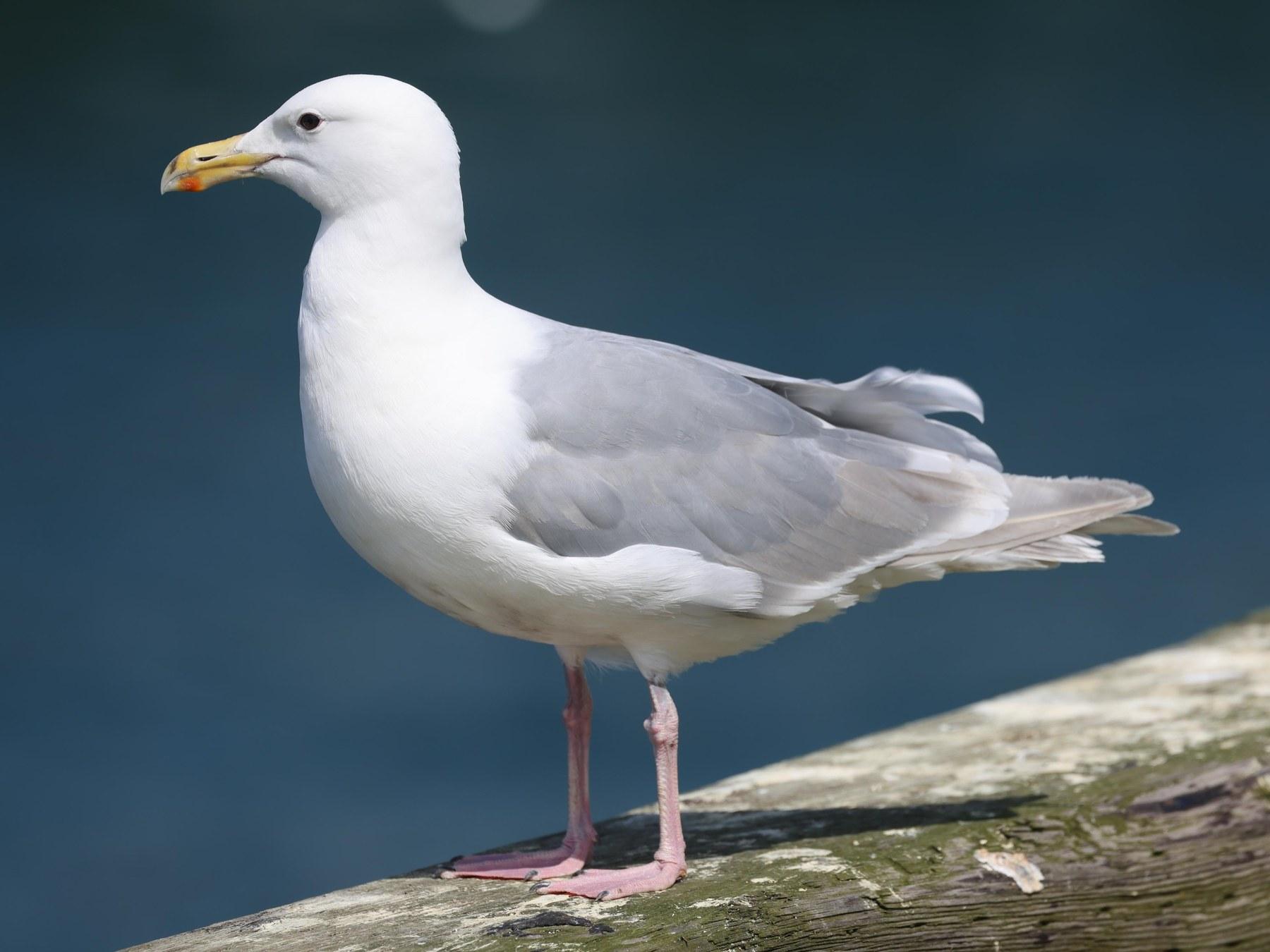
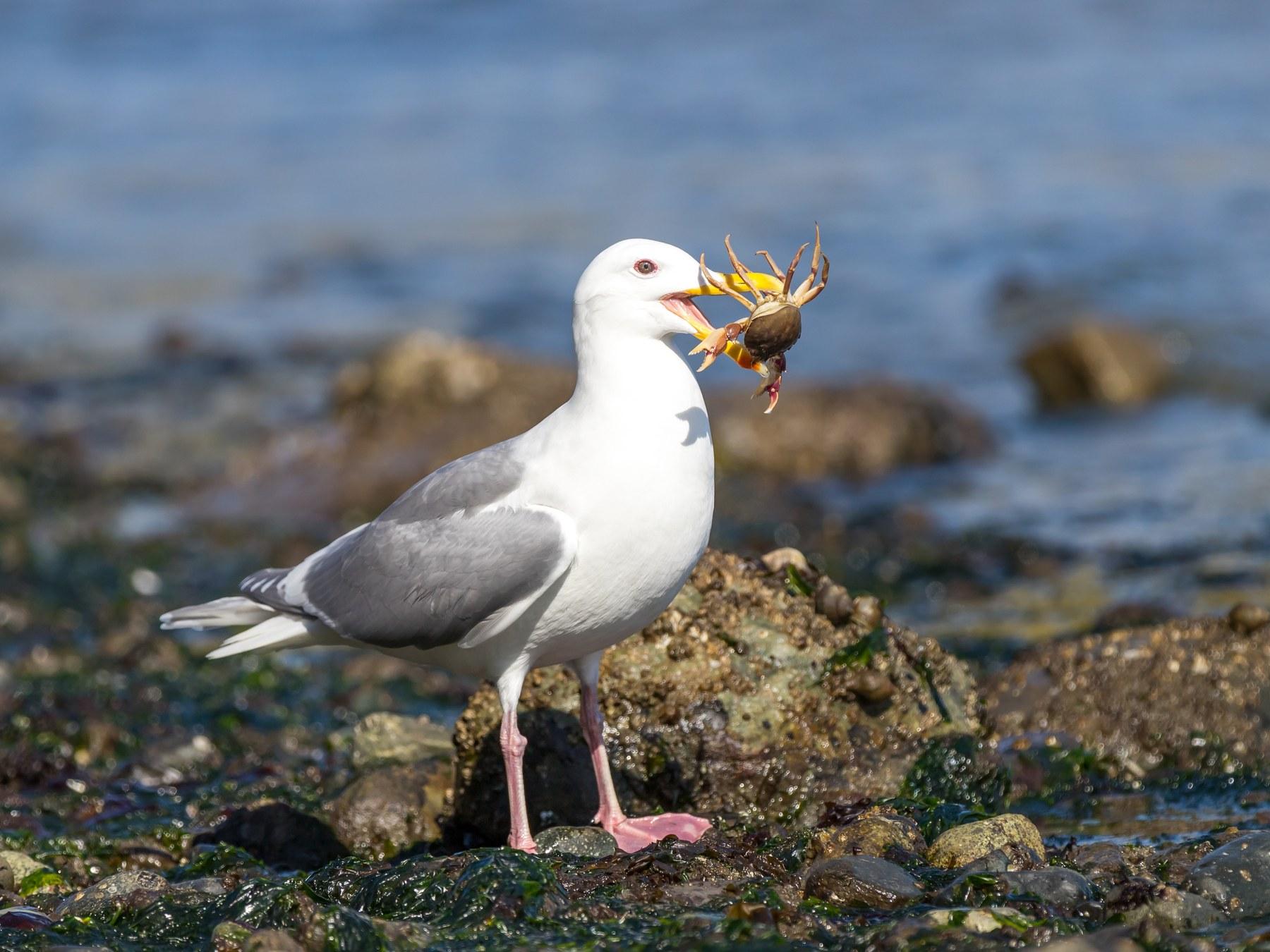
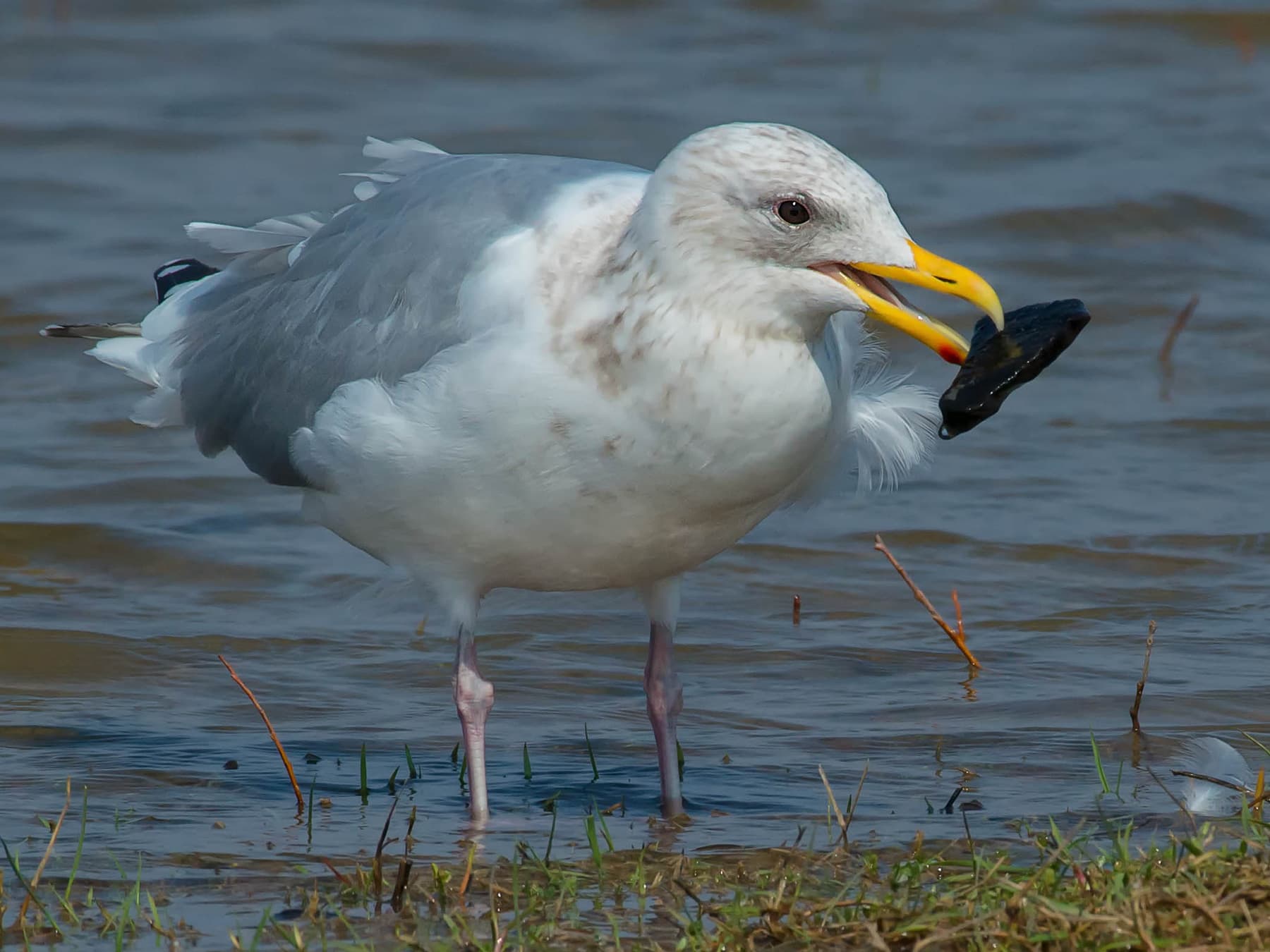
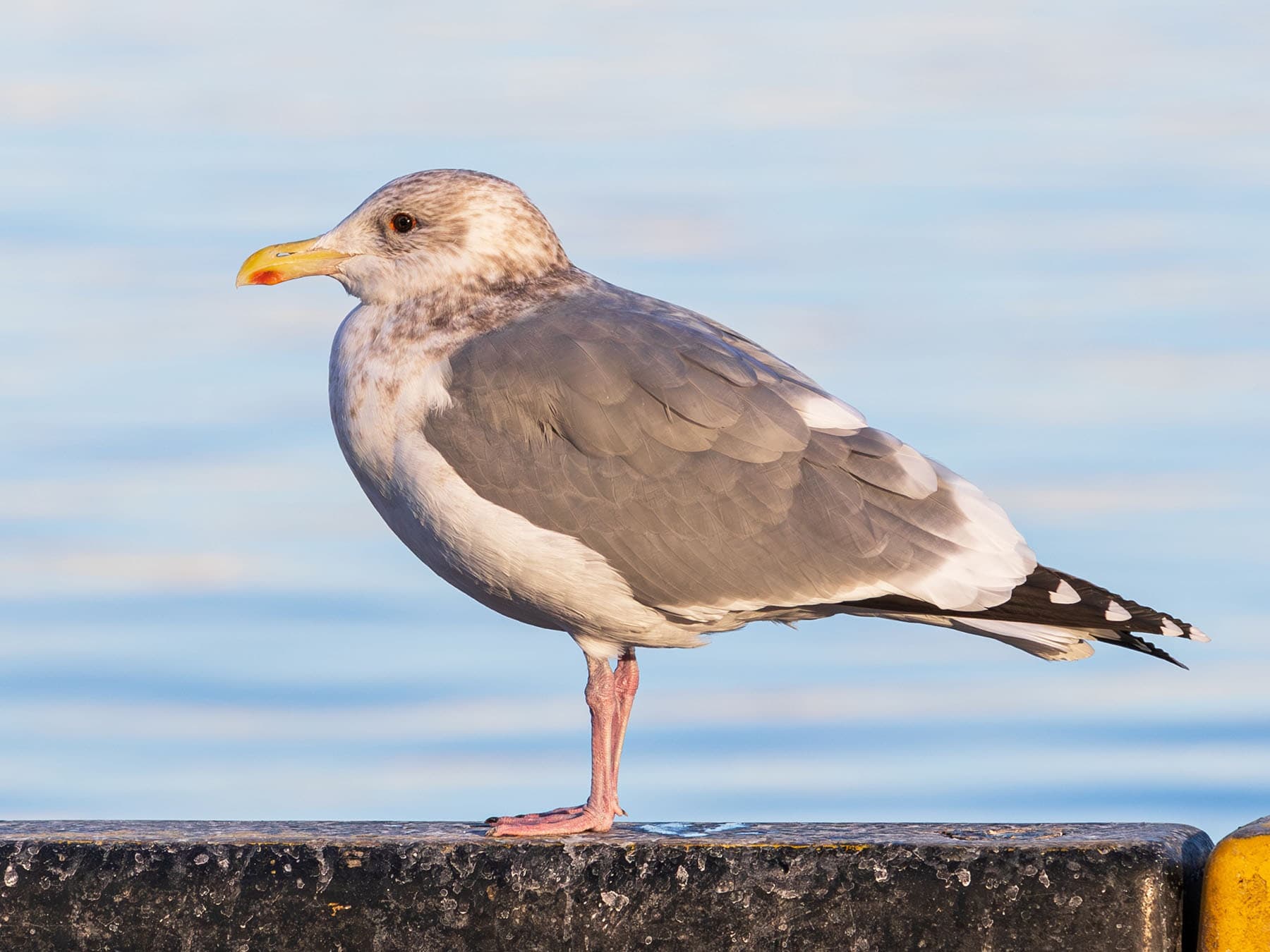
Look for a big, bulky gull with a large, rather flat head, short broad wings and a heavy bill. Adults are white with a pale gray back, and the mark to look for is the wingtip: it is the same soft gray as the back, with no black at all. Males and females look alike, though males are a little larger.
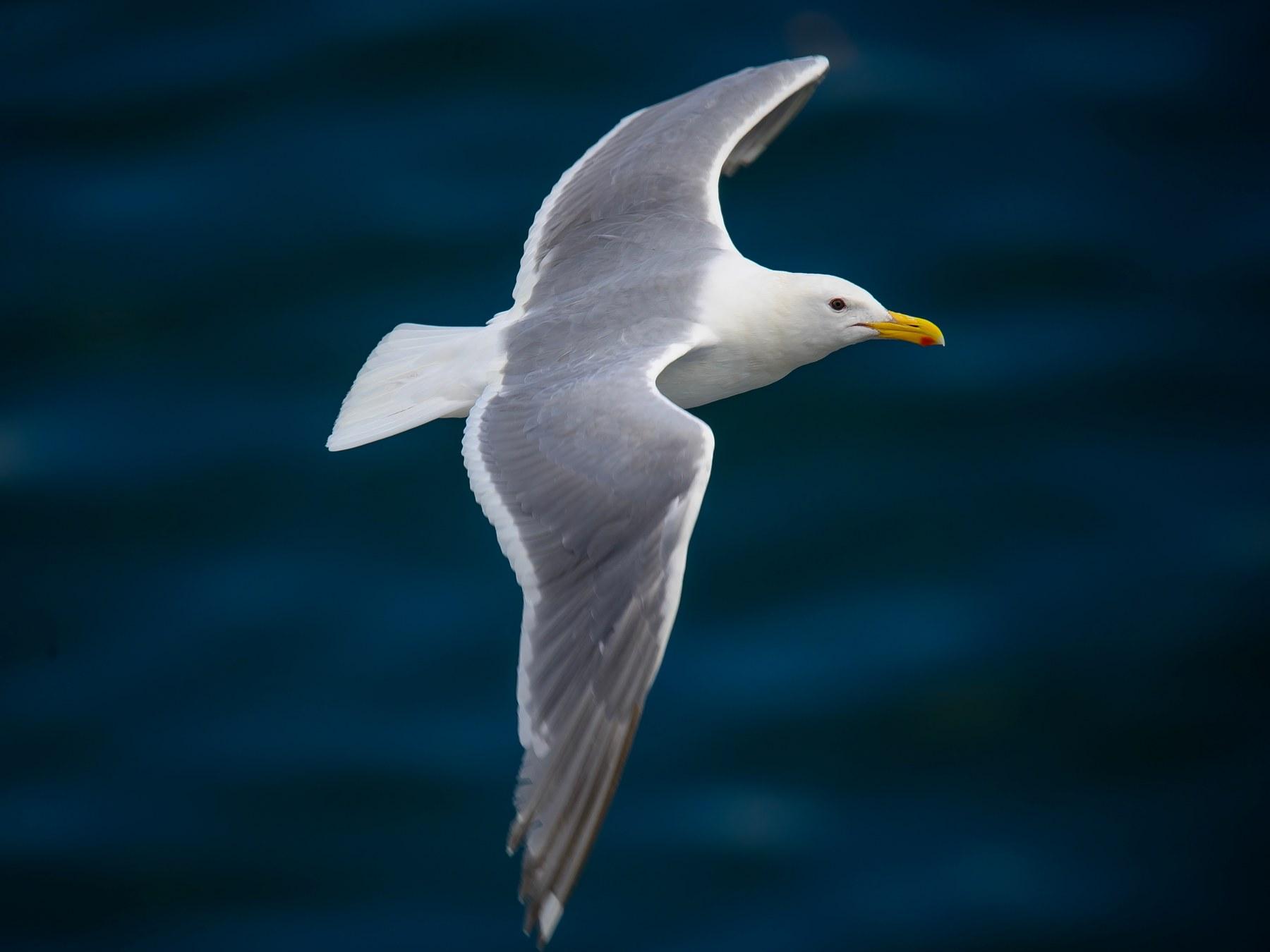
Close up, an adult has small, dark eyes set high on the head, each ringed with reddish-purple skin, pink legs, and a yellow bill with a red spot near the tip of the lower half. In flight the gray wing has a broad white trailing edge, and the white tips to the flight feathers show as a row of pale spots, sometimes called a string of pearls. The outermost wing feather has a white patch, or mirror, near its tip, and some birds show smaller mirrors on the next one or two.
Size and weight
This is one of the largest gulls in North America: 22.4-24.4 in (57-62 cm) long, with a wingspan of 52.0-53.9 in (132-137 cm) and a weight of 31.4-48.0 oz (890-1,360 g), roughly 2-3 lb. It is bigger than an Iceland Gull and smaller than a Glaucous Gull.
Males are heavier. In a Washington sample, males averaged 43.2 oz (1,224 g) and females 33.8 oz (957 g).1
Adult plumage in summer and winter
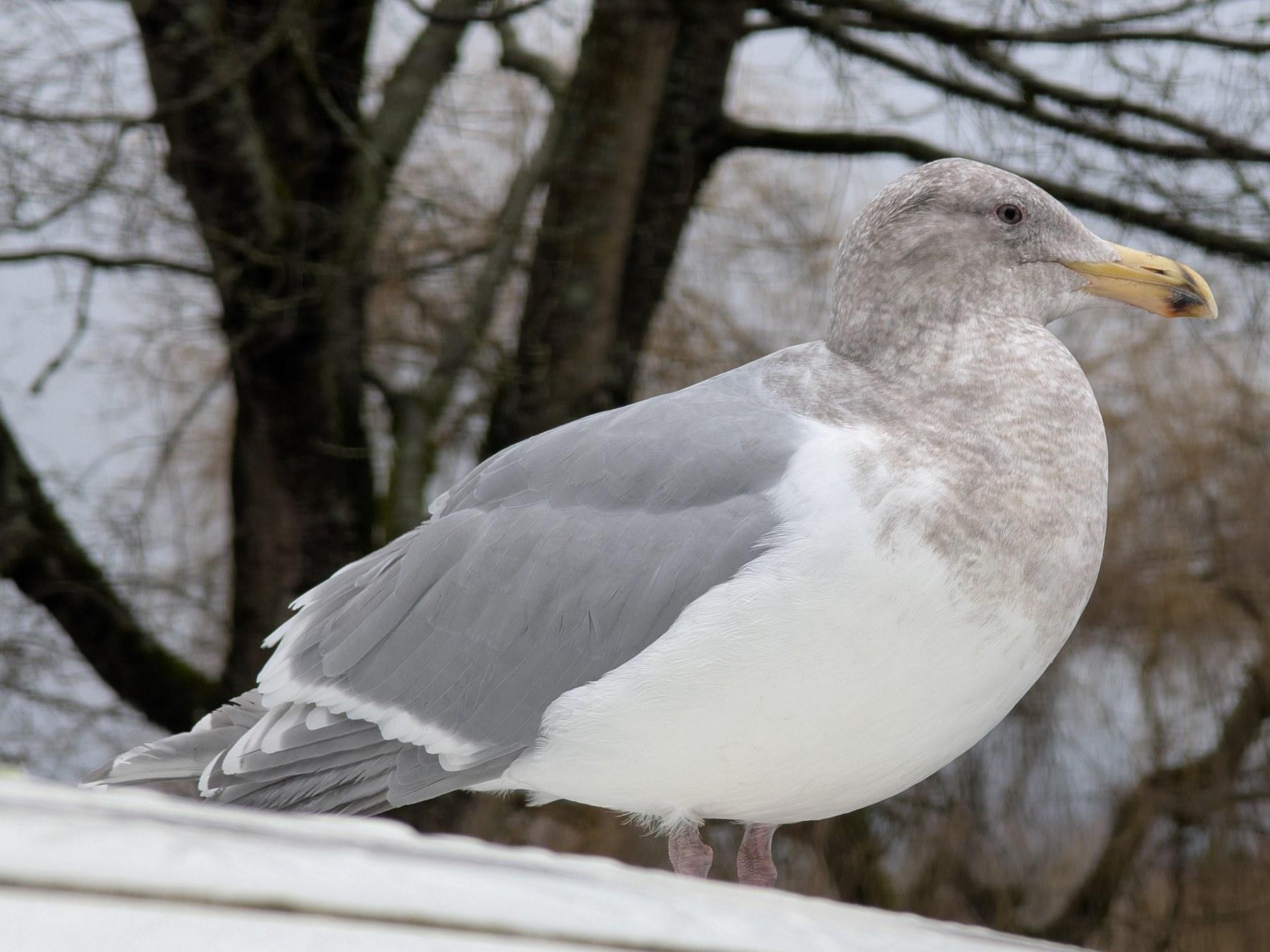
In breeding plumage the head, neck, underparts and tail are clean white, the legs bright pink and the bill spot red. In winter the head, neck and sides of the breast are thickly streaked brownish gray, which gives the bird a hooded look, the legs turn a duller pink, and in most adults the red bill spot is clouded with black from the fall. The gray wingtips stay the same all year.
Young gulls: plumage by age
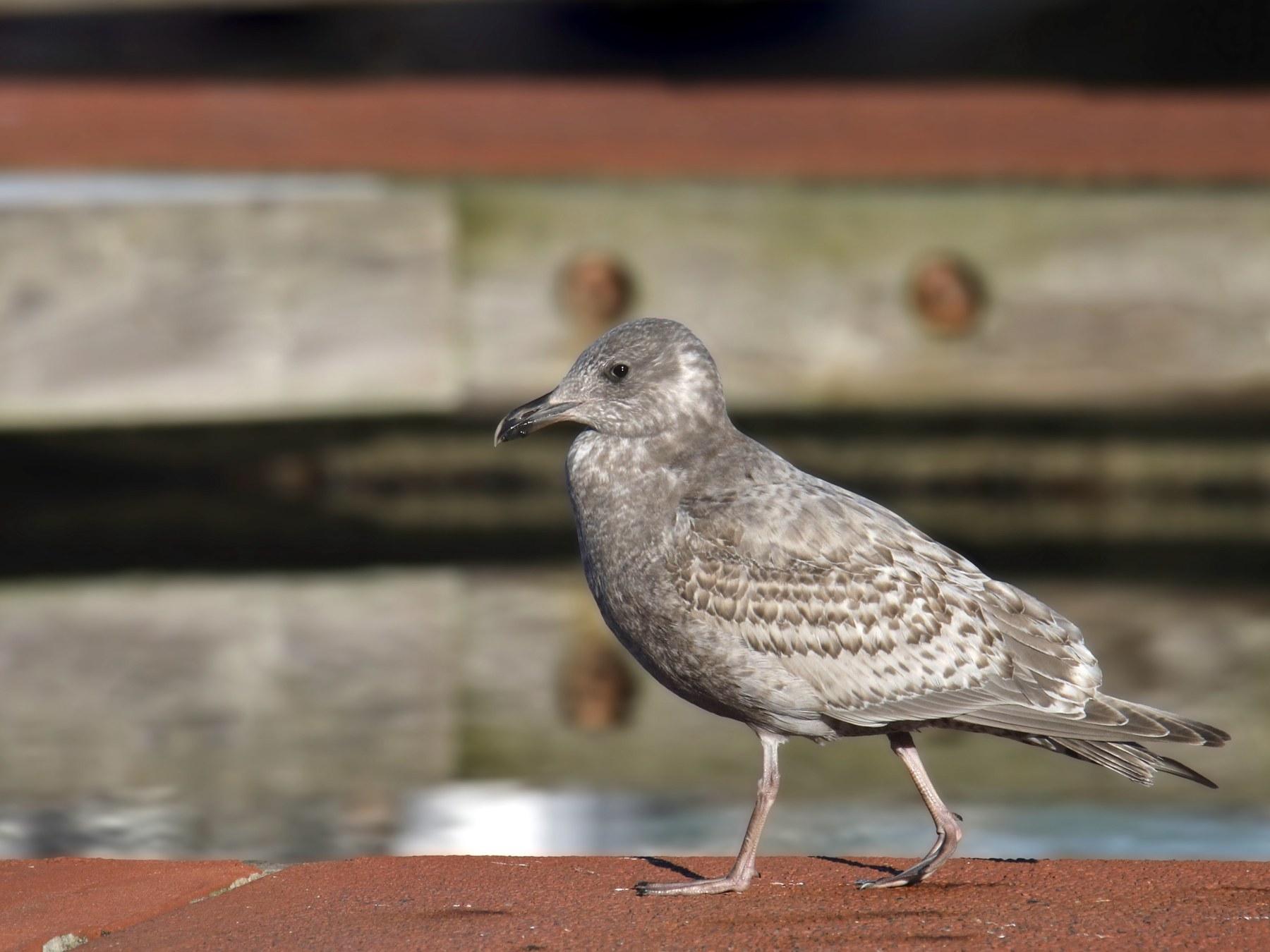
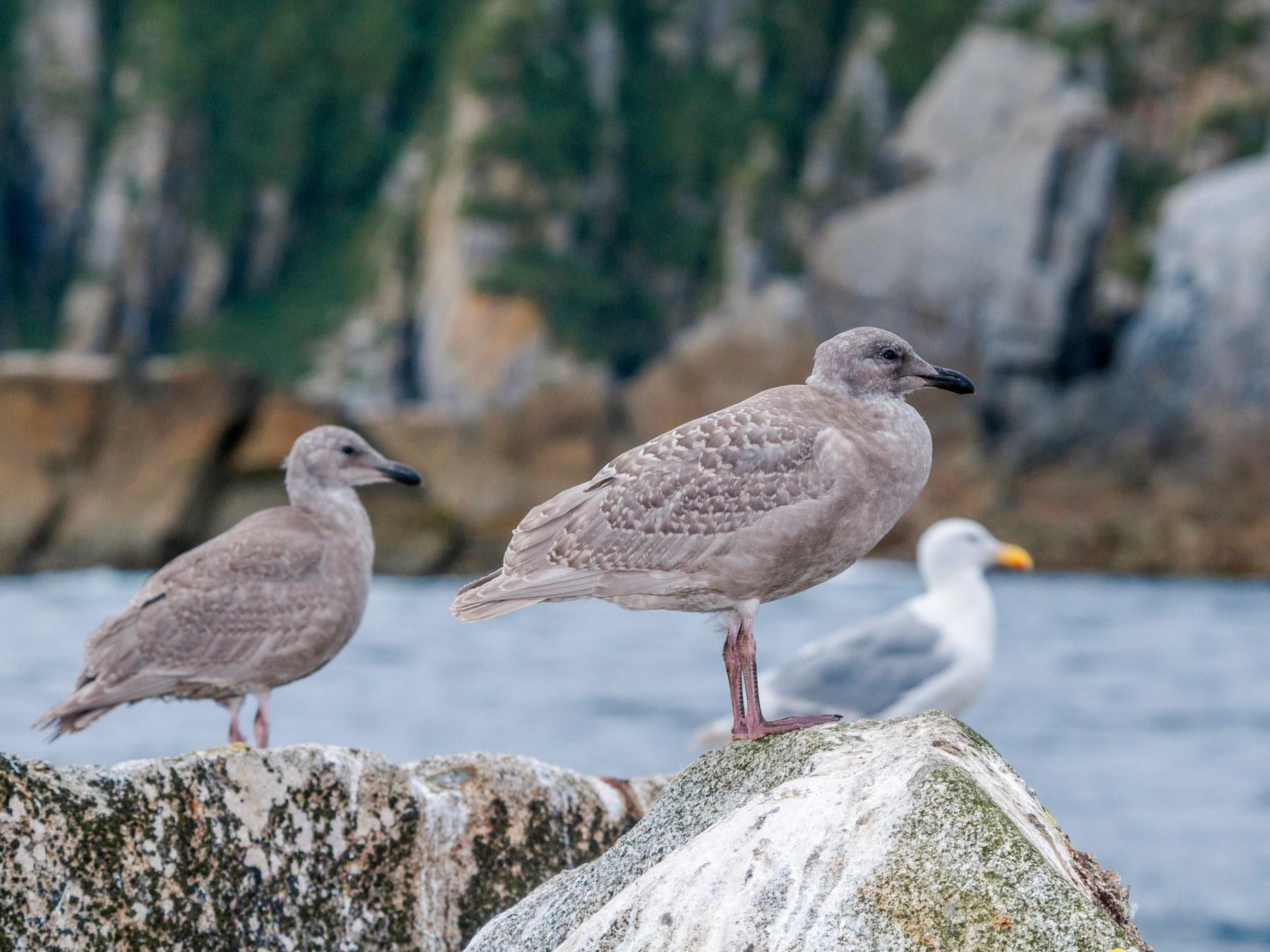
This is a four-year gull: three-year-olds look nearly adult but keep dark tips to the tail, and adult plumage comes at four. Young birds in their first winter are the ones to learn. They are pale gray-brown nearly all over, or mottled brown and white, with a heavy black bill. Unlike most young gulls they have no blackish flight feathers or dark tail: the wingtips are pale brown like the rest of the wing. Young birds from hybrid stock are darker.
From midwinter into their first spring, many first-year birds look white-headed, as old feathers wear and bleach rather than molt; in one study 60-70% showed it.1 In the second winter a bird is smudgy brown with pale tan wingtips, its back turning gray, and its bill varies a lot from bird to bird. By the third winter the back is gray like an adult's, with a faded brown wash on the wing, pale tan wingtips and often part of a dark tail band. Newly fledged young at the colony are mid- to dark gray with pale buff feather tips and a black bill.
The in-between ages are not well studied, and some published descriptions of them may involve hybrids, so an odd-looking young gull in the Pacific Northwest is often best left unnamed.
Identification: hybrids and the 'Olympic Gull'
Hybrids are the main identification problem. The Glaucous-winged Gull interbreeds with the Western Gull in Washington and Oregon, with the Slaty-backed Gull in Japan, Kamchatka and the Commander Islands, and with the Glaucous Gull and American Herring Gull in Alaska. The Glaucous-winged x Western hybrids are common enough to have an informal name, the 'Olympic Gull'.
Hybrids are in-between birds: often a medium-gray back, wingtips darker than a pure bird's and a darkish eye, so that some look like a large version of the 'Thayer's' form of the Iceland Gull; the flatter, bigger head and thick, angled bill give them away. A Glaucous-winged x Western hybrid that looks like an American Herring Gull usually has a yellow or gold eye with a yellow to orange ring. Some keep the dark eye and purple or red ring of a Glaucous-winged, and backcrosses can look very like a pure parent. Hybrids with Glaucous or Herring Gulls in Alaska often have a dark eye. The shade of the back and of the wingtips is among the best ways to sort them, since the two species overlap in measurements.2
Identification: the hybrid zone
The Western Gull hybrid zone runs along the coast from the Strait of Juan de Fuca, Washington, to Coos Bay, Oregon, centered near Grays Harbor, with a broader spread of mixed genes north to the Queen Charlotte Islands of British Columbia.2 Hybrids were noted on the Olympic Peninsula as early as 1900.1 On Destruction Island, Washington, a study published in 1978 found that over half the breeding birds were intermediate in eye, eye-ring, back shade and wingtip pattern.3 In Bell's 1996 study of 706 specimens from 33 colony areas, the hybrids' genes sat nearer to Glaucous-winged than to Western Gulls, and the zone acted as a partial barrier to gene flow; it also appeared to have expanded while its midpoint stayed put.2 A 2024 study of the zone's ecological niches treats it as stable.4
Identification: similar gulls
The Western Gull is about the same size but has a darker gray back, black wingtips and a golden-brown eye, and its first-year birds are mainly dark brown.
A Glaucous Gull is larger and paler, with white wingtips, a yellow eye and a long, straight bill. Young Glaucous Gulls have a pink bill with a sharp black tip, where a first-year Glaucous-winged has an all-dark bill and averages darker. Worn Glaucous-winged Gulls are often mistaken for Glaucous Gulls.
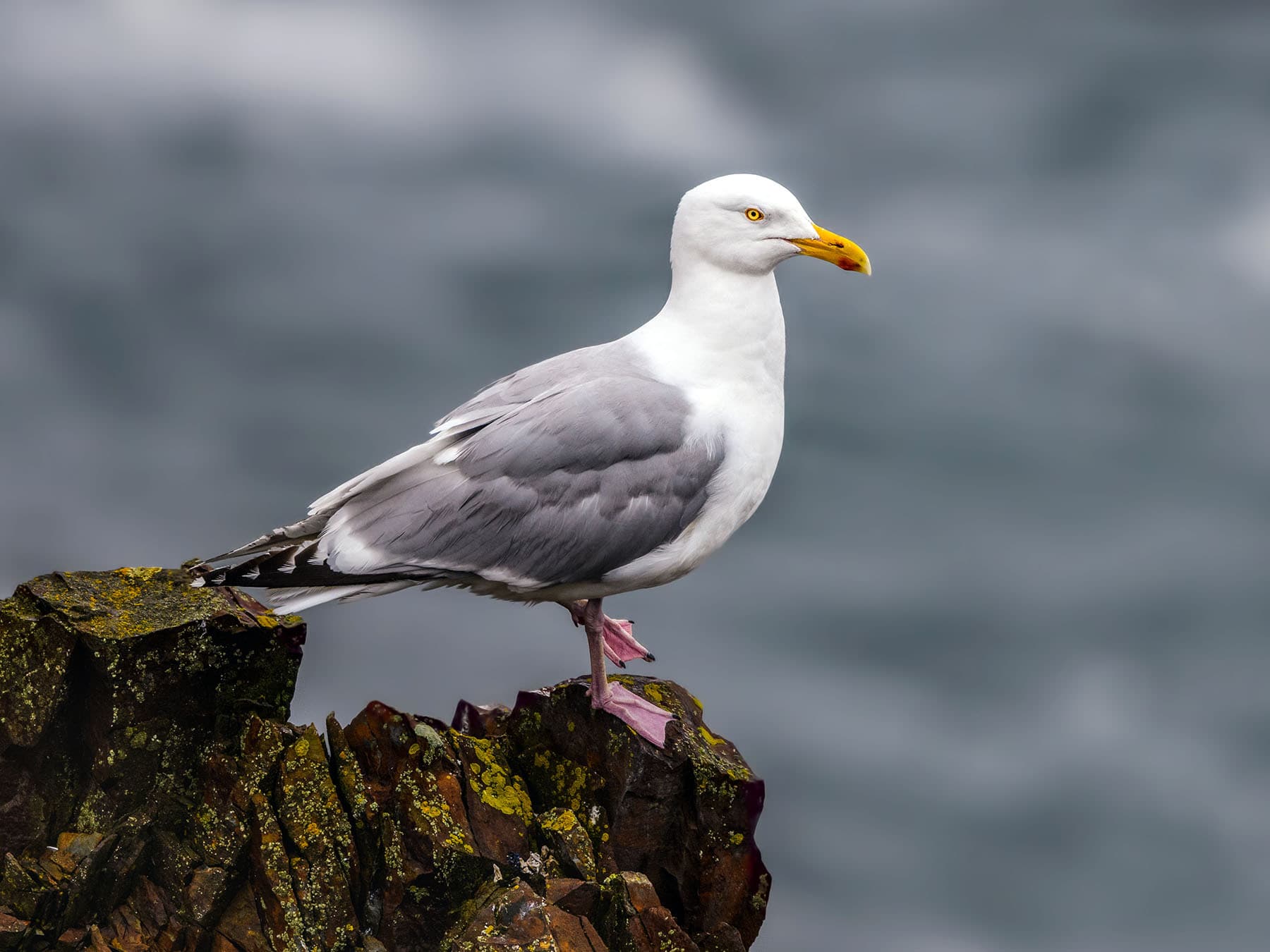
An American Herring Gull is slightly smaller, with black wingtips holding white spots and a golden eye; its young are darker, without the pale brown wingtips. On parts of the Alaska coast the two interbreed so freely that some colonies may hold no pure Herring Gulls.5 An Iceland Gull, including the 'Thayer's' form, is smaller and slimmer-billed, with wingtips that run from white to gray to dark.
The California Gull is smaller and slimmer-billed, with a darker back, black wingtips, greenish-yellow legs and a red and a black spot on the bill. A Vega Gull, an Asian gull that reaches Alaska, and the Slaty-backed Gull both have black in the wingtip, the Slaty-backed with a much darker back and bright pink legs.
Not sure it’s a Glaucous-winged Gull? Check your photo: Birdfact names the bird and shows the look-alike side by side.
Its size
Adults- Length
- 58–62 cm
- Wingspan
- 132–137 cm
- Weight
- 890–1360 g
Its song and calls
It has no song in the songbird sense. Its calls are much like those of Herring Gulls and other large gulls, and the everyday call is a kjau, heard all year on the ground and in flight.
In the long call, a bird leans forward and gives a run of loud notes, written as au-au-khau-khau-khau: two longer, coarser notes and then shorter ones. Both sexes give it, and in one study a whole bout lasted about 4.8 seconds on average.1 A gull that sees a person or predator still some way off gives two or three short ka notes, and a loud, often repeated call when the danger is close to the nest or chicks. Mates, and parents with young, use a drawn-out, repeated mew, and chicks beg with a thin we-e-e call.
It calls all year and most in the breeding season, when it calls at night as well, though mostly by day. We found no study comparing hybrids' calls with either parent's; the main handbook account, written in 2008, calls it unknown.
- Calls0:00 / 0:11
Recorded in British Columbia, Canada · August 2022
Heard one and not sure? Let the bird song identifier listen.
When and where to see it
This is a gull of the North Pacific coast. It breeds on coastal islands and cliffs from Russia's Commander Islands, Kamchatka and the Kuril Islands through the Aleutian and Pribilof Islands and western Alaska, and south along the coast of British Columbia and Washington to northwestern Oregon. It also nests on inland lakes in southwest Alaska and on the Alaska Peninsula.
From Alaska to Washington it can be seen all year. Farther south it is mainly a winter bird, common in California from November to March and reaching northwestern Mexico, and in Asia it winters south to Hokkaido, with some as far as Tokyo. Look for it on beaches and rocky shores, in harbors, fishing ports and estuaries, and on piers and waterfront roofs; it is rarely found inland except at landfills.
Migration and winter range
It is a partial migrant. Some birds stay on their territories through the winter, while many others move south between late August and late October, and Alaska birds move ahead of the advancing sea ice. In winter some go well out to sea, up to 340 mi (550 km) offshore in the Gulf of Alaska and off British Columbia and California.
Young birds mostly stay fairly close to home. Of first-year birds banded in British Columbia, 74% were found within 124 mi (200 km) of where they hatched, and under 5% of birds up to 25 months old went more than 600 mi (965 km), though one traveled about 1,240 mi (2,000 km). Strays have reached Hawaii, Illinois and Newfoundland, and even Morocco, the Canary Islands and Ireland. During the 20th century the breeding range spread north to St. Matthew Island in the Bering Sea, linked to a northward shift in the sea ice.1
Spotting tips
Check the wingtips first: on an adult they match the back, with no black. In winter, look through gulls at harbors, landfills and fish-processing plants, and remember that in Washington and Oregon, where it meets the Western Gull, a pale gull with darker wingtips may be a hybrid. Young birds are easiest to name in their first winter, when they are pale brown nearly all over, wingtips included, with a black bill.
What it eats
The Glaucous-winged Gull eats almost anything: fish such as herring, sand lance and anchovies, mussels, clams, crabs, barnacles, chitons, limpets, sea stars and sea urchins, carrion and garbage. What it eats depends on where it lives. In the western Aleutians it takes chitons, limpets, sea urchins, mussels and fish, and seabirds such as storm-petrels and auklets; around southern British Columbia, garbage, herring, sand lance and shellfish; and in Monterey Bay, anchovies and squid.
It walks the shore at low tide picking up food and pulling chitons and limpets off the rocks, plunges in head first from 3-5 ft (1-1.5 m) above the water and snatches food at the surface. It carries clams, crabs and oysters up and drops them, often again and again, onto rocks or pavement to break them open. It also steals food from other gulls and other birds, and kills some prey: chicks of other Glaucous-winged Gulls, Rock Pigeons, seabirds and, on Middleton Island in Alaska, feral rabbits.
Feeding at boats, rivers and landfills
It follows fishing boats, gathers at fish plants and landfills, and waits near feeding bears, Bald Eagles and Peregrines for leftovers. In southwest Alaska, bears and gulls together scavenged 20-30% of dead sockeye salmon within two days of their death, and in Prince William Sound gulls were estimated to eat about 26% (223 metric tons) of the spring herring spawn. Birds from Vancouver have been reported making daily round trips of up to 87 mi (140 km) to feed. In some areas gulls fly inland to landfills as the tide rises and go back to the shore to feed and bathe at low tide.
Adults catch fish more successfully than young birds, and feeding skill improves with age. Gulls learn to avoid shellfish carrying paralytic shellfish poison and can bring it back up.1
Food then and now
Feathers tell a longer story. Feathers from Salish Sea colonies collected from 1860 to 2009 show the diet has become less marine and lower in the food chain, though the authors call the data equivocal on whether the gulls switched to garbage or to marine invertebrates.6 A study of mercury in feathers from 1887-1996 supports the shift.7 In a study published in 2017, though, near-shore marine prey still made up most of the breeding diet at three British Columbia colonies.8 At two colonies off Vancouver Island, chicks were fed mainly fish, and the main fish moved from Pacific herring in the 1980s to Pacific sand lance in 2009 and 2010.1
Nesting and breeding
Glaucous-winged Gulls nest in colonies, rarely alone, mostly on small, flat, low islands with bare rock and short plants, often of 5-25 acres (2-10 hectares). Colonies hold anything from under 10 pairs to 10,000. In British Columbia, 96% of nests were on the ground and 4% on sea cliffs. They also nest on breakwaters, piers and the roofs of waterfront buildings. By 1986 downtown Vancouver held about 500 pairs on roofs, and a survey in Victoria found 99 roof nests, with one to nine pairs a roof; on roofs they choose sites near water and near other nesting gulls.
In southern British Columbia the first birds return to the colonies in early February and most are back by late April. Pairs are monogamous and usually stay together for years: in one study 95% of 94 pairs kept the same mate from one year to the next. They first breed at 4-7 years old in Washington and British Columbia; on Protection Island, Washington, the average was 5.4 years, and 59% started at five.1
The nest and eggs
The nest is a scrape ringed with torn turf and moss, built up with grass, weeds, roots, twigs, seaweed and odds and ends such as string or bones. Both birds build, and a pair may start several nests but finish only one. A sample of 100 nests averaged about 15 in (38.6 cm) across, with a cup 8.5 in (21.6 cm) wide and 4.2 in (10.6 cm) deep.
First eggs are laid from early May in Washington, late May to early June in southern British Columbia and around 2 June on Squab Island, Alaska, and older birds lay earlier. The clutch is 1-4 eggs, usually 2-3; in four samples, three-egg clutches made up 57-84% of the total. The eggs are olive-green to grayish olive, with dark brown and olive-gray scrawls and blotches. Both parents incubate for 26-29 days, in earnest once the clutch is complete. A pair raises one brood a year and may lay again 12-13 days after losing a clutch.1
By 2009-2010, Salish Sea gulls were laying fewer, smaller eggs, and later. Clutches there averaged 2.82 eggs in 1962 but 2.25 by 2009, and eggs have shrunk about 5% in volume since 1902. Mean first-egg dates moved from 15 May in 1959-1986 studies to 22 May in 2008-2010. Five of the nine clutch studies came from one island, and the author says the declines were likely due to less food.9 On Triangle Island, off the open coast of British Columbia, clutches averaged 2.3-2.9 a year in 2002-2011.10
Nestlings and fledging
Chicks hatch with their eyes open, in pinkish-cinnamon to buff down spotted black on the head and throat, and weigh about 2.4 oz (68 g). They stay in or near the nest for two days, then run and hide when disturbed, and both parents feed them by bringing up food, mostly fish. Chicks know their parents' mew call, but adults do not recognize their own chicks. Chicks that stray into a neighbor's territory are attacked and sometimes killed, and neighboring adults caused about 45% of chick deaths, mostly in the first week.
On Mandarte Island, British Columbia, young birds first flew at about 44 days (37-53) and left the colony at about 57 days. In studies from Alaska and British Columbia, 32-81% of eggs hatched, and each female raised from 0.98 to 1.87 young.1
Hybrid pairs and breeding success
Studies disagree on how mixed pairs fare. On Destruction Island, in the 1978 study, pure pairs hatched fewer eggs than pairs with a hybrid.3 At two colonies in the hybrid zone, females paired with hybrids did better, which the authors tied to nest habitat and a diet with more fish.11 Across eight mixed colonies in 1989, Western-type birds did best.12 On Protection Island in 2010, among 81 pairs, hatching success and clutch size did not differ.13 Whether like pairs with like is disputed too: two studies found it,3, 13 one found it only weakly12 and one found little evidence.11 In the hybrid complex at Grays Harbor, nests in dense plants lost fewer eggs, probably to predators.14
Nesting colonies and their islands
Gull colonies change the islands they nest on. On Mandarte Island, British Columbia, 18 native plant species, 32% of those once recorded, were lost and 31 exotic species arrived over 116 years, as the gull colony grew and old-growth conifers died out. In a comparison of nearby islands, those with gull colonies had less native and more exotic plant cover and higher soil carbon and nitrogen, though the study shows only that these go together, not that the gulls cause them.15
Behaviour
The Glaucous-winged Gull flies strongly and buoyantly on slow, shallow wingbeats, rides updrafts and sits high on the water. It roosts in flocks on sheltered water, log booms and tidal flats; one 1972 study counted roosts of 6,100-29,000 birds. Birds leave the roost up to 45 minutes before sunrise and come back up to 45 minutes after sunset.1 Some pairs stay together through the winter and defend a stretch of beach.
On Protection Island, Washington, in a colony of Glaucous-winged Gulls and hybrids, numbers peaked between mid-March and mid-September, and few birds were on the island from late September to mid-January.16
Courtship behavior and colony defense
In courtship the female tosses her head and tugs at the male's bill until he brings up food, about twice a day and most often just before laying; in one study the meals averaged 0.6 oz (17.9 g), mainly fish.1 Displays include an upright threat posture, the long call, a mew display, grass-pulling and choking; unlike Herring Gulls it lacks the head-throwback.
Anyone walking through a colony meets a cloud of circling, calling gulls, and now and then a bird strikes from behind with its feet and can draw blood. Gulls also dive at Bald Eagles. Away from the colony, it chases Northwestern Crows and Rock Pigeons off food but can lose food to crows working together, and it gives way to Bald Eagles.
Lifespan and predators
The oldest Glaucous-winged Gull on the US Bird Banding Laboratory's longevity list was at least 26 years 2 months old. It was banded in British Columbia on 10 August 1993 and found dead in Washington on 25 October 2019, taken by a predator. The record before it was a bird of 23 years 10 months, banded in British Columbia in 1977.17
Most live much shorter lives. It rarely lives beyond 15 years, and in a 1960s British Columbia study birds that reached four years old were expected to live about 9.5 more years. In British Columbia and Washington studies adults survived 83-87% of years, while first-year survival was 40% in British Columbia birds banded as chicks and 61% on Protection Island; about half of young birds die within four months of fledging.1
Predators
Eggs and chicks are taken by other gulls, ravens, crows, Bald Eagles, river otters and foxes, and adults by Bald Eagles, Snowy Owls and river otters. Glaucous-winged Gulls made up 20% of the dead birds found on British Columbia beaches in surveys there.1
Conservation
The Glaucous-winged Gull is listed as Least Concern on the IUCN Red List, in a 2018 assessment.18 NatureServe ranks it secure worldwide (G5), but as a breeder in Oregon, at the southern edge of its range, it is ranked S2; these are conservation ranks, not legal listings.19 It is not on the Partners in Flight Watch List,20 and in Canada it was assessed as apparently secure in 2015.21
Population and trends
Partners in Flight estimates about 470,000 breeding-age birds worldwide and 440,000 in the US and Canada, for around 2010, scaled up from eBird data rather than counted.20 Canada's 2019 assessment puts its breeding numbers at 50,000-100,000 birds.21 Older counts use pairs and cannot be added to these: about 200,000 nesting pairs on the North American coast in counts from 1988-1990, roughly 133,000 of them in Alaska.1
The North American Breeding Bird Survey finds no significant change from 1968 to 2025 on its routes in Washington, Oregon, California and British Columbia (-0.37% a year, 95% credible interval -2.18 to +1.18, on 58 routes). Alaska's own routes show a fall that is not significant either.22 Within that, the survey's yearly index peaked in the mid-1990s, and its 2025 estimate is about half the peak value, though with a wide margin. The declines since 1993 (-2.16% a year) and since 2005 (-3.27% a year) are statistically significant, while the last ten years are not.22 Canada's 2019 assessment says survey results suggest a moderate decrease since about 1970, supported by winter surveys in British Columbia.21
Population changes in the Salish Sea
Numbers rose for much of the 20th century: the Strait of Georgia had 6,150 pairs in 1959-60 and 13,002 in 1986. In the Salish Sea numbers have fallen since, though sources place the turn anywhere from the early 1980s to the 1990s. Fourteen Strait of Georgia islands held 5,116 nests in 1986 and 3,506 in 1997-99, a 31% drop.1 A 2019 study puts the Georgia Basin peak in the early 1980s and cites a fall to about half of it by 2010,23 and the Protection Island colony in Washington grew until the early 1990s and then fell to about half.24
Several causes have been suggested. In the Strait of Georgia and in the Strait of Juan de Fuca, disturbance and predation by recovering Bald Eagles at colonies seemed partly responsible.1, 21 A feather study suggests that less fish in the diet may help to explain the declines.6 A model of Protection Island fitted gull numbers closely to eagle numbers, though its authors say other factors undoubtedly contributed.23
Conservation: contaminants, oil and disease
Eggs from Mandarte Island, a colony near cities, held up to about twice the PFAS, flame retardants and mercury of eggs from offshore Cleland Island in 2008-2022. One group of flame retardants (PBDEs) fell over that time, while other flame retardants, PFAS and mercury dipped and then rose again in recent years.25 Eggs from the Seattle area in 1984 had shells 8-10% thinner than eggs collected in Puget Sound before 1940.
After a 1988 oil spill, numbers fell on the northwest coast of Vancouver Island, and after the Exxon Valdez spill, studies of Prince William Sound disagreed on whether numbers had increased by 1998.1 On Protection Island, in a colony of Glaucous-winged Gulls and hybrids, in 2006-2011 egg cannibalism rose and hatching success fell in years with warmer seas, though the authors say it is unclear whether this affects numbers.26 In a 2023 H5N1 bird flu outbreak on Rat Island, Washington, among Glaucous-winged x Western hybrids, about 2-3% of the adults died, though chick deaths were high.27 In a 2020-2021 study of 202 wintering adults in British Columbia, birds at landfills, in towns and in natural places showed few differences in six blood measures of health, though the authors say they probably sampled healthy birds.28
Similar birds
Often mistaken for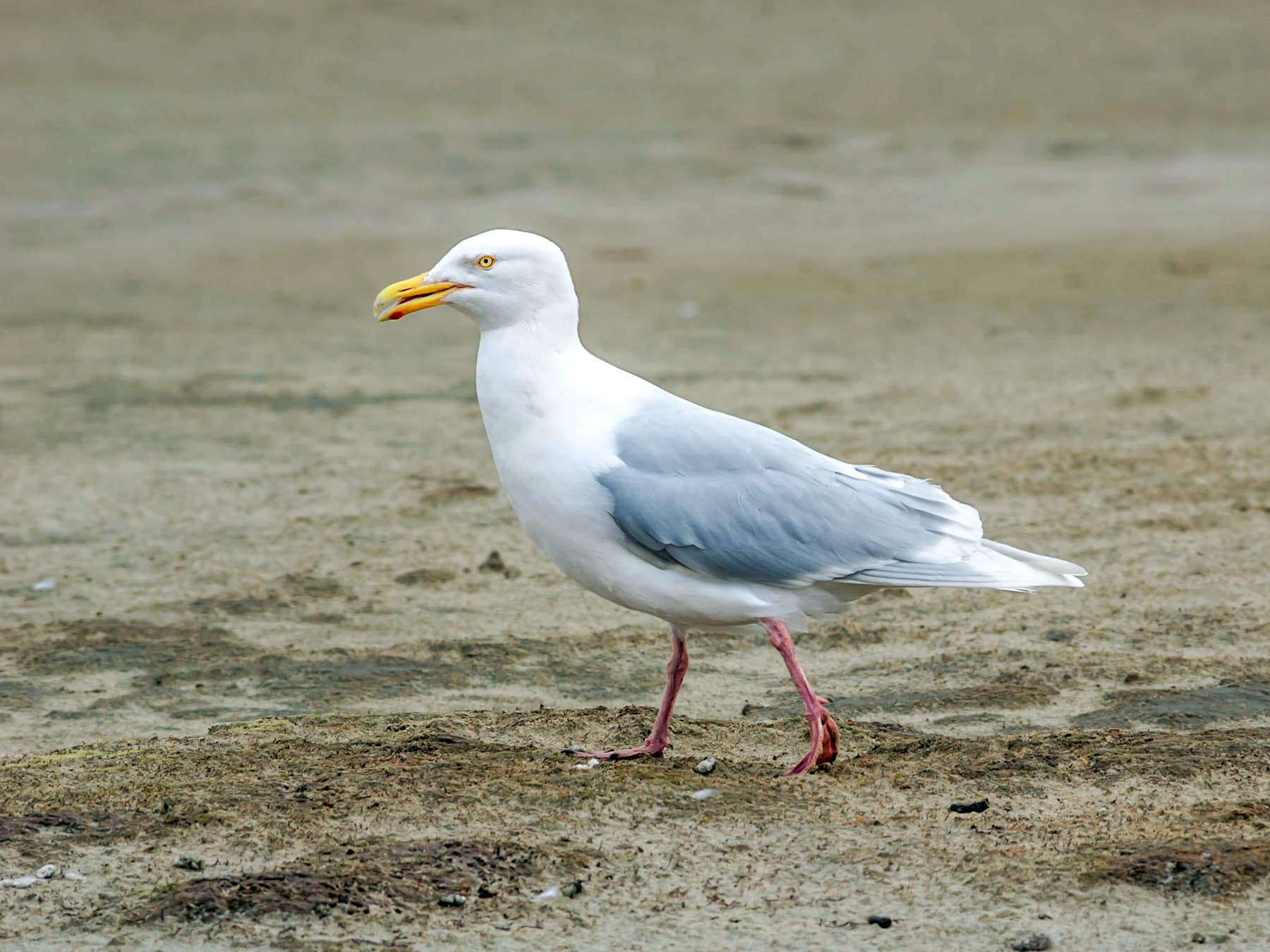
Quick facts
- Length
- 58–62 cm
- Wingspan
- 132–137 cm
- Weight
- 890–1360 g
- Lifespan
- oldest recorded 26 years 2 months
- Family
- Gulls & Terns
- Migration
- Partial migrant
- Global status (IUCN)
- Least Concern
- World population
- About 470,000 breeding-age birds worldwide (Partners in Flight's estimate, around 2010)
- Population trend
- No significant long-term change in the Breeding Bird Survey since 1968 (routes in Washington, Oregon, California and British Columbia; Alaska's own routes show a non-significant fall), but numbers peaked in the mid-1990s and have fallen significantly since then
- Scientific name
- Larus glaucescens
Questions
2What is its scientific name?
Are Glaucous-winged Gulls aggressive?
Near the nest, yes. They mob people who walk into a colony and now and then strike with their feet, and neighbors attack chicks that wander. We found no study that ranks gulls by aggression, so whether it is the most aggressive gull is not something the evidence answers.
Sources
41- 1Hayward, J. L. and Verbeek, N. A. (2020). Glaucous-winged Gull (Larus glaucescens), version 1.0. Birds of the World. Cornell Lab of Ornithology. doi:10.2173/bow.glwgul.01 (opens in a new tab)
- 2Bell, D. A. (1996). Genetic differentiation, geographic variation and hybridization in gulls of the Larus glaucescens-occidentalis complex. The Condor 98(3): 527-546. doi:10.2307/1369566 (opens in a new tab)
- 3Hoffman, W., Wiens, J. A. and Scott, J. M. (1978). Hybridization between gulls (Larus glaucescens and L. occidentalis) in the Pacific Northwest. The Auk 95(3): 441-458. doi:10.1093/auk/95.3.441 (opens in a new tab)
- 4Geng, X., Summers, J. and Chen, N. (2024). Ecological niche contributes to the persistence of the western x glaucous-winged gull hybrid zone. Ecology and Evolution 14(7): e11678. doi:10.1002/ece3.11678 (opens in a new tab)
- 5Pierotti, R. J. et al. (2026). American Herring Gull (Larus smithsonianus), version 2.0. Birds of the World. Cornell Lab of Ornithology. Accessed 20 November 2026. Source (opens in a new tab)
- 6Blight, L. K., Hobson, K. A., Kyser, T. K. and Arcese, P. (2015). Changing gull diet in a changing world: a 150-year stable isotope record from feathers collected in the Pacific Northwest of North America. Global Change Biology 21(4): 1497-1507. doi:10.1111/gcb.12796 (opens in a new tab)
- 7Choy, E. S. et al. (2022). Stable mercury trends support a long-term diet shift away from marine foraging in Salish Sea glaucous-winged gulls over the last century. Environmental Science and Technology 56(17): 12097-12105. doi:10.1021/acs.est.1c03760 (opens in a new tab)
- 8Davis, M. L., Elliott, J. E. and Williams, T. D. (2017). The Glaucous-winged Gull (Larus glaucescens) as an indicator of chemical contaminants in the Canadian Pacific. Archives of Environmental Contamination and Toxicology 73(2): 247-255. doi:10.1007/s00244-017-0368-y (opens in a new tab)
- 9Blight, L. K. (2011). Egg production in a coastal seabird, the glaucous-winged gull (Larus glaucescens), declines during the last century. PLoS ONE 6(7): e22027. doi:10.1371/journal.pone.0022027 (opens in a new tab)
- 10Hipfner, J. M. (2012). Effects of sea-surface temperature on egg size and clutch size in the Glaucous-winged Gull. Waterbirds 35(3): 430-436. doi:10.1675/063.035.0307 (opens in a new tab)
- 11Good, T. P., Ellis, J. C., Annett, C. A. and Pierotti, R. (2000). Bounded hybrid superiority in an avian hybrid zone: effects of mate, diet, and habitat choice. Evolution 54(5): 1774-1783. doi:10.1111/j.0014-3820.2000.tb00721.x (opens in a new tab)
- 12Bell, D. A. (1997). Hybridization and reproductive performance in gulls of the Larus glaucescens-occidentalis complex. The Condor 99(3): 585-594. doi:10.2307/1370471 (opens in a new tab)
- 13Moncrieff, A. E., Megna, L. C., Hayward, J. L. and Henson, S. M. (2013). Mating patterns and breeding success in gulls of the Larus glaucescens-occidentalis complex, Protection Island, Washington, USA. Northwestern Naturalist 94(1): 67-75. doi:10.1898/12-16.1 (opens in a new tab)
- 14Good, T. P. (2002). Breeding success in the Western Gull x Glaucous-winged Gull complex: the influence of habitat and nest-site characteristics. The Condor 104(2): 353-365. doi:10.1093/condor/104.2.353 (opens in a new tab)
- 15Lameris, T. K. et al. (2016). A century of ecosystem change: human and seabird impacts on plant species extirpation and invasion on islands. PeerJ 4: e2208. doi:10.7717/peerj.2208 (opens in a new tab)
- 16Hayward, J. L. et al. (2017). Daily and annual habitat use and habitat-to-habitat movement by Glaucous-winged Gulls at Protection Island, Washington. Northwestern Naturalist 98(3): 180-189. doi:10.1898/nwn17-02.1 (opens in a new tab)
- 17USGS Bird Banding Laboratory. Longevity records of North American birds: Glaucous-winged Gull. USGS Eastern Ecological Science Center, Bird Banding Laboratory. Accessed 20 November 2026. Source (opens in a new tab)
- 18BirdLife International (2018). Larus glaucescens. The IUCN Red List of Threatened Species 2018: e.T22694334A132543276. doi:10.2305/IUCN.UK.2018-2.RLTS.T22694334A132543276.en (opens in a new tab)
- 19NatureServe. Larus glaucescens: Glaucous-winged Gull. NatureServe Explorer. Accessed 20 November 2026. Source (opens in a new tab)
- 20Partners in Flight (2024). Avian Conservation Assessment Database, version 2024.05.23 (global). Partners in Flight. Accessed 20 November 2026. Source (opens in a new tab)
- 21Environment and Climate Change Canada (2019). Status of Birds in Canada: Glaucous-winged Gull (2019 edition). Government of Canada. Accessed 20 November 2026. Source (opens in a new tab)
- 22Hostetler, J. A. et al. (2026). The North American Breeding Bird Survey, Analysis Results 1966-2025. U.S. Geological Survey data release. doi:10.5066/P1OSNSFC (opens in a new tab)
- 23Henson, S. M. et al. (2019). Predator-prey dynamics of bald eagles and glaucous-winged gulls at Protection Island, Washington, USA. Ecology and Evolution 9(7): 3850-3867. doi:10.1002/ece3.5011 (opens in a new tab)
- 24Cowles, D. L., Galusha, J. G. and Hayward, J. L. (2012). Negative interspecies interactions in a Glaucous-winged Gull colony on Protection Island, Washington. Northwestern Naturalist 93(2): 89-100. doi:10.1898/nwn11-12.1 (opens in a new tab)
- 25Kesic, R., Elliott, J. E., Lee, S. L. and Elliott, K. H. (2024). Legacy and emergent contaminants in glaucous-winged gull eggs from Canada's Pacific coast: spatial distribution, temporal trends, and risks for human consumers. Environmental Pollution 363: 125099. doi:10.1016/j.envpol.2024.125099 (opens in a new tab)
- 26Hayward, J. L. et al. (2014). Egg cannibalism in a gull colony increases with sea surface temperature. The Condor 116(1): 62-73. doi:10.1650/condor-13-016-r1.1 (opens in a new tab)
- 27Haman, K. H. et al. (2024). A comprehensive epidemiological approach documenting an outbreak of H5N1 highly pathogenic avian influenza virus clade 2.3.4.4b among gulls, terns, and harbor seals in the Northeastern Pacific. Frontiers in Veterinary Science 11: 1483922. doi:10.3389/fvets.2024.1483922 (opens in a new tab)
- 28Hall, H. et al. (2025). Physiological health of wintering glaucous-winged gulls in coastal British Columbia. Conservation Physiology 13(1). doi:10.1093/conphys/coaf048 (opens in a new tab)
- 29U.S. Fish and Wildlife Service (2026). 50 CFR 10.13: List of Birds Protected by the Migratory Bird Treaty Act. Electronic Code of Federal Regulations. Accessed 20 November 2026. Source (opens in a new tab)
- 30Environment and Climate Change Canada. Birds protected in Canada. Government of Canada (Wayback copy of 4 Oct 2026). Accessed 20 November 2026. Source (opens in a new tab)
- 31AviList Core Team (2025). AviList: The Global Avian Checklist, v2025b. doi:10.2173/avilist.v2025b (opens in a new tab)
- 32American Ornithological Society (2026). Check-list of North American Birds (taxa.csv). American Ornithological Society. Accessed 20 November 2026. Source (opens in a new tab)
- 33Cornell Lab of Ornithology. Glaucous-winged Gull. All About Birds. Accessed 20 November 2026. Source (opens in a new tab)
- 34National Audubon Society. Glaucous-winged Gull. Guide to North American Birds. Accessed 20 November 2026. Source (opens in a new tab)
- 35Pierotti, R. J., Annett, C. A., Shaffer, S. A. and Devincenzi, D. M. (2024). Western Gull (Larus occidentalis), version 2.0. Birds of the World. Cornell Lab of Ornithology. Accessed 20 November 2026. Source (opens in a new tab)
- 36Weiser, E. and Gilchrist, H. G. (2020). Glaucous Gull (Larus hyperboreus), version 1.0. Birds of the World. Cornell Lab of Ornithology. Accessed 20 November 2026. Source (opens in a new tab)
- 37Snell, R. R., Pyle, P. and Patten, M. A. (2020). Iceland Gull (Larus glaucoides), version 1.0. Birds of the World. Cornell Lab of Ornithology. Accessed 20 November 2026. Source (opens in a new tab)
- 38Hebert, C. E. et al. (2024). Vega Gull (Larus vegae), version 1.0. Birds of the World. Cornell Lab of Ornithology. Accessed 20 November 2026. Source (opens in a new tab)
- 39Burger, J., Gochfeld, M., Garcia, E. and Kirwan, G. M. (2020). Slaty-backed Gull (Larus schistisagus), version 1.0. Birds of the World. Cornell Lab of Ornithology. Accessed 20 November 2026. Source (opens in a new tab)
- 40Winkler, D. W. (2020). California Gull (Larus californicus), version 1.0. Birds of the World. Cornell Lab of Ornithology. Accessed 20 November 2026. Source (opens in a new tab)
- 41Chugach Regional Resources Commission. Glaucous-winged Gull (Bird Ethnography of the Chugach Region). crrcalaska.org. Accessed 20 November 2026. Source (opens in a new tab)

Checked by
Nathan Cope, founder and editor
Nathan founded Birdfact and leads its writers and contributors in the UK, the US and Canada. He has watched and studied birds for more than ten years, and checks every article and species guide before it’s published.