


Glaucous Gull
Ice Gull, Snow Gull · Larus hyperboreus
By the Birdfact teamChecked by Nathan Cope
On this page14 sections
How to recognise it
What do Glaucous Gulls look like?
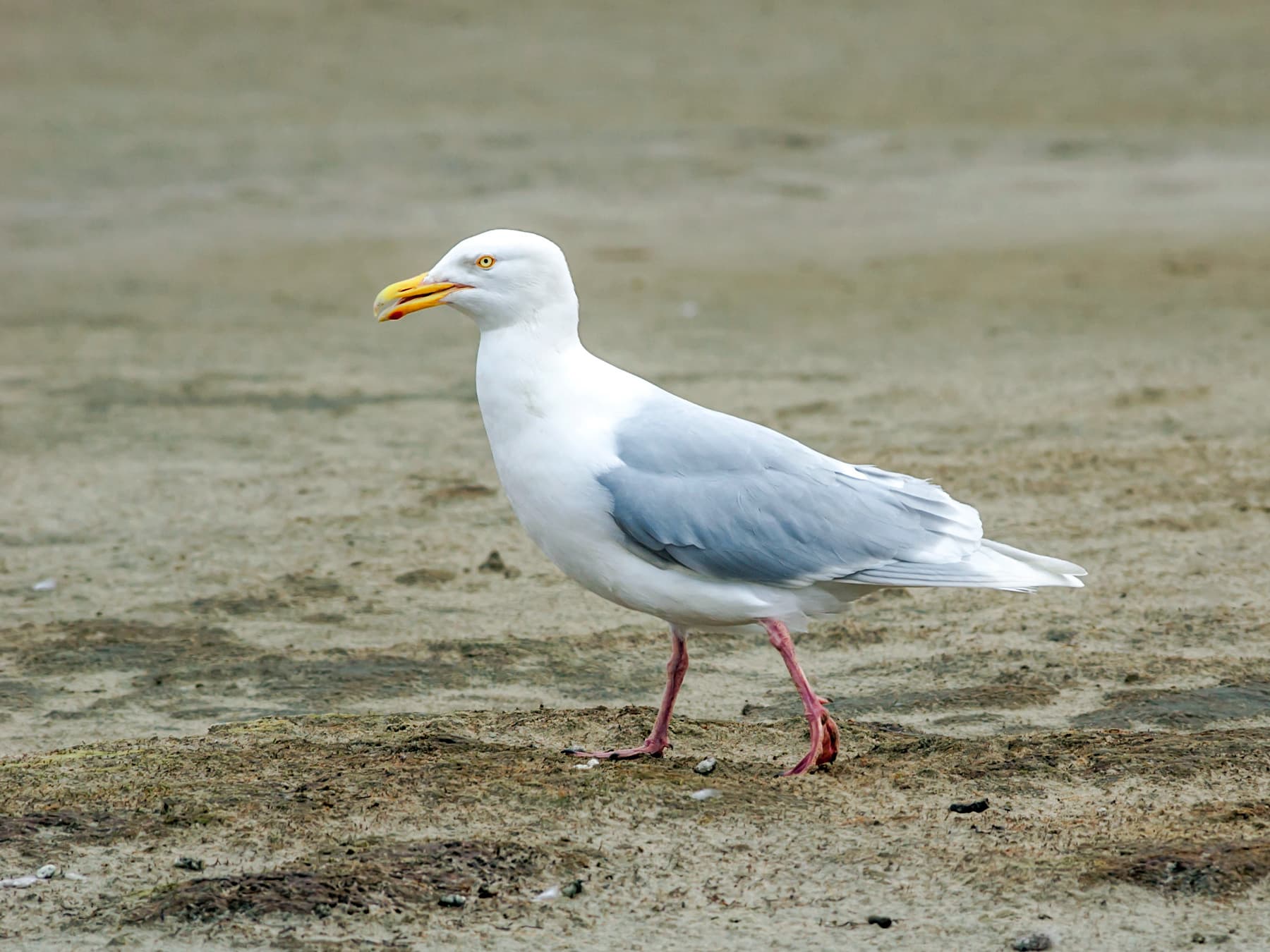
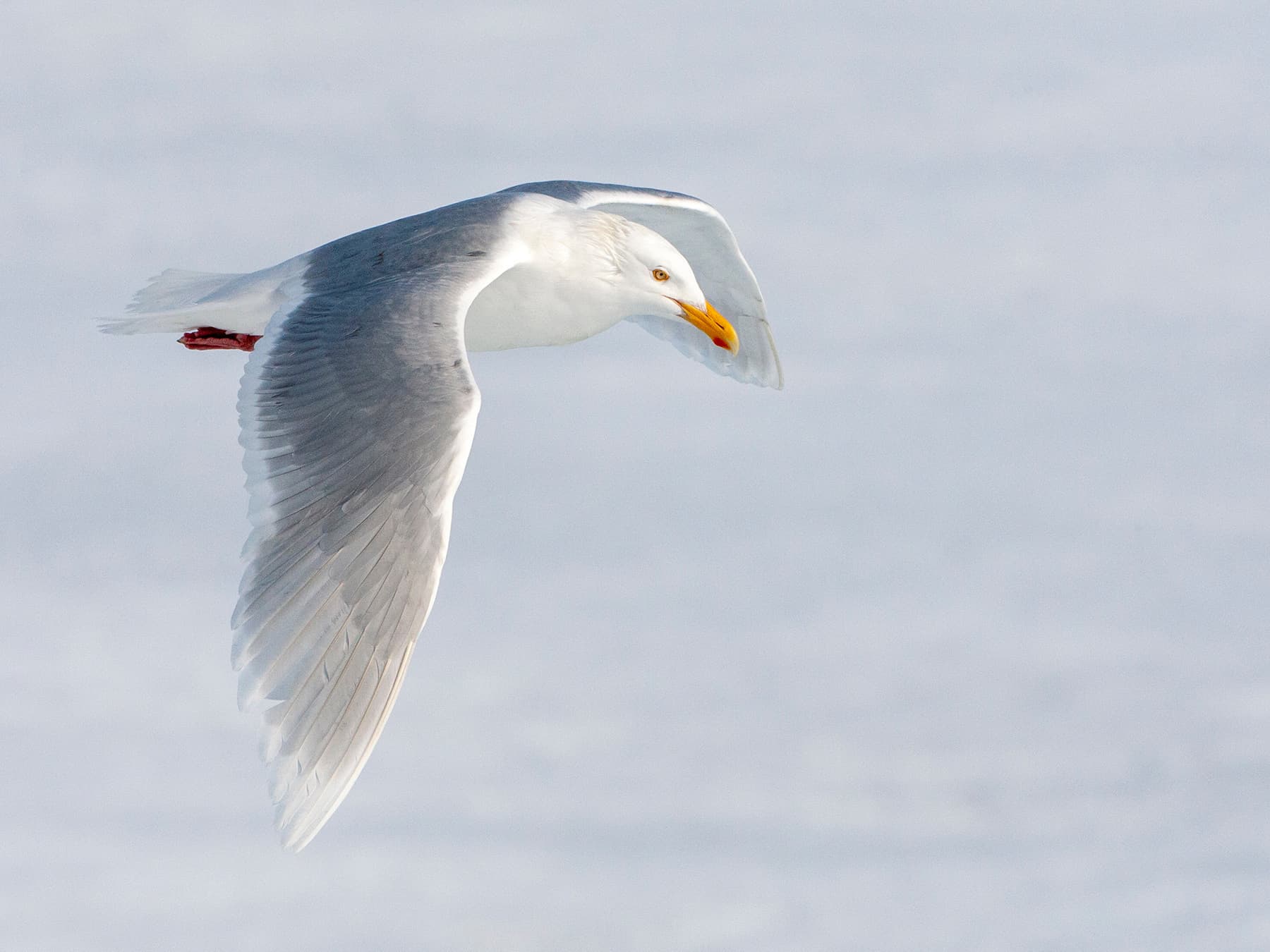
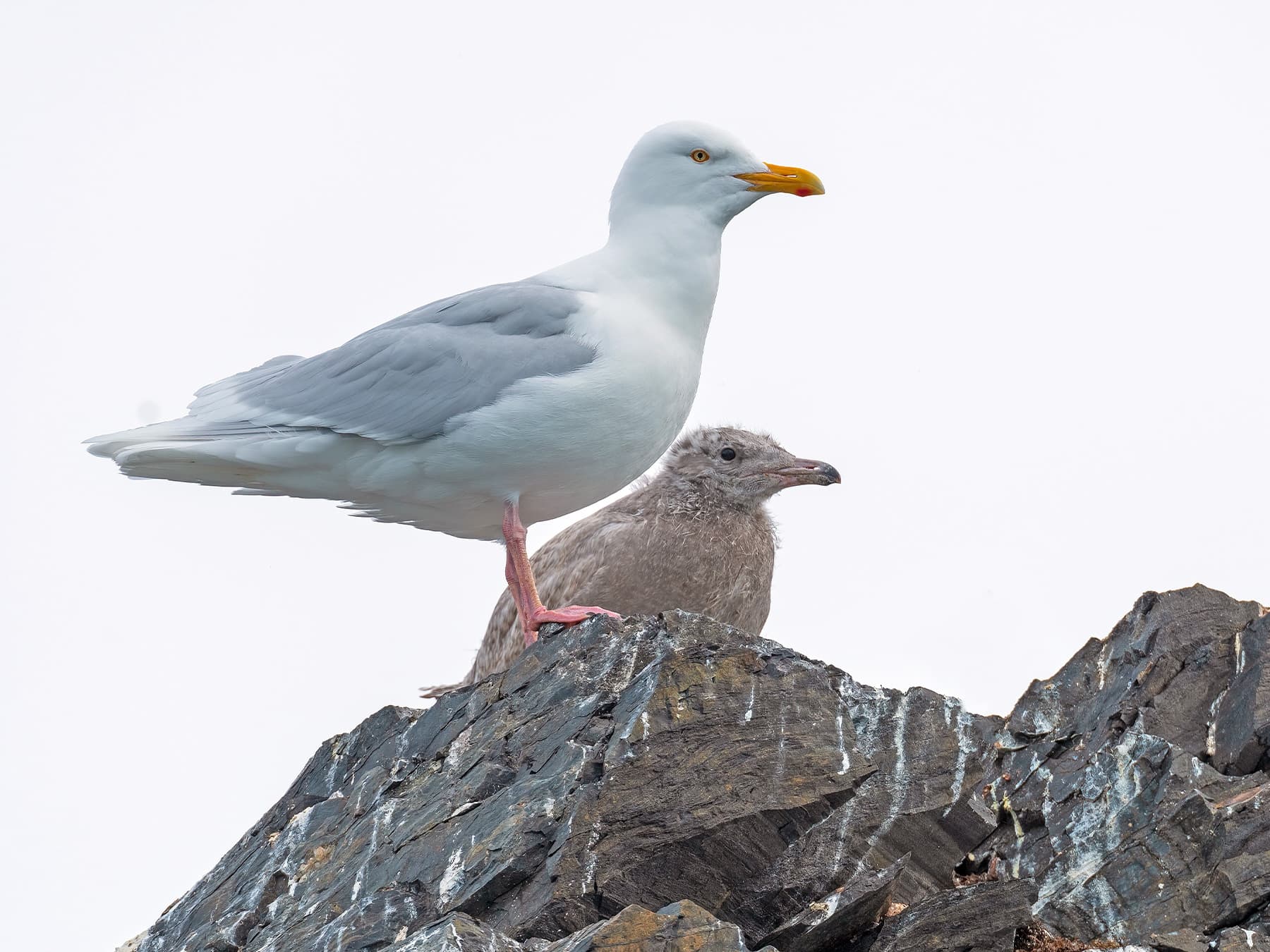
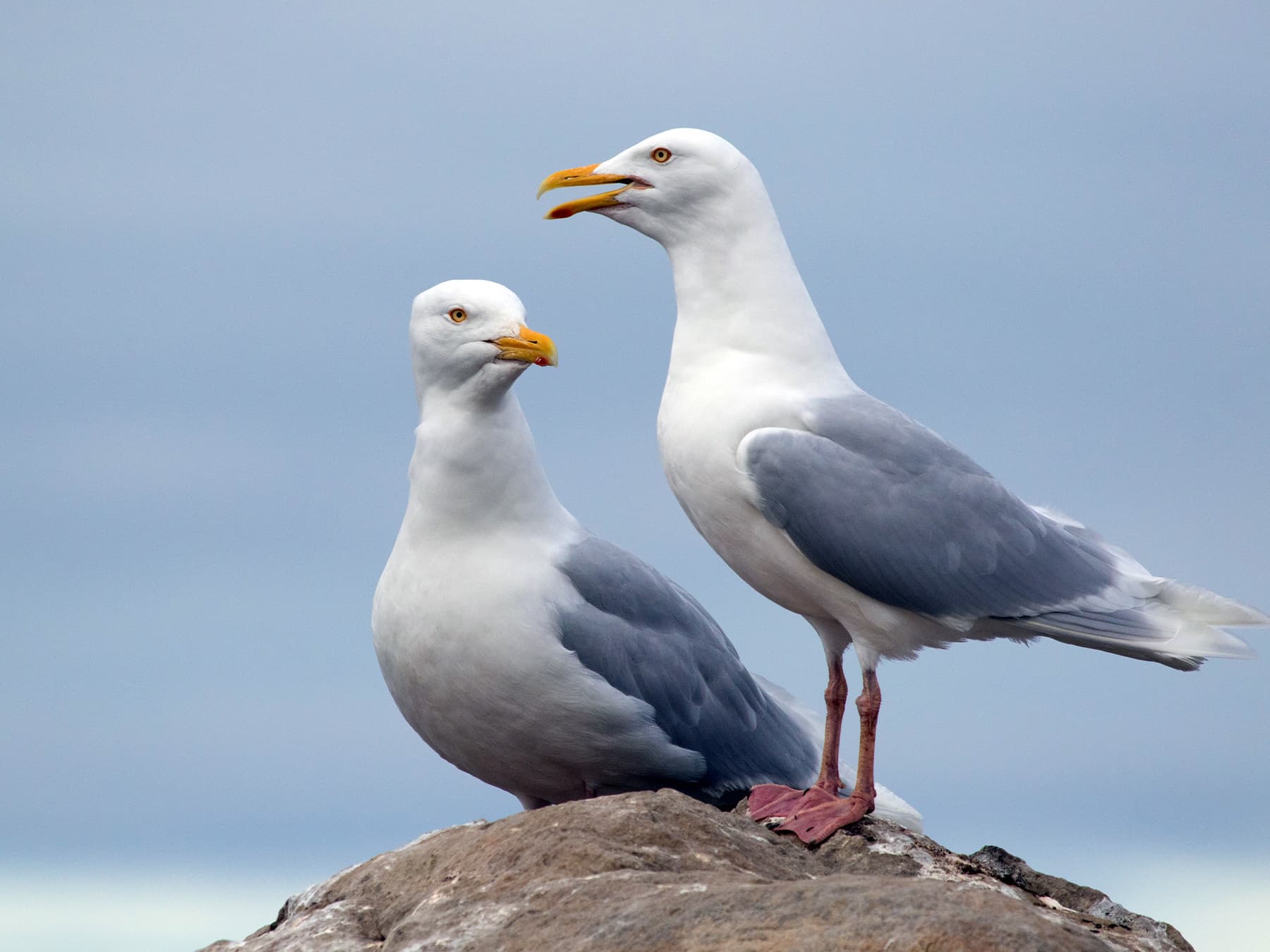
In breeding plumage, Glaucous gulls have pale gray wings, which are tipped with white. Their underparts and tail are white, and the breast is white with some faint streaking. Their legs and feet are pink.
Glaucous gulls have white heads and a yellow bill with a red spot on the lower mandible, near the tip. Their light yellow eyes are surrounded by an orange eye-ring.
During winter, their head and nape become mottled with brown streaks.
Males and females are alike in appearance, with females usually marginally smaller than males.
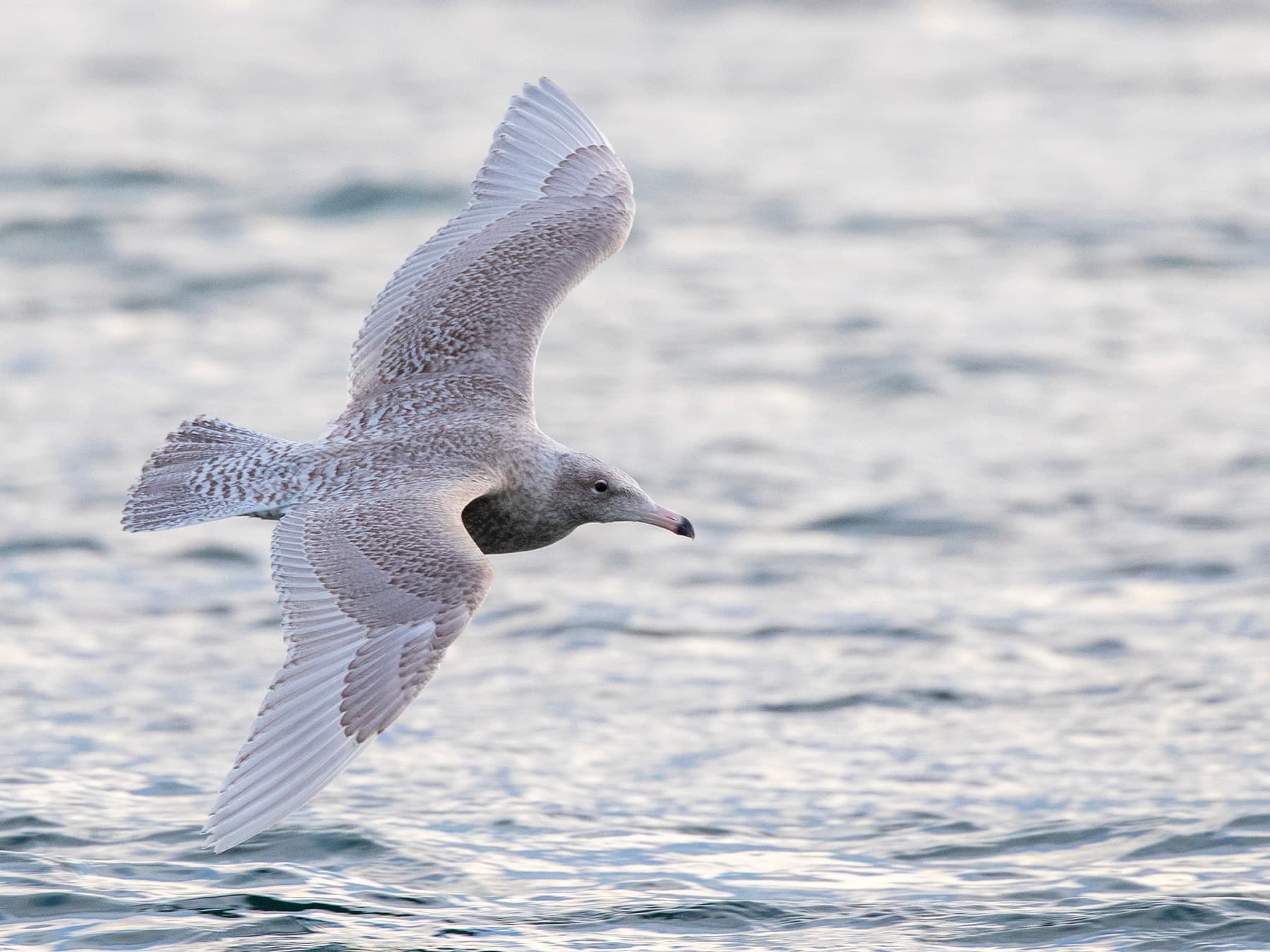
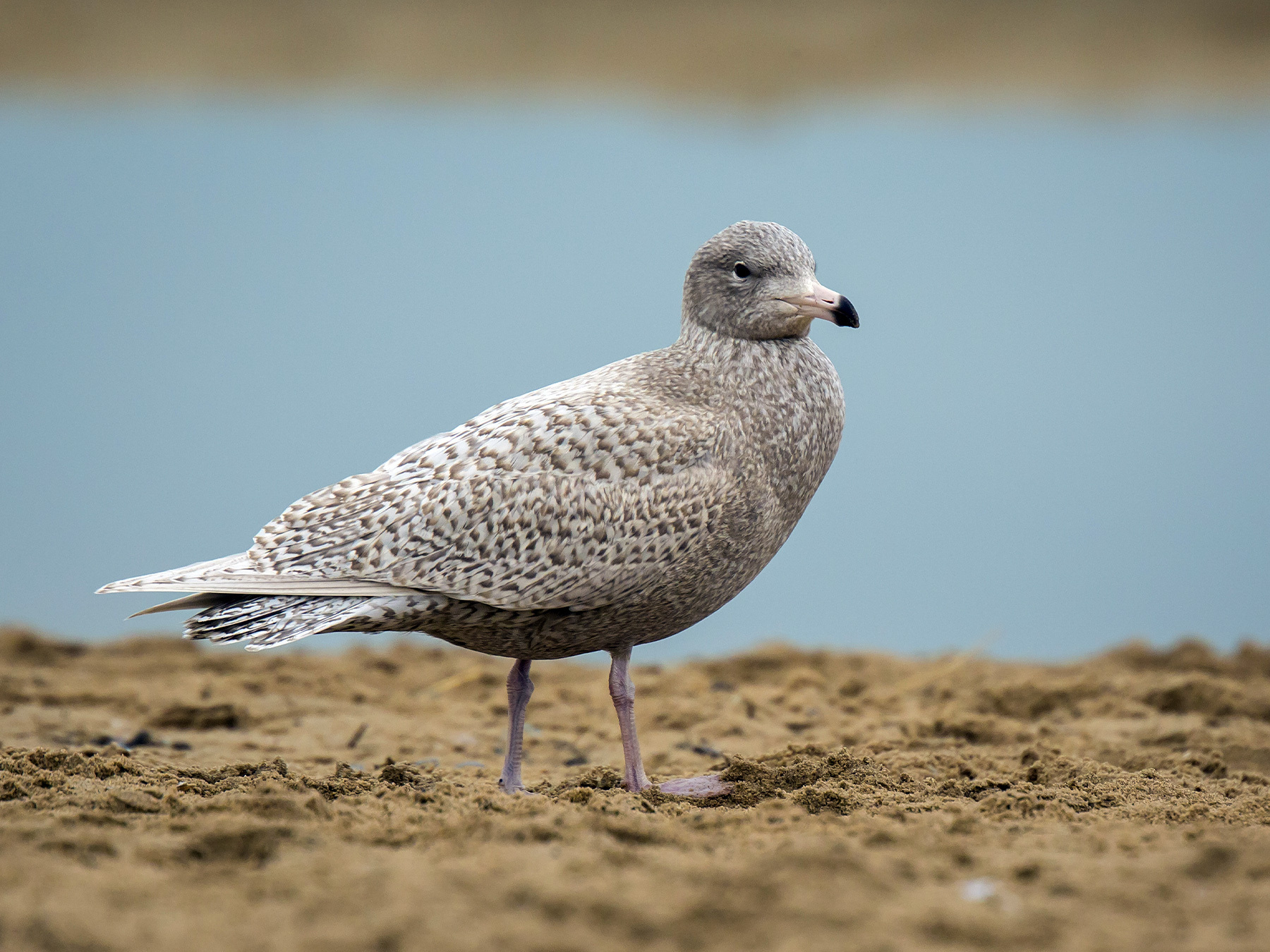
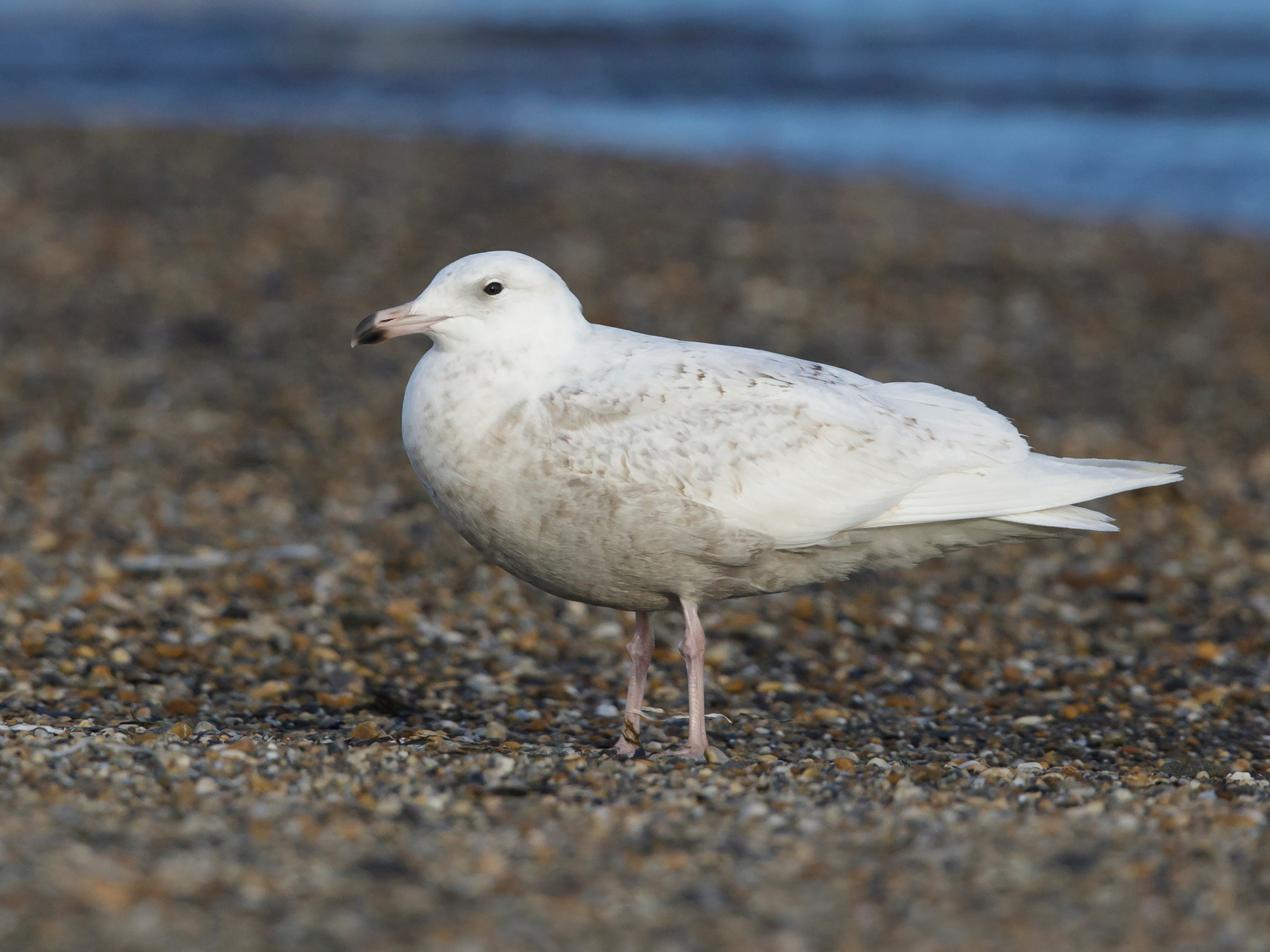
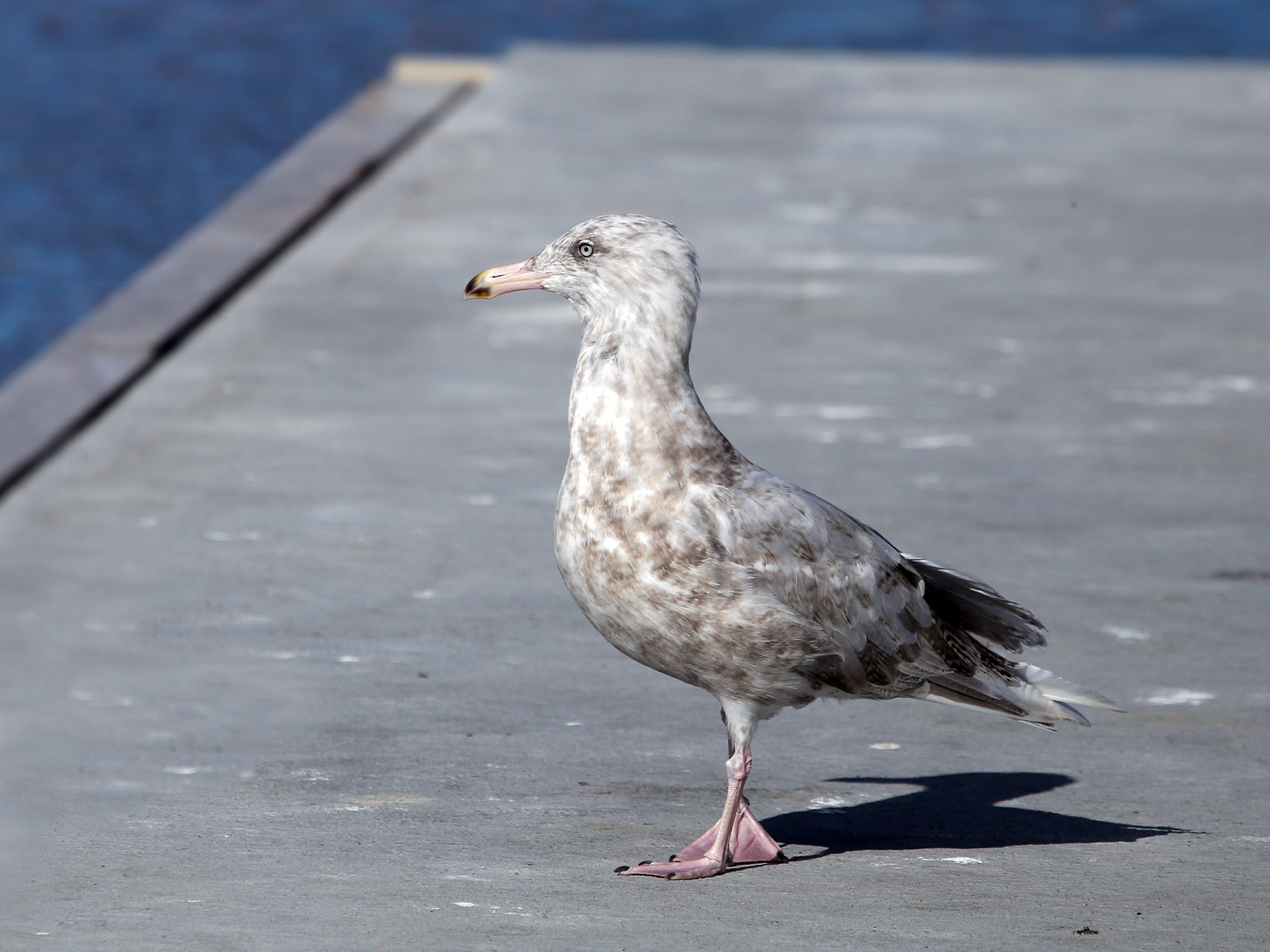
First-year juvenile Glaucous gulls are a creamy-biscuit color, with a scaled appearance, slightly darker on the wings and underparts than on the head and breast. Their eyes are dark brown and their bill is pink, tipped with black.
By their second year, plumage is more of a uniform pale cream-brown, and by their third year it’s hard to distinguish between young Glaucous gulls and adults, with only some minor brown patches remaining on the juvenile’s wings.
How big are Glaucous Gulls?
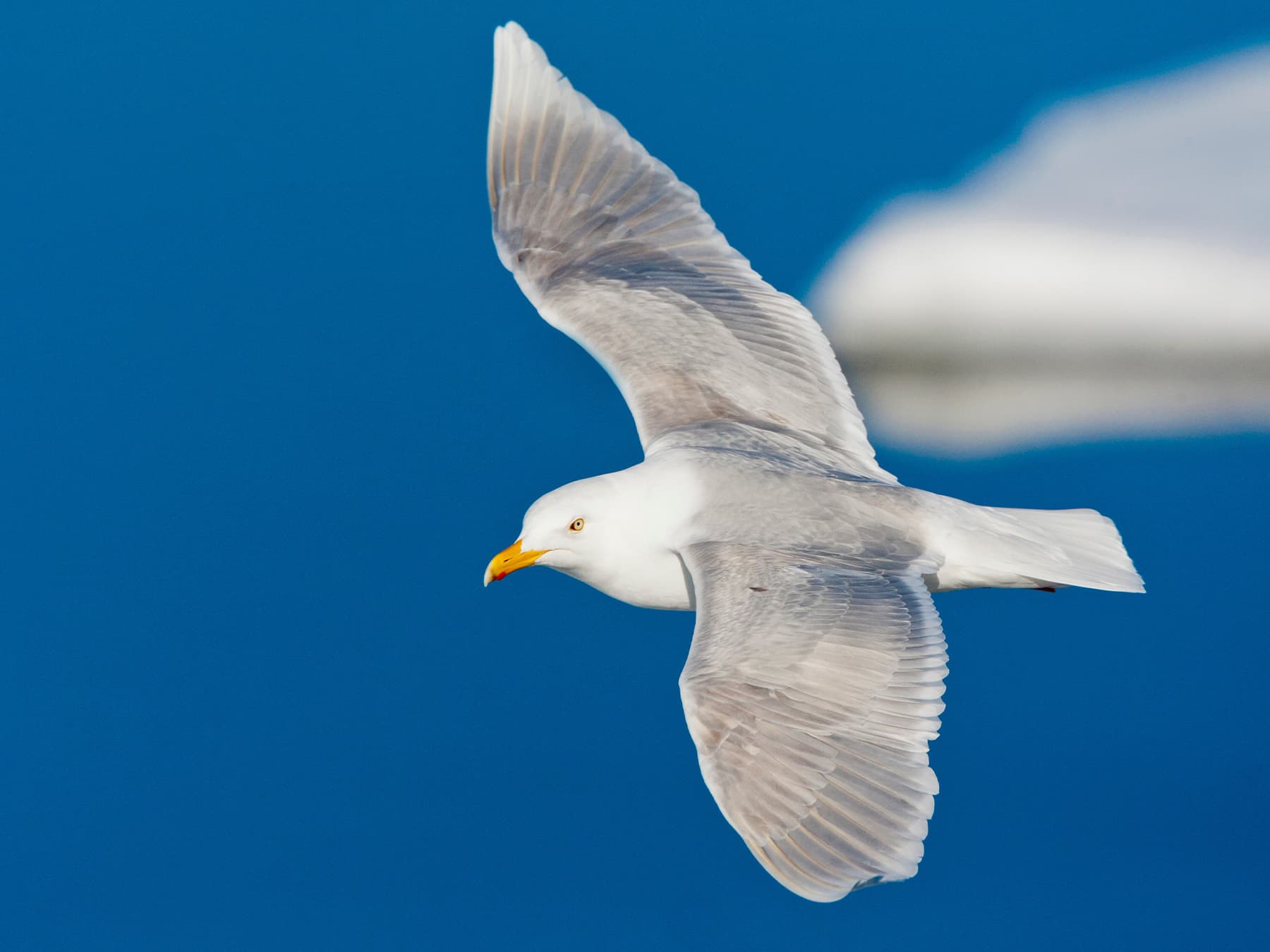
The world’s second-largest gull species, after the great black-backed gull, has a vast wingspan of up to 165 cm (5.4 ft) and can weigh up to 2 kg (4.4 lb). Females are slightly smaller and lighter than males.
- Length: 62 cm to 68 cm (24 in to 27 in)
- Wingspan: 150 cm to 165 cm (59 in to 65 in)
- Weight: 1 kg to 2kg (2.2 lb to 4.4 lb)
Its size
Adults- Length
- 62–68 cm
- Wingspan
- 140–165 cm
- Weight
- 1300–2000 g
Its song and calls
What sound does a Glaucous Gull make?
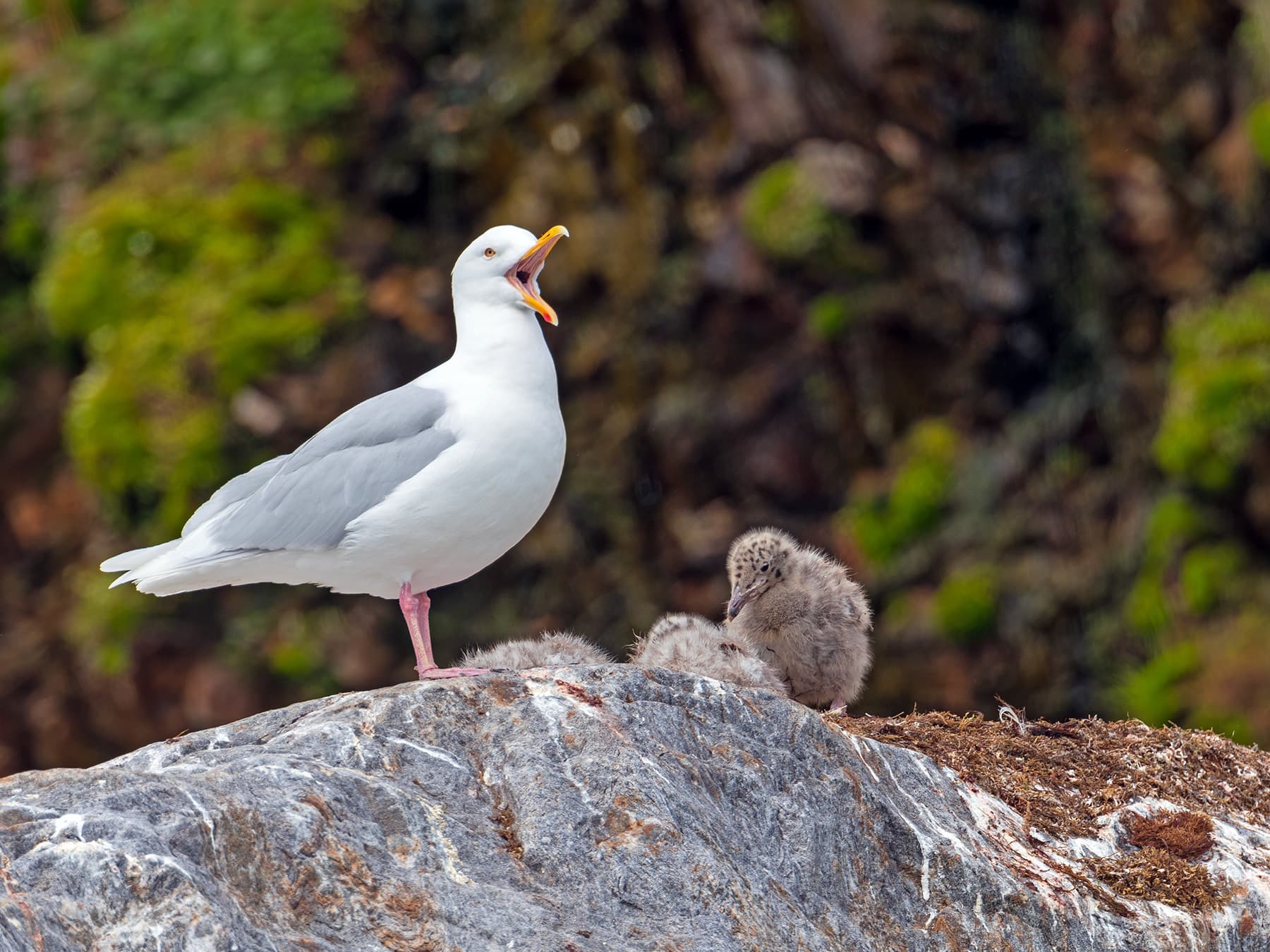
An initial ‘kek-kek-kek’ alarm call is used when a threat is first detected, which quickly escalates to a loud, piercing ‘fe-kaw, fe-kaw, fe-kaw’ warning call if a predator continues to approach.
A trumpeting long call is also heard, thought to be a contact call used to indicate recognition or to signal a shift change in incubation duties.
When and where to see it
OctoberArriving
Most recorded in October
- 1. Shetland Islandsunder 0.1%
- 2. Morayunder 0.1%
- 3. Orkney Islandsunder 0.1%
- 4. Antrimunder 0.1%
- 5. Aberdeenshireunder 0.1%
Each dot is a county, state or province: the bigger and darker, the larger the bird’s share of that place’s bird records that month. Grey dots: no regular records. The ringed point is the centre of the bird’s records this month; the arrow shows how it moved since last month, and the dashed loop its path through the year. “Arrivals” colours places where it becomes regular this month (orange) or is in its last regular month (grey). GBIF eBird Observation Dataset, 2019–2024. Map data: Natural Earth, US Census Bureau; place centres © OpenStreetMap contributors.
In your area
See when the Glaucous Gull is recorded in your county, state or province.
How often the Glaucous Gull turns up in the UK, Ireland, the United States and Canada through the year, from birdwatchers' records.
United Kingdom
Winter visitor · regularly Sep–Jul · most records in January
Ireland
Winter visitor · regularly Nov–May · most records in February
United States
Resident · all year · most records in June
Canada
Winter visitor · regularly Nov–Aug · most records in January
Show as a table
| Month | United Kingdom | Ireland | United States | Canada |
|---|---|---|---|---|
| January | 0.016% (regular) | 0.030% (regular) | 0.020% (regular) | 0.17% (regular) |
| February | 0.014% (regular) | 0.052% (regular) | 0.017% (regular) | 0.11% (regular) |
| March | 0.009% (regular) | 0.024% (regular) | 0.009% (regular) | 0.091% (regular) |
| April | 0.003% (regular) | 0.009% (regular) | 0.003% (regular) | 0.051% (regular) |
| May | 0.002% (regular) | 0.006% (regular) | 0.005% (regular) | 0.017% (regular) |
| June | 0.002% (regular) | – | 0.031% (regular) | 0.017% (regular) |
| July | <0.001% (regular) | – | 0.007% (regular) | 0.018% (regular) |
| August | <0.001% | <0.001% | 0.004% (regular) | 0.014% (regular) |
| September | 0.001% (regular) | 0.001% | 0.004% (regular) | 0.007% |
| October | 0.005% (regular) | 0.001% | 0.003% (regular) | 0.007% |
| November | 0.007% (regular) | 0.004% (regular) | 0.004% (regular) | 0.059% (regular) |
| December | 0.010% (regular) | 0.009% (regular) | 0.011% (regular) | 0.13% (regular) |
Recorded regularly in
Worldwide: recorded regularly in 23 countries
Countries where it was recorded in at least 3 of the 6 years 2019–2024. Linked countries have their own bird list.
Europe (16)
North America (4)
Data: EOD – eBird Observation Dataset (Cornell Lab of Ornithology), accessed via GBIF.org, CC BY 4.0. Records from 2019–2024, aggregated and filtered by Birdfact. How these lists are made
What is the habitat of a Glaucous Gull?
Coastal environments are favored by nesting Glaucous gulls, in particular rocky clifftops, remote tundra landscapes and offshore islands.
Nest spots are often isolated, and colonies are usually limited to less than a few dozen pairs. It’s common for Glaucous gulls to nest near geese and eiders, or with other cliff-nesting bird species.
In winter, inland sightings are more common, with landfill sites, reservoirs and sewage farms offering foraging sites. Harbors, bays and beaches are also common spots for winter sightings.
What is the range of a Glaucous Gull?
Glaucous gulls breed throughout the circumpolar regions of North America and Eurasia, from Alaska and the High Arctic islands of Canada, along the coasts of Greenland and Iceland, and through the Arctic islands of Svalbard and Novaya Zemlya to the northern coast of far eastern Russia.
During winter, migration occurs to frost-free coasts to the south, with Glaucous gulls heading down the Atlantic coasts of Canada and the United States, as far south as Virginia and North Carolina, and on the Pacific side to Washington and occasionally as far south as Oregon and California.
Within their European range, overwintering Glaucous gulls can be found in Iceland and in coastal regions of Norway, the British Isles, Denmark, Germany, the Netherlands, and Belgium. Northern France forms the southern extreme of their non-breeding range, with around 10 to 30 birds spending winters there.
Where do Glaucous Gulls live?
Of the North American population of Glaucous gulls, around 85,000 pairs are in Alaska, and up to 50,000 pairs in Canada. Between 30,000 and 100,000 pairs breed in Greenland, and further east, up to 15,000 pairs regularly breed in Iceland, and between 6,500 and 10,000 pairs in European Russia and the Svalbard archipelago.
How rare are Glaucous Gulls?
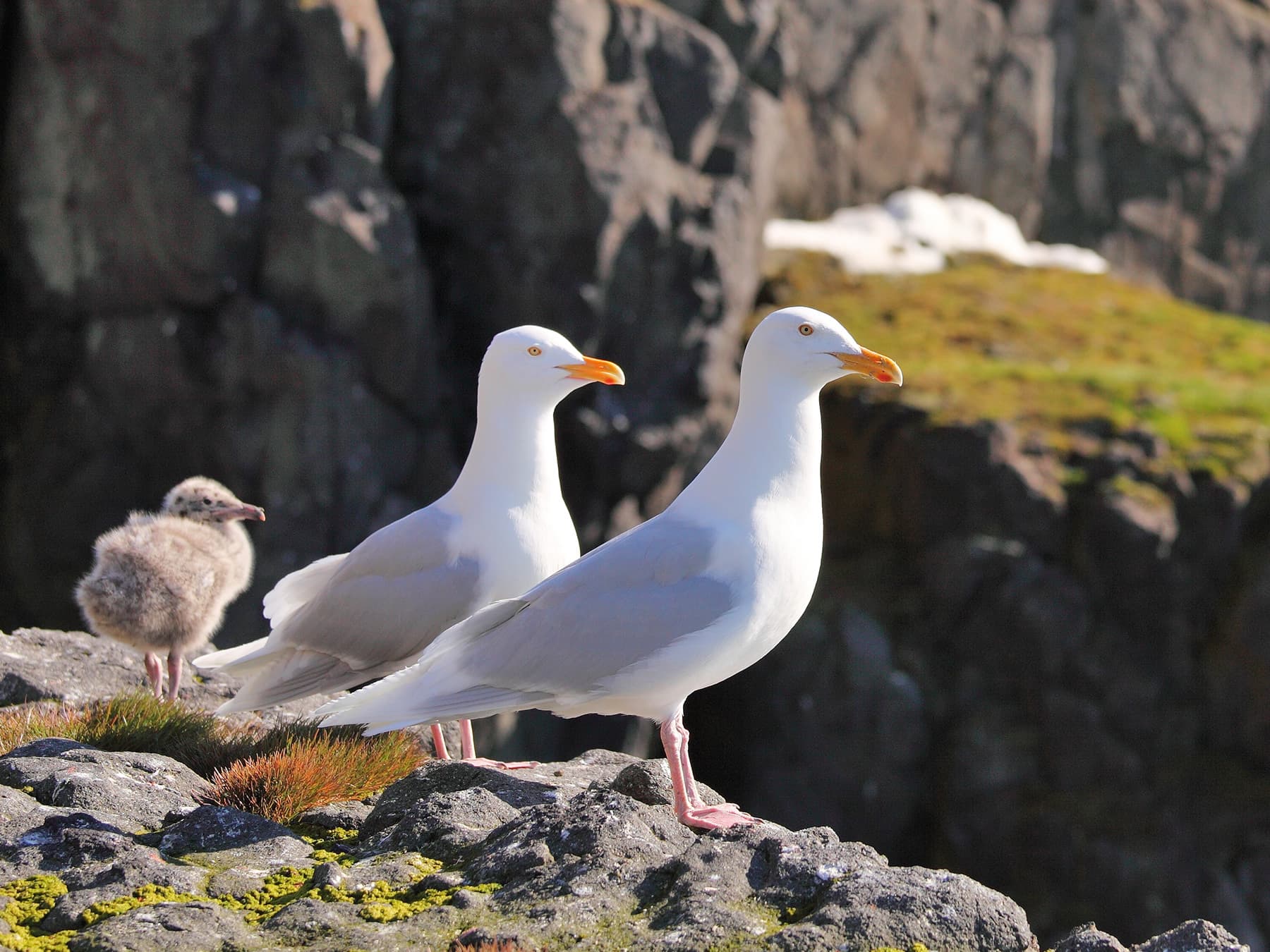
Glaucous gulls are not an especially rare species within their usual distribution range, but inland sightings are uncommon, and it is highly unusual to spot one outside of their Arctic breeding grounds during the spring and summer.
Where can you see Glaucous Gulls in the US?
Alaska is the only location in the US where Glaucous gulls breed, with established nesting grounds along the west and northern coasts. In winter, sightings are reported along the Atlantic coast, as far south as North Carolina, and on the Pacific coast, most visiting Glaucous gulls only reach as far as the Washington coast, with sightings becoming less concentrated further along the coast of Oregon towards California.
Where can you see Glaucous Gulls in Canada?
Glaucous gulls are found across northern Canada from the northern regions of Labrador to the High Arctic. More than 500 breeding colonies are found across Devon, Cornwallis, Bathurst and Ellesmere Islands. In winter, southward migration occurs, especially to Newfoundland and Labrador.
Where can you see Glaucous Gulls in the UK?
In the UK, only around 170 birds are recorded annually during winter, so sightings are not especially common. Glaucous gulls may spend winters at any coastal location around the entire British Isles and also occasionally venture further inland, to join large roosts at reservoirs or forage at landfill sites.
Migration
Do Glaucous Gulls migrate?
Only a small number of Glaucous gulls are non-migratory, remaining in the lower reaches of Arctic Canada all year round. Most populations are migratory, traveling between breeding grounds in the Arctic Circle and wintering territories around coastlines in milder climates further south.
Why do Glaucous Gulls migrate?
During the coldest times of the year, feeding grounds in the far north of the Glaucous gull’s range become frozen and inhospitable, making survival increasingly difficult as temperatures plunge. Wintering grounds further south offer frost-free waters and a more plentiful supply of fish.
Tips for seeing it
- Look for large, pale gulls with no black on wingtips
- Check Arctic coastlines and ice edges during breeding season
- In winter, scan northern coasts and large inland water bodies
- Observe behavior: more solitary than other gulls
- Listen for deep, hoarse calls, distinct from smaller gulls
What it eats
What do Glaucous Gulls eat?
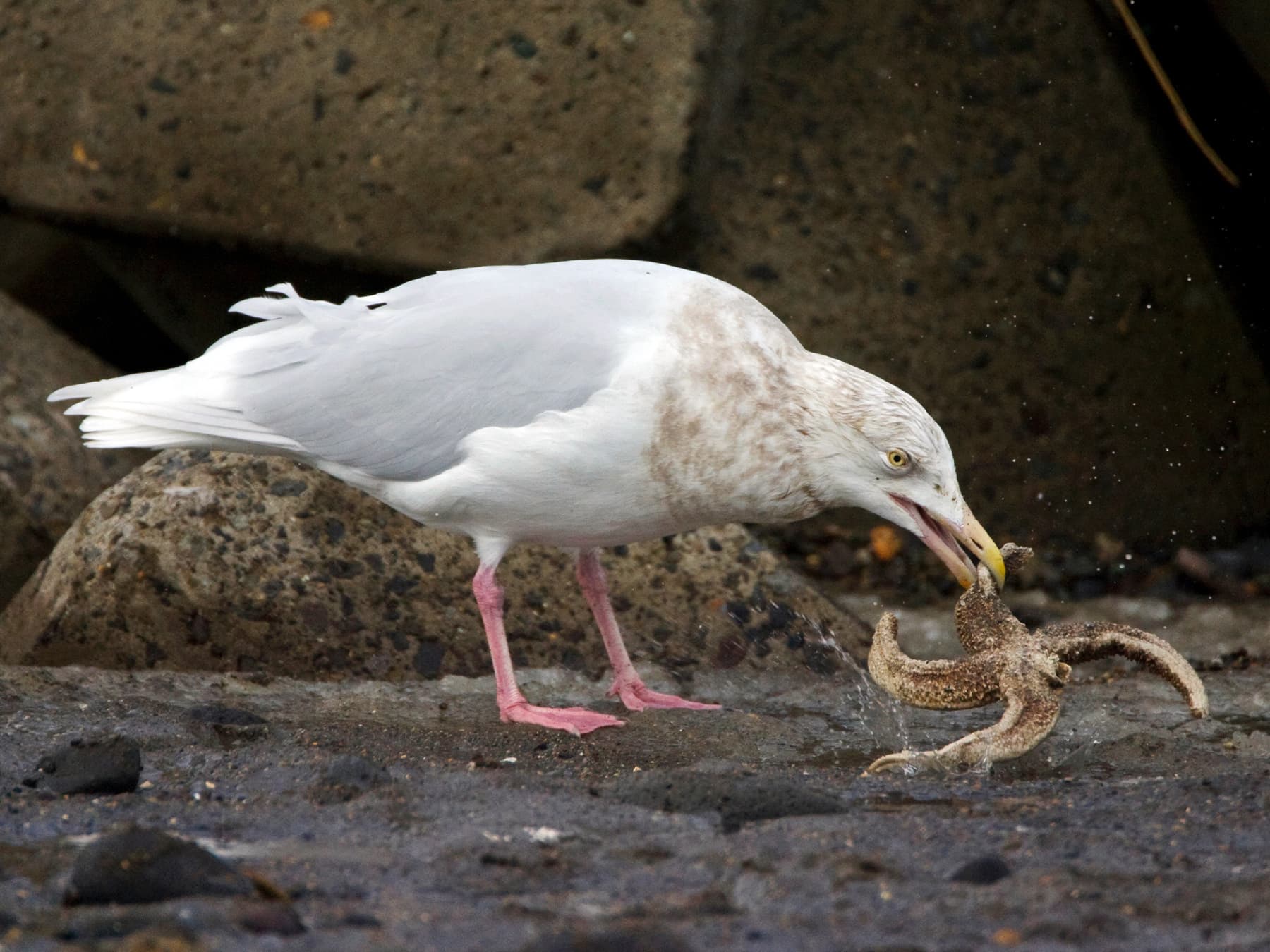
Glaucous gulls are predatory seabirds, feeding on a range of prey found in marine environments, including fish, shellfish, crustaceans, chicks and eggs of shorebirds, seabirds (particularly auks), and waterfowl and small mammals (lemmings, shrews and weasels). Refuse, scraps, carrion, and roadkill are also frequently eaten.
Arctic cod, herring, and sand lance are among the most common fish species, caught just below the water’s surface. Prey, including young birds, is usually swallowed whole.
What do Glaucous Gull chicks eat?
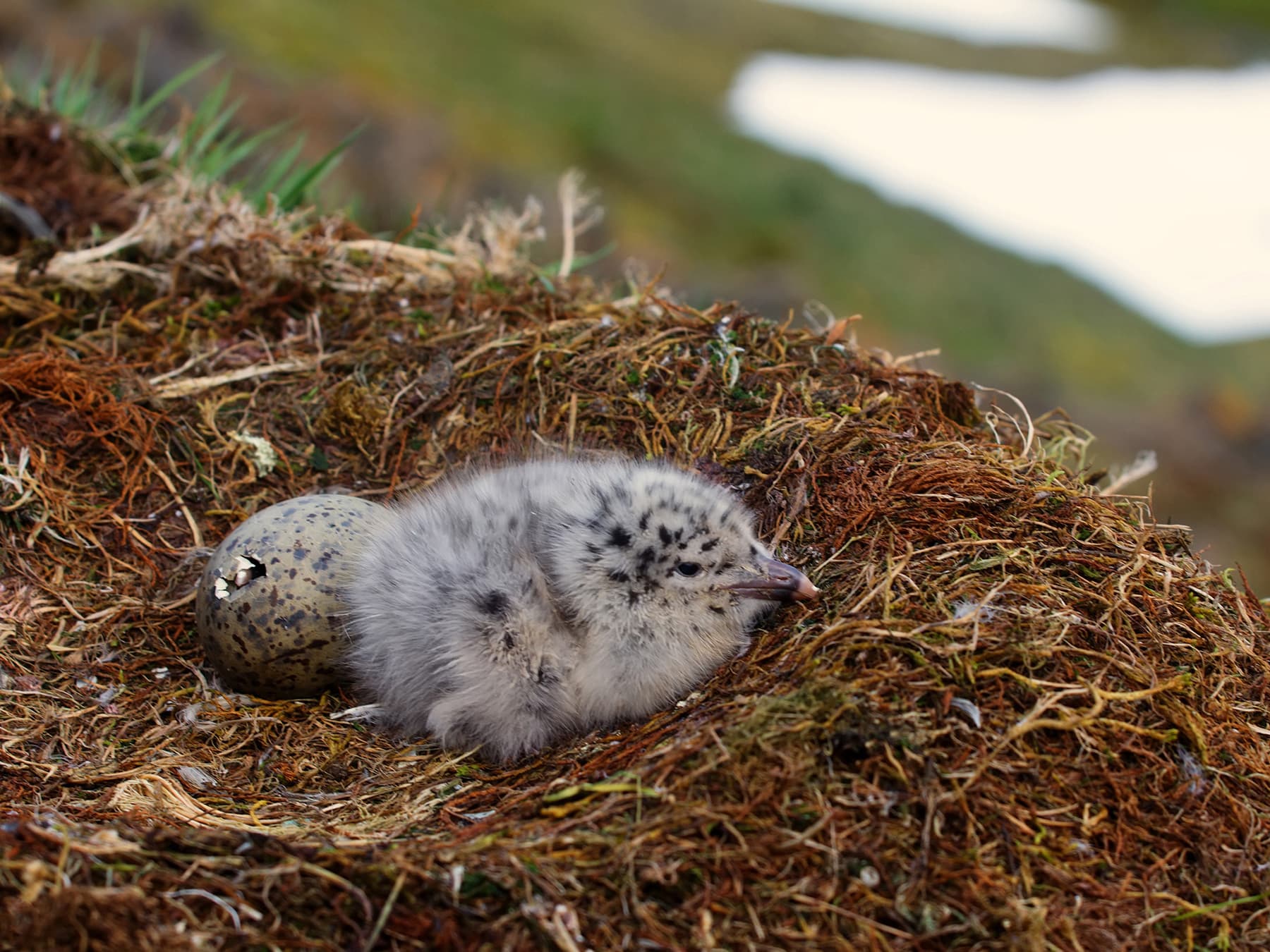
Adult Glaucous gulls feed newly hatched chicks on food that is regurgitated onto the ground, as well as taking partially digested food directly from the adult’s throat. Birds’ eggs or young murre hatchlings may be brought to the nest and pecked open for gull chicks to feed on.
Nesting and breeding
Where do Glaucous Gulls nest?
Nest sites are chosen that are out of reach of Arctic foxes, which are a top predator of Glaucous gulls. Remote clifftops, rocky or grassy ledges and small islets are popular choices.
Nests are bowl-shaped depressions, built up with grasses, seaweed, moss and sedge, constructed by both male and female birds. Twigs and feathers may also be used, and the nest is constantly added to during the nesting period, becoming rather bulky by the time the young hatch.
When do Glaucous Gulls nest?
Glaucous gulls arrive on their breeding grounds from April onwards, and nesting begins in May, with eggs laid in May or June. Incubation is shared between the male and female and lasts for 27 to 30 days.
Young Glaucous gulls leave the nest a few days after hatching, are fed on the ground by both parents for the first few months, and are able to fly after between 45 and 50 days.
What do Glaucous Gull eggs look like?
Eggs laid by Glaucous gulls are brown, with darker brown streaky markings. A typical clutch consists of between 2 and 3 eggs, which measure 77 mm by 54 mm (3 in by 2.1 in).
Do Glaucous Gulls mate for life?
Glaucous gulls form monogamous and long-term pairs, reuniting on breeding grounds each spring to raise young together. Pairings have been observed to last for several years in a row. Pairs raise a single brood in a season, and in years of poor food availability, breeding may be skipped.
Behaviour
Are Glaucous Gulls aggressive?
Glaucous gulls have a reputation as being one of the most aggressive gull species, charging at intruding birds that approach nest sites and driving off any competition for food. Apart from great black-backed gulls, most other seabirds will not stick around to contest any challenge.
Where do Glaucous Gulls sleep at night?
In winter, rafts of roosting glaucous gulls can be seen on inland lakes and reservoirs. Large groups of birds gather at sunset, roosting communally on the water’s surface until sunrise the following morning.
Lifespan and predators
How long do Glaucous Gulls live?
The average lifespan of a Glaucous gull is thought to be from 10 to 20 years, although the oldest known individual bird, identified through a ringing scheme, reached 22 years. Breeding occurs for the first time from 4 years of age.
What are the predators of Glaucous Gulls?
Predation of adult Glaucous gulls is rare, due to their large size and degree of physical aggression shown when threatened. Arctic foxes, polar bears, red foxes, grizzly bears and gyrfalcons are known occasional predators.
Eggs and young may also opportunistically be targeted by the predators above, although the aggressive nest defense by Glaucous gulls means that these raids are not usually successful.
Are Glaucous Gulls protected?
Glaucous gulls are protected under the Migratory Bird Treaty Act of 1918 in the United States and under the Migratory Birds Convention Act, 1994 in Canada. In the UK, the species is included in the Wildlife and Countryside Act, 1981. This legislation protects the species against being killed, injured, or taken into captivity.
Are Glaucous Gulls endangered?
Across their global range, Glaucous gulls are considered a species of least concern. The world population is estimated at between 400,000 and 1.5 million and is thought to be stable. In the UK, Glaucous gulls have Amber status on the British Birds of Conservation Concern list.
Conservation
While currently listed as Least Concern, Glaucous Gulls face threats from climate change affecting their Arctic breeding grounds.
Oil spills and marine pollution also pose risks. Some populations have shown declines, prompting ongoing monitoring efforts.
More photos
4 photos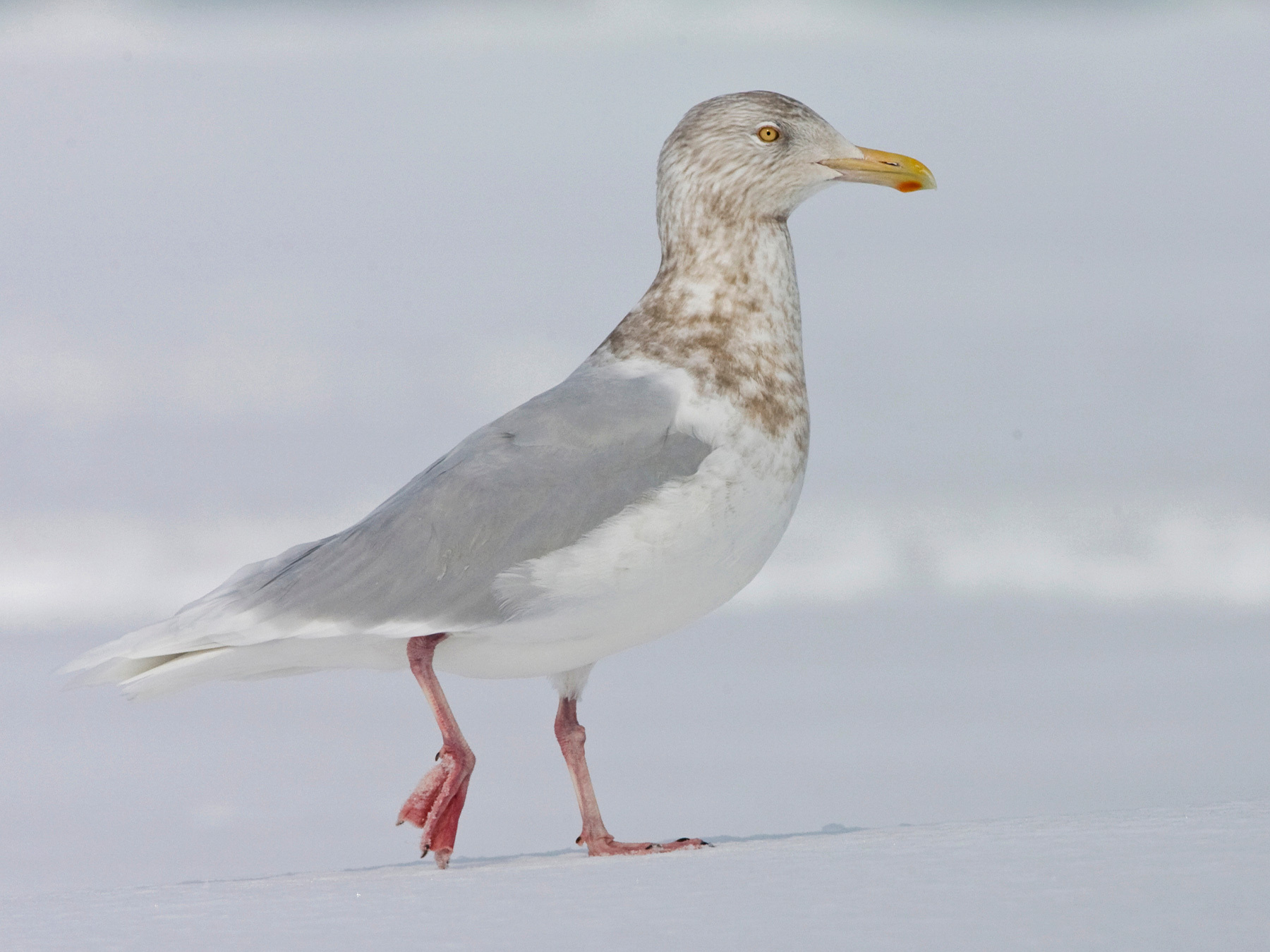
Glaucous Gull guides
6 guides- What Do Seagulls Actually Eat? Diet Secrets of These Clever Scavengers
- Do Seagulls Migrate? (All You Need To Know)
- Baby Seagulls: All You Need to Know (with Pictures)
- Seagull Nesting Secrets: Unveiling the Hidden Sanctuaries by the Sea
- What is a Group of Seagulls Called? (Complete List + Why?)
- How Long Do Seagulls Live?
Quick facts
- Length
- 62–68 cm
- Wingspan
- 140–165 cm
- Weight
- 1300–2000 g
- Lifespan
- 15–20 years
- Family
- Gulls & Terns
- Migration
- Partial migrant
- Global status (IUCN)
- Least Concern
- World population
- 400,000 - 1,500,000 mature individuals
- Population trend
- Stable
- Also called
- Ice Gull, Snow Gull
- Scientific name
- Larus hyperboreus
Questions
2Is a Glaucous Gull a scavenger?
Glaucous gulls are both predators and scavengers, and they also find food by stealing prey from other birds. They scavenge on beach shores for carcasses of marine animals, such as seals and whales, and will also scour landfill sites and roadsides for scraps and roadkill.
Are Glaucous Gulls dangerous?
While not a threat to humans, Glaucous gulls are known for their aggressive foraging habits and physically threatening behavior towards other birds that compete to share a food source. Birds that attempt to feed at a site where Glaucous gulls are feeding will be chased, and vicious attacks are not uncommon.
Sources
3- 1BirdLife International. 2018. Larus hyperboreus. The IUCN Red List of Threatened Species 2018: e.T22694343A132544122. Source (opens in a new tab)
- 2Wetlands International (2015)
- 3Wetlands International (2015)

Checked by
Nathan Cope, founder and editor
Nathan founded Birdfact and leads its writers and contributors in the UK, the US and Canada. He has watched and studied birds for more than ten years, and checks every article and species guide before it’s published.