
Western Flycatcher
Pacific-slope Flycatcher, Cordilleran Flycatcher · Empidonax difficilis
By the Birdfact teamChecked by Nathan Cope
On this page14 sections
How to recognise it
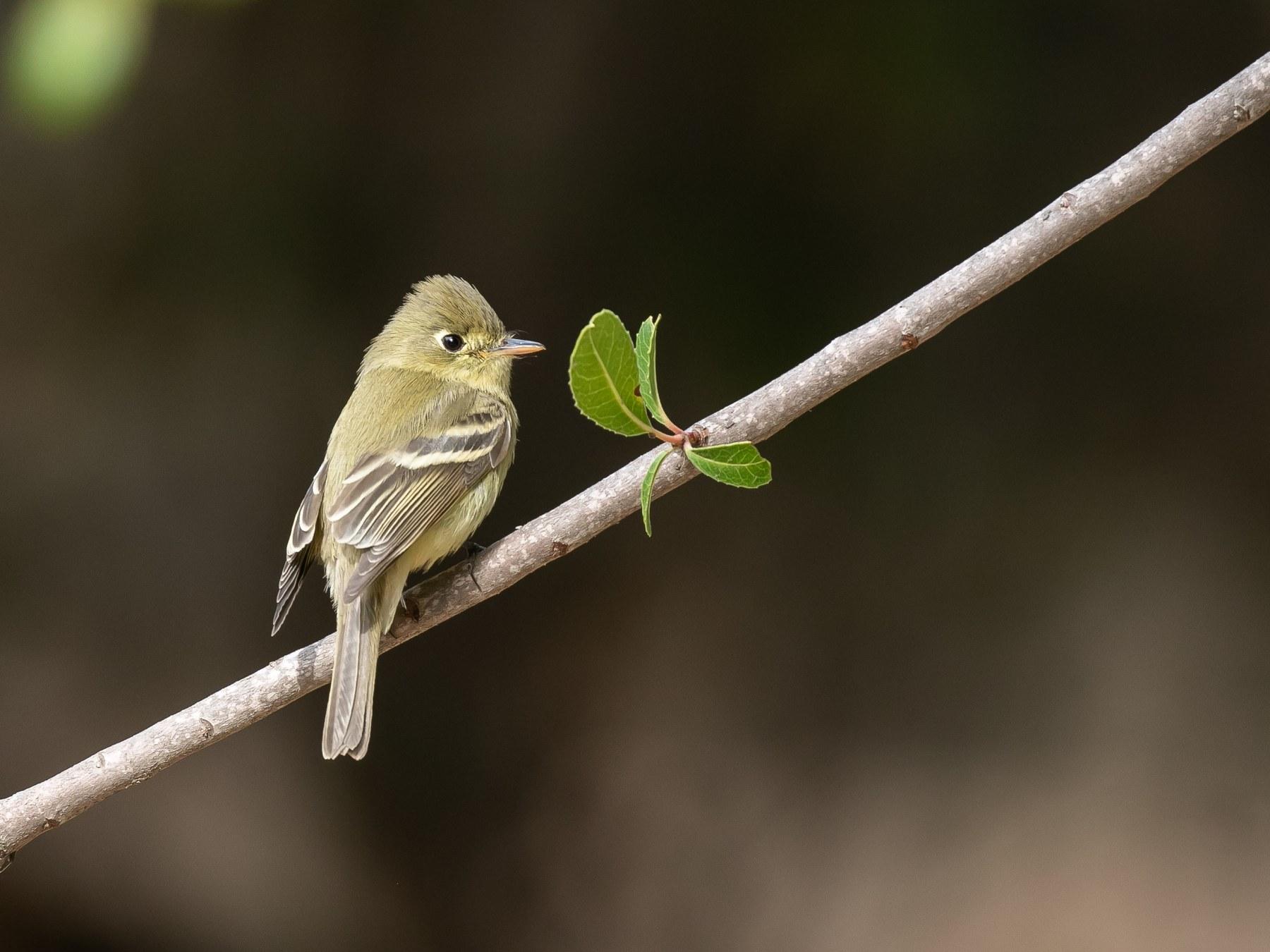
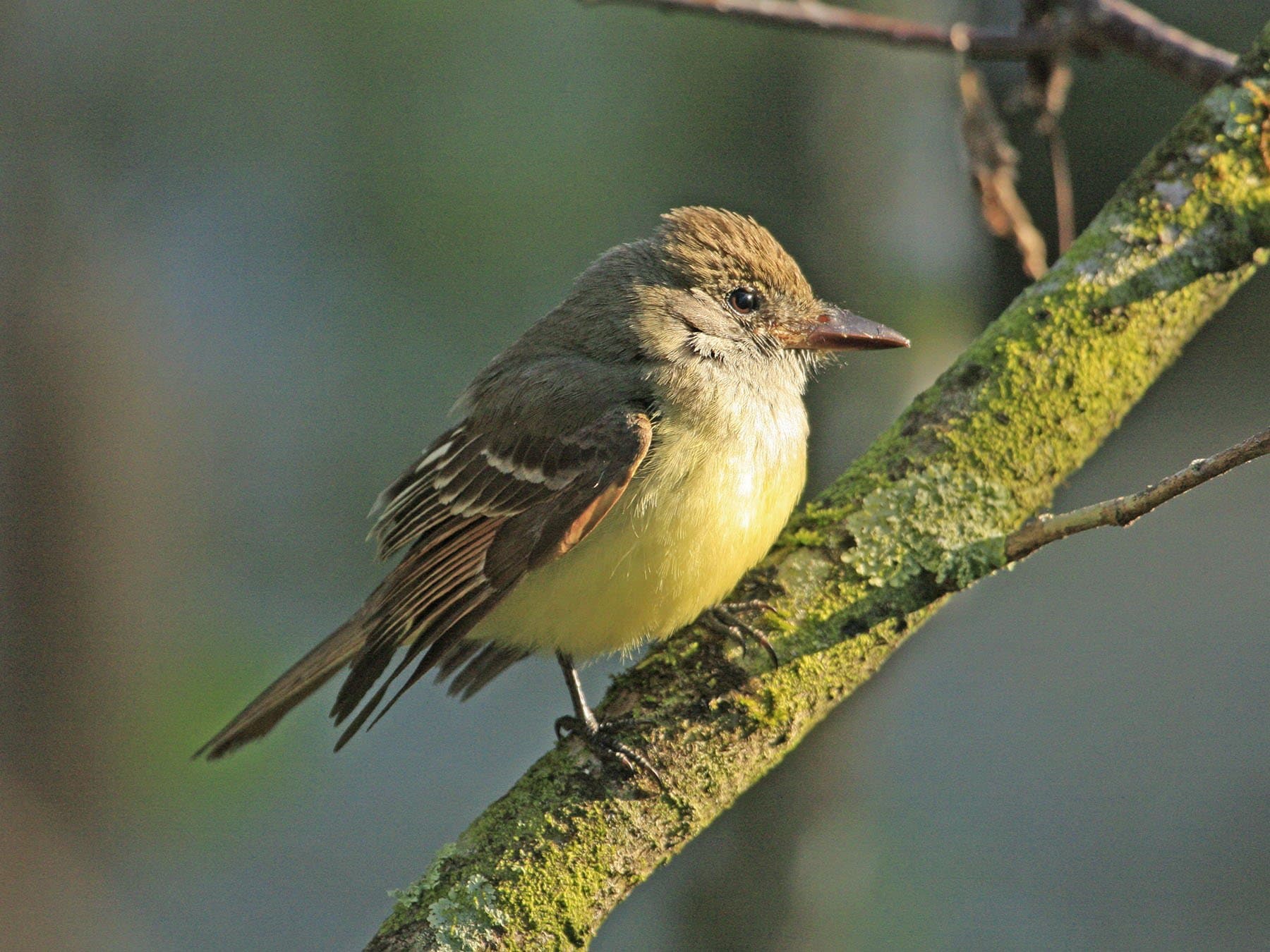
This is a small, olive-green and yellowish flycatcher with a white eye-ring that is broad behind the eye and thin or broken above it, so it looks like a teardrop. It has two pale wing bars, a yellowish throat and a pale lemon-yellow belly, and it flicks its tail upward when it perches.
The upperparts run from olive-green to brownish olive. The eye-ring is white with a yellow tinge, and the wing bars range from pale olive to lemon. The breast is pale buffy olive to lemon, often with soft olive streaks, and the tail is grayish brown. The crown looks peaked.
The bill is wide when seen from below. Its upper half is blackish, and the lower half is usually all yellow or orange, sometimes pinkish near the base. The inside of the mouth is orange-yellow, the eyes are dark and the legs dusky to dark gray. Worn birds can look browner above and drabber, grayer below, with fainter wing bars.
Size and weight
It is a small bird, 5.5–6.7 in (14–17 cm) long with a wingspan of 7.9–9.1 in (20–23 cm), and it weighs 0.3–0.5 oz (8–13 g).
Inland birds from the US and Canada are a little larger than coastal ones. In adults measured in northern California and Oregon, inland males' wings averaged longer than coastal males'. Body size also falls from north to south, and the birds of California's Channel Islands are larger than mainland birds.1
Male, female and young birds
Males and females look alike in every plumage, so they cannot be told apart in the field.
Juveniles, seen mainly from June to October, are like adults but washed brownish above and below. Their wing bars range from buff to a cinnamon buff, the yellow below is paler or duller, and some show a buffy-brown band across the breast. Fresh tail feathers are often tipped tawny to buff.
Adults replace all their feathers mostly on the wintering grounds, mainly from August to November. Young birds replace part of their plumage there, mainly from September to December.
Identifying the Pacific-slope and Cordilleran forms
The coastal Pacific-slope form and the inland Cordilleran form cannot be told apart by sight, and their calls and songs proved unreliable too, because they vary continuously from one form to the other.1
Even in the heart of each range they are extremely hard to separate, and male songs and calls are the best guide there. Where the two meet, in southwestern Canada and the northwestern US, they cannot be separated at all.2
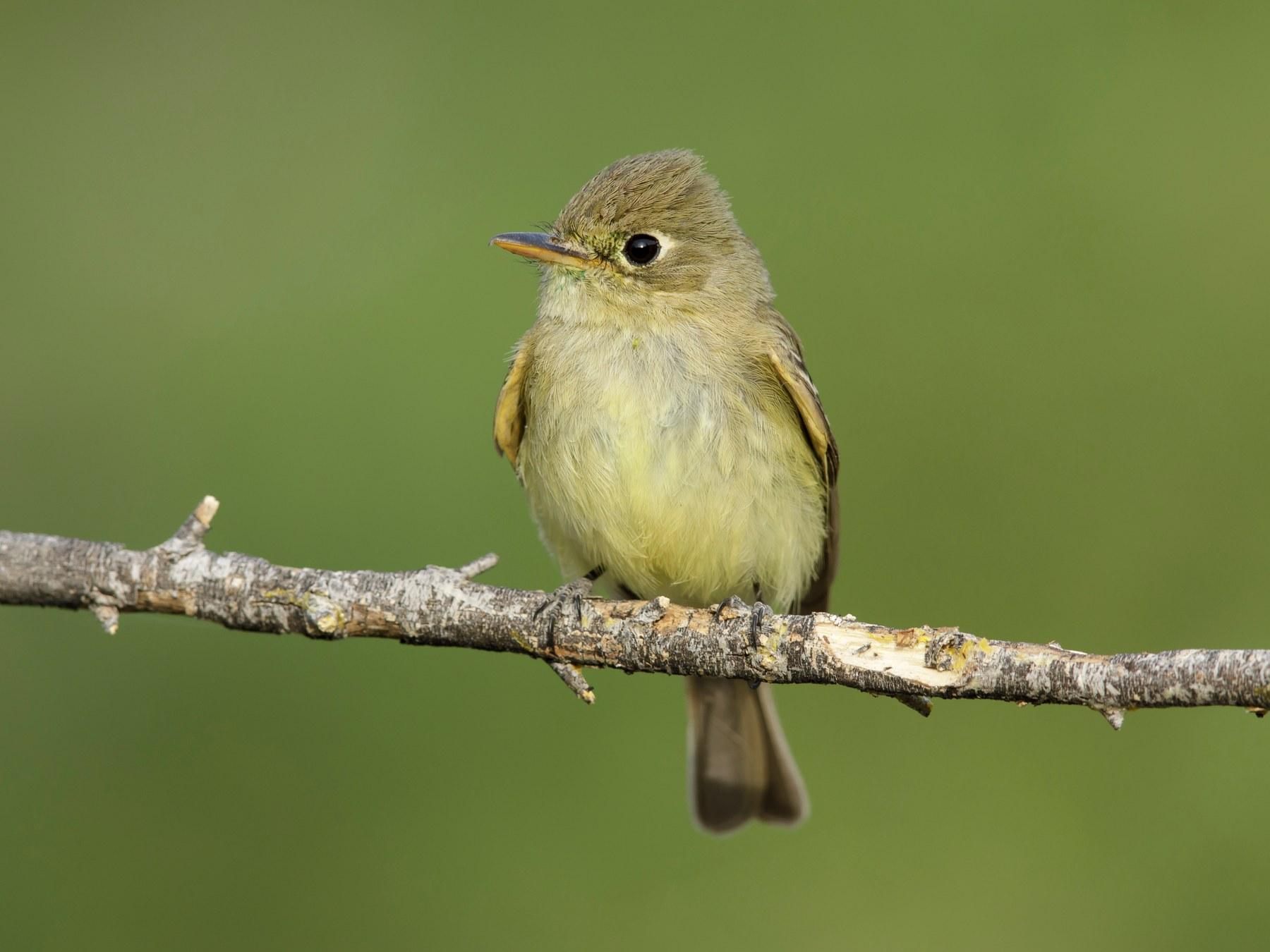
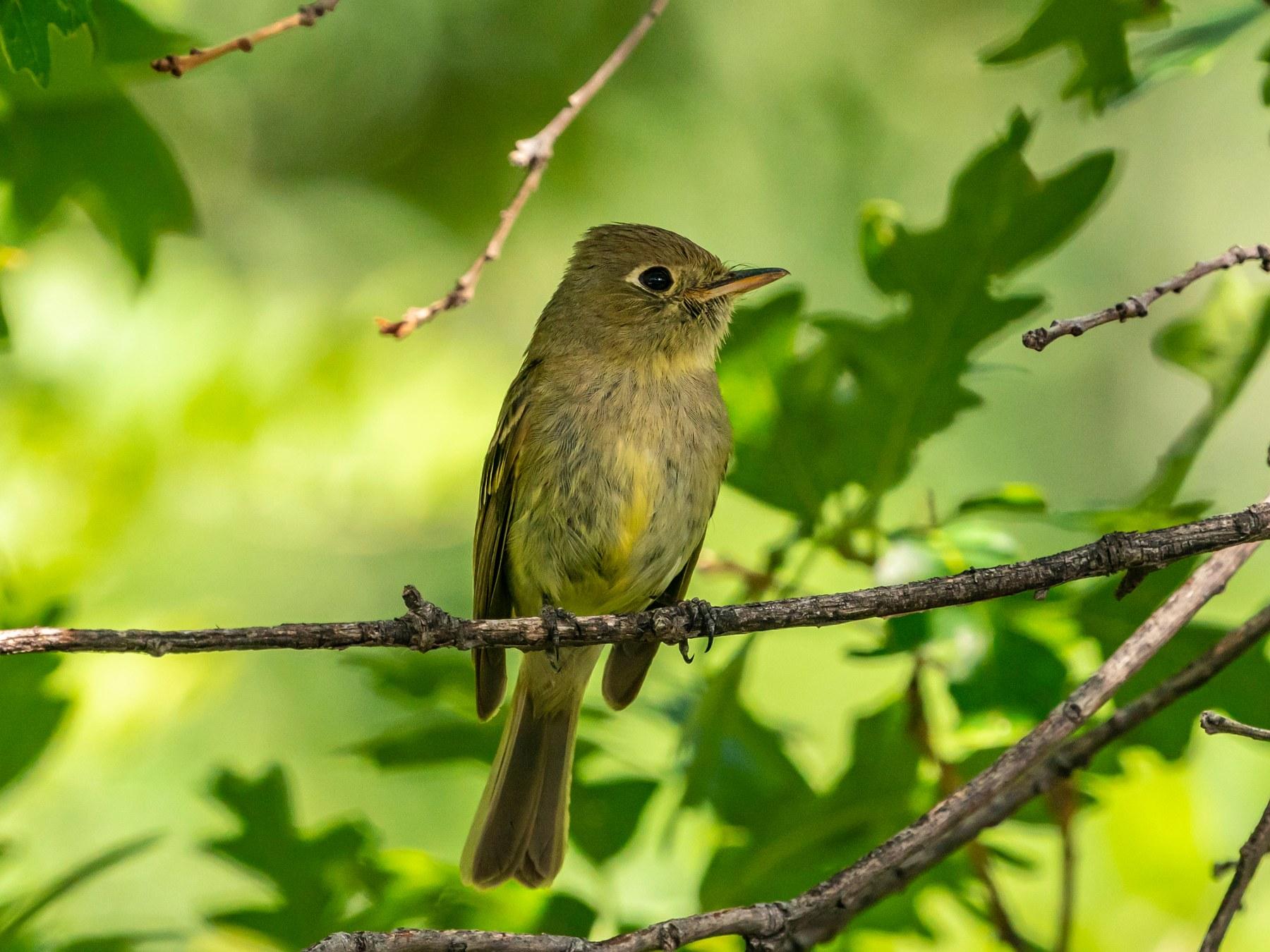
In the hand there are slight differences. Mainland coastal birds have a moderately bright greenish-yellow breast and a short wing and bill, while inland birds from the US are relatively bright yellow, larger and more pointed-winged. The Mexican mountain birds are duller and smaller than the US inland birds. These are specimen marks, not field marks.
Identifying it from similar birds
It is one of the Empidonax flycatchers, and voice and range are the best ways to tell it from the others in the group. In eastern North America, its yellowish underparts together with the teardrop eye-ring help separate a stray from the eastern Empidonax.
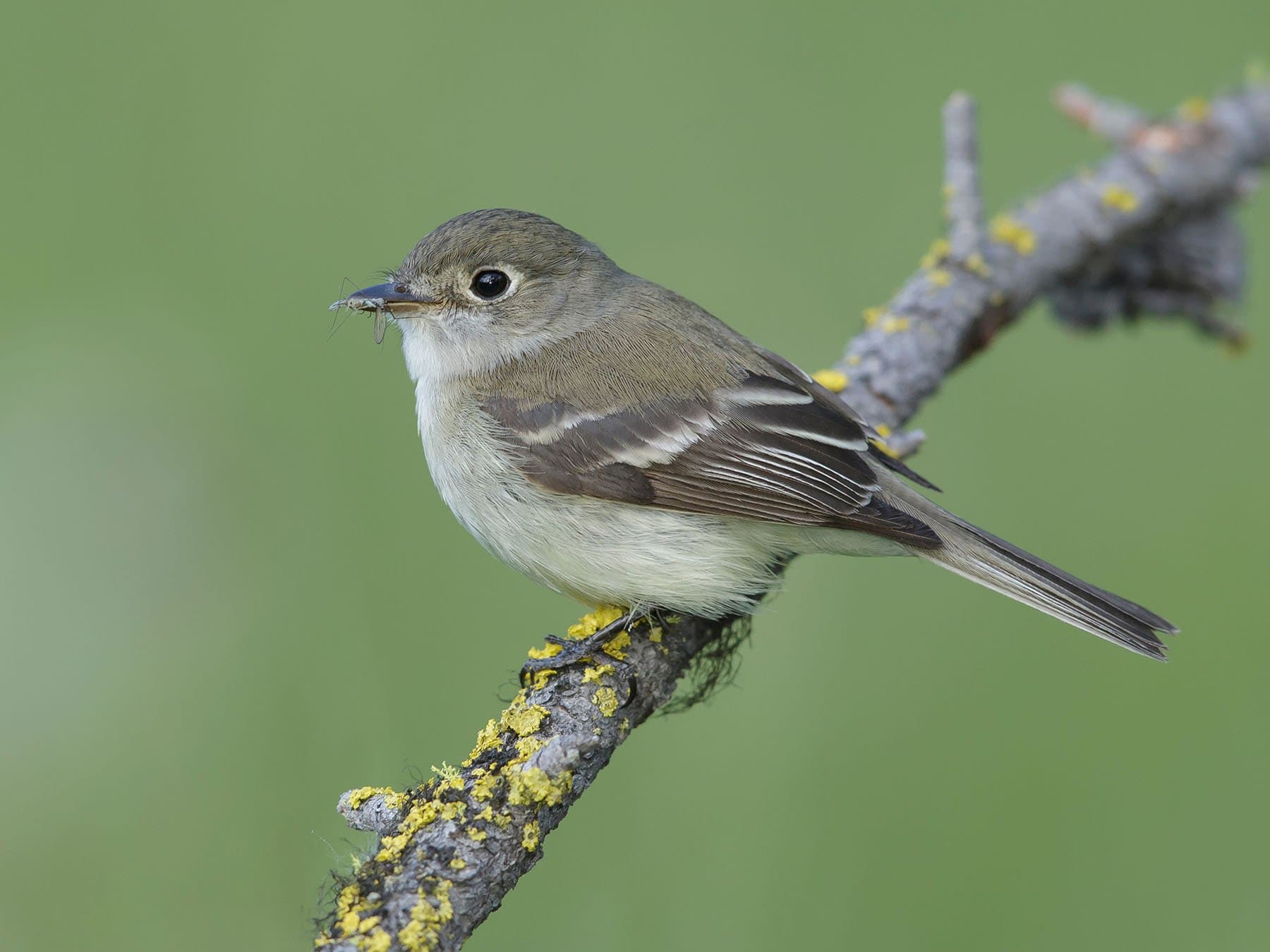
A Willow Flycatcher has a white throat, a large, wide bill and a faint or missing eye-ring, especially in the West. A Least Flycatcher is smaller, with a white throat that has no yellow tinge, whitish underparts with only a slight yellow wash on the belly, and a complete or nearly complete white eye-ring. A Yellow-bellied Flycatcher is brighter green above, and its blackish wings contrast boldly with its wing bars. Its eye-ring is narrow and rounded or slightly almond-shaped, with almost no point behind the eye.
A Hammond's Flycatcher is grayer, with a pale gray throat, dark gray sides to the breast and a short, narrow bill. An adult Hammond's has a lower bill that is half to two-thirds dark, though a young bird's is mostly orangish. Its eye-ring is also often thicker behind the eye, so the eye-ring alone does not separate them. Where the two meet, Western Flycatchers tend to keep to lower slopes and wooded canyon bottoms.
A Dusky Flycatcher is grayish olive to grayish brown above, with a whitish throat and mostly whitish underparts that can carry a yellow wash, and an adult's bill is mostly dusky with pale orange only at the base. A Gray Flycatcher is pale gray above and white below, with a long, narrow bill and a long tail that it dips gently down and then raises, unlike the quick upward flick of a Western Flycatcher.
Not sure it’s a Western Flycatcher? Check your photo: Birdfact names the bird and shows the look-alike side by side.
Its size
Adults- Length
- 14–17 cm
- Wingspan
- 20–23 cm
- Weight
- 8–13 g
Its song and calls
The sound heard most is a rising, slurred call, usually written psee-yeet for coastal birds and pit-peet or tee-seet for inland ones. Both sexes give it, and a male on his territory repeats it about every 7–10 seconds as he feeds.
For years this call was known as the male's position note. Birds of the World calls that name "grossly inaccurate", since females give the call as well, and treats the female's short tsip as the true position note.1
Only males sing. The song is three high, thin phrases, usually in the same order: a seet, a middle note of one or two parts, and a final note. Both sexes also give a harsh chrrip when aggressive, a sharp seet as an alarm, and snap their bills in disputes.
The player on this page has two recordings: rising calls from Adair Village, Oregon, in April 2023, and a series of repeated notes from Custer State Park in South Dakota's Black Hills in June 2015.
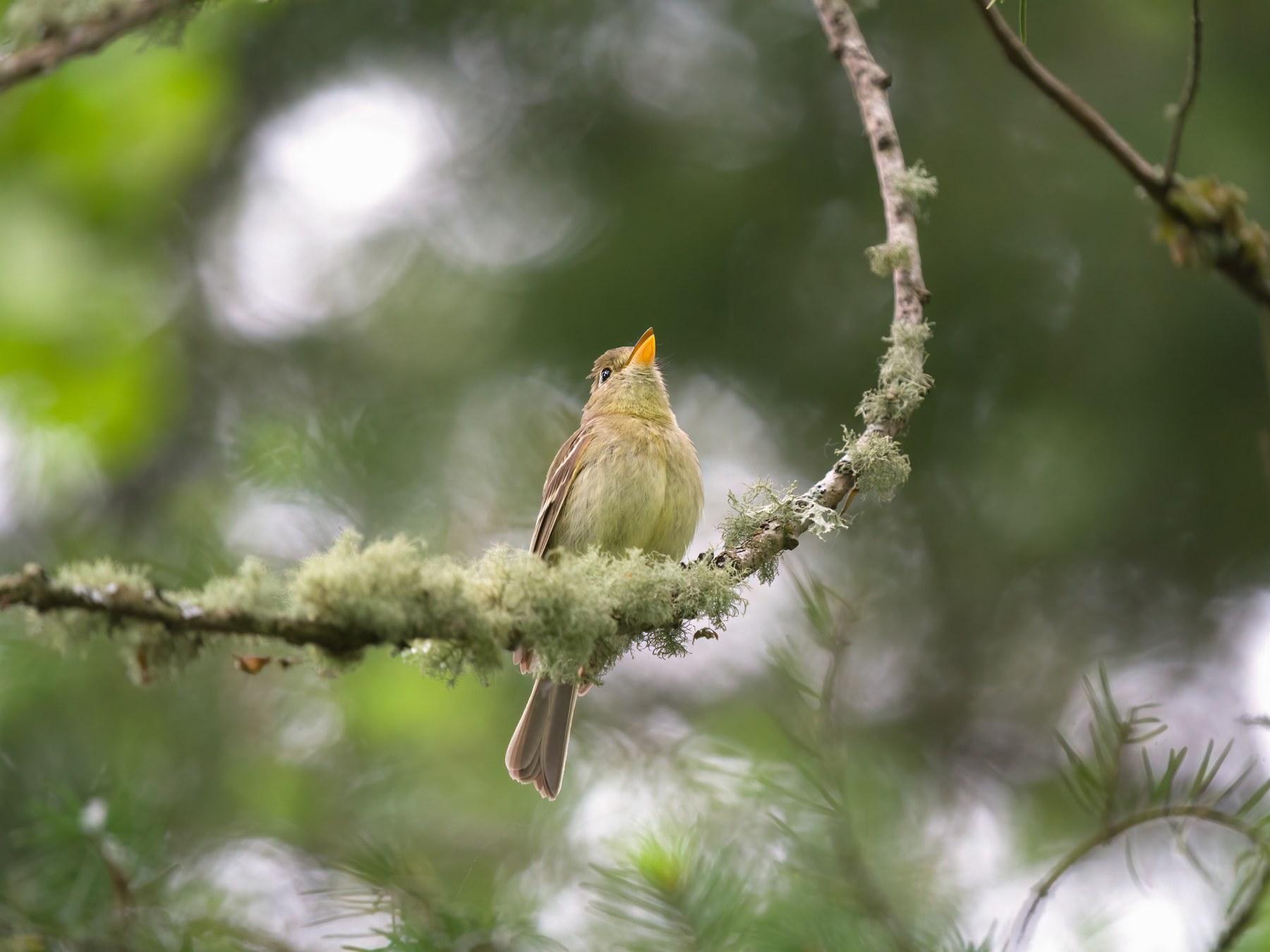
Telling the forms apart by voice
In the northern half of the range coastal birds sing higher. The peak of the middle note reaches 7 to over 8 kHz in coastal birds, against about 6 kHz in inland birds. But every phrase of the song, and the rising call, varies continuously between the two, and mixed populations fill the gap completely.
The old rule that coastal birds give a continuous rising call and inland birds a call broken in two fails in many places. Two-part calls come from southern Mexico, and none was found in recordings from Montana. The call identifies the species well, but naming the form from it is risky. Its songs are thought to be innate rather than learned, though how they develop has not been studied in this species.1
A 2023 genomics study of 20 birds singing one of the two pure song types and 14 likely hybrids with intermediate songs found six regions of the genome that differ strongly between the two former species and may be linked to their song differences.3
Dawn song
Males do not sing as soon as they arrive in spring, but once they do, dawn song starts at the first hint of light. In one study of seven males on a British Columbia island, males sang almost without a break for 2–3 hours after sunrise until the females arrived, then fell silent. They sang again from about the third day of nest building and stopped for the season soon after the eggs hatched. Males without a mate keep singing through the morning.1
- Rising calls0:00 / 0:09
Recorded in Oregon, United States · April 2023
- Repeated notes0:00 / 1:31
Recorded in South Dakota, United States · June 2015
Heard one and not sure? Let the bird song identifier listen.
When and where to see it
November
Mostly absent
The year across North America
Choose a place on the map to see its year, or find yours.
Not regularly recorded in November
Up to 1.2% of a place’s bird records that monthHere in other months
How this map is made
Each county, state or province is shaded by the Western Flycatcher’s share of all the bird records there that month: the darker, the larger the share. A place with only a trace of records in a month is left unshaded. Shades compare places on this map with each other, not one bird with another. Records: GBIF eBird Observation Dataset, 2019–2024. Map: Natural Earth; place centres © OpenStreetMap contributors.
How often the Western Flycatcher turns up in the United States and Canada through the year, from birdwatchers' records.
United States
Summer visitor · regularly Mar–Oct · most records in July
Canada
Summer visitor · regularly Apr–Sep · most records in July
Show as a table
| Month | United States | Canada |
|---|---|---|
| January | 0.002% | – |
| February | 0.001% | – |
| March | 0.016% (regular) | – |
| April | 0.076% (regular) | 0.018% (regular) |
| May | 0.12% (regular) | 0.10% (regular) |
| June | 0.23% (regular) | 0.23% (regular) |
| July | 0.23% (regular) | 0.25% (regular) |
| August | 0.10% (regular) | 0.094% (regular) |
| September | 0.098% (regular) | 0.030% (regular) |
| October | 0.021% (regular) | 0.001% |
| November | 0.004% | 0.001% |
| December | 0.003% | <0.001% |
Worldwide: recorded regularly in 3 countries
Countries where it was recorded in at least 3 of the 6 years 2019–2024. Linked countries have their own bird list.
North America (3)
Data: EOD – eBird Observation Dataset (Cornell Lab of Ornithology), accessed via GBIF.org, CC BY 4.0. Records from 2019–2024, aggregated and filtered by Birdfact. How these lists are made
It breeds in western North America, from southeastern Alaska and the Canadian Rockies south to the mountains of Mexico and the Cape district of Baja California Sur. Coastal birds breed from southeastern Alaska to northern Baja California on the Pacific slope, mostly west of the Cascades and the Sierra Nevada, and on the Channel Islands.
Inland birds breed in the mountains of the interior, from northern Idaho and central Montana through Nevada, Utah, Wyoming and Colorado to Arizona, New Mexico, west Texas and the Black Hills. In Mexico they breed in the mountains south to Oaxaca and Veracruz.
It winters in Mexico. Coastal birds winter mainly in the Pacific lowlands, up to about 4,900 ft (1,500 m), from southern Baja California and Sonora to Oaxaca, and inland birds in mountains and foothills. A few winter in California and along the lower Colorado River in Arizona: in figures dating from 1994, California had 3–4 winter records a year in the north and 6–7 in the south.1
It is a rare stray in the East, usually in late fall. A bird killed in a collision in Cook County, Illinois, in September 2010 was first identified as a Yellow-bellied Flycatcher, until DNA showed it was a Western Flycatcher.1
Spotting tips
Look in shady, damp forest along a stream, ravine or canyon, where it hunts from perches inside the trees. Listen for the rising call, which it repeats every few seconds. Check ledges under bridges and the eaves of cabins and sheds in the woods, where it often nests.
Habitat
It lives in shady, moist forest with streams, ravines or canyons and open space to fly under the canopy. Coastal birds use humid conifer forest, such as Douglas fir and western hemlock in British Columbia and Washington, as well as pine-oak woods, dense second growth and streamside alder and cottonwood. Inland birds use cooler, drier pine, fir and spruce forest, almost always along watercourses. Even on migration it seeks deep shade.
Along 14 streams on the central British Columbia coast, carrying from no salmon to over 122,000 fish, it was the most commonly detected of the 55 bird species recorded, though salmon numbers did not explain how many there were.4 In a western Washington study that compared unlogged streamside forest with strips of trees left along streams after logging, it was one of a few species that made up most of the bird detections.5 A 30-year resurvey of old-growth forest in southwestern British Columbia classed its change in numbers along the elevation gradient as stable.6
Little is known about its winter habitat, which includes mountain evergreen, pine-oak, gallery and tropical forests.1 Partners in Flight names tropical dry forest for the coastal form and Mexican pine-oak forest for the inland form.7
Range changes
It has spread east and north in British Columbia since the mid-1940s and was first recorded in Alberta in 1954.1 In San Diego County the breeding population grew mainly after 1940. The county's bird atlas says planted eucalyptus, new structures with places to nest and maturing streamside woods must all have contributed, though much of the spread has been in canyons these changes barely touched.8
Migration
Birds that breed in the US and Canada winter in Mexico. Except for the breeders of southern Baja California, which stay all year, coastal birds migrate completely over medium distances, and so do the northern inland birds. Migration is drawn out in both forms.
In spring birds arrive from about mid-March in southern California, from mid-April to mid-May on the British Columbia coast and in May in southeastern Alaska. In fall they leave British Columbia mainly in August and September, and pass through California from late July to mid-October, with a peak in September. Specimen data show that adults' migration peaks about two weeks before that of young birds.1
At one Oregon Coast Range site, first arrival dates recorded from 1996 to 2014 showed no statistically significant change.9
What it eats
It eats almost nothing but insects, caught in the air or picked from leaves, along with some spiders and a few berries.
In a 1912 study of 157 stomachs collected from March to October, mostly in California, over 99% of the food was animal. Wasps and bees made up 38.8% and flies 31.2%, with beetles, true bugs and moths. Plant matter, including blackberry, elderberry and tarweed, turned up in 19 stomachs.1
We found no source that recommends a feeder food for it: it hunts live insects inside the forest.
How it catches its food
It hunts from perches inside the trees. It flies out to snatch an insect in midair, or to pick one off a leaf, and it also hovers to take caterpillars and spiders from foliage.
In one Monterey County study about 75% of its hunting was done from inside trees, at middle and lower levels. About 60% of its foraging flights were aerial and 40% gleaning, the median flight was under 6.6 ft (2 m), and it rarely came back to the same perch.1
Nesting and breeding
It nests on a firm surface with shelter above: a fork in a tree, a tree cavity, a cut bank, an earth or rock ledge, behind loose bark or among roots. It also nests on buildings, bridges and road cuts. It often builds under bridges, beneath the eaves of cabins in the woods or on the rafters of sheds.
In British Columbia 30% of 154 nest sites were on buildings and bridges, and 56% in trees or shrubs. Colorado birds have nested in mine tunnels and cabins.1 In San Diego County nests were found on a pipe under a bridge, a ledge over a patio and the supports of a deck.8
The female builds the nest alone, in 5–6 days. It is a cup of moss, lichen, bark strips, grass and leaves held together with spider web and lined with fine grass and hair, and nests near houses can include string, paper or yarn.
In British Columbia nests were 1–43 ft (0.3–13 m) up, and just over half between 4.3 and 9.2 ft (1.3–2.8 m). In southeastern Alaska six nests in moss on spruce and cottonwood were 39–92 ft (12–28 m) up.1
Eggs and young
A clutch is usually 3 or 4 eggs, with a range of 1–5. The eggs are dull or creamy white with brown spots or blotches at the larger end, about 0.7 by 0.5 in (17 by 13 mm). In British Columbia 79 of 123 clutches held four eggs.1
The female incubates alone for about 14–15 days. The young leave the nest at about 15 days old, and both parents feed them. In three Monterey County broods the young were still being fed at least 14 to 22 days after leaving the nest. The male sometimes feeds the female on the nest in coastal California, but did not in an Arizona study.1
Pairs raise one or two broods, and second clutches have been reported after a successful first brood. In San Diego County an early arrival gives birds time for two broods.8
Laying runs from April (early April in San Diego County) to July or early August. In British Columbia eggs have been found from 14 May to 8 August, just over half of 146 clutches between 10 June and 3 July. In Arizona the dates were 28 May to 24 June in the Santa Catalina Mountains and 5–27 June on the Mogollon Rim.1
The Brown-headed Cowbird lays its eggs in some nests, mostly at low rates: 3 of 99 nests in coastal British Columbia and 6 of 157 museum egg sets. Near Missoula, Montana, though, 5 of 12 nests held cowbird eggs.1
Behaviour
It is solitary except when breeding, and it appears to be largely monogamous. Males defend territories with chases, harsh chrrip calls and bill snaps.
On Haida Gwaii, territories were estimated at about 6.2 acres (2.5 ha), ranging from 2.5 to 8.6 acres (1–3.5 ha) across seven males, and one of the seven apparently had two mates. Its courtship displays have not been described.1
Lifespan and predators
How long a typical Western Flycatcher lives is not known, because its yearly adult survival rate is unknown. The oldest on the US Bird Banding Laboratory's current list was at least 7 years old. Filed under the former Cordilleran Flycatcher, it was a male banded in Wyoming on 1 June 2008 in its second year, and caught and released there on 14 June 2014.10
Older lists give 6 years 11 months for a bird banded in California in its first year, in 1992, and found in Oregon in 1999, and 6 years 9 months for one from California.1
Little is known about its predators. In one northwestern California study, at least 10 of 41 nests were taken by Steller's Jays.1
Conservation
It is not considered threatened. BirdLife International assessed the two former species separately in 2021, and both are of Least Concern; we found no assessment of the lumped species.11
About 13 million Western Flycatchers are estimated to exist.2 Partners in Flight still lists the two former species separately, at about 9.5 million Pacific-slope and 3.6 million Cordilleran Flycatchers worldwide, for a population year around 2010. Partners in Flight's concern scores are 11 of 20 for the former Pacific-slope and 13 for the former Cordilleran Flycatcher, and neither is on its Watch List.7
Population trend
The North American Breeding Bird Survey shows a decline. Across the survey area, counts fell by 0.49% a year from 1967 to 2025, with a 95% credible interval of –0.88 to –0.10, on 741 routes. In the lower 48 states the fall was 1.05% a year. Across the whole survey area the decline steepened to 1.85% a year over the last ten years, 2015 to 2025.12
Not every region fell. Counts rose by 1.03% a year in Canada, almost all of it in British Columbia, and they also rose in Colorado, by 1.73% a year. The steepest declines were in Oregon (2.55% a year) and Washington (1.21%), with California down 0.92%. The survey's modeled index was 4.82 birds per route in 1967, peaked at 5.67 in 1994 and fell to 3.61 in 2025, its lowest point.12
Loss of mountain conifer forest, on both the breeding and wintering grounds, is the main threat named for it.2 Buildings have given it new places to nest. At Point Lobos in Monterey County, clearing fallen wood and brush ended nesting there, as reported in 1936.1
Legal status
In the US it is protected under the Migratory Bird Treaty Act. The federal list of protected birds still names it as two birds, the Pacific-slope Flycatcher and the Cordilleran Flycatcher.13 Under the Act and its regulations, no one may take, possess or sell the birds, their parts, nests or eggs except as the regulations permit.14, 15 No federal depredation order names it,16 and it is not listed under the Endangered Species Act.17
In Canada it is on the list of birds protected under the Migratory Birds Convention Act.18
Names and relatives
Its scientific name is Empidonax difficilis. It is a tyrant flycatcher. Its closest relative is the Yellowish Flycatcher of southern Mexico and northern Central America, and the pair's nearest relative in turn appears to be the Yellow-bellied Flycatcher.
It was one species, the Western Flycatcher, in the American Ornithologists' Union checklists of 1957 and 1983. In 1989 the Union split it into the Pacific-slope and Cordilleran Flycatchers, on differences in voice and in enzyme proteins (allozymes) and because the two bred side by side in the Siskiyou region of northern California.
Later work undermined the split. Mixed populations turned up beyond the Siskiyous, some birds sang both song types, and the main meeting zone proved to be the greater Kootenays, from southeastern British Columbia and southwestern Alberta to northwestern Montana, northern Idaho and northeastern Washington.1 A DNA study across southern interior British Columbia and Alberta found the two forms hybridizing.19
In 2023 the American Ornithological Society made them one species again and brought back the name Western Flycatcher, citing widespread hybridization and no consistent differences in voice, genes or shape across a broad contact zone.20 AviList, the global checklist this page follows, recognizes five subspecies.21
Some birds still raise questions. A 1988 genetic study found low genetic variety on Santa Catalina Island, in the Channel Islands, which its authors put down to a bottleneck when the island was colonized.22 Accounts disagree on the island birds' color, from a brighter, purer yellow breast to a paler chest or a drabber look, though all agree they are larger, and two of them give a longer bill.1, 2, 8
A 2019 genomic study found a highly divergent lineage in a part of the range not sampled before, which it suggests is more isolated than the two former species were from each other.23 The birds of the Oaxaca and Guerrero mountains in southern Mexico may be a separate subspecies or even a separate species, and much more work is needed.1
Similar birds
Often mistaken for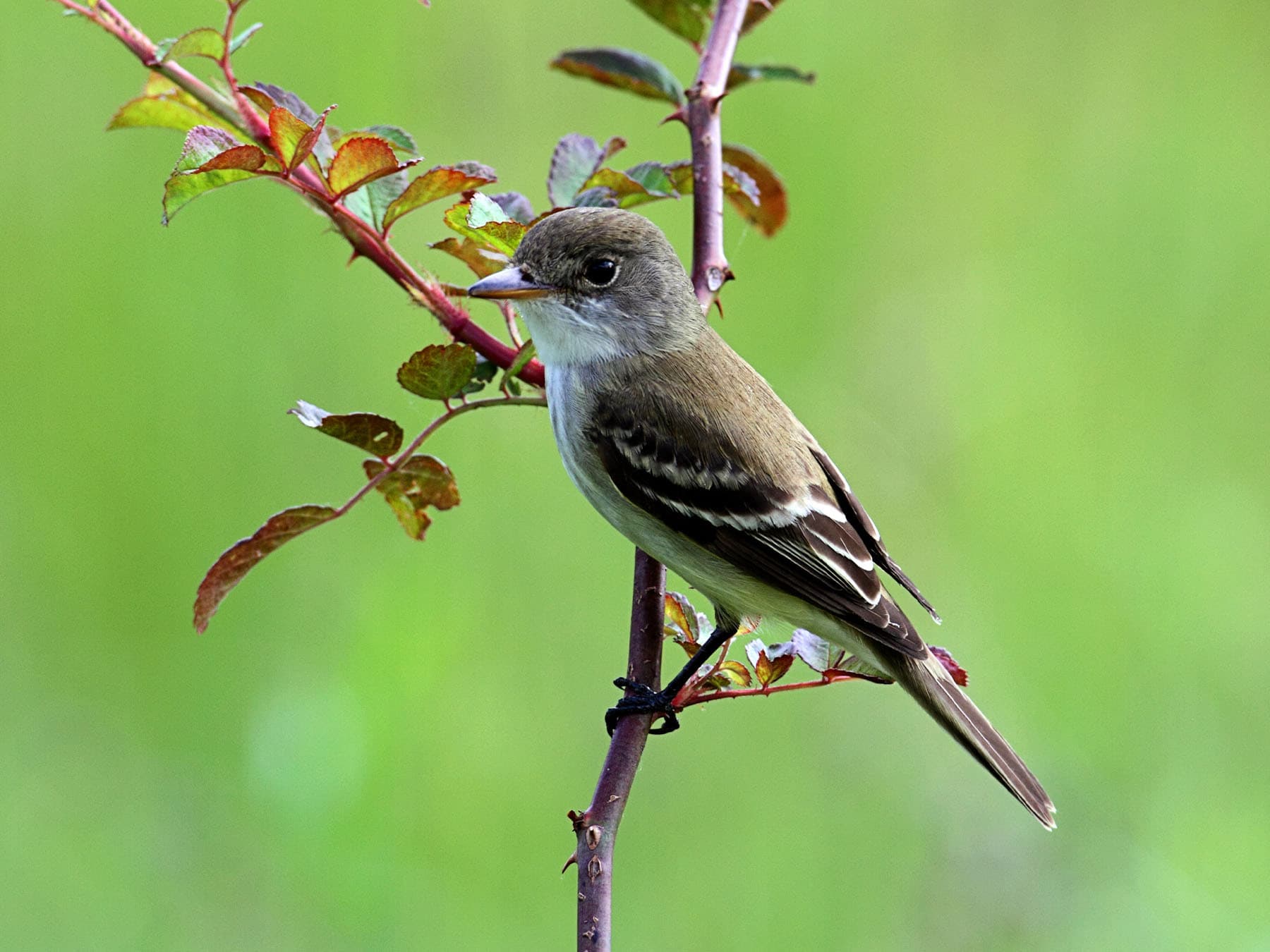
Quick facts
- Length
- 14–17 cm
- Wingspan
- 20–23 cm
- Weight
- 8–13 g
- Lifespan
- oldest recorded 7 years
- Family
- Tyrant Flycatchers
- Migration
- Full migrant
- Global status (IUCN)
- Least Concern
- World population
- About 13 million (Partners in Flight's two former-species estimates)
- Population trend
- Declining: Breeding Bird Survey counts fell about 0.5% a year from 1967 to 2025, faster in the lower 48 states and in the last ten years, while numbers rose in British Columbia and Colorado
- Also called
- Pacific-slope Flycatcher, Cordilleran Flycatcher
- Scientific name
- Empidonax difficilis
Questions
2Is the Pacific-slope Flycatcher the same as the Western Flycatcher?
Yes. Since 2023 the Pacific-slope and Cordilleran Flycatchers have been treated as one species, the Western Flycatcher, and the old names now mark the coastal and inland forms. See Names and relatives.
Are Western Flycatchers rare?
No. About 13 million are estimated to exist, and they are common in shady western forests, though survey counts have fallen since 1967. In the East it is a rare stray. See Conservation status.
Sources
30- 1Lowther, P. E., McCallum, D. A., Pyle, P. and Hopping, W. A. (2023). Western Flycatcher (Empidonax difficilis), version 1.0. Birds of the World (B. K. Keeney and S. M. Billerman, editors). Cornell Lab of Ornithology. doi:10.2173/bow.wesfly.01 (opens in a new tab)
- 2Cornell Lab of Ornithology. Western Flycatcher (Overview, Identification, Life History). All About Birds. Accessed 28 November 2026. Source (opens in a new tab)
- 3García, N. C. et al. (2023). Comparative genomics of two Empidonax flycatchers reveal candidate genes for bird song production. Evolution 77: 1818-1828. doi:10.1093/evolut/qpad096 (opens in a new tab)
- 4Wagner, M. A. and Reynolds, J. D. (2019). Salmon increase forest bird abundance and diversity. PLOS ONE 14: e0210031. doi:10.1371/journal.pone.0210031 (opens in a new tab)
- 5Pearson, S. F., Giovanini, J., Jones, J. E., Kroll, A. J. et al. (2015). Breeding Bird Community Continues to Colonize Riparian Buffers Ten Years after Harvest. PLOS ONE 10: e0143241. doi:10.1371/journal.pone.0143241 (opens in a new tab)
- 6Freeman, B. G. et al. (2025). Pacific Northwest birds have shifted their abundances upslope in response to 30 years of warming temperatures. Ecology 106. doi:10.1002/ecy.70193 (opens in a new tab)
- 7Partners in Flight (2024). Avian Conservation Assessment Database, version 2024.05.23 (global). Partners in Flight. Accessed 28 November 2026. Source (opens in a new tab)
- 8San Diego County Bird Atlas. Western or Pacific-slope Flycatcher Empidonax difficilis (pp. 343-345). San Diego County Bird Atlas. Accessed 28 November 2026. Source (opens in a new tab)
- 9Robinson, W. D. et al. (2019). Idiosyncratic changes in spring arrival dates of Pacific Northwest migratory birds. PeerJ 7: e7999. doi:10.7717/peerj.7999 (opens in a new tab)
- 10USGS Bird Banding Laboratory. Longevity records of North American birds: Western Flycatcher (AOU 4640). Bird Banding Laboratory, Bander Portal longevity tables. Accessed 28 November 2026. Source (opens in a new tab)
- 11BirdLife International (2021). Empidonax difficilis and Empidonax occidentalis. The IUCN Red List of Threatened Species 2021 (two assessments). IUCN Red List. doi:10.2305/IUCN.UK.2021-3.RLTS.T22699871A187283001.en (opens in a new tab)
- 12Hostetler, J. A. et al. (2026). The North American Breeding Bird Survey, Analysis Results 1966 - 2025. U.S. Geological Survey data release. doi:10.5066/P1OSNSFC (opens in a new tab)
- 13U.S. Fish and Wildlife Service (2026). 50 CFR 10.13 List of Migratory Birds (version of 2026-11-25). Electronic Code of Federal Regulations. Accessed 28 November 2026. Source (opens in a new tab)
- 14U.S. Congress. 16 U.S.C. 703: Taking, killing, or possessing migratory birds unlawful. U.S. Code (Cornell LII copy). Accessed 28 November 2026. Source (opens in a new tab)
- 15U.S. Fish and Wildlife Service (2026). 50 CFR 21.10 General permit requirements (version of 2026-11-25). Electronic Code of Federal Regulations. Accessed 28 November 2026. Source (opens in a new tab)
- 16U.S. Fish and Wildlife Service (2026). 50 CFR Part 21 Migratory bird permits (version of 2026-11-25), searched in full. Electronic Code of Federal Regulations. Accessed 28 November 2026. Source (opens in a new tab)
- 17U.S. Fish and Wildlife Service (2026). 50 CFR 17.11 Endangered and threatened wildlife (version of 2026-11-25). Electronic Code of Federal Regulations. Accessed 28 November 2026. Source (opens in a new tab)
- 18Environment and Climate Change Canada. Birds protected in Canada. Canada.ca. Accessed 28 November 2026. Source (opens in a new tab)
- 19Rush, A. C., Cannings, R. J. and Irwin, D. E. (2009). Analysis of multilocus DNA reveals hybridization in a contact zone between Empidonax flycatchers. Journal of Avian Biology 40: 614-624. doi:10.1111/j.1600-048x.2009.04681.x (opens in a new tab)
- 20NatureServe. Empidonax difficilis, Western Flycatcher. NatureServe Explorer. Accessed 28 November 2026. Source (opens in a new tab)
- 21AviList Core Team (2025). AviList: The Global Avian Checklist, v2025b. AviList. doi:10.2173/avilist.v2025b (opens in a new tab)
- 22Johnson, N. K. and Marten, J. A. (1988). Evolutionary Genetics of Flycatchers. II. Differentiation in the Empidonax difficilis Complex. The Auk 105(1): 177-191. doi:10.1093/auk/105.1.177 (opens in a new tab)
- 23Linck, E. et al. (2019). Dense geographic and genomic sampling reveals paraphyly and a cryptic lineage in a classic sibling species complex. Systematic Biology 68: 956-966. doi:10.1093/sysbio/syz027 (opens in a new tab)
- 24National Audubon Society and Kaufman, K. (1996). Western Flycatcher (Empidonax difficilis). Audubon Guide to North American Birds (text adapted from Kaufman, Lives of North American Birds, 1996). Accessed 28 November 2026. Source (opens in a new tab)
- 25Gross, D. A. and Lowther, P. E. (2020). Yellow-bellied Flycatcher (Empidonax flaviventris), version 1.0. Birds of the World, Cornell Lab of Ornithology. doi:10.2173/bow.yebfly.01 (opens in a new tab)
- 26Sedgwick, J. A. (2020). Hammond's Flycatcher (Empidonax hammondii), version 1.0. Birds of the World, Cornell Lab of Ornithology. doi:10.2173/bow.hamfly.01 (opens in a new tab)
- 27Pereyra, M. E. and Sedgwick, J. A. (2020). Dusky Flycatcher (Empidonax oberholseri), version 1.0. Birds of the World, Cornell Lab of Ornithology. doi:10.2173/bow.dusfly.01 (opens in a new tab)
- 28Tarof, S. and Briskie, J. V. (2020). Least Flycatcher (Empidonax minimus), version 1.0. Birds of the World, Cornell Lab of Ornithology. doi:10.2173/bow.leafly.01 (opens in a new tab)
- 29Sedgwick, J. A. (2020). Willow Flycatcher (Empidonax traillii), version 1.0. Birds of the World, Cornell Lab of Ornithology. doi:10.2173/bow.wilfly.01 (opens in a new tab)
- 30Schlossberg, S. and Sterling, J. C. (2020). Gray Flycatcher (Empidonax wrightii), version 1.0. Birds of the World, Cornell Lab of Ornithology. doi:10.2173/bow.gryfly.01 (opens in a new tab)

Checked by
Nathan Cope, founder and editor
Nathan founded Birdfact and leads its writers and contributors in the UK, the US and Canada. He has watched and studied birds for more than ten years, and checks every article and species guide before it’s published.