Species Profile
Yellow-bellied Flycatcher
Empidonax flaviventris
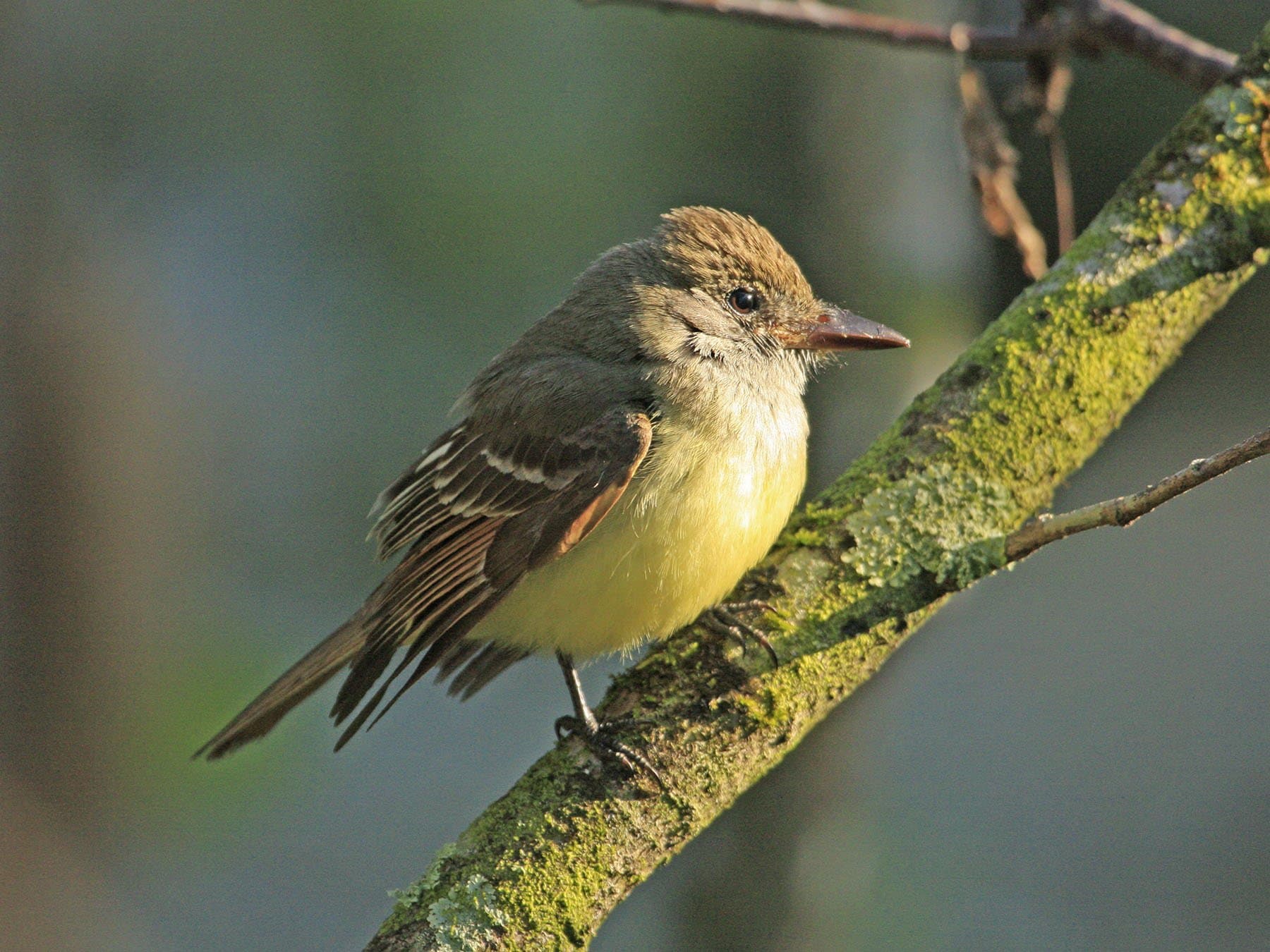
Yellow-bellied Flycatcher perched on a moss-covered branch, showing its yellow underparts and olive-brown back.
Quick Facts
Conservation
LCLeast ConcernLifespan
2–4 years
Length
13–15 cm
Weight
8.5–17 g
Wingspan
18–20 cm
Migration
Long-distance Migrant
Dressed in olive-green and butter-yellow, the Yellow-bellied Flycatcher is a secretive boreal specialist — a "moss tyrant" that breeds in remote sphagnum bogs across Canada and spends fewer than 70 days a year on its breeding grounds. Its genus name, Empidonax, translates from Greek as "master of the gnats."
Think you've spotted a Yellow-bellied Flycatcher?
Upload a photo and we'll confirm it instantly
Confirm with a PhotoAppearance
Wide dark eyes, a bold yellowish eye ring, and a distinctly short tail give this compact flycatcher an alert, big-headed look quite unlike most small woodland birds. Adults measure 13–15 cm in length and weigh between 8.5 and 17 g — roughly chickadee-sized. The upperparts are olive-green to brownish-olive, providing superb camouflage against the mossy, shaded forest floor where the species breeds.
The most diagnostic feature is the underparts: a warm yellow wash extends from the throat all the way to the belly. This yellow throat immediately separates the Yellow-bellied Flycatcher from every other eastern Empidonax species, all of which have whitish throats. The chest shows a faint dusky wash or indistinct breast band. The wings are blackish with two broad, white-to-yellowish wing bars that contrast sharply against the dark flight feathers.
The bill is broad and flat — the classic flycatcher shape — with a dark upper mandible and an orange-pink lower mandible. Rictal bristles surround the bill's base, acting as a net to improve insect-catching efficiency. The eye ring is bold, complete, and typically yellowish-white; crucially, it lacks the teardrop-shaped extension seen in Pacific-slope and Cordilleran Flycatchers, which is a useful separation feature in the field. The tail is relatively short and notched to square-tipped. The wings are rounded.
The species is monomorphic: males and females are identical in plumage and cannot be reliably separated in the field. Juveniles closely resemble adults but show more buff-coloured (rather than white) wing bars and a slightly warmer overall tone. There is no significant seasonal variation in plumage.
Identification & Characteristics
Colors
- Primary
- Olive
- Secondary
- Yellow
- Beak
- Black
- Legs
- Black
Markings
Yellow wash on throat and underparts (diagnostic among eastern Empidonax); bold complete yellowish-white eye ring without teardrop extension; orange-pink lower mandible; two broad yellowish wing bars
Tail: Relatively short, notched to square-tipped; shorter than most other Empidonax species
Attributes
Understanding Attributes
Rated 0–100 based on research and observation. A score of 50 is average across all bird species. These attributes are relative and don't necessarily indicate superiority.
Habitat & Distribution
The Yellow-bellied Flycatcher is strongly tied to cool, moist, shaded environments throughout its breeding range. It favours boreal coniferous forests, spruce-fir bogs, sphagnum peatlands, tamarack-white cedar swamps, and willow-alder thickets along coldwater streams. Breeding territories typically feature an open canopy, a shrubby understory, pit-and-mound microtopography characteristic of old-growth forest structure, and — above all — a thick carpet of sphagnum moss on the forest floor. In Canada, the species frequently uses black spruce stands with heath, blueberries, Labrador tea, and laurel in the understory.
An estimated 87% of the global population breeds in Canada's boreal forest, making this one of the most thoroughly boreal of all North American songbirds. The breeding range extends from central Canada and Newfoundland west to just east of the Rocky Mountains. It extends south into the northeastern United States: northern Michigan, Wisconsin, Minnesota, northern New York, northern New England (Maine, New Hampshire, Vermont), and the Maritime Provinces. New breeding populations have recently been confirmed in eastern Alaska, suggesting a northward range expansion. In the United States, the species reaches the southern limit of its breeding range in northern Pennsylvania, where it is listed as state endangered.
During spring and autumn migration, the Yellow-bellied Flycatcher passes through the eastern half of the United States. Almost all migration routes run through the east, even for birds nesting in far western Canada. Spring migrants pass through in mid-to-late May; autumn birds move through from late July to September. The species winters from northeastern Mexico south through Central America to Panama, favouring humid montane forests at 1,000–2,000 m elevation, dense rainforest, and shade-grown coffee plantations.
In the UK, the Yellow-bellied Flycatcher is an extreme rarity. In September 2020, a single individual found in a garden at Balephuil on the island of Tiree, Argyll, Scotland became the first record for Britain and the entire Western Palearctic — almost certainly a bird blown off course during its southward migration from Canada.
Where to See This Bird
Explore regional guides for locations where this bird has been recorded.
Diet
The Yellow-bellied Flycatcher's choice of breeding habitat is partly a dietary strategy: sphagnum bogs and spruce-fir swamps produce enormous hatches of midges, crane flies, and mosquitoes throughout the short boreal summer, providing a reliable and abundant food supply during the critical nesting period. Insects make up the vast majority of the diet year-round. The broad, flat bill and rictal bristles around the gape are direct adaptations for aerial hunting.
Recorded prey items include crane flies, flying ants, small wasps, beetles, caterpillars, mosquitoes, midges, stoneflies, true bugs, moths, and spiders. The species hawks flying prey from a perch — darting out, seizing an insect in midair, and returning to the same or a nearby perch — and also hovers to pluck prey from leaves and stems.
The diet is not exclusively insectivorous. The species occasionally supplements its intake with fruit, including berries and poison ivy berries, and sometimes seeds — particularly in autumn when insect availability declines before and during migration. On the wintering grounds in Central America, the species forages in dense vegetation near streams and forest edges, defending small territories to maintain exclusive access to productive foraging patches. This territorial behaviour on the wintering grounds is maintained through repeated tu-wee calls rather than physical confrontation.
Behaviour
On the breeding grounds, males throw their head back with each note as they sing from exposed perches — a distinctive gesture that makes a singing bird easy to spot even in dense spruce. When a rival or predator intrudes, the response escalates: singing becomes more vigorous, head feathers are raised, and wings are flicked and drooped in a display of agitation. Away from these moments of confrontation, the Yellow-bellied Flycatcher is a quiet, unobtrusive bird that is easy to overlook despite its distinctive colouring.
Outside the breeding season, the species is largely solitary. During migration it moves through dense thickets and shaded woodland interiors, keeping low and inconspicuous — a habit that makes it easy to miss even when it is passing through in numbers. On its Central American wintering grounds, individuals defend foraging territories and use the tu-wee call to signal ownership, a behaviour unusual among small migratory flycatchers that often tolerate overlap in winter.
Foraging takes place mainly in the lower to middle levels of the forest. The Yellow-bellied Flycatcher uses the classic flycatcher technique of sallying out from a perch to catch insects in midair, but also hovers briefly to pluck prey from foliage. It is notably quiet and inconspicuous around the nest during the breeding season — a behaviour that helps conceal one of the most cryptically placed nests of any North American bird. Males have a complex pre-dawn flight song that appears to incorporate every vocalisation the species is capable of producing, though this is rarely witnessed.
Calls & Sounds
Vocalisation is the most reliable means of identifying the Yellow-bellied Flycatcher in the field, and the species has a more varied repertoire than is often appreciated. The primary advertising song of the male is a sharp, rough, descending tse-berk, che-lek, or che-bunk — a slurred, buzzy two-syllable note delivered at a leisurely pace of just 6–8 times per minute. Males throw their head back with each note when singing from an exposed perch. This song contrasts markedly with the Least Flycatcher's snappier, more evenly pitched che-bek, which is delivered at a frantic pace of at least 50 times per minute.
The most commonly heard vocalisation — used by both sexes during migration and on the wintering grounds — is a soft, rising two-note whistle transcribed as tu-wee, chu-wee, or per-wee?. It is reminiscent of the call of the Eastern Wood-Pewee but shorter in duration. Females use this call repeatedly when nest-building or during breaks from incubation; both sexes use it to maintain contact. On the wintering grounds in Central America, the same call serves to defend foraging territories.
Additional vocalisations include a flat chilk or killic call, an abrupt brrrt uttered at the moment of catching prey, and soft twitters during social interactions. Males produce a complex pre-dawn flight song that appears to incorporate the full range of vocalisations the species is capable of — a rarely witnessed performance that suggests a richer vocal life than the bird's quiet reputation implies. The species is notably silent around the nest during the breeding season, a behaviour that helps conceal its location from predators.
Flight
The Yellow-bellied Flycatcher's flight reflects its life in dense, low vegetation. The wings are rounded — a shape associated with manoeuvrability in cluttered environments rather than sustained long-distance travel — and the tail is relatively short, giving the bird a compact, blunt-ended silhouette in the air. In direct flight between perches, the wingbeats are rapid and slightly undulating, typical of small flycatchers.
Foraging flights are short and precise: the bird sallies from a low perch, intercepts an insect in midair with an audible snap of the bill, and returns — often to the same perch. It also makes brief hovering flights to pluck prey from foliage, a technique that requires fine motor control and good spatial awareness in dense vegetation. These foraging sallies rarely exceed a few metres.
Despite its rounded wings and sedentary appearance on the breeding grounds, the Yellow-bellied Flycatcher is a capable long-distance migrant. It travels from boreal Canada to Central America twice a year — a round trip of several thousand kilometres — almost entirely through the eastern half of North America. Migration is conducted largely at night, and the species is regularly detected at night by its tu-wee call on nocturnal migration monitoring stations. In flight overhead, the combination of small size, compact shape, and yellowish underparts can suggest the species, though positive identification in flight requires a heard call.
Nesting & Breeding
One of the most cryptically placed nests of any North American songbird, the Yellow-bellied Flycatcher's cup is so thoroughly concealed by overhanging moss and vegetation that it is virtually invisible from above. The female selects a shady spot on the ground — typically tucked under a tree root, in a hollow in a mossy log, beneath the roots of a fallen tree, or nestled at the base of a fern — and builds a bulky open cup of mosses, grasses, sedges, and rootlets, lined inside with fine rootlets.
Clutch size is 2–5 eggs, typically 3–4. The eggs are white with fine speckling of small brown dots and blotches concentrated around the larger end; each egg measures approximately 13 × 17 mm. Incubation is performed by the female alone and lasts approximately 15 days. Both parents bring food to the nestlings, which fledge after a further 13–15 days in the nest.
The breeding season runs from May to late August, but the species' residency on the breeding grounds is extraordinarily brief — often fewer than 70 days, and rarely more than 90.
Some birds do not arrive until early or mid-June, and some adults begin their southward migration as early as mid-July. Some pairs manage two broods in a season: the male tends the first brood of fledglings while the female simultaneously builds a second nest and begins a new clutch. It is worth noting that a singing male does not guarantee a mated pair or active nest — many reported "breeding" records are of unmated males advertising for a mate that never arrives.
Lifespan
Typical lifespan in the wild is 2–4 years, and the maximum recorded age from banding data is approximately 5 years and 2 months — though banding records for this secretive species remain limited, so the true upper limit may be higher. Sexual maturity is reached at around one year of age, meaning most individuals breed in their first full summer after hatching.
Survival rates are shaped by the hazards of long-distance migration — predation, weather events, and collision with man-made structures during nocturnal flight — as well as nest predation on the breeding grounds. The ground-nesting habit makes eggs and nestlings vulnerable to mammalian predators including weasels, squirrels, and chipmunks, as well as snakes. The extraordinary concealment of the nest in sphagnum moss is the primary defence against these threats.
Compared to other small Neotropical migrants of similar size, the Yellow-bellied Flycatcher's lifespan appears broadly typical. The Least Flycatcher, its closest ecological counterpart in eastern North America, has a maximum recorded age of around 8 years according to banding records — though direct comparisons are complicated by differences in how intensively each species has been studied. The average adult body weight of approximately 11.9 g places it at the lighter end of the Empidonax genus, which may influence both metabolic rate and longevity.
Conservation
The Yellow-bellied Flycatcher is listed as Least Concern by the IUCN (2016), and globally the picture is broadly positive. Partners in Flight estimates the total population at 13–14 million mature individuals. North American Breeding Bird Survey data from 1966 to 2019 show an overall increase of approximately 2% per year. This increase is driven largely by stable and expanding populations in Canada's boreal forest, where 87% of the global population breeds.
The regional picture, however, is considerably more troubling. Mountain Birdwatch monitoring data from 2010 to 2025 show an overall decline of 14% across the northeastern United States. The Catskill Mountains of New York have recorded a collapse of approximately 71% since 2011 — among the steepest declines documented for any songbird in the region. Vermont populations have declined around 28.5% over the same period, and in Pennsylvania the species is listed as state endangered — upgraded from threatened in 2005 — and is a US Fish & Wildlife Service Migratory Bird of Conservation Concern in the Northeast.
The principal threats include habitat loss and forest fragmentation on both breeding and wintering grounds; spruce die-offs caused by bark beetle outbreaks in the northeastern US; desiccation of sphagnum moss ground cover when forest is fragmented; acid rain degrading conifer-forest habitat; and the loss of shade-grown coffee plantations on Central American wintering grounds.
Climate change poses a long-term existential threat. In the Adirondack Mountains, the species has already shifted its breeding range upwards by over 1,000 feet in elevation between 1973 and 2014.
Climate models predict the Yellow-bellied Flycatcher could be absent from the contiguous lower 48 states entirely by 2080, losing 73% of its current breeding range as it retreats northward into Canada and Alaska.
Population
Estimated: 13,000,000–14,000,000 mature individuals
Trend: Increasing
Globally increasing at approximately 2% per year (North American Breeding Bird Survey, 1966–2019), driven by stable boreal populations in Canada. Regional declines are significant: northeastern US populations down 14% (2010–2025), with a ~71% collapse in the Catskills of New York since 2011.
Elevation
Breeding: near sea level to ~1,000 m; wintering: 1,000–2,000 m (montane Central America)
Additional Details
- Family:
- Tyrannidae (Tyrant Flycatchers)
- Predators:
- Nest predators include weasels, squirrels, chipmunks, and snakes; adults taken by small hawks and falcons during migration
- Similar species:
- Least Flycatcher, Alder Flycatcher, Willow Flycatcher, Acadian Flycatcher, Pacific-slope Flycatcher, Cordilleran Flycatcher
Status In Uk
The Yellow-bellied Flycatcher has just one accepted record in Britain. On 22 September 2020, a bird was found in a garden at Balephuil on the island of Tiree, Argyll, Scotland — the first record for Britain and for the entire Western Palearctic. The finder initially dismissed it as unremarkable, describing it as "nothing exceptional, about the size of a small robin," before a visiting birder recognised its significance. The record was accepted by the British Birds Rarities Committee and published in the journal British Birds.
News of the find spread rapidly through the birding community. Dozens of twitchers travelled to Tiree by charter boat and plane from the mainland, with the influx raising over £700 for the Tiree Community Trust — a tangible community benefit from a single lost bird. The Tiree record is consistent with the pattern of North American vagrant flycatchers reaching western Britain in September and October, when strong westerly weather systems can carry small migrants thousands of kilometres off course during their southward migration from Canada.
Given the species' abundance — an estimated 13–14 million individuals — and the regularity with which other North American passerines reach Britain, further records are plausible. Any future Yellow-bellied Flycatcher in Britain would most likely appear in September or October on western headlands, islands, or coastal scrub in Ireland, Scotland, or southwest England. Identification would rely heavily on the yellow throat, the complete yellowish eye ring without a teardrop extension, and — if the bird calls — the distinctive rising tu-wee whistle.
Similar Species
Eleven species share the Empidonax body plan — small, olive-brown above, pale below, with two wing bars and an eye ring — and several are essentially identical in the field without a heard call. This makes the group one of the most consistently humbling identification challenges in North American birding, and the Yellow-bellied Flycatcher sits at the centre of it.
The most important separation is from the Least Flycatcher, which overlaps broadly in range and habitat during migration. The Least Flycatcher has a whitish throat (never yellow), a greyer overall tone, a more prominent eye ring, and a very different song: the snappy, rapid che-bek delivered 50+ times per minute versus the Yellow-bellied's slow, buzzy che-bunk. The Alder Flycatcher and Willow Flycatcher both lack the yellow throat and have a more elongated body shape with a longer tail. The Acadian Flycatcher has a more pronounced teardrop eye ring and a greener tone, with a very different explosive peet-sah song.
The trickiest separations involve the western species. Pacific-slope and Cordilleran Flycatchers (formerly lumped as "Western Flycatcher") are very similar in overall colour and both show yellow underparts, but they have a teardrop-shaped eye ring extension behind the eye — absent in Yellow-bellied — and different vocalisations. A 2014 DNA study also confirmed a reliable additional field mark: Yellow-bellied shows less buffy edging on the secondaries than either western species. In autumn, when all Empidonax are silent, even expert observers routinely leave these birds unidentified.
Birdwatching Tips
The Yellow-bellied Flycatcher is one of the most challenging birds to see well in eastern North America — not because it is genuinely rare, but because it is secretive, moves through dense cover, and its brief migration window is easy to miss. In the United States and Canada, the best strategy during spring migration is to check shaded woodland interiors and thickets in mid-to-late May, particularly after nights with southerly winds. The species tends to stay low, often below 3 metres, and can sit motionless for long periods.
On the breeding grounds, the species is most reliably found by ear. The primary song — a rough, descending tse-berk or che-bunk — is distinctive once learned, and the softer rising tu-wee whistle is the call most likely to be heard during migration. Singing males in boreal bogs and spruce-fir swamps in June are the most reliable indicator of breeding activity, though confirming an active nest is extremely difficult given how well concealed they are.
Separating the Yellow-bellied Flycatcher from other Empidonax species is notoriously difficult. The yellow throat is the single most reliable visual feature — no other eastern Empidonax shows this. The bold, complete, yellowish eye ring (without a teardrop extension) and the orange-pink lower mandible are supporting features. In autumn, when silent birds pass through, even experienced observers often record them simply as "Empidonax sp." Vocalisation remains the gold standard for identification. The Least Flycatcher sings a snappier che-bek at a frantic pace of 50+ times per minute — very different from the Yellow-bellied's leisurely 6–8 notes per minute.
In the UK, the species is a once-in-a-generation vagrant; see the Status in the UK section for the full story of the 2020 Tiree record. Any future record would most likely appear in September or October on western headlands or islands following strong westerly weather systems.
Did You Know?
- In 2010, a small flycatcher was collected in Chicago and placed in the Field Museum's collection trays alongside Yellow-bellied Flycatcher specimens. Four years later, DNA analysis revealed it was actually a Western Flycatcher — the first-ever record of that species in Illinois, hiding undetected in plain sight. The same study identified a new field mark: Yellow-bellied Flycatchers show less buffy edging on the secondaries than either Pacific-slope or Cordilleran Flycatchers.
- In September 2020, a Yellow-bellied Flycatcher found in a garden on the island of Tiree, Argyll, Scotland became the first record for Britain and the entire Western Palearctic. The homeowner initially thought it was "nothing exceptional, about the size of a small robin." Dozens of twitchers travelled by charter boat and plane to see it, raising over £700 for the Tiree Community Trust.
- Males defend their wintering territories in Central America using the same tu-wee call they use during migration — an unusual degree of year-round vocal consistency for a small Neotropical migrant. Most comparable species tolerate considerable overlap on their wintering grounds; the Yellow-bellied Flycatcher does not.
- The species is regularly detected at night by automated recording stations during nocturnal migration — its rising tu-wee whistle is one of the more distinctive flight calls in the eastern North American night-migration soundscape, allowing researchers to track its passage even when the bird itself is invisible overhead.
- Climate change is pushing the Yellow-bellied Flycatcher uphill and northward. In the Adirondack Mountains of New York, the species shifted its breeding range upwards by over 1,000 feet in elevation between 1973 and 2014. Climate models predict it could disappear entirely from the contiguous United States by 2080, losing 73% of its current breeding range.
Records & Accolades
Moss Tyrant
Sphagnum specialist
One of North America's most habitat-specialised flycatchers, breeding almost exclusively in sphagnum moss bogs and spruce-fir swamps in the boreal forest.
Shortest Breeding Stay
Fewer than 70 days
Among the briefest breeding-ground residencies of any Neotropical migrant — some adults begin their southward migration as early as mid-July.
First Western Palearctic Record
Tiree, Scotland, September 2020
The only accepted record for Britain and the entire Western Palearctic, found in a garden on the Hebridean island of Tiree.
Community Photos
Be the first to share a photo of the Yellow-bellied Flycatcher
Upload a PhotoIdentify Any Bird Instantly
- Upload a photo from your phone or camera
- Get an instant AI identification
- Ask follow-up questions about the bird
Monthly Birds in Your Area
- Personalised for your location
- Seasonal tips and garden advice
- Updated every month with new species