


Violet-green Swallow
Tachycineta thalassina
By the Birdfact teamChecked by Nathan Cope
On this page13 sections
How to recognise it
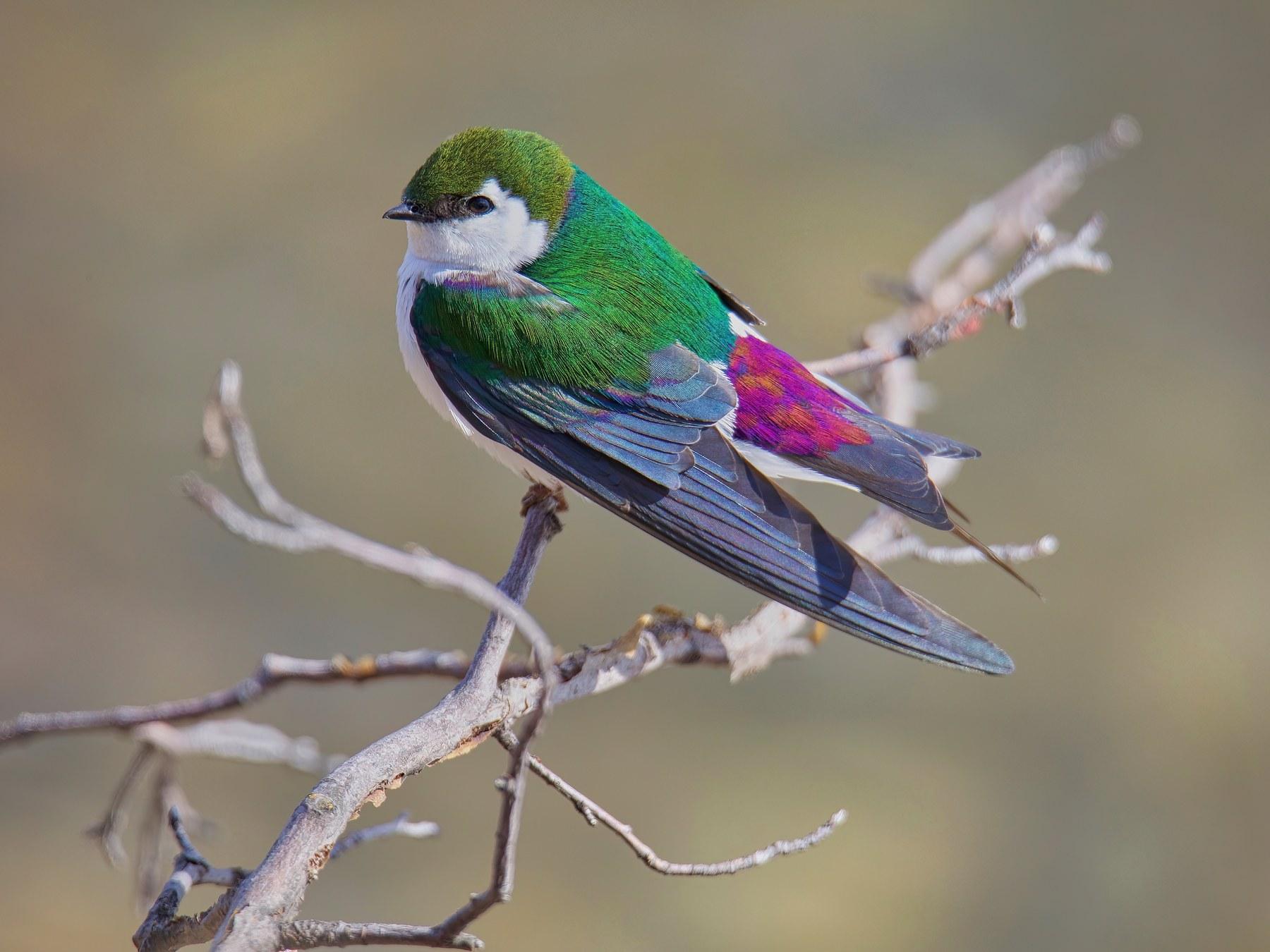
This is a small swallow of the West, green above and white below. In good light an adult male's back and crown shine glossy green, with a purple nape and violet just above the tail; at a distance or in shade it can look dark.
Two marks settle it. White on the face runs up behind the eye and over it. And a white patch on each side of the rump often comes so close to its partner that the rump looks crossed by one white band.
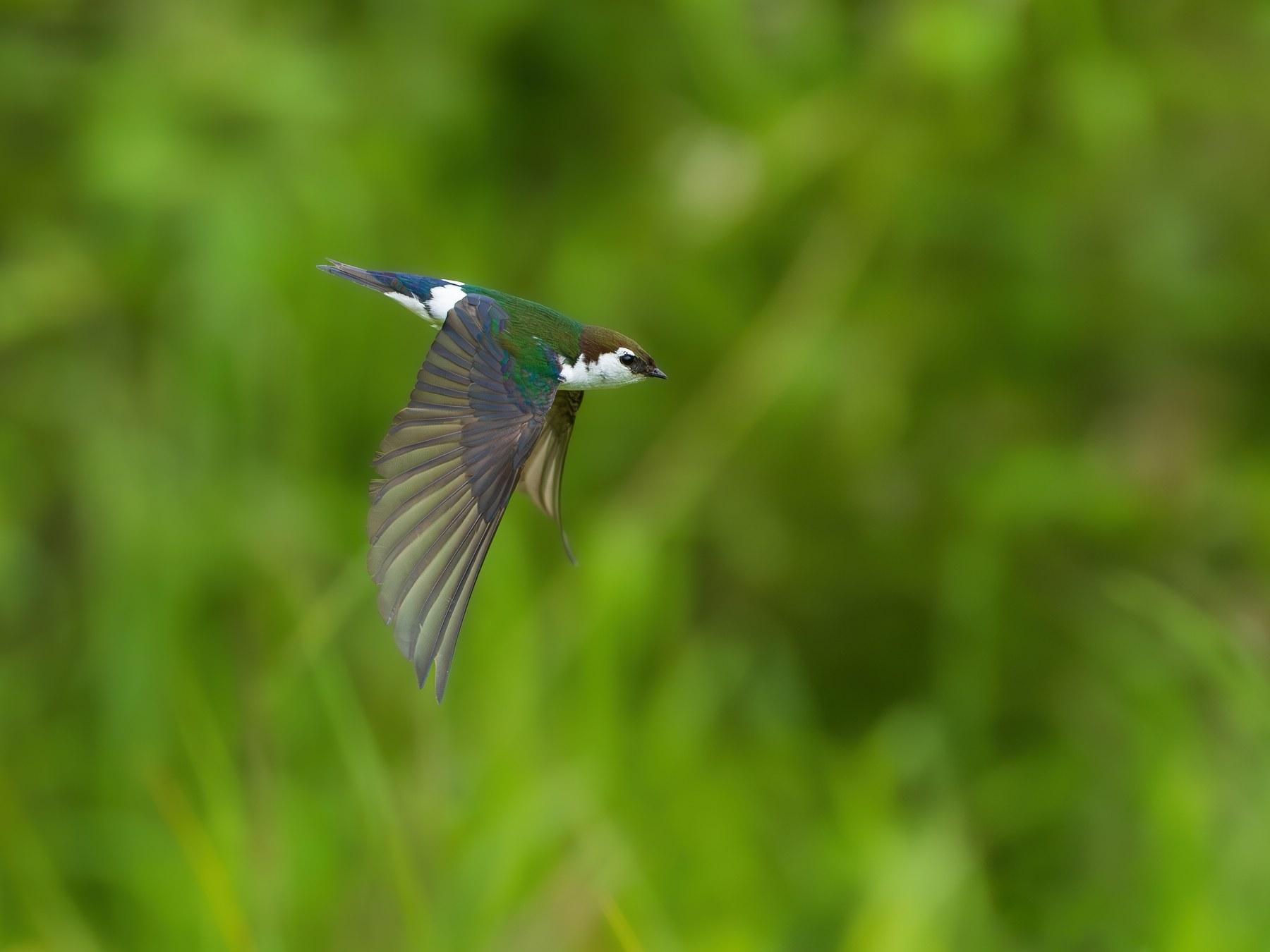
In flight it looks compact and short-tailed, with long, pointed wings and a fast, fluttery action. Perched, the wing tips reach past the end of the short, slightly forked tail.
Size and shape
It is 4.7–5.5 in (12–14 cm) long, with a wingspan of 10.6–11.8 in (27–30 cm), and weighs 0.4–0.6 oz (11–17 g). That makes it about the size of a Bank Swallow, smaller than a Barn Swallow and a little smaller than a Tree Swallow, with a shorter, less forked tail.
Two subspecies are recognized: the widespread thalassina, and brachyptera, with shorter wings, in the central and southern Baja peninsula and on the coast of Sonora and Sinaloa. Variation across the range is slight: size falls smoothly from north to south, and birds of the southern Pacific Coast average smaller and greener.
Male, female and young
The sexes differ. The adult male is the brightest: a glossy green crown and back with a bronzy tone, a purple nape, a bluish-green rump grading into violet-purple feathers above the tail, and a clean, silky-white face and underparts.
The adult female is duller. Her crown is browner, a bronzy green, and her cheeks and ear coverts are a dusky, marbled gray-brown, though the white still reaches above the eye. Her throat has a slight ashy-brown wash. She has the same white rump patches, and some females are nearly as bright as males.
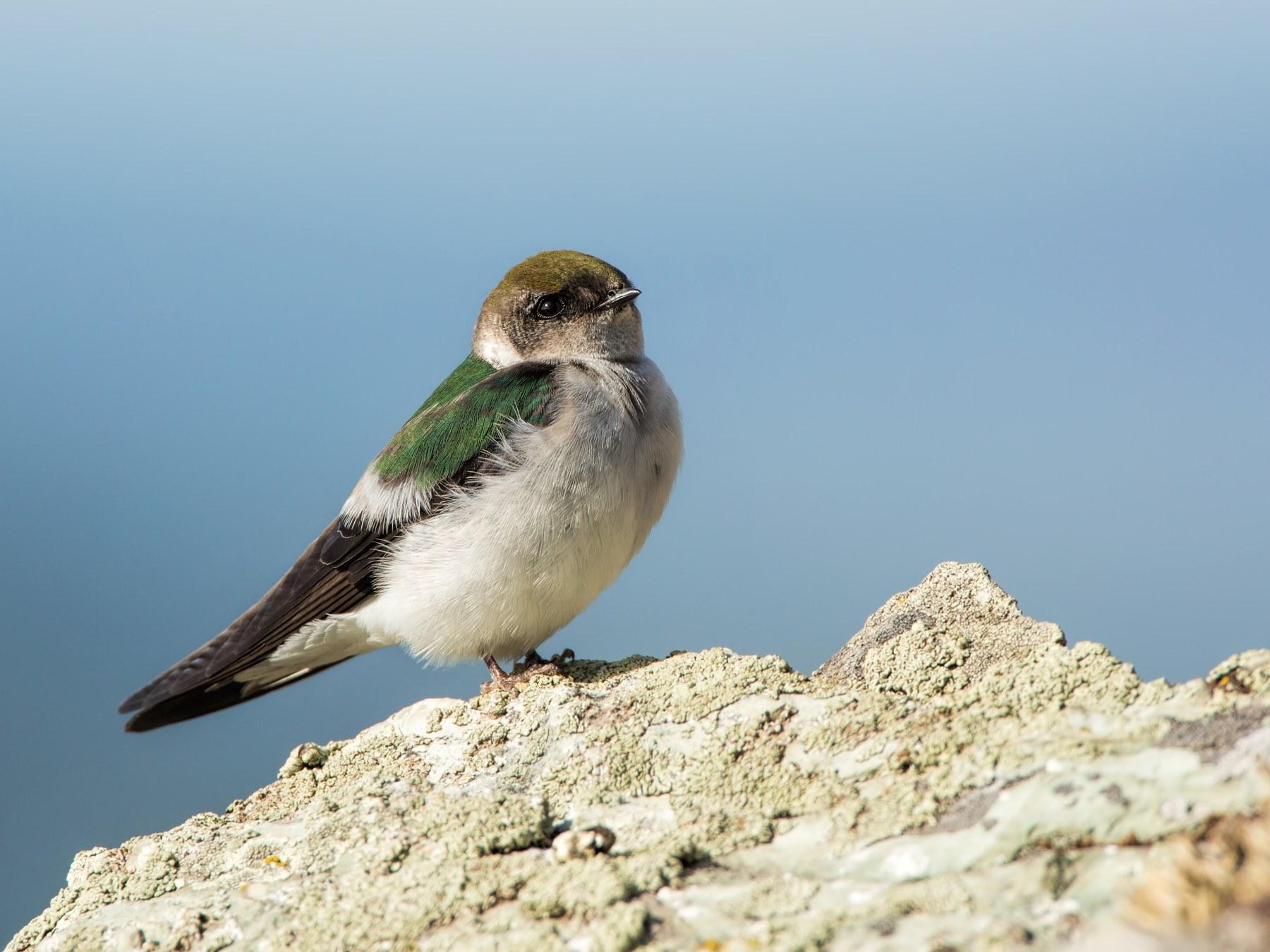
Juveniles, seen from May to September, are dull grayish or sooty brown above with little gloss, with a dingy throat and chest and only a hint of the white face pattern. After a complete molt in their first fall most look much like adults, though young females stay duller, with a little to a lot of brown in the back and rump. In fall these young birds can be hard to age and sex.
Males look adult after that first fall molt. Females may do so then, or only after their second-year molt, and perhaps occasionally not until the molt after that. This difference between the sexes is said to be unique to the genus among North American birds.1 Adults replace all their feathers once a year, usually starting on the breeding grounds in July.
Identification: similar birds
A Tree Swallow is the bird most often confused with it. A Tree Swallow has no white curling up behind the eye, and no big white patches at the sides of the rump, and its tail is longer and more forked. Adult male Tree Swallows are steely blue above, not green. A young Tree Swallow has a clean white throat against dark cheeks, where a young Violet-green's throat is dingy. In the air, the Violet-green soars less.
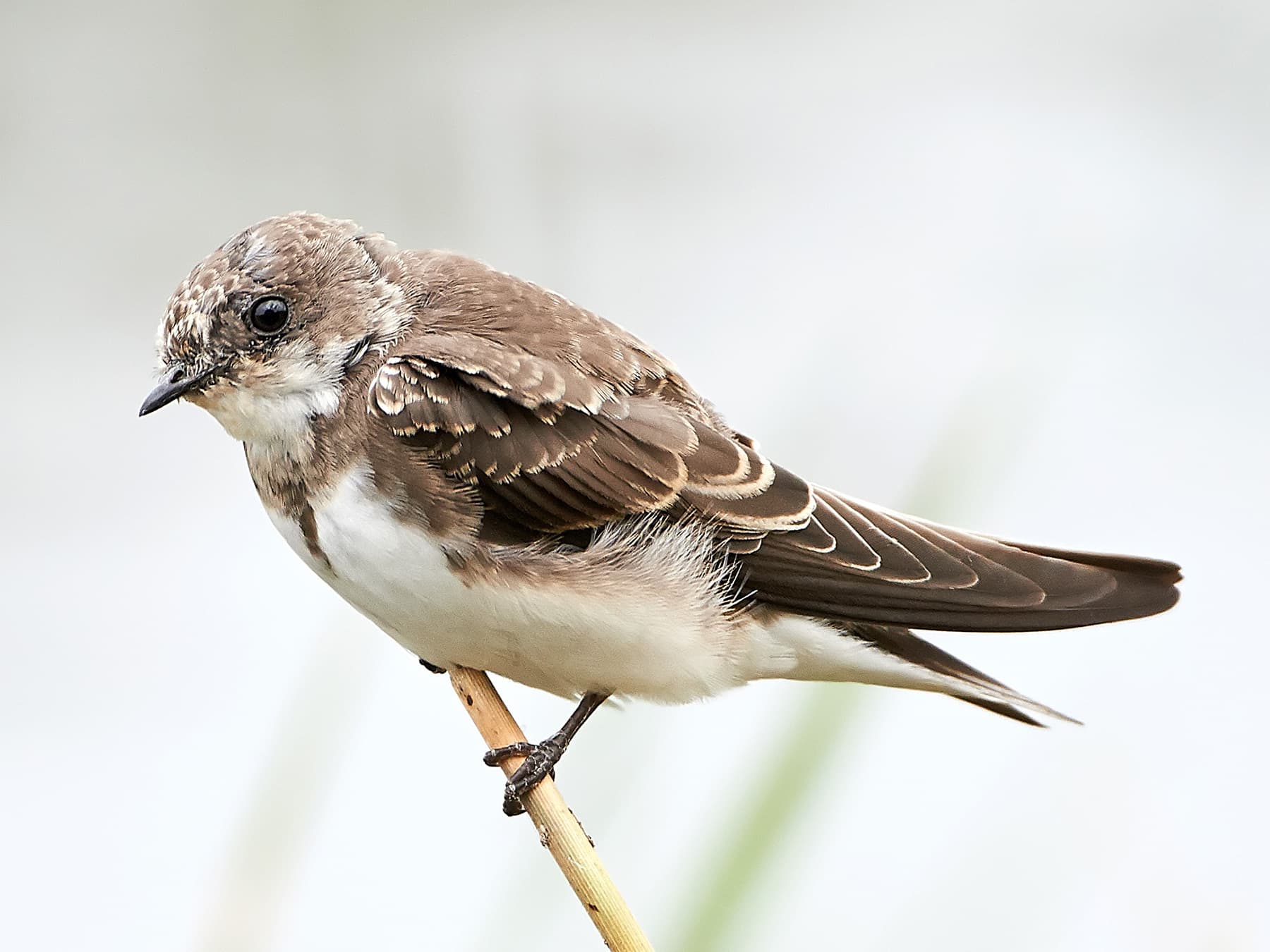
A Bank Swallow is about the same size but brown above, with a brown rump and a sharp dark band across its white breast. A Northern Rough-winged Swallow is plain grayish brown above, with a square tail and a gray-brown wash across the throat and breast.
A Cliff Swallow has a square tail, a pale buff rump, a chestnut throat and usually a pale forehead patch. A White-throated Swift, which often feeds with it, is a larger swift, 6–7 in (15–18 cm) long, blackish with white from the throat into the belly, white flank patches and rapid wingbeats.
Not sure it’s a Violet-green Swallow? Check your photo: Birdfact names the bird and shows the look-alike side by side.
Its size
Adults- Length
- 12–14 cm
- Wingspan
- 27–30 cm
- Weight
- 11–17 g
Its song and calls
What you will mostly hear are calls: short twittering notes, a chee-chee given in pairs or series, and a zwrack alarm call. One field guide also describes a high dee-chip in flight and a series of varied tweet notes.
Birds of the World's account, last revised in 2011, describes no song. Predawn song-flights have been mentioned without details, and recordings labeled as song and as dawn song have been published.2
In a study in Arizona's Chiricahua Mountains, the chee-chee was given almost always when a bird was with another swallow, and perched juveniles gave it while waiting for their parents, who appeared to find them by voice. The twittering was heard only in flight, apparently during courtship and while pairs settled on territories, and never at nests where pairs were settled. The zwrack, like a Purple Martin's, marks high alarm at the nest.1
Once settled at the nest the adults are largely silent; one Washington observer, writing in 1943, called them a very quiet species.3
- Calls0:00 / 0:12
Recorded in Colorado, United States · May 2025
Case · iNaturalist · CC0 1.0
- Calls from a bird in view0:00 / 0:17
Recorded in California, United States · April 2020
Heard one and not sure? Let the bird song identifier listen.
When and where to see it
It breeds in western North America, from central Alaska, the southwest Northwest Territories, British Columbia and southwest Alberta south through the Rocky Mountain and Pacific states to Baja California and the Mexican highlands. Its eastern edge runs through central Montana, the western Dakotas, northwest Nebraska, east-central Colorado and west Texas. It is rare east of that line, though it has nested at least once in far western Kansas.
Look for it in open woodland of conifers, broadleaf trees or both, such as ponderosa pine, Monterey pine and quaking aspen, especially where there are standing dead trees. It also uses canyons and cliffs, and towns and settlements with nest boxes. It shares habitat with the Tree Swallow but is often in more open places.
It nests from the plains up to about 13,100 ft (4,000 m), most commonly at 4,900–9,800 ft (1,500–3,000 m). In the south it apparently prefers to nest in mountains; in the north it nests lower down and near the coast.
It is thought to benefit from habitat opened by fire, and in the forests of northern California it is known to depend on old legacy trees. Cliffs matter too: one Colorado study found the most birds on the largest cliffs,1 and on cliffs managed by the City of Boulder in 2015, White-throated Swifts and Violet-green Swallows made up much of the activity seen.4
At the northeast edge of the range, a sight record at Regina on 12 April 1968 first put it on Saskatchewan's hypothetical list, after a few unconfirmed reports from the 1930s.5, 6 The first nest in the province was found in a clay-cliff crevice near Val Marie on 14 June 1969.6
When do they migrate?
Large numbers are back in the Southwest by February, and birds leave from late July in western Washington and from August elsewhere. Mexican birds stay in Mexico and move to lower elevations. In Alaska it arrives in early May and leaves in late August.
Early spring dates in older lists include 18 February in Arizona, 19 February in California, 20 February in Oregon, 6 March in British Columbia and 8 May in Alaska.1 At Bellingham Bay in western Washington, one observer's 35 years of first-arrival dates ran from 25 February to 7 April, about 21 March on average.3 At one Oregon Coast Range site, its first arrival dates showed no significant shift over 1985–2014, while 6 of 18 species there arrived significantly earlier.7
After the young fledge, birds move away from the nest area to streams, lakes and tidewater, and flocks gather before migration, in August even at the tree line on Mount Rainier. Large flocks pass through southern Arizona for a few days each October, and late fall dates in the same lists run from 10 August in Montana to 28 October in California.1 Little is known about its routes, and we found no tracking study of the species.
Where do they go in winter?
Most winter in Mexico and northern Central America. Birds of the World's 2011 range text puts the southern limit at Guatemala, El Salvador and Honduras; its newer subspecies text, from 2014, says northern Nicaragua. A few stay north of Mexico, in California's Imperial Valley, the lower Colorado River valley and on the coast, and occasionally in southern Arizona. It is casual in Costa Rica and western Panama and has been recorded once in Colombia.
In winter it uses lowlands, coastal plains and tidal flats. In accounts summarized in 1942, it was also found in El Salvador's interior mountains over cloud forest at 8,900–9,800 ft (2,700–3,000 m) and pine forest at 6,600–7,500 ft (2,000–2,300 m).1
Tips for seeing it
What it eats
Only flying insects, caught and swallowed in flight. It is not known to eat seeds or berries, and we found no source that recommends any feeder food for it. Prey includes flies, leafhoppers and other true bugs, aphids, beetles, wasps, wild bees and winged ants, and moths.
In 67 stomachs examined by Beal and reported by Bent in 1942, true bugs, mostly leafhoppers and leaf bugs, made up 36% of the food, flies 29%, wasps, bees and ants 23% and beetles 11%. The bugs and beetles probably reflect insects carried up by rising air.1 In a study of food brought to nestlings, published in 2014, flies and true bugs dominated, and 92.6% of 1,047 food items were under 0.2 in (5 mm) long.8
How they feed
It often feeds higher than other swallows, circling at great heights, but it also skims low over fields and water. It hunts in small groups or loose flocks of up to several hundred, often with other swallows and White-throated Swifts. It drinks in flight, skimming the water with its bill.
Nesting and breeding
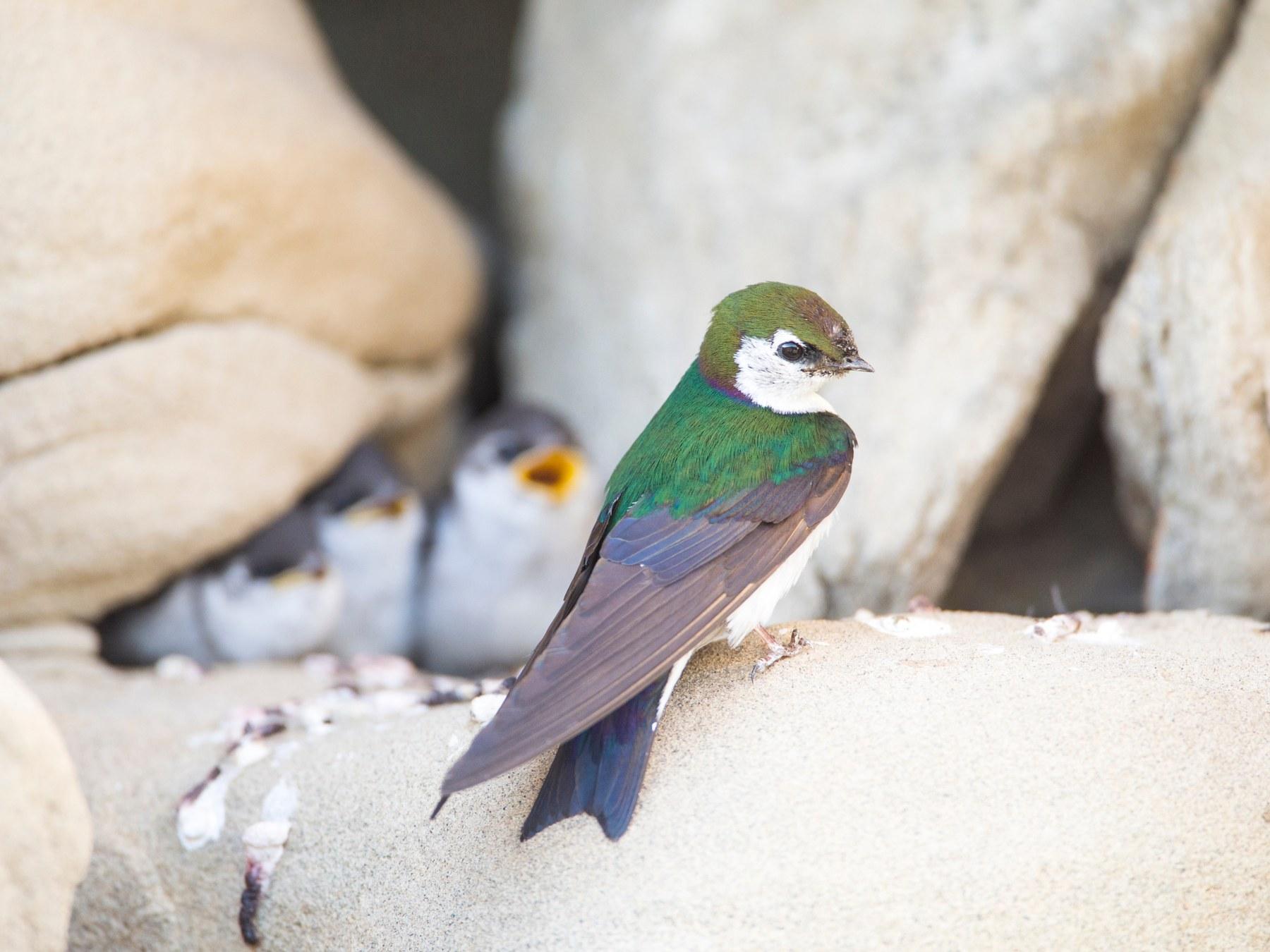
It nests in cavities, alone or in small colonies of up to about 25 pairs. Old woodpecker holes and other holes in trees such as ponderosa pine, oak and aspen are typical, along with crevices in cliffs and nest boxes. Less often it uses holes in sand or dirt banks, gaps in buildings and old Cliff or Bank Swallow nests.
The nest is a cup of grass stems, small twigs, rootlets and straw, topped with a thick layer of feathers added late in building, sometimes after the first eggs. The female gathers most of the material.
Do they return to the same nest?
Often to the same site, and sometimes to the same hole or box, though there is no evidence that they reuse an old nest itself. At high elevation in Colorado, 84% of females returned to their breeding site and 44% to the same nest site, in a study known from a conference abstract.1
Nest boxes
It uses nest boxes, which have clearly helped the species in some regions; boxes 10–16 ft (3–5 m) up are used. Boxes add to local populations but account for only a small fraction of nest sites, and how much it nests in them is poorly documented.1, 9
Put boxes 9–15 ft (2.7–4.6 m) up and at least 30 ft (9 m) apart, since the birds like small groups.10 We found no source that recommends an entrance-hole size.
Eggs and young
Nest building starts from mid-April to mid-May in Oregon, and breeding toward the end of May in Washington. In Mendocino County, California, first clutches were started on average in early June (121 nests).1
A clutch is usually 4–6 eggs, rarely 7. They are pure white and unmarked, about 0.7 by 0.5 in (19 by 13 mm). Average clutches were 4.4 in Colorado nest boxes (53 nestings), 4.3 in Mendocino County and 3.3 in New Mexico drought years (30 nests).1
Incubation takes about 14–15 days, evidently mostly or entirely by the female.
Both parents feed the young, the female more: at one Oregon nest she made 86% of the feeding trips. Brooding has been described for one female, and no male has been reported brooding.1 At a Washington box, nestlings reached their parents' weight by about day 10 and peaked at about 0.7 oz (20–21 g) around day 17, then slimmed down before leaving; their eyes opened over a day or two from about day 8 or 9.1, 3
Young leave the nest 23–24 days after hatching, rarely a day or two later, and most pairs raise one brood a year, though second broods have been recorded in Montana, Nevada and Oregon. Fledglings may return to the nest, and how long parents go on feeding them is not known. In the Chiricahua Mountains, juveniles of at least five broods used one exposed branch at different times, where their parents fed them.1
There are surprisingly few data on breeding success for a bird that uses boxes. In Oregon about 69% of nests survived the nesting period, with predation about half the losses, and in New Mexico drought years the average hatch rate was 70% and 45% of hatchlings lived to 14 days (30 nests).1 The age at first breeding is not known.
Nest-hole competition
It often competes for nest holes with House Sparrows and other hole-nesters, including Western Bluebirds, Tree Swallows and Mountain Chickadees. It arrives later in spring than the resident cavity nesters, and in one 1974 contest in Arizona's White Mountains, a pair of Mountain Chickadees kept a nest hole against the swallows.11
In one northern Arizona nest-box study (1981–1984), lone swallows never drove off Western Bluebirds in 15 encounters, but groups of about 4–12 swallows drove bluebirds from a box in 61% of 59 encounters. Even so, swallows ended up nesting in only 11 of the 33 disputed boxes, and about a quarter of 47 swallow nests were in boxes that bluebirds had used before. The birds were not marked.12
It has also been recorded laying an egg in an active Western Bluebird nest, which the authors read as incidental egg-dumping rather than parasitism.13
Behaviour
It is sociable all year: it nests alone or in colonies, and feeds and migrates in flocks. It often perches on wires and on exposed or dead branches. Pairs are apparently monogamous, but females apparently accept matings outside the pair and may seek them.
In a comparison with Tree Swallows, male Violet-greens spent more time guarding their mates than their nests, the reverse of male Tree Swallows, which suggests they face more competition for mates than for nest sites.1
It sunbathes, sometimes in large numbers. At Flathead Lake in western Montana, birds basked on one silver roof over a few weeks of late June and July, only in direct sun, in light wind and at mean air temperatures of at least 74°F (23.4°C), apparently to rid themselves of parasites.14
Flight
Its flight is fast and fluttery, with rapid, shallow wingbeats broken by glides, and it soars less than the Tree Swallow. A cruising speed of 28 mph (45 km/h) was reported in 1942.1
One field note suggests it can become torpid in the cold. On 11 April 1965 at Saratoga Springs in Death Valley, three sluggish birds found on a dune after a cold night revived and flew; no temperatures were taken, and the authors say the behavior strongly suggests hypothermia.15
Lifespan and predators
The oldest on record was a male at least 9 years 1 month old. He was banded in California in May 1985 as a bird hatched the year before or earlier, and caught and released alive there in July 1993.16 Some references still give the previous record, 6 years 10 months.
We found no source that gives a typical lifespan: there are no data on survival, and the average age is unknown.
Predators and other dangers
Little is known about its predators. House Wrens nesting close by may wreck the eggs in swallows' nests, and in one 1929 Washington fight over boxes among House Sparrows, House Wrens and the swallows, the swallows' eggs were destroyed. Cats watched nests there and tried without success to reach them.3
Conservation
It is not rare. It is rated Least Concern on the IUCN Red List17 and globally secure by NatureServe.18 Partners in Flight puts the population at about 7.2 million breeding-age birds worldwide, 6.7 million of them in the US and Canada, with a reference year of about 2010, and gives it a concern score of 10.19
Numbers have fallen. The North American Breeding Bird Survey estimates a fall of 0.62% a year in the US from 1967 to 2025 (95% credible interval −1.10 to −0.21) and 0.50% a year across the whole survey; in Canada the change, −0.15% a year, is not significant.20
There was no significant change from the late 1960s to 1995. The fall came after that and continued: in the US, 1.09% a year over 1995–2015 and 1.56% a year over 2010–2025, both significant, with the smoothed index at its lowest in 2019. The last ten years on their own (2015–2025: −0.65% a year, interval −1.72 to +0.46) are not significant because the interval is wide. The US index fell from 10.27 birds per route in 1967 to 7.14 in 2025, about 30% lower.20
Long-term falls are significant in Oregon (−1.40% a year), California (−0.78), New Mexico (−1.68) and Alaska (−2.26, with the interval just clear of zero). Most other states and British Columbia show no significant long-term change.20
Conservation: what is known
It is one of the least studied North American swallows, partly because its nest sites are relatively inaccessible.1, 9
Birds of the World's 2011 account found no documented effects of people on its numbers, and suggests that introduced House Sparrows and European Starlings may have reduced numbers in southern Canada.1 Elsewhere it may lose nest sites to them.21 Alaska's wildlife agency calls the global decline of insects a likely driver of falls in birds that feed on flying insects, and says that tree removal over the past two centuries has taken away many of the natural holes it nests in.9
Alaska's State Wildlife Action Plan lists it as a Species of Greatest Conservation Need.9 NatureServe ranks it S5 (secure) in Alaska, Washington, Oregon, Montana, Wyoming, Colorado, Arizona and British Columbia, S4 in several others, and S3 in Alberta, Nebraska, Utah and, as a breeder, New Mexico; California is unranked.18
Legal status
In the US it is a protected migratory bird under the Migratory Bird Treaty Act,22 and the protection covers its nests and eggs.23 It is not listed under the Endangered Species Act.24
In Canada it is protected under the Migratory Birds Convention Act, 1994, which bars possessing the bird or its nest. Under the 2022 regulations, its nest may not be damaged or disturbed without a permit while it holds a live bird or a viable egg.25, 26, 27
It is not on Mexico's 2010 list of species at risk.28
Similar birds
Often mistaken for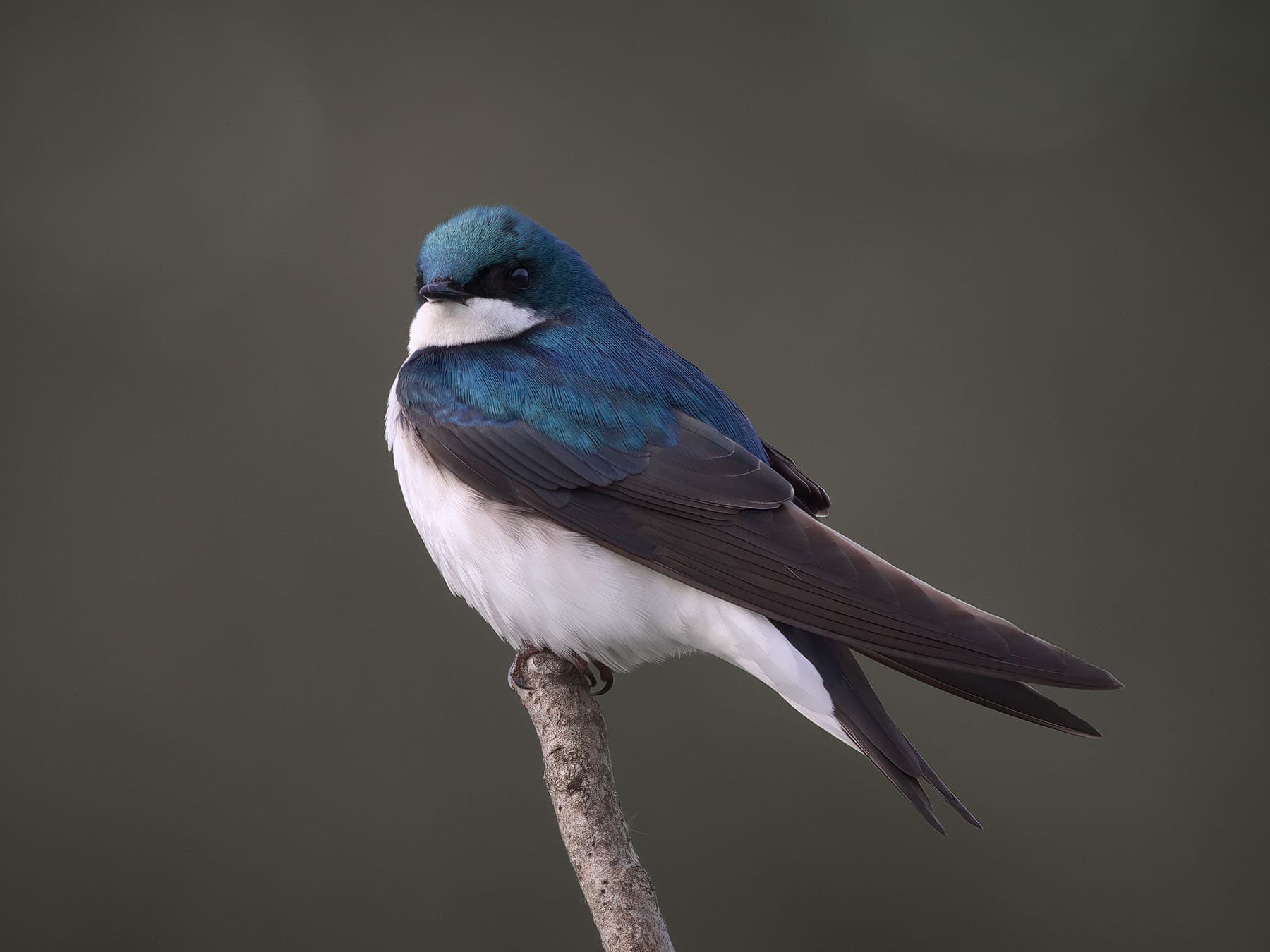
Quick facts
- Length
- 12–14 cm
- Wingspan
- 27–30 cm
- Weight
- 11–17 g
- Lifespan
- oldest recorded 9 years 1 month
- Family
- Swallows & Martins
- Migration
- Partial migrant
- Global status (IUCN)
- Least Concern
- World population
- About 7.2 million breeding-age birds worldwide, 6.7 million in the US and Canada (Partners in Flight, reference year about 2010)
- Population trend
- Still common, but fewer than when the survey began: the Breeding Bird Survey shows a significant long-term fall of about 0.6% a year in the US since 1967, with no clear change before the mid-1990s and steeper falls since (about 1.6% a year over 2010–2025); the last ten years alone are not statistically significant, and Canada shows no significant long-term change
- Scientific name
- Tachycineta thalassina
Questions
2Why is it called a Violet-green Swallow?
Does it hybridize with Tree Swallows?
A mixed pair of Tree and Violet-green Swallows once nested in Illinois, far east of the Violet-green's range, but raised no young. Hybrids with Tree, Northern Rough-winged and Cliff Swallows are also listed by eBird, without detail.1
Sources
43- 1Brown, C. R., Knott, A. M. and Damrose, E. J. (2020). Violet-green Swallow (Tachycineta thalassina), version 1.0. Birds of the World (A. F. Poole, editor). Cornell Lab of Ornithology. doi:10.2173/bow.vigswa.01 (opens in a new tab)
- 2Cornell Lab of Ornithology. Violet-green Swallow. NestWatch. Accessed 22 November 2026. Source (opens in a new tab)
- 3Edson, J. M. (1943). A Study of the Violet-Green Swallow. The Auk 60(3): 396-403. doi:10.2307/4079262 (opens in a new tab)
- 4Covy, N., Benedict, L. and Keeley, W. H. (2019). Rock climbing activity and physical habitat attributes impact avian community diversity in cliff environments. PLOS ONE: e0209557. doi:10.1371/journal.pone.0209557 (opens in a new tab)
- 5Eddie, Bill (1968). Violet-Green Swallow at Regina. Blue Jay 26(3). doi:10.29173/bluejay3386 (opens in a new tab)
- 6Houston, C. Stuart (1969). First Violet-Green Swallow Nest in Saskatchewan. Blue Jay 27(3). doi:10.29173/bluejay3708 (opens in a new tab)
- 7Robinson, W. Douglas et al. (2019). Idiosyncratic changes in spring arrival dates of Pacific Northwest migratory birds. PeerJ 7: e7999. doi:10.7717/peerj.7999 (opens in a new tab)
- 8Garlick, Niels W., Newberry, Gretchen N. and Rivers, James W. (2014). An Assessment of Nestling Diet Composition in the Violet-Green Swallow (Tachycineta thalassina). Northwest Science 88(1): 49-54. doi:10.3955/046.088.0109 (opens in a new tab)
- 9Alaska Department of Fish and Game. Violet-green Swallow (Tachycineta thalassina) species profile. ADF&G Species. Accessed 22 November 2026. Source (opens in a new tab)
- 10Cornell Lab of Ornithology. Violet-green Swallow. All About Birds. Accessed 22 November 2026. Source (opens in a new tab)
- 11Franzreb, K. E. (1976). Nest site competition between Mountain Chickadees and Violet-green Swallows. The Auk 93(4): 836-837. Accessed 22 November 2026.
- 12Brawn, J. D. (1990). Interspecific competition and social behavior in Violet-green Swallows. The Auk 107(3): 606-608. Accessed 22 November 2026.
- 13Kleiber, Danika, Turner, Jenne, Budden, Amber E. and Dickinson, Janis L. (2007). Interspecific Egg-dumping by a Violet-green Swallow in an Active Western Bluebird Nest. The Wilson Journal of Ornithology 119(1): 126-128. doi:10.1676/05-156.1 (opens in a new tab)
- 14Blem, Charles R. and Blem, Leann B. (2000). EFFECTS OF SOME METEOROLOGICAL VARIABLES ON BASKING BEHAVIOR IN VIOLET-GREEN SWALLOWS. Journal of Field Ornithology 71(2): 339-344. doi:10.1648/0273-8570-71.2.339 (opens in a new tab)
- 15Lasiewski, R. C. and Thompson, H. J. (1966). Field observation of torpidity in the Violet-green Swallow. The Condor 68(1): 102-103. Accessed 22 November 2026.
- 16USGS Bird Banding Laboratory. Longevity Records of North American Birds, Version 2025.1 (last updated December 2025). USGS Eastern Ecological Science Center, Bird Banding Laboratory. Accessed 22 November 2026. Source (opens in a new tab)
- 17BirdLife International (2025). Tachycineta thalassina. The IUCN Red List of Threatened Species 2025 (via the GBIF IUCN Red List checklist). GBIF dataset 19491596-35ae-4a91-9a98-85cf505f1bd3. Accessed 22 November 2026. Source (opens in a new tab)
- 18NatureServe (2026). Tachycineta thalassina (NatureServe Explorer record, element 100465). NatureServe Explorer. Accessed 22 November 2026. Source (opens in a new tab)
- 19Partners in Flight (2024). Avian Conservation Assessment Database, version 2024.05.23 (global). Partners in Flight / Bird Conservancy of the Rockies. Accessed 22 November 2026. Source (opens in a new tab)
- 20Hostetler, J. A. et al. (2026). The North American Breeding Bird Survey, Analysis Results 1966-2025. U.S. Geological Survey data release. doi:10.5066/P1OSNSFC (opens in a new tab)
- 21National Audubon Society. Violet-green Swallow. Guide to North American Birds. Accessed 22 November 2026. Source (opens in a new tab)
- 22U.S. Fish and Wildlife Service. 50 CFR 10.13 List of Migratory Birds. Electronic Code of Federal Regulations (version of 2026-11-17). Accessed 22 November 2026. Source (opens in a new tab)
- 23U.S. Fish and Wildlife Service. 50 CFR 10.12 Definitions. Electronic Code of Federal Regulations (version of 2026-11-17). Accessed 22 November 2026. Source (opens in a new tab)
- 24U.S. Fish and Wildlife Service. 50 CFR 17.11 Endangered and threatened wildlife. Electronic Code of Federal Regulations (version of 2026-11-17). Accessed 22 November 2026. Source (opens in a new tab)
- 25Environment and Climate Change Canada. Birds protected in Canada under the Migratory Birds Convention Act, 1994. Canada.ca. Accessed 22 November 2026. Source (opens in a new tab)
- 26Government of Canada. Migratory Birds Convention Act, 1994 (S.C. 1994, c. 22). Justice Laws Website (current to 2026-10-29). Accessed 22 November 2026. Source (opens in a new tab)
- 27Government of Canada. Migratory Birds Regulations, 2022 (SOR/2022-105). Justice Laws Website (current to 2026-10-29). Accessed 22 November 2026. Source (opens in a new tab)
- 28SEMARNAT. NOM-059-SEMARNAT-2010 (DOF 30/12/2010). Diario Oficial de la Federacion. Accessed 22 November 2026.
- 29Jobling, J. A.. Tachycineta. The Key to Scientific Names (Birds of the World). Accessed 22 November 2026. Source (opens in a new tab)
- 30Jobling, J. A.. thalassina / thalassinus. The Key to Scientific Names (Birds of the World). Accessed 22 November 2026. Source (opens in a new tab)
- 31Montana Natural Heritage Program and Montana Fish, Wildlife and Parks. Violet-green Swallow (Tachycineta thalassina). Montana Field Guide. Accessed 22 November 2026. Source (opens in a new tab)
- 32AviList Core Team (2025). AviList: The Global Avian Checklist, v2025b. AviList. Accessed 22 November 2026. Source (opens in a new tab)
- 33Tobias, J. A. et al. (2022). AVONET: morphological, ecological and geographical data for all birds. Ecology Letters 25: 581-597. Accessed 22 November 2026. Source (opens in a new tab)
- 34Myhrvold, N. P. et al. (2015). An amniote life-history database to perform comparative analyses with birds, mammals, and reptiles. Ecology 96: 3109. Accessed 22 November 2026. Source (opens in a new tab)
- 35U.S. Fish and Wildlife Service. 50 CFR 21.10 General permit requirements. Electronic Code of Federal Regulations (version of 2026-11-17). Accessed 22 November 2026. Source (opens in a new tab)
- 36U.S. Fish and Wildlife Service. 50 CFR Part 21 Migratory bird permits (whole part). Electronic Code of Federal Regulations (version of 2026-11-17). Accessed 22 November 2026. Source (opens in a new tab)
- 37Winkler, D. W. et al. (2020). Tree Swallow (Tachycineta bicolor), version 1.0. Birds of the World (A. F. Poole, editor). Cornell Lab of Ornithology. doi:10.2173/bow.treswa.01 (opens in a new tab)
- 38Garrison, B. A. and Turner, A. (2020). Bank Swallow (Riparia riparia), version 1.0. Birds of the World (S. M. Billerman, editor). Cornell Lab of Ornithology. doi:10.2173/bow.banswa.01 (opens in a new tab)
- 39De Jong, M. J. (2020). Northern Rough-winged Swallow (Stelgidopteryx serripennis), version 1.0. Birds of the World (A. F. Poole and F. B. Gill, editors). Cornell Lab of Ornithology. doi:10.2173/bow.nrwswa.01 (opens in a new tab)
- 40Brown, C. R., Brown, M. B., Pyle, P. and Patten, M. A. (2020). Cliff Swallow (Petrochelidon pyrrhonota), version 1.0. Birds of the World (P. G. Rodewald, editor). Cornell Lab of Ornithology. doi:10.2173/bow.cliswa.01 (opens in a new tab)
- 41Ryan, T. P. and Collins, C. T. (2020). White-throated Swift (Aeronautes saxatalis), version 1.0. Birds of the World (A. F. Poole and F. B. Gill, editors). Cornell Lab of Ornithology. doi:10.2173/bow.whtswi.01 (opens in a new tab)
- 42palmarium ('Case'), iNaturalist user. iNaturalist observation 281384204, sound 1464652 (Violet-green Swallow calls). iNaturalist. Accessed 22 November 2026. Source (opens in a new tab)
- 43Wilton, P.. XC550991 Violet-green Swallow. xeno-canto. Accessed 22 November 2026. Source (opens in a new tab)

Checked by
Nathan Cope, founder and editor
Nathan founded Birdfact and leads its writers and contributors in the UK, the US and Canada. He has watched and studied birds for more than ten years, and checks every article and species guide before it’s published.