


Vermilion Flycatcher
Common Vermilion Flycatcher · Pyrocephalus rubinus
By the Birdfact teamChecked by Nathan Cope
On this page14 sections
How to recognise it
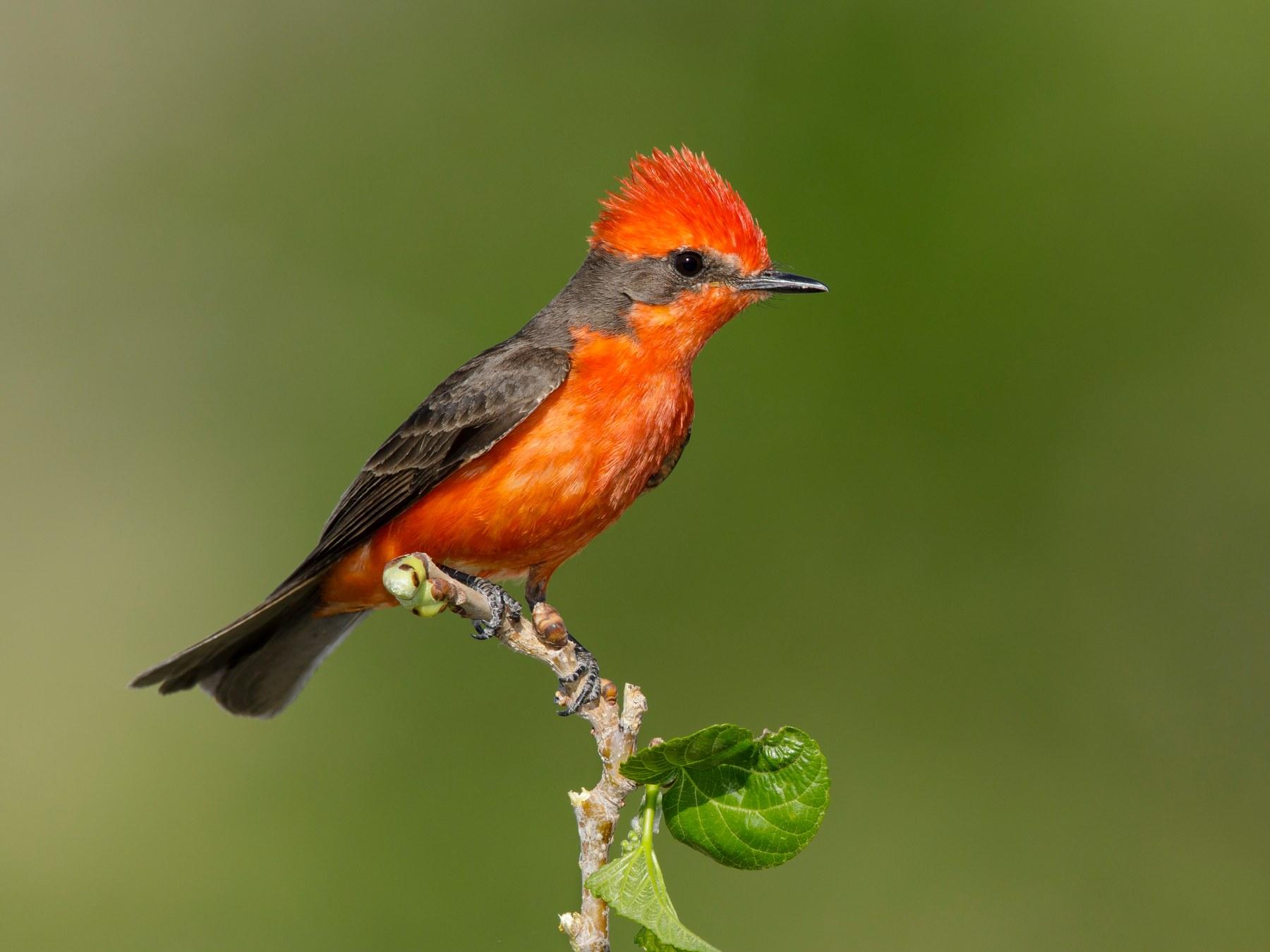
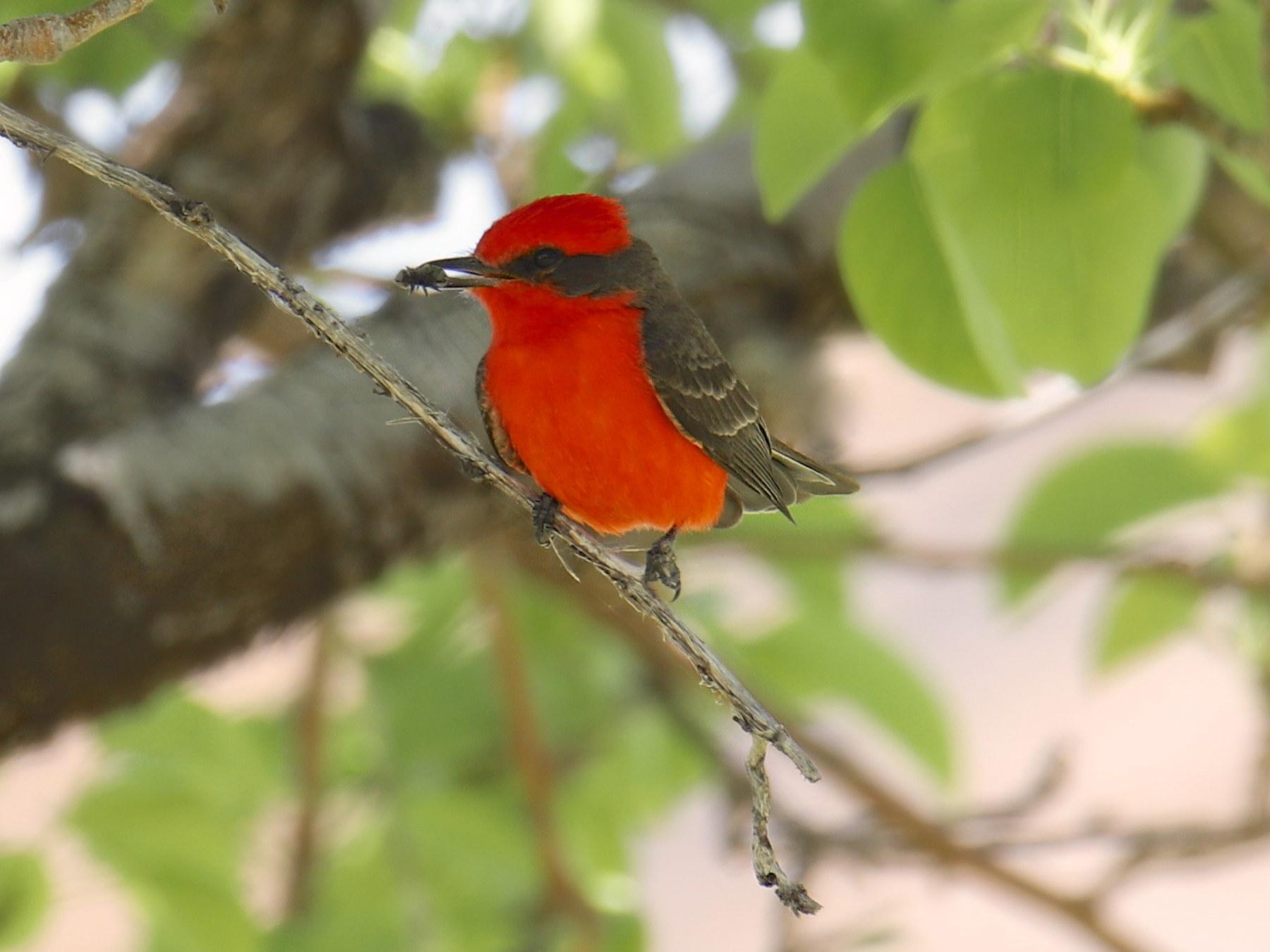
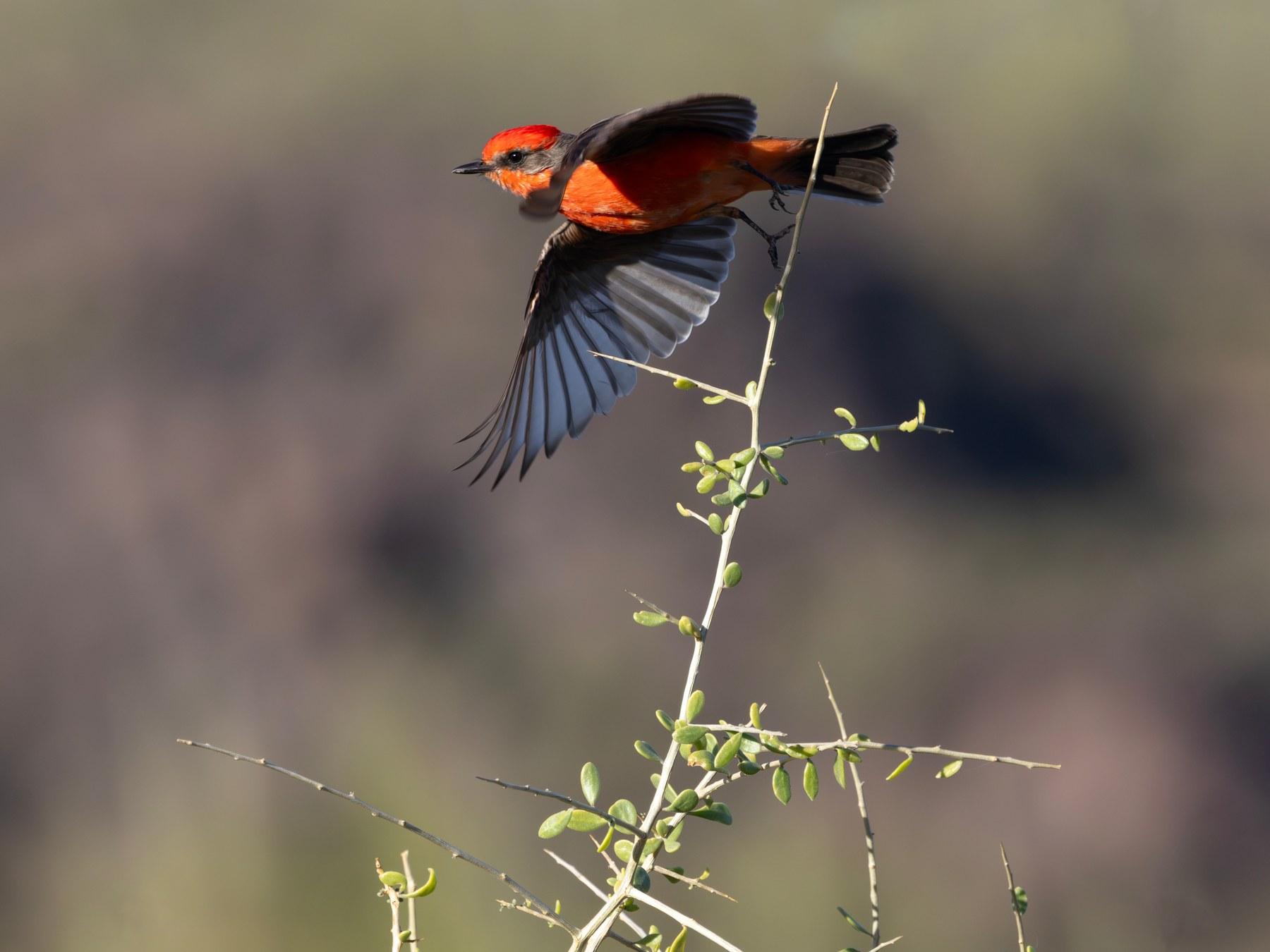
An adult male is hard to miss: a small flycatcher with a vivid red crown and underparts, a dark brown mask from the bill through the eye to the nape, and a dark brown back, wings and tail. The red runs from scarlet to orange-red, and in aggressive encounters he raises his crown feathers into a short crest.
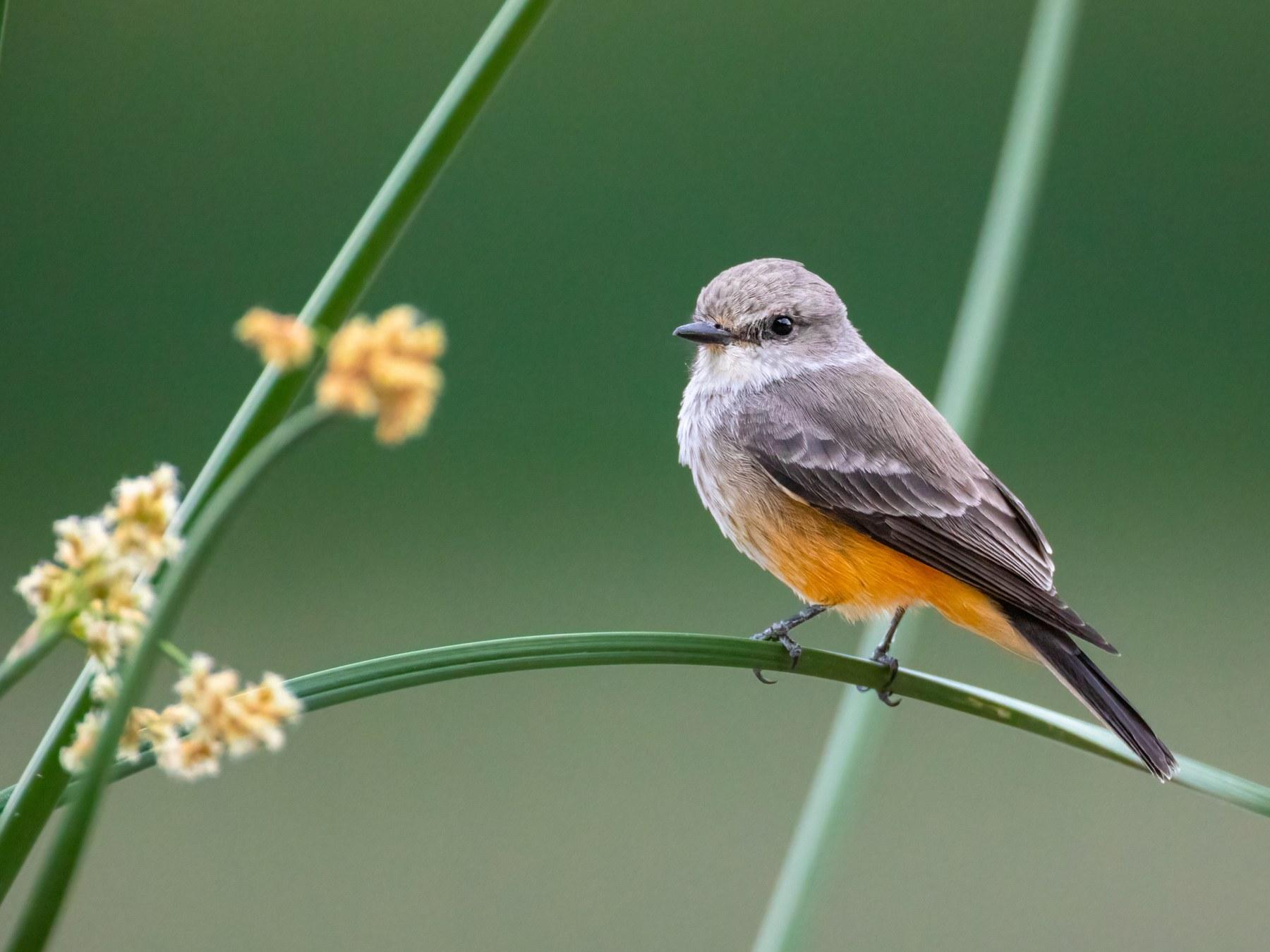
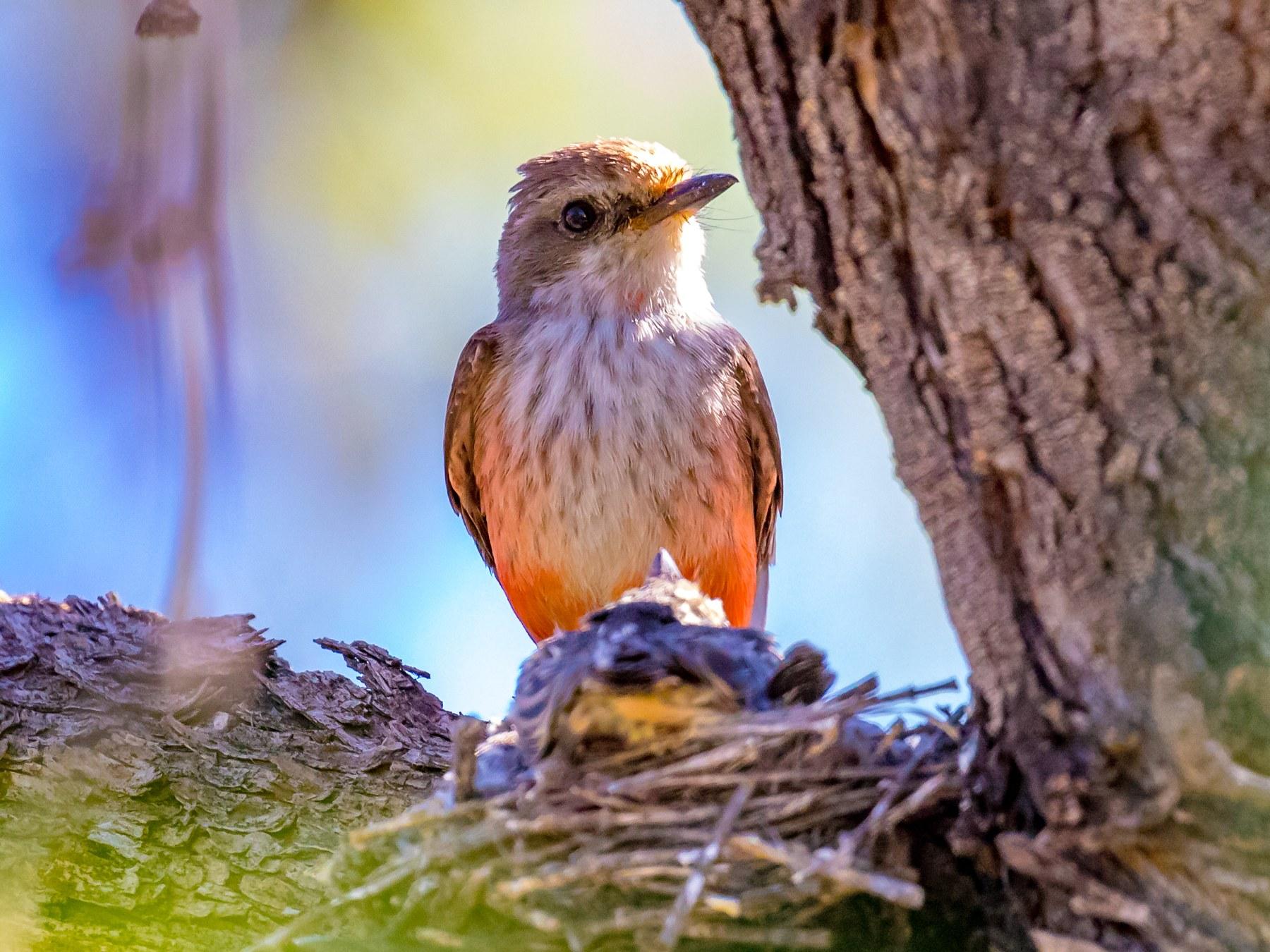
The female is much plainer. She is gray-brown above, with a faint pale line over the eye and two faint wing bars, and whitish below with fine gray-brown streaks on the breast and sides. Her best mark is a wash of pale salmon, pinkish red or orange-buff on the lower belly and under the tail.
Both sexes have a small, broad-based, brownish-black bill, a dark eye and blackish legs. It often sits on an open perch near the ground and flicks its tail down as it lands after chasing an insect.
Size and weight
It is a small bird, 5.1–5.5 in (13–14 cm) long with a wingspan of 9.4–10.2 in (24–26 cm), and it weighs 0.4–0.5 oz (11–14 g). Males and females overlap widely in size.
Male, female and young birds
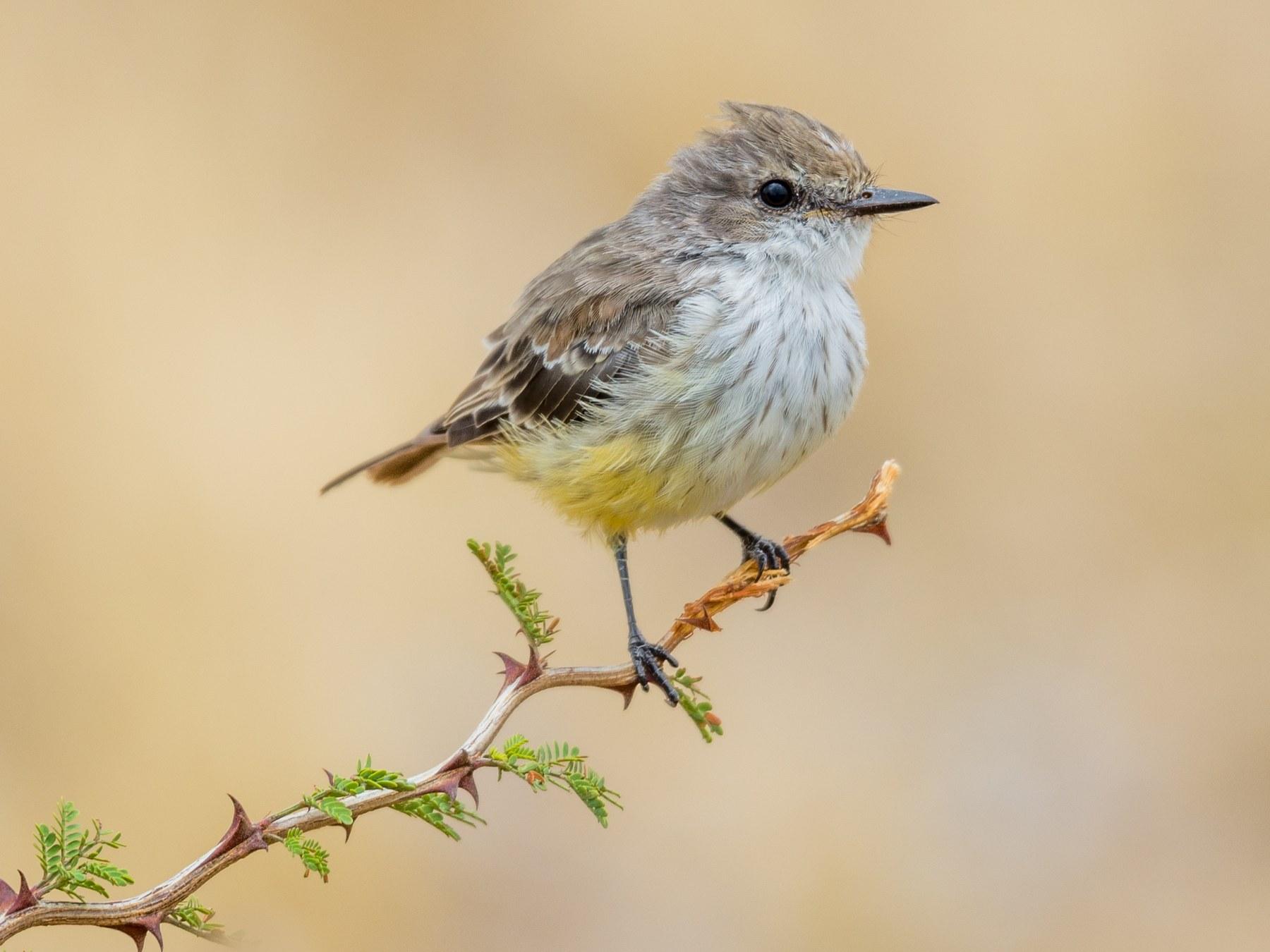
The sexes differ in color in every plumage except the juvenile, most strongly as adults. A female with a pale yellow wash low on the belly instead of pink, and usually no pinkish feathers on the crown or breast, is most likely in her first year.
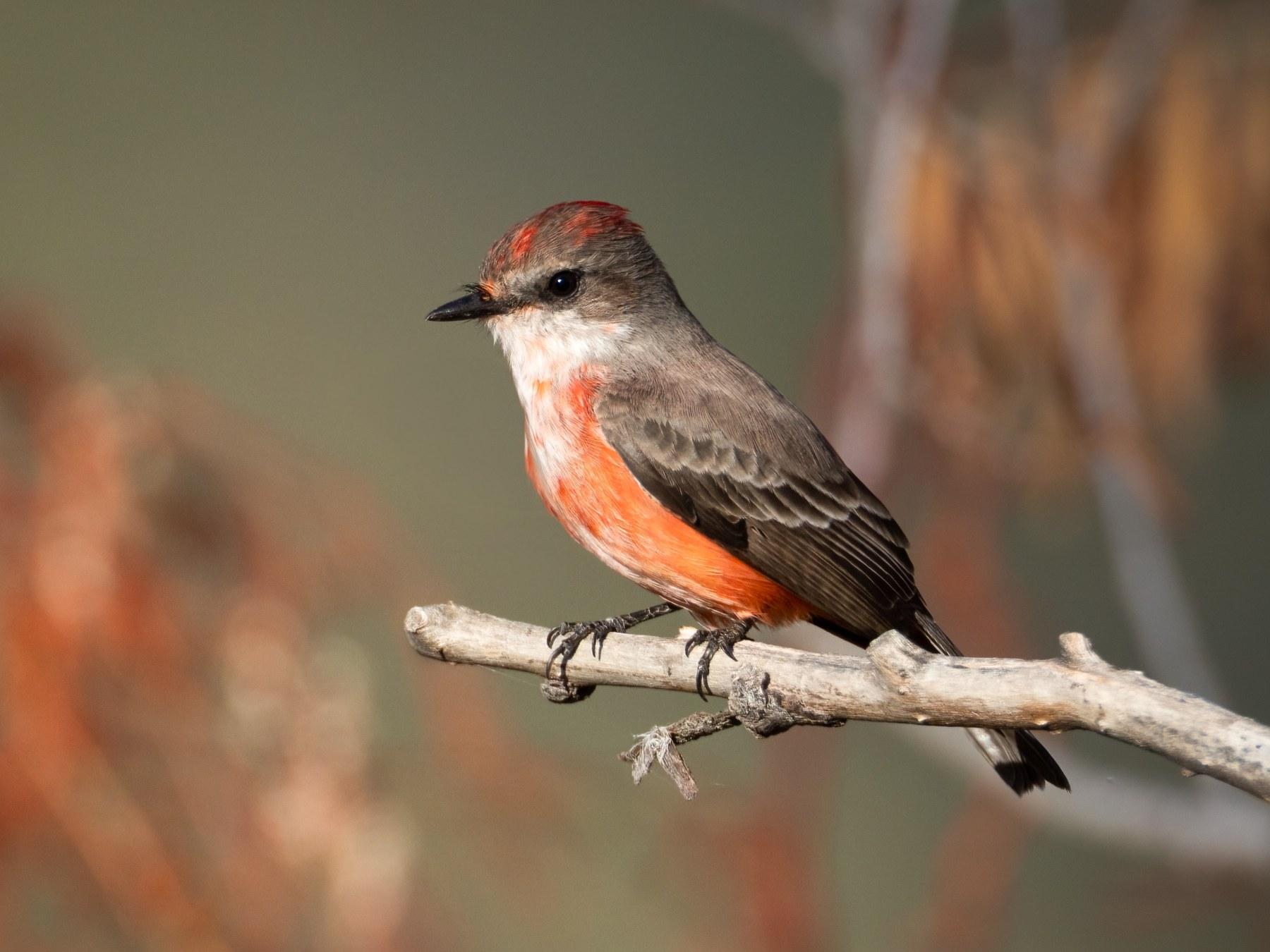
Young males take about a year to look like adults. Through their first year, mainly from August to the following July in North America, they are brown and streaked like a female, with red on the crown or breast. The red varies from a few feathers to almost all dull red mottled with paler feathers, and the lower belly is washed salmon-pink to orange-red, so some first-year males look much like females.
Juveniles, seen mainly from April to September, look scaly above, with pale edges to the gray-brown feathers. They are white below, with brownish-gray streaks on the chin and sides and dusky spots below. Males and females look alike at this age, though some young males show a pink tinge below.
Males from southern California east to western Texas average more orange-red, often mottled paler on the crown and breast, while the Texas and Mexican form is described as a deeper red with the blackest back. The difference is weak and changes gradually across the range,1 and a DNA study found no genetic difference between the two forms in the parts of the genome it sampled.2
Identifying it from similar birds
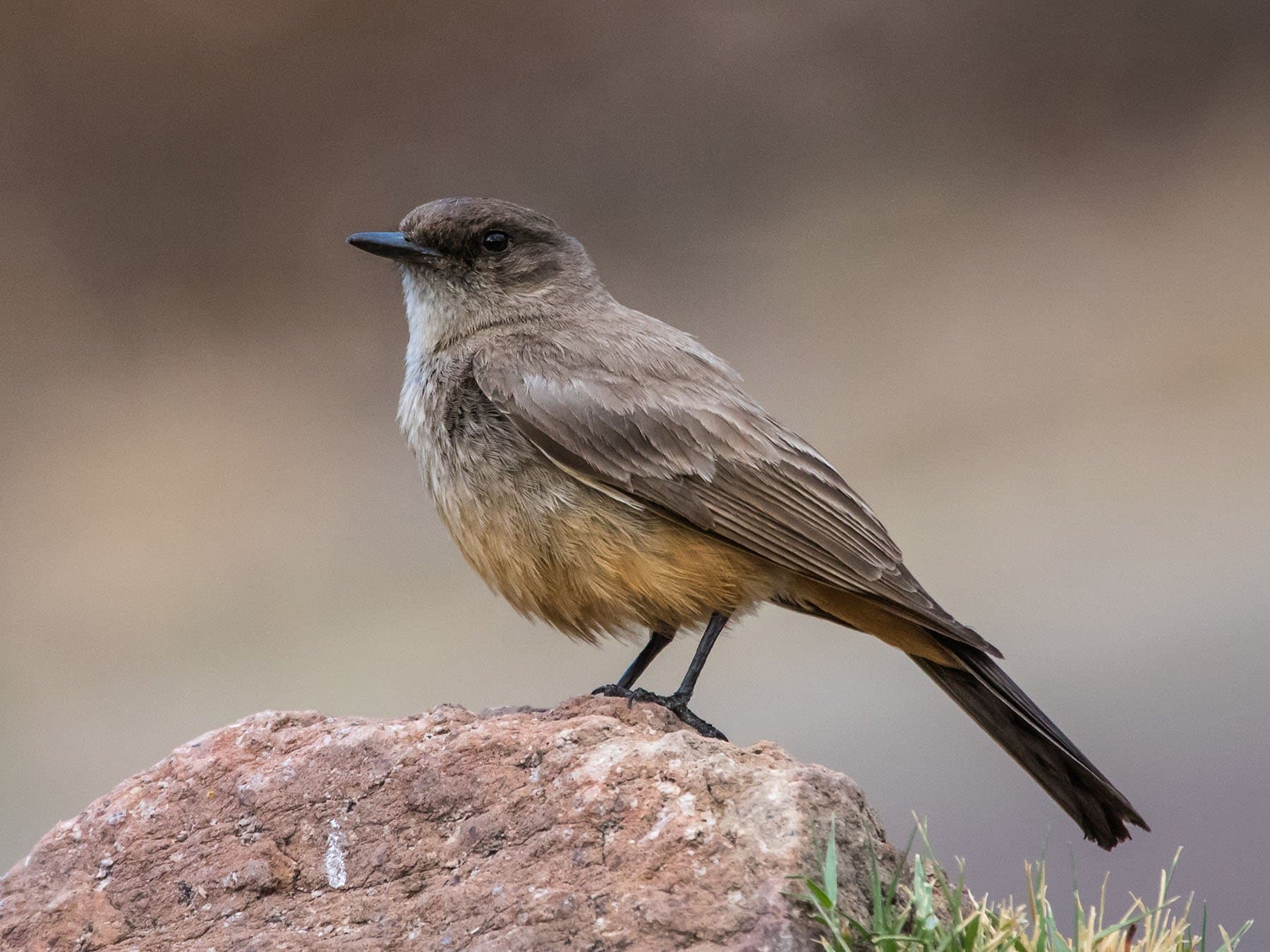
A female, adult or first-year, could be confused with a Say's Phoebe. The phoebe is larger, about 6.7 in (17 cm), with an evenly cinnamon belly and undertail, no streaked whitish breast, no pale line over the eye, and a blackish tail that contrasts with its gray-brown back. Both species wag their tails, so the tail action does not help.
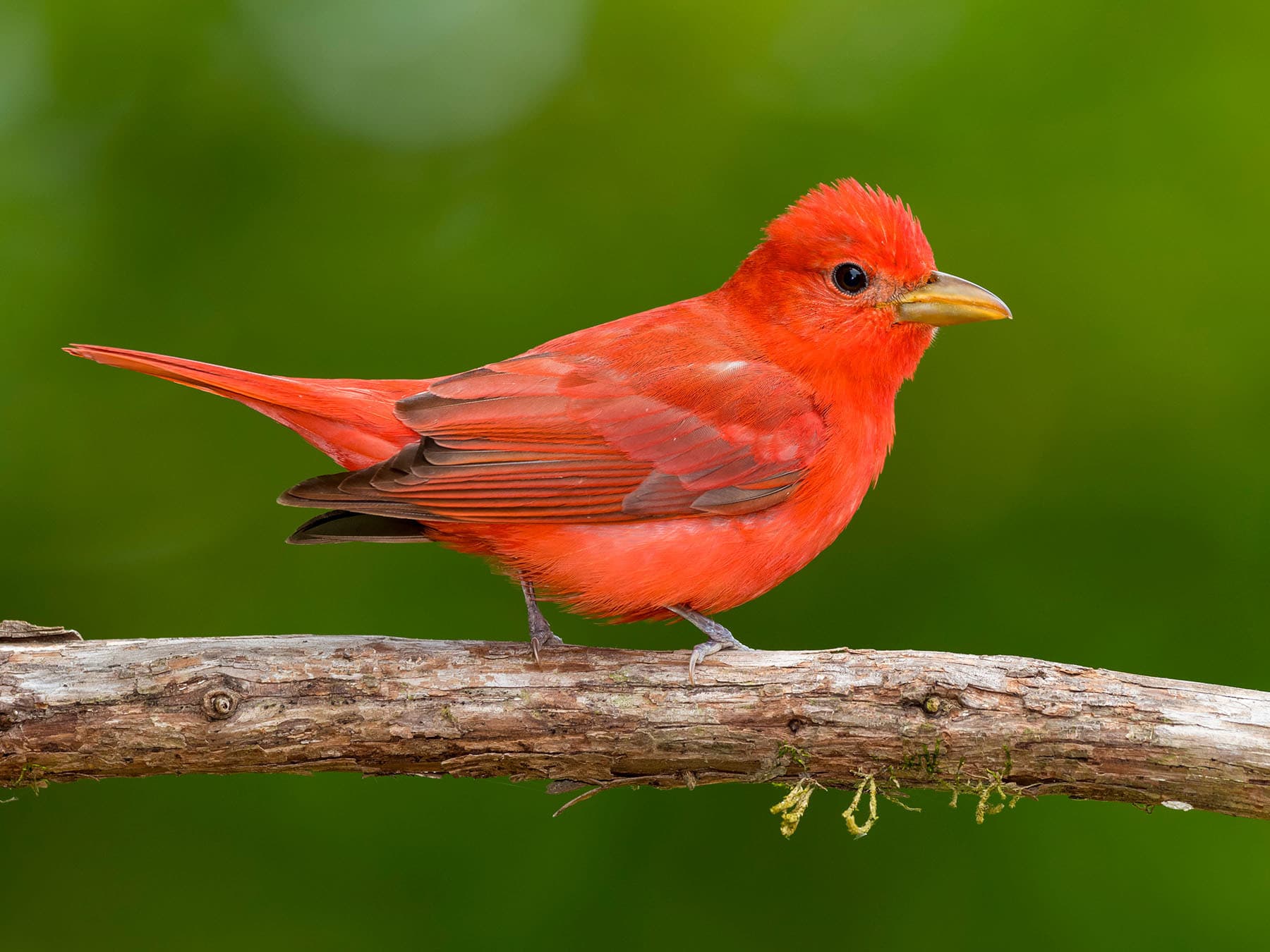
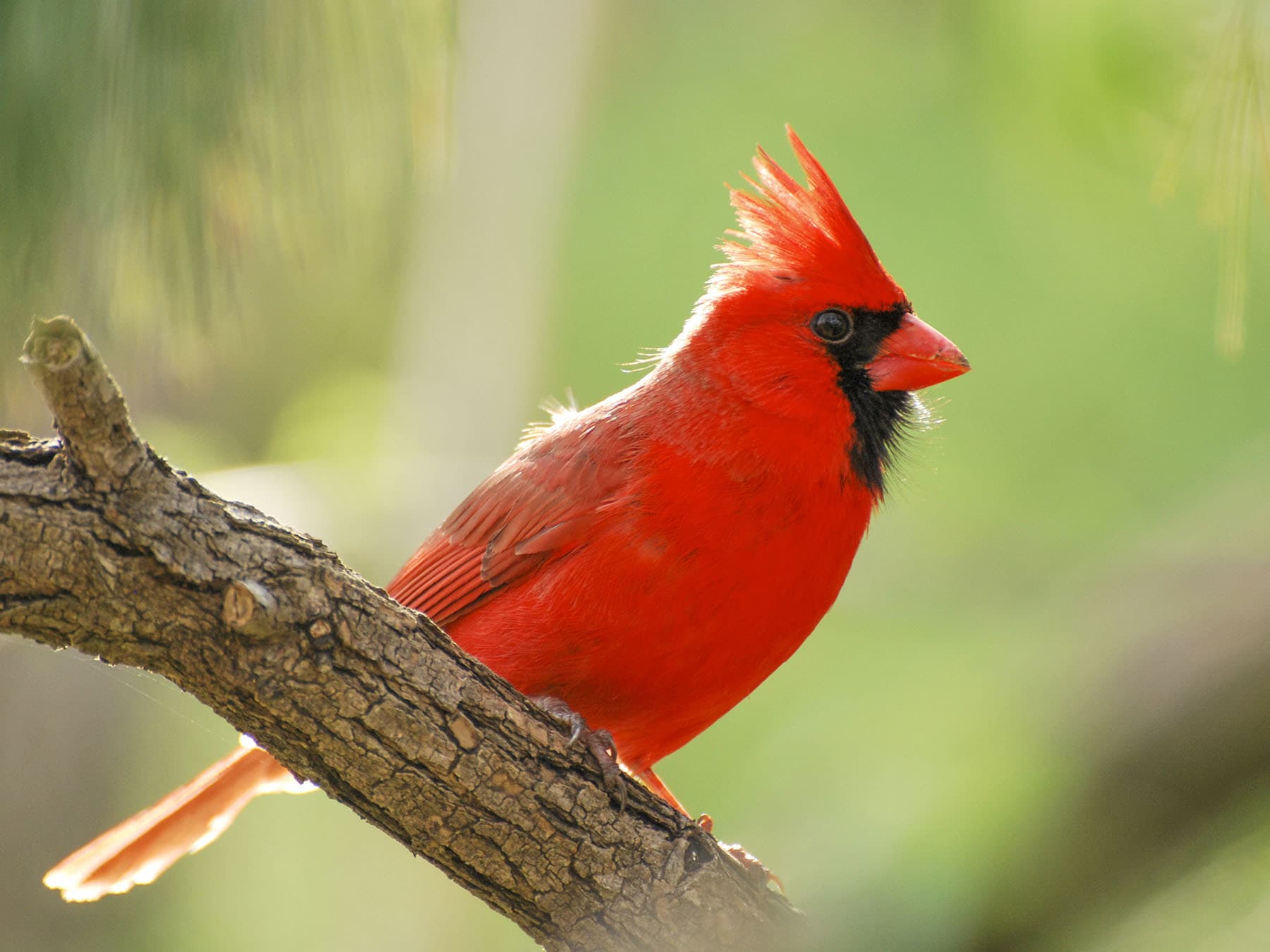
The adult male is distinctive, but other red birds are worth ruling out. An adult male Summer Tanager is larger, about 6.7 in (17 cm), and rosy red all over, wings and tail included, where the male Vermilion Flycatcher's are dark brown. A breeding male Scarlet Tanager is larger too, 6.3–6.7 in (16–17 cm), with a bright red body, black wings and tail and a pale bill. A Northern Cardinal is much bigger, males 8.7–9.3 in (22.2–23.5 cm) long, with a prominent crest and a heavy orange-red bill.
Not sure it’s a Vermilion Flycatcher? Check your photo: Birdfact names the bird and shows the look-alike side by side.
Its size
Adults- Length
- 13–14 cm
- Wingspan
- 24–26 cm
- Weight
- 11–14 g
Its song and calls
The song is a quick little phrase, usually under a second long: a run of short introductory notes and a four-note ending, written pit-a-zee or p-p-pik-zee. A male repeats it, from a perch or in his song flight, and sings several variations.
The call heard most is a sharp peent or pisk, given by both sexes while feeding and, in an aggressive form, as an alarm or at other males. One field guide writes it peet-peet or peet-a-weet. Even this call is not frequent, and a pair can stay silent for long spells.3
Song seems to serve in holding a territory, in courtship and in aggressive displays. In one playback study, males flew toward the speaker more for long songs than short ones once nest building had begun, which the authors suggest means males treat long songs as the bigger threat. Males also sang more, and longer songs, after their nests were built.4
Females often snap their bills while the male is in his display flight, and in western Texas a bill snap came between each repeated song in every one of dozens of displays watched. An infrequent wing whir, in bursts of two to six wingbeats, has also been recorded in flight.1
The player on this page has two song recordings, both from Comal County, Texas, made in April and June 2020.
Song flight display
In the breeding season the male sings in a striking display flight. He flies up above the trees, usually singing, then levels off and flutters forward with his crown and breast feathers raised, rising a little at intervals and almost stalling, before he swoops and glides back down to a perch.
How high he goes and how he beats his wings vary. Birds in one Arizona study rose about 40 ft (12 m), beating their wings rapidly and shallowly between stalls,3 and one field guide says up to 50 ft or more.5 In three song flights watched on the lower Colorado River in 1964, the birds rose to about the same height as Galapagos birds (now a separate species), which climbed 15–25 ft (5–8 m) above the vegetation, and their wingbeats were slow, deep and butterfly-like.6 In 1968 most Arizona males did not stall at all.7
Dawn song
Males sing most in the morning and early in the breeding season, starting an hour or two or more before sunrise, though song goes on through the day and into the evening.1 In Arizona, one observer first found the repeated display call almost restricted to the twilight before dawn, then in 1968 heard it through the morning and now and then later at the same sites.3, 7 In a Colombian city, males in built-up areas began the dawn chorus 101 minutes before sunrise on average, against 38 minutes in less built-up areas.8
Song and traffic noise
Noise changes how it sings. In Mexico City, males in noisier territories sang long songs, a correlation only.9 In an urban park in Puebla, 30 males called more in response to playback where their territories were noisier.10 In playback experiments, males sang shorter bouts during sudden peaks of noise,11 and 8 of 21 males stopped singing at once when played 2 kHz filtered traffic noise, against 4 of 21 at 1 kHz.12
- Song0:00 / 0:09
Recorded in Texas, United States · June 2020
- Song, distant0:00 / 0:07
Recorded in Texas, United States · April 2020
Heard one and not sure? Let the bird song identifier listen.
When and where to see it
In the US it breeds in southern Arizona, southern New Mexico and western and central Texas, locally in southern California and southern Nevada, and rarely in extreme southwestern Utah. It breeds now and then in central and western Oklahoma and southeastern Colorado, and rarely in Kansas. From there its range runs south through Mexico and Central America, with separate populations in northern, western and southern South America.
Most US birds stay all year. Outside the breeding range it winters on the Texas coastal plain and in the deserts of southeastern California and southwestern Arizona, and small numbers winter on the California coast, along the Gulf Coast and through mainland Florida. Winter numbers are highest in southern Texas, around Nogales and along the Colorado River in southern Arizona.
It also wanders. Strays turn up far to the north, especially in fall, and by 2021 had reached southern Quebec, Ontario, Minnesota, British Columbia and southwestern Newfoundland.1
Spotting tips
Look in open country near water: a line of cottonwoods, willows or mesquite along a stream or dry wash, a park or a golf course. The male's red shows from a long way off. Watch for a bird that flies out from a low perch and comes straight back. Early on spring mornings, listen for the song and watch for the male's fluttering song flight.
Habitat
It lives in open country, usually near water. In the Southwest that means streamside woods of cottonwood, willow, sycamore and mesquite along dry washes and streams, and mesquite woods (bosques). In Texas and New Mexico it also uses open parkland with scattered oaks and junipers. Arid scrub, farmland, savanna, parks and golf courses are used too, from the lowlands up to about 9,800 ft (3,000 m). In winter it uses open and semi-open ground with hedges and scattered trees and bushes, often near water.
In one Arizona study it bred in cottonwood and mesquite woods but not where a dense canopy of Fremont cottonwoods stood over a thick mesquite understory.1 It sometimes nests in garden trees near houses, and in the Mojave Desert small numbers breed at golf courses, parks and suburban oases.
Does it migrate?
Partly. Most populations stay put all year, but the northernmost breeders, in the southern US and northwestern Mexico, and the southernmost, in southern South America, migrate, over distances of up to about 2,500 miles (4,000 km). Returning birds reach northern Sonora by early March and southern California by mid-March, and they leave southern California by late August. Their routes have not been studied, though at least a few birds regularly move east to winter on the northern Gulf Coast.
In South America the southern population breeds in southern Bolivia, southern Paraguay, Uruguay and central and northern Argentina. In the southern winter it moves north, reaching Amazonian Brazil, southeastern Colombia and southeastern Ecuador. This southern population is the one sometimes called the Scarlet Flycatcher (see Names and relatives). Some fall strays in North America may come from it, a possibility that still needs investigating.
What it eats
It eats insects and other small invertebrates, caught in the air or on the ground: butterflies and moths, grasshoppers and crickets, beetles, termites, bees, mayflies, flies and spiders. No plant food has been seen eaten, and the diet of adults has never been studied systematically.1 Where beehives stand near a favorite perch, it sometimes takes many bees.5 It coughs up the hard parts of insects as pellets.
In one southern Arizona study in July, the 250 food items brought to nestlings were 28% butterflies and moths (half of them caterpillars), 22% spiders, 16% mayflies, 14% grasshoppers and crickets, 10% flies, 6% beetles and 4% termites.1
We found no feeder food recommended for it, but it drinks from standing water such as bird baths, troughs and puddles.
How it catches its food
It is a sit-and-wait hunter. From an open perch, often low, it flies out to snap an insect from the air, chasing any that dodge, or drops to the ground for prey, sometimes hovering briefly, then returns to a perch. Large prey such as grasshoppers and butterflies is carried back and beaten on the perch before it is eaten.
Most of its hunting is close to the ground. It rarely hops and spends little time on the ground, though on one Texas golf course birds were often seen hopping on the putting greens, presumably feeding. In one Arizona study, 94% of foraging in mesquite and 76% in cottonwood was within 10 ft (3 m) of the ground, and less than 5% was over water. Breeding males there spent 87–92% of the day sitting, and on average less than 1% of their time singing and displaying.1
Nesting and breeding
The male appears to choose much of the nest site. He flies to a fork in a tree, crouches and makes shaping movements, fluttering his wings over his back and giving a chatter call. The female often ignores him, or joins him and takes his place, and the nest ends up within about 8 ft (2.5 m) of his favorite spot.1, 7
The female generally builds the nest: a small, flimsy, shallow cup of twigs, grass, rootlets, fibers and plant down, bound with spider silk, lined with feathers and hair and sometimes decorated with lichens. It is about 2.5–3 in (64–76 mm) across and so shallow that it only just holds the eggs. It sits in a horizontal fork of a tree, usually in a spot clear of leaves.
Nest trees include mesquite, cottonwood, willow, sycamore, huisache, oak and pecan. In Arizona nests are typically 8–20 ft (2.4–6 m) up, occasionally as high as 59 ft (18 m). Average heights in US and Sonoran samples run from 9.5 ft (2.9 m) in Texas honey mesquite to 33 ft (10.1 m) in cottonwood habitat in Sonora and Arizona.1
Eggs and young
A clutch is usually 2 or 3 eggs, occasionally 4. The eggs are white to cream or pale buff, boldly blotched with very dark brown over pale olive or lavender, mostly around the larger end, and look unlike the eggs of any other North American flycatcher.
The female incubates alone for about 14 days, and the male regularly brings her food on the nest. The young leave the nest at about two weeks old. Both parents feed them, and the male may look after the fledglings while the female starts the next nest. Pairs raise one or two broods a season, and two Texas pairs were suspected of raising three.
In the US, egg laying runs from March to July. In Arizona and the Colorado River valley most first clutches on old egg cards were laid from 6 to 30 April.1 Birds breed in their first spring.
In a four-year Texas study, 59–80% of nests with eggs fledged at least one young each year.1
It is a host of the Brown-headed Cowbird. In one study in central Arizona and Sonora, 8 of 39 clutches (20.5%) were parasitized, and parasitized nests fledged fewer flycatcher young on average (1.0 against 1.67). In western Texas 5 of 14 successful nests were parasitized, and in a Texas study 34 of 179.1
Behaviour
Outside the breeding season it is usually alone, though small flocks of 4–5 males have been reported in winter. Breeding pairs hold territories, and in one Arizona study home ranges averaged 2.2 acres (0.88 ha) and did not overlap.1 Both sexes chase smaller birds away from the nest tree, though fights are generally infrequent. In aggressive encounters a bird raises its crest and pumps and fans its tail.
Pairs are socially monogamous and form soon after the females arrive; males usually get back several days to a week ahead of them. Before mating, males often fly to the female with a large, showy insect, and in five Arizona encounters the male held a butterfly or moth, which he gave to the female in three.1
Social monogamy is not the whole story. At one site in Tlaxcala, Mexico, a DNA study of a population of about 24 pairs (six families sampled in 2001, eight in 2003) found young fathered outside the pair, and signs that other females had laid eggs in some nests. The authors say their high rates are probably overestimates, because the data are sparse.13
Lifespan and predators
How long a typical Vermilion Flycatcher lives is not known: we found no published survival figures. The oldest on the US Bird Banding Laboratory's records was at least 5 years 6 months old, a male banded in Mexico in October 1968, already past its hatching year, and shot in Mexico in 1972.14 In figures dating from 1989, it was the only band recovery among 161 birds banded.1
Little is known about what kills them. A scrub-jay took a nest in Morongo Valley, California, and fire ants ate live nestlings at one Texas nest.1 In Argentina a nest-parasite beetle has been found on nestlings, and the nestlings in one parasitized nest died.15
Conservation
The Vermilion Flycatcher is a species of Least Concern worldwide.16 Partners in Flight estimates about 15 million birds, about 540,000 of them in the US, for a population year around 2010.17
The North American Breeding Bird Survey shows no clear long-term trend in the US. Counts changed by +0.50% a year from 1967 to 2025, with a 95% credible interval of –0.58 to +1.44 that spans zero, and the last ten years (+0.74% a year, –1.89 to +3.46) are just as uncertain. Over 1995–2025, though, the survey estimates a credible rise of +1.46% a year (+0.40 to +2.51). The bird is scarce on survey routes, under one per route, which the survey flags as a weakness in its data. Of the three states with data, only Arizona shows a credible long-term increase, +1.49% a year from 1968 to 2025.18
The survey covers only the US part of a range that lies mostly in Mexico, Central America and South America, and we found no range-wide trend figure.
Population changes
By the early 1990s the breeding range in southern California had shrunk, though this is poorly documented. The bird was once more common along the lower Colorado River, in the Imperial and Coachella valleys, on the upper Mojave River and around San Diego. The change is put down to habitat loss, as water management ended the yearly floods and native cottonwoods and willows were lost.1 By 2005, breeding had been confirmed at only eight sites on southern California's coastal slope, the earliest in 1958.19
Elsewhere it spread. It was unrecorded in Oklahoma before 1949, first nested in the Texas Panhandle in 1959 and in Colorado in 1981, and became more widespread on the Edwards Plateau and in south Texas from 1983. In Florida, where only one had been recorded before 1940, there were at least 130 reports by 1992.1
The main threat appears to be the loss of desert riparian woodland, which leaves it exposed to groundwater pumping, cattle grazing, channelized rivers and the cutting of trees. Along the lower Colorado River, water management and development removed virtually all of its habitat, and a 1991 study described its numbers and range there as drastically reduced over the previous 50 years. Continued heavy groundwater pumping in southern Arizona would devastate the remaining riparian woods, while restoring cottonwood and willow along the Colorado would likely bring the bird back quickly.1
Legal status
In the US the Vermilion Flycatcher is on the federal list of birds that the Migratory Bird Treaty Act protects.20 Under the Act and its regulations, no one may take, possess, sell or transport the bird, its parts, nests or eggs except as the regulations permit.21, 22 No federal depredation order names it,23 and it is not listed under the Endangered Species Act.24
Names and relatives
Its scientific name is Pyrocephalus rubinus, and the genus name means fire-headed.25 It is a tyrant flycatcher. It resembles the phoebes in form, behavior and voice, and the two genera are generally considered each other's closest relatives, though a 2008 DNA study placed them in different groups.1
Its genus has one other member, the Brujo Flycatcher of the Galapagos Islands. The Galapagos birds were treated as part of this species until 2021. That year the South American Classification Committee recognized them as a separate species, on differences in DNA, voice, plumage and size.1
'Scarlet Flycatcher' is not an English name for this species in the main world checklists. The xeno-canto sound archive files the North American birds as Pyrocephalus obscurus, the Vermilion Flycatcher, and the migrants of southern South America as P. rubinus, the Scarlet Flycatcher.26 A 2016 DNA study suggested that the southern migrant form is a separate species.2 AviList, the global checklist this page follows, keeps them as one species with ten subspecies, and says further revisions are likely.27
Similar birds
Often mistaken for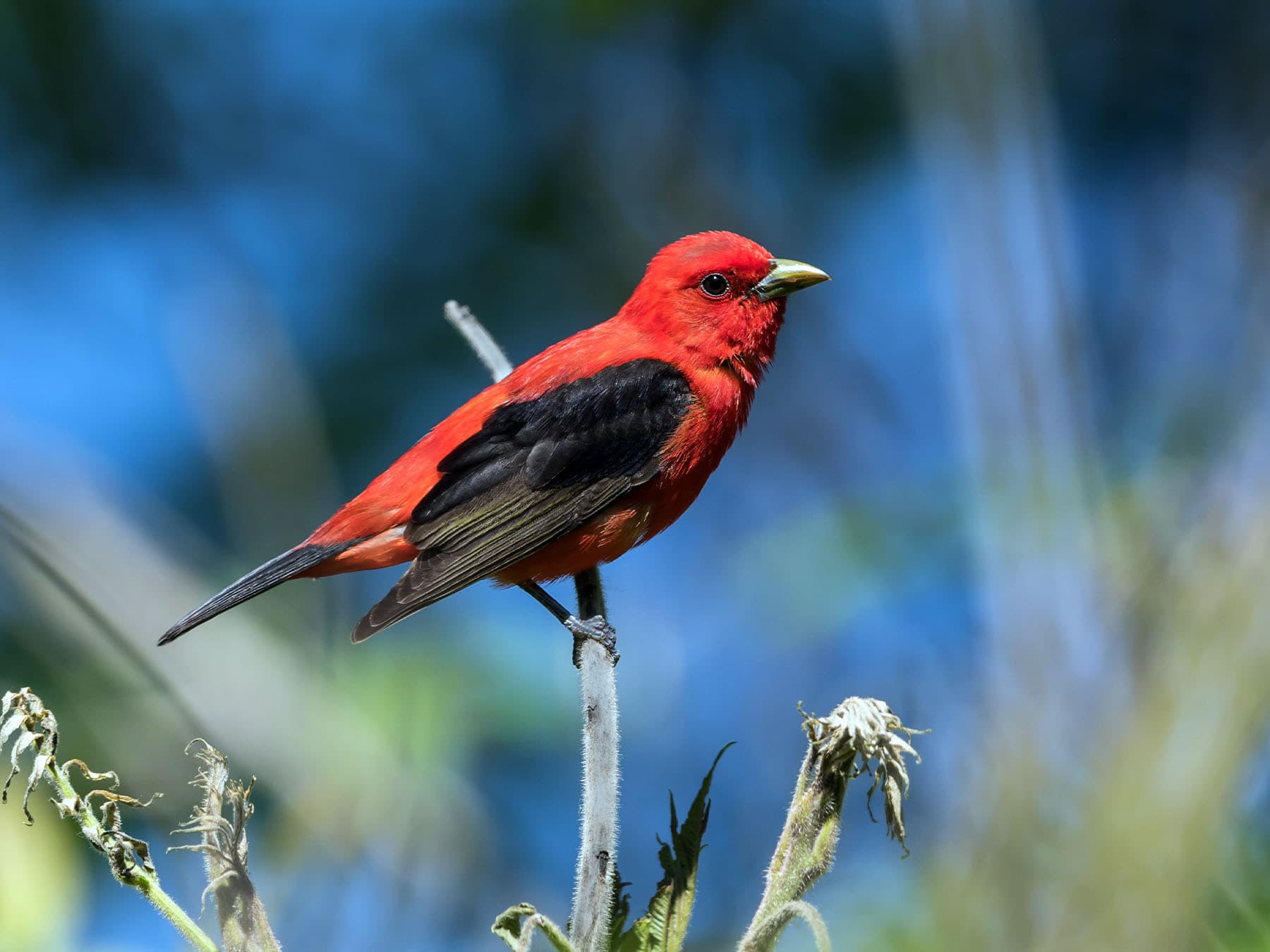
Quick facts
- Length
- 13–14 cm
- Wingspan
- 24–26 cm
- Weight
- 11–14 g
- Lifespan
- oldest recorded 5 years 6 months
- Family
- Tyrant Flycatchers
- Migration
- Partial migrant
- Global status (IUCN)
- Least Concern
- World population
- About 15 million worldwide; about 540,000 in the US (Partners in Flight, around 2010)
- Population trend
- No clear long-term trend in US Breeding Bird Survey counts (1967–2025); a credible rise since 1995 and in Arizona
- Also called
- Common Vermilion Flycatcher
- Scientific name
- Pyrocephalus rubinus
Questions
1Is the Vermilion Flycatcher rare?
Not overall. It is a species of Least Concern with about 15 million birds worldwide, and it is common in parts of the US Southwest. It is scarce on US survey routes, though, and only a stray far north of its range. See Conservation status.
Sources
35- 1Ellison, K. S., Wolf, B. O. and Jones, S. L. (2021). Vermilion Flycatcher (Pyrocephalus rubinus), version 1.1. Birds of the World (A. F. Poole, editor). Cornell Lab of Ornithology. doi:10.2173/bow.verfly.01.1 (opens in a new tab)
- 2Carmi, O., Witt, C. C., Jaramillo, A. and Dumbacher, J. P. (2016). Phylogeography of the Vermilion Flycatcher species complex: multiple speciation events, shifts in migratory behavior, and an apparent extinction of a Galápagos-endemic bird species. Molecular Phylogenetics and Evolution 102: 152-173. doi:10.1016/j.ympev.2016.05.029 (opens in a new tab)
- 3Smith, W. J. (1967). Displays of the Vermilion Flycatcher (Pyrocephalus rubinus). The Condor 69(6): 601-605. doi:10.2307/1366432 (opens in a new tab)
- 4Ríos-Chelén, A. A. and Macías García, C. (2007). Responses of a sub-oscine bird during playback: effects of different song variants and breeding period. Behavioural Processes 74(3): 319-325. doi:10.1016/j.beproc.2006.11.007 (opens in a new tab)
- 5National Audubon Society and Kaufman, K. (1996). Vermilion Flycatcher (Pyrocephalus rubinus). Audubon Guide to North American Birds (text adapted from Kaufman, Lives of North American Birds, 1996). Accessed 22 November 2026. Source (opens in a new tab)
- 6De Benedictis, P. (1966). The flight song display of two taxa of Vermilion Flycatcher, genus Pyrocephalus. The Condor 68(3): 306-307. doi:10.2307/1365570 (opens in a new tab)
- 7Smith, W. J. (1970). Courtship and territorial displaying in the Vermilion Flycatcher, Pyrocephalus rubinus. The Condor 72(4): 488-491. doi:10.2307/1366409 (opens in a new tab)
- 8Sánchez-González, K., Aguirre-Obando, O. A. and Ríos-Chelén, A. A. (2020). Urbanization levels are associated with the start of the dawn chorus in vermilion flycatchers in Colombia. Ethology Ecology & Evolution 33(4): 377-393. doi:10.1080/03949370.2020.1837963 (opens in a new tab)
- 9Ríos-Chelén, A. A., Quirós-Guerrero, E., Gil, D. and Macías García, C. (2012). Dealing with urban noise: vermilion flycatchers sing longer songs in noisier territories. Behavioral Ecology and Sociobiology 67(1): 145-152. doi:10.1007/s00265-012-1434-0 (opens in a new tab)
- 10Chavez-Mendoza, N. E., José-Ramírez, S. and Ríos-Chelén, A. A. (2023). Evidence that traffic noise increases territorial response in vermilion flycatchers. Frontiers in Ecology and Evolution 11: 1175732. doi:10.3389/fevo.2023.1175732 (opens in a new tab)
- 11Muñoz-Santos, I. and Ríos-Chelén, A. A. (2022). Vermilion flycatchers avoid singing during sudden peaks of anthropogenic noise. acta ethologica 26(3): 201-210. doi:10.1007/s10211-022-00409-x (opens in a new tab)
- 12Muñoz-Santos, I., Sosa-López, J. R. and Ríos-Chelén, A. A. (2025). Non-masking noise suppresses bird song. Behavioural Processes 231: 105239. doi:10.1016/j.beproc.2025.105239 (opens in a new tab)
- 13Ríos-Chelén, A. A. et al. (2008). Intra-specific brood parasitism revealed by DNA micro-satellite analyses in a sub-oscine bird, the vermilion flycatcher. Revista Chilena de Historia Natural 81(1): 21-31. doi:10.4067/s0716-078x2008000100002 (opens in a new tab)
- 14USGS Bird Banding Laboratory. Longevity records of North American birds: Vermilion Flycatcher (AOU 4710). Bird Banding Laboratory, Bander Portal longevity tables. Accessed 22 November 2026. Source (opens in a new tab)
- 15Gonzalez, E., Jauregui, A., Mariani, R. and Segura, L. N. (2023). New avian hosts for Taphropiestes plaumanni (Coleoptera: Cavognathidae) and the record of nestlings skin lesions and body deterioration associated with parasitism. Anais da Academia Brasileira de Ciências 95(2): e20201599. doi:10.1590/0001-3765202320201599 (opens in a new tab)
- 16BirdLife International (2021). Pyrocephalus rubinus (Boddaert, 1783). The IUCN Red List of Threatened Species 2021. IUCN Red List. doi:10.2305/IUCN.UK.2021-3.RLTS.T103682912A187307157.en (opens in a new tab)
- 17Partners in Flight (2024). Avian Conservation Assessment Database, version 2024.05.23 (global). Partners in Flight. Accessed 22 November 2026. Source (opens in a new tab)
- 18Hostetler, J. A. et al. (2026). The North American Breeding Bird Survey, Analysis Results 1966-2025. U.S. Geological Survey data release. doi:10.5066/P1OSNSFC (opens in a new tab)
- 19Benson, T. A. (2005). Breeding Vermilion Flycatchers in cismontane San Bernardino County, California. Western Birds 36(1): 56-58. doi:10.21199/wb36.1.2 (opens in a new tab)
- 20US Fish and Wildlife Service (2026). 50 CFR 10.13, List of Birds Protected by the Migratory Bird Treaty Act. Electronic Code of Federal Regulations (version of 2026-11-17). Accessed 22 November 2026. Source (opens in a new tab)
- 21United States Congress (2023). 16 U.S.C. 703, Taking, killing, or possessing migratory birds unlawful. United States Code, 2023 edition (govinfo). Accessed 22 November 2026.
- 22US Fish and Wildlife Service (2026). 50 CFR 21.10, General permit requirements. Electronic Code of Federal Regulations (version of 2026-11-17). Accessed 22 November 2026. Source (opens in a new tab)
- 23US Fish and Wildlife Service (2026). 50 CFR Part 21, Migratory bird permits (whole part searched). Electronic Code of Federal Regulations (version of 2026-11-17). Accessed 22 November 2026. Source (opens in a new tab)
- 24US Fish and Wildlife Service (2026). 50 CFR 17.11, Endangered and threatened wildlife. Electronic Code of Federal Regulations (version of 2026-11-17). Accessed 22 November 2026. Source (opens in a new tab)
- 25Cornell Lab of Ornithology. Vermilion Flycatcher Overview. All About Birds. Accessed 22 November 2026. Source (opens in a new tab)
- 26xeno-canto Foundation. xeno-canto recordings of the genus Pyrocephalus (United States search and genus licence search). xeno-canto.org. Accessed 22 November 2026. Source (opens in a new tab)
- 27AviList Core Team (2025). AviList: The Global Avian Checklist, v2025b. AviList. doi:10.2173/avilist.v2025b (opens in a new tab)
- 28NatureServe. Pyrocephalus rubinus, Vermilion Flycatcher. NatureServe Explorer (open API). Accessed 22 November 2026. Source (opens in a new tab)
- 29Fraga, R. M. (1977). Notas sobre la reproducción del Churrinche (Pyrocephalus rubinus). El Hornero 11(5): 380-383. doi:10.56178/eh.v11i5.1232 (opens in a new tab)
- 30US Fish and Wildlife Service (2026). 50 CFR 10.12, Definitions. Electronic Code of Federal Regulations (version of 2026-11-17). Accessed 22 November 2026. Source (opens in a new tab)
- 31Schukman, J. M. and Wolf, B. O. (2020). Say's Phoebe (Sayornis saya), version 1.0. Birds of the World, Cornell Lab of Ornithology. doi:10.2173/bow.saypho.01 (opens in a new tab)
- 32Robinson, W. D. (2020). Summer Tanager (Piranga rubra), version 1.0. Birds of the World, Cornell Lab of Ornithology. doi:10.2173/bow.sumtan.01 (opens in a new tab)
- 33Mowbray, T. B. (2020). Scarlet Tanager (Piranga olivacea), version 1.0. Birds of the World, Cornell Lab of Ornithology. doi:10.2173/bow.scatan.01 (opens in a new tab)
- 34Halkin, S. L. et al. (2026). Northern Cardinal (Cardinalis cardinalis), version 2.1. Birds of the World, Cornell Lab of Ornithology. doi:10.2173/bow.norcar.01 (opens in a new tab)
- 35Ellison, K. S., Wolf, B. O. and Jones, S. L. (2021). Brujo Flycatcher (Pyrocephalus nanus), version 1.0. Birds of the World (S. M. Billerman, editor). Cornell Lab of Ornithology. doi:10.2173/bow.brufly1.01 (opens in a new tab)

Checked by
Nathan Cope, founder and editor
Nathan founded Birdfact and leads its writers and contributors in the UK, the US and Canada. He has watched and studied birds for more than ten years, and checks every article and species guide before it’s published.