


Summer Tanager
Piranga rubra
By the Birdfact teamChecked by Nathan Cope
On this page13 sections
How to recognise it
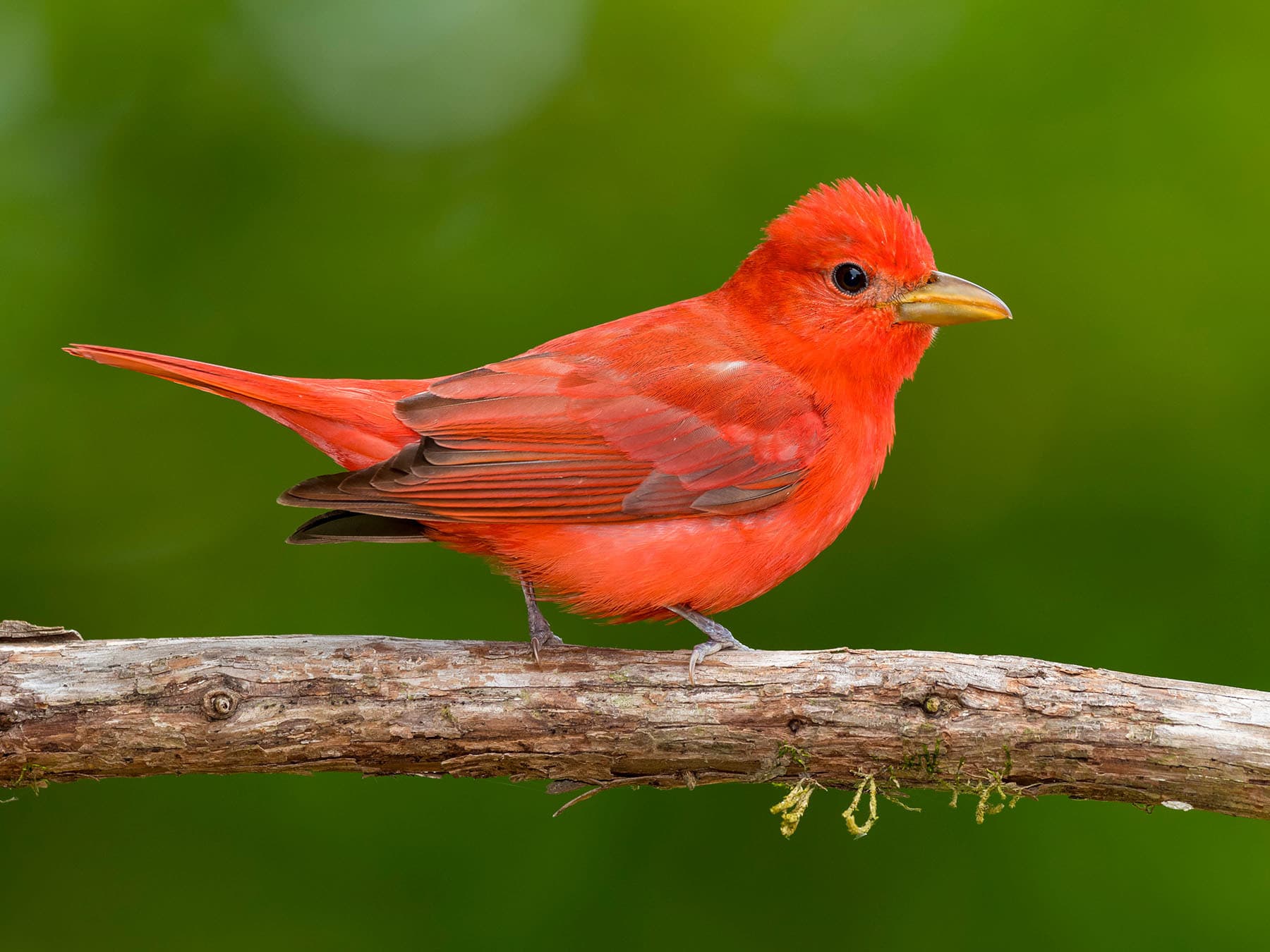
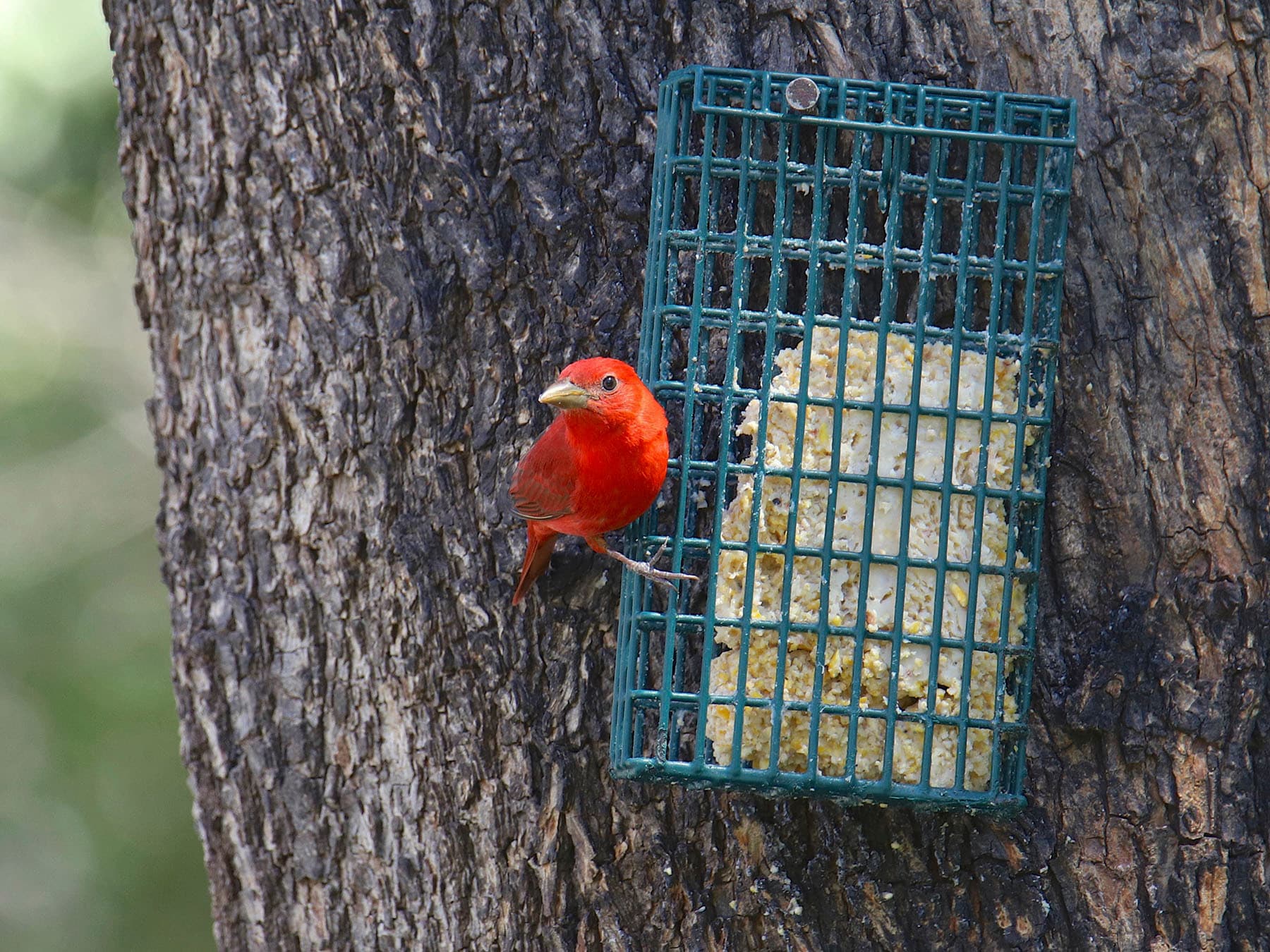
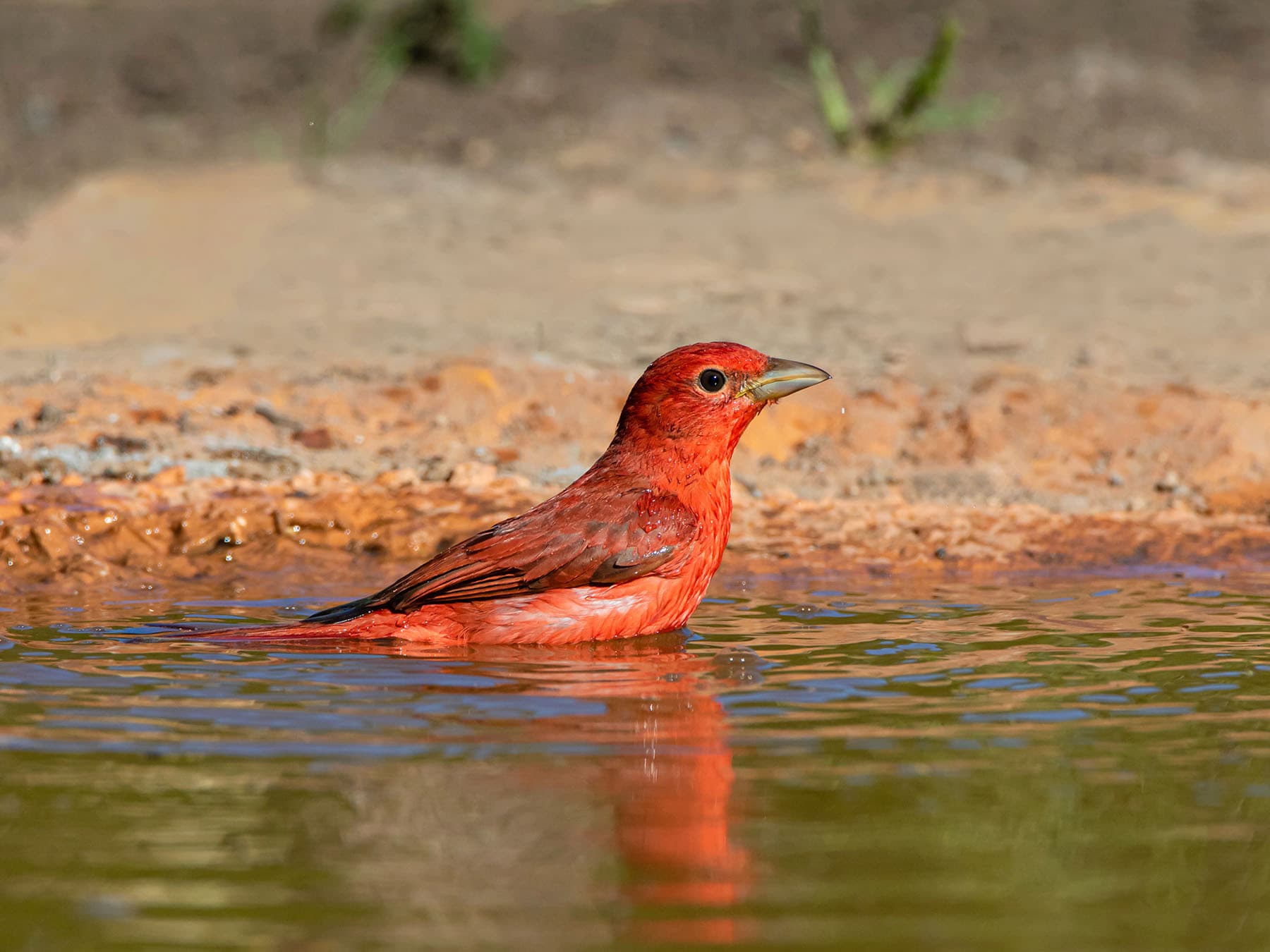
An adult male Summer Tanager is red from head to tail. There is no black on the wings, no black face and no tall crest: just rosy red all over, with a large, thick, pale bill. He stays red all year.
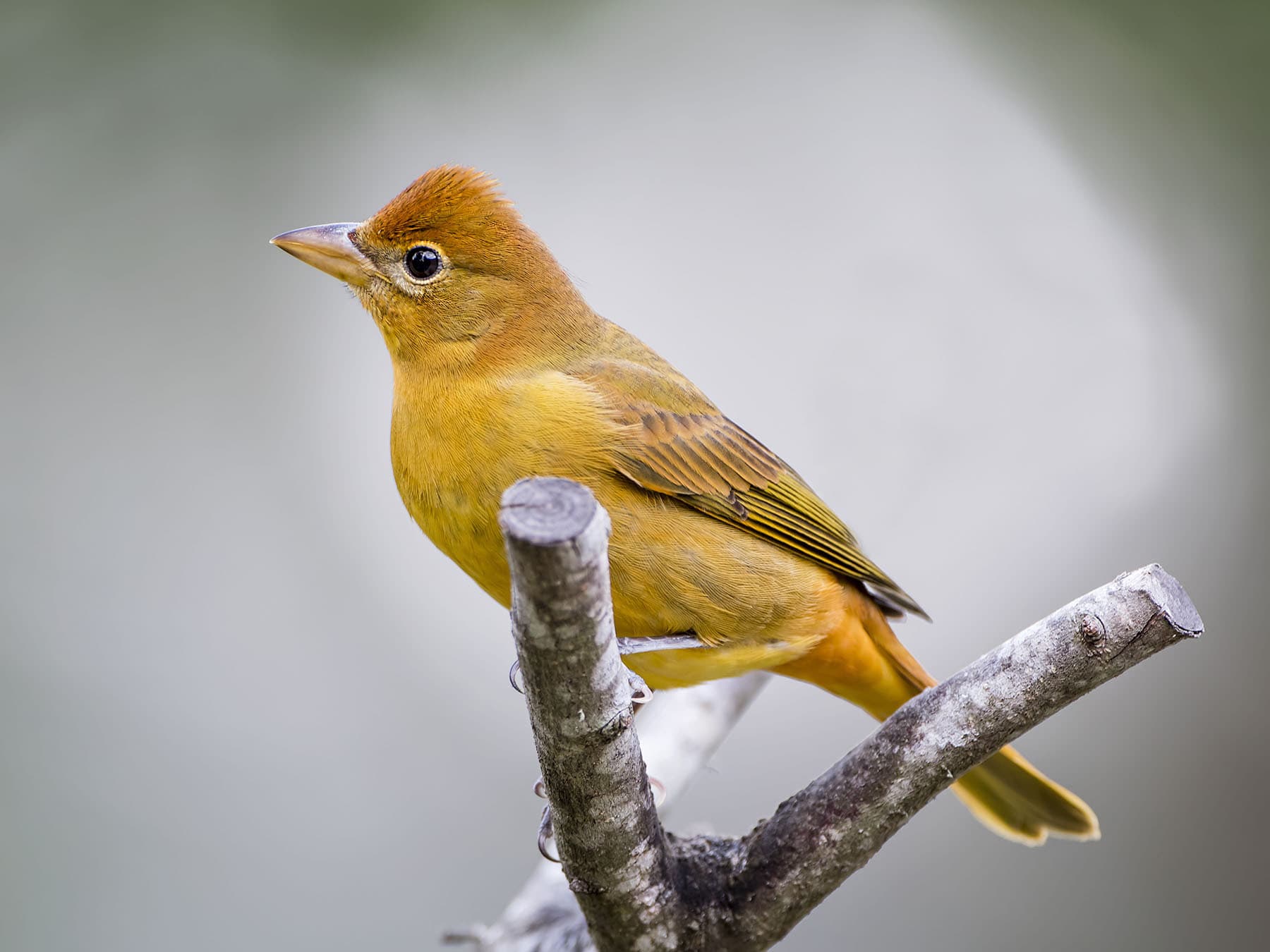
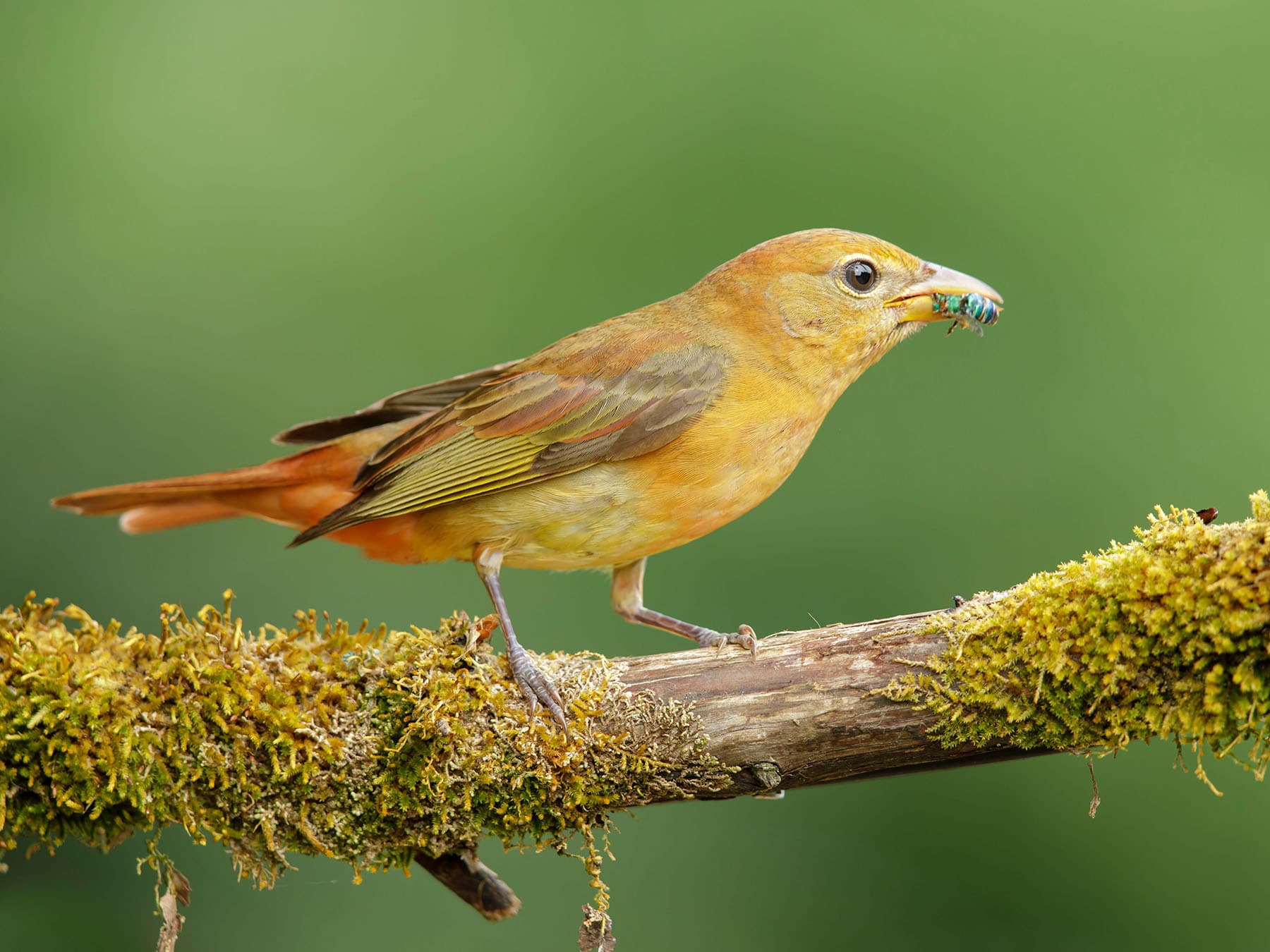
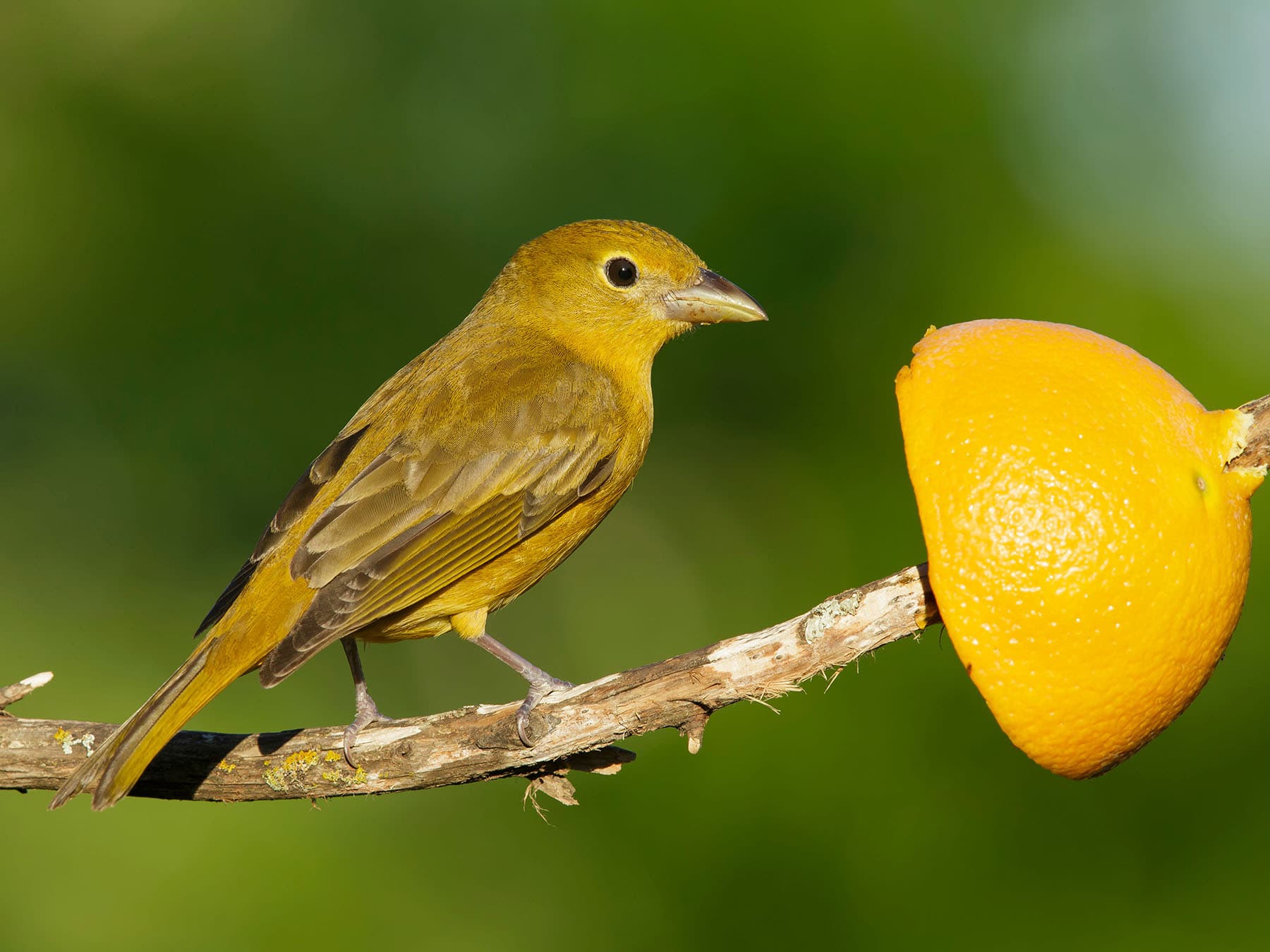
The female is yellow: mustard to orange-toned below in the East, plainer yellow in the West, and yellowish olive above, without the green cast of a female Scarlet Tanager. Her wings look about the same color as her body, and she has the same big pale bill as the male.1, 2 Both sexes are chunky, big-headed songbirds, and a raised crown can make the head look slightly peaked.
Size and shape
Summer Tanagers are 6.7 to 7.5 inches (17-19 cm) long, with a wingspan of 11 to 12 inches (28-30 cm), and weigh 0.8 to 1.1 ounces (23-31 g).2 That is smaller than an American Robin and larger than a sparrow.
Birds in the Southwest are larger, with bigger bills and paler plumage, than birds in the East.
Males, females and young
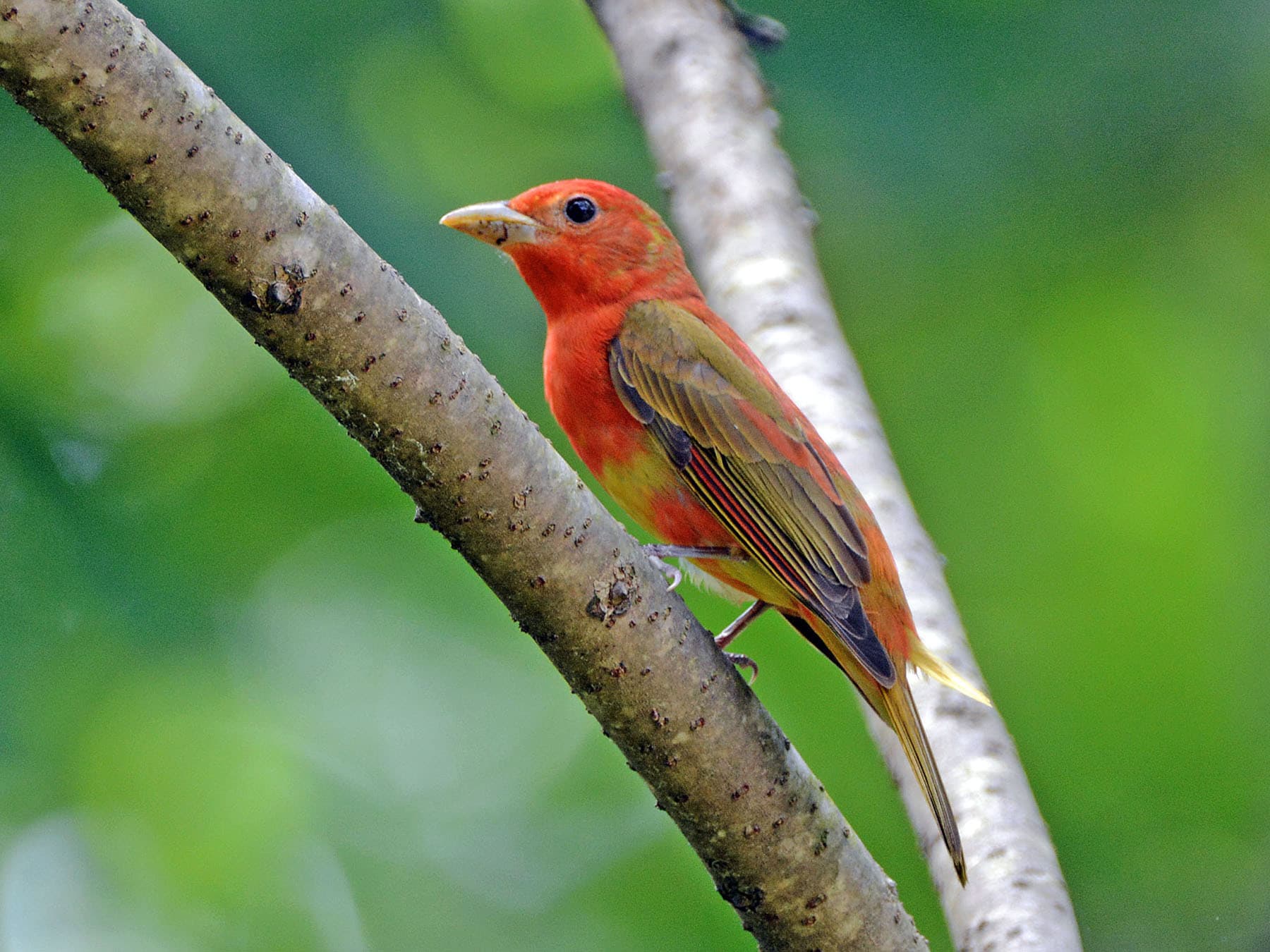
Young males cause the most double-takes. Through their first winter and first summer they are yellow with red blotches, the red spreading as the year goes on. By spring the red can cover most of the body or just a few patches, so a first-spring male often looks splashed with red and yellow, and one with little red can look like a female. A male turns all red after a complete molt late in his first summer, at a little over a year old.1, 3
Females are not always plain yellow. They carry a variable number of pinkish or red feathers, more in the East, and some older females apparently turn partly or wholly red. In a female the red is usually a wash; in a young male the red patches stand out sharply against the yellow.
Juveniles, seen mainly from June to August, look different again. In the East they are olive-buff and streaked, with buff wing bars and a whitish, streaked breast; western juveniles are largely yellow. Young males and females look alike at this age.
Identification: similar birds
Scarlet Tanager. The male is a deeper, brighter red with black wings and tail; after the breeding season he turns greenish but keeps the black wings. The female is greener, with wings darker than her body and a thinner bill. Its call is a chip-burr, not pit-i-tuck.
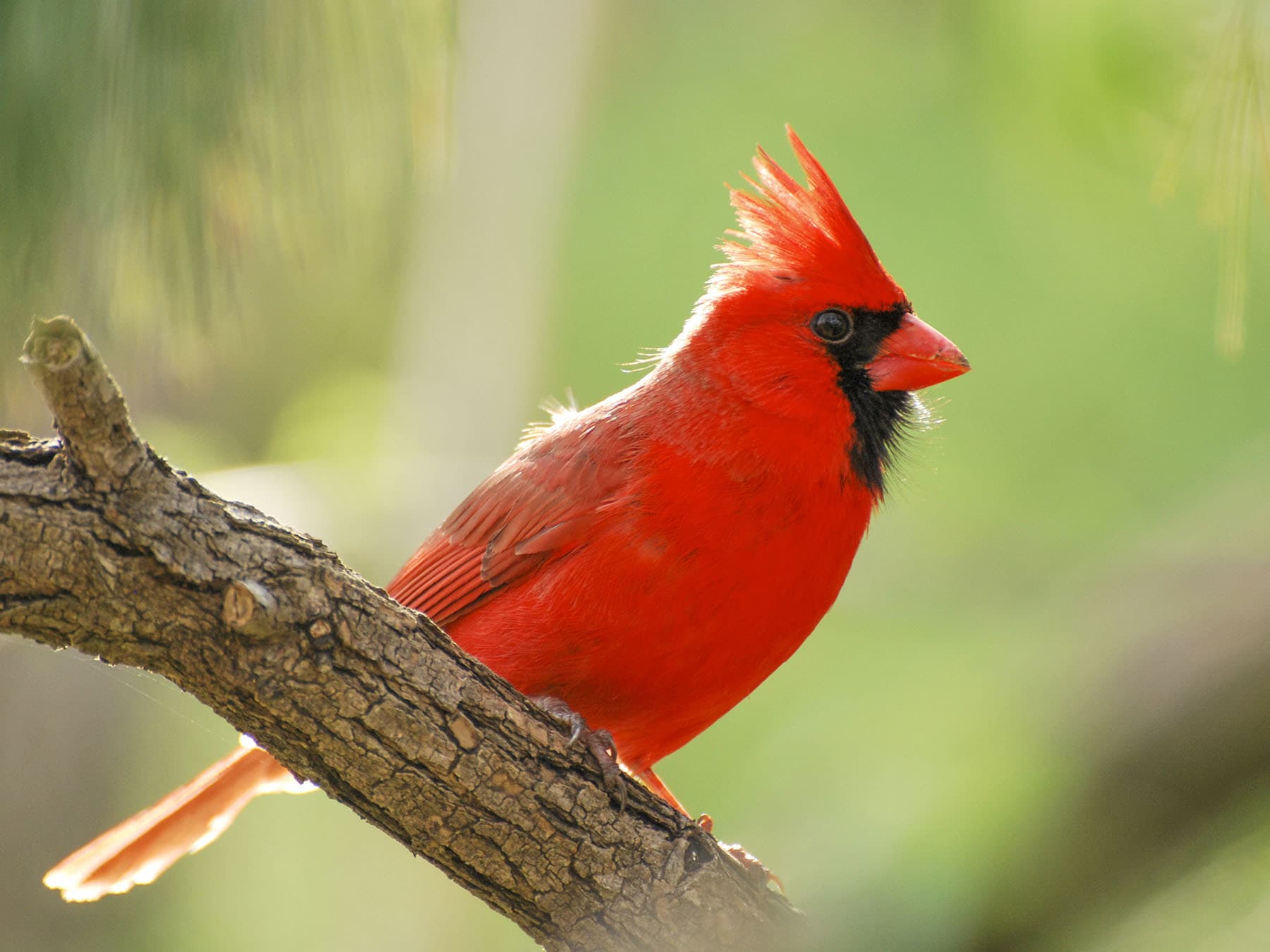
Northern Cardinal. Longer, 8 to 9 inches (21-23 cm), and crested in both sexes. The male has an obvious pointed crest and a black face around a conical red bill; a male Summer Tanager has no black on the face and a pale bill. Female cardinals are duller but keep the crest, and have a heavy pinkish bill.
Hepatic Tanager. A bird of Southwest mountains, breeding higher up, in open pine-oak woods. It has gray cheeks, a grayish wash on the sides and usually a darker bill, and males are a duller red. Females and young are yellow, like a female Summer Tanager, so check for the gray cheeks.
Western Tanager. Females show two wing bars on grayish wings, and a grayish back. Female and young male Summer Tanagers have plain wings; only streaky juveniles show buff bars.
Female orioles. A female Orchard Oriole is smaller and yellow-green, with a sharply pointed bill and white wing bars. A female Summer Tanager has a thick, blunt bill and wings the color of her body.
Not sure it’s a Summer Tanager? Check your photo: Birdfact names the bird and shows the look-alike side by side.
Its size
Adults- Length
- 17–19 cm
- Wingspan
- 28–30 cm
- Weight
- 23–31 g
Its song and calls
The song is a run of sweet, whistled phrases strung together with brief gaps, robin-like but softer. A typical song lasts a few seconds, though a male can link phrases into much longer runs. Each note is clearer than in a Scarlet Tanager's song, which has a burry, hoarse sound.4
Both sexes give a clicking pi-tuck or pit-i-tuck, adding notes when excited. It is very different from a Scarlet Tanager's chip-burr, which helps with females and with birds hidden in the leaves. Rivals also give a whining chew, and pairs give a soft pew near the nest. Some females sing a short, slurred version of the song.
In a study of 58 males, each had on average about 10 figure types (distinct song units), and neighbors shared more of them than distant males.4 Eastern males sing lower-pitched, faster songs than western males.5
Song season
Males arrive on their territories already singing, from several high perches. Song is strongest before pairing; after that most of it comes at dawn and dusk, and it almost stops when the molt begins in mid to late July. At one California site the pattern was different: males sang little on arrival and most while they had eggs and young.
- Song0:00 / 0:20
Recorded in Alabama, United States · June 2025
- Calls0:00 / 0:33
Recorded in Mississippi, United States · June 2026
Heard one and not sure? Let the bird song identifier listen.
When and where to see it
Summer Tanagers breed across the southern and eastern United States, north to about southern New Jersey, central Ohio, central Illinois and southwestern Iowa, and in the Southwest from southern California to west Texas and into northern Mexico.
In the East they nest near gaps and edges in open deciduous woods, and in pine-oak woods in the Southeast. In the Southwest they live in willow and cottonwood woods along streams and, higher up, in mesquite and salt cedar. Where they meet Scarlet Tanagers, Summer Tanagers use the shorter, more open woods with fewer kinds of trees, while Scarlets favor tall, closed forest, though the two overlap widely. They are less likely to be found in highly fragmented forest.1, 6
Spotting tips
For such a bright bird, a Summer Tanager is hard to see: it moves slowly through the canopy and sits still for long spells. Listen for the pit-i-tuck call and the robin-like song, then look up into the leaves. On migration they also turn up in parks, gardens and coastal woods.
Migration and winter range
This is a long-distance migrant. Almost all leave the breeding grounds in September and October and winter from central Mexico through Central America to northern South America, as far as Bolivia and Brazil. A few stay in southern California, southern Arizona and southern Florida.
They migrate mainly at night. Many eastern birds apparently cross the Gulf of Mexico, while western birds probably go overland through Mexico. In spring they reach Florida from mid to late March, northern Arkansas, southern Illinois and southern California by about April 20, and central Illinois and central Ohio by about May 7. They leave the north of the range in late September and Florida by late October.1 A few, mostly males, overshoot north of the breeding range in spring.
Autumn birds weighed on the Gulf coast (44 of them) carried on average fat equal to about half their lean weight,1 and birds reaching Panama in autumn still had enough for about 550 miles (890 km) more.7 After the spring crossing, most birds on a Mississippi island were never caught again, and the few that were stayed about two days on average.8 A few banded birds have returned to the same wintering sites in Honduras, Panama and Costa Rica in later years.
Range changes
By the late 20th century the Summer Tanager had apparently retreated from parts of the northern edge of its eastern range (it once bred in central Iowa, southern Wisconsin and northern Illinois) and from much of the lower Colorado River. Meanwhile it spread in the Southwest, from southeastern California to southwestern Utah, in the 30 years before 1994.1
What it eats
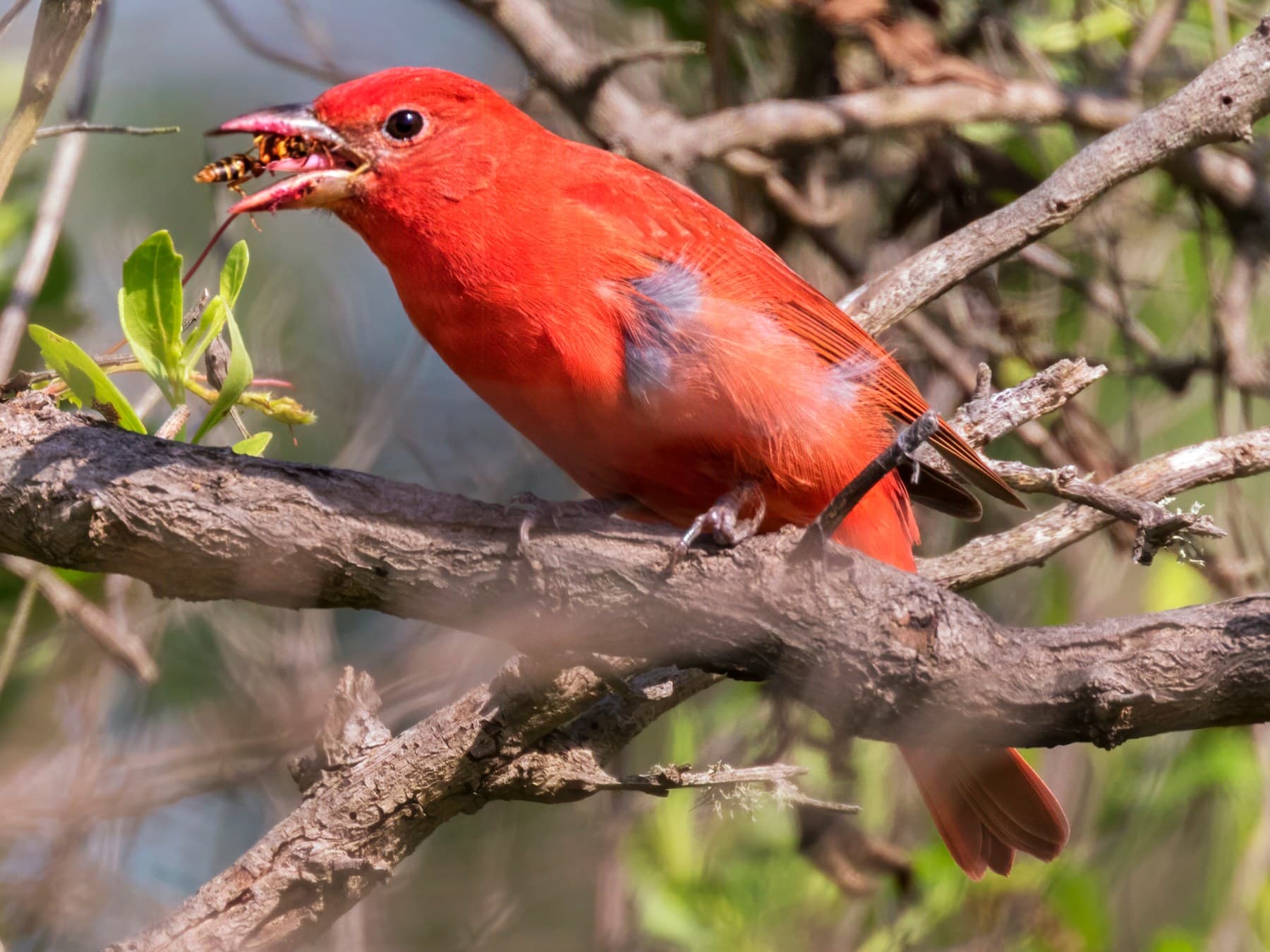
Summer Tanagers specialize in bees and wasps, on their breeding and wintering grounds alike. A tanager snatches a bee or wasp in the air, then knocks it against a branch and rubs the sting off before swallowing. It also attacks wasp nests, chasing off or killing the wasps, then ripping into the comb for the larvae. Birds of the World notes that some individuals may take bees at beekeepers' hives.1
They eat plenty of other insects too: cicadas, beetles, caterpillars, grasshoppers, dragonflies, flies and moths, and spiders. In seven birds from the lower Colorado River (22 prey items), cicadas made up 40% of the prey, bees, wasps and their relatives 22% and spiders 13%.9 Fruit matters mostly late in summer, on migration and in winter: blackberries, mulberries, blueberries, pokeweed, figs, citrus and bananas.
How they feed
They hunt high in the trees, sitting still, then sallying out to catch insects in the air or hovering to pick them off leaves. On the lower Colorado River half of their feeding moves were sallies after flying insects and half were hovers.9 On a spring stopover island in Mississippi, 24 radio-tracked birds ate mainly insects even when fruit was plentiful.10 They drink little, probably getting most of their water from food.
Feeders and yards
Old records include peanut butter taken at bird feeders, and the photos here show a female at half an orange and a male at a suet feeder. Summer Tanagers may also feed in berry bushes and fruit trees near woodland.
Nesting and breeding
Pairs apparently form each spring and stay together for one season; by 2012 there were no detailed studies of marked birds. The female alone gathers material and builds the nest, often with the male close by; it takes about 4 or 5 days, sometimes up to 18.1 The nest is a shallow, open cup of dry grass and weed stems lined with fine grass, about 3.5 inches (9 cm) across. Eastern nests are often so loosely built that the eggs show through the floor; nests at a California site were sturdier.
It is placed where leaves cluster thickly or twigs fork, well out along a horizontal limb and often above a gap: a creek bed, a road or a clearing left by a fallen tree. It is usually 10 to 35 feet (3-11 m) up,2 though nests have been found from about 4 feet (1.3 m) to over 70 feet (22 m).1
Eggs and young
Eggs are laid from May to July; in Kentucky egg dates peak in late May.11 There are usually 3 or 4 eggs, sometimes 2 and rarely 5, pale blue to pale green with brown spots and blotches, often heaviest at the broad end.1, 6 The female incubates them for 11 to 12 days. Some males feed her at or near the nest, and in North Carolina even those that had not fed her brought food on the day the eggs hatched.12
The young leave the nest at about 9 or 10 days old, barely able to fly. Both parents keep bringing food for three weeks or more, while the young stay hidden in the canopy; a disturbed fledgling freezes, sometimes pointing its bill at the sky. Second broods are rarely reported in the East, but on the lower Colorado River two broods were apparently typical.13 Birds first breed at about one year old.
Nest parasites and nest losses
In Illinois studies most Summer Tanager nests held Brown-headed Cowbird eggs, 11 of 13 in the south and 6 of 6 in central Illinois, but only 1 of 16 did at a California site.1 The tanagers chase cowbirds from the nest area, but in southern Illinois parasitized nests fledged about 20% fewer young tanagers, though from only eight nests.14 In Georgia pine forests, 64% of nests failed, apparently mostly to predators.15
Behaviour
Summer Tanagers are usually alone outside the breeding season, including in winter, though migrants sometimes gather in groups of 30 or so. Males defend territories with song, calls and chases, especially in the first days after they arrive, and near the nest a tanager will chase other birds, from wood-pewees and cardinals to cowbirds and orioles. Near the nest it dives at Blue Jays, squirrels, raccoons and snakes, calling hard; in the few records, it did not mob a Cooper's Hawk.
They bathe in shallow water, including bird baths, and sometimes sunbathe with wings and tail spread. Anting is rarely seen: in a 1941 record, a bird rubbed crushed ants under its wings.
Lifespan and predators
The oldest Summer Tanager on the US Bird Banding Laboratory's list was at least 11 years old: a male banded in Arizona in 2011 and caught and released there again in 2021.16 Banding studies give an apparent annual survival of about 56% for adults in the Southwest, a little lower in the Southeast; apparent survival counts birds that move away as lost.1
Summer Tanagers migrate mainly at night, and many have been killed at television towers: one tower in Leon County, Florida, killed 146 in spring migration and about as many in fall.17 How much such collisions matter to the population is not known.
Conservation
The Summer Tanager is listed as Least Concern on the IUCN Red List. Partners in Flight estimates about 12 million birds and gives it a Continental Concern Score of 8 out of 20 (2023).18
The North American Breeding Bird Survey shows numbers dipping to about 1990 and rising since; the survey-wide trend for 1966 to 2025 is a small, significant increase of 0.27% a year. Over that period numbers rose in Texas, Kansas and Illinois and fell in Florida, by about 1% a year, and in West Virginia.19
Losses have been local and severe. On the lower Colorado River, where it was common in the early 1900s, about 216 were estimated in 197613 and 138 by 1983, probably because riverside forest was cleared for farmland.20
Similar birds
Often mistaken for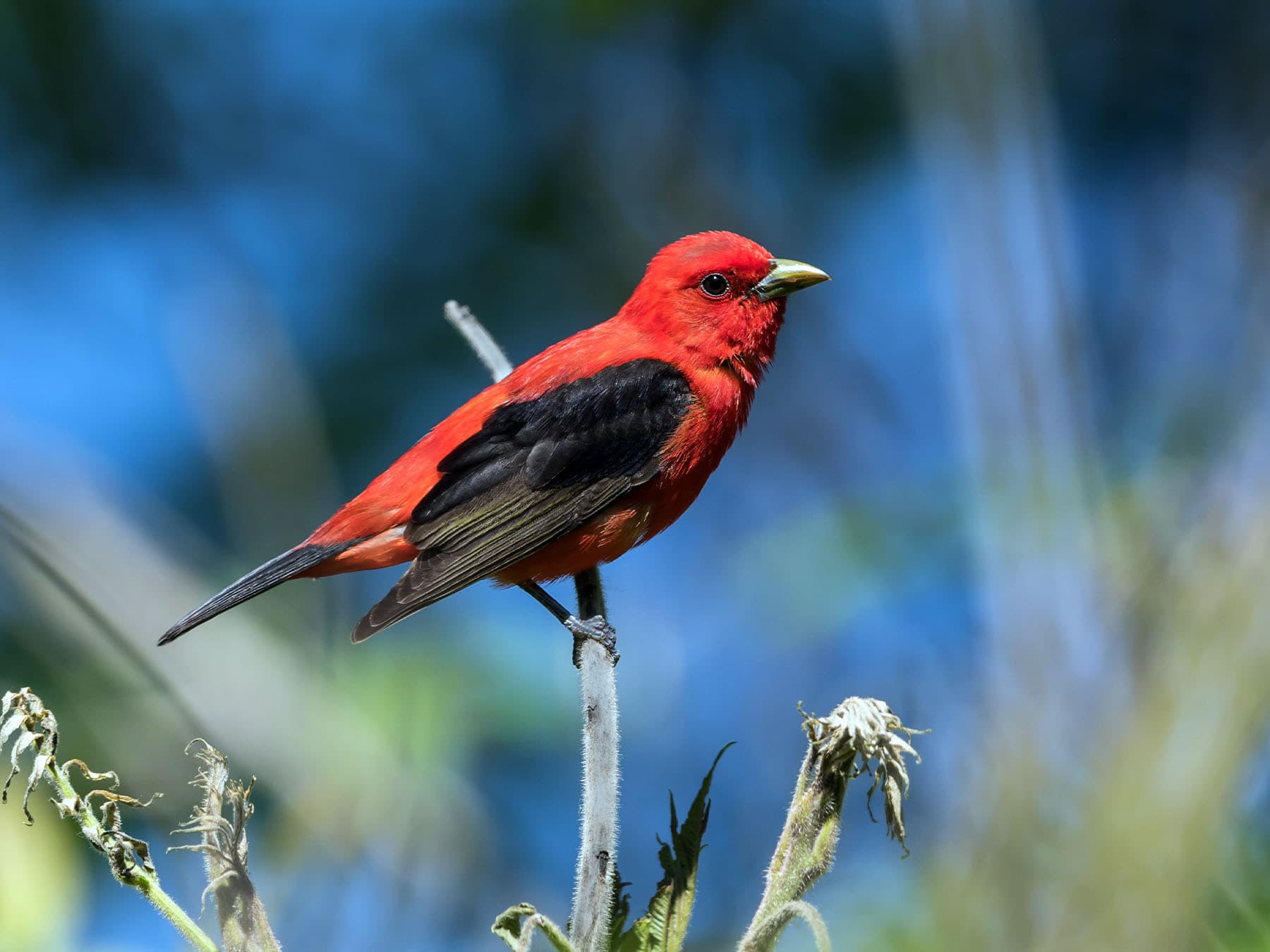
Quick facts
- Length
- 17–19 cm
- Wingspan
- 28–30 cm
- Weight
- 23–31 g
- Lifespan
- oldest recorded at least 11 years
- Family
- Cardinals & Grosbeaks
- Migration
- Long-distance Migrant
- Global status (IUCN)
- Least Concern
- World population
- About 12 million (Partners in Flight, 2023)
- Population trend
- Common and slowly increasing overall, but lost from parts of its range
- Scientific name
- Piranga rubra
Questions
2Is it rare to see a Summer Tanager?
Not in its range in summer: it is fairly common in southern and eastern woods from spring to early fall. It is easy to miss in the treetops, so listen for the pit-i-tuck call. See where and when.
Is a Summer Tanager a cardinal?
Not a cardinal itself, but a member of the cardinal family. Despite its name, it is not a true tanager: DNA studies place it and the other Piranga tanagers with the cardinals, grosbeaks and buntings.21
Sources
28- 1Robinson, W. D. (2020). Summer Tanager (Piranga rubra), version 1.0. Birds of the World (A. F. Poole, editor). Cornell Lab of Ornithology. doi:10.2173/bow.sumtan.01 (opens in a new tab)
- 2National Audubon Society. Summer Tanager. Guide to North American Birds. Accessed 2 November 2026. Source (opens in a new tab)
- 3Tennessee Wildlife Resources Agency. Summer Tanager. Tennessee Wildlife Resources Agency. Accessed 2 November 2026. Source (opens in a new tab)
- 4Shy, E. (1985). Songs of Summer Tanagers (Piranga rubra): structure and geographical variation. American Midland Naturalist 114: 112-124. doi:10.2307/2425246 (opens in a new tab)
- 5Shy, E. (1983). The relation of geographical variation in song to habitat characteristics and body size in North American tanagers (Thraupinae: Piranga). Behavioral Ecology and Sociobiology 12: 71-76. doi:10.1007/BF00296935 (opens in a new tab)
- 6Cornell Lab of Ornithology. Summer Tanager. All About Birds. Accessed 2 November 2026. Source (opens in a new tab)
- 7Rogers, D. T., Jr. and Odum, E. P. (1966). A study of autumnal postmigrant weights and vernal fattening of North American migrants in the tropics. Wilson Bulletin 78: 415-433. Accessed 2 November 2026.
- 8Kuenzi, A. J., Moore, F. R. and Simons, T. R. (1991). Stopover of Neotropical landbird migrants on East Ship Island following trans-Gulf migration. Condor 93: 869-883. doi:10.2307/3247722 (opens in a new tab)
- 9Rosenberg, K. V., Ohmart, R. D. and Anderson, B. W. (1982). Community organization of riparian breeding birds: response to an annual resource peak. Auk 99: 260-274. doi:10.1093/auk/99.2.260 (opens in a new tab)
- 10Aborn, D. A. and Moore, F. R. (2004). Activity budgets of Summer Tanagers during spring migratory stopover. Wilson Bulletin 116: 64-68. doi:10.1676/0043-5643(2004)116[0064:ABOSTD]2.0.CO;2 (opens in a new tab)
- 11Mengel, R. M. (1965). The Birds of Kentucky. Ornithological Monographs 3, American Ornithologists' Union. Accessed 2 November 2026.
- 12Potter, E. F. (1973). Breeding behavior of the Summer Tanager. Chat 37: 35-39. Accessed 2 November 2026.
- 13Rosenberg, K. V., Ohmart, R. D., Hunter, W. C. and Anderson, B. W. (1991). Birds of the Lower Colorado River Valley. University of Arizona Press, Tucson. ISBN 9780816511747.
- 14Trine, C. L., Robinson, W. D. and Robinson, S. K. (1998). Consequences of Brown-headed Cowbird brood parasitism for host population dynamics. Parasitic Birds and Their Hosts (S. I. Rothstein and S. K. Robinson, eds.). Oxford University Press. ISBN 9780195099768.
- 15White, D. H. et al. (1999). Abundance and reproduction of songbirds in burned and unburned pine forests of the Georgia Piedmont. Journal of Field Ornithology 70: 414-424. Accessed 2 November 2026.
- 16USGS Bird Banding Laboratory. Longevity records of North American birds. USGS Eastern Ecological Science Center, Bird Banding Laboratory. Accessed 2 November 2026. Source (opens in a new tab)
- 17Stevenson, H. M. and Anderson, B. H. (1994). The Birdlife of Florida. University Press of Florida, Gainesville. Accessed 2 November 2026.
- 18Partners in Flight (2023). Avian Conservation Assessment Database and Population Estimates Database. Bird Conservancy of the Rockies. Accessed 2 November 2026. Source (opens in a new tab)
- 19Hostetler, J. A. et al. (2026). The North American Breeding Bird Survey, Analysis Results 1966-2025. U.S. Geological Survey data release. doi:10.5066/P1OSNSFC (opens in a new tab)
- 20Hunter, W. C. (1984). Status of nine bird species of special concern along the Colorado River. California Department of Fish and Game, Sacramento. Accessed 2 November 2026.
- 21Klicka, J., Burns, K. J. and Spellman, G. M. (2007). Defining a monophyletic Cardinalini: a molecular perspective. Molecular Phylogenetics and Evolution 45: 1014-1032. doi:10.1016/j.ympev.2007.07.006 (opens in a new tab)
- 22National Audubon Society. Scarlet Tanager. Guide to North American Birds. Accessed 2 November 2026. Source (opens in a new tab)
- 23National Audubon Society. Northern Cardinal. Guide to North American Birds. Accessed 2 November 2026. Source (opens in a new tab)
- 24National Audubon Society. Hepatic Tanager. Guide to North American Birds. Accessed 2 November 2026. Source (opens in a new tab)
- 25National Audubon Society. Western Tanager. Guide to North American Birds. Accessed 2 November 2026. Source (opens in a new tab)
- 26National Audubon Society. Orchard Oriole. Guide to North American Birds. Accessed 2 November 2026. Source (opens in a new tab)
- 27Fitch, H. S. and Fitch, V. R. (1955). Observations on the Summer Tanager in northeastern Kansas. Wilson Bulletin 67: 45-54. Accessed 2 November 2026.
- 28AviList Core Team (2025). AviList: The Global Avian Checklist, v2025. data/reference/avilist.csv. Accessed 2 November 2026. Source (opens in a new tab)

Checked by
Nathan Cope, founder and editor
Nathan founded Birdfact and leads its writers and contributors in the UK, the US and Canada. He has watched and studied birds for more than ten years, and checks every article and species guide before it’s published.