
Roseate Spoonbill
Pink Curlew · Platalea ajaja
By the Birdfact teamChecked by Nathan Cope
On this page13 sections
How to recognise it
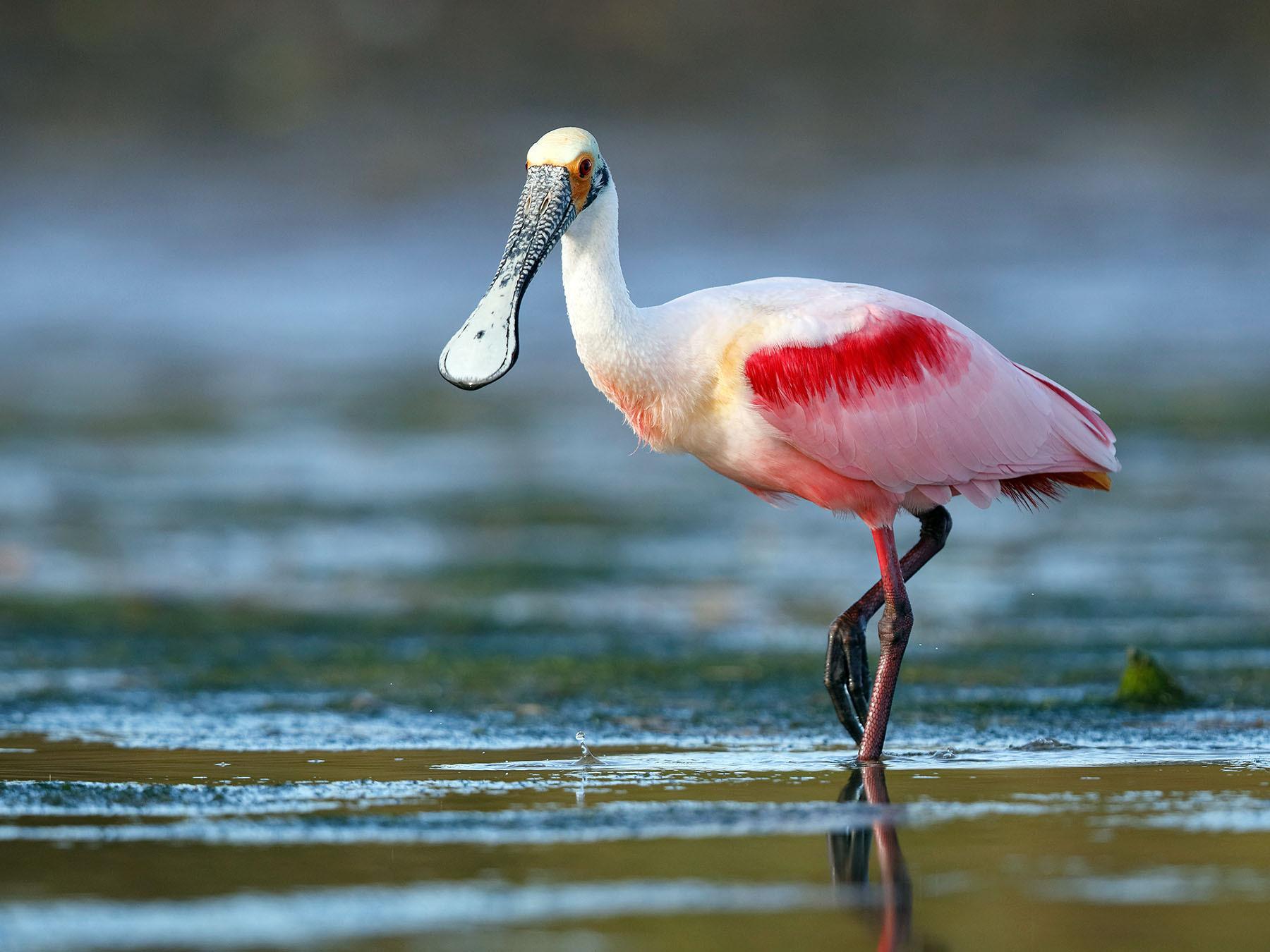
Its pink color and spoon-shaped bill make the Roseate Spoonbill hard to mistake at any age. The bill is long and narrow at the base, and broadens at the tip into a flat spoon.
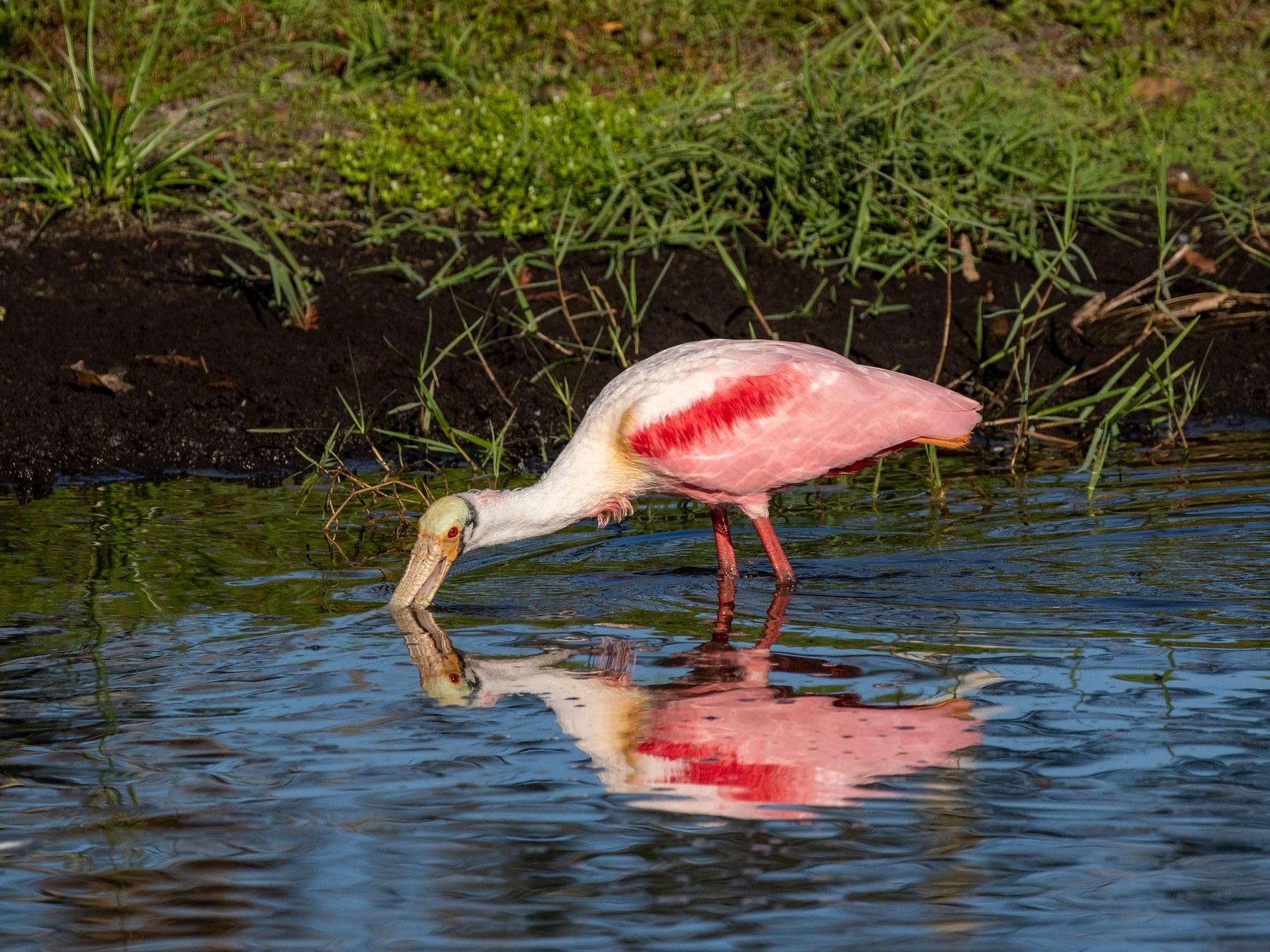
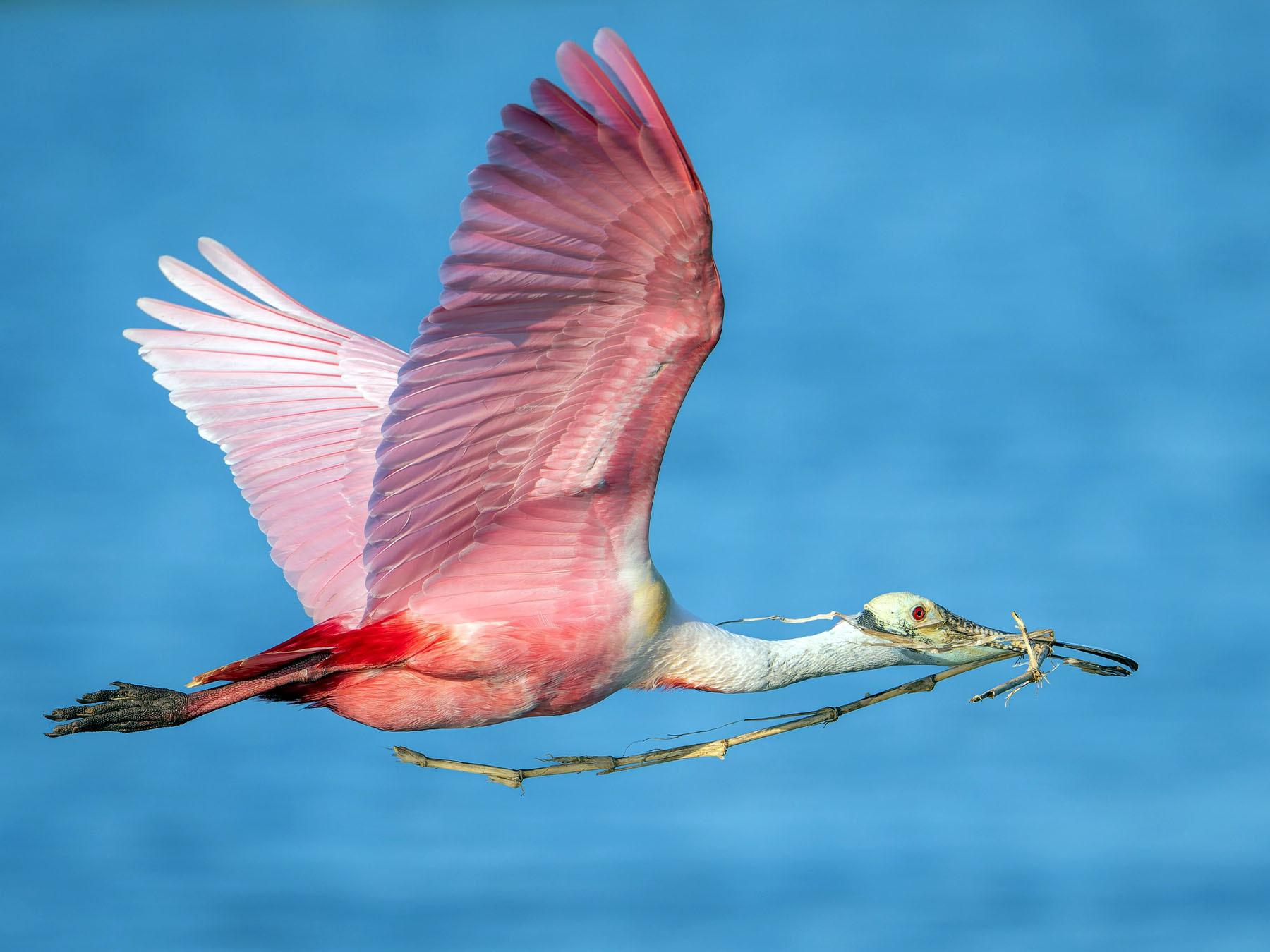
An adult has a bare head of pale green to golden-buff skin, with a band of thick black skin around the ear and down the nape, and a red eye. The neck, upper back and upper breast are white. Below them the body and wings are bright pink, with brilliant carmine on the shoulders and the tail coverts, a tuft of stiff, curled carmine feathers on the breast and a buffy-yellow patch on the side of the breast near the bend of the wing. The tail is tawny buff, almost orange, and the legs are magenta-red with blackish feet.
The bill is grayish green to grayish tan, mottled with green, black and yellow, with small hornlike bumps at the base of the upper half. When it walks and feeds, a spoonbill holds its body level with the head down, not upright like a heron or egret.
Size and weight
A Roseate Spoonbill is 28-34 in (71-86 cm) long, with a wingspan of about 47-51 in (120-130 cm), and stands about 31.5 in (80 cm) tall. It weighs about 2 lb 10 oz to 3 lb 15 oz (1.2-1.8 kg), larger than a White Ibis and smaller than a Great Blue Heron. The bill alone is 6-7 in (15-18 cm) long, and about 2 in (5 cm) wide at the spoon.
The sexes look alike in color, but males are larger, with longer bills, a difference you can see when a pair stands together. Nesting adults weighed in Florida averaged 3 lb 5 oz (1.49 kg; 27 birds), and in a Texas sample the males' bills averaged 6.6 in (16.8 cm) against 6.1 in (15.6 cm) for females (sample sizes unknown).1
Juvenile and immature plumages
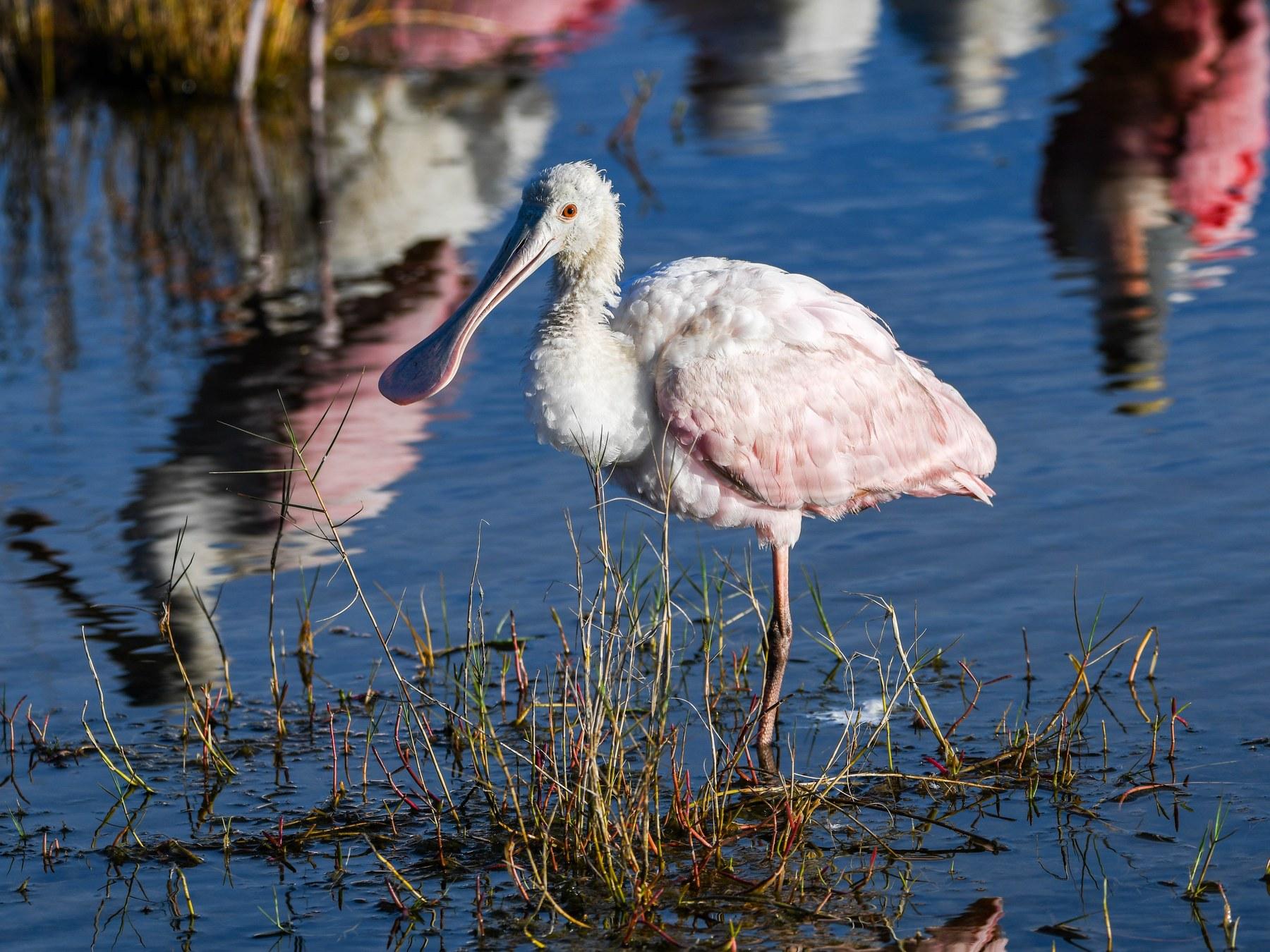
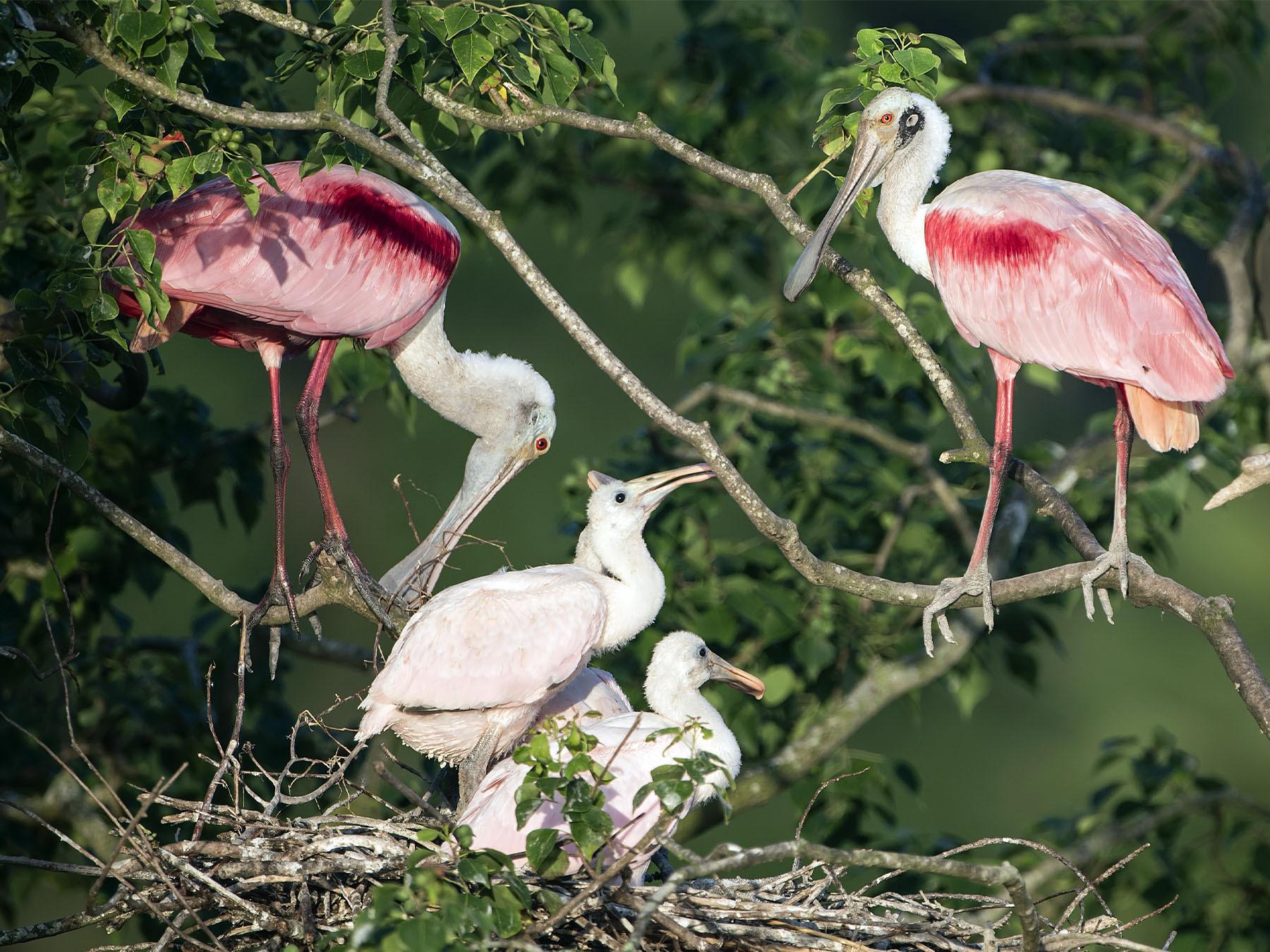
Young birds look quite different from adults. A juvenile is mostly white with a pink wash, pinkest on the wings and tail, with dusky tips to the wing feathers. Its head is covered in whitish feathers, with only the lores and a broad ring around the eye left bare. When it leaves the nest the bill is pinkish, darker toward the base, and the legs are dark gray-brown.
In a partial molt at about 4-10 months the back and breast turn pinker and the wing coverts lose their dusky tips (those on the flight feathers fade with wear). The head stays feathered and white, and the bill becomes dirty yellow to dull green. The head goes bare at the first complete molt, at about 14-15 months, and the new skin is blue-green at first. After the next molt, at about 20-21 months, the bird looks like an adult but less colorful, with a greenish bare head and only some carmine on the wing. Full adult plumage comes at about 32-34 months, nearly three years old. These ages come mainly from a 1926 account, and as of 2000 its idea that adults molt twice a year had never been confirmed in living birds or specimens of known age.1
Why the plumage is pink
The pink comes from carotenoid pigments in the spoonbill's food, and how much pigment is laid down, and where, goes with the bird's age. The main pigments in adult feathers are canthaxanthin and astaxanthin, and canthaxanthin is also the chief pigment in the feathers of several flamingos and the Scarlet Ibis.1
Crustaceans and other small water animals carry these pigments. Some scientists believe the color comes from prey such as shrimp, which take up the pigments from algae.2
Identification: telling it from a flamingo
The other big pink wading bird it is compared with is the American Flamingo, and the two overlap in parts of their ranges. A flamingo is much bigger, with a pinkish-red feathered head and neck, a yellow eye and a pale pink bill with a black tip that bends sharply down in the middle. A spoonbill has a white neck, a bare greenish head, a red eye and a long flat bill that ends in a spoon.
Young birds differ too: a young flamingo is gray-brown, while a young spoonbill is whitish with a pink wash.
Not sure it’s a Roseate Spoonbill? Check your photo: Birdfact names the bird and shows the look-alike side by side.
Its size
Adults- Length
- 71–86 cm
- Wingspan
- 120–130 cm
- Weight
- 1200–1800 g
Its song and calls
The Roseate Spoonbill has no song in the songbird sense and is essentially silent. Apart from a soft grunt given while feeding, the calls described come from nesting colonies; the main handbook account, written in 2000, found nothing on its voice outside the breeding season and thought the list probably incomplete.1
At the colony, an alarmed bird gives a rapid, low huh-huh-huh-huh with the bill partly open. Partners make low cackling and clucking sounds when they change places at the nest, and feeding birds give a soft, grunting uh-uh-uh, much like a White Ibis. One field guide describes low croaks and clucking.
Begging chicks give a high, thin cheeping and a trembling, trilling whistle. In courtship and at nest changeovers adults also make a soft rattle with the bill, though it is not true bill-clattering like a stork's: the bill is too soft and leathery.
Heard one and not sure? Let the bird song identifier listen.
When and where to see it
November
Leaving
The year across North America
Choose a place on the map to see its year, or find yours.
Most recorded in November
Up to 0.51% of a place’s bird records that monthHere in other months
How this map is made
Each county, state or province is shaded by the Roseate Spoonbill’s share of all the bird records there that month: the darker, the larger the share. A place with only a trace of records in a month is left unshaded. Shades compare places on this map with each other, not one bird with another. Records: GBIF eBird Observation Dataset, 2019–2024. Map: Natural Earth; place centres © OpenStreetMap contributors.
How often the Roseate Spoonbill turns up in the United States through the year, from birdwatchers' records.
United States
Resident · all year · most records in January
Show as a table
| Month | United States |
|---|---|
| January | 0.082% (regular) |
| February | 0.077% (regular) |
| March | 0.062% (regular) |
| April | 0.062% (regular) |
| May | 0.020% (regular) |
| June | 0.032% (regular) |
| July | 0.048% (regular) |
| August | 0.050% (regular) |
| September | 0.045% (regular) |
| October | 0.053% (regular) |
| November | 0.070% (regular) |
| December | 0.068% (regular) |
Worldwide: recorded regularly in 26 countries
Countries where it was recorded in at least 3 of the 6 years 2019–2024. Linked countries have their own bird list.
North America (14)
- Aruba
- Bahamas
- Belize
- Costa Rica
- Cuba
- Dominican Republic
- El Salvador
- Guatemala
- Honduras
- Mexico
- Nicaragua
- Panama
- Turks & Caicos Islands
- United States
Data: EOD – eBird Observation Dataset (Cornell Lab of Ornithology), accessed via GBIF.org, CC BY 4.0. Records from 2019–2024, aggregated and filtered by Birdfact. How these lists are made
In the United States the Roseate Spoonbill breeds along the coasts of Texas, Louisiana and southern Florida, with some nesting inland in southern Florida and Louisiana. In Florida it nests in Florida Bay, around Tampa Bay and in Brevard County, among other places. In Texas most breeders nest on the upper and central coast, around Galveston, Matagorda, San Antonio and Corpus Christi bays, with a few colonies south to the Rio Grande, and it is a common sight on the Texas Gulf Coast. In Louisiana it nests mainly in the southwestern and south-central parishes.
Beyond the US it lives locally on the coasts of Mexico and northern Central America, on Cuba, Hispaniola and in the Bahamas, and through much of South America east of the Andes to northern Argentina, breeding abundantly in the Pantanal. On the Pacific side of Mexico, a 2011 study found it a regular summer resident in the estuaries of Sonora, north at least to Bahía Kino.3
Habitat
It feeds in shallow water of every kind, salt, brackish and fresh: coastal bays, estuaries, lagoons, seagrass beds, marshes, wet prairies, mangrove swamps, tidal mudflats, canals, ponds and roadside ditches, and crayfish, catfish and cattle ponds too. It nests mostly on islands, natural or made from dredge spoil, on mangrove keys and barrier islands, or in trees and shrubs standing in water.
It usually feeds in water 5 in (12 cm) deep or less. Judging by its leg length, it can wade and feed to about 8 in (20 cm), though it will also feed in water above its chest with the head and neck under. About 5 in (13 cm) is reported as the best depth for feeding.1, 4 In Everglades aerial surveys in 2000-2009, spoonbills were less likely to be present where water was deeper than 10 in (25 cm), and more likely where there was more tree cover.5
Do they migrate?
Partly. After nesting, birds disperse widely, and some populations may migrate regularly. In Florida Bay, where spoonbills nest in winter, adults leave the colonies in March or April and return in October or November; where they spend the summer was largely unknown when the main handbook account was written in 2000. Texas colonies are used until some time in August, and birds return from late February to April.
Many Texas birds winter in Mexico, though some stay all year on the Texas coast. From 910 Texas birds banded as nestlings in 1955-1983, there were 11 winter recoveries in Mexico, 9 of them on the coast from Tamaulipas to Veracruz, and 1 in Louisiana.1
Wanderers and a spreading range
After breeding, wanderers, usually young birds, travel far from the colonies. They have reached the Atlantic coast north to North Carolina and exceptionally southern New York, and inland states as far apart as Pennsylvania, Ohio, Wisconsin, Nebraska, Colorado, Utah and California. California had irruptions to the Salton Sea in 1959, 1973 and 1977, and in some years the movement north is large and irruptive.1
In Arkansas, where it is a rare bird, the first record came in 1959. A 2021 study of citizen-science records found birds there from April to late October, peaking in August, most without breeding plumage and believed to be young birds, with up to 128 together. It also recorded the first Arkansas nesting, in 2020, in Ashley County.6
Spotting tips
In Florida, look in Florida Bay, around Tampa Bay and on the Atlantic coast of Brevard County; in Texas and Louisiana, in coastal marshes, bays and ponds. Watch shallow water for a pink bird walking slowly with its head down, sweeping its bill from side to side. Feeding often peaks at low tide. In late summer and fall, a pale, whitish spoonbill far from the coast is most likely a wandering young bird.
What it eats
The Roseate Spoonbill eats small water animals: chiefly small fish, then crustaceans, above all shrimp and prawns, and water insects. Crayfish, crabs, mollusks and slugs are taken too, and some plant material, such as sedge roots and stems.
In a small, mostly Florida sample of 30 stomachs and nestling food samples, small fish such as minnows and killifish made up 42-90% of the diet and crustaceans, mostly shrimp, 5-55%.1 Florida Bay nestlings were fed about 85-90% small fish, mainly sailfin mollies, and 10-15% small shrimp by wet weight. Preliminary results suggested that parents bring whatever fish is most abundant.1
How they feed
A spoonbill feeds mainly by touch. Walking slowly through the water, it moves its partly open bill in half circles from side to side in the water or the mud and snaps it shut when it touches prey. It also probes, grabs and pecks, partly by sight, and probably stirs the bottom with its feet to flush prey. The bill has sensitive nerve endings, though in 2000 how touch feeding works was still not well understood. It swallows by lifting the bill and jerking the head back, and shakes or beats larger or hard-shelled prey on a hard surface.
It is usually active by day but often feeds at night as well. A 1999 study of eyesight in six wading birds described it as mainly a twilight feeder that does more of its foraging at night than in daylight.7 Florida Bay adults flew on average 7.7 mi (12.4 km) in 19 minutes to their feeding grounds on the mainland (92 birds), often 19 mi (30 km) and as far as 40 mi (65 km).1 Texas breeders fed only 0.6-0.9 mi (1-1.5 km) from the colony.1
Nesting and breeding
The Roseate Spoonbill nests in colonies, of its own kind or mixed with herons, egrets and ibises. In Texas and Louisiana it nests from early spring into summer, April to July or August. On mainland Florida it nests from late February or March to June, and in Florida Bay usually in fall and winter, November to March, though by 2000 timing there had become more irregular.
Nests are usually on islands or over water, where land predators cannot easily reach them. In Florida most are in red and black mangroves, 4-16 ft (1.2-5 m) up; on Texas islands they are on the ground or in low shrubs and small trees. The nest is a bulky, loose platform of sticks lined with finer twigs and leaves, and a new one is built each year. From the few pairs watched, the male picks the site and brings sticks, and the female works them into the nest.
Eggs and young
A clutch is 1-5 eggs, usually 3-4. The eggs are dull white to pinkish or pale greenish-blue, spotted and blotched with brown. They are laid every other day, and incubation starts the day after the first is laid. At Nueces Bay, Texas, each egg took 22 days to hatch (29 nests).1 The eggs hatch in the order laid, so chicks in a nest differ in age. Both parents incubate, taking turns so that one is always at the nest.
Chicks hatch with bright salmon-pink skin, bill and legs under short white down, and without a spoon: the bill starts to broaden at about 9 days and is spoon-shaped by 16 days. Both parents brood them and feed them by regurgitation, the chick putting its bill into the parent's open bill. In Florida Bay in 1990-1992, a parent with small nestlings made on average 1.4-2.1 feeding trips a day, away about 4.6-4.9 hours each time (seasonal means).1
The chicks climb onto nearby branches at about 14 days, have their full feathers at about 42 days and first fly at about 6 weeks. They stay at the colony and are fed until about 2 months old: 7 radio-tagged young in Florida Bay left at 67 days on average.1 Pairs raise one brood a year and may nest again if a colony fails early. Spoonbills probably first breed at 3 years old, when they reach full adult plumage.
Nest success
Success swings widely from year to year, from total colony failure to an average of 2.5 young per nest; colonies that are not abandoned typically raise 1-2 young per nest. At Nueces Bay, Texas, 154 nests in 1978-1980 raised about 1.5 fledglings per nesting attempt.1
In Florida Bay, food is probably the main limit. A long-term study there has monitored nesting and water levels since 1987. It concluded that spoonbills need falling water to concentrate their prey fish if they are to raise young, and that the link between water level and prey is likely a threshold rather than a straight line.8 In a season Audubon Florida reported in June 2026, 157 of 244 monitored nests in Florida Bay fledged at least one chick, about 1.2 chicks per nest.9
Behaviour
The Roseate Spoonbill is very sociable. It flies in flocks, nests in colonies and roosts with other wading birds, and feeding and roosting groups can number from 2 to about 400.
In flight it stretches its head and neck out, with the bill level and the feet trailing, and flies with deep, slow wingbeats broken by short glides. Flocks travel in lines or wedges, like geese. A whole flock may take off at once, possibly in alarm, and birds point their bills at the sky when another spoonbill flies over. Both habits appear to be unique to this spoonbill.1
Social behavior
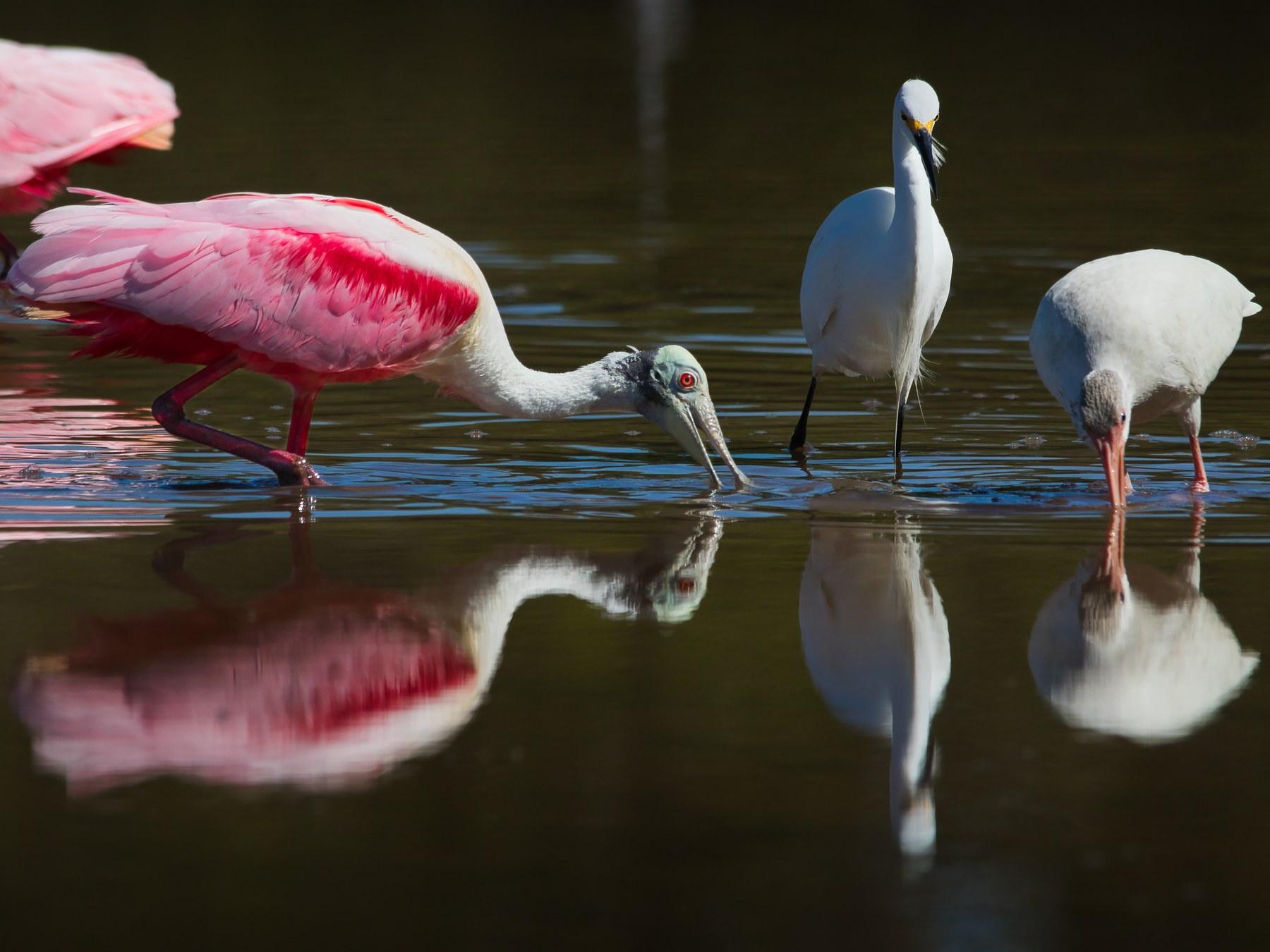
Spoonbills nest and roost with Great, Snowy, Reddish and Cattle Egrets, Little Blue, Tricolored and Great Blue Herons, night-herons, White, White-faced and Glossy Ibises, Wood Storks and cormorants. In mixed colonies they seem to be at the bottom of the pecking order. Great and Snowy Egrets may follow feeding spoonbills and catch the prey they flush, and spoonbills may feed together, flushing prey for one another.1
At the colony, two birds sometimes fly at each other beating their wings in sham battles, but no injuries from these have been reported. A spoonbill swims if it has to, preens with its spoon, and sleeps standing, often on one leg with its head tucked back.
Lifespan and predators
The oldest Roseate Spoonbill on the US Bird Banding Laboratory's current list was at least 16 years 6 months old. It was banded as a nestling in Florida on 4 May 2009 and seen alive in Florida, its marker read, on 27 November 2025.10 In captivity, one bird hatched from an egg was still alive at 29 years.1 Of 18 radio-tagged Florida Bay juveniles, 22% survived the first 5-7 weeks after leaving the colony.1
Raccoons are probably the most important predator in the nesting season, raiding eggs and driving colonies away. Turkey Vultures have been reported killing healthy nestlings, Bald Eagles probably took young birds in Florida Bay, Peregrine Falcons occasionally take new fledglings, grackles take eggs where nests have been deserted, and fire ants kill hatchlings. 1 In Texas, coyotes also take eggs and young.2 We found no information on predators of adults. Of 110 Florida Bay nestlings examined after death in 1987-1992, disease killed 20%, malnutrition 21% in a dry period, and predators, mainly Turkey Vultures, 35% at sites without raccoons.1
Conservation
The Roseate Spoonbill is listed as Least Concern on the IUCN Red List, and NatureServe ranks it globally secure for its very large range (a rank last reviewed in 1996), while ranking it imperiled in Florida.11, 12 Older estimates put the world population at about 150,000-200,000 birds, and Partners in Flight's figure, scaled up from a 1998 US estimate, is about 170,000.13, 14 In the 1990s the US held about 5,500 breeding pairs: 2,901 in Texas and 1,505 in Louisiana in 1996, and about 1,100 in Florida.1
On the Breeding Bird Survey, the US trend for 1966-2025 is a rise of 3.16% a year, with a 95% credible interval of +0.60% to +5.84% that excludes zero, so the long-term increase is statistically clear. The recent picture is less certain. Every window ending in 2025 that starts in 1995 or later spans zero, the last ten years (2015-2025) show -5.98% a year (-14.83% to +4.34%), and the yearly index has fallen to about half its 2014 peak, with wide uncertainty. Texas is the only state whose ten-year trend excludes zero: -10.14% a year for 2015-2025.15
Partners in Flight notes that neither the Breeding Bird Survey nor the Christmas Bird Count covers the species fully, and that a climate-driven shift could make the trend look better than it is, though it judges the long-term gain likely real.14
Conservation: plume trade and recovery
In the 1800s the spoonbill was hunted for its feathers. John James Audubon saw spoonbill wings sold as fans in St. Augustine, Florida, in the 1830s. The disturbance as plume hunters raided shared colonies for egret feathers probably took the greatest toll. By the 1890s it had essentially vanished from most of its old US breeding range, through plume hunting, settlement, disturbance of colonies and hunting for food. Texas probably had no breeders left by 1895. Florida birds kept declining into the 1930s, after the 1910 plume law, because they were still taken in large numbers for food near coastal colonies, and Florida fell to a low of 15-16 pairs by 1941.1
Recovery came in the 20th century. Texas breeding resumed in 1923 at San Antonio Bay and reached about 830 pairs by 1941, probably helped by birds from Mexico, Audubon sanctuaries and less hunting for meat. In Florida Bay, continued disturbance slowed recovery until the bay became part of Everglades National Park in 1960; nesting there went from 15 pairs in 1940 to 1,254 pairs, the peak, spread over 18 colonies in 1978. Birds returned to Tampa Bay, nesting there in 1975 for the first time since 1912, and reached the Atlantic coast at Kennedy Space Center in 1987.1
Florida Bay has since declined, from 1,250 pairs in 1979 to 600 by 1989, 400 by 1994 and fewer than 100 by 2010, while many spoonbills have moved to feed and nest elsewhere in Florida and beyond. Audubon has studied the spoonbill since 1934 and treats it as a gauge of the health of the Everglades and Florida Bay.4
Conservation today: water and disturbance
In 2000, the loss and degradation of coastal feeding habitat was judged probably the most important problem, at least in the US: in Florida Bay, water management has likely reduced prey, and in Texas and Louisiana marsh loss was the concern.1 Audubon Florida reported in 2025 that water levels in South Florida had risen nearly 5 in since 2000, and that rising water is pushing spoonbills to nest farther inland and north.4
In Florida Bay studies published in 1994 and 1996, boats near or inside colonies caused declines in nesting birds, poor success and abandonment, and after a buffer zone was posted at one colony, nesting numbers more than doubled the next year. In Texas, birds returned to a former colony site after raccoons were removed. No organochlorine pesticides were found in nestlings from eastern Florida Bay in 1987-1991, and Gulf Coast eggs of 1972-1973 held DDE, but apparently not enough to thin the shells.1 On Texas islands, too much disturbance can make a whole colony of nesting waterbirds, spoonbills among them, desert its island for the year.16
Outside the US, the 2000 handbook account names hunting as a problem in Central and South America, and notes that 9 of 16 recovered bands from Texas birds came from birds that had been shot.1
Legal status
In the United States the Roseate Spoonbill is on the federal list of birds protected under the Migratory Bird Treaty Act. It is not a migratory game bird, and it is not listed under the Endangered Species Act; the US Fish and Wildlife Service's species profile gives it the status Species of Concern.17, 18, 19
Florida lists it as a State-designated Threatened species. Under the state's rule, the bird, its nests and its eggs may not be taken, possessed or sold except as the Fish and Wildlife Conservation Commission's rules or permits allow. It is also covered by the Commission's guideline for threatened wading birds, in effect since December 2018.20, 21 In Texas, the nests, eggs and young of colonial waterbirds are protected under the Migratory Bird Treaty Act and the Texas Parks and Wildlife Code.16 It has no entry in Mexico's list of species at risk, NOM-059.22
More photos
1 photos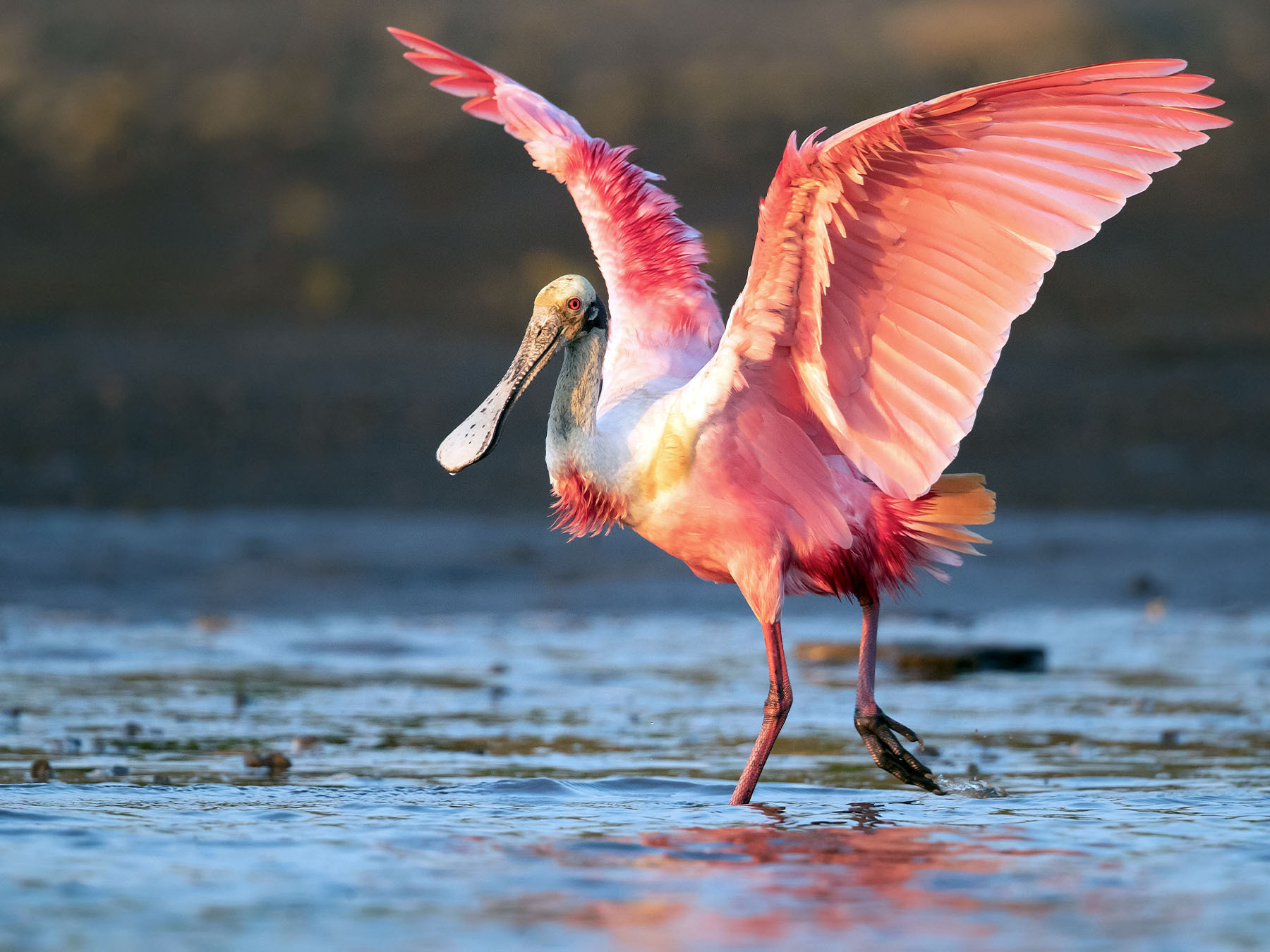
Quick facts
- Length
- 71–86 cm
- Wingspan
- 120–130 cm
- Weight
- 1200–1800 g
- Lifespan
- oldest recorded 16 years 6 months
- Family
- Ibises & Spoonbills
- Migration
- Partial migrant
- Global status (IUCN)
- Least Concern
- World population
- About 150,000–200,000 worldwide (older estimates; Partners in Flight puts it near 170,000)
- Population trend
- Increasing in the US over 1966-2025 on the Breeding Bird Survey, though numbers have drifted down since a 2014 peak and the recent fall is not statistically clear
- Also called
- Pink Curlew
- Scientific name
- Platalea ajaja
Questions
3How rare is a Roseate Spoonbill?
Not rare worldwide: it is listed as Least Concern, and it is locally common on the coasts of Florida, Texas and southwestern Louisiana. Florida lists it as threatened; a 2011 state review draft had recommended listing because the bird nests in a restricted number of places.13 Away from those coasts it turns up mainly as a wanderer, usually a young bird after the breeding season.
Is a Roseate Spoonbill a kind of flamingo?
No. It belongs to the ibis and spoonbill family, Threskiornithidae. It is one of six spoonbills in the world and the only one in the Americas, and the only spoonbill with brightly colored plumage; the others, such as the Eurasian Spoonbill, are mainly white.
Why is it called a Roseate Spoonbill?
Spoonbill for the bill, which is shaped like a spatula, and roseate, or rosy, for its pink feathers. It is known locally as the pink curlew. Linnaeus described it in 1758 as Platalea ajaja, chiefly from a picture of a Brazilian bird that Georg Marcgrave had called Aiaia in 1648.23, 1 For much of its history it was placed alone in the genus Ajaia, and today's checklists put it in Platalea.
Sources
30- 1Dumas, J. V. (2020). Roseate Spoonbill (Platalea ajaja), version 1.0. Birds of the World (A. F. Poole and F. B. Gill, editors). Cornell Lab of Ornithology. doi:10.2173/bow.rosspo1.01 (opens in a new tab)
- 2Texas Parks and Wildlife Department. Roseate Spoonbill (Platalea ajaja). TPWD wildlife species pages. Accessed 29 November 2026. Source (opens in a new tab)
- 3Fleishman, A. B. and Blinick, N. S. (2011). Northerly extension of the breeding range of the Roseate Spoonbill in Sonora, México. Western Birds 42(4): 243-246. doi:10.21199/wb42.4.3 (opens in a new tab)
- 4National Audubon Society (Audubon Florida) (2025). Are Rising Sea Levels Impacting Roseate Spoonbills in Florida Bay?. Audubon Florida news. Accessed 29 November 2026. Source (opens in a new tab)
- 5D'Acunto, L. E., Pearlstine, L. and Romañach, S. S. (2021). Joint species distribution models of Everglades wading birds to inform restoration planning. PLoS ONE 16(1): e0245973. doi:10.1371/journal.pone.0245973 (opens in a new tab)
- 6Tumlison, C. R., Wills, G. and Rowe, K. (2021). Distribution and history of the Roseate Spoonbill (Platalea ajaja) in Arkansas. Journal of the Arkansas Academy of Science 75. doi:10.54119/jaas.2021.7514 (opens in a new tab)
- 7Rojas, L. M., McNeil, R., Cabana, T. and Lachapelle, P. (1999). Behavioral, morphological and physiological correlates of diurnal and nocturnal vision in selected wading bird species. Brain, Behavior and Evolution 53(5-6): 227-242. doi:10.1159/000006596 (opens in a new tab)
- 8Lorenz, J. J. (2014). The relationship between water level, prey availability and reproductive success in Roseate Spoonbills foraging in a seasonally-flooded wetland while nesting in Florida Bay. Wetlands 34(S1): 201-211. doi:10.1007/s13157-012-0364-y (opens in a new tab)
- 9National Audubon Society (Audubon Florida) (2026). Roseate Spoonbill Nesting Improved Over Last Year in Florida Bay. Audubon Florida news. Accessed 29 November 2026. Source (opens in a new tab)
- 10USGS Bird Banding Laboratory. Longevity records of North American birds: Roseate Spoonbill (AOU 1830). USGS Eastern Ecological Science Center, Bird Banding Laboratory. Accessed 29 November 2026. Source (opens in a new tab)
- 11BirdLife International (2025). Platalea ajaja. The IUCN Red List of Threatened Species 2025. IUCN Red List (via GBIF's IUCN Red List checklist dataset). doi:10.2305/IUCN.UK.2025-2.RLTS.T22697574A281037780.en (opens in a new tab)
- 12NatureServe. Platalea ajaja: Roseate Spoonbill. NatureServe Explorer. Accessed 29 November 2026. Source (opens in a new tab)
- 13Florida Fish and Wildlife Conservation Commission (2011). Biological status review: Roseate Spoonbill, supplemental information (peer reviews and draft report). FWC listing documents archive. Accessed 29 November 2026. Source (opens in a new tab)
- 14Partners in Flight (2024). Avian Conservation Assessment Database, version 2024.05.23 (global). Partners in Flight. Accessed 29 November 2026. Source (opens in a new tab)
- 15Hostetler, J. A. et al. (2026). The North American Breeding Bird Survey, Analysis Results 1966-2025. U.S. Geological Survey data release. doi:10.5066/P1OSNSFC (opens in a new tab)
- 16Texas Parks and Wildlife Department (2024). News release, 28 March 2024 (rookery islands). TPWD news. Accessed 29 November 2026. Source (opens in a new tab)
- 17U.S. Fish and Wildlife Service (2026). 50 CFR 10.13, List of Birds Protected by the Migratory Bird Treaty Act. Electronic Code of Federal Regulations (eCFR), issue 17 Nov 2026. Accessed 29 November 2026. Source (opens in a new tab)
- 18U.S. Fish and Wildlife Service (2026). 50 CFR 20.11, Meaning of terms (migratory game birds). eCFR, issue 17 Nov 2026. Accessed 29 November 2026. Source (opens in a new tab)
- 19U.S. Fish and Wildlife Service. Roseate Spoonbill (Platalea ajaja), species 9714. ECOS Environmental Conservation Online System. Accessed 29 November 2026. Source (opens in a new tab)
- 20Florida Fish and Wildlife Conservation Commission (2023). Rule 68A-27.003, F.A.C., Florida Endangered and Threatened Species List; Prohibitions. Florida Administrative Code (Cornell LII copy; history to 5-24-23). Accessed 29 November 2026. Source (opens in a new tab)
- 21Florida Fish and Wildlife Conservation Commission. Roseate Spoonbill (Platalea ajaja). FWC species profiles. Accessed 29 November 2026. Source (opens in a new tab)
- 22SEMARNAT (2010). NOM-059-SEMARNAT-2010 (DOF 30 Dec 2010) and the modification of Anexo Normativo III (DOF 14 Nov 2019). Diario Oficial de la Federación. Accessed 29 November 2026. Source (opens in a new tab)
- 23AviList Core Team (2026). AviList: The Global Avian Checklist, v2025b. AviList. doi:10.2173/avilist.v2025b (opens in a new tab)
- 24Cornell Lab of Ornithology. Roseate Spoonbill. All About Birds. Accessed 29 November 2026. Source (opens in a new tab)
- 25National Audubon Society. Roseate Spoonbill. Guide to North American Birds. Accessed 29 November 2026. Source (opens in a new tab)
- 26Delfino, H. C. et al. (2026). American Flamingo (Phoenicopterus ruber), version 1.2. Birds of the World. Cornell Lab of Ornithology. Accessed 29 November 2026. Source (opens in a new tab)
- 27Bent, A. C. (1926). Life histories of North American marsh birds. U.S. National Museum Bulletin 135. Accessed 29 November 2026. Source (opens in a new tab)
- 28Lewis, J. C. (1983). Habitat suitability index models: roseate spoonbill. U.S. Fish and Wildlife Service, FWS/OBS-82/10.50. Accessed 29 November 2026. Source (opens in a new tab)
- 29White, D. H.. Roseate Spoonbill. The Texas Breeding Bird Atlas. Accessed 29 November 2026. Source (opens in a new tab)
- 30Texas Parks and Wildlife Department. Gulf Coast wildlife. Texas Junior Naturalists. Accessed 29 November 2026. Source (opens in a new tab)

Checked by
Nathan Cope, founder and editor
Nathan founded Birdfact and leads its writers and contributors in the UK, the US and Canada. He has watched and studied birds for more than ten years, and checks every article and species guide before it’s published.