


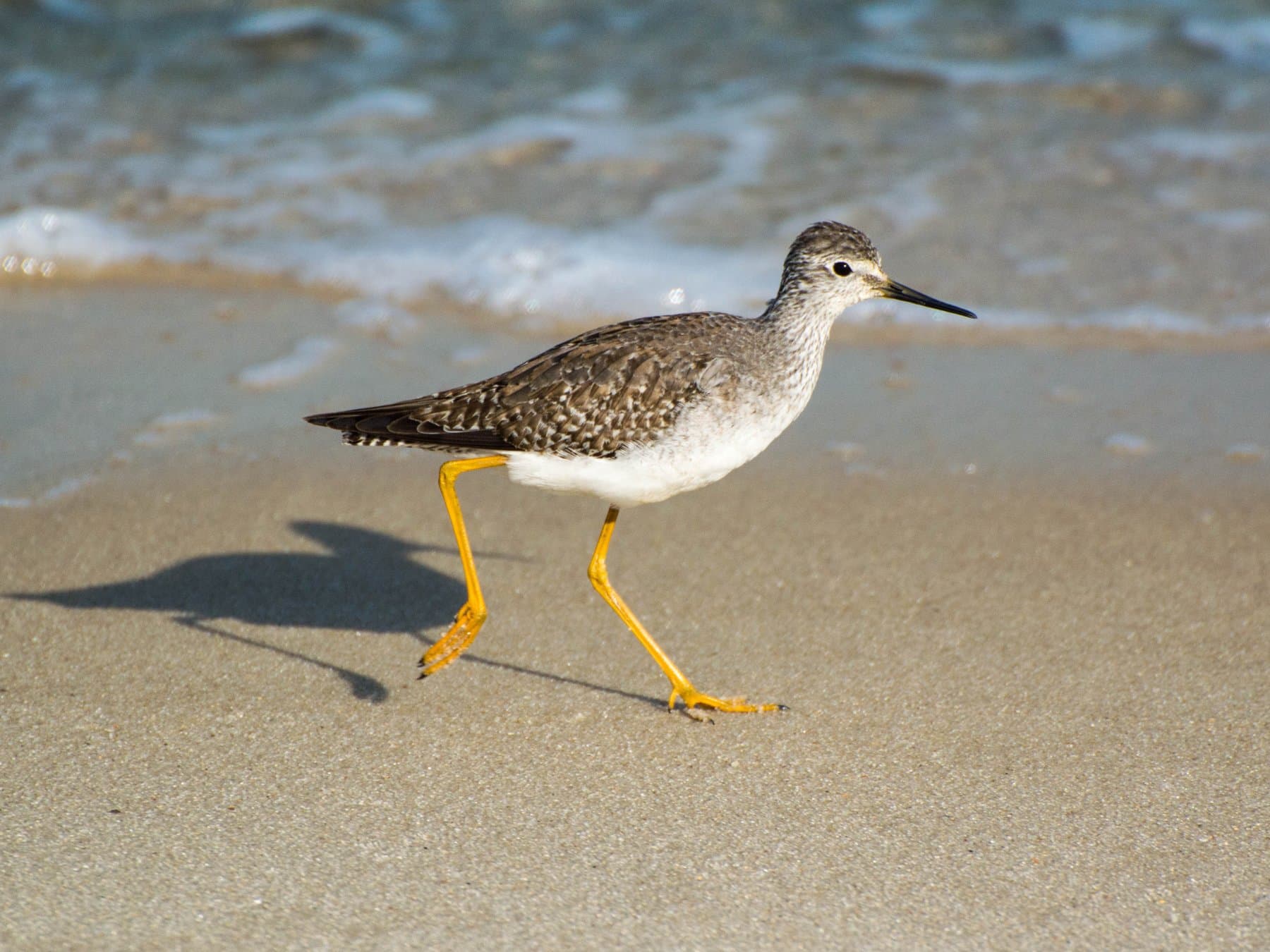
Lesser Yellowlegs
Tringa flavipes
By the Birdfact teamChecked by Nathan Cope
Vivid yellow legs flashing against mudflat and marsh, the Lesser Yellowlegs is a slender, elegant shorebird that travels up to 30,000 km each year between its boreal breeding grounds and the grasslands of South America. Despite looking almost identical to the Greater Yellowlegs, it is — surprisingly — more closely related to the much bulkier Willet. A bird that weighs about as much as a deck of cards, yet crosses the open Atlantic in a single flight.
On this page14 sections
How to recognise it
The Lesser Yellowlegs is immediately recognisable by its vivid, bright-yellow legs — a field mark that holds in every plumage, every season, and every age class. Pair those legs with a long, graceful neck, slender body, and a straight, needle-thin black bill, and you have a bird that is hard to confuse with anything other than its close lookalike, the Greater Yellowlegs.
The bill is the key to separating the two species. On the Lesser, it is roughly equal to the length of the head — straight, fine, and dagger-like. The Greater Yellowlegs has a bill about 1.5 times the head length, with a subtle upward kink near the tip. In breeding plumage, the Lesser's upperparts — back, scapulars, and wing coverts — are boldly mottled grey-brown, black, and white. The underparts are white, with brown streaking on the neck and breast and irregular blackish barring on the flanks. The head shows fine grey streaking and a white eye-ring, and the primary feathers are black.
Non-breeding (basic) plumage is considerably plainer: the upperparts become more uniform grey-brown with pale spots concentrated on the wing coverts, and the underparts are white with only fine grey streaking on the neck and breast. Juveniles resemble non-breeding adults but are browner above with more regular, profuse pale spotting — a neatly scaled appearance. First-winter birds can be told from adults by pale rather than dark notching on the tertials.
The sexes are essentially identical in plumage throughout the year. Females average slightly longer wings than males, but this difference is not visible in the field. The species is monotypic — no subspecies are recognised, and no geographic variation in appearance has been reported.
Not sure it’s a Lesser Yellowlegs? Check your photo: Birdfact names the bird and shows the look-alike side by side.
Its size
Adults- Length
- 23–27 cm
- Wingspan
- 59–64 cm
- Weight
- 67–94 g
Its song and calls
The Lesser Yellowlegs is a vocal species, and its calls are one of the most reliable ways to separate it from the Greater Yellowlegs in the field. The standard contact and flight call is a flat, whistled "tu" or "tu-tu" — sometimes rendered as "tew" or "tew-tew" — typically delivered as one or two notes. The quality is soft, falling slightly in pitch, and lacks the ringing, musical quality of the Greater Yellowlegs, which habitually calls in a louder series of three or more notes ("tew-tew-tew" or "dear-dear-dear"). If you hear a yellowlegs and count only one or two notes, the Lesser is the more likely candidate.
On the breeding grounds, males produce a sustained, melodic song during undulating display flights — a ringing vocalisation audible from some distance across open boreal terrain. This song is given repeatedly during the display, which can involve multiple males flying together over shared foraging and nesting areas. Outside the display context, alarmed birds call persistently and rapidly in succession, particularly when predators or humans approach the nest or chicks.
The species is highly responsive to auditory cues. Foraging calls attract conspecifics to productive feeding areas, and chick calls elicit an immediate and aggressive parental response — researchers have used recordings of chick calls to draw breeding adults into mist nets for ringing. Both sexes vocalise, and no significant differences between male and female calls have been reported. The species is most vocal during the breeding season and at migratory stopovers, where flocks can be numerous and persistently noisy.
- Call0:00 / 0:20
Recorded in MB, Canada · June 2010
Heard one and not sure? Let the bird song identifier listen.
When and where to see it
OctoberPeak season
Most recorded in October
- 1. Stockton-on-Tees0.67%
- 2. Lincolnshire0.26%
- 3. Aberdeenshire0.23%
- 4. Louth0.21%
- 5. Wicklow0.16%
Each dot is a county, state or province: the bigger and darker, the larger the bird’s share of that place’s bird records that month. Grey dots: no regular records. The ringed point is the centre of the bird’s records this month; the arrow shows how it moved since last month, and the dashed loop its path through the year. “Arrivals” colours places where it becomes regular this month (orange) or is in its last regular month (grey). GBIF eBird Observation Dataset, 2019–2024. Map data: Natural Earth, US Census Bureau; place centres © OpenStreetMap contributors.
In your area
See when the Lesser Yellowlegs is recorded in your county, state or province.
How often the Lesser Yellowlegs turns up in the UK, Ireland, the United States and Canada through the year, from birdwatchers' records.
United Kingdom
Resident · all year · most records in October
Ireland
Passage migrant · regularly Mar–Oct · most records in October
United States
Summer visitor · all year · most records in August
Canada
Summer visitor · regularly Apr–Oct · most records in August
Show as a table
| Month | United Kingdom | Ireland | United States | Canada |
|---|---|---|---|---|
| January | 0.005% (regular) | 0.005% | 0.041% (regular) | 0.001% |
| February | 0.005% (regular) | 0.006% | 0.041% (regular) | <0.001% |
| March | 0.004% (regular) | 0.012% (regular) | 0.065% (regular) | 0.001% |
| April | 0.005% (regular) | 0.013% | 0.20% (regular) | 0.079% (regular) |
| May | 0.003% (regular) | 0.006% (regular) | 0.13% (regular) | 0.19% (regular) |
| June | 0.002% (regular) | 0.002% | 0.022% (regular) | 0.051% (regular) |
| July | 0.010% (regular) | <0.001% | 0.15% (regular) | 0.28% (regular) |
| August | 0.002% (regular) | 0.002% | 0.36% (regular) | 0.67% (regular) |
| September | 0.006% (regular) | 0.022% (regular) | 0.21% (regular) | 0.46% (regular) |
| October | 0.017% (regular) | 0.031% (regular) | 0.11% (regular) | 0.16% (regular) |
| November | 0.004% (regular) | 0.001% | 0.052% (regular) | 0.008% |
| December | 0.003% (regular) | – | 0.037% (regular) | <0.001% |
Recorded regularly in
Worldwide: recorded regularly in 63 countries
Countries where it was recorded in at least 3 of the 6 years 2019–2024. Linked countries have their own bird list.
North America (39)
- Anguilla
- Antigua & Barbuda
- Aruba
- Bahamas
- Barbados
- Belize
- Bermuda
- British Virgin Islands
- Canada
- Caribbean Netherlands
- Cayman Islands
- Costa Rica
- Cuba
- Curaçao
- Dominican Republic
- El Salvador
- Grenada
- Guadeloupe
- Guatemala
- Haiti
- Honduras
- Jamaica
- Martinique
- Mexico
- Montserrat
- Nicaragua
- Panama
- Puerto Rico
- Sint Maarten
- St Barthélemy
- St Kitts & Nevis
- St Lucia
- St Martin
- St Pierre & Miquelon
- St Vincent & the Grenadines
- Trinidad & Tobago
- Turks & Caicos Islands
- United States
- US Virgin Islands
South America (14)
Oceania (1)
- US Outlying Islands
Data: EOD – eBird Observation Dataset (Cornell Lab of Ornithology), accessed via GBIF.org, CC BY 4.0. Records from 2019–2024, aggregated and filtered by Birdfact. How these lists are made
Tips for seeing it
The bright yellow legs are the single most reliable field mark at any distance — they are vivid enough to catch the eye before any other feature registers. Once you have the legs, check the bill: on the Lesser Yellowlegs it is straight and roughly equal to the head length, giving the bird a fine, needle-nosed profile. The Greater Yellowlegs has a noticeably longer bill with a slight upward kink, and calls in a louder, more ringing series of three or more notes — "tew-tew-tew" — compared to the Lesser's quieter one- or two-note "tu" or "tu-tu".
In the UK, late August through October is the best window for vagrant birds, with south-west England — particularly coastal wetlands in Cornwall, Devon, and Scilly — producing the most records. Inland sites are less reliable but not impossible; the Nosterfield bird in North Yorkshire demonstrated that individuals can settle for extended periods. Check any muddy-edged freshwater pool or coastal lagoon during this window, especially after westerly Atlantic weather systems that can drift transatlantic migrants off course.
In North America, the species is easiest to find during migration. Spring passage through the interior United States peaks in April and May; fall migration runs from late June (failed breeders) through September (juveniles). The Prairie Pothole Region of the Great Plains — the Dakotas, Nebraska, Kansas, and the Canadian prairies — is the single best area for large numbers. Flooded agricultural fields and shallow wetland edges are productive. The species often mixes with Dunlin, dowitchers, and other Tringa sandpipers, so scanning mixed shorebird flocks carefully is worthwhile.
In flight, look for the white rump patch and the long yellow legs projecting well beyond the tail tip — both features are visible at considerable range and help separate the species from similarly sized waders.
What it eats
Insects dominate the diet on the breeding grounds, where crane fly larvae, beetles, dragonfly nymphs, and other terrestrial and aquatic invertebrates are the primary prey. During migration and winter, the diet shifts towards aquatic invertebrates: aquatic worms, crustaceans, snails, mayflies, water boatmen, and small fish all feature regularly. Seeds are taken only occasionally.
The typical foraging method is rapid, erratic walking through very shallow water — often just a centimetre or two deep — picking at prey on or just below the surface with quick, precise bill jabs. The high-stepping gait keeps the body clear of the water while the neck stretches forward to strike. Less frequently, the bird probes into soft mud, sweeps its bill back and forth through liquid mud or water (a technique called side-sweeping), snatches flying insects in mid-air, or plucks prey from emergent vegetation.
The species forages both by day and at night. In daylight it relies primarily on vision; in darkness it switches to tactile methods, using the sensitive bill tip to detect prey by touch. During migration, Lesser Yellowlegs have been observed following other shorebirds and ducks to exploit invertebrates disturbed by those species — an opportunistic strategy that maximises energy intake at stopover sites where refuelling speed matters.
Diet selection appears to be largely driven by prey availability, though some studies have found that individuals selectively target certain prey types even when alternatives are abundant — suggesting some degree of active preference rather than purely opportunistic feeding.
Nesting and breeding
Pairs form shortly after birds arrive on the breeding grounds from late April, with most arriving by mid-May. The Lesser Yellowlegs is seasonally monogamous; pairs typically do not re-mate in subsequent years. Courtship involves males performing undulating display flights over communal foraging areas and nesting territories, often alongside rival males. At the peak of the display, the male glides with tail spread and neck craned upwards — a posture that can be seen from some distance across open boreal terrain.
Before committing to a final nest site, a pair may excavate and line up to 75 separate scrapes in the ground — a level of prospecting behaviour apparently unique among shorebirds. The final nest is a shallow depression about 10 cm across and 3.5 cm deep, typically placed next to a fallen log, branch, or low shrub, and sparsely lined with dry grass, leaves, moss, or twigs gathered nearby. Nest sites are generally drier and more densely vegetated than those of the Greater Yellowlegs, and almost always within 200 metres of water.
The clutch normally consists of four eggs (range 3–5), buff, grey-brown, or greenish in ground colour and spotted in various shades of brown. Eggs average 3.9–4.7 cm in length and 2.7–3.1 cm in width. Both parents incubate for 22–23 days, and eggs hatch within a few days of each other.
The young are precocial: downy chicks leave the nest within hours of hatching and feed themselves immediately. Both parents initially brood and guide the chicks, flying ahead to suitable foraging areas and calling the young forward. The female typically departs around 11 days after hatching, leaving the male to care for the chicks until they fledge at 22–31 days. There is one brood per season, though pairs will re-nest after a failure. Most birds first breed at age two, though some attempt breeding in their first year.
Behaviour
In flight, the Lesser Yellowlegs is buoyant and relaxed — more so than many shorebirds of similar size. The wingbeats are fluid and unhurried, giving the bird an almost tern-like ease in the air, particularly when compared to the stiffer, more mechanical flight of some larger waders. It typically flies in a straight line at moderate height, though it will jink and twist when alarmed.
The key flight features are the bold white rump patch, visible from a considerable distance, and the long yellow legs projecting well beyond the tail tip. The tail itself is white with fine dark barring. The wings appear uniformly dark above — there is no wing bar — which, combined with the white rump, creates a distinctive two-tone pattern that is easy to pick up as a bird flushes from a wetland edge.
During migration, the species travels both by day and at night, often in small, loose flocks of 3 to more than 50 birds, frequently mixed with other shorebird species. Eastern-breeding birds undertaking transoceanic Atlantic crossings must sustain flight for multiple days without landing — a feat that requires substantial pre-migratory fat deposition. On the breeding grounds, males perform undulating display flights over nesting territories, gliding with tail spread and neck craned upward at the peak of the display — a very different flight style from the purposeful direct flight used during migration.
Lifespan and predators
Precise longevity data for the Lesser Yellowlegs are limited by the challenges of tracking small migratory shorebirds across a range spanning Alaska to Argentina. Most individuals are believed to survive 3–5 years in the wild, based on survival rate estimates from banding studies, though the true upper limit of lifespan is likely higher than current records suggest.
Annual survival rates are influenced heavily by conditions encountered along the entire migratory route — not just on the breeding grounds. Hunting pressure in the Caribbean and South America, habitat quality at key stopover sites, and the energetic demands of transoceanic flights all affect survival. Juveniles making their first southward migration face the greatest risks, navigating thousands of kilometres without the benefit of prior experience.
Most birds first breed at age two, though some attempt breeding in their first year. The female's early departure from the brood — typically around 11 days after hatching — means she can begin pre-migratory fattening sooner than the male, potentially improving her survival prospects on the southward journey. The male, remaining with the chicks until fledging at 22–31 days, departs later and arrives on wintering grounds in a more depleted condition.
Conservation
The Lesser Yellowlegs was uplisted from Least Concern to Vulnerable on the IUCN Red List in 2024, as part of a broader reassessment of migratory shorebirds that revealed widespread, accelerating declines across the group. The global population is estimated at 527,000–660,000 mature individuals. The North American Breeding Bird Survey records an average annual decline of -2.36% from 1970 to 2019 — a cumulative loss of approximately 63–70% depending on the survey method. Between 2003 and 2015, surveys in Alaska recorded declines of up to 9% per year. COSEWIC listed the species as Threatened in Canada in 2020, estimating a 25% decline over three generations (12 years) based on BBS data, and greater than 50% over 10 years based on International Shorebird Surveys.
The greatest current threat is hunting. The Lesser Yellowlegs is likely the most widely hunted shorebird in the Atlantic Americas Flyway. Legal hunting continues in parts of the Caribbean — particularly Barbados, Guadeloupe, and Martinique — and in South America, where current harvest levels are considered unsustainable. Hunting in mainland North America was banned by the Migratory Bird Treaty Act in 1918, which allowed populations to partially recover from catastrophic 19th-century market hunting. That recovery is now being reversed.
Habitat loss compounds the pressure: ongoing loss of wetland and intertidal habitat in South America from agricultural expansion and shoreline development, and degradation of key stopover sites such as Quill Lakes in Saskatchewan, reduce the species' ability to refuel during migration. Climate change adds further stress through increased drought risk on breeding grounds, coastal flooding, and greater hurricane severity during fall migration. Agricultural pesticide use in the Prairie Pothole Region may also reduce food availability at critical stopover sites.
Conservation responses include the International Lesser Yellowlegs Working Group, formed under the Road to Recovery initiative, and the Western Hemisphere Shorebird Reserve Network (WHSRN). The species is designated an Orange Alert Tipping Point species in the 2025 State of the Birds report — meaning it has lost more than 50% of its population in 50 years and declines are accelerating.
Conservation History
The Lesser Yellowlegs has lived through one of the most dramatic conservation arcs of any North American shorebird — a story of near-destruction, partial recovery, and renewed decline that spans more than 150 years.
In the 19th century, the species was shot in enormous numbers by market hunters supplying game to urban restaurants and markets. Its fatal vulnerability was behavioural: rather than fleeing when a flockmate was shot, Lesser Yellowlegs would hover and circle over the fallen bird, allowing hunters to continue shooting until the entire flock was gone. By 1916, ornithologists were reporting that flocks had vanished from sites where they had been abundant in 1870.
The Migratory Bird Treaty Act of 1918 — signed between the United States and Canada — banned the hunting of shorebirds in North America and allowed populations to begin recovering over the following decades. That recovery was slow and uneven, but by the mid-20th century the species had re-established itself at many sites from which it had disappeared. It was a rare conservation success story: a bird pulled back from the brink by a single piece of legislation.
That recovery, however, was never complete. From the 1970s onwards, a new set of pressures — legal hunting in the Caribbean and South America, wetland habitat loss, and climate change — began reversing the gains. The causes this time are more diffuse and harder to address with a single treaty, which is why the species' current trajectory is proving more difficult to halt than the 19th-century crisis it survived.
Courtship & Display
Courtship begins shortly after birds arrive on the breeding grounds in late April and early May. Males perform undulating display flights over communal foraging areas and nesting territories — a looping, roller-coaster aerial display that can involve several males flying simultaneously over the same area. At the peak of each undulation, the male glides with his tail fanned and neck craned upward, producing a sustained, ringing song that carries across the open boreal landscape.
Between aerial bouts, males perch prominently on top of dead trees or snags and call loudly — a conspicuous advertisement that serves both to attract females and to warn rival males. Males guard females closely from competitors during courtship and the egg-laying period.
The nest-scrape selection process is one of the most elaborate pre-nesting behaviours documented in any shorebird. Before a final nest site is chosen, a pair may excavate and line up to 75 separate scrapes — see Nesting and Breeding for full details. This extended prospecting may allow the pair to evaluate multiple sites for predator activity, proximity to water, vegetation cover, and drainage — factors that collectively determine nest success.
Uk And European Records
The Lesser Yellowlegs is a regular autumn vagrant to the UK, with around five birds recorded each year — almost all between August and October, consistent with the southward migration of juveniles and adults from North American breeding grounds. The first confirmed British record dates to 1854–55, when a bird was shot at Misson, Nottinghamshire. For most of the 20th century, each new arrival required formal review by the British Birds Rarities Committee (BBRC). By the 2010s, records had become frequent enough that the BBRC removed the species from its national rarities list in January 2019 — a significant milestone that reflects both the species' increasing regularity and, possibly, changes in observer coverage and awareness.
Records span the entire country, but south-west England — Cornwall, Devon, and the Isles of Scilly — produces the highest concentration, particularly during and after westerly Atlantic weather systems that can carry transatlantic migrants off course. Coastal lagoons, estuaries, and freshwater pools with muddy margins are the most productive habitat types to check. Inland records are less frequent but do occur; the species occasionally settles for extended periods, as demonstrated by an individual that wintered at Nosterfield Quarry, North Yorkshire from autumn 2019 through to early 2020.
Elsewhere in Europe, the species is recorded as a vagrant across the Atlantic fringe — Ireland, Iceland, the Azores, and mainland western Europe — with occasional records from further east. Given the species' documented capacity for multi-day transoceanic flights, European vagrancy is best understood not as an accident but as a predictable consequence of the migration strategy used by eastern-breeding birds.
Quick facts
- Length
- 23–27 cm
- Wingspan
- 59–64 cm
- Weight
- 67–94 g
- Lifespan
- 3–5 years · oldest recorded 5 years
- Family
- Sandpipers & Snipes
- Migration
- Long-distance Migrant
- Global status (IUCN)
- Vulnerable
- World population
- 527,000–660,000 mature individuals
- Population trend
- Strongly decreasing. The species has experienced a cumulative decline of approximately 63–70% since the 1970s. The North American Breeding Bird Survey records an average annual decline of -2.36% from 1970–2019. Uplisted from Least Concern to Vulnerable on the IUCN Red List in 2024.
- Scientific name
- Tringa flavipes
Sources
18- 1Lesser yellowlegs - Wikipedia Source (opens in a new tab)
- 2Lesser Yellowlegs Tringa flavipes Species Factsheet | BirdLife DataZone Source (opens in a new tab)
- 32024 Red List update reveals migratory shorebirds are declining globally | BirdLife DataZone (2024) Source (opens in a new tab)
- 4Lesser Yellowlegs - eBird Source (opens in a new tab)
- 5Lesser Yellowlegs | Audubon Field Guide Source (opens in a new tab)
- 6Lesser Yellowlegs Overview, All About Birds, Cornell Lab of Ornithology Source (opens in a new tab)
- 7Lesser Yellowlegs Life History, All About Birds, Cornell Lab of Ornithology Source (opens in a new tab)
- 8Lesser Yellowlegs | BTO BirdFacts Source (opens in a new tab)
- 9Lesser Yellowlegs (Tringa flavipes) :: xeno-canto Source (opens in a new tab)
- 10Tringa flavipes (lesser yellowlegs) | Animal Diversity Web Source (opens in a new tab)
- 11Lesser yellowlegs (Tringa flavipes): COSEWIC assessment and status report 2020 (2020) Source (opens in a new tab)
- 12Why are Shorebirds Disappearing? Alaska Department of Fish and Game Source (opens in a new tab)
- 13Flyway-scale GPS tracking reveals migratory routes and key stopover and non-breeding locations of lesser yellowlegs - PMC (McDuffie et al. 2022) (2022) Source (opens in a new tab)
- 14Lesser Yellowlegs | Boreal Songbird Initiative Source (opens in a new tab)
- 15Lesser Yellowlegs - Road to Recovery Source (opens in a new tab)
- 16Lesser Yellowlegs — Historical Rare Birds Source (opens in a new tab)
- 17Happy Lesser Yellowlegs Anniversary! — Lower Ure Conservation Trust Source (opens in a new tab)
- 18Lesser Yellowlegs - Nature Canada Source (opens in a new tab)

Checked by
Nathan Cope, founder and editor
Nathan founded Birdfact and leads its writers and contributors in the UK, the US and Canada. He has watched and studied birds for more than ten years, and checks every article and species guide before it’s published.