


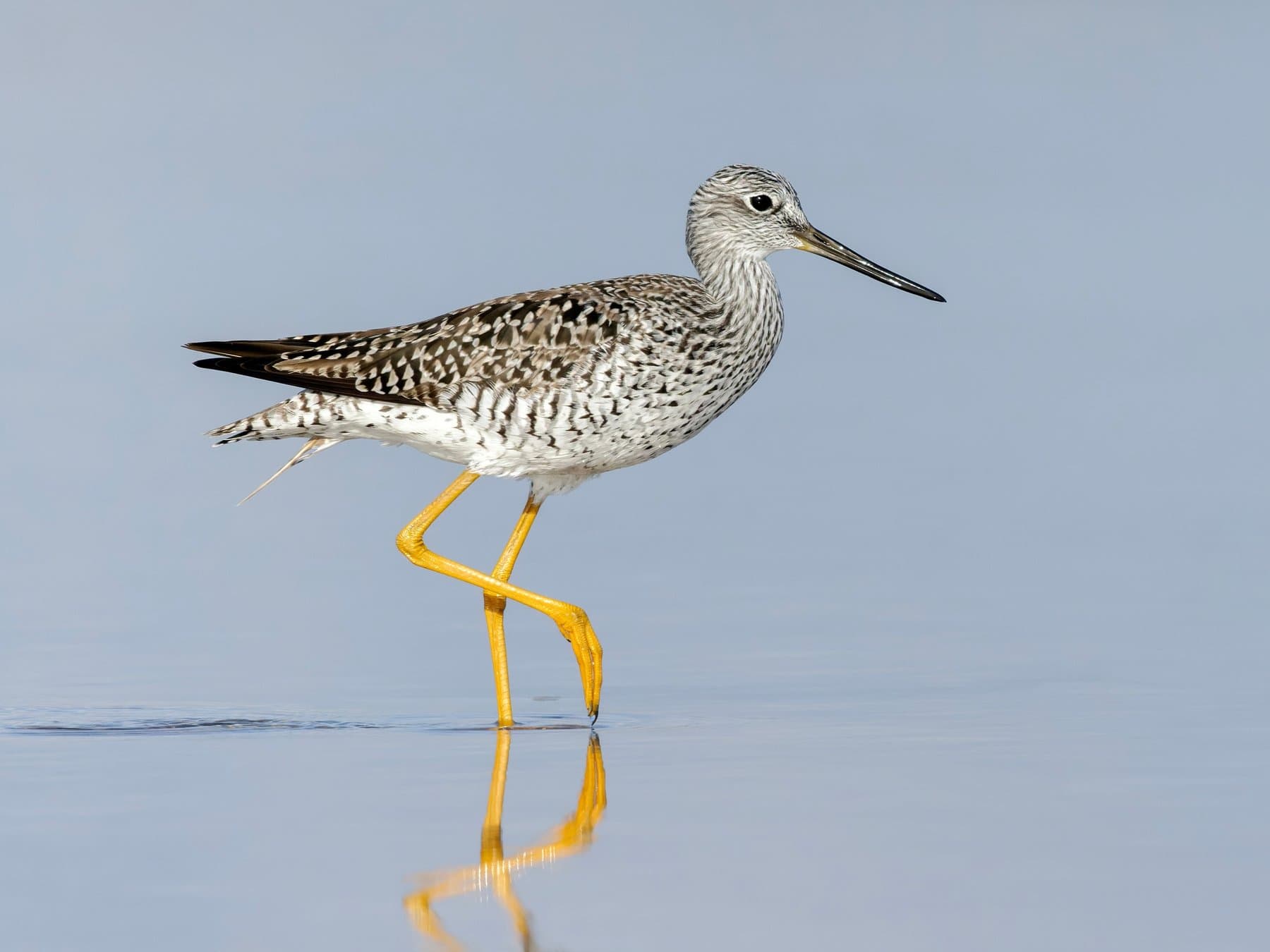
Greater Yellowlegs
Tringa melanoleuca
By the Birdfact teamChecked by Nathan Cope
Bright yellow legs, a piercing three-note whistle, and a reputation for alerting every other shorebird on the wetland to danger — the Greater Yellowlegs is hard to miss and impossible to ignore. This large, long-legged wader breeds in the remote boreal bogs of Canada and Alaska, then fans out across the Americas in one of the most extensive migrations of any North American shorebird, reaching as far south as Tierra del Fuego.
On this page13 sections
How to recognise it
Upright posture, a high-stepping gait, and legs that glow bright yellow — sometimes tinged orange in spring — set the Greater Yellowlegs apart from most other waders at a glance. Those legs are proportionately long, allowing the bird to wade in deeper water than most other sandpipers.
The bill is long, thin, and dark, measuring approximately 1.5 times the length of the head. It has a slight upward curve and is noticeably thicker at the base than that of the very similar Lesser Yellowlegs — a key distinction when the two species occur together. In breeding plumage, the bill is solidly black; in non-breeding plumage it may show a paler grey base.
Non-breeding adults are grey-brown above, mottled with dark streaks and pale spots in a loose checkerboard pattern. The underparts are white, with fine dark streaking on the neck and breast and variable barring on the flanks. A bright white eye-ring is usually visible. In breeding plumage, the pattern intensifies considerably: the breast and neck develop dense dark bands, the flanks show heavier barring that may extend across the belly, and the back and shoulders take on more extensive black markings.
Juvenile birds are browner above than adults, with crisp buff-edged feathers giving a warmer, more scaly appearance. The sexes are similar in plumage throughout the year; males average slightly larger but this is not reliably detectable in the field. In flight, the legs extend well beyond the tail — a useful feature at any distance.
Not sure it’s a Greater Yellowlegs? Check your photo: Birdfact names the bird and shows the look-alike side by side.
Its size
Adults- Length
- 29–40 cm
- Wingspan
- 60–74 cm
- Weight
- 111–250 g
Its song and calls
Few shorebirds are as vocal as the Greater Yellowlegs, and its calls are a primary identification feature. The standard alarm and flight call is a loud, clear, ringing whistle of three notes — variously rendered as "tu-tu-tu," "tew-tew-tew," "dear-dear-dear," or "whew-whew-whew" — with the third note typically slightly lower in pitch than the first two. Occasionally four notes are given. The call carries far across open wetlands and is distinctly louder, harsher, and more emphatic than the corresponding two-note call of the Lesser Yellowlegs — one of the most reliable ways to separate the two species in the field, even at long range.
On the breeding grounds, males perform a more complex song during aerial display flights: an insistent, repeated "tuu-whee tuu-whee" or a loud, ringing whistled phrase delivered while rising and falling on fluttered wings. Both sexes also give this song from the ground or from a conspicuous perch such as a spruce treetop. The species is most vocal during migration and on the breeding grounds, and noticeably quieter on the wintering grounds.
Its role as the sentinel of mixed shorebird flocks is inseparable from its voice. In a flock of thousands of birds, the Greater Yellowlegs is typically the first to call out a threat, and its alarm call triggers an immediate response from every other species present. This behaviour is so consistent that 19th-century hunters gave it the names "telltale" and "tattler" — a bird whose voice could not be silenced even when it cost the hunter his shot at other quarry.
- Song and calls0:00 / 0:36
Recorded in Newfoundland and Labrador, Canada · May 2010
- Call0:00 / 0:07
Recorded in Cotopaxi: Laguna de Limpiopungo, Ecuador · November 2003
Heard one and not sure? Let the bird song identifier listen.
When and where to see it
OctoberIn season
Most recorded in October
- 1. Newfoundland and Labrador2.0%
- 2. Saskatchewan1.6%
- 3. Prince Edward Island1.4%
- 4. Manitoba1.3%
- 5. New Brunswick1.2%
Each dot is a county, state or province: the bigger and darker, the larger the bird’s share of that place’s bird records that month. Grey dots: no regular records. The ringed point is the centre of the bird’s records this month; the arrow shows how it moved since last month, and the dashed loop its path through the year. “Arrivals” colours places where it becomes regular this month (orange) or is in its last regular month (grey). GBIF eBird Observation Dataset, 2019–2024. Map data: Natural Earth, US Census Bureau; place centres © OpenStreetMap contributors.
In your area
See when the Greater Yellowlegs is recorded in your county, state or province.
How often the Greater Yellowlegs turns up in the United States and Canada through the year, from birdwatchers' records.
United States
Resident · all year · most records in August
Canada
Summer visitor · regularly Jan–Nov · most records in September
Show as a table
| Month | United States | Canada |
|---|---|---|
| January | 0.20% (regular) | 0.036% (regular) |
| February | 0.17% (regular) | 0.032% (regular) |
| March | 0.18% (regular) | 0.044% (regular) |
| April | 0.30% (regular) | 0.24% (regular) |
| May | 0.13% (regular) | 0.18% (regular) |
| June | 0.038% (regular) | 0.058% (regular) |
| July | 0.19% (regular) | 0.26% (regular) |
| August | 0.39% (regular) | 0.63% (regular) |
| September | 0.32% (regular) | 0.63% (regular) |
| October | 0.31% (regular) | 0.49% (regular) |
| November | 0.29% (regular) | 0.16% (regular) |
| December | 0.20% (regular) | 0.031% |
Worldwide: recorded regularly in 54 countries
Countries where it was recorded in at least 3 of the 6 years 2019–2024. Linked countries have their own bird list.
Europe (1)
North America (40)
- Anguilla
- Antigua & Barbuda
- Aruba
- Bahamas
- Barbados
- Belize
- Bermuda
- British Virgin Islands
- Canada
- Caribbean Netherlands
- Cayman Islands
- Costa Rica
- Cuba
- Curaçao
- Dominica
- Dominican Republic
- El Salvador
- Grenada
- Guadeloupe
- Guatemala
- Haiti
- Honduras
- Jamaica
- Martinique
- Mexico
- Montserrat
- Nicaragua
- Panama
- Puerto Rico
- Sint Maarten
- St Barthélemy
- St Kitts & Nevis
- St Lucia
- St Martin
- St Pierre & Miquelon
- St Vincent & the Grenadines
- Trinidad & Tobago
- Turks & Caicos Islands
- United States
- US Virgin Islands
Data: EOD – eBird Observation Dataset (Cornell Lab of Ornithology), accessed via GBIF.org, CC BY 4.0. Records from 2019–2024, aggregated and filtered by Birdfact. How these lists are made
Tips for seeing it
During migration — which runs from late June all the way through mid-November in autumn — the Greater Yellowlegs is one of the most reliably encountered shorebirds across North America. Tidal flats, freshwater marshes, flooded agricultural fields, sewage lagoons, and lake shores are all productive habitats. The species tends to favour slightly deeper water than other shorebirds, so scan the margins of pools where the water is ankle-deep rather than the bare mud edges where smaller sandpipers congregate.
The call is the single most useful identification tool. A loud, clear, three-note whistle — "tu-tu-tu" or "tew-tew-tew" — delivered with the third note slightly lower in pitch is the classic Greater Yellowlegs alarm call. The Lesser Yellowlegs gives a softer, two-note call. Bill length is the key visual distinction: the Greater's bill is noticeably longer than its head (roughly 1.5× head length) and slightly upturned, while the Lesser's bill barely exceeds head length and is straight. Body size helps too — the Greater is roughly 50% larger — but this is only obvious when both species are side by side.
In the UK, any yellowlegs sighting is a notable event. Check coastal wetlands and inland reservoirs in autumn and winter, particularly after Atlantic weather systems that can drift transatlantic vagrants eastward. Sites in Norfolk, Suffolk, and Cornwall have produced records. Spring migration in North America peaks in March and April, when the Greater Yellowlegs typically arrives two or more weeks ahead of the Lesser — a useful timing clue when only one species is present.
What it eats
The Greater Yellowlegs is an opportunistic predator whose diet shifts considerably between seasons. On the breeding grounds, insects and their larvae dominate — the boreal summer produces an abundance of midges, mosquitoes, beetles, and other invertebrates that the species exploits heavily. During migration and winter, the diet broadens to include small fish such as killifish and minnows, crustaceans, snails, tadpoles, frogs, marine worms, and a wide range of aquatic invertebrates. Seeds and berries are occasionally taken.
Its primary foraging technique is a swift, stabbing lunge at prey visible at or near the water surface. The bird's long legs allow it to wade in water deep enough to reach prey that smaller shorebirds cannot access. When fish are present, the Greater Yellowlegs becomes noticeably animated, running through the shallows with neck outstretched and bill angled forward, herding prey into corners before striking.
It also employs a bill-sweeping technique — walking forward while moving the bill tip back and forth through the water — to disturb and capture invertebrates hiding in soft substrate. This method is used less frequently than by the Lesser Yellowlegs, and the Greater tends to rely more on visual detection of prey. Foraging takes place mainly during daylight hours, with birds roosting communally at night, often alongside other shorebird species on exposed mudflats or in dense marsh vegetation.
Nesting and breeding
Greater Yellowlegs arrive on their boreal breeding grounds from late April to May, with pairs forming shortly after arrival. The nest is a simple shallow depression in moss or peat, typically placed at the base of a short coniferous tree, under a low shrub, or beside a moss hummock. It is sparsely lined with grass, leaves, lichen, and twigs, measuring approximately 15 cm across with an inner cup around 2.5 cm deep.
The clutch consists of 3–4 eggs, almost always 4, which are buff to grey-brown in colour and blotched with grey and dark brown markings. Eggs average 49 mm in length and 33 mm in breadth, weighing approximately 28 g each. Both parents are believed to share incubation duties over approximately 23 days. The young are precocial and downy at hatching; they leave the nest within a few hours and begin self-feeding almost immediately.
Both parents tend the chicks and react aggressively to predators, using distraction displays to draw intruders away from the brood. The young are capable of fluttering flight at approximately 25 days and strong, sustained flight by 35–40 days. Only one brood is raised per season. Breeding concludes by late July, and adults — particularly females — begin moving south remarkably early, with some departing the breeding grounds as early as late June.
Behaviour
In flight, the Greater Yellowlegs is immediately recognisable by its long yellow legs trailing well beyond the tail — a feature visible at considerable distance. The white rump patch is prominent and conspicuous, contrasting sharply with the dark back and uniformly dark wings. The tail is white with fine dark barring. Unlike many shorebirds, the Greater Yellowlegs shows no wing bar, making the plain, dark upperwing a useful negative field mark.
The flight style is strong and direct, with fairly deep, fluid wingbeats. When flushed, the bird typically rises steeply and calls loudly before settling again — often circling back over the same area, a habit that made it a predictable target for 19th-century hunters. On migration, birds travel both by day and night, and radio-tracking has revealed that individuals can sustain long overwater or overland flights without stopping.
The wing shape is long and pointed, suited to sustained travel over large distances. When coming in to land, the bird holds its wings raised briefly above the body — a characteristic posture shared with several other Tringa sandpipers including the Common Greenshank. At close range, the size difference between Greater and Lesser Yellowlegs is apparent in flight, with the Greater appearing noticeably bulkier and longer-winged.
Lifespan and predators
Precise lifespan data for the Greater Yellowlegs are poorly documented, largely because its remote breeding habitat and dispersed wintering range make long-term individual monitoring difficult. No specific maximum longevity record has been identified in the published literature. The BTO notes that survival data for this vagrant species are not routinely collected in the UK. Based on comparable Tringa sandpipers of similar size — such as the Common Greenshank, which has been recorded living beyond 10 years — it is reasonable to expect that Greater Yellowlegs can live for at least a decade under favourable conditions.
Mortality causes include predation at all stages of the life cycle, with nest predation a significant factor on the breeding grounds. Adults use distraction displays to protect chicks, but ground nests remain vulnerable to foxes, corvids, and mustelids. During migration, birds face exhaustion, adverse weather, and collision risks. Hunting in parts of the Caribbean and South America represents an ongoing and poorly quantified source of adult mortality. Some individuals — particularly immatures — appear to carry significant parasite loads that prevent them from completing northward migration, leading to oversummering on the wintering grounds in coastal South America.
Conservation
The Greater Yellowlegs is listed as Near Threatened on the IUCN Red List — a status it was uplisted to in 2016 from Least Concern. The global population is estimated at approximately 140,000 individuals (Partners in Flight; Audubon), making it one of the rarer shorebirds in North America despite its apparent abundance during migration. The 2025 State of the Birds report designated it an Orange Alert Tipping Point species, meaning it has lost more than 50% of its global population over the past 50 years and has shown accelerated declines within the past decade. Partners in Flight rates it 14 out of 20 on the Continental Concern Score.
Wetland habitat loss and degradation on the wintering grounds is the primary current threat. The species uses dispersed wetland habitats rather than concentrating at a few key sites, which provides some resilience but makes population monitoring difficult.
Climate change threatens both boreal breeding habitat and wetland availability on wintering grounds. The attrition of small, temporary wetlands used as migration stopover sites — driven by intensive agriculture — is an additional pressure.
Hunting played a major historical role in population decline. Before the Migratory Bird Treaty Act of 1918, Greater Yellowlegs were heavily shot as game birds; some hunters took hundreds in a single season, and the species' habit of circling back after being flushed made it an easy target. Populations recovered following legal protection in North America. Today, hunting in mainland North America is prohibited. In parts of the Caribbean and South America, however, thousands of migrating shorebirds — including Greater Yellowlegs — are still shot annually, largely without regulation, representing an ongoing and poorly quantified mortality source.
Similar Species
Separating the yellowlegs from each other is one of the classic shorebird identification challenges — and the two species frequently occur together during migration, removing the luxury of memory comparison. Size is the most obvious difference between the Lesser Yellowlegs (Tringa flavipes) and the Greater: the Greater is roughly 50% larger. But this is only useful when both species are present for direct comparison. Bill length is the most reliable single-bird distinction: the Greater's bill is approximately 1.5 times the length of its head and has a slight upward curve, while the Lesser's bill barely exceeds head length and is straight and needle-fine. The Greater's bill is also noticeably thicker at the base. The call clinches identification at any distance: three loud, emphatic notes from the Greater versus two softer notes from the Lesser.
The Common Greenshank (Tringa nebularia) is the Greater Yellowlegs' closest relative and shares several features: a long, slightly upturned bill, a bold white rump in flight, and a coarse dark breast pattern in breeding plumage. The Greenshank's legs are greenish-grey rather than yellow, and its call — a ringing "tew-tew-tew" — is similar enough to cause confusion. In Europe, the Greenshank is the default large Tringa wader; any bird with bright yellow legs should trigger immediate scrutiny.
The Willet is larger and stockier, with a thick straight bill and grey legs, and shows a bold black-and-white wing pattern in flight that immediately separates it. The Spotted Redshank (Tringa erythropus) has red legs and a drooped bill tip, and lacks the yellow leg colour entirely.
Courtship & Display
The Greater Yellowlegs performs one of the more elaborate courtship displays of any North American shorebird, though it takes place in such remote habitat that it is rarely observed. Males begin displaying shortly after arriving on the breeding grounds in late April or May. The aerial display is the centrepiece: the male rises steeply into the air above the bog, then alternately rises and falls with a series of flutters and long glides. All the while he delivers a loud, ringing, repeated song — audible from a considerable distance across the open muskeg. The display flight can last several minutes.
On the ground, the courting male runs in circles around the female, pausing to pose with wings raised above the body — a posture that displays the white underwing and rump. Mating follows if the female is receptive.
Pairs are presumed to be monogamous for the season, though the remote nature of the breeding habitat means long-term pair fidelity has not been confirmed. Both sexes are believed to share incubation duties, and both attend the chicks after hatching, reacting aggressively to any intruder that approaches the nest or brood.
The species' habit of perching atop spruce trees — unusual for a ground-nesting shorebird — is most pronounced during the breeding season, when adults use elevated vantage points to scan for approaching predators. This tree-perching behaviour, combined with the elaborate aerial song flight, gives the Greater Yellowlegs a distinctly un-wader-like quality on its breeding grounds.
Quick facts
- Length
- 29–40 cm
- Wingspan
- 60–74 cm
- Weight
- 111–250 g
- Lifespan
- 7–10 years
- Family
- Sandpipers & Snipes
- Migration
- Long-distance Migrant
- Global status (IUCN)
- Near Threatened
- World population
- ~140,000 individuals
- Population trend
- Declining; designated an Orange Alert Tipping Point species by the 2025 State of the Birds report, having lost more than 50% of its global population over the past 50 years.
- Scientific name
- Tringa melanoleuca
Sources
16- 1Greater yellowlegs - Wikipedia Source (opens in a new tab)
- 2Greater Yellowlegs Tringa melanoleuca Species Factsheet | BirdLife DataZone Source (opens in a new tab)
- 3Greater Yellowlegs Overview, All About Birds, Cornell Lab of Ornithology Source (opens in a new tab)
- 4Greater Yellowlegs Identification, All About Birds, Cornell Lab of Ornithology Source (opens in a new tab)
- 5Greater Yellowlegs Life History, All About Birds, Cornell Lab of Ornithology Source (opens in a new tab)
- 6Greater Yellowlegs | Audubon Field Guide Source (opens in a new tab)
- 7Greater Yellowlegs - eBird Source (opens in a new tab)
- 8Greater Yellowlegs | BTO BirdFacts Source (opens in a new tab)
- 9Greater yellowlegs — Grokipedia Source (opens in a new tab)
- 10Greater Yellowlegs - BirdWeb (Seattle Audubon) Source (opens in a new tab)
- 11Manitoba Breeding Bird Atlas - Greater Yellowlegs Source (opens in a new tab)
- 12Greater Yellowlegs - NH Audubon State of the Birds Source (opens in a new tab)
- 13A Mellow Tu-Tu-Tu Can Only Mean One Thing | PenBay Pilot Source (opens in a new tab)
- 14Greater Yellowlegs | Missouri Department of Conservation Source (opens in a new tab)
- 15Greater Yellowlegs - Northeast Birder Source (opens in a new tab)
- 16Greater Yellowlegs (Tringa melanoleuca) :: xeno-canto Source (opens in a new tab)

Checked by
Nathan Cope, founder and editor
Nathan founded Birdfact and leads its writers and contributors in the UK, the US and Canada. He has watched and studied birds for more than ten years, and checks every article and species guide before it’s published.