
Willet
Tringa semipalmata
By the Birdfact teamChecked by Nathan Cope
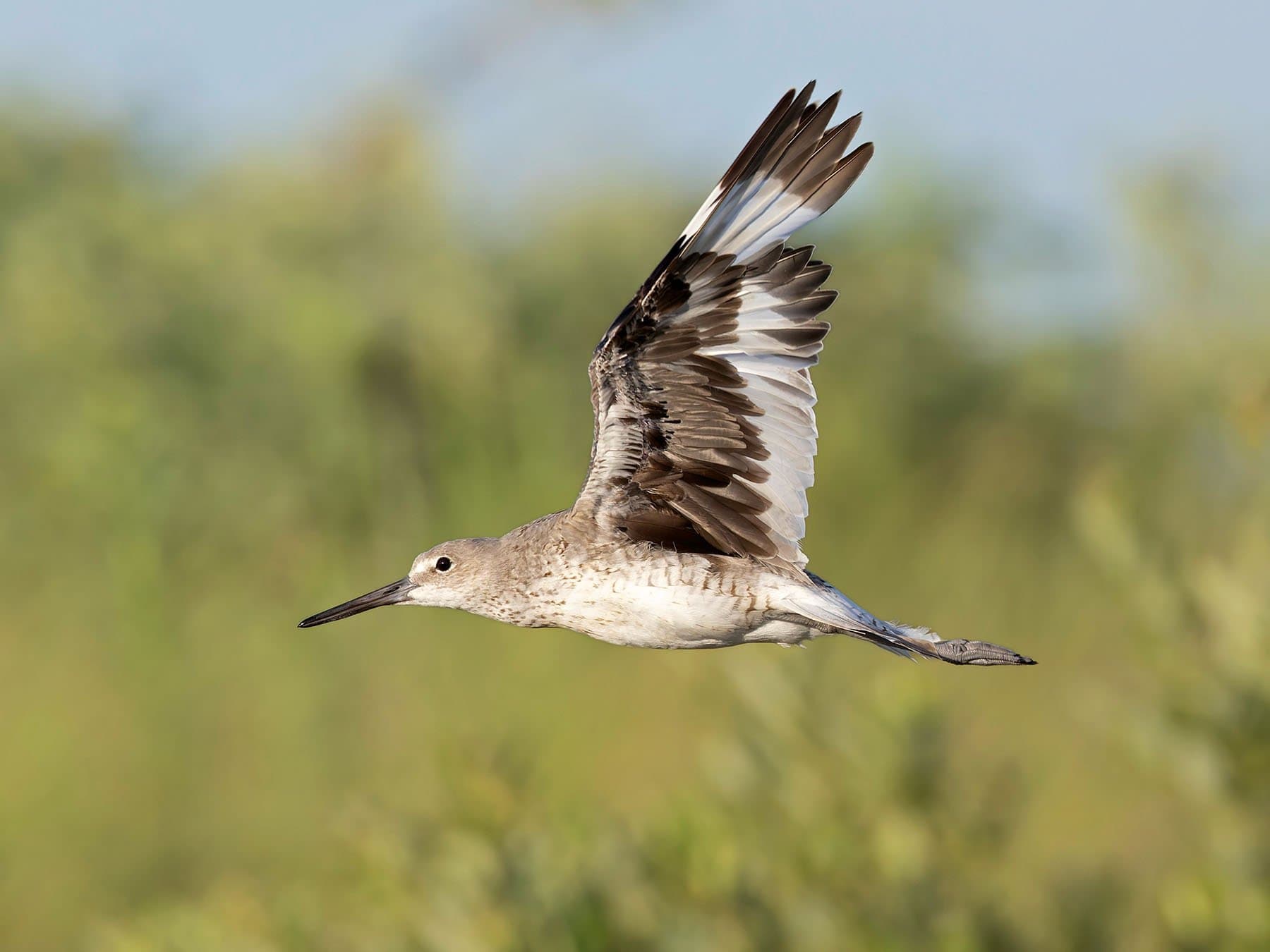
Stand at the edge of a salt marsh in spring and you may hear it before you see it — a ringing, far-carrying pill-will-willet that gives this large shorebird its name. On the ground the Willet looks unremarkable, a stocky grey-brown wader with a heavy bill and long bluish-grey legs. Take flight, though, and a bold, broad black-and-white wing stripe blazes the full length of each wing — one of the most dramatic field marks of any North American shorebird.
On this page14 sections
How to recognise it
The Willet is the largest member of the genus Tringa, with a pigeon-sized body set on long, bluish-grey legs. At rest it is a study in understatement — grey-brown above, white below, with a straight, heavy bill noticeably longer than the head. The bill is dark with a paler greyish or brownish base, and a narrow whitish eye ring combined with a white area above the lores gives the face a faintly spectacled look. The toes are slightly webbed, a feature encoded in the scientific name semipalmata (Latin for 'half-palmed'), which also allows the bird to swim when necessary.
In flight, the Willet becomes unmistakable. A broad, bold black-and-white wing stripe runs the full length of each wing — black primary coverts contrasting sharply with white secondaries — making it one of the most eye-catching field marks of any North American shorebird. The white rump is also conspicuous as the bird banks away.
Plumage changes substantially with the seasons. In breeding dress (spring and early summer), the upperparts become heavily mottled and barred with brown and black, and the breast and flanks carry bold dark barring. Non-breeding birds are considerably plainer: uniform grey-brown above and clean white below, with little patterning. Juveniles resemble non-breeding adults but show buff-edged feathers on the back, creating a scaly appearance.
Two subspecies differ noticeably in size and tone. The Eastern Willet (T. s. semipalmata) is smaller, darker, and browner, with a stouter, shorter bill and heavier barring in breeding plumage. The Western Willet (T. s. inornata) is approximately 10% larger, with legs and bill around 15% longer, and is paler and greyer overall — giving it a more godwit-like silhouette in the field. The sexes are similar in plumage in both subspecies, though females are slightly larger than males.
Not sure it’s a Willet? Check your photo: Birdfact names the bird and shows the look-alike side by side.
Its size
Adults- Length
- 33–41 cm
- Wingspan
- 66–70 cm
- Weight
- 200–330 g
Its song and calls
The Willet's name is onomatopoeic — it is named directly after its own voice. The loud, ringing territorial song, a repeated pill-will-willet (sometimes rendered as will-will-willet), carries far across salt marshes and beaches and is one of the most evocative sounds of the North American coast in spring. Both sexes give this call, but it is most frequent from males on the breeding grounds, often delivered in flight with wings held stiffly and downcurved.
The two subspecies sound subtly different: Eastern Willets give a higher-pitched call repeated at a faster rate than Western birds. The difference is too fine for most human ears to detect reliably, but the birds themselves perceive it clearly — playback experiments show that individuals respond significantly more strongly to recordings of their own subspecies than to those of the other. This vocal divergence, combined with differences in size, plumage, and breeding habitat, underpins the ongoing scientific debate about whether the two forms should be treated as separate species.
Other vocalisations include a staccato kleep given as a predator-response call by breeding birds; a high, anxious kip-kip-viek alarm call used by non-breeding birds; a kreei contact call; and a klay-dir used when crossing another Willet's territory and during migration. A quieter kuk-kuk-kuk-kuk is also noted. Males produce a quiet click-click sound during pre-copulatory displays. Xeno-canto hosts over 171 foreground recordings of the species, reflecting how frequently and conspicuously Willets vocalise throughout the year.
- Call0:00 / 1:51
Recorded in Nova Scotia, Canada · July 2024
Heard one and not sure? Let the bird song identifier listen.
When and where to see it
OctoberLeaving
Most recorded in October
- 1. Mississippi0.66%
- 2. South Carolina0.49%
- 3. Alabama0.43%
- 4. Florida0.40%
- 5. California0.36%
Each dot is a county, state or province: the bigger and darker, the larger the bird’s share of that place’s bird records that month. Grey dots: no regular records. The ringed point is the centre of the bird’s records this month; the arrow shows how it moved since last month, and the dashed loop its path through the year. “Arrivals” colours places where it becomes regular this month (orange) or is in its last regular month (grey). GBIF eBird Observation Dataset, 2019–2024. Map data: Natural Earth, US Census Bureau; place centres © OpenStreetMap contributors.
In your area
See when the Willet is recorded in your county, state or province.
How often the Willet turns up in the United States and Canada through the year, from birdwatchers' records.
United States
Resident · all year · most records in August
Canada
Summer visitor · regularly Apr–Sep · most records in July
Show as a table
| Month | United States | Canada |
|---|---|---|
| January | 0.16% (regular) | 0.003% |
| February | 0.14% (regular) | 0.002% |
| March | 0.12% (regular) | <0.001% |
| April | 0.16% (regular) | 0.020% (regular) |
| May | 0.12% (regular) | 0.091% (regular) |
| June | 0.14% (regular) | 0.10% (regular) |
| July | 0.18% (regular) | 0.11% (regular) |
| August | 0.20% (regular) | 0.074% (regular) |
| September | 0.13% (regular) | 0.018% (regular) |
| October | 0.12% (regular) | 0.003% |
| November | 0.16% (regular) | 0.002% |
| December | 0.15% (regular) | 0.002% |
Worldwide: recorded regularly in 44 countries
Countries where it was recorded in at least 3 of the 6 years 2019–2024. Linked countries have their own bird list.
North America (35)
- Anguilla
- Antigua & Barbuda
- Aruba
- Bahamas
- Barbados
- Belize
- Bermuda
- British Virgin Islands
- Canada
- Caribbean Netherlands
- Cayman Islands
- Costa Rica
- Cuba
- Curaçao
- Dominican Republic
- El Salvador
- Grenada
- Guadeloupe
- Guatemala
- Haiti
- Honduras
- Jamaica
- Martinique
- Mexico
- Nicaragua
- Panama
- Puerto Rico
- St Kitts & Nevis
- St Martin
- St Pierre & Miquelon
- St Vincent & the Grenadines
- Trinidad & Tobago
- Turks & Caicos Islands
- United States
- US Virgin Islands
Data: EOD – eBird Observation Dataset (Cornell Lab of Ornithology), accessed via GBIF.org, CC BY 4.0. Records from 2019–2024, aggregated and filtered by Birdfact. How these lists are made
Tips for seeing it
The Willet's bold black-and-white wing stripe is the single most reliable field mark — even a distant bird flushing from a beach reveals it instantly. At rest, look for the large, stocky build, heavy straight bill, and long bluish-grey legs that set it apart from smaller sandpipers. In breeding plumage (April–July), the heavily barred breast and mottled back are distinctive; in winter, the plain grey-brown upperparts and clean white underparts can suggest a godwit at first glance, particularly in the larger Western subspecies.
Along the US Atlantic Coast, Willets are present year-round on the Gulf Coast and from spring through autumn on the Mid-Atlantic and New England coasts. The best months for seeing breeding birds in salt marshes are May and June, when males are actively calling and displaying. Both subspecies occur together along the Atlantic Coast during autumn migration (July–October), offering a rare chance to compare the smaller, darker Eastern bird with the larger, paler Western bird side by side.
On the Pacific Coast, Western Willets are common on beaches and mudflats from autumn through spring, with numbers peaking October–March. Bolinas Lagoon, Morro Bay, and Elkhorn Slough in California are reliable sites. Inland, look for Western Willets on prairie wetlands in the Dakotas, Nebraska, and Montana from May through July.
Listen for the loud, ringing 'pill-will-willet' call — it carries far across open marsh and is often the first indication of the bird's presence. Willets are vocal and alert, frequently calling when flushed, which makes them easy to locate even in dense vegetation. Dawn and dusk on the breeding grounds, when males are most actively singing, offer the best acoustic experience.
What it eats
Fiddler crabs are the signature prey of coastal Willets. Along the Atlantic and Gulf coasts, Eastern Willets target several species — including Minuca minax, Minuca pugnax, and Leptuca pugilator — along with mole crabs (Emerita talpoida), marine worms, clams, mussels, whelks, amphipods, and small molluscs. Their foraging method is flexible: steady walking and pecking from the surface, deep probing into soft mud or silt, and active stalking of larger prey in shallow water.
The sensitive, nerve-rich bill tip allows Willets to detect buried prey by touch — a technique called rhynchokinesis — which is why they can feed effectively at night and during overcast conditions when visual foragers struggle. Tidal cycles drive much of their daily activity; birds follow the receding tide onto exposed mudflats and return to roost as water rises.
Western Willets on their freshwater breeding grounds eat a very different menu: aquatic insects including water scavenger beetles (Hydrophilidae), diving beetles (Dytiscidae), and snout beetles (Curculionidae), as well as spiders and small fish (Cypriniformes). In winter, western birds shift back to coastal prey — shore crabs (Hemigrapsus), brachyuran crabs, nereid worms, and mussels. Both subspecies occasionally take plant material including grass shoots and seeds, particularly when invertebrate prey is scarce.
Nesting and breeding
Willets breed from May through July, with mating occurring in May and early June. They are monogamous, and pairs often remain together for several years — in eastern populations, bonds may persist for life, while in western populations mate fidelity runs at around 65%. Males perform aerial courtship displays, flying with wings held high above the head and fluttering the primary feathers while delivering the ringing 'pill-will-willet' call. The female flies to the male and hovers beneath him as both sing; the pair then slowly descends to the ground together in a coordinated spiral.
The male leads the female through the territory and creates several trial nest scrapes for her to evaluate. The chosen nest is a shallow depression scraped out using feet and breast. It is placed typically on the ground among dense short grass, in cordgrass or saltgrass (eastern birds), or on bare ground or raised sites near water (western birds). The female lines the cup with surrounding vegetation, finer grasses, and sometimes pebbles or shell fragments, producing a finished nest approximately 15 cm across and 5 cm deep.
Clutch size is typically four eggs (rarely three or five), laid over approximately six days. Eggs are olive-buff to greyish with bold, irregular dark brown spots, measuring roughly 4.9–6.2 cm long by 3.4–4.0 cm wide. Incubation lasts 22–29 days, averaging 25 days, and is shared by both parents — with one notable division of labour: only the male incubates at night, and sometimes during midday, while the female takes other shifts.
Chicks are precocial — eyes open, covered in buff or grey down, and able to walk and peck at vegetation within hours of hatching. They leave the nest within one to two days and find their own food from the outset. The female departs the nest site entirely two to three weeks after hatching, leaving the male to complete chick-rearing alone until the young fledge at approximately four weeks of age. Willets raise one brood per year and often nest in loose colonies, particularly along the Atlantic Coast.
Behaviour
In flight, the Willet undergoes a transformation. The broad, bold black-and-white wing stripe blazes the full length of each wing, and combined with the white rump and white tail sides, the pattern is so striking that even a brief glimpse of a flushing bird is enough for a confident identification. No other large North American shorebird shows a comparable wing pattern.
The wingbeats are strong and fairly rapid for a bird of this size, with a slightly stiff, direct quality on longer flights. On shorter hops between feeding areas, Willets often fly low over the water or marsh surface. Willets migrate at night, typically in small groups, and generally fly at low altitudes of less than 150 metres.
The wingspan of 66–70 cm gives the bird a broad-winged, powerful silhouette that can briefly suggest a small gull or godwit before the wing pattern resolves. Western Willets, being approximately 10% larger than eastern birds, appear noticeably more godwit-like in the air, with longer wings and a more attenuated rear end. During territorial flights on the breeding grounds, males hold the wings stiffly and downcurved while delivering the ringing 'pill-will-willet' call — for the full courtship display that precedes this, see the courtship and display section.
Lifespan and predators
Willets are relatively long-lived for shorebirds of their size. The typical lifespan in the wild runs from around five to ten years, and the oldest recorded individual — a banded bird — reached at least ten years and three months. Annual survival rates in adults are estimated at 76–98%, a wide range that reflects variation between years and populations but indicates that most adults that survive their first year have a good chance of reaching breeding age and beyond.
Both males and females can breed as early as their second year, though first-year birds often do not attempt to nest. Mortality causes include predation by hawks, falcons, herring gulls, snakes, otters, crows, ravens, foxes, and raccoons — with eggs and chicks particularly vulnerable to mammalian predators at ground-level nests. Adults are most at risk from aerial predators, particularly during migration when they are moving through unfamiliar areas at night.
Compared to the closely related Wood Sandpiper, which has a recorded maximum of around 11.7 years, the Willet's longevity is broadly similar. The combination of high adult survival, strong mate fidelity, and a precocial chick strategy gives the species a resilient life-history profile. However, the low reproductive rate — one brood per year, four eggs maximum — means sustained habitat loss or elevated adult mortality can quickly tip populations into decline.
Conservation
The Willet is listed as Least Concern on the IUCN Red List, with a global population estimated at around 250,000 individuals. That headline figure, however, masks a worrying trajectory. Breeding Bird Survey data show an overall decline of approximately 1.9% annually across the eastern region, and the species appeared on the 2014 State of the Birds Watch List as at risk of becoming threatened or endangered without conservation action. It has also been added to the US Fish & Wildlife Service conservation watch list.
The threats are numerous. Coastal development on breeding, stopover, and wintering grounds reduces available habitat, while the invasive reed Phragmites australis replaces the native salt marsh grasses that eastern Willets depend on for nesting. Mosquito ditching, marsh draining, and coastal armoring (sea walls and revetments) reduce both willet abundance and the macroinvertebrate prey communities they rely on. Contaminants accumulating in coastal sediments, avian botulism outbreaks, and collisions with power lines built through wetland breeding sites add further pressure. Western birds face conversion of native grasslands and prairie wetlands to agriculture.
Climate change poses perhaps the most acute long-term threat. A study in Chesapeake Bay projected that Willet populations could decline by nearly 80% with a sea level rise of 3.3–6.6 feet by 2100. This is a stark figure: all of the species' salt marsh nesting habitat sits only inches above current sea level. The eastern subspecies is ranked Highly Vulnerable to climate change along the Atlantic Coast, creating a significant gap between its current Least Concern IUCN category and its real-world vulnerability.
Conservation History
The Willet's story is one of near-extirpation followed by slow, hard-won recovery. By the late 19th century, the eastern population had been devastated by market hunting. Willets were shot in enormous numbers for food and for the millinery trade, and their large size and conspicuous behaviour made them easy targets. John James Audubon had already noted in the 1840s that Willets 'historically' bred near New Bedford, Massachusetts — a sign that the decline was already well advanced by the time systematic records began. A Field & Stream article in 1904 profiled the Willet as a game bird even as the author admitted they had 'rapidly decreased.' By 1910, the species had been virtually extirpated from its entire range north of Virginia.
The Migratory Bird Treaty Act of 1918, which banned the commercial hunting of migratory birds in the United States, was the turning point. With hunting pressure removed, Willets began the slow process of recolonising their former range — but recovery was measured in decades, not years. They reappeared in New Jersey in the 1950s, New York in the 1960s, Maine, Massachusetts, and Connecticut in the 1970s, and New Hampshire and Rhode Island only in the 1980s. The full recolonisation of the historic range took more than 60 years.
Today the eastern population faces a new set of threats that the Migratory Bird Treaty Act cannot address: sea level rise, invasive Phragmites, coastal development, and contaminant accumulation. The species' recovery from hunting is a genuine conservation success story, but it also illustrates how quickly a widespread bird can be pushed to the brink — and how long the road back can be.
Courtship & Display
Willet courtship is an aerial affair. The male takes to the air above his territory, holding his wings high above his back and fluttering the primary feathers in a slow, exaggerated wingbeat while delivering the ringing 'pill-will-willet' call repeatedly. This display flight is conspicuous and loud, designed to advertise both territory ownership and fitness to prospective mates.
When a female is attracted, she flies to the displaying male and hovers directly beneath him as both birds sing together. The pair then descends slowly to the ground in a coordinated spiral — a behaviour that cements the pair bond and signals readiness to begin nesting. Once on the ground, the male leads the female through the territory, showing her several trial nest scrapes he has prepared in advance. The female evaluates these options and selects the site she prefers, after which she takes the lead in lining the chosen scrape with vegetation.
Males also make a quiet 'click-click' sound during pre-copulatory displays on the ground. Pair bonds, once formed, are strong: eastern birds may remain bonded for life, while western birds show mate fidelity rates of around 65% between seasons. The broken-wing distraction display — used by both sexes when a predator approaches the nest — is equally theatrical. The adult drags a wing along the ground, calling loudly to draw the threat away from eggs or chicks, before suddenly 'recovering' and flying off once the danger has passed.
Subspecies Comparison
The question of whether Eastern and Western Willets are one species or two has occupied ornithologists for decades, and the evidence increasingly favours a split. The two forms differ in size, plumage, breeding habitat, vocalisation, and migratory behaviour — and they have very little overlap in their annual ranges, a pattern consistent with separate species rather than subspecies.
In size, the Western Willet (T. s. inornata) is approximately 10% larger overall, with legs and bill around 15% longer than the Eastern bird (T. s. semipalmata). In the field, this gives the Western bird a more attenuated, godwit-like silhouette, while the Eastern bird appears stockier and shorter-billed. In breeding plumage, the Eastern bird is darker and browner with heavier barring on the breast and back; the Western bird is paler and greyer, with finer, less contrasting markings.
The vocal differences, though subtle to human ears, are biologically significant. Eastern birds give a higher-pitched, faster 'pill-will-willet' than Western birds, and playback experiments confirm that individuals respond more strongly to recordings of their own form. Breeding habitats are entirely different — coastal salt marshes for the east, inland prairie wetlands for the west. The two forms also winter on opposite coasts of the Americas: eastern birds head to the Caribbean and South America, while western birds move to the Pacific coast. The American Ornithological Society has not yet formally split the two, but the case is considered strong by many authorities, and a split may be forthcoming.
Quick facts
- Length
- 33–41 cm
- Wingspan
- 66–70 cm
- Weight
- 200–330 g
- Lifespan
- 5–10 years · oldest recorded 12 years
- Family
- Sandpipers & Snipes
- Migration
- Partial migrant
- Global status (IUCN)
- Least Concern
- World population
- Approximately 250,000 individuals
- Population trend
- Decreasing. Breeding Bird Survey data show an overall decline of approximately 1.9% annually across the eastern region. The species appeared on the 2014 State of the Birds Watch List and has been added to the US Fish & Wildlife Service conservation watch list.
- Scientific name
- Tringa semipalmata
Sources
15- 1Willet - Wikipedia Source (opens in a new tab)
- 2Willet Tringa semipalmata Species Factsheet - BirdLife DataZone Source (opens in a new tab)
- 3Willet - eBird, Cornell Lab of Ornithology Source (opens in a new tab)
- 4Willet | Audubon Field Guide Source (opens in a new tab)
- 5Willet Overview - All About Birds, Cornell Lab of Ornithology Source (opens in a new tab)
- 6Willet Life History - All About Birds, Cornell Lab of Ornithology Source (opens in a new tab)
- 7Willet Identification - All About Birds, Cornell Lab of Ornithology Source (opens in a new tab)
- 8Catoptrophorus semipalmatus (willet) - Animal Diversity Web Source (opens in a new tab)
- 9Conservation Success Story: Willet - Smithsonian's National Zoo Source (opens in a new tab)
- 10Willet | Climate Action Tool Source (opens in a new tab)
- 11Bird of the Month: Willet - NH Audubon Source (opens in a new tab)
- 12Willet - Chesapeake Bay Field Guide Source (opens in a new tab)
- 13Tringa semipalmata (Willet) - Avibase Source (opens in a new tab)
- 14Willet (Tringa semipalmata) - Xeno-canto Source (opens in a new tab)
- 15Willet - NatureWorks (NH PBS) Source (opens in a new tab)

Checked by
Nathan Cope, founder and editor
Nathan founded Birdfact and leads its writers and contributors in the UK, the US and Canada. He has watched and studied birds for more than ten years, and checks every article and species guide before it’s published.