


Gadwall
Gray Duck · Mareca strepera
By the Birdfact teamChecked by Nathan Cope
On this page14 sections
How to recognise it
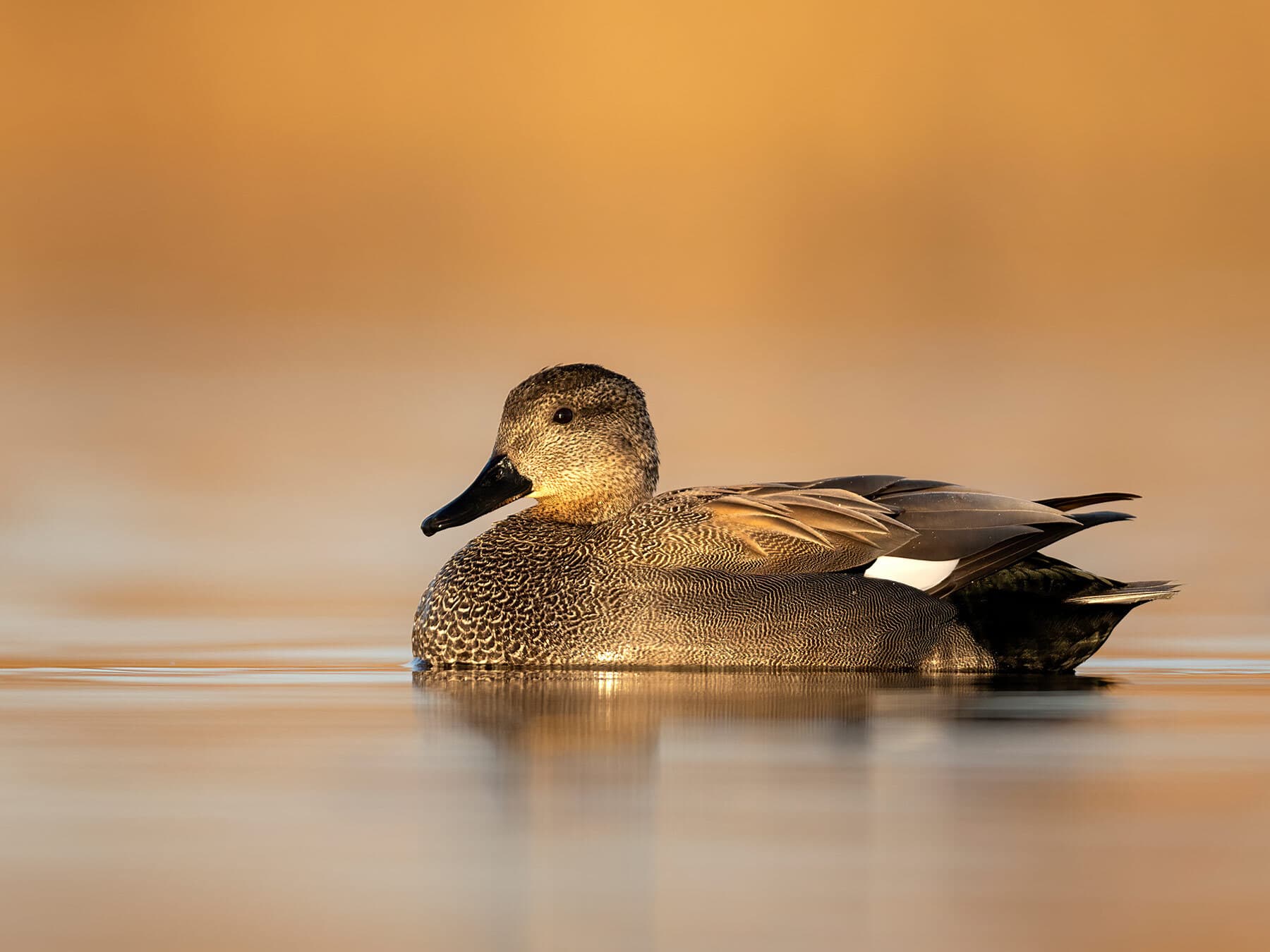
Gadwalls are strongly migratory, heading south from their northern breeding grounds to parts of Central America, south Asia, and northeast Africa. Slightly smaller than a Mallard, Gadwalls are primarily gray, and the male finely banded. Females are predominantly brown, similar to a female Mallard.
Appearance & Identification
What does a Gadwall look like?
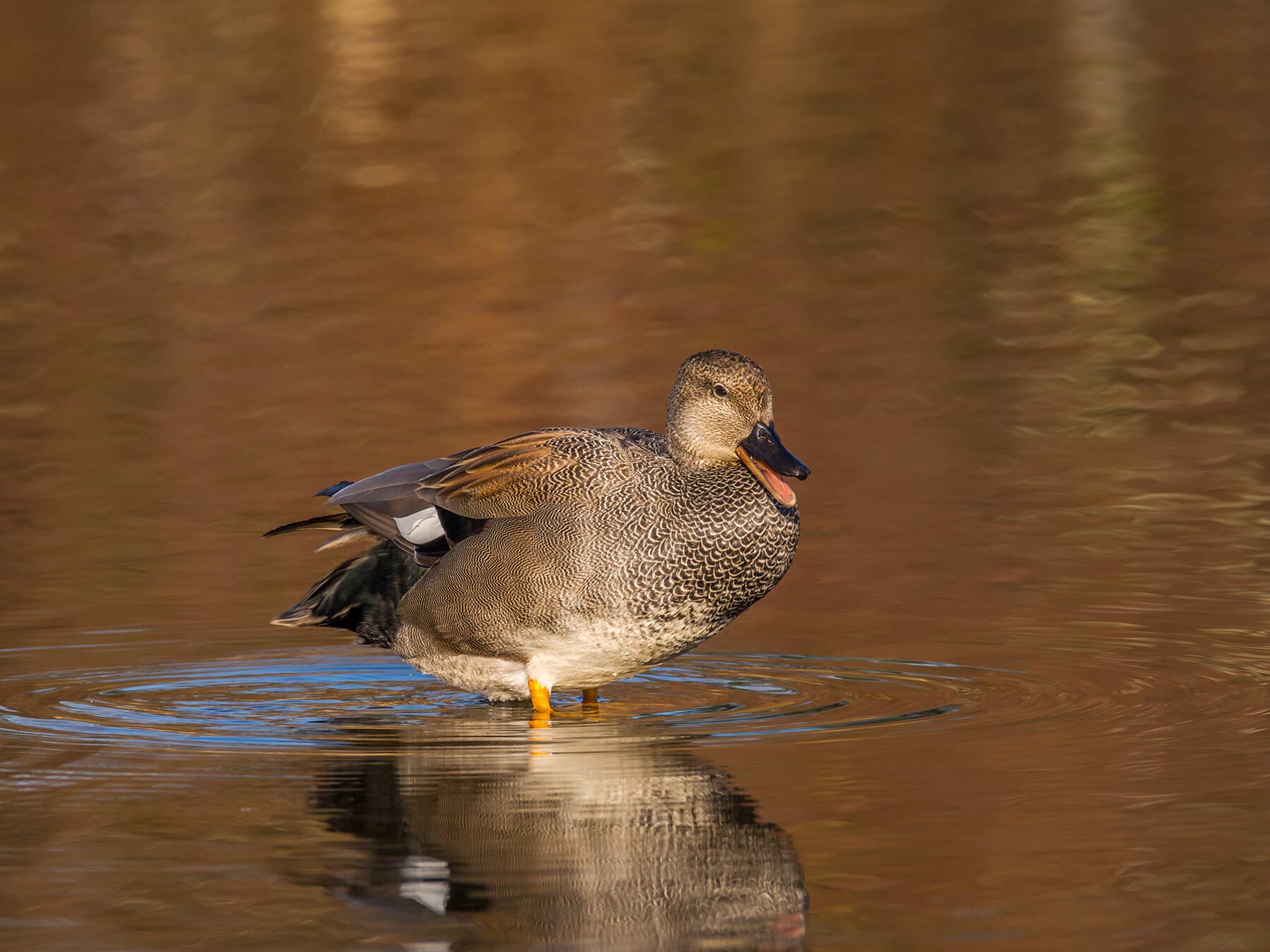
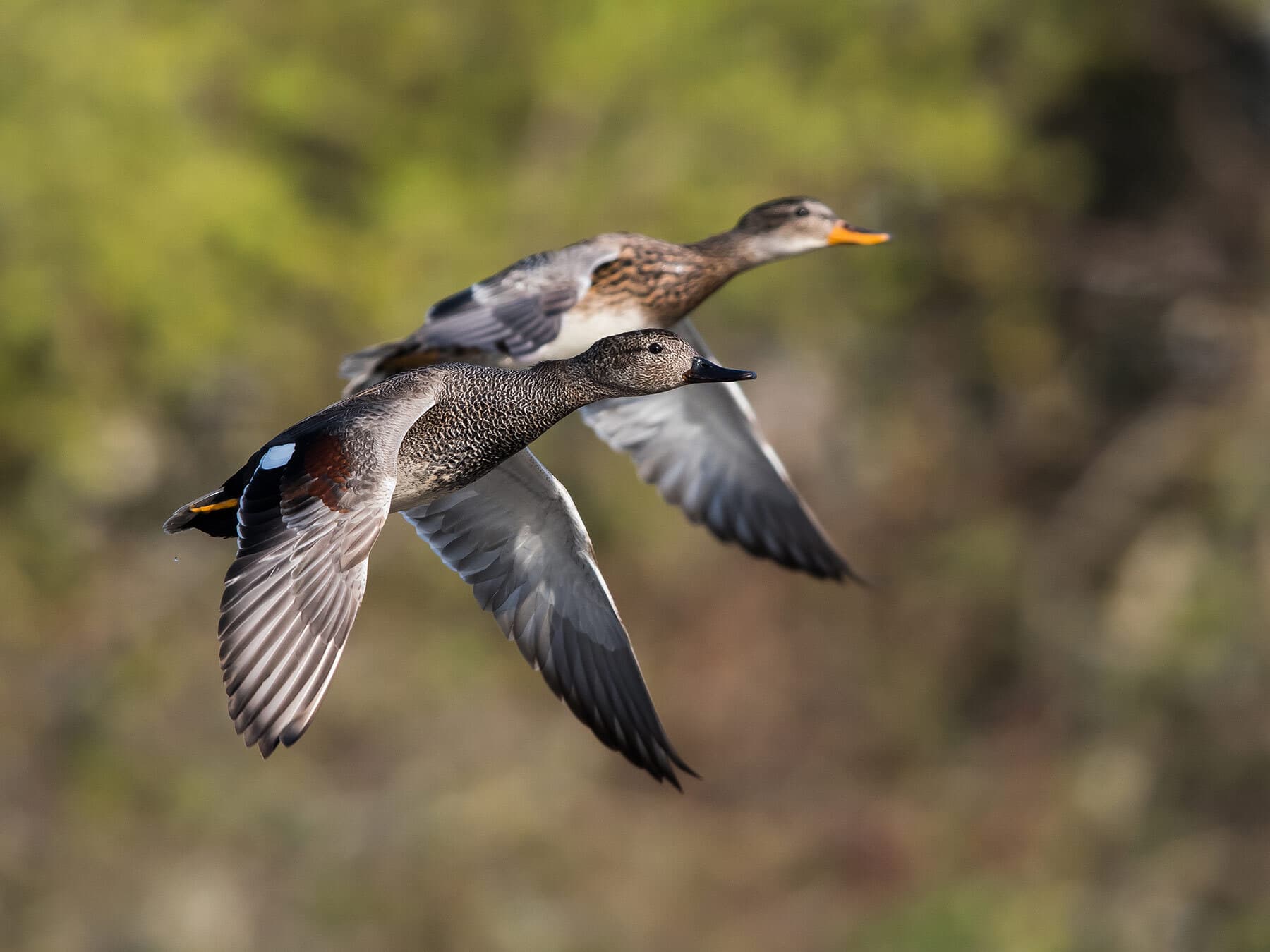
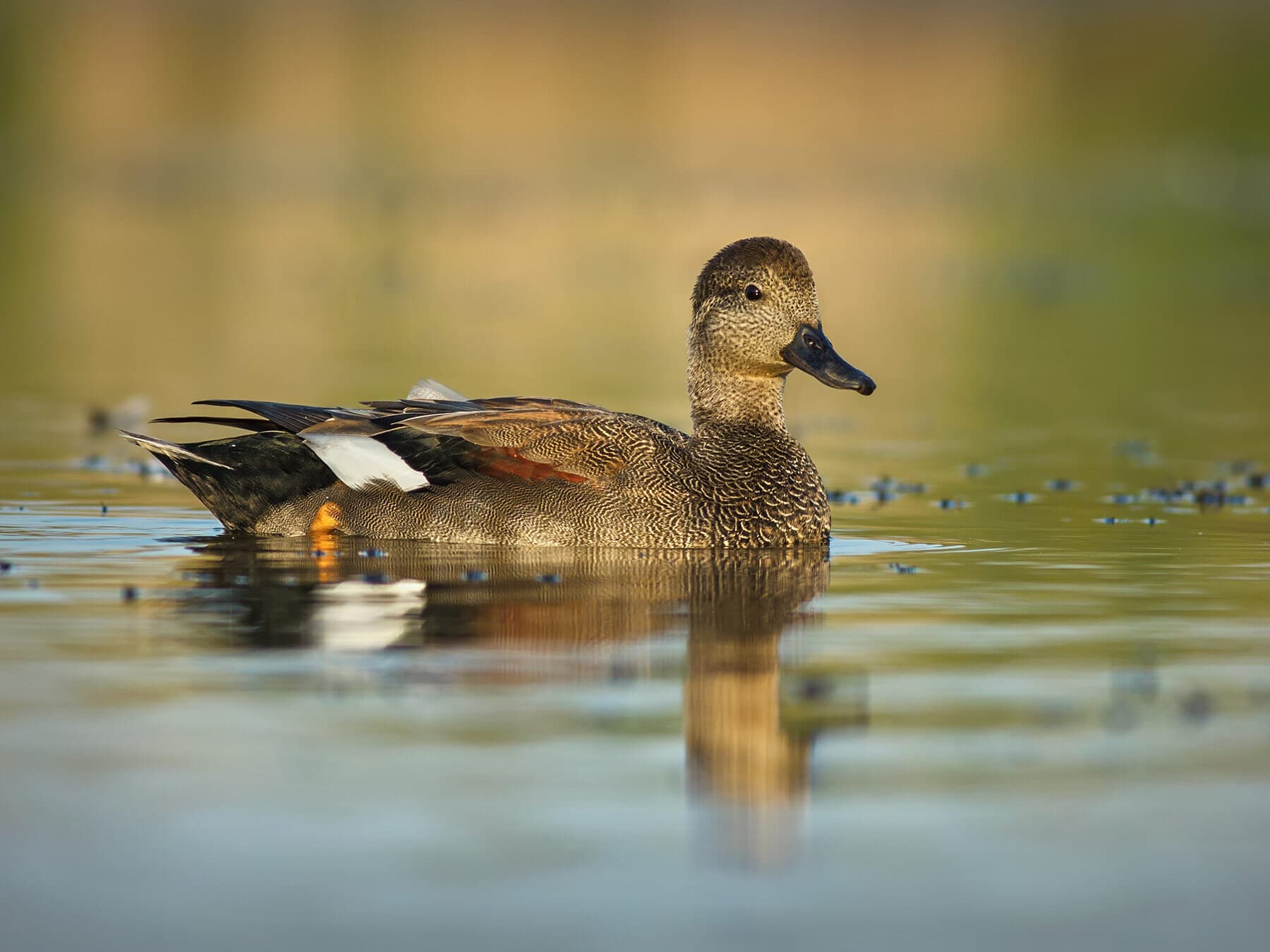
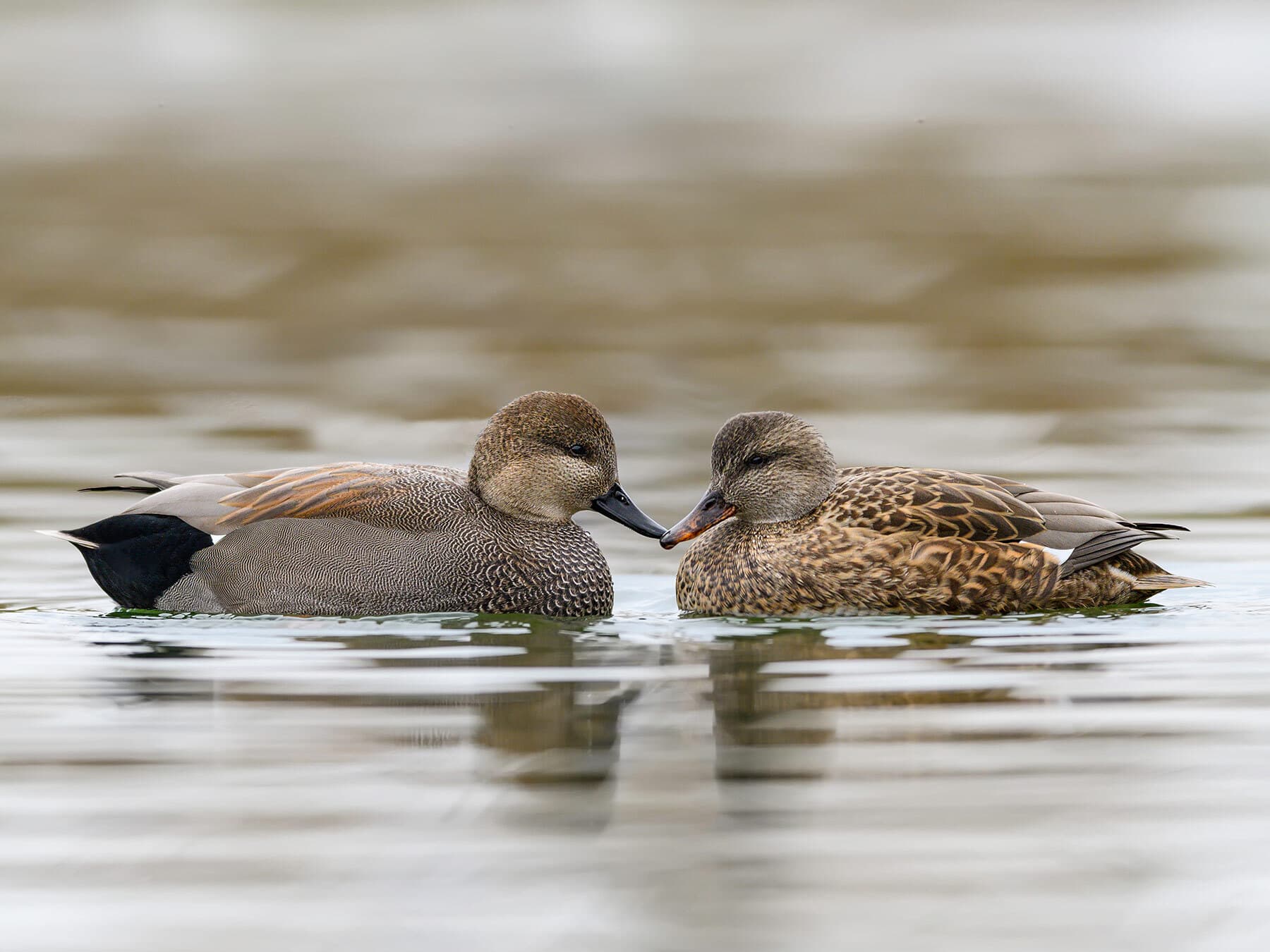
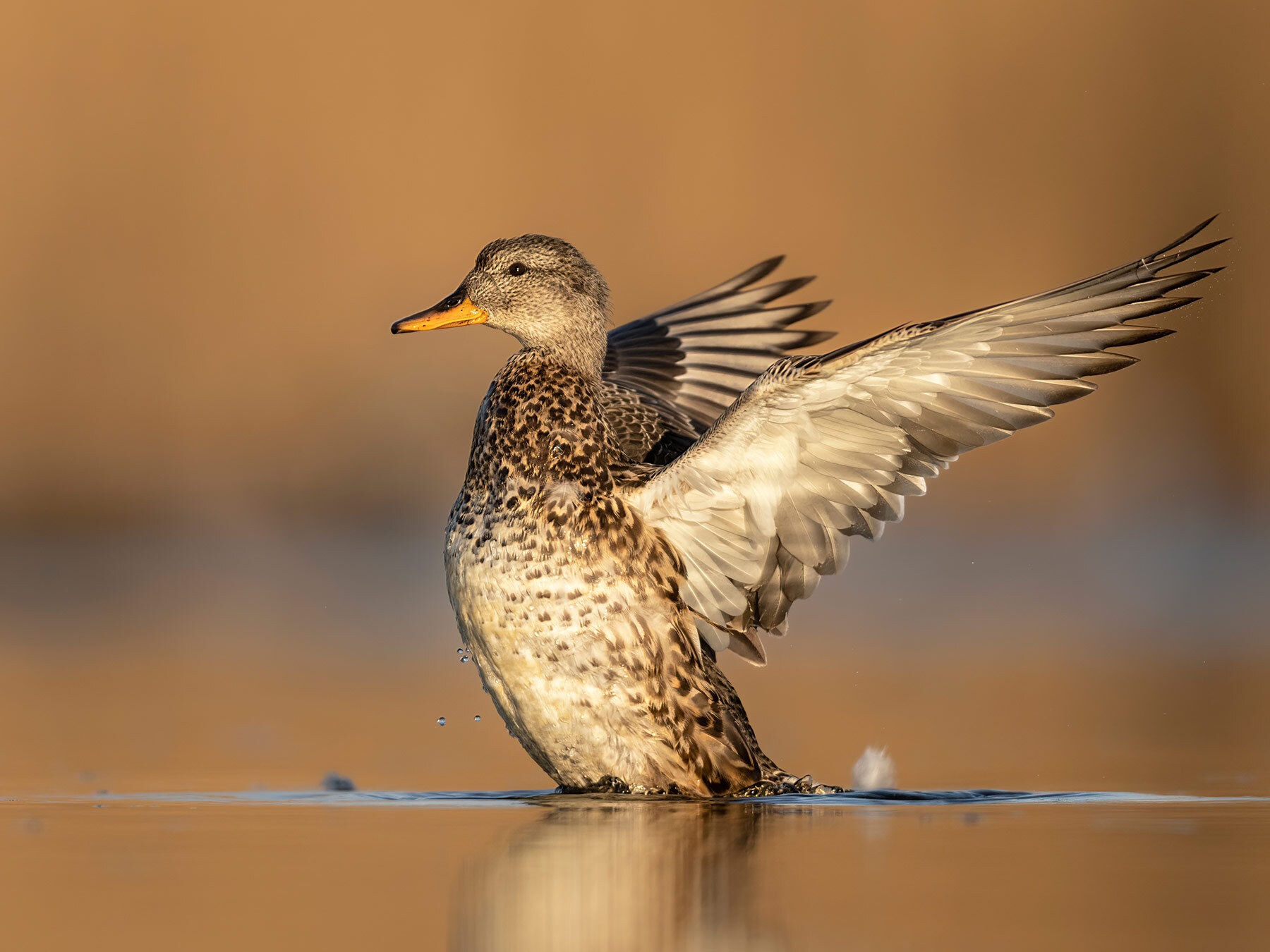
Gadwalls are medium-sized dabbling ducks. From a distance, the female looks similar to other female dabbling ducks, e.g., Mallards. Males are gray overall, but closer inspection reveals finely striped and banded plumage which covers the bird's neck, chest, and back.
Both males and females have a distinctive bill color that helps identify them from other ducks (orange-yellow with a black stripe and lateral spots).
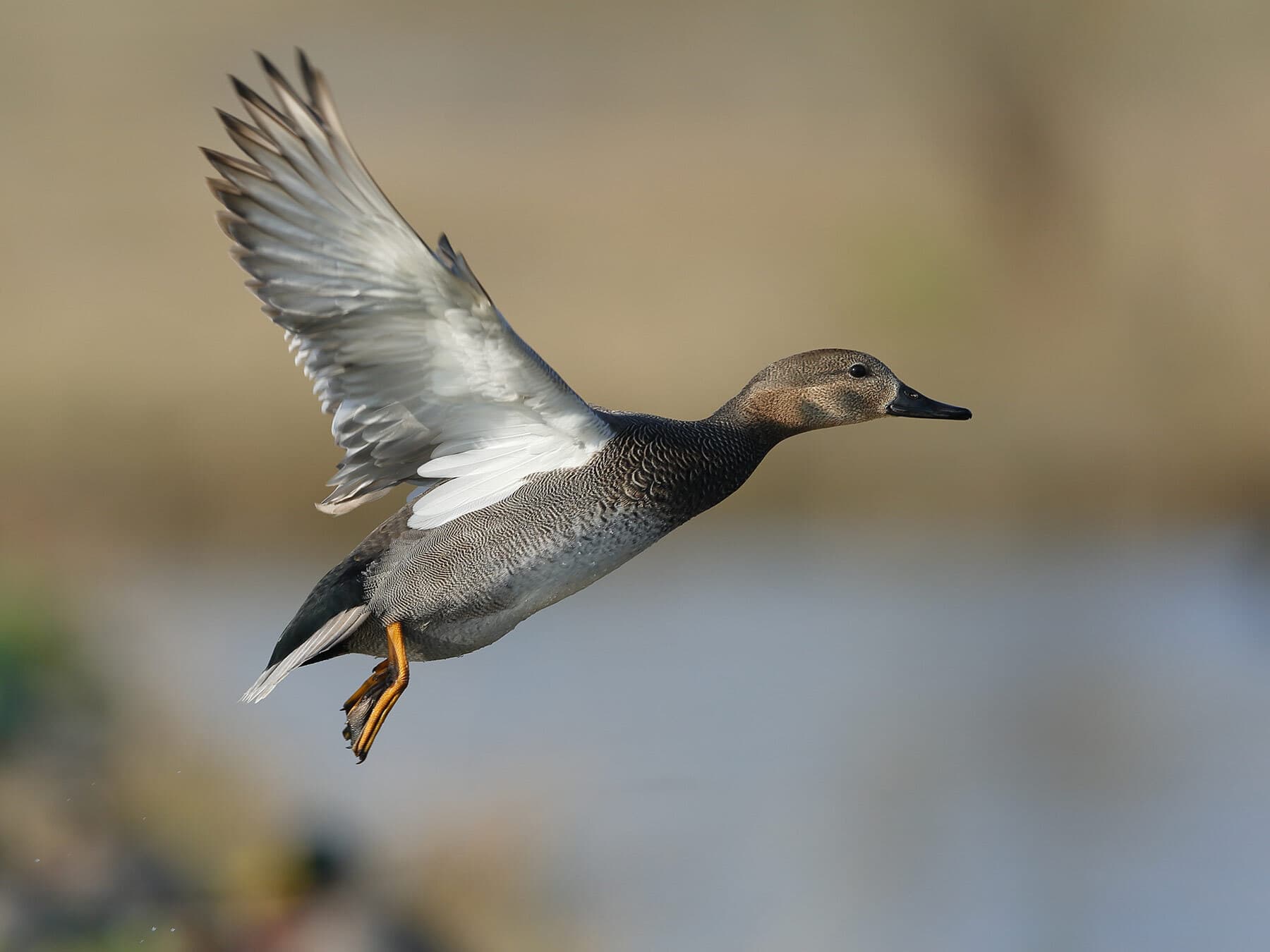
Gadwalls also feature a white section across their rear feathers, distinguishing them from other dabbling ducks (the white feather is not in the same position as the Mallard).
How big are Gadwalls?
Gadwalls measure 47 to 58cm (19 to 23in) long with a wingspan of 78 to 85 cm (31 to 33in). The male is slightly heavier than the female, weighing an average 990g (36oz), and the female weighs 850g (30oz).
Its size
Adults- Length
- 46–56 cm
- Wingspan
- 84–95 cm
- Weight
- 650–1000 g
Its song and calls
What does a Gadwall sound like?
Gadwalls do sing as such, and their vocalizations are generally described as calls. The male possesses a wide variety of calls, most of which are rasping and croaky, sometimes reedy. The male also whistles.
The female’s main call is a largely nondescript quack, higher-pitched than other dabbling ducks like Mallards.
Both the male and female have a quiet tickety-tickety-tickety call for feeding.
- Song0:00 / 0:40
Recorded in Normandie, France · May 2022
- Call0:00 / 0:23
Recorded in Bretagne, France · February 2026
When and where to see it
OctoberIn season
Most recorded in October
- 1. Stockton-on-Tees2.2%
- 2. Rutland1.7%
- 3. Warwickshire1.6%
- 4. South Yorkshire1.6%
- 5. Nottinghamshire1.5%
Each dot is a county, state or province: the bigger and darker, the larger the bird’s share of that place’s bird records that month. Grey dots: no regular records. The ringed point is the centre of the bird’s records this month; the arrow shows how it moved since last month, and the dashed loop its path through the year. “Arrivals” colours places where it becomes regular this month (orange) or is in its last regular month (grey). GBIF eBird Observation Dataset, 2019–2024. Map data: Natural Earth, US Census Bureau; place centres © OpenStreetMap contributors.
In your area
See when the Gadwall is recorded in your county, state or province.
How often the Gadwall turns up in the UK, Ireland, the United States and Canada through the year, from birdwatchers' records.
United Kingdom
Resident · all year · most records in January
Ireland
Resident · all year · most records in January
United States
Resident · all year · most records in January
Canada
Resident · all year · most records in November
Show as a table
| Month | United Kingdom | Ireland | United States | Canada |
|---|---|---|---|---|
| January | 0.80% (regular) | 0.24% (regular) | 0.52% (regular) | 0.37% (regular) |
| February | 0.77% (regular) | 0.20% (regular) | 0.46% (regular) | 0.30% (regular) |
| March | 0.78% (regular) | 0.23% (regular) | 0.50% (regular) | 0.41% (regular) |
| April | 0.80% (regular) | 0.20% (regular) | 0.31% (regular) | 0.44% (regular) |
| May | 0.75% (regular) | 0.17% (regular) | 0.17% (regular) | 0.37% (regular) |
| June | 0.52% (regular) | 0.088% (regular) | 0.14% (regular) | 0.31% (regular) |
| July | 0.44% (regular) | 0.058% (regular) | 0.084% (regular) | 0.17% (regular) |
| August | 0.64% (regular) | 0.10% (regular) | 0.095% (regular) | 0.18% (regular) |
| September | 0.70% (regular) | 0.18% (regular) | 0.13% (regular) | 0.28% (regular) |
| October | 0.65% (regular) | 0.18% (regular) | 0.29% (regular) | 0.44% (regular) |
| November | 0.73% (regular) | 0.22% (regular) | 0.51% (regular) | 0.46% (regular) |
| December | 0.76% (regular) | 0.20% (regular) | 0.46% (regular) | 0.35% (regular) |
Recorded regularly in
Worldwide: recorded regularly in 86 countries
Countries where it was recorded in at least 3 of the 6 years 2019–2024. Linked countries have their own bird list.
Europe (43)
- Åland Islands
- Albania
- Austria
- Belarus
- Belgium
- Bosnia & Herzegovina
- Bulgaria
- Croatia
- Czechia
- Denmark
- Estonia
- Faroe Islands
- Finland
- France
- Germany
- Greece
- Hungary
- Iceland
- Ireland
- Isle of Man
- Italy
- Jersey
- Kosovo
- Latvia
- Lithuania
- Luxembourg
- Malta
- Moldova
- Netherlands
- North Macedonia
- Norway
- Poland
- Portugal
- Romania
- Russia
- Serbia
- Slovakia
- Slovenia
- Spain
- Sweden
- Switzerland
- Ukraine
- United Kingdom
Asia (33)
- Armenia
- Azerbaijan
- Bangladesh
- Bhutan
- China
- Cyprus
- Georgia
- Hong Kong SAR China
- India
- Iran
- Israel
- Japan
- Jordan
- Kazakhstan
- Kuwait
- Kyrgyzstan
- Lebanon
- Mongolia
- Myanmar (Burma)
- Nepal
- Oman
- Pakistan
- Palestinian Territories
- Philippines
- Qatar
- Saudi Arabia
- South Korea
- Taiwan
- Tajikistan
- Thailand
- Turkey
- United Arab Emirates
- Uzbekistan
North America (6)
Data: EOD – eBird Observation Dataset (Cornell Lab of Ornithology), accessed via GBIF.org, CC BY 4.0. Records from 2019–2024, aggregated and filtered by Birdfact. How these lists are made
What is the habitat of a Gadwall?
Gadwalls breed in freshwater aquatic environments, including wetlands, marshlands, and mudflats with abundant vegetation. They tend to nest near rivers, lakes, reservoirs, and other freshwater bodies. However, Gadwalls do sometimes occupy coastal environments.
Gadwalls prefer densely vegetated aquatic environments that provide shelter and camouflage. In North America, these environments typically contain saltgrass and wheatgrass.
In the winter, the non-breeding habitat of Gadwalls varies, though it tends to be vegetation-dense freshwater in-land habitats. Gadwalls have been observed wintering at high elevations in the Himalayas.
What is the range of a Gadwall?
Gadwalls are widespread in the upper Northern Hemisphere and breed across much of the central Holarctic. Breeding grounds don’t extend much further north than central Canada in the west and central Russia in the east.
Their breeding range extends from the Pacific Northwest, south to California and the central USA, west to Iceland, Russia, and north Japan, and south to Morocco, Algeria, Turkey, Iran, and other parts of the Middle East.
Gadwalls’ extensive wintering range stretches from much of the southern USA, Mexico, and Central America to north Africa, west Africa, the Middle East, the Indian Subcontinent, South Asia, China, and Mongolia.
Where do Gadwalls live?
Gadwalls live in open wetlands near freshwater, such as lakes, rivers, streams, lagoons, and reservoirs. However, they prefer densely vegetated aquatic landscapes.
Gadwalls can be found across the USA and Canada, Central America (in the winter), the UK, western, central, and eastern Europe, and north Asia, stretching to China and north Japan.
How rare are Gadwalls?
The global Gadwall population is extremely large due to their broad Northern Hemispheric range. The bird isn’t considered rare across its range and is listed by IUCN as a species of Least Concern.
Gadwalls are becoming rarer across parts of their European range. The Gadwall is an Amber List species with just 1,200 or so breeding pairs in the UK. The population used to be considerably higher.
Conversely, the US Gadwall population is climbing and has increased dramatically since the 1980s.
Where to see Gadwalls in the US?
Gadwalls are much more common in the west USA but breed in the Great Lakes, Alberta, Saskatchewan, North and South Dakotas, Kansas, California, and the Pacific Canadian and American coastlines. In the winter, Gadwalls disperse across the USA and Central America and can be spotted in Idaho, Kansas, Ohio, and Virginia.
Where to see Gadwalls in the UK
In the UK, Gadwalls are uncommon in the breeding season, but winter migrants boost breeding numbers.
They breed in south Wales, parts of Northern Ireland, east Scotland, south England, and the Midlands, especially across the Cambridgeshire fens and Ryemead in Hertfordshire. Gadwalls can be spotted across much of the country’s wetlands and freshwater waterways in the winter.
Migration
Do Gadwalls migrate?
Gadwalls are generally strongly migratory, but some southern populations remain sedentary throughout the year. Gadwalls in Canada tend to migrate each year, heading to their wintering grounds across the southern USA and Central America. Utah, Alabama, Florida, Idaho, and Arkansas see sharp increases in their Gadwall populations throughout winter.
In Europe, winter birds head to the Netherlands, Belgium, France, Ireland, and England from Poland, south Sweden, and western Russia. However, some birds end up as far south as the Mediterranean and North Africa.
Russian and eastern European populations also migrate to North Africa, West Africa, and the Middle East. In Asia, birds migrate to China, South Asia, Mongolia, and the Indian Subcontinent.
Tips for seeing it
- Look for Gadwalls in shallow wetlands and coastal areas
- Observe their distinctive white speculum during flight
- Listen for their soft, raspy call, unlike the loud quack of many ducks
- In the UK and the US, check managed wetlands and reservoirs during the winter months
What it eats
What do Gadwalls eat?
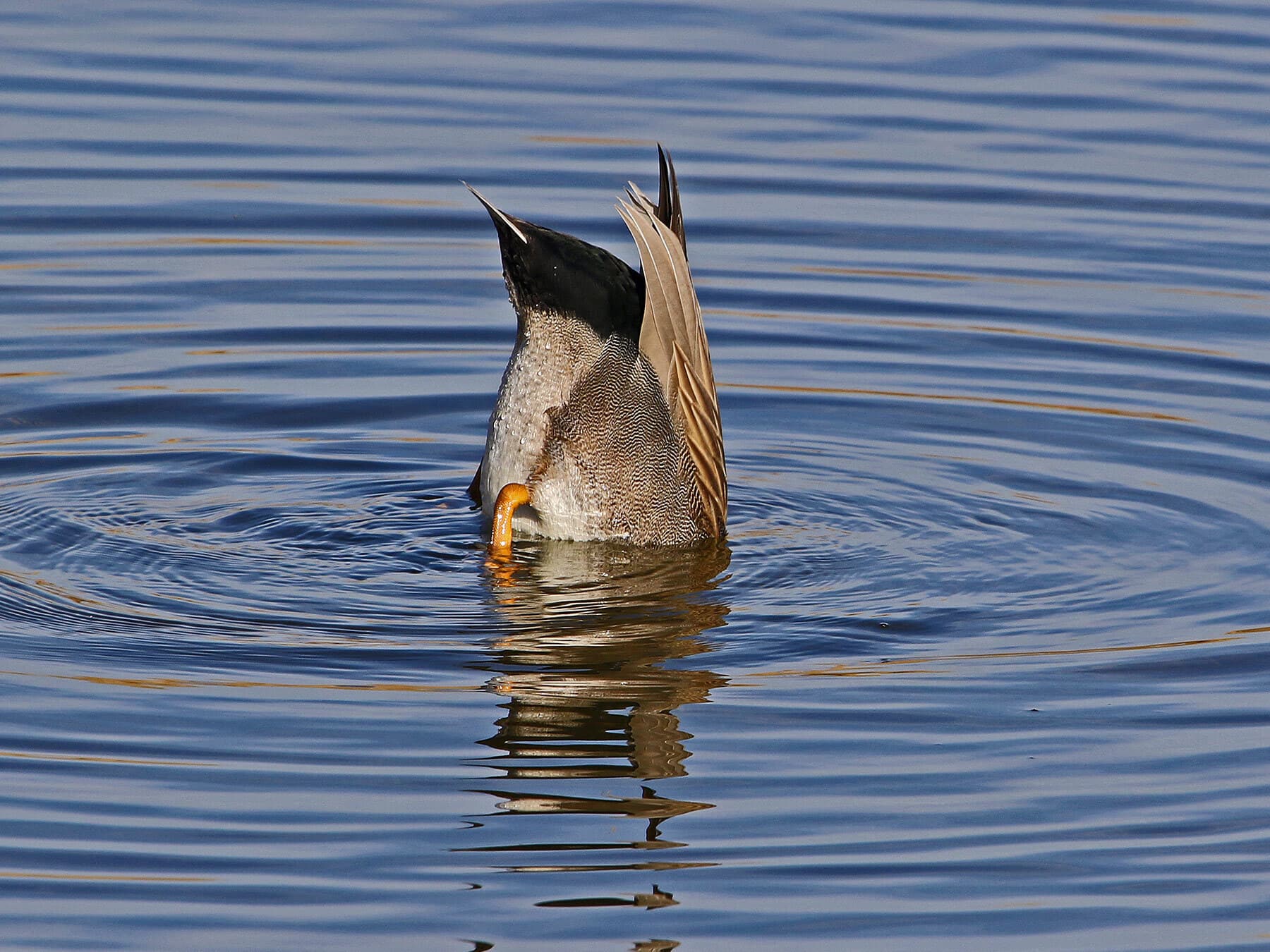
Gadwalls are essentially herbivorous, consuming a diverse range of pondweed, rushes, and various aquatic plants. Studies report that Gadwalls eat as much as 95% plant food. The remaining 5% consists of small aquatic invertebrates consumed incidentally rather than purposefully.
What do baby Gadwalls eat?
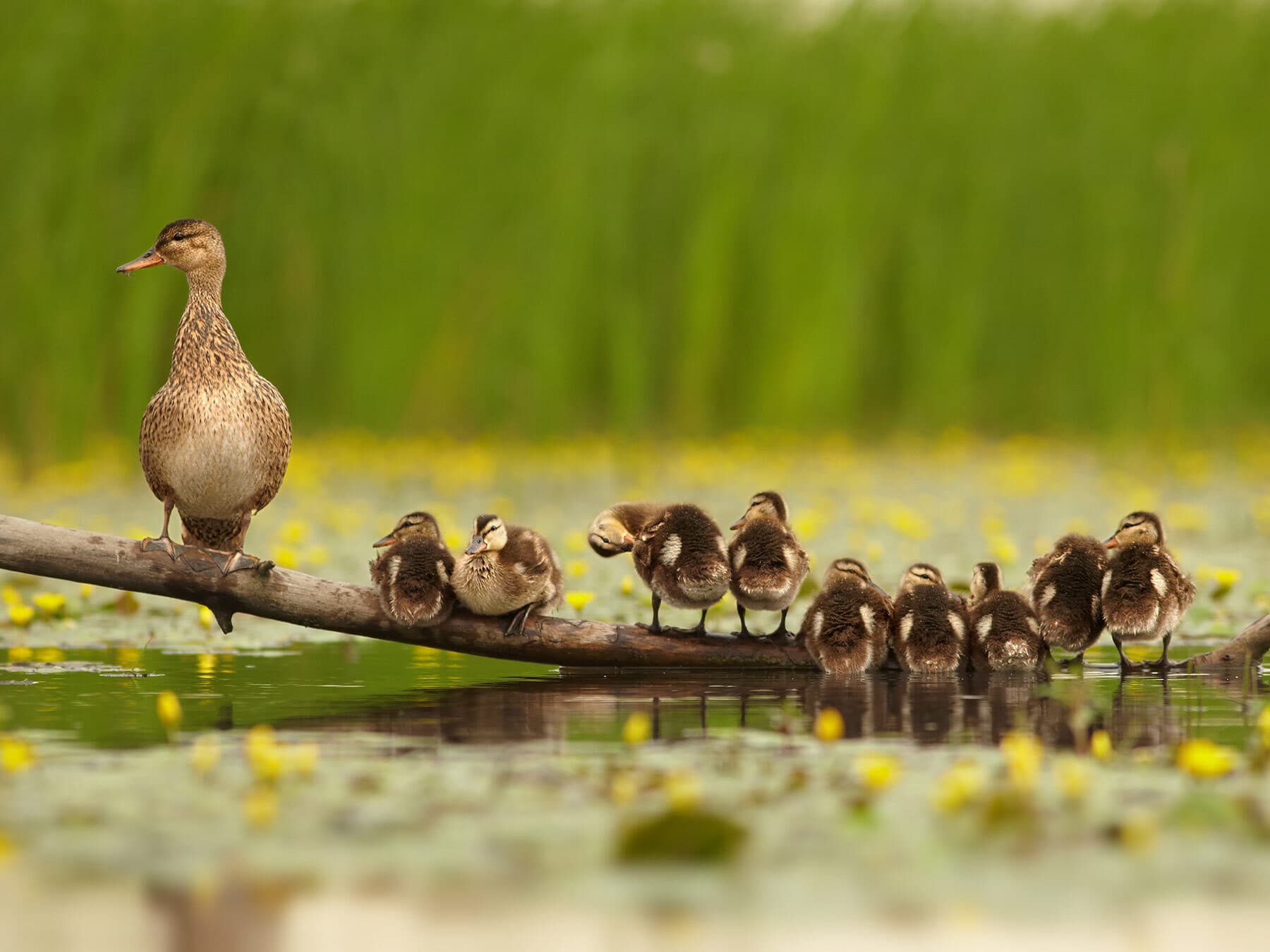
Gadwall ducklings consume a similar diet to their parents, except in the first few days when they eat primarily invertebrates. Algae and pondweed are the most important food items to Gadwall ducklings.
Nesting and breeding
Where do Gadwalls nest?
Gadwalls nest in their favored sheltered wetland habitats. Tall grasses and plenty of aquatic vegetation are preferred.
Some evidence suggests that Gadwalls assess predator abundance prior to picking a nesting site. The nest itself is situated within tall grasses (usually over 1-foot high) and protective vegetation to provide shelter and camouflage.
The nest is formed in a depression scraped from the soil. The depression is lined with vegetation. The nest measures just 8 to 10cm deep. Nests are sometimes reused from year-to-year.
What do Gadwall eggs look like?
Gadwall eggs are ovular, measuring around 55mm long. They’re a dull cream color, though some have a greenish tinge.
Female Gadwalls lay between 7 to 12 eggs and take care of all incubation duties. The female raises the chicks, too, with the male taking only a distant role in parenting. This is typical among ducks.
Do Gadwalls mate for life?
Gadwalls are one of a handful of ducks that are typically monogamous, sometimes remating with the same partner each breeding season.
There are exceptions, however, and couples may detach and “remarry.” Most duck breeding behavior involves polygamy. Gadwall males probably are promiscuous however, and play little to no part in raising the chicks.
Behaviour
Are Gadwalls gregarious?
Gadwalls are not as gregarious as other dabbling ducks like Mallards. Instead, they’re relatively quiet and reserved, confining themselves to their mated pairs across the breeding season. Wintering Gadwalls are more sociable.
Are Gadwalls aggressive?
Gadwalls are not as aggressive as other dabbling ducks like Mallards but are still territorial during the breeding season. The mother duck is especially defensive of her chicks until she eventually abandons them to allow them to join a nearby flock.
Lifespan and predators
How long do Gadwalls live?
Gadwalls typically live for 4 to 5 years. The oldest recorded individual was around 23 years old.
Parasites and waterborne diseases are frequent causes of mortality, especially in first-year birds.
What are the predators of Gadwalls?
Gadwalls face predation by several animals on land, water, and in the air. Eagles, falcons, hawks, and other raptors target ducklings, as do gulls and skewers.
Foxes, wild dogs, weasels, mink, coyotes, and badgers target both young and adult birds. Gadwalls generally avoid most land predators by confining themselves to their sheltered wetland habitats.
Are Gadwalls protected?
Gadwalls are not globally protected. They’re listed by the IUCN as a species of Least Concern, meaning their population is stable and sustainable across its global range.
In the UK, Gadwalls are listed as an Amber List species under the Birds of Conservation Concern 4: the Red List for Birds (2021) and are protected under the Wildlife and Countryside Act, 1981.
In the USA, Gadwall numbers have increased dramatically from the mid-19th-century.
Conservation
While currently listed as Least Concern, Gadwalls face threats from habitat loss and degradation of wetlands. Conservation efforts focus on protecting and restoring wetland habitats, particularly in breeding and wintering areas. Sustainable hunting practices are also crucial for population management.
More photos
2 photos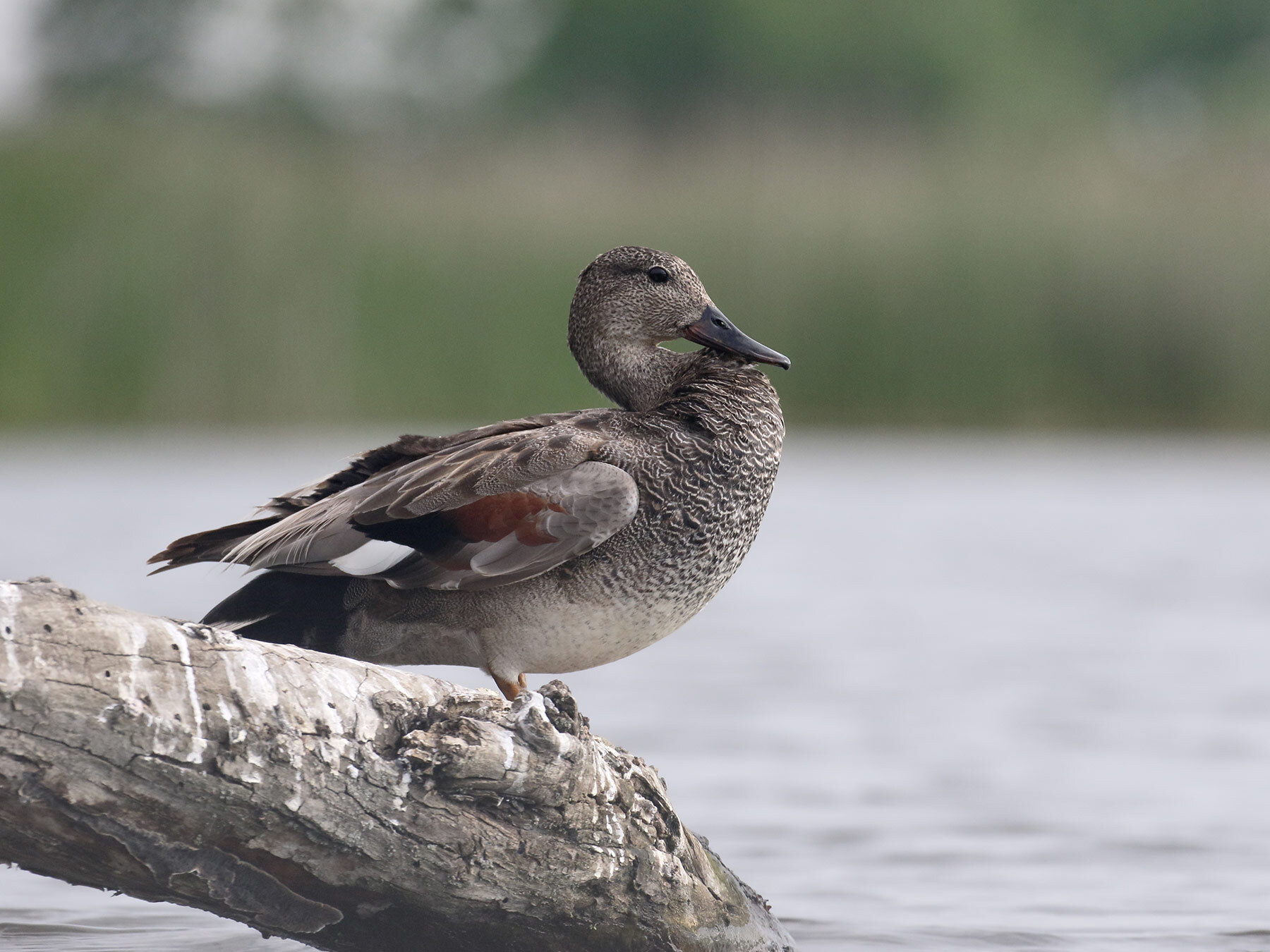
Gadwall guides
5 guidesQuick facts
- Length
- 46–56 cm
- Wingspan
- 84–95 cm
- Weight
- 650–1000 g
- Lifespan
- 10–15 years
- Family
- Ducks, Geese & Swans
- Migration
- Long-distance Migrant
- Global status (IUCN)
- Least Concern
- World population
- 4,300,000 - 4,900,000 mature individuals
- Population trend
- Increasing
- Also called
- Gray Duck
- Scientific name
- Mareca strepera
Questions
2Is a Gadwall a mallard?
A Gadwall is its own species from the waterbird family Anatidae and is not a Mallard. However, mallards and Gadwalls are both dabbling ducks and have much in common. However, the Gadwall is smaller than the Mallard, and the male especially features entirely different plumage.
Is a Gadwall a duck?
Gadwalls are dabbling ducks from the waterbird family Anatidae. They’re smaller than a Mallard, and the male features finely barred black and white plumage.
Sources
3- 1BirdLife International. 2016. Mareca strepera. The IUCN Red List of Threatened Species 2016: e.T22680149A86020572. Source (opens in a new tab)
- 2Wetlands International (2015)
- 3Wetlands International (2015)

Checked by
Nathan Cope, founder and editor
Nathan founded Birdfact and leads its writers and contributors in the UK, the US and Canada. He has watched and studied birds for more than ten years, and checks every article and species guide before it’s published.