
Blue-gray Gnatcatcher
Blue-grey Gnatcatcher · Polioptila caerulea
By the Birdfact teamChecked by Nathan Cope
On this page13 sections
How to recognise it
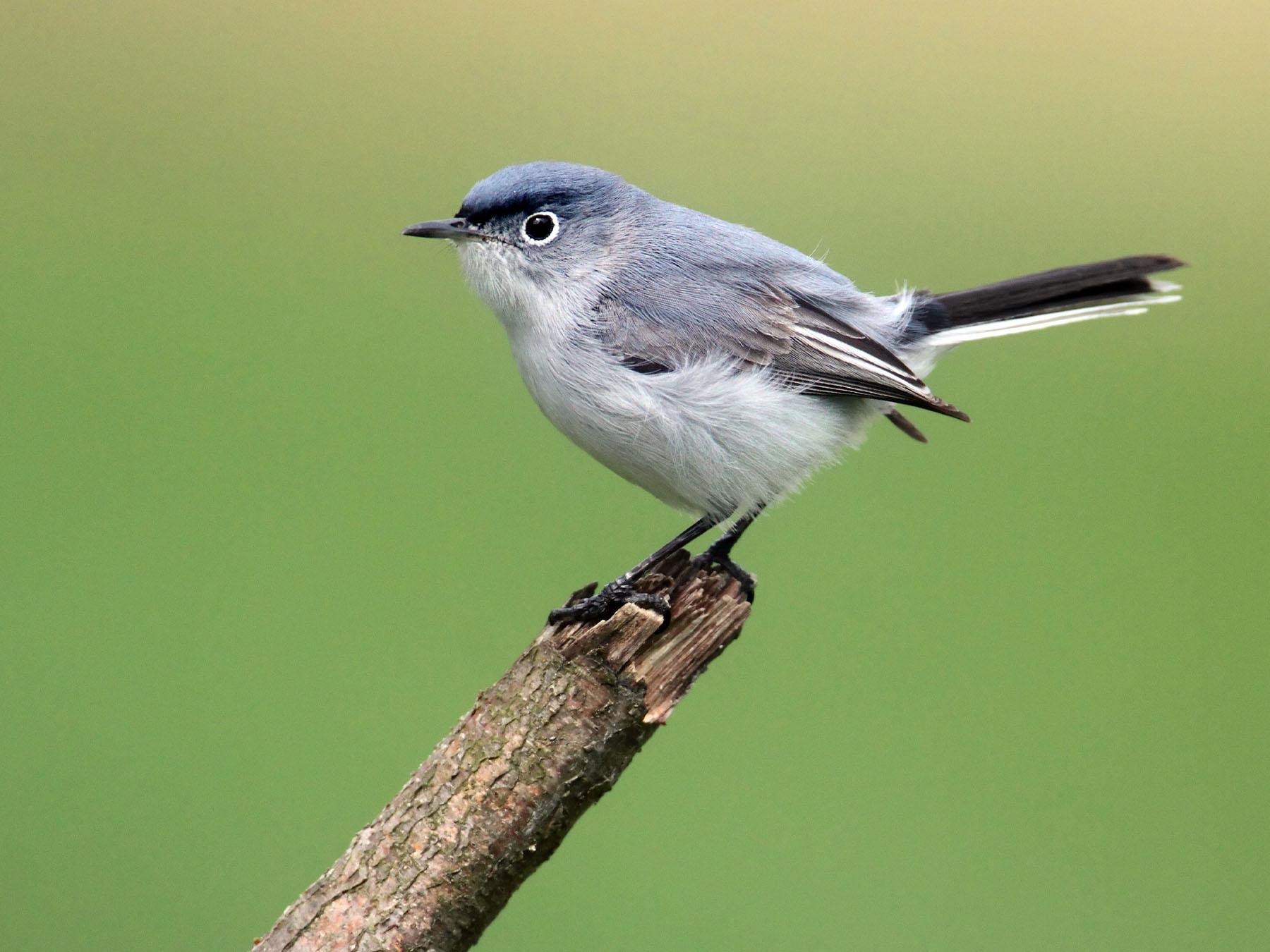
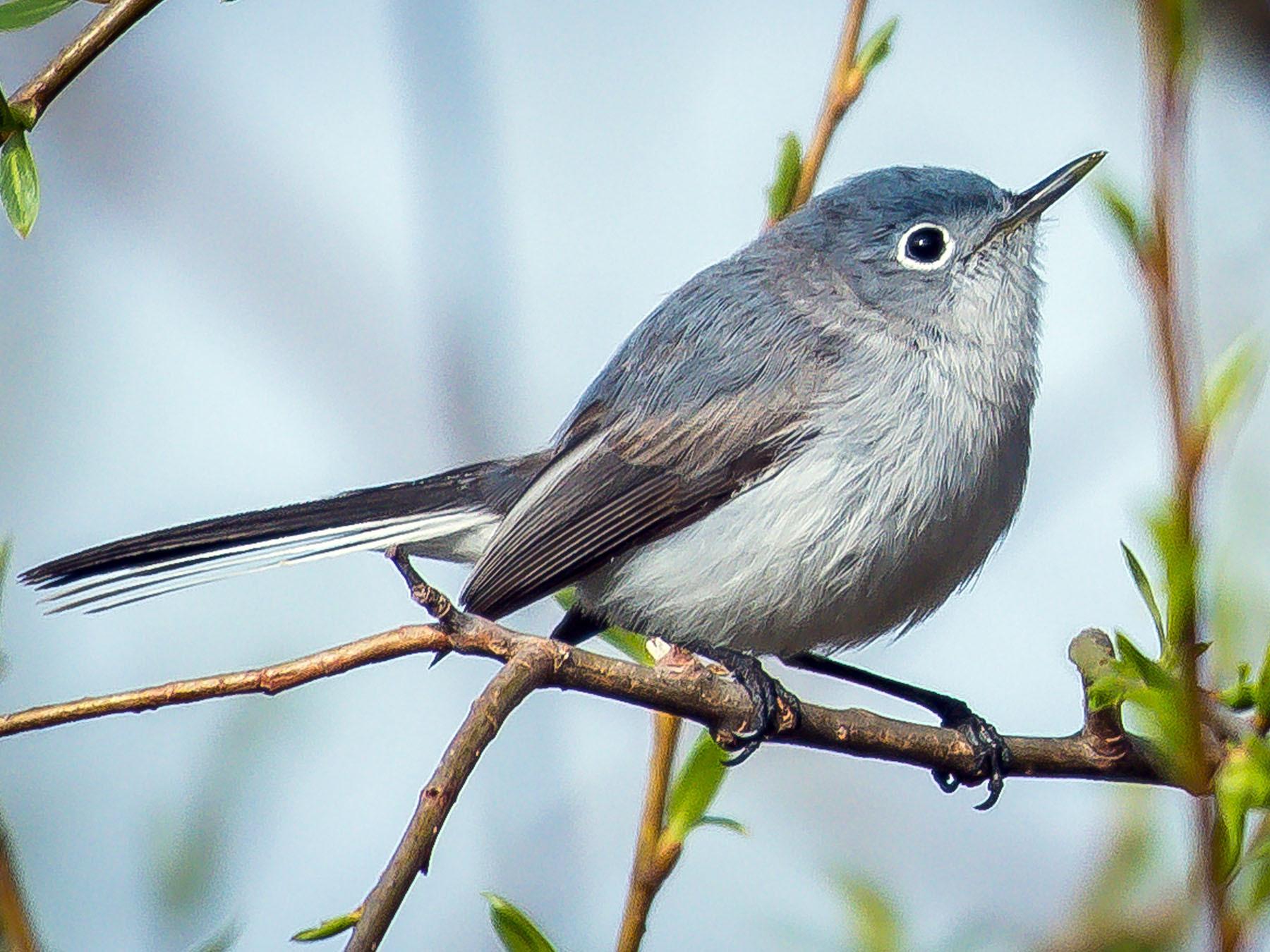
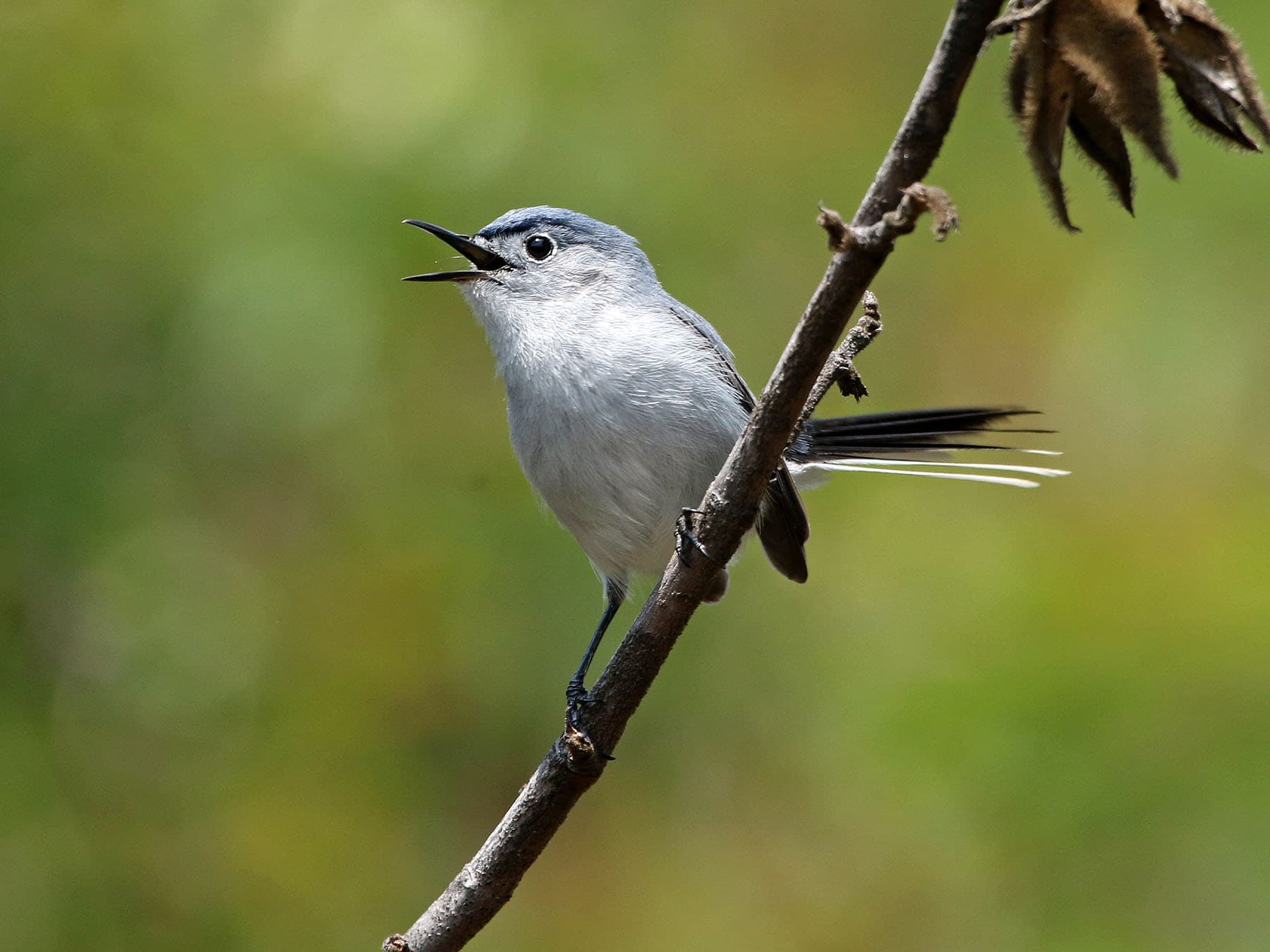
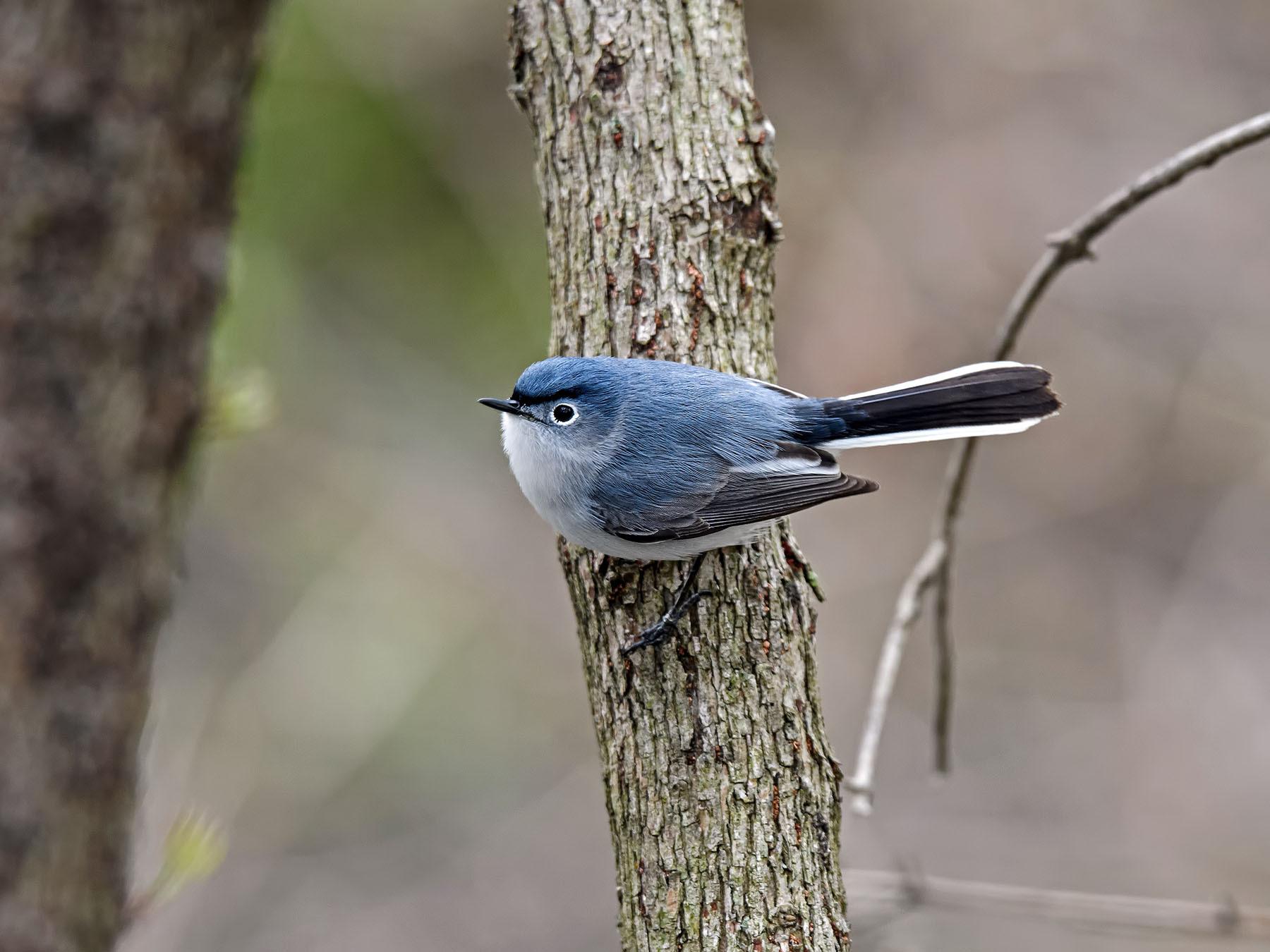
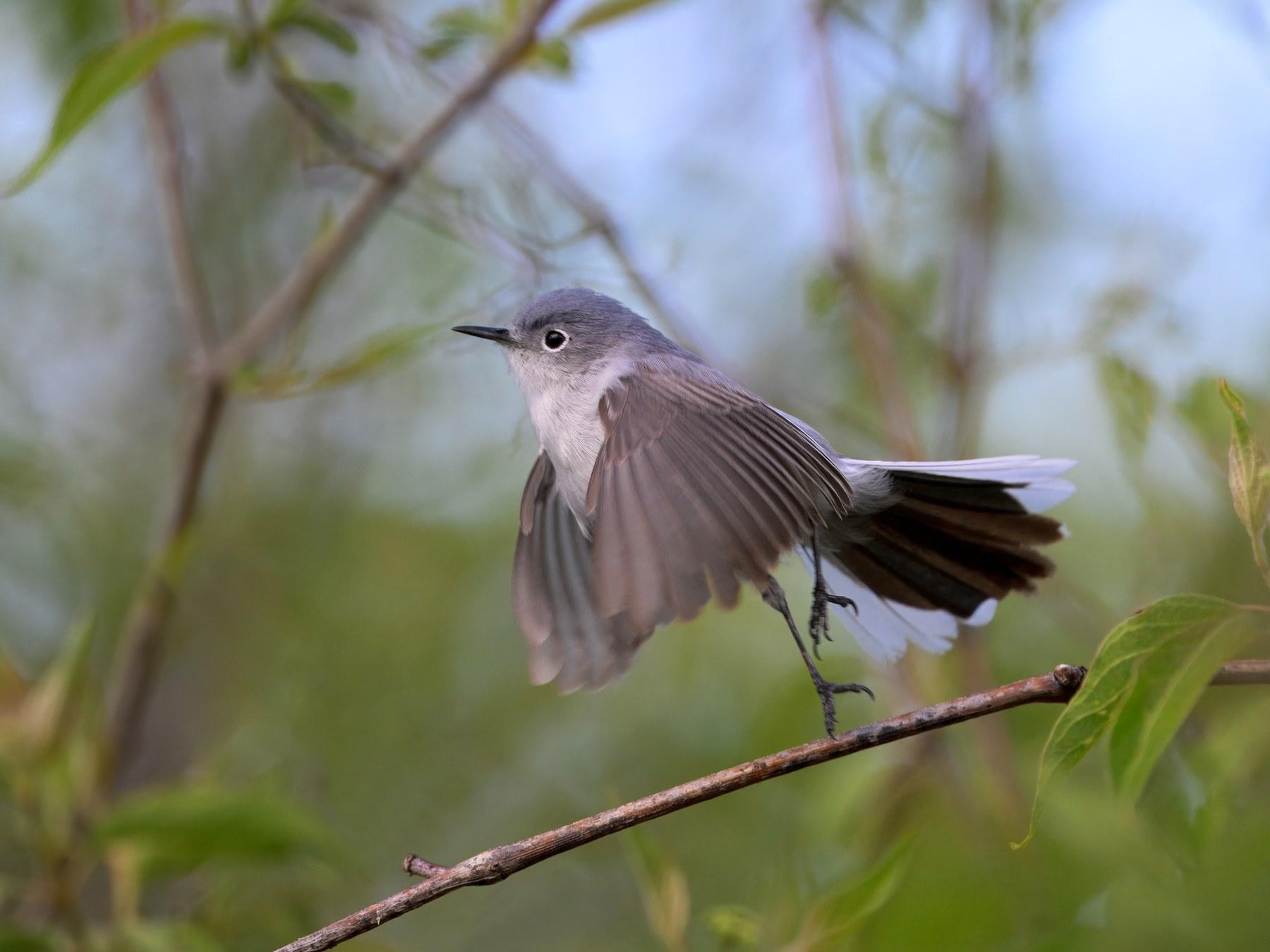
The tail is the mark to look for: long, black and white, and hardly ever still. It moves the tail constantly, often cocking it up or to one side, and flicks and fans it to flash the white outer feathers. It hops and sidles along branches, rarely comes down to the ground, and has a fine, narrow bill.
The tail is black in the middle, and the outer feathers are mostly white, so from above it looks black with white edges and from below the closed tail looks mostly white. The rest of the bird is blue-gray above and white below, with a complete white eye-ring and sides washed pale gray.
The pattern varies a little across the range. In eastern birds the outermost tail feather is white except at its base, and the closed tail looks all white from below. Western birds have more black at the base of the outer feathers, so from below the closed tail shows black at its base. Birds of dry regions tend to be grayer and paler than those of humid regions, which tend to be bluer or darker.
Size and shape
It is 3.9–4.3 in (10–11 cm) long, with a wingspan of about 6.3 in (16 cm), and weighs about 0.2 oz (5–7 g). More than 45% of its length is tail, which gives it a slender, long-tailed shape. It is smaller and slimmer than the bluish wood-warblers it can be mistaken for.
Male, female and young birds
In the breeding season, about March to August, the male has a thin black line that meets across the forehead above the bill and runs back over each eye, ending just behind it. His crown and nape are a brighter blue then, and first-spring males grow the black line too. Females have no black on the head. They average duller, grayer or browner than males, with the same white eye-ring and black-and-white tail.
In fall and winter, mainly September to February, the sexes look alike and are usually impossible to tell apart, and adults are hard to tell from first-year birds. A gnatcatcher with no black on its head may be a female, or any bird outside the breeding season.
Juveniles, seen from about June to August, have a plain mouse-gray head with a narrow white eye-ring, a browner back and a gray wash across the breast and sides. Their feathers look loose and soft, the corners of the mouth look fleshy, and the tail is already black and white.
Identification: similar birds
In most of the East it is the only gnatcatcher. In the West three others can look like it, and the tail is the first thing to check. A California Gnatcatcher is slightly smaller, with a mostly black tail: its outer feathers have only narrow white edges and tips, so the tail looks mostly black from below. It also has grayer underparts, and the breeding male has a full black cap.
A Black-tailed Gnatcatcher also has much less white in the tail, a shorter, darker bill and, in breeding males, a glossy blue-black cap. Where the two breed together, the Black-tailed keeps to scrub, while the Blue-gray is more often in woodland and higher up. A Black-capped Gnatcatcher breeds in the US only at a few sites in southeastern Arizona. Its breeding male has a glossy black cap reaching below the eye, and its tail is more strongly graduated, with shorter outer feathers. A breeding male Blue-gray shows only a thin black line across the forehead and over the eye.
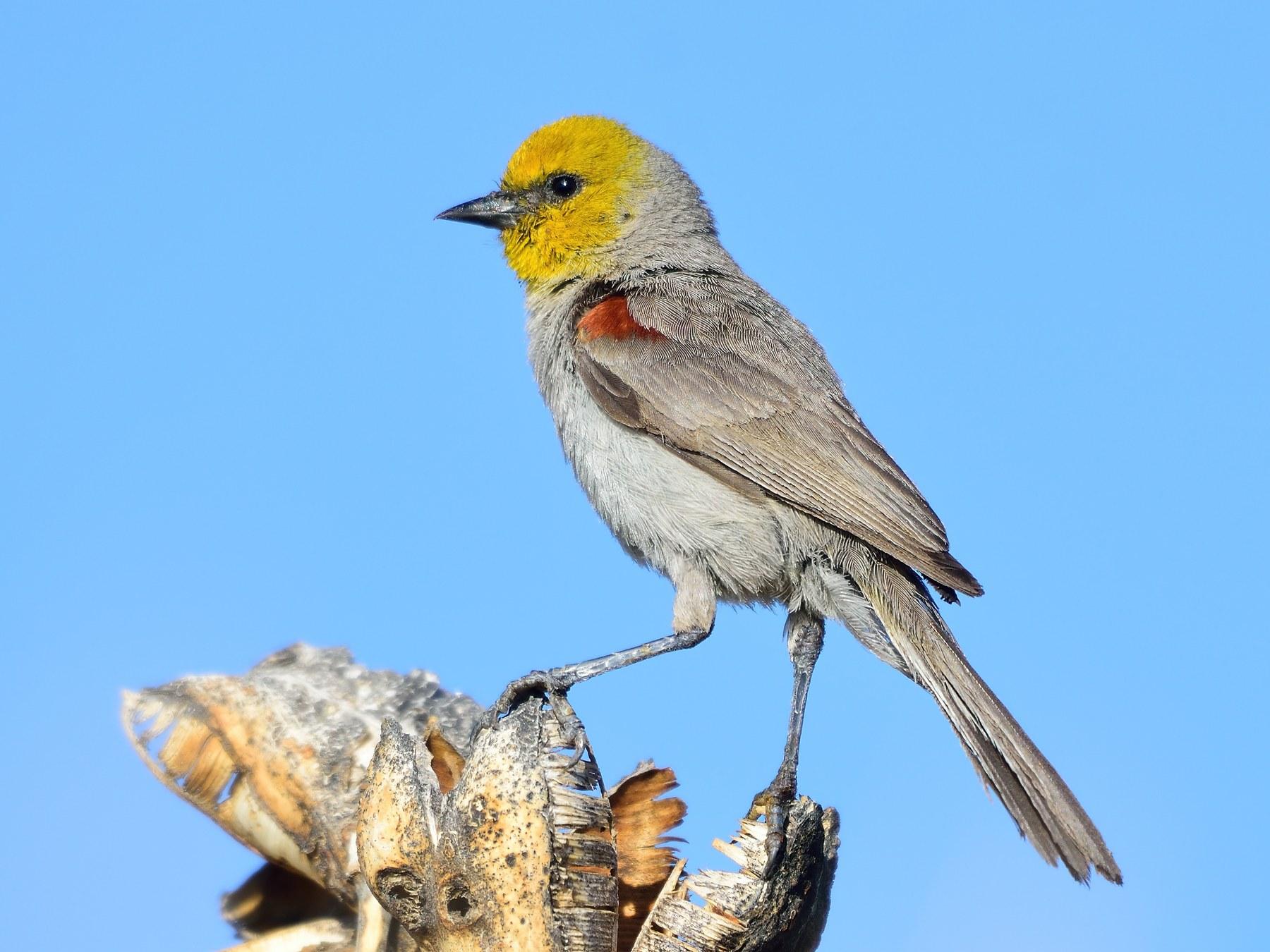
Voice helps too, as the gnatcatchers' songs and calls differ markedly. A young Verdin can resemble a female gnatcatcher, but it has a shorter tail and lacks the black and white.
Not sure it’s a Blue-gray Gnatcatcher? Check your photo: Birdfact names the bird and shows the look-alike side by side.
Its size
Adults- Length
- 10–11 cm
- Wingspan
- 16 cm
- Weight
- 5–7 g
Its song and calls
Listen for a high, mewing, nasal call, written zeee, spee or chay, often in short bursts of two to six notes. You can hear the calls at any time of year; the song is heard more seldom.
Agitated birds call faster and louder. A two-note bee-beee may show mild agitation, and very agitated birds give high trills. In fights and when mobbing, usually as they dive at an intruder, they also make a loud snap with the bill.
The song is soft and easy to miss. Most descriptions and recordings are of a long, rambling jumble of sharp chips, high whistles, mews and trills that can run for 10 seconds or more and is hard to hear beyond about 165 ft (50 m). Only males sing. Some snippets appear to imitate other birds, among them Blue Jay, American Crow, Gray Catbird and Tufted Titmouse, though these imitations are presumed rather than proven.
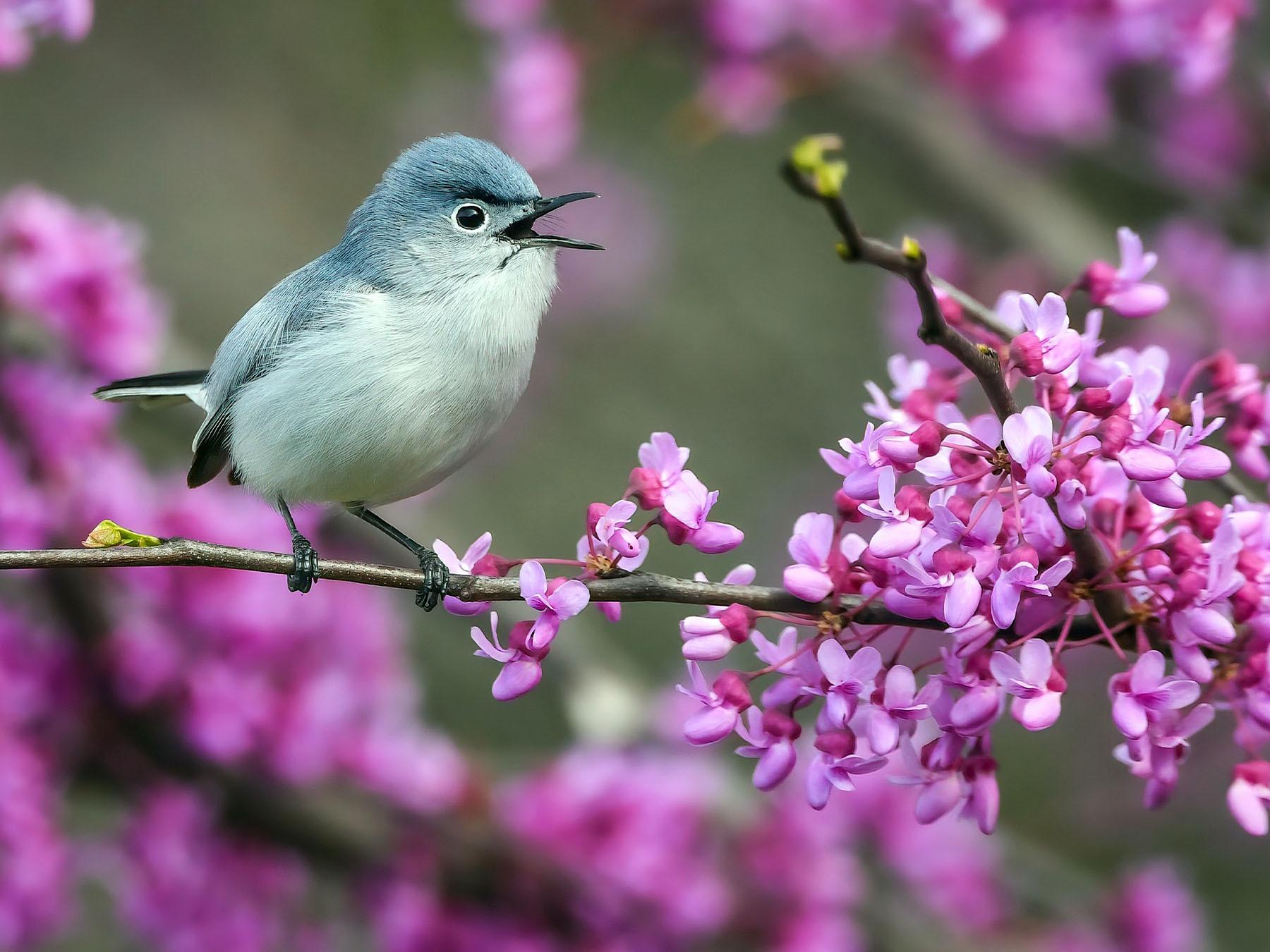
At a California study site in Monterey County, males early in the nesting season gave a short advertising song of four to eight sibilant phrases, spee, spuu, spee, speet, in the half hour after sunrise; there, the long, whispered song seemed linked to courtship.1 Song apparently peaks early in the breeding season, and in southern Vermont it was heard from April 20 to July 11.2
- Song0:00 / 0:06
Recorded in North Carolina, United States · April 2023
- Calls0:00 / 0:07
Recorded in Rhode Island, United States · May 2023
Heard one and not sure? Let the bird song identifier listen.
When and where to see it
November
Leaving
The year across North America
Choose a place on the map to see its year, or find yours.
Most recorded in November
Up to 1.8% of a place’s bird records that monthHere in other months
How this map is made
Each county, state or province is shaded by the Blue-gray Gnatcatcher’s share of all the bird records there that month: the darker, the larger the share. A place with only a trace of records in a month is left unshaded. Shades compare places on this map with each other, not one bird with another. Records: GBIF eBird Observation Dataset, 2019–2024. Map: Natural Earth; place centres © OpenStreetMap contributors.
How often the Blue-gray Gnatcatcher turns up in the United States and Canada through the year, from birdwatchers' records.
United States
Resident · all year · most records in May
Canada
Summer visitor · regularly Apr–Nov · most records in May
Show as a table
| Month | United States | Canada |
|---|---|---|
| January | 0.33% (regular) | <0.001% |
| February | 0.28% (regular) | – |
| March | 0.28% (regular) | <0.001% |
| April | 0.70% (regular) | 0.042% (regular) |
| May | 0.76% (regular) | 0.21% (regular) |
| June | 0.51% (regular) | 0.040% (regular) |
| July | 0.43% (regular) | 0.038% (regular) |
| August | 0.51% (regular) | 0.064% (regular) |
| September | 0.46% (regular) | 0.032% (regular) |
| October | 0.30% (regular) | 0.006% |
| November | 0.31% (regular) | 0.011% (regular) |
| December | 0.34% (regular) | 0.004% |
Worldwide: recorded regularly in 11 countries
Countries where it was recorded in at least 3 of the 6 years 2019–2024. Linked countries have their own bird list.
North America (11)
- Bahamas
- Belize
- Canada
- Cayman Islands
- Cuba
- El Salvador
- Guatemala
- Honduras
- Mexico
- Turks & Caicos Islands
- United States
Data: EOD – eBird Observation Dataset (Cornell Lab of Ornithology), accessed via GBIF.org, CC BY 4.0. Records from 2019–2024, aggregated and filtered by Birdfact. How these lists are made
From spring to late summer it lives in leafy woods, woodland edges, thickets and scrub across much of the US. It appears to favor the edges of gaps and clearings, nesting in more open, scrubby spots and feeding in thicker cover, and it is rare or absent where needle-leaved conifers dominate. In winter, look for it in the far South: southern Florida, southern California, and the Gulf Coast west from Mississippi to the Rio Grande Valley.
It breeds south of a line from southern Maine, central New Hampshire and northern Vermont through extreme southern Ontario and southwestern Quebec, west to northern Michigan and central Minnesota. On the Great Plains it nests only in wooded country. In the West it breeds through Arizona, Utah, central and southern Nevada and parts of California and New Mexico, and the range continues south through Mexico to Belize and El Salvador; it also breeds in the Bahamas. In the Northeast it keeps mostly to lowland woods near rivers and lakes; western birds use oak woodland, chaparral and pinyon-juniper.
The winter range runs from the coastal plain of the southeastern US through Cuba, the Bahamas and Mexico to Honduras. In southern Florida, wintering birds use hammocks, cypress swamps, citrus groves, pine flatwoods and ornamental plantings. Most birds appear to winter south of the US. In Mexico it lives from sea level to about 8,200 ft (2,500 m).
Migration
Northern birds migrate long distances, while birds in the southern US and northeastern Mexico apparently move shorter distances, and most nesting birds in the Bahamas and Central America stay all year. In spring the first birds reach southern Ohio, Indiana, Maryland and Virginia in late March, and New England and the upper Midwest in mid to late April. In many areas April and September are the peak months.
The start of the fall movement is hard to see. Birds appear to leave the breeding grounds as soon as their young are independent, from mid to late August, though around Tallahassee, Florida, the breeding birds have gone by early June. Passage peaks on the Gulf Coast in late September, and more than 1,000 were counted in Nueces County, Texas, on September 23, 1989.2
Two banded birds show how far some travel. One banded in western Pennsylvania was found in Jalisco on Mexico's Pacific coast, though it may have been a stray; another, banded on eastern Long Island, New York, turned up in Durango, Mexico, nine months later, in January.2
Range expansion
Its breeding range spread north through the 20th century. In the 1920s and 1930s it reached southeastern Minnesota and spread northeast across western Pennsylvania. After a large flight in 1947 it began nesting regularly in eastern Pennsylvania and northern New Jersey, and by 1948–1951 it was widespread in the Lake Ontario lowlands of upstate New York. Major northward overflights of migrants followed in 1954, 1956, 1963 and several years of the early 1970s, and the first New Hampshire nest was documented in the 1960s. In the West it has reached Idaho and Wyoming, and the first Wyoming nests were reported in 1983. The eastern spread coincided with spells of warmer-than-average winters in peninsular Florida: the 1940s into the early 1950s, and again the early 1970s.2
The spread has continued. A model of North American Breeding Bird Survey data from 1972 to 2015 estimated that the northern edge of its eastern range moved 1.2 degrees of latitude north.3 Between Wisconsin's first (1995–2000) and second (2015–2019) breeding bird atlases, its range in the state grew 17.9% and its range edge moved about 14 miles (23 km) north.4 Over one 26-year period the range shifted about 195 miles (314 km) north, perhaps linked to a warming climate.2
Spotting tips
In spring, check the outer twigs of leafy trees along rivers and woodland edges, where it works restlessly through the foliage, flicking its tail.
What it eats
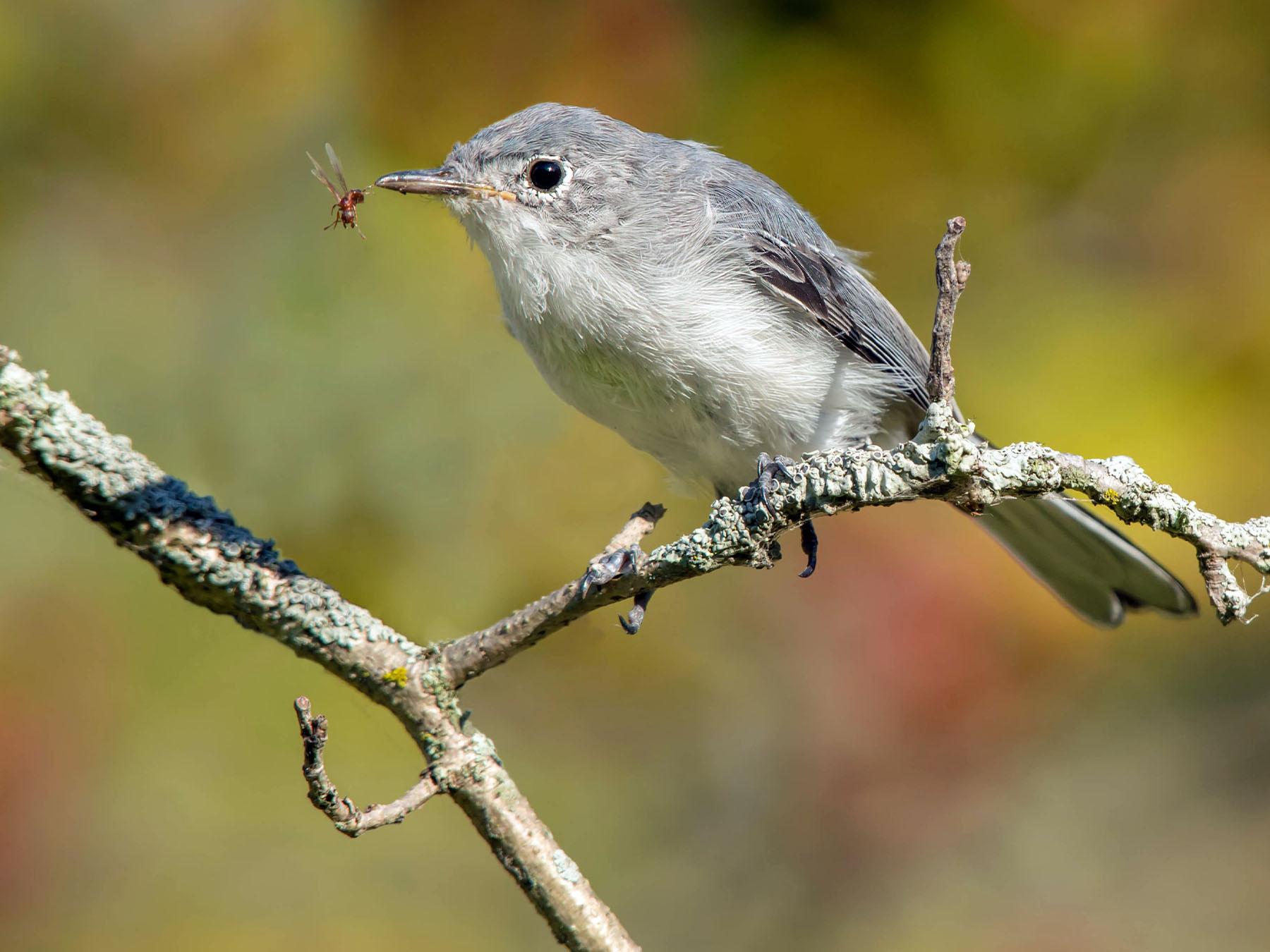
It eats small insects and spiders, picked mostly from leaves and twigs near the tips of branches in broad-leaved trees and shrubs. Despite the name, gnats make up little of what it eats. Its prey includes leafhoppers and treehoppers, beetles, wasps, true bugs, flies, moths and caterpillars, as well as insect eggs and larvae. No source we read records it eating plant food.
In 71 stomachs from Monterey County, California, and Yuma, Arizona, prey came from 70 families of insects and other arthropods.2 Leafhoppers and their relatives were in 83% of the California stomachs and 54% of the Arizona ones, beetles in 69% and 92%, and spiders in 35% and 54%.2 In California, grasshoppers were in 20% of 704 food loads brought to nestlings, and in southwestern Vermont half of 34 identified prey items were adult and larval moths.2
How it feeds
Most of its feeding is in the canopy. It gleans prey from the surfaces of leaves and twigs, picks insects off foliage while hovering, and darts out after insects it has flushed; it rarely catches them in long flights. Its constant tail movements may help flush hidden prey, though no study we read has tested this.
Prey under about 0.2 in (5 mm) is swallowed at once. Larger insects have their wings removed, and anything over about 0.4 in (10 mm) is beaten on a perch before it is swallowed. On fall stopover in hurricane-damaged forest in Louisiana, birds spent 52% of their foraging time gleaning and 26% on aerial moves.2
Do they visit feeders?
We found no record of it at bird feeders in the sources we read, among them Birds of the World, Audubon and NatureServe, and none recommends a food for it. It lives on small insects and spiders found among leaves and twigs, and no source we read records it taking seeds or suet.
Nesting and breeding
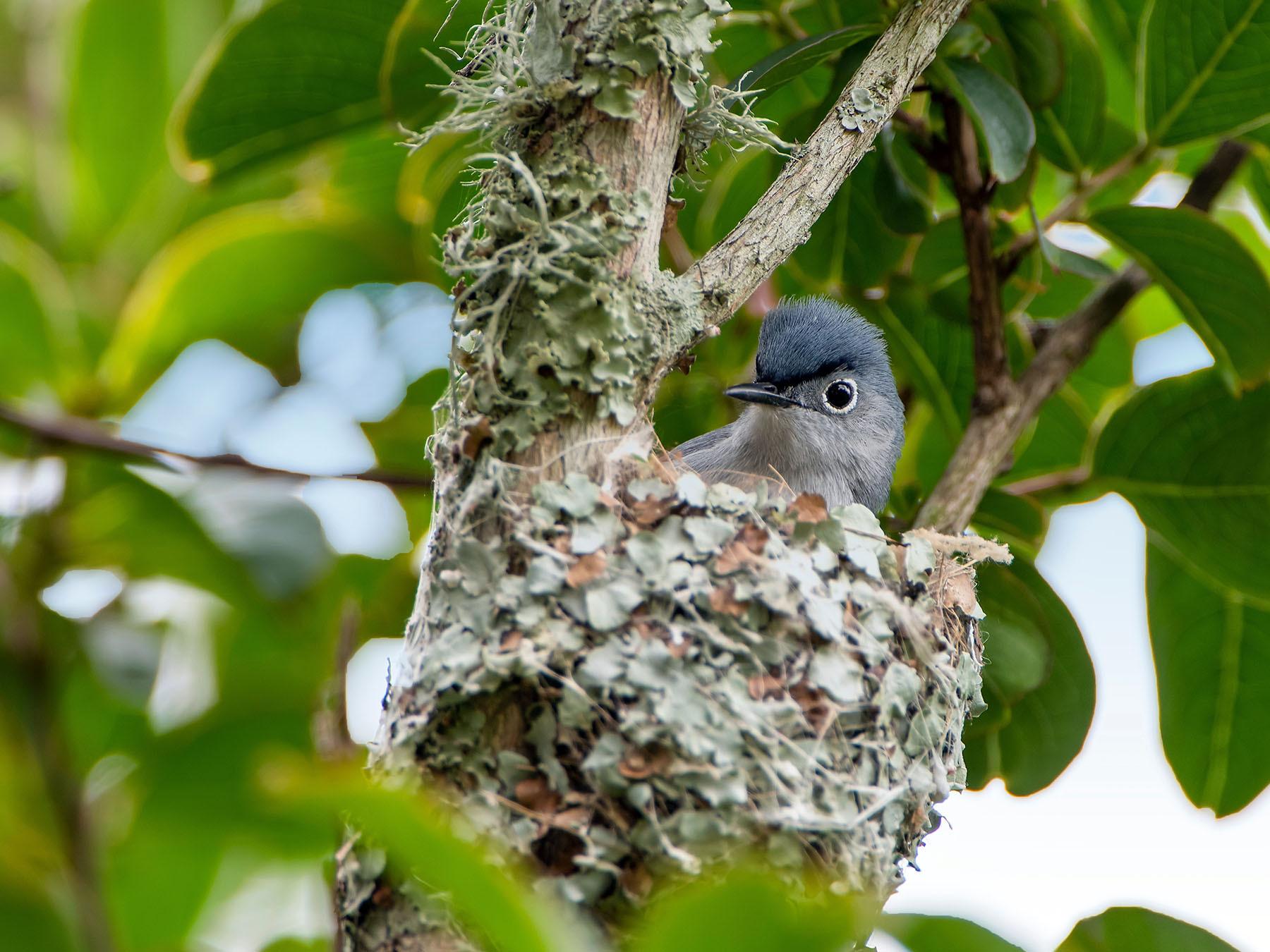
It is one of the earliest-nesting small insect-eating songbirds. Both sexes build the nest, a small, high-walled cup of plant fibers and bark strips bound with spider web or caterpillar silk. The outside is covered with flakes of lichen, and the lining is made of ever finer material such as plant down, hair and feathers. The nest is usually saddled on a branch well out from the trunk of a living broad-leaved tree, often more than halfway up, where it can look like a knot on the branch.
In 557 nest record cards from eastern North America, nests ranged from about 2.6 to 80 ft (0.8–24.4 m) above the ground, averaging about 28 ft (8.5 m).2 Nest building starts as early as March 15 in the South, below about 36.5° N, where the median start is April 20, and the median start in the north is mid-May; in southwestern Vermont, clutches were begun from May 16 to June 26.2
A nest is used for only one attempt, but pairs often pull an old nest apart and reuse the material, especially after a failure or after cowbirds have laid in the nest. At the Monterey County site in 1963, 23 of 42 nests held material from an earlier nest, and one female reused material in six nests in a row.1
Eggs and young
The female lays one egg each morning, usually four or five in all, sometimes three or six. The eggs are pale blue or bluish white, sparsely spotted with reddish brown, sometimes in a ring at the larger end. Both parents incubate, the female alone at night, for about 13 days (11–15), starting once the last egg is laid. The young hatch naked with their eyes closed and leave the nest 10–15 days later.
Both parents feed the young, the male bringing food while the female broods them in the first days. Feeding goes on for about three weeks after the young leave the nest; they are essentially independent 19–21 days after fledging, but may stay on the territory for up to a month.
Most pairs raise one brood, and pairs renest again and again after failures, up to six or seven attempts in a season. Second broods were attempted by 5 of 23 pairs in southwestern Vermont, 3 of which raised young from two nests, and by 1 of 22 pairs in northern Florida.2 At the Monterey County site, 4 of 12 pairs raised two broods in 1963.1
Cowbirds and nest losses
Despite its small size, it is a regular host of the Brown-headed Cowbird. It cannot throw out or puncture cowbird eggs, and deserting the nest appears to be its only defense.2 How often it is parasitized varies widely by place. In an Illinois study, cowbirds had laid in 20 of 36 nests whose contents could be checked (56%), and the gnatcatchers abandoned 16 of them (80%) during laying or early incubation; no parasitized nest there fledged a gnatcatcher.5, 2 In New Mexico pinyon-juniper woodland, 79% of 288 nests were parasitized, accepting the cowbird eggs was the main response, and parasitism caused 58% of the gnatcatcher nests to fail.6 In southwestern Vermont, only 1 of 28 pairs with nestlings or fledglings was parasitized.2
Nest success also varies. At the Monterey County site in 1963, young left 24.4% of 42 nests, and 5 of 12 pairs raised no young at all.1 In the Illinois study of 93 nests from 1995 to 1997, overall nest success was 11%.5 Predation appears to have caused most failures in California and Vermont.2 At the California site, scrub-jays were probably the main nest predator.1
Behaviour
It is restless and quick, hopping and sidling along branches with its tail always on the move. Its flight is fluttering and direct, with light, moth-like wingbeats, and usually short. It lives alone or in pairs in the breeding season, and families of three to six stay together until mid-August. On migration and in winter it more often joins mixed flocks of small birds.
Pairs are monogamous and often form within a day of arriving, but there is no strong evidence that they stay together beyond one season. In dry tropical forest in northeastern Mexico it was the commonest member of winter mixed flocks and one of their core species.2
Territorial behavior
For its size it is pugnacious. It drives birds smaller than about 7 in (18 cm) away from the nest tree and the trees nearby, and it is aggressive toward much larger birds too, predators or not. Attacks on 20 non-predatory bird species were recorded at the Monterey County site and on 19 more in southwestern Vermont, and birds have even gone for a western fence lizard and a chipmunk.2
Pairs hold territories in the breeding season, on average about 4.6 acres (1.8 ha) at the California site and about 1.7 acres (0.7 ha) in Vermont.2, 1 In boundary disputes, a male fans his tail to show the white outer feathers, which the black central ones usually partly hide, and gives slow, emphatic peeew calls.1 It is apparently not territorial in winter. Near Tucson, Arizona, wintering birds appeared to keep home ranges of at least about 22 acres (9 ha) without defending them, often traveling in pairs.1
Lifespan and predators
The oldest on record with the US Bird Banding Laboratory was at least 6 years 3 months old: a bird banded in Colorado on September 28, 2017, already past the year it hatched, and caught and released there on September 22, 2022.7 The laboratory's historical table gives 4 years 2 months, for a male banded in Pennsylvania in 1970.7 No source we read gives a typical lifespan.
One estimate of yearly adult survival from the MAPS banding program is 0.597, or about 60%, but it rests on 360 captures and only 12 returns.2
Predators and dangers
The Birds of the World account, last revised in 2012, knew of no published case of predation on adults. Adults do harass Cooper's and Red-tailed Hawks, Barn Owls, Western Screech-Owls, Northern Pygmy-Owls and Loggerhead Shrikes, which suggests these may take them. Recorded nest predators are Blue Jay, scrub-jays, Yellow-billed Magpie and Red-bellied Woodpecker, and rat snakes, American Crow, Common Grackle, raccoons and squirrels are suspected.2
Birds that winter in temperate and subtropical areas may suffer in hard winters. After the hard winters of 1977–78 and 1978–79, numbers fell on census plots in Maryland and North Carolina, then recovered.2 A four-summer study of window strikes on a college campus in northwestern Illinois found no Blue-gray Gnatcatchers among the dead birds, as expected for a group that a national analysis rates at low risk of window collisions.8
Conservation
It is not rare. It is listed as Least Concern on the IUCN Red List.9 Partners in Flight estimates about 260 million breeding-age birds for about 2010, 230 million of them in the US and Canada, and its assessors consider it relatively tolerant of human activity and land use.10
The highest breeding densities on record come from southern floodplain swamps, with about 860 territorial males per square mile (331 per km²) in a South Carolina hardwood swamp forest.2 A 2008–2020 survey of three bottomland and riparian forest refuges in Oklahoma and Texas estimated about 200 birds per square mile (77 per km²).11 A 2006 review classed it as an "urban avoider" in California.2 A Missouri study found support for fewer birds in shrublands where housing was denser.12, 2
Population trend
Across the North American Breeding Bird Survey as a whole there has been no clear change since 1966: +0.07% a year, with a 95% credible interval of −0.17 to +0.30.13 That flat line hides a rise and a fall. The survey's index rose from 2.47 birds per route in 1970 to between about 3.5 and 3.8 from 1993 to 2004, peaking at 3.82 in 1995, then fell to a low of 2.52 in 2021 and stood at 2.68 in 2025. From 2005 to 2025 it fell 1.59% a year (−1.90 to −1.27), and over 2015–2025 by 1.84% a year (−2.39 to −1.25).13
Regions differ. Over the survey's full span it has increased clearly in southern New England, the upper Midwest and Utah, by 6.13% a year in Massachusetts and 4.45% in Iowa, and also in Mississippi and New Jersey. It has declined clearly in Arkansas, West Virginia, Kentucky and Missouri, and in the Appalachian Mountains, Central Hardwoods and West Gulf Coastal Plain/Ouachitas regions.13
Legal status
In the US it is on the list of birds protected under the Migratory Bird Treaty Act.14 The Act makes it unlawful to pursue, hunt, take, capture, kill or possess these birds, their parts, nests or eggs, except as regulations permit.15 It is not listed under the Endangered Species Act; the listed gnatcatcher is the Coastal California Gnatcatcher, a subspecies of the California Gnatcatcher (federal species database checked in November 2026).16
In Canada it is covered by the Migratory Birds Convention Act, 1994, whose convention lists gnatcatchers among the migratory insect-eating birds.17 It is not on Mexico's NOM-059 list of species at risk, as modified in 2019.18
Names and relatives
Its scientific name is Polioptila caerulea. Linnaeus described it in 1766, as Motacilla caerulea, from Pennsylvania (taken to mean Philadelphia). It is the most widespread gnatcatcher in North America, the only one found in colder temperate regions and the only truly migratory one. The global AviList checklist spells its name Blue-grey Gnatcatcher.
It belongs to the gnatcatcher family, Polioptilidae, with the gnatwrens. The family is related only distantly to the Old World warblers (Sylviidae) and is nearer the wrens. AviList recognizes eight subspecies, from caerulea in the East and obscura in the West to resident forms in Mexico, Belize, the Bahamas and on Cozumel, and they are hard to tell apart in the field.
Similar birds
Often mistaken for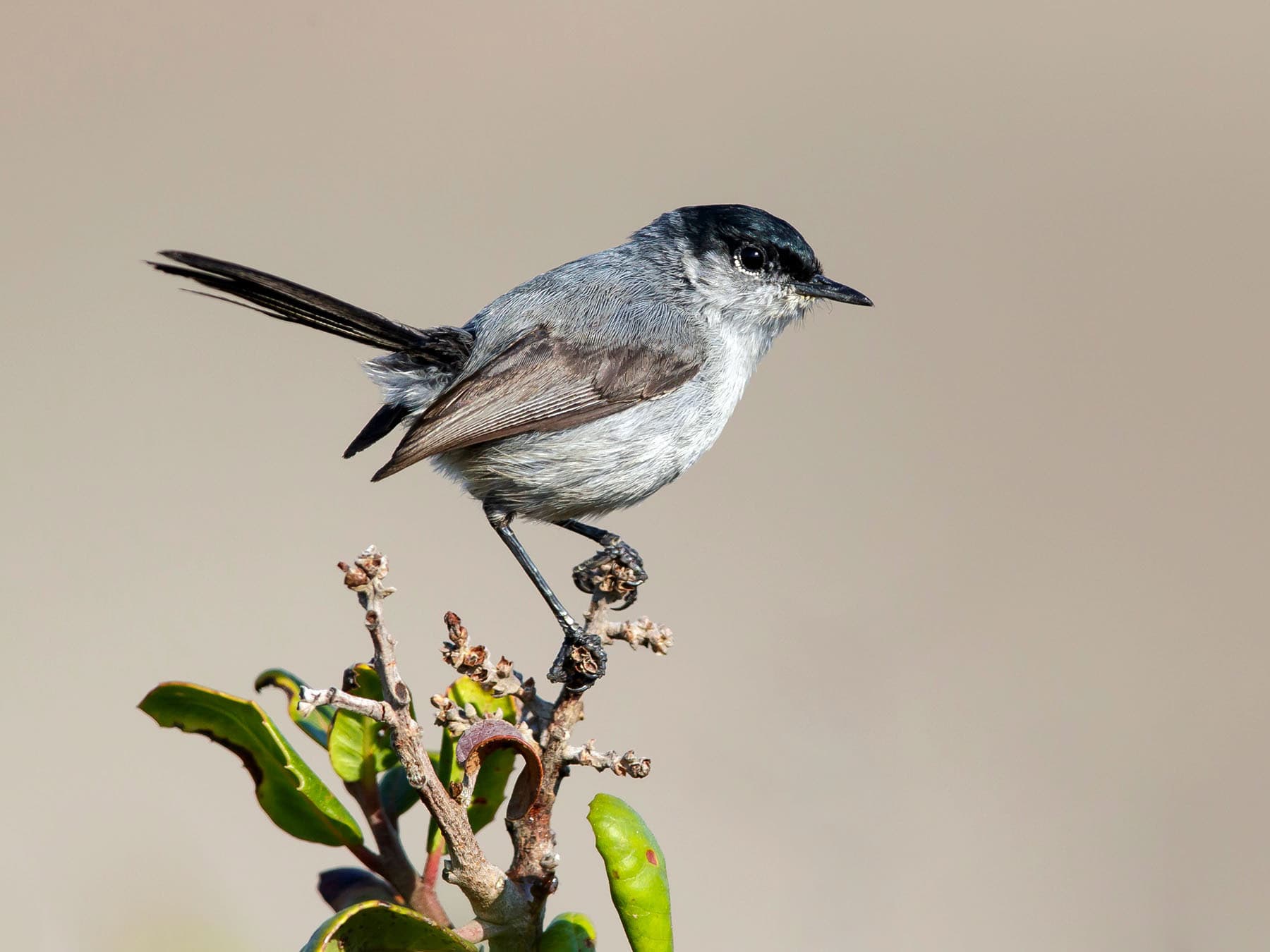
Quick facts
- Length
- 10–11 cm
- Wingspan
- 16 cm
- Weight
- 5–7 g
- Lifespan
- oldest recorded 6 years 3 months
- Family
- Gnatcatchers
- Migration
- Partial migrant
- Global status (IUCN)
- Least Concern
- World population
- About 260 million breeding-age birds (Partners in Flight estimate for about 2010)
- Population trend
- No clear change across the North American Breeding Bird Survey since 1966, but that hides a rise to a plateau from the early 1990s to the mid-2000s and a clear decline since: about 1.8% a year over 2015–2025. Since 1966, numbers have risen clearly in southern New England, the upper Midwest and Utah, and fallen in Arkansas, West Virginia, Kentucky, Missouri and the Appalachians
- Also called
- Blue-grey Gnatcatcher
- Scientific name
- Polioptila caerulea
Sources
28- 1Root, R. B. (1969). The behavior and reproductive success of the Blue-Gray Gnatcatcher. The Condor 71(1): 16-31. doi:10.2307/1366044 (opens in a new tab)
- 2Kershner, E. L. and Ellison, W. G. (2020). Blue-gray Gnatcatcher (Polioptila caerulea), version 1.0. Birds of the World (A. F. Poole, editor). Cornell Lab of Ornithology. doi:10.2173/bow.buggna.01 (opens in a new tab)
- 3Rushing, C. S., Royle, J. A., Ziolkowski, D. J. and Pardieck, K. L. (2019). Modeling spatially and temporally complex range dynamics when detection is imperfect. Scientific Reports 9: 12805. doi:10.1038/s41598-019-48851-5 (opens in a new tab)
- 4Stallworth, D. T., Anich, N. M. and Zuckerberg, B. (2025). Poleward range shifts of breeding birds in Wisconsin. Ecology and Evolution: e71796. doi:10.1002/ece3.71796 (opens in a new tab)
- 5Kershner, E. L., Bollinger, E. K. and Helton, M. N. (2001). Nest-site selection and renesting in the Blue-gray Gnatcatcher (Polioptila caerulea). The American Midland Naturalist 146(2): 404-413. doi:10.1674/0003-0031(2001)146[0404:nssari]2.0.co;2 (opens in a new tab)
- 6Goguen, C. B., Curson, D. R. and Mathews, N. E. (2009). Effects of parasitism by Brown-headed Cowbirds (Molothrus ater) on reproductive success of three frequent hosts in New Mexico. The Southwestern Naturalist 54(1): 58-67. doi:10.1894/mh-44.1 (opens in a new tab)
- 7USGS Bird Banding Laboratory. Longevity records, AOU 7510 Blue-gray Gnatcatcher (current and historical tables). U.S. Geological Survey. Accessed 28 November 2026. Source (opens in a new tab)
- 8Hager, S. B. and Craig, M. E. (2014). Bird-window collisions in the summer breeding season. PeerJ 2: e460. doi:10.7717/peerj.460 (opens in a new tab)
- 9BirdLife International (2025). Polioptila caerulea. The IUCN Red List of Threatened Species, version 2025-2 (GBIF copy; taxon 22711581). IUCN Red List / GBIF. doi:10.2305/IUCN.UK.2025-2.RLTS.T22711581A137578947.en (opens in a new tab)
- 10Partners in Flight (2023). Avian Conservation Assessment Database, Global (ACAD 2023). Partners in Flight. Accessed 28 November 2026. Source (opens in a new tab)
- 11Stewart, D. R. et al. (2025). Assessing trends and density of bird species in bottomland hardwood forests and riparian forests using simulation and sample size optimization for surveys. Scientific Reports 15: 7137. doi:10.1038/s41598-025-91804-4 (opens in a new tab)
- 12Burhans, D. E. and Thompson, F. R. (2006). Songbird abundance and parasitism differ between urban and rural shrublands. Ecological Applications 16(1): 394-405. doi:10.1890/04-0927 (opens in a new tab)
- 13Hostetler, J. A. et al. (2026). The North American Breeding Bird Survey, Analysis Results 1966-2025. U.S. Geological Survey data release. doi:10.5066/P1OSNSFC (opens in a new tab)
- 14U.S. Fish and Wildlife Service (2026). 50 CFR 10.13, List of Migratory Birds. Electronic Code of Federal Regulations (version of 2026-11-25). Accessed 28 November 2026. Source (opens in a new tab)
- 15United States Congress (1918). 16 U.S.C. 703, Taking, killing, or possessing migratory birds unlawful. United States Code (Cornell LII copy). Accessed 28 November 2026. Source (opens in a new tab)
- 16U.S. Fish and Wildlife Service. ECOS species profile 9429, Blue gray Gnatcatcher (Polioptila caerulea), and search 'Polioptila%'. Environmental Conservation Online System. Accessed 28 November 2026. Source (opens in a new tab)
- 17Parliament of Canada (1994). Migratory Birds Convention Act, 1994 (S.C. 1994, c. 22). Justice Laws Website (current to 2026-11-12). Accessed 28 November 2026. Source (opens in a new tab)
- 18SEMARNAT (2019). Modificación del Anexo Normativo III, Lista de especies en riesgo de la Norma Oficial Mexicana NOM-059-SEMARNAT-2010. Diario Oficial de la Federación, 14 Nov 2019. Accessed 28 November 2026. Source (opens in a new tab)
- 19Cornell Lab of Ornithology. Blue-gray Gnatcatcher: Overview, Identification and Life History. All About Birds. Accessed 28 November 2026. Source (opens in a new tab)
- 20National Audubon Society and Kaufman, K.. Blue-gray Gnatcatcher. Audubon Guide to North American Birds. Accessed 28 November 2026. Source (opens in a new tab)
- 21NatureServe. Polioptila caerulea, Blue-gray Gnatcatcher (ELEMENT_GLOBAL.2.105237). NatureServe Explorer. Accessed 28 November 2026. Source (opens in a new tab)
- 22AviList Core Team (2025). AviList: The Global Avian Checklist, v2025b. AviList. doi:10.2173/avilist.v2025b (opens in a new tab)
- 23Atwood, J. L. and Bontrager, D. R. (2020). California Gnatcatcher (Polioptila californica), version 1.0: Identification. Birds of the World (A. F. Poole and F. B. Gill, editors). Cornell Lab of Ornithology. doi:10.2173/bow.calgna.01 (opens in a new tab)
- 24Farquhar, C. C. and Ritchie, K. L. (2020). Black-tailed Gnatcatcher (Polioptila melanura), version 1.0: Identification. Birds of the World (A. F. Poole and F. B. Gill, editors). Cornell Lab of Ornithology. doi:10.2173/bow.bktgna.01 (opens in a new tab)
- 25Atwood, J. L. and Lerman, S. B. (2020). Black-capped Gnatcatcher (Polioptila nigriceps), version 1.0: Identification. Birds of the World (J. del Hoyo, A. Elliott, J. Sargatal, D. A. Christie and E. de Juana, editors). Cornell Lab of Ornithology. doi:10.2173/bow.bkcgna.01 (opens in a new tab)
- 26Webster, M. D. (2020). Verdin (Auriparus flaviceps), version 1.0: Identification. Birds of the World (A. F. Poole and F. B. Gill, editors). Cornell Lab of Ornithology. doi:10.2173/bow.verdin.01 (opens in a new tab)
- 27González-García, F., Molina Hernández, A. and Santiago-Alarcon, D. (2020). First record of non-migratory Blue-gray Gnatcatcher (Polioptila caerulea) as a host to the Bronzed Cowbird (Molothrus aeneus) in Mexico. The Wilson Journal of Ornithology 132(3): 779-784. doi:10.1676/20-96 (opens in a new tab)
- 28Jones, K. C. et al. (2007). Incidence of nest material kleptoparasitism involving Cerulean Warblers. The Wilson Journal of Ornithology 119(2): 271-275. doi:10.1676/05-145.1 (opens in a new tab)

Checked by
Nathan Cope, founder and editor
Nathan founded Birdfact and leads its writers and contributors in the UK, the US and Canada. He has watched and studied birds for more than ten years, and checks every article and species guide before it’s published.