


American Pipit
Buff-bellied Pipit · Anthus rubescens
By the Birdfact teamChecked by Nathan Cope
On this page13 sections
How to recognise it
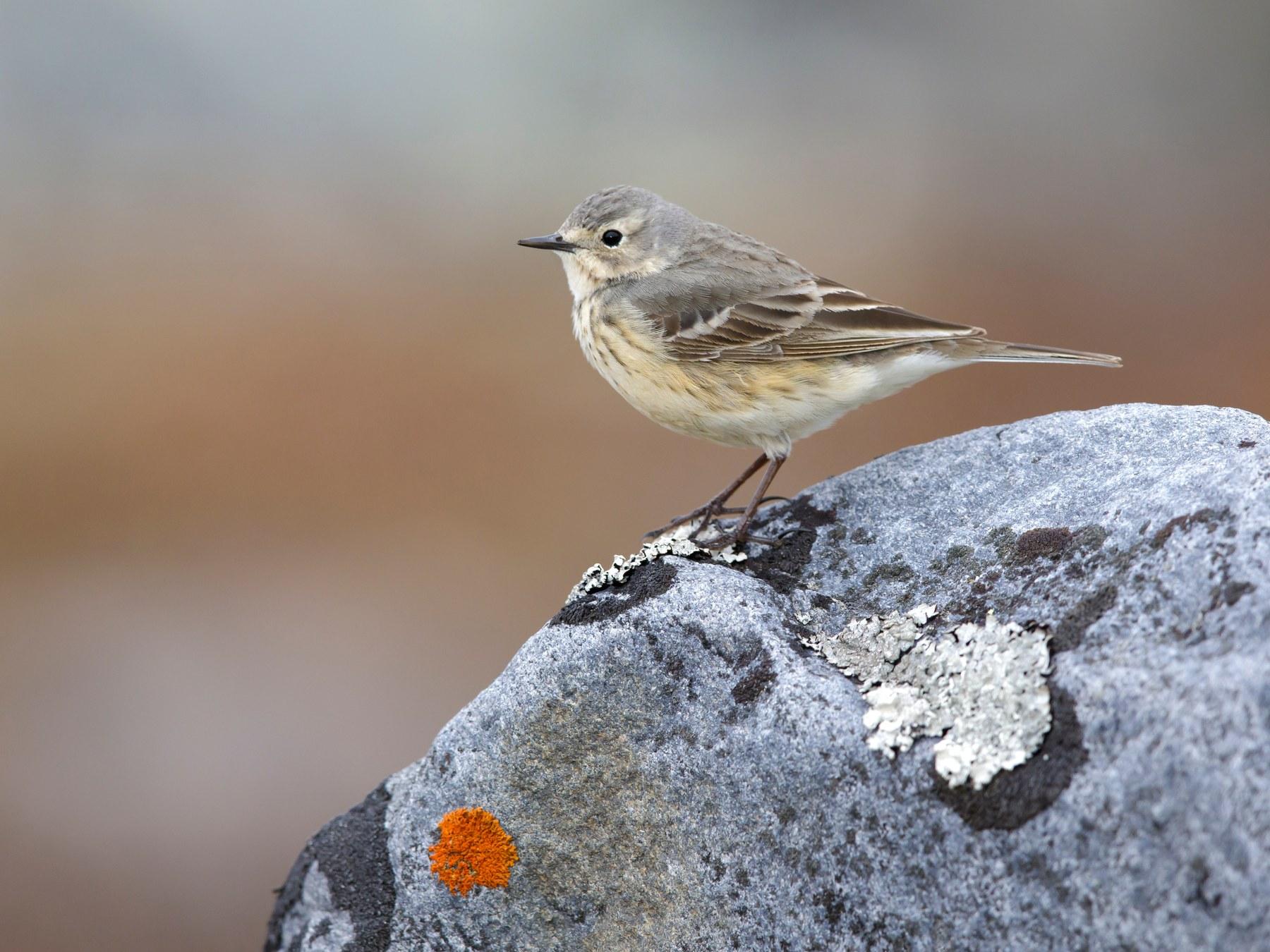
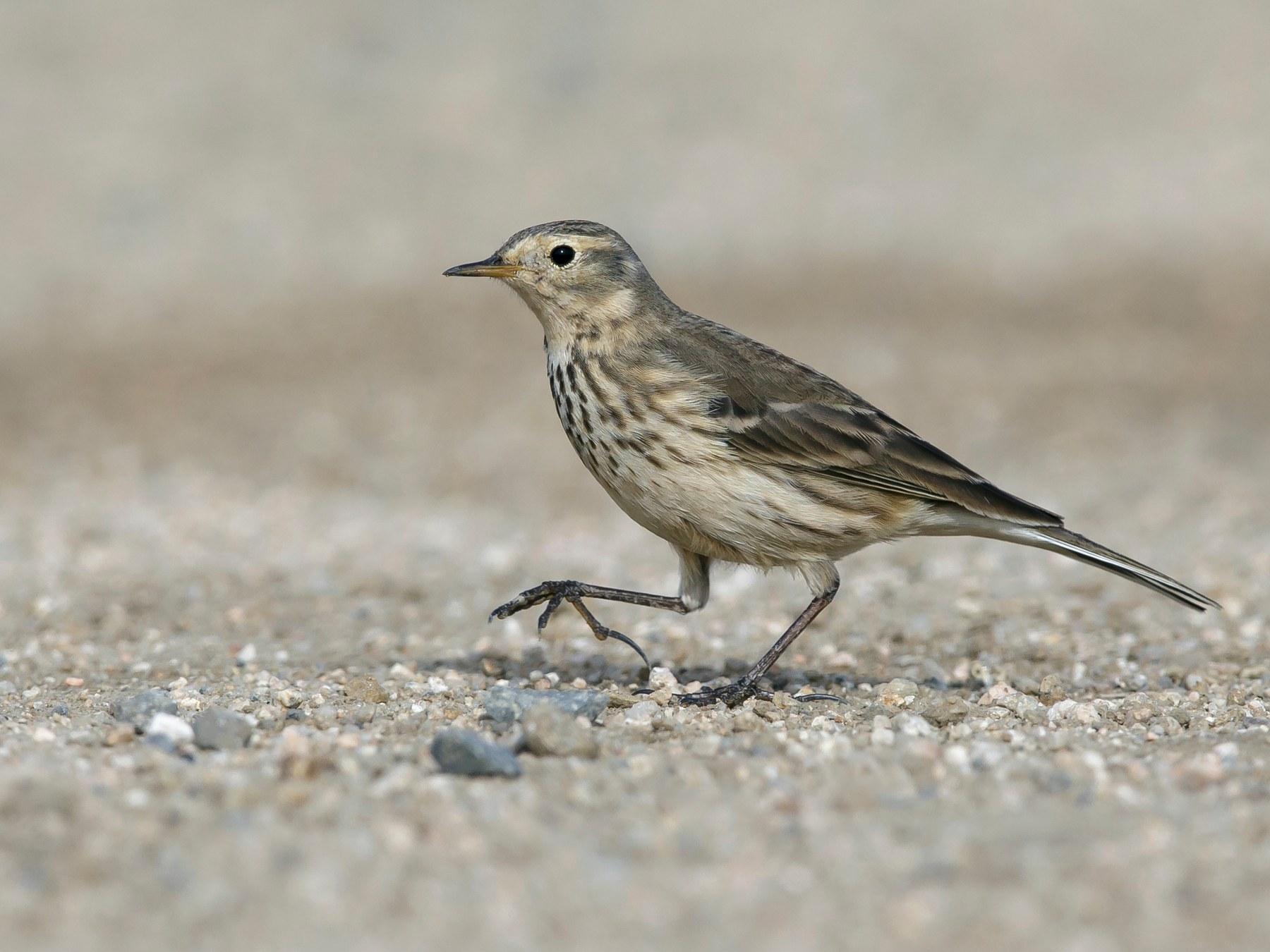
Picture a slim, sparrow-sized brown bird walking, not hopping, across a bare field or a muddy shore, its tail bobbing up and down as it goes. That is the American Pipit. It has a thin, pointed bill, a fairly plain gray-brown back and a blackish tail with white outer feathers that flash when it flies. Flocks often give themselves away first with a high call as they pass overhead.
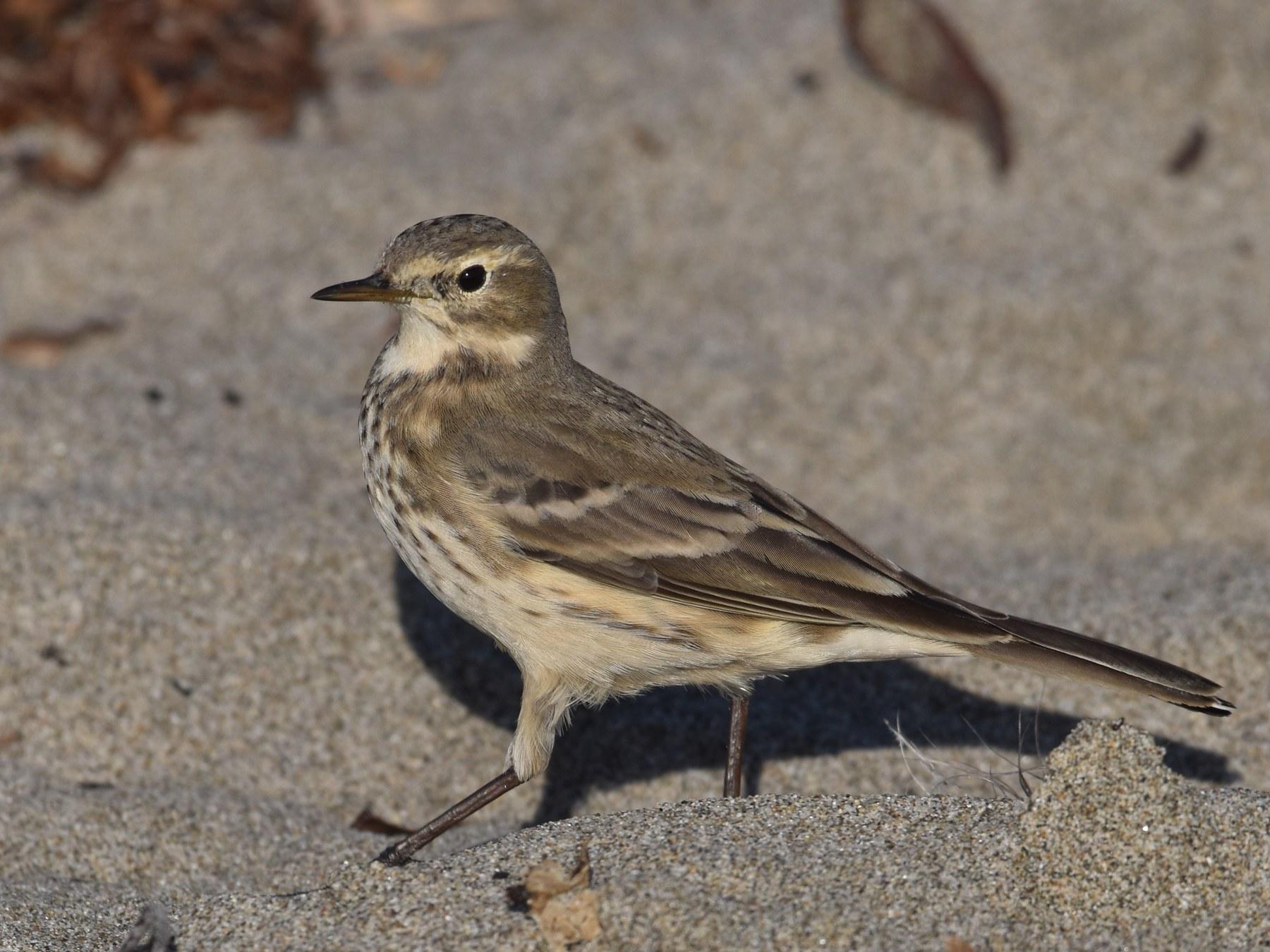
Most people in the US see it in fall, winter and on migration, in its nonbreeding plumage. Then it is gray-brown to olive-gray above with faint dusky streaks on the crown and back. Look for a pale buff eyebrow, a thin white eye-ring and a darker patch on the cheek. Below it is whitish to pale buff, with brown streaks across the breast that fade along the sides, and it shows two pale wing bars.
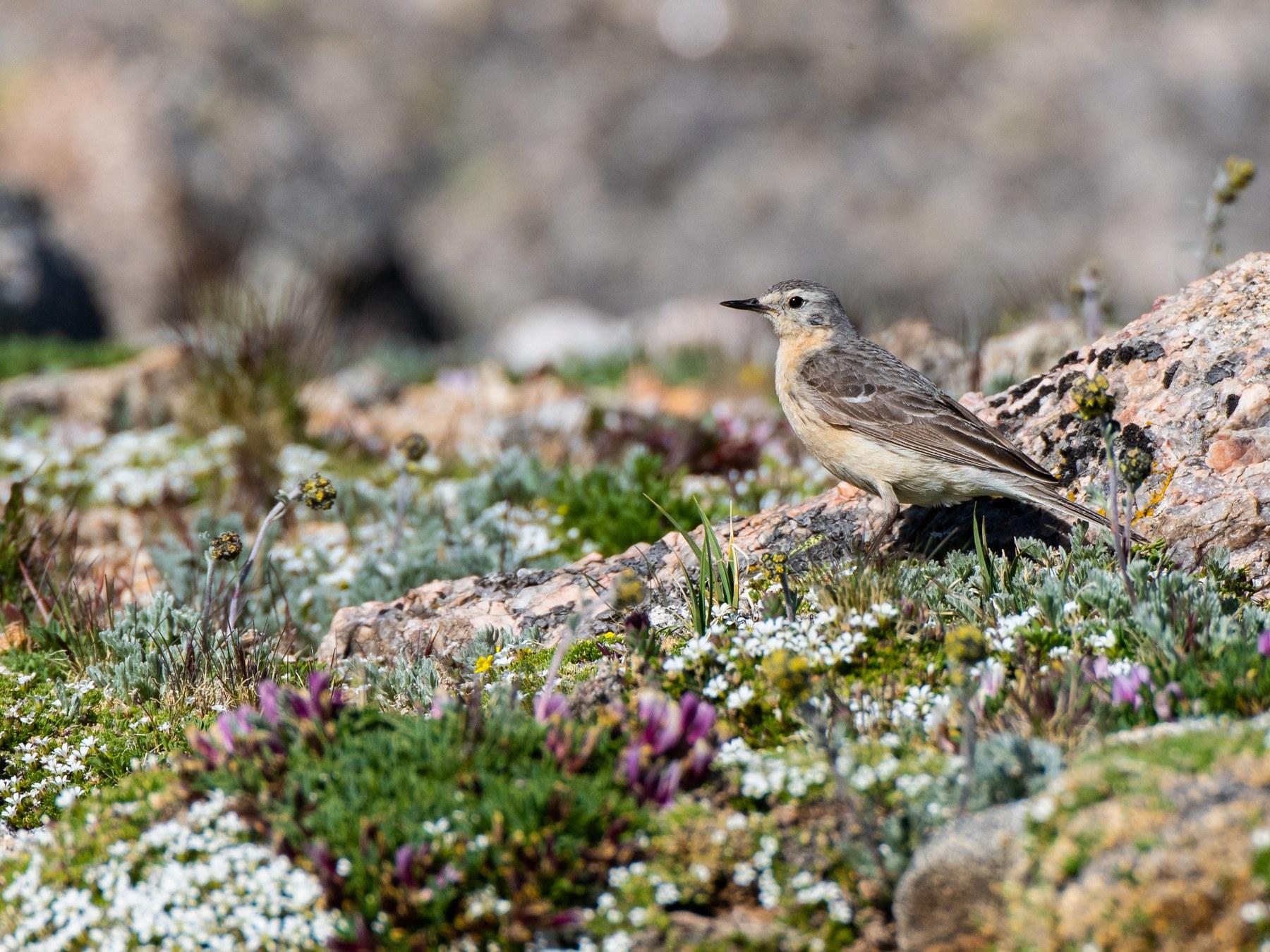
In breeding plumage, from about March to July, it is grayer and plainer above, with little or no streaking, and the gray runs over the crown and onto the cheeks. The eyebrow and throat turn buff to orange, with a thin dark stripe at the side of the throat, and the underparts are buff to orange-buff, richest on the chest, with few or no streaks. Breeding birds differ across the range: yellowish-pink below in Alaska, cinnamon in northern North America and a rich pinkish in the mountains of the western US. By midsummer the plumage wears and looks browner.
The bill is dusky brown, darkest on top, with a paler, yellowish base to the lower half, and the eye is dark brown. Adult legs are usually dark, from brownish black to dusky with a pink tinge, but not always: in one 2024 comparison of nonbreeding birds, 60% had dark legs, 30% reddish brown and 10% pink.1 The hind claw is unusually long, which may help the bird walk on snow and soft mud.
Size and shape
It is 5.5–6.7 in (14–17 cm) long, with a wingspan of 10.6 in (27 cm), and weighs 0.7–0.9 oz (19–26 g).2 That puts it between a Yellow-rumped Warbler and a White-crowned Sparrow in size. The shape is slim, with long legs and a fairly long, square-ended tail.
Males average slightly larger than females, though the two look the same, and the biggest birds live in the mountains of the western US. On the Beartooth Plateau in Wyoming, females outweighed males just before and during egg laying and weighed less than them afterwards.1
Male, female and young birds
Males and females look alike in every plumage. Adults molt all their feathers after nesting, mainly from July to September near the breeding grounds, and molt part of their plumage into breeding dress from February to April, on or near the wintering grounds.
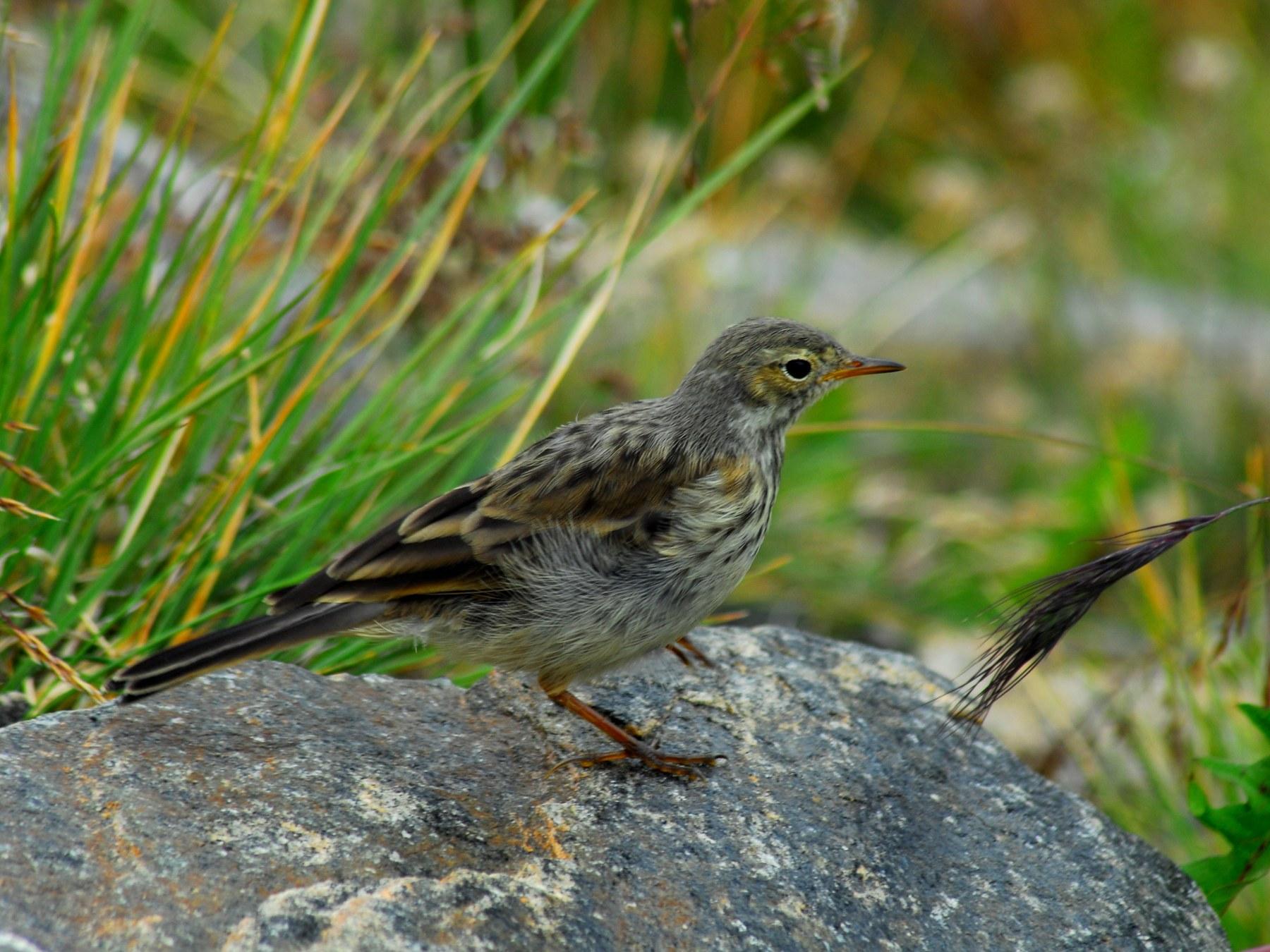
Juveniles, this year's young, are seen mainly from June to August on or near the breeding grounds. They look like nonbreeding adults but are more heavily mottled and streaked above, with wider, browner wing bars and a whitish eye-ring that stands out because the eyebrow and eye-line are faint, and their legs look brighter pink. The juvenile plumage is still poorly described. A 1951 note comparing museum specimens found a young American Pipit streaked above, where a young Sprague's Pipit was scaly.3
Identification: similar birds
It is the only pipit over most of North America. Its main lookalike inland is Sprague's Pipit, in the center of the continent, which has a boldly streaked, scaly-looking back and crown, a plain buffy face without a dark cheek patch, pale pinkish to yellowish legs and a shorter tail with more white. Sprague's does not habitually bob its tail. The American Pipit is usually in wetter places, and it sometimes perches on wires, fences and treetops, which Sprague's rarely does.
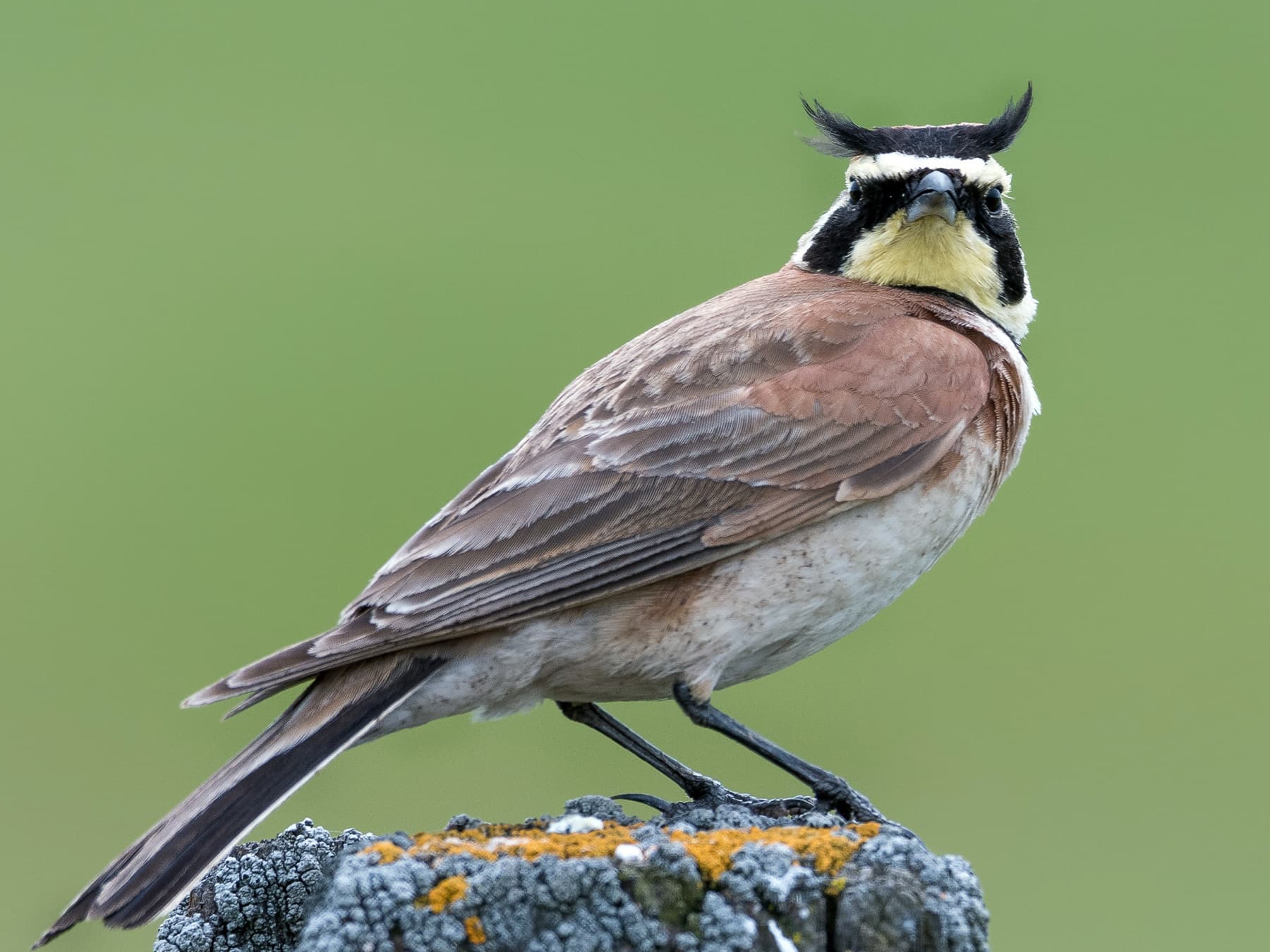
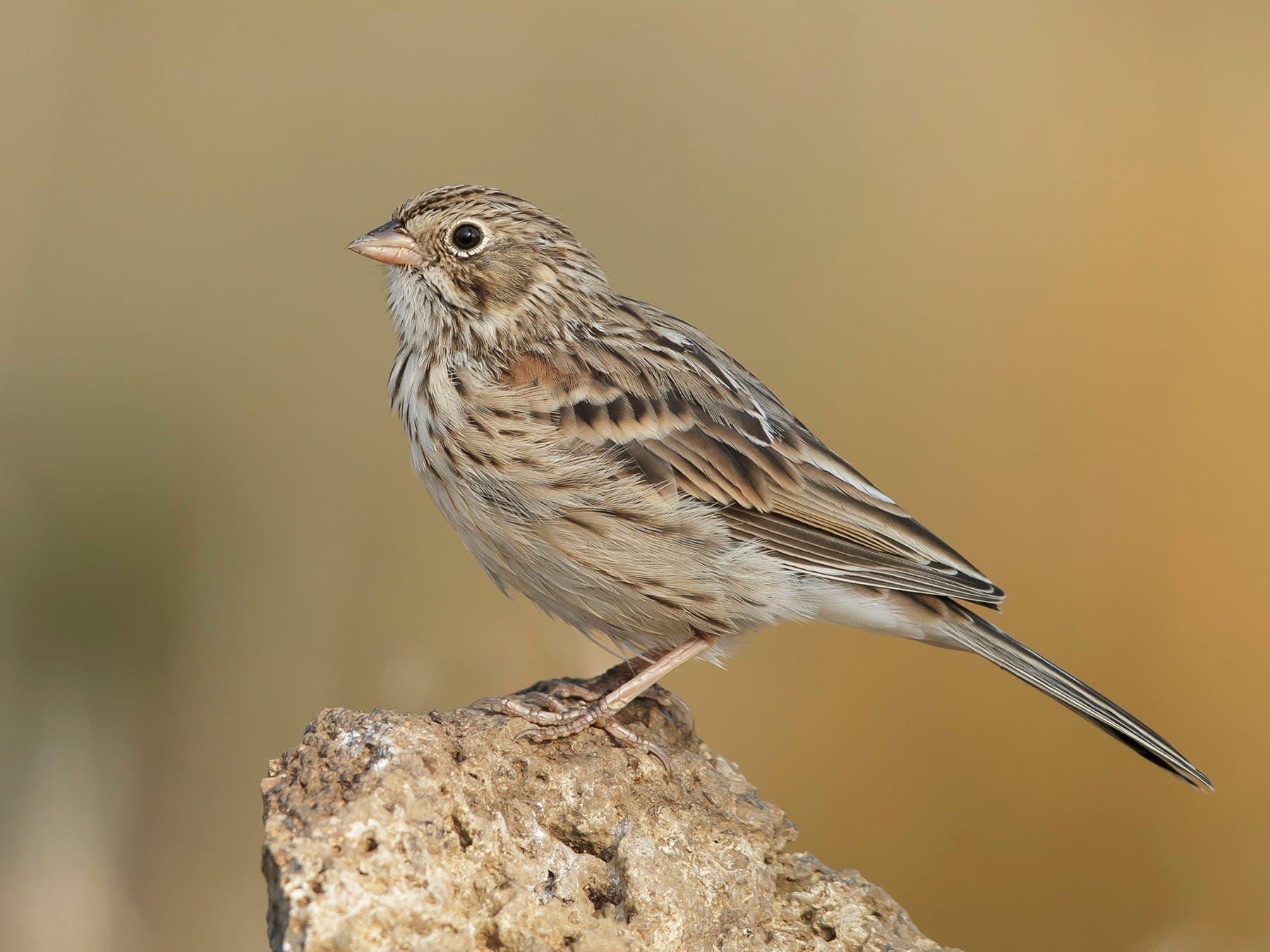
Horned Larks share winter fields with pipits. They are heavier, with black on the face and breast, a white to yellow eyebrow and chin, and small feather "horns" that males usually hold up. A Palm Warbler also wags its tail and often feeds on the ground, but it is a smaller warbler with bright yellow feathers under the tail. A Vesper Sparrow shows white outer tail feathers too, but it has a short, conical bill, streaks above as well as below, and a pale cheek framed in dark.
On the Pacific coast, two rarer pipits turn up. The Red-throated Pipit, a rare fall migrant usually found among American Pipit flocks, has a boldly streaked back and crown, white wing bars and pink legs. Most adults have an orange-red throat, and its flight call is a strident "speeee" rather than the American Pipit's "tsit-tsit". The Siberian Pipit, a rare visitor to western North America, is probably not safely told from an American Pipit in breeding plumage. In winter it tends to be whiter below, with bolder blackish breast streaks and pinker legs. In the 2024 comparison, 96% of Siberian Pipits were white or off-white below against 36% of American Pipits, and 72% had pink legs against 10%, so no single mark settles every bird.1
Not sure it’s a American Pipit? Check your photo: Birdfact names the bird and shows the look-alike side by side.
Its size
Adults- Length
- 14–17 cm
- Wingspan
- 27 cm
- Weight
- 19–26 g
Its song and calls
The sound to learn is the call, a thin, high "pi-pit" or "sip-it", often doubled. Pipits give it mostly in flight, though also on the ground, and flying birds call a lot, so it is often the first sign that a flock is around.
Each flight call is very short and drops in pitch. In a 2023 study of 155 calls from 30 recordings, American Pipit calls lasted about 69 milliseconds and fell from about 8.2 to 4.4 kHz. The Siberian Pipit also gives an M-shaped call that the study did not find in any American bird.4 Near the nest, both parents give a loud, repeated "peep" when a predator comes close; one male called 21 times in 30 seconds. They also have a far-carrying "weet" warning and a soft note when the male brings food.
Only males sing. The song is a rapid run of high notes, repeated phrase after phrase for up to about 15 seconds, given from a perch or in a song flight. In the flight the male climbs up to about 130 ft (40 m), though heights vary, then floats down with wings open and tail raised and spread, often onto the perch he left. In unpublished timings, flights averaged 18.2 seconds (11–31 seconds, 19 flights), and unmated males displayed more often, one making 18 flights in an hour.1 Some observers put the climb at 100 ft or more.2
It calls all year but is most vocal in the breeding season, and it is silent at night. At Mount Rainier, in a study published in 1947, songs were frequent in early July, and flight songs had stopped by late July.5
- Flight calls0:00 / 0:24
Recorded in Glacier National Park, United States · August 2019
- Flight call0:00 / 0:02
Recorded in McGrath State Beach, United States · November 2026
Ben · iNaturalist · CC0 1.0
Heard one and not sure? Let the bird song identifier listen.
When and where to see it
In winter, look for flocks on open, usually rather damp ground: lake and river edges, mudflats, beaches, salt marshes, plowed and stubble fields, pastures, sod farms, airfields, sports fields and wastewater ponds. It winters from about southern New Jersey, southern Pennsylvania, the southern Midwest, Oklahoma and Texas west to Arizona, most of California and western Oregon, and south through Mexico to Baja California Sur, Oaxaca and Veracruz. A few reach northern Central America and the Caribbean. It avoids ground that stays under snow, so the northern edge of the winter range moves with frost and open water.
In summer it breeds mainly on treeless tundra: Arctic tundra from western Alaska to west Greenland, and alpine meadows, fell fields and boulder fields high in the western mountains, south to New Mexico and central California. In the eastern US it breeds on three New England peaks: Maine's Mount Katahdin and New Hampshire's Mount Washington and Mount Madison.
In the western lower 48 states it breeds mostly above treeline in Washington, Oregon, California, Idaho, Nevada's Snake Range, Montana, Wyoming, Utah, Colorado, Arizona's San Francisco and White Mountains and New Mexico. In California it nests in the Sierra Nevada, mostly in the central and southern ranges above 10,000 ft (3,050 m), and in New Mexico above 11,500 ft (3,500 m) in the Sangre de Cristo Range.1
Migration
It is a migrant, moving south as the weather turns and wintering where the ground is free of snow. It migrates by day, in loose, straggling flocks of a few birds to several hundred, and flies low: in east-central Alaska, migrants averaged about 62 ft (19 m) up in spring and 49 ft (15 m) in fall.1
Older state accounts give the timing. In spring, wintering birds have mostly left Louisiana and Florida by late March and Texas and Arizona during April, and breeders reach their sites from mid-April in the Sierra Nevada to mid-May at Churchill, Manitoba. In fall, Arctic birds leave from mid-August to late September, and birds reach Arizona, Louisiana and Florida in October and Texas in November.
Some stop on mountaintops on the way south. At high-elevation sites in interior British Columbia from August to early October, 79% of 534 pipits detected were in alpine grassland, with the most birds in mid-September.1
Range changes and rare visitors
It has colonized mountains in California since the early 1970s, and a singing male at 8,040 ft (2,450 m) in the Sierra San Pedro Mártir, Baja California, suggests a small breeding population there.
Strays have reached Jamaica, Providencia, San Andrés and Costa Rica, it turns up regularly on migration on Bermuda and in western Iceland, and it has strayed as far east as Sweden and Italy.1 The first for Cuba was one bird at Guanahacabibes National Park on 3 December 2014.6 In Britain and Ireland it is a very rare fall visitor; the first British record was on St Kilda in 1910.7
Tips for seeing it
What it eats
It eats mainly insects and other small invertebrates: flies, true bugs, beetles, moths and caterpillars, grasshoppers and spiders. On the coast it also takes marine worms and small crustaceans, and it eats some seeds, especially in fall and winter. We found no source that recommends any feeder food for it.
It feeds on the ground, walking steadily and scanning, then pecking or picking food from plants. Now and then it runs at prey or makes a short flight after an insect, and it wades into shallow water at the edges of streams and ponds and in coastal pools. Most prey is swallowed whole, though butterflies lose their wings first.
On alpine breeding grounds it often feeds on snowfields, picking up insects from the snow. In July in Wyoming, snowfields took up to 18% of foraging trips on the busiest day, and at Clay Butte, Wyoming, 19.6% of 254 feeding observations were on snow.1
The menu changes with the season. In the alpine summer, animal food is almost the whole diet. Wyoming nestlings got 58.3% flies in 144 food samples from 5 nests, and of 62 large loads brought to Wyoming nestlings, 71% were moths and caterpillars. In a 1944 fall sample of 103 birds in Utah, seed bugs and other true bugs made up 56.3% of prey items, beetles 16.3% and weed seeds 14.0%.1 Seeds may matter more inland in fall and winter: one field guide suggests they can make up close to half the diet then.8
Nesting and breeding
It nests on the ground, usually in a wet or dry meadow, a tussock or a bank, tucked under overhanging plants, turf or a rock. It is not known to nest in shrubs, trees or on cliffs. The female builds alone, scraping a hollow and making a cup of coarse dry grasses and sedges lined with finer grass and sometimes hair, while the male occasionally carries material. Inside, the cup is about 2.8 in (7.2 cm) across and 1.5 in (3.9 cm) deep.
Nest direction may follow the weather. In Wyoming, 78% of 36 nests faced northwest to northeast, perhaps away from wind, drifting snow and sun, while 64% of 44 California nests faced south to west.1 At Mount Rainier, nests were under the edge of a boulder, under aster leaves and, apparently, in the mouth of an old rodent burrow.5
Eggs and young
Females lay as soon as nest sites clear of snow: many in May and early June in Alaska, in June in Wyoming and Colorado, and in early to mid-June in California. Late clutches are rare; only 1 of 294 Wyoming clutches was begun after 15 July.1 The eggs are dull white to buffy white but so thickly spotted with reddish brown that they often look dark brown.
Clutches hold 3–7 eggs and are larger farther north, averaging 4.2 in New Mexico (6 nests), 4.6 in Colorado (116), 5.0 in Wyoming (366) and 5.5 in Alaska (114). Where snow lies late, birds lay later and smaller clutches.1 In the Beartooth Mountains, Wyoming, from 1987 to 1989, egg size and shape varied more between females than within one female's clutch, which the author took to suggest a substantial inherited component.9
The female incubates alone, for about 14 days: 14 days 10 hours on average at 9 Wyoming nests. While she sits, the male calls her off to feed her, usually away from the nest. The young hatch nearly naked, with sparse gray down. Only the female broods them, and both parents feed them, the male more at first.
The young leave at about 14 days (14.2 days on average at 19 Wyoming nests), able to walk but with short wings and tails.1 The parents feed them for about two more weeks, and families then break up into loose flocks. Pairs raise one brood a year, and a female may lay again if her first clutch is lost.
Breeding success
Nest success varies with the site and the weather. On the Beartooth Plateau, Wyoming, 70% of 84 nests fledged young, against 57% of 14 at Guanella Pass, Colorado, 75% of 8 on Mount Washington, New Hampshire, and 33% of 12 on Baffin Island, where most losses were to bad weather.
Summer snow is a real hazard. When a storm buried 17 alpine nests at about 10,500 ft (3,200 m) in the Beartooth Mountains for 24 hours, the youngest nestlings fared worst: all 44 nestlings 11 days or older survived, but only about 11% of the 36 younger ones did. At a lower, subalpine site at 9,500 ft (2,900 m), 4 of 58 nestlings died in the same storm.1
No cowbird or other brood parasitism has been reported, though model cuckoo eggs placed in a small sample of Alaskan nests were not rejected, which suggests it could be vulnerable. Blowfly larvae sometimes live in the nest. In one sample they were found in 2 of 66 nests with young and killed 5 of the 8 nestlings in them; in another, 3 of 85 broods of older nestlings had them and none died.1
Behaviour
It walks or runs rather than hops, sometimes nodding its head, and it bobs its tail often as it walks. One early observer at a Mount Rainier nest found the tail "almost constantly in motion".5 We found no source that explains why it bobs. Its flight is strong and undulating, and it perches on shrubs, trees, fences and wires where they exist.
Outside the breeding season it is usually in flocks, from small groups to hundreds of birds. A winter flock flushes together, circles and drops back to feed. One South Carolina field held two to three hundred in 1927.10 A flock of about 1,000 birds was once seen coming in to roost in a marshy field.1
Pairs form for one season, and some birds arrive on the breeding grounds already paired. Males hold their territories with song flights, displays, chases and fights, and defend them most strongly until about halfway through incubation. Territories run from about 1/3 to 5 acres.2 In one unpublished study of six pairs with nestlings, watched for 140 hours, males made 49 of 63 nest-defense bouts.1
Males have two displays. In one, rivals walk back and forth toward each other with wings drooped, bobbing their tails; in the other, described from Rocky Mountain birds, a male stands upright on a raised perch with bill and tail held high, and the tail does not bob.
Lifespan and predators
The oldest American Pipit on the US Bird Banding Laboratory's longevity list was at least 4 years 1 month old: a female banded in New Hampshire on 29 June 1939, at an unknown age, and caught and released there on 2 July 1943. It is the only record on that list.11 Birds of the World gives an older female, at least 5 years 1 month, from a 1983 list of longevity records.1 No source we read gives survival rates or a typical lifespan.
Little is known about how many return. On the Beartooth Plateau, 1 male of 222 nestlings banded in 1963 bred there in 1964, and 4 of 32 adult females banded in 1987–1988 were seen the next year.1
Red foxes take eggs and nestlings, and deer mice, ground squirrels and Common Ravens may take them too; long-tailed weasels are suspected of killing adults and young. Adults are taken by falcons, including American Kestrel, Merlin, Prairie Falcon and Peregrine Falcon, by Rough-legged Hawks and by Barn and Short-eared Owls, and possibly by ravens. Groups of 8–10 pipits may chase or mob a Peregrine. A female flushed from her nest flutters off low and silent with the white tail edges spread, without any broken-wing act.
Conservation
The American Pipit is rated Least Concern on the IUCN Red List, although that 2019 assessment was made for the old combined species, before the Siberian Pipit was split off.12 Partners in Flight estimates about 18 million breeding-age birds in the US and Canada, as of about 2010.13 The same source's world figure of 20 million was made before the split and included the Siberian Pipit.2
NatureServe ranks it G5 globally. Its lowest breeding ranks are in Maine (S1) and in New Hampshire, Wyoming and Arizona (S2); these are conservation ranks, not legal listings.14
Population trend
Nobody knows for sure which way numbers are going. The North American Breeding Bird Survey publishes no trend for it,15 and the survey is not suited to monitoring it.1 Partners in Flight's continental trend, taken from Christmas Bird Counts, is a fall of 4.3% a year over the long term, but its 90% interval runs from a 20.7% fall to a 6.4% rise, and Partners in Flight itself marks the trend unreliable.13
One analysis of Christmas Bird Counts found a significant winter decline in the West, in California and Oregon, but no significant change in the central and eastern regions. Whether the western fall is real still needs more analysis: it could come from towns growing around the count circles, from birds wintering farther north, or from a real loss of damp habitat.1
Conservation pressures
Clearing forests probably added migration and winter habitat, while draining wetlands may have taken some away. On the breeding grounds, sheep grazing, recreation and mining may damage alpine meadows, though the effects are not yet known.1
Climate change may shrink its nesting habitat as shrubs and treeline move north and upslope.2 A 1991 study predicted that treeline in the Greater Yellowstone area could rise from about 9,800 ft (3,000 m) to 10,800 ft (3,300 m), which could lead to the local loss of some pipit populations.1
Legal status
In the United States it is on the federal list of birds protected under the Migratory Bird Treaty Act.16 Under the federal regulations, no one may take, possess, sell or transport such a bird, its parts, nests or eggs except as a permit or regulation allows.17 It is not listed under the Endangered Species Act.18
In Canada, pipits are among the birds in the Migratory Birds Convention Act's schedule.19 In Mexico it is not on the 2010 national list of species at risk, NOM-059-SEMARNAT-2010; we did not read later changes to the list.20 In Britain, where it is a very rare visitor, it is protected as a wild bird under the Wildlife and Countryside Act 1981, and it is not on Schedule 1.21
Names and taxonomic status
Its scientific name is Anthus rubescens. Rubescens is Latin for "reddish" or "blushing", and it was first described in 1771 as a lark, from Pennsylvania. The word "pipit" sounds like the call, but it is traced to the Latin pipio, "to peep".
For a long time it was treated as part of the Water Pipit, together with the Rock Pipit. Studies of genetics, voice and behavior split that group, first into the Water Pipit, the Rock Pipit and an American Pipit that still included the Asian birds. Buff-bellied Pipit is a name used for that combined species. In 2023, a study of mitochondrial DNA and 338 flight calls recommended treating the Asian birds as a separate species, the Siberian Pipit (Anthus japonicus). It found the two lineages 2.2% and 2.5% apart in two mitochondrial markers, and dated their split to roughly 1.5 to 2.7 million years ago.4 Ornithologists adopted the split in 2024.2
A 2026 study of whole mitochondrial genomes from 39 pairs of related lineages on either side of the Bering Strait found the American and Asian pipits already clearly distinct, one of ten pairs with separate Old World and New World lineages.22 The ancestor probably reached North America from Asia across the Bering Strait.4 Birds of the World recognizes three subspecies, pacificus, rubescens and alticola of the Rocky Mountains and Sierra Nevada, while AviList folds pacificus into rubescens, leaving two.
Similar birds
Often mistaken for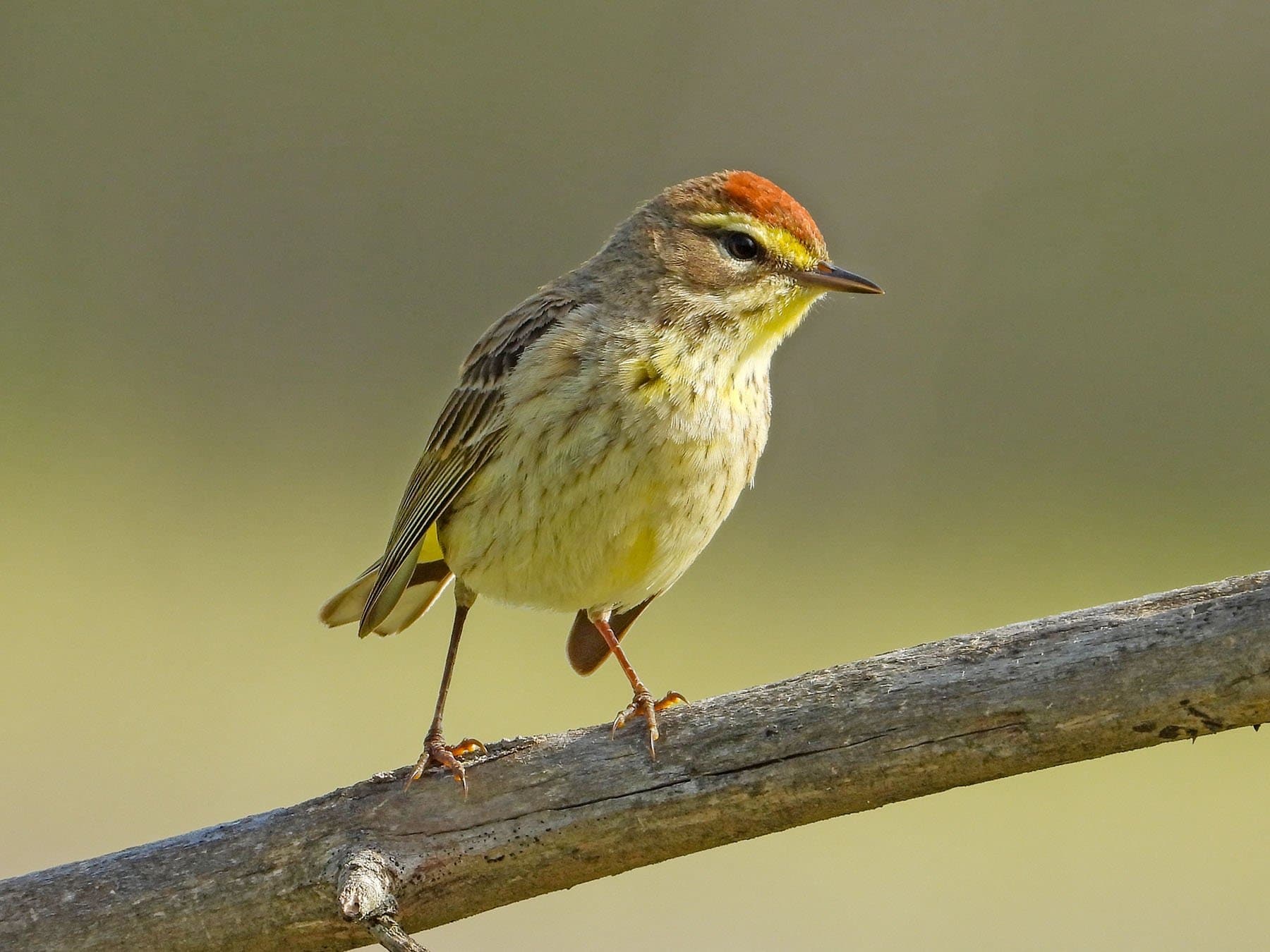
Quick facts
- Length
- 14–17 cm
- Wingspan
- 27 cm
- Weight
- 19–26 g
- Lifespan
- oldest recorded 4 years 1 month
- Family
- Wagtails & Pipits
- Migration
- Full migrant
- Global status (IUCN)
- Least Concern
- World population
- About 18 million breeding-age birds in the US and Canada (Partners in Flight, estimate year about 2010)
- Population trend
- Not monitored by the Breeding Bird Survey; winter counts suggest a decline in the West, but Partners in Flight rates its own trend unreliable, with a range that runs from a fall to a rise, so the long-term direction is unknown
- Also called
- Buff-bellied Pipit
- Scientific name
- Anthus rubescens
Questions
2Is an American Pipit a sparrow?
No. It is a pipit, in the wagtail and pipit family, not a sparrow. It has a thin, pointed bill rather than a sparrow's heavier bill, and it walks and bobs its tail instead of hopping (see appearance).
Is the Buff-bellied Pipit the same bird?
Partly. Buff-bellied Pipit is the name used for the combined species before the Siberian Pipit was split from it. Today the North American bird is the American Pipit, and the Asian birds are the Siberian Pipit (see names and taxonomic status).
Sources
34- 1Hendricks, P., Verbeek, N. A. and Mlodinow, S. G. (2024). American Pipit (Anthus rubescens), version 2.0. Birds of the World (B. K. Keeney and S. M. Billerman, editors). Cornell Lab of Ornithology. doi:10.2173/bow.amepip.02 (opens in a new tab)
- 2Cornell Lab of Ornithology. American Pipit: Overview, Identification, Life History and Maps. All About Birds. Accessed 22 November 2026. Source (opens in a new tab)
- 3Shortt, T. M. (1951). On the Juvenal Plumage of North American Pipits. The Auk 68(3): 265. doi:10.2307/4080978 (opens in a new tab)
- 4Doniol-Valcroze, P. et al. (2023). Molecular and acoustic evidence support the species status of Anthus rubescens rubescens and Anthus [rubescens] japonicus (Passeriformes: Motacillidae). Zootaxa 5343(2): 173-192. doi:10.11646/zootaxa.5343.2.4 (opens in a new tab)
- 5Pickwell, G. (1947). The American Pipit in Its Arctic-Alpine Home. The Auk 64(1): 1-14. doi:10.2307/4080059 (opens in a new tab)
- 6Good, M. J. and Alayon, G. (2019). First report of American Pipit (Anthus rubescens) on Cuba. Journal of Caribbean Ornithology 32: 1-3. doi:10.55431/jco.2019.32.1-3 (opens in a new tab)
- 7British Trust for Ornithology. American Pipit (Anthus rubescens). BTO BirdFacts. Accessed 22 November 2026. Source (opens in a new tab)
- 8National Audubon Society and Kaufman, K.. American Pipit. Audubon Guide to North American Birds. Accessed 22 November 2026. Source (opens in a new tab)
- 9Hendricks, P. (1991). Repeatability of size and shape of American Pipit eggs. Canadian Journal of Zoology 69(10): 2624-2628. doi:10.1139/z91-369 (opens in a new tab)
- 10Hudson, G. E. (1928). A Probable Recurrence of a Partial Albino Pipit (Anthus rubescens) in Winter. The Auk 45(3): 381-382. doi:10.2307/4076057 (opens in a new tab)
- 11USGS Bird Banding Laboratory (2025). Longevity Records of North American Birds, version 2025.1 (AOU 6970). U.S. Geological Survey. Accessed 22 November 2026. Source (opens in a new tab)
- 12BirdLife International (2019). Anthus rubescens. The IUCN Red List of Threatened Species 2019 (via GBIF's copy of the IUCN checklist). IUCN Red List / GBIF. doi:10.2305/IUCN.UK.2018-2.RLTS.T22718575A155437845.en (opens in a new tab)
- 13Partners in Flight (2024). Avian Conservation Assessment Database, Global (version 2024.05.23). Partners in Flight. Accessed 22 November 2026. Source (opens in a new tab)
- 14NatureServe. Anthus rubescens (American Pipit). NatureServe Explorer. Accessed 22 November 2026. Source (opens in a new tab)
- 15Hostetler, J. A. et al. (2026). The North American Breeding Bird Survey, Analysis Results 1966 - 2025. U.S. Geological Survey. doi:10.5066/P1OSNSFC (opens in a new tab)
- 16U.S. Fish and Wildlife Service (2026). 50 CFR 10.13 List of Migratory Birds (eCFR, issue of 2026-11-17). Electronic Code of Federal Regulations. Accessed 22 November 2026. Source (opens in a new tab)
- 17U.S. Fish and Wildlife Service (2026). 50 CFR 21.10 and Part 21 (eCFR, issue of 2026-11-17). Electronic Code of Federal Regulations. Accessed 22 November 2026. Source (opens in a new tab)
- 18U.S. Fish and Wildlife Service (2026). 50 CFR 17.11 Endangered and threatened wildlife (eCFR, issue of 2026-11-17). Electronic Code of Federal Regulations. Accessed 22 November 2026. Source (opens in a new tab)
- 19Government of Canada (1994). Migratory Birds Convention Act, 1994 (S.C. 1994, c. 22), Schedule. Justice Laws Website. Accessed 22 November 2026. Source (opens in a new tab)
- 20SEMARNAT (2010). NOM-059-SEMARNAT-2010 (DOF 30/12/2010). Diario Oficial de la Federación. Accessed 22 November 2026. Source (opens in a new tab)
- 21UK Parliament (1981). Wildlife and Countryside Act 1981, section 1 and Schedule 1. legislation.gov.uk. Accessed 22 November 2026. Source (opens in a new tab)
- 22Collier, K. A. et al. (2026). Mitogenomes reveal the timing and distribution of divergence events among trans-Beringian birds. PeerJ 14: e20675. doi:10.7717/peerj.20675 (opens in a new tab)
- 23Davis, S. K., Robbins, M. B. and Dale, B. C. (2020). Sprague's Pipit (Anthus spragueii), version 1.0: Identification. Birds of the World (A. F. Poole, editor). Cornell Lab of Ornithology. doi:10.2173/bow.sprpip.01 (opens in a new tab)
- 24Beason, R. C. (2020). Horned Lark (Eremophila alpestris), version 1.0: Identification. Birds of the World (S. M. Billerman, editor). Cornell Lab of Ornithology. doi:10.2173/bow.horlar.01 (opens in a new tab)
- 25Wilson Jr., W. H. (2020). Palm Warbler (Setophaga palmarum), version 1.0: Identification. Birds of the World (A. F. Poole, editor). Cornell Lab of Ornithology. doi:10.2173/bow.palwar.01 (opens in a new tab)
- 26Jones, S. L. and Cornely, J. E. (2020). Vesper Sparrow (Pooecetes gramineus), version 1.0: Identification. Birds of the World (A. F. Poole and F. B. Gill, editors). Cornell Lab of Ornithology. doi:10.2173/bow.vesspa.01 (opens in a new tab)
- 27Tyler, S. (2020). Red-throated Pipit (Anthus cervinus), version 1.0. Birds of the World (J. del Hoyo, A. Elliott, J. Sargatal, D. A. Christie and E. de Juana, editors). Cornell Lab of Ornithology. doi:10.2173/bow.retpip.01 (opens in a new tab)
- 28Tyler, S. (2020). Water Pipit (Anthus spinoletta), version 1.0. Birds of the World (J. del Hoyo, A. Elliott, J. Sargatal, D. A. Christie and E. de Juana, editors). Cornell Lab of Ornithology. doi:10.2173/bow.watpip1.01 (opens in a new tab)
- 29Montana Natural Heritage Program. American Pipit (Anthus rubescens). Montana Field Guide. Accessed 22 November 2026. Source (opens in a new tab)
- 30Hendricks, P. (1987). Foraging patterns of Water Pipits (Anthus spinoletta) with nestlings. Canadian Journal of Zoology 65(6): 1522-1529. doi:10.1139/z87-235 (opens in a new tab)
- 31Schneider, K. R. (2014). Featured Photo: Hypermelanism in an American Pipit. Western Birds 45(1): 84-86. doi:10.21199/wb45.1.6 (opens in a new tab)
- 32Schneider, K. R. (2015). Hypermelanistic American Pipit returns to winter in central California. Western Birds 46(3): 263. doi:10.21199/wb46.3.7 (opens in a new tab)
- 33AviList Core Team (2025). AviList: The Global Avian Checklist, v2025b. AviList. doi:10.2173/avilist.v2025b (opens in a new tab)
- 34Jobling, J. A.. The Key to Scientific Names: Anthus; rubescens. Birds of the World. Accessed 22 November 2026. Source (opens in a new tab)

Checked by
Nathan Cope, founder and editor
Nathan founded Birdfact and leads its writers and contributors in the UK, the US and Canada. He has watched and studied birds for more than ten years, and checks every article and species guide before it’s published.