Species Profile
Palm Warbler
Setophaga palmarum
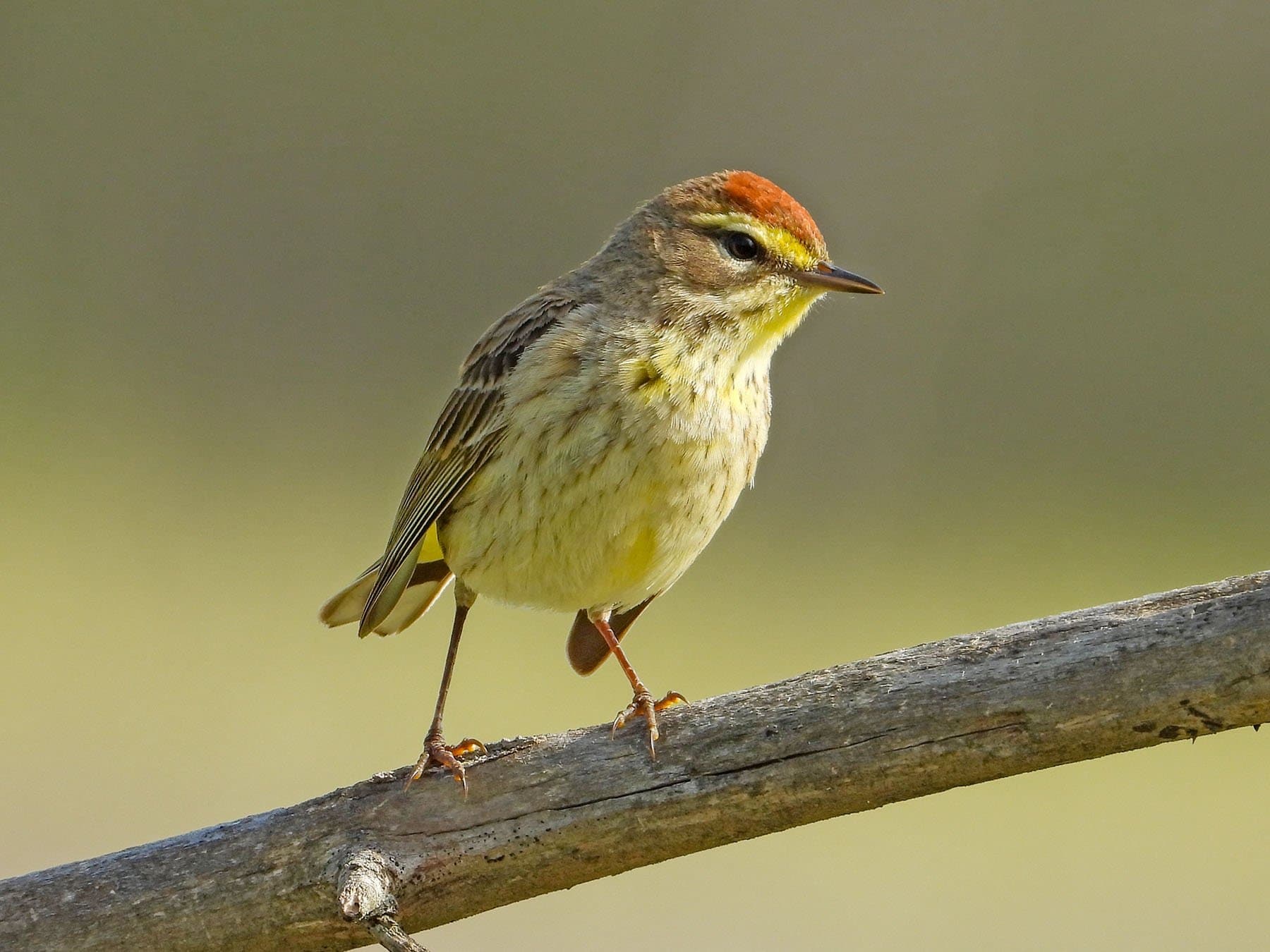
Palm Warbler perched on a bare wooden branch, showing its reddish-brown cap, yellow underparts, and streaked flanks.
Quick Facts
Conservation
LCLeast ConcernLifespan
2–5 years
Length
12–14 cm
Weight
8.5–14.2 g
Wingspan
19–21 cm
Migration
Long-distance Migrant
Bob your eyes down to the ground the next time you're birding in Florida or along the Atlantic coast in autumn — that small, tail-pumping warbler working the leaf litter is almost certainly a Palm Warbler, one of North America's most terrestrial wood-warblers. Despite its name, this species breeds not among tropical palms but deep in the sphagnum bogs of Canada's boreal forest, making it one of the northernmost nesting warblers on the continent.
Think you've spotted a Palm Warbler?
Upload a photo and we'll confirm it instantly
Confirm with a PhotoAppearance
The Palm Warbler is a small, somewhat stocky songbird measuring 12–14 cm in length. Its most reliable field mark — visible in every plumage, every season — is the bright yellow undertail coverts, which flash conspicuously as the bird pumps its tail. A pale to bright yellow supercilium (eyebrow stripe) and a dark eyeline through the eye complete the face pattern. The bill is short and sharply pointed, dark in colour; the legs are blackish.
Breast and flank streaking is a useful diagnostic detail: most warblers show black or grey streaks, but the Palm Warbler's streaks are distinctly reddish-brown (rufous), a feature that holds across both subspecies and all seasons. The wings show low-contrast pale wing bars, and the tail has a wide, square dark base that contrasts with the yellow vent patch.
Two subspecies look markedly different. The Western Palm Warbler (S. p. palmarum) is the drabber form: cold greyish-brown upperparts, off-white to pale yellowish belly, a bright yellow throat and vent, and a whitish eyebrow. In non-breeding plumage, the chestnut cap is replaced by brown and the overall impression is washed-out and pale. The Yellow Palm Warbler (S. p. hypochrysea) is considerably richer: brownish-olive upperparts with a warm tinge, uniformly bright yellow underparts from throat to vent in all plumages, bold rufous breast streaking, and a vivid yellow eyebrow.
In breeding plumage (spring and summer), both subspecies sport a vivid chestnut cap, a crisply defined eyeline, and a dark cheek. Non-breeding and immature birds are pale, washed-out versions of their spring selves — some autumn immatures are so nondescript they resemble pipits in both appearance and behaviour, identifiable mainly by their incessant tail-wagging. Moult from juvenile to first basic plumage occurs between July and September.
Identification & Characteristics
Colors
- Primary
- Brown
- Secondary
- Yellow
- Beak
- Black
- Legs
- Black
Markings
Bright yellow undertail coverts, rufous-chestnut crown (breeding), pale to yellow supercilium, dark eyeline, rufous-brown breast streaking, constant tail-bobbing behaviour
Tail: Short, square-tipped; wide dark base contrasting with bright yellow undertail coverts; tail pumped continuously in characteristic bobbing motion
Attributes
Understanding Attributes
Rated 0–100 based on research and observation. A score of 50 is average across all bird species. These attributes are relative and don't necessarily indicate superiority.
Habitat & Distribution
On the breeding grounds, the Palm Warbler is a bog specialist. It nests almost exclusively in open sphagnum bogs and peatlands within the boreal forest zone, favouring sites with scattered black spruce (Picea mariana), tamarack (Larix laricina), and cedar at the margins, and a ground layer of Sphagnum moss, sedges, and other damp bog plants. It is the only warbler species likely to be found nesting in muskegs and bogs across the boreal forest. The Western Palm Warbler also uses dry pine barrens with ground cover of blueberry, bearberry, and sweet fern.
The breeding range sweeps across boreal Canada from southeastern Yukon and northeastern British Columbia east to Labrador and Newfoundland, dipping south into the extreme northern United States — northern Minnesota, Wisconsin, Michigan, New York's Adirondacks, Vermont, New Hampshire, and Maine. An estimated 98% of the global population breeds in Canada's boreal forest. In British Columbia, breeding is restricted to the northeastern corner of the province (Fort Nelson River lowlands, Taiga Plains Ecoprovince), almost entirely below 750 m elevation.
In winter, the species occupies a broad arc from the southeastern United States through the Caribbean and into Central America. The wintering range extends along the Atlantic coast from Delaware south through Florida, along the Gulf Coast to Texas, throughout the Bahamas and Greater Antilles (Cuba, Hispaniola, Jamaica, Puerto Rico), the Virgin Islands, and the Yucatán Peninsula south to Nicaragua. Small numbers winter regularly along the Pacific coast of the United States and Mexico. Unusually for a warbler, the Palm Warbler winters as far north as southern Nova Scotia and has been recorded every year since 1900 on Christmas Bird Counts in Massachusetts.
During migration, Palm Warblers use a wide variety of open and semi-open habitats: weedy fields, forest edges, fence rows, hedgerows, stream margins, overgrown pastures, and scrubby areas with scattered trees. For US birders, Florida is the standout destination — the Palm Warbler is one of the most abundant wintering warblers in the state, present from October through April. It is a common migrant along the entire Atlantic seaboard, reaching New England by mid-to-late April. Canadian birders can find breeding birds in boreal bogs from British Columbia to Newfoundland, and small wintering populations persist in Nova Scotia and on southeastern Vancouver Island.
Where to See This Bird
Explore regional guides for locations where this bird has been recorded.
Florida
United States
Georgia
Kentucky
Louisiana
Massachusetts
Maine
Maryland
Michigan
Minnesota
Mississippi
Alabama
North Carolina
New Jersey
Connecticut
District of Columbia
Delaware
New York
Pennsylvania
South Carolina
Rhode Island
Tennessee
Virginia
Manitoba
Nova Scotia
Northwest Territories
Ontario
Saskatchewan
Diet
Insects dominate the Palm Warbler's diet during the breeding season. The menu includes small beetles (Coleoptera), mosquitoes, flies (Diptera), caterpillars (Lepidoptera), aphids (Hemiptera), grasshoppers (Orthoptera), ants, bees and wasp larvae (Hymenoptera), and spiders. On the breeding grounds, prey is taken from the ground, from low shrubs, from the foliage of scattered conifers, and in mid-air by sallying from a perch.
In autumn and winter, the diet broadens considerably. Palm Warblers consume raspberries, bayberries (Myrica pensylvanica), sea grapes, and hawthorn berries, as well as seeds. They also take nectar from century plants, sea grapes, and tiger claw trees — an opportunistic nectivory that few competitors mention but which is well documented on the wintering grounds.
The Palm Warbler is a diurnal visual forager. Its most distinctive foraging method is walking and hopping across open ground, gleaning insects from the soil surface and low vegetation — a technique far more typical of a pipit or a thrush than a warbler. It also hovers momentarily to snatch insects from foliage and makes short aerial sallies to catch flying prey. In winter, foraging birds regularly join mixed flocks, benefiting from the extra eyes of sparrows and juncos to locate food and detect predators.
Behaviour
Tail-bobbing is the Palm Warbler's signature. The bird pumps its tail continuously — whether walking across a lawn, perching on a fence post, or clinging to a shrub — and this habit alone is enough to identify even the most featureless autumn individual. Only two other Setophaga warblers (Kirtland's and Prairie) share this incessant tail-pumping, and neither overlaps with the Palm Warbler's typical haunts in winter.
The Palm Warbler is the most terrestrial member of its genus. It spends far more time on the ground than any other wood-warbler, walking and hopping across open areas with a gait that recalls a pipit or a wagtail — folk names such as 'Wagtail Warbler' and 'Tip-up Warbler' capture this perfectly. On the breeding grounds it also gleans insects from the foliage of black spruce, tamarack, and cedar, and regularly sallies into the air to catch flying insects like a miniature flycatcher.
Outside the breeding season, Palm Warblers are sociable birds. They frequently join mixed-species foraging flocks with Dark-eyed Juncos, sparrows, Ruby-crowned Kinglets, Pine Warblers, and Yellow-rumped Warblers. On the breeding grounds, males are territorial and sing persistently from high perches — often throwing the head far back — to establish territory and attract mates. The species is generally tolerant of human activity and can be found foraging on suburban lawns, in car parks, and along roadsides.
Calls & Sounds
The Palm Warbler's song is a slow, buzzy, flat-toned trill — a series of 4–16 buzzy notes that each swell slightly in pitch, strung together into a continuous trilling quality lasting 1–3 seconds. Songs are separated by 12–18 seconds of silence. The effect has been transcribed as peacie peacie peacie peacie or sawee sawee sawee sawee. It is often compared to the trill of a Chipping Sparrow, but is distinctly slower, weaker, and buzzier; it also resembles the trill of a Dark-eyed Junco. Only the male sings, and song quality and speed vary between individuals and between the two subspecies.
Males sing from high, exposed perches — often from the very top of a spruce or tamarack, head thrown far back — to establish territory and attract mates. Singing begins soon after dawn and continues until early afternoon. Males are most vocal from arrival on the breeding grounds in early April through to early to mid-July, after which song frequency drops sharply.
The primary call is a sharp, husky tchit or chek — described as more metallic and sharper than the chip note of a Yellow-rumped Warbler. A louder, sharper alarm note is also given. Flight calls have been recorded as a thin tink note. The Palm Warbler does not sing often during migration and is generally quiet on the wintering grounds, though chip calls are given year-round and are a useful way to detect birds moving through dense cover.
Flight
In flight, the Palm Warbler appears compact and slightly heavy-bodied for a warbler, with a relatively short, broad tail and rounded wings. The flight style is undulating — a series of quick wingbeats followed by a brief closed-wing glide — typical of the wood-warbler family, though the Palm Warbler's undulations are somewhat shallower and less pronounced than those of many relatives.
The yellow undertail coverts and yellow rump are conspicuous in flight, flashing as the bird rises from the ground. The wide, square dark base of the tail contrasts with the yellow vent patch, creating a distinctive rear-end pattern visible even at distance. The pale eyebrow and dark eyeline are also visible on a bird flushed from the ground at close range.
The Palm Warbler migrates nocturnally, moving in small flocks often mixed with other warblers and songbirds. During migration, birds are regularly detected by their thin tink flight call as they pass overhead at night. Daytime movements are typically low and direct, with birds dropping quickly into cover when disturbed. On the wintering grounds, short flights between foraging patches are low and fast, hugging the ground more closely than most warblers.
Nesting & Breeding
Palm Warblers are early nesters. Males arrive on the breeding grounds in early April and begin singing from high perches to establish territories. Pair formation runs from late April to mid-May, and nest-building starts in early to mid-May. Egg dates range from mid-May to late June, occasionally into mid-July.
The nest is an open cup placed on or very near the ground, typically nestled in sphagnum or peat moss at the base of a small conifer — spruce, tamarack, or cedar — close to the trunk. It is frequently concealed under a clump of grass or on top of a sphagnum hummock, near the margins of heath bogs with dense shrub cover. The female constructs the nest from weed stalks, grass, sedges, shreds of bark, rootlets, woody stems of Labrador tea, and bracken fern, then lines it with fine grasses, feathers, and hair. Finished nests measure approximately 7.5–11.5 cm in diameter and around 5 cm tall.
Clutch size is 4–5 eggs. The eggs are creamy white, speckled with brown and lavender spots, and measure approximately 1.6–1.9 cm long by 1.2–1.3 cm wide. Incubation lasts 12 days and is performed primarily by the female; the male feeds her on the nest. Young are altricial at hatching — naked with patches of light brown down. Both parents feed the nestlings, which leave the nest at around 12 days old and can fly short distances within one to two days of fledging.
The Palm Warbler is predominantly monogamous, though bigamous males — holding two females on territory simultaneously — have been documented. The species is generally single-brooded, though two broods per year have been reported. Nest predators include Gray Jays, Short-tailed Weasels, and Garter Snakes. When Brown-headed Cowbirds lay parasitic eggs in the nest, the Palm Warbler employs a striking defence: rather than abandoning the nest or accepting the foreign egg, it buries the cowbird egg by constructing a new floor layer at the bottom of the cup — effectively entombing the parasite's egg beneath its own clutch. This active anti-parasitism strategy makes it one of the few warbler species to physically counter brood parasitism.
Lifespan
The maximum recorded lifespan for a Palm Warbler is 6 years and 7 months, established through banding records held by the Cornell Lab of Ornithology. Typical lifespans in the wild are not well documented for this species, but small migratory songbirds of similar size generally live 2–5 years on average, with annual survival rates around 50–60%.
The principal mortality causes are collision with communication towers and windows during migration — Palm Warblers are among the most frequently killed species at lighted towers across the United States, with one Florida tower alone accounting for over 1,800 deaths across 25 years. Predation on the breeding grounds by Gray Jays, Short-tailed Weasels, and Garter Snakes takes a toll on eggs and nestlings. Body parasites including ticks, mites, and Hippoboscid flies have also been recorded.
Compared to related species, the Palm Warbler's maximum recorded age of 6 years 7 months is broadly similar to other Setophaga warblers of comparable size. The Yellow-rumped Warbler, a close relative and frequent winter flock companion, has a recorded maximum of around 7 years. Annual survival is likely improved by the Palm Warbler's adaptability on the wintering grounds — its tolerance of disturbed habitats and willingness to use suburban areas reduces competition for food and shelter during the most energetically demanding months.
Conservation
The Palm Warbler is listed as Least Concern on the IUCN Red List (2018), with a global population estimated at approximately 13 million mature individuals (Partners in Flight / BirdLife International). The population trend is stable to increasing: Breeding Bird Survey data from Canada (1970–2012) show a long-term moderate increase of approximately +4.54% per year, and the species scores just 9 out of 20 on the Partners in Flight Continental Concern Score, indicating low conservation concern overall.
The most acute threat is collision mortality during migration. Palm Warblers are among the most frequently killed species at lighted communication towers across the United States. A single television tower in Florida caused the deaths of more than 1,800 Palm Warblers over a 25-year period — a striking illustration of how a single structure can act as a sustained mortality sink for a migratory species. Window collisions are an additional significant source of mortality.
The species' near-total dependence on Canada's boreal forest — approximately 98% of the global population breeds there — creates a structural vulnerability. The boreal zone faces growing pressure from peat harvesting, tar sands oil development, logging, and associated linear infrastructure. Bog drainage and peat extraction can directly destroy nesting habitat. Forestry and oil and gas development may also increase nest predation by Common Grackles and brood parasitism by Brown-headed Cowbirds.
Climate change poses a longer-term threat to the boreal ecosystem. Curiously, the Palm Warbler has shown a southward range expansion in New Hampshire, Vermont, New York, and Maine since the late 1990s — a pattern counter to what climate change predictions would suggest, and one that remains unexplained. On the wintering grounds, the species is generally tolerant of human activity and uses disturbed and open habitats readily, which buffers it against habitat loss in the south.
Population
Estimated: Approximately 13,000,000 mature individuals
Trend: Increasing
Stable to increasing. Canadian Breeding Bird Survey data (1970–2012) show a long-term moderate increase of approximately +4.54% per year. Partners in Flight Continental Concern Score: 9/20 (low concern).
Elevation
Breeding: sea level to approximately 750 m (95% of individuals in British Columbia below 750 m; range 390–788 m). Wintering: primarily lowland, sea level to moderate elevations.
Additional Details
- Predators:
- Nest predators on the breeding grounds include Gray Jays, Short-tailed Weasels, and Garter Snakes. Adults face predation from raptors during migration and on the wintering grounds. Body parasites including ticks, mites, and Hippoboscid flies have been recorded.
Subspecies
Two subspecies of Palm Warbler are recognised, and they differ enough in appearance that birders treat their separation as a genuine identification challenge — particularly in autumn, when both are in their dullest plumage.
The Western Palm Warbler (Setophaga palmarum palmarum) is the nominate form and the more widespread of the two. It breeds across the western and central boreal forest from British Columbia to Ontario and winters primarily in the Caribbean Basin and along the Atlantic coast from Delaware to Florida. In all plumages it is the drabber bird: cold greyish-brown upperparts, a whitish to pale yellowish belly, a bright yellow throat and vent, and a whitish supercilium. The chestnut cap of breeding plumage is replaced by brown in autumn, and the overall impression is pale and washed-out. The contrasting bright yellow vent and yellowish rump remain the most reliable features.
The Yellow Palm Warbler (Setophaga palmarum hypochrysea) breeds in the eastern boreal forest from Ontario east to Nova Scotia and Newfoundland, and winters mainly along the Gulf Coast from Louisiana to northern Florida, with smaller numbers in the West Indies. It is a considerably richer bird: brownish-olive upperparts with a warm tinge, uniformly bright yellow underparts from throat to vent in all plumages, bold rufous streaking on the breast and flanks, and a vivid yellow supercilium. Even in its dullest autumn plumage, the Yellow Palm Warbler retains enough yellow below to be clearly separable from the Western form.
The two subspecies also follow different migration routes — a cross-migration pattern that is almost unique in North American birds. In spring, the Yellow subspecies migrates north along the Eastern Seaboard, east of the Appalachians, while the Western subspecies moves through the Mississippi Valley and Great Lakes. In autumn, the routes reverse: the Western subspecies becomes the dominant form along the Atlantic coast, while the Yellow subspecies heads southwest to the Gulf. The two forms literally swap coasts between seasons.
Similar Species
Several species share the Palm Warbler's ground-foraging habit or streaked-brown appearance, and careful attention to a few key features will resolve most confusion.
The Yellow-rumped Warbler is the most frequent source of confusion in winter, as it also forages on the ground and shows yellow patches. The Yellow-rumped is larger and chunkier, with a bold yellow rump patch (not just a yellow vent), white wing bars, and — crucially — it does not bob its tail. The Palm Warbler's rufous-brown breast streaking is also quite different from the Yellow-rumped's dark grey streaks.
American Pipits and Sprague's Pipits share the Palm Warbler's ground-walking habit and streaked breast, and in poor light an autumn Palm Warbler can genuinely resemble a pipit. Pipits are larger, longer-tailed, and walk with a more deliberate stride; they lack any yellow in the plumage and show white outer tail feathers in flight. The Palm Warbler's yellow undertail coverts and yellow rump are diagnostic.
The Pine Warbler can look superficially similar, particularly the dull female and immature plumages. Pine Warblers are stockier, with a larger bill, bolder white wing bars, and unstreaked or faintly streaked underparts; they do not bob their tails and are strongly associated with pine trees rather than open ground. The Prairie Warbler also bobs its tail but is smaller, brighter yellow below, and shows a distinctive face pattern with a curved black cheek stripe.
Birdwatching Tips
The tail-bob is your starting point. Any small, ground-foraging songbird that pumps its tail continuously — in a weedy field, on a beach, or along a forest edge — is almost certainly a Palm Warbler outside of the boreal breeding zone. No other common warbler shares this habit, and it is visible at considerable distance.
In the United States, Florida is the premier destination. From October through April, Palm Warblers are abundant across the state — look for them on lawns, in open scrub, along roadsides, and at the edges of marshes. They are often the most numerous warbler at Florida feeders and parks in winter. Along the Atlantic seaboard, the species is a common migrant in September–November and again in April–May; check weedy fields, coastal scrub, and beach margins. In the Midwest and Great Plains, the Western subspecies passes through in May, often in mixed warbler flocks.
Separating the two subspecies is straightforward once you know what to look for. The Yellow Palm Warbler (eastern) has uniformly bright yellow underparts and a vivid yellow eyebrow; the Western Palm Warbler is much paler below with a whitish eyebrow and a contrasting bright yellow vent. In autumn, the Western subspecies is the one most likely to appear along the Atlantic coast, while the Yellow subspecies heads to the Gulf Coast.
Similar species to watch for: the Yellow-rumped Warbler also forages on the ground and shows yellow patches, but lacks the rufous-brown breast streaking and constant tail-pumping. Autumn pipits (American Pipit, Sprague's Pipit) share the ground-walking habit and streaked breast but are larger, longer-tailed, and lack any yellow in the plumage. The Pine Warbler can look similar but is stockier, has white wing bars, and does not bob its tail.
In Canada, breeding birds can be found in boreal bogs from late April onwards — listen for the slow, buzzy trill from the top of a black spruce at the bog margin. Access is often challenging, as prime nesting habitat is remote muskeg. In British Columbia, the Fort Nelson River lowlands in the northeastern corner of the province are the place to look.
Did You Know?
- The Palm Warbler's name is a geographical accident: German naturalist Johann Friedrich Gmelin named it in 1789 from a specimen collected on Hispaniola — a Caribbean island full of palms — but the species shows no particular affinity for palms and actually breeds in sphagnum bogs as far north as Yukon. Folk names that better capture its character include 'Wagtail Warbler' and 'Tip-up Warbler.'
- The two subspecies perform a cross-migration that is almost unique among North American birds: the Yellow Palm Warbler migrates east of the Appalachians in spring but winters along the Gulf Coast, while the Western Palm Warbler migrates through the Mississippi Valley in spring but winters along the Atlantic coast and Caribbean — the two forms literally swap coasts between seasons.
- A single television tower in Florida killed more than 1,800 Palm Warblers over a 25-year period, making this species one of the most frequently recorded tower-collision casualties in the United States.
- When a Brown-headed Cowbird lays a parasitic egg in a Palm Warbler's nest, the warbler doesn't abandon the nest or accept the intruder — it buries the cowbird egg by building a new floor layer at the bottom of the cup, entombing the foreign egg beneath its own clutch.
- An estimated 98% of the entire global Palm Warbler population — roughly 13 million birds — breeds in Canada's boreal forest, making the species almost entirely dependent on the health of a single biome that faces growing pressure from peat harvesting and tar sands development.
Records & Accolades
Ground Warbler
Most terrestrial Setophaga
The Palm Warbler spends more time foraging on the ground than any other member of its genus, walking and hopping across open areas in a style more reminiscent of a pipit than a warbler.
Cross-Migration
Subspecies swap coasts
The two Palm Warbler subspecies follow opposite migration routes between seasons — the Yellow form moves east in spring but winters in the west Gulf, while the Western form does the reverse.
Boreal Dependent
98% breed in Canadian boreal forest
An estimated 98% of the entire global Palm Warbler population breeds in Canada's boreal forest — one of the highest concentrations of any North American songbird in a single biome.
Community Photos
Be the first to share a photo of the Palm Warbler
Upload a PhotoIdentify Any Bird Instantly
- Upload a photo from your phone or camera
- Get an instant AI identification
- Ask follow-up questions about the bird
Monthly Birds in Your Area
- Personalised for your location
- Seasonal tips and garden advice
- Updated every month with new species