Species Profile
Vesper Sparrow
Pooecetes gramineus
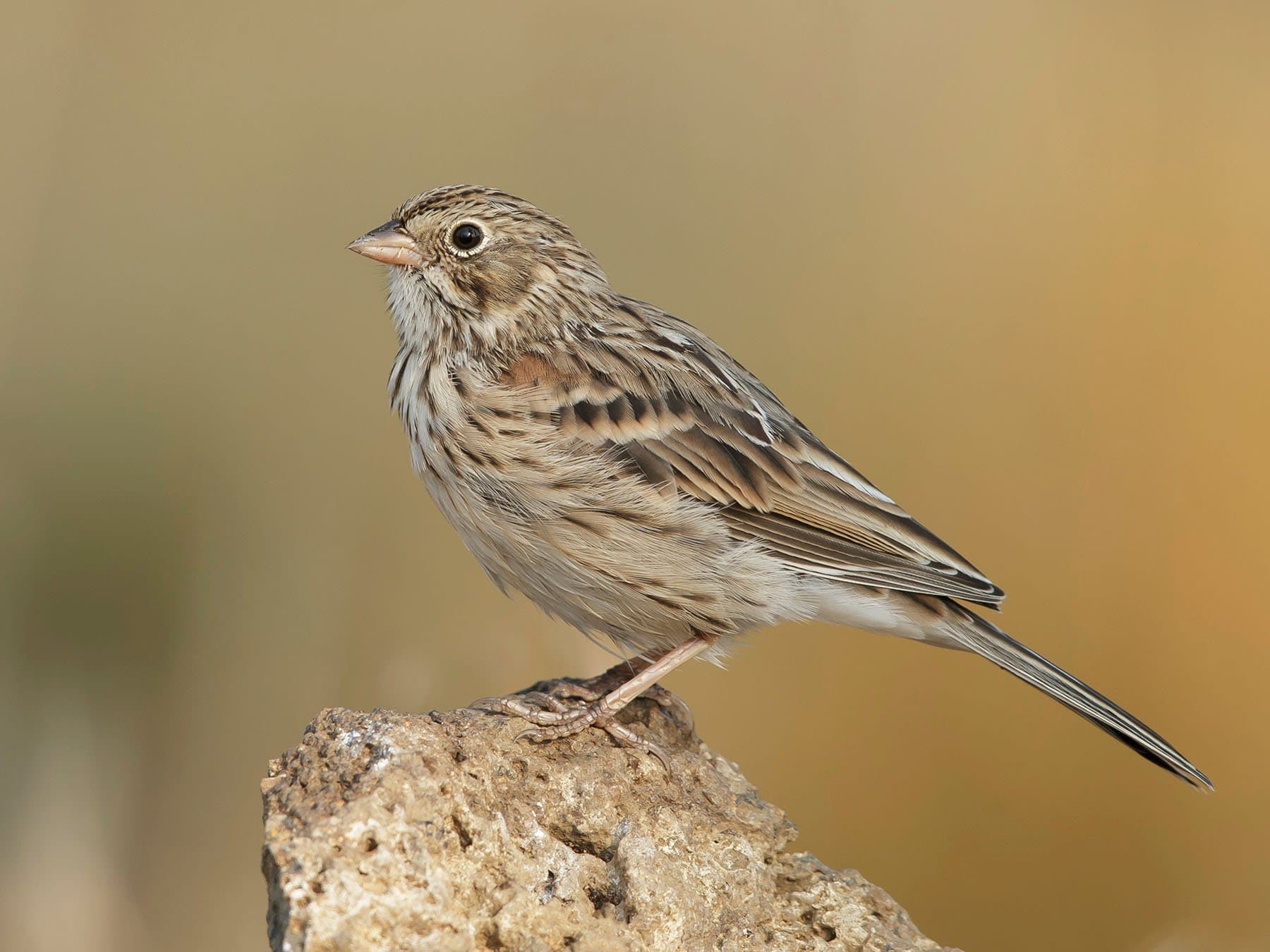
Vesper Sparrow perched on a textured rock, showing its streaky brown and white plumage and pale eye-ring against a soft background.
Quick Facts
Conservation
LCLeast ConcernLifespan
2–4 years
Length
13–17 cm
Weight
19.5–28.3 g
Wingspan
25–28 cm
Migration
Partial migrant
Named by the naturalist John Burroughs in the 1880s for its habit of singing at dusk, the Vesper Sparrow is a streaky, medium-sized grassland bird with three diagnostic field marks: a narrow white eye-ring, white outer tail feathers that flash in flight, and a small chestnut patch on the shoulder. Its rich, melodious song — two pairs of slurred whistles followed by cascading trills — is one of the most evocative sounds of open farmland across North America.
Think you've spotted a Vesper Sparrow?
Upload a photo and we'll confirm it instantly
Confirm with a PhotoAppearance
Three field marks set the Vesper Sparrow apart from the many streaky brown sparrows it shares its grassland home with. The narrow white eye-ring is the most reliable at close range; the white outer tail feathers, which flash conspicuously as the bird flushes or lands, are the most useful at distance; and the small chestnut (rufous) patch on the lesser wing coverts — the "shoulder" — is diagnostic when visible, though it is often tucked out of sight. No other common grassland sparrow combines all three.
The overall impression is of a chunky, pale sparrow. The upperparts are light brown to greyish-brown, heavily streaked with black and tan. The underparts are dull white, with darker streaking concentrated on the throat, breast, and sides, leaving the belly clean and unstreaked. A dark brown cheek patch is framed along its lower and rear edges by white, giving the face a subtly patterned look. The bill is conical and pinkish, the legs are dusky pink, and the eyes are dark brown to reddish-brown. The tail is short and notched.
Males and females are essentially identical in plumage — the sexes are very difficult to separate in the field. Males average slightly heavier (20.9–28 g, averaging 26.5 g) than females (19.5–28.3 g, averaging 24.9 g). In spring and summer, the plumage becomes grayer overall with more prominent streaking. Juveniles resemble adults but lack the rufous lesser coverts; their juvenile feathers are fully grown by around 31 days after hatching, with the definitive prebasic moult occurring between July and November.
Four subspecies show subtle but consistent differences. P. g. gramineus of the northeast has a medium build, a slightly stout bill, and pale grey upperparts. P. g. confinis of the northwest is the largest subspecies, with a longer tail and more slender bill. P. g. affinis of the Pacific coast is the smallest and brownest, sometimes showing a pinkish hue. P. g. altus of the interior mountains is intermediate in size with paler, more washed-out tones.
Identification & Characteristics
Colors
- Primary
- Brown
- Secondary
- White
- Beak
- Pink
- Legs
- Pink
Markings
Narrow white eye-ring; white outer tail feathers (conspicuous in flight); small chestnut (rufous) patch on lesser wing coverts (shoulder); unstreaked white belly contrasting with streaked breast; dark cheek patch framed below and behind by white
Tail: Short, notched tail with white outer tail feathers that flash conspicuously in flight
Attributes
Understanding Attributes
Rated 0–100 based on research and observation. A score of 50 is average across all bird species. These attributes are relative and don't necessarily indicate superiority.
Habitat & Distribution
Open, dry habitats with short or sparse vegetation and patches of bare ground are the Vesper Sparrow's defining requirement. On the breeding grounds, this translates to old fields, pastures, meadows, hayfields, native grasslands, prairies, sagebrush steppe, and agricultural croplands. The species thrives where agricultural crops do worst — on sandy, rocky soils with patchy vegetation — and is often the first bird to appear on reclaimed mine sites. It avoids dense vegetation and heavily grazed sagebrush with little grass cover. A mix of bare ground for foraging, moderate-structured vegetation for nesting, and scattered taller plants or fence posts for singing perches is the ideal combination.
The breeding range spans a broad swath of northern North America, from British Columbia, Alberta, Saskatchewan, Ontario, and Nova Scotia south through most of the northern and central United States. In the West, birds breed in mountain meadows and sagebrush steppe up to approximately 3,000 m (9,800 ft) elevation. The range extends south to central California, northern Arizona and New Mexico, northern Texas, Tennessee, and the Appalachians of western North Carolina. An estimated 10% of the total North American population breeds within the Boreal Forest.
In the United States and Canada, Vesper Sparrows are widespread summer visitors across the northern states and prairie provinces. In the western US, they are present year-round in parts of California. Birdwatchers in the Great Plains, the Intermountain West, and the agricultural Northeast have the best chance of encountering breeding birds from April through August. In Canada, the species breeds across all southern provinces and is a familiar grassland bird on the prairies.
Winter birds move south to the southern United States — from central California, Oklahoma, and New Jersey southward — through the Gulf Coast states and into Mexico as far south as Oaxaca. Some birds reach Baja California. On the wintering grounds, they occupy dry shrublands, grasslands, and open agricultural fields. The species has been recorded as a vagrant in Bermuda, the Bahamas, Belize, the Cayman Islands, Guatemala, and Saint Pierre and Miquelon.
Where to See This Bird
Explore regional guides for locations where this bird has been recorded.
Montana
Idaho
Arizona
North Dakota
Colorado
Utah
South Dakota
Texas
Wyoming
Alberta
Manitoba
Saskatchewan
Diet
Seeds and insects form the two pillars of the Vesper Sparrow's diet, with the balance shifting markedly through the year. During the breeding season, insects take on greater importance, supplying the protein that both adults and growing chicks require. Beetles, grasshoppers, caterpillars, moths, true bugs, cutworms, and armyworms are all taken, along with spiders. Outside the breeding season, seeds dominate — particularly those of grasses, weeds, and grain crops.
Almost all foraging takes place on the ground. Birds work across bare soil between grass and weed clumps, scratching with their feet — sometimes both simultaneously — to expose buried seeds. They will also pick insects and spiders from low-growing plants, but rarely venture more than a few centimetres above the ground. This ground-level focus makes open, short-structured vegetation with patches of bare soil essential: dense swards offer little foraging opportunity.
In winter, Vesper Sparrows often forage in loose mixed-species flocks across dry agricultural fields and shrubby grasslands, including the Chihuahuan Desert grasslands of northern Mexico. The company of other sparrow species may improve foraging efficiency and reduce individual predation risk. On the breeding grounds, the shift toward insect prey in spring coincides with the peak availability of invertebrates in grassland habitats — a timing that aligns neatly with the energy demands of egg-laying and chick-rearing.
Behaviour
Vesper Sparrows spend the vast majority of their time on the ground. They walk and run through short grass and bare soil with a purposeful, slightly hunched gait, pausing to scratch with both feet simultaneously to uncover seeds — a foraging technique shared with few other sparrows. When flushed, they fly low and fast before dropping back into cover, flashing those white outer tail feathers as they go.
Outside the breeding season, Vesper Sparrows are loosely social, forming small flocks of up to 30 birds that forage together across open fields. They often associate with Savannah Sparrows, Grasshopper Sparrows, Brewer's Sparrows, and Lark Buntings. During the breeding season, males become territorial and sing persistently from the highest available perch — a fence post, shrub, or isolated tree limb — to advertise ownership of their patch.
Courtship is an energetic ground-level affair. The male runs alongside the female with wings raised and tail spread wide, periodically leaping into the air to deliver a short flight-song. If a predator approaches the nest, the female performs a distraction display — fluttering away from the nest with wings drooped and spread, mimicking an injured bird to draw the intruder away from the eggs or chicks.
One of the Vesper Sparrow's most characteristic but rarely highlighted behaviours is dust-bathing. Birds frequently puff up and roll in bare soil on fields and dirt roads, working loose earth through their feathers to clean them and suppress ectoparasites. Louse flies (Ornithoica vicina) have been recorded on this species. The Vesper Sparrow is also an ecological pioneer: it is often the first bird to colonise reclaimed mine sites and one of the first to abandon old farm fields as they revert to shrubland — making it a useful indicator of grassland succession.
Calls & Sounds
The Vesper Sparrow's song is one of the most musical produced by any North American sparrow — rich, unhurried, and carrying well across open country. It opens with two pairs of slurred, whistled notes: the first pair at a lower pitch, the second pair stepping up higher, before dissolving into a series of short, descending trills. A popular mnemonic renders it as "come-come, where-where, all-together-down-the-hill" — the leisurely opening notes followed by a more complex, buzzy cascade. The song resembles that of the Song Sparrow but is distinguishable by its more deliberate, unhurried opening and the absence of an overall descending pitch arc.
Males sing from elevated perches throughout the breeding season to establish territories and attract mates. The species is particularly noted for singing at dusk and continuing well after sunset — especially early in the breeding season — a habit that inspired the naturalist John Burroughs to rename the bird "Vesper Sparrow" in the 1880s. Previously known as the Bay-winged Bunting or Grass Finch, Burroughs felt the name failed to capture the bird's most distinctive quality: the beauty of its evening song. The word vesper refers to the evening prayer service in Christian tradition, and the name has endured ever since. During courtship, males also deliver a short flight-song while leaping into the air beside the female.
The call is a short, sharp chip note, distinctively different from the calls of both the Song Sparrow and the Savannah Sparrow — a useful distinction when birds are moving through cover. Females are not known to sing. Song output is highest in April and May at the start of the breeding season and declines through summer as territorial boundaries become established.
Flight
In flight, the Vesper Sparrow's white outer tail feathers are immediately eye-catching — a clean white flash along both edges of the tail that is visible the moment the bird takes off and persists until it drops back into cover. This feature alone is often enough to clinch an identification at distance, and it is the first thing experienced observers look for when a sparrow flushes from a grassy field.
The flight style is low and direct, with a slightly undulating quality typical of small sparrows. Birds rarely fly high or far when flushed, preferring to skim low over the vegetation before pitching back down into cover a short distance away. During migration, Vesper Sparrows travel in small loose flocks of typically 30 or fewer birds, moving at night or in the early morning hours like most migratory passerines.
The wings are moderately broad for a sparrow, with a wingspan of 25–28 cm, giving the bird enough lift for sustained flight during its medium-distance migrations between northern breeding grounds and southern wintering areas. The wingbeats are rapid and shallow, producing a slightly flickering impression in flight. When males perform their courtship flight-song, they leap vertically from a perch or the ground, delivering a brief burst of song at the apex of the jump before dropping back down — a display that is more vertical leap than sustained flight.
Nesting & Breeding
Nest-building begins as early as April, when birds return to their northern breeding grounds. The female selects a site on the ground, typically in a shallow natural depression at the base of a grass clump, weed, or shrub, where the surrounding vegetation provides overhead concealment. She constructs a bulky, loose open cup from grasses, sedges, mosses, strips of bark, and rootlets, then lines it with finer grass, rootlets, and animal hair. The male takes no part in construction.
Clutch size ranges from 2–6 eggs, typically 3–5, averaging around 4 in May–June and declining to around 3 by July as the season progresses. The eggs are whitish to pale greenish-white, blotched and spotted with brown, grey, and purplish markings, and measure approximately 1.9–2.3 cm long by 1.3–1.7 cm wide. Incubation lasts 11–14 days (average 13 days) and is carried out primarily by the female, though males occasionally take a turn. Nestlings hatch helpless, with sparse tufts of down and flesh-coloured skin; both parents feed them. Young leave the nest after 7–14 days (average 9–10 days) but remain dependent on their parents for 20–29 days after hatching.
Pairs typically raise 2–3 broods per season. Despite this productivity, nest success is low: only around 29% of nests successfully fledge young. Predation by raccoons, skunks, domestic and feral cats, hawks, owls, and snakes accounts for many failures, while farm machinery destroys nests during mowing and haying. Brown-headed Cowbirds parasitise Vesper Sparrow nests, laying their own eggs among the clutch; the larger, faster-growing cowbird chicks typically outcompete the sparrow nestlings for food.
The species is typically seasonally monogamous, though polygyny has been recorded. Males that arrive later in the season — around mid-April, roughly two weeks after the first arrivals — are less likely to secure a mate. Males holding territories with more shrub cover tend to be more successful breeders. Hybridisation with Field Sparrows has been documented, though it is rare.
Lifespan
Vesper Sparrows typically live 2–4 years in the wild, a lifespan broadly typical for small migratory passerines of their size. The maximum recorded lifespan from banding data is 7 years and 1 month — a figure that reflects the upper limit achievable by individuals that successfully navigate the many hazards of migration, predation, and harsh winters. Most birds do not approach this age; annual survival rates for small grassland sparrows are generally modest, with first-year birds facing the highest mortality.
The main causes of mortality include predation at the nest (raccoons, skunks, snakes, cats, hawks, and owls), destruction of nests by farm machinery during mowing and haying, and the cumulative costs of two or more long-distance migrations per year. Brown-headed Cowbird parasitism reduces the reproductive output of pairs that are parasitised, indirectly affecting population recruitment rather than adult survival directly.
Compared to related New World sparrows, the Vesper Sparrow's lifespan is broadly similar to that of the Savannah Sparrow and other open-country species of comparable size. Larger sparrows and those with more sedentary lifestyles tend to live longer on average; the energetic costs of annual migration to Mexico and back impose a real toll on survival. Individuals that establish territories in high-quality habitat — with good food availability and lower predator pressure — are likely to achieve longer lifespans and higher lifetime reproductive success.
Conservation
The Vesper Sparrow is listed as Least Concern on the IUCN Red List (2016), with a global population estimated at approximately 34–35 million individuals by Partners in Flight and Audubon. Despite this apparently healthy total, the long-term trend is clearly downward: populations declined by approximately 30% between 1970 and 2014, earning the species a Continental Concern Score of 11 out of 20. It is not on the Partners in Flight Watch List at the continental level, but it is listed as endangered, threatened, or of special conservation concern in several US states. Connecticut has recorded no confirmed nesting since 1984 and lists the species as state endangered; New Hampshire reports strongly declining populations.
The primary drivers of decline are grassland habitat loss and agricultural change. Conversion of open land to residential and commercial development removes breeding habitat outright. Changes in farming practice — removal of hedgerows, increased mowing frequency, earlier harvests that destroy active nests, and the loss of fallow strips — have degraded the patchwork of short-structured vegetation the species depends on. In the Northeast, the reversion of abandoned farmland to shrubland and forest has eliminated large areas of open habitat. Brood parasitism by Brown-headed Cowbirds and predation by a range of mammals and raptors add further pressure.
The most acute conservation concern involves the Oregon Vesper Sparrow (P. g. affinis), a subspecies with a restricted breeding range in southwestern British Columbia, western Washington, western Oregon, and northwestern California. Its total range-wide population is estimated at fewer than 3,000 individuals — approximately 300 of which remain in Washington state, the majority on a single military installation, Joint Base Lewis-McChord. The subspecies is a Species of Greatest Conservation Need in both Oregon and Washington, a Bird of Conservation Concern under the US Fish and Wildlife Service, and was petitioned for listing under the federal Endangered Species Act in 2017. Threats specific to this population include invasive plants such as Scotch broom, conifer succession into prairie habitats, and disturbance from military training exercises. The species is protected across its range under the Migratory Bird Treaty Act of 1918.
Population
Estimated: Approximately 34–35 million individuals
Trend: Decreasing
Declining — approximately 30% decrease between 1970 and 2014 (Partners in Flight). Continental Concern Score 11/20. The Oregon Vesper Sparrow subspecies (P. g. affinis) is critically imperilled with fewer than 3,000 individuals range-wide.
Elevation
Breeds from sea level to approximately 3,000 m (9,800 ft) in western mountain meadows and sagebrush steppe
Additional Details
- Family:
- Passerellidae (New World Sparrows)
- Predators:
- Raccoons, skunks, domestic and feral cats, hawks, owls, and snakes
- Subspecies:
- Four recognised: P. g. gramineus (northeast), P. g. confinis (northwest interior), P. g. affinis (Pacific coast / Oregon Vesper Sparrow), P. g. altus (interior mountains)
- Similar species:
- Savannah Sparrow, Song Sparrow, Lark Sparrow, Grasshopper Sparrow, Lincoln's Sparrow
- Brood parasitism:
- Parasitised by Brown-headed Cowbird (Molothrus ater)
- Conservation legislation:
- Protected under the Migratory Bird Treaty Act of 1918 (USA). Oregon Vesper Sparrow petitioned for listing under the Endangered Species Act in 2017.
Subspecies
Four subspecies of Vesper Sparrow are currently recognised, each associated with a distinct part of the breeding range and showing subtle but consistent differences in size, bill shape, and plumage tone.
P. g. gramineus, the nominate subspecies, breeds across the northeastern United States and adjacent Canada. It has a medium build, a slightly stout bill, and pale grey upperparts with well-defined streaking. P. g. confinis breeds across the northwestern interior and is the largest subspecies, with a longer tail, more slender bill, and paler, more washed-out tones overall. P. g. affinis — the Oregon Vesper Sparrow — breeds in the Pacific coastal lowlands from southwestern British Columbia south to northwestern California and is the smallest and brownest subspecies, sometimes showing a pinkish hue to the underparts. It winters in central and southern California and northwestern Baja California. P. g. altus breeds in the interior mountain grasslands and is intermediate in size with particularly pale, sandy upperparts.
The Oregon Vesper Sparrow deserves special attention. With a total range-wide population estimated at fewer than 3,000 individuals, it is one of the most imperilled bird populations in the Pacific Northwest. Its breeding habitat — native prairie and oak savanna in the Puget Trough and Willamette Valley — has been reduced to a fraction of its historical extent by urban development, agriculture, and the encroachment of invasive plants such as Scotch broom. In Washington state, approximately 300 birds survive, the majority on Joint Base Lewis-McChord, where military land management has inadvertently maintained the open prairie conditions the subspecies requires. A petition to list P. g. affinis under the federal Endangered Species Act was filed in 2017.
Similar Species
The Vesper Sparrow shares its grassland habitat with several streaky brown sparrows that can cause confusion, but a systematic check of a few key features resolves most identification challenges quickly.
The Savannah Sparrow is the most frequently confused species. It is slightly smaller and shorter-tailed, typically shows a yellow or pale supercilium (absent in Vesper), has a more heavily streaked breast, and — crucially — lacks both the white eye-ring and the white outer tail feathers. The Savannah Sparrow's tail is short and notched, but its outer feathers are brown, not white. The Song Sparrow is stockier, with a longer, rounded tail, a heavily streaked breast converging on a central breast spot, and no white in the tail. It tends to favour wetter, more vegetated habitats than the Vesper Sparrow and pumps its tail in flight — a useful behavioural cue.
The Lark Sparrow is noticeably larger and more boldly marked, with a striking chestnut, black, and white head pattern that makes it unmistakable at close range. In flight, it shows white tips to the outer tail feathers rather than white edges — a subtle but consistent difference. Grasshopper Sparrows are smaller and flat-headed, with a buffy wash to the breast and face and no white in the tail. Lincoln's Sparrow has a finely streaked buffy breast band and a more secretive, skulking behaviour. When in doubt, the combination of white eye-ring, white outer tail feathers, and chestnut shoulder patch is unique to the Vesper Sparrow among North American grassland sparrows.
Birdwatching Tips
The white outer tail feathers are the single most useful field mark at any distance. When a sparrow flushes from a grassy field and shows a clear white flash along the edges of its tail as it flies away, Vesper Sparrow should be your first thought. At rest, look for the narrow white eye-ring and the chestnut shoulder patch — the latter is often hidden but worth checking on a perched bird. The unstreaked white belly, contrasting with the streaked breast, is also a useful supporting feature.
In the United States and Canada, the best time to find Vesper Sparrows is from late April through July on the breeding grounds. Open agricultural land, native grasslands, sagebrush steppe, and reclaimed mine sites are all productive habitats. Birds are most conspicuous when males are singing from fence posts, shrubs, or isolated trees — scan elevated perches along roadsides and field edges. Early morning and evening are the most productive times, and the Vesper Sparrow is particularly worth listening for at dusk, when its song carries clearly across quiet fields.
Separating Vesper Sparrows from similar species takes practice. The Savannah Sparrow is the most frequently confused species: it shares the streaked breast and grassland habitat, but lacks the white eye-ring and white outer tail feathers, and typically shows a yellow supercilium. The Song Sparrow has a more heavily streaked breast with a central spot, a longer rounded tail, and no white outer tail feathers. The Lark Sparrow is larger and more boldly patterned, with a distinctive chestnut-and-white head pattern and white-tipped (not white-edged) tail. In winter flocks, Vesper Sparrows often associate with Savannah Sparrows and other open-country sparrows — scanning mixed flocks carefully can be productive.
On the wintering grounds in the southern US and Mexico, look for Vesper Sparrows in dry shrubby grasslands, open agricultural fields, and desert grasslands. They are often found in loose flocks of 30 or fewer birds, sometimes alongside Savannah Sparrows and Lark Buntings.
Did You Know?
- The name "Vesper Sparrow" was coined by the naturalist John Burroughs in the 1880s — he renamed the bird, then called the Bay-winged Bunting, because he believed its song sounded most beautiful at evening twilight. The word vesper comes from the Latin for evening and refers to the traditional Christian evening prayer service.
- The Vesper Sparrow is the sole member of its genus, Pooecetes — a name combining the Ancient Greek words for "grass" (poa) and "dweller" (oikētēs). Its closest living relative is thought to be the Lark Sparrow (Chondestes grammacus), which is also the only member of its genus.
- Only around 29% of Vesper Sparrow nests successfully fledge young — a strikingly low success rate driven by predation, farm machinery, and Brown-headed Cowbird parasitism.
- The Oregon Vesper Sparrow subspecies (P. g. affinis) has a total range-wide population of fewer than 3,000 birds. Roughly 300 of those survive in Washington state, almost entirely on a single military base — Joint Base Lewis-McChord — where the open prairie habitat they need has been inadvertently preserved by military land management.
- Vesper Sparrows are enthusiastic dust-bathers, rolling and puffing in bare soil on fields and dirt roads to clean their feathers and suppress parasites. Louse flies (Ornithoica vicina) have been recorded on the species — one reason this behaviour is so persistent.
Records & Accolades
Evening Songster
Sings after sunset
The Vesper Sparrow is named for its habit of singing at dusk and continuing well after sunset — a quality that inspired naturalist John Burroughs to rename it in the 1880s.
Sole Genus Member
Only species in Pooecetes
The Vesper Sparrow is the sole member of its genus, Pooecetes — meaning 'grass dweller' in Ancient Greek — making it a taxonomically unique New World sparrow.
Subspecies in Crisis
Fewer than 3,000 birds
The Oregon Vesper Sparrow (P. g. affinis) has a total range-wide population of fewer than 3,000 individuals, with ~300 surviving almost entirely on a single military base in Washington state.
Community Photos
Be the first to share a photo of the Vesper Sparrow
Upload a PhotoIdentify Any Bird Instantly
- Upload a photo from your phone or camera
- Get an instant AI identification
- Ask follow-up questions about the bird
Monthly Birds in Your Area
- Personalised for your location
- Seasonal tips and garden advice
- Updated every month with new species