Species Profile
Lark Sparrow
Chondestes grammacus
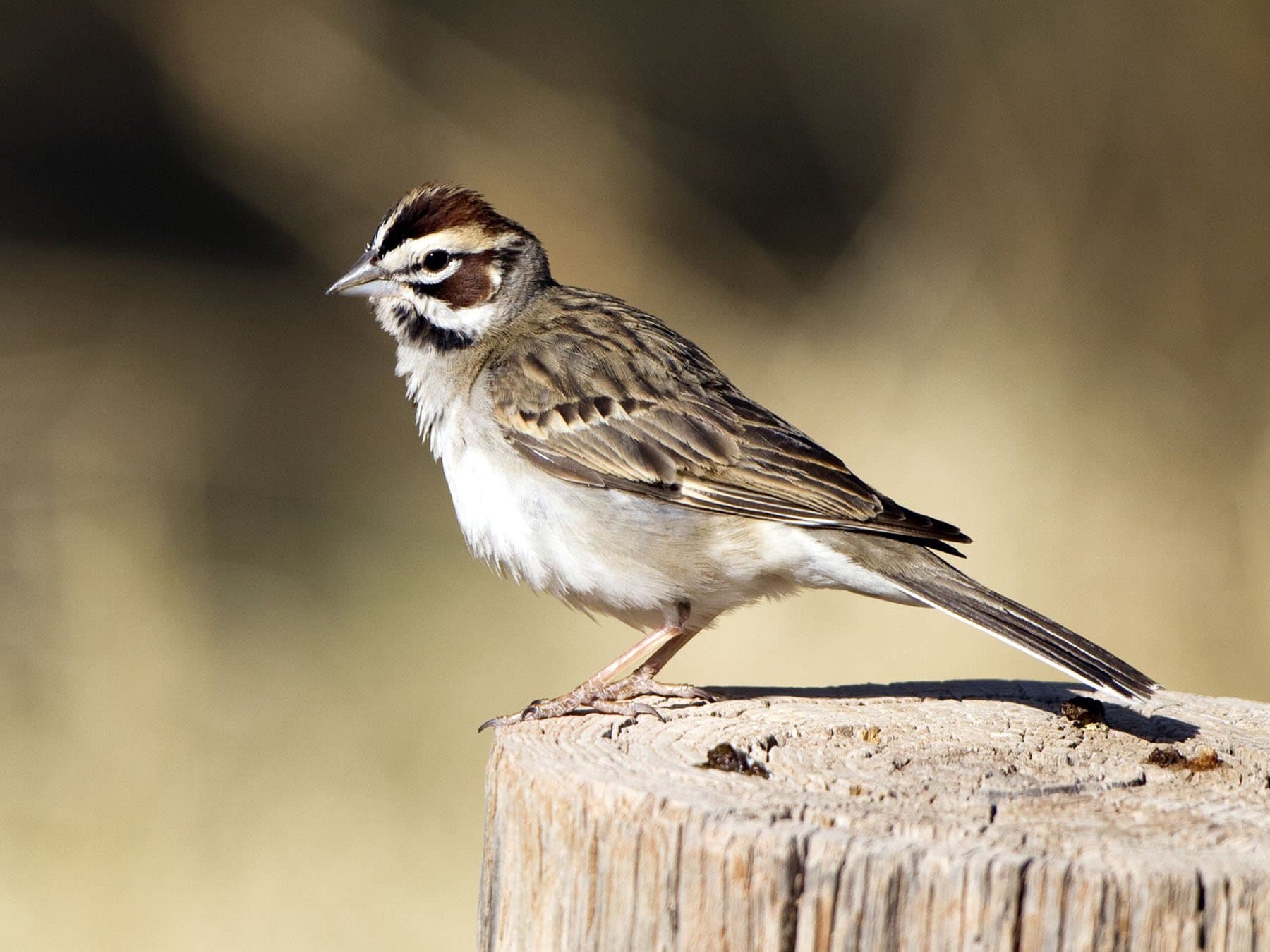
Lark Sparrow perched on a weathered wooden post, showing its distinctive brown and white head pattern and streaked back.
Quick Facts
Conservation
LCLeast ConcernLifespan
3–5 years
Length
15–17 cm
Weight
24–33 g
Wingspan
28 cm
Migration
Partial migrant
With a bold harlequin face of chestnut, black, and white that no other North American sparrow can match, the Lark Sparrow is one of the continent's most instantly recognisable grassland birds. A single black "stickpin" spot marks its otherwise clean white breast, and white-cornered tail feathers flash conspicuously with every wingbeat — field marks so distinctive that misidentification is almost impossible.
Think you've spotted a Lark Sparrow?
Upload a photo and we'll confirm it instantly
Confirm with a PhotoAppearance
Chestnut cheek patches and crown sides are framed by crisp white supercilium and central crown stripes, with a bold black malar stripe running down each side of the throat — no other North American sparrow combines these three colours in this arrangement, which has earned the bird the nickname "harlequin of the grasslands." The Lark Sparrow is also a fairly large, long-tailed bird for its family, at 15–17 cm noticeably bigger than most of its relatives.
The upperparts are grey-brown with dark brown and tan streaks on the back and scapulars — typical sparrow patterning that contrasts with the flamboyant head. The underparts are clean white or pale grey and almost entirely unmarked, save for a single bold black spot at the centre of the breast. Birders call this the "stickpin," and once seen it is immediately diagnostic. The tail is notably long and rounded; the outer two feathers on each side are tipped white, creating conspicuous white corners that flash in flight.
The bill is thick and conical, suited to cracking seeds. Legs and feet are pale pinkish-brown. Western birds (subspecies C. g. strigatus) tend to be slightly paler overall than eastern birds (C. g. grammacus), though the difference is subtle in the field. Seasonal change is minor: spring wear can dull the chestnut head patches slightly before fresh autumn plumage restores their full richness.
Identification & Characteristics
Colors
- Primary
- Brown
- Secondary
- White
- Beak
- Grey
- Legs
- Pink
Markings
Bold harlequin facial pattern of chestnut, black, and white; single black central breast spot ("stickpin"); white-cornered tail
Tail: Long and rounded; outer two feathers on each side tipped white, creating conspicuous white corners visible in flight
Attributes
Understanding Attributes
Rated 0–100 based on research and observation. A score of 50 is average across all bird species. These attributes are relative and don't necessarily indicate superiority.
Habitat & Distribution
Lark Sparrows are birds of open country with one consistent requirement: a combination of bare or sparsely vegetated ground for foraging and elevated structures — shrubs, trees, fence posts, or wires — for singing. Across their broad range this translates into a wide variety of specific habitats: prairies and mixed-grass grasslands, sagebrush steppe, mesquite savanna, open oak woodland, fallow fields with brushy edges, overgrazed pastures, sandy barrens, open pinyon-juniper woodland, and the unique limestone cedar glades of Tennessee, where bare rocky outcrops, sparse herbaceous cover, and scattered eastern red cedars support a small but notable breeding population.
The core breeding range runs from Montana and North Dakota south through Texas, and west to eastern Washington, Oregon, and the California coast. Smaller breeding populations extend into southern Manitoba, Saskatchewan, and British Columbia. Year-round resident populations occur in Arizona, parts of California, Texas, and northern Mexico. Migratory birds winter from Texas south through Mexico to Guatemala and occasionally into northern Central America. In the United States, the species is considerably less common in the east, where its range has contracted significantly since the mid-20th century.
For UK birders, the Lark Sparrow is an extreme rarity — but one with a compelling history. There are only two accepted records on the British List, both in Category A. The first was at Landguard Point, Suffolk, on 30 June 1981, which became the first record for the entire Western Palearctic and caused considerable excitement before being formally accepted. A second record has since been accepted. Both birds were likely transatlantic vagrants that overshot their intended destinations. Autumn is the most likely season for future occurrences along the east coast of England.
Where to See This Bird
Explore regional guides for locations where this bird has been recorded.
Nebraska
Montana
Idaho
Kansas
Nevada
New Mexico
Arizona
North Dakota
Colorado
Oklahoma
Utah
South Dakota
Texas
Wyoming
Diet
Seeds dominate the Lark Sparrow's diet for most of the year. Grass seeds, weed seeds, and waste grain from agricultural fields are the staples, particularly in winter when insects are scarce. The birds walk steadily across bare or sparsely vegetated ground, picking food items directly from the soil surface or gleaning from low stems — a foraging style that suits their preference for habitats with patches of exposed earth.
During the breeding season, insects become a major component of the diet. Grasshoppers are especially important and are consumed in large numbers; in areas prone to grasshopper outbreaks, Lark Sparrows provide a measurable degree of natural pest control in agricultural landscapes. Other invertebrates taken include beetles, caterpillars, and various other arthropods. Nestlings are fed predominantly insects, reflecting the higher protein requirements of growing chicks, with some grass seeds mixed in.
During migration, Lark Sparrows may join mixed-species flocks to exploit temporarily abundant food sources. Foraging is almost entirely terrestrial — the birds rarely feed above low vegetation — and the walking gait allows them to cover ground efficiently. In winter, loose flocks work roadsides, brushy field margins, and weedy areas, often returning to productive patches day after day.
Behaviour
Lark Sparrows walk rather than hop — an unusual trait among sparrows that Thomas Say noted when he formally described the species in 1822, writing that the birds "run upon the ground like a lark, seldom fly into a tree, and sing sweetly." Walking is the primary mode of locomotion on the ground, used whether foraging or simply moving between patches of cover. Birds spend long periods moving steadily across open ground, picking seeds and insects from the soil surface. When flushed, they typically fly to a fence post, wire, or shrub top before dropping back to the ground.
Outside the breeding season, Lark Sparrows are sociable. They form loose feeding flocks and frequently associate with White-crowned Sparrows and Vesper Sparrows during migration and on wintering grounds. Territorial behaviour intensifies sharply in spring: rival males are highly intolerant of one another, and disputes can escalate from counter-singing to mid-air grappling.
Males sing persistently from exposed perches — fence posts, wires, and shrub tops — particularly in early morning and evening.
Calls & Sounds
The Lark Sparrow's common name is itself a tribute to its song — early naturalists considered it comparable to the rich, varied songs of Old World larks, and Thomas Say noted in 1822 that the birds "sing sweetly." The song typically opens with two clear, whistled notes, then unfolds into a varied series of churrs, buzzes, trills, chirps, and musical phrases. The Missouri Department of Conservation describes it as beginning with two clear whistles followed by alternating buzzes and melodious trills; some observers report hearing three distinct notes at the end of the sequence. The overall effect is a complex medley that changes enough between renditions to hold the listener's attention.
Males sing persistently from exposed perches, particularly in early morning and evening. Unusually for a temperate-zone passerine, they also sing at night during the breeding season, and occasionally deliver song in flight during territorial display. The song serves both to attract females and to warn rival males; in areas of high density, neighbouring males may engage in extended counter-singing bouts from adjacent perches before resorting to physical confrontation.
The flight call is a thin, high-pitched "sit" or "tsit." The typical contact and alarm call is a short "tchip," "tink," or "tsip." Multiple call types have been recorded from single individuals, suggesting a varied call vocabulary. Females are generally much quieter than males and do not produce the full territorial song.
Flight
Noticeably longer-tailed than most sparrows, the Lark Sparrow cuts a slightly thrush-like silhouette in direct flight — an impression reinforced by its tendency to fly higher than most of its relatives, particularly during migration. The wings are pointed, and the overall shape is distinctive enough to prompt a second look even before the plumage is resolved.
Once the tail is visible, identification is immediate: the outer two feathers on each side are tipped white, creating bold white corners that flash conspicuously against the dark central feathers. This feature is visible at considerable distance and is one of the most reliable field marks when the bird is airborne. Flocks in migration are easy to pick out against open sky or scrubby vegetation as the white corners of multiple birds flash simultaneously.
The flight style is undulating — a series of wingbeats followed by a brief glide with wings partially closed — typical of the sparrow family. When flushed from the ground, the bird typically makes a short, low flight to a nearby fence post or shrub top rather than diving back into cover, which gives observers a good opportunity to note the tail pattern and overall size. During the male's courtship display, brief song flights are performed over the territory, though the species is far less aerial in display than larks or pipits.
Nesting & Breeding
The breeding season runs from mid-April through July across most of the range. Lark Sparrows are monogamous within a season, though pairs do not necessarily reunite in subsequent years. The female alone builds the nest, typically placing it on the ground in a shallow depression sheltered by a clump of grass, a forb, or a small shrub — often on a slight rise in the land. Occasionally nests are placed in shrubs or low trees, averaging around 1.4 m above ground, and sometimes in rocky cliff crevices. Females will also reuse old nests of other species, including Northern Mockingbirds, Curve-billed Thrashers, Scissor-tailed Flycatchers, and Western Kingbirds.
The nest itself is a thick-walled open cup of grass, twigs, weedy stems, and bark, lined with fine grass, rootlets, and animal hair. Clutch size is 3–6 eggs, typically 4–5. The eggs are creamy white to greyish white — sometimes with a bluish or brownish tint — marked with dark brown, black, or purplish spots and scrawls. Egg dimensions are approximately 1.8–2.3 cm long by 1.5–1.7 cm wide. The female incubates alone for 11–12 days. Chicks hatch with eyes closed and sparse down.
Both parents feed the nestlings. Young leave the nest 9–12 days after hatching and move to nearby shrubby cover, where they continue to be fed by the adults. As incubation nears completion, the pair's tolerance of conspecifics increases markedly — birds that were fiercely territorial begin foraging in loose groups with neighbouring pairs. Pairs may raise one or two broods per season. The species is an occasional victim of brood parasitism by the Brown-headed Cowbird, which can significantly reduce nesting success in heavily parasitised areas.
Lifespan
The typical lifespan of a wild Lark Sparrow is 3–5 years, consistent with other small passerines of similar size and ecology. Annual survival rates are influenced by predation, harsh weather on wintering grounds and during migration, and the hazards of long-distance travel. The species faces predation from a range of raptors, as well as from snakes and small mammals at the nest.
The maximum recorded lifespan is 9 years and 11 months, documented through the North American Bird Banding Laboratory — a figure that places the Lark Sparrow among the longer-lived small sparrows on record. First-year mortality is typically the highest of any age class, as inexperienced birds face the full gauntlet of migration for the first time. Most individuals do not approach this maximum.
Compared to related species, the Lark Sparrow's longevity record is broadly similar to that of the White-crowned Sparrow (maximum around 13 years) but exceeds that of many smaller grassland sparrows. Brood parasitism by Brown-headed Cowbirds can reduce annual productivity, but the main driver of population-level change appears to be habitat availability rather than direct mortality.
Conservation
The Lark Sparrow is listed as Least Concern on the IUCN Red List (assessed 2016), with a global population estimated at approximately 11 million mature individuals by Partners in Flight (2019). Despite this relatively healthy total, the long-term trend is downward: populations declined by around 32% between 1970 and 2014, with an overall range-wide decline of approximately 1% annually since Breeding Bird Survey monitoring began in the late 1960s. The species scores 10 out of 20 on the Partners in Flight Continental Concern Score, indicating low concern at the continental level, but regional pictures are considerably more worrying.
Declines are most pronounced in the eastern portion of the range and in several western states including California, Idaho, Oklahoma, Oregon, and Texas. The species is listed as Threatened in Tennessee, where it breeds in the specialised limestone cedar glade habitat. It is considered a Special Concern species in Minnesota, where oak savanna and dry prairie habitats have been severely reduced. It is now extirpated from Michigan entirely. Some regional populations — notably in Wisconsin, South Dakota, and Manitoba — have shown stability or modest increases, suggesting the picture is not uniformly bleak.
The primary threats are habitat loss through conversion of native grasslands and prairies to cropland, forest regeneration in the eastern United States (which eliminated the open habitats that allowed range expansion in the 19th century), increased fire frequency driven by invasive non-native grasses, and brood parasitism by Brown-headed Cowbirds. Conservation efforts focus on preserving and restoring native grassland, savanna, and shrub-steppe habitats, particularly in states where the species is most at risk.
Population
Estimated: Approximately 11 million mature individuals (Partners in Flight, 2019)
Trend: Decreasing
Declining approximately 1% annually since the late 1960s; overall decline of around 32% between 1970 and 2014 (Partners in Flight). Declines most pronounced in eastern range and in California, Idaho, Oklahoma, Oregon, and Texas. Some regional populations stable or increasing.
Elevation
Lowlands to around 2,500 m in western mountain ranges; most abundant below 1,500 m
Additional Details
- Predators:
- Raptors, snakes, and small mammals; Brown-headed Cowbird brood parasitism reduces nesting success
- Subspecies:
- Two subspecies: C. g. grammacus (eastern) and C. g. strigatus (western, slightly paler)
- Similar species:
- No other North American sparrow shares the harlequin facial pattern; white tail corners recall Vesper Sparrow but head pattern is unique
Subspecies
Two subspecies of Lark Sparrow are currently recognised, differing subtly in plumage tone and more significantly in their breeding and wintering ranges. The nominate subspecies, Chondestes grammacus grammacus, breeds across the eastern portion of the range — from Minnesota and east Texas east to Pennsylvania and Georgia — and winters from the southeastern United States southward into Mexico. Eastern birds tend to be slightly darker and more richly coloured overall.
The western subspecies, C. g. strigatus, breeds from British Columbia and Manitoba south through the Great Plains to California and west Texas, and winters from California to Florida and south through Mexico. Western birds are on average slightly paler, though the difference is subtle enough that subspecific identification in the field is rarely straightforward, particularly in worn plumage. The two subspecies intergrade across a broad zone in the central Great Plains where their ranges overlap.
The Lark Sparrow is the sole member of the genus Chondestes — a monotypic genus with no close living relatives among the New World sparrows. Molecular studies place it within the family Passerellidae, but its exact phylogenetic position within that family has been debated. The genus name derives from the Greek chondros (grain) and esthio (to eat), a reference to the seed-heavy diet that Thomas Say observed when he described the species in 1822.
Courtship & Display
The male Lark Sparrow's courtship display opens with a ground-level strut: he hops towards the female, then crouches low and fans his tail to display the white corners, simultaneously drooping his wings until they nearly touch the ground. The posture is strikingly reminiscent of a displaying turkey. His bill may also point upward as he flutters his wings, and the sequence — which can last up to five minutes — is often accompanied by song. It is the combination of tail-fanning, wing-drooping, and the twig ceremony described below that sets this display apart from any other North American sparrow.
Rival males are fiercely intolerant during this period: territorial disputes frequently escalate from counter-singing to mid-air grappling, with two birds locking together and tumbling towards the ground before separating.
Most strikingly, copulation is preceded by the male presenting the female with a small twig — a behaviour known as the "twig ceremony" that has not been recorded in any other North American sparrow species (Cornell Lab of Ornithology). The evolutionary function of this gift-giving is not fully understood, but it may serve as a mate-quality signal or a bonding behaviour that reinforces the pair bond immediately before mating.
Birdwatching Tips
In the United States, the Great Plains and western states offer the best opportunities. Look for birds perched on fence posts, telephone wires, and shrub tops along roadsides through open grassland and sagebrush country from late April through August — the walking (rather than hopping) gait is a useful behavioural clue when the head pattern is obscured by vegetation. In Texas, mesquite savannas with weedy patches are particularly productive. In Tennessee, the limestone cedar glades around the Nashville Basin support a small breeding population and are worth visiting specifically for this species.
During migration (August–October), small numbers appear along the Atlantic coast, and vagrant individuals occasionally turn up at coastal watchpoints. The song is a useful locator: a rich, varied medley of buzzes, trills, and whistles that carries well across open country and is unlike any other sparrow's song. Males sing persistently from exposed perches, especially in early morning. In flight, the long, rounded tail with conspicuous white corners is visible at considerable distance and is the most reliable airborne field mark.
For UK birders, the species is an extreme rarity — but the east coast in autumn is the place to watch, and any large, long-tailed sparrow with a patterned face deserves a second look.
Did You Know?
- Just before copulation, the male Lark Sparrow presents the female with a small twig — a "twig ceremony" not recorded in any other North American sparrow species.
- The oldest recorded Lark Sparrow was a male aged at least 9 years and 11 months, documented through the North American Bird Banding Laboratory — placing it among the longer-lived small sparrows on record and well above the 3–5 year typical lifespan.
- The first Lark Sparrow ever recorded in the Western Palearctic was found at Landguard Point, Suffolk, on 30 June 1981 — initially flushed from a flock of House Sparrows and a Skylark. Only one further British record has been accepted since.
- The Lark Sparrow is the sole member of the genus Chondestes — a monotypic genus whose name derives from the Greek for "grain eater," and whose closest living relatives among the New World sparrows remain debated by molecular studies.
- The species underwent a dramatic eastward range expansion in the 19th and early 20th centuries as settlers cleared the great eastern forests, and once bred as far east as New York. As forests regenerated from the 1930s onwards, the eastern range collapsed almost entirely — making the Lark Sparrow a vivid case study in how human land-use change can both create and destroy bird populations within a single century.
Records & Accolades
Most Distinctive Face
Unique harlequin pattern
The only North American sparrow with a chestnut, black, and white harlequin facial pattern — unmistakable among over 30 grassland sparrow species.
Unique Courtship Gift
Twig ceremony
The only North American sparrow known to present the female with a twig immediately before copulation — a behaviour unrecorded in any other member of the family.
Western Palearctic First
Landguard Point, Suffolk, 30 June 1981
The first Lark Sparrow ever recorded in the Western Palearctic, found among House Sparrows and a Skylark at Landguard Point, Suffolk.
Most Complex Sparrow Song
Named after Old World larks
Its song was considered so rich and varied by early naturalists that the species was named after the celebrated songsters of the Old World.
Community Photos
Be the first to share a photo of the Lark Sparrow
Upload a PhotoIdentify Any Bird Instantly
- Upload a photo from your phone or camera
- Get an instant AI identification
- Ask follow-up questions about the bird
Monthly Birds in Your Area
- Personalised for your location
- Seasonal tips and garden advice
- Updated every month with new species