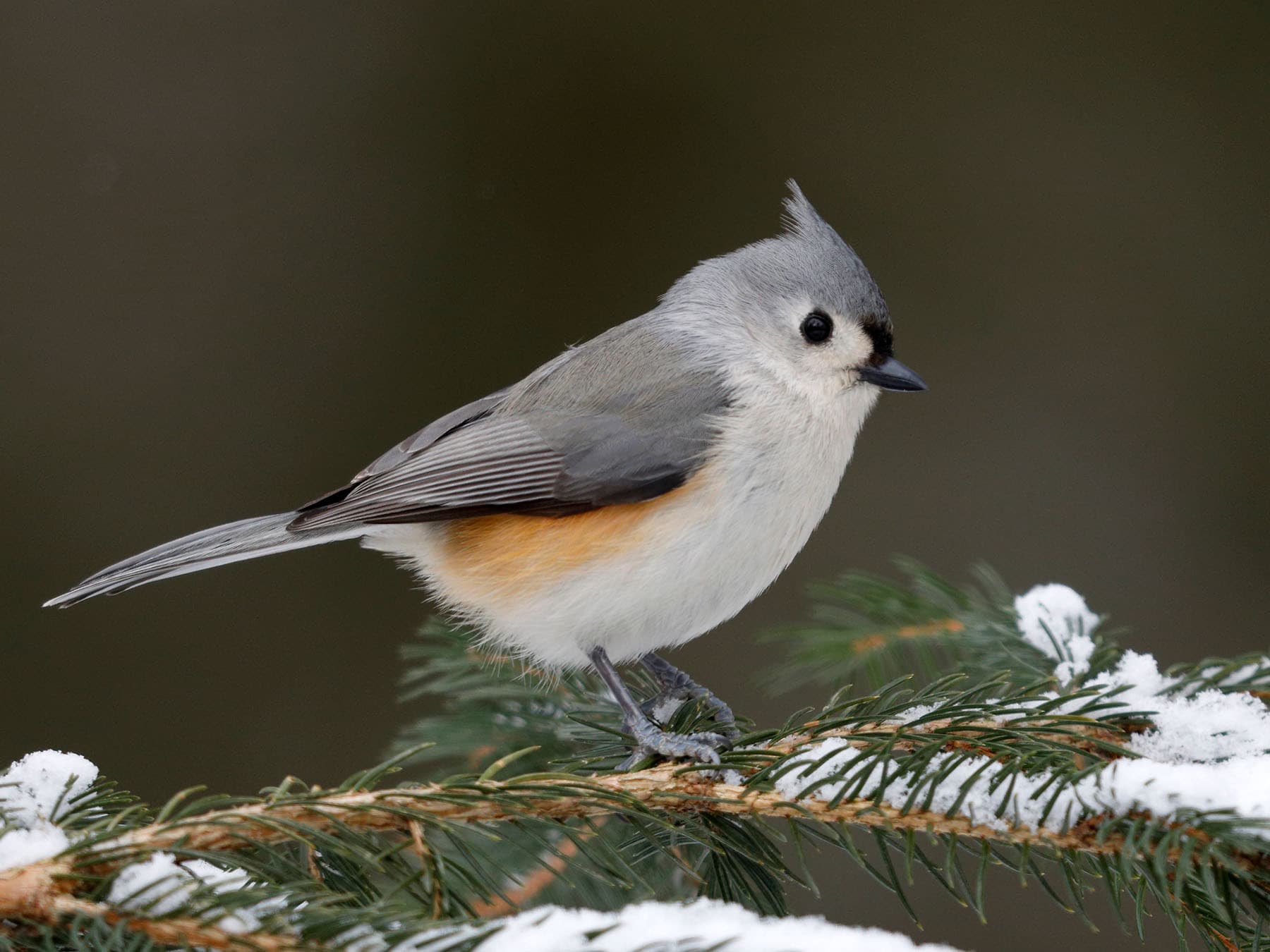
Published 23 Oct 2026
Tufted Titmouse Sounds: Song, Calls and What They Mean
By the Birdfact teamChecked by Nathan Cope
The Tufted Titmouse's song is a loud, whistled peter-peter-peter, but each bird sings about 8 to 13 song patterns, most of them shared with its neighbors. Its scratchy chick-a-dee call carries information: titmice add D notes for a small, dangerous owl, and even chipmunks listen.
On this page13 sections
- What does a Tufted Titmouse sound like?
- The song: peter-peter-peter
- What the different songs mean
- Do female titmice sing?
- Young titmice learning to sing
- The chick-a-dee call
- What the dee notes tell other birds
- Alarm calls and the distress scream
- Calls between mates
- Titmouse or another bird?
- Do titmice sing at night?
- About the recordings
- Sources
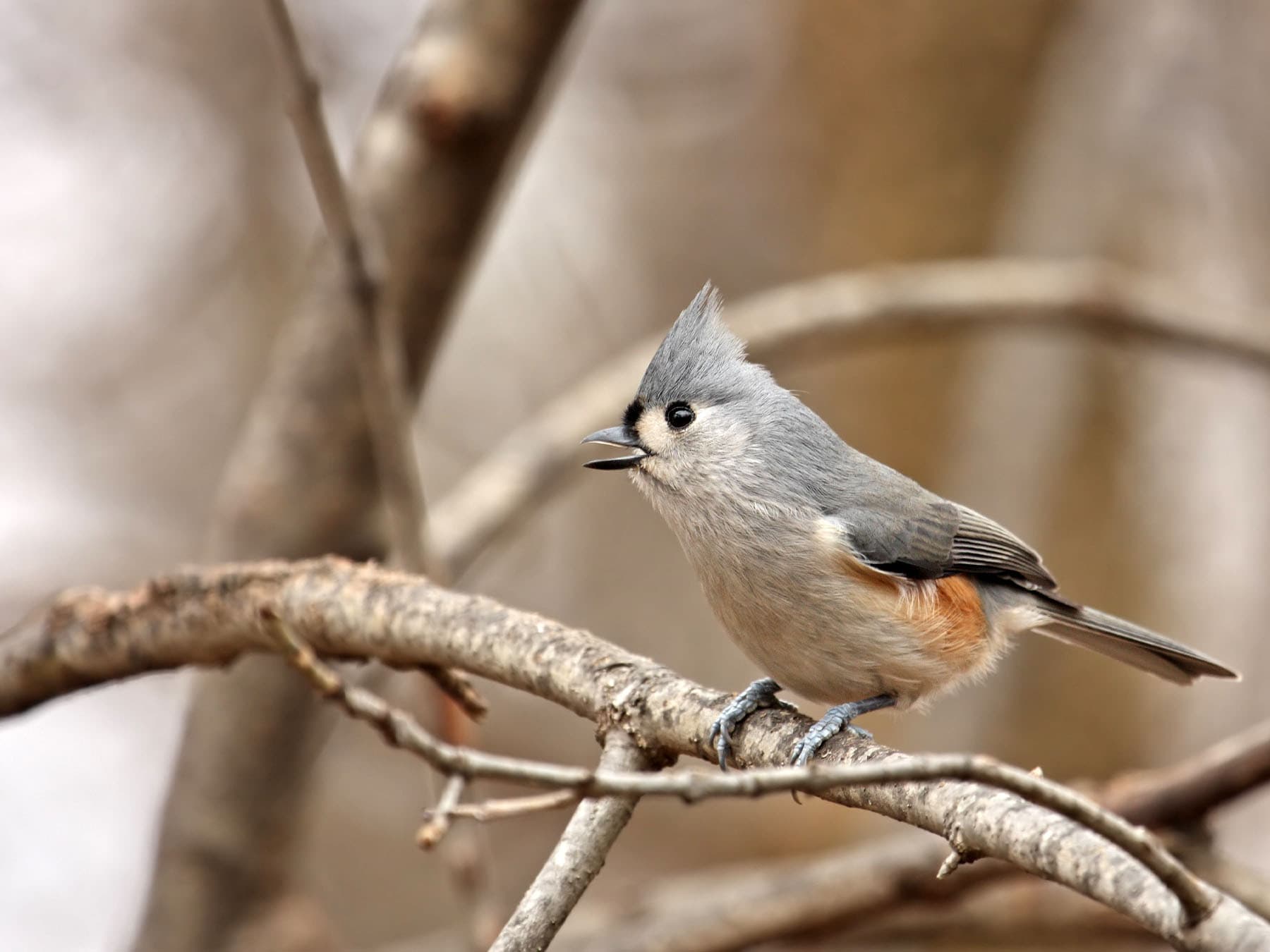
What a Tufted Titmouse sounds like, from its whistled song to the chick-a-dee call it uses to rate a predator, with recordings and spectrograms. For the bird itself, see Tufted Titmouse identification, song and facts.
What does a Tufted Titmouse sound like?
Best known for a loud, clear whistle, "peter-peter-peter": a phrase of one or two notes said again and again, as many as 11 times in a row.1 That is the song, heard mostly in spring and summer. All year round titmice also call: short contact notes,1 a rough "tsee-day-day-day" much like a chickadee's, fussy scolds, and harsher notes when a predator is about.2
The song: peter-peter-peter
The song is a run of clear, whistled phrases, each of one or two notes1; Audubon's guide describes 4 to 8 notes, and says it can be heard even in a midwinter thaw.3 A titmouse may sing a single phrase now and then, or as many as 35 songs a minute, and singing peaks from March to May.1
The "peter" is only one pattern. In one population, each titmouse sang 8 to 12 song patterns, which researchers call themes, and most or all of them were shared with its neighbors.4 One study counted 20 different song types in all; six Kentucky males averaged about 12 each, and neighbors there shared about two-thirds of them.1 The figure below shows four songs from four places: the rhythm, the pitch and the shape of the notes all change, and the Michigan bird gives one whistle at a time rather than a run.

What the different songs mean
Titmice do not use their song patterns at random. In one study, each bird's patterns fell into three groups, and the one used most was sung especially early in the day, early in the season and in the middle of the territory. The authors suggest that this group works as a long-range advertisement, a second signals a male ready to escalate a dispute, and a third a bird unlikely to attack or about to back off.5
Neighbors also answer in kind. Titmice match each other's songs during bouts of singing more often than chance would predict, and established birds can shift their songs slightly toward their neighbors' from year to year.4 In playback tests, titmice reacted less strongly to songs recorded 3 km (2 miles) away than to their own neighbors'.1
Do female titmice sing?
Yes, occasionally, and more quietly than males.1 More: male vs female Tufted Titmouse.
Young titmice learning to sing
Young titmice pick up the local songs in their first summer. Birds still on their parents' territory begin to sing recognizable versions,4 and within about 4 weeks of leaving the nest the songs of their parents and neighbors can be heard in theirs. Males sometimes sing quietly near their fledglings, which may help the young learn.1
Fledglings beg noisily for food; little has been written about the calls young titmice make in the nest.1
The chick-a-dee call
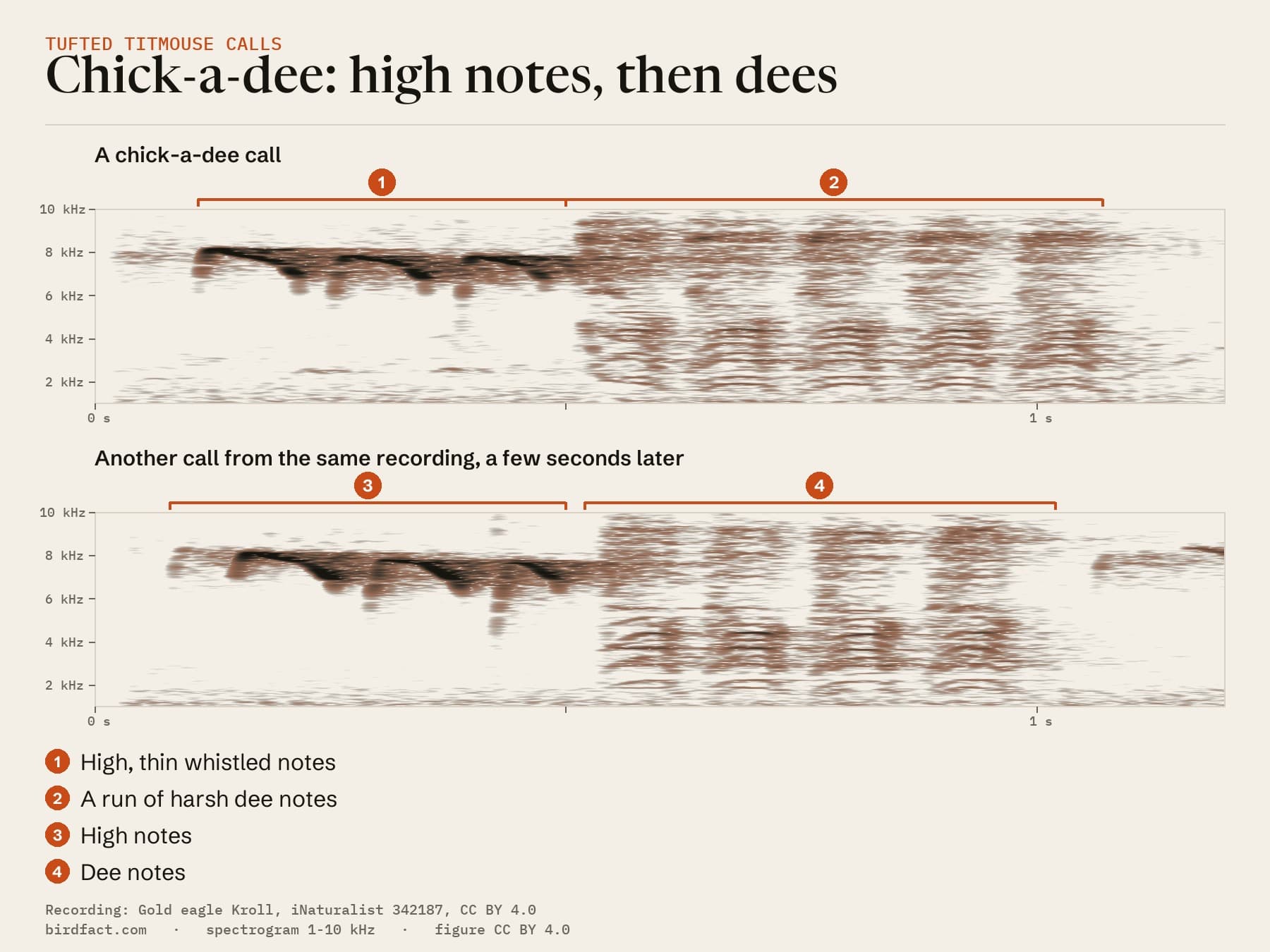
Titmice have a chick-a-dee call like their chickadee relatives, a string of different notes. Researchers recognize four main kinds of note in it, called Z, A, Dh and D, and they come almost always in that order. In one study, calls averaged about three notes, though calls like the ones below run much longer. Each titmouse's calls differ slightly from others', which may let titmice tell each other apart.6 All About Birds writes the call as a scratchy "tsee-day-day-day"2; on a spectrogram it shows as thin high notes, then harsher dee notes.
What the dee notes tell other birds
The dee notes carry information about danger. When researchers showed winter flocks of titmice models of birds of prey, small, high-threat predators such as an Eastern Screech-Owl drew longer mobbing and calls with more D notes than a big, lower-threat Red-tailed Hawk. Played back, the screech-owl calls kept other titmice from returning to feed for longer than the hawk calls did. Titmice seem to count how many D notes are given in a stretch of time, rather than how many come in each call.7
The calls carry to other animals too. Titmice and chickadees are the core of mixed winter flocks, titmice often lead the mobbing of an owl or hawk, and other birds come to their calls.1 Even eastern chipmunks listen: played titmouse mobbing calls, chipmunks foraged as if the risk of being caught had gone up, though calls of a hawk itself made no difference.8
Alarm calls and the distress scream
For a hawk in flight nearby, a titmouse gives a high, thin "seet", the call often described as the flying-predator alarm. Raspy "jway-jway" scolds come in fights and may also serve as alarms.1
A titmouse caught by a predator, or by a bird bander, screams: all 36 titmice handled from mist nets in one study did so.1 Recorded in traps, titmice gave more notes as a person came closer and when they were caught and held, mixing high notes with low, harsh ones whether or not other titmice were near. The calls carried over 60 m (200 feet) and did not readily draw larger birds of prey; they may confuse a predator, or warn other titmice and help bring them in to mob.9 In an earlier experiment, titmice approached a played-back distress call slowly and cautiously, which fits a warning better than a call for help.10 Males gave more chick-a-dee calls than females as the threat grew, though the study could not rule out rank or size rather than sex (bigger birds generally did not call more).11
Calls between mates
No source we read describes a single "mating call". Singing peaks from March to May, as pairs settle on territories and start nesting, and the high song rates of that season likely help defend the territory, stimulate the female and solicit mating. Males give high "see" notes in territorial disputes, in courtship and just before mating, and one observer described a male giving a thin, high squeal as he quivered his wings before mating. Females quiver their wings, apparently to ask the male for food, and the wings make an audible flutter.1 A female disturbed on her nest hisses.1 More: Tufted Titmouse nesting.
Titmouse or another bird?
Chickadees. Carolina and Black-capped Chickadees give chick-a-dee calls too, and titmice often travel with them, so it helps to see the bird. The songs differ more: a titmouse repeats its whistled phrase in a run, while a Black-capped Chickadee sings a clear, whistled "fee-bee"12 and a Carolina Chickadee four whistled notes, "see-dee, see-dee".13 More: chickadee calls and song.
Black-crested Titmouse. The titmouse of Texas and nearby sings a similar peter-peter-peter, though one-note songs are more common14, and its calls differ mainly in quality, most notes being sharper and more nasal.1
Do titmice sing at night?
We found no record of Tufted Titmice singing at night in Birds of the World or in the study summaries we read on their song.
About the recordings
All recordings on this page are field recordings shared under open licenses (CC0, CC BY or CC BY-SA), checked at their source. Recordings from iNaturalist were identified by the recordist and at least one other user; the Chapel Hill and Michigan birds were seen, and several observations also have photos. Spectrograms are drawn from the recordings themselves.
Sources
- Ritchison, G., Grubb Jr., T. C., Pravosudov, V. V. (2020). Tufted Titmouse (Baeolophus bicolor), version 1.0. Birds of the World (P. G. Rodewald, editor). Cornell Lab of Ornithology. doi:10.2173/bow.tuftit.01
- Cornell Lab of Ornithology. Tufted Titmouse Sounds. All About Birds. Accessed October 23, 2026. Source
- National Audubon Society (text: Kaufman, Lives of North American Birds). Tufted Titmouse. Audubon Guide to North American Birds. Accessed October 23, 2026. Source
- Schroeder, D. J., Wiley, R. H. (1983). Communication with shared song themes in Tufted Titmice. The Auk 100(2): 414-424. doi:10.1093/auk/100.2.414
- Schroeder, D. J., Wiley, R. H. (1983). Communication with repertoires of song themes in tufted titmice. Animal Behaviour 31(4): 1128-1138. doi:10.1016/S0003-3472(83)80020-7
- Owens, J. L., Freeberg, T. M. (2007). Variation in chick-a-dee calls of tufted titmice, Baeolophus bicolor: note type and individual distinctiveness. The Journal of the Acoustical Society of America 122(2): 1216-1226. doi:10.1121/1.2749459
- Courter, J. R., Ritchison, G. (2010). Alarm calls of tufted titmice convey information about predator size and threat. Behavioral Ecology 21(5): 936-942. doi:10.1093/beheco/arq086
- Schmidt, K. A., Lee, E., Ostfeld, R. S., Sieving, K. (2008). Eastern chipmunks increase their perception of predation risk in response to titmouse alarm calls. Behavioral Ecology 19(4): 759-763. doi:10.1093/beheco/arn034
- Branch, C. L., Freeberg, T. M. (2012). Distress calls in tufted titmice (Baeolophus bicolor): are conspecifics or predators the target? Behavioral Ecology 23(4): 854-862. doi:10.1093/beheco/ars041
- Hill, G. E. (1986). The function of distress calls given by tufted titmice (Parus bicolor): an experimental approach. Animal Behaviour 34(2): 590-598. doi:10.1016/S0003-3472(86)80128-2
- Freeberg, T. M., Branch, C. L. (2013). Call variation in tufted titmice (Baeolophus bicolor) in a distress context: potential sex differences. Ethology 119(8): 680-691. doi:10.1111/eth.12109
- National Audubon Society (text: Kaufman, Lives of North American Birds). Black-capped Chickadee. Audubon Guide to North American Birds. Accessed October 23, 2026. Source
- National Audubon Society (text: Kaufman, Lives of North American Birds). Carolina Chickadee. Audubon Guide to North American Birds. Accessed October 23, 2026. Source
- National Audubon Society (text: Kaufman, Lives of North American Birds). Black-crested Titmouse. Audubon Guide to North American Birds. Accessed October 23, 2026. Source
- Clark, K., Parker, A., Bostian, K., Koffel, T., Gold eagle Kroll, steve (xeno-canto). Recordings used on the Tufted Titmouse sounds page. iNaturalist; xeno-canto. Accessed October 23, 2026. Source