


Published 26 Oct 2026
Pigeon Sounds: Cooing, Calls and Wing Claps
By the Birdfact teamChecked by Nathan Cope
Feral pigeons coo low and soft with the bill shut, the gullet swelling the throat. Males give a rolling display coo while they bow and strut, and both sexes give a nest call from the nest site. Pigeons also clap their wings on take-off, and a fast take-off makes a tone from the outermost flight feather.
On this page12 sections
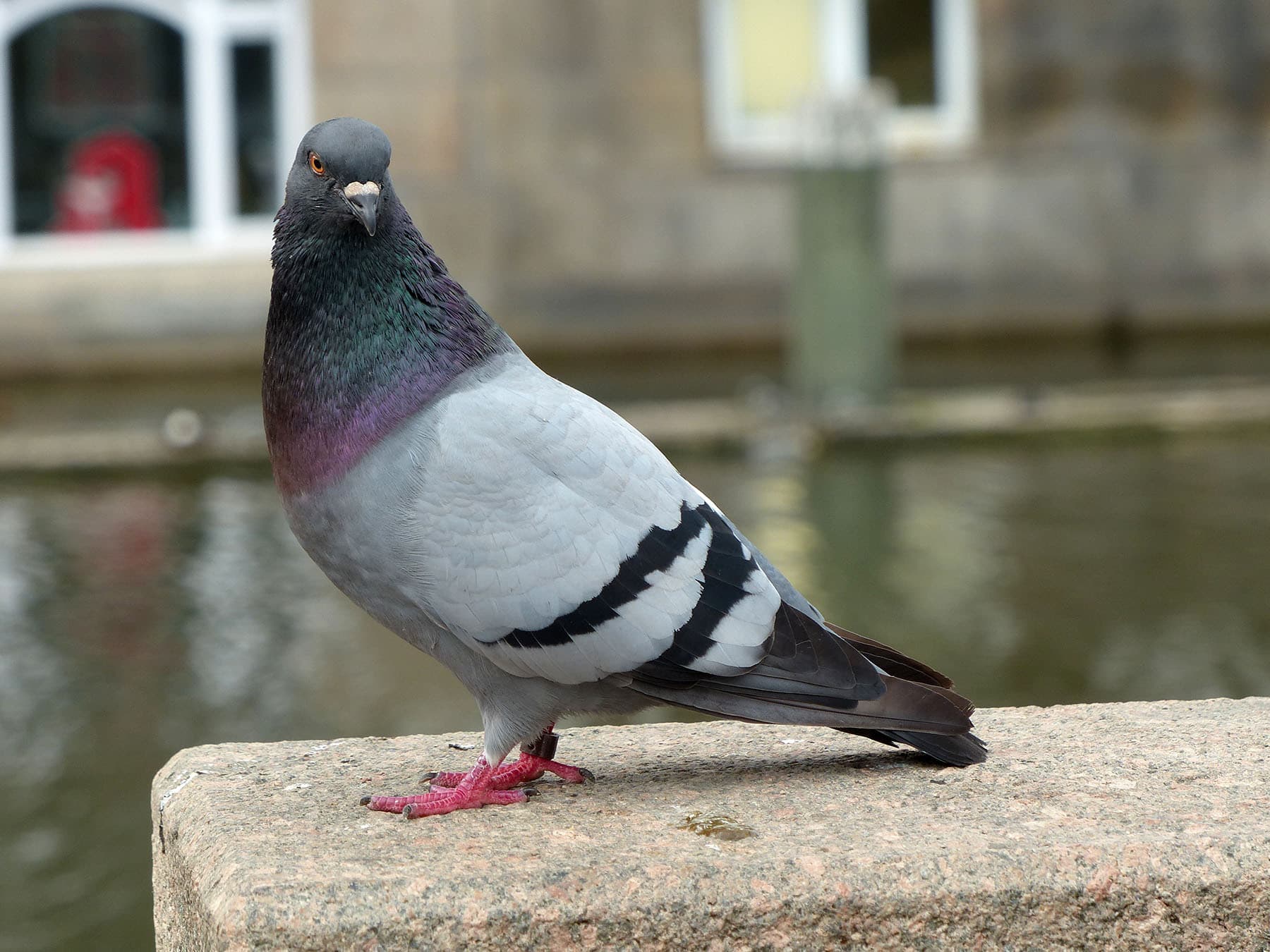
What a feral pigeon sounds like, from the rolling coo of a courting male to the claps of its wings, with recordings and spectrograms of real birds. It is about the town pigeon (a Rock Dove); the last section shows how its coo differs from a Woodpigeon's, a Collared Dove's and a Stock Dove's.
What does a pigeon sound like?
Mostly a low, soft, slightly wavering coo. All the pigeon's calls are low-pitched, somewhat tremulous cooing notes1, soft and guttural.2 Within that range there are a few distinct sounds: the display coo of a male showing off, the nest call, a grunt of alarm and the squeaky begging of the young. Pigeons also make sounds without their voice: they clap their wings, snap their bills and stamp their feet.1
The display coo
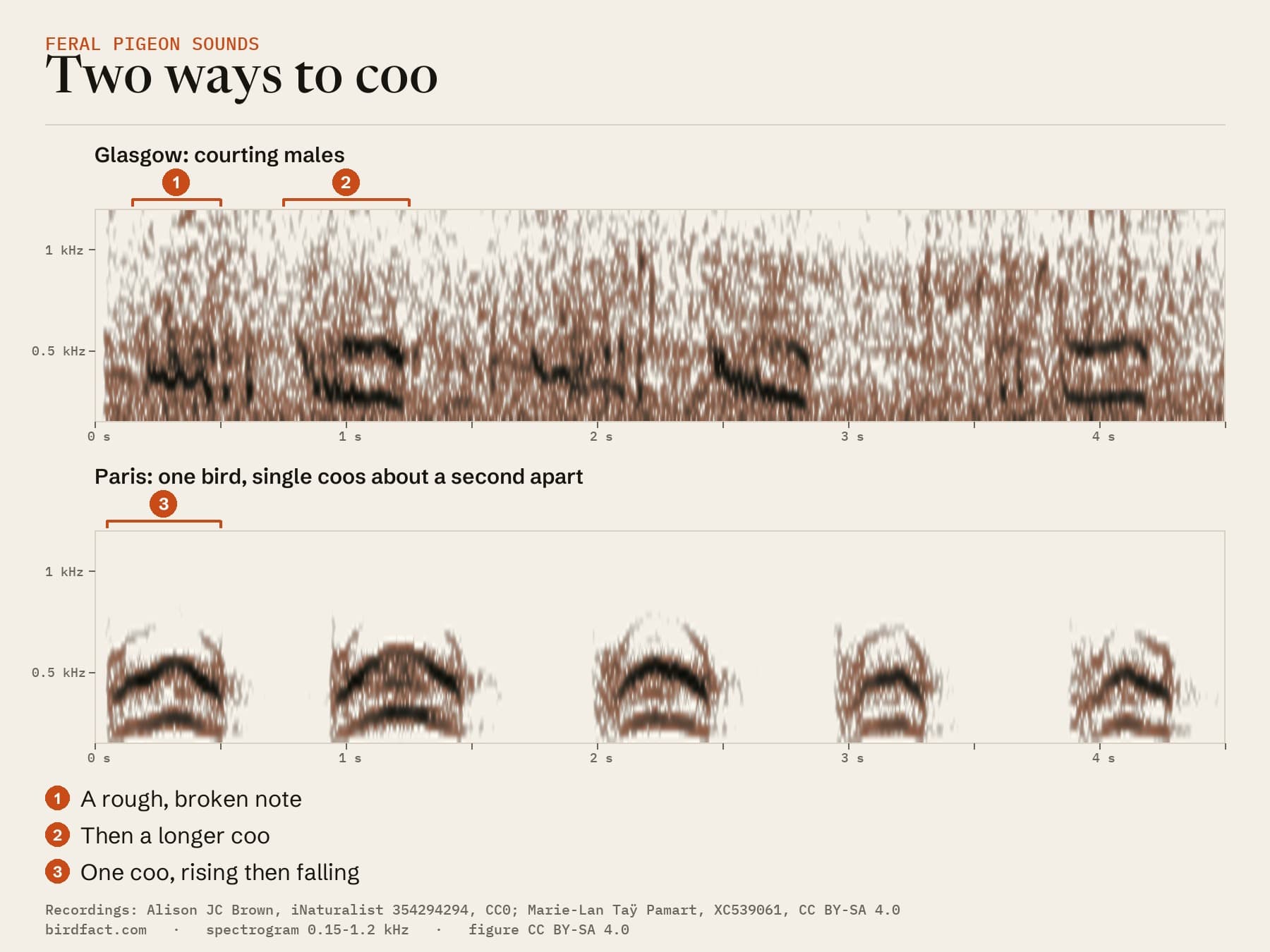
The pigeon's main song is its display coo, written as "coo, roo-c'too-coo". The male gives it while he struts, bows, swells his throat and fans his tail, often turning in circles: the bow-coo. It is both a threat and a courtship song. Aimed at another male, it makes the rival leave or fight; aimed at a female, it becomes courtship, and it goes on helping to keep the pair together after they have paired.1 To the ear it is a rolling series of throaty coos.3
In a 1975 thesis on 12 caged homing pigeons at Durham University, bow calls varied a lot from one bird to the next in pitch, loudness and timing, and the author suggested they may let pigeons recognise each other. When the female walks away and the male follows close behind her, tail fanned (driving), his call changes into a separate driving call, which the study wrote as "wang-wang-krroooo".4
The nest call
The nest call, written as "oh-oo-oor", is given on the nest site, with the head bowed and the wings twitching. A male picks a site and sits on it giving the call to attract a mate, and the female calls from the site while he brings her nest material.1 It is a long coo, given at the nest by a bird looking for a mate.3 In caged pigeons, both sexes gave it, males more often, in sequences that commonly lasted over a minute, the coos at roughly even gaps, each one rising and then falling in pitch.4
The Paris bird below gives single coos at an even pace, more like the nest call than the rolling display coo, though its recordist heard it while it waited to be fed, not at a nest. Without seeing what a bird is doing, it is not always possible to say which call it is giving.
Why do pigeons coo?
To claim a territory and a nest site, and to win and keep a mate. The display coo warns off other males and courts females; the nest call draws a mate to the site. Feral pigeons coo all year, more in spring and summer, at any time of day, and the cooing is tied to the territory and the nest.1
Females listen. In a playback study, the sound of a male's courtship on its own drew more response from captive females than silent video of it, especially cooing back; sound and video together worked best.5
How pigeons coo with their bill shut
A cooing pigeon keeps its bill closed. Air from the lungs is pushed into the upper part of the gullet (oesophagus), which balloons and makes the throat swell. In pigeons this pouch has no link to the air sacs, and in ring doves, where the mechanism was measured, it is the upper gullet that fills, not the crop below it. The inflated gullet filters out the higher frequencies, which leaves a purer tone.6 The sound itself is made in the syrinx, the bird's voice box, by thin membranes that vibrate as the air pulses through them.7
Across birds, species that call with the mouth shut tend to have lower voices than their size alone would predict.6 In the caged homing pigeons' recordings, the calls had no main energy above 1 kHz.4
Alarm calls
Birds of the World lists an alarm or distress call, a grunting "oorhh", given at the sight of a possible predator,1 a short grunt when the bird is alarmed.3 In caged pigeons, a short, harsh call came mostly from females at the nest when something came too close.4 But a 2013 study describes the pigeon as a species without specific alarm calls: no call known to tell other pigeons what kind of danger is near, as many birds have.8 The grunt and the harsh call are reactions to a threat close by, not a warning code. Pigeons may have another warning signal in their wings, though it has not been tested, as the next section explains.
Wing claps and whistles
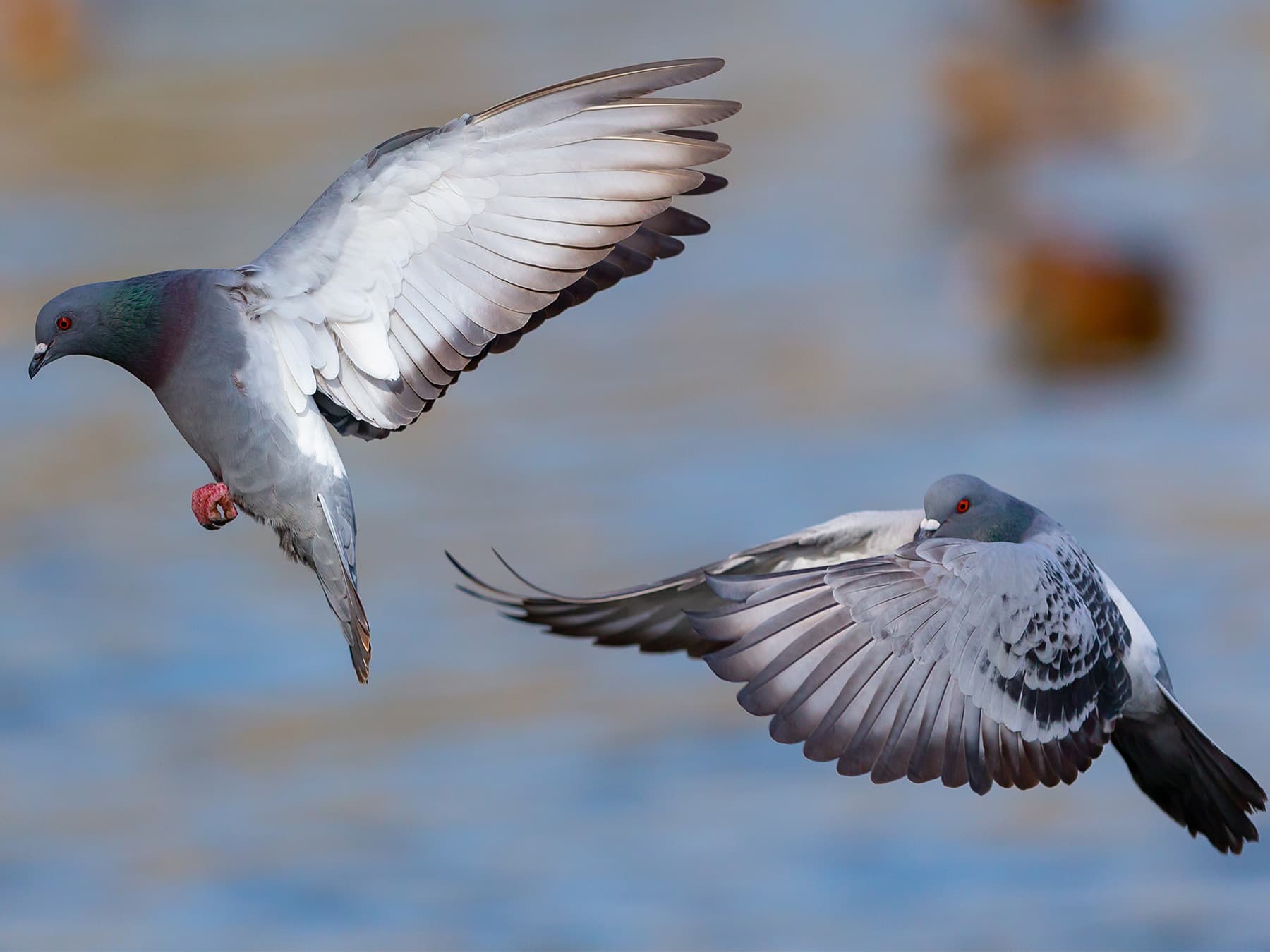
The slapping sound as a pigeon takes off is its wings meeting. Filmed in aviaries, the wings touched over the back at the top of the upstroke in the first four wingbeats of a take-off.9 It makes a sharp slapping sound.3 Males also clap their wings in display flights, after mating and at other times.1
Listen closely and a fast take-off also has a tone, at about 700 Hz, on each downstroke. It comes from a small stretch of the outermost flight feather that flutters in the airflow; when researchers stiffened that part of the feather with hairspray, the tone disappeared in 4 of 5 birds. Both sexes have the feature. The tone needs the fast wingbeats of a hurried take-off, so it could tell other pigeons how alarmed a bird was, but nobody has yet tested whether pigeons use it that way.9
Pigeons sometimes stamp their feet audibly as they land.3
Baby pigeon sounds
Squabs give squeaky peeps when they are fed.1 In caged pigeons, a day-old chick's cheeps were barely audible, but loud enough to record by day 4; each began with a click as the bill opened, gone by day 8.4 From about day 8-10, squabs hiss and snap their bills at intruders.1 More: baby pigeons.
Young pigeons start to coo at 30-40 days old and give adult coos at 5.5-12 months.1 In the caged birds, young males gave a softer, warbling version of the bow call at 3-4 months, and the full display at about 4 months, earlier than the adult cooing age given above.4

Learned or inborn?
Male and female pigeon sounds
Males and females share the same calls, but males call more often and more loudly.1 The display coo is mostly a male sound: mature females in the caged study rarely gave the bow call, and theirs was higher and quieter,4 and researchers studying colonies of feral pigeons treat bow-cooing as a male behaviour.11
Pigeon, Woodpigeon or dove? Telling the coos apart
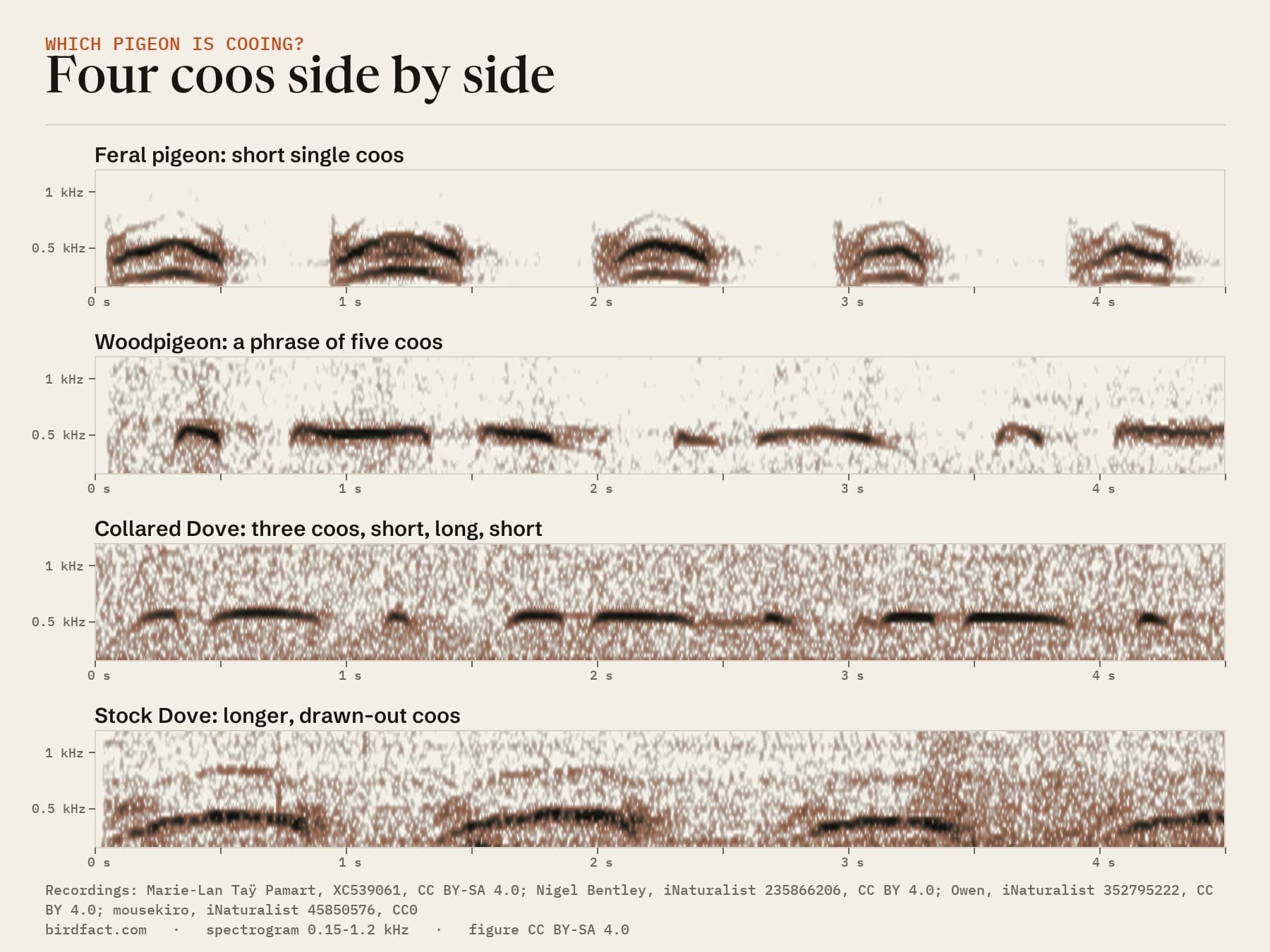
Four pigeons and doves coo in Britain, each with its own rhythm. The feral pigeon gives short single coos, or a rolling display coo when it is showing off. The Woodpigeon sings a phrase of four or five deep coos, usually stressed on the second, again and again;12 the Collared Dove three coos with the middle one stressed;13 and the Stock Dove, which is not very vocal, a series of drawn-out coos.14 The figure shows all four on one time scale.
More: Woodpigeon call and song, Collared Dove call and song and, for North America, Mourning Dove sounds. For the bird itself, see feral pigeon (Rock Dove) identification and facts.
Sources
- Lowther, P. E., Johnston, R. F. (2020). Rock Pigeon (Columba livia), version 1.0. Birds of the World (S. M. Billerman, editor). Cornell Lab of Ornithology. doi:10.2173/bow.rocpig.01
- National Audubon Society. Rock Pigeon. Audubon Guide to North American Birds (text adapted from Kaufman, Lives of North American Birds, 1996). Accessed 26 October 2026. Source
- Cornell Lab of Ornithology. Rock Pigeon sounds. All About Birds. Accessed 26 October 2026. Source
- Spiteri, N. J. (1975). Social, especially agonistic, behaviour in the pigeon. MSc thesis, Department of Psychology, Durham University. Accessed 26 October 2026. Source
- Partan, S. R., Yelda, S., Price, V. L., Shimizu, T. (2005). Female pigeons, Columba livia, respond to multisensory audio/video playbacks of male courtship behaviour. Animal Behaviour 70(4): 957-966. doi:10.1016/j.anbehav.2005.03.002
- Riede, T., Eliason, C. M., Miller, E. H., Goller, F., Clarke, J. A. (2016). Coos, booms, and hoots: the evolution of closed-mouth vocal behavior in birds. Evolution 70(8): 1734-1746. doi:10.1111/evo.12988
- Goller, F., Larsen, O. N. (1997). In situ biomechanics of the syrinx and sound generation in pigeons. Journal of Experimental Biology 200(16): 2165-2176. doi:10.1242/jeb.200.16.2165
- Stephan, C., Bugnyar, T. (2013). Pigeons integrate past knowledge across sensory modalities. Animal Behaviour 85(3): 605-613. doi:10.1016/j.anbehav.2012.12.023
- Niese, R. L., Tobalske, B. W. (2016). Specialized primary feathers produce tonal sounds during flight in rock pigeons (Columba livia). Journal of Experimental Biology 219(14): 2173-2181. doi:10.1242/jeb.131649
- Nottebohm, F., Nottebohm, M. E. (1971). Vocalizations and breeding behaviour of surgically deafened ring doves (Streptopelia risoria). Animal Behaviour 19(2): 313-327. doi:10.1016/s0003-3472(71)80012-x
- Jankowiak, Ł., Tryjanowski, P., Hetmański, T., Skórka, P. (2018). Experimentally evoked same-sex sexual behaviour in pigeons: better to be in a female-female pair than alone. Scientific Reports 8: 1654. doi:10.1038/s41598-018-20128-3
- Baptista, L. F., Trail, P. W., Horblit, H. M., Boesman, P. F. D., Garcia, E., Perlman, Y. (2025). Common Wood-Pigeon (Columba palumbus), version 1.1. Birds of the World (J. del Hoyo, A. Elliott, J. Sargatal, D. A. Christie, E. de Juana and M. G. Smith, editors). Cornell Lab of Ornithology. doi:10.2173/bow.cowpig1.01.1
- Romagosa, C. M., Mlodinow, S. G. (2022). Eurasian Collared-Dove (Streptopelia decaocto), version 1.1. Birds of the World (P. Pyle, P. G. Rodewald and S. M. Billerman, editors). Cornell Lab of Ornithology. doi:10.2173/bow.eucdov.01.1
- Baptista, L. F., Trail, P. W., Horblit, H. M., Boesman, P. F. D., Garcia, E. (2020). Stock Dove (Columba oenas), version 1.0. Birds of the World (J. del Hoyo, A. Elliott, J. Sargatal, D. A. Christie and E. de Juana, editors). Cornell Lab of Ornithology. doi:10.2173/bow.stodov1.01
- xeno-canto, iNaturalist. Recordings used on the pigeon sounds page. xeno-canto.org and inaturalist.org. Accessed 26 October 2026. Source