Published 27 Oct 2026
Goshawk or Sparrowhawk? How to Tell Them Apart
By the Birdfact teamChecked by Nathan Cope
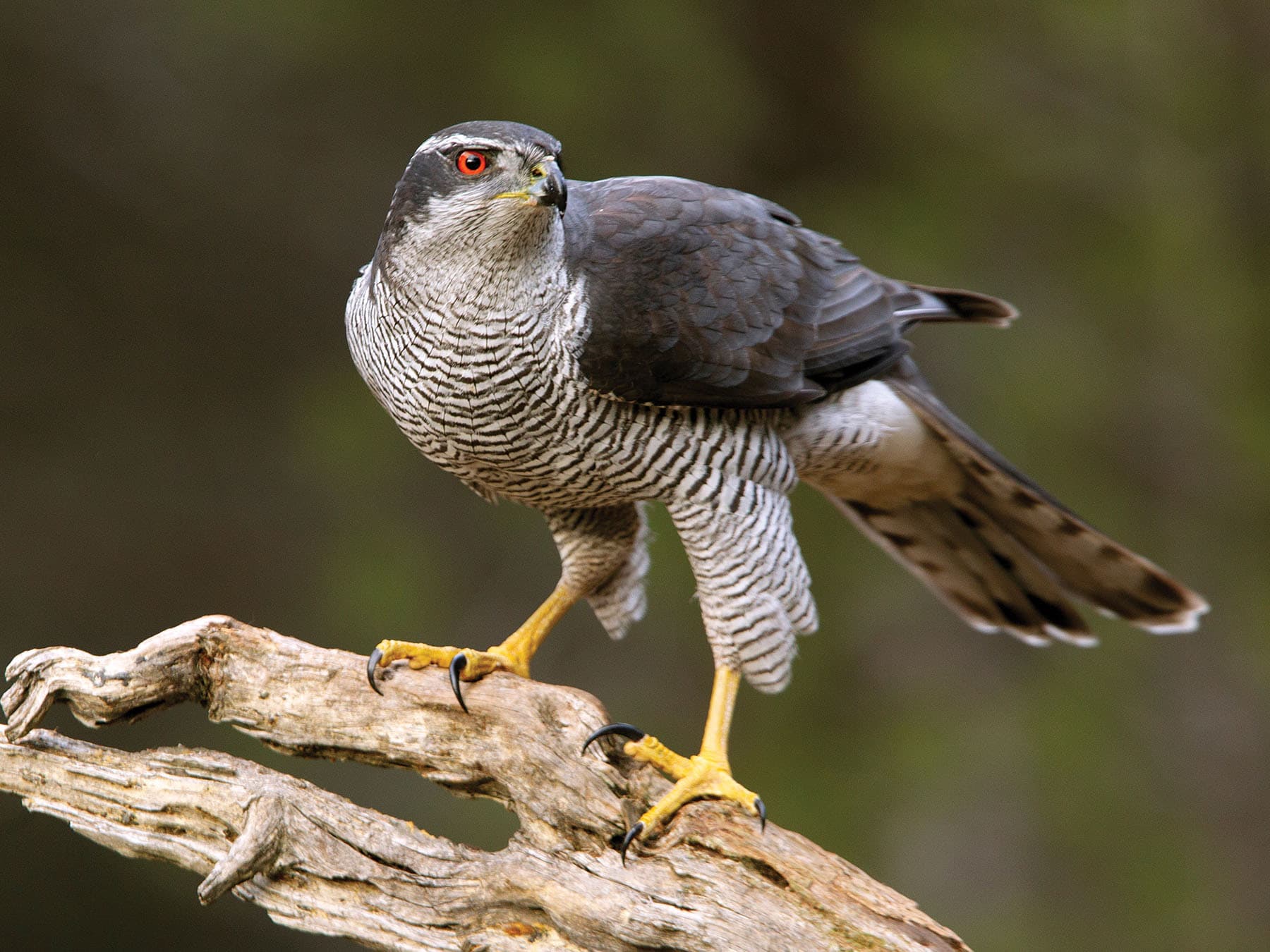
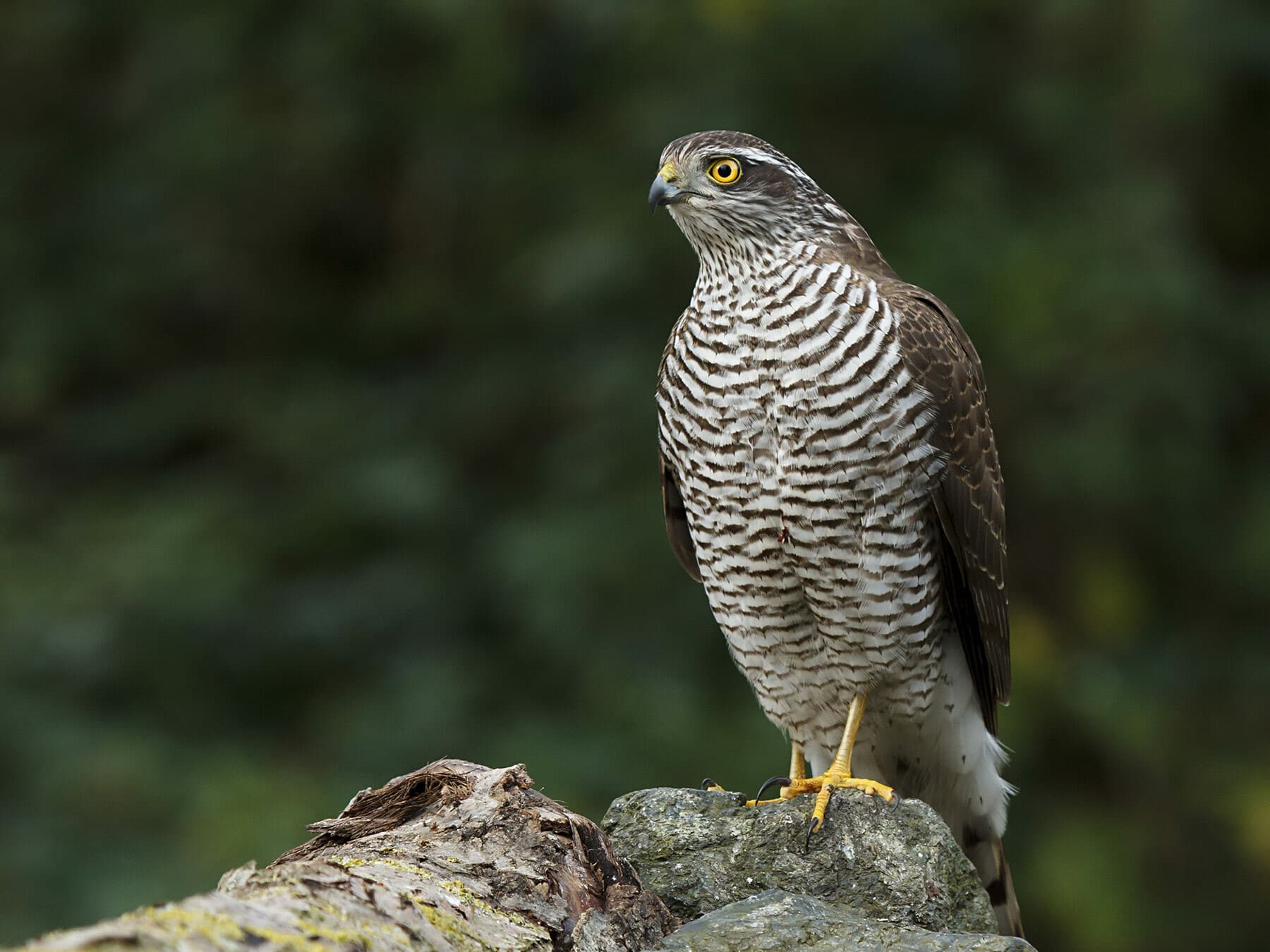
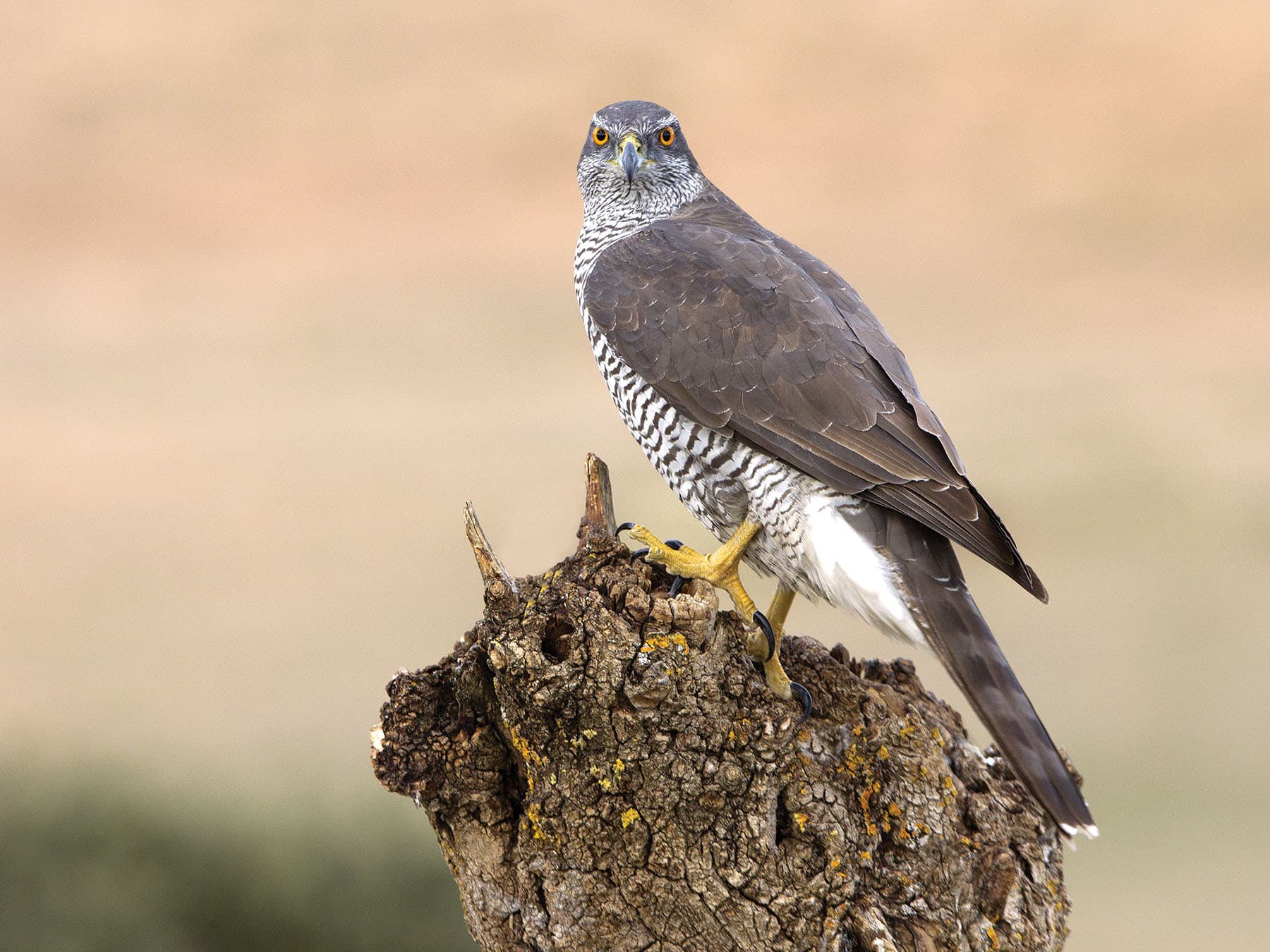
Look at the build: a Goshawk has a bigger head and bill, a deeper chest, thicker legs and white undertail feathers. A Sparrowhawk has a small head and thin legs
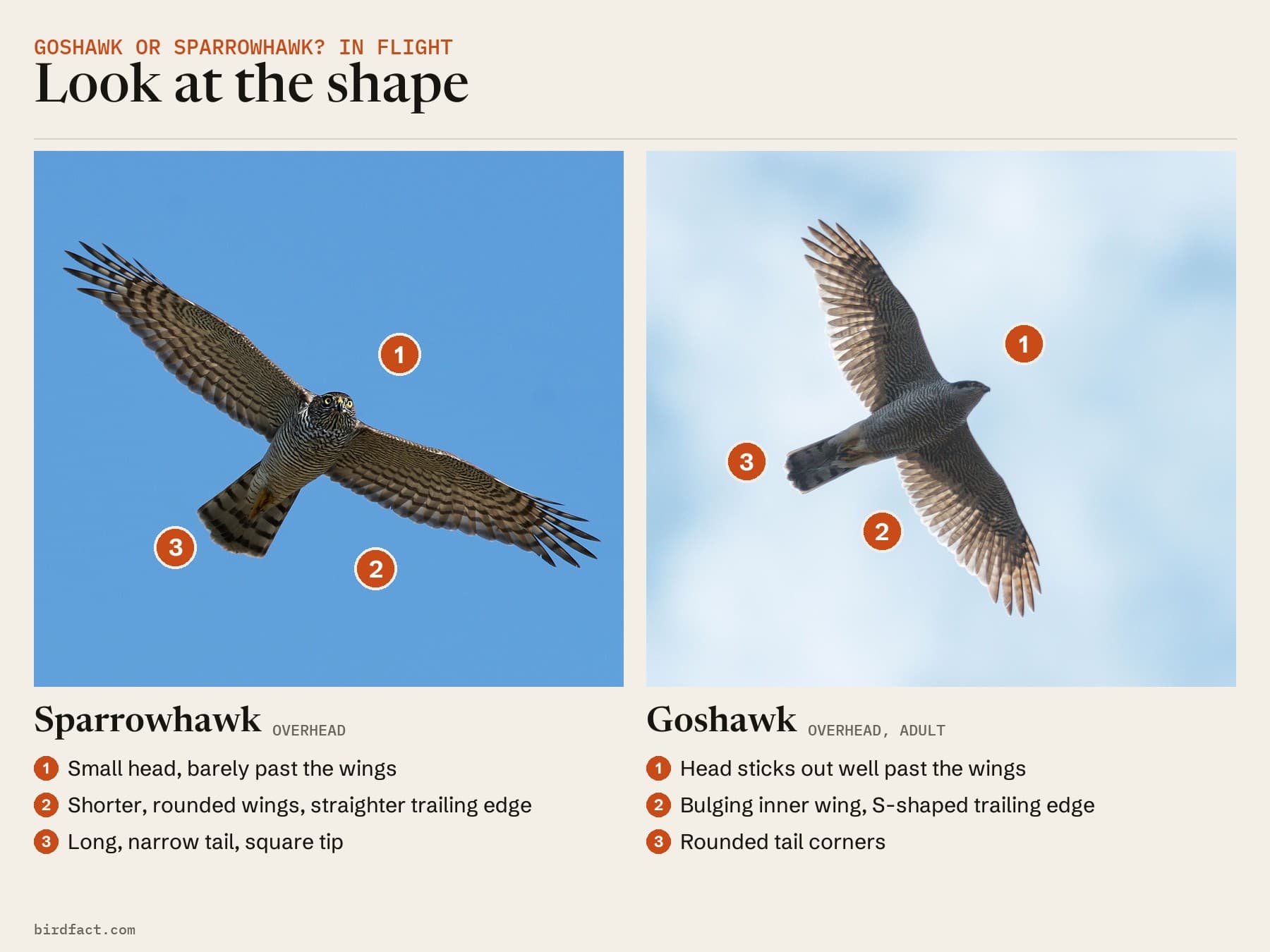
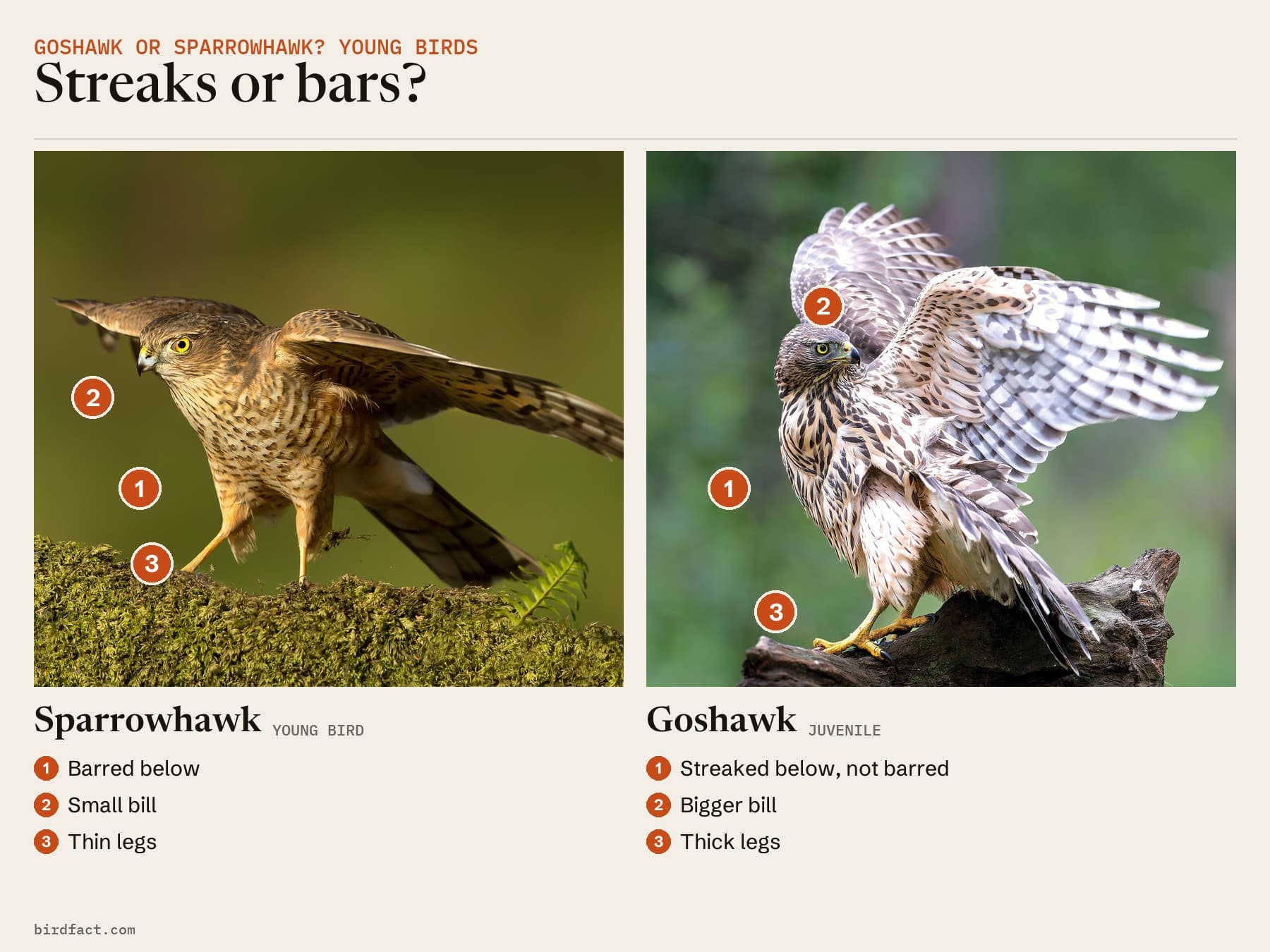
In flight a Goshawk’s head sticks out farther and its tail has rounded corners; a Sparrowhawk’s tail is longer, with a square tip. Young Goshawks are streaked below, young Sparrowhawks barred.
On this page15 sections
Goshawk or Sparrowhawk? Look at the build
| Feature | Sparrowhawk | Goshawk |
|---|---|---|
| BuildDecisive | Sparrowhawk: Small head and bill, slim chest, thin legs | Goshawk: Big head and bill, deep chest, thick legs, white undertail |
| Tail in flight | Sparrowhawk: Long and narrow, square tip | Goshawk: Shorter and broader, rounded corners |
| Young birdsDecisive | Sparrowhawk: Barred below | Goshawk: Streaked below |
| Size | Sparrowhawk: 28-38 cm, 110-342 g | Goshawk: 48-62 cm, 600-2,000 g |
| Where | Sparrowhawk: Woods, towns and gardens | Goshawk: Woods and forests, rarely gardens |
The closest pair is a female Sparrowhawk and a male Goshawk: check the head, legs and tail corners.
Seen one and not sure which? Identify it from a photo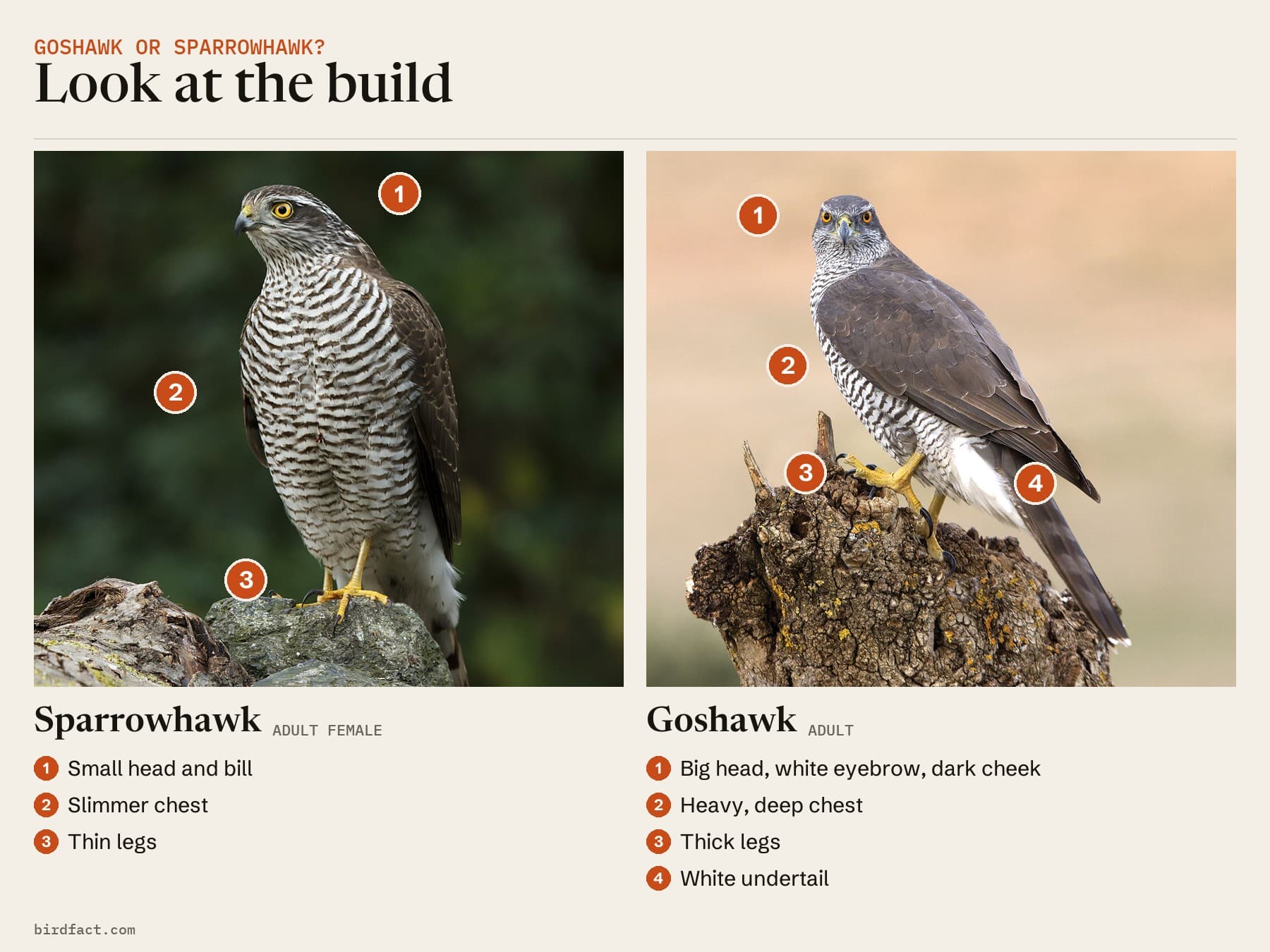
A Goshawk is a bigger, stockier hawk: bigger head and bill, deeper chest, thicker legs, white undertail and a relatively shorter tail with rounded corners. They do not overlap in weight, but a male Goshawk can look like a big female Sparrowhawk. Young Goshawks are streaked below, young Sparrowhawks barred.
A Goshawk looks like a bigger, stockier Sparrowhawk, and a large female Sparrowhawk can be taken for a Goshawk, so the two are easy to mix up. This page sets them side by side: build and size, shape in flight, adults and young birds, eyes, calls, where you see them, what they eat, and their history in Britain. For each bird in full, see the Sparrowhawk and Goshawk guides.
How do you tell a Goshawk from a Sparrowhawk?
Look at the build rather than the colours, which are much alike. A Goshawk has a bigger head and bill, a heavier, deeper chest, thicker legs and white undertail feathers that often show; a Sparrowhawk of any age has a smaller head and bill and thinner legs.1, 2, 3
In flight, a Goshawk's head sticks out farther in front of the wings, the inner wing bulges and the tail is relatively shorter, with more rounded corners. A Sparrowhawk has a longer, narrower, square-tipped tail and shorter, rounder wings. Young Goshawks are streaked below, young Sparrowhawks barred.
| Sparrowhawk | Goshawk | |
|---|---|---|
| Length | 28-38 cm | 48-62 cm |
| Weight | 110-196 g (male); 185-342 g (female) | 600-1,100 g (male); 900-2,000 g (female) |
| Head and bill | Small head, small bill | Big head, bigger bill |
| Legs | Long and thin | Thicker |
| Tail in flight | Long, narrow, square tip | Shorter for its size, rounded corners |
| Wings in flight | Shorter, rounded, straighter trailing edge | Longer, bulging inner wing |
| Adult face | Pale stripe over the eye on females; orangey cheeks on males | White eyebrow and a dark patch behind the eye |
| Young birds below | Barred | Streaked |
| Where | Woods, towns, parks and gardens | Woods and forests; rarely in gardens |
| UK breeding pairs (estimates) | About 31,000 (2016) | About 620 (2013-17) |
Size: the hard pair
The two do not overlap in weight. Birds of the World gives male Goshawks from 517 g, and female Sparrowhawks up to 350 g; the RSPB's ranges in the tables are narrower, but the gap is the same. The Goshawk's bill is nearly twice as long: 20.5-26.1 mm, against 10.7-14.9 mm in a Sparrowhawk.1, 4, 2
In both, the female is much bigger than the male: female Goshawks weigh 50-90% more than males. So the closest pair is a female Sparrowhawk and a male Goshawk. A male Goshawk looks like a very large female Sparrowhawk, with a heavier breast, relatively longer wings and a slightly shorter tail.3
How alike the two can look is disputed. A 1973 flight-identification guide in British Birds warned that, in the brief views these hawks give, small male Goshawks are not infrequently taken for large female Sparrowhawks.5 In 1982 Marquiss and Newton, who studied Goshawks nesting in Britain, called that a bird-book claim: most British Goshawks are of the big northern type, every male considerably larger than any Sparrowhawk and about three times as heavy, and the two differ in shape as much as size.6 Both can be true: the weights do not overlap, but a fast or distant bird can still fool you.
In practice the usual mistake runs the other way. Where Marquiss and Newton found only Sparrowhawk nests, they suspected that Sparrowhawks displaying above the trees had been taken for Goshawks, and large female Sparrowhawks hunting with a slow, display-like flight have been misidentified as Goshawks too.7
| Sparrowhawk | Goshawk | |
|---|---|---|
| Length | 28-38 cm | 48-62 cm |
| Weight, male | 110-196 g | 600-1,100 g |
| Weight, female | 185-342 g | 900-2,000 g |
| Bill | 10.7-14.9 mm | 20.5-26.1 mm |
In flight
Shape tells them apart overhead. A Sparrowhawk has a longer, narrower tail with a square tip, and shorter, rounder wings whose trailing edge runs straighter, with a small head that barely shows in front of the wings. A Goshawk has a deeper chest and a bigger head that sticks out farther, inner wing feathers that bulge so the trailing edge looks S-shaped, and a tail with more rounded corners.1, 2
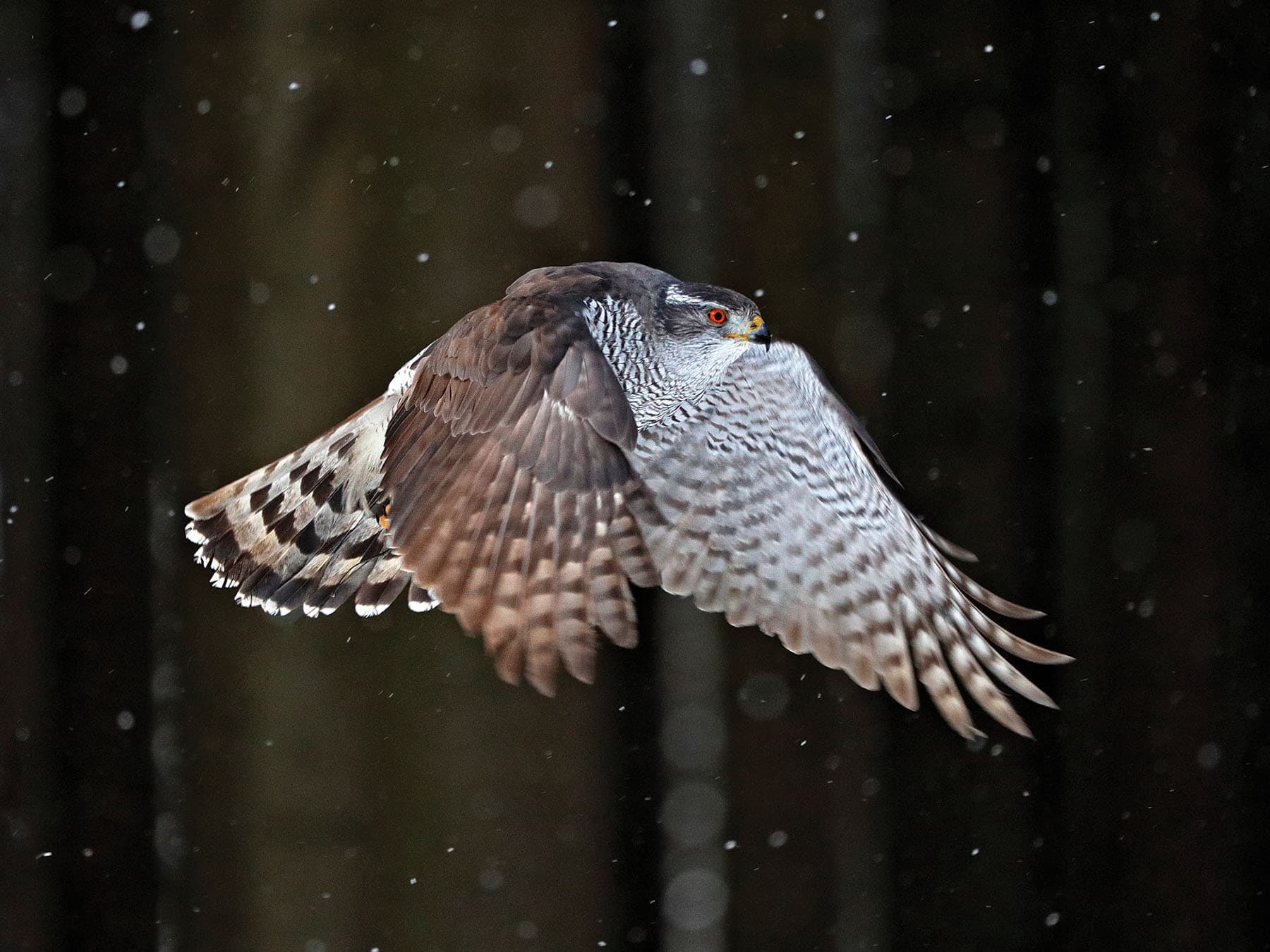
Goshawks fly with slower, deeper wingbeats than Sparrowhawks, glide for longer and soar more readily. In late winter they display over their nesting woods in a "sky dance", circling high with the white undertail feathers fanned out, then flying with slow, exaggerated wingbeats, undulating and sometimes diving into the trees. Most displays are in January and February, early in the morning, and most are by females. Displaying Sparrowhawks fan their tail and white undertail feathers too, so a white undertail supports an identification rather than settling it.8
Adults
An adult male Sparrowhawk is blue-grey above, with orangey cheeks and orangey-brown bars below; a female is grey-brown above with dark-brown bars and a pale stripe over the eye.4, 9 Adult Goshawks of both sexes are grey above and white below with dense grey bars, with a white eyebrow between a dark crown and a dark patch behind the eye, and white undertail feathers; females are browner, with less contrast in the face.1, 3
The hardest bird is an adult female Sparrowhawk with a bold pale eyebrow and grey bars. Any orange on the cheek rules out a Goshawk; otherwise look for the small bill, thin legs and square tail. The eye can help: a female Sparrowhawk's is yellow to orange, never the deep orange-red of many adult male Goshawks. More on male and female Sparrowhawks.

Eyes
A Sparrowhawk's eye is pale yellow in young birds, yellow to orange in females and yellow-orange to orange-red in adult males.9 A Goshawk's stays yellow until it is three or four years old, then darkens: to orange-red in males, orange-yellow in females.1 So the eye does not separate young birds, which both have yellow eyes, or adult males, which can both be orange-red.
Young birds
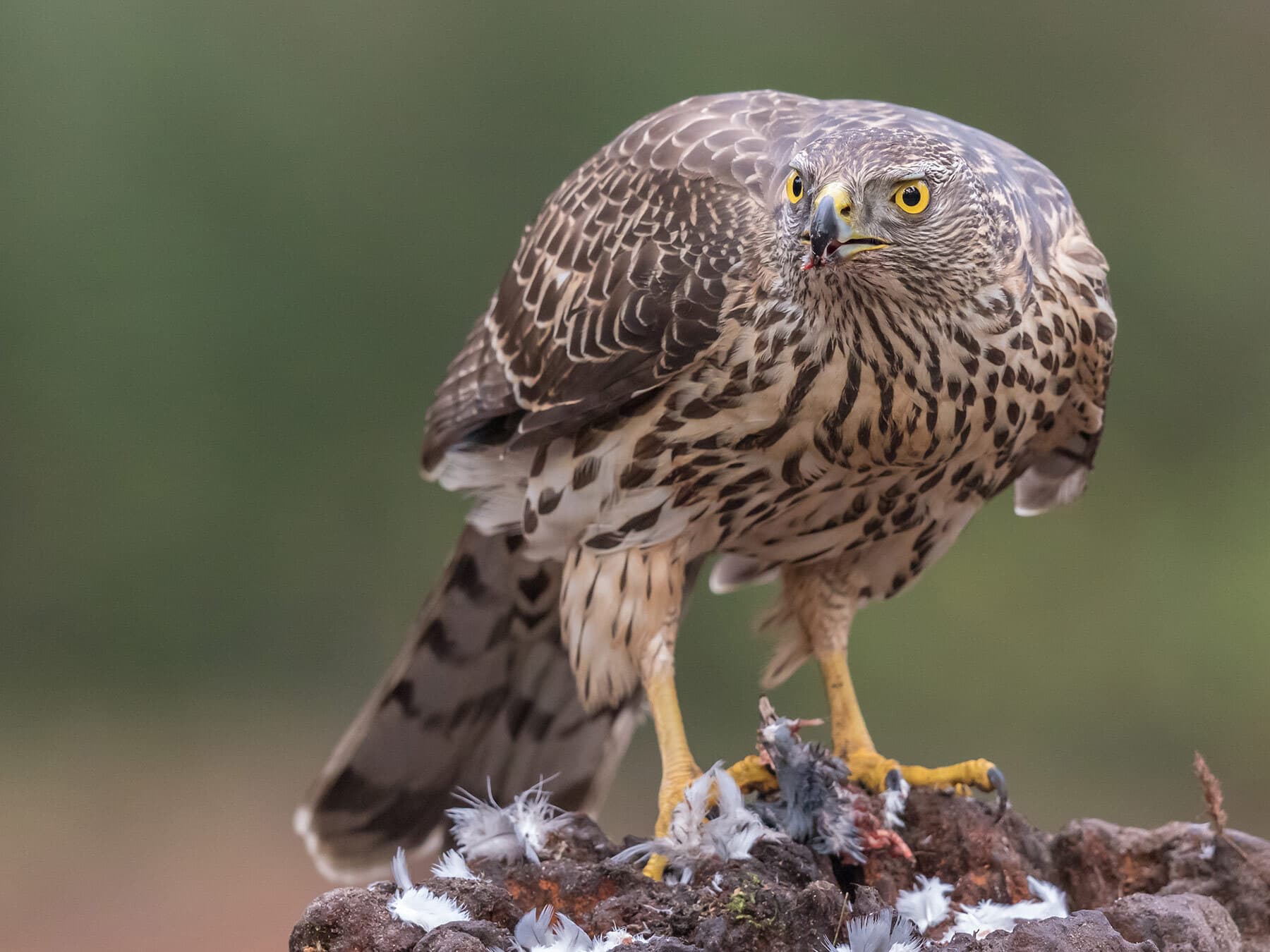
Young birds differ in pattern as well as build. A young Goshawk is brown above with pale edges to the feathers and buff to white below with dark streaks running down the breast, not bars.1, 2 A young Sparrowhawk looks like a browner female, with rusty edges above and broader bars below.9 One trap: young male Sparrowhawks have a distinct pale eyebrow, like an adult Goshawk, but their backs are brown and their bars are brown too.
Young Sparrowhawks' bars are more ragged than an adult's, so the breast can look streaky. A young Goshawk's marks are dark, drop-shaped streaks that run down onto the undertail.5
Calls
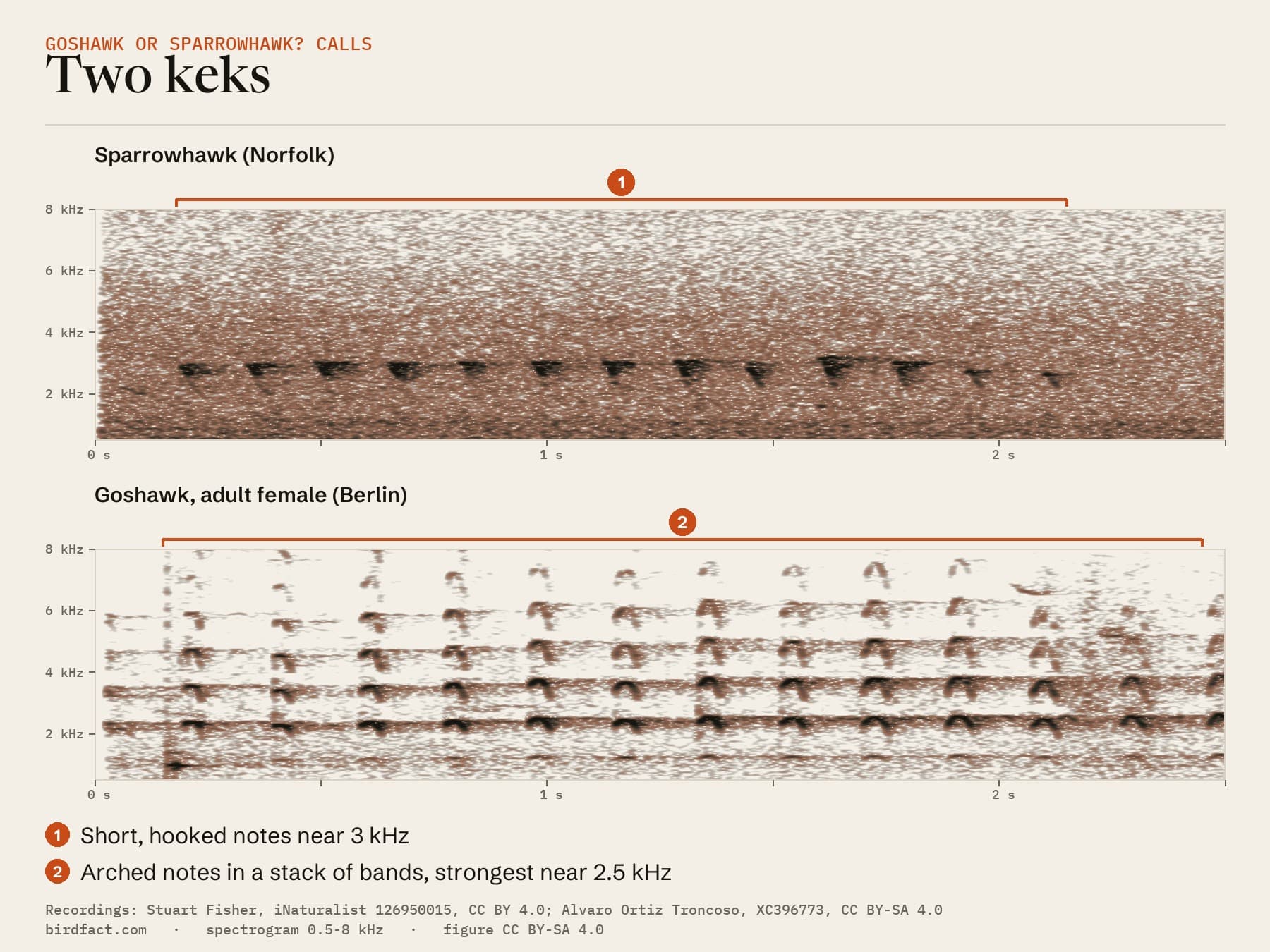
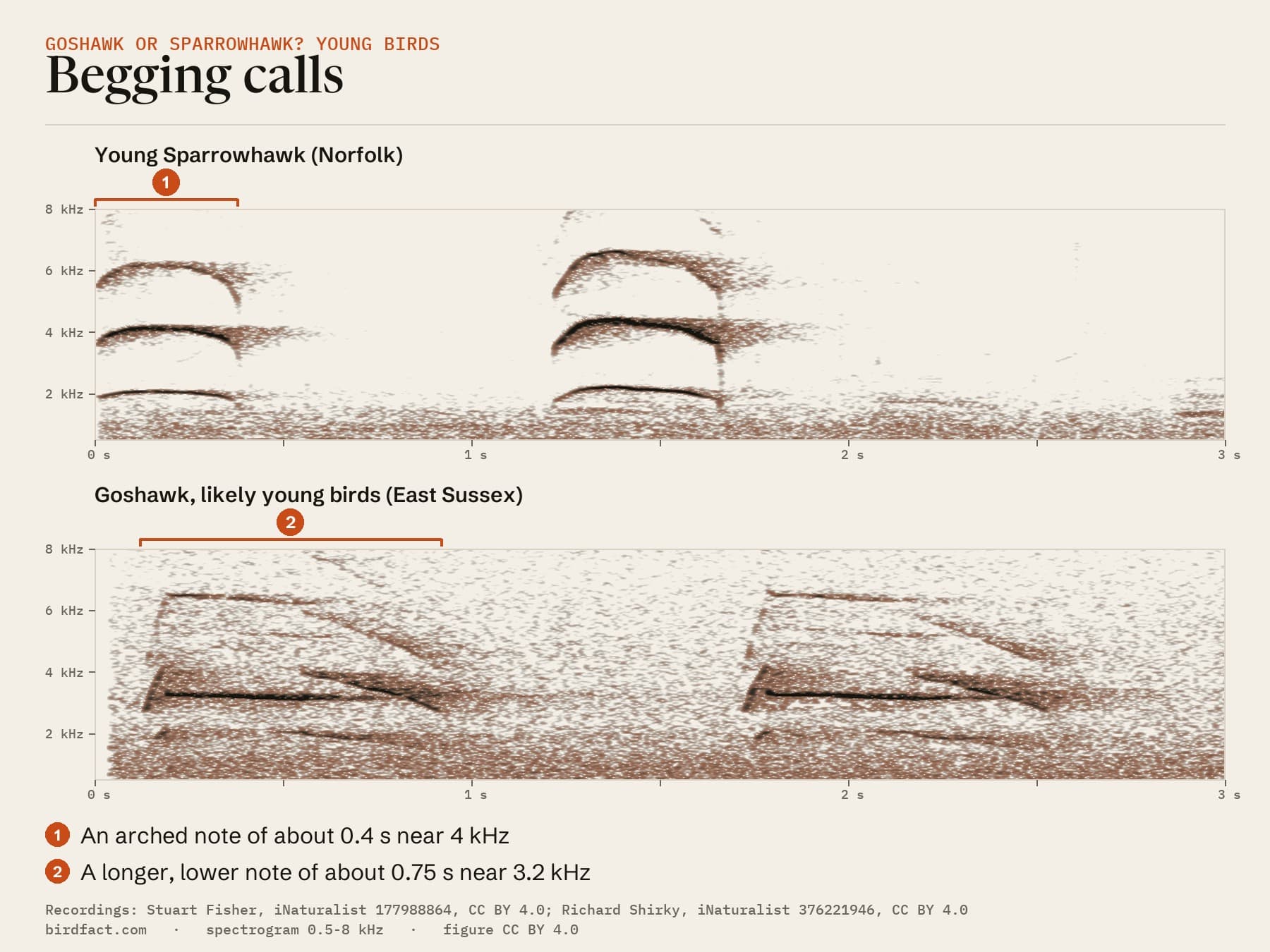
Both are quiet away from the nest. The Sparrowhawk's main call is a cackling kek-kek-kek; its young beg with thin, drawn-out notes.9 A Goshawk has a chattering kek-kek-kek too, given slowly then faster to advertise its territory and fast as an alarm, and a drawn-out wail when food is being passed at the nest; females wail when begging for food from their mates. It calls most from setting up a territory until egg-laying, often early in the morning.1
In the recordings below, the Goshawk's kek notes are arched and lower, strongest near 2.5 kHz, against about 3 kHz for the Sparrowhawk's short, hooked notes, at a similar pace. The Goshawk notes we read as young birds begging are longer and lower than a young Sparrowhawk's: about 0.75 seconds near 3.2 kHz, against about 0.4 seconds near 4 kHz.10, 11, 12, 13 These are single recordings, so take the numbers as a guide. More on Sparrowhawk calls.
Where you see them
Sparrowhawks live across almost all of Britain and Ireland, in woods, towns, parks and gardens.14 Goshawks are woodland birds, secretive and hard to see, and very unlikely to turn up in a garden.2 Of the pairs reported in 2023, most were in England, especially the south-west, with Wales and Scotland next; many live in large forests such as the New Forest and Thetford Forest.15, 16 Where both nest in the same area, Goshawks tend to use more open woodland than Sparrowhawks.6 Elsewhere in Europe, Goshawks now breed in some big cities.1 So a hawk dashing through a garden is almost always a Sparrowhawk.
What they eat
A Sparrowhawk takes mostly small birds, such as finches, sparrows and tits.9 More on what Sparrowhawks eat. A Goshawk takes bigger prey: pigeons, crows, gamebirds, squirrels and rabbits.2, 3
So yes, a Goshawk will take a pigeon. In the breeding season in Kielder Forest, pigeons made up about half its prey, by number and by weight, followed by crows (18%) and gamebirds (11%). In breeding-season studies across Britain in the 1970s, Woodpigeons and Red Grouse were its main prey, with partridges and red squirrels in the lowlands.1 In a 1970s study that released four radio-tagged male Goshawks on Oxfordshire farmland in winter, Woodpigeons made up 40% of their kills.17
Both hunt by surprise.2, 9 Goshawks hunt mostly from perches within or beside woodland, moving between them in short flights; in the same Oxfordshire work, released Goshawks began most attacks from a perch, and only 3% at prey already in flight.18
Do Goshawks reduce Sparrowhawk numbers?
Goshawks kill other birds of prey, Sparrowhawks among them.1 In his long-term Sparrowhawk study, Ian Newton noted that after Goshawks colonised some of his study areas, Sparrowhawks seemed to decline there and to nest only in the denser stands, though this had not been studied in detail.19 In Kielder Forest, a study running from 1973 to 2014 found Sparrowhawks made up 10% of the birds of prey that Goshawks killed, an estimated 1 to 53 a year as Goshawk numbers grew; yet in the part of the forest where Sparrowhawk territories were counted, numbers held: 7-14 in 1974-79 and 7-16 in 2002-14. The authors suggest the losses were made up, though they had no data on Sparrowhawks moving in.20
Are Goshawks rare in the UK?
Yes, though much less so than they were. The Rare Breeding Birds Panel received reports of 755-1,089 pairs in 2023, the second-highest total on record after 2022, and county recorders' estimates add up to 1,704 or more; the Panel thinks its totals are underestimates. Numbers have risen 3,844% since its monitoring began in 1973.15 The BTO gives about 620 pairs for 2013-17 and the RSPB 280-430.16, 2 There are about 31,000 pairs of Sparrowhawks.14
Goshawks were more or less wiped out in Britain by the late 1800s, through persecution and the loss of woods. Today's birds descend from Goshawks that escaped from falconers or were released in the 1960s and 1970s, apparently not from birds crossing from the Continent; some breeding birds in the 1970s still wore jesses or bells.6 Where birds were released, and high levels of illegal killing, are thought to explain why the range is still patchy.16 Goshawks are still persecuted and their nests robbed; under the Wildlife and Countryside Act they are a Schedule 1 species, protected from disturbance at the nest.2 From 2009 to 2023 the RSPB confirmed at least 50 Goshawks as victims of persecution: 31 shot or shot at, 7 poisoned, 10 trapped and 2 killed in other ways.21
Nesting and lifespan
Goshawks lay 3-4 eggs, incubated for 35-38 days, and the young stay in the nest for 35-42 days.16 Sparrowhawks lay 4-5, incubated for about 33 days, and the young leave after 26.5-30.5 days.14 Goshawks live longer: a typical life expectancy of 7 years once they breed, usually from two years old, against 4 years for a Sparrowhawk, which breeds at one. The oldest ringed Goshawk in Britain and Ireland lived 18 years 8 months, the oldest Sparrowhawk 17 years 1 month.22 The oldest in Europe were a Swedish Goshawk of 22 years and a Dutch Sparrowhawk of 21 years 7 months.23
Names and old falconry
"Goshawk" comes from the Old English for "goose hawk".1 Both were falconers' birds. The Boke of Saint Albans, printed in 1486, lists the Goshawk as the hawk for a yeoman, and the Sparrowhawk for a priest.24 More on the Sparrowhawk's other lookalike in Kestrel or Sparrowhawk?
Which is bigger, a Buzzard or a Goshawk?
A female Goshawk is about the size of a Buzzard; a male is smaller.2 A Buzzard is 51-57 cm long and weighs 550-1,300 g.25 The 1973 British Birds guide put a female Goshawk close to a Buzzard in size, though shorter-winged and longer-tailed, with a head that sticks out more; many British females are bigger than a Buzzard.5, 6
Sources
- Mlodinow, S. G. (2024). Eurasian Goshawk (Astur gentilis), version 1.1. Birds of the World (N. D. Sly, editor). Cornell Lab of Ornithology. doi:10.2173/bow.norgos1.01.1
- RSPB. Goshawk. RSPB Birds A-Z. Accessed 27 October 2026. Source
- Naturalis Biodiversity Center. Birds of Europe 3.1: Northern Goshawk. Naturalis, Linnaeus NG. Accessed 27 October 2026. Source
- RSPB. Sparrowhawk. RSPB Birds A-Z. Accessed 27 October 2026. Source
- Christensen, S., Nielsen, B. P., Porter, R. F., Willis, I. (1973). Flight identification of European raptors. Part 8. Kestrels, Accipiters and Black-winged Kite. British Birds 66: 472-493. Accessed 27 October 2026. Source
- Marquiss, M., Newton, I. (1982). The Goshawk in Britain. British Birds 75: 243-260. Accessed 27 October 2026. Source
- Kemp, J. B. (1992). Harrier-like hunting technique of female Sparrowhawks. British Birds 85: 377. Accessed 27 October 2026. Source
- Prytherch, R. (1993). Mystery photographs 187. British Birds 86: 174-175. Accessed 27 October 2026. Source
- Meyburg, B.-U., Marks, J. S., Garcia, E., Perlman, Y. (2025). Eurasian Sparrowhawk (Accipiter nisus), version 1.1. Birds of the World (J. del Hoyo, A. Elliott, J. Sargatal, D. A. Christie, E. de Juana and M. G. Smith, editors). Cornell Lab of Ornithology. doi:10.2173/bow.eurspa1.01.1
- Alvaro Ortiz Troncoso. XC396773, Eurasian Goshawk, alarm call. xeno-canto. Accessed 27 October 2026. Source
- Stuart Fisher. iNaturalist 126950015, Eurasian Sparrowhawk (sound 502811). iNaturalist. Accessed 27 October 2026. Source
- Richard Shirky. iNaturalist 376221946, Eurasian Goshawk (sound 2047301). iNaturalist. Accessed 27 October 2026. Source
- Stuart Fisher. iNaturalist 177988864, Eurasian Sparrowhawk (sound 791019). iNaturalist. Accessed 27 October 2026. Source
- BTO. Sparrowhawk (Accipiter nisus). BTO BirdFacts. Accessed 27 October 2026. Source
- Eaton, M., Rare Breeding Birds Panel (2025). Rare breeding birds in the UK in 2023. British Birds 118: 568-634. Accessed 27 October 2026. Source
- BTO. Goshawk (Astur gentilis). BTO BirdFacts. Accessed 27 October 2026. Source
- Kenward, R. E. (1979). Winter predation by Goshawks in lowland Britain. British Birds 72: 64-73. Accessed 27 October 2026. Source
- Kenward, R. E. (1982). Goshawk hunting behaviour, and range size as a function of food and habitat availability. Journal of Animal Ecology 51: 69-80. doi:10.2307/4311
- Newton, I. (2008). Highlights from a long-term study of Sparrowhawks. British Birds 101: 607-623. Accessed 27 October 2026. Source
- Hoy, S. R., Petty, S. J., Millon, A., Whitfield, D. P., Marquiss, M., Anderson, D. I. K., Davison, M., Lambin, X. (2017). Density-dependent increase in superpredation linked to food limitation in a recovering population of northern goshawks. Journal of Avian Biology 48: 1205-1215. doi:10.1111/jav.01387
- RSPB (2024). Birdcrime 2023: appendices. RSPB Investigations. Royal Society for the Protection of Birds, Sandy. Accessed 27 October 2026. Source
- BTO. Longevity records for Britain & Ireland in 2024. BTO Online Ringing and Nest Recording Report. Accessed 27 October 2026. Source
- Fransson, T., Kolehmainen, T., Moss, D., Robinson, R. (2023). EURING list of longevity records for European birds (1 September 2023). EURING. Accessed 27 October 2026. Source
- Berners, J. (attributed), Blades, W. (facsimile ed.) (1486). The Boke of Saint Albans. St Albans; facsimile Elliot Stock, London, 1881. Accessed 27 October 2026. Source
- RSPB. Buzzard. RSPB Birds A-Z. Accessed 27 October 2026. Source