Published 27 Oct 2026
Sparrowhawk Call: What Sparrowhawks Sound Like
By the Birdfact teamChecked by Nathan Cope
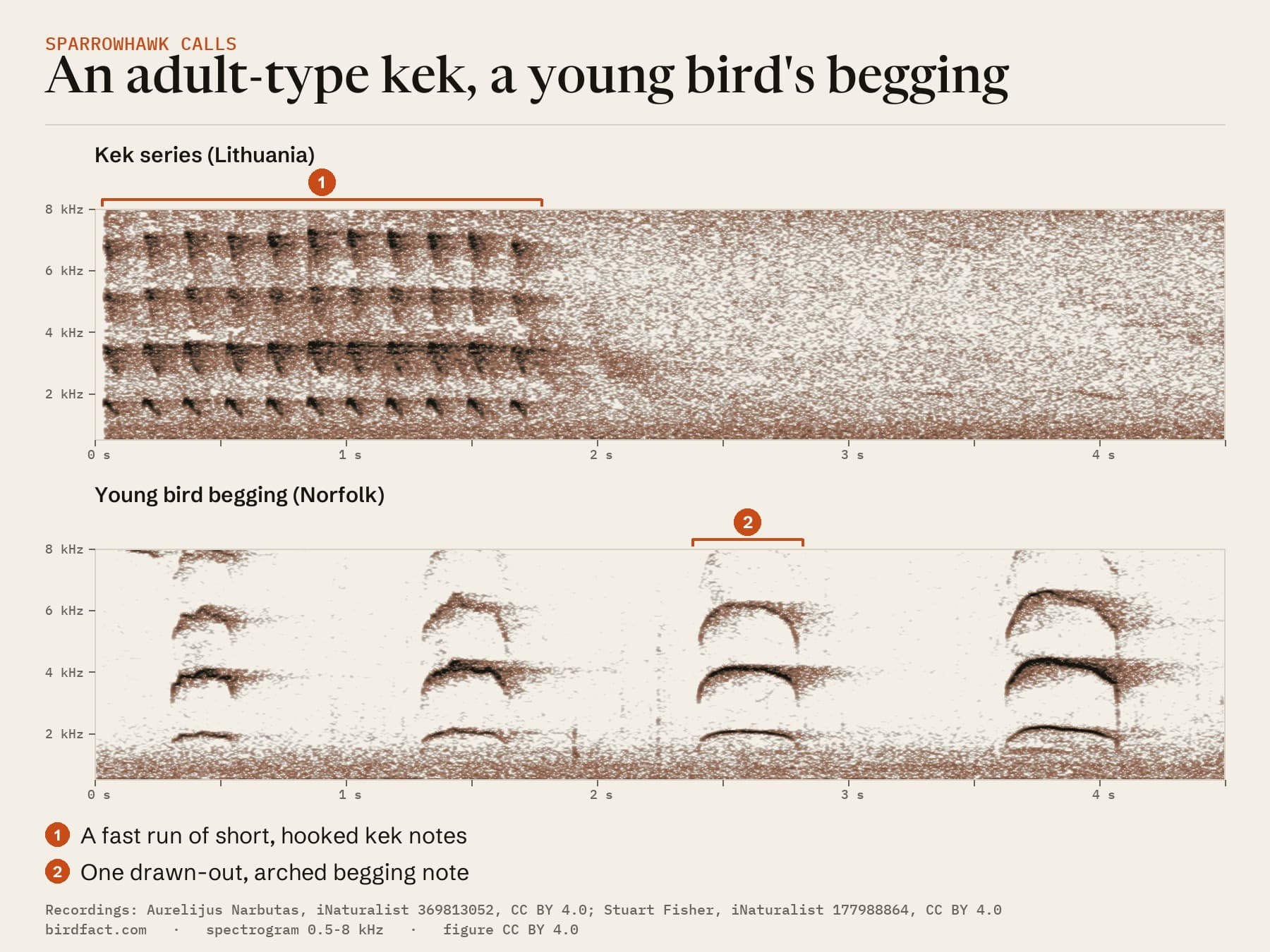
An adult Sparrowhawk's call is a fast, cackling kek-kek-kek, heard mostly near the nest. Most Sparrowhawk recordings in Britain are made in July and August, when young birds beg with drawn-out notes about a second apart. In our recordings, a Kestrel's notes are higher.
On this page8 sections
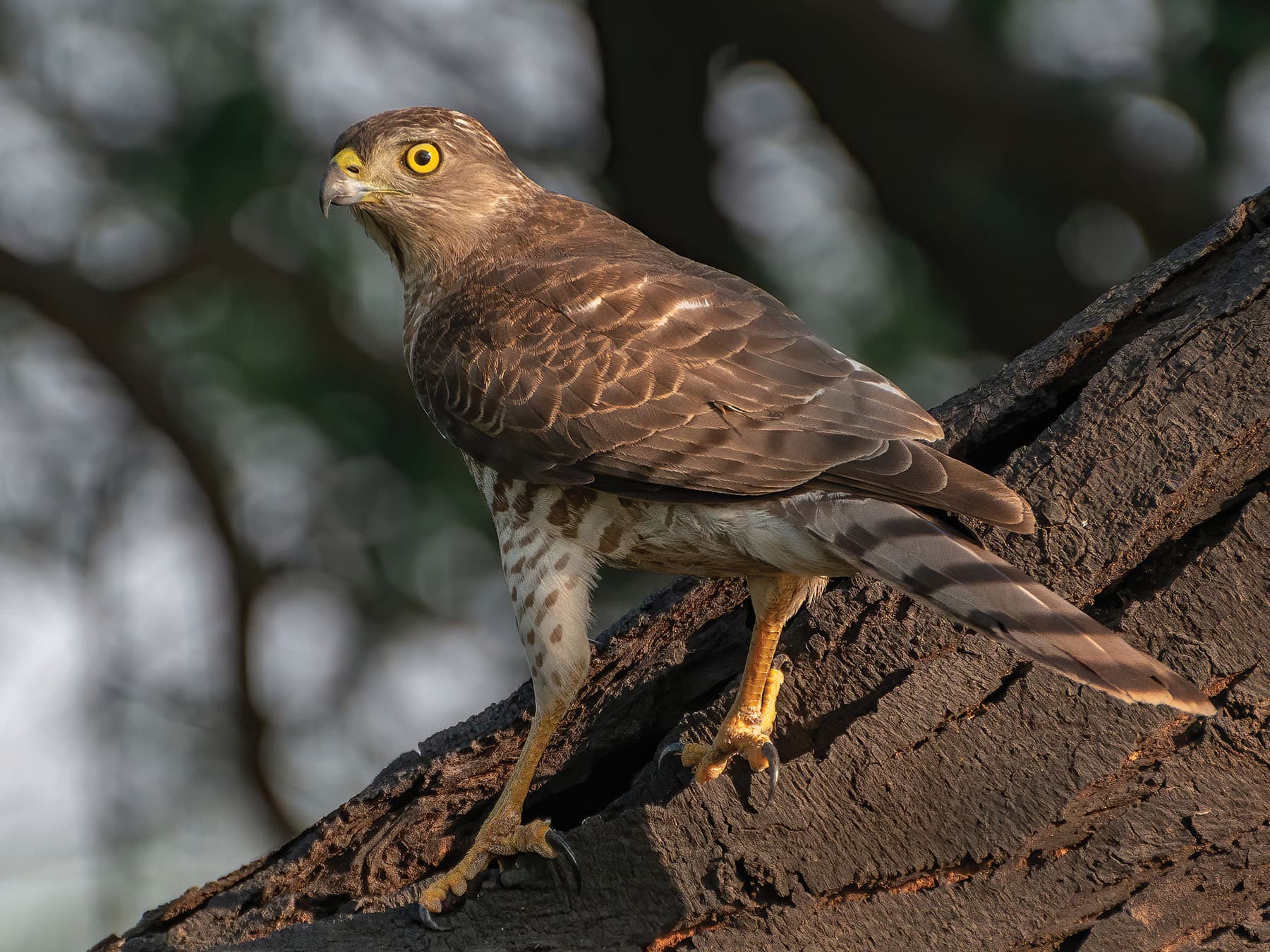
Most recordings of Sparrowhawks in Britain and Ireland are not of adults at all. In July and August, young Sparrowhawks that have left the nest call for food with thin, drawn-out notes, over and over, while their parents still feed them. Adults are quiet away from the nest; their own call is a fast, cackling kek-kek-kek. This page has recordings of both, what they look like as spectrograms, when you are most likely to hear them and how to tell them from a Kestrel. For the bird itself, see our Sparrowhawk guide.
What does a Sparrowhawk sound like?
Young birds begging
Young Sparrowhawks beg for food with thin "peeay" notes.1 In the recording below, each note is an arch, rising and falling, three to five tenths of a second long, and they come about once a second; they are higher and much longer than the adult's kek.4
The young keep calling after they leave the nest, while their parents feed them for another three to four weeks.1 In a Dumfriesshire study, most clutches were started in May and most chicks hatched in June; the young flew in July and could fend for themselves by August.5 The recordings below peak at the same time.
When you hear them
Recordings show how seasonal the calling is. Of 102 Sparrowhawk observations with a sound recording from the UK on iNaturalist, 94 were made in July or August, while observations of the birds themselves are spread right through the year.6 On xeno-canto, 52 of 80 recordings from Britain and Ireland were made in July or August, and the recordists marked 39 of those as young birds. Of all 80, 49 are marked as young birds and only 14 as adults.7
So a Sparrowhawk you hear calling in late summer is most likely a young bird begging. Outside the nesting season, Sparrowhawks are seldom heard.
| Month | UK observations with sound | All UK observations |
|---|---|---|
| Jan | 0 | 376 |
| Feb | 0 | 450 |
| Mar | 0 | 569 |
| Apr | 4 | 685 |
| May | 2 | 337 |
| Jun | 1 | 295 |
| Jul | 38 | 534 |
| Aug | 56 | 786 |
| Sep | 0 | 532 |
| Oct | 1 | 503 |
| Nov | 0 | 337 |
| Dec | 0 | 331 |
| Total | 102 | 5,735 |
iNaturalist research-grade observations, counted by the month they were made (to 27 October 2026). Observations show where people look and listen as well as when birds call, so read them as a guide, not a census.
Calls at the nest
Near the nest, adults have more to say. At an occupied nest in Berlin in April, with the female sitting, a recordist heard a wailing call and then a series of kek notes, "somewhat similar to goshawk calls, but softer"; the male arrived at the nest seconds later. The recordist does not say which bird called.8
Female calls
Birds of the World describes no call given only by females.1 Young Sparrowhawks are brown, like females, so a "female" heard calling in July or August may well be a young bird begging. More on telling them apart on our male and female Sparrowhawks page.
Sparrowhawk or Kestrel?
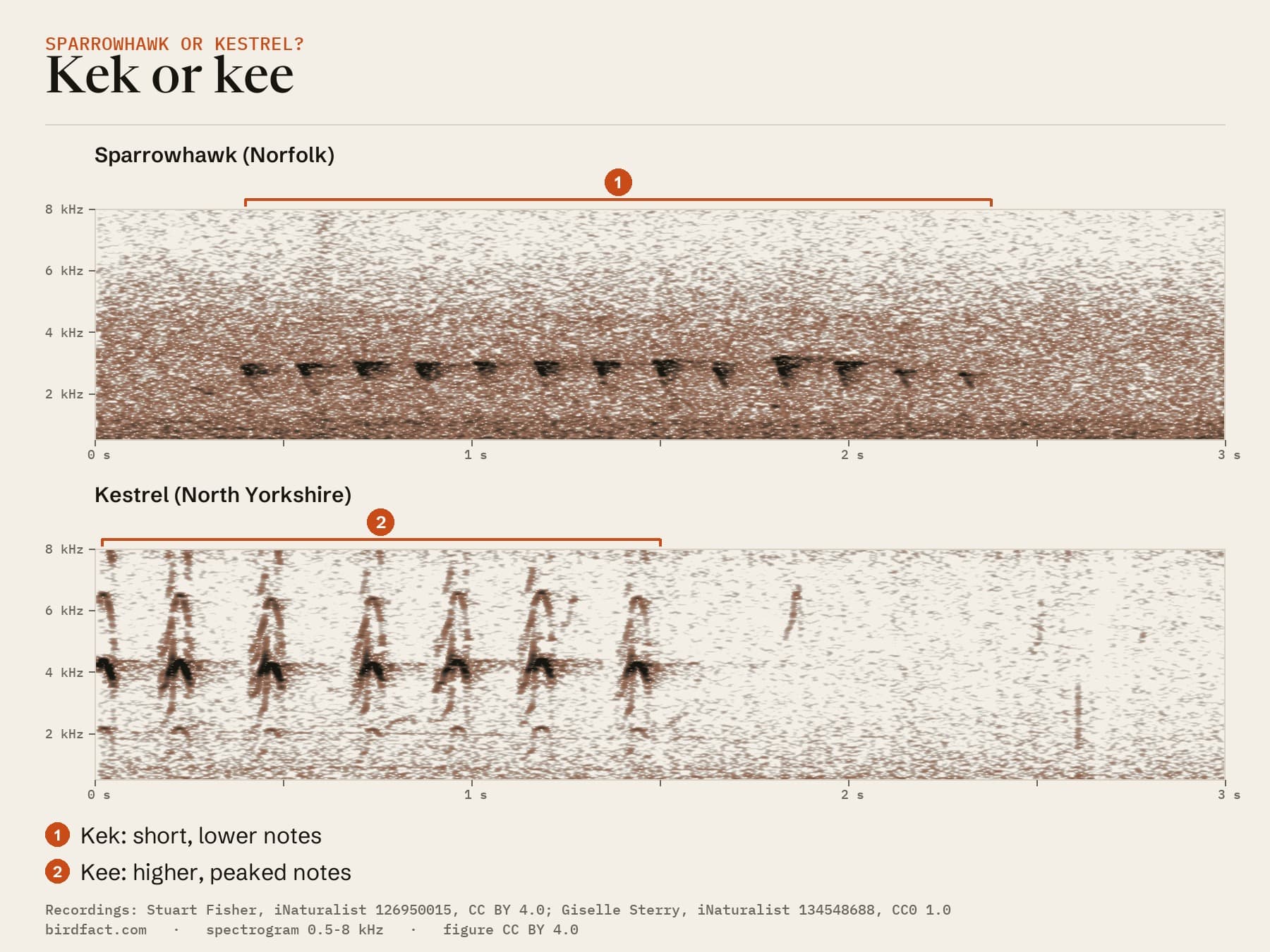
A Kestrel's commonest calls are a quick, shrill run of kik notes and a piercing kee-kee-kee with longer notes, the usual call near the nest.9, 10 In the recordings below, the notes we read as a Kestrel's kee are higher than the Sparrowhawk's, near 4 kHz against about 3 kHz, each shaped like a sharp peak, and a little slower, four or five a second.11, 2 For everything else, from flight to size, see Kestrel or Sparrowhawk?
Small birds' alarm calls
You are more likely to hear a Sparrowhawk's effect than its voice. It hunts by surprise, and it is often noticed only by the alarm calls of small birds and the sudden scattering from a feeder.12 More on how Sparrowhawks hunt.
Sources
- Meyburg, B.-U., Marks, J. S., Garcia, E., Perlman, Y. (2025). Eurasian Sparrowhawk (Accipiter nisus), version 1.1. Birds of the World (J. del Hoyo, A. Elliott, J. Sargatal, D. A. Christie, E. de Juana and M. G. Smith, editors). Cornell Lab of Ornithology. doi:10.2173/bow.eurspa1.01.1
- Stuart Fisher. iNaturalist 126950015, Eurasian Sparrowhawk (sound 502811). iNaturalist. Accessed 27 October 2026. Source
- Aurelijus Narbutas. iNaturalist 369813052, Eurasian Sparrowhawk (sound 2010755). iNaturalist. Accessed 27 October 2026. Source
- Stuart Fisher. iNaturalist 177988864, Eurasian Sparrowhawk (sound 791019). iNaturalist. Accessed 27 October 2026. Source
- Newton, I., Marquiss, M., Village, A. (1983). Weights, breeding, and survival in European Sparrowhawks. The Auk 100: 344-354. doi:10.1093/auk/100.2.344
- iNaturalist (2026). Eurasian Sparrowhawk observations in the United Kingdom, research grade, by month observed. iNaturalist API v1 (observations/histogram, taxon_id 5106, place_id 6857). Accessed 27 October 2026. Source
- xeno-canto, GBIF (2026). Xeno-canto bird sounds: Eurasian Sparrowhawk recordings from Great Britain and Ireland. GBIF occurrence API (xeno-canto dataset), country GB and IE. Accessed 27 October 2026. Source
- Alvaro Ortiz Troncoso. XC467097, Eurasian Sparrowhawk, call. xeno-canto. Accessed 27 October 2026. Source
- Kirwan, G. M., Pyle, P., Hansasuta, C. (2025). Eurasian Kestrel (Falco tinnunculus), version 1.1. Birds of the World (G. M. Kirwan and B. K. Keeney, editors). Cornell Lab of Ornithology. doi:10.2173/bow.eurkes.01.1
- Naturalis Biodiversity Center. Birds of Europe: Eurasian Sparrowhawk and Common Kestrel. Naturalis, Linnaeus NG. Accessed 27 October 2026. Source
- Giselle Sterry. iNaturalist 134548688, Common Kestrel (sound 533985). iNaturalist. Accessed 27 October 2026. Source
- RSPB. Sparrowhawk. RSPB Birds A-Z. Accessed 27 October 2026. Source